The Biggest Loser for the DS and Wii is now out, thanks to Blitz Games and THQ. The famous TV show that advocates a healthier lifestyle in both …
Author: Serkadis
-
A to Z of what’s wrong with America
(NaturalNews) America has some major challenges. Lots of things could use some improvement. To help create this A-to-Z list of what’s “wrong” with America, we tapped into the collective wisdom of our Facebook fans (http://facebook.naturalnews.com) who came up with a nice collection of both serious and funny answers to this question. (I added the descriptions.)
By the way, just in case you’re feeling more optimistic today (or want some inspiration), we also have an A to Z list of what’s right with America! www.NaturalNews.com
A to Z of what’s wrong with America – The list
A is for Aspartame – The magic powder that turns diet soda into brain poison.B is for Bailout money – Because all we really need is another trillion dollars.
C is for Codex Alimentarius – Because we all need to be protected from dangerous vitamins, right?
D is for Dumbing Down – No matter how uneducated the kids are, there’s always a public school willing to compromise its standards just enough to let them pass.
E is for Environmental Policy – Because treating the rivers and waterways like America’s toilet makes for fascinating beach swimming.
F is for FDA (or Foreclosures) – Just what we need: A Big Pharma tyranny enforcement branch in Washington D.C.
G is for Genetically Modified Organisms – Because playing God with the food supply sounded like such a great idea, we just couldn’t resist.
H is for Health insurance (or lack thereof) – Just another financial scam to enslave Americans in a medical police state while denying them access to real health services.
I is for Intellectual Property laws – Corporations already own patents on 20% of the human genome, including your genes.
J is for Junk food – Is it junk? Or is it food? It looks like food, but nourishes like junk. Let’s all eat some more…
K is for Krispy Kreme doughnuts – Because as long as we’re all gonna be clinically obese, we might as well die with a smile on our faces and donut powder on our lips.
L is for corporate Lies – Just when you thought they ran out of ’em, they miraculously come up with new ones. (http://www.naturalnews.com/027483_SIGA_Technologies_vaccines.html)
M is for Mainstream Media and Mammograms – The Mainstream Media pushes mammograms, a brilliant technology for causing breast cancer and heart damage.
N is for National debt – It’ll never be paid off, but it’s fun to watch it expand. I wonder what happens when it gets too high?
O is for Oil – Why build wind farms when you can just buy more oil from the Arab states or drill in the Amazon?
P is for Pharmaceuticals – Because you were all born deficient in patented chemicals, and Big Pharma is determined to “correct your imbalances.” There’s a fee involved, of course.
Q is for Quacks – Oncologists, vaccine pushers, c-section surgeons and nutritionally-illiterate physicians who push patented chemicals instead of real health solutions.
R is for Real Estate Bubbles – Because buying a home is the best investment you can ever make… until suddenly it isn’t.
S is for SSRI drugs – Need a little violence in your school? Psychiatric drugs are standing by, ready to help unleash a few flying bullets.
T is for Tyranny – Whether we’re talking about the FTC, FDA, DEA, CDC, IRS or DHS, a little tyranny goes a long way towards keeping the sheeple in line.
U is for Unemployment – It’s the worst since 1945, and that’s if you believe the official government numbers that don’t even count people who gave up looking for work.
V is for Vaccines – The greatest quackery yet cooked up by drug pushers. See “Q” above.
W is for Wall Street – A place where crooks can turn greed and aggression into insane profits.
X is for X-rays and medical imaging – You’re in luck: Just when you were hoping for a little DNA mutation, your doctor orders another CT scan. (http://www.naturalnews.com/023582.html)
Y is for Yard sales – Because what we really want to see when driving around the neighborhood is all our neighbors’ junk strewn across their front lawns.
Z is for Zillions – Which is how much fiat money will soon be printed by the Federal Reserve when other nations stop buying worthless U.S. debt.
-
A to Z of what’s right with America
(NaturalNews) Ah, America. Land of the free. Home of the brave. Baseball and apple pie. It’s all so irresistibly attractive that it’s begging for a list of 26 awesome things about America.
So I asked the NaturalNews Facebook team to come up with an A-to-Z list of what’s right with America. You’ll find the complete list below.
In case you’re feeling more pessimistic, by the way, we’ve also published an A-to-Z of what’s wrong with America. You can find that list at: www.NaturalNews.com
A to Z of what’s right with America – The list
A is for Alternative medicine – Although the Associated Press hasn’t figured it out yet, alternative medicine is cheaper, safer and more effective than pharmaceuticals and surgery.B is for Breastfeeding – Because the best milk is mother’s milk.
C is for the Constitution – Without it, this website wouldn’t even exist and free speech would be stifled.
D is for Democracy – Despite all its shortcomings, Democracy is still the best form of government the world has come up with.
E is for Education – Although it’s not perfect, we still have some outstanding schools and teachers teaching our nation’s youth some important skills and knowledge.
F is for Farmer’s Markets – The last place in the country where you can still buy real food grown by real people.
G is for home Gardening – Turn your lawn into a garden and you’ll have your own food supply!
H is for Herbs – The best medicine, made by Mother Nature.
I is for Internet – The last medium of freedom. Without it, we’d all still be plugged into the Matrix.
J is for Juicing – Because drinking raw, living vegetable juices is perhaps the single best thing you can do for your own health.
K is for Kayaking– And all the other stuff you can do in the great outdoors across America’s amazing national and state parks.
L is for Liberty – While we still have some left, it might be a good idea to protect it.
M is for Meditation and Massage therapy – Both are really healthy, relaxing activities available all across America.
N is for Nutritional supplements – Even though the FDA has tried to destroy the industry, you can still find an amazing assortment of nutritional supplements across the USA.
O is for Organics – Thank God we have chemical-free foods and personal care products available — and an organization working to protect them (www.OrganicConsumers.org).
P is for the People – Without whom this nation would not exist. The American People have amazing diversity, creativity and resilience.
Q is for Quantum shift in consciousness – It’s happening right now, and it could help uplift the nation into a whole new paradigm soon.
R is for Random acts of kindness – Despite all its problems, America is still a place where you can find kind, compassionate people who are willing to lend a helping hand.
S is for Superfoods – America offers a huge, diverse assortment of medicinal superfoods. Just visit any health food store!
T is for Traditional Chinese Medicine – Okay, it doesn’t sound truly American, but the fact is that TCM is achieving wild success across the country, and now many American TCM practitioners are helping people heal with the power of medicinal herbs and acupuncture.
V is for Voting – Although it isn’t perfect, it’s still the best way we have going for people to exercise some control over the laws of the land.
W is for Wilderness – It’s one of the most impressive things about America: The vast expanses of diverse, gorgeous wilderness.
X is for Xenodochial – It’s a word you’ve probably never heard of, but it means being friendly to strangers. Lou Dobbs is eXcluded.
Y is for Yoga – America has become a hub for yoga activity. No matter what kind of yoga you’re interested in, you can find it in a major American city.
Z is for Zoos and MuZeums – America has lots of fantastic zoos and museums where you can learn a wealth of information about the world around you.
-
Artificial Sweeteners are Continually Found to be Unsafe and Toxic
(NaturalNews) A recent study presented at the annual meeting of the American Society of Nephrology in San Diego found that adult women who drink at least two diet sodas a day experience a 30 percent drop in kidney function over the course of a decade. Findings indicate that artificial sweeteners such as aspartame and sucralose are the culprits in the rapid degeneration of glomerular filtration rates in the kidneys of those consuming excessive amounts of artificially-sweetened diet sodas.
Dr. Julie Lin of Brigham and Women’s Hospital in Boston and her colleague Dr. Gary Curhan conducted the research correlating artificial sweetener intake to kidney degradation, highlighting one of the many dangers of artificial sweeteners.
A 2005 study conducted by Dr. Morando Soffritti of the esteemed European Ramazzini Foundation of Oncology and Environmental Sciences and the Cesare Maltoni Cancer Research Center confirmed once again what independent scientists discovered over thirty years ago; aspartame consumption leads to all sorts of illness and disease including cancerous tumors, lymphomas, leukemias, lesions in various organs, transitional cell carcinomas, nerve damage, seizures, and premature death.
Original approval of aspartame by the FDA involved questionable studies that were later investigated by the drug enforcement division of the Bureau of Foods. Though found to be faulty and ridden with errors, the FDA ignored both these reports and the slew of adverse event data that surfaced following aspartame’s approval. Between 1974 when aspartame was approved and 1990, the number of brain tumors in people over the age of 65 had increased by 67 percent.
Similarly sucralose, a chlorocarbon popularly marketed as the artificial sweetener derived from sugar, has been implicated in severe chronic illnesses including brain and nervous system disorders, migraine headaches, cancers, and immune-system debilitation.
Though touted as safe, the chlorocarbon components of sucralose are verifiable toxins. Those who have experienced negative symptoms from sucralose often recover following the discontinuation of its consumption. Among other results, laboratory tests have concluded that long-term sucralose consumption shrinks the thymus gland, the biological source of the immune system.
According to Dr. Soffritti’s research group, most studies alleging the safety of artificial sweeteners like aspartame and sucralose fail to use internationally-recognized “Good Laboratory Practices” for conducting carcinogenicity bioassays and thus arrive at faulty, corporate-controlled outcomes. Rather than objectively seek results, the studies used to allege safety are often funded by the companies producing the additive in question.
Preferable options include natural foods like raw honey and raw agave nectar which are healthy, enzyme-rich sweeteners that work great in moderation. Natural stevia extract is another excellent option as it contains no sugar and no calories, and it is completely safe and suitable for those with a diabetic condition or for those who are looking to cut sugar intake.
Soda alternatives include stevia or fruit-juice sweetened soda water. Some stevia extracts are available in various flavors including root beer and vanilla, offering multitudinous options in creating quick, healthy beverages. Fruit juices mixed in soda water also offer a refreshing thirst quencher for those who don’t mind a little natural fruit sugar every now and then.
There are plenty of alternatives to artificial chemical sweeteners like aspartame, sucralose, and saccharin but they are often difficult to find in processed foods. Chalk this up as another great motivation to pursue whole, healthy foods that are as close to their natural states as possible.
Sources:
Diet Sodas May Be Hard on the Kidneys – WebMD
Diet Soda, Sodium Tied to Kidney Trouble: Studies – Atlanta Journal-Constitution
Bella Italia: The Soffritti Aspartame Study – Dr. Janet Starr Hull
Sucralose Toxicity Information Center
Aspartame Toxicity Information Center
About the author
Ethan Huff is a freelance writer and health enthusiast who loves exploring the vast world of natural foods and health, digging deep to get to the truth. He runs an online health publication of his own at http://wholesomeherald.blogspot.com. -
Amazon’s Assassin’s Creed 2 pre-order bonuses, new cinematic video
If you’re feeling strapped for cash this past couple of weeks, particularly because of your latest purchases, Uncharted 2 and Modern Warfare 2, too ba…
-
Palm Pixi Review: Not For Everyone, But It Fits A Niche

Palm and Sprint have taken a very different approach to the launch of the Pixi than they did with its slightly older and slightly brawnier brother, the Palm Pre. In the days leading up to the Pre, both parties were on full attack mode; keynotes were held, massive tradeshow booths were built, full page newspaper ads were run, and countdowns ticked away. With the Pixi? They’ve got a commercial.
Compared to Palm’s last run, the marketing campaign surrounding the Pixi is decidedly more average – and after spending a few days with the phone, I’d say they made the right decision there.
Read the rest of this entry at MobileCrunch >>
-
Weekly Address: Veterans Day and Fort Hood
The President looks back at a week where we honored those who serve on Veterans Day, and mourned those we lost at Fort Hood. He discusses the review he has ordered into the Fort Hood incident, and pledges to stand by our servicemen and women, as well as our veterans, as his most profound responsibility.
-
PS3 version to get more out of Just Cause 2
Just Cause 2 developer, Avalanche, made a special announcement at their London event earlier today, and it’s special indeed for PS3 gamers. New featur…
-
BlackBerry Theme Studio – Build your own BlackBerry Theme! (Part Two)
 In my previous BlackBerry® Theme Studio post, I explained the main features and tools of new version 5.0. Now that you have this information under your belt, the process for creating a BlackBerry theme is pretty easy. I suggest you download BlackBerry Theme Studio v5.0 and have the software open as you read along. Let’s get started!
Step 1: Make your theme assets.Design your icons, backgrounds and other theme images in your favorite design tool – Photoshop, Photoshop Elements, Paint Shop Pro, BlackBerry® Composer etc.
For fun, I’ve designed a new background image for my theme:

Step 2: Import your assets into the right spot in Theme Builder.
For example, suppose I want to change the background on my Home Screen to this space background. I will:- Jump into Theme Builder.
- Click the Home Screen button in the Inspector.
- Click the Background button.
 4. Add the background I want. Theme Builder can accept JPEGs, BMP, GIF, PNG and(new in this release!) Photoshop files.
 5. The new Background is added to my theme.Customizing your theme icons, highlights and backgrounds throughout works pretty much the same way. Design the graphic, bring it in and Theme Builder puts it in the right spot.
Step 3: Put your theme on a BlackBerry® smartphone.
Once you have the Theme looking the way that you want, it’s time to put it on a real BlackBerry smartphone:
- Click File -> Export. This pops up the export dialog.
- Select Install To BlackBerry.
- Enter a Theme Name and your BlackBerry password.
- Plug in your BlackBerry smartphone to your computer using a USB cable.
- Click OK.
 6. BlackBerry Theme Studio packages up your theme into a format that the BlackBerry smartphone can read.
7. You’ll be asked to “Activate” your new theme on your BlackBerry smartphone, which means that you’re making it the default theme on your BlackBerry. Click YES And the theme is up and running!
In future posts, we’ll introduce a series of tips and tricks to aid your BlackBerry theme creation. For now, post a comment below of what type of BlackBerry theme you’d like to make and what you think of the new BlackBerry Theme Studio v5.0.
-
Section 8 DLC teased for holidays?
Could there be a DLC coming our way this holidays for the futuristic shooter, Section 8 (PC, Xbox 360, PS3)? That’s the vibe we’re getting, based on S…
-
Apple was NOT more profitable selling cell phones than Nokia in Q3
By Joe Wilcox, Betanews
For days, I’ve read blogs and news stories misstating Apple’s cell phone profitability compared to Nokia. Headlines range from the AppleBlog’s “Apple Surpasses Nokia as Most Profitable Cell Phone Maker” to Reuters’ “Apple tops phone chart as Nokia, Samsung step up” to Silicon Alley Insider’s “Apple’s iPhone Operating Profit Beats Nokia For The First Time,” among, many, many others. As good as this feat sounds for Apple — profit share beating market share — every one of these stories is wrong. Right, everyone is wrong.
Three days ago, Strategy Analytics released report “Apple Becomes World’s Most Profitable Handset Vendor in Q3 2009,” written by Alexander Spektor. I contacted Spektor this morning for clarification on the report or for an actual copy. He hasn’t yet responded. So I have to go by all the misreporting.
According to Telephony Online: “The firm estimates that Apple’s iPhone operating profit came in at $1.6 billion in Q3, while Nokia recorded only $1.1 billion in operating profit.” Reuters: “Apple does not unveil profits per business line, but Strategy Analytics estimated Apple’s operating profit for its iPhone handset unit stood at $1.6 billion in the third quarter, compared with Nokia’s $1.1 billion.”
Well, hell, that sounds reasonable enough, right? Wrong. Apple and Nokia SEC filings tell a different story. Both companies announced third calendar quarter results a few days apart in mid October. For devices and services, Nokia reported profits of $785 million euros, which is about US $1.1 billion. Apple reported total profits — that is for all products — of $1.67 billion in its earnings press release, and later the 10-K filing. I searched the 10-K, and, as I expected, Apple doesn’t breakout iPhone profits.
But it doesn’t have to for purposes of this discussion. I don’t doubt that Apple is more profitable per handset, since iPhone is a smartphone, than Nokia. But the numbers don’t add up to Apple’s overall handset profitability exceeding Nokia’s during third quarter, unless someone is making the bold assumption that all, or nearly all, Apple profits came from iPhone. They surely do not. What? Apple made only $70 million on iPod, Macintosh, retail and software — $1.6 billion — on iPhone. No way.
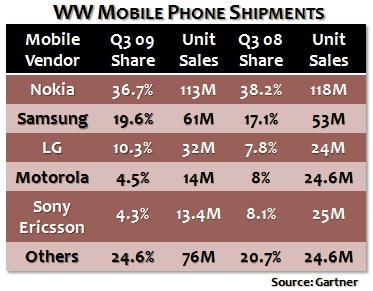
The disturbing lack of fact checking seems to be a trend when it comes to Apple these days. One headline today about Gartner Q3 phone sales data claimed that Apple had closed in on Research in Motion. The reporter later changed the headline after I tweeted that the numbers show RIM extended its lead over Apple (see second chart).
Gartner reported that cell phone manufacturers sold 41 million smartphones during third quarter. Earlier this week, IDC reported that manufacturers shipped 43.3 million smartphones during the same time period. The nearly 2.4 million difference shows still historically low inventory levels — even for Apple. Based on Gartner’s numbers, Apple only had about 400,000 units unsold at the end of the quarter. During its October earnings call, Apple acknowledged that it couldn’t ship enough iPhones to meet demand during third quarter.
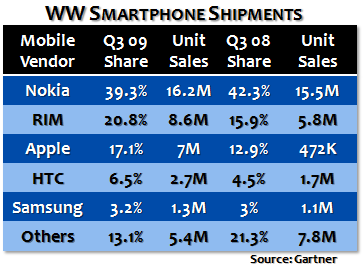
Gartner and IDC put Apple smartphone market share the same — 17.1 percent — but RIM’s share was much higher based on actual sales: 20.8 percent compared to 19 percent as accounted by shipments. That made RIM’s real-time market share even greater than Apple’s during Q3.
As for Apple’s overall phone profits being higher than Nokia’s, don’t believe it. Just because dozens of Websites report something as true doesn’t make it so. Because of the extent of misreporting, I can’t say where the fault lies. The Strategic Analytics report, which again I haven’t seen, might have gone no further than present numbers showing that Apple makes more profit per phone than Nokia. That absolutely makes sense. But to assert that iPhone generated $1.6 billion profit during a quarter when all Apple products generated $1.67 billion is simple stupidity.
[Update:: That rascal (I’m being polite) John Gruber has flamed my analysis. Since Gruber doesn’t take comments on his site, I’m put in position of defending the analysis here. Gruber uses Apple’s non-GAAP (Generally Accepted Accounting Principles) like a club. I quite purposely did this analysis based on GAAP figures, because that’s how Apple is required to report them. Of course, I was well aware of the non-GAAP figures, which would add more than $1 billion to Apple profit during third calendar quarter. But like it or not, that money is deferred over eight quarters.
I chose to use the GAAP figures because a) Again, that’s what Apple is supposed to report; b) It made for a simpler analysis; c) Apple recognizes previously deferred revenue with the quarterly results; d) According to Apple SEC filings, deferred revenue is for more than just iPhone and Apple TV. The last two points are paramount.
The non-GAAP figure can include previously deferred revenue, which mixes monies taken in during the one quarter with revenue held back from an earlier time. Additionally, not all Apple’s deferred revenue is from iPhone or Apple TV. For example, according to the October 2009 10-K filing: “For online sales to individuals, for some sales to education customers in the U.S., and for certain other sales, the Company defers recognition of revenue until the customer receives the product.” The third quarter was a big one for Apple educational sales, which presumably includes accounting for rebates offered for iPod touch. Apple doesn’t say how much non-iPhone revenue it deferred from third quarter, although that should become clearer when future results are announced.
The point, deferred revenue — the non-GAAP results Gruber so gleefully trumpeted — is not so cut-and-dried about iPhone or as explained by his simple math. Lots of companies defer subscription revenue, and that money is counted over time, whether or not Gruber or anyone else likes it. Contractual licensing accounts for 55 percent of Microsoft server software revenue, which must be deferred over 24 or 36 months. No reputable analyst firm compares Microsoft non-GAAP server profits to competitors’ profits. But Mac enthusiasts and investors treat Apple differently, for reasons that should be obvious regarding the company’s high-flying shares.
I stand by my GAAP analysis. It’s the proper way to look at iPhone revenues/profits, for as long as Apple defers a portion of the product’s revenue.]
[Update 2: On November 16th, I finally heard back from Strategy Analytics. As I expected, the figures stated for Apple were based on non-GAAP iPhone sales. Strategy Analytics calculated for operating profit, which would be higher than the net profit figures I used.]
-
New Economics Paper Explains How Shorter Copyright Stimulates More Music
In the recent debate in the UK about copyright extension for performances, one of the key points raised by many who were against the proposal was that economic studies suggested that it would really only help a few big superstars (who probably were well enough off already) while harming up-and-coming artists greatly. Christian Zimmerman points us to a recent economics paper by Francisco Alcala and Miguel Gonzalez-Maestre that models why this happens, and points out that copyright extension actually serves to decrease incentives for the creation of new content. The full paper (pdf) basically points out that extending copyright really only helps the superstar performers, since, for everyone else, the economic value of the content is exhausted by the time the extension would matter. That’s pretty obvious. But the more troubling part is that this also then negatively impacts the market for new artists, because money and attention that might have gone towards new works end up going instead to those older works.
Increasing the returns in the case of success may be counter productive
for helping new artistic careers. Most artistic markets operate in the framework of an
overwhelming machinery of promotion and advertising. Incentives to invest in the promotion
of the superstars rise as the prospects of superstars’ revenues improve (as caused
by modifications in the regulation of copyrights or the size of global markets). In this
environment, the expected discounted return of a young artist’ career may be reduced as
a result of a positive shock to superstars’ revenues. As a consequence, larger high-type
artists’ revenues may result in the long run in fewer numbers of artists, and therefore, less
high-quality artistic creation.
Nice to see more economists recognizing the problems of the current copyright system.
Permalink | Comments | Email This Story
-
Russians ban Modern Warfare 2 console versions for ‘No Russian’ mission
The Russians are angry. Apparently, they did not like how the controversial airport massacre level in Activision’s blockbuster game was named the “No …
-
Newspaper Industry Lawyers Attack Fair Use, Claim Google Is Illegal
Hmm. So, on Monday Rupert Murdoch suggests that the courts would reject fair use as a concept, and by Friday two newspaper industry lawyers just happen to have an op-ed piece in the Wall Street Journal explaining how Google violates copyright law by caching the websites it indexes. If the names of the lawyers — Bruce W. Sanford and Bruce D. Brown — sound vaguely familiar, that’s because they’re the same two lawyers who, six months ago, wrote a laughably ridiculous editorial (that time for the Washington Post) proposing special new copyright laws to save newspapers, while destroying pretty much everything that makes the internet useful. Of course, both the Washington Post and the WSJ conveniently left out the fact that these two lawyers regularly represent newspapers and other media and entertainment firms — even as that seems rather relevant (what happened to those FTC disclosure laws?).
While I do actually agree with the lawyers that it’s a shame the focus on the Google Book Search settlement avoided the big fair use question, I think they’re entirely wrong to suggest that Google itself violates copyright law.
The copyright code allows public libraries to copy texts as long as there is no “direct or indirect commercial advantage.” But that does not describe what search engines do. They use the complete copies they take for free to sell the advertising that has made them enormously profitable. This has a direct impact on book publishers, and on the publishers of magazines and newspapers that are losing the advertising that once supported them. According to Ken Auletta’s recently released book “Googled,” its search business alone now takes in 40% of all advertising across the Internet.
Perhaps Sanford and Brown are unfamiliar with basic copyright law, but the commercial advantage issue is only a small part of copyright law, and there are plenty of well-established cases of fair use in commercial use. In fact, I’d suggest that they consult the very media companies they work for, as most of them regularly rely on fair use defenses for reprinting or broadcasting content — despite the fact that they’re very commercial entities.
Furthermore, it appears that Sanford and Brown are either unfamiliar with how Google works — or are purposely misrepresenting it. In the case of most news stories, Google has little or no ads. It only recently put ads on Google News — long after the decline in ad revenue for newspapers. Besides, if local advertisers are finding a better return by advertising on Google, isn’t that a good thing? That’s called competition, and I’m surprised these lawyers would be against that.
In the last year, many fresh ideas have begun to circulate on how to help the publishing industry transition profitably to the online world. But without legal reform to back up these new business models, publishers will not have the bargaining power to make the search engines into true partners willing to compensate them meaningfully for their copyrights.
Yes, proposals like the ones that you guys suggested in the Washington Post without disclosing who pays your bills? Funny how that works. And those proposals are not about “helping the publishing industry transition profitably.” Plenty of smart publishers are perfectly profitable. The proposals are about protecting the status quo and hurting the innovators who better serve the market. Sanford and Baker are trying to protect their big clients, but they’d be better off telling them to innovate, rather than push bogus editorials and pass ridiculous laws designed to hold back progress.
Permalink | Comments | Email This Story
-
Telus and Bell Blackberry Unlock Codes Get more Complicated

The Bell Blackberry Bold 9700 has a new lock on it called the Service Provider (SP) lock. Both the original “Network” lock aka MEP2, and the new SP lock aka MEP4, are needed to unlock the Bell 9700 now. We’ve found 2 methods to do it and blogged about it on our site.
Through the eyes of a cell phone unlocker, it seems that RIM is always making an effort to tighten security on their new Blackberry devices. This time it has gone beyond RIM, with Bell and soon TELUS adding new locks on their Blackberry phones.
We like to call them “MEP4? locks instead the old MEP2 that we’ve grown so fond of. It has already been implemented on the Bell 9700 which has 2 locks – the network lock and the Service Provider (SP) lock. Unlock code developers, crackers and hackers are still in the process of developing a quick and “Instant” method for unlocking these MEP4 codes. Although we are able to unlock the Bell Blackberry Bold 9700, it’s interesting to see that RIM, Rogers and T-mobile are still using MEP2 codes for the Rogers Blackberry Bold 9700 and T-mobile Blackberry Bold 9700.
Perhaps Telus and Bell are doing this to protect their new HSDPA network? Or maybe they are passionate about retaining their clientele and keeping exclusivity of their handheld devices. Who knows? Regardless, we have discovered 2 methods to unlock the Bell Blackberry Bold 9700.Method 1: Unlocking the Bell Blackberry Bold 9700 with IMEI & PIN#
Calculate the 2 unlock codes with just the IMEI and PIN #.
PROS:
- Can be calculated accurately within 24-72 hours.
- Incorrect IMEI and PIN submissions will result in a “Not Found” code instead of returning an incorrect code due to an incorrect IMEI submission.
CONS:
- Longer than normal process times.
- If your IMEI and PIN are not in the database, you will get a “Not Found” code even though everything was submitted properly.
- Very pricey compared to method 2.
Method 2: Unlocking the Bell Blackberry Bold 9700 with Blackberry Logger info:
Calculates the 2 unlock codes with a “Logger” that is read off of your phone with a third party program. This is the method we have adopted to unlock your Bell Blackberry Bold 9700.
PROS:
- Accurate codes are generated within 0-48 hours.
- A great way to accurately generate all the information from your Blackberry device to avoid errors in typing your IMEI.
CONS:
- Instant speeds are not available.
- Altered logs will create incorrect codes – do NOT alter when you send in your Bell 9700 logs.
The program to get your Blackberry log can be downloaded here. After getting your IMEI and MEP from the program, you can purchase your Bell Blackberry Bold 9700 unlock code. Simply enter the MEP under the “Model” section.UPDATE: For those commenting, it’s not actually a virus/trojan. It’s a security feature called “Themida” which protects the software from being duplicated or taken apart. Certain Virus scanners say that its a trojan horse, but its nothing harmful whatsoever.
© Sam of Cellfservices.com for BlackBerry Cool, 2009
-
GIVEAWAY: TeleNav GPS Navigator on the T-Mobile BlackBerry Bold 9700
It’s great when companies take the time to make their software available for the latest and greatest BlackBerry devices and TeleNav have done just that. The above video shows TeleNav GPS Navigator on the T-Mobile BlackBerry Bold 9700 as well as some thoughts about the device.
We’re also giving away 3, 1 year subscriptions to TeleNav GPS Navigator. Just comment what you think of the Bold 9700 and we’ll select 3.
UPDATE: Thanks for participating everyone. The winners will be contacted shortly.
© Darryl Labonte for BlackBerry Cool, 2009
-
Fox News Tries Selective DMCA Takedowns: If Liberal Bloggers Use It, Take It Down
An anonymous reader alerts us to the story that Fox News has sent a series of DMCA takedown notices to YouTube for a guy who’s been putting up clips that have been popular among the “liberal” blogworld. Now, there’s an open question as to whether or not these clips are fair use — but even if we assume that they are infringing, there’s an interesting element to this. They only targeted the guy who posts clips that liberal blogs are using. There are tons of other clips that conservative blogs use — and those remained up.
In many ways, that shows how the DMCA is really being abused. It is not being used because of any loss in revenue from these clips being online. It’s really being used solely to stifle opposition speech. I don’t care which side of the political spectrum you fall on, this is an example of an attempt to stifle speech, not protect some sort of business model. It’s using the DMCA to take down clips that are being used by people that disagree with the copyright holder, even while they leave up tons of other clips used by people who agree. I can understand why Fox News is doing this, but it goes way beyond the intended purpose of the DMCA (while also suggesting that Fox News apparently is way too sensitive about its critics). Update: Amusing. After all this started getting attention, Fox News decided to send takedowns for other content as well. Looks like once it was clear how bad this look, it realized it needed to take down the others as well.
Permalink | Comments | Email This Story
-
Soon It Will Be Cheaper to Compute Than to Cache
At the NewTeeVee Live conference in San Francisco yesterday, I interviewed Sam Blackman, co-founder and CEO of Elemental Technologies, about trends on computing and storage costs. Elemental makes software that takes advantage of graphics processors to provide super fast transcoding, which is the process by which video content is formatted for different devices. The idea of storing one copy of a piece of content and formatting it on the fly makes intuitive sense when compared to storing four or five copies of that content and then delivering it only when needed.
But for now the cost of storing multiple copies is actually cheaper than doing the transcoding in real time. That difference in cost has been a barrier keeping some service providers from buying products that offer capabilities such as those of Elemental’s new server, which launched yesterday. However, Blackman believes that will change within the next three years as prices for processing fall faster than the price of storage. A similar trend is enabling people to store more of their data online, rather than on their hard drives. The cost of bandwidth is so low that folks don’t mind either streaming content or looking it up online rather than downloading it and keeping it on their computers. Check out Blackman’s comments in the video below.

-
Relive your misspent youth with these Transformers USB drives

Brando, home of the odd USB device, finally has a product I want to order. No no, it’s not a heated slipper or a spy camera, it’s a Transformers USB drive. How cool is that?It’s only a 2GB drive, and it’s pretty expensive at $45, but they certainly are cool. There are two models to choose from, Jaguar on the Decepticon side, and Tigerton from the Autobots.
So is it just me, or were Transformers cooler in the 80’s? I was looking at one at the store the other day, and it just seemed cheap compared to how I remember them.
-
Modders hard at work circumventing Xbox banning
 Were you one of the 1 million Xbox live users that got banned yesterday? Well, you might not want to go buy that new Xbox quite yet. Some of the modders (you know, the ones who got you banned in the first place) are working on a solution that returns the firmware to an almost stock configuration, which would allow you to actually use your console again.
Much like the jailbreakers, the Xbox modders are nothing if not persistent. Yesterday, Microsoft went after the estimated 1 million Xbox owners that had tampered with their systems. The ban locked out the installation of games on the hard drive, stopped Windows Media Player from working, wrecked the gamertags stored on the Xboxen in question, and blocked the consoles from logging in to Xbox Live.
There are two fixes currently being worked on, one from iXtreme LT, which isn’t ready yet, and one from Xbox-Scene which works, but is extremely complex. And you need to know your CPU key, which can be difficult to obtain, particularly if you’re already banned.
[via Daily Tech]


