Author: Serkadis

  • Cupertino, You Have a Problem

    appleappsarebigIf you’re a baseball fan like I am, then you know that it in order to win, teams need more than just marquee stars. The role players, pinch hitters and relievers — all have to contribute in order for a team to win. A weak link can blow a game. Same goes for companies — every member of the team has a role to play. Why do I bring this up? Apple’s iTunes App Store and its murky and muddled policies.

    Apple’s designers and engineers have done a good job putting together what is an iconic product, the iPhone. Its software gurus have helped foster the app revolution. But it when it come to the App Store approval process, Apple is blowing it.

    Let me put it in terms Apple and its management can understand: The foggy and opaque App Store approval process is as big a disaster as Dell’s DJ MP3 Player.

    For months now, I have watched the twists and turns of the Apple App Store drama with a degree of bemusement. After all, the rejection (or approval) of quirky and pointless apps aimed at hormone-challenged post-pubescent boys weren’t of concern to me. I couldn’t get upset over Google Voice fiasco, but that was understandable (not acceptable) because it was coming in the way of the carrier voice service.  But lately, things have gotten a bit out of control.

    The irrational approval process and reasons behind it given by the apparatchiks of Cupertino are driving developers to extreme frustration — especially those who have been Apple loyalists for years. Earlier this week, Joe Hewitt, a well-known programmer and a Facebook employee, threw up his hands in frustration over Apple’s App Store approval process and said he wants to work on a different project. (Check out my video interview with Joe Hewitt.)

    No, Facebook isn’t killing its iPhone app — it is a corporation, after all, and will bend over backwards to appease Apple — but Hewitt is someone who’s made many vital contributions toward turning the iPhone into a major platform. He was carrying Apple’s water long before the rest of the 100,000 apps showed up, which is just one of the reasons why he was nominated to GigaOM’s Top 15 Mobile Influencers List earlier this year. When he speaks, I listen — plain and simple. And he expressed his anger in 140 characters.

    Today, Rogue Amoeba, a company that is well-known within the Apple community for its audio-focused products, is publicly beating its head against the Great Wall of Cupertino.

    Rogue Amoeba wanted to ship a bug fix for their app, Airfoil Speakers, but it took the better part of four months to get it approved. It was an arduous process, one that made the inner workings of the government bureaucracies look like a model of efficiency. The net-net, as described by company CEO Paul Kafasis in a blog post, is this:

    First, be aware that Apple is acting as a gatekeeper, and preventing you from getting the software that developers such as ourselves are trying to provide you. We wanted to ship a simple bug fix, and it took almost four months of slow replies, delays, and dithering by Apple. All the while, our buggy, and supposedly infringing version, was still available. There’s no other word for that but “broken.” Right now, however, the platform is a mess. The chorus of disenchanted developers is growing and we’re adding our voices as well. Rogue Amoeba no longer has any plans for additional iPhone applications, and updates to our existing iPhone applications will likely be rare.

    Others, such as programmer Jeff LaMarche, disagree with the disenchanted developers and have come to the defense of Apple. But I’m more inclined to side with Kafasis, as this is a problem that flares up more often than California wildfires.

    John Gruber, who pens the Daring Fireball blog and is one of the most respected Mac-related writers out there, offers a very balanced view of the situation — and finds Apple at fault. “At a certain point good developers are just going to say, ‘I don’t need this,’” Gruber writes.

    Gruber, as we’ve seen in the past, has the ear of the senior management at Apple. So perhaps his fair and balanced assessment is going to help Apple wake up from its stupor.

    Apple has a very serious problem on its hands, one that can derail its grand plan. It needs to fix this as quickly as possible. Otherwise the company is going to blow the game in the bottom of the ninth — much like the Phillies in Game 4 of the 2009 World Series.

  • AMD breaks 7GHz barrier with liquid helium and nu-metal


    A while back I went to a fun overclocking event held by AMD, where there was a lot of vapor, some exploding burritos, and some overclocking that got tantalizingly close to 7GHz. It was just an arbitrary number, and they broke a bunch of other records, but they couldn’t quite hit that last target. But a few months and I can only guess how much liquid helium later, they nailed it.

    7ghz

    Their video, far from the lighthearted hijinx and sloppy editing of my own, is a professional affair, dominated by some nu-metal that perfectly embodies the concept of overclocking. Well, that’s not really true. But it’s better than the constant hissing noise that is the soundtrack to mine.


  • Blockbuster’s way down, but poised for a comeback

    By Tim Conneally, Betanews

    Yesterday, U.S. movie rental chain Blockbuster Inc. reported a third quarter net loss of $116.8 million, some $96 million worse than last year. Overall sales were $910.5 million, down from the $1.15 billion it made in the same quarter last year.

    Numbers notwithstanding, Blockbuster may be in a better position now than it was earlier this year.

    In the spring, Blockbuster looked like it was about to go extinct and end the video store era. While the company was busy dealing with diminished profits as the home video rental market transitioned to streaming video, by-mail rentals, and DVD rental kiosks; it had the additional terror of a huge debt coming due at a time when lending was absolutely frozen.

    But in yesterday’s earnings call, Blockbuster CEO Jim Keyes gladly said those debts have been taken care of with a $675 million senior secured notes offering, and that it’s time for Blockbuster to concentrate on bouncing back against competitors Netflix and Redbox.

    “There’s really only one threat to Blockbuster and that is if we don’t adapt,” Keyes said in yesterday’s conference. “I am really pleased to report that…our transformation is now continuing. In spite of our change in operating focus for the first three quarters, we did not lose sight of the strategic direction of the company and we have continued on the path toward transforming the company into a multi-channel offering by increasing our points of presence through Blockbuster Express vending kiosks and Blockbuster on-demand digital streaming.”

    As the economy worsened, Blockbuster’s vast amount of retail real estate, (which comprised around 40% of the company’s total value) began to look like a big impediment. While the company closed a large number of its stores this year (216 closed last quarter, 115 are expected to close this quarter) Keyes says the Blockbuster store will remain an essential part of the company moving forward.

    “As we gain traction in digital streaming, the primary question remains what will become of the stores?” Keyes asked. “Well, the answer is simple — our stores represent… a compelling competitive advantage. First, with fewer stores available today in the video store industry, there are just simply fewer places to find the breadth and depth of physical DVD offerings. The Blockbuster store is an important part of the entertainment lifestyle of mainstream America. In addition, we remain an important partner of the studios as we offer them a lucrative revenue stream on the majority of their product that never finds its way to the theater.”

    Indeed, Hollywood studios are divided in their support for $1 kiosk-based and streaming rentals, with some studios delaying their titles from rental circulation until they’ve been for sale for 30 days. Others have not yet committed to a release schedule yet.

    Keyes explains this further. “There are a handful of studios either testing digital day-and-date releases at a higher price point than traditional rental or contemplating a retail window or going day-in date on video on demand. If the studios go day-and-date on video on demand, it provides a significant boost to Blockbuster on demand. If the studios put a retail window in, it would accelerate the popularity of retail movies available in our stores. If the studios put in a vending window, there is certainly an obvious advantage to our stores and we can provide the vending channel with previously viewed product at a lower cost of goods. So the key here is that given our multi-channel approach, we have the flexibility to adapt, the ability to be supportive of the studios and their current and also in the studio’s future decisions surrounding viewing windows.”

    The bottom line is that Blockbuster can capitalize on the studios’ desire to squeeze the most profit out of a movie’s release.

    Copyright Betanews, Inc. 2009


    Add to digg
    Add to Google
    Add to Slashdot
    Add to Twitter
    Add to del.icio.us
    Add to Facebook
    Add to Technorati


  • Crysis & Crysis Warhead $15 each this weekend on Steam

    header
    Steam has yet another great weekend sale going on right now. Both Crysis and Crysis Warhead are $15 each this weekend and let me just say, they are totally worth it.

    You may have missed the game the first time around because of its insane graphic requirements. But chances are that you’ve updated your PC, or bought a new one, it should have no issues running the epic game. Buy at least the original if you’re don’t want to invest $30 total. It’s just a good ol’ running and shooting game. You’ll love it.


  • Verizon Starts Passing On RIAA Infringement Letters To Users

    Allison K alerts us to the news that Verizon is the latest US broadband provider to agree to pass along the RIAA letters accusing Verizon customers of unauthorized file sharing. AT&T, Comcast, Cox and some other ISPs already do this. The letters don’t include specific threats of action (so, no “three strikes” type policies), but the RIAA is clearly hoping that by passing on the letters it will discourage unauthorized file sharing. It’s a bit of a waste for Verizon to need to spend resources on this, and it really is just the RIAA’s first step in the door to eventually push for kicking people off of the internet, but on the whole it’s not that terrible to pass along notices. In the end, my guess is that it will actually serve to do a lot more to promote encryption services than anything else. Maybe some encryption service can approach Verizon about “sponsoring” those customer notifications.

    Permalink | Comments | Email This Story


  • Hello Galileo, European GPS system to go live in 2010

    Screen shot 2009-11-13 at 10.33.01 AM

    The Galileo navigation satellite project has been in the works for some time now in Europe, spearheaded mainly by the drive to mitigate reliance on U.S. foreign satellite guidance systems. Galileo will, in theory, “offer greater accuracy — down to a meter and less; and greater penetration — in urban centers, inside buildings, and under trees; and a faster fix” when compared to the U.S. run GPS satellites. The new system is set to be offered with a tiered service model, five tiers to be exact, and will also come with an integrity check of sorts, warning users if and when their reported location may not be exactly bang on. Any good news for those of us stateside? Sure is. The U.S. and EU have agreed to make both the GPS and Galileo systems interoperable; newer navigation hardware will be able to position you using either constellation as well as benefit from any future improvements to the United States’ system. Europe started launching Galileo ’sputniks’ into orbit in December of 2005 and the main constellation is set to go live sometime in 2010. Here’s to hoping that our beloved smartphones are updated with the new technology sooner rather than later.

    Read

  • First screenshots of Fallout MMO (that may never be released)

    fmmo

    Long before Fallout 3 there was Fallout 2. And before that, Fallout. Interplay made the two first games, while Bethesda made the third one under some sort of licensing deal that would allow Interplay to create new Fallout games not connected to Fallout 3. Then Bethesda sued Interplay, which puts a game it was working on, a Fallout MMO, in jeopardy. These are screenshots of that game, to be used as evidence during the legal proceedings.

    I’d hate to be a cynic and call it Fallout 3 With Grinding, but it certainly is reminiscent of Fallout 3, no? Granted, the Super Mutant looks a little different, a little more pastel, but yeah.

    fmmo2

    fmmo3

    I’d play it. A Wasteland MMO could be a nice change of pace from Night Elves, Dwarves, and Orcs.


  • CrunchDeals: HP MediaSmart LX195 for $199

    hp-server-008-620x436

    You better act quick. This deal ends today. But if you really need a smaller WHS for, lets say, backup purchases only, the HP MediaSmart LX195 is perfect and Newegg has it on sale just for you.

    For only $199, you can get a 640GB HP MediaSmart LX195 server. Sure, the hard drive is little on the small side, but it’s easy enough to upgrade. You can either swap out the hard drive later or plug in an external hard drive for more storage. Windows Home Server makes it easy to add even an external drive to the cluster.

    For $199, it even could make a great gift to some technology-fluent parents. The backup and restore feature would be worth it alone. But act fast, the sale ends today.


  • Google, Murdoch, Madoff

    Hows that for a title.  Just thought it would be a fun day to rehash some old posts that made me look a little prescient

    Today the feds arrested 2 programmers that worked for Madoff. I wrote this in January:

    Jan 18th 2009 10:11AM

    Im taking a flyer here, but if they were to put me on the case, the first people I would talk to are the software developers.  Somewhere along the line there was a software program written or modified that allowed Madoff to enter the numbers he made up, who they were paying out cash to and would print the checks and  statements.  Its very unlikely that it was off the shelf software because it would be impossible for all the numbers to balance, or he would need to use suspense type of accounts that would raise red flags for even the smallest of accounting firms.

    Maybe I have missed it, but I have yet to see an article written or any commentary about the software Madoff Investments used or read about any programmers that have come forward that worked for him. Someone had to outline the details of what they wanted the software to do, and in a scam of this size, could it be anyone but Madoff himself ? Someone had to take that information and either create or modify software to keep the whole mess running smoothly for him.

    Find the programmers who wrote the software and you will find out how the whole thing worked.


    And as the Google, Murdoch discussions continue, some people have actually started to recognize there might be something to what I wrote in May of 08

    Is there anything more fun than sitting around, growing your hair, drinking a Bud while listening to Jethro Tull and pondering how to change the balance of power in the search world and unseat Google ?
    Better search ? Too subjective. Better monetization ? After the fact. Better User Interface ? Will we know it when we see it ? A new and different search ? Semantic ? Human powered ? We won’t know till we know.

    But what about the Google Index, all the websites that are indexed by Google ? What is it worth to be in the Google Index ? What would you, as a website owner require in order to remove your site from the Google Index and no longer be available when someone does a google search ?

    It should just be a matter of dollars and cents and sense, shouldn’t it ?

    How many websites would have to recuse themselves from the Google Index before Google Search was negatively impacted ?

    Mahalo.com
    thinks it needs to support the 25k most common search terms in order to be successful. What would happen if MicroSoft or Yahoo or a MicroHoo went to the 5 top results for the top 25k searches and paid them to leave the Google Index ?

    A theoretical maximum of 125k sites, but with overlap, probably closer to 100k or less, times how much per site on average ?

    The math starts to get interesting. At $1,000 per site average times 100k sites, thats only $ 1 Billion Dollars. The distribution would obviously favor the larger sites, so of that billion dollars, would the top 1k sites take 500k each and the remaining 99k split the rest ?

    Given the stakes, why stop at $ 1 Billion Dollars ? Would the top 1k most visited sites take a cool $1mm each, plus a committment from MicroSoft or Yahoo to drive traffic through their search engines to more than make up for the lost Google Traffic. After all, once consumers realized that Google no longer had valid search results for the top 25k searchs, that traffic would most likely go to MicroSoft and Yahoo.

    And why we are at it, why not require that these 100k sites switch from Googles Publisher Network to Yahoo’s or MicroSofts ? It would start to earn back the $1 Billion paid out very quickly.

    On top of that, in order to grease the skids even further, why not issue advertising credits to the sites that switched off Google ? Its soft dollars, that would sweeten the pot and drive more traffic.

    IN essence, its no different that any other content aggregation play. Its paying for content . But, It would take some big ones to go for it and see if it worked. However, without question, every search engine has some number of core sites, that when removed from its index , destabilizes the value of its search.

    The question is how many ? What would it cost to get that number of sites to turn Google off and stay off, and would the traffic created as users switch from Google more than compensate for the cost ?

    Or would Google recognize the risk and jump in and offer more to websites to stay ?

    Sure would be interesting to find out.

  • Switzerland Continues To Fight Google Street View; Takes Google To Court

    A few months ago, when Google launched its “Street View” tool in Switzerland, the government got upset and told Google to take the site down because it violated people’s privacy. This was despite the fact that Google had been discussing the project with the government and put in place multiple privacy safeguards, including blurring faces and license plates. Apparently, it wasn’t enough. Mr. LemurBoy alerts us to the news that Switzerland is now taking Google to court over Street View, claiming that it doesn’t blur people enough, and that sometimes the cameras can see over fences or walls. Of course, anyone walking down the street can see the same things as well, and if they’re tall enough, they can see over walls. Is Switzerland going to take tall people to court as well?

    Permalink | Comments | Email This Story


  • Xbox Europe hits 10 million consoles in sales

    xbox_360_chrome_hdmiYou’ve got to admit, Microsoft is having a good month. First, they release Windows 7. Now, they hit a rather remarkable milestone of 10 million consoles shipped in Europe.

    No word on how many of those consoles were sold to replace units that had died due to the RROD, but it’s impressive nonetheless. The Xbox 360 is also the only console to show year to year growth in the EU this year. Love it or hate it, the Xbox 360 has turned into the quite the home entertainment appliance. You can read the whole press release here.

    Which is just what Microsoft wants.


  • In Rural Kentucky, A Surprising Twist On The Health Debate

    HAZARD, Ky.— From a strip-mined bluff at the edge of this famous mountain town you can see one of the most concentrated and diverse sets of medical facilities in rural America: a general hospital, a psychiatric hospital, a university-based rural health care center and clinics for primary care, cancer, urology, cardiology, addiction and ear-nose-and throat problems.

    Videos: Profiles of Hazard, Ky. Residents

    • Gerry Roll
    • Beverly May
    • Annie Fox
    • Tracy Grubbs

    Yet Hazard, which for 40 years was a coal boomtown, rests at the center of the worst life expectancy in America, according to a 2008 report by the American Human Development Project. Diabetes, asthma, lung cancer and emphysema, heart disease and life-long obesity are all problems encountered in the waiting rooms of these facilities.

    Very little is likely to change under any of the current initiatives focusing on health care reform, say some experts like Dr. Forest Callico, former director of the Appalachian Regional Hospitals and a rural health advisor to both the Clinton and second Bush administrations. “It’s not all about the money,” says Callico. “We have to transform the way we take care of people.”

    Bad as most health measures appear in lower Appalachia, Callico says, there are enduring models in places like Hazard that could prove instructive to rebuilding healthy communities across the nation, both rural and urban. He cites the work of two women who have dedicated much of the last 20 years to building community health programs in two adjoining counties, Perry — where Hazard is – and Harlan.

    ‘We’re out here dying’

    Gerry Roll, who reached adulthood as a homeless, single mother, helped organize Hazard-Perry County Community Ministries, which despite its name has no religious mission. She wants to “create a community that values good health,” a vision that goes well beyond the cluster of hospital resources perched on the hill above her offices. It requires building a system that addresses everything from exercise and diet to regular medical screening, and includes services that support good health.

    “We’re out here dying and we’re showing up in the emergency room when we’re half dead, instead of saying, you know what, I live in this community. I want sidewalks,” she says. “I want ambulance services. I want grocery stores convenient, (so) that all of my neighbors can get there. I’d like to see some form of public transportation,” much needed by people without cars in steep mountain country.

    She advocates a community boot-strap approach in which residents come together as health consumers and pressure the system to meet their specific needs. As an example of how the agency works, Roll cites the area’s leading health problem: Type II or adult onset diabetes, largely linked to bad diet and a lack of exercise.

    “We’ll have a patient who sees the doctor and the doctor says you need to change your diet, and here’s a diet and (the doctor) will hand them a sheet of paper, and will tell them to exercise more, to walk or go to the gym, will tell them everything to do,” she says. “And the person will sit there and say yes, yes, I’ll do that, I’ll do that. They may not do any of that. They may not be able to get to the store. May not know how to prepare the food. They may not want to exercise. And there’s no one to encourage them to do that.”

    So Community Ministries “lay health workers” go into patients’ homes once or twice a week, call them on the phone, drive them to the grocery or even organize regular walks with their neighbors—in short , taking an “interest in their life.”

    The health workers are almost always local people. Frequently they are previous clients of community health outreach projects who first became volunteers and then were trained on the job. During visits, they evaluate patients’ living conditions to see if they qualify for housing and medical care under an array of federal programs, and then complete oral inventories of each client’s health history. Afterwards they bring the clients into one of the community clinics established in the two counties, and then when necessary refer them to private practitioners who offer limited free consultations in the evenings.

    Plenty of government programs, little knowledge of how to use them


    Family nurse-practitioner Beverly May works with Roll at the Little Flower Clinic down by the Kentucky River in one of Hazard’s poorer neighborhoods. It and two clinics in Harlan County serve some 2,500 homeless or poorly housed people. She tells the story of an itinerant Baptist preacher whom she calls Charlie to protect his privacy. He had come in for a regular health screening, which always includes a blood sugar test for diabetes.

    “Charlie said, ‘Oh no, I don’t have diabetes, you don’t have to stick my finger.’” A tall, robust, courtly black man—a descendant of the segregated coal camps set up in the 1920s—Charlie was always well dressed, usually wearing a freshly pressed white shirt even with his overalls. He had no health insurance, but he was sure he was perfectly healthy.

    May insisted on the test, and found he had a dangerously high blood sugar level. “It didn’t take much medication, it didn’t take much health care” to fix Charlie’s problem, she said, but by doing that “you have greatly reduced someone’s risk of getting kidney disease, blindness, heart disease down the line. So by a dramatic drop like that, we have changed his picture entirely for his future. We do that every day.”

    May says her patients typically come in without having had any care for years – they may not have a job or insurance and can’t afford a doctor’s fee. Half the population of the two counties falls below the poverty line, and are covered by Medicaid or Medicare, but May says they frequently don’t know how to use those government programs for the poor and elderly.

    Health care as a ‘joint enterprise’


    The approach taken by Roll and May is at the heart of a statewide commission examining health care reform in Kentucky. It’s led by Dr. Gilbert Friedell, a crusty 82-year-old who taught at Harvard and the University of Massachusetts Medical School, and ran the University of Kentucky’s Markey Cancer Center after spending 12 years directing the National Cancer Institute’s bladder cancer project. He is a doctor’s doctor. But he believes that too often doctors are a major problem in creating healthy communities. “Health care,” Friedell argues, “has to be a joint enterprise between patients, families and physicians.”

    In operation for about a year, the Friedell Committee, as it is known, has organized a series of working groups aimed at generating citizen activism on local health issues. One group is targeting a half dozen counties where citizens will be encouraged to challenge local boards of health on what they’re doing to improve local health markers. Another is targeting three counties where diabetes is prevalent, urging local leaders to press their health services to develop a coherent plan of coordinated care—from monitoring to diet to exercise to long-term treatment. A third group is focusing on how well—or poorly—counties are following a new law to enroll every child in a state-mandated health care program.

    The objective is not only to evaluate current health care assets and deficits, but, more importantly, to create “citizen tools” that can be employed across the state to hold doctors, hospitals and county health boards accountable.

    Nationally, Friedell believes, the health reform debate has to be transformed.

    “Currently the issues are framed as insurance or not insurance,” he says. “Having insurance gives you financial access to a system, assuming there is a system. It gives you nothing more than that. And getting into the system, if there is one, doesn’t tell you anything about the quality of care, the availability of services, the way the patients and families are treated.”

    Lowest life expectancy


    Kentucky’s Fifth Congressional District, which includes Harlan and Perry counties, has the lowest life expectancy of any district in America: 72.6 years for men and 76.4 for women. Many factors contribute to those numbers and they would be little changed, Friedell says, by either a government-run system or a requirement that all people have insurance. Substantive change, he says, will only arrive built on a basis of re-ordered health values founded on programs like the one Gerry Roll and her colleagues have tried to build in Hazard.

    An hour away from Hazard, across the corkscrew roads of Pine Mountain, is Kentucky’s second most famous coal town, Harlan—known for a half century of militant miners’ activism. Coal’s fortunes have declined sharply since the 1960s when more than 60 coal trains a day rumbled alongside the Cumberland River in downtown Harlan. In those days the United Mine Workers union established one of the region’s landmark hospitals to deal with miners’ growing health problems.

    The UMW hospitals were long ago converted into non-profit hospitals known as the Appalachian Regional Hospital system. Today, the biggest health problem is diabetes and its associated cardio-vascular problems. As in Perry County, half the population qualifies for Medicare or Medicaid. But simply qualifying for public insurance hasn’t helped much, says Annie Fox, who about a decade ago helped organize a citizens’ committee to address local health problems.

    The group, Harlan Countians for a Healthy Community (HCHC), took the same approach as Gerry Roll’s organization in Perry County—targeting everything from walking trails to clinical care to adolescent drug abuse prevention.

    “As with so many issues,” Fox says, “we have this myopic kind of vision of what health is, or what housing is, or what drug abuse is: well, hey, they’re all utilized by the human body, and unless you deal with the whole issue, there’s going to be tons of fallout. That’s why it’s important that you get people in decent housing that they can have a refrigerator, they can have potable water, they can have decent sanitation.”

    ‘We’re planted where the need is’

    It’s been a rough road keeping HCHC alive with ever-changing financing mechanisms, but gradually Fox’s group collaborated with community leaders to buy a house in a low-income neighborhood that has become part community center and part clinic. “We’re planted where the need is,” she says. “This is a very comfortable place for our clients. They say, ‘Wow, I’d love to be able to have a home like this.’ Part of our work is to help people realize that dream.”

    Cathy Nance lives in one of 10 houses maintained by HCHC. Perched on Pine Mountain, the highest in the area, the small home has anchored her once troubled life.

    Outreach worker Tracy Grubbs recalls the time they were working for the county and Nance came into work right after open heart surgery, with “big staples in her chest.” When Grubbs asked why she had come in, Nance said she had no place to live and couldn’t afford to stop working.

    “I had no choice,” Nance says now. “I’m divorced and I didn’t have no other way but to go back to work. And then [when I had] the kidney cancer, it was the same thing. But my health just kept declining and the doctor took me off work.”

    Unable to pay her rent, she was evicted from her apartment and moved in with friends. Then HCHC intervened. The program paid her rent on the house where she now lives until she qualified for Social Security disability, helped her buy new furniture using federal funds and filed requests with pharmaceutical companies for free medications. “If it hadn’t been for Tracy and her program, it’s no telling what would have happened to me,” Nance says.

    Bringing diabetes under control

    Fox estimates HCHC’s approach has saved Harlan’s Appalachian Regional Hospital at least a half a million dollars a year in non-compensated emergency room visits and other care. Though no countywide health statistics are available, both the Hazard and Harlan clinics also report that they have brought their 2,500 patients’ diabetes indicators down to very near the national norms.

    Even so, that kind of success hasn’t ensured that organizations like HCHC and Perry County Community Ministries would find secure funding. HCHC, which won national acclaim for its community-driven approach, was funded as a model research program through the University of Kentucky’s Center for Rural Health. But the flow of dollars ended when the study was finished, which meant that Fox and her colleagues had to scramble to keep the program alive.

    Currently, HCHC’s services result from a collaboration: Fox and Hazard’s Gerry Roll sat down to look at how they could gain access to longer-term state and federal support by joining forces. They creatively applied for money from a variety of sources – and even enlisted a Rotary Club’s help.

    The programs they run are the sort that former federal rural health advisor Forest Callico says will be essential to any national reform effort that takes actual care seriously. “The debate about health care transformation has always started with the assumption that it’s all about the money. I think that people in my profession abdicated leadership in health care a long, long time ago to the economists and the attorneys,” he says.

    Financing alone will solve few of the problems of rural or urban health care, Callico says. He argues that the community initiatives stitched together like those in Harlan and Perry Counties provide solid bottom-up models for a profound shift in the overall health policy debate. “We can figure out from people who know each other saying, here’s how we can make these moving parts actually work together in a systemic way.”

  • Google Integrates AdSense For Feeds, FeedBurner, Analytics

    The desire to integrate products is strong at Google; it’s not hard to imagine that the company would eventually like to offer one great, big search/video/email/advertising ball.  And today, it took a tiny step along that path by rolling together some analytics products.

    A post on the AdSense for Feeds blog announced, “If you use either AdSense for feeds or Google FeedBurner to track item clicks and also use Google Analytics, as of today, you will automatically start to see your feed item click analytics show up in Google Analytics with some additional information added to help you understand how distributing your feed with FeedBurner leads to traffic on your site.”

    The post then continued, “Specifically, we will help you classify your links by tagging the Source as ‘feedburner,’ the Medium as the channel in which we sent out your feed such as ‘feed’ or ‘email,’ and the Content as the actual endpoint application in which the user viewed your feed content such as ‘Google Reader’ or ‘Yahoo! Mail.’”

    More distribution endpoint labels are on the way, too.

    Hopefully this update will help people earn a little extra money heading into the holidays.  At the least, it may simplify FeedBurner and AdSense for Feeds users’ lives a little, which would also represent a nice treat this time of year.

    Related Articles:

    > Google Launches Analytics For Mobile Apps

    > Correcting Your Web Analytics Mistakes

    > FeedBurner/Google Alum Goes To Twitter

  • Celebrating A Visionary On Healthy Aging

    A renowned thinker about what it means to grow old died this week. Geriatric psychiatrist Dr. Gene Cohen, 65, enjoyed debunking the myth that aging means an inevitable decline of mind and body.

    Cohen’s research showed that old age can be a time of creativity. One study showed that older people involved in community-based arts programs were healthier and more independent after a year, than people of the same level of health who didn’t take part. This made sense, he said, because science shows that brain cells do not die off as we age, but continue to grow.

    And by creativity, Cohen spoke not just of the arts, but creative thinking. In his 2005 book, “The Mature Mind: The Positive Power of the Aging Brain,” he told the story of his in-laws, stranded in a snowstorm with no taxis in sight, trying to get to his home.

    His father-in-law spotted a pizza shop across the street and ordered a large pizza for delivery. “Oh, there’s one more thing,” he told the cashier. “We want you to deliver us with it.” That favorite family story, Cohen wrote, shows that “creativity knows no age limits. But in my experience, this kind of out-of-the-box thinking is a learned trait that improves with age.”

    Cohen had his own spurt of mid-life creativity. He started making board games, to challenge the minds of young and old. One game was a three-dimensional combination of chess and Scrabble; another was an adaptation of cribbage. His last one was designed to play with someone with Alzheimer’s or another memory disorder. 

    Even last year, he was excited about his work on aging and imagination. He was interested in how he could help people with dementia use their imagination to replace memory. His own mother couldn’t remember her 90th birthday, he said. But she could imagine 90 candles on a cake shared by family and friends and just thinking about that gave her a sense of happiness.

    Cohen, the founder of the Center on Aging, Health & Humanities at George Washington University, in Washington, D.C., died on November 7 of prostate cancer.

  • Smartphone Sales Up 12% In Q3

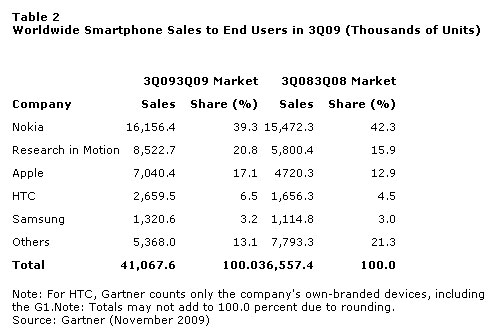
    Global mobile phone sales reached 308.9 million units in the third quarter of 2009, a slight increase of 0.1 percent from the third quarter of 2008, according to a new report from Gartner.

    Smartphone sales showed solid growth with more than 41 million units sold for a 12.8 percent increase from the same period last year.

    "The third quarter of 2009 saw the announcement of many new mobile devices, including several Android smartphones ready for the holiday season in the fourth quarter, but hardware commoditisation and the growth in open platforms will make it harder for them to stand out," said Carolina Milanesi, research director at Gartner.

    "Many devices will reach the market in time for Christmas, and mobile carriers will run incentives for consumers during the holidays. We expect sales of mobile devices in the fourth quarter of 2009 to show year-over-year growth," said Ms Milanesi.

    Smartphone-sales

    "As many vendors and industry watchers call for a decrease in sales into the channel, our sell through data is showing that 2009 performance will be flat rather than down over 2008."

    Nokia led the mobile market in Q3 with 36.7 percent of the share, followed by Samsung at 19.6 percent and LG with 10.3 percent market share.

    Nokia also ranked at the top in smartphone sales with 39.3 percent of the market, followed by Blackberry maker Research in Motion with 20.8 percent and Apple with 17.1 percent.

    "Smartphones continued to represent the fastest-growing segment of the mobile-devices market and we remain confident about the potential for smartphones in the fourth quarter of 2009 and in 2010," said Ms Milanesi.


    Related Articles:

    >Google Launches Custom Search For Smartphones

    >Buy A Blackberry From Walmart Get A $100 Gift Card

    >Apple And LG Rank High In Consumer Satisfaction


  • CrunchDeal: Wii for $99 at Toys “R” Us

    truYou might not want to wait until the day after Thanksgiving to pick up that Wii. Toys “R” Us is running a deal this coming weekend where you can pick up a Wii system and a Ready for Play Wii Pack for $249.

    The Ready for Play pack includes a 20-pack of AA batteries, a copy of Mario & Sonic at the Olympics game, an Ultimate Gaming Ottoman, and your choice of any four Gear Monkey video game accessories. Sounds like a screaming deal to me. Go get one at your local store, or online.


  • Mathematics Learning in Early Childhood: Paths Toward Excellence and Equity

    Cover imageEarly childhood mathematics is vitally important for young children’s present and future educational success. Research has demonstrated that virtually all young children have the capability to learn and become competent in mathematics. Furthermore, young children enjoy their early informal experiences with mathematics. Unfortunately, many children’s potential in mathematics is not fully realized, especially those children who are economically disadvantaged. This is due, in part, to a lack of opportunities to learn mathematics in early childhood settings or through everyday experiences in the home and in their communities. Improvements in early childhood mathematics education can provide young children with the foundation for school success.
    Relying on a comprehensive review of the research, Mathematics Learning in Early Childhood lays out the critical areas that should be the focus of young children’s early mathematics education, explores the extent to which they are currently being incorporated in early childhood settings, and identifies the changes needed to improve the quality of mathematics experiences for young children. This book serves as a call to action to improve the state of early childhood mathematics. It will be especially useful for policy makers and practitioners-those who work directly with children and their families in shaping the policies that affect the education of young children.

  • EU’s Cookie Law Should Crumble

    A bunch of folks have been sending in versions of this story about new EU cookie rules that will require anyone placing cookies on your computer to first get consent. This is the sort of law that is passed by people who don’t understand the technology at all, and misinterpret “cookies” as automatically being malicious. This is the sort of thing that people who were first understanding the web got concerned about a decade ago, until they realized it was nothing to worry about. Except… it appears some people haven’t quite figured that out yet, and tragically, they make laws in the EU.

    Permalink | Comments | Email This Story


  • BrailleNote Apex makes it easier to take notes with Braille QWERTY keyboard

    braillenote

    This is the BrailleNote Apex. It’s a device that the blind/visually impaired (I’m not sure which term is the more acceptable one) can use to, as the name and photo implies, take notes. It runs Windows CE 6, which this type of device usually runs, and, is aimed at students and the like.

    Like so many netbooks, it’s powered by an Intel Atom processor, and comes with a bit of flash storage—8GB, to be exact. Of course, you can add extra storage with a handy SDHC card.

    An internal application suite, named Keysoft, can let users browse the Web, send and read e-mail, record audio notes, etc. There’s even an instant message client.

    Yes, this is something that I’d have to see in person to fully appreciate how it works, and how positive an impact it makes on people’s lives.

    via SlashGear


  • Tweeting Habits Parsed By Time, Day

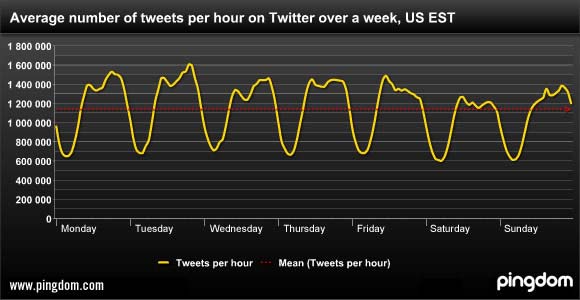
    A new report has shed some light on the habits of Twitter users.  The good people of Pingdom tracked the number of tweets sent over the course of three weeks, and today, released their statistics regarding what days and times folks most like to send messages in under 140 characters.

    Some broader facts may be in order first, though.  A Royal Pingdom blog post stated, "[T]he average number of tweets per day was over 27.3 million.  The average number of tweets per hour was 1,138,772."

    Also, "The highest number of tweets per hour we measured was 1,841,289," and "the lowest number of tweets measured during the period was 566,854 per hour . . ."

    Now, as for the specifics.  In one sense, there’s no surprise on the time front; people don’t tweet as much during traditional sleeping hours.  Otherwise, Pingdom recorded steady activity throughout the day.  Which could signal good things for Twitter, since individuals aren’t just playing around with it when they’re already stuck in front of a computer.

    Interestingly, users don’t exactly abandon it on weekends, either (although the number of tweets does decline a little).  And at the rate things are going, the Royal Pingdom blog post noted that it shouldn’t be long before Twitter is processing one billion tweets per month.

    Related Articles:

    > Twitter Puts Retweet Roll-Out On Hold

    > Compete Builds "Twitter Down" Case

    > Research Scientist Heads From Yahoo To Twitter