Shawn Lee of Rockstar has dropped a hint in an interview that a second installment of Bully just might be on its way.The relevant portion of the inter…
Author: Serkadis
-
Website claims to have hacked Modern Warfare 2 PC, charges US 20
In a total “Stick It To The Man” attitude, website Call of Duty Hacks is claiming that the much-hated IWNET system for Modern Warfare 2 (PC, PS3 and X…
-
Thou shalt not look: Activision slaps a Cease & Desist on MW2 aimbot hack
 Hope you peeped that youtube video when we told you about it earlier, because Activition has fired off a cease and desist order on the video of the aimbot and wallhack being used. They claim it’s a copyright infringement, but there’s a whole lot more video out there that they are just ignoring. Sounds like someone is trying to hide their dirty laundry.
-
Kindle being criticized for failing to support the blind
 Despite the fact that the Kindle has been suggested as an almost perfect alternative to traditional textbooks, some schools have been reluctant to embrace it. This is due to a design issue that makes accessing the audiobook function somewhat difficult for the blind.
The Kindle’s new read-aloud feature shows great promise for the visually impaired, something that has been missed by other e-readers on the market. The issue becomes activating the read-aloud feature. It’s buried fairly deep in the menu system, and would pretty much require a sighted person to activate it.
In a rather interesting move, the Federation for the Blind has sued one of the schools that participated in a pilot program that brings e-readers into libraries and classrooms for students. The group also filed complaints with the DOJ against 5 other schools that were participating in the trial with Amazon.
MSNBC reports that Amazon has already stated that they working towards making the software easier to navigate, and now many schools have stated that they are not going to be rolling out the electronic devices to their students any time soon.
-
Dr. Donald Berwick: We Need To Have More Consequences In The Health Care System
In the health overhaul debate, most of the focus has been on cutting costs and finding the money to cover the uninsured. But often lost in the legislative tussling is a third, just as important goal: Improving the quality of care.
Dr. Donald Berwick, an internationally-known health care quality and patient safety expert, is working to make sure that doesn’t happen.
As co-founder, president and CEO of the Institute for Healthcare Improvement, Berwick for two decades has been both a bit of a nag and an inspirational leader encouraging front-line health workers and health care leaders to make changes to reduce hospital deaths and complications as well as making health systems more efficient.
The Cambridge, Mass.-based nonprofit partners with hospitals and other health care organizations worldwide to accelerate efforts to improve quality. It is funded largely through major health foundations, including The Robert Wood Johnson Foundation and health companies including Kaiser Permanente. In the past four years, IHI has organized major campaigns to get hospitals to adopt simple steps to cut preventable deaths and injuries. More than 4,000 hospitals have taken part.
Berwick, 63, has been a big promoter of efforts to reduce hospital infections, revamp the Medicare payment system to produce better patient outcomes and make public information on hospitals and doctor performance.
Berwick recently sat down with KHN’s Phil Galewitz to discuss progress, obstacles and health care overhaul. Here is the edited interview:
Q: Why is it so difficult to improve the quality of health care and get hospitals and physicians to adopt practices that have been proven to improve care?
A: Hospitals and health care systems are making phenomenal strides in quality and my optimism is very high. But the structures are still broken. We have fragmented payment systems and fragmented institutional boundaries. The enemy is fragmentation. We just don’t seem to form into the coalitions, the communities we need to make progress. Until we fix structures and finance it is going to be very hard to make fast progress.
Q: How do you see the health overhaul affecting the movement to improve quality?
A: I see in the (congressional) bills potentially very helpful changes — investments in better data and better research so we understand the comparative performance of different health care systems and clinical care. There’s lot of demonstration money for projects for integrative systems all over our country in many different locales.
Q: Has the concept of transparency – publicizing information on the comparative performances of hospitals, doctors and other providers — improved quality?
A: We really haven’t tried it. We have made progress to transparency. I have become a bit of an extremist on this. I think we have to really turn the lights on in the system. My main interest in that is for learning. I know there is variability in performance in health care around the country — individual physicians, hospitals and health systems vary tremendously in what they do, how they approach care, how they use resources and what results they get. That means we can learn….Without transparency, learning is really stymied.Q: Are patients using the data to shop for doctors, hospitals or health plans?
A: I see transparency working at three levels, and in some ways, the patient level is weakest. The strongest lever is learning — that if I can find out who has the lowest mortality rate for cardiac surgery or the shortest waiting times, I can go learn from them.
The second level (on which transparency) works is the super-egos of those who give the care. They all want to do well and not want to see themselves at bottom of some list of performers and that is a tremendously powerful lever. I do not believe the fundamental dynamic through which improvement occurs through transparency is the public making its choices. I don’t think that’s the way it happens.
Q: What do you think of the transparency efforts in the House and Senate health reform bills — including publishing hospital infection rates and making public and penalizing hospitals with the highest readmission rates?
A: Being aware of variation in infection rates is going to stir the super-egos of the system quite a bit and I hope the public gets a bit outraged and mobilized as voters ask why we pay systems the amount of money we are and not have them adopt the best practices.
The penalizing is edgy stuff. I do think we need to create more and more consequences for good and bad performance but we need to learn our way into that because if we get that wrong we get into a gaming of the system which we an ill afford and we will frighten a system into defensiveness instead of stimulating it into progress.
Q: In July, you helped bring together health care providers from 10 communities who were holding down costs and providing high quality care: Tallahassee, Fla; Sayre, Pa; Sacramento, Calif.; Cedar Rapids, Iowa; Portland, Maine; Asheville, N.C.; Temple, Texas; Richmond, Va.; Everett, Wash. and La Crosse, Wisc. What did you learn?
A: They are all really, really inspiring. They are solving the problem. If every community in America looked like those ten, we would be done, health care would be affordable and of high enough quality in our country. What are they doing? I don’t think we know yet. But one hallmark is there is cooperation. They are cooperating at the local level – hospitals, physicians and other resources and payers are coming together and putting limits on system and doing the best with what they have and have a commitment not to harm any patients, but not to be so (wasteful) in ways of spending public funds.
Q: What can these types of communities get out of the health reform bills?
A: First, they need not to be stopped. I am a little bit worried if we get reform wrong, some of these creative coalitions and new structures could be impeded by mistakes in legislation.
They need encouragement to cooperate. Bundling payments, offering payments for outcomes and value by some definition will help. We need to stop paying for volume. That is the key. We have to stop paying for (volume) and start paying for the results we want which is health and safety and good outcomes for our patients.
Q: With health overhaul legislation moving forward, how are you feeling about major changes coming to our health system?
A: It’s a pretty exciting time. It’s time to commit to justice and that means universal coverage. We have got to go there. It’s embarrassing that we have not gone there. So that is job No. 1. But to do that simply by funding existing systems is a formula for a spiral we can’t endure. We have to restructure care and the system.
Can we do that from Capitol Hill and the White House? No. We can encourage it, we can support it, we can set some goals out at a price we can afford. But eventually this is going to devolve back to communities…only they can execute the changes and care structures that we really need. It could be an exciting time as we watch the mobilization of change at the level which change has to happen.
Related KHN story: Revolving-Door Patients Illustrate Health System Flaws (Kenen, 6/30)
-
ESRB rates Assassin’s Creed 2 with M for ‘sexual overtones’
Assassin’s Creed 2 (PS3, Xbox 360, and PC) has been given the M rating by the ESRB. Their justification for it: “sexual overtones” and “seduction mini…
-
UK Again Says That Mod Chipping Isn’t Legal
The war against actually being able to own the products you (thought you) bought continues. An appeal by a guy convicted for installing mod chips in video game consoles in the UK has been rejected. Even though the guy himself might not have been violating copyright law, apparently the fact that such mod chips could be used by others to potentially violate copyright law is enough to get him convicted. So, basically, modifying the hardware that you legally purchased? Not legal.
And… in somewhat related news, a bunch of folks have sent in the story of Microsoft cutting off what may be hundreds of thousands of players from Xbox Live for using modded consoles. Microsoft, obviously, is trying to stop players from cheating (one use of a modded console), which is understandable, and certainly within Microsoft’s right. Still, the action does come across as a bit heavy handed. There are perfectly good reasons to mod a gaming console, such as to play unofficial games — and as much as I understand the desire to stop people from cheating or playing pirated games, it still seems like you should be able to modify hardware that you legally purchased.
Permalink | Comments | Email This Story
-
DS homebrew – TonesynthDS v0.23
The homebrew coders from the Hotelsinus Sound Design has released a new version of TonesynthDS, a matrix-based synth sequencer for the Nintendo DS. Th…
-
Gearbox talks Borderlands 2
 In a recent interview, Mike Neumann from Gearbox software was asked about DLC and the possibility of a Borderlands 2. And while Gearbox was pretty vague about the future of the franchise, I sincerely doubt that any game that has been selling so well that it’s hard to find at retail outlets won’t have a sequel.
Apparently there really is no rest for the wicked. Gearbox confirmed that “there’s a chance of a Borderlands 2″. Currently though, they are focusing on downloadable content and other such horse beating projects. It’s quite obvious that there will be a sequel, however considering the fact that the game has only been out for a very short time, I think it’s safe to assume that we’re looking at a year or more before we see it.
-
Video: Checking out the Zune HD’s new 3D games
A major and valid criticism of the Zune HD when it launched was the utter lack of apps. Weather, a calculator, and a game that’s been on the Zune for like a year. It had nothing on the thousands upon thousands of apps and games available for the iPod touch… and it still has nothing on that. But slightly less nothing. There are now a dozen games available for the sexy little player, and they’re really not bad at all. I downloaded the interesting-looking ones and put them on video so you can see just how they perform.

Somehow I missed the skating game, but I already shot and rendered my video before even seeing it, so if you’re waiting on that one, best look elsewhere. But I checked out Audiosurf Tilt, Project Gotham Racing, Checkers, Lucky Lanes Bowling, and Goo Splat. I skipped Chess, Sudoku, and for some reason Space Battle 2, which sounds right up my alley.
The games are all free, and they all display an ad beforehand. That’s a bit ugly, but we knew it was coming, and I have to stick to my guns — the ad-supported world is coming and we’d better get used to it.
-
Walmart Offering $100 Gift Card With Any BlackBerry Purchase
Are you getting ready to pick up a new BlackBerry? Head on over to Walmart next week and you’ll receive a $100 gift card with the purchase of any BlackBerry device. We’ve included the list of available devices, so you can make out your shopping list. Of course, all the phones listed below will require a 2-year contract agreement. The offer runs from 8 am Saturday through November 20th.

- AT&T Curve 8310
- AT&T Bold 9000
- Sprint Curve 8330 (Red & Titanium colors)
- T-Mobile 8520 (Black, White, and Frost)
- T-Mobile Pearl 8120 (Emerald)
- Verizon Storm
- Verizon Storm II
[via EngadgetMobile]
-
Preview of Poynt upcoming gas and weather features

Poynt is probably the best LBS app for BlackBerry. Currently, the app lets you find local businesses, movies, restaurants, events and people. The app gives you the relevant information you’re looking for, and with driving directions, interactive maps and contact information, Poynt connects you with these places.
In the upcoming version of Poynt (weeks away!), the app will be adding gas and weather functionality. These features are really awesome and we have some pics of the features in action.

The gas feature in Poynt shows you all the surrounding gas stations in your area and what the current price of gas is at that station. This feature is going to be huge for anyone who commutes to work and it will save you a ton of money over time.

The weather feature in Poynt has two components. When you set your location with Poynt, the app’s background will change based on what the weather is like. If it’s snowing, Poynt’s background will be covered in snow and show you what the temperature is. In the pic, we show what Poynt looks like for someone in Anchorage Alaska. If you want more information about the weather, you can click through and get the full weather forecasts and details.
These new features are going to make Poynt, an already killer app, even better.
Poynt is available free in App World.

© Kyle for BlackBerry Cool, 2009
-
Nobel Prize Winning Scientists Say Federally Funded Research Should Be Available Free Online
For many years, there’s been a lot of debate over the fact that many scientific journals effectively lock up the results of federally funded research in expensive journals that are inaccessible to the public — including many other researchers. Locking up useful research is troubling enough, but when it’s federally funded, it’s really problematic. Many scientists are quite troubled by this, and Glyn Moody points out that a group of Nobel Prize-winning scientists has now urged Congress to require federally-funded research to be freely available online. Really, they’re pushing in favor of a new law, the The Federal Research Public Access Act of 2009, which seems to make a lot of sense. If the government is funding the research, the more widely available it is, the better.
Permalink | Comments | Email This Story
-
The new Palm Pixi commercial: The mystery witch is dead!
It’s a new day at Palm. The Pixi, Palm’s Treo-esque addition to the WebOS line-up, is getting new commercials without Miss Crazy Face and her magical Pre. Instead, you get hot people taking pictures of each other and having fun.
This is the kind of commercial that I call the McCafe (or Devin’s lifestyle in Seattle) – excited people doing something exciting. It’s a big departure from Palm and a points to a move towards the mainstream.
It’s a nice change and look forward to our Palm Pixi review shortly.
-
Wind Turbines on the Isthmus of Tehuantepec in Mexico, Can Achieve About 50% of Installed Capacity

2009Nov11: Wind turbines on the Isthmus of Tehuantepec in Mexico, can achieve about 50% of installed capacity because of wind speeds of 10 meters per second, according to Dana R. Younger, senior renewable energy adviser to the IFC – the private arm of the World Bank (The Wall Street Journal).
Reference: The Wall Street Journal http://online.wsj.com/article/BT-CO-20091111-715851.html
Image Description: San Jose Chichihualtepec, Oaxaca, Mexico. Photo by Joseadrian0593, 2005. Wikimedia Commons http://commons.wikimedia.org/wiki/File:San_Jose_Chichihualtepec.jpg Image Permission: The copyright holder of this work, hereby releases it into the public domain. This applies worldwide.
-
Online Video Rights: Why Technology Isn’t Enough to Bring About Change
 This morning’s Video Rights Roundtable was, as we hoped, a rare opportunity for online video industry players to talk about their conflicts and collaborations in the wild — not in a courtroom or conference room. In a (more than) two-hour discussion, the nearly 50 attendees shared their perspectives on the increasingly complex world of rights, responsibility and opportunities surrounding online video content. Complete liveblog coverage is available at GigaOM Pro (subscription required), and Ryan Lawler was on-site with some additional event coverage at NewTeeVee. More links below the fold (and full event video coming soon!).
 - In Round One, Ethan Applen, director of technology and business strategy for Warner Bros., talked about copyright enforcement as video content shifts online. While the DVD business was threatened by the emergence of digital piracy, he said that online distribution is even more vulnerable. To approach the problem, he said, the first line of defense is to make illegal consumption of content online more difficult. “That’s what we need to tackle,” he added (subscription required).
- In Round Two, Liz Gannes brought Michael Seibel, CEO of Justin.TV, and Yangbin Wang, from Vobile, up to discuss rights issues specific to real-time/live-streaming video content (subscription required). The two companies are partnering to automate unauthorized content detection and takedown. Ryan has the full scoop at NewTeeVee.
- In Round Three, Betsy Zedek, content protection counsel, Fox Group Legal, fielded questions about the future of copyright law in the digital age (sub. required), and the audience discussed the sticky issue of fair use. Paul Sweeting takes a deeper look at these issues at GigaOM Pro.
- The final section of the event was an open discussion among the audience (sub. required), which touched on the challenges posed by BitTorrent (Ryan recaps this discussion over at NewTeeVee), opportunities to monetize online content in new ways, and the future of medium-budget movies.

-
Facebook coming to PS3 in mystery update?

Some leaked screenshots from Sony show a PS3 interface with what looks like a native Facebook client configurable. There’s also a new photo browser and the ability to change the color of your gamercard, but at those features I make a dismissive gesture— thusly. A Facebook app would be handy, though a constant stream of status updates from heavy players might be lead to mutings by less gaming-orientated friends. “Devin found a new item!”But that’s just the usual pain that comes with convergence. Facebook integration was announced for the Xbox 360 back at E3, though it’s not yet to the point of an actual client. It’s been given a few test runs, and I have to say it looks a bit ugly in NXE form, but what doesn’t? I think what irks me the hipshot way the avatars stand. It isn’t right.

See?
The one small picture of Facebook on the PS3 is at the top (yes, that’s all there is), and it’s not even of a client. It’s a user accounts configuration screen that happens to include Facebook. So it’s not much to look at, but it was traced to Sony UK’s site, so we’re pretty sure it’s legit. Sony “doesn’t comment on rumor or speculation,” obviously, so we won’t be hearing from them, but it would be ridiculous to think that a all-in-one entertainment device like the PS3 wouldn’t have Facebook on it eventually.
While the ability to post interesting things to Facebook would be pretty limited with a Dual Shock and other inherent console limitations, I’m really loving the development of a meta-layer to the consoles that’s always floating just out of sight. Hit pause, check the latest tweets and status updates, grab another Fresca, and then back to the game. I’m not a part of it yet since the Super Nintendo doesn’t really have that level of connectivity, but I look forward to it once I actually buy into this new generation of consoles.
[via Joystiq]
-
Facebook for iPhone developer goes from Apple supporter to ‘I quit!’ in 3 months
If you’re an iPhone user with a Facebook account, chances are good that you have Facebook for iPhone. In fact, it has roughly 17.3 million users, or about 28% of the 60 million users accessing Facebook on a mobile device.
One of the developers who worked on that app is Joe Hewitt, who today tweeted: “Time for me to try something new. I’ve handed the Facebook iPhone app off to another engineer, and I’m onto a new project.”
He’s not just leaving the Facebook project, but abandoning the iPhone altogether.
Hewitt told TechCrunch today that he quit the project because of Apple’s strict approval and management policies in the iTunes App Store.
He said: “My decision to stop iPhone development has had everything to do with Apple’s policies. I respect their right to manage their platform however they want, however I am philosophically opposed to the existence of their review process. I am very concerned that they are setting a horrible precedent for other software platforms, and soon gatekeepers will start infesting the lives of every software developer.”
This is quite a turn of events, considering Hewitt’s last blog entry in August said: “No matter how annoyed I get, I will not stop developing for Apple’s platforms or using Apple’s products as long as they continue to produce the best stuff on the market. I never forget how deeply Apple cares about making their users happy, and that counts more than how they treat their developers. Besides, when I have a problem with a friend, I don’t threaten to boycott our friendship until they change, so I’m not going to do that to Apple either.”
The developer he’s handed the app over to is Owen Yamauchi, a Facebook software developer and former Apple engineer.
-
Is Infochimps’ Aggregated Data a Boon to Researchers or a Privacy Nightmare?
 A pair of slices from a massive scrape of Twitter’s API could be of great use to programmers and researchers alike — as long as users don’t mind. The company behind the mining effort, Infochimps, is trying to demonstrate and promote its data aggregation service while offering up some useful information to interested parties.
At the end of last year, Infochimps posted a heftier version of its scrape of Twitter, which was taken down at the behest of the micro-messaging site over user privacy concerns. By releasing curated, anonymized chunks of data, the company may avoid most of the user privacy concerns that arose last time around. Then again, it may not.
One of the sets, a “token count,” adds up the number of particular tokens (individual hashtags, smileys and URLs) that have been tweeted since March 2006. The other links the ID strings between Twitter’s Search API and the standard Twitter API. The two APIs issue different ID numbers to users, which makes it annoying, if not impossible, for developers to link data across both services to one user.
Infochimps says it hopes “to send a signal that this data is valuable and useful to real-time search engines, Twitter apps, and social media researchers.” It also hopes to “start a conversation about where value really lies in this type of data, [and] the various ownership and privacy issues that arise.” Given the complaints from Twitter the first time data was posted, it’s a smart move on the part of Infochimps to add this disclosure and thoroughly anonymize the data. The company very much wants to avoid any sort of ill will or backlash from the Twitterati over the release of the data sets. Back in 2006, AOL Research released 20 million search keywords attached to user IDs for researchers to use. A number of individuals were identified as a result of the “anonymized” data, leading to a number of concerns over what sorts of data are kosher to be released.
Ownership and privacy aside, Infochimps is offering the “tokens” data set broken out by month for free, and $9,500 for a version broken out by hour. The “ID/API mapping” data set is being offered for $6,000.

-
Bing Managed Big Gain In October
According to new data from Experian Hitwise, October was the month of the underdog with respect to the search market. The two search companies that usually dominate lost a bit of share, while Bing (and to a lesser degree, Ask) gained ground.
Let’s start with the success stories. Bing’s market share rose from 8.96 percent in September to 9.57 percent in October, which represents an increase of 6.8 percent. That’s nothing to sneer at, even if Bing remains solidly in third place.
Fourth-place Ask also made a small amount of progress as its share increased from 2.56 percent to 2.62 percent – a jump of 2.3 percent that’s far better than a dip.
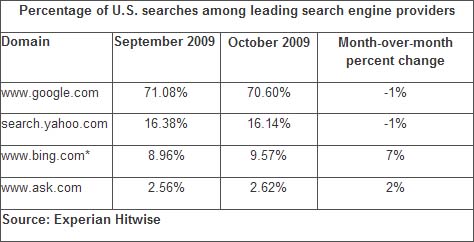
Meanwhile, Google came sort of close to losing its grasp on the 70 percent mark, slipping from 71.08 percent to 70.60 percent on a month-to-month basis. And Yahoo fared about the same, moving from a market share of 16.38 percent to 16.14 percent.
As always, it’s not smart to read too far into a single month’s search report. Still, Experian Hitwise also recorded a Yahoo loss (and Ask gain) in September, so a trend may be starting to emerge.
Related Articles:
> Bing Gets A Bunch Of New Search Features


