Author: Serkadis

  • HP Buys 3Com to Play Cisco’s Server Game

    hplogoUpdated: HP said today that it plans to buy router and switching gear maker 3Com for $2.7 billion — a deal that seeks to put HP on better competitive footing against Cisco and its server efforts. HP and the rest of the computing industry have struggled to come up with an answer to what Cisco calls unified computing systems, which combine servers and networking into one box, and in doing so have tended to lean on partnerships with networking providers such as Brocade and Juniper.

    With its No. 2 line of Pro Curve networking gear, HP  was seen by the industry as being in the best position to compete, so this deal looks like an admission from HP that it has some holes in its networking portfolio that Cisco could exploit.  The boards of both companies have approved the deal. HP will pay $7.90 per share in cash for 3Com. My question is: Why didn’t it buy Brocade?

    Update: Cisco has posted a comment in response to the deal, basically saying that HP is welcome to follow its industry leadership in unified computing.

    Update2: Dan Primack over at peHUB has raised some legitimate questions about the price HP paid, and noted how 3Com’s stock has been steadily rising in the last couple of weeks. He pulled some Bloomberg data that shows how trading volume shot up today before the deal was announced, leading him and other blogs to suspect insider trading may be at work.

  • Microsoft bans ‘small percentage’ of modded Xbox 360s from Xbox Live

    xboxbanned

    Fair warning to those of you who play your modded Xbox 360 on Xbox Live: Microsoft is breaking out the ban hammer. Again.

    While Microsoft hasn’t released official numbers, and only says that a “small percentage” of Xbox Live accounts have been banned, I’ve seen the number 600,000 used a lot.

    So, 600,000 people who once were able to play their burned DVDs are no longer able to. I’d shed a tear for y’all, but to expect to be able to play copied games online is a bit of a stretch. You want to copy games? Go ahead, your business is your business; I’m not going to preach otherwise. But then to complain that you’re not able to play the game online, well, come on.

    The Microsoft statement reads, as told to GamesIndustry.biz:

    We have taken action against a small percentage of consoles have been modified to play pirated game discs. In line with our commitment to combat piracy and support safer and more secure gameplay for the more than 20 million members of our Xbox Live community, we are suspending these modded consoles from Xbox Live.

    So there you have it. If you want to play online, you’re going to have to play by the rules. I know that can be difficult in places such as Brazil, where the cost of a legitimate, non-copied game can hover around the $150 mark, but that’s a matter for another day, if not an entire book.


  • Google Integrates World Bank Data

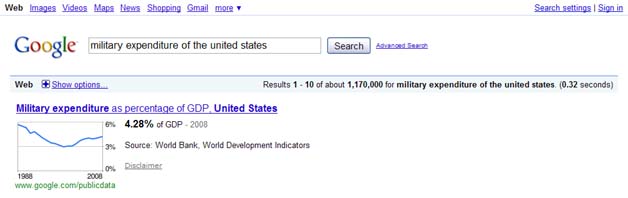
    Students and statistics hounds now have even more reason to love Google.  Today, the search giant announced that it’s made information related to 17 World Development Indicators available through standard search results pages.

    The stats come courtesy of the World Bank, and a post on the Official Google Blog explained, "Search should be intuitive, so we’ve done the work to think through queries where public data will be most relevant to you.  To see the new data, try queries like [gdp of indonesia], [children per woman in brazil], [rwanda’s population growth], [energy use of iceland], [co2 emissions of iceland] and [gdp growth rate argentina]."

    At that point, you’ll get something like the screenshot below:

    Then, if you click on the graph, Google will take you to an interactive page where you can put together a more informative diagram.

    Have fun finding out a little bit more about our world.  And here’s one last dollop of info so that you don’t waste a bunch of time: the available World Development Indicators are CO2 emissions per capita, Electricity consumption per capita, Energy use per capita, Exports as percentage of GDP, Fertility rate, GDP deflator change, GDP growth rate, GNI per capita in PPP dollars, Gross Domestic Product, Gross National Income in PPP dollars, Imports as percentage of GDP, Internet users as percentage of population, Life expectancy, Military expenditure as percentage of GDP, Mortality rate (under 5), Population, and Population growth rate.

    Related Articles:

    > Bing Gets A Bunch Of New Search Features

    > Google Gives Users A Way To Lock SafeSearch

    > Google Adds Advanced Statistics Search Feature

  • If You Want To Make Money As A Musician You Need To Be A Musical Entrepreneur

    One of the common criticisms we hear around here when we talk about the various business models that are working for more and more musicians these days, is that it’s somehow “unfair” or even “wrong” that musicians need to think about business models these days, since they should just be spending all their time creating music. Of course, this assumes (incorrectly) that the same thing wasn’t true in the past as well. For years, musicians have always teamed up with business managers and music labels for that very reason: to delegate some of the business tasks. That doesn’t change in the modern era. What does change is that the different opportunities have grown significantly. Either way, Andrew Dubber (who’s always worth paying attention to on these topics) recently put a comment on a blog post on this particular topic that is so good it shouldn’t be buried as just a comment, so I’m going to highlight some of the key parts here:


    Musicians deserve more money than they get. Most train harder and for longer than brain surgeons in order to do what they do, and then they earn less than checkout operators for what they do. I strongly believe that more money should go to more musicians more often than it does….

    Making music is not (usually) a job of work. It is a creative act. You don’t have the RIGHT to make money from your music. You only have the opportunity.

    If you make music speculatively – that is, you create it in the hopes of making money from it, then you are a music entrepreneur. As such, entrepreneurship rules apply.

    You may invest a good deal of energy, effort and expense in your creative ideas. You may make a lot of money. You will probably make none. But nobody OWES you money just because you put the work in.

    If your business model is to grow and sell oranges, then it’s no good picking the oranges, then leaving them on the footpath outside your house with a price tag on each one. It doesn’t matter how great your oranges are, or how hard you’ve toiled in your garden. Someone WILL take your oranges. Some will get kicked to the side of the road. Some will get stepped on. But it’s not because people are immoral and don’t understand or appreciate fruit properly.

    If you wish to be reliably rewarded for your music, then get employed to make music as your job.

    Bingo. That’s the point I’ve been trying to make for years on this, but said much better than I could express it. He then goes on to make another point I’ve tried to make in the past, which is that if you compare the situation today to what it was in the past, there are so many more opportunities to make money. In the past, it was nearly impossible to make money on music because there were so many gatekeepers.


    The odds are stacked against you. History is littered with musicians who are disillusioned, embittered and broke. This was true before the internet just as it’s true now. The internet is neither your saviour, nor your enemy.

    Let me make that bit clear: prior to the internet, most people spent NO money on music. If they bought a record in a year, it was a gift for a nephew (and it was usually rubbish). Some people spent a lot of money on music, because it was tied up with cultural things like identity that they were really invested in.

    Back when you needed a record label to just be heard, it was a lottery. The odds were bad, the lottery tickets were expensive, and most of the prizes – if you did happen to win – were just awful. Now you don’t need to play that game – but you need to be smart and you need to understand what the rules of the new game are.

    You CAN, of course, get signed to a record label (and that lottery is still in play) but you can also be an entrepreneur. I recommend the latter – but not because it guarantees you money.

    But the simple fact is that you don’t become a successful entrepreneur by making things that people will not pay for, insisting that they should, and then complaining that their morals are to blame. They may not share your morals, but that’s not even the point.

    It’s not their job to understand your needs. It’s your job to understand theirs.

    You become a successful entrepreneur by meeting people’s needs and wants, solving a problem for them and doing it in a way that allows you to make money.

    I’ve said it before and I’ll say it again. Even if it was true that all the people you wish to target with your art are immoral thieves who you would never invite into your home – why would you insist on trying to change their behaviour as part of your business strategy?

    And he concludes by pointing out (as we have in the past as well) where the real “sense of entitlement” comes from:


    You may make great and interesting music, and put on an amazing show with amazing costumes…. But decrying a sense of entitlement among those who won’t pay you for what you insist on doing is back to front.

    The people with the weird sense of entitlement are the ones who stamp their feet and say ‘look at all this hard work I put in – where’s my money?’

    Permalink | Comments | Email This Story


  • Checking in with Donald Berwick, President and CEO, Institute for Healthcare Improvement

    KHN’s Phil Galewitz talks to Donald Berwick, M.D., M.P.P., President and CEO of the Institute for Healthcare Improvement (IHI), and clinical professor of pediatrics and health care policy at the Harvard Medical School. He says he hopes the public “gets a bit outraged and mobilized as voters ask why we pay health care systems the amount of money” we do and not have them adopt the best practices in treatment and efficiencies.

    Listen to audio version (.mp3) | Read Related Story

  • New Chinese VC Firm Launches

    FUEL Capital is raising $100 million for its debut fund, as first reported by Zero2IPO. The focus is on the first institutional rounds for Chinese companies that already have some revenue.

    The firm is led by longtime Intel Capital vet Cadol Cheung, who most recently served as head of its Asia-Pacific investment activity. VentureWire reports that FUEL’s team also incoludes S.C. Mak, a former managing director in Walden International’s Hong Kong office, and Intel Capital’s former in-house counsel Joseph Cha.

    ShareThis


  • IAB Releases New Guidelines for Email Monetization

    The Interactive Advertising Bureau (IAB) has released a list of "best practices" for marketers and publishers who want to monetize their email efforts. The best practices come in a document appropriately titled "Email Monetization Strategies."

    The IAB considers this part of its ongoing efforts to establish a "solid foundation" of guidance and tools for the email marketplace. It provides publishers, agencies and marketers with recommendations and best practices for the successful execution of email marketing campaigns.

    The document covers:

    – The use of email newsletters to reach valuable audiences
     
    – Stand-alone email advertising to drive sales and site registration

    – Revenue opportunities and pricing models for email newsletters and stand-alone email advertising
     
    – Descriptions of emerging trends such as video in email campaigns

    iab

    "The email channel offers a unique opportunity to reach consumers with relevant, differentiated and personalized content and messaging," said Sherrill Mane, SVP, Industry Services, IAB. "Email Monetization Strategies provides an in-depth assessment and guide to maximizing the success of email marketing."

    "Email is one of the most effective direct and brand marketing mediums," said Sean O’Neal, Chief Revenue Officer, Datran Media, and co-chair of the IAB’s Email Committee. "These best practices provide the latest information and strategies to marketers and publishers so that they can maximize their email communications with their customers."

    In case you think email is on the way out due to spam or social media, read the reasons why we don’t believe that is the case here and here.

    Related Articles:

    > Marketing Best Practices for Long Form Video

    > 7 Behavioral Targeting Privacy Principles

    > IAB Announces Guidelines for In-Game Ad Standards

    > IAB Releases Social Advertising Best Practices

    > IAB Rolls Out Click Measurement Guidelines

    > IAB Releases Definitions for Social Media Ad Metrics

    > IAB Releases Video Ad Guidelines

  • Should mankind be able to control the weather?

    clouds

    In lieu of an actually interesting collection of words and punctuation marks, I present this debate that has nothing to do with us: the weather in China. It seems that they’ve figured out how to control the weather over there using super-duper technology called cloud seeding. You may have heard of it. The problem is that officials there are blaming scientists for causing a major snowstorm; more snow is expected in the coming days. Basically, it’s snowing too much, too early, and the powers that be aren’t happy.

    Like I said, I sincerely doubt the good people of Columbus, Ohio care about the weather in China, but it helps introduce a topic that I can run with for a minute: should man control the weather? I’ve come up with two points of view based on zero research to help get the conversation started.

    Yes we should! We’re mankind, the top of the food chain and arbiters of all that happens on the planet. If we can move earth, drain lakes, divert rivers, drop nuclear bombs (throwing untold garbage into the atmosphere), then why shouldn’t we be allowed to control when it rains? I can see it being genuinely helpful, too, bringing rain to an area that’s going through a drought. You know what I mean. It wouldn’t merely be controlling the weather for the sake of it.

    No we shouldn’t! If man were meant to fly he’d have wings, and if man were meant to control the weather he’d have the equivalent of wings for the purposes of this sentence. Who’s to say what would happen if we mess up while seeding the clouds? Or, to get theological, what right do we have to dictate the weather patterns He has chosen for us?


  • Speed Improvement, UI Enhancements, and Video Library Support

    We are inching ever so close to the 1.0 release, with today’s beta version 0.9.0.169 update available at http://blackberry.wordpress.org/install

    Here is what’s new:

    • Based on all the great feedback, we reworked much of the UI layout for the main view, blog view, and media view
    • Ability to upload videos from your media library
    • New option to set media file properties (filename, caption, title, and position)
    • Created a new file browser that resembles the native BlackBerry file browser
    • Big improvements in the speed at which you can view and manage comments
    • Lots of optimizations for uploading photos and videos using base64 encoding
    • Indonesian language support updated thanks to Kate of Pixel Insert
    • Improved French language support thanks to Yann Nave of blog.onbebop.net

    Here are a few screenshots of the new beta:


    If you are running one of the latest versions of the app, it should prompt you to upgrade. If not, you can always download the latest version by pointing your mobile browser to: http://blackberry.wordpress.org/install

    And always, if you have any issues, please post to the forums so we can effectively track and respond to the issue:  http://blackberry.forums.wordpress.org/

  • Bing gets geekier with new Wolfram Alpha integration

    By Tim Conneally, Betanews

    Since Microsoft’s Bing search engine debuted, it’s made a strong charge against Google, the search market’s dominant player. It has had diverse and attention-grabbing advertising campaigns, its partnership with Yahoo is one of the biggest search collaborations of the last decade, and it regularly rolls out timely and compelling new features like the recent integration of Twitter and Facebook feeds.

    Because of this, Bing has been steadily gaining traffic and revenue, according to recent figures by Hitwise and IDC.

    Today, Bing is beginning to show a geekier and more productive side through a partnership with computational search engine Wolfram Alpha. Now, in addition to doing Web searches, Bing can process raw numerical data in areas such as nutrition, health and advanced mathematics.

    “By using our API, Bing will be able to seamlessly access the tens of thousands of algorithms and trillions of pieces of data from Wolfram|Alpha, and directly incorporate the computations in its search results,” Wolfram Alpha’s Schoeller Porter wrote today.

    For an increasing number of topics, Bing can create more sticky search results pages. One of the examples the Bing team used in its blog today was the query “dodecahedron,” a twelve-sided polygon (and character in Norton Juster’s kid’s story The Phantom Tollbooth). On the Bing results page, it now shows an image of the polygon, its combinatorial properties, its geometric properties, and more. On Google, it also provides images, but everything else is presented as a link, immediately shuffling the searcher off to another site. The more useful data Bing can deliver, the longer it will be able to keep the user aboard.

    These features began rolling out today, but will not be complete for a few days, so availability of Wolfram Alpha results will vary. In Betanews tests today, the calculation capability was not yet online.

    Copyright Betanews, Inc. 2009


    Add to digg
    Add to Google
    Add to Slashdot
    Add to Twitter
    Add to del.icio.us
    Add to Facebook
    Add to Technorati


  • Daniel Craig will not be James Bond in Activision’s games

    With their new James Bond game coming out next year plus plans to make a series out of the Bond franchise, Activision decided not to get Daniel Crai…

  • Confirmed: Playdom Raises $43 Million

    Playdom, a Mountain View, Calif.-based social gaming company, is raising up to $70 million in VC funding at around a $300 million valuation, according to Eric Eldon. New Enterprise Associates reportedly is among the investors. Eldon also reports that Rick Thompson, Playdom’s co-founder and chairman, has raised around $50 million for a VC fund of his own.

    Update: TechCrunch puts the round a $43m, with a $260m pre-money valuation ($406m post). Says NEA was joined by Norwest Venture Partners and Lightspeed Venture Partners.

    Update II: The company has issued the following press release:

    Playdom, a leading social gaming company, announced today that it has closed $43 million of financial investments as part of its Series A financing. The investment, led by New Enterprise Associates (NEA), along with Playdom chairman Rick Thompson, Lightspeed Venture Partners and Norwest Venture Partners (NVP), will be used to finance strategic acquisitions and expand the company’s pipeline of market-leading games.

    “We are focused on growing Playdom into a world-class gaming company. A number of compelling games are in development for 2010, and we’re bullish about our future and the potential to bring people together through social gaming,” said John Pleasants, CEO of Playdom. “Social games appeal to everyone, everywhere. Our players range from ages 13 to 80 and come from more than 150 countries, so the opportunity for growth is tremendous.”

    In conjunction with this financing, Playdom has added Scott Sandell, general partner at NEA, to its Board of Directors. Sandell joins Playdom’s existing board members CEO John Pleasants and founders Rick Thompson, Dan Yue and Chris Wang.

    “We are thrilled to partner with such an exciting company and strong leadership team,” said Sandell. “We believe social gaming is a transformative industry and Playdom is playing a critical role in shaping its future and the future of online social entertainment.”

    Playdom currently runs 13 games on leading social networking platforms including Facebook, MySpace and iPhone. The company is the largest game developer on MySpace and has two of the top five role-playing games on Facebook, including its popular titles Sorority Life and Mobsters 2: Vendetta.

    Playdom has over 190 employees in offices in Mountain View and San Francisco, CA, as well as a game studio in Eugene, OR.

    ShareThis


  • Biden: "I Have Everything To Hope, But Little To Fear"

    On Veterans Day, Vice President Joe Biden joins all Americans in honoring those who have fought and died for our country. Yesterday, in recognition of the seven soldiers killed by a roadside bomb in Afghanistan last month, the Vice President visited Fort Lewis military base in Washington, where he spoke to a crowd of 500 people, recognizing the bravery and sacrifices of the fallen soldiers:

    It’s that valiance that we remember here today at Fort Lewis.  It’s that valiance that we honor today at Fort Hood.  And it’s that valiance that we’ll celebrate tomorrow, our nation’s 91st Veterans Day.

    Today, these seven men take their place on the rolls of the greatest American heroes.  And the rest of us — all the rest of America — should once again be reminded and rededicate ourselves to a simple proposition:  The only sacred responsibility we have as a nation — the only sacred responsibility we have as a nation — is to give all those we send all they need, and care for them and their families when they come home.  That’s the only truly sacred obligation our government has.  

    Meriwether Lewis — soldier, explorer, a leader of men — when speaking of his historic expedition, said of those under his command, "With such men I have everything to hope, but little to fear."

    Well, I say to all Americans today:  Knowing these seven men are watching over us now, and that our military is filled with thousands upon thousands of women and men like them — I think we can believe that, even as we struggle with tragedy, even as we grapple with the profound loss and devastating grief, we can look up at the heavens, think of those heroes, and know with certainty that we have everything to hope, but little to fear, thanks to them.

    Vice President Speaks at Fort Lewis

    Vice President Joe Biden speaks at the memorial service for seven soldiers killed by a roadside bomb on Oct. 27 in Afghanistan, at Ft. Lewis, Washington, Tuesday, November 10, 2009. (Official White House Photo by David Lienemann.)

    Vice President Places Coins at Fort Lewis

    Vice President Joe Biden places a coin in front of each pair of boots at the memorial service for seven soldiers killed by a roadside bomb on Oct. 27 in Afghanistan, at Ft. Lewis, Washington, Tuesday, November 10, 2009. (Official White House Photo by David Lienemann.)

    Today, the Vice President and Dr. Jill Biden hosted a luncheon at the Naval Observatory for Veterans and active duty servicemembers along with their families. The Bidens, whose son Beau recently returned from Iraq, were joined by Secretary of Veterans Affairs Eric K. Shinseki.

    Biden Has a Talk on Veterans Day

    Vice President Joe Biden greets attendees of a luncheon for veterans and their families at the Naval Observatory residence in Washington DC, Wednesday, November 11, 2009. (Official White House Photo by David Lienemann.)

    Dr. Biden on Veterans Day

    Dr. Jill Biden speaks to veterans and their families flanked by Vice President Joe Biden and Veterans Affairs Secretary Shinseki during a luncheon for veterans and their families at the Naval Observatory residence in Washington DC, Wednesday, November 11, 2009. (Official White House Photo by David Lienemann.)

    Biden Speaks to Veterans Day Luncheon

    Vice President Joe Biden speaks to veterans and their families accompanied by Vice President Joe Biden and Veterans Affairs Secretary Shinseki during a luncheon for veterans and their families at the Naval Observatory residence in Washington DC, Wednesday, November 11, 2009. (Official White House Photo by David Lienemann.)

  • Fight Night Round 4 (and everyone else on planet earth) predicts a Pacquiao win

    manny

    I know something about MMA, but I know next to nothing about boxing. Yet even I can laugh about the latest EA Sports prediction, via Fight Night Round 4, that says that Manny Pacquiao will beat Miguel Cotto this weekend. I laugh because saying Pacquiao will win the fight is like saying the sun will rise in the morning. (Now watch Cotto knock out Pacquiao in the first.)

    This is just the latest simulation that EA Sports has run with its games. The most recent one, that the Philadelphia Phillies would beat the New York Yankees in seven games didn’t exactly pan out.

    EA Sports has also predicted that the Cleveland Cavaliers will win the NBA Finals this year, and that the Pittsburgh Penguins will win the Stanley Cup.

    Did EA Sports already do a UEFA Champions League prediction yet? (I imagine after the seeding we’ll see a FIFA World Cup prediction.)

    And now we play the waiting game.


  • UK base land offered in Cyprus peace talks

    The PM meeting the President of Cyprus; Crown copyrightThe UK would hand over almost half of its sovereign land in Cyprus if the country is reunified, the Prime Minister has said.

    Gordon Brown urged Cypriots to be “bold” and “courageous” in their efforts to reach a deal between the divided Turkish and Greek populations.

    Following talks with President Dimitris Christofias at Number 10, the Prime Minister praised his work to progress discussions and encouraged him to resolve the issue.

    The PM said:

    “It is important that the solution to the Cyprus Problem is a Cypriot one – a solution by Cypriots for Cypriots. Nevertheless, as a sign of support for the negotiations, I can confirm today that an offer has been made to the United Nations to make available just under 50 per cent of the territory of the UK’s Sovereign Base Areas to a unified Cyprus in the event of a solution.

    “It will be up to the two leaders to negotiate what happens with this land. The Sovereign Base Areas would be able to function as normal within a reduced land area. Today, my message to Cyprus’ leaders and to their people is: you can make history. Be bold, be courageous. The UK will support you.”

    The two sovereign base areas – Akrotiri and Dhekelia – were retained under UK jurisdiction when Cyprus was granted independence in 1960 and cover 98 square miles.

  • Assassin’s Creed II TV spot will have you staring into the eyes of death

    For this upcoming TV spot for Assassin’s Creed II, you’ll find yourself staring into the eyes of Ezio’s victims. It’s a little creepy and morbid seein…

  • Chumby One goes on sale for $99

    chumby-oneIn case you’re one for hard lines and plastic over soft and cuddly, head over to the Chumby store and order yourself the new Chumby One. It’s way more advanced than the original model with a faster CPU, a lot more storage, FM tuner, and is half the price at only $99. But like I said before, I still want the older model.

    The original Chumby was fun and whimsical; the One is up-tight. Just look at the two next to each other. The Classic is like the over weight and funny looking party boy that can always score with the ladies. But the One on the other hand, looks more like the straight-laced, classically handsome church boy. I mean, if you’re actually going to own one of these things, don’t you want one that’s fun?

    [Chumby via Engdaget]


  • As Hollywood Insists Canada Is A Den Of Copyright Thieves, Movie Business Is Thriving

    For years, Hollywood has pushed a totally ridiculous claim that Canada is somehow a den of copyright thieves, and it needs to make its copyright laws much more strict. This fantasy has worked on journalists and politicians, who insist that the movie industry is dying in Canada due to rampant piracy. Except someone forgot to inform the real world. An anonymous reader sends over the news that the owners of Cineplex in Canada are reporting record box office sales and revenue, even with the current economic downturn. Once again (and yes, we’ve been pointing this out for a decade), it appears that it’s the actual experience that gets people to go to the movies. The folks at Cineplex note that a growing number of highly experiential films — such as those using IMAX or 3D technology — has really helped in getting more people into the theater and in getting them to pay more.

    Oh, and as a special note to NBC Universal’s General Counsel, Rick Cotton, who seemed so worried about those poor corn farmers who would be decimated by piracy, you can rest easy:


    Concession revenues did well due to a film slate that catered to family audiences, who tend to be higher concession spenders.

    Phew. Now Rick can go back to working on ways to stop people from watching the Olympics and figuring out ways to avoid paying copyright royalties to songwriters.

    Permalink | Comments | Email This Story


  • Don’t Forget About The Other Determinants of Health

    After months of discussion and debate, the House has passed its version of health care reform. But as many observers, including me, have already noted, health care reform has primarily become health insurance reform over the course of the year.

    The focus on health insurance reform, at least in part, reflects polling data that shows the public is much more responsive to issues like guaranteeing coverage to people without regard to pre-existing conditions or health status and providing subsidized insurance or access to Medicaid to people who need help. There is far less interest in slowing spending or controlling costs, especially in ways that could be viewed as making access to whatever health care patients or their physicians want more difficult. Not surprisingly, this lesser interest is reflected in the legislation just passed.

    To be fair, the House bill, as well as the bill voted out by the Senate Finance Committee, contains a variety of changes that focus on quality and health system performance improvements. These include proposals that encourage the development of more primary care providers as well as requirements to improve the coordination of care for people who are jointly on Medicare and Medicaid and other high users of services.

    There are also promising pilots that would bundle payments for post-acute care and that test incentive models that encourage accountable care organizations—groups of providers that are responsible for managing the cost and quality of care for a group of patients–and other payment and service delivery models. Based on past experience, however, the Secretary of Health and Human Services needs to be able to fully implement successful pilots without new authorizing legislation from the Congress. Otherwise the likelihood of even promising pilots becoming a part of Medicare is small.

    As we move to the endgame of what will at best be health care reform 1.0, it is also important to remember that if we want to improve health—presumably health care reform is a means to improving health—we need to focus on more than just health care and reform of the health care system.

    We probably all know that health care is only one means of improving health. It became especially clear to me after spending three years as a commissioner on the World Health Organization Commission on the Social Determinants of Health, which focused on the relationship of poverty, education, early childhood education, the treatment of women and individual empowerment to health and life expectancy. While the importance of clean water and sanitation to health is obvious for developing countries, focusing on the environment where people live and work is also important for developed countries—especially if we want to make progress reducing the disparities in health outcomes observed in minorities and disadvantaged populations.

    The rationale for considering the role of these social determinants of health is relevant for all age groups, but it is especially important for children. Improving the conditions surrounding a child’s early development will improve opportunities for better health throughout the child’s life span. Many of the biggest challenges the country now faces begin in childhood. Obesity, cardiovascular disease, cancer and mental health problems—conditions that account for more than 75% of health care spending today—all can have roots in the early years of life.

    Improving nutrition during gestation and delivery is critical to the health development of a child. It also plays a role in the likelihood of a child’s developing obesity, type 2 diabetes, high blood pressure and heart disease later in life. This means that making sure pregnant women with low incomes have stable access to nutritional food is thought of as an important strategy for improving future health.

    Making sure that pregnant women have access to substance abuse programs is another strategy that would markedly improve children’s health. As it is, too many children are born with serious medical challenges because their mothers had substance abuse problems. Not aggressively intervening to make sure such care is available and easily accessible imposes large financial burdens on the system and incalculable human costs on the children born to substance-abusing women.

    Similarly, investments in early childhood education, especially for the poor, should be regarded as an important tool for preventing disease, improving quality of life and increasing later productivity. Recognizing the social determinants of health means that programs like Head Start, Title I of the Education Act of 1965 that funded schools with high concentrations of poor children and is now part of No Child Left Behind, and ensuring that school lunches provide basic nutrition, including fresh fruits and vegetables, may be as important to improving health as any of the changes now under consideration even if they are not regarded as a traditional part of health care reform.

    The Congress and the country are finding reforming the health care system a major challenge—one that is likely to take many rounds of legislation. As we struggle through this first round of health care reform, it is important that we remember that the ultimate goal is to provide for a healthier America. Improving the conditions in which people are born and live, age and die may be at least as important as reforming health care in achieving this goal.

    Gail Wilensky is a Senior Fellow at Project HOPE, an international education foundation. She was the Administrator of the Health Care Financing Administration (now the Centers for Medicare and Medicaid Services) from 1990-1992 and the chair of the Medicare Payment Advisory Commission from 1997-2001.

  • Motorola Eyes $4.5 Billion Home/Networks Unit Sale

    NEW YORK (Reuters) – Motorola Inc (MOT.N) is in the early stages of looking into a potential sale of its $4.5 billion television set-top box and network equipment business, two sources said on Wednesday.

    Motorola is in the early stages of seeking buyers for the unit, whose suitors include private equity firms and other communications equipment makers, said one source familiar with the situation.

    Motorola may decide to keep the unit in the end, said the source, who was not authorized to speak with the media.

    J.P. Morgan Chase & Co and Goldman Sachs Group Inc are advising Motorola on the possible sale, the source said.

    J.P. Morgan and Goldman Sachs declined to comment.

    Motorola, which has been losing market share in its cellphone business for years, declined to comment, but said it was still focused on its previously stated plan to separate its handset business from the rest of the company.

    Analysts said there could be a lot of interest in the home and networks unit, particularly because Motorola has a strong market share in the set-top box segment, where it is bigger than Scientific Atlanta, owned by Cisco Systems Inc (CSCO.O).

    But RBC analyst Mark Sue said that a divestiture of any of Motorola’s other business units could hurt Motorola’s money- losing handset business.

    “The mobile devices business still needs the rest of the businesses to fund it operations. It hasn’t really recovered fully yet so it would be a little too early to cut off the lifeline,” Sue said.

    While growth in the mobile network equipment market has slowed dramatically in recent years, rival gear makers could see Motorola as a way to increase their market share, particularly in the United States.

    Avian Securities analyst Matthew Thornton said a $4.5 billion price tag would represent an 18 percent premium over his estimated valuation of $3.8 billion for the home and networks unit, based on operating earnings.

    Potential suitors could include Ericsson (ERICb.ST), Samsung Electronics Co Ltd (005930.KS), Alcatel Lucent SA (ALUA.PA) or Nokia Siemens, a venture of Nokia (NOK1V.HE) and Siemens AG (SIEGn.DE), analysts said.

    The Wall Street Journal cited China’s Huawei Technologies Co Ltd [HWT.UL] and UK based Pace Plc (PIC.L) as other potential buyers.

    Private equity firms, including TPG, also have taken a look at the unit, a source briefed on the process said. The source could not be identified by name because they were not authorized to speak to the media.

    The Wall Street Journal cited Silver Lake Partners as another potential bidder.

    TPG declined comment and Silver Lake Partners was not immediately available for comment.

    Motorola spokeswoman Jennifer Erickson said the company does not comment on rumor or speculation.

    “Separation into two independent, publicly traded companies (Mobile Devices and Broadband Mobility Solutions, which comprises Enterprise Mobility Solutions and Home and Networks Mobility Solutions) is the publicly stated long-term goal of Motorola,” Erickson said. “We remain committed to the separation goal and continue to believe that it is the right strategy to position Motorola for long-term success.”

    Motorola shares were down 15 cents, or 1.7 percent, at $8.70 in afternoon trading on New York Stock Exchange. (Reporting by Sinead Carew, Megan Davies and Jessica Hall in New York; editing by Andre Grenon and Tim Dobbyn)

    ShareThis