Author: Serkadis

  • Blockbuster wants you to rent your movies on SD cards now

    blockyBlockbuster, observing the popularity of services like RedBox (a DVD rental kiosk), has decided they’re going to skip a step and start offering movie rentals that come on an SD card. The new kiosks would load a DRMed movie onto your own SD card, and the content will expire after X viewings or days. They’re hoping that the better quality of the movies (vs. streaming ones or regular DVD) will bring users back. You might have picked a format that’s actually supported by media devices, guys.

    SD cards are everywhere, indeed, but there are precious few DVD players, TVs, and personal media players that support them. Your computer has an SD card reader, or else you’ve bought one by now, but I don’t think people want to rent things to play them on their computers if they can stream them so incredibly easily. Sure, working out how to get an SD card’s content onto your TV may be easy for tech-oriented people like you and me, but for the people grabbing a movie on the way out of the grocery store… not so much.

    With luck, Blockbuster will wise up and allow a USB drive to be plugged in. I mean, why didn’t they do that first thing? Everybody has those sitting around. And not that many people have high-capacity SD cards. If the movies are over 2GB, a lot of people are sunk because they only have the card that came with their camera (likely 512MB or thereabouts). Oh well, it’s a step in the right direction. Although I guarantee you’ll see a Blockbuster DRM-stripping app out there within a few weeks of these hitting the street.


  • More Independent Film Makers Embrace News Of Their Film Being Pirated

    Alan Gerow was the first of a few folks to send in the news that some independent filmmakers not only discovered that their film, Ink, had ended up being widely available via Bittorrent, but that they were quite happy about the exposure. Alan sends over the email that the filmmakers sent out:


    Dear Fans and Friends,

    Over the weekend something pretty extraordinary happened. Ink got ripped off. Someone bit torrented the movie (we knew this would happen) and they posted it on every pirate site out there. What we didn’t expect was that within 24 hours Ink would blow up. Ink became the number 1 most downloaded movie on several sites having been downloaded somewhere between 150,000 to 200,000 times as far as we can tell. Knowing there’s absolutely nothing we can do about it, we’ve embraced the piracy and are just happy Ink is getting unprecedented exposure.

    As a result, Ink is now ranked #16 on IMDb’s movie meter and is currently one of the top 20 most popular movies in the world.

    This all started as a result of the completely underground buzz that you’ve each helped us create. We’ve had no distributor, no real advertising and yet the word of mouth that you’ve generated has made the film blow up as soon as it became available worldwide. So many of you came to see the movie multiple times, bringing friends and family and many of you have bought the DVD and Blu-ray from us. All of this built up and built up and suddenly it exploded.

    We don’t know exactly where this will all lead, but the exposure is unquestionably a positive thing.

    Ink hits Netflix, Blockbuster, iTunes and many more tomorrow! Remember to get your signed copies, t-shirts and posters at the Ink Store.

    Thank you so much for the constant love and support.

    Jamin and Kiowa
    Double Edge Films”

    Again, we’ve seen this with other films as well, but it’s always nice to see filmmakers who realize it doesn’t make sense to freak out, but to look for ways to take advantage of this as a promotional opportunity.

    Permalink | Comments | Email This Story


  • Brazil Will Pledge to Reduce Greenhouse Gas Emissions by 38-42% by 2020 at Copenhagen Climate Summit

    800px-Ponte_estaiada_Octavio_Frias_-_Sao_Paulo

    2009Nov10: Brazil will pledge to reduce greenhouse gas emissions by 38-42% by 2020 at the Copenhagen climate change summit in December 2009, according to Brazil’s chief of staff, Dilma Rousseff (Guardian.co.uk).

    Reference: Guardian.co.uk http://www.guardian.co.uk/environment/2009/nov/10/brazil-emissions

    Image Description: The Octavio Frias de Oliveira bridge, São Paulo – Brazil. Photo by Marcosleal, 2008Aug14. Image Location: Wikimedia Commons http://commons.wikimedia.org/wiki/File:Ponte_estaiada_Octavio_Frias_-_Sao_Paulo.jpg Image Permission: This file is licensed under the Creative Commons Attribution ShareAlike 3.0 License. In short: you are free to share and make derivative works of the file under the conditions that you appropriately attribute it, and that you distribute it only under a license identical to this one.

  • Is WIPO Taking An Evidence-Based Approach To IP Enforcement?

    While the World Intellectual Property Organization (WIPO) is often seen as being inherently in favor of stronger intellectual property rights, every so often, the organization shows itself open to more reasonable approaches. A few years back, for example, it questioned the evidence on patents, and had trouble finding any real evidence that stronger patents resulted in greater innovation. Now, via Slashdot, we hear about a discussion at WIPO concerning “enforcement” issues where a number of papers were presented that pushed back on excessive pro-IP positions. These included a paper by WIPO Chief Economist, Carsten Fink, which calls out many of the previous studies on “losses” due to counterfeiting and piracy, and notes how misguided many of them are. While I think Fink uses some outdated and since disproved economic theory in his paper, overall it’s nice to see at least some acknowledgment of moving more towards evidence based policy setting, rather than the maximalist’s default “more is better” position.

    Permalink | Comments | Email This Story


  • ONN reports: Modern Warfare 3 in the works, features hours of gameplay, first footage revealed

    Having a blast playing Modern Warfare 2(PC, PS3 and Xbox 360)? Well it looks like Infinity Ward is already working on the next iteration of the game, …

  • Mouse and keyboard vs. Console controller: Let’s bury the hatchet

    hugg
    I suck at GoldenEye. There, I’ve said it. I get schooled every time I play, even if I’m Odd Job. And chances are, everyone who reads this is better than me at Halo, Killzone, and pretty much every other console FPS. That’s just an upfront disclosure in case you want to skip this post and get right to the flaming. After all, I’m just writing this because I’m bad at these games, right?

    The thing is, I would probably ruin you in Counter-Strike or Team Fortress 2. In fact, it seems to me that every time I read about a PC team going up against a console team in the same game, the console team gets manhandled. Why is that? Well, probably because a mouse and keyboard is a better way of controlling a first-person shooter. You know it, I know it, but that doesn’t mean we can’t be friends.

    Here’s the thing: the gaming world isn’t governed by players and their preferences. It’s a business, subject to market forces, development pressures, and all that sort of thing. Remember when Halo was going to be a Mac exclusive? That didn’t happen for a reason: because there was more money to be made in launching it with a new console. Was it a better or worse game for it? I don’t know, I’m not a freaking oracle. And that’s not the point of this post anyway.

    Look, making a big game is a nightmare. A studio needs to get a return on a huge investment, and where are the sales? In the piracy-ridden, heterogenous PC market, where you have to cater to every possible hardware configuration? No, but the game will probably be at its best on a high-end PC, so you kind of want to hit that anyway. But the main thing is to get a game onto the PS3 and 360 in as playable a form as possible. That way you have a guaranteed base of 40 or 50 million units that will all run it perfectly and work together just the way they’re designed to. Maybe they won’t have a mouse, but so what?

    So you get AAA FPS titles like Modern Warfare 2 on a console, where people can play the game just fine against each other and enjoy the full experience — with a dual shock. Is the PC version the “definitive” version of the game? With MW2 I would suggest not, but with others it may be the case (GTA4 for instance). To make a blanket statement on this would be to commit a pretty foolish error. At the same time, don’t take someone to task for saying that Borderlands is better on the PC. I mean, what? It is!

    itscool

    Besides, I don’t think it’s an insult against console gamers or their games to say that a mouse and keyboard is the better control method. It’s like saying a wheel controller with pedals is a better controller for racing games. It just is! It doesn’t mean that everyone sucks without one, or that games that don’t support wheels are garbage. It’s just presenting an ideal. Can there be great FPSes on consoles? Sure! But let’s be honest about it and qualify that by saying that there’s auto-aim, the enemies shoot slower, and they generally have a more horizontally-orientated environment. It just makes it a better game on the console. They switch it up for the PC version, if they make one; if I can get headshots 90% of the time in Gears on PC, versus 10% on console, they better damn sure make it so that doesn’t break the game.

    The console versus PC debate, which is what the mouse vs. controller thing is really about, ends up being a kind of silly one. There are fantastic games on both platforms, and some just work better on one or the other. Platformers are best with a specific controller, joystick sensitivity, and button layout. Real-time strategy demands a level of versatility, precision, and resolution that’s only available on PCs. And if we’re honest, so do FPSes in their ideal format. But that’s not always possible; the convenience and standard hardware of consoles often means a better deal for developers, and sometimes a better game for the consumer.

    I may never be good at GoldenEye, but I could never say that game sucked. So let’s stop being such prideful bastards about our games and just agree to say “whatever works for you.”


  • Former eBay CEO Meg Whitman Defends Skype Buy

    Meg Whitman, former chief executive officer of eBay,  defended her decision to buy Skype in a radio interview with KTKZ’s Capitol Hour featuring Eric Hogue. Whitman is running for the office of the Governor of California on a Republican ticket, and is currently leading in the Republican primaries. Here is what she had to say on the show.

    Hogue noted that “one of your opponents, Steve Poizner, referred to the fact that it was you as CEO of eBay that spent $2.1 billion on Skype, and that didn’t work, and he’s drawing the comparison here. Is that a fair or unfair comparison here, Meg?” She answered:

    You know, we made so many acquisitions at eBay, so many of which were absolutely terrific. PayPal, a lot of our classified sites. And actually I think Skype will prove to be a good acquisition for eBay. You probably read that the company just sold about two-thirds of the interest in Skype to an investor group, kept a portion, and got almost all the money back, and I think Skype will be very effective. So I am very proud of my tenure at eBay. You know we took eBay from 30 individuals, 30 employees to 15,000, from $4.7 million in revenues to nearly $8 billion in revenues. So I’m very proud of the record and proud of the acquisition record.

    I commend her for riding the eBay rocket ship, but when it comes to Skype, we all know she blew it. And once again, she dodged the question. How can she defend overlooking and not buying the JoltID technology from Skype co-founders Niklas Zennstrom and Janus Friis? That decision cost eBay another 5 percent of Skype when the auction giant had to settle with the two co-founders.

  • Broadcom Goes Open Source to Push HD Voice

    Broadcom is hoping to lower the price of high-definition VoIP services by taking its BroadVoice codecs open source. But even if this move lowers the price for HD voice, will consumers pay even a marginal premium for a better quality call?

    The Irvine, Calif.-based company’s BroadVoice family of voice codecs comprises two variants: BroadVoice32 for wideband speech sampled at 16 kHz, and BroadVoice16 for narrowband telephone-bandwidth speech sampled at 8 kHz. Both will be made available as C source code in an effort to lower the price for broadband operators looking to upgrade the audio quality of subscribers’ calls.

    Higher-quality calls are a good thing, of course, and may be a selling point for service providers looking to stand out from the crowd. (Whether they can actually save wireline is far from certain, though.) But quality has often been a less-important feature for consumers, as cell phones (with their mobility) and VoIP (with their lower cost) have demonstrated. Broadcom’s move to open source may result in cheaper HD voice services, but until those prices are nearly indistinguishable from traditional services HD is likely to remain a small market.

  • Copyright And Education In Conflict?

    Dark Helmet writes in to alert us to an article discussing a recent Larry Lessig speech concerning conflicts between copyright and education, leading DH to write:

    “What do we, as a society, value more: business rights or education rights?

    Because we’re more and more often hearing stories about IP law effecting things like text book answers, lesson agendas, syllabi, etc. It seems that we are so wrapped up in the idea of personal rights and personal walls around the content that we create or organize that we’re losing sight of some truly important values, none more so than the ability to educate our emerging leaders to their fullest. After all, what could do more to promote the progress of our society and way of life as a whole than to educate our masses to the fullest? What standing could one possibly have to impede another’s education to eke out further profit?”


    Indeed. For quite some time it’s appeared that there’s a bit of a conflict in the basics of copyright and the concept of education — which is all about sharing information and spreading that information. It’s one of those things that copyright maximalists (especially the ones who are professors) usually don’t like to talk about.

    Permalink | Comments | Email This Story


  • Google puts free Wi-Fi in 47 airports for the holidays (plus they’re matching charitable donations)

    goog
    Well, the spirit of giving arrived a little early this year! For my birthday last month, Google announced it was partnering to offer free Wi-Fi on all Virgin America flights until January 15th. Great, thanks Google, now I have to check the feeds even while flying at 500MPH. But I guess that wasn’t enough kindness to satisfy the Goog.

    They’ve just announced that they’re going to be extending the free Wi-Fi to 47 entire airports. And not only that, but there’s a raft of giveaways, charity matching, and other nonsense in the bargain as well. I’m starting to think that it’s not “Don’t be evil” so much as “Give away enough stuff that people forget about the evil.” Maybe that’s disingenuous. In fact, I’m sure it is. Oh well, ’tis the season for moral ambiguity.

    Here are the details, as briefly as I can state them.

    • All airports on this list have Wi-Fi right now. Except Sea-Tac, which is getting it later (just my luck).
    • Google will match any donation (up to $250K) made via the Wi-Fi in one of the airports. The airport that has the most donations on January 15 will get a $15,000 credit to donate to a local charity of their choice.
    • The service is provided by “Boingo, Advanced Wireless Group, Time Warner Cable, Electronic Media Systems, Lilypad as well as numerous airports that provide wireless services themselves.” i.e. Google is just paying the bill, everything else is the same.
    • No data is being collected besides the donation data (you’re not a guinea pig).
    • At some point you’ll be able to submit a photo of yourself via the Wi-Fi in order to enter for a prize drawing. Okay…? That’s kind of weird. I guess “Don’t be creepy” isn’t in the Google charter.

    Sounds good to me. If anyone finds a catch, let us know, but I think it’s pretty straightforward. More info at the Free Holiday WiFi page, if you’re interested or feeling FAQ-y.

    Also, as commenter Harold points out, Yahoo! will be providing Times Square with Wi-Fi for a whole damn year, and Microsoft is partnering with JiWire to put Bing-sponsored free Wi-Fi in “hotels and airports.”

    [via LA Times and Black Book, and The P-I for that last bit]


  • Eleven Countries that Comprise The Climate Vulnerable Forum Announce they Will Voluntarily Commit to Achieving Carbon Neutrality 2009

    800px-Bandosisland

    2009Nov10: The 11 countries that comprise The Climate Vulnerable Forum announce that they will voluntarily commit to achieving carbon-neutrality. They also call on wealthy countries to give 1.5% of their GDP for climate action in the developing world. Bangladesh, Barbados, Costa Rica, East Timor, Ethiopia, Ghana, Grenada, Guyana, Kenya, Kiribati, Lesotho, Maldives, Nepal, Philippines, Rwanda, Vanuatu, and Vietnam comprised the group of 11 (ENS).

    Reference: Environment News Service http://www.ens-newswire.com/ens/nov2009/2009-11-10-01.asp

    Image Description: Illa de Bandos, North Male Atholl, Maldives; foto feta per J. Ollé el juiol del 2006. Image Location: Wikimedia Commons http://commons.wikimedia.org/wiki/File:Bandosisland.jpg Image Permission: This file is licensed under the Creative Commons Attribution ShareAlike 3.0 License. In short: you are free to share and make derivative works of the file under the conditions that you appropriately attribute it, and that you distribute it only under a license identical to this one.

  • Compare And Contrast: How GPL Enforces Violations vs. How RIAA/MPAA/BSA Enforce Violations

    While we’ve discussed how extreme views in the open source community can, at times, rival the way the entertainment industry acts towards those who violate licenses, reader Nick Coghlan writes in to point to an article that highlights how different they are in many cases, with Bradley Kuhn, the technical director of the Software Freedom Law Center (SFLC), putting forth new guidelines that encourage people not to jump to conclusions when they see potential violations, and to give the benefit of the doubt to anyone they suspect of violating the license. Compare that to the tens of thousands of threat letters sent out by the RIAA, at times with little real evidence.

    Permalink | Comments | Email This Story


  • Nokia’s N900 gets its marching orders

    N900

    Nokia smartphone loyalists that feel S60 is a bit long in the tooth and are looking for something new should be all smiles today, as earlier Nokia announced that the Maemo 5-powered N900 smartphone has begun shipping out after a series of delays. To officially retail for around 500€ ($749 USD), the N900 has been spotted on various US-based websites for well under $600. And that’s a darn good deal, too, because you’re not going to find many phones at that price that offer up the following:

    • Maemo 5 OS
    • 3.5-inch WVGA (800 x 480) resistive touchscreen display
    • 110.9 × 59.8 × 18mm, 181g
    • Portrait-orientation sliding QWERTY
    • Mozilla-based browser, full Adobe Flash support
    • ARM cortex A8 processor
    • 32GB internal memory
    • 5.0 MP Carl Zeiss camera with dual-LED flash, auto-focus and sliding cover
    • MicroSDHC support up to 16GB
    • FM transmitter
    • Quadband GSM/GPRS/EDGE, WCDMA 900/1700/2100, Wi-Fi, Bluetooth with A2DP
    • GPS
    • 1320 mAh battery

    One word of caution: as it currently stands, the N900 will not play nice with the new SIMs from 3 in the UK, Ireland, Sweden, Denmark and Austria, although a software update to resolve this comparability issue is due out before the end of the year. A launch video from Nokia is lying in wait after the jump.

    Read

  • Logitech Takes on Cisco, to Buy LifeSize for $405M

    LifeSize_logoLogitech, a Swiss maker of peripherals for computers and digital consumer devices, is buying 6-year-old Austin, Texas-based video conferencing device maker LifeSize Communications for $405 million in cash. LifeSize has raised $80 million in funding from Norwest, Austin Ventures, Norwest Venture Partners, Redpoint Ventures, Sutter Hill Ventures and Pinnacle Ventures. It makes high-definition video conferencing systems that use standard broadband connections and IP technologies to connect distributed offices and locations. The deal will put Logitech in direct competition with Cisco Systems in the hotly contested video conferencing equipment market.

    LifeSize is a competitor to Cisco Systems and Tandberg, a Norwegian video conferencing company that Cisco wants to buy for some $3 billion. LifeSize currently has over 9,000 customers and is sold across the world. In a previous post, Stacey pointed out that Cisco’s Telepresence gear “provides an immersive HD experience, is expensive, and is aimed squarely at the high end of the market, where it competes with services such as HP’s Halo. Tandberg gear, on the other hand, is cheaper and aimed at the middle market.”

    Tandberg’s biggest competitor is LifeSize. Logitech also owns SightSpeed, a software-based video conferencing product that works with most PC cameras. While SightSpeed and Skype are good for low-end, free video conferencing, most companies want something larger, but don’t want to spend millions. LifeSize fits into that sweet spot, which is why I liked them in the first place.

    I first wrote about LifeSize in 2005, when the company was being incubated inside the offices of Norwest Venture Partners, LifeSize’s biggest investor. Norwest partner Vab Goel is a co-founder of the company that’s spearheaded by Craig Malloy. As part of the deal, Malloy will stay at the helm of LifeSize, which will in turn become a division of Logitech.

    I was impressed by the company and what it had been able to do. “Using off-the-shelf components, and adding some magical software sauce, these guys have worked out a way to stream HD signals over a one-megabit-per-second connection. I think these are the types of applications which are going to push the demand for broadband,” is what I wrote at the time.

    The video conferencing market has exploded since then. Cisco in particular has been touting its vision of telepresence. In his column for GigaOM, Cisco CEO John Chambers said: “High-speed networking enables new human collaboration at a profound level, and such collaboration will radically change the way we think.” Video is part of that change, which is why he spending billions of dollars trying to buy Tandberg.

  • A real beta process at work: Mozilla fires up Firefox 3.6 Beta 2

    By Scott M. Fulton, III, Betanews


    Download Mozilla Firefox 3.6 Beta 2 for Windows from Fileforum now.


    After several weeks of delay for the release of Firefox 3.6 Beta 1, you might say the Mozilla team had some ground to make up. Flying squarely in the face of any commercial company that says it gets bogged down with so much user feedback, the organization accelerated the release of the public Beta 2, in response to 190 major issues with Beta 1 detected and reported by a multitude of users.

    Betanews has only had the public Beta 2 up for the last hour, so we can’t draw too many conclusions just yet. What we are noticing is that the browser’s general responsiveness to the user seems smoother and snappier than the current stable version 3.5.4 (our tests on 3.5.5 are pending). While any 3.5 version is worlds more reliable than version 3.0, running ordinary tasks in Google Chrome appears noticeably faster, if not to a stopwatch than to our eyes. Firefox 3.6 Beta 1 appeared to have more of its game face on, and Beta 2 would appear to have its pants zipped up and its shirt tucked in.

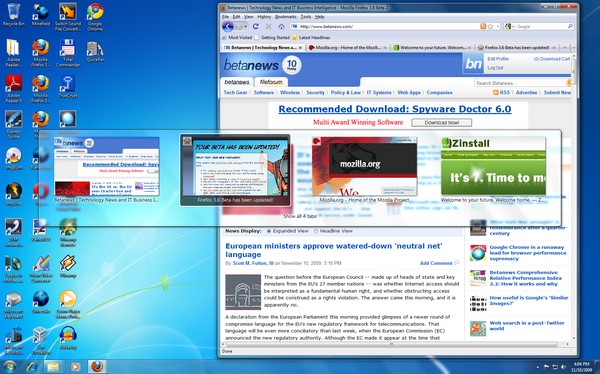
    For reasons we never quite discovered (and that we’d be willing to accept had more to do with Betanews.com than Firefox), the new Ctrl+Tab thumbnail preview feature had difficulty rendering the Betanews front page in Beta 1. That problem seems to have disappeared in Beta 2, so our thumbnail now shows up in miniature in the Windows 7 taskbar and in the new Ctrl+Tab selection pane.

    Beta 2 of Firefox 3.6 renders Betanews among its Ctrl Tab previews!

    We haven’t yet run Beta 2 through every benchmark test on every platform, but we’ve just completed an early round of tests on Windows 7. So far, Beta 2 is the best performing Firefox we’ve ever tested, overall. On our new CRPI 2.2 scoring system, it registered a score of 14.63, compared to a 24.63 score for our most recent test of the stable Google Chrome 3 (not a typo there, the difference is exactly 10 points). Our last test of stable version 3.5.4 scored 13.88 on Win7 (we’ll test stable 3.5.5 soon).

    But not everything is faster with Beta 2; there are certain elements of its execution profile that are somewhat faster, and others that are somewhat slower. For example, our tests show that Beta 2 is faster at loading pages, and at accessing that first element of the page, but not necessarily at getting that critical onLoad() JavaScript event fired. That event has been a secret to Apple Safari’s success. The faster that event loads, the faster the browser can start executing code even while the remainder of the page is still downloading and being rendered. Beta 2 scored an 8.69 in our CSS rendering test on Windows 7 versus 3.5.4’s 10.48, which may be an indicator of the effect of bug fixes — maybe more stable, but slower. But Beta 2 scored a 4.38 on loading everyday pages versus 3.5.4’s 2.96; and Beta 2 scored 5.81 on rendering old-style HTML tables versus 3.5.4’s 4.27.

    Mozilla looks like it’s concentrating on improving those elements that everyday users see and feel without a stopwatch (or without Betanews calculating everything to the n-th degree), and it’s making headway there.

    There are obvious changes to the calculation profile, suggesting changes in the JavaScript engine, perhaps for reliability and security. If you look at the speed of individual methods and instructions unto themselves, it’s improved nicely: 43.50 in Windows 7 on the TestWorld instructions test versus a Firefox 3.5.4 score of 41.92. However, put those instructions to work with algorithms, and those faster instructions don’t scale up the same way: Beta 2 scored a low 7.46 on the new JSBenchmark classic algorithmic test battery, while 3.5.4 scored a 9.14.

    Still, the overall score for Beta 2 is a few tenths of a point higher than for Beta 1, suggesting that Mozilla’s making the right tradeoffs. The organization has not publicly announced Beta 2’s availability at the time of this writing, though a confirmed public Beta 2 build was downloadable from Mozilla’s servers. Yes, we tested to make certain this wasn’t a Release Candidate masquerading as a public beta (it’s happened before). “Private” preview builds of 3.6 Beta 3 are already available.

    Copyright Betanews, Inc. 2009


    Add to digg
    Add to Google
    Add to Slashdot
    Add to Twitter
    Add to del.icio.us
    Add to Facebook
    Add to Technorati


  • CrunchDeals: $20 off $100 BestBuy.com purchase with PayPal

    bbuypaypal

    Damn you, Best Buy and double damn you, PayPal. Why must you tempt me so?

    If you have a PayPal account and you use it to make a purchase of $100 or more at BestBuy.com, you’ll get $20 loaded back into your PayPal account “2-3 weeks after the end of the promotion.” Think of it as a lazy man’s rebate. The promotion ends next Monday, November 16th.

    So long, money. I hardly knew ye.

    Use PayPal at BestBuy.com and get $20 cash back on a purchase of $100 or more [BestBuy.com]


  • MySpace To Host Exclusive Stream Of “New Moon” Red Carpet

    Don’t be surprised if MySpace experiences a big traffic spike on Monday, November 16th.  The social network intends to host a live stream of red carpet arrivals at the world premiere of The Twilight Saga: New Moon.

    In one sense, this could have been something of a cheap trick; it’s a good bet that boatloads of young girls would tune in even if they could only catch a glimpse of Robert Pattinson and listen to a random correspondent babble.  MySpace is demonstrating its influence and taking things quite a bit further, though, offering fans an exclusive experience.

    According to an official statement emailed to WebProNews, "Viewers will . . . be able to take part by posting comments or questions to The Twilight Saga: New Moon Premiere MySpace page that may then be presented to the celebrities during the broadcast."

    What’s more, "Anya Marina, writer and performer of ‘Satellite Heart’ on The Twilight Saga: New Moon Original Motion Picture Soundtrack, will co-host the broadcast."


    The Twilight Saga: New Moon Trailer and Premiere Announcement

    New Moon Premiere | MySpace Video

    So consider passing word of the event along to any relatives or friends who are Twilight fans.  And with respect to what sort of traffic numbers MySpace might see, it should interest even the franchise’s biggest detractors to know that the New Moon trailer received a whopping 4.2 million views within 24 hours of its debut on MySpace.

    Related Articles:

    > Paramount Follows Up "Paranormal" Marketing With More Social Fun

    > Facebook, MySpace May Share Content

    > MySpace Introduces New Music Features

  • Razer’s new Abyssus mouse ain’t fancy, but you wouldn’t guess that from the price

    abyssus
    Don’t get me wrong. I love Razer stuff. But this Abyssus mouse hearkens back to their earlier days when they were hocking two-button, ambidextrous ball mice for premium prices and only a few people took them really seriously. Now, obviously, for some, this super-basic mouse might be a good thing, but really, for $50 you can get a Death Adder (recently upgraded), G500, or any number of premium mice that are probably just as comfortable, and far more capable, than this one.
    http://www.razerzone.com/gaming-mice/razer-abyssus/
    The real problem is that their sensitivities are in hardware switches on the bottom; that can be good, but one of the strengths of Razer mice is their on-the-fly sensitivity, which allows you to dynamically adjust the software sensitivity at any time, to a high degree of precision. That’s not present here. If you really need a stripped-down mouse, there are plenty out there, and I’m sure the Abyssus is great, but for your money, there are better options.


  • Adobe Laying Off 680 Employees

    It’s official — following several tweets today from Adobe employees, a company spokesperson confirmed for us that Adobe “filed an 8-K this afternoon [that]  reports a company restructuring which will result in a 9 percent reduction in the company’s work force (approximately 680 employees).” You can read the filing here.

    “Adobe is restructuring its business to align costs with its fiscal 2010 operating plan and budget, the company’s three-year strategic priorities and the realities of the business environment, as well as to ensure its ability to continue investing in long-term growth opportunities,” the spokesperson continued. The advisory we received also noted that at the close of its acquisition of Omniture, Adobe reduced the Web analytics firm’s work force by 9 percent.

    These are tough times for some folks in the software industry. Adobe’s announcement comes right on the heels of Microsoft laying off 800 employees.

  • More Important Saving Lives From Swine Flu Or Protecting Roche’s Monopoly?

    In other parts of the world, it’s become acceptable for governments to simply ignore drug patents in order to produce more of necessary drugs in times of health scares. However, the US has mostly shied away from doing that, as the myth of patents as some great encouragement for innovation remains deeply rooted (and, oh yeah, pharmas are big campaign funders). However, with growing concern over the lack of supply for swine flu vaccines, there is some talk over whether or not the US will consider importing generic Tamiflu, even though the drug is still under patent in the US. There are approved generics, which are chemically identical, that are made elsewhere, such as India. However, importing it into the US, while it could save lives, is bound to be massively controversial. However, again, if we’re going to have a moral discussion about intellectual property, can someone please explain the moral argument for not being able to use generic drugs in this instance?

    Permalink | Comments | Email This Story