Author: Serkadis

  • Amazon Kindle For PC Now Available

    Amazon.com has released its free Kindle for PC application that allows users to read books on their personal computer without having to own the e-reader device.

    The move comes as Amazon aims to make it s Kindle content available on a broader range of devices. Kindle books can now be read on the iPhone, iPod touch, Kindle DX and now a PC.

    Amazon has made its Kindle for PC available for free download to users in over 100 countries. The U.S. Kindle store offers access to more than 360,000 books, including new releases, which are usually priced at $9.99 or less.

    Kindle for PC features include Amazon’s Whispersync technology that automatically saves and synchronizes bookmarks and last page read across devices. The Kindle for PC allows users to read some on their PC and some on a Kindle, while saving their place.

    Kindle-For-PC

    "Kindle for PC is the perfect companion application for customers who own a Kindle or Kindle DX," said Ian Freed, vice president, Amazon Kindle.

    "Kindle for PC is also a great way for people around the world to access a huge selection from the Kindle Store and read the most popular books of today even if they don’t yet have a Kindle."

    Sony’s eBook Store and BarnesandNoble.com are compatible with a Mac or a PC, while Kindle for PC is compatible with Windows XP, Vista and Windows 7.

    Key features of the Kindle For PC include:


    • Access their library of previously purchased Kindle books stored on Amazon’s servers for free
    • Choose from more than 10 different font sizes and adjust words per line
    • View notes and highlights marked on Kindle, Kindle DX, iPhone, and iPod touch
    • Zoom in and out of text with a pinch of the fingers (Windows 7 users only)

    Related Articles:

    >Amazon Rolls Out Kindle For PC

    >Electronic Books May Become Really Popular

    >Consumer Interest In E-Readers Mixed

  • It’s the US vs. the EU over Oracle+Sun and the meaning of ‘open source’

    By Scott M. Fulton, III, Betanews

    Oracle top story badgeLate yesterday, Sun Microsystems gave the first public notice to the US Securities and Exchange Commission that Oracle Corp., its prospective suitor, had received a Statement of Objections from the European Commission with regard to Oracle’s plan to acquire Sun. Not only had 62% of Sun shareholders already cleared the deal last May, but the US Justice Dept. cleared the deal last August.

    At issue was the fate of MySQL, the open source database product that Sun acquired in January 2008. In Sun’s one-paragraph 8-K filing, it mentioned the EC’s sole focus: “The Statement of Objections sets out the Commission’s preliminary assessment regarding, and is limited to, the combination of Sun’s open source MySQL database product with Oracle’s enterprise database products and its potential negative effects on competition in the market for database products.”

    Though the EC had not yet issued its own official statement on the Objection, as is its usual course with private communications, once Oracle issued its own public statement confirming receipt of the letter, the US Justice Dept. took an unusual stand of its own. Late yesterday, Deputy Assistant Attorney General Molly Boast weighed in with the US’ official opinion that Oracle would continue to produce MySQL in addition to its own commercial RDBMS, going so far as to hypothesize that if Oracle changed MySQL, the open source community would change with it.

    “There are many open-source and proprietary database competitors. The Division concluded, based on the specific facts at issue in the transaction, that consumer harm is unlikely because customers would continue to have choices from a variety of well established and widely accepted database products,” reads DAAG Boast’s statement last night. “The Department also concluded that there is a large community of developers and users of Sun’s open source database with significant expertise in maintaining and improving the software, and who could support a derivative version of it.”

    Boast appeared to echo Oracle’s response earlier in the day, which was quite strong but not at all uncharacteristic of Oracle: “The transaction does not threaten to reduce competition in the slightest, including in the database market. The Commission’s Statement of Objections reveals a profound misunderstanding of both database competition and open source dynamics. It is well understood by those knowledgeable about open source software that because MySQL is open source, it cannot be controlled by anyone. That is the whole point of open source.

    “The database market is intensely competitive with at least eight strong players, including IBM, Microsoft, Sybase and three distinct open source vendors,” Oracle’s statement continued. “Oracle and MySQL are very different database products. There is no basis in European law for objecting to a merger of two among eight firms selling differentiated products. Mergers like this occur regularly and have not been prohibited by United States or European regulators in decades.”

    The double-whammy response — colored red, white, and blue, but mainly red for Oracle — triggered an unprecedented comment from EC spokesperson Jonathan Todd, who with regard to previous Statements such as to Intel and Microsoft, withheld comment until a later time. In a comment to Dow Jones this morning, Todd dismissed Oracle’s statement as “superficial,” but then went straight to the heart of the Justice Dept.’s complaint, suggesting that the DOJ didn’t really investigate the conditions of the merger.

    “We don’t always have the same evidence in front of us,” Todd told Dow Jones. He went on to suggest that if Oracle acquires the copyright to MySQL, Oracle could then exert its influence in deciding which developers had the right to make use of it — meaning it would no longer truly be open source.

    It is true that, while the US Justice Dept. has not demonstrated any particular duty to protect “open source” as an entity unto itself, the European Commission has. While the US’ assessment of this and other cases tends to evaluate the past, present, and prospective future positions of companies in the market, the EC often portrays open source as a competitor deserving of certain guarantees.

    To that end, Todd added to Dow Jones that he felt it unusual for the DOJ to comment with regard to what he considered a matter of European jurisdiction. Oracle is headquartered in Redwood Shores, California, and Sun Microsystems in Santa Clara. MySQL was founded in Sweden, though its official headquarters as a Sun subsidiary is now in Cupertino.

    The public face of MySQL, vice president Kaj Arno, has withheld direct comment on the whole affair, although last July he posted links to comments from his colleagues suggesting a positive outcome. Since that time, however, one of those colleagues — MySQL co-creator Michael “Monty” Widenius — posted his objection to the deal last month, unless Oracle were willing to offload MySQL to a third party, “enabling an instant solution instead of letting Sun suffer much longer,” as Widenius put it.

    Recently, Widenius followed up that post with what was effectively a how-to guide for killing MySQL off. “The easiest way to kill MySQL would be to not sell licenses any more or make their prices ‘really high,’” he began.

    Then he advanced a theory which effectively counters the position of the Justice Dept.: “The simple fact is that keeping a project like MySQL alive and having it compete with big vendors like Oracle, require many people working in it. If they can’t get any revenue from doing that (except support revenue, which is not enough), you will find very few companies prepared to do development, and extremely few (or none) investment companies would put serious money on a company that gets all of its money on services (not scalable).”

    Copyright Betanews, Inc. 2009


    Add to digg
    Add to Google
    Add to Slashdot
    Add to Twitter
    Add to del.icio.us
    Add to Facebook
    Add to Technorati


  • Justices Show Supreme Skepticism About Broad Business Model Patents

    You never know how they’ll actually rule, but in hearing the oral arguments in the Bilski case over the patentability of business models (and, most likely, software), one thing became quite clear: nearly every Supreme Court Justice was seriously skeptical of outlandish patent claims. We’ve noted, of course, that the Supreme Court over the past few years has taken a renewed interest in patent law, pushing back time and time again against the Federal Circuit (CAFC), who in the 80s and 90s seemed to take the position that more patents was always a good thing. Sensing that, with Bilski, CAFC even pushed back on its own earlier rules, and it appears that the Supreme Court at least agrees that the era of crazy business model patents should end now. The full transcript is worth reading, but Justin Levine did a nice job summarizing some of the highlights in the questioning by the Justices:


    JUSTICE GINSBURG: But you say you would say tax avoidance methods are covered, just as the process here is covered. So an estate plan, tax avoidance, how to resist a corporate takeover, how to choose a jury, all of those are patentable?

    MR. JAKES: They are eligible for patenting as processes, assuming they meet the other statutory requirements.

    JUSTICE BREYER: So that would mean that every — every businessman — perhaps not every, but every successful businessman typically has something. His firm wouldn’t be successful if he didn’t have anything that others didn’t have. He thinks of a new way to organize. He thinks of a new thing to say on the telephone. He thinks of something. That’s how he made his money. And your view would be — and it’s new, too, and it’s useful, made him a fortune — anything that helps any businessman succeed is patentable because we reduce it to a number of steps, explain it in general terms, file our application, granted?

    MR. JAKES: It is potentially patentable, yes.


    JUSTICE BREYER: You know, I have a great, wonderful, really original method of teaching antitrust law, and it kept 80 percent of the students awake. They learned things.[Audience laughter.] It was fabulous. And I could probably have reduced it to a set of steps and other teachers could have followed it. That you are going to say is patentable, too?

    MR. JAKES: Potentially.


    JUSTICE SCALIA: You know, you mention that there are all these — these new areas that didn’t exist in the past because of modern business and what-not, but there are also areas that existed in the past that don’t exist today. Let’s take training horses. Don’t you think that — that some people, horse whisperers or others, had some, you know, some insights into the best way to train horses? And that should have been patentable on your theory.

    MR. JAKES: They might have, yes.

    JUSTICE SCALIA: Well, why didn’t anybody patent those things?

    MR. JAKES: I think our economy was based on industrial process.

    JUSTICE SCALIA: It was based on horses, for Pete’s sake. You — I would really have thought somebody would have patented that.

    Of course, these are the same Justices that have been pushing back on the patent world for quite some time. What about the newer Justices? Turns out they were pretty skeptical as well. There were some questions about new Justice Sotomayor, who had been an IP litigator at one point, but seemed pretty skeptical of these sorts of patents:


    JUSTICE SOTOMAYOR: So how do we limit it to something that is reasonable? Meaning, if we don’t limit it to inventions or to technology, as some amici have, or to some tie or tether, borrowing the Solicitor General’s phraseology, to the sciences, to the useful arts, then why not patent the method of speed dating?

    MR. JAKES: Well, first of all, I think, looking at what are useful arts, it does exclude some things. It does exclude the fine arts. Speaking, literature, poems, I think we all agree that those are not included, and there are other things as well. For example, a corporation, a human being, these are things that are not covered by the statutory categories.

    JUSTICE SOTOMAYOR: So why are human activities covered by useful arts?

    MR. JAKES: Human activities are covered.

    Chief Justice Roberts dug into the Bilski patent in question, and noted how ridiculously broad the claims were:


    CHIEF JUSTICE ROBERTS: What — I’m looking at your Claim 1, in Joint Appendix page 19 to 20. How is that not an abstract idea? You initiate a series of transactions between commodity providers and commodity consumers. You set a fixed price at the consumer end, you set a fixed price at the other end, and that’s it.

    I mean, I could patent a process where I do the same thing. I initiate a series of transactions with sellers. I initiate a series of transactions with buyers. I buy low and sell high. That’s my patent for maximizing wealth.

    I don’t see how that’s different than your claim number 1.

    He went on to point out that some of what the patent seems to cover has been around since the 17th century (history buff, apparently). Anyway, you never know how the Justices will actually rule — and there are big questions well beyond just “allow/don’t allow” that will be the really important thing to watch for in the decision. Will they set up a new “test” for patentability? Will they exclude certain areas (business models? software?) from patent coverage? Will they come out with a very narrow ruling that just focuses on Bilski’s patent and leave the bigger questions for another day? That’s where things will get interesting. But, at the very least, it seems likely that the worst case scenario of saying a patent like Bilski’s is valid is quite unlikely to be the end result.

    Permalink | Comments | Email This Story


  • The Traffic News Corp. Would Lose Without Google

    As you may know, Rupert Murdoch, Chairman and CEO of News Corp., is saying he may block search engines from accessing the organization’s content. He expressed this notion in a recent interview.

    If Murdoch were to act upon this, it would mean theoretically that you would no longer be able to find Wall Street Journal, New York Post, etc. content on Google. Of course that would be in a world where scraped content isn’t frequently crawled by search engines.

    If Murdoch were to pull all of the original content, he would risk all of his content just being found on other sites through Google (or Yahoo or Bing or wherever). The reality is that illegal scraping will continue to exist, and search engines aren’t perfect. There is a great chance that they will still crawl the content, without even knowing it was originally produced by News Corp. properties. With News Corp.’s content in the search engines, at least the engines will be able to place that content higher in results where it would be more likley to drown out the scraped versions.

    This week, a Google spokesman told Emma Barnett at the Telegraph, "Google News and web search are a tremendous source of promotion for news organisations, sending them about 100,000 clicks every minute."

    and…

    "If publishers want their content to be removed from Google News specifically all they need to do is tell us."

    So in other words, Google is fine with Murdoch pulling out. News Corp.’s the one that stands to lose more from that. Experian Hitwise shared some rather interesting data with WebProNews:

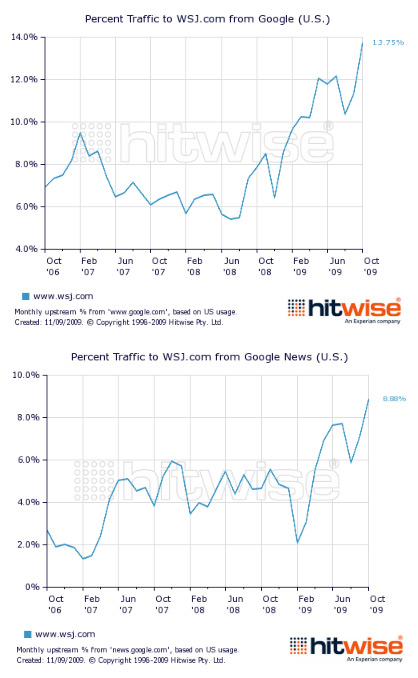
    – On a weekly basis Google and Google news are the top traffic providers for WSJ.com account for over 25% of WSJ.com’s traffic. 
     
    – According to Experian Hitwise data, over 44% of WSJ.com visitors coming from Google are "new" users who haven’t visited the domain in the last 30 days.

    – Twitter and Facebook sent 4% of US visits to News and Media sites in October 2009. (via @Hitwise_US)

    Percentage of Traffic to WSJ.com from Google

    It’s interesting to look at the above graphs and note that WSJ.com is getting considerably more traffic from Google and Google news than in years past. It will also be interesting to see if Murdoch goes through with pulling content from Google.

    As it stands right now, it is still easy to go to Google News and find content from the Wall Street Journal. If that and other News Corp.- owned publications are removed, that can only mean increased traffic for similar sites.

    Related Articles:

    > Murdoch On Blocking Search Engines: "I Think We Will"

    > Google Okay With Blocking News Corp.

    > Murdoch Says Newspapers Must Charge For Online Content

    > Obvious: People Don’t Want to Pay for Online News

    > Google Trying to Differentiate Between Blogs and News?

    > Can SEO Help Save the Publishing Industry?

    > Reuters Happy to Take Traffic the AP Doesn’t Want

  • Panasonic Japan to release AVCHD-compatible, external DVD burner

    panasonic_VW-BN2

    Panasonic Japan announced the VW-BN2 [JP] today, an external DVD burner that supports video recorded in the AVCHD format. The device allows you to burn your AVCHD video files directly from the camera (via USB 2.0) onto DVD. You can also use it to convert HD video quality into standard quality videos.

    The maximum burning speed is 8x for DVD±R, 4x for DVD±R DL, 6x for DVD-RW, 8x for DVD+RW and 3x for DVD-RAM. The device is sized at 139×138.8×18mm and weighs 395g.

    Panasonic plans to start selling the burner in Japan for $290 from December 25. No word yet on international sales plans.


  • The Ultimate iPhone Car Kit: Complete remote control via the iPhone

    Is there anything the iPhone can’t do? Sure you can store your files, add contacts, and play Civilization Revolution on it but did you know you could drive your car with it?

    The lads from Engineer Awesome rigged up a Oldsmobile Delta 88 to run entirely by remote control and then created an iPhone app so they could drive the sucker with a few choice taps and swipes.

    They also ride their car like a surf board.

    The boys come from Waterloo Labs at National Instruments so these guys know how to bring the science.


  • Samsung announces its own ‘open’ mobile platform – bada

    bada

    As Sesame Street is currently celebrating its 40th anniversary, now seems like as good a time as any for us to practice our counting…of mobile operating systems/platforms. 1. 2. 3. 4. 5. Darn, my hand ran out of fingers! Well, no matter, Samsung thinks there is plenty room for more and has taken the wraps off its own, new open mobile platform, bada.


  • Word from the White House: Controlling Costs for Families, Small Businesses, and the Government

    It’s no secret that institutions of all stripes focus their communications on certain messages day to day. We thought it would all be a little more open and transparent if we went ahead and published what our focus will be for the day, along with any related articles, documents, or reports. 

    Supporting blog post: "Bending the Curve in More Ways Than One," OMB Blog, OMB Director Peter Orszag, 10/13/09

    Talking Points: Controlling Costs for Families, Small Businesses, and the Government

    From the beginning of this process, President Obama has been clear that health insurance reform must not only provide security and stability for Americans with insurance and affordable options for uninsured Americans, but also slow the unsustainable cost growth that is burdening families, threatening businesses’ viability, and exploding our national deficit.
    Fortunately, the House and Senate versions of reform share a variety of measures that will reduce the rapid growth in health care costs while also providing Americans with higher quality care including:

    Changing the way we handle hospitalizations, to prevent mistakes and to prevent unnecessary readmissions.
    Creating incentives in the payment system to reward quality of care rather than just the quantity of procedures.
    Giving physicians incentives to collaborate in the coordination of patient care.
    Investing in research into what works and what doesn’t in health care.
    Reducing hospital-acquired infections and other avoidable health-center acquired conditions through rigorous reporting and transparency.
    Putting prevention first, rewarding care that focuses on wellness and treating the whole patient in an integrated and coordinated delivery system.
    Tackling the insurance bureaucracy, streamlining the payment system to save time and money that is now spent processing claims and navigating through the byzantine insurance system.
    Establishing a health insurance exchange with a public insurance option, where individuals and small businesses can buy lower-cost insurance that will spur competition and put downward pressure on costs.
     

    These measures build upon the significant down payment we already made in the American Reinvestment and Recovery Act to begin switching from paper records to computerized records; to strengthen preventive care; to invest in patient-centered health research; and to build up the workforce of primary care providers.
    And there are also ideas that will further control cost growth that have been proposed and are being looked at as the legislative process continues, such as:

    A fee on insurance companies offering high-premium plans — which would create a strong incentive for more efficient plans that would help reduce the growth of premiums.
    Establishing a Medicare commission — which would develop and submit proposals to Congress aimed at extending the solvency of Medicare, slowing Medicare cost growth, and improving the quality of care delivered to Medicare beneficiaries.

  • Sega reveals Bayonetta Special Edition for Europe

    Sega has some extra good news for our gamer friends across the pond. Sega Europe has put together a special edition bundle for Bayonetta that will be …

  • Samsung Aims for the Masses With bada, But Will Developers Bite?

    Samsung-Intros-Mobile-Platform-bada-3GSamsung today unveiled plans to launch a new mobile software layer in the hopes of bringing high-end, smartphone-style apps to a broad range of its handsets. The question, of course, is whether it can lure developers to the platform.

    Samsung’s bada – which means “ocean” in the Korean company’s native tongue — is an open platform designed to allow developers to create full-blown mobile apps for handsets that may not run a traditional smartphone operating system. While Samsung isn’t disclosing many details, bada is described as a software platform — not a competing OS — that rides atop the company’s proprietary phone software, and that could run on top of Linux. The manufacturer is releasing a full SDK and Samsung handset simulator, and plans to woo developers at a conference next month in Seoul, Korea, with events in London and San Francisco to follow in January.

    But those developers have an ever-increasing number of attractive platforms on which to build their apps. Apple’s iPhone dominates the smartphone app space, of course, but Google is gaining traction in a big way with the recent launch of Verizon’s Droid initiative, and Research In Motion is building out an app store to serve its massive customer base. What’s more, those vendors are luring developers by dangling millions of dollars in prize money.

    Described by one Samsung executive as the company’s “landmark, iconic new platform,” bada will launch for developers next month and will make its commercial debut in handsets in the first half of 2010. Apps developed using bada will be available through Samsung’s Application Store. As the company noted in a press release:

    “By adopting Samsung bada, users will be able to easily enjoy various applications on their mobile,” the manufacturer said in a prepared statement. “Samsung bada also offers an easy-to-integrate platform for mobile operators so that mobile operators can provide unique and differentiated services to their customers.”

    While the thought of yet another mobile platform may seem ridiculous, the strategy at the heart of bada is compelling. As GetJar has proven, there’s a substantial demand for apps by users who don’t own high-end smartphones. If bada can help developers address a broad base of handsets simply by making a few small tweaks to existing smartphone apps — which is no mean feat — it may gain traction with the kingmakers of the mobile realm.

  • Dante’s Inferno PS3 and Xbox 360 demo out next month

    Visceral Games has a grand idea for gamers this holiday season: spend Christmas in hell! No, not literally, of course, and they don’t mean having Chr…

  • Qik gets DROID support, DVD-resolution streaming video dreams come true

    Motorola-droid-Screenshot-2

    Our favorite live video-broadcasting service just upped the ante last night. Qik has gone ahead and introduced not only support for Android 2.0 and the Motorola DROID, but the capability to stream 720×480 video live right from the handset. Because the camera supports that resolution, dummies. We’ve taken it out for a spin and have been pretty blown away by the video quality and also the updated interface and UI. If you want to download the DROID-specific version, you’ll need to shoot an email over to Qik. Sample video and the email address along with press release is after the break.

    Droid Does Qik!

    Our eyes popped a few weeks back when we first learned about the powerful Motorola Droid and the potential it has with its amazing camera. We set out to enhance our Android client to not just have the basic Droid and Android 2.0 support – but also showcase the power of the device. Today we are really excited to announce that no only can you download the Qik client from the Android Marketplace that supports Droid, but also request early beta access to a high-res Qik client for Droid that can capture videos in DVD resolution.

    Share your experiences in DVD resolution

    With this device we are raising the bar on quality – yet again! Qik for Droid can now capture of DVD resolution (720×480) video – first ever by any live mobile video provider. If you are interested in giving this beta version a try send an email to [email protected]

    Droid and Android 2.0 support

    We have reworked our UI to support Droid’s amazing new high resolution screen.

    Sharing gets more personal with improved Speed Sharing Ribbon
    The Qik Speed Sharing Ribbon(TM) makes it easy to share what you are seeing with your friends. You can create shortcuts to select contacts from your phone and place them in the Speed Sharing Ribbon so that the next time you Qik you can share your Qiks with them with just a tap on the screen. You can even record your Qiks as private and share them privately just by selecting a person from the Speed Sharing Ribbon. Also, you can setup your sharing preferences for your favorite social networks like Facebook, Twitter and YouTube right from the phone and have them appear on the Speed Sharing Ribbon enabling you to share your Qiks with ease.

    So, equip your new Droid device with Qik by downloading it from the Android Marketplace and let us know what you think by sending an email to [email protected].

  • Is Murdoch’s Move Against Google Really About Twitter And Facebook?

    I’m a big believer in the idea that “earned media” or “earned links” are increasingly important online. That’s the idea that growing numbers of people are relying on news links that are being passed to them via friends on social networks like Twitter and Facebook. It’s about recognizing that more and more often news stories “find people” rather than the other way around. That is, people are increasingly getting links from friends, acquaintances and colleagues, rather than going searching for the news. And those “earned” links or “passed links” are quite valuable because friends are more likely to trust and pay attention to what is personally sent to them, rather than what’s just on the front page of a news site.

    However, even given all of that, I’m not sure I buy Mark Cuban’s explanation for Rupert Murdoch and his plan to stop Google from indexing his sites. Cuban says that it’s all about this recognition that such earned links are becoming so important these days, and Murdoch realizes that links from Twitter and Facebook are growing in value, whereas links from Google have little value. To be honest, I’d be surprised if Murdoch had thought through it that carefully, but more to the point, I’m not sure I believe the full premise. Yes, those links are valuable, but they need to start somewhere, and one of the ways they start is from news junkies using aggregators like Google News to find the news and start passing them around. Blocking that starting process makes little sense. On top of that, even when I’m passed a link, I’ll often use Google News or other sites to dig deeper. Taking News Corp. sites out of the picture doesn’t help at all. And, finally, while I keep hearing about sites getting so much more traffic from such passed links these days, I can say with authority that on Techdirt, they’re still a tiny fraction of the traffic we get from Google.

    So, yes, directly passed links from friends or colleagues are valuable and important, but it’s a part of a wider ecosystem of news sharing that Google News and other aggregators are most certainly a large part of. Saying that blocking Google News makes sense because of things like Twitter and Facebook ignores how Google News plays into those links even being on Twitter and Facebook.

    Permalink | Comments | Email This Story


  • Here’s Why Motorola Bet on Android

    37875The estimate that Verizon sold 100,000 Droid phones this weekend as part of the Droid onslaught is pretty sweet for Motorola, as is the assumption from Mark McKechnie with Broadpoint AmTech that the cellular provider purchased 200,000 of the handsets from Motorola in anticipation of high demand. But the more interesting part of his research note wasn’t the past — it’s the future, namely that he thinks Motorola’s handset business should return to an operating profit next year on the strength of co-CEO’ Sanjay’s Jha’s bet on the Android operating system. From the analyst note:

    We estimate each Android unit contributes 4x the gross profit of a feature phone unit and that 10 million Android units will contribute nearly half of the gross profits in MOT’s handset division.

    And that profit boost is why Jha is betting on Android — and why the bet must succeed. Motorola doesn’t have any more aces, and consolidation is a real threat for the handset industry. After watching Apple’s iPhone and devices from Research In Motion steal profits from the handset industry, Jha hopes Android offers the winning hand that Motorola needs in order to take some of those profits back.

  • Criterion’s Need for Speed title set for 2010

    Electronic Arts’ Need for Speed racing franchise has been on a downward spiral in the past few years, and even EA admits it. They’re now taking steps …

  • Medicare Advantage Plans Are Largely Unpopular In Rural States

    Kansas Health Institute examines Medicare Advantage plans, which are less popular in rural areas, in a series of reports: “In Kansas, about one in 10 Medicare beneficiaries is enrolled in a Medicare Advantage plan. That’s about half the national average. Medicare Advantage plans, which have about 40,000 Kansas participants, tend to be more popular in urban states where the beneficiary pools are larger and most doctors and hospitals participate in the plans. But in a rural state like Kansas, it’s not unusual for a small town doctor to refuse participation in Advantage plans because they mean more paperwork and less pay. Most small town hospitals also balk at joining an Advantage plan network.”

    “‘If you’re a hospital, the reason you’d sign up for an Advantage plan is to get a certain number of patients you’re not getting now. You agree to see them for less based on the likelihood that you’ll be seeing more of them and come out ahead,’ said Dennis George, chief executive for the Coffey Health System hospital in Burlington. ‘But if you’re the only hospital in a small town, it’s pretty unlikely that you’ll be seeing more patients and the last thing you want to do is see the same number of patients for less money.’ … Today, Advantage plans are subsidized by Medicare and cost, on average, between 12 percent and 14 percent more than traditional Medicare” (Ranney, 11/9).

    In a separate article, KHI reports on support for cuts to Medicare Advantage plans: “A key provision in the health reform bill passed late Saturday by the U.S. House calls for cutting billions of dollars currently spent on federal subsidies to Medicare Advantage plans. Those savings would then be shifted to help underwrite the expansion of health insurance to millions of Americans. But the Medicare Advantage plans, if the bill becomes law, will have to find ways to cover beneficiaries for less than what standard Medicare services cost or, most likely, go out of business. That’s all right with Kansas Insurance Commissioner Sandy Praeger, a Republican.” (Ranney, 11/9).

    In another article, KHI reports on seniors’ differing views of Medicare Advantage plans. Pam Brown, a counselor at the Jayhawk Area Agency on Aging office in Topeka, says that dissatisfaction “comes when seniors realize they’re paying higher co-pays and deductibles than if they’d opted for regular Medicare and supplemental coverage, or when they realize their doctor or hospital is not part of their Advantage plan’s network. … Those who ‘love’ their Advantage plans, she said, usually cite the lower premiums and the access they provide to free or low-cost services such as dental care, eye exams, hearing aids, or fitness club memberships” (Ranney, 11/9). KHI also includes an explanation of the Medicare Advantage program (11/9).

  • Key Senators Could Influence – Even Halt – Action on Health Bill

    In anticipation of the full Senate debate on health reform, news organizations are keeping tabs on lawmakers who could become players – or obstructers – when the bill hits the floor.

    The Washington Post: Sen. Tom Coburn, R-Okla., “has no faith that Congress will improve America’s health care system and says the Senate even makes it hard for him to heal the sick. He recently had to stop delivering babies and now only sees a few patients for free because of what he calls absurd rules governing outside compensation for U.S. senators” (Jordan, 11/10).

    The Burlington Free Press: “As the spotlight on health care reform shifts from the House to the more conservative Senate, Sen. Bernie Sanders, I-Vt., will be pushing for a hard left turn in the form of a single-payer system.” Because even Sanders admits such a plan would not be politically viable nationally, he is pushing to allow states to create their own, miniature single-payer systems (Gaudiano, 11/10).

    Roll Call: Sen. Ben Nelson, D-Neb., a moderate, said he would not vote to allow a reform bill to be debated unless it includes language restricting federal funds to be applied towards private insurance plans that cover abortions (Drucker, 11/9).

    New York Times: Senator Susan Collins, a Maine Republican and pivotal centrist courted by the White House, delivered a blistering critique of the Senate bill on Monday, saying she could not support it because it would increase insurance costs for many middle-income families and small businesses (Pear, 11/9).

  • Senate Braces For Final Reform Drive

    Roll Call: “Senate Democratic leaders are still pushing to bring up their health care reform bill next week, even though the gambit comes with risks as they race against the clock to get a measure passed before the end of the year.” In his effort to bring the health bill to the floor next week before the Thanksgiving recess, Reid “appears to be calculating the public relations dangers of suspending debate” for the weeklong recess “do not outweigh the need to get the debate rolling” (Pierce, 11/10).

    The Hill: “Senior aides and senators say Democrats plan to pivot quickly and file the first procedural vote as early as Monday. A ‘motion to proceed’ vote, which brings the bill to the floor, would require 60 votes — a first, critical test of the caucus’s unity on procedural votes.” Meanwhile, the Congressional Budget Office is expected to complete its cost analysis of the Senate Democrats’ reform bill “by the end of this week or early next” (Rushing, 11/9).

    McClatchy: But the GOP definitely plans to use the Senate’s procedures to their advantage. “Republicans Monday had new hope that they could influence health care deliberations — influence that’s so far eluded them — as the debate moves to the Senate, where the rules and the politics can work to their advantage,” meaning, the Democrats may have difficulty reaching the necessary 60-votes without listening to the more conservative lawmakers Republicans are now working to sway (Lightman, 11/9).

    CQ Politics: “Senate Majority Leader Harry Reid insists that he and his colleagues refuse to be ‘bound by any timelines’ on health care legislation. But House passage of its overhaul bill this weekend has created momentum for — and pressure on — the Nevada Democrat to push forward on a Senate version by year’s end” (11/9).

    The Christian Science Monitor: Five “flash points” to watch in the debate will be: (1) the public option; (2) the cost of the plan; (3) the revenue-raising measures; (4) mandates for people to buy coverage; and (5) abortion (Feldmann, 11/9).

  • Today is Netflix on the PS3 day

    ps3flix (1)

    PS3 owners no longer have to be jealous of Xbox 360 owners. Now, they too can stream Netflix goodness through their gaming console of choice. That is, with a little help from a free Netflix disc they can.

    The loader disc should have arrived last week for those that jumped on the offer right away. Just pop that Netflix disc into your PS3 to load-up the software and away you go. Of course you have to use that disc, which activates the service via Blu-ray’s BD-Live service, every time you want to stream something from Netflix, but it’s better than nothing. Hopefully Sony and Netflix are working on a software update that will enable the service without this step. Hopefully.


  • Google Gives AdWords Users New Alert Options

    Google has introduced a couple of new alert options for AdWords advertisers. Users can of course use account alerts, and can also use custom alerts. Now Google has added new alerts for keyword and budget ideas, which are personalized tips to help users improve their campaigns’ effectiveness. These are in the "opportunities" tab.

    "New ideas are usually generated for campaigns and ad groups every few weeks, but you may miss ideas that can expand your coverage and boost your traffic if you don’t check the Opportunities tab regularly," explains Google’s Dan Friedman. "Now, when there are new ideas available for your review, you’ll see them highlighted along with the rest of your campaign alerts."

    AdWords alerts

    Google has also added the ability to create custom alerts for changes in conversion volume, conversion rate, and cost per conversion for users using AdWords conversion tracking.

    "By setting alerts for your conversion data, you can make sure that you’re quickly notified about fluctuations in your key metrics," says Friedman.

    Google says it is still working on bringing custom alerts to all linked accounts for My Client Center (MCC) users, but until then, you can just set custom alerts for individual accounts if you can log into them directly.

    Related Articles:

    > Google Gives AdWords Advertisers New Comparison Option

    > Google Launches Latest Version of AdWords API

    > More "Ads by Google" Across the Web