Only a couple of days left for Modern Warfare 2 for release. More and more info is being poured. Here is one of those. Four new screenshots of the game was released. Have a look…


Only a couple of days left for Modern Warfare 2 for release. More and more info is being poured. Here is one of those. Four new screenshots of the game was released. Have a look…
 There were rumors out there that the iPhone would be coming to authorized resellers soon, and we’re finally starting to see it showing up. Surprisingly, The Shack will be the first one out the gate.

It was one of the most sought after applications on the Internet until it was leaked earlier today. And now that it’s out there—and it is all over the place, easily findable by anyone able to use a search engine—we can all move on with our lives. Yes, Microsoft COFEE, the law enforcement tool that mystified so many of us (including Gizmodo~! and Ars Technica~!), is now available to download. If only there were a “bay” of some sort where, I don’t know, pirates hang out…
I’m not mentioning any names, nor will there be any screenshots, but the resourceful among you will be able to find the application. Not that it’ll do you any good, since this is how Microsoft describes COFEE, which stands for Computer Online Forensic Evidence Extractor:
With COFEE, law enforcement agencies without on-the-scene computer forensics capabilities can now more easily, reliably, and cost-effectively collect volatile live evidence. An officer with even minimal computer experience can be tutored—in less than 10 minutes—to use a pre-configured COFEE device. This enables the officer to take advantage of the same common digital forensics tools used by experts to gather important volatile evidence, while doing little more than simply inserting a USB device into the computer.
To reiterate: you have absolutely no use for the program. It’s not something like Photoshop or Final Cut Pro, an expensive application that you download for the hell of it on the off-chance you need to put Dave Meltzer’s face on Brett Hart’s body as part of a message board thread. No, COFEE is 100 percent useless to you.
Given that, what makes COFEE so mysterious, so special? The sole reason is because it’s never been available before (unless, of course, you’re a law enforcement official). People get a thrill by having something they’re not meant to have, and that effect is magnified online where you have chat rooms and message boards filled with people who get all excited over the idea of having some super-secret piece of software that was never meant to reside on their hard drive.
So that’s that then; Microsoft COFEE is out there. It’s not too big, either, at around 15MB. I’ve kept this post as cryptic as possible primarily to work y’all, and to put over COFEE as the most amazing thing to have never been leaked onto the Internet… until now~!
I’ve discussed in the past the question of whether or not there’s even a moral question to consider when it comes to copyright, if you can first show a situation where everyone is better off (i.e., if the end result of content being shared, willingly, is better for both the content creators and consumers, why should morals even be a question?). Separately, I have made clear that I do not engage in any sort of unauthorized file sharing — noting that it is illegal and, I personally believe, wrong. Some people have pushed back on that latter point, suggesting that my labeling it as “wrong” is, in fact, a moral statement as well. A couple months ago (yes, I’m slow, but I’m catching up on some old “saved” submissions), SteelWolf sent over some thoughts on why file sharing is not wrong, and why there’s actually a moral argument in favor of sharing:
It is through sharing that we develop a culture and advance humanity. Creative works like art and music are, at their core, about sharing with others. They tell stories, reveal personalities, or comment on the world in ways that others can appreciate, forming a part of our culture as they are spread around. Gregor Mendel’s discoveries about genetics had no value while they were gathering dust on the monastery bookshelf; it is only when those discoveries were shared with the world that they became vital.Infinite Goods Should Be Shared
Say you have something that is good for others, and it is infinite, so you will not lose any of it by giving some away. I don’t think it’s a stretch to say that most people’s idea of morality would dictate that they should share that thing. In general, information is something that can be seen as a public good. If somebody has a discovery or an idea, it costs nothing to give it away, it is not scarce, yet it can potentially benefit the world.
On this, I absolutely agree — but it is much more the argument for why the content creators themselves should share their content first. And that’s where things get tricky. I do think it makes sense to share content. I think that content creators would find themselves better off if they share their works (and do so strategically, in combination with a business plan that takes advantage of it). But what if the original creator doesn’t want the content shared? Then what?
SteelWolf argues that there’s a moral imperative to share, but again, this seems to apply more to the content creator, than those downstream:
Faced with an infinity of good things in the form of content information, why would somebody chose not to give it away? What is gained by hoarding something that can help others and costs nothing to share? Let’s say you figure out that you can protect people from a deadly virus, say, influenza, with a vaccine. While it costs something to manufacture physical vaccines and mail them to everybody in the world, sharing the information behind it is free. Others can chose whether or not they want to invest money in creating their own, but sharing has given them the option to do so where before it did not exist. Faced with this situation, who would chose to let thousands of people perish by denying them even the potential opportunity to save themselves?Yet this is exactly the choice many people are making in the name of “intellectual property.” They would rather see others suffer than share something infinite with them, desperately clinging to business models that depend on scarcity. In the 21st century, ideas, information, digitized content are all infinitely available. For these things, the Star Trek replicator has been made, and it’s time to use that as a stepping stone to greater things.
Faced with an infinite supply of information that can potentially benefit billions of people, I chose to share. Those who try to hoard this information are both attempting to drink the ocean and doing wrong.
While I think this is interesting, and at times compelling, in the end I’m still not convinced there’s a moral component here, except potentially for the creator/innovator. But, at the same time, I still believe that we’re better off taking the moral discussion out of it. Perhaps a moral argument like the one above is helpful to convince some, but it leads right back to the economic discussion, where some will ask why anyone would bother in the first place, if they’re just told they need to give it away for moral reasons.
Instead, I’m more convinced by economic arguments that show greater opportunity in sharing infinite goods, in that it decreases the cost of creation, promotion and distribution, while making it easier reach a larger audience for selling scarce products. Again, if you can make the economic argument, and then throw in the moral benefits of spreading information on top of it, that makes sense. But a purely moral argument still falls a bit short for me. Still, I’m sure it will lead to an interesting discussion here.
Permalink | Comments | Email This Story
Last year, we wrote how odd it was that former VP Al Gore banned reporters from a speech he gave, where all audio-video equipment was also banned. These days, such “no reporters allowed” speeches make no sense — because anyone can be a reporter. Yet, it seems that there’s something in the veep sauce (or veep wannabe sauce) that leads to these sorts of positions, as former VP candidate, Sarah Palin, is trying to do the same thing, barring “reporters” along with any kind of recording devices from a talk that she is giving. You can understand, perhaps, why politicians like to do this, but it seems both out of touch and completely pointless. Every single person in that room can be a reporter in one way or another — and it doesn’t take a recording device, but a pencil and some paper (or a decent memory). Trying to block out the “official” press is just a waste of time.
Permalink | Comments | Email This Story

The always thorough DPReview has finally published its epic review of the Canon 7D. Their conclusion? Brilliant. While in the end your purchase probably will rely more on your investment into the Canon, Nikon, Pentax, or whatever ecosystem, the 7D performs incredibly well and should be considered among the very best available. Not much else to say except I wish I had two grand burning a hole in my pocket so I could pick one up.
Is Rupert Murdoch flip-flopping on paywalls again? Way back when (i.e., two years ago) Murdoch was a big believer in the idea that news should be free online, and that he could more than make it up with other business models. But, then, earlier this year, he did a complete flip-flop, declaring that all his publications would put up paywalls, saying that free content is bad, and accusing aggregators and search engines of “stealing” content. Some speculated that it was all a ploy to get others to put up paywalls. Though, others just think Murdoch’s getting a little senile. Either way, it looks like he’s stalling a bit. Jay Rosen points us to the news that Murdoch is “postponing” the date for when he wants his papers to have paywalls. It’s not clear if the delay is due to technical difficulties in implementing a paywall, or if he’s actually reconsidering. Either way, it doesn’t look like the great big paywall is going up any time soon.
Permalink | Comments | Email This Story
 Even though less than 1 percent of the population uses Google Voice, David Erickson, president of the Free Conferencing Corp., a conference call company whose numbers are blocked by the service, is pretty aggrieved. So he met with the FCC and filed a letter urging the regulatory agency to get Google to play fair. He also offered to help Google find lower rates for its rural call termination fees. “Google shouldn’t be able to tell consumers where they can call and where they can’t,” he said in an interview with The Hill, a trade publication.
Actually, I’m with him on this issue. Erickson’s company may be taking advantage of a legal loophole that the telecommunications companies and now Google want closed, but it’s not clearly illegal (although the loophole is closing). And by providing voice service for customers even as an “Internet application” Google’s decision to limit certain aspects of the service because of the costs might be reasonable for a restaurant owner running a buffet, but is less so for someone providing a telecommunications service.
Such so-called traffic pumping is an issue the FCC has known about for a while, so clearly companies like Erickson’s, which appear to be benefiting from an arbitrage play that boosts costs for carriers that have to terminate calls on higher-cost rural lines, haven’t been morally repugnant enough to get the FCC or Congress to take definitive action to stop them.
Erickson doesn’t think the FCC should step in at all on the issue of overhauling the pricing schemes that result in higher termination costs on rural lines (and generates sales at his company), he says in a letter filed this week with the FCC, but he does request more scrutiny over Google Voice. He’s lost me at this point. If you’re gonna run to a regulator to force someone to play your game, you can’t get upset when the regulator wants to make sure the rules by which you play that game are fair.


I amaze myself sometimes. You see, I have so much power as a writer on this invincible and influential blog that sometimes I can change an entire industry with but a word. Case in point: apparently my recent post on Eee’s decision to change the touchscreen to resistive on their Eee Keyboard was so crushing that they’ve altered their entire business plan and delayed the device to accommodate it. O Mighty Blogger! Thou humblest the world!
Actually, I’m guessing they did some focus groups and found that the trade-off of “lower price and crappier touchscreen” with “people actually wanting the device” was unacceptable. At any rate, the device (which had an original internal release window of August-ish) may not make it in time for the holidays. It’s not rare that we see a device at CES that doesn’t make it during the next year, but I really had hopes for this thing.
We were already somewhat concerned about the nomination of Victoria Espinel for the IP Czar job in the administration (forced on the administration by the silly and pointless “ProIP” Act from last year). On Thursday, she had her confirmation hearings where she said pretty much what we expected about how important intellectual property is, and how she viewed her job as coordinating different government agencies to crack down on infringers. Much of her (brief) testimony (pdf) talked up the usual industry claims about the importance of intellectual property on the economy, not recognizing how misleading they are. These are stats that simply credit anything covered by intellectual property laws, as if the only reason those industries exist is because of those laws. That’s a mistake.
But more troubling? Espinel made it clear that her job is not to do as the Constitution requires, and make sure that intellectual property laws are properly “promoting the progress of arts and the useful sciences” (she never mentions this part), but, instead she claims her focus is cracking down on infringement to protect jobs:
If I am confirmed as the United States Intellectual Property Enforcement Coordinator, I will work side by side with agencies, Congress, stakeholders and the public to ensure that jobs that depend on intellectual property are not compromised by others’ unwillingness to respect and enforce the rule of law….
But intellectual property law is not about “protecting jobs” it’s about encouraging innovation. Innovation can be disruptive. Jobs can get shifted around. Protecting jobs is not encouraging innovation. It’s the opposite.
Better and smarter protection and enforcement of intellectual property rights will create more jobs…
There’s simply no evidence to support that. Shouldn’t our IP Czar rely on actual evidence rather than broad industry claims that are unproven?
Then, on being questioned she appeared to support Hollywood’s position that any net neutrality laws won’t apply to mandating content filters on ISPs. It’s looking like — just as was initially feared — this position is really to get Hollywood’s own representative in the White House. What a shame. If you must have an “IP Czar” shouldn’t it be someone who’s actually focused on making sure progress is being promoted, rather than someone who wants to blindly crack down on infringement with no thought towards whether or not it makes sense?
Permalink | Comments | Email This Story
Back in September, we wrote about Glenn Beck’s misguided attempt to gain control over the domain name used as part of an internet meme that is critical of Glenn Beck, GlennBeckRapedAndMurderedAYoungGirlIn1990.com (it’s a dead site now, keep reading). If you’re unfamiliar with the meme, it’s mocking a favorite tactic of various cable news talk show hosts, to “ask questions” that are accusatory in nature, whether or not there’s any substance to back them up. Glenn Beck didn’t accuse the site of defamation or anything, but filed a domain name complaint, saying that it violated his trademark. As we noted at the time, the trademark claim was really questionable — and, of course, only served to draw more attention to the site and the internet meme.
The site brought on lawyer Marc Randazza who filed one of the most brilliant responses (pdf) to a legal threat that you’ll ever see. It’s quite amusing. Randazza takes the old “moron in a hurry” test up one level, using the “abject imbecile” test. And then there was this:
We are not here because the domain name could cause confusion. We
do not have a declaration from the president of the international
association of imbeciles that his members are blankly staring at the
Respondent’s website wondering “where did all the race baiting content
go?” We are here because Mr. Beck wants Respondent’s website shut
down. He wants it shut down because Respondent’s website makes a
poignant and accurate satirical critique of Mr. Beck by parodying Beck’s
very rhetorical style. Beck’s skin is too thin to take the criticism, so he
wants the site down.
Apparently, Randazza’s letter worked wonders. The WIPO Arbitration Panel has rejected the attempt to take the domain, saying that it was a legitimate use of Beck’s name:
In the present context, this Panel considers that if Internet users view the disputed domain name in combination with a visit to Respondent’s website, the “total effect” is that of political commentary by Respondent, capable of protection as political speech by the First Amendment under the Hustler Magazine standard. Respondent appears to the Panel to be engaged in a parody of the style or methodology that Respondent appears genuinely to believe is employed by Complainant in the provision of political commentary, and for that reason Respondent can be said to be making a political statement. This constitutes a legitimate non-commercial use of Complainant’s mark under the Policy.
Either way, now that the site’s owner has prevailed, he apparently feels he has made his point, and has agreed to voluntarily hand over the domain (pdf), along with an explanation in the First Amendment and how not to respond to internet memes:
It bears observing that by bringing the WIPO complaint, you took what was merely one small critique meme, in a sea of internet memes, and turned it into a super-meme. Then, in pressing forward (by not withdrawing the complaint and instead filing additional briefs), you turned the super-meme into an object lesson in First Amendment principles.It also bears noting, in this matter and for the future, that you are entirely in control of whether or not you are the subject of this particular kind of criticism. I chose to criticize you using the well-tested method of satire because of its effectiveness. But, humor aside, your rhetorical style is no laughing matter. In this context of this WIPO case, you denigrated the letter of First Amendment law. In the context of your television show and your notoriety, you routinely and shamelessly denigrate the spirit of the First Amendment….
Permalink | Comments | Email This Story

President Barack Obama signs the Worker, Homeownership, and Business Assistance Act of 2009 in the Oval Office, Nov. 6 , 2009. (Official White House Photo by Pete Souza)
This morning the Department of Labor released its Employment Situation report for October and while the numbers are disappointing, they are not surprising. Analysts have known for some time that the unemployment rate could reach this level, but it remains an unacceptable situation.
When this administration began its work in January 2009, the economy was in a freefall, shedding 700,000 jobs a month. We met these challenges head on by immediately putting a plan into action to create jobs and drive economic growth. As a result, housing markets are now showing signs of recovery, credit is flowing again and just last week we saw that the economy is growing, rather than shrinking, for the first time in a year.
Unfortunately, there are still millions of Americans who want employment but cannot find it. We are committed to supporting these Americans as they look for work and struggle to raise their families and pay their bills.
Earlier today, the President signed legislation that expands unemployment benefits as well as provides an additional tax cut for struggling businesses to help save and create jobs. Extended UI benefits will strengthen our economy further. By helping struggling families pay for groceries and other household needs, economists say that these benefits are one of the best ways to stimulate economic activity.
In addition to this extension, we’ve worked over the past months to revolutionize the unemployment insurance (UI) system. The Recovery Act made $7 billion available in incentives to states to modernize their UI systems. As a result, more workers, including part-timers, and people upgrading their skills are now eligible for benefits for the very first time. These efforts have not only have strengthened the safety net but make it possible for unemployment insurance to be a stepping stone to a better future for millions of Americans.
To be sure, we have a long way to go. There are still millions of Americans who need and want work but can’t find it. There are still too many families struggling. But you can’t have job growth until you have growth in economic output. That is what the policies of this Administration are designed to create and I will make sure that the Department of Labor is supporting workers every step of the way.
Hilda Solis is the Secretary of Labor
 Remember when you’d argue with your friends about how many of this or that you had or did, and someone would always trump you by saying they had infinity? And do you remember the inevitable retort? “Oh yeah, well I’ve got infinity plus one.” Seems someone at Verizon decided to put that childish little witticism into practice as a service plan for the Droid.
I’m heading over to Norway in the next few days to give a talk at the Nordic Music Week event, and it’s nice to see that the courts in that country seem to recognize how silly the IFPI’s demands that major ISP Telenor block access to The Pirate Bay are. Telenor was smart enough to fight back, and the courts have now said that Telenor is not liable for what its users do, and should not have to block access to a site like The Pirate Bay. From TorrentFreak on the ruling:
The court ruled that Telenor is not contributing to any infringements of copyright law when its subscribers use The Pirate Bay, and therefore there is no legal basis for forcing the ISP to block access to the site…. In making its decision, the court also had to examine the repercussions if it ruled that Telenor and other ISPs had to block access to certain websites. This, it said, is usually the responsibility of the authorities and handing this task to private companies would be “unnatural.”
Good to see a court recognize that the entertainment industry doesn’t own the internet, and shouldn’t be the one to determine what is and what is not legal online.
Permalink | Comments | Email This Story
 Nintendo’s generally vocal president, Reggie Fils-Aime, made headlines today when again he denied that Nintendo was working on the Wii HD. He said, “I don’t know how forcefully we can say there is no Wii HD.” That’s pretty clear, but it’s also mostly a lie. What do you expect the man to say two months before Christmas? “Psst, don’t buy the $200 Wii for your kid this year. We’ve got something real special coming in a few months. You’re going to want that instead.”
Does anyone seriously think that Nintendo is not building a high-def capable system? You can’t even buy a SD TV larger than 20 inches anymore. Reggie probably told the truth when he said “there is no Wii HD” as it’s probably not named Wii HD, but there has to be some sort of high-def gaming system in the works. If there isn’t, Nintendo is in trouble.
Nintendo made the right decision to make the original Wii not powerful enough to run HD graphics and therefore less expensive. It became an instant success because of not only the novel motion controller and easy-to-like bundled game, but also the relatively low starting price of $250 when compared to the Xbox 360 and PS3. If Nintendo had built a more powerful system, one of those points would have given way and events might have been a tad different.
Plus, back when the Wii came out, HDTVs were still a luxury. They were only available in larger sizes and a higher prices. Now tube TVs are all but gone and increasingly small LCDs are reaching 720p resolutions. By next year, 1080p will probably be the standard resolution for 32-inch or larger screens and every TV will be at least 720p; Nintendo will need to put out a system accordingly.
Of course this next-generation system will employ a motion control scheme. It’s not like Nintendo is going to take a step backwards. This system might not be called the Wii HD, but it’ll follow the Wii philosophy and be high-definition.
Even if Nintendo outs a system next year that’s as powerful and cheap as a nettop today, it will be able to handle at least 720p graphics with a good graphics driver. Nintendo has proved that gameplay and accessibility are more important in the marketplace than graphics, but as time passes and more households upgrade to high definition, it’s becoming the standard, and Nintendo will have to work within those parameters.
Reggie would never tell us a lie. He’s not like that. However, you can bet that Nintendo is working on a low-cost, but also high-def capable, Wii successor as we speak.
By Scott M. Fulton, III, Betanews

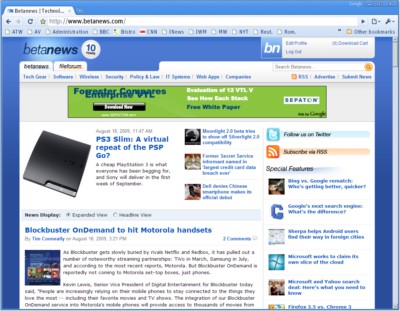 If, as Google says, a Web browser is not so much an application but a platform upon which a new class of applications may be built, then that platform must provide support. It needs to give its users the ability to accomplish tasks, and to devise new and better ways to accomplish them better. For as we all know now, “browser” is an inappropriate word for the thing we use to communicate with the Web using HTTP, because the Web is becoming a space for everyday applications deployment. Especially in the content industry, active work takes place within the browser, much more so than passive amusement.
To that end, a browser may serve either as a springboard or a plank.
Despite Google Chrome’s achievements, the crucial element of support remains missing. For all the spotlight we’ve given Chrome for being the fastest Web browser on Windows, it does not yet serve the purpose of supporting users and helping them to make their online tasks more efficient. This is why Google’s expert tuning of its V8 JavaScript engine for Chrome is so important, because the browser has truly evolved into a JavaScript platform rather than an HTML platform.
For everyone I know who has, over the last year, made the switch from Microsoft Internet Explorer to any other browser, the reasons have had less to do with security than in the past. People who are compelled to switch are tired of how slow IE has become, and the sinking feeling that it’s getting slower — a feeling which Betanews confirmed this week with actual facts. If you’re the manufacturer of a competitive browser, and you have the opportunity to offer your customer a free alternative that’s close to 21 times faster overall than IE, and your brand is not only one of the most recognized in the world but the only one analysts believe can truly challenge Microsoft, you’d think there would be an exodus of mass proportion.
There has been no such exodus. The reason is because, despite the number “4” on the version currently under development, Chrome gives one the feeling that it’s never been finished once.
In a way, it doesn’t make sense to have a JavaScript engine that’s as good as it is, running a platform that is so minimalistic. As the manufacturer of any set-top box can tell you, a viewer’s entire experience in front of his TV can be ruined if the functionality of the program guide isn’t solid. A browser user’s bookmarks list is the counterpart of the program guide; it’s “what’s on,” and it’s also how to get there.
Not that a list of folders and bookmarks is anywhere near as informative as an STB’s program guide. But for years, Firefox has had the good sense to enable users to open the bookmarks list in their sidebar, to open and close it with a keystroke (Ctrl-I) and scroll through it using a scroll bar. For IE8, Microsoft added an appealing and versatile Favorites menu that opens with the same keystroke (as part of an effort to win back refugees to Firefox). This menu starts off life as a pop-up, but can then be pinned to the left side as a sidebar. Then it too can be switched from Favorites (bookmarks) to RSS Feeds and browsing history. It’s a versatile feature that Microsoft has thought through, and that performs well.
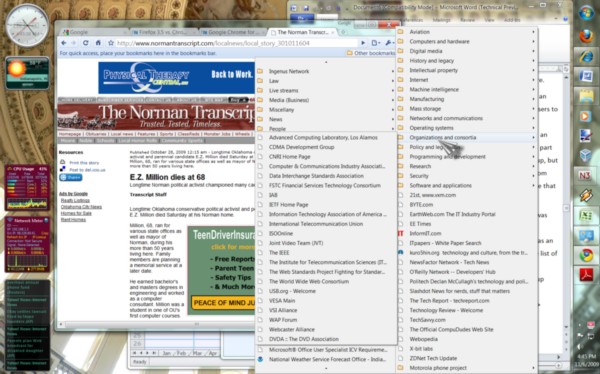
In Chrome 3, the Bookmarks Bar was only part of the New Tab screen, and was actually provided by a Google Web page. With Chrome 4, the Bookmarks Bar becomes a feature of the actual program (along with curious re-additions such as an actual button for the home page, a recent Google discovery). But the complete list of bookmarks is only available through an “Other Bookmarks” menu on the right. Clicking on this button pulls up a drop-down menu, whose folders in turn pull up other pop-up menus. So you’re not perusing a folder tree as with Firefox or IE; instead, you’re scrolling through pop-ups. And you’re scrolling slow…ly… because these are classic menus; there are no scroll bars. So if you have a long bookmarks list, you’re not going anywhere fast.
That I’m no fan of Chrome’s bookmarks system is nothing new — I first called attention to this last June. Back then, Chrome 3 was on the “beta” and “dev” tracks, while Chrome 2 was the version declared stable. Here I noted that Firefox 3.5 was more adept at searching for stored bookmarks by various criteria than Chrome, the browser from the company that’s supposed to be known for search.
But I’m not exactly the only one screaming for functionality out here. Our own Fileforum features reviews from testers over the months who have explicitly asked why Chrome seems to be all chassis and no interface. “It’s as useful as a chocolate fireguard,” wrote madmike; “very bland, short on features, but competent,” wrote bobad; and, “I wish they could make it look and act like Firefox,” wrote CyberDoc999.
Next: Shelving basic functionality under “Other…”
Shelving basic functionality under “Other”
That the Google Chrome user might only keep eight or so Web sites on her New Tab page, plus a handful of “Other Bookmarks” in a menu that should never grow large enough to have to be scrolled; that History is a separate page and not a function you can use side-by-side with other pages; that Chrome lacks the ability to even add the searching, researching, and translating functionality that Google makes for its own Toolbar for IE and Firefox; and that the button for the home page is a new feature that’s just now being tested, are all indications that Google only projects its browser will be used lightly and occasionally, by folks who’ll do a Google query, read the result, and come back to Google. If that’s truly the case, one wonders why Google actually bothers making its underlying JavaScript engine as good as it is — effectively mounting a V8 engine to a tricycle.
In fairness, Mozilla Firefox also lacks that functionality. But Mozilla knows how to help users make Firefox more functional: through a wide array of add-ons, along with a developers’ community that’s nurtured and educated in the ways of making proper software without so much initial trial-and-error.
Plug-ins and add-ons to Chrome do exist, and forums such as this one have cropped up in anticipation of a burgeoning market in these things at some future date. But for now, the theme of these sites appears to be stuck with themes. Even now, when skinning of some applications has become an art form that has brought forth its own grass-roots competitive “Olympics,” Chrome themes are a throwback to the Netscape Navigator era, sometimes comprised of celebrity photos cropped so that their faces fit just inside the tab area, decorated like the bedroom of some Disney Channel star.

Tell me you’d actually intentionally make your own Web browser look like a just-fertilized lawn.
While Internet Explorer is dog slow, and now slower by the month, version 8 has functionality and, for the first time in IE’s existence, a reasonable degree of versatility. It also is relatively stable — crashing is not its problem. Crashing is a Firefox trademark — to this day, the “stable” version crashes on average 1.5 times per day for me, a fact which this “Firefox user” is not proud to share.
Yet even though it does exhibit greater stability, Chrome lacks the functionality that makes it adaptable to users’ everyday purposes, and that enables them to take it beyond the realm of “general purpose” into “heavy duty.” Google’s complete inability to make that jump, to get the clue, to provide evidence of having listened to the smallest portion of tester sentiment, bewilders me completely as to whether the company has any realistic notion of what “beta” means anyway.
With Mozilla, the newest code is developed under a private track, which only means that the developers aren’t taking comments from the public about it, even though it’s publicly available. When it’s developed enough to demonstrate in public, then it enters the “beta” track, which Mozilla code-names “Shiretoko” for 3.5 test code and “Namoroka” for 3.6. When Mozilla delays the rollout of a new build to the stable channel, it gets groans and moans from folks like me…but it’s generally because real beta testers have found real problems, or have advised some really good ideas.
A full-featured browser chassis capable of running thoroughly debugged JavaScript add-ons that won’t crash, and that contain the basic functionality that Microsoft and Mozilla discovered as far back as 2005, coupled with the proven superior V8 JavaScript engine, would clinch the alternative browser market in maybe one year’s time. But that year has already passed for Chrome, which is already gaining a reputation as a browser that makes up for its performance superiority with slow and cumbersome functionality. As long as Google continues to not get this message, then we all need to face up to the fact that Google isn’t exactly open, is it?
 Early in the summer, IPTV startup Myka delivered an impressive Linux-based device which was not quite a set-top box and not quite a home theater PC (HTPC). Though the device’s identity was sort of nebulous, the company’s goal was crystal clear: to easily make the tons of different types of Internet video content viewable on the TV.
This week, the company has announced its second device, the Myka ION, which pushes itself up against the HTPC category. Because it’s equipped with a 1.6 GHz dual core Intel Atom 330 CPU, it could even be called a “net-top box.”
Whatever you want to call it, Myka is really charging toward its goal of making the vast spectrum of Web video available in an easy and compact way. Since the ION is effectively an Ubuntu 9.10 mini ITX PC, it can run popular media manager software Boxee and XMBC alongside the Hulu desktop client — a bit of useful software which neither Boxee nor XMBC can actually run themselves.
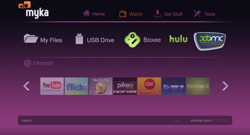 In case the name didn’t already give it away, the Myka ION is equipped with an Nvidia ION GPU which supports DirectX 10 graphics, and full 1080p HD video without overtaxing the CPUs.
The company expects it to be shipping in about four weeks, and it will be available in various configurations, with different capacity hard drive sizes (up to 1 TB) and with additional options like a Blu-ray drive, and 802.11n wireless.
We’ll give it a closer look when it becomes available before the holidays.
Well, Netflix streaming on the PS3 works. Of course, you need to use the special disc (can’t just download the software eh? how quaint). But it appears to be working correctly. Check out the video above, which demonstrates that it’s working, and working smoothly.
I’m actually glad that the PS3 has Netflix streaming now. It’s a nice addition to a really great Blu-ray player. If I owned a PS3, I’d totally get the disc and stream my heart out…
You know, like I have been doing since 2008 on my 360.
With Thanksgiving just a few weeks’ away consumers are already starting to search for deals online.
Over the last seven days fifty percent of the top "Black Friday" related search terms include ads, sales and deals, according to Google Insights for Search.
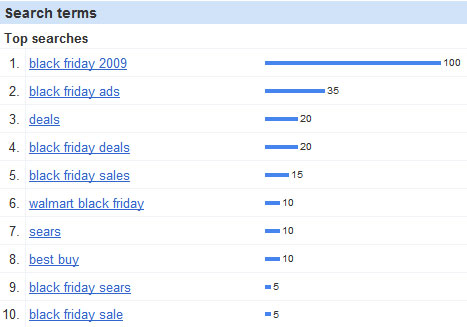
The Google Retail Advertising Blog provides more details. "Interestingly, when we look at Black Friday rising searches over the last 7 days, we see that ‘Early Black Friday’ is the second rising search term, meaning it has grown over 2,000% during this time period with respect to the previous time period."
"It also may indicate that consumers are not only leveraging ‘Black Friday’ and searches to locate promotions on these days, but may be seeking out similar types of promotions and offerings even before Thanksgiving weekend."
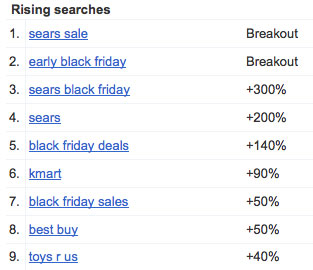
Google also offers advice on what types of ads will appeal the most to bargain shoppers. "Text ads should highlight specific price points, discounts, coupon codes, and special promotions. Also, remember to keep an eye on search trends in your own category by leveraging Google Insights for Search."
Related Articles:
>Cyber Monday Tips From The Google AdWords Crew
>Consumer Online Spending To Grow 24%
>Black Friday Online Sales Better Than Anticipated
We’ve been pretty big critics of the music tax concept, that was being pushed by Jim Griffin’s Choruss along with Warner Music (who had hired Griffin to create this program). Of course, we’ve only been able to criticize what bits and pieces have leaked out from those who have seen Griffin’s presentations. That’s because, despite a busy conference schedule, Griffin never seems to publicly describe what Choruss really is. So, every time we hear some new info about Choruss, and explain why it’s bad, we get angry emails from Griffin calling me all sorts of insulting names, and insisting that I’ve mischaracterized Choruss. So, we ask for more details, and we don’t get them. Instead, we’re given amorphous descriptions about how it’s “an experiment.” But what is the experiment? Well, it will be lots of things. As soon as we narrow in on an example, however, and explain why it’s bad, we’re attacked because the plan might not include that particular example. But we haven’t yet heard an example that makes sense.
Griffin had agreed (as part of an angry email) to answer questions from the Techdirt community, and we obliged by sending him a long list of questions. Griffin had some personal issues to deal with over the summer, which was totally understandable, but we still haven’t heard any answers. I’m beginning to wonder if we ever will.
But the biggest question I had was if he could explain who the “tens of thousands” of students were who Griffin told a conference in June would be using Choruss this fall semester. It seemed odd to find out that so many students had signed up for something when we still weren’t being told what it was. As the fall semester started, we asked to hear from students who were using Choruss, and got silence — which seemed odd. Apparently, it’s because those tens of thousands of students hadn’t signed up for the fall.
However, as a bunch of you have sent in, now the claim is that six college campuses will be testing Choruss this spring semester, but Griffin won’t say who they are and the campuses won’t admit to participating. They claim that they’re afraid of backlash from folks like us — but that makes me wonder. If the concept is so good, why not stand up and defend yourself for being a part of the program? If you can’t defend the reasons for testing the program, it makes me wonder why you’re doing it in the first place.
The article at the Chronicle of Higher Education provides a few new details that don’t sound particularly appealing. Rather than (as some had suggested earlier, but since Griffin never made it clear, we just don’t know if this was ever true) a system that would let students share files freely under some sort of blanket license, it sounds like “yet another limited music service.” It will allow unlimited downloads, but you have to use the Choruss service (again, perhaps the article is wrong, but that’s what it says). Similar services have been tried on various campuses and failed, so we’re curious to hear what’s so special about Choruss that will be different.
It still seems like Choruss is trying to solve a problem that doesn’t exist. We’re seeing more and more smart musicians put in place business models that work. They work in a way that lets fans choose to send money to the artists they want to support directly, without a big middleman. Choruss appears (from all we’ve heard) to be an attempt to set up a big middleman that will take big chunks of money and then use some magical process to figure out how to dole it out. But why do we need that overhead? The market is figuring stuff out. It doesn’t need another middleman.
Permalink | Comments | Email This Story


