Author: Serkadis

  • My Thoughts on the Skype Settlement: Winners & Losers Scorecard

    The final results are in: eBay and private investors led by Silver Lake Partners have struck a deal with Skype founders and JoltID, the technology company controlled by Skype founders Niklas Zennström and Janus Friis. They are also transferring the ownership of intellectual property needed to make sure that Skype works as an Internet telephony service. More than 500 million Skype subscribers can breathe a sigh of relief. Skype founders will be making an investment in the new entity and will get a 14 percent stake in the company. The deal is likely to close in the fourth quarter. Those are the facts. Below the fold you can read my winner-and-loser scorecard on this deal.

    Found Money: Zennström and Friis are the real winners here. For a few hundred thousand in legal bills, they have not only managed to wipe out an investor competitor, they have shifted the focus away from the ignominious failure that was Joost. They have turned their ownership of a P2P technology into yet another payday and, most importantly, they are now sitting in the catbird seat to reap the rewards of Skype again. Verdict: Winners

    0131chip.jpgDouble Dipped: In order to get the deal done, both the investors and eBay took a hair cut. Investors now control 56 percent of the Skype while eBay’s stake is down 5 percent to 30 percent of the new Skype. There is a lot of spin in the press release issued by Skype, but the fact remains as I pointed out on the day this deal was announced, Zennström and Friis had them by the curlies. It was clear that this deal wasn’t going to get done without their blessing.

    “Skype will be well positioned to move forward under new owners with ownership and control over its core technology,” said eBay President and CEO John Donahoe. “At the same time, eBay continues to retain a significant stake in Skype and will benefit from its continued growth. We look forward to closing the deal and focusing on growing our core e-commerce and payments businesses.”

    Poor John is stuck being the mop-up man. eBay, thanks to the stellar work of its previous management team including Meg Whitman, currently running for governor of California, is paying twice for its mistakes. If my previous employer, Business 2.0, was still publishing the 101 Dumbest Things list, I would make eBay’s original Skype deal as the No. 1 dumbest thing…ever! Verdict: Losers.

    Index-ed to Nothing: Now let’s look at this great spin quote:

    The investor group will no longer include Index Ventures, which has withdrawn from participation. Commenting on its decision to withdraw, Danny Rimer of Index Ventures, said: “We are pleased that Skype will now be able to put litigation behind it, and we wish Josh Silverman, his team and the Skype investors well in continuing to grow a great business. Although Skype has the potential to be a great investment, the deal terms changed for Index such that it no longer matches our investment criteria and thus we have decided not to participate in the transaction.”

    Index Ventures and Mike Volpi were the architects of the deal from day one, and so no, they didn’t opt out of the agreement. No one opts out of a deal for which they are happy to bend a few rules. What it means is that they were hustled out, and that tells me two things: This was way, way personal. I have heard it from my sources that there is no love lost between the various entities involved and the lawsuits just brought the hostilities out in the open. Verdict: Losers

    Making a Marc: Earlier this morning I spoke with Marc Andreeseen of Andreessen Horowitz and asked him about the deal. “We wouldn’t go through this for just a company, but this is Skype, so from our standpoint it was worth going through,” he said. He pointed out that his firm is all about founders and “we like founders being part of the company.” He added that there is “no emotional baggage and we didn’t take this personally.”

    This was a high-profile deal for a new fund. Given that Andreessen Horowitz bet so much of their fund’s total money on this deal ($60$50 million of $300 million), any successful conclusion is a win. Verdict: Winners

    Silver Lake Partners: The rest of the investors can breathe easy that this got through. Those personal emails didn’t make pretty reading. The fact that they don’t have to deal with Volpi and Index might be a blessing in disguise. Verdict: Winners

    Canada Pension Plan Investment Board: Are they still there…oh cool! Verdict: Meh!

    No Silver Lining?: One person who I totally feel for is Silverman, the current CEO of Skype. He gets to run a company which will have the looming presence of its founders.

    Whatever the press spin might say, the new investor group is like a poisoned well. It will be a polarized group, always looking over their shoulders. Silverman is going to need to keep a lot of people happy, and those board meetings with nearly two-dozen people aren’t going to be fun, either. But as Biggie Small once said:

    “It’s like the more money we come across, the more problems we see.”

  • Twitter Implementing Retweets On A Small Scale

    Remember Twitter’s plans to make “retweeting” an official function?

    Sure you do, the mock-ups looked like this:

    Well, Twitter just announced the following:

    We’ve just activated a feature called retweet on a very small percentage of accounts in order to see how it works in the wild. Retweet is a button that makes forwarding a particularly interesting tweet to all your followers very easy. In turn, we hope interesting, newsworthy, or even just plain funny information will spread quickly through the network making its way efficiently to the people who want or need to know.

    So keep your eyes peeled, because you might be one of the lucky ones!

    PS. If you’re not seeing the retweet option, Twitter has a consolation prize for you. It’s cleaning up the spam in trending topics.

    Comments

  • Activision calls DJ Hero but a ‘first step’ in expanding the music game genre beyond rock

    djherofirststep

    Here’s comes another DJ Hero story. Activision called the game’s launch “successful” at a conference call yesterday, saying that the game represents a “first step toward diversifying beyond rock” and into other genres, like hip hop and electronic music. In other words, the game’s soft sales aren’t necessarily a cause for alarm (if you were ever concerned in the first place).

    We’ve already discussed why the game didn’t exactly fly off the shelf: it’s too expensive; people may be burned out on the music game genre; DJing doesn’t appeal to people the way that rock does; and so on. Activision did address one issue, and said that the game’s marketing campaign had only begun in earnest during the World Series. People can’t play a game they don’t know exists.

    Activision had better hope that “people may be burned out on the music game genre” isn’t the case if it truly intends for DJ Hero to be a “first step” in branching out to other genres.

    And of these genres, which ones have any chance at all of success in the U.S.? You can assume hip hop has the best shot, given its popularity, while electronic music is nowhere near as popular here as it is in Europe.

    So yeah, Activision isn’t too concerned right now with DJ Hero’s performance. Baby steps.


  • Bluebeat Claims It Owns Beatles Copyright By Re-recording Songs; Judge Disagrees

    In the US, if you really want to “protect” your copyrighted works, you have to register the works. Unlike for a patent or a trademark, it’s pretty much a rubberstamp process. Every so often the Copyright Office will reject a registration, but it’s rare. It does still go through them all, though. Or at least it’s supposed to. However, we recently wrote about the weird case of the site Bluebeat.com selling Beatles MP3s for $0.25. We noted that nowhere on the site did the company explain how it had the rights to do so, but in its response to the lawsuit filed by EMI, it explained its bizarre logic.

    Basically, the company claims it somehow re-recorded the songs via a “psycho-acoustic simulation” (don’t ask) and then added an image to the file, making it a totally new work (um… yeah). And then it registered the copyrights on those new recordings, claiming that the re-recording is a new work where Bluebeat.com actually owns the copyright. Its “proof” is that the Copyright Office okayed the registration — suggesting that the rubber stamp at the Copyright Office is a bit too quick at times. A judge isn’t buying it and has barred the sale of the MP3s for the time being (i.e., almost certainly forever). While it’s amusing to see Bluebeat’s tortured explanation, perhaps some of the blame needs to go to the Copyright Office for allowing these registrations in the first place. Of course, you have to wonder if this now also opens up Bluebeat to additional charges of false representation in registering the copyright…

    In the meantime, some readers have noted that this is not the first time that the folks behind Bluebeat.com have had ridiculous interpretations of copyright law. Two and a half years ago, it sued Apple, Microsoft, RealNetworks and Adobe for not using the DRM created by Bluebeat’s parent company, Media Rights Technologies. Basically, the company claimed that by not preventing the ability to rip files, these companies were violating the DMCA. Of course, that makes no sense.

    Given that it’s now twice that we’re seeing totally foreign interpretations of basic copyright law, it almost makes you wonder if the company is doing this to make a point about the ridiculousness of copyright law, rather than for any legitimate reasons. Either that, or the company actually thinks that filing lawsuits as publicity stunts is smart. I would imagine that a judicial slapdown might correct the folks behind Bluebeat and MRT of that notion.

    Permalink | Comments | Email This Story


  • Recognizing the Scientists of Today and Tomorrow

    First Lady Michelle Obama at Dept. of Energy

    (First Lady Michelle Obama visits the Department of Energy for the National Science Bowl competition in Washington, D.C., Nov. 5, 2009. Official White House Photo by Samantha Appleton)

    During a visit yesterday to the Department of Energy, First Lady Michelle Obama was all smiles as she praised employees for their bright ideas, innovation, and hard work—all in the name of making the United States a more energy-efficient country. She also made sure to highlight the importance of investing in the future scientists of the country—the children who today sit in math and science classes across the country, and tomorrow will be working in our labs:

    But whether it’s doing groundbreaking scientific research; or ensuring our nuclear security; making our homes, our offices, our cars, appliances more efficient; or fighting to turn the tide on climate change, what you’re doing here couldn’t be more urgent.  Your work is critical for our economy and our national security and preserving our environment for our kids and our grandkids.  That’s the work that you do.

    And it’s not easy.  Everyone knows it’s not easy.  And I know that most of what you’re working on right now, as hard as you’re working, probably won’t even be finished this year, or maybe not even this administration, or even during the course of your careers here at the Department.  You may not see the final outcome of the work that you’re doing.

    So in the coming decades, you all will be passing the torch to the next generation.  Truly, you’re going to be handing over what you’ve begun to a lot of young people who are right now just beginning to develop — those future scientists and public servants.  And it truly will be up to that next generation, it’s going to be up to them, our children, our grandchildren, the young people that we mentor, it’s going to be up to them to carry all of this wonderful work forward. 

    Steven Chu at Dept. of Energy

    First Lady Michelle Obama listens as Energy Secretary Steven Chu asks questions during the National Science Bowl competition at the Department of Energy in Washington, D.C., Nov. 5, 2009. (Official White House Photo by Samantha Appleton)

  • Toyjector: Cute mini projector to be released in Japan

    Picture 3

    Tokyo-based Princeton has announced a super-cute projector today, the so-called Toyjector [JP]. The device is sized at just 50×50x50mm, weighs 120g, comes in an extra-kawaii box and is available in either red or white.

    princeton_toyjector

    The FLCOS projector is certainly nice to look at and very portable, but it only produces images with 300×224 resolution and 100:1 contrast ratio and features just 5 lumens brightness. Needless to say, you can’t expect great (or even sufficient) images with these specs. Princeton says you can use the Toyjector for 10,000 hours before you need to replace the lamp. There’s also an internal 1W mono speaker, which won’t get you far either.

    princeton_toyjector_2

    But at $150, the Toyjector is affordable at least, and Princeton throws in a tripod, too. It’s Japan-only so you need to contact the Japan Trend Shop or Geek Stuff 4 U in case you live outside Japan and interested in getting one.


  • The iPhone’s China syndrome: Sales of 5,000 and climbing

    By Richard Adhikari, MacNewsWorld

    The iPhone went on sale last week in China, and it landed more or less with a thud. Cupertino’s carrier partner in that country, China Unicom, announced on Tuesday that only 5,000 customers had purchased the phone thus far. At this rate, the handset may have trouble meeting sales expectations. China Unicom had pledged to sell 1 million iPhones per year.

    Price could be one deterrent — the iPhone starts at around the equivalent of USD$730. Add in monthly subscriber fees, and you’re soon looking at a rather pricey phone in a country where the average income of urban workers in 2008 was less than $4,300.

    Another problem could be the wide choice of devices available to the Chinese consumer. In addition to cheaper gray-market iPhone sales — which Kevin Wang, director of China research at iSuppli, had pegged at about 1 million units per year — the iPhone has to contend with a number of competitors. These range from Nokia phones, which dominate the market, to iPhone knockoffs to Android phones.

    “It’s most likely a combination of all these factors,” Brian Marshall, an analyst at Broadpoint AmTech, told MacNewsWorld. However, he’s optimistic that things will pick up for the iPhone. “Over time, I think the iPhone scales nicely in China,” Marshall said. “I think China Unicom’s figure of 1 million iPhone sales a year is conservative.”

    Still, Apple may need to do something about price. It had a similar experience with the iPhone in India, according to BusinessWeek. The iPhone was launched in India in August of 2008, and by April 2009, total sales were reportedly less than 20,000. As is possibly the case in China, price and competition from an entrenched market leader — Nokia again — are making things difficult for the iPhone in India.

    Taking care of business

    On the enterprise front, the iPhone seems to be making some headway.

    For one thing, Medallia, which helps companies track interactions with customers in near real-time, has announced an iPhone app for what it calls “enterprise feedback management”. This lets users access, monitor and respond in real-time to customer feedback across all channels, including social media.

    “More and more of our customers’ employees are using the iPhone at work,” Amy Pressman, Medallia’s president and chief financial officer, told MacNewsWorld. These users range from vice presidents to managers of individual hotels and retail stores to front line staff.

    Medallia’s announcement follows in the footsteps of IBM. In October, Big Blue announced that Lotus Domino 8.5.1 would natively support the iPhone.

    With more than 100,000 apps now in the app store, why are these apps important to investors? Because these are meat-and-potatoes apps that will be heavily used for business-critical purposes, and their use may spur more iPhone sales.

    Also, the iTunes App Store and the iPhone will gain credibility as more enterprises pick up iPhone apps, opening up another new market for Apple. “We have found that our iPhone-using enterprise customers are more interested in applications beyond email than our customers who use other smartphones,” Pressman said.

    Killing off Kindle?

    Meanwhile, as has been widely expected, more and more iPhone owners are using the devices as e-readers, according to research by Flurry. Flurry offers analytics, deployment and monetization tools for mobile app developers.

    In September, apps categorized as “books” on the App Store outnumbered those designated as “games” for the first time, Flurry found. In October, one out of every five new iPhone apps launched was a book. Flurry’s survey sampled more than 2,500 apps, 40 million consumers and four platforms — the iPhone and the iPod touch, the BlackBerry platform, JavaME, and Android.

    Whether or not sales of Amazon’s Kindle e-reader will be affected by people using the iPhone as an e-reader has yet to be seen. However, with Amazon stating that holiday sales of the Kindle might set new records, it could be that the iPhone might ride another new wave of demand and see a further boost in sales.

    Apple will remain strong, said Broadpoint AmTech’s Marshall. He’s sticking with his price target of $235 a share.

    Originally published on MacNewsWorld

    © 2009 ECT News Network. All rights reserved.

    © 2009 BetaNews.com. All rights reserved.

    Copyright Betanews, Inc. 2009


    Add to digg
    Add to Google
    Add to Slashdot
    Add to Twitter
    Add to del.icio.us
    Add to Facebook
    Add to Technorati


  • eBay Reaches Deal with Skype Founders, Deal To Proceed

    NEW YORK (Reuters) – EBay Inc (EBAY.O) said on Friday that private investors looking to buy Skype had agreed to settle litigation with Skype’s founders, who will get a 14-percent stake in the Internet phone service in the transaction.

    EBay, which is selling Skype in order to focus on its core online auction and payments business, said the group led by Silver Lake reached a settlement with Joltid and Joost, the companies of Skype founders Niklas Zennstrom and Janus Friis.

    Under the agreement, Silver Lake and investors including Andreessen Horowitz and the Canada Pension Plan Investment Board (CPPIB), will together hold 56 percent of Skype and eBay will retain 30 percent.

    The buyers will no longer include Index Ventures. The Skype founders had filed a lawsuit accusing Index and its partner Michelangelo Volpi of using confidential information in their bid to acquire a 65 percent stake in Skype.

    Under the deal, eBay will get approximately $1.9 billion in cash and a note from the buyer worth $125 million. The deal values Skype at $2.75 billion and is not subject to a financing condition. It is expected to close in the fourth quarter of 2009, eBay said.

    Zennstrom and Friis will contribute Joltid software and make a significant capital investment in exchange for their stake in the company.

    The agreement gives Skype ownership over all software previously licensed from Joltid and ends all litigation pending against the investor group and eBay at the closing of the acquisition.

    Andreessen Horowitz founder Marc Andreessen, who also founded Netscape Communications, said he sees better growth prospects for Skype as a private company, including more flexibility to make strategic investments.

    “We have very ambitious goals in terms of products and product strategies,” Andreessen said, citing mobile as one area for growth.

    The technology entrepreneur said that his firm Andreessen Horowitz would continue to work with Index Ventures on different deals and said that the firms were currently in talks about two other technology investment opportunities. He declined to be more specific. (Reporting by Sinead Carew; Editing by Derek Caney)

    ShareThis


  • Thinking Beyond Facebook and Twitter for Social Relevance

    Update: Ford announced profits o nearly $1 billion between July and September. This is attributed to increased market share and a successful cost-cutting program. I wonder if the company’s social media strategy played a significant role.

    Original Article: When you think about social media marketing or building your social media presence, you probably think about Facebook or Twitter, or perhaps YouTube or MySpace. That’s good. These are some of the top places on the Internet where people are spending their time online.

    What online communities do you focus on? Comment here.

    That said, there are probably plenty of places that you are either overlooking or just plain ignoring. They might not have the broad user-bases of the aforementioned services, but there are people there, and the more people you can reach and engage with, the better off you may be in some cases (depending on your goals for social network use).

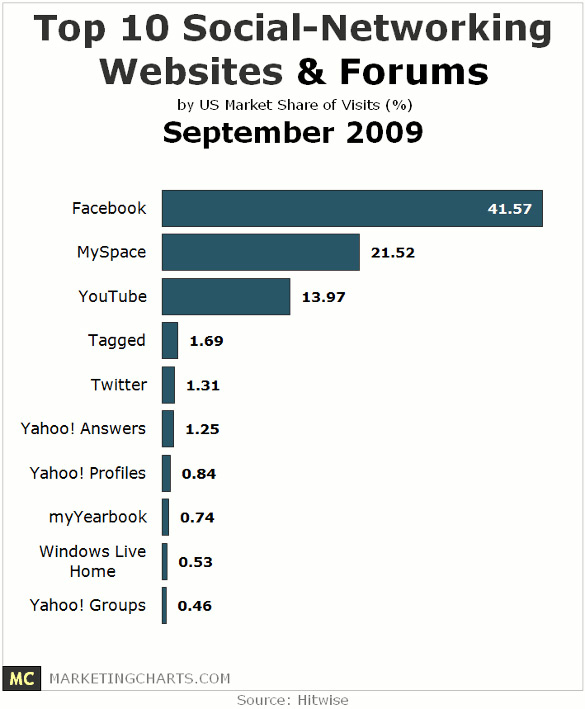
    According to Hitwise data, the top ten social networking websites and forums by US market share of visits looked like this:

    Top Ten Social Networks

    To be clear, the Hitwise data from which MarketingCharts compiled the above graph is based on US market share of visits as defined by the IAB, which is the percentage of online traffic to the domain or category, from Hitwise’s sample of 10 million US internet users. It’s unclear exactly what all kinds of sites fall into the social networks category.

    But the point is that there are a lot of places out there where people are forming communities that you may not be thinking of, but may provide plenty of opportunities for driving more engagement, brand awareness, and/or even traffic.

    Are you considering things like Tagged or Yahoo Profiles/Groups? Are you considering the forums out there that pertain to your niche? Forums are relevant in social media marketing. I’ve discussed this in the past. Forums are basically social networks. They’re communities too. You have to think about where the people are, and not just where they are, but where they are talking. Where they’re communicating with others.

    Forums or other more narrow communities may even prove to be more valuable tools than Facebook or Twitter in some cases. They are more likely to be focused on specific niches, than on the general public. There are certainly plenty of times where the general public – the Facebook/Twitter crowds are who you are trying to reach, but there will be other times when you may want to reach a specific group of people, which may or may not be a part of Facebook or Twitter.

    Look at Ford for example. Scott Monty, who runs the social media efforts for the Ford Motor Company recently told WebProNews that they use all sorts of forms of social media, because "Let’s face it, people are using all sorts of forms."

    "We try to be where the mainstream are and we do it in a way that humanizes the company at every turn, so we’re on Twitter, Facebook, Flickr, YouTube, Scribd, Delicious, and upcoming as our major platforms," he said. "And we’re constantly monitoring to see what the trends are and where people are going, so that we’re relevant."

    The key word there is relevant. Go where you’re relevant.

    What are some less thought about communities that you use to engage with people? Discuss here.

    Related Articles:
     

    Forums Are Relevant in Social Media Marketing

    How Big Brands Use Social Media

    Some Brands Have Good Ideas For Social Media. Do You?

    Using Facebook Traffic to Drive Brand Loyalty

  • Student Health Plans In Massachusetts Blasted By Report

    “Insurance companies rack up much higher profits on health coverage sold to nearly 100,000 Massachusetts college students than on plans available to the general public, according to long-awaited data released late yesterday by the state,” The Boston Globe reports. “The figures also show that college-student plans also have higher administrative costs. The result is that less of the premiums paid by students goes toward medical care.”

    The report, released by the Division of Health Care Finance and Policy, “shows that, on average, 30 cents of every premium dollar goes toward profits and administrative costs, compared with 12 cents for plans sold to the general public. The remainder of the premiums is what’s used to pay medical bills. Students at state schools faced the greatest disparity: 45 cents of every insurance dollar they pay goes to profit and administrative costs, according to the report.” The study was initiated after students at several campuses complained that “the lower-cost insurance products marketed to them offer limited coverage, leaving many vulnerable to enormous medical debts after accidents or serious injuries” (Lazar, 11/6).

  • LinkedIn Tests a New Design

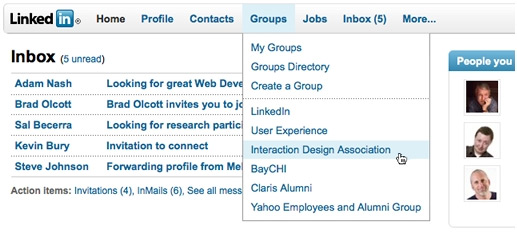
    LinkedIn is testing a new design. Only a select number of users will see it, however. New features include:

    –  A global navigation bar at the top of the page that provides convenient access to all LinkedIn services.

    – Simplified local navigation within each of the LinkedIn areas (Profile, Contacts, Groups, etc.).

    – More room available for page content. Less scrolling.

    – A cleaner, less-cluttered look.

    Here is what it looks like:

    New Linkedin Design

    New Linkedin Design

    "We began the redesign effort several months ago by analyzing how people use LinkedIn," says LinkedIn’s Kevin Bury. "We looked at what features people use the most and pored over several years of data from usability research on the site. Armed with this information we began doing design explorations of how to better organize LinkedIn features, and make them more convenient to find and use."

    "We factored into this effort additional features we knew were coming," he adds. "We narrowed down the designs to a few candidates we felt were strong contenders. We then prototyped these designs and had users perform tasks with the prototypes in the usability lab. We went through numerous iterations until we arrived at a design we felt worked the best.  One of the key features of the new design is that it allows much more space for page content – information about you and your professional network."

    LinkedIn says it will be paying attention to user feedback, and there is no word on whether or not changes will be permanent. That’s what testing is for though. The company also makes no mention of whether or not a greater number of users will be able to see the new design, and if so, when that would be.

    Are you seeing the new design? If so, what do you think? Share your thoughts here.

    Related Articles:

    > LinkedIn Announces 50 Million user Milestone

    > LinkedIn Makes Profile Organization Easier

    > LinkedIn Introduces Custom Profiles for Companies

  • Political Cartoon: ‘Protest’

    Kaiser Health News provides this fresh take on health policy develoments with Pat Bagley’s “Protest.”

  • Californians Who Lose Jobs Find Health Care Safety Net Badly Frayed

    In this article for Kaiser Health News, Janet Wilson focuses on California and reports on how the safety net is fraying as economic woes take their toll on state budgets. “With a nip here and a slash there, California’s budget crisis is now affecting health care for millions of residents, from wealthy Orange County to the struggling city of Oakland. State officials have made tough cuts to health services once deemed vital. Funds for county and community dental clinics were slashed, just when those who lost Medi-Cal funds for private dental care began showing up at their doors. Foot and eye care are also out, along with hearing aids, mental health care and other services long covered under Medi-Cal, but now trimmed by state officials to save $130 million. More than two million people lost the services” (11/6). Read entire story.

  • Encouraging Test Results for New Hepatitis C Drug

    In just three days of a phase I trial, Idenix’s experimental, nucleotide-containing Hepatitis C drug (IDX184) demonstrates excellent safety and antiviral activity.

    Idenix Pharmaceuticals Presents Data on IDX184 for the Treatment of Hepatitis
    C Virus (HCV)

    CAMBRIDGE, Mass., Oct. 30 /PRNewswire-FirstCall/ — Idenix Pharmaceuticals,
    Inc. (Nasdaq: IDIX), a biopharmaceutical company engaged in the discovery and
    development of drugs for the treatment of human viral diseases, today
    announced presentations of data on IDX184, a once-daily novel liver-targeted
    nucleotide prodrug of 2′-methyl guanosine (2’MeG) for the treatment of HCV, at
    the annual meeting of the American Association for the Study of Liver Diseases
    (AASLD) currently being held in Boston, Massachusetts.

    Data from a three-day, phase I proof-of-concept study evaluating the safety
    and antiviral activity of IDX184 will be presented. This double-blind,
    placebo-controlled, monotherapy, dose-escalation study enrolled 41
    treatment-naive HCV genotype 1-infected patients into four dosing cohorts (25
    mg, 50 mg, 75 mg and 100 mg). IDX184 was well tolerated in this study with no
    serious adverse events reported and no discontinuations from the study.

    Continue reading the entire article:
    http://www.reuters.com/article/pressRelease/idUS140350+30-Oct-2009+PRN20091030

  • CVS Investigated By FTC Over Business Practices

    “CVS Caremark Corp (CVS.N) has been the subject of a U.S. Federal Trade Commission investigation over some of its business practices since August, the company said on Thursday,” Reuters reports. “Various groups have asked the government to look into CVS Caremark’s practices since drugstore chain CVS bought pharmacy benefits management business Caremark Rx Inc in March 2007. They claim that changes to services in the pharmacy benefits business since the acquisition have led to higher prices, compromised quality of care and pushed patients to choose CVS drugstores over other pharmacies.”

    The announcement came shortly after CVS said its pharmacy benefits business had lost billions of dollars. “CVS said it is confident that it is conducting its business in compliance with antitrust laws. It said its practices and the services it offers are designed to cut healthcare costs and expand choices for consumers” (Wohl, 11/5).

  • Dems Tout AMA, AARP Endorsements Of House Health Bill

    ABC News: “Even as a wave of conservative protestors took over Capitol Hill, House Democrats’ health care bill picked up the support of several influential organizations that could turn the tide in their favor among the most concerned groups: medical professionals and senior citizens. President Obama this afternoon made a surprise appearance at the daily White House press briefing to thank AARP and the American Medical Association for throwing their weight behind the House Democrats’ health care bill” (Khan, 11/5).

    “Democrats hailed the backing of the AMA, the nation’s largest doctors’ group, as especially significant, since its position had been in doubt,” The Wall Street Journal reports. “But the group’s statement of support was lukewarm, saying the measure is ‘not the perfect bill.’ AARP, the largest senior citizens’ organization, officially endorsed the bill, citing the fact that it would help lower drug costs for seniors and make it easier for older Americans who don’t yet qualify for Medicare to buy insurance policies.”

    The Journal reports that Obama said the AMA “would not be supporting it if they really believed that it would lead to government bureaucrats making decisions that are best left to doctors… They would not be with us if they believed that reform would in any way damage the critical and sacred doctor-patient relationship” (Bendavid and Adamy, 11/6).

    The AMA’s support comes with “a big blinking asterisk,” Forbes reports. “Dr. James Rohack, the president of the doctors group, said on a conference call Thursday that the bill deserves support only if Congress also passes a separate bill that increases Medicare reimbursements to doctors, which are scheduled to be cut 21% per visit or procedure at the start of next year.” Rohack added that the bill is “‘not perfect, but it is consistent enough with our principles to warrant support,’ … echoing earlier statements that suggest the AMA believes some reform is better than the status quo.” But “[l]eft open were two major issues: reforming the medical malpractice system and changing the formula that Medicare uses to determine how much to reimburse physicians” (Whelan, 11/5).

    The Dallas Morning News: The AMA committed to support health reform efforts in May, based on the calculation that the organization “could help pass a sweeping health care overhaul while securing its own prized goals: caps on medical lawsuit awards and the repeal of a formula that annually threatens to cut Medicare payments to doctors. But the House health legislation that is headed to the floor Saturday addresses neither special issue head-on. The House will vote separately on a bill to change Medicare payments, but that legislation would add to the deficit and land in the Senate, which rejected such legislation last week.” Rep. Michael Burgess, R-Texas, an obstetrician and member of the AMA, says “they’ve hurt themselves… They supported [the bill] too soon, and they didn’t get the things they needed” (Michaels, 11/5).

    Los Angeles Times: “The bill’s endorsement by the doctors’ and seniors’ lobby groups — in addition to support announced by the American Cancer Society Cancer Action Network — helps counter mounting opposition among employer groups that are stepping up their advertising campaign against the bill” (Hook and Levey, 11/6).

  • Pumpkin Oatmeal

    We always have a lot of pumpkin on our hands after Halloween.  I like roasting pumpkin seeds with some olive oil, cumin, and salt for a crunchy snack or topping for salads or vegetables.  Then I’ll steam and puree the pumpkin flesh and make large batches of pumpkin bread, stir pumpkin into chili or black bean soup, and savor warm pumpkin oatmeal on chilly mornings.

    Pumpkin is one of the most nutritional fruits available year-round.  Sidebar: did you know pumpkin is actually a fruit, not a vegetable?  The rule is — if it has seeds, it’s a fruit.  So technically, these are all fruits: cucumbers, tomatoes, squash, zucchini, bell peppers, green beans.  But modern society refers to all these fruits as vegetables.

    Getting back to our friend the pumpkin, there are so many reasons to eat pumpkin as much as possible.  It is low in fat and calories, and packed with antioxidants, fiber, and vitamins C and E.  It boosts immunity, reverses skin damage, and reduces the risk of heart disease.  Both the seeds and flesh are highly nutritious, so take advantage of the plentiful pumpkins this time of year.  And when the season is over, go for canned pumpkin as well.  It’s one food item that is just as nutritious canned as fresh.

    We’d love to hear other ways you use pumpkin, so please share favorite pumpkin ideas by commenting below!

    Pumpkin Oatmeal

    1/2 cup old-fashioned oatmeal
    1 cup milk or soy milk
    1/4 cup pumpkin puree
    1/4 tsp pumpkin pie spice (or more if you like more spice)
    Dash of salt
    1 Tbsp chopped nuts
    1 Tbsp dried cranberries
    Honey or maple syrup to taste

    1. Place milk, oats, pumpkin, pumpkin pie spice, and salt in a saucepan.  Bring to a boil.  Reduce heat to low and simmer for 5 minutes, stirring occasionally.
    2. Remove from heat and place in bowl.  Stir in nuts and cranberries.  Sweeten with honey or maple syrup to taste.

    Serves 1

  • Insurance Companies Make The Best Of A Very Bad Year

    “Rising unemployment, swine flu and the threat of health care reform all ganged up on managed care companies in the third quarter and could hurt their performance heading into 2010,” the Associated Press reports. Nevertheless, companies reported better third-quarter profits than anticipated and one analyst noted that “they’re holding their own in a very, very bad situation.” Cigna “reported a third-quarter profit that soared 92 percent, as improving equity markets helped turn around the performance of a discontinued business the insurer maintains but no longer markets.” UnitedHealth Group also reported double-digit gains compared with the same quarter in 2008. Insurers also reported losses in enrollment, as companies laid off workers (Murphy, 11/05).

  • Dingell Plays Powerful And Historical Health Care Role

    NPR examines the historical role that Rep. John Dingell has played in health care policy, including the establishment of Medicare: “When people think of health care and Congress, often the first name that springs to mind is the late Sen. Edward Kennedy of Massachusetts. But while Rep. John Dingell, (D-MI) may not be as well known, he has a legacy on health care that is, if anything, even richer than Kennedy’s was. And when the House takes up its health overhaul bill this weekend that bears Dingell’s name as its lead sponsor, it could cap more than a half century of effort on his part to bring health insurance to nearly every American.”

    “Dingell’s quest for universal health care actually began in 1932, when his father, John Dingell Sr., was first elected to the House from Michigan. The elder Dingell quickly became one of the architects of the New Deal. … And when the elder Dingell died in 1955, John Dingell Jr. didn’t just take over his father’s seat, but also his quest for national health insurance” (Rovner, 11/6).

  • Microsoft showing off transparent glass display technology during college tour

    microsoft

    Microsoft’s research division is hitting the streets and hanging with the college crowd recently. This nationwide tour is showing off some sick technology in an effort that’s probably, although I don’t know for sure, aimed at making Microsoft look cool and hip to upcoming talent. The demos should do just that too. Think Tom Cruises’s person computer from Minority Report combined with Tony Stark’s toys from Iron Man.

    Like iStartedSomething points out, some of this demo could be staged. It’s not that hard to follow a script to “simulate” a tech demo. But we’ve seen some fantastic stuff from Microsoft’s back rooms recently with the Courier, all those mice concepts, and a pressure-sensitive keyboard. I wonder what else is hidden? [via SlashGear]