Author: Serkadis

  • Facebook Most Widely Used Network Among Businesses

    Webinars and podcasts are the most popular social media resources for business people, used by 69 percent of those who turn to such channels for business information, according to a new study by Business.com.

    Facebook is the primary social network on which consumer-focused companies maintain one or more profiles, cited by 83 percent of respondents compared with 45 percent for Twitter. Business-to-business companies maintain a presence on both social sites with 77 percent maintaining a profile on Facebook and 73 percent on Twitter.

    Among those using social media for business purposes in their jobs, 62 percent visit company or brand profiles on social networking sites and 55 percent search for business information on these sites.

    Use-of-Social-Media

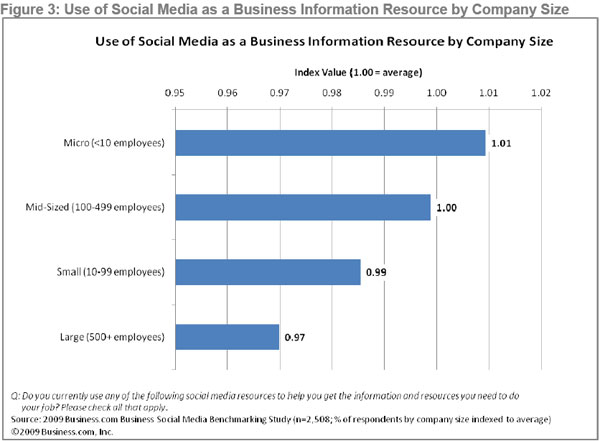
    Consultants and marketers are the most active users of social media as a resource for business information, particularly in micro (less than 10 employees) and small businesses (10-99 employees). IT professionals have the lowest participation rate.

    The average company in this study was planning, developing or running seven different social media initiatives; 65 percent of respondents staffing those initiatives, and 71 percent of companies themselves, have less than two years of experience with social media for business.

    Building brand awareness and brand reputation are two of the top social media success metrics, but nearly two-thirds of companies focused on these metrics have little insight into performance via standard or easily accessible reports.

    "We are constantly analyzing trends to determine exactly what tools business professionals leverage most for purchasing," said Ben Hanna, Ph.D., vice president, marketing, Business.com

    "This survey was a way for us to benchmark where businesses, and business people, are finding value in social media."


    Related Articles:

    > Thinking Beyond Facebook And Twitter For Social Relevance

    > Facebook,Foo Fighters To Pair Up Tonight

    >Twitter Expands Into More Than Just 2 Languages


  • Fortress Posts Third Quarter Loss

    NEW YORK (Reuters) – Fortress Investment Group LLC (FIG.N), a listed hedge fund and private equity giant, posted a third quarter loss on Friday as management fees tracked a decline in total assets.

    Fortress shares were down 5 percent or 23 cents at $4.34 in morning trading.

    Fortress said its net loss attributable to Class A shareholders was $59 million, or 43 cents a share, in the quarter, compared with a loss of $57 million, or 66 cents, in the year-earlier period.

    Revenue came in at $143.7 million, down from $185.2 million a year earlier, mainly on lower management fees. Analysts had expected revenue of $123 million, according to Thomson Reuters I/B/E/S, and pretax distributed earnings of 9 cents a share. Pretax distributed earnings were 11 cents a share, the company said.

    Like other hedge fund firms, Fortress was hit hard last fall as waves of cash-strapped investors tried to withdraw their money. At the end of the quarter Fortress managed $32 billion in assets, down from $34.3 billion a year earlier as it tried to block redemptions.

    On a conference call with analysts, Fortress Chief Executive Daniel Mudd was upbeat, noting its assets under management were 21 percent higher than their low of $26.5 billion at the end of March. “After all the gloom and doom, I think we may be going into a golden age of alternatives,” he said.

    Other hedge fund managers have also reported the return of new money as markets rebounded this year. Many industry watchers say last year’s worst-ever returns and record redemptions are safely behind them.

    The stock has plunged 81 percent since going public at the peak of the buyout bubble in early 2007, though it has surged fourfold from a record low in December last year.

    (Reporting by Joseph A. Giannone and Ross Kerber; Editing by Derek Caney, Phil Berlowitz)

    ShareThis


  • Turnaround Funds Eye UK Liquor Retailer Threshers

    LONDON (Reuters) – Funds specialising in turning around troubled companies are among the favourites to buy the stores of British liquor chain Threshers from administrators, people familiar with the matter said on Friday.

    Private equity firms, convenience store operators, rival off-licence chains and retailers are all poring over First Quench’s stores, which include Threshers and other chains, as its administrator KPMG looks to secure a speedy sale, the people said.

    R Capital, the owner of Little Chef, the roadside restaurant chain that called in Michelin-starred chef Heston Blumenthal to revitalise the menu at the chain, is looking at the business, as is private equity firm Rutland Partners, sources said.

    Hilco and Endless, which also specialise in turning around distressed companies, are interested in all or parts of First Quench’s network, sources said.

    The firms declined to comment.

    KPMG said on Thursday that it planned to close 373 loss-making First Quench stores, out of its 1,200 store network, at a cost of about 1,700 jobs. 

    The stores, which include the Wine Rack, Victoria Wine, Bottoms Up and The Local brands, have been losing around 20 million pounds ($33.2 million) a year, hit by competition from large retailers and small convenience stores.

    “We have had a range of interested parties considering everything from one store through to a very large number of stores,” said Ian Corfield, a joint administrator at KPMG.

    Indicative offers are due by Nov. 13 with KPMG hoping to sew up the process by Nov. 26.

    RETAIL INTEREST

    Large multiple retailers are also on the list of parties requesting further information, though First Quench’s stores are viewed as too small for the likes of Tesco (TSCO.L), Asda (WMT.N) and Sainsbury’s (SBRY.L), one source said.

    Convenience store chain Costcutter and rival off-licence Bargain Booze are also considering offers, but their franchise model makes them more likely to be interested in First Quench’s small franchise arm, numbering some 86 stores, the source said.

    “The franchise business may well be a very attractive proposition for somebody to take on as a unit; we are certainly exploring with various parties whether that will be of interest,” said Corfield, though he declined to comment on individual interested parties.

    Costcutter’s majority owner Bibby Line Group and Bargain Booze’s private equity owner ECI Partners both declined to comment.

    KPMG’s preferred option is to find a buyer for a large part of the business but it may consider offers for individual brands or even individual stores, Corfield said.

    But carving out a brand could present difficulties in separating the business’ supply chain, back office function, logistics and IT, one source said.

    “It’s not beyond the wit of man, but it’s not the easiest option either,” the source said. ($1=.6025 Pound)

    By Simon Meads and Tom Freke
    (Editing by Karen Foster)

    ShareThis


  • Congressional Study Says $42 Billion Could Be Raised By Legalizing Internet Gambling

    Ragaboo writes

    A congressional report was recently released estimating that the regulation of Internet gambling could amount to around $42 billion in revenue for the U.S. government. Considering both the current financial climate and the fact (given the nature of the Internet) Americans are gambling online anyway, whether the government likes it or not, it seems like an incredible waste not to simply regulate the industry. Regulation provides much-needed funds, allows standards to be imposed and oversight to ensure safety, and also allows safety nets and safeguards to be forced to be put in place against underage and problem gamblers. As it currently stands, millions are playing online poker alone from within the United States (whether or not the government approves of it, which in an of itself isn’t explicitly clear) and countless others are gambling, and yet every cent being made in that industry is going overseas.”

    Indeed. Online gambling seems like one area where a regulated market would make a lot more sense than outright prohibition. Many other countries already do this, and it’s really odd that the US continues to resist it. Many claim that it’s really just an effort by the existing casinos to block out competition, but it would seem that those casinos would benefit greatly themselves by being able to offer their own online offerings. And, even with this new evidence, it looks like Congress is actually going in the opposite direction.

    Permalink | Comments | Email This Story


  • A Suggested Users List for Twitter That You Can Actually Use

    Twellow has launched a new "Suggested Users" feature aimed at connecting Twitterers with similar interests. It should be much more useful to the common Twitter user than Twitter’s own suggested list, which is one static list for everybody, and includes mostly celebrities and other well-known people. In fact, Twitter may be getting rid of that list soon anyway.

    Twellow’s feature is tailored to the interests of the specific user, so your list will be completely different than the next person’s. 

    Twellow is a WebPronews service, which provides Twitter users with a directory of people to follow by category or location.

    "Being able to find people that really share common interests is what Twellow is all about," says Twellow’s lead developer, Matthew Daines. "This new feature should really add value to our Twellow toolset in helping people meet this goal."

    suggested_users_tab

    "While Twitter has offered a suggested users list for some time, it really hasn’t been very useful for the average Twitter user," he says. "Our large database of categorized users really has allowed us to provide a much better matching system for suggesting users to follow. These are relevant people who actually share your personal interests."

    Twellow’s Suggested Users feature can:

    – Display up to 500 profiles.
     
    – Let you follow users right from the list.

    – Let your ignore and hide profiles you don’t think are good matches.

    – Let you click the More Info buttons on each profile to show the categories for that profile. Your matches are marked with a green star.

    – Let you adjust your profile categories if suggestions are not accurate, then return and view the new results.

    Check out the Suggested Users feature on Twellow, and let us know what you think about it. Our team is always open to feedback.

    Do you think such a feature would make Twitter more useful? Comment here.

    Related Articles:

    Easily Find Twitterers You’re Interested In

    Twellow Adds New "View Non-Mutuals" Feature

    Location Adds Purpose and Context to Twitter

  • Foundry Backs Pete Sheinbaum’s Mandelbrot Project

    Mandelbrot Project Inc., a stealth-mode startup founded by former Daily Candy CEO Pete Sheinbaum, has raised $500,000 in first-round funding from Foundry Group, according to a regulatory filing.

    Seth Levine, the Foundry partner on Mandelbrot’s board of directors, declined to comment. Mandelbrot is based in Boulder, Colorado. www.themandelbrotproject.com

    ShareThis


  • iApps: The Software Suite Apple Should Create

    iTunes_Example_Library

    Once upon a time, iTunes did exactly what it sounded like it should do: play music. It was the digital jukebox for your mac, Rip, Mix, Burn, remember that?

    Looking at the sidebar in iTunes now, I’ve got Music, Movies, TV Shows, Podcasts, iTunes U, Audiobooks, Applications, and Radio, and that’s just the main library. Next is the iTunes Store and a “Purchased” smart list, the Genius feature, iTunes DJ and (finally) my custom Smart Playlists. That’s a lot to pack into one application, especially considering that many of the features have nothing to do with each other. There are very few times when I’m wanting to watch a movie that I care to look through my music collection. Music and video are two different functions, and in my opinion, deserve two different apps.

    Actually, I’d like to see Apple release an entire “iApps Suite,” separating out audio, video, and applications. Strip Movies and TV Shows out of iTunes and integrate them into a new “iVideo” app, or something similarly named. Hide the video content from the iTunes store in iTunes and create a link for an iVideo store inside the new video app.

    Similarly, I’d like to see Apple break out the App Store into it’s own dedicated application. Leave the functionality exactly as it is now and simply move it into its own app. There are many times that I’ve got iTunes open, most of the time just to listen to music, and have no interest whatsoever in my collection of apps.

    Maybe my desire for Apple to break apart iTunes is because of my background in Unix, and the Unix philosophy for writing applications that “do one thing, and do it very well.” Or, maybe it’s because the direction iTunes has taken doesn’t seem very “Mac like.” Take the bundled applications for example. Mail, iCal, and Address Book are very often lumped together in the same app. Thunderbird (with the lightning extension) does this, as do Outlook and Lotus Notes. Apple sees sending and receiving mail, calendaring, and storing information about contacts as three separate functions, and wrote three separate apps to handle it. The iLife suite is another great example of separating applications that do different things. iPhoto ties into iWeb, Garageband, iMovie, and iDVD, but they are still separate apps for separate purposes.

    I thought for a while that audio, video, and apps were all lumped together in iTunes to make it easier to sync to iPods and iPhones. But, iCal, Address Book, and iPhoto have no problem syncing their data. iPhoto will, by default, open when you plug-in an iPod touch or an iPhone, but Address Book and iCal sync silently, if configured to do so in iTunes. If iTunes were to be separated into different apps, perhaps the iSync utilities role could be expanded to handle what is synced where. That almost sounds like the job of a system preference to me.

    Now I think that the three functions of iTunes are tied together because of the iTunes store. Since Apple used the same distribution model that had been successful with music for movies and TV shows, adding the functionality to iTunes and the iTunes Store offered the path of least resistance. Similarly, when it needed to build another store for applications, Apple built it on top of what was already successful.

    I don’t see Apple changing directions with iTunes any time soon. If it were to create three apps out of the one iTunes, it would have to create them for Windows as well. I don’t have access to the source code, but knowing what I do about programming and development, I can’t imagine that would be an easy task. Perhaps this is a third-party opportunity for some ambitious indie devs out there? Or, maybe, just maybe, if we get the right people’s attention, a conversation might start that leads to some real change.

  • Dr. Jill Biden: A Mother's Gratitude on Veterans Day

    Vice President Biden and Dr. Jill Biden With Troops

    (Dr. Biden and Vice President Biden greet soldiers from the Delaware Army National Guard 261st Signal Brigade at their homecoming in September. Official White House Photo by David Lienemann)

    Like military moms across the country, Dr. Jill Biden looked for small ways to send the comforts of home to son Beau during his deployment: she and Vice President Biden sent him a Christmas stocking stuffed with candy and playing cards; she baked him his favorite brownies for his birthday; she helped him keep up with children Natalie and Hunter by mailing artwork and photos of soccer games. This Veterans Day, with Beau safely home after almost a year in Iraq, Dr. Biden expresses her gratitude for the sacrifices of all military families in an essay published today in USA WEEKEND Magazine, and shares how she plans to honor the men and women who risk their lives for our country:

    It helps that families such as ours realize we’re never alone, as I’ve seen this year how powerful the support of the community can be: A local restaurant provides pizzas at a welcome-home event; a minor-league baseball team, the Wilmington Blue Rocks, dedicates a game night in support of our troops; one of our schools adopts a military unit. Then, there’s an organization I’ve worked with in the past few years called Delaware Boots on the Ground. It started as a group of military moms and spouses who came together to support our Delaware National Guard members and their families. "Boots" now performs simple acts of service for deployed soldiers and their families, like supporting summer camps for children who have a deployed parent. There are just so many ways that each American can lend a hand and make a difference.

    Beau came home safely Sept. 25, after almost a year in Iraq. My family feels so blessed.

    Joe and I plan to visit Arlington National Cemetery this Veterans Day and spend time with veterans and soldiers to show our thanks. On Veterans Day and every day, it’s our duty to show appreciation for their service and remember that each of us has the ability to make a difference in the life of a service member. Even though Beau’s deployment is complete, I still consider myself a member of the military family. I always will.

  • Adding Facebook and Twitter Followers – A Little One on One ?

    I was thinking of ideas on how to add twitter and/or facebook fan page followers. I dont have a real need to have to do so. I was just curious about ways to do so.

    Think of it as one of those things my minds wanders off to while Im working out.

    One thing that poppedup as what I thought was a decent idea was the idea of  rewarding those who refer and/or generate followers to my pages on twitter (@mcuban), or on FAcebook (/markcuban) a unique page where they were the only person approved to have access and for some period of time, they would have exclusive access for questions and answers.

    So for instance, if you helped me add 1k followers on twitter, i would create a new ,private account on twitter and you would be the only approved follower. You could ask me anything and I would respond for some period, probably 24 hours. After which I would replace you with another follower. I could do the same on facebook.  I would set up a private account and only friend this person.  Using the wall, we could have an exchange about any subject.

    Good idea or bad idea ?

  • Early sales figures for Windows 7 nicely high, but do we know why?

    By Scott M. Fulton, III, Betanews

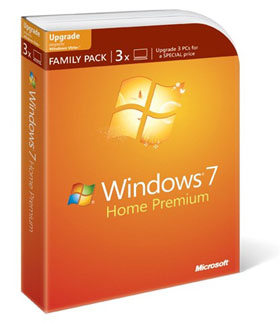
    Windows 7 Family PackThe initial sales figures for Microsoft Windows 7 after its worldwide launch on October 22 are still being tabulated, but the early estimates sound very promising: According to industry analysis firm NPD, unit sales for Windows 7 software SKUs in the US were 234% higher — better than triple — the unit sales for Vista’s launch, and US revenue from Win7 software sales was up 82% over Vista’s launch.

    But as Vista veterans will recall, that launch was botched somewhat, first by a costly delay, then by a decision to launch the product twice (first to businesses in October 2006, then to consumers in January 2007), and then by a lack of participation from partners. And there were still more reasons the Vista launch fizzled, one of which, believe it or not, included the scheduling of the launch on a Tuesday.

    Windows 98, Windows Me, and Windows XP all launched on Thursdays, to moderate success or higher; and Windows 7 launched on a Thursday. You would think that since NPD’s tabulation of sales figures runs between Sundays and Saturdays, the fact that the initial sales figures only reflect the first three days (plus all those pre-sales) of Windows 7 versus the first five days of Vista, would be even more impressive. Yet it’s those pre-sales that may tell the real tale here, according to NPD vice president of industry analysis Stephen Baker, who credited a better-run pre-sale event from Microsoft and its retail partners as contributing to the more successful launch this time around. If you’ll recall, the hype over Vista had fizzled long before January.

    The top three selling SKUs in the three-day window were all upgrades: for Home Premium, followed by Professional (from Vista Business), and the Home Premium Family Pack. We don’t know specific unit sales numbers, but can we draw any conclusions yet about who is doing the upgrading and why? For instance, are they XP users, or are those folks more likely to purchase new PCs with Win7 pre-installed (whose sales are not included in these NPD figures, but whose early estimates also appear positive)?

    “Questions like that on hardware are hard to answer after three days of sales,” Stephen Baker told Betanews this morning. “Some portion of the first three days of sales is just pent-up demand, driven by lack of product to sell in the first ten days. So in that respect, I am not sure what the initial motivators are.”

    In his blog post on launch day, Baker credited stores like Best Buy with their willingness this time around to cooperate with Microsoft, especially with little things like displaying Win7-based PCs — not Vista — during early October even before Win7 or the PCs with Win7 were available. Seeing those systems, and some of their new form factors, might contribute to some of that pent-up demand Baker told us about.

    “In general, though, consumers rarely buy PCs for ‘new’ features,” Baker told us, letting the air out of that balloon. “As a tool and a home communication necessity, PCs are most often bought on need. The latest form factor isn’t or design isn’t what motivates consumers to buy, it is what gets them to buy at the point-of-sale in the store. But getting them to make a decision to buy is based on need, price, and promotion.”

    We definitely saw the promotion part of that solution as early as August, with a respectable and, for once, not insulting advertising campaign that blanketed all media, including television. But this time around, OEMs were participating in that promotion as well, and were in sync with Microsoft’s timetable, publishing early notices of markdown deals, and drumming October 22 into consumers’ heads.

    But that doesn’t cover the need factor; and we wondered, how much did Vista contribute to that need. Since, after all, the top three selling SKUs were all upgrades, were folks really willing to dump Vista?

    No, according to NPD’s Baker: He believes that the factor that publishers like Betanews had been calling the “Vista perception problem” are not as pervasive as we make it out to be, especially in the consumer space. More importantly than how we may dramatize things, consumers were simply more motivated by the “refresh” aspect of the new system, says Baker.

    “I would suspect that most of it is new look-and-feel, and a PC refresh without the cost,” he told Betanews. “Bloggers may dislike Vista, but the vast majority of consumers really don’t mind it.”

    Copyright Betanews, Inc. 2009


    Add to digg
    Add to Google
    Add to Slashdot
    Add to Twitter
    Add to del.icio.us
    Add to Facebook
    Add to Technorati


  • Social Networking Donation Cause Leaves MySpace For Facebook

    Causes is a social networking donation platform that uses MySpace so that people can raise money for causes or issues that they believe in. Generally these kinds of activities help provide a community around issues like Breast Cancer, or stop smoking, or other issues that are part of our daily life. Causes is an excellent application that makes the process of raising and donating money for a specific cause very easy and embeddable into someone’s MySpace page.

    Last night according to ReadWriteWeb and Stanford Social Innovation Review, Causes has sent an e-mail out to all their MySpace members stating that they will be moving over to Facebook and no longer supporting MySpace. I do not see why they could not do both, but apparently Causes does not want to support both platforms. From a business viewpoint – Causes would be very smart to provide support for both platforms; everyone needs a simple easy way to donate to the cause they believe in.

    Stanford Social Innovation Review though also brings up the specter of money, in that it is well known that Facebook caters to a richer clientele than MySpace. Going out to Quanticast – the demographics for MySpace and Facebook makes this a compelling argument.

    MySpace Demographics:

    Facebook Demographics:

    What is interesting about the Quanticast information is on the right side data pane where people who are likely to visit Facebook, Causes shows up as the number one entry in the likely to visit category.

    causeslikeytovisit

    Where on the likely to visit column causes does not even show up.

    myspacelikelytovisit

    Demographics are also telling – people are much less likely to be college educated on MySpace, meaning they just simply do not make a lot of money. However, some research points out that poor people donate more overall money to causes that influence their groups or their interest groups than rich people do. The problem also might be in the micropayments processing side; small amounts of money usually are quickly degraded by mounting fees from payment processors, handling, and movement than larger payments, which is a definite possibility and, one of the drawbacks to the micropayment system.

    What is sad though is that rather than supporting both platforms, which is just good business, Causes has decided to abandon MySpace in favor of Facebook. Regardless of the reason, from a business viewpoint you don’t abandon a channel until it stops being profitable, if Causes believes that MySpace is no longer profitable, then there is more here about the internal workings and visitor counts of MySpace than we generally have discussed in the blogging world, let alone the press.

    Causes definitely needs to post a statement on their blog, so we know what the reason is, rather than speculating as to what the reasons are.

    Comments

  • What’s YOUR favorite protocol?

    c3po
    Yesterday’s trip down memory lane with the Gopher protocol got me thinking about all the other protocols I used to use, and those that I continue to use on a regular basis. There’s little doubt that hypertext transfer protocol (HTTP) is one of the most widely used protocols on the Internet today. But there are a host of other protocols used every day! Let’s look at a few of my current favorites, and some that have gone the way of the Dodo bird.

    Before I get started, I think we should break out protocols that one uses intentionally, and those ancillary protocols that get used in the normal execution of your other protocols. For example, every time I visit a web page I intentionally use the HTTP protocol. But unless I’m manually keying in IP addresses, there’s an awful lot of DNS traffic taking place, too. I don’t intentionally use the DNS protocol: it happens behind the scenes as I’m using my web browser. So with that out of the way, here are the protocols I intentionally choose to use on a regular basis:

    HTTP
    No surprise here. I write for CrunchGear, so I use HTTP (TCP port 80) to access the WordPress back-end to compose stories. I visit product web pages. I watch videos at YouTube and Hulu. I compose email at GMail. HTTP is the king of protocols.

    SSH
    As a systems administrator, I use the Secure Shell protocol (TCP port 22) daily to access the variety of Linux systems I maintain. Whether for my day job, or my personal web server, I’d be dead in the water without SSH. I also use SSH as a SOCKS proxy so that I can access a variety of resources using my home IP address. This is particularly useful when I’m using an untrusted wireless network: the link from my laptop to my proxy server is encrypted, shielding my traffic from anyone snooping that wireless network.

    IRC
    I use Internet Relay Chat to communicate and collaborate on a number of projects. It’s also a terrific way to get ad hoc support on open source programs that I use. I’m usually idling in one or two channels. I prefer IRC over IM, usually, but can’t really give a good explanation as to why.

    X
    As a Linux user, I use the X Window protocol all the time. Sometimes it’s to display applications running on my local machine; and sometimes it’s to display applications running from one of the server I maintain.

    Some of the lesser used, but still important, protocols I use include

    • DNS: as mentioned above, the Domain Name System is a supporting protocol that makes our use of the Internet vastly easier. It’s really the backbone of the modern Internet, if you think about it. It uses TCP and UDP ports 53.
    • SMTP: like DNS, Simple Mail Transport Protocol is one of those things that keeps the Internet alive without being in-your-face all the time. Every time you send an email — whether you use Thunderbird, or Outlook, or GMail, or Hotmail — the messages travel back and forth using SMTP. It uses TCP port 25.
    • ICMP: the Internet Control Message Protocol is one of those protocols people use without even thinking about it. Every time you ping a host to see if your Internet connection is working, you’re using ICMP.
    • BitTorrent: I don’t use it too much, but I know a lot of people who do. BitTorrent easily accounts for a large percentage of daily Internet traffic today.
    • FTP: the File Transfer Protocol is still heavily used today. Downloading drivers and patches is the dominant use, but it’s still a handy tool for getting any kind of file transferred.
    • Telnet is something I still use when I must, though I try hard to avoid it since it has basically no security at all. I use telnet to manage some Ethernet switches at my day job.
    • NNTP, the Network News Transfer Protocol, is used for accessing Usenet. I’ve never dipped my toes into the dark waters of Usenet, though John and Nicholas have. I envy their bravery.

    But these are all modern — or at least currently utilized — protocols. What about the stuff from yesteryear? As I mentioned in my Gopher post yesterday, I started using the Internet by way of a SLIP, and later PPP, connection. Prior to accessing the Internet, I was using Bulletin Board Systems, which had their own suite of protocols:

    • ZMODEM was the very first piece of software I ever bought. I paid for a license for the shareware file transfer protocol so that I could download files from the various BBSes faster.
    • Before ZMODEM, I was using XMODEM to download files. Surprisingly, I still occasionally use XMODEM to transfer switch firmware to an Ethernet switch I manage!
    • A dabbled with BiModem for a bit, in order to streamline the simultaneous sending and receiving of files.
    • FidoNet is one of those supporting protocols from which I benefited, but never really used directly. It allowed the BBSes I used to communicate with other BBSes, thereby increasing the number of people with whom I could connect. I spent most of my time on systems running WWIV, which had it’s own protocol for inter-board communication called WWIVnet.

    So how about you? What protocols do you use regularly? Which protocols from days of yore do you miss?


  • Keyboards, Phones and NetBooks

    Some people wondered why I stayed with my Sidekick despite still not getting my contacts back and all the troubles the network had. The answer is easy. They keyboard is so above any beyond any other phone, I can type a good 50 words per minute on it. (Its amazing how fast my thumbs are on this thing)  Which in turn allows me to answer emails quickly and accurately.  I dont lose any productivity when Im on my Sidekick compared to sitting  in front of my desktop or full sized laptop.  To me, thats money in the bank.

    Thats not to say I never stray and try new phones and alternatives. I do.  I have tried any make and model of phone, with slideout keyboard, touchscreen, you name it. None match the sidekick.

    Recently I bought a couple netbooks for my kids.  The kids love them.  I cant type of them to save my life.  Trying to pop over to check and respond to some emails is a frustrating experience.  Maybe I could learn to get used to them, but the keyboards are so small, it takes real concentration to try to touch type.

    All of which got me thinking. Im not the only person who has mastered their phone keyboard. Regardless of model.  Plus, like most of us, I have an investment in “conforming” to the typing platform of my phone.  Texting is so popular, we quickly become productive typists on our phones. So rather than creating an entirely new “typing platform” like most Netbooks do, why not create a line of Netbooks that merely are an extension of our phones ? Do Netbooks need, or should they even have Keyboards ?  Why not a “monitor” that can travel and be tethered via bluetooth to any and all manner of phone ?

    I would love nothing better than to be able to take a nice monitor with some PC/Netbook like features that pairs with my SideKick.  Less to carry. Less cost.  Just as I can send the sound to an external device, why not allow me to connect from my phone to the monitor , using my phone as my keyboard and even have the option of using the storage on my phone as the hard drive ?

    Am I the only one who would prefer this approach ?

  • New Legend of Zelda: Spirit Tracks trailer features armored spirit Zelda

    Nintendo has sent out a press release announcing the final US release date for The Legend of Zelda: Spirit Tracks. Nestled in all the PR-speak is a ni…

  • Duplicate Content on Google, Bing & Yahoo

    Duplicate content is a common occurrence on the web and in many cases can hurt search engine rankings. While the search engines may not always technically penalize webmasters for duplicate content, there are still a lot of ways it can hurt.

    WebProNews is covering the Search Marketing Expo (SMX) East in New York, where representatives from the three major search engines (Google, Yahoo, and Bing) discussed how their respective web properties handle duplicate content issues. Following are some takeaways from each.

    Duplicate Content in Google

    Duplicate Content on Google - Joachim KupkeThe way Google handles duplicate content has been discussed a lot in recent memory. This is largely due to a video Google’s Greg Grothaus uploaded, in which he discusses at length, the way Google handles a variety of different elements of the duplicate content conversation.

    Joachim Kupke, Sr. Software Engineer of Google’s Indexing Team reiterated much of what Grothaus said. He also said that Google has a ton of infrastructure for content duplication elimination:

    – redirects
    – detection of recurrent URL patterns (the ability to ‘learn’ recurrent url patterns to find duplicated content)
    – actual contents
    – most recently crawled version
    – earlier content
    – contents minus things that don’t change on a site

    Kupke said to avoid dynamic URLs when possible (although Google is "rather good" at eliminating dupes). If all else fails, use the canonical link element. Kupke calls this a "Swiss Army Knife" for duplicate content issues.

    Google says the canonical link element has been tremendously successful. It didn’t even exist a year ago, and is has grown exponentially. It has had a huge impact on Google’s canonicalization decisions, and 2 out of 3 times, the canonical tag actually alters the organic decision in Google.

    Google says a common mistake is designating a 404 as canonical, and this is typically caused by unnecessary relative links. So, avoid changing rel="canonical" designations, and avoid designating permanent redirects as canonical.

    Also, do not disallow directives in robots.txt to annotate duplicate content. It makes it harder to detect dupes, and disallowed 404s are a nuisance. There is an exception however, and that is that interstitial login pages may be a good candidate to "robot out," according to Kupke.

    Kupke says that canonical works, but indexing takes time. "Be patient and we WILL use your designated canonicals." Cleaning up an existing part of the index takes even longer, and this may leave dupes serving for a while despite rel=canonical, Kupke adds.

    At SMX, Google announced that cross domain rel=canonical is coming within this year. So for example, if the Chicago Tribune has an article on the New York Times, and the rel=canonical points to the Chicago Tribune then Google will only credit the Chicago Tribune with the content.

    Duplicate Content in Bing

    Sasi Parthasarathy

    As far as how Bing views duplicate content, intention is key. If your intent is to manipulate the search engine, you will be penalized.

    Sasi Parthasarathy, Program Manager of Bing says to consolidate all versions of a page under one URL. "Less is more, in terms of duplicate content." If possible, use only one URL per piece of content.

    Bing isn’t supporting the canonical link element (as a ranking factor) yet, but it is coming. They do say to use it, but it’s just not really a ranking factor in Bing yet. Bing says that there has been an increase in the usage of canonical tags in the past 6 months, but adoption issues still exist. According to Parthasarathy, 30% of canonical tags point to the same domain (which is fine), and 9% use it to point to other domains. This could be a mistake or it could be manipulative. Bing says they will look for other factors to try and determine which it is.

    Bing says canonical tags are hints and not directives. "Use it with caution," and not as an alternative to good web design.

    With regards to www vs non-www, just pick one and stick with it consistently. Remove default filenames at the end of your URLs. Bing also says 301 redirects are your best friend for redirecting, use rel="nofollow" on useless pages, and use robots.txt to keep content you don’t want crawled out.

    Duplicate Content in Yahoo

    Cris Pierry

    If everything goes according to plan, you’re going to need to worry about how Bing handles duplicate content if you’re worried about how Yahoo handles it, but Yahoo’s Cris Pierry, Sr. Director of Search, offered a few additional tips.

    Pierry says descriptive URLs should be easily readable, and it’s not a good idea to change URLs every year. In addition, use canonical, avoid case sensitivity, and avoid session IDs and parameters.

    Pierry also says to use sitemaps, and submit them to Yahoo Site Explorer. Improve indexing by proper robots.txt usage, and use Site Explorer to delete URLs that you dont’ want Yahoo to index. Finally, provide feeds to Yahoo Site Explorer, and report spam sites linking to you in Site Explorer.

    Yahoo says metadata and SearchMonkey are enhancing presentation.

    WebProNews reporter Mike McDonald contributed to this article from SMX East.


  • Facebook Blocks More Ad Networks

    Back in July Facebook updated policies for third-party ads on Facebook Platform. The company disabled two entire ad networks and over 100 more apps were suspended or brought into compliance over ad-related violations. Half of those had over a million monthly active users.

    Facebook has now disabled two more offer and ad networks, which the company says have repeatedly violated its policies. This has all been part of Facebook’s continued action against deceptive ads. The company has addressed its efforts in this area on the company’s developer blog.

    Nick Gianos"First, deceptive ads are a widespread issue on the Web and one we fight aggressively," says Facebook’s Nick Gianos. "This battle is not new and it’s far from over. We faced stimulus scam ads on our own system earlier this year and pushed them off the site with rigorous enforcement. We did the same months later when deceptive ads from third-party ad networks appeared in applications. We’re doing that again now as we see them appear in the form of offers."

    "We recognize that monitoring ads isn’t the first area of focus for an entrepreneur just getting started with social applications," he says. "That’s why ad networks that don’t play by the rules should expect to be our first point of contact in our line of enforcement. Our policies are clear. If you’re an ad network and don’t comply with them, you are doing a disservice to your customers, and you should expect your business opportunities on Facebook to cease."

    The company emphasizes that it is the responsibility not only of ad networks, but also of developers to make sure content running in third-party apps is appropriate.

    Facebook’s policies on offers and "inappropriate" ad content can be viewed here. If there are questions, which there no doubt will be, they can be sent to Facebook via the Platform Advertising Contact form.

    Related Articles:

    > Facebook App Developers Face New Obstacles

    > Facebook Puts Privacy Policy in Users’ Hands

    > Facebook Most Widely Used Network Among Businesses

  • 3G and Wi-Fi toting Dell Mini 3iX party it up with the FCC

    dell-mini-3ix-fcc

    It looks as if Dell’s Android handset is getting ready for prime time with AT&T as a new filing found on the FCC’s website has revealed the Mini 3iX. With both 850/1900 MHz bands of UMTS as well as Wi-Fi on board, the 3iX is likely to be identical to the Mini 3i which was unveiled in mid-August by China Mobile, the only difference being the aforementioned. If this is indeed the case then we’re looking at a 3.5″ 360×640 touchscreen display, 3 megapixel camera, A-GPS and support for Microsoft Exchange. The question is, will anybody even care?

    [Via Unwired View]

    Read


  • Rumor Has It: 8GB 3GS, RFID-Capable iPhones on the Way?

    iPhone3GS-2What better way to end the week than with two fresh, shiny new iPhone rumors to chew on? According to various reports, the iPhone 3GS could get an 8GB model just in time for the holidays, and Apple is said to be testing iPhones that support radio-frequency identification (RFID), a tech that allows devices to sense nearby embedded chips without coming in actual contact with them.

    While the timing of both rumors happens to be concurrent, please note that it is very unlikely that if Apple were to release an 8GB iPhone 3GS in time for the holiday season, it would use the new RFID tech. It’s more likely that the RFID integration will come to fruition in later models of the iPhone.

    $99 8GB 3GS

    Rumors of the smaller capacity 3GS come via Boy Genius Report, which has proved fairly reliable in the past when it comes to predicting product launches by Apple. They claim to have heard news of the 8GB model from two separate sources at AT&T:

    Definitely not confirmed, but rather interesting nonetheless. We’ve heard now from two sources that AT&T, and we guess Apple, are contemplating launching an 8GB iPhone 3GS at the $99 price point before Christmas. One source said this was AT&T’s way of combating the Droid madness.

    It should be noted that BGR specifically points out that they haven’t heard any of this from Apple or any of its personnel, which could mean that AT&T is pitching the idea but doesn’t necessarily confirm that Apple is receptive. Still, a 3GS at the magical $99 sweet-spot would definitely take some of the wind out of Droid’s sails.

    Of course, there is the fact that Phil Schiller said the Apple holiday lineup is set. That should mean no new products, right? Or it could mean that the 8GB 3GS was already on the roster and that it just hasn’t been announced yet. Still, if it is coming in time for Christmas, Apple is already missing out on some prime holiday buying time. We’ll definitely see it before Black Friday if we’re going to see it at all.

    RFID

    Apple is looking into integrating RFID swipe support into new iPhone prototypes, AppleInsider reports. iPhones boasting RFID capabilities could allow for things like making swipe payments, proximity alerts, and getting data from swiping RFID-embedded objects or even animals.

    RFID tech is ideal for this sort of thing because it requires little power, since the data transferred is often small in size, usually only a number or a URL. There’s also the cost benefits of the tech, and the fact that they’re already in wide use. According to AppleInsider:

    The cost of RFID chips is now down to just a few cents each in quantity, making it possible to apply them to a wide variety of uses. Shipping companies and retailers already use RFIDs to track packages much like barcodes; libraries use them to track books, farmers use them to identify animals in herds, and the army, theme parks and schools attach RFIDs to people.

    The site also speculates that Apple could then leverage its existing iTunes accounts, broadening it to make it a method for paying for anything via your iPhone, so long as the vendor you’re dealing with is equipped to accept RFID payments. Such payment systems using cell phones have already been used widely in parts of Asia and Europe.

    If Apple gets in early on widespread RFID adoption here in North America, it could see the kind of industrial and business success it’s been missing thus far. It might become as common to see an iPhone-based device on the loading dock as it is to see one in a Starbucks.

  • Race and Poverty Linked with Disturbing Forecasts

    Nearly half of all children in the United States and 90% of African American children will rely on food stamps at some point during childhood, and fallout from the recession could push those numbers higher.

    read more

  • Google’s Music Service In China Attracting Advertisers

    Google’s music service in China hasn’t achieved much so far; no one should look for Google’s next quarterly financial report to say it’s brought in hundreds of millions of dollars in revenue or toppled Baidu.  But neither has it failed, and one person who’s close to the service recently indicated that it’s picking up steam.

    Google LogoGary Chen is close by merit of being the founder and CEO of Orca Digital.  Orca Digital owns Top100.cn, which is Google’s partner in the venture.

    As for what Chen to say, it turns out that some big companies have aligned themselves with the project, even if they’re not yet spending a lot of money.  According to Loretta Chao, "Chen . . . said in an interview that five advertisers have signed on for the service so far, including Nokia Corp., Apple Inc. and Volkswagen AG, with total commitments of 2.5 million yuan ($370,000)."

    Then here’s the really interesting part: Chao continued, "Orca Digital and Google expect to sign several more ad deals that could bring in $1 million each, and hope to have a total of 30 advertisers within a half year . . ."

    If things continue to snowball at that rate, Google’s music service in China could become quite important in a rather short period of time.

    Related Articles:

    > Google Search By Voice Learns Chinese (In Limited Fashion)

    > Chinese Paper Accuses Google Of "Malicious Retaliation"

    > Baidu Pummeled Following Low Forecast