Microsoft has two new Windows 7 ads and, well, they are just like the first batch. A random regular person thinks that they designed Windows 7 when we all really know it was us nerds that posted every little Vista flaw on message boards and blogs. But we shouldn’t take all the credit. Regular people hate Vista too. One more video is after the jump.
Author: Serkadis
-
Microsoft’s new Windows 7 ads keep with the same message
-
Nurturing and Sustaining Effective Programs in Science Education for Grades K-8: Building a Village in California: Summary of a Convocation
K-8 science education in California (as in many other parts of the country) is in a state of crisis. K-8 students in California spend too little time studying science, many of their teachers are not well prepared in the subject, and the support system for science instruction has deteriorated. A proliferation of overly detailed standards and poorly conceived assessments has trivialized science education. And all these problems are likely to intensify: an ongoing fiscal crisis in the state threatens further cutbacks, teacher and administrator layoffs, and less money for professional development.A convocation held on April 29-30, 2009, sought to confront the crisis in California science education, particularly at the kindergarten through eighth grade level. The convocation, summarized in this volume, brought together key stakeholders in the science education system to enable and facilitate an exploration of ways to more effectively, efficiently, and collectively support, sustain, and communicate across the state concerning promising research and practices in K-8 science education and how such programs can be nurtured by communities of stakeholders.
-
FCC Poised To Let Hollywood Break Your TV And DVR
Earlier today, we wrote about how even the MPAA’s own members have shown they don’t need to break your TV and DVR with selectable output control in order to release video-on-demand movies prior to DVD releases. Yet, if you hadn’t noticed, the MPAA has been on a big rampage lately insisting that they need to do this to add yet another window to its release schedule. That’s because the way Hollywood thinks is that they only way to make money is to take away what consumers want and, instead, add more annoying “windows.” This is faulty thinking. However, it’s even more faulty to claim that they need to break your TV and DVR to release this content. The MPAA’s basic argument is that without this, there will be piracy — but even the MPAA admits that every movie is pirated by the time it’s in the theaters (i.e., before it would need this window).
Want to know why the MPAA got 60 Minutes to run its propaganda piece on movie piracy this week? Because it knew this fight was close to a deciding point, and a little moral panic might help tip it over the edge into Hollywood’s favor.
For a while, the FCC has pushed back and refused to grant the movie studios an exemption in order to break your TV, but word is coming down that, despite promises to make decisions based on “evidence,” the FCC is ready to give in and let the MPAA break your TV and DVR in order to stop you from recording the movies it releases. Why? There’s no good reason at all, other than the administration’s cozy relationship with Hollywood these days. The industry’s own actions show that this will do nothing to make it easier for it to release movies earlier. The industry’s own claims show that it will do nothing to decrease piracy.
The only thing it will do is harm millions of consumers who believe their TV and DVR should work the way they were intended to work.
Public Knowledge is asking people to send a letter to the FCC, protesting this decision. I’m not a fan of “form letters,” but I would suggest reading over the suggested letter and then crafting your own (polite, well argued) version, and sending it to the FCC. Hopefully the FCC realizes that breaking your TV and DVR for the sake of protecting Hollywood’s billions (which still continue to go up) is not progress. It’s a blatant attempt to take away consumer rights.
Permalink | Comments | Email This Story
-
Breaking: Large Hadron Collider shut down by precision bird strike

The LHC is recovering from a serious overheating problem, caused by a piece of stale bread dropped by a bird onto an apparently unprotected thermal vent. Impossible, you say?Not impossible. I used to bulls-eye whomp rats in my T-16 back home.
While it’s not about to be mistaken for a moon any time soon, the Large Hadron Collider probably is the closest thing we’ve got to the Death Star. With miles of passages, the capability to destroy a planet, and a bunch of people dressed in white scooting around inside, it’s actually a pretty good fit. So it’s no surprise that it has the same weakness. Concerned only with interference from cosmic radiation and nearby townspeople, the structure was built underground — but they didn’t count on the possibility ofa small one-man fighter armed with the Forcea clumsy bird with a bit of baguette making the trench run and hitting it where the least expected it.
The absurdity of this failure (though it apparently won’t affect the re-activation) makes me think that maybe the LHC really is so abhorrent to nature that the universe is contriving to snuff it out.
[via PopSci]
-
Predictably, Google Exec Smacks Apple with Android Talk
Mario Queiroz, VP Production Management for Google Android, talked about Android and its competition, the iPhone, in an interview with FOX Business Network’s Liz Claman. Queiroz touts his company’s approach to form partnerships and alliances with carriers and handset makers as a better way of doing business compared with the iPhone. You can watch the video, which comes across as an Android advertorial.

-
Atlus to replace faded Demon’s Souls strategy guides
Just because Demon’s Souls is a veritable test of skill, doesn’t mean you should be taking on those evil nasties without your trusty strategy guide….
-
Who Do You Trust on Health Insurance Reform?
With the House having put forth their actual legislation, organizations that have withheld final judgment now have something solid to evaluate. And the floodgates have opened.
Today the President made surprise stop by the daily press briefing to commend two particular endorsements, from the AARP and the AMA. Ask yourself who you trust to tell the truth on reform and on your health – these massive organizations of doctors and seniors throwing their support behind it, or the health insurance industry, their lobbyists, and their handmaidens coming out against it.
THE PRESIDENT: Hey! Hello, everybody. Please sit down. Good afternoon, everybody. I wanted to come down and just talk a little bit about health care before Robert gives his regular briefing.
I am extraordinarily pleased and grateful to learn that the AARP and the American Medical Association are both supporting the health insurance reform bill that will soon come up to a vote in the House of Representatives.
When it comes to the AARP, this is no small endorsement. For more than 50 years, they have been a leader in the fight to reduce the cost of health care and expand coverage for our senior citizens. They are a non-partisan organization, and their board made their decision to endorse only after a careful, intensive, objective scrutiny of this bill. They’re endorsing this bill because they know it will strengthen Medicare, not jeopardize it. They know it will protect the benefits our seniors receive, not cut them. So I want everybody to remember that the next time you hear the same tired arguments to the contrary from the insurance companies and their lobbyists. And remember this endorsement the next time you see a bunch of misleading ads on television.
The AARP knows this bill will make health care more affordable. They know it will make coverage more secure. They know it’s a good deal for our seniors. And that’s why we’re thrilled that they’re standing up for this effort.
The same is true for the doctors and medical professionals who are supporting this bill today. These are men and women who know our health care system best and have been watching this debate closely. They would not be supporting it if they really believed that it would lead to government bureaucrats making decisions that are best left to doctors. They would not be with us if they believed that reform would in any way damage the critical and sacred doctor-patient relationship.
Instead, they’re supporting reform because they’ve seen firsthand what’s broken about our health care system. They’ve seen what happens when patients can’t get the care they need because some insurance company has decided to drop their coverage or water it down. They’ve seen what happens when a patient is forced to pay out-of-pocket costs of thousands of dollars that she doesn’t have to get the treatment she desperately needs. They’ve seen what happens when patients don’t come in for regular check-ups or screenings because either their insurance company doesn’t cover them or they can’t afford health insurance in the first place. And they’ve seen far, far too much of their time spent filling out forms and haggling with insurance company bureaucrats.
So the doctors of America know what needs to be fixed about our health care system. They know that health insurance reform would go a long way toward doing that.
We are closer to passing this reform than ever before. And now that the doctors and medical professionals of America are standing with us; now that the organizations charged with looking out for the interests of seniors are standing with us, we are even closer.
I want to thank both organizations again for their support, and I urge Congress to listen to AARP, listen to the AMA, and pass this reform for hundreds of millions of Americans who will benefit from it. Thank you.
-
Google Books Gets A Little More Organized
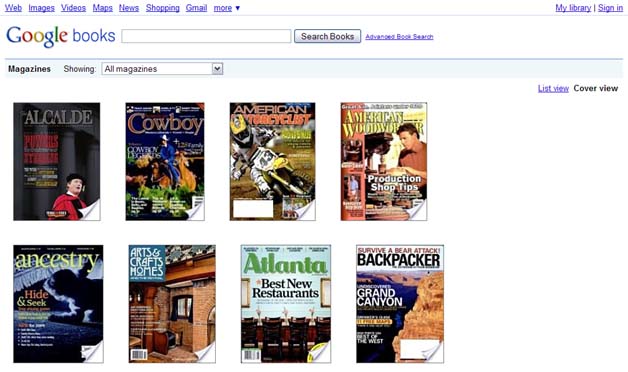
Big libraries are neat – the idea of having so much information (and entertainment) available in one place is just inherently attractive. The trouble is, big libraries can also be overwhelming, and so Google Books has tried to make its own virtual library a little more accessible by creating a list of available magazines.
Jeffrey Peng, a software engineer, put together the list. It’s available in either a "cover view" or a list view that provides more text and information. Users can sort the magazines according to how much of them can be seen by the non-paying public, too.

Admittedly, this doesn’t sound huge. But stick with us a moment. Just shy of 100 magazines are available through Google Books, and although that number isn’t overwhelming, it is unwieldy. Magazines are meant more for enjoyment than heavy research, so it makes sense to be able to browse a list rather than rely on a search function.
Furthermore, this development may signal that additional magazines will soon become available through Google Books.
Then here’s the other significant thing about the list: Peng wrote on the Inside Google Books blog that it was created in response to user requests (specifically, perhaps, a Facebook group with 45 members). So this is a nice example of someone within a multibillion-dollar corporation listening to what "the little people" want.
Related Articles:
> November 9th Target Set In Google Books Case
> French Case Over Google Books Begins
> Google Books Opens Door To On-Demand Printing
-
Sophos study suggests Windows 7 UAC’s default setting is self-defeating
By Scott M. Fulton, III, Betanews
A blog post Tuesday by Sophos senior security engineer Chester Wisniewski stated that recent Sophos tests revealed that User Account Control — the part of Windows that prompts the user for permission before granting elevated privileges — was ineffective in stopping common samples of malware from running, in a Windows 7-based system without virus protection.Whereas two of the ten chosen malware samples for the test would not run in Win7 without UAC turned on at all, only one more sample (a low-prevalence worm code-named W32/Autorun-ATK) was thwarted by UAC. The other seven ran as though they were being blocked only by a stack of dominoes.
Those items that ran unimpeded were: Troj/FakeAV-AFY and Troj/FakeAV-AFX, two low-prevalence Trojans that pretend to be a free anti-virus test; Mal/EncPk-KY and Mal/EncPk-KP, two garden-variety spam viruses; Troj/Agent-LIW, a low-prevalence Trojan that adjusts the behavior of Internet Explorer; Troj/Zbot-JN, a variation of the Trojan that attempts to steal online banking login information by first masquerading as an anonymous e-mail request for a date; and W32/Autorun-ATC, a garden-variety worm that changes the startup script.
“User Account Control did block one sample; however, its failure to block anything else just reinforces my warning prior to the Windows 7 launch that UAC’s default configuration is not effective at protecting a PC from modern malware,” Wisniewski wrote.
That default configuration is a new setting for Windows 7, that’s one level down (and one level less annoying for some users) than Vista’s default. During the testing process earlier this year, Windows 7 generated considerable controversy for effectively enabling some applications to generate a kind of “privilege self-elevation privilege” for themselves, which some saw as a vulnerability gift-wrapped for anyone wanting to go exploiting it. Others complained about a more sweeping potential problem: that the whole point of generating the message in the first place (stopping privilege elevation) is forfeited if developers leave a back door wide open.
As Wisniewski told Betanews this afternoon, his intention was not to prove UAC pointless in and of itself, but to suggest that Windows 7 may be vulnerable right out of the box unless and until users do something above and beyond the default.
“This was a quick test to determine if the efficacy of restricting administrative rights through the use of UAC alone will protect against malware infecting a computer running Windows 7,” Wisniewski told us. “I did not test how it would have behaved if UAC was dialed up, or perhaps run in what people are calling ‘Vista mode.'”
But if anti-virus is the solution to the problem (of course, Sophos is an anti-virus software maker), then what good is UAC at all, even if it’s dialed up? Is Chet suggesting the whole thing is pointless anyway?
“I am performing some follow-up testing, although as is the case with malicious software, it does take a bit of time to safely perform these tests. With the data I have at the moment, I am not making recommendations as to what you do with UAC,” he responded, “merely warning people that it does not protect a machine effectively against malware. I think Microsoft acknowledges this with their efforts on Microsoft Security Essentials and Forefront.”
But isn’t UAC generally effective against malicious applications that seek elevated privilege levels, even if they’re not among the most dangerous viruses cited by Sophos?“We did not select specific malicious or difficult samples, merely the most recent ten at the time. Most were ‘Fake AV’ even if the sample names did not indicate that. We have generic detection for malicious packers and other nastiness that proactively finds many samples…With proper anti-malware protection, Windows 7 is far safer,” acknowledged Sophos’ security engineer.
“One benefit that UAC could have provided,” he continued, “is an additional layer of protection that would help in the event that your anti-virus has failed to detect a new sample. It does not appear from my results that this is the case.”
-
Ford announces inflatable seatbelts, one step closer to Demolition Man
Ford just announced the inflatable seatbelt, intended to protect passengers seated in the back of the vehicle, where they are more vulnerable to head, chest, and neck injuries. How long will it be before our vehicles are filled with SecureFoam, filling our vehicles whenever we crash.
The new seatbelts will be available starting next year, debuting in the 2010 Ford Explorer. Ford has stated that they intend on offering the new seatbelts on all of their cars worldwide in the future. The new seatbelts are considered to be much safer then the current technology, and more comfortable. Ford hopes that the new design will help to increase the usage of rear belts.
-
WE WON! Lenovo will allow you swap Fn and Ctrl in BIOS

Take that, fat-cats in Congress!OMG! Did you hear? Lenovo has just added a BIOS feature to its new ThinkPads allowing you to swap Ctrl and Fn! Apparently this was a big request for many people in the world and Lenovo, being good guys, listened intently and pushed this passed the faceless bureaucrats in accounting and GOT THIS THROUGH! Hope, people, is what Lenovo promised, and change is what you get.
Honestly, though, has anyone even thought they needed this BIOS tweak let alone requested it? Anyone out there TOTALLY big into Ctrl being on the outside? -
Thousands Protest Health Bill At Capitol
“Chanting ‘Kill the bill,’ thousands of conservatives rallied at the Capitol on Thursday against the Democrats’ health care overhaul plan, labeling it a government takeover of the nation’s medical system,” The Associated Press reports. “‘This bill is the greatest threat to freedom that I have seen,’ House Republican leader John Boehner of Ohio told the crowd gathered on the lawn near the West Front of the Capitol. The protest attracted many of the so-called Tea Party demonstrators angry with increased spending and an expanded government role under the Obama administration” (Kellman, 11/5).
The Washington Post: “Dozens of Republican lawmakers, led by Rep. Michele Bachmann (R-Minn.), stood on the Capitol steps and pledged to do everything they could to defeat the health-care reform bill by Saturday, when House members plan to vote. ‘You came! You came to your House!’ said Bachmann, who organized the ‘Hands Off Our Health Care!’ rally in recent days with impassioned pleas on conservative talk radio and cable television shows” (Rucker, 11/5).
The New York Times: “A series of spot interviews suggests that the protesters have come to Washington from all across the country – Texas, Ohio, Oregon and the greater Washington area. It’s a generally older crowd, many in their 50s and 60s, predominantly, white, and many self-identified as Christians. They are fiercely conservative and deeply skeptical of the government, many of them adamantly opposed to abortion rights” (Herszenhorn, 11/5).
ABC News: “Dozens of buses, organized by the conservative group Americans for Prosperity carried grassroots activists and concerned citizens from Pennsylvania, New Jersey, Maryland and North Carolina. Organizers said activists became energized after Republican victories in Virginia and New Jersey Tuesday. ‘Speaker Pelosi did not get the message on Tuesday that people aren’t happy with the way things are going,’ Dave Schwartz, Maryland state director of Americans for Prosperity, told ABC News. ‘We need to send her another message'” (Dwyer, 11/5).
-
Google Tests New AdSense Interface
Google announced the beta testing of a new AdSense interface today. It is being tested with a small group of publishers. Google says the new interface was designed based on the top three requests from users:
1. Provide insights to help you make more informed decisions about you sites.
2. Offer you more control over the ads that appear on your sites.
3. Help you manage you account more efficiently
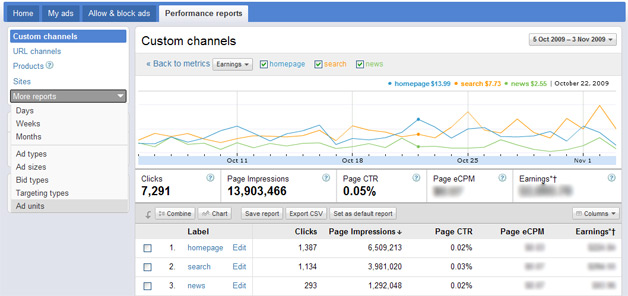
With the new interface, AdSense publishers can get more detailed performance reports that let them view daily stats in graphical formats. In addition, it provides metrics like amount you’ve earned from various ad, targeting, and bid types.

The interface includes some improvements to the Ad Review Center that will give users more options to manage ads that appear on their sites, and offer what Google says is a cleaner interface that will make it easier to find and review them within the Ad Review Center.
"We’ve streamlined the AdSense interface to simplify common tasks, such as making a change to several ad units simultaneously," says Google. "Additionally, to help you get the most out of AdSense, we’ve added more relevant help on every page, a message inbox for tips from our team, and alerts with important account related notices."
The limited beta testing is taking place in English, Spanish, French, German, Italian, and Japanese. The test will be rolled out to thousands of publishers over the coming weeks (they will be notified via email notification).
Related Articles:
> Google Familiarizes AdWords Users with New Interface
> Blogger Gets AdSense For Feeds Integration
> Google Friend Connect Gets an AdSense Feature
-
New Book Teaches that Music, Movement and Literature Go Hand in Hand for Young Children
Sometimes books come out of practical experiences. That is what led authors Rebecca E. Hamik and Catherine (Cat) M. Wilson to write their new book, Singin’, Sweatin’, and Storytime: Literature-based Movement and Music for the Young Child." Their new "kid-tested" book links music, movement and literature in the classroom.
Hamik is a physical education teacher, while Wilson, an MENC member, teaches general music. They teamed up when their school switched to all-day kindergarten. Given 45 minutes for the class, they wanted to fill them with meaningful classroom instruction for their students aged four to six.
“What we developed was a series of joyful lesson plans that not only give children a music foundation, but also teach physical education and other classroom skills,” Wilson says.
Each lesson has a story for the teacher to read to the children, a music activity, and a physical activity. The book also includes adaptations for regular classroom teachers and paraprofessionals and a music CD.
MENC and Rowman & Littlefield Education copublish Singin’, Sweatin’, and Storytime. Visit rowmaneducation.com for ordering information, the table of contents, reviews, and other book details. The book is $95 for the cloth version with an audio CD or $55 for the paperback version with an audio CD. MENC members receive a 25% discount.
In a joint interview, Wilson and Hamik discussed how they developed their book.
Authors Catherine (Cat) M. Wilson (left) and Rebecca E. Hamik
Question: In the chapter, “The Skeleton and Singing a Spiritual,”the pairing of “The Skeleton Inside You” and “Dry Bones” is so much fun. Can you describe how you went about linking the stories with the music?
Wilson: We were developing this health lesson plan near Halloween. The kids were very enthusiastic about learning about bones, and they loved the song “Dry Bones.” The song has historical value as an African American spiritual and it always gets the kids moving. We decided that the combination was fabulous!
Hamik: I want to provide the kids with important health information at an early age. The skeleton is a great way to introduce bones and body parts. I searched on several web sites to find books to go with each lesson.
Question: The music is diverse, from opera to spirituals to geographic locations like Africa. Did you want to provide music and movement from different genres and if so, how did you decide what went together?
Wilson: We wanted the musical genres to be very diverse to give students a wide variety of music to enjoy. We paired the countries with the songs and the games to give students an understanding of the world around them. We tried to choose countries from each continent, and countries from which some of our students immigrated so that they could share a piece of their culture with their classmates.
Hamik: Ditto!
Question: You discuss literacy and the young child and lay out what children are likely be able to do by the end of kindergarten. It must be wonderful to see children progress as they learn to sing and also to control their body movements.
Wilson: Young children develop rapidly, and it is amazing to see the difference in a very young child from the beginning of the year to the end of the year. Physically, socially, emotionally, and academically, they make tremendous progress. Giving them a musical, physical experience that is very diverse lays a strong foundation for their future musical and physical education. Education is a layering process…Children retain what they learn, too. I often have older kids come up to me and say they loved doing ‘The Three Piggy Opera.’
Hamik: I am amazed at how far our children grow and learn in a year’s time and it stays with them in future years.
Question: You have created a work with 42 different lessons. Do you have a favorite lesson?
Wilson: It would be hard to pick a favorite lesson. My favorite unit is 6, because I love studying world cultures and celebrations.
Hamik: I love the unit 2 health lessons, especially the germs.
Question: Is music or literature or movement more important in some lessons than others? Or is each element pretty equal in each lesson?
Wilson: I feel like all three of these elements reinforce each other. I personally would emphasize the musical study and Becky would probably emphasize the movement. A regular classroom teacher might be more inclined to emphasize the literature component. I think that this will all depend upon the teacher using the book. Unit 4 is skill based, and some lessons in that unit are geared more for movement or more for music. Most of the time we tried to balance the activities.
Hamik: Some lessons don’t have as much movement but the concepts that are taught are important for this age group, so if you forgo movement one day, you pick it up in the next lesson.
Question: Is there anything else you would like readers to know about your book?
Wilson: We want potential readers to know that we had a great time developing this curriculum for our very young students, and they were so enthusiastic to come and see us every day. Our first priority when writing this book was to develop plans for teachers that would involve and inspire very young students in a way that was joyful, creative, active, an appealing to all types of learners whether they were visual, aural, or kinesthetic modality. We strove to make a resource that would get lots of classroom use.
Hamik: Young children come to school with a varying amount of background information. This book gives teachers the opportunity to expand their knowledge base and to provide life long skills. The book is cross-curricular, provides higher order thinking skills. It also gives a good foundation into 3 subject areas and their standards.
—Roz Fehr, November 5, 2009. © MENC: The National Association for Music Education
-
Hermit Nation: Does Tech Boost Social Isolation?
We’re all familiar with the stereotype of the tech cave dweller, perusing a list of arcane Linux commands on a lonely Saturday night, no friends in sight. In the age of ubiquitous — and social — technology, though, can we conclude that the Internet, smartphones and new technologies isolate us and encourage cocooning, or the opposite?The Pew Internet & American Life Project sought answers to such questions through phone interviews with 2,512 adults in the U.S., and there are surprises in the survey results. I do wonder, though, how the results might skew differently if people under 18 had been included. Here are just some of the findings, with more results below the fold:

“We find that the extent of social isolation has hardly changed since 1985, contrary to concerns that the prevalence of severe isolation has tripled since then,” Pew researchers report. The survey, released yesterday, also found that the overall diversity of the average person’s social network — including close family and friends as well as acquaintances — is greater through usage of social networks such as Facebook: “For instance, frequent Internet users and those who maintain a blog are much more likely to confide in someone who is of another race.”
Internet use does not pull people away from places such as parks, cafes and restaurants, Pew researchers conclude: “Internet access has become a common component of people’s experiences within many public spaces.” Also, in opposition to the conclusion that Internet usage primarily bridges gaps between people who are geographically far from each other, the survey found that there is little difference between local social usage of technology and distant communication. The following graphic based on the survey results shows that people who belong to a neighborhood online forum are much likely than the average person to have diverse interactions with neighbors:

Does mobile phone usage outpace face-to-face contact as a primary way for people to stay in touch with their closest family and friends? No, according to the survey results: “On average in a typical year, people have in-person contact with their core network ties on about 210 days; they have mobile phone contact on 195 days of the year.” The following graphic breaks out days of contact per year via various communication mediums, according to how far away others are:

Younger people are overwhelmingly more likely to belong to social networks than older people are, the Pew survey also finds, and it’s worth noting that all the people surveyed were over 18. Results could be different for teenagers and children. There are many more findings and graphics from the survey, found here. For the most part, although your smartphone still doesn’t make you the life of the party, the results argue against the long-standing presumption that technology usage is social poison.

-
White Knight Chronicles gets voice chat and Home items
Another update for White Knight Chronicles coming up, but no, Level 5 Games isn’t finished with the North American release. They did, however, finis…
-
Canadian Gov’t Issues Takedown To Newspaper For Posting Section Auditor General Report
We’ve discussed in the past how silly it is for countries to have “crown copyright” (basically granting the government copyright over government documents). Luckily, the US has no such thing, but it makes no sense elsewhere. The government doesn’t need copyright incentives to create works. The only purpose crown copyright can serve is for the sake of censorship. Canada has a perfect example of that, as the Auditor General issued a takedown to both The Globe and Mail and Scribd, for posting one section of the Auditor General’s report on immigration. The Auditor General claims that to post parts of her report, newspapers (and others) need to ask permission on a case-by-case basis, due to the copyright. Of course, The Globe and Mail is a newspaper, and posted it as part of its reporting — which should be clear fair use/fair dealing (even if there was copyright over this material — which there shouldn’t be). And yet, we keep being told that Canada’s copyright laws are too lenient?
Permalink | Comments | Email This Story
-
Atlus announces North American release for Shin Megami Tensei: Strange Journey
In the near future, a mysterious, growing, black void dubbed the Schwarzwelt appears at the Earth’s southern pole. So begins the story in Atlus’ first…
-
Streaming at 3:30pm EST: Your GreenGov Ideas
More than 14,000 federal and military personnel participated in the GreenGov Challenge – submitting over 5,300 ideas and casting more than 165,000 votes. Today at 3:30pm EST, some of the top ideas are being presented to the Steering Meeting on Federal Sustainability, a group comprised of a senior official from each agency who is responsible for delivering their agency’s sustainability plan.
Tune-in at Whitehouse.gov/GreenGov to learn how we’re turning your GreenGov ideas into action.
[UPDATE: This event has now concluded. You can watch the video below.]
-
Deezer: Another Startup That Will Face the Music on Premium Streaming
French startup Deezer, a venture-backed streaming music provider that competes directly with much-discussed Spotify in Europe, today announced a two-tiered premium service model intended to extract revenue from power users. The site claims 16 million visitors and 11 million registered users, some of whom will now be expected to pay €4.99 ($7.42) each month to remove advertising and hear higher-quality streams, or €9.99 monthly to add a desktop app and mobile streaming to phones including iPhones, BlackBerrys and Android devices.As we’ve seen with Spotify’s still-too-low paid-user conversion rate, the vast majority of users are loath to shell out monthly fees to improve on the free-streaming experience. Drawing subscription revenue from a low percentage of power users to cover streaming costs that aren’t offset by advertising income isn’t yet proven as a business model, and Deezer is going to have a difficult time showing that it’s different from its rivals in that respect. Paid subscriptions for music have always been a tough nut to crack, and mobile apps aren’t yet bringing in new customers. And as free desktop streaming services continue to improve, largely due to better user interfaces and shorter loading times, premium offerings from stream providers actually become less attractive rather than more appealing.
Unlike Spotify’s, Deezer’s service is already available in the U.S., though its Stateside catalog is severely limited at present. (Want one of Green Day’s hits? You’ll have to settle for a cover band.) The company reportedly has agreements with all four majors, but its licenses obviously vary from country to country. The premium services will be rolled out first in France, then elsewhere in Europe.
Deezer revealed a €6.5 million round of funding from AGF Private Equity and CM-CIC Capital Prive last month, bringing its total funding to €12.2 million over two years. But with a far-better-funded rival in Spotify, Deezer still has an uphill climb to win consumers’ attention.