Author: Serkadis

  • Indiscreet tweet trips awareness of Web SSL vulnerability

    By Scott M. Fulton, III, Betanews

    Internet security engineers who had been meeting secretly to discuss a possible extension to Transport Layer Security (TLS) to thwart a possible low-level exploit, were compelled yesterday to reveal the existence of their meetings after another security engineer unconnected to their project went public with a conceptual framework of the very type of exploit they were working to pre-emptively patch.

    The problem is essentially a repeat of what developers of TLS and its parent protocol, Secure Sockets Layer (SSL), have dealt with a handful of times in the past: the potential of man-in-the-middle attacks by malicious servers that can pass themselves off as security authenticators. As the team from wireless security service provider PhoneFactor discovered last August, it was possible using both Microsoft IIS 7.0 and Apache httpd Web servers to demonstrate a situation where a false TLS server authenticates itself to a genuine Web client, then authenticates itself to a genuine TLS server, effectively setting itself up as a go-between that’s privy to the complete contents of what appears to the innocent client to be a fully encrypted SSL session.

    With online bank transactions worldwide currently covered just with SSL, the potential for global exploit now that the technique behind the attack is widely known, has just become enormous.

    As PhoneFactor engineer Marsh Ray blogged this morning, he first suspected the possibility of a vulnerability while doing code testing of a product that a PhoneFactor partner was developing to support its software. “We realized this situation needed to be handled with a good measure of care,” Ray wrote. “Over the first part of September 2009, we began disclosing the initial group of independent security consultants for independent verification and advice on how to proceed.”

    With the cooperation of groups such as the Internet Engineering Task Force, a working group was formed with the objective of developing an extension to TLS. Security vendors with representatives to the IETF, Ray implied, are aware of his and supervisor Steve Dispensa’s work, so it’s likely that remedial code for the problem has already been developed, and is being tested now.

    Without divulging the technical details, here is the basic theory of Ray’s and Dispensa’s discovery: During a typical TLS (SSL) session, a handshaking process initiated by a client results in the legitimate server validating the client’s certificate, and the client validating the one passed by the server. From there, an exchange takes place whose result is the production of an exclusive session key. Methods exist for one or the other party to request a change in the parameters of their transactions, perhaps to switch to a different, stronger cipher suite. However, because of the “post-only” nature of HTTP — the transaction protocol around which the TLS session is based — moving the session over to the stronger suite cannot mean suspending transactions in progress and picking them back up again later after the move. Instead, the old session is effectively ended and a new one begins.

    At least, that’s what’s supposed to be enabled to happen, and there’s where the trouble starts. The old session is ended, but in order to renegotiate the session, the client and server have to start all over again. In a situation similar to someone’s e-mail application replying to your e-mail with a message whose subject line begins, RE:, the conversation between client and server over what to change to, contains a reference to the request for renegotiation — the request that had, when sent earlier, been encrypted.

    Now it’s not, and that’s the problem. The certificate chain that had been encrypted is now revealed in clear text; and it becomes possible for a malicious middleman to inject code into that chain. Ray was able to demonstrate the methods to security vendors, and that’s where we’ll stop before we get too detailed.

    On a different IETF mailing list yesterday afternoon, a security researcher with SAP, who was running tests on Microsoft IIS, effectively discovered the same concept, and disclosed his discovery in a responsible manner as well. The problem: Someone reading that mailing list effectively broadcast the news “TLS is cracked,” or something to that effect, to all his friends on Twitter.

    Apparently last night — maybe in the middle of the night — is when Ray and Dispensa began getting phone calls from partners. The news was out, and now the need to keep “Project Mogul” secret had evaporated. Though a solution has already been in the works since at least early September, the race to secure the principal protocol governing the Web’s monetary transactions has just kicked into overdrive.

    Copyright Betanews, Inc. 2009


    Add to digg
    Add to Google
    Add to Slashdot
    Add to Twitter
    Add to del.icio.us
    Add to Facebook
    Add to Technorati


  • Changes for Apax in Asia

    Max Burger-Calderon has retired as chairman of Apax Partners‘ Asia operations, according to Dow Jones. He will now serve as part-time nonexecutive chairman, and will not be succeeded in his fulltime role. Dow Jones also reports that Michael Prahl has left Apax, where he focused on retail and consumer investing out of the firm’s Hong Kong office. www.apax.com

    ShareThis


  • Nintendo Game Boy inducted into the National Toy Hall of Fame

    Before the days of the PSP and the DS, only one name came to mind when it came to portable gaming – the Nintendo Game Boy. Since its launch in 1989,…

  • Google Dashboard launched

    google-dashboard

    Ever wonder how much of your personal information you’ve willingly donated to Google over the past 11 years? Today, Google announced the launch of a new product to help you find out, and it’s titled Google Dashboard. The Dashboard allows you to view all facets of your Google life: Gmail, Google Calendar, web history, what mobile phones are syncing with your account, YouTube, and more. You can view your purchase history in Google Checkout, see that you have an Orkut account that you didn’t know about, and see how many people have called your Google Voice number. It’s a nice gesture but this is all the stuff we’ve voluntarily leaked to Google, we’re curious about the dirt the big G has managed to collect on its own! 

    Read

  • Gopher: Content > Presentation

    gopher-overbite
    If you spend any amount of time using the Internet as we know it today, chances are you have suffered some inconvenience from the variety of interpretations of the various “standards” used to create the web. Every web browser renders web pages slightly differently; some Flash content isn’t compatible with older versions of Flash (and some versions of Flash aren’t supported on some operating systems at all!), etc. If you make your living creating web content, all of those problems may be amplified several times. Doesn’t it make you long for a real standard, where content is king, and presentation of said content is the same, regardless of whether you’re shopping for shoes or looking for an academic journal? The Gopher protocol, created in the early 1990s, had all that, and it ain’t dead yet!

    Ars Technica has a nice retrospective of the Gopher protocol. It’s a no-nonsense information presentation mechanism that places content squarely at the forefront. No pictures-of-text or confusing and inconsistent navigation elements to slow you down: navigating one Gopher site is the same as navigating any other Gopher site.

    Firefox provides native support for the Gopher protocol, and the Overbite project provides an enhanced add-on for Firefox, as well as an Adobe AIR standalone Gopher client. Old protocols die hard, I guess. There’s even a Twitter-over-Gopher solution (although everyone knows that Twitter-over-IRC earns more geek points).

    I used Gopher at my university’s library, where the entire card catalog was indexed in a Gopher space. It was, at the time, remarkably obtuse and hard to use; but then again I was still fighting SLIP connections on my home dial-up to access the “Internet”. Everything was a little kludgey back then.

    Given Gopher’s limited resurgence in popularity, what kind of Gopher site would you create today?


  • CNN.com Launches News Trivia Quiz

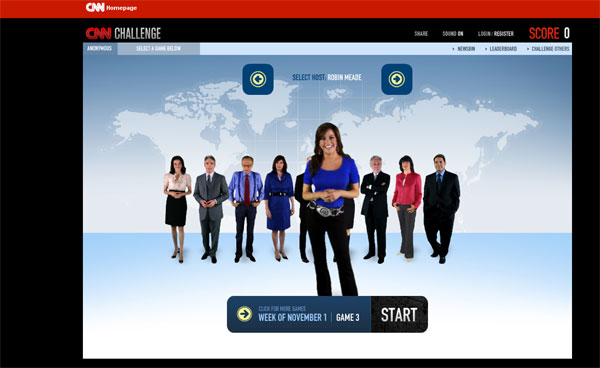
    CNN.com said Thursday it is introducing a new interactive online news trivia quiz called the CNN Challenge.

    CNN Challenge will focus on both historical news events and the top stories of the week. New quizzes about historical events will be available every Tuesday and Wednesday, and a new current news quiz will be available every Thursday.

    The CNN Challenge features three rounds of five question, focused on the who, what, when, where and why of certain news events. In the final stage of the quiz dubbed the "Lighting Round" users will have 90 seconds to answer five questions. Users receive points based on their response time and value of the question, which varies by the stage of the quiz.

    After taking the quiz, users can check the "Newsbin" for answers to and additional context on each of the questions, as well as links to more information related to the questions.

    CNN-Challenge

    There is also a social aspect allowing users to share the quiz on Facebook, Twitter and Mixx. Users can also see where they rank on a "Leaderboard" for the quiz or challenge other members of the community.

    CNN has signed on in-car communications system, Ford Sync to sponsor the quiz. Fifteen-second Sync video ads will run between some rounds starting later this month.

    "The CNN Challenge offers CNN.com’s users the ability to expand their knowledge of the news and current events in a fun and engaging way," said KC Estenson, senior vice president and general manager of CNN.com.

    "At its core, the CNN Challenge is another example of how we are leveraging interactivity and the social nature of the web to create a unique online experience."


    Related Articles:

    > CNN Launche App For The iPhone

    > CBS Trying Hand At Citizen Journalism

    >NBC Launches Video Trivia Game On Facebook


  • Lime Rock Raises $410 Million Fund

    Lime Rock, an energy-focused private equity firm, has closed its second Lime Rock Resources fund with $410 million in capital commitments. It will seek to acquire, directly operate and improve lower-risk oil and gas properties in the United States.

    PRESS RELEASE

    Lime Rock, a private equity firm focusing on the global energy sector, today announces the closing of Lime Rock Resources II with $410 million in total capital commitments. Like the first Lime Rock Resources fund, Lime Rock Resources II will seek to acquire, directly operate, and improve lower-risk oil and gas properties in the United States. Together with the Lime Rock Partners funds, which invest growth capital in energy companies worldwide, Lime Rock now manages private equity funds with $3.9 billion in total capital commitments.

    35 institutional investors, including leading endowments, foundations, and pension funds, made capital commitments to Lime Rock Resources II. 68% of capital commitments came from existing Lime Rock investors, with the remainder from new investors. Lime Rock began marketing the fund in August 2008.

    Eric Mullins, co-CEO of the Lime Rock Resources team, said, “When we launched the fundraising for Lime Rock Resources II, we had no idea of the economic turmoil that was to come only a month after the launch. To be able to count on the continued support of so many of our existing investors and to be able to win the trust of quite a few new investors during this challenging period has been a gratifying, and humbling, experience. We are excited to be able to begin our efforts to reward the trust of all the investors in Fund II.”

    Lime Rock closed the first Lime Rock Resources fund in 2005 with $456 million in total capital commitments. Based in Houston, the Lime Rock Resources team has completed eight major transactions. It has acquired oil and gas properties in New Mexico, Texas, and Oklahoma and is seeking to acquire other mature properties nationwide. The Lime Rock Resources team’s first fund has already returned over one-third of capital to investors through quarterly distributions of operating cash flow and property sales. Including the $600 million of acquisitions already completed, the two Lime Rock Resources funds have acquisition capacity of over $1.5 billion and investor equity capital of $866 million.

    Charlie Adcock, co-CEO of the Lime Rock Resources team, added, “Both our investors and our team recognize the irony that the most difficult time to raise private equity capital is usually the most opportune time to deploy it. We are thankful to our investors for their extraordinary support over the last year. We now have significant equity capital to implement our strategy in an exciting time. We believe that, over the next few years, stress at many property holders as well as the continued rationalization of oil and gas portfolios will present opportunities for our team to acquire lower-risk properties and apply our intensive cost, efficiency, and operations focus to generate good long-term returns for our investors.”

    Thompson & Knight acted as counsel for Lime Rock during the fundraising.

    For more information, please visit www.limerockresources.com.

    ShareThis


  • BlackBerry shipments grew five times faster than iPhone in Q3

    By Joe Wilcox, Betanews

    Despite last week’s blog and news assertions that iPhone market share had reached 30 percent or even 40 percent, today IDC put Apple’s smartphone smack in its place: No. 3, with 17.1 percent worldwide smartphone market share during third quarter. A year earlier, Apple ranked ahead of Research in Motion, which has reclaimed second spot, behind Nokia.

    Manufacturers shipped 43.3 million smartphones during third quarter, up 3.2 percent from 41.9 million units in second quarter and up 4.2 percent from 41.5 million units in third quarter 2008. More broadly, manufacturers shipped 287.1 million handsets, up 5.6 percent year over year, according to IDC.

    Nokia’s overall handset and smartphone markets shares were almost identical, 37.8 percent and 37.9 percent, respectively. For smartphones, second-ranked RIM posted year-over-year shipment growth of 35.7 percent growth, compared to 7.1 percent for Apple. While iPhone is doing quite well, BlackBerry is doing much better. RIM shipments increased from 6 million to 8.2 million units year over year, while Apple shipments grew much less — from 6.9 million to 7.4 million units.

    Last week, I blogged that “iPhone cannot win the smartphone wars” and about a month ago that “iPhone’s global success is more myth than marketing reality.” Same day as my post from last week, ChangeWave released survey results asserting that BlackBerry smartphone market share was 40 percent, while Apple had reached 30 percent.

    On October 27th, an Apple 2.0 blog post about the ChangeWave data set off a series of follow-up/copycat reports claiming that iPhone was in “striking distance” of BlackBerry, including All Things Digital, CNET, National Post, Technologizer and The Unofficial Apple Weblog, among, many, many, many others. Reports of iPhone soon overtaking BlackBerry were seemingly everywhere late last week.

    Q3 09 Smartphone Shipments

    But in keeping with reservations I expressed on Twitter last week: Apple’s smartphone market share is nowhere near 30 percent. It’s still quite aways from 20 percent. I tweeted: “Busy street. Do you see 3 iPhones or 4 BlackBerries for every 10 smartphones? No? Why then believe ChangeWave’s 30% iPhone share claim?”

    Several people responded that they in fact did see numbers that high. Michael Gartenberg, Interpret’s vice president of strategy and analysis, tweeted: “it’s all anecdotal which means nothing. That’s why we do surveys ;)” To which I responded: “Right, but you also publish methodology with those surveys. This one has only number of people. Demographics unclear.”

    ChangeWave’s presentation of the data reflects larger problems with how online news is degenerating into a mass grab for traffic and page views. ChangeWave was highly selective, presenting only market share data on Apple, Palm and RIM smartphones. The data polarized around BlackBerry and iPhone, conflict sure to make great blog titles and news headlines, particularly with Apple an endlessly hot topic. Meanwhile, ChangeWave’s online report offered scant methodology — other than number of people surveyed — to support its findings.

    ChangWave’s methodology is much different than IDC’s. The survey method gives a snapshot of what people are using now, which can be a very useful metric. But typically surveys are online, with people self-selecting to participate (I can only assume that’s how ChangeWave collected the data). Self-selected surveys can skew the data, particularly for devices like BlackBerry and iPhone, which might have higher connected audience — among other factors.

    Q3 09 Mobile Phone Shipments

    By comparison, IDC’s data is more exact by counting the number of smartphones actually shipped during a three-month time period. While the data is more precise, it’s less likely to reveal overall usage share — something a well-done survey can do.

    Gartner also counts number of units, but differently than IDC. Gartner counts sales to end users, while IDC tracks total units shipped, which doesn’t necessarily mean sold. That’s why Gartner unit shipments for iPhone are typically lower than Apple’s shipment data, which corresponds with IDC data. Both Apple and IDC count shipments into the channel. The difference also explains why Gartner has consistently put BlackBerry ahead of iPhone, based on actual smartphone sales.

    All three methodologies are useful for measuring a product’s success, but in different ways. Gartner’s data will contrast against IDC’s, both offering necessary views on number of smartphones shipped and those actually sold. Gartner hasn’t yet publicly released third-quarter smartphone shipment data.

    As for iPhone, I predict the smartphone will remain in third place as long as US distribution is locked to a single carrier. Gartner predicts that by fourth quarter 2012, Android phones will be second to Symbian-based handsets (mostly from Nokia), with BlackBerry and iPhone neck-and-neck but RIM’s device ahead.

    Copyright Betanews, Inc. 2009


    Add to digg
    Add to Google
    Add to Slashdot
    Add to Twitter
    Add to del.icio.us
    Add to Facebook
    Add to Technorati


  • IER: Special Interests, Foreign Competitors Win Under Senate Global Warming Bill

    American families, U.S. competitiveness shortchanged by shortsighted proposal

    Washington, DC – Today, the U.S. Senate Environment and Public Works Committee passed a global warming bill. Following the panel’s vote, Thomas J. Pyle, president of the non-partisan, pro-market Institute for Energy Research (IER), issued this statement:

    “The winners today are rent-seeking corporations, Washington special interests and our global competitors, especially China. The timing of this vote – which will weaken America’s ability to compete in the global economy – is particularly ironic, given that just yesterday a U.S. global warming envoy official told Congress that ‘No country holds the fate of the Earth in its hands more than China.’

    “Enacting burdensome policies – such as cap-and-trade – will drive energy prices up and make it more difficult to create jobs, wealth and prosperity here in the U.S. China’s hand, however, will only grow stronger, as they continue to aggressively access and develop all forms of energy in their country and across the world. This, in large part, is what has enabled their enormous economic growth and expansion.

    “While the members of this committee who voted to advance this legislation may attempt to downplay their vote to increase energy costs for American families, seniors and small businesses as an inside-the-beltway procedural motion, the fact remains that job-killing, carbon regulating legislation has cleared a major hurtle and is a major step closer to becoming law.”

    For additional information, please contact Patrick Creighton, 202-621-2947, or Laura Henderson, 202-621-2951.

    #####

  • “It is now abundantly clear that we have at our fingertips all of the tools we need to solve three or four climate crises” 2009

    753px-Solar_eclipse_2005-crowds_Madrid

    2009Nov5: “It is now abundantly clear that we have at our fingertips all of the tools we need to solve three or four climate crises,” writes U.S. Vice-President Al Gore in Our Choice, A Plan to Solve the Climate Crisis. “The only missing ingredient is collective will.”

    Reference: USA Today http://www.usatoday.com/weather/climate/2009-11-05-algore_N.htm

    Image Description: Solar eclipse, Madrid. Photo by MGR!, 2005Oct3. Image Location: Wikimedia Commons http://commons.wikimedia.org/wiki/File:Solar_eclipse_2005-crowds_Madrid.jpg Image Permission: This file is licensed under the Creative Commons Attribution 2.0 License.

  • Content Is Advertising: Free Local Commercials, Sponsored By Another Company

    Via Adam Savage, I heard about a fun project that highlights the advertising is content, content is advertising concept in multiple ways. It’s a site called ILoveLocalCommercials.com, which features two filmmakers going around the country making (free — and awesome) TV commercials for local businesses that are nominated on the site. As mentioned, the commercials are really quite impressive, such as the “brutally honest” commercial for Cullman Liquidation (“get yourself a home, or don’t, I don’t care”) or for Ray’s Midbell Music that involves a rap about how being in the school band is cool:


    The commercials are really entertaining in their own way, and have garnered hundreds of thousands of views — again, demonstrating how good advertising is content. The guys making the videos also put up a short “behind the scenes” version of each video as well, to explain the backstory a bit more. The backstory on Cullman Liquidation is pretty entertaining as well.

    But why are these guys doing this? Well, the whole thing is actually part of a promotion from another company, MicroBilt, that’s trying to promote its own line of small business services. So it’s paying for the whole thing — showing how content is advertising. None of the videos are actually about MicroBilt, but in sponsoring the entire site and the whole process, it’s helping to get its name out there in a fun (non-intrusive, non-annoying, non-sneaky) manner. It’s not about product placement or trying to “sneak” a brand into something. Everything’s totally upfront. But it’s a fun project, with highly entertaining content that shows both how advertising is content and how content is advertising.

    Oh yeah, and it appears that Cullman Liquidation has also picked up on the whole “looooooooooots of t-shirts” concept. On the Cullman Liquidation website, the company is selling t-shirts based on the commercial…

    Permalink | Comments | Email This Story


  • Apple welcomes Windows pirates with open arms

    pirates
    Apple seems to have bought some keywords on Google including, most interestingly, “download windows 7.” That’s right: every hax0r out to download Win7 will see a little ad from Apple saying “Upgrading to Windows 7? There’s never been a better time to switch to a Mac. Find out why.”

    Computerworld tested a few other keywords, including “buy Windows 7″ and “Windows 7″ itself and the ads didn’t appear. Clearly they are looking for a “different” type of customer.

    Why are the targeting pirates? It doesn’t make a lot of sense but it does make sense for Apple to target folks who are on the fence about Windows 7 and could be looking to download the OS for free rather than making the total jump. Those same swing-users could be swayed to roll over to OS X given enough prodding.


  • Quick Look: Warhammer Online Mac Edition

    Over the years, I’ve been forced to redefine my definition of “native” game clients for OS X. At first, I was a die-hard, nothing but true native code for me, thanks. Then, as the harsh reality of understanding that true native code is about as likely as Congress putting aside their differences and acting on what’s best for the common man, in a moment of true despair I opined that maybe running games in Crossover wasn’t such a bad idea.

    Now, the trend seems to be to use TransGaming’s Cider, which in non-technical terms a wrapper game developers can use to bridge their Windows code over to OS X. It’s not a “true” native client, but, since it doesn’t require a virtual machine or the ritual sacrifices that seem to go along with getting games to run on Crossover, I can handle that. Warhammer Online, from EAMythic is the latest game to get ported. After a few months of beta, it was released October 26. Full disclosure: this isn’t a full review. I’ve only got about 15 hours or so of game play to base these observations on.

    Luelell_004

    I’ve had decent luck with Cider ports, although my sample set of Sims 3 and Spore is a little small. Warhammer Online: Age of Reckoning (WAR) is definitely the most resource-intensive of the ports I’ve tried. For the most part, it worked fairly well. I have a brand-new MacBook Pro, but with only 2GB of RAM. I had enough stutters and jerks to prove to me that jumping to 4GB would be optimal, but it wasn’t unplayable with 2GB, either.

    Gameplay

    Warhammer has two modes: one where you fight against the computer-controlled monsters (PvE), and one where you fight against other players (PvP). There are two sides, Order and Destruction, and they are locked in the age-old, time tried, cliché battle to control the lands. What I liked is you can earn the experience needed to level up in both modes — although there is a separate level called Renoun where you only earn in PvP.

    The PvE quests are fairly trite, being mostly “go forth and kill me 10 of these.” One nice variation is a Public Quest. When you go into an area, you’ll get a pop up to “kill x of this.” Any player in the area killing these contributes to the kill total. Participating in these earns you some influence you can use to buy better gear — almost all the gear upgrades I found were earned from either Influence or Renoun rewards.

    Zallya_006

    There are also PvP quests relating to capturing enemy turf or killing other players. You can also play PvP scenarios, which are similar to a Team Fortress-type map. You’ll go into a small area and need to fight other player for control of a few objectives. This is where I had the most fun. The battles are short, usually fairly intense, and last about 15 minutes. You can queue up for one with a press of a button. When enough players are queued up, the scenario will begin. When it’s completed the game will return your previous location. Being able to gain levels doing this relieves some of the boredom attached to just running quests.

    There are a couple of amusing bones EA has thrown to Mac players. All Mac players unlock an in-game title, “I’m a(n) Order/Destruction” depending on your faction. If PC/Mac people kill enough of each other, you can also unlock a secret title.

    Competition

    Warhammer’s biggest competition on the Mac is World of Warcraft, and in many ways it’s not a fair comparision. WoW has years of polish behind it and only has a PvE mode (the PvP stuff is more of a tack-on than a core game component as it is in WAR). There is a visual similarity between the two, but it’s ironic. Warhammer Online is based on the old Game Designers miniatures game, which WoW borrowed from for its look. However, I found the look to not be a sharp as WoW, and the characters models were a little bland by today’s standards.

    Zallya_009

    One of the benchmarks I’ve used when reviewing games to judge their elusive “fun” factor is how many times I bullcrap myself into thinking, “I’m just logging in to check one thing,” knowing full well I’m going to be in there for at least an hour. That about sums up my weekend with WAR. You can download a free, 10 day trial here. Existing customers, aka, yous Windoze folks, can download the client for free.

  • Breaking: Online social network use isn’t detrimental to your actual social network

    twitter

    A Pew Internet & American Life study has refuted the idea that use of the Internet necessarily leads to decreased social isolation. Quite the opposite!, yelled a character in a Charles Dickens novel. It turns out that as people continually use things like Twitter, Facebook, and the like, they’re both expanding their social circle and increasing contact with said circle.

    The old way of thinking was that spending all day on the computer would come at the expense of maintaining meaningful human contact. Can’t talk to someone about The Issues of the Day online, right? (Wrong, but whatever.)

    Some bullet points, because those are easy to write:

    • People who use mobile phones have a 12 percent larger discussion circle (people you talk to about Important Stuff) than non-mobile users

    • The diversity of a person’s “core network” is 25 percent larger for mobile phone users, and 15 percent larger for basic Internet users

    • People who use social networks tend to have “real” social networks that are more diverse than people who don’t

    • Internet users are no less likely to have a chat with their neighbor than someone who doesn’t use the Internet all that much

    You can read the full study here, or, like me, just be content with the executive summary. My interest in social networks died some time ago, but hooray for all the folks out there who keep bringing the thunder.

    via Yahoo


  • Media Molecule: No sequel for LittleBigPlanet

    Media Molecule has shot down the possibility of a sequel for LittleBigPlanet. In an interview with Critical Gamer, the devs shut the doors closed on a…

  • Ares Capital Posts Gain, Allied Capital Posts Loss

    (Reuters) – Small-business lender Ares Capital Corp (ARCC.O) posted a quarterly profit that beat analysts’ estimates by a cent, while struggling rival Allied Capital Corp (ALD.N), which Ares agreed to buy last month, posted a quarterly loss.

    Ares Capital posted a net profit of $63.3 million, or 62 cents a share, for the third quarter, compared with a loss of $41.4 million, or 43 cents a share, a year earlier.

    Excluding professional fees related to the acquisition of Allied Capital and dilution from a recent offering, the company earned 36 cents a share.

    Analysts were looking for a profit of 35 cents a share, excluding items, according to Thomson Reuters I/B/E/S.

    Ares gained $30.4 million from investments and foreign currency transactions during the quarter, compared with $74.2 million it lost in the same quarter last year.

    Separately, Allied Capital said it had a quarterly net loss of $140.7 million, or 79 cents a share, hurt by a $117.5 million loss on extinguishment of debt.

    Ares Capital agreed to buy Allied Capital in October in an all-stock deal valued at $648 million, providing relief to the debt-laden company. 

    Ares shares were up about 4 percent at $10.87 Thursday on Nasdaq, while those of Allied were up about 4 percent at $3.27 on the New York Stock Exchange.

    (Reporting by Anurag Kotoky in Bangalore; Editing by Ratul Ray Chaudhuri)

    ShareThis


  • Ancestry.com Shares Jump in Debut

    NEW YORK (Reuters) – Ancestry.com Inc (ACOM.O), a website backed by Spectrum Equity Investors, rose in its initial public offering debut on Thursday.

    The company priced the 7.4 million shares at $13.50 per share on Wednesday, within an expected range.

    Ancestry.com, which operates a website that allows people to trace their family roots by scouring online records.

    The Provo, Utah-based company had expected to sell 7.4 million shares in its IPO for between $12.50 and $14.50 each, in a $100 million offering.

    Its shares were up 10.5 percent to $14.92 in early afternoon trading on Nasdaq.

    Ancestry.com, which said it had 1 million subscribers as of September, was founded in 1983 and is majority owned by private equity firm Spectrum, whose stake in the company will fall to 54.8 percent after the IPO from 67 percent. Spectrum bought Ancestry.com for $354.8 million in December 2007.

    Existing shareholders are selling about 45 percent of the shares in the IPO, with the rest coming from the company.

    Ancestry.com expects net proceeds of $48.4 million from the IPO, and will use the money in part to repay $12.1 million it owes CIT Lending Services Corp, a unit of CIT Group Inc, (CITGQ.PK) and use the rest for working capital.

    Ancestry.com’s registered users have built 12 million family trees containing 1.25 billion profiles, according to the filing.

    Its revenue in the first nine months of 2009 was $164.8 million, largely from subscriptions, up 13.5 percent from the year-earlier period. Over the same period, its profit rose 250 percent to $12.2 million. In 2008, each subscriber generated about $16.09 in revenue per month.

    The IPO was lead managed by Morgan Stanley (MS.N) and Bank of America Merrill Lynch (BAC.N). Underwriters will have the option to buy another 1.1 million shares. (Reporting by Megan Davies; Editing by Tim Dobbyn)

    ShareThis


  • Obama To Visit House Dems To Rally Support For Saturday Health Bill Vote

    “In a last-minute exercise of presidential hand-holding, President Obama plans to travel to Capitol Hill on Friday morning to meet with House Democrats, one day before they vote on his highest domestic priority: a bill to overhaul the nation’s health care system,” The New York Times reports. “White House officials said the president wanted to address any lingering doubts about the legislation in the House, where liberal Democrats are concerned that the bill’s so-called public option — a government-backed insurance plan — is too weak, and where conservative Democrats are uneasy about whether the legislation would permit federal money to be used to pay for abortion” (Stolberg, 11/5).

    Meanwhile, support for the House bill could also be bolstered by the arrival of two new Democratic congressmen, CNN reports. “Representative-elect John Garamendi [D-Calif.] will be sworn in by House Speaker Nancy Pelosi Thursday afternoon.” On Friday, “Representative-elect Bill Owens [D-N.Y.] is expected to be officially sworn in as a member of Congress.” At that point, ” the House will be back at full strength, with 435 members. Thanks to their victories in Tuesday’s special elections, the Democrats will increase their majority by one, and will hold a 258 to 177 advantage in the chamber.” The tally on Saturday is expected to be close and 218 votes “will be needed to pass the bill” (Steinhauser and Walsh, 11/5).

  • Secretary Duncan Connects American and Jordanian Students

    In President Obama’s address to the Muslim world delivered from Cairo in June, he called for the creation of an online network so "a teenager in Kansas can communicate instantly with a teenager in Cairo."

    Yesterday, teenagers from Washington, DC and Amman did exactly that.

    Kansas to Cairo

    Photo credit: Leslie Williams, Dept of Education, 11/4/2009

    Dr. Waleed Al-Ma’ani, the Jordanian Minister of Education and I moderated a discussion by a dozen students from Bell Multicultural Early College High School in Washington and their counterparts in Jordan via videoconference.

    Before this dialogue, the students were asked to identify a common challenge facing students in America and Jordan. The American and Jordanian students chose climate change. They corresponded before the event, writing questions to ask each other and sharing their research. The students from both countries were well-prepared and thoughtful in speaking to climate change and encouraging to each other when it was their turn to speak.

    I was impressed by how quickly the students recognized the challenges climate change is presenting both countries and their individual lives.

    At the end of the discussion, the students asked each other how they could keep up the dialogue. They talked about setting up a Facebook group for themselves and they made plans for a second videoconference in June. They’re also talking about a joint project to set up recycling programs or public awareness campaigns about climate change at their schools.

    It was tremendously exciting for me to see the President’s vision becoming real. It was clear that the last statement from America to Jordan summarized the students’ feelings about the event: "You all are amazing."

    President Obama said in Cairo that "all of us share common aspirations – to live in peace and security; to get an education and to work with dignity; to love our families, our communities, and our God." Students from both countries showed that we all believe that education can change lives.

    Kansas to Cairo - 2

    Photo credit: Leslie Williams, Dept of Education, 11/4/2009


    Arne Duncan is Secretary of Education