If for some strange reason you thought Resistance was the last new Insomniac IP, better think again. In the words of senior community manager James St…
Author: Serkadis
-
T-Mobile’s “Project Dark” a Threat to Prepaid Providers
 T-Mobile USA has seen its growth stall and its ARPU slide in recent months as cut-rate discount service providers poach budget-conscious customers, and as AT&T and Verizon Wireless target high-end users. So the nation’s fourth-largest carrier is taking aim at both segments at we enter the holiday season with new calling plans and two new Android phones. But it’s the prepaid guys who have the most to fear.
“Even More Plus” plans, which don’t require a contract, include an unlimited-everything option for $80 a month and a voice-only unlimited plan for $50 a month. And while T-Mobile doesn’t offer subsidized handsets with the new no-contract plans, it does allow users to pay for expensive phones over a 20-month period without interest; users who already have a handset can also take advantage without additional fees. A number of traditional contract plans are offered, too, under the “Even More” category.
The prepaid plans, which were announced yesterday, had been rumored for weeks as the centerpiece of T-Mobile’s “Project Dark” initiative, and the carrier is clearly taking aim at its bigger brothers by marketing the offerings on its web site as “1/2 the price of comparable AT&T or Verizon plans.” But it’s the smaller, prepaid-only providers that could be feeling nervous about the new plans. T-Mobile hasn’t matched the rock-bottom plans of bargain-basement providers like TracFone Wireless, but it does operate a truly national network and it offers a more compelling lineup of handsets than most prepaid competitors. For prepaid users looking for more than just voice and text messaging, “Even More Plus” will be pretty attractive.


-
ResponseLogix Raises $5.6 Million
ResponseLogix Inc., a Sunnyvale, Calif.-based provider of automotive digital response management software, has raised $5.6 million in new VC funding. Emergence Capital Partners led the round, and was joined by return backers GRP Ventures, Shasta Ventures, Belo Corp. and AH Belo Corp.
PRESS RELEASE
ResponseLogix, Inc., the leading provider of automotive digital response management software, today announced the closing of $5.6 million in new funding led by Emergence Capital Partners. The round also included existing investors GRP Ventures, Shasta Ventures, Belo Corp. and AH Belo Corp. The funds will be used to further cement ResponseLogix’s leadership in the growing market for internet lead management services to the auto industry.
“Emergence Capital Partners invested in ResponseLogix because of its market leadership position, compelling customer value proposition, and the experience and passion of the management team,” said Jason Green, General Partner at Emergence Capital Partners. “We have watched ResponseLogix grow its business dramatically during one of the worst financial and auto industry downturns in history. I can’t wait to see what happens to this company as the economy rebounds.”
Emergence Capital Partners is the leading venture capital firm focused on cloud-based business and consumer services companies. In 2002, Emergence Capital was the first to recognize the power and potential of SaaS to disrupt the technology industry and invested in some of the most successful companies including Salesforce.com and SuccessFactors. Their mission is to help build market leading companies in true partnership with forward thinking entrepreneurs. Today the firm has over $325 million under management from premiere institutional investors.
“The Emergence team has a proven track record of funding and building market-leading technology companies, particularly software-as-a-service (SaaS) businesses. As a SaaS business ourselves, we are delighted to partner with them to accelerate our growth,” said Tom Mohr, President and CEO of ResponseLogix. “We are also pleased that existing investors joined Emergence in this financing. The commitment of all our investors in ResponseLogix further validates our value proposition — that a rapid quote response and effective ongoing customer follow-up are the keys to driving automotive Internet sales.”
About ResponseLogix, Inc.
ResponseLogix delivers software as a service (SaaS) technology to auto dealers so they can better respond to Internet leads. SmartQuote™ answers Internet leads within 10 minutes, with a price quote on multiple vehicles based on the customer’s make, model and trim level request. SmartFollow™ helps dealers stay in touch with the customer with dynamically timed, interactive follow-up emails. SmartFacts™ delivers powerful analytics to help optimize the performance or Internet sales departments. The ResponseLogix’s SmartQuote product recently received recognition by Automotive News Magazine as one of ten featured products in its annual post-National Automobile Dealers Association convention product review, this year entitled “Cool Stuff at NADA”. ResponseLogix products are available in 40 US markets for Toyota, Ford, Lincoln-Mercury, Chrysler, Dodge, Jeep, Honda, Lexus, Audi, Honda, Acura, Nissan, Infiniti and Hyundai dealers across the US. Additional OEM’s will be supported soon. Additional information is available at www.responselogix.com.
-
YouTube Faces Formal Complaints In Germany
In about two weeks’ time, the two-year anniversary of YouTube Germany’s launch will roll around. The site’s set to receive more legal documents than birthday presents, however, as it’s facing some formal complaints.
The distribution of copyrighted material is at issue, of course, and so is the (lack of) distribution of royalties. What sets this situation a little bit apart from other ones is that a number of individuals -rather than just a money-grubbing organization or two – are involved.

Wolfgang Spahr reported, "Those filing the complaints include: U.K. soprano Sarah Brightman and her German producer Frank Peterson; German producers Jon Caffery (Die Toten Hosen) and Toni Cottura (Backstreet Boys, Twenty Four Seven, Scatman); independent publishers Gerig Musikverlage, Bishop Songs and Musikverlag Progressive; plus independent labels Highball Music and Coconut Music."
Then here’s the other odd thing about the situation: the claimants have asked for both the uploaders and downloaders of copyrighted material to be identified.
Still, it seems that German authorities will get to say a few things before the case even makes it to court. And it’s almost hard to guess what sort of outcome YouTube really wants, considering that it might appreciate having a global stage to promote Content ID and point out some of the music industry’s quirks.
Related Articles:
> YouTube Strikes Deal With UK Broadcaster
> Report: Emails May Make Viacom’s Case In YouTube Suit
> Germany Gives Street View Go-Ahead
-
Public Firefox 3.6 beta now expected Wednesday, 3.5.4 Tuesday
By Scott M. Fulton, III, Betanews
 During a Mozilla developers’ planning meeting today, it was officially announced that Firefox users will begin seeing notices for version 3.5.4’s availability beginning tomorrow (October 27). Full information about security issues addressed by this regular update will probably be released at that time, although Betanews tests indicate that Windows 7 users in particular will probably notice a bit of a speed boost, on account of improved document load times.
The first public beta of Firefox 3.6, which adds even more Windows 7 integration, will be released the following day. It will probably not be the final public beta for the product, as a development cycle for Beta 2 has been ongoing since the Beta 1 code was frozen last October 14.
As Betanews reported before, our tests show Firefox 3.6 speed gains to be sizable on all platforms, now pulling the venerable browser to within the performance levels of version 2 of Google Chrome (although version 3 is the current stable edition, and version 4 is its widely distributed dev channel build). However, we also expected to see the final public build ten days ago — its released was blocked on account of newly discovered bugs. Some sources had reported the product was actually released, and a few went on to say it was released and then retracted; data obtained by Betanews from Mozilla indicates this was never the case.
Tomorrow’s rollout of the stable version bug fix means the window for the next bug fix in that cycle moves to mid-December, which is not the most desirable timeframe. During today’s planning meeting, contributors called for suggestions as to how or whether that timeframe could be adjusted.
-
Dear Hollywood: Don’t Be Idiots; Don’t Delay Movie Rentals
Sometimes you just shake your head at ideas that come out of some executives that are just so incredibly dumb, it makes you wonder how anyone ever took them seriously. There have been some hints about this latest one, though. Just last week, in discussing the latest IP Colloquium podcast, we noted (with surprise) that Paramount’s top lawyer thought the solution to business model problems in the entertainment industry was “more windows.” Windows, of course, are the different time periods in which movies are released solely for different formats/media. So, it starts with the theater (the first window), followed by video, pay per view, cable and network TV — each representing another window, and another chance to squeeze more money out of the same content.
Yet, with the industry facing some challenges, rather than actually looking at what users want, its top brains seem to think that the answer is more windows. It’s hard to explain how incredibly short-sighted this is, because it’s so monumentally backwards that it makes you wonder what they’re thinking. At best, my guess is that the execs are extrapolating out in the simplest form that with the launch of each “window” they make more money, so the way to make even more money must be to offer more windows. Of course, this assumes two rather basic things that are totally wrong. One, is that these windows won’t piss off users and two, that those users have no alternatives.
But, apparently not realizing that, these execs have hit upon a few different attempts to add more windows. First, they’ve been pushing for the permission to break your TV or DVR with selectable output control barring your ability to tape movies. This way, they can create a new “window” of movies on TV that you can’t record, that they can offer before the movies even get out on video. Of course, this will (a) piss people off and (b) drive them to more piracy. Brilliant.
The other attempt, is to get video rental places to stop renting movies when the DVDs first come out. The LA Times had an entire article explaining this plan, whereby the studios would force all rental services, including Netflix and Blockbuster to not rent certain films — but only offer them for sale. The idea (short-sighted as it is), is that this would somehow force people to buy more DVDs, which gives the studios a higher margin than rentals. We actually heard about this earlier this year with the contract terms that the studios tried to put on Redbox, but it’s apparently trying to do the same with Netflix and Blockbuster as well.
This idea is so bad that even the LA Times, who tends to support its hometown industry more often than go against it, put out a separate opinion piece with the original article, calling this new idea “crazy” and “absurd.”
In the meantime, what do customers actually want? Well, there’s pretty good evidence they prefer choice not being limited by windows. They’ve been clamoring for so-called “day-and-date” release, whereby all these windows are compressed. If you don’t want to see a movie in the theater, why not be able to get the DVD? It’s as if the studios don’t realize that part of what they’re selling is the social experience of “going out” to the theater. Even better, if the DVD comes out at the same time as the theater version of the film, less marketing money needs to be spent to sell more DVDs, and you can do nice tie-ins, like having the ability to buy the DVD as you walk out of the theater. Giving people more value and more choice is what the market is asking for.
Instead, Hollywood execs are trying to take away choice and limit value. Incredible.
Permalink | Comments | Email This Story
-
Star Trek onesies for young nerdlings
 While scores of parents the world over may worry endlessly about the distinct possibility of their children growing up nerdly, I say get ‘em started early with stuff like these Star Trek onesies.
Nerdy kids are smart, they develop loyal friendships, and they laugh hysterically at various factoids and inside jokes that most of the rest of society will never understand. Plus if you happen to be around during your freshman year of college for the first time a nerd gets drunk, don’t walk away. Picture child-like wonderment mixed with double-jointed limb flailing and uproarious laughter, and you’ve got the makings of a good night.
As for these onesies, they’re available in several styles and sizes for $16.
Star Trek Uniform Onesies [ThinkGeek]
-
At long last, Microsoft to release Outlook .PST file specifications
By Scott M. Fulton, III, Betanews
Three weeks ago, the European Commission signaled its approval of Microsoft’s revised plan for a more vendor-neutral Web browser selection screen for European Windows users. But that revised plan was buffered with a big bonus: a promise to supply the general public with a wealth of interoperability information, including about proprietary formats.
Among the most sought after formats on that list has been for Outlook Personal Folders — the much-maligned .PST file format, whose lack of comprehension has been the pet peeve of certainly every developer who’s ever worked on a calendar or smartphone synchronization utility. Now the manager for Microsoft’s new Office Interoperability Group announced this morning that work is under way on public documentation for the file format.
“This will allow developers to read, create, and interoperate with the data in .PST files in server and client scenarios using the programming language and platform of their choice,” reads Paul Lorimer’s notice this morning. “The technical documentation will detail how the data is stored, along with guidance for accessing that data from other software applications. It also will highlight the structure of the .PST file, provide details like how to navigate the folder hierarchy, and explain how to access the individual data objects and properties.”
Although Microsoft had already documented the Outlook Object Model, that was essentially the type library, or interface, for .NET applications to address components of the running Outlook 2007 application. That’s only helpful if you’re a developer of an add-on or some other product that assumes that Outlook is running. What Microsoft is promising today goes much deeper: As a Microsoft spokesperson told Betanews this afternoon, the specification will actually enable some organizations to finally comply with new government policies for corporate governance, especially with regard to maintenance of interoffice communications.
Back in March 2007, the issue of whether Outlook’s ability to automatically delete old communications was brought to light by way of AMD’s ongoing antitrust suit against Intel. At that time, Intel’s attorneys claimed the company inadvertently destroyed much of the internal e-mails it had been ordered to keep, on account of an internal network policy enabling Outlook to destroy old .PST files. Knowing that such a loss was possible, Intel managers had instructed their staff to create new, personal .PST files that could not be destroyed.
Had a better understanding of the .PST file format been available at the time, theoretically, forensic engineers may have been able to recover deleted .PST material from backups, or from hard drives that were also in use for other purposes.
The documentation will be released under the company’s Open Specification Promise, which was unveiled in February 2008 with the expectation that the .PST format would certainly be among those that the European Commission would expect to see opened up. But even after today’s announcement, the matter of when the documentation would be released, was left undetermined. As Lorimer puts it, the amount of time Microsoft expects to take will be determined by how long “industry experts and interested customers” may take reviewing the drafts, “to ensure that it is clear and useful.”
-
Reid To Announce His Support For Public Plan
Senate Majority Leader Harry Reid plans to announce at a 3:15 press conference today his support for inclusion of a public option in health care reform legislation. Politico reports that Reid will announce his “plans to push ahead with a public option vote – most likely one that includes an opt-out provision for states – even though he’s currently short several votes for passage, according to people close to the situation.”
“Reid, who spoke with virtually every member of his 60-member caucus this weekend, currently has between 56 and 57 votes for a proposal to create a national insurance plan but allow states to opt out of it, according to Democratic aides. A public option with a delayed ‘trigger’ – supported by the White House and Sen. Olympia Snowe (R-Maine) – has between 58 and 59 backers.” That iteration could be floated “as an alternative if the opt-out measure fails to obtain the 60 votes needed for cloture, sources said.” During the course of the weekend, Reid convened several meetings with his leadership team, and wrangled “over the details with White House Chief of Staff Rahm Emanuel” (Thrush, 10/26).
Bloomberg: “Reid’s move gives new momentum to the so-called public option as Congress considers the biggest changes to the U.S. medical-care system since it created Medicare, the health program for the elderly, in 1965.” The majority leader needs at least 60 votes “to overcome the ability of Republicans to block consideration of legislation. Virtually all Republicans oppose the measures passed by two Senate committees (Rowley, 10/26).
The Washington Post’s Capitol Briefing blog reports that “senior Senate sources said they have been informed by Reid that the leader intends to send several versions of health-care reform legislation to the Congressional Budget Office for cost analysis, and that the bills may offer different approaches to creating a public option.” Some of these approaches include an “an ‘an opt out’ clause that would allow states to decide not to participate in a government plan; an ‘opt in’ provision for states that many Democratic moderates prefer; and a ‘trigger’ that would create a government plan if private insurers do not offer policies at affordable prices (Murray, 10/26).
CNN’s Political Ticker: “Reid hopes his proposal will appeal to liberal senators who have been insisting on a public option as well as to conservatives who are wary of a government-run plan but could persuaded to support one if states have the authority to opt out.” Democratic sources have told CNN that because Reid does not yet have firm commitments in place for the requisite 60 votes, his “strategy is risky.” But an aide described Reid as “cautiously optimistic” (Bash, 10/26).
-
On Shelves This Week: October 25 – October 31, 2009
We have a rather sizeable haul of new games this week. The cream of the crop includes such titles as Tekken 6, DJ Hero, Forza Motorsport 3, Ratchet &a…
-
Highest Cost Generating Plant Comes On Line in Florida to Obama Fanfare
Florida Power & Light (FPL) has built a 25 megawatt photovoltaic power plant in Southern Florida that will supply power to 3000 homes and businesses–a small fraction of the company’s over 4 million customers.[i] And, when the plant comes on-line Tuesday, October 26, 2009, President Obama will travel to Florida in Air Force One to promote the largest US photovoltaic plant and the carbon dioxide emissions it will displace. However, Obama’s flight will result in releasing greenhouse gases, negating some of the more than 19,000 tons the plant is estimated to save each year.[ii] And, President Obama won’t mention the high construction costs of this photovoltaic plant that will be paid for by US taxpayers and electricity consumers in Florida.
He also won’t mention that while the plant employed 400 draftsmen, carpenters, and others during its construction, few full-time employees will be needed during its operation—one engineer to trouble shoot problems and six ground keepers to keep the grass trimmed and animals away.[iii] As such, the ongoing operation of this solar plant will not help the rising Florida unemployment rate.
FPL spent $152 million building the plant[iv], which amounts to $6,080 per kilowatt—a figure substantiated by the Energy Information Administration, who ranks photovoltaic solar the highest cost technology of a potential slate of 20 possible future generating technologies.[v]

While traditional fossil fuel technologies cost substantially less, solar photovoltaic technology is being supported by Federal subsidies, consisting of investment tax credits and accelerated depreciation, and by mandates for renewable power in many US states.[vi] The Florida Legislature approved a one-time rate increase of about 31 cents per month for the average customer to cover the construction of three solar test sites totaling 110 megawatts—about one half of one percent of the total energy FPL produces.[vii]
European Experience
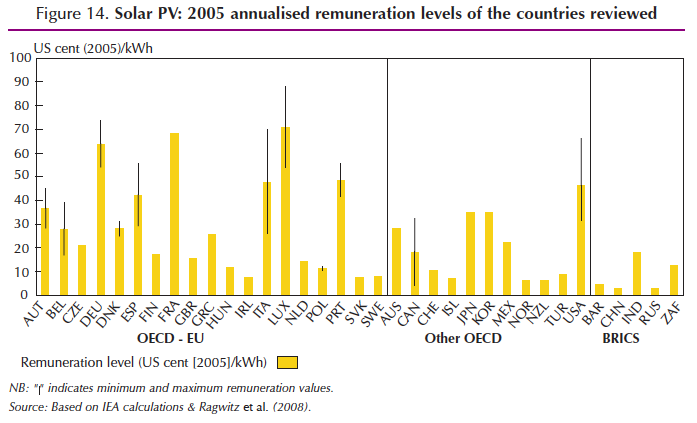
The US is not the only country building and subsidizing solar plants. In fact, it ranks fourth in the world for cumulative installed solar electric power. Germany ranks first, Spain second, and Japan third.[viii] In Germany, solar producers receive as much as 64 US cents per kilowatt hour through a feed-in tariff, which requires utility companies to purchase renewable power at their higher cost. The feed in tariff for photovoltaic solar in Germany is more than eight times higher than the electricity price at the power exchange.[ix] Germany is reducing its subsidies for solar to ease costs for electricity consumers. Surprisingly, Germany’s photovoltaic manufacturing industry is beginning to support slashing subsidies due to competition from Chinese manufacturers, whose production costs are 30 percent lower. China is now the world’s largest producer of solar cells.[x]
Spain has a mandate requiring 20 percent of its electricity generation to come from renewable power by 2010, and it uses feed-in tariffs to further promote renewable generation. In 2008, Spain’s solar power cost was over 7 times higher than its average electricity price.[xi] Spain also slashed subsidies for solar power, limiting those subsidies to 500 megawatts, about one-fifth of the solar capacity it subsidized in 2008.[xii] In Japan, the government has set a target for 30 percent of all households to have solar panels installed by 2030.[xiii]
Subsidy Levels by Country
In 2008, the International Energy Agency released an analysis of policies used to deploy renewables during the period 2000-2005 for the 30 countries of the Organization for Economic Cooperation and Development and for Brazil, Russia, China, India, and South Africa.[xiv] They found that the investment costs of photovoltaic systems are high, representing the most important barrier to their deployment. The agency’s calculated 2000-2005 policy effectiveness levels for photovoltaics are lower by a factor of ten than for more mature renewable technologies such as wind energy. Feed-in tariffs (complemented by the easy availability of soft loans and fair grid access) have been very effective in Germany, albeit at a high cost. In recent years, the level of the German feed in tariff for solar photovoltaics has decreased to some extent, and an element of degression, a pre-determined percentage decrease in the renewable technologies’ support level, has been introduced. The German parliament approved proposals for acceleration of degression rates for stand-alone installations from 5 percent per year in 2008 to 10 percent per year in 2010 and 9 percent from 2011 onwards. According to the IEA, this creates incentives to reduce costs.
The IEA calculated the remuneration levels in 2005 for each renewable technology for the 35 countries they analyzed. The solar remuneration levels are given in the figure below. In Luxembourg, for example, the remuneration level in 2005 was as high as 90 cents US per kilowatt hour. The average renumeration levels are higher for solar photovoltaic technologies than for other more mature renewable technologies due to their high investment costs.
Conclusion
Even with large subsidies, solar photovoltaic power is having trouble gaining market share, contributing less than one percent to the total power generated in each of the countries that have the largest solar capacity in the world—Germany, Spain, and the United States. The reason is the high investment costs that solar power needs for deployment. Regardless, our Federal and state governments seem intent on making consumers of electricity pay for solar technologies that are not economic against traditional generating technologies causing taxpayers and customers to subsidize their construction and operation. Our state and Federal politicians tout that this will help employment. However, when the largest solar plant built in the United States goes operational on Tuesday, it will lose 393 employees that it employed for less than a year, needing only 7 for ongoing operations.
[i] http://my.att.net/s/editorial.dll?eeid=6895421&eetype=article&render=y&ck=&ch=mo
[ii] http://www.fpl.com/environment/solar/desoto.shtml
[iii] “Solar plant set to open, even as shadows loom”, Herald Tribune, Zac Anderson, Oct. 14, 2009, http://www.heraldtribune.com/article/20091014/ARTICLE/910141033/2055/NEWS?Title=Solar-plant-set-to-open-even-as-shadows-loom
[iv] Ibid.
[v] Energy Information Administration, Assumptions to the Annual Energy outlook 2009, Table 8.2, http://www.eia.doe.gov/oiaf/aeo/assumption/index.html
[vi] http://www.instituteforenergyresearch.org/2009/10/19/the-u-s-doubles-down-on-solar-subsidies-while-europe-retreats/
[vii]“Solar plant set to open, even as shadows loom”, Herald Tribune, Zac Anderson, Oct. 14, 2009, http://www.heraldtribune.com/article/20091014/ARTICLE/910141033/2055/NEWS?Title=Solar-plant-set-to-open-even-as-shadows-loom
[viii] Solar Energy Industries Association, http://www.seia.org/cs/about_solar_energy/industry_data
[ix]“Economic Impacts from the promotion of renewable energies”, Rheinisch-Westfalisches Institut fur Wirtschaftsforschung , http://www.instituteforenergyresearch.org/germany/Germany_Study_-_FINAL.pdf
[x] “Solar-Power Incentives in Germany Draw Fire,” Vanessa Fuhrmans, Wall Street Journal, September 28, 2009, http://online.wsj.com/article/SB125383541153239329.html
[xi] Study of the effects on employment of public aid to renewable energy sources, Universidad Rey Juan Carlos, March 2009, http://www.juandemariana.org/pdf/090327-employment-public-aid-renewable.pdf
[xii] Wall Street Journal, “Darker Times for Solar-Power Industry”, May 11, 2009, http://online.wsj.com/article/SB124199500034504717.html .
[xiii] Energy Information Administration, International Energy Outlook 2009, May 2009, page 68, http://www.eia.doe.gov/oiaf/ieo/pdf/0484(2009).pdf .
[xiv] International Energy Agency, “Deploying Renewables: Principles for Effective Policies”
-
Alice in Chains launches its new album, yes, via an iPhone App
 Last week, Volkswagen “launched” the new 2010 GTI via an iPhone App. This week, famous rock band Alice in Chains launches its new album via an iPhone App. It comes out tomorrow, and includes the album itself, along with photos, news, videos, etc. Think of it as a bonus DVD, back in the early days of when the record labels were trying to figure out how to get people to buy CDs.
-
BlackBerry 5.0, T-Mobile Price Cuts & More Mobile Monday Madness
 What a Monday it is turning out to be for the mobile industry — one major news announcement after another. Three of the most notable include:
- BlackBerry 5.0, the latest operating system update for RIM devices, is out. James Kendrick from jkOnTheRun has the details. From what I understand, it has follow-up flags for email, which makes it pretty useful.
- T-Mobile USA caused a major upheaval yesterday when it announced an everything unlimited plan for $79 a month. You just need to bring your own devices. Jason Devitt, CEO of Skydeck and one of our favorite mobile industry insiders, thinks this is a major development as it indicates that the market might be ready to transition from the culture of two-year contracts and subsidized phones.
- Verizon is betting that a slew of new devices, including the Android-powered Droid, are going to push its sales up in the coming quarters. The company needs a hit phone badly: It added 1.2 million new subscribers in the third quarter vs. 2 million added by archnemesis AT&T during the same period.

-
PS3 Netflix: The best use of BD-Live yet
Finally, Sony’s PlayStation 3 home video game console and Blu-ray player will be receiving Netflix Instant streaming, a feature which has appeared on a number of other pieces of hardware, including rival console Xbox 360 and connected Blu-ray players from manufacturers such as Samsung, LG, and even Sony itself.
But unlike those other platforms, which connect to Netflix Instant Streaming through an interface native to the console, PlayStation 3 users will be required to boot up the service from a Netflix Blu-ray disc, which utilizes BD-Live to access the online content. BD-Live is a Blu-ray standard which lets a disc have downloadable bonus content instead of limiting it to content burned onto the disc.
Wedbush Morgan analyst Michael Pachter believes the BD-Live technique was chosen to work around some exclusivity clauses between Netflix and Microsoft, but the real reason is unknown. We’ve contacted Netflix and Sony for comment on Pachter’s hypothesis, and will update with their responses as they arrive.
But whatever the reason, the inclusion of Netflix on PlayStation 3 means big things. Firstly, and most obviously, it takes away one of the major exclusive capabilities of Microsoft’s Xbox 360 and offers it for free. On the 360, Netflix subscribers must also be an Xbox Live gold member, which costs $50 a year, raising the price of Netflix streaming-only access by some 46%. This adds fodder to the debate that the PS3’s online capabilities are not as good as the 360’s, but are at least offered freely.
Secondly, this will help expose even more consumers to Netflix Instant streaming. The PS3 has an estimated 9 million users now, and numbers have been swelling rapidly thanks to the recent — and long demanded — console price cut. The Netflix disc can be obtained free of charge and opens the PS3 to the streaming library of more than 17,000 titles. Rather than pack the disc with the PlayStation 3, Netflix is only making the Instant Streaming discs available through the mail, which could ensure higher customer conversion.
Thirdly, this has potential to be the single largest use of BD-Live yet. In September, Deluxe Digital Studios said users were connecting to BD-Live about 4 million times a month, with the majority of interest coming in the form of downloadable trailers. Meanwhile, the first three months after Netflix was introduced on Xbox Live, more than 1 million users were connected to the service for 1.5 billion minutes. Even if users were connecting to BD-Live in five-minute increments, which is long for a trailer, that would still only amount to 20 million minutes a month.
-
U.K. Social Networking Sites Account For 25% Of Display Ads
Social networking sites in the U.K. accounted for 13.8 billion display ad impressions in August 2009, representing more than 25 percent of all display ads viewed online, according to a new study by comScore.
Telecommunications companies were the heaviest social networking site advertisers, serving more than 949 million display ad impressions on social networks in August, or about 7 percent of all display ads delivered in the site category.
The retail advertiser category ranked second with 753 million display ad views, followed by banking brands with 248 million, travel brands with 213 million, and entertainment brands with 181 million display ad views.
Among the top 10 advertiser categories on social networking sites, teen content advertisers delivered the highest amount of their ad impressions in the social networking category at 37.3 percent. Online dating advertiser (33.8%) and retail advertisers (30.1%) also delivered an above average proportion of their ads in the site category.
A demographic analysis of display ads on social networking sites in the U.K. found while ad delivery skewed somewhat younger than average, all age segments were reached with a notable percentage of display ads.
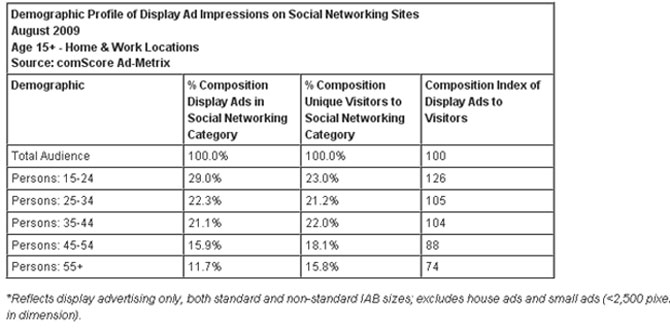
Display-Ad-Demographics15-24 year olds were the highest indexing age segment, accounting for 29 percent of display ad impressions while representing 23 percent of the total category audience. Those between the ages of 25-44 received ads at a slightly higher than average rate, while those 45 and older received ads at a lower than average rate. Each of the five age segments accounted for at least 15 percent of the category audience and 10 percent of ad impressions.
“CPMs on social networking sites have traditionally suffered relative to other content categories, in part because of the perception that much of the audience are younger consumers with lower spending power,” said Mike Read, comScore managing director, Europe.
“However, these data suggest that every demographic segment is reached via social networking sites and that no particular age segment accounts for an overwhelming percentage of ads delivered. Given the overall reach and volume of ads delivered on social networking sites, brand advertisers who ignore this channel may be missing a significant opportunity and enabling their competitors to gain a dominant share of voice in the channel.”
Related Articles:
> Making Money With Social Media
>Facebook Can Drive More Traffic Than Google
> Social Media Will Not Replace Search
-
Social Networks Blamed For $2.25B In Lost Productivity
Short stretches can really accumulate. Did you know, for instance, that if someone comes back from lunch nine or ten minutes late every day, he (or she) will take the equivalent of free week of paid vacation per year? And similarly, one IT services and technology company believes social networking is costing UK businesses $2.25 billion each year.
Morse surveyed 1,460 office workers, and on average, they admitted to spending 40 minutes per week on Twitter, Facebook, and the like. While on the clock, and for personal use. Morse did some multiplying and came up with the figure $2.25 billion (or actually, £1.38 billion – we converted) in lost productivity.

What’s more, Morse tried to make its estimate conservative. It turns out that, when asked about their coworkers, the respondents said they believe the average amount of time spent on social networks is closer to 59 minutes.
Philip Wicks, a consultant at Morse, observed in a statement, "The popularity of social networking sites such as Twitter and Facebook has grown considerably over the last couple of years, however with it has come the temptation to visit such sites during office hours. When it comes to an office environment the use of these sites is clearly becoming a productivity black hole."
Don’t be surprised if another wave of businesses decides to create usage policies or block its employees from accessing Facebook, Twitter, and MySpace, then.
Related Articles:
> Hitwise: Facebook Receives One-Seventh Of UK Page Views
> Online Retailers To Focus On Facebook And Twitter During Holidays
> Hitwise: Facebook’s Social Market Share Up 194 Percent
-
Google Taken To Court To Explain Why It Shut Down Someone’s Gmail Over Missent Email
Paul Alan Levy writes “Last month, you wrote about the travesty perpetrated by Rocky Mountain Bank when it sued Google to shut down the gmail account of a Google customer to whom the bank had mistakenly emailed a pile of customer records. Equally disturbing was the way that Google — which is usually pretty good about standing up to subpoenas for customer identity — just rolled over and obeyed the court’s order even though a second’s review of the company’s ex parte arguments to the court showed both that the bank never explained what the Gmail customer did wrong, never explained how Google could be sued in the face of 47 USC 230, and never showed that there was diversity jurisdiction.
So we have gone back to court, representing MediaPost Communications, arguing that Google’s report to the Court, showing its compliance, is a judicial record that should have been, and now must be, filed publicly. We agree of course that any actual customer identification in the compliance report should be redacted.”
This is a tricky issue. After all, Google, as a private company, has the right to shut down an email account on its own. But, seeing as this was all a part of a legal case, with a number of questionable elements, it does seem like the information that led to the account being shut down should be a part of the public record.
Permalink | Comments | Email This Story
-
Digital Contents Expo Tokyo: Awesome “Time And Space Mapping Software”

The Tokyo Polytechnic University has showcased c-loc at this year’s Digital Contents Expo, a spectacular mapping software for “time and space” that runs on a touch screen. The technology looks super-futuristic, and it not only works but is actually useful, too.
The idea is to visualize geographical and chronological data via 3D graphics and let users easily access and alter the data they see via a touch screen. c-loc can cover text-based information, images, sounds and videos. You can use it to visualize how a certain building (space) evolves over the years (time), for example. The makers target archeologists, historians, urban researchers and others with their product.
Here are two videos I took of the mapping software in action at the event yesterday.
Video 1:
Video 2:
-
Transcript: Health On The Hill – October 26, 2009
KHN’s Mary Agnes Carey and Eric Pianin talk about new optimism among liberal Democrats that a public option will be included in the final health overhaul bill. They also discuss Senate Majority Leader Harry Reid’s determination to have a bill soon. View the HOTH video or listen to the audio version (mp3).
Related Video
Transcript:
JACKIE JUDD: Good day. I am Jackie Judd with Health on the Hill, a conversation about efforts to pass health care reform legislation. Joining me, Mary Agnes Carey of Kaiser Health News and Eric Pianin, also of Kaiser Health News. Welcome to you both. Over the weekend, it became apparent that the public option, the discussion of the public option has been revived. What happened?
MARY AGNES CAREY: It’s an amazing story. If you look back at the Town Hall meetings in August, a lot of opposition, loud opposition to the public plan. About a month ago, the Senate Finance Committee took a vote and did not vote for the public plan to be included in the Senate Finance Bill. At that point, a lot of analysts thought it was dead.
I think there has been a lot of pushback from progressive groups, from Democrats who have said now wait a minute, this debate is about choice and we want the public plan in there to provide choice to millions of Americans to help in the Democrats’ words and the words of President Obama “keep health insurers honest.” I think there was a very strong pushback and this is where we are now.
JACKIE JUDD: And what are the range of ideas now when we say the public plan, both in the House and the Senate?
MARY AGNES CAREY: There is debate over what the rates would be paid, for example, and the more robust option in the House had considered in the past was setting provider rates, what was paid to the doctors and physicians, tagging that to the Medicare reimbursement rates, or perhaps adding 5-percent additional for physicians.
There seems to be more support coalescing behind a public plan where the rates are negotiated, so it means you wouldn’t save as much money, but it may be more political acceptable to folks, and now there is a discussion about putting the public plan into the Bill, letting states opt out if they choose.
JACKIE JUDD: And what does the White House think of all this discussion?
ERIC PIANIN: Well, I think the White House is very excited that the prospects of improved or passage of health care reform this fall. The President desperately wants to have a Bill on his desk. I think that there still is some real tension between the White House and Congressional Leaders over the best approach and what form of public option would be most saleable and politically wise.
JACKIE JUDD: What signals did you pick up on over the weekend about what the White House would like the public option to look like at this moment?
ERIC PIANIN: I think the President and his advisors want what many people think is a relatively weak version of the public option. They don’t want the public option to take effect immediately. Instead, they want to see how the legislation works out.
If, down the road in certain states, citizens are not afforded adequate insurance at reasonable prices, if in some states 95-percent of the citizens do not have the option of getting affordable insurance, then this public option would trigger in. And I think that there is a feeling on the Hill, particularly among liberal Democrats including Harry Reid the Senate Majority Leader that is too weak a version.
What they would prefer is what Mary Agnes was discussing, this provision where you create a public option, if states want to opt out of it they may, but for the rest of the country there would be a public option.
JACKIE JUDD: And what is the political calculation that the White House would at this moment support? What is the most cautious approach to a public option?
ERIC PIANIN: Well, I think that the President at this point would prefer the trigger mechanism and I think part of it is a concern that many conservative Democrats who have to run for reelection next year would have a very tough time defending a robust public option. They want the weakest version, if you will, and the trigger mechanism certainly fills that Bill.
JACKIE JUDD: Okay and on Capitol Hill, Senator Reid, the Senate Majority Leader, is trying to cobble together a single Bill from the two committee Bills. What is the status of that?
MARY AGNES CAREY: The negotiations are ongoing with members of the Senate Health, Education, Labor and Pensions Committee as well as the Finance Committee. We have had White House representatives in the room. They are hoping to finalize the discussions this week, get a Bill to the Congressional Budget Office, also known as the CBO, to give a score to see if it will hit that $900 billion mark that the President has set and if it doesn’t they would have to make adjustments but they want to see what the price tag is because they have told members that they want to do that before the Bill goes to the floor.
JACKIE JUDD: But we don’t know the contours of it yet.
MARY AGNES CAREY: We don’t know yet. Of course, they are negotiating; for example, the Bills differ on things like would there be an employer mandate? It is in the HELP Committee Bill, not in the Senate Finance Bill. How would the individual mandate work? The HELP Committee Bill has a very robust public option. The Senate Finance Bill has this co-op provision that had been inserted, so we have to see how they work out those differences.
JACKIE JUDD: Okay, thank you to both, and thank you for joining us. I’m Jackie Judd.
-
Need a replica iPhone? No? Well here’s one anyway.
![Screen shot 2009-10-26 at [ October 26 ] 9.50.26 AM](http://www.mobilecrunch.com/wp-content/uploads/2009/10/Screen-shot-2009-10-26-at-October-26-9.50.26-AM.png)
In just about every other movie or TV show we watch, at least one of the characters (if not half the cast) is rocking the iPhone. For example: Have you seen Chuck? If not, you definitely should — it’s a great show — but it has more Apples than Granny Smith.
Sooner or later, one of these shows is going to have a reason to destroy an iPhone on camera. Up until now, the prop folks have only read had two options: Smash a real iPhone to pieces, or recreate the iPhone in one-off prop form. Depending on the size of the production, either of those options might be a bit too pricey. Enter: the iPhone dummy.


