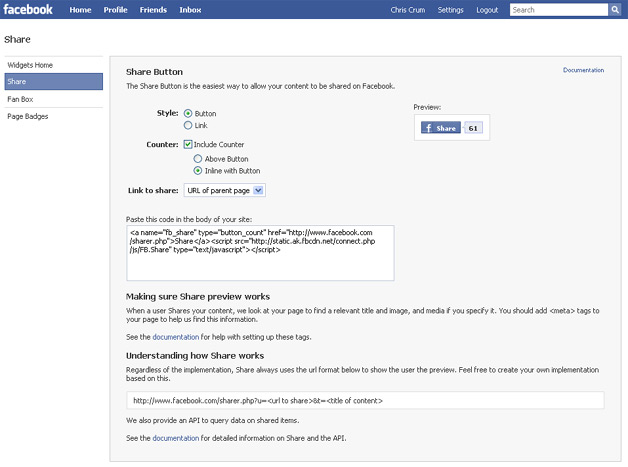
Facebook launched a new version of its Share button today. This includes a live counter and analytics. When you use the new share button on your content, you can measure engagement and view the number of shares, likes, comments made, and clicks back to your site.
"Share analytics bring new opportunities to show how content is being shared on Facebook, such as Techmeme for selecting top stories and bit.ly for analyzing URL traffic," a spokesperson for Facebook tells WebProNews. "The new Share button is among the easiest Facebook Connect widgets to install and can be added to any website with just a few lines of code."
To get the share button, go to Facebook’s widgets page. From there, you can set up how you want it to look and retrieve the appropriate code.
The Facebook share button can be a tremendous contributor to the driving of traffic via the social network. Once Facebook updates begin appearing in Bing results (and possibly Google if Google makes a deal with Facebook) search and share buttons should combine for some major measurable traffic.
According to Facebook, users share over 2 billion pieces of content on the social network each week. Most of that, the company says, is facilitated by Facebook Share buttons across the web. More on the new share button here.
As we saw at last week’s “What’s Next for the Web?” Bunker Series event, we’re pushing the boundaries of the web. The NewNet, as we call it, is blurring the lines between what’s online and what’s real life. From augmented reality apps to location-based services and speech-activated mobile tools, technology is increasingly working to leverage everyday human interaction as its interface with the world. This morning, we have two pieces on our subscription research service, GigaOM Pro, looking at this very trend.
First, Ed Gubbins takes a look at how this shift is impacting the search market, in “How Search Is Evolving Beyond Text.” We wrote a lot last week about the move toward real-time search, but audio, video and image search are growing up, too. Whether its matching input sounds and images with indexed sounds and images or leveraging crowd-sourced metadata on video clips, new tools are helping seekers get the content they’re looking for without relying on the simple text query.
Liz Shannon Miller flips the question on its head to show how web analytics can act as a road map to success for real-world events. As we interact with online content, we leave dozens of digital footprints about who we are, what we like, and where we live. In “New Use For Web Stats: Finding Hot Markets, Offline,” Liz looks at how everyone from indie films and big-name bands is tapping into this rich data source to build an audience.
Sign up with GigaOM Pro today to read these and dozens of other detailed research briefings and in-depth articles in each of five areas: NewNet, Mobile, Connected Consumer, Infrastructure and Green IT. Today’s also the last day to take advantage of our Bunker event discount code for GigaOM Pro. Sign up using this discount code “BUNKER1019″ and get $20 off the regular one-year subscription price of $79.
Nothing says “please rob me blind” like riding a foot-powered scooter and housing your iPhone in a dedicated quiver-like sash that exposes the top-most part of the device, logo and all.
But if you’re confident in your ability to maneuver your scooter safely out of harm’s way or you live in some sort of suburban utopia where nobody gets their i-Products stolen, then perhaps the $20 Strap Pocket for iPhone will appeal to you.
It’s made of light and durable and Neoprene and works with all generations of iPhone and iPod touch models (and, of course, other similarly-sized gadgets). There’s a main pocket for the device, a smaller pocket for headphones, and a buckle for attaching it to a full-sized bag “for additional fail-safe security,” according to the product description.
Our favorite iPhone outlaw, geohot, has released an update to the iPhone jailbreak software blackra1n. Dubbed RC2 the update addresses several issues including:
Fixes 3G signal issues
Tethered jailbreak for 3.1 OOTB iPod touch 8GB and new 3GS’
Fixes issues with package software”Icy“
Versions for both Windows and Mac now available
No need to rerun blackra1n if you already applied RC1 successfully, but for those of you who have not been able to crack into your iPiece take RC2 for a spin. Let us know how it goes!
WNYC’s excellent radio program On The Media this week decided to spend an hour discussing the music industry. It’s quite well done, in that it highlights how this is actually a great time in the music industry for musicians and fans — with the only party really in trouble being the old record labels. The program talks to numerous knowledgeable people, including James Boyle, Amanda Palmer, Greg Kot and others. The one section, however, that I thought was a bit weak, was the section on live shows. That section only focused large stadium/amphitheater shows — the kind that only a very small number of bands deal with. It doesn’t even mention the much more common forms of touring and live shows. Furthermore, that section only seemed to talk to one individual — a smaller concert promoter who used the part to basically bash Live Nation. Now there are things you can complain about with Live Nation (though, I’d argue that they’ve got a much better understanding of where the market is heading than most people give them credit for based on conversations I’ve had with Live Nation folks), but that segment was incredibly one-sided.
The other thing that I found incredibly telling was that the person who sounded most out of date and most in denial was not the RIAA representatives (who actually sounded at least somewhat circumspect on how the music industry was changing), but Rob Levine from Billboard Magazine, who still insists that it makes no sense to pay attention to “those who steal music.” He brushes aside the band Ok Go for just doing “ok” as if you don’t count unless you go platinum in record sales. He dismisses things done “as a hobby” as simply not mattering. He is, of course, defending Billboard’s obsolete “charts” which are still based mostly on CD sales and radio play, but just comes across as someone who doesn’t even realize what he’s measuring (at 43:15 on the podcast):
“Right, okay, the one thing that does skew our ratings is that older people buy more music. They steal less music…. So like, you know, a Bruce Springsteen or a Madonna might overperform on the album sales chart relative to some more subjective measure of their popularity. But as far as like who’s stealing what… I mean, what use is that?”
And that, right there, is why Billboard has become so obsolete. It’s lead by people who think that file sharing is “stealing” and that it’s meaningless in figuring out where the money is in music. It ignores the studies that have shown that people who download also end up buying more music. It ignores the studies that show people who download are more likely to attend a show or buy merchandise (things that Billboard doesn’t appear to think matter at all in the industry). It’s as if Billboard wanted to judge the popularity of the transportation industry by judging how many buggy whips are sold. Yes, as automobiles became more popular, buggy whip sales declined. Sucks to be you if you’re focused just on measuring buggy ship sales, but the problem is that you’re measuring the wrong thing.
Instead, the guy who sounds like he’s really looking to the future is Duncan Freeman, of the site Band Metrics, who shows that the really important thing is not figuring out how many CDs are being sold, but how much fans are devoted to an artist (disclosure: I’ve met Duncan a few times at events, and talk to him occasionally about the music industry — he’s also given me an account on Band Metrics to check it out, even though it’s not yet fully public — though, I actually haven’t used it yet). The program shows how a band can actually figure out where their biggest fans are, where they’re getting the most buzz, and actually helps bands better connect with fans in multiple ways — not just on the old model of selling them more CDs.
Oh yeah, one other point. Some Hollywood lawyers were getting on my case earlier this year, every time I claimed that the RIAA announced last year that it was no longer suing end users, even though it did keep suing. Those lawyers insisted that the RIAA said no such thing (even though that’s what all of the press reported). In this podcast, the RIAA’s Jonathan Lamy repeats: “Last December, we officially announced that we would end the litigation program against end users.” Except it hasn’t.
Overall, the program is a really great hour’s worth of discussion on the types of things we regularly talk about here, and well worth a listen if you’re interested in these things.
TopTenReviews, an Ogden, Utah-based provider of expert tech and entertainment reviews, has acquired the consumer media division of Imaginova Inc. No financial terms were disclosed for the deal, which includes Space.com, LiveScience.com and Newsarama.com. TopTenReviews raised $6 million in 2007 from Highway 12 Ventures and Village Ventures.
PRESS RELEASE
TopTenREVIEWS today announced it has acquired the Consumer Media Division of Imaginova Inc., a privately held company based in New York City. Included in the acquisition are Space.com, LiveScience.com and Newsarama.com. As part of the ongoing expansion, TopTenREVIEWS has established the TechMediaNetwork to incorporate these properties.
TopTenREVIEWS, the 4th largest technology news site according to September 2009 U.S. comScore Media Metrix data, joins Space.com, LiveScience.com and Newsarama.com as TechMediaNetwork properties, a network encompassing technology, science and entertainment. Combined, 12.2 million people visit TechMediaNetwork sites each month.
“This acquisition expands TopTenREVIEWS’ coverage as a trusted technology adviser and strengthens the company as a source of technology news,” said TopTenREVIEWS founder and CEO Jerry Ropelato. “We see strong potential for growth in traffic and revenue as a result of the synergy between the sites.”
TopTenREVIEWS is a privately held technology review Web site covering software, Web services, consumer electronics and entertainment, offering millions of reviews in more than 350 categories. With Space.com, LiveScience.com and Newsarama.com, TopTenREVIEWS expands its coverage to include news and information about technology, science and comic genre entertainment, in addition to content about purchasing the best technology and entertainment products. TopTenREVIEWS will expand its coverage of consumer reviews to include products and services related to the new properties.
“Creating TechMediaNetwork is a natural progression in our company’s goal to create a more comprehensive network of technology and entertainment news, information and purchasing advice,” said Stan Bassett, president of TopTenREVIEWS. “Our new tech network broadens our ability to educate people on a wider range of topics – from astronomy to health to computer security.”
The sites, each brand leaders in their markets, will remain fundamentally the same. The science properties syndicate original content to the following news portals: Yahoo!, MSNBC, AOL, USA Today and FoxNews.com. TopTenREVIEWS will also continue the relationships Imaginova had with the scientific community, including the National Science Foundation (NSF) and the National Aeronautics and Space Administration (NASA), while expanding its technology and entertainment coverage.
Space enthusiasts visit Space.com for compelling content about space science, astronomy and exploration news. Launched in 1999, Space.com has enjoyed the past management participation of several key space-related public figures.
LiveScience.com is the leading source for groundbreaking developments in health, the environment and technology. It is the 2007 winner of the Online Journalism Award for Specialty Journalism among large Web sites, by the Online News Association (ONA). Known for its ability to convert often complex concepts into simple explanations, LiveScience attracts millions of visitors each month.
Newsarama.com provides comprehensive coverage and commentary of comics and genre-related entertainment. It won the 2008 Eisner Award for Best Comics-Related Periodical/Journalism. Entertainment Weekly included Newsarama in its list of “100 Greatest Websites,” and the American Library Association lists it as a research resource in the field of comics.
Founded in 2003, TopTenREVIEWS.com provides consumers with side-by-side product and pricing comparisons to help them research, shop and purchase technology and entertainment products and services. To fuel growth, TopTenREVIEWS received a Series A investment from venture capital firms Highway 12 Ventures and Village Ventures in June 2008. The investment in TopTenREVIEWS built on the success of the initially self-funded company’s vision to change the way consumers shop for technology and entertainment products and services by providing helpful, accurate and unbiased reviews and resources.
To learn more about TechMediaNetwork, visit www.techmedianetwork.com. For more information about TopTenREVIEWS, visit: www.toptenreviews.com/about-us.html. For more information on LiveScience, visit: www.livescience.com; Space.com, www.space.com; and Newsarama, www.newsarama.com.
Rumors are abound that Nokia may be looking to release a new version of its Booklet 3G netbook sometime next year.
I use the term “rumors” loosely as the basic idea seems to be that Compal Electronics, the company that manufactures the current Booklet 3G, is “working overtime to satisfy demand,” according to DigiTimes and, therefore, “market rumors are circulating that Nokia will take advantage of its current netbook momentum by releasing a new version in 2010.”
Yes, that does indeed sound plausible — why not? A computer product released in 2009 that sells well would probably see some sort of update in 2010. And as chipsets get smaller and faster, it’d be silly for Nokia to just sit on a single Booklet offering.
Now information about when a new model would be released might be more helpful. If Nokia’s going to push one out on January 1st or something, it might be a good idea to hold off on buying the current Booklet 3G. From the sounds of it, though, it doesn’t seem like we’re anywhere close to a situation like that:
“Compal is expected to have a good chance of landing the orders, according to the report. However, no special insight was provided as to why Compal will receive the orders except for the fact that the Taiwan-based notebook maker is currently Nokia’s netbook manufacturing partner.”
So take this news with a grain of salt. If the current Booklet 3G is successful, though, it’d be odd if Nokia didn’t update the line sometime next year.
ATHENS/LONDON (Reuters) – The list of bidders for Greek mobile operator Wind Hellas was whittled down to two on Monday, with only the current owner and a group of bondholders left in the running to bail out the debt-laden company.
Wind Hellas, which must agree a debt restructuring deal with lenders — owed 3.2 billion euros ($4.8 billion) — within the month, said on Monday it would continue to talk to the two bidders and would identify a preferred candidate next week.
The company is looking to secure new cash investment and a reduction in debt, said Matthew Tippetts, director of Wind Hellas parent company Hellas Telecommunications UK.
“The group is now working with its creditors to achieve the necessary consents to implement a transaction,” Tippetts said.
Current owner Weather Investments, majority-owned by Egyptian telecoms tycoon Naguib Sawiris, is one of the bidders, while a group of subordinated bondholders coordinated by Aladdin Capital is the other, the company said in an emailed statement.
U.S. buyout house TPG Capital, which previously owned the company alongside Apax Partners, had also looked closely at making an offer before ultimately declining to do so.
The subordinated bondholders — owed 1.17 billion euros — have said they would be willing to back a buyout of the company if an alternative deal undervalued Wind Hellas’s assets. [ID:nLM294867] (Reporting by Tom Freke and Simon Meads in London, with Harry Papachristou in Athens; Editing by David Holmes) ($1=.6650 Euro)
DUBAI (Reuters) – Abraaj Capital, the Middle East’s biggest private equity firm, is in advanced talks to invest in a logistics firm, and is setting up a new fund worth at least $2 billion to exploit attractive valuations, its managing director said on Monday.
“Right now we do have some transactions at very advanced stages — before the year end or the start of next year … Something in logistics which operates in more than one country. It is not a Gulf company,” Mustafa Abdel-Wadood told the Reuters Middle East Investment Summit.
Asked whether a fourth fund is likely, Abdel-Wadood said: “It is on the way. It is a constant cycle. The size is an adaptive process … It will be larger than the last fund.”
When asked the potential size of the fund Abdel-Wadood said it would be more than $2 billion with funding coming primarily from regional sources.
“Our core supporters will always remain the region, regional institutions, regional investors with increased participation from non-regional investors,” he added.
The firm also has $3 billion to invest in the next two years, roughly the same as January’s level, coming from the current fund and the new fund that is in the making.
Abdel-Wadood said the firm had no plans to “realistically” exit from its existing portfolio companies in the next 18 months.
“This is probably not the best exit environment,” he said. “There is a little bit of a window … but there is no pressure for us to do (that).”
Abraaj has about $6.5 billion in funds under management. Among those investments is a stake in United Arab Emirates-based low-cost carrier Air Arabia (AIRA.DU: Quote, Profile, Research, Stock Buzz).
The private equity firm reiterated its interest in countries with large populations and economies such as Turkey, Saudi Arabia and Egypt. Countries such as Iran have potential but currently still entail too many investment risks, Abdel-Wadood said.
In terms of sectors, Abraaj is looking across the board, but highlighted consumer banking, food, basic infrastructure, healthcare and education.
“The reason is there is a structural imbalance between the demand for all these services and current supply,” Abdel-Wadood said.
Private equity activity in the Middle East has suffered during the crisis, but experts see the industry rebounding in 2010, as liquidity is slowly returning to the market, albeit less abundant and at a higher cost.
“It’s pricier, its less in how much you can leverage … generally it’s not as easy as it was two years ago,” he said.
By Nicolas Parasie and Rachna Uppal
(Additional Reporting by John Irish, Natsuko Waki, Amran Abocar and Chris Wickham; Editing by Rupert Winchester)
NEW YORK (Reuters) – A group of Blackstone Group LP (BX.N) investors has appealed the dismissal of their class-action lawsuit seeking to hold the private equity firm responsible for their losses on its stock.
The appeal to the U.S. Court of Appeals for the Second Circuit came after Judge Harold Baer of Manhattan federal court last month said the plaintiffs had failed to state a claim on which they could recover.
The plaintiffs had alleged that prior to its initial public offering, Blackstone failed to disclose that investments in bond insurer FGIC, Freescale Semiconductor Inc [FSLSM.UL] and real estate were losing value.
Blackstone went public in June 2007 at $31 per common unit. The price of the units had fallen to about $7 by the time the plaintiffs filed their amended complaint in October 2008.
Baer concluded that Blackstone’s exposure to FGIC and to Freescale fell short of being “material.” He also said the plaintiffs failed to show a link between known problems in residential housing in late 2006 and early 2007 and Blackstone’s investments in commercial and hotel properties.
Blackstone units rose 12 cents to $15.94 in morning trading on the New York Stock Exchange.
The case is Landmen Partners Inc v. Blackstone Group LP, U.S. District Court, Southern District of New York, No. 08-3601. (Reporting by Jonathan Stempel; editing by John Wallace)
RiskMetrics Group today announced the opening of its annual comment period for its 2010 proxy voting policies. The comment period, part of RiskMetrics’ policy development process, offers institutional investors, corporate issuers, and industry constituents the opportunity to provide feedback on RiskMetrics’ draft policies.
The comment period runs through November 11 and covers updates to RiskMetrics’ proxy voting policy in markets worldwide. Topics covered include takeover defenses, board and director independence, executive compensation, and share purchase authorities.
RiskMetrics gathers extensive input each year from clients and market constituents through a policy survey, issue-oriented roundtables and a unique open comment period to ensure its voting policies comprise a broad range of views. This year’s policy survey had over 700 respondents, weighing in on issues ranging from management say-on-pay to sustainability and corporate responsibility. The full results from the survey are posted to RiskMetrics’ Policy Gateway.
RiskMetrics Group plans to release its final 2010 U.S. and International policy updates on November 20 and its Global Policy Summary and Concise Guidelines in late-December. To participate in RiskMetrics’ comment period, please visit here. To learn more about RiskMetrics’ policy formulation process, please visit here.
In advance of the BlackBerry Storm2 release, RIM has released OS 5.0 for the first generation BlackBerry Storm. There are a host of improvements as detailed by RIM.
New Power / Lock button usage
Using the Power or Lock button on the top of the BlackBerry smartphone, you can perform the following tasks depending on the state of the BlackBerry smartphone:
State of the BlackBerry smartphone: Unlocked and the back light is turned on
Action: Press and release button.
Result: Locks the BlackBerry smartphone and turns off the back light.
Action: Press and hold button.
Result: Turns off the BlackBerry smartphone.
State of the BlackBerry smartphone: Unlocked and the back light is turned off
Action: Press and release button.
Result: Turns on the back light.
Action: Press and hold button.
Result: Turns on the back light and displays the power off prompt.
State of the BlackBerry smartphone: Locked and the back light is turned off
Action: Press and release button.
Result: Turns on the back light and displays the unlock prompt.
Action: Press and hold button.
Result: Turns on the back light and presents the power off prompt.
State of the BlackBerry smartphone: Locked and back light is turned on
Action: Press and release button.
Result: Presents the unlock prompt.
Action: Press and hold.
Result: Presents the power off prompt.
Verizon released the BlackBerry OS 5.0 update alongside the Storm2 launch date this morning. I just had to try it out as I had ranked the BlackBerry Storm as the worst phone ever made. I’ve only had the update loaded for about an hour so far, but everything seems slightly better including the reception, responsiveness, and the iPhone-like effects. I still don’t like the phone but at least it seems usable now.
It looks like the US Chamber of Commerce Web site, and has a convincing URL: www.chamber-of-commerce.us. It bears the seal of the Chamber, a private organization that advocates for business issues before federal legislators. And where you’d expect to find links to the real Chamber Web site, there they are — real links to www.uschamber.com.
But it’s another daring act of imitation crafted by the self-proclaimed impostors known as the Yes Men — the same group that, in 2004, successfully pretended to be Dow Chemical representatives, appearing on the BBC to take responsibility for the Bhopal chemical plant tragedy. This was after Yes Men posted a similar impostor Web site purporting to come from Dow Chemical. That site had a press response address, to which the BBC addressed its request for an interview, and from which Yes Men — still pretending — complied.
A transcript of what appeared to be a speech from Chamber president Thomas Donohue from the National Press Club appeared last week on the fake Chamber site, appearing to reverse the Chamber’s stance on global climate change issues. “In business, as in life, we sometimes don’t look ahead. We seize the day while forgetting the year,” the phony speech began. “Let’s remember Lehman Brothers, a committed, solid member of this Chamber, who in the interest of short-term gain scuttled a century. They ate lamb, but were left without wool when the cold, hard winter set in. We must learn from the past, so that we can manage the future.”
Continuing what may be a perfect batting average on the subject, Reuters ran the phony press release as actual news, and both CNBC and Fox News interrupted programming to report the developments as real. In a face-saving attempt, a CNBC commentator suggested that perhaps the White House, not the Yes Men, was actually responsible for the hoax.
The Chamber’s real viewpoints on the dubiousness of scientific data pointing to the trends of global climate change, have recently prompted high-level members such as Apple and GE to resign their membership.
Last week, the real US Chamber issued a DMCA takedown notice (PDF available here) to the ISP hosting the phony site, Fremont, California-based Hurricane Electric. “The Web site infringes the Chamber of Commerce’s copyrights by directly copying the images, logos, design, and layout of the Chamber of Commerce’s copyright-protected official Web site,” the notice reads.
The ISP’s defense, according to the Chamber, was that it was an “upstream provider,” and thus unable to comply.
Two Web sites side-by-side: [left] the real US Chamber of Commerce; [right] the Yes Men rip-off.
Last Thursday, the Yes Men’s response came from its own lawyers: counsel for the Electronic Frontier Foundation. In a letter to the Chamber’s attorneys sent that day (PDF available here), warning that if Hurricane Electric complies with the takedown request, the Chamber may be liable for misrepresentation of infringement. Citing the Supreme Court, the EFF’s Matthew Zimmerman wrote, “parodies must often use substantial portions of an original work to make their point.”
But the problem — one which may haunt both the Yes Men and the Chamber — is that the law has never been particularly clear on this point. What’s more, the law has been specifically clear about the extent to which it has been unclear, pointing to a glaring, seven decades-long gap that has never quite been filled.
The first real legal precedent on the electronic use of parody came by way of a 1956 ruling from the Ninth Circuit Court of Appeals, against comedian Jack Benny. At the time, his TV show periodically produced send-ups of popular movies, and Benny’s troupe had performed a parody of the 1944 movie Gaslight with Charles Boyer and Ingrid Bergman, based on the theatrical play. The rights holders to that production, Loew’s Incorporated, claimed copyright infringement and won, and Benny’s appeal was denied, after Loew’s had argued that Benny’s defense of parody-as-fair-use couldn’t hold up. To be parody, Loew’s said, it had to be funny.
The courts struggled to bypass having to address those arguments; and eventually the Ninth Circuit ruled that if a parody resembles its target too closely, that’s copyright infringement. In other words, a reasonable person might be confused into thinking the parody was real because 1) Jack Benny looked so much like Charles Boyer (or Ingrid Bergman); 2) neither the real Gaslight nor the parody were…well, all right, all that funny.
But the case law on the current books comes from the Ninth Circuit’s classic 1978 reversal of itself, in a case surrounding the alleged lack-of-fair-use around some of Walt Disney Co.’s trademarks. The Ninth Circuit decided at that time, “Parody and satire are deserving of substantial freedom — both as entertainment and as a form of social and literary criticism…At the very least, where as here, it is clear that parody has neither the intent nor the effect of fulfilling the demand for the original, and where the parodist does not appropriate a great amount of the original work than is necessary to ‘recall or conjure up’ the object of his satire, a finding of infringement would be improper.”
It’s that case law which the EFF is relying upon for its Yes Men defense. However, here’s the problem: In delineating where its predecessors went wrong, the 1978 Ninth Circuit ruled that a parody should not be confusable with the original, reasoning that true copyright infringement takes place when the infringing work substitutes for the original work.
And there will be the stickler in this latest Yes Men case, for the impostors didn’t just use the name “Thomas J. Donohue,” but also the graphics and style of the real US Chamber Web site. And the bottom of the fake speech transcript page clearly reads, “Copyright 2009 U.S. Chamber of Commerce…All rights reserved.” That’s a mark that traditionally has never been appropriated by others for “fair use” parody.
The implications of a final ruling on this subject go way beyond the interests of parody practitioners. For instance, an individual’s right to register sound-alike domain names, or defacement names such as “AirFranceSucks.com” — a practice currently considered cybersquatting — could become permanently protected by law.
Bloggers at Think Progress chronicled Fox Business and CNBC breaking the fake Yes Men press release as real news.
Meanwhile, a completely separate issue could arise with regard to whether Yes Men appropriated their fake Web site name improperly. The name they chose falls under the .us top-level domain, whose rules are not the same as for .com.
According to the .us domain registration agreement (PDF available here), information posted on a .us Web site may be used by the US government for any purpose. For that reason, according to Dept. of Commerce guidelines, the Web site must disclose its proper identity.
The WHOIS database currently lists the registrant of the fake address as “Support and Commitment, Inc.,” which is known to have also registered “CheneyBush.com,” “georgewbush.org,” and “YesBushCan.com.” Back in 2004, at the height of the presidential campaign, the latter site was responsible for issuing a fake press release, claiming it had defected from its candidate and endorsed John Kerry for President — an announcement that, once again, was covered by real sources as real news.
Qualcomm has joined its rival Intel in jumping aboard the open source bandwagon. The San Diego-based chipmaker today unveiled the Qualcomm Innovation Center, a subsidiary created to “optimize open source software with Qualcomm technology.” The QuIC, as Qualcomm has dubbed it, will be headed by Rob Chandhok, who serves as senior vice president of software strategies for Qualcomm CDMA Technologies.
“Open source and community-driven software development is becoming increasingly important to the wireless industry,” Chandhok said in a prepared statement. “To fulfill this commitment and to provide focus to this effort, Qualcomm has transferred experienced software engineers to QuIC. These engineers will focus on such important open source initiatives as Linux and Webkit, and on open source operating systems such as Symbian, Android and Chrome.”
Qualcomm gained traction in the feature-phone space with its own BREW platform for application development, but working with other platforms is nothing new for the company: Earlier this year it released Java Platform Standard Edition 6 on its Snapdragon ARM-based architecture, and it’s targeting carriers with a cross-platform app store. And while Apple’s proprietary iPhone OS has taken the mobile industry by storm, open source operating systems such as Android, Chrome and Moblin are gaining traction (GigaOM Pro, sub. required) among developers on both handsets and netbooks. Indeed, Intel has partnered with Nokia in an effort to build its open source business in mobile. So as Qualcomm steps up its fight with its rival, the company is sagely placing a wager on the open source market.
“In this early version, the app is exactly like the mobile version I see on my iPhone,” he writes. “Voicemails even play within GVoice. It refreshes the Inbox every minute, so I’m always up to date on my voicemails and text messages without having to look at my phone. Of course, I can send texts from it or initiate a call to a contact from one of my two phones, as well.”
With the iPhone 3GS, the possibilities are endless. In July 2009, Harold Smith and Graham Mcbain took the iPhone 3GS, and made the first prototype of the OWLE Bubo, which we covered on CrunchGear. Now, just four months later, the OWLE Bubo is ready to ship to the public. OWLE, which stands for Optical Widgets for Life Enhancement, is aiming to making mobile video much easier, by taking the parts you use on your camcorder, and enabling you to use them on the iPhone.
The Bubo comes standard with a hotshoe mount on top for LED lights, four tripod mounts and standard 37mm lens threading so that you can put your own lenses on it, in addition to the lens that the Bubo comes with.
UK folks interested in the iPhone 3GS only have mere weeks to wait before they can shop around and escape the tyranny of O2, according to a report from The Guardian this past weekend. In fact, in only two short weeks, Orange will begin offering the coveted Apple handheld, on Nov. 10.
That’s the day following the end of O2’s exclusivity contract with Apple, so it literally couldn’t begin offering it any earlier. No word yet on when specifically Vodafone will begin offering the device, though it will eventually join its two rivals in selling the 3GS sometime in the new year.
According to The Guardian, despite the iPhone’s strong performance to date, interest in the device in the UK isn’t showing signs of stopping anytime soon:
Certainly interest in the iPhone among UK consumers shows no signs of abating. Already Orange has had over 200,000 customers register their interest in getting the device, before the company has even said what it will charge for it.
While the timing seems ideal in terms of sparking a holiday price war for Christmas consumer dollars, that scenario is actually fairly unlikely, since Orange UK has made statements to the contrary, claiming that instead of offering a lower price on the device than O2, it will try to attract customers with added value. That might take the form of accessories, temporary contract incentives, or pre-loaded applications, which is the mobile equivalent of bloatware, if you ask me.
It’s a disheartening sign for those who were expecting a more open field with regards to the sale of the iPhone to result in more affordable prices, but remember that this is only the beginning. Vodafone will enter the fray in 2010, as will the smallest UK carrier, 3, according to recent statements by the company’s CEO, Kevin Russell:
I would expect the iPhone to be on the 3 network sometime during 2010. At the moment, we don’t have the iPhone. We don’t really have any smartphones, but if we improve our range of smartphones and introduce the iPhone then our data traffic will grow massively.
If networks want to use the iPhone to do more than just retain existing subscribers, they’ll have to begin offering clearly defined advantages, and nothing attracts attention more than lower prices. Remember that the iPhone is already among the most heavily subsidized devices on the market, though, so it isn’t clear how much further providers can go without seriously affecting profitability.
What was the big news that happened in your sector in Q3? Catch up with GigaOM Pro’s, “Quarterly Wrap-ups.”
Not much info on this yet, but NEC is apparently preparing a mobile PC that’s reportedly as “capable as a personal computer” for business customers. The yet to be named device features three main buttons and a 7 to 8-inch LCD display (which appears to be a touch screen). Sorry, the small picture is all that’s available at this point.
NEC says the device boots up quickly and lets users boost productivity through accessing files and software through cloud computing. The company plans to start selling the device in Japan this autumn and wants to sell 100,000 to 200,000 units yearly. Eventually NEC hopes it can sell more than 1 million of the hand-helds each year.
NEC has lost the top spot among Japan’s PC makers to Fujitsu in August (16.2% market share to 16.0%). The company announced a whopping 48 new models last week.
Via Nikkei [registration required, paid subscription]
If you are or ever have been the board gaming type, you may have run across Settlers of Catan, or at least heard of it from a fanatic friend. The game, which is a bit like Risk but without the war (at least in its basic incarnation), is all about resource gathering, trading, and colonization.
Fans of the series (and there are many) will be pleased to know that Settlers is now playable on your iPhone thanks to Catan ($4.99, iTunes link), an app that faithfully recreates the experience on your mobile device. If you aren’t yet a fan, Catan for your iPhone or iPod touch might just be the thing that converts you.
Gameplay
If you’ve played Settlers the board game, or if you’ve played it on your PC or Xbox 360, then you’ll already be familiar with the gameplay in the iPhone version, since it uses the standard rule set. Expansions are available for the board game which add more tiles or new gameplay elements, but for now, Catan on the iPhone doesn’t offer any of these additional modes of play.
The board consists of 19 hexagonal tiles, themselves laid out in a hexagon pattern. Each tile represents one resource, either Sheep, Wheat, Ore, Lumber or Brick. Each player gets to place settlements at the corners of these tiles, and collect resources from them when the number on the tile is rolled. Each tile has a number from 1 to 12, and each player rolls two six-sided die at the beginning of their turn.
Some tiles, like those with a 6 or an 8, come up more frequently, statistically speaking, and are strategically advantageous because of this. The goal in the game is to amass resources, which you can use to buy more settlements, roads, and other things to earn victory points. In traditional play, the first person with 10 victory points is the winner.
Catan on the iPhone lets you play with between three and four players. You can either play against computer opponents, or play hot seat multiplayer mode, in which you pass the iPhone off to other players when it’s their turn. It’s not an ideal multiplayer situation, since you have to trust your partner not to glance at your resource distribution, but without a Wi-Fi or Bluetooth option, it at least works well enough to be playable.
Sights and Sounds
Clearly, Catan wasn’t rushed out to the masses on the iPhone. Developer United Soft Media (USM) took its time in refining the look and feel of this cult sensation before its release, probably predicting correctly that fans of the game would be sticklers when it came this version’s faithfulness to the original.
The board is viewed from a top-down perspective, and you can zoom in or out using touch controls. Your resource count is displayed at the bottom of the screen in a convenient and non-obtrusive status bar. All of your controls are nested in a pop-out tab interface usually hidden at the right side of the screen behind an arrow button.
Sound is great, with a nice, fitting soundtrack running in the background, and appropriate sound effects for things like trades, resources, and standard button presses. In fact, I’d say it compares favorably even to the console version on the Xbox 360.
Conclusion
Whether you’ve heard of Settlers of Catan before or not, the iPhone port is an awesome time-waster. It’s engrossing, rich, and carefully tailored to the handheld touch-controlled platform. I will say that I found the difficulty to be rather on the challenging side, even when playing against a stacked line up of all the weakest computer players. The Xbox version has both a universal difficulty switcher and different AIs, allowing for greater versatility, and I would recommend Catan for iPhone adopt that in future, too. Still, for $4.99, you couldn’t ask for a better or more challenging pocket strategy game.
Growing mobile data use turned up heat on carriers in Q3. Read the, “Mobile Q3 Wrap-up.”
 As we saw at last week’s “What’s Next for the Web?”


 Verizon released the BlackBerry OS 5.0 update alongside the
 ![Two Web sites side-by-side: [Left] The real US Chamber of Commerce; [Right] the Yes Men rip-off](http://images.betanews.com/media/3982.jpg "Two Web sites side-by-side: [Left] The real US Chamber of Commerce; [Right] the Yes Men rip-off")


 Qualcomm has joined its rival Intel in jumping aboard the open source bandwagon. The San Diego-based chipmaker


 With the iPhone 3GS, the possibilities are endless. In July 2009, Harold Smith and Graham Mcbain took the iPhone 3GS, and made the first prototype of the OWLE Bubo, which we covered on CrunchGear. Now, just four months later, the OWLE Bubo is ready to ship to the public. OWLE, which stands for Optical Widgets for Life Enhancement, is aiming to making mobile video much easier, by taking the parts you use on your camcorder, and enabling you to use them on the iPhone.
 UK folks interested in the iPhone 3GS only have mere weeks to wait before they can shop around and escape the tyranny of O2, according to a report from The Guardian this past weekend. In fact, in only two short weeks, Orange will begin offering the coveted Apple handheld, on Nov. 10.


 If you are or ever have been the board gaming type, you may have run across
  Gameplay
 Some tiles, like those with a 6 or an 8, come up more frequently, statistically speaking, and are strategically advantageous because of this. The goal in the game is to amass resources, which you can use to buy more settlements, roads, and other things to earn victory points. In traditional play, the first person with 10 victory points is the winner.
 Sound is great, with a nice, fitting soundtrack running in the background, and appropriate sound effects for things like trades, resources, and standard button presses. In fact, I’d say it compares favorably even to the console version on the Xbox 360.


