Author: Serkadis

  • Microsoft wins round one in its battle against Vista

    By Scott M. Fulton, III, Betanews

    Anyone who would continue to frame the consumer PC market in 1980s terms, as a continuance of the old war between Microsoft and Apple, would be sorely disappointed by this morning’s earnings news from Microsoft. The measured candor that continues to emerge from CFO Chris Liddell suggests that Macintosh and iPhone are not even on the company’s radar at the moment, and that his real battle is against a tougher and more menacing foe: Vista.

    As of yesterday, it was officially okay for Microsoft to pronounce Vista part of its past, to “un-support” it from a marketing standpoint (though certainly not from a service standpoint). Steering Microsoft clear of the perfect storm — the effects of the global recession, coupled with the peak in negative attitude toward Vista — means putting Vista behind it, placing it in the adversarial role normally characterized by someone who looks a lot more like Justin Long than John Hodgman.

    If Microsoft had continued on its unprecedented downward slope, as it was forced to report on last July, analysts might have concluded the company was in a recession of its own — a kind of corollary of the “two consecutive quarters of decline” rule normally applied to the country’s economic state. But the slope was not so down this time, and literally all the credit was bestowed upon the company’s newest, bravest warrior, Windows 7.

    “To put the quarter results into perspective, Q1 represented the highest number of Windows licenses sold in one quarter, ever,” pronounced Investor Relations GM Bill Koefoed, “and September was the highest single month of Windows unit sales ever. In summary, it was a very solid quarter for the Windows division; and with Windows 7, we have a great product for the recovering PC market.”

    During the low point of the economic crisis, what kept the PC market from collapsing altogether was the ability to shift its product mix towards netbooks — the lowest-priced segment, but certainly the lowest-margin end of the business as well. As Microsoft CFO Chris Liddell reported, netbooks went from 0 to 12% of the overall consumer PC market in just one year’s time. During that same year, Windows was able to find itself installed on 90% of those systems.

    “Find itself” is actually a very accurate phrase, because this wasn’t really what Microsoft intended, and it actually became something of a real problem. At a time when the company needed to tout Service Pack 2 as the life saver for Vista, the netbook surge presented consumers with the single biggest confirmation of Vista’s inadequacy to date: the presence of Windows XP, not Vista, on nearly all of those netbooks.

    “People are clearly willing to pay for having Windows on their netbooks, so that’s the first and most important fundamental,” Liddell told a Deutsche Bank analyst this morning. “Then in terms of Windows 7 reaction, clearly [we’ve] yet to see, but early indications in terms of the OEM builds that we’re having, and the mix that they’re putting in terms of Windows 7, is encouraging…in terms of their expectations of the number of people who are going to want to see a Windows 7 on their netbook as opposed to an XP. In terms of the ASP [average selling price], clearly it’s almost twice on Windows 7 what it would be on XP, or a significant premium…So it’s going to be beneficial, but I think it’s more important symbolically from our point of view that people see value in Windows 7 and are willing to pay for it. Netbooks, even though they’ve grown fast, are still a relatively small component of the overall demand, so it’s not going to have a massive financial impact, but it’ll certainly help in terms of ASP comparisons year-over-year, if we get the sort of good attach of Windows 7 that we’re starting to see in the early days.”

    As it did during Vista’s premiere, Microsoft has opted to defer about $1.5 billion of revenue from pre-orders of Windows 7 from OEMs and retail customers, until the following quarter. Still, the activity surrounding Win7 in this past quarter indicated that the period of time in which customers were deferring their operating system investments had clearly ceased. Operating income from its client division, now called the “Windows and Windows Live” division (reflecting the realignment of online software around the core product, and away from online services like Bing), dropped only marginally on an annual basis to $2.81 billion, on revenue just 3.3% lower at $3.98 billion. With Server & Tools and Entertainment & Devices income slightly higher on the year on revenue that was basically flat, the company was able to sustain a huge hit from the declining value of its stock awards — essentially a $2.2 billion write-down.

    So total income was down about 25.3% annually to $4.48 billion — not good, but not unexpected in the wake of last quarter. And besides a little bit of credit given to the success of Halo 3 on the Xbox 360 game platform, Windows 7 enthusiasm was credited for keeping income from business operations stable.

    “What I think we’re seeing is the robustness of the concept of a PC,” Liddell told an RBC Capital analyst this morning. “Even through an economic reset, it’s something that people want to spend money on, and I think that gives us confidence in the sort of long-term trend, the long-term ability to have good, potentially double-digit growth in PC demand. That’s clearly helped by the fact that we’ve got new form factors, Windows 7 helps clearly. You’re just seeing a general positive trend on a long-term basis [for] a reset.”

    The next battlefield for Microsoft will be getting Vista off of business desktops and notebooks. Toward that end, the cards could finally be stacked in Windows 7’s favor, for reasons Liddell alluded to today. Existing business PCs can be perceived as slow, for either of two reasons: If they’re five years old or more, they’re probably single-core. And if they’re newer than that, they’re probably stuck with Vista. Either way, they’re slow, and that perception may play into business’ decision to make a PC investment during calendar year 2010.

    At least maybe. “The big variable in my mind is business PCs,” stated CFO Liddell candidly. “That’s been a significant negative, that’s decreased double-digits over most of the last few quarters, and it’s dragged down the numbers. That can’t continue forever. Eventually those PCs wear out and have to be replaced, so the big variable in terms of rebound is going to be the strength and speed of the business PC refresh cycle. We hope and expect that to be next year…We’re probably still relatively cautious, but when you start to see a rebound in that, plus what you’re seeing in the consumer side, we feel pretty good about what we see demand’s going to look like in the next calendar year.”

    Liddell did let something slip a bit when he said that revenue for the Business Division should recover in the near term when business spending in general recovers, “combined with the impact of Office 2010.” That’s a product whose release window even now is the entire next year, but Liddell’s framework seems to put O10 someplace closer to late second-quarter, early third-quarter.

    Copyright Betanews, Inc. 2009


    Add to digg
    Add to Google
    Add to Slashdot
    Add to Twitter
    Add to del.icio.us
    Add to Facebook
    Add to Technorati


  • Citizen Journalism: Making a Psystar Hackintosh

    Reader Louis sent in this longish missive about his own experiences installing a Psystar Hackintosh. We were stymied last night by the authentification procedure so we didn’t even get as far as Louis but it seems that the install, while fairly seamless, is fraught with problems. The speakers on our HP, for example, don’t work and while Apple’s Ink feature shows up in the control panel, the touchscreen is about useless.

    Here’s Louis’ take:

    I saw your article about the success you’ve had. I’d like to share my experience to date.

    I’m running a G31M-ES2L and an 8800GT. It’s an original PsyStar machine with an upgraded video card.

    I purchased the app yesterday. Followed install instructions posted .
    The SL install reports a failure but I could boot to the desktop in SL with the Rebel EFI CD. (The instructions have since been revised to reflect this).

    Note: I also had to use a PS2 kbd in order to select the HD option when booting from the PsyStar CD (USB doesn’t work for me until I get to the desktop).
    Went through the normal OS registration info that comes up after install.

    The machine is basically crippled without an activation code for the Rebel EFI application ( it installs the kexts etc needed to properly recognize your HW) and Psystar is behind on sending them out (Just spoke with a very nice support person).

    So, all in all, things proceeded as they should have up to that point.

    Received the authentication code today and authenticated the app.

    However, the app errored out with my account info in the next step.

    Apparently you can’t get phone support for this app. I spoke with a tech who noted I had to send an email for support. He was very nice but couldn’t help.

    I rebooted and tried the authentication code a second time and the app won’t even accept it. It simply errors out now.

    REBEL EFI doesn’t appear to be ready for prime time yet, IMO.

    Who wants to wait days for support for something that’s supposed to simplify a process?

    FTR I do own Apple HW and this is mostly a fun/tinkering machine for secondary use.


  • Psystar Rebel EFI isn’t magic, won’t install OS X on “any machine”

    macosx10312py8When the Psystar Rebel EFI software launched yesterday, the Internet collectively gasped at the wild claims but a few people in the Hackintosh community probably knew better. Sites were claiming that the Rebel EFI software would allow OS X to be installed on any computer, but that simply isn’t true as I’ve found out over the last 12 hours. In fact, it doesn’t seem to offer any more hardware support than the open source Chameleon bootloader.

    Now, I found the Psystar software easier to use than Chameleon, but the same systems that previously rejected OS X using Chameleon, did the same with Psystar. One is an Core 2 Solo U3500 1.4GHz with a ATI Radeon HD 4330 GPU. This computer will not get past the gray screen with a spinning beach ball in the top left, which means the graphics card probably isn’t compatable according to the updated Rebel EFI FAQ page. The other is an Z520 Atom 1.33GHz netbook with an Intel GMA950 GPU. This guy won’t get past the Apple logo. I had the same results using Chameleon a few weeks ago.

    John managed to install OS X using the Rebel EFI bootloader on an HP Touchsmart computer yesterday. I’ve not had any luck so far though. In fact, we got an email a few minutes ago stating that while someone managed to install OS X and purchase the software, the activation key will not work, rendering the machine almost useless. Psystar’s phone tech support just told him to email the company but so far nothing has been resolved.

    The Psystar Rebel EFI might be a terrific piece of software, but it doesn’t seem ready for retail consumption yet. In the mean time, let me point you towards the rich development community behind the OSX86 project and Chameleon. Chances are that if they say your hardware isn’t compatible and their solutions won’t work, Psystar’s Rebel EFI installer probably won’t either.


  • Codename Keychest: Disney’s New Film View Technology

    Disney has been diligently working on a new technology, code-named Keychest, that would give users the ability to watch a movie from any device imaginable.

    Does Disney’s Keychest sound interesting to you? Tell us.

    Disney's KeychestA studio insider gave this scenario on how Keychest could possibly work…

    "Dad has a Zune, Mom has an iPod, there’s a Mac and a PC at home and a Roku box; right now, those devices don’t talk to one another … We intend to blend those worlds."

    It’s being rumored that Disney could begin testing the new technology in as little as two months, and it may be consumer ready by next year. Supposedly, Keychest will use cloud-computing coupled with a physical product (e.g. a DVD), that will only require the person to pay for the rights so that it could be watched on any device.

    It’s no secret that companies have been looking for a distribution model, as some feel consumers are slowly buying less DVD’s. This is where the Keychest technology would step in.

    Would you use Disney’s Keychest technology?
    Let us know.

  • Final Fantasy XIII Elixirs dated for retail

    Remember the Final Fantasy XIII (Xbox 360, PlayStation 3) Elixirs announced back in Tokyo? As promised, they’re heading to retail in Japan come winter…

  • Reality Check: WellPoint Analysis Continues the Misinformation Campaign

    Reality Check

    Constructive debate on health care is always welcome. It’s an important part of the process of achieving meaningful reform. Unfortunately, what we’ve seen out of the insurance industry over the past few weeks can’t be categorized as either "constructive" or even a "debate" but rather a misinformation campaign designed to confuse and distract attention from those who are seeking real health care solutions.
     
    The most recent salvo was a set of state-by-state analyses released yesterday by WellPoint claiming that under health reform individual premiums would skyrocket. Like the now widely discredited report from America’s Health Insurance Plans (AHIP) and the deeply flawed Blue Cross Blue Shield analysis, the WellPoint study arrives at its conclusion by cherry picking certain policies and ignoring major aspects of reform that would affect both the number of people covered and the premiums they would pay. Among the policies that WellPoint’s study consciously ignores: special policies for young adults including premium credits and a special "young invincibles" plan; reinsurance to lower the cost of catastrophic care; and the benefits of creating a new health exchange, which the non-partisan CBO says will reduce premiums. As a result, WellPoint reaches almost exactly the opposite conclusion that the Congressional Budget Office (CBO) and other independent health experts have reached about the benefits of health insurance reforms.
     
    Bottom line: if you take a flawed methodology and break it down state by state, you still end up with a flawed result.
     
    The WellPoint analysis did make one novel argument worth noting. It argued that imposing fees on health insurance providers and drug and device makers represents a tax on individuals and families. This is an argument that is being echoed by conservative think tanks like AEI. But the claim does not withstand scrutiny for at least three reasons:  
    • First, the idea that the entire fee will be passed on to consumers is not credible – especially given the policy design. The policy assesses a flat amount per year, paid by companies based on their market share, beginning in 2010. The assumption that these companies will accumulate the amount of these fees and pass them along in a lump sum to enrollees later simply does not make sense.
       
    • Second, these fees are intended to recapture part of the benefits these businesses will get from reform. No one disputes that newly insuring nearly 30 million more Americans will increase their access to needed services – translating into new business for insurers, drug companies and device makers and other providers. This new revenue would far exceed the amount of the new fees – so if you believe that they will pass along the new assessment, they will also pass along their new windfall to consumers. 
       
    • Third, the fees help improve and expand coverage and thus reduce the $1,000 hidden tax tens of millions of Americans pay for the uncompensated care of the uninsured. Even if you believed that somehow companies would find a way to pass the fees along, they would be more than outweighed by the benefits middle-class families would get from not only hundreds of billions of dollars in health care tax credits but from reducing the hidden tax they currently pay for the uninsured.


  • Wal-Mart rolling out tech support services

    guyHey, lookin’ good there Mr. Man. I like your protective booties. They look like slippers!

    Wal-Mart has contracted with service provider N.E.W. to offer tech support services, seemingly in an attempt to compete with Best Buy’s Geek Squad and similar outfits.

    It’s probably not a bad idea, seeing as though Wal-Mart is making a bigger push into the consumer electronics retail void that’s been left open by the closing of stores like CompUSA and Circuit City.

    Plans will apparently be offered on prepaid cards with pricing set at between $99 and $339 for services such as TV, home theater, and wireless network setups, to name a few. Service will be provided by third-party contractors, so it’s not quite the same as how Best Buy offers in-store Geek Squad stuff. This appears to be more in-home service only, not counter service inside actual Wal-Mart stores.

    Service offerings are expected to roll out in all Wal-Mart locations by the holidays.

    [via Reuters]


  • Light it up, Sega style!

    Sega may not be into making consoles anymore, but look! Zippo has gone and picked up the slack for them. Sort of. Check these out – Zippo has rolled…

  • Disney’s Keychest: Is Giving Back Your Fair Use Rights With More DRM Really A Step Forward?

    A bunch of folks have sent in different stories about Disney’s new “Keychest” technology offering, which would (in theory) allow users to purchase content that would be stored online, and which they could then access from any “participating service.”


    With Keychest, when a consumer buys a movie from a participating store, his accounts with other participating services–such as a mobile-phone provider or a video-on-demand cable service–would be updated to show the title as available for viewing. The movies wouldn’t be downloaded; rather, they would reside with each particular delivery company, such as the Internet service provider, cable company or phone company.

    The idea, supposedly is:


    to address two of the biggest hurdles blocking widespread consumer adoption of movie downloads: the difficulty of playing a movie back on devices other than a PC or laptop, and limited storage space on those computers’ hard drives.

    Now, while you must admit that allowing people to access the same content after a single purchase on multiple devices is definitely a step up from the “old” way of doing things, it does kind of ignore some important points: such as the fact that, for the most part, you could already do this on your own. As we know, it’s legal to rip your CD’s and then store that content on an iPod or on your computer and listen to the music how you want to do so. And, even though this is perfectly legitimate fair use of content for movies as well, Hollywood has used the worst provision in the DMCA — the anti-circumvention provision — to block people from doing what is accepted fair use with movie and television content.

    So all Keychest really seems to be doing is giving you back your fair use rights on content — but also wrapping it in additional DRM, such that it only works on “participating services.” Oh, and it could include other limitations as well:


    And Keychest would allow movie studios to dictate how many devices, connected to which distribution networks, a given title can be played on.

    So, kudos to Disney for recognizing that people hate having to buy the same content over and over again and hate being limited on what devices they can view content on… but, creating a new, more permissive DRM solution, just to give back some of an individual’s fair use rights, isn’t really a huge win.

    Permalink | Comments | Email This Story


  • Profile of Twitter Users

    The Pew Internet and American Life Project just released a study “Twitter and Status Updating, Fall 2009” two days ago (October 21, 2009).  The report provides interesting information about social network users.  Twitter traffic exploded over the last year, going from about 2 million unique visitors per month in December 2008 to over 17 million in May 2009.  According to the study, 19% of internet users use Twitter or another service to share updates about themselves, or to see updates about others.  This represents a significant increase in its earlier finding in April 2009 when just 11% of internet users were using a status-update service.  Additionally, the study points out that the growth of Twitter is being driven by three groups of internet users:  “social network Web site users, those who connect to the Internet via mobile devices, and younger Internet users–those under age 44.”

    It is interesting to learn that whether or not a user is on other social networks determines their willingness to use a service like Twitter.  The Pew study found that internet users who use social network sites like Facebook, LinkedIn, or MySpace are more likely to use Twitter or another status updating service.  Thirty-five percent of internet users who have profiles on MySpace, Facebook, or LinkedIn also have profiles on Twitter. The study also found that just 6% of internet users who do not use these social networks are on Twitter.

    According to the Pew study, wireless access is an independent factor in predicting whether someone uses Twitter or another status update service.  Fifty-four percent of internet users have a wireless connection to the Web in September 2009. Of this group, 25% use Twitter or another status-update service, up from 14% wireless users in December 2009. However, only 8% of internet users who rely exclusively on tethered access use Twitter or another service, up from 6% in December 2008.  Perhaps, the mobile Web users are more likely to tweet since they have wireless access.

    In addition, the study indicated that the more Web-connected devices a user has, the more likely they are to tweet.  Thirty-nine percent of Internet users with four or more Internet-connected devices (such as a laptop, cell phone, game console, or Kindle) use Twitter, compared to 28% of Internet users with three devices, 19 percent of Internet users with two devices, and 10 percent of Internet users with one device.

    The Pew study showed that young people flock to Twitter.  Internet users in age between 18 and 44 are more likely than older users to use Twitter or another status update service.  According to the study, the median age of a Twitter user is 31 and has remained stable over the past year.  Both MySpace and LinkedIn have gotten younger users.  The median age for MySpace is now 26, down from 27 in May 2008 and the median age for LinkedIn is now 39, down from 40.  However, Facebook users are getting older, upping its median age to 33, from 26 in May 2008.

    Do you use any social networks?  Do you own any mobile Web-connected devices?  How do you fit into the Pew study?  Do you agree with the results mentioned in this report?  Please feel free to share your comments here.

    Posted in Social Networking

  • VC-Backed Movetis Mulls IPO

    BRUSSELS (Reuters) – Belgian drugmaker Movetis is considering an initial public offering (IPO) as one of several options to raise capital needed to market its leading product, its chairman said on Friday.

    A stock market float by the gastrointestinal specialist, which was founded in 2006 as a spin-out from Johnson & Johnson (JNJ.N), could signal an opening in the IPO window for European drug companies following a dearth of new issues.

    Unlike riskier biotechnology groups, Movetis already has advanced products and has just obtained approval from the European Commission to sell its lead drug Resolor, also known as prucalopride, as a treatment for chronic constipation.

    It plans to launch the drug in Germany and Britain in the first quarter of 2010, with other EU countries following later next year.

    Resolor treats chronic constipation in women for whom existing laxatives fail to provide relief.

    “We will need additional financing to launch this product … and we are examining different ways to obtain this financing. An IPO is one of them,” Movetis Chairman Staf Van Reet told Reuters.

    Movetis was also considering a further private financing round, Van Reet said, adding that its stakeholders were prepared to continue to invest substantially in the company.

    Belgian media have reported that the group plans to launch an IPO next month and could start trading in Euronext Brussels from December.

    Besides Resolor, the group has two products in Phase II mid-stage clinical development. They will start clinical trials performed on a larger group of patients next year.

    It also has two products in its pre-clinical pipeline.

    Resolor will compete with a range of mostly over-the-counter (OTC) drugs, marketed mainly by small to medium-sized players.

    “But it is not really a replacement for these products. It is aimed specifically at patients who cannot be helped adequately by existing products,” Van Reet said.

    Movetis will conduct further clinical studies to determine the safety and efficacy of Resolor as a treatment for chronic constipation in men, and also intends to develop the product for the treatment of children.

    Long termer, it is looking at interesting product opportunities to supplement its offering, Van Reet said, adding however that it had no immediate acquisition plans.

    Movetis was spun off in November 2006 from Janssen Pharmaceutica, a unit of U.S. healthcare giant Johnson & Johnson (JNJ.N).

    It has the right to commercialise Resolor in the European Union, Iceland, Liechtenstein, Norway and Switzerland, but Johnson & Johnson kept the rights for the rest of the world when the group was spun off.

    The group is, however, entitled to royalties when Johnson & Johnson starts marketing Resolor in different parts of the world, Van Reet said.

    Leading investors in Movetis include French venture capital group Sofinnova Partners and Life Sciences Partners of the Netherlands.

    By Antonia van de Velde
    (Editing by Ben Hirschler and Mike Nesbit)

    ShareThis


  • Gartmore Eyes London Listing

    LONDON (Reuters) – Fund management firm Gartmore, which manages more than 17 billion pounds ($28 billion) of assets, is preparing an initial public offering as early as the end of the year, sources close to the matter said on Friday.

    Private equity firm Hellman & Friedman, which holds a 50 percent stake in Gartmore, is looking to cut its stake by listing the fund manager’s shares in London, sources said.

    The preparations reheat proposals from 2007 to float the company for up to 1.5 billion pounds. These plans were put on ice due to the financial crisis and company valuations have since dropped significantly.

    In April, a senior Gartmore executive played down the likelihood of an IPO because of the state of the markets. [ID:nLS156350]

    However, the recent surge in equity prices has reignited interest amongst private equity firms to list portfolio businesses.

    “Hellman & Friedman is always looking at these opportunities; it wouldn’t be at all surprising if they would want to do something with Gartmore, which has some momentum behind it,” a source with knowledge of the situation said.

    Hellman & Friedman and Gartmore both declined to comment.

    Private equity firms are looking to realise some of their better-performing businesses in order to return money to investors, who have been starved of cash as company sales have been difficult to achieve.

    There is a long list of IPO candidates from private equity firms — BC Partners’ [PCPRT.UL] Amadeus, Medica and Unity Media; Bridgepoint’s [BRDG.UL] Pets at Home, Blackstone’s Travelport and Permira’s [PERM.UL] New Look.

    But Europe’s IPO market is still at a fragile stage, with investors demanding big discounts in valuations.

    Hellman & Friedman’s stake dates from October 2006 when it backed a management buyout leaving senior management and the private equity firm with equal holdings in the company.

    (Reporting by Daisy Ku, Raji Menon and Simon Meads; Editing by Tom Freke; Editing by Jon Loades-Carter) ($1 = 0.6006 pound)

    ShareThis


  • Video hilarity: Windows 7 launched on a MacBook Pro on NBC’s The Today Show

    Oh, dear. Microsoft CEO Steve Ballmer was on The Today Show (international viewers: The Today Show is a morning news and entertainment program that airs on NBC, a big TV network here) to unveil Windows 7. Call me crazy, but isn’t that a first-gen MacBook Pro in the background? Good job, NBC!

    I’ve embedded the video from Hulu for our U.S. readers, and for international readers here’s a few screencaps:

    mbp1

    mbp2

    mbp3

    Once again, bravo, NBC, for a job well done! (And people call us sloppy, with a budget one-zillionth that of The Today Show!)


  • Kentucky Supreme Court Hears Online Gambling Case

    The Kentucky Supreme Court heard arguments on Thursday on whether the Common Wealth of Kentucky has the power to seize 141 domains belonging to online gambling sites.

    Previously a Franklin Circuit Court Judge ruled for the state saying it was allowed to seize the domain names, but the Court of Appeals overturned that decision. The case was then appealed to the Supreme Court.

    Jon L. Fleischaker, attorney for the Interactive Media Entertainment &Gaming Association (iMEGA) called the efforts by Kentucky Governor Steve Beshear to block the state residents’ use of Internet gambling websites "intellectually dishonest."

    "They made up a process that is totally lacking in due process," Fleischaker said during arguments before the Supreme Court.

    Fleischaker, along with attorneys representing Sportsbook.com and the Interactive Gaming Council, asked the Supreme Court to uphold an earlier decision by the Kentucky Court of Appeals, blocking the seizure of 141 domain names belonging to online gambling sites.

    In a 2-to-1 decision, the Appeals Court in January rejected the governor’s claim that Kentucky players and the Internet gambling sites had violated state law. The decision also held that a lower court had erred when it applied the state’s "gambling devices" statute to justify the seizure of the Internet domain names.

    Judge-Michelle-Keller

    "[I]t stretches credulity to conclude that a series of numbers, or Internet address, can be said to constitute a "machine or any mechanical or other devicedesigned and manufactured primarily for use in connection with gambling," Judge Michelle M. Keller wrote in her majority opinion.

    A decision is not expected before the end of the year.
     

  • Does the New iMac Foretell the Next Apple TV?

    new imacs

    Apple’s brand new 27-inch iMacs come with an interesting feature: the ability to act as a display for connected devices via the built-in DisplayPort connection. This means that, with the proper adaptors, you can connect an array of home theatre devices to the iMac, including Blu-Ray players. The screen has also moved to the HDTV standard 16:9 ratio and it’s wall mountable. All of this makes me think one thing, my next HDTV may be an iMac.

    The setup would be relatively straightforward. The new iMacs already come with wireless mouse and keyboard, so controlling it from your couch isn’t a problem. Add a tuner attachment from Elgato to get your cable on the iMac, as well as DVR capabilities. Plug in your Blu-Ray player via DisplayPort and then install any of the plethora of multimedia interfaces available for the Mac. My personal favorite is Boxee.

    None of this is particularly groundbreaking, you could have done something very similar with a bit more hackage the day before the new iMacs were announced. But it does lead one to start thinking in an interesting direction. There’s no doubt that the computer and the television are moving towards convergence. Apple’s made its first play for the digital living room with the Apple TV, to less than impressive results, as we’ve discussed before. It’s also a company that learns from its mistakes and has a history of taking small, evolutionary steps that can, in a few years, add up to some really exciting changes. Just look at how they’ve handled multitouch.

    Combine these small steps with the slow death of desktop computers and Apple has to be thinking about what the future of the iMac will be. What would be the next steps toward a real iMac as HDTV? Well, you’d need to integrate the tuner, and you’d definitely have to offer a large range of sizes, while simultaneously dropping prices. This wouldn’t be quite as hard as you might imagine. The current 27-inch iMac is much more powerful than you really need, and the cost of LCD displays is quickly dropping. Integrate the Apple TV’s media interface and tweak OS X a bit to make it easier to control from ten feet away and you’re almost there.

    Do I think this is definitely the direction Apple is moving with the iMac? Not necessarily, but its actions thus far have certainly got me thinking about it and I wouldn’t be surprised to see Apple make a strong play at the high-end of the HDTV market. In a few years you may be able to buy 30, 40 and 50 inch iMacs, at a premium over standard HDTVs, but with a lot more functionality built-in. It’s certainly Apple’s style to go into an industry and try to slice off the top 10 percent of market share, which also happens to include the lion’s share of the profits. It’s done it in computers, it’s done it with cell phones, why not with HDTVs?


    In Q3, NewNet focus turns to business models and search. Read the, “NewNet Q3 Wrap-up.”

  • Star Wars Lightsaber laser pointers make for an easy purchasing decision

    c5e6_star_wars_laser_pointers_close

    As laser pointers go, you could do far worse than this little keychain Lightsaber. I mean think about it; if your job requires you to use a laser pointer, then you might as well have a cool one. And at $15, it’s not like this is a huge monetary investment. As an investment in your social standing amongst your peers, though, this thing ought to pay off in spades.

    Choose from Darth Vader or Darth Maul versions, available at ThinkGeek.

    Features include:

    • Working red dot laser pointer
    • The force
    • Highly detailed scaled replicas
    • Batteries included
    • Pew pew pew!

    Those are the actual features listed on the product page. Very nice.

    Star Wars Lightsaber Laser Pointer [ThinkGeek]


  • Microsoft Q1 2010 by the numbers: Windows license sales at record levels

    By Joe Wilcox, Betanews

    Microsoft may have quite a headache, but the economy finally isn’t whacking the company as hard. This morning, Microsoft announced fiscal 2010 first quarter results before Wall Street’s opening bell, beating analyst consensus expectations. Mixing metaphors, Microsoft’s results don’t stink as bad as they have for the last couple of quarters.

    Windows 7 is off to a resounding start. Microsoft launched the new operating system yesterday, but PC OEMs have been buying the software for months. During a conference call with financial analysts this morning, Bill Koefoed, general manager of Microsoft investor relations, said that Windows license sales were strongest ever for any single quarter.

    For fiscal 2010 first quarter, Microsoft reported revenue of $12.92 billion, for a 14 percent year-over-year decline. Operating income: $4.48 billion, down 25 percent. Net income: $3.57 billion, or 40 cents a share. Net income fell by 18 percent and earnings per share by 17 percent year over year.

    Results would have been higher if not for a one-time charge. Microsoft deferred $1.47 billion from fiscal first quarter to the second, because of technology guarantees for Windows 7. People buying Windows Vista PCs were eligible for free or discounted 7 upgrades starting July 1. Without the deferral, Microsoft would have reported $14.39 billion in revenue, for only a 4 percent year-over-year decline, and 52 cents earnings per share, up 8 percent from fiscal 2009 first quarter.

    Microsoft stopped offering guidance during fiscal 2009. So Wall Street consensus was solely based on analysts’ judgment. Consensus called for a 17.9 percent year-over-year revenue decline, to $12.37 billion. Earnings-per-share estimate was 32 cents, for a 33.3 percent consensus decline. So even without the deferral, Microsoft beat the Street.

    Chris Liddell, Microsoft’s CFO, described the quarterly results as “strong,” during the conference call. He attributed Microsoft’s start at revenue and earnings recovery to Windows and Xbox sales and to cost containment. Fiscal 2010 first quarter “might have been the bottom of the economic reset,” he said. He predicted real recovery to start in early calendar 2010.

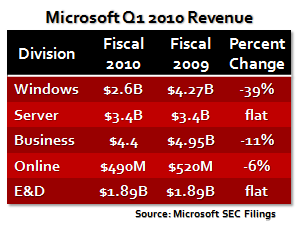
    Microsoft Q1 2010 Revenue

    Liddell still didn’t offer much guidance for fiscal second quarter, but still more than other quarters:

    • Windows & Windows Live: Revenue growth will be in line with the PC market, or slightly ahead. Liddell said Microsoft expects the “netbook mix to stabilize” over the fiscal year.
    • Server & Tools: Revenue growth will exceed server shipments.
    • Business: Revenue growth will lag the PC market, in part as businesses wait for Office 2010.
    • Online Services: Revenue growth will be equal to or better than the market.
    • Entertainment & Devices: Flat.

    Microsoft got a little boost by bad news not being worse. Last week, Gartner and IDC released better-than-expected preliminary third calendar quarter PC shipment data. Gartner had expected worldwide PC shipments to decline 5.6 percent, when they instead rose 0.5 percent to 80.9 million units. IDC put PC shipments up 2.3 percent following 6.8 percent and 2.4 percent declines in the first and second quarters, respectively. IDC estimated PC shipments to be 78.1 million units. By comparisons, Microsoft estimates that worldwid, year-over-year PC shipments were flat to 2 percent growth. Sequentially, sales were up in the mid-teens.

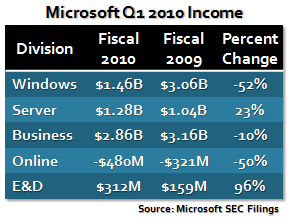
    Microsoft Q1 2010 Income

    But circumstances mitigated the benefits to Microsoft:

    • Netbooks continued their sales surge. Most of these portables shipped with Windows XP Home, for which Microsoft collects substantially smaller licensing fees than either Windows Vista or 7. However, Microsoft also shipped Windows 7 Starter Edition, which margins are better than XP Home.
    • Some regions sagged: PC shipments declined 8 percent year over year in EMEA (Europe, Middle East and Africa), offset by dramatic netbook and low-cost notebook sales, according to IDC.
    • Checks on component suppliers suggest that OEMs flooded the channel with inventory in anticipation of strong Windows 7 uplift. Microsoft could see Windows license sales decline in fiscal second quarter, particularly if PC sell-through is weaker than OEMs and retailers anticipate.

    Segment Results

    Windows & Windows Live. Microsoft has changed the name of what was the “Client” division to “Windows & Windows Live,” reflecting recent organizational changes. Revenue fell 39 percent year over year and income by 52 percent. The declines are not as severe as they seem, because of the $1.47 billion deferral. Windows & Windows Live revenue was $2.6 billion without the deferral but $3.8 billion with it. Microsoft expects to realize $1.7 billion total deferred revenue for the division in the coming quarter.

    The division derives 80 percent of its revenue from license sales to PC OEMs, which were up 6 percent year over year. However, OEM license revenues declined by 6 percent, reflecting the margin damage inflected by increasing netbook sales. Microsoft estimates that during the quarter, netbooks accounted for 12 percent of PC sales.

    Microsoft reported that Windows license sales were strong during the quarter, with sales during September being the strongest for any month ever, in line with the aforementioned record quarterly sales. Robust license sales reflect strong OEM demand for Windows 7. However, as mentioned earlier, the strong license sales could be viewed as OEMs flooding the channel with units that may or may not sell through. Liddell said that OEMs “are buying in anticipation of demand” rather than for “actual demand.” Therefore, robust Windows license sales are cautiously encouraging.

    Server & Tools. The division is most insulated against economic maladies, because 55 percent of revenues comes from contractual volume-licensing agreements. However, because of corporate layoffs, Microsoft is seeing customers renewing license contracts at lower levels. The division’s revenue was flat year over year, while income grew by 23 percent. Microsoft predicted that industry server hardware sales declined 20 percent year over year during the quarter.

    Business. Next to Windows, Microsoft’s other cash cow division reported revenue and income declines of 11 percent and 10 percent, respectively. Several factors accounted for growth declines, including aggressive back-to-school promotions for Office and declines in Business and Dynamics licensing — down 4 percent and 6 percent, respectively.

    Consumer revenue declined $390 million, or 34 percent, which is seemingly counter-intuitive to Microsoft offering deep discounts. Shouldn’t revenue increase then? The discounts were for Office Home and Student 2007, which comes with three licenses and sold for less than $90 from some retailers. Presumably, the heavily discounted three licenses-for-one product sapped sales from higher-priced, single-license Office SKUs.

    Online Services. Income plummeted by 50 percent. The division’s performance, with ad sales in decline, starkly contrasts with quarterly results from Google, which asserted the worst of the econolypse is over. The majority of the Online Services division’s sales come from advertising, which fell 3 percent year over year to $421 million.

    Entertainment & Devices. Microsoft sold 2.1 million Xbox consoles during the quarter, bringing the install base to about 35 million. Xbox Live revenue grew by 50 percent.

    Copyright Betanews, Inc. 2009


    Add to digg
    Add to Google
    Add to Slashdot
    Add to Twitter
    Add to del.icio.us
    Add to Facebook
    Add to Technorati


  • Google Launches Latest Version of AdWords API

    Google has launched the newest version of the AdWords API v2009 beta. That would be version 200909. Google cites the following as the highlights of the new API:

    Asynchronous calls – Asynchronous calls allow you to work with large sets of data faster and more easily. Instead of having to wait for our system to fully complete your request before you can make another one, you’re now able to make another call as soon as the API service confirms that it has received your previous call. No more waiting for the server to complete large requests. V200909 will continue to support Synchronous methods as well.

    Keyword and placement ideas – With the new TargetingIdeaService, you’ll be able to get keyword and placement ideas through the API, leveraging the functionality of the search-based keyword tool.

    Location Extensions preview – Limited location extensions functionality is now available as a preview of the full functionality in development.

    AdWordsThese are just the highlights. Google has a complete list of all of the new features in its release notes.

    The company says that over the next few months, it will continue to introduce new features and additional AdWords functionality. New features will include ReportService, AccountService and the ability to pre-check for errors.

    "Given that v2009 introduces new concepts and features, we have extended the sunset period for deprecated services to 6 months," Google says. "If you haven’t already begun migrating your systems to the v2009 API, we strongly encourage you to start right away."

    v13 services CampaignService, AdGroupService, CriterionService, AdService, InfoService, KeywordToolService, and SiteSuggestionService will sunset on April 22, 2010. Other v13 service sunset dates will be announced in due time.

  • Women, Mothers, Families and Reform

    We’ve discussed health insurance reform from a lot of different perspectives here at WhiteHouse.gov, from doctors to seniors to small business owners.  In a new video, First Lady Michelle Obama discusses it as a woman, and as a mom:

    Viewing this video requires Adobe Flash Player 8 or higher. Download the free player.

    download .mp4 (77 MB)

    iVillage is also taking questions on this video that HHS Secretary Kathleen Sebelius will answer next week, hop over to join in.

     
  • Hands On: Magic Mouse

    Our very own Olly Farshi dropped by his local Apple Store in Helsinki and was kind enough to hook us up with a quick hands on video looking at Apple’s new Magic Mouse. So, enjoy!


    As Q4 begins, online video is now mainstream. Read the, “Connected Consumer Q3 Wrap-up.”