Author: Serkadis

  • Senate Leaders Close To Including A Version Of Public Option In Health Bill

    The New York Times: “In pushing to include a government-run health insurance plan in the health care bill, the Senate majority leader, Harry Reid, is taking a calculated gamble that the 60 members of his caucus could support the plan if it included a way for states to opt out.”

    “The Senate has long been seen as opposed to the federal government selling health insurance in competition with private industry, but now senior Senate Democrats and White House officials are strongly considering including such a measure in health care overhaul legislation, officials say.” But moderates from both parties however, seized on the opportunity to ask Reid again to slow the bill down so Senators have a chance to analyze and consider it. They include Sens. Ben Nelson, D-Neb.; Olympia Snowe, R-Maine; and Susan Collins, R-Maine (Pear and Herszenhorn, 10/22).

    The Associated Press reports that the provision to allow states to opt out could help to attract the votes of the moderates. “Several officials said no final decisions had been made, with one possibility that the idea was being circulated to see whether it could attract enough support to survive on the Senate floor. … Democratic moderates are skeptical of allowing the government to sell insurance, concerned that it would mark an unwarranted federal intrusion into the private marketplace and potentially jeopardize payment rates to doctors, hospitals and other providers” (Espo, 10/23).

    The Wall Street Journal: “Nelson, who has met twice this week with Mr. Reid, said it would be “very difficult” for him to support any proposal that creates a national plan — even one that allows states to opt out.” Similarly, Senate Budget Committee Chairman Sen. Kent Conrad of North Dakota said he has assurances that any plan “wouldn’t be tied to Medicare” (Hitt and Adamy, 10/23).

    CongressDaily: “Conrad, who authored the co-op system in the Finance Committee bill as an alternative to a public option, said Thursday states should have the choice to participate in a nonprofit” (Edney, 10/23).

    Roll Call reports that “Snowe and Nelson noted that centrists want to make sure the underlying bill is acceptable to them before allowing it to come to the floor. They argued that once the measure is officially being debated, it will be difficult to secure the 60 votes necessary to strip key provisions — such as a public insurance option. Sixty votes are needed to overcome a filibuster of any amendment or bill” (Pierce, 10/22).

    Bloomberg offers more insights into what Snowe is thinking: “‘A public option at the forefront really does put the government in a disproportionate position with respect to the industry,’ Snowe, the only Republican to vote for a health plan so far, said in an interview with Bloomberg Television’s ‘Political Capital With Al Hunt,’ airing this weekend” (Litvan and Dodge, 10/23).

    CNN: “In recent days, two administration officials have told CNN that the prevailing White House opinion is for the Senate health care bill to include a so-called ‘trigger’ mechanism proposed by Snowe that would bring a public option in the future if thresholds for expanding coverage and lowering costs go unmet in coming years. The source familiar with Thursday evening’s meeting said Obama ‘pushed for a so-called trigger, because it’s the more bipartisan way to go,’ due to Snowe’s support for the concept” (Bash and Walsh, 10/22).

    The Washington Independent has a scoreboard on how the public option might fare in the Senate with 14 on the fence, 47 likely supporters and 39 likely opponents (10/22).

    Politico: “The pace of the negotiations is picking up. Sen. Chris Dodd (D-Conn.), who is representing the Senate Health, Education, Labor and Pensions Committee, said the merger group hopes to send a package to the Congressional Budget Office soon.” Several senators have said it’s imperative for a new CBO score on the bill before they will consider it (Budoff Brown, 10/23).

    But The Hill reports on how some see the schedule unfolding as the process continues. “The healthcare reform debate will be pushed deep into December and possibly beyond by a lengthy floor debate, several senators predicted Thursday. Senate Majority Leader Harry Reid (D-Nev.) is under pressure from a group of centrist Republicans and Democrats who are demanding a go-slow approach” in order to have enough time “to review the legislative language and to give the Congressional Budget Office (CBO) a chance to provide a detailed cost estimate.” That means the legislation “has no chance of being approved by Thanksgiving” (Bolton, 10/22).

  • Officials Question Validity Of Community Research Center Cancer Studies

    The New York Times reports that the whistleblowing of a former vice president of a research hospital in Urbana, Ill., has highlighted some questionable research practices at certain community cancer research sites.

    The Times examines the Carle Foundation Hospital where a vice president for research questioned the validity of federally sponsored cancer experiments and was fired. “Because the patients at community centers tend to be older, sicker, less affluent and generally more diverse than those treated at big academic medical centers, they are considered more representative of the national population. So, over the years, the community centers have played important roles in developing new treatments for breast, lung and prostate cancer.” If Carle is any indication, however, these sites may not be applying the best practices in researching cancer treatments. The vice president — and a federal audit — found deficiencies in 12 of 29 experiments at Carle, endangering and/or skewing the results of several studies (Wilson, 10/22).

  • Our love/hate relationship with Microsoft: What happens now?

    By Carmi Levy, Betanews

    Over the years, Microsoft has been vilified for more reasons than you can shake a memory stick at. But the world is bigger than Microsoft; and if we’re going to take the time and effort to hate something, it makes more sense for it to be something deserving of hate — like government corruption, unsanctioned access by certain countries to nuclear missiles, and diseases that evolve faster than our ability to comprehend them. Tossing bile at a mere software company would be too easy if it weren’t so pointless.

    As Microsoft releases Windows 7 unto a world that has been well-trained to be suspicious of such events, now is a pretty good time to reconsider why so many people have for so long held a special degree of contempt for the company. It’s also an ideal time to question why this has been the case in the first place, and figure out what our attitudes should be from this point forward.

    Microsoft’s failures have always led to success

    There’s a reason Ford never followed up the Edsel with another car called “Edsel:” Some brands just deserve to die. (It’s a good thing “Vista” wasn’t a Microsoft executive’s first name.)

    Carmi Levy: Wide Angle Zoom (200 px)Most recently, Vista’s been the lazy person’s target for vilification and vitriol. When it was released, it was big and buggy, and although Microsoft eventually fixed most of the countless niggling problems with its flagship OS product, it couldn’t repair the damage to the Vista brand.

    Vista is only the latest in a long line of Microsoft missteps. Whether it’s on account of the Xbox red circle of death, XP’s sieve-like (in-) security, Windows ME’s general crumminess, or Bob’s absolute disconnection from reality, Microsoft has had to survive a number of high-profile failures.

    But the company that’s never failed hasn’t been invented yet. (Sorry, Google.) Failure is what teaches great companies — and people — to achieve greater success the next time out. And in Microsoft’s case, its successes far outweigh its failures. For better or worse, Microsoft’s influence on a wide range of markets has forged consistency and purpose in those markets, when no one else was willing or able to step up to the plate and take the lead. To wit:

    • Desktop operating systems. While some folks have valid reasons for disliking Windows, there’s got to be at least some good baked into it to explain the basic fact that 90% of the computing world runs it. Since Windows 3.0 first transitioned Microsoft’s GUI-based OS from curious plaything to serious competitor, the franchise has been the centerpiece of an ever-growing ecosystem of developers, vendors and users, all of whom have built careers and businesses around this now-ubiquitous OS. Mass adoption in various markets often seems to be accompanied by a certain degree of contempt: We all may despise Toyotas for being boring, soulless transportation appliances, but we buy them by the boatload because they get the job done.
    • Applications. I still get e-mails from frustrated WordPerfect for DOS users who claim writing just hasn’t been the same since Microsoft’s Word vanquished WordPerfect’s offering — and, rather starkly, WordPerfect Corporation itself. Whatever. I still have nightmares when I remember trying to move data between Lotus 1-2-3 and WordPerfect. Microsoft’s Office paradigm redefined how we got work done, and its market dominance made it easy for me to share my work with virtually anyone else who mattered.
    • Development. The catch-as-you-can state of programming languages before Windows-based machines took over forced developers to either invest significant time in learning multiple languages, or risk backing the wrong horse by choosing the wrong one to learn. Products like Visual Basic opened up development paths to more users and broadened the landscape for consumers and businesses alike. Suddenly, programming wasn’t so arcane.
    • Networking. While Novell rightly gets credit for defining and popularizing the modern Local Area Network, Microsoft’s Windows NT Server assumed the mantle and drove the concept into the heart of corporate IT. It certainly wasn’t always pretty, especially if you were responsible for patching and securing it, but it was a good enough, familiar enough product family for most organizations.

    A kinder, gentler Microsoft

    As it brings Windows 7 to market, Microsoft is showing signs of greying around the temples. Perhaps nowhere is this more evident than in the evolution of its CEO, Steve Ballmer. Long known for being an exuberant — sometimes overly so — Microsoft booster, Mr. Ballmer’s antics, from throwing chairs to cheerleading during keynotes, are near-legendary. But somewhat uncharacteristically, his behavior during the Windows 7 launch has been nothing short of reserved and reflective.

    Through Ballmer, we see a Microsoft that isn’t so much monolithically monopolistic as it is customer-centered and, dare I say it, soft around the middle. Could this be a kinder, gentler Microsoft? Perhaps. The company makes it clear that consumer feedback to Vista’s failings guided its Windows 7 development effort. And as new software delivery paradigms threaten its OS and productivity software dominance as never before, its efforts to build businesses in previously non-core sectors (Windows Azure Platform, anyone?) provide glimpses into a company that has come to terms with being merely mortal.

    What’s left to hate?

    So this clearly isn’t your father’s Microsoft. But is that a good or a bad thing? Is a post-antitrust, post-king-of-the-world, post-desktop company that doesn’t rampage through its markets as much as it carefully steps through them necessarily a good thing for the broader tech market?

    Perhaps so. The tech landscape already has an heir apparent in Google, which now finds itself in the similarly unenviable position of lightning rod for those who seem to always need a lightning rod. By virtue of its size and perception as a monopolistic player, Google now falls under the same harsh criticism that had defined Microsoft for the better part of a generation.

    Which leaves Microsoft to define a new path for itself, unencumbered by the weight of the constant attention typically afforded a singular leviathan of a given industry. It also leaves those of us who habitually cast an evil eye on this or any company, to wonder whether doing so serves any real purpose at all. Anyone who flogged Microsoft for the sins of its most recent Windows products, lost any significant reason this week to go on doing so. Sometimes, it just pays to be nice.

    Carmi Levy is a Canadian-based independent technology analyst and journalist still trying to live down his past life leading help desks and managing projects for large financial services organizations. He comments extensively in a wide range of media, and works closely with clients to help them leverage technology and social media tools and processes to drive their business.

    Copyright Betanews, Inc. 2009


    Add to digg
    Add to Google
    Add to Slashdot
    Add to Twitter
    Add to del.icio.us
    Add to Facebook
    Add to Technorati


  • The Ad-Supported World: Ready or not, here it comes

    brought
    A few weeks ago, Microsoft made a minor splash by announcing they’d offer an ad-supported version of Microsoft Office. Most of the functionality would be there, but there’d be an ad down there in the corner. A tempest briefly raged in this teapot, but died down once people realized they’d been using ad-supported software for years and never even thought to complain. After all, every time you search for something — look, ads! Have a free email account? Ads here and there (targeted based on the content of your email, which surprisingly few people find disturbing), and sometimes even included in your outgoing messages. Ad-supported services and software are embedded in our technological landscape whether you realize it or not, and it’s beyond question that they’ve cultivated improvement.

    So when word came down that Apple had filed a patent for what appears to be an ad-supported version of OS X, my shock abated almost instantly. In fact, I only felt more justified in backing ad-supported products. There will be objections, some legitimate, some hysterical, but I think it will become increasingly clear over the next few years that this sort of thing is not only unavoidable, but ultimately desirable. As with other major emerging concepts like globalization, peer to peer connectivity, net neutrality, and device convergence, the evolution of advertising will be denied, debated, and championed in a million different ways. And that’s okay. Like those other processes (all of them still ongoing), you don’t have to accept them right away, but it helps if you realize that resistance is futile.

    daaaamnFirst, though, give yourselves a pat on the back. As a member of the vanguard of new media, next-generation services, and experimental technology, you should feel a certain pride. And I think you’ve also been justified in your various transgressions out here on the frontier — blocking ads, pirating media and software, and misusing or abusing other services (to a point at least) — because you moved faster than the rest of the world and it’s their fault that they didn’t see it coming, or weren’t fast enough to react in time. I don’t want to get all copyfight up in here, but the dinosaurs of media and communications deserve all the flak and failure they’ve piled up. I know it, you know it, they won’t say so but they know it too — but the time for sulking and suing is over. Instead, they’re piling into the wagons and hitting the trail. The latest Wild West on the internet is being clogged with settlers, and, at the risk of allowing this metaphor to overstay its welcome, there’s about to be a new sheriff in town (pictured at right). And the next few years will be the story of how the West was re-won — by corporate interests, as usual. Hey, it had to happen sometime.

    Look. The fastest growing mobile platforms in the world are essentially trojan horses for new advertising (Android) and paid content (Apple). DRM is starting, thank god, to assume a form that isn’t instinctively abhorrent to even to the most seasoned of internet users. Digital distribution is no longer looked upon as an aberration, but an opportunity. And this positive change in new advertising is combined with, as Eric Clemons noted back in March, a failure on the part of traditional advertising to engage its audience on any level. Of course, his objections apply equally to a banner ad that’s in your browser as it does to a banner ad that’s on your desktop. Let’s talk about it.

    Break yourself

    So what can you do? Well, you can change the way you advertise. Ads these days are so bad that anybody who clicks one is guaranteed to be a sucker. And the supply of suckers, birth rates notwithstanding, is decreasing as techsavviness increases (along with AdBlock, torrenting, etc.). Even when you take an ethical stand, like Penny Arcade and others, and only advertise on your site for things you want you readership to support, ads simply won’t do any more. I wonder why? Let’s see. Tell me how most ads these days differ from the following:

    TechCrunch's celebrated Devin Coldewey
    (image from here)

    Except for the fact that you no longer have to send a piece of mail to a physical address (usually, anyway), it is evident that the bulk of advertising hasn’t changed in 150 years. Interesting, that — and surprising that such a mind-bogglingly backward-looking strategy has survived so long. But luckily for us, advertisers are finally beginning to realize that the internet isn’t just a periodical with infinite pages. Innovators have, over the last four or five years, created a huge, rich playpen for marketers, and unsurprisingly those marketers have largely ignored it. Hence the trouble monetizing such obvious gold mines as Flickr, FaceBook, Twitter, and so on. “How will we make money on Twitter, there’s no place to put our gold-rush-era advertisements for Gammon’s Unctuous Ointment?” Sorry, but change comes from within, people. I don’t want to tell you how to do your job, but if you can’t figure out how to take a hundred million eyeballs a day and turn it into cash, you should reconsider your profession.

    That’s why I see all these troublesome embedded ads and sponsored services as non-threatening — even cute in a way. They represent the infancy of new advertising, and stuff like an ad-supported OS or office suite are their first wobbly steps. Photogenic in a way, but be ready to capture the first few falls as well. For instance: Apple’s potential system, while obviously just a rough sketch in more ways than one, has the troubling flowchart box “User pre-buys time?” Yeah, that’s not going to happen. Coin-op computing is not the way to go. Revisit Eric’s article for a few ideas on what is the way to go, but while I have you I’d like to add a few examples I’ve just thought up in the last few minutes, if I may. I doubt I’m the first person to think of these, but I don’t see any of them being implemented widely, so pretend I invented them for the purposes of this post.

    Ads that aren’t anachronisms

    oldbusted

    When you say “ad-supported,” it conjures images of ugly banner ads surrounding the functional portion of the program or service. You and I see it every day in Gmail, after all, and who hasn’t seen worse? Nagware also comes to mind; I used WinRAR for a decade and clicked down its nag screen thousands of times before giving in. But that’s old school. These days, ads are rectangles filled with lies. Nobody clicks on those any more, or if they do, the numbers are decreasing at a rate which must alarm those who fill the rectangles. But what if the ads were to be invisible? Picture this: an OS-wide layer that detects searches, reads text on webpages, and scours all content for products and services. A Snap-esque pop-up or browser bar provides the lowest prices, latest blog posts, and a link to the official site. It provides trackable clickthroughs (bankable) and is, in fact, useful to the user. In a “normal” machine you could turn this off, and in an ad-supported machine you couldn’t (without some work anyway). Sure, it’s not a full solution, but honestly, would you mind having that on your machine if it meant saving a couple hundred bucks up front? Even if you say yes (and I might), I guarantee there are about a hundred million people who would say no. Can you say Wal-Mart? I knew you could. I’d venture to say that this is one of the driving ideas behind Chrome OS.

    So that’s a kickoff point for ads in the OS: unavoidable yet unobtrusive, simple yet functional. What about in the browser? It’s more difficult because the user has more control over what they do and don’t see. But the same principles are at work, and at the risk of tooting TechCrunch’s horn, we’re already applying them (and have been before I got here; I’m not claiming any credit). Look down at the bottom of this paragraph. It’s a CrunchBase widget! Useful, embeddable, trackable, and customizable — mark my words, in a year or two these things (not just CrunchBase but similar items) will be everywhere. After all, who says an ad has to be produced by the company making the product? People don’t like those ads anyway. They’re badly designed, and frequently damned lies to boot. But in a CrunchBase or say GDGT embedded widget, you know the source, you don’t have to worry about spin, and it’s no skin off your back if TechCrunch gets a penny whenever you click through to Sony’s site through one. And here’s the fun part: payment, placement, and tracking are virtually identical to traditional ads. Sony doesn’t want to pay a website to advertise for them? Then no links to Sony. Users can figure it out by themselves.

    If I’m honest, they should be a bit smaller if they’re to be everywhere. And have more stuff. You get the idea, though. …yeah, it’s me, so what?

    But media, Devin, you’re forgetting the media! Billions are spent on television advertising. Or so I’m told — I only see TV ads at the gym and at bars these days, since I download or stream all my media. I’m not boasting of being some elite master pirate and internet jockey; the fact is that tech-savvy people do what I do, or rather I do what they do, because at the moment it’s easier and better. That’s all. And there are more people qualifying as tech-savvy every day. Media companies are realizing that, and TV ads, while not on their way out, are going to have to be heavily augmented with something else. What could it be? What did I say about the other ads — oh yes, unavoidable yet unobtrusive, simple yet functional. Okay, here’s one I just thought up as I typed this sentence. When you stream or download a show, have metadata or an on-screen menu or page (visible during the intro, ads, or whatnot) where you can buy associated items. But not just DVD sets. I mean, if someone’s watching episode 89, they either own episodes 1-60 already or will be buying them sooner or later anyway. You’re trying to sell God to the choir. Why not accessorize? The meta-page I theorize (an enormous advertisement in disguise) can have all manner of things: links to the coffee shop the characters were in. Prices and local availability for the clothes they wore. iTunes link for songs from the soundtrack. Related shows! Related books! Every time you provide an episode for free (if that continues) — with unskippable ad breaks for your regular ads! — you get to expose every viewer to a cornucopia of products that they are probably at least a little interested in. Can you say that about cable? And if you do say it, will people laugh?

    How I learned to stop worrying and so on

    But I seem to have wandered off from the original topic. Let’s get something straight. The world is already ad-supported. It always was. And it will continue to be. Don’t fight it. It’s like slipping into a warm bath. If Apple puts out an ad-supported version of OS X, or Google Checkout is built into Chrome OS, or Microsoft brings back Clippy to suggest sponsored websites, you can cry all you want, but know that advertising makes the world go round. For a brief, exciting time, you’ve been ahead of the curve, in a land where ad-men feared to tread. You hate advertising, and rightly so, because you’ve been subjected to it in its worst possible guise. For a decade at least, ads have been a lame, decrepit wolf in comically unconvincing sheep’s clothing. That’s changing — and while it’s too little, too late for some (the RIAA and MPAA for two, or their dignity at least), it’s a golden opportunity for others, and it means progress and improvement for the end user.

    It’ll take some time, but the coming renaissance in advertising is going to happen whether you like it or not, just as the revolution in communications happened to the advertisers — who decidedly did not like it. They fancied themselves an immovable object, but the truly unstoppable force of progress has since relieved them of that idea. Users have been empowered to choose when, how, and from whom they will accept advertising. The race now is not to the biggest and flashiest ad, as it has been for generations, but to the very opposite end of the spectrum. The winner will be the one who best convinces the user that they are not being advertised to at all. Indeed, we are about to change the very definition of advertisement. Care to help?



  • Congress Reauthorizes Ryan White Care Act – Funding For HIV/AIDS

    The New York Times: “The House on Wednesday overwhelmingly passed legislation allocating billions of dollars in federal money for the treatment of HIV and AIDS.  By a vote of 408-9, the House reauthorized the Ryan White Care Act, first enacted in 1990 and named for the Indiana teenager who died of AIDS. The Senate has already passed the bill by unanimous consent.”

    “The bill … approves an additional four years of funding for the program, which is administered by the Department of Health and Human Services to about 500,000 lower-income people each year. It allocates $2.55 billion for fiscal year 2010, with that figure rising to $2.95 billion by the 2013 fiscal year” (Becker, 10/21).

    Dow Jones Newswires: “Both the Senate and House bills state the federal government must establish a goal of testing 5 million patients annually for HIV and AIDS. Federal health agencies will have to report to Congress to detail whether they met the goal” (Favole, 10/21).

  • Mattel Launches Ecommerce Website

    Toy maker Mattel has launched its own ecommerce site, MattelShop.com, offering a selection of its popular brands along with social shopping features.

    MattelShop.com features a social shopping tool called ShopTogether, developed by shopping application firm DecisonStep, that allows users to browse the site with family and friends. Shoppers have the ability to chat with each other in real time about the various toys offered on the site.

    "We have developed a unique online shopping destination that is playful, social and informative," said Chuck Scothon, General Manager & Senior Vice President, Mattel Digital Network.

    "The MattelShop.com serves as a research and shopping tool allowing parents, grandparents and gift-givers alike to choose the best toys for children this holiday season."

    The site includes a complete catalog of Mattel’s brands such as Barbie and Hot Wheels along with other toys, games and licensed products from the company’s portfolio. Consumers can browse toys by age, gender and play preference.

    The site also features ConciseClick that allows shoppers to watch videos of products, provides description and price and allows users to drop items into a shopping cart.

    In addition, MattelShop.com has a presence on Facebook, Twitter and YouTube.
     

  • Health Care Changes Forcing Companies To Adapt, Could Cost Doctors

    “Although thousands of doctors are converting their offices to electronic health records, a change the federal government supports with $19 billion in grants, there is a major catch — the government is still working on establishing a standard for e-records,” the Las Vegas Sun reports. “Doctors who buy a software program could lose hundreds of thousands, if not millions of dollars, if their systems aren’t compatible with the future government standard.”

    Software companies are meanwhile competing for the new business stimulated by the governments’ $19 billion economic recovery act investment in health information technology. One expert, Wes Rishel, tells the Sun there are currently 200 systems available, but that he expects the “crowded field” to narrow to 10 or so software providers over time. Those companies will be the ones that adapt easily to government standards (Lucht, 10/23).

    David Brailer, President Bush’s top health IT official and head of Health Equity Partners, is also on the lookout for companies that adapt quickly to changes in the health care business, Bloomberg reports. The California Public Employees’ Retirement System, or “Calpers,” is “betting as much as $1 billion that (Brailer) can remake the $2.5 trillion health-care industry one startup at a time.” Brailer will use the investment to target “big pain points” where the health system wastes money and is inefficient, he said. Calpers is “the sole investor” in the company. 

    “So far, Brailer has invested more than $120 million in 30 companies, and said he plans to spend $150 million to $200 million a year beginning in 2010. One company aims to save hospitals up to $1.6 million a year each, using a centralized center to read radiology images. Others make electronic chemotherapy pumps that save time and curb treatment errors, run pharmacy chains that blend alternative therapies with traditional drugs, or match consumers to insurance plans based on their medical history” (Mullaney, 10/23).

  • Facebook Receives 1/4 Of US Page Views?

    More often than not, when something is successful overseas, it’s even more successful in its home market.  And this led one person to wonder: if Facebook receives one-seventh of all page views in the UK (as Hitwise suggested last week), how’s it doing in the US?  He found that it might receive as many as one-fourth of all page views.

    Perry DrakeThis isn’t quite an apples-to-apples comparison.  Think of it as Golden Delicious versus Red Delicious apples, at least, since Perry Drake, who’s the vice president of Drake Direct and an associate professor at New York University, used Compete statistics to look at Facebook’s US standing.

    Anyway, Drake supplied the graph you can see below (sorry for the blurriness – we enlarged it) and wrote, "In the US Facebook accounts for, now get this, 1 in every 4 or 25% of our total pageviews.  Unbelievable!  Google on the other hand accounts for only 8% of the total pageviews (or 1 in 12)."

    Drake also wrote, "[W]hen we look at total number of visits to these two sites, we notice that Google does have an edge as the figure below shows.  But, surprisingly, that edge is quickly slipping away."

    So it seems that an interesting shift is taking place.  Facebook’s marketing and financial departments must be jumping for joy (and perhaps preparing to count a lot of cash).

  • Google Launches Custom Search For Smartphones

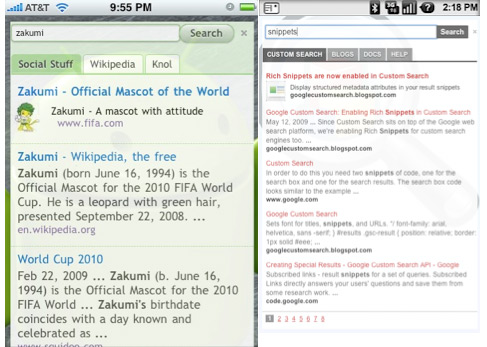
    Google has launched Custom Search for smartphones. This means that if you own a site and add a Google Custom Search box to it, it will format search results to fit the screens of supported mobile devices.

    The following devices are supported:

    – Android-powered phones
    – iPhone
    – iPod Touch
    – Palm Pre

    When users search on a site with Google’s Custom Search box, they are redirected to a Google-hosted Custom Search results page created specifically for the siteowner’s custom engine. If webmasters would rather serve the results from their own site, however, Google does give that option. They can host their own version of the mobile Custom Search home page.

    Googel Custom Search for mobile

    "You can test this out on your phone right now. Here are a few samples: search for user-generated content (e.g., search for "zakumi") from sites like Wikipedia or Knol, or look for more information on Custom Search (e.g., search for "promotion")," says Google Search Group Product Manager Rajat Mukherjee. "As you can see, Custom Mobile Search results can match the look and feel of your own website, and we’ve enabled interactive features, such as label tabs for navigation, as well as promotions."

    More information about setting up custom search for mobile can be found here in this post from the Custom Search blog.

    The addition of custom search for smartphones should make a lot of people happy. The company says one of its most requested features in a Product Ideas survey was about enabling a mobile version of custom search. Google says that more features will be coming soon.

  • Belkin issues a voluntary recall of some TuneBase models

    belkin-tunebase
    Quick note: If you purchased a Belkin TuneBase iPod dock after April 1, 2009, click here to see if your model has a thing for starting fires. You probably don’t want that feature.


  • New Law Speeds Up VA’s Beleaguered Budget Process

    President Obama signed a law Thursday to grease the Veterans Affairs Department’s troubled budgeting process by changing the schedule to allocate funds a year in advance, the Washington Post reports. The Veterans Health Care and Budget Reform and Transparency Act “means timely, sufficient and predictable funding from year to year. For VA hospitals and clinics, it means more time to budget, to recruit high-quality professionals, and to invest in new health care equipment,” Obama said (Shear, 10/22).

    The VA budget has emerged from Congress late 20 of the past 23 years, which, for the department’s health system, has led to “delays in replacing medical equipment or insufficient staff to handle their work,” the Associated Press reports. “The VA provides health care for more than 23 million American veterans; as many as a quarter of the nation’s population qualifies for VA coverage, either as veterans or family members of veterans” (10/22).

  • Illegal Immigrants, Though Excluded From Government Insurance, Remain Part Of Health Debate

    Lawmakers are excluding undocumented immigrants from health care reform legislation and barring them from receiving any government benefits.

    Kaiser Health News interviews Dr. Antonio Falcon, a Texas physician, about the care of illegal immigrants in border communities. “Falcon, a member of the Texas Medical Association and the United States-Mexico Border Health Commission, … worries that lawmakers in Washington are failing to address several important border health issues, including illegal immigrants’ health care … [and] warned that failure to recognize the high, unreimbursed costs of caring for this population could undermine hospitals and providers along the border and open the door to public health risks for the entire nation.” Falcon says: “It seems like policy makers want to isolate [the issue of] illegal immigrants’ care as something that’s kind of standing out there on its own and it’s not. It’s mixed in with the rest of the soup. Like it or not” (Marcy, 10/23).

    Kaiser Health News also provides an explainer on immigrants and health care in the United States and how health reform bills may affect them (Evans, 10/23).

    Meanwhile, KQED Public Radio in San Francisco explores the effects of immigration reform on public health and looks at “what it’s like for undocumented and seasonal workers to get health care under the current system, and how immigration reform could change things.” The station specifically reports on the Immigration Reform & Control Act (IRCA), information about the H1N1 vaccine and barriers that undocumented immigrants face in receiving health care in California. The program is part of a series called Health Dialogues (10/23).

  • Chasm Between Insurers And Reform Supporters Grows

    Although “[h]ealth insurers insist they’re still committed to getting a health care overhaul bill passed this year,” many people in Washington are “wondering if — or when — the industry will change its mind and try to kill it,” The Associated Press reports.

    “The industry’s chief lobbyist, Karen Ignagni, said Thursday that insurers ‘can continue to make a major contribution to the overhaul effort.’ … But her comments came in the midst of mounting tensions between her industry and majority Democrats. …” 

    “Some in Washington … argue that Democrats’ nonstop attacks make it obvious the industry has already been carved out of the legislative process — unlike the pharmaceutical industry, hospitals and doctors, with whom lawmakers are working. … Should the insurance industry opt for a broader attack, it would not take long to launch a TV ad campaign” (Fram, 10/22).

    One company is already making its case to Congress. “WellPoint Inc., the nation’s largest health insurer by members, is striking out against proposed health-overhaul legislation with new data it presented to members of Congress Thursday,” The Wall Street Journal reports. “The insurer’s conclusions, building on a study the insurance lobby put out last week, purport to show state by state how proposed changes to the nation’s health-care system would drive up premiums for some individuals and small businesses” (Johnson, 10/22).

    Meanwhile, “hundreds of people” protested the insurance industry outside the Washington, D.C., hotel where America’s Health Insurance Plans, the industry’s trade group, was holding a conference, USA Today reports. “The event was organized by Health Care for America Now, a group that supports a government-run ‘public’ health insurance option as part of health care reform.” Several families “shared stories of denied care” and “signed a letter asking AHIP’s president and CEO, Karen Ignagni, to meet them at the hotel to ‘hear firsthand the ways in which the entities you represent have disrupted our lives.’ The letter was used as a print ad in several Capitol Hill newspapers. They did not receive a response, according to Health Care for America Now” (Gaudiano, 10/22).

    NPR: “No one in the insurance industry group was interested in commenting on the protest, including their spokesperson” (Seabrook, 10/22).

  • Google Makes Google Reader More Personal

    Google has added some new things to Google Reader in order to deliver a more personalized experience for the user. The company compares the features to how personalized search improved search results based on search history. Google thinks the new changes will have a similar affect on users’ reading experience.

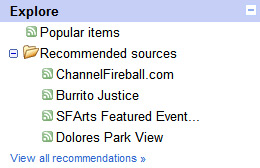
    In Google Reader, there is a new "Explore" section that appears under the "People You Follow" section. Within this section are the previously existing recommendations feature and a new one – "Popular items."

    Googel Reader - Explore "We use algorithms to find top-rising images, videos and pages from anywhere (not just your subscriptions), collect them in the new Popular items section and order them by what we think you’ll like best," explains Google’s Beverly Yang. "Now you don’t have to be embarrassed about missing that hilarious video everyone is talking about — it should show up in your ‘Popular items’ feed automatically."

    "And to make it easier to find interesting feeds, we’re moving recommendations into the new Explore section and giving it a new name — ‘Recommended sources,’" she adds. "Like always, it uses your Reader Trends and Web History (if you’re opted into Web History) to generate a list of feeds we think you might like."

    Apart from the new Explore section, Google has also added personalized ranking to feeds. There is a new Sort by Magicsort option called "magic," that re-orders items in the feed based on your personal usage and overall activity in Google Reader. This can be accessed by clicking "sort by magic," under the "feed settings," menu of a particular feed or folder.

    "Unlike the old ‘auto’ ranking, this new ranking is personalized for you, and gets better with time as we learn what you like best — the more you ‘like’ and ‘share’ stuff, the better your magic sort will be," says Yang. "Give it a try on a high-volume feed folder or All items and see for yourself!"

    It’s going to be interesting using Google’s new personalization features in Reader moving forward. It should be a good way to determine just how well Google really does know users. Unlike searches, which are prone to be much more random, Reader is a more intimate experience, where users frequently return to specific topics and sources. This does occur in search to some extent, but the very nature of searching means you’re looking for something wherever you can find it in most cases (not counting just being lazy and searching for specific domains).

  • Obama Won’t Tout Massachusetts Health Coverage Plan During Trip Today

    President Obama will not talk about the Massachusetts health care program to cover the uninsured or even talk about health reform for the country on a trip to that state today, focusing instead on clean energy and fundraising, The Washington Post reports.

    “The president’s critics say his reluctance to spotlight the Massachusetts model is real-world evidence that his vision would not work on a national scale. High costs have forced the state to trim benefits for legal immigrants and prompted one safety-net hospital to sue over a $38 million shortfall. Obama’s allies — and even one prominent adversary — see a more nuanced picture that offers guideposts for federal lawmakers as they finalize decisions on a bill that could reshape one-sixth of the economy.”

    Massachusetts has sparked much debate in America over covering 97 percent of residents in a system where there are serious cost containment issues, though it enjoys popularity among doctors and residents (Connolly, 10/23).

    The Associated Press, in the meantime, reports that Obama’s cabinet members often stop in Nevada — Senate Majority Leader Harry Reid’s home state — to help the senator in his campaign for re-election. “‘The president will continue to send his Cabinet members to Nevada and across the country to find the best ways to repair our economy, reform our health insurance system and build upon Nevada’s efforts to create green energy jobs,’ said White House spokesman Adam Abrams” (Freking, 10/23).

  • Chamber Of Commerce Uses DMCA Claim Against Yes Men Prank Site

    There was a lot of news a few days back when notorious pranksters, Yes Men, set up a fake press conference pretending to be the US Chamber of Commerce, announcing that it had changed its controversial stance on climate change — which had recently driven some large companies, including PG&E and Apple, to leave the CoC. The fake press conference, along with a fake website and fake press release, apparently fooled some in the media — including Reuters — until someone from the real Chamber of Commerce burst into the room and confronted the pranksters. The video is great:


    Part of the hoax was a fake website at www.chamber-of-commerce.us, and apparently the real Chamber of Commerce has sent a DMCA takedown on the site. The EFF is responding in support of Yes Men, saying that the site is a parody, which is protected fair use. While I think that the Chamber of Commerce is pretty dumb to issue the takedown — only giving the Yes Men more attention — I’m not sure that the parody defense will stick here. While the site is for the purpose of criticism, the site is most certainly not an obvious parody. It’s designed to look real. Thus, the bigger issue may actually be trademark infringement, not copyright infringement, as the site could certainly confuse users, but there are other ways to deal with such things that don’t involve a DMCA takedown.

    Permalink | Comments | Email This Story


  • Family Portait

    Here’s the First Family portrait, released by the Photo Office this morning:


    [View Full Size]

  • Soupy Sales Dies, Web Responds

    Comedian Soupy Sales has passed away at the age of 83, reportedly at a Hospice in New York. 

    Provide your condolences at the Famous Dead website — www.FamousDead.com …

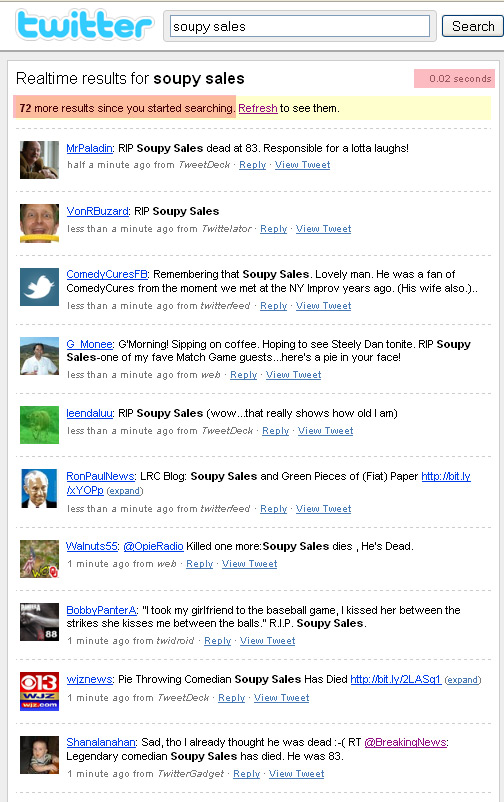
    The web is abuzz with fond memories and sadness of his death.  The rate at which the Tweets about him are rolling in provide evidence to that.

    Soupy Sales Remembered on Twitter

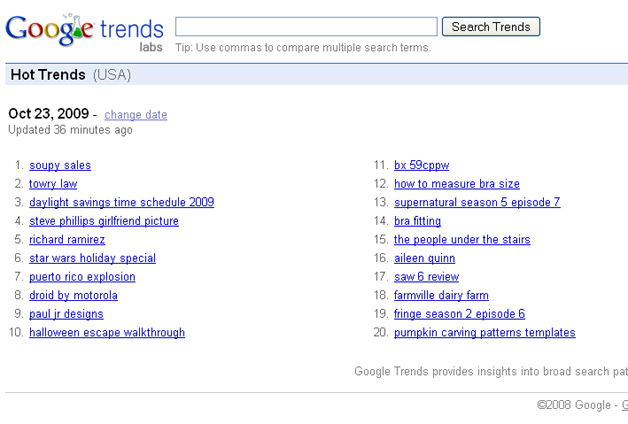
    Soupy Sales is the number one query on Google’s Hot Trends list.

    Soupy on Google Hot Trends

    Soupy was known for his children’s television show, Lunch with Soupy Sales, in which he was frequently received a pie in his face, which became his trademark.

    The death of Sales is just the latest in a seemingly never-ending stream of celebrity deaths this year.

  • EverBank Buying Tygris Commercial Finance

    EverBank Financial Corp., a Jacksonville, Fla.-based financial services firm, has agreed to acquire Tygris Commercial Finance Group, a commercial finance and leasing company. The stock-for-stock transaction is expected to increase EverBank’s capital base by about $470 million. EverBank has raised approximately $100 million in private equity funding from Sageview Capital. Tygris was formed in 2007 with more than $1.75 billion in equity commitments from Aquiline Capital Partners, New Mountain Capital, TPG Capital, Diamond Castle Holdings and Hamilton Lane.

    PRESS RELEASE

    EverBank Financial Corp®, one of the nation’s largest privately-held financial services firms, announced today it has reached a definitive agreement to acquire Tygris Commercial Finance Group, Inc., a commercial finance and leasing company.

    The stock-for-stock acquisition will increase EverBank’s capital base by approximately $470 million, and is expected to have a positive impact on earnings.  EverBank’s capital position will be significantly enhanced upon consummation of the acquisition, resulting in expected Tier 1 (core) capital and risk based capital ratios of approximately 11% and 19%, respectively. The acquisition agreement also includes a $65 million pre-acquisition cash investment by Tygris into EverBank designed to provide EverBank with growth capital prior to the consummation of EverBank’s acquisition of Tygris. 

    “The Tygris acquisition will provide EverBank with substantial growth capital to continue its successful approach of offering high-credit-quality residential loan and retail deposit products to the “mass affluent” market as well as pursue other strategic acquisition opportunities,” stated Rob Clements, Chairman and CEO of EverBank.  “As a result of EverBank’s deployment last year of approximately $150 million of growth capital, the company has recognized record year-to-date earnings of $26.0 million through the second-quarter of 2009, resulting in earnings growth of 41% over the comparable period in 2008.  We believe that by continuing to pursue attractive lending and deposit opportunities, while offering business leasing products, EverBank can further enhance its financial position and provide competitive lending and banking solutions to customers in the current market environment.”
     

    “As a healthy, growing bank, EverBank was fortunate to be able to consider a variety of potential strategic acquisition opportunities before deciding to partner with Tygris,” stated Blake Wilson, President and CFO of EverBank.  “We chose to partner with Tygris based on the quality of its people, leasing products and platform, and the potential future opportunities available to the combined organization.  By bringing Tygris together with our credit, capital and funding infrastructure, our customers will benefit by having another stable lending source available to them.”
     

    The acquisition, which is expected to close in late 2009, has been approved by both parties’ boards of directors and remains subject to regulatory approvals, among other customary conditions.  EverBank was advised by the law firm of Skadden, Arps, Slate, Meagher & Flom LLP.  Tygris was advised by the investment banking firm of Goldman Sachs & Co. and the law firm of Sullivan & Cromwell LLP.

    ShareThis