Hollywood producer Adrian Askarieh divulged some juicy information on the coming Kane & Lynch: Dead Men (PlayStation 3, Xbox 360, PC) movie. It’s …
Author: Serkadis
-
So! How excited are you about Windows 7
 It’s nigh on a few hours before the Windows 7 launch and things are heating up in the big city. Folks are lining up at the Windows store, children are quieter and more attentive in school, and the troubles of the world – global warming, terrorists, the economy – are on hold. We are waiting for a miracle and when it comes it will rhyme with ‘dindows’ and end with ‘7′
How happy are you about Windows 7? Like how totally happy?
Joking aside, I’ve been using a Windows 7 machine for almost a month now and I’m quite impressed with the stability and usability. I’m genuinely excited. Not excited enough to buy into it right now, but sooner or later we’ll all be using it somewhere. Microsoft is a juggernaut and no amount of snark can change that.
-
The Crook in the Nook: Barnes & Noble ebooks are overpriced compared to Amazon
By Joe Wilcox, Betanews
Yesterday, I excitedly preordered Barnes & Noble’s “Nook” ebook reader. Today, I cancelled the order — and I’m none to happy about it. Why can’t Barnes & Noble learn from its past mistakes? The bookseller’s digital titles are way overpriced — at least compared to Amazon (Sony charges even more than both booksellers for many titles).
Quick examples — and more will come later in this post: Twilight by Stephanie Meyer: $6.59 from Amazon; $8.79 from B&N. Philip K Dick’s Do Androids Dream of Electric Sleep?: $8.38 from Amazon; $11.20 from B&N. (Sony charges $9.89 for the first and $9 for the second.)
Barnes & Noble has been down this sordid path before. Ten years ago, B&N was an early ebook pioneer, opening a store using Microsoft Reader technology. But the bookseller had the pricing all wrong, asking the same price for digital — for which there was no printing or distribution costs — as hardcover books. That’s right, and the ebooks came with onerous DRM that made sharing titles nearly impossible.
For years, I criticized B&N and other ebook sellers for overpricing that stalled adoption. Eventually, Barnes & Noble closed its ebook store. Here’s the epitaph I wrote in September 2003 on the now defunct Microsoft Monitor Weblog once run by JupiterResearch (Forrester Research has absorbed the analyst firm):
This morning I received a notice from Barnes & Noble.com informing that as of today, the company would no longer offer ebooks online. Customers like me have 90 days to retrieve titles from their online Microsoft Library; 90 days from purchase for Adobe ebook customers.
I purchased my first Microsoft Reader ebook about four years ago, and, unless I am mistaken, from Barnes & Noble.com. The company offered an excellent ebook library and facilities for downloading titles. I will sorely miss the service. The larger question is what Barnes & Noble.com’s exit means for the larger ebook market. Maybe I’m a nut, but I find reading an ebook on my HP iPaq handheld to be quite enjoyable.
Still, publishers could have done more to make the price of titles more appealing. Who wants to pay 25 bucks for a new ebook, the same as the hardcover price? That hardcover book has associated printing and distribution costs that shouldn’t affect ebook pricing. The hardcover can be passed around among family members or borrowed by the neighbor across the street. The ebook version is much less portable, so why charge so much?
I don’t see the ebook market as dead, but Barnes & Noble.com’s bowing out of the market isn’t a good sign. I remember when the bookseller championed for good writers without big-name publishers or offered print-on-demand services that could revive out-of-print editions. Maybe we’re just not a nation of leisure readers anymore, which would be the sadest commentary on this development yet.
Four years would pass before Amazon showed enough cunning and courage to release the Kindle reader and reasonably priced ebooks. Kindle has got to be the ugliest ebook reader on the planet. It’s styling matches what I imagine an Amazon warehouse to look like. But the ebooks are priced to sell, and that’s the appeal. Price matters — a principle Amazon has long and successfully practiced. Apple applied the principle to iTunes Music Store in 2003, by offering 99-cent singles. Kindle reader isn’t the revolution so much as Kindle book pricing. Why doesn’t Barnes & Noble get that?
Pricing turned me away from an ebook reader that is really exciting (more on the device in a few paragraphs). Some more comparisons:
- 1776 by David McCullough: $9.99 from Amazon; $14.40 from B&N
- Michael Crichton’s State of Fear: $7.99 from Amazon; $11.99 from B&N
- Wisdom of Our Fathers: Lessons and Letters from Daughters and Sons by Tim Russert: $9.99 from Amazon; $11.16 from B&N
- Robert J. Sawyer’s Flash Forward: $7.85 from Amazon; $9.99 from B&N
- Too Big to Fail: The Inside Story of How Wall Street and Washington Fought to Save the Financial System — and Themselves by Andrew Ross Sorkin: $9.99 from Amazon; $14.99 from B&N.
In my searches, I only found a few a newer or popular titles were Amazon and B&N matched prices, such as Dan Brown’s The Lost Symbol or The Sisterhood of the Traveling Pants by Ann Brashares. But the for majority of my searches, Amazon titles cost considerably less than those from Barnes & Noble. My searches were random, and some I abandoned because Amazon had many ebook titles not available from Barnes & Noble.
I’m not quibbling pennies here. Barnes & Noble pricing is as much as 50 percent more than Amazon. I found few instances where the difference was less than 10 percent. Barnes & Noble may not be asking as much as it did during its 1999-2003 foray into ebooks, but pricing is way too high — particularly for a bookseller playing catchup. Amazon has got an early mass-market ebook lead. Competitive ebook pricing would be crucial to winning over people to Nook.
Barnes & Noble appears to be betting on the device as the bigger draw. No question, Nook is cool. It’s well designed, competitively priced and likely more extensible because of the Android operating system. From the broadest strategy perspective, Barnes & Noble is preparing an ebook and content publishing platform as much as a simple digital book reader. That’s impressive.
But can the device be enough when ebook pricing is so much higher? For me, the answer is no. I suspect that many other potential buyers will balk at higher pricing, too. I ask you, Betanews readers, to offer your opinions in comments. Is Barnes & Noble asking too much? Are you even interested in ebooks (I ask mainly because of DRM)?
In fairness, Barnes & Noble learned a few lessons from its past ebook selling mistakes, and these are worth observing. The first effort came from the Barnes & Noble.com Website, at a time when fewer people were online. The new strategy looks to leverage the physical stores, which makes sense. For example, Nook will be sold at Barnes & Noble stores. Something else: The bookseller is addressing longstanding criticisms of onerous DRM by allowing customers to lend their ebooks for as long as 14 days.
The difference between Kindle and Nook is the difference between the approach of a real bookseller versus a warehouser. Barnes & Noble is trying to anticipate the needs of the reading customer. Use of physical stores and ebook lending are great examples of Barnes & Noble leveraging its strengths and anticipating what its customers want. But do those needs include paying as much as 50 percent more for ebooks than Amazon? You tell me. That’s what comments are for.
-
Trying To Explain The Economics Of Abundance In Two Minutes Or Less With A Whiteboard
UPS recently asked us to create a series of three videos, where we try to explain some of the stuff we talk about here on Techdirt in under two minutes, using a white board. You can check out the first video here, where I attempt to give a quick visual explanation of the economics of abundance. It’s a complicated topic — so narrowing it down to less than a minute obviously involves simplifying some of the concepts greatly, but it should kick off a fun discussion.
There are two more videos that will come out in the next few weeks. And… since we’ve been having this big disclosure discussion lately, yes, UPS sponsored these videos (as is clearly noted in the video itself), though we had free reign in creating the scripts. As you’ll see, I think it’s pretty clear that nothing in the videos is any different than what I normally say, and none of it is somehow “influenced” by UPS.Permalink | Comments | Email This Story
-
Hey, you got Bluetooth in my Nintendo DS

A cartridge that supplies Bluetooth functionality to the DS? Why, you ask? Well, I asked the same question when I saw this, and there is no certain answer. But the fact is that the DS is a versatile, well-documented device that is used for more than just playing games. Putting Bluetooth functionality in there just makes it that much more useful.How about a wireless headset for your DS? Or maybe streaming homebrew ROMs from your computer? The implications of this device are staggering. Well, that’s a bit of an overstatement. It might be handy for some, let’s just leave it at that.
[via Hack a Day]
-
As Windows 7 Rolls Out, 4 Things to Expect
 Microsoft is set to roll out its much talked-about — and generally well-reviewed — Windows 7 operating system tomorrow, a day some are referring to as Redmond’s Day of Redemption. Because of the ubiquity of Windows, such a major upgrade will affect many technology sectors — from mobile to utility software to wireless and connectivity solutions and beyond. With that in mind, here are four things to expect as Microsoft’s new operating system arrives.
 Not Too Many Fireworks — After All, For Some, It’s Already Arrived: In light of the debacle that Windows Vista has been for Microsoft, many people have been lulled into forgetting what happens when the company delivers a well-received version of Windows. But as IBM executive Savio Rodrigues has noted, Microsoft has since learned to practice “adoption-led marketing.” The company shrewdly opened up the beta and release candidate testing for Windows 7 to anyone — a far more open approach than it’s ever taken — and has both delivered the OS to its volume licensees and already released it in the UK. It appears to be working: Pre-orders for Windows 7 have set records, even outselling Amazon’s record for “Harry Potter and the Deathly Hallows.”
 A Slew of Hardware Announcements: There will, of course, be countless new PCs, netbooks, notebooks and peripheral devices arriving in conjunction with Windows 7. (Acer today unveiled a version of its popular Aspire One netbook with Windows 7 and a 3-D display.) Touchscreen devices based on the OS will also arrive.
As eWeek notes: “Companies such as Dell and Intel could see their own revenues boosted substantially if Windows 7 proves a hit.” In fact, there are numerous hardware companies that stand to benefit. In some categories, such as netbooks, Windows 7 can’t escape the harsh new reality of razor-thin profit margins, but in others, both manufacturers and Microsoft stand to benefit from a rising Windows 7 tide.
 Far Fewer Hardware Incompatibilities Than Vista Had: Partly through developing Windows 7 based on lots of user feedback, and partly due to the guts of the OS, it’s very unlikely that we’ll see a repeat of the many hardware incompatibilities that Vista had when it was first released. (Windows 7 uses the oft-patched and upgraded core code from Vista.) That said, some hardware incompatibilities are inevitable; there are already rumblings about problems syncing mobile phones with the OS.
 Shifts In Connectivity, and Utilities: In the wake of previous Windows rollouts, connectivity and networking technologies have been heavily affected by what Microsoft builds into a new version; in some cases the company’s bundling of utilities and security enhancements has forced software players selling standalone utilities out of business. One very notable software layer in Windows 7 enables “virtual Wi-Fi,” which essentially allows a user to group multiple Wi-Fi connections together to boost coverage and speeds. It’s a convenience that will become even more useful when wireless broadband access technologies beyond Wi-Fi are included.
While previous Windows rollouts provide some guidance as to what to expect from Windows 7, it’s been many years since Vista first arrived, and both the hardware landscape and the connectivity landscape are vastly different now. To some extent, we are heading into uncharted territory.


-
TerraCycle introduces speakers made of candy wrappers, chip bags

TerraCycle, the company that makes household items out of recycled bottles and other gear, is now making speakers made out of chip bags and candy wrappers. Their Universal Speakers won’t win any awards for clarity but they don’t require any batteries and connect straight to any music player.
TerraCycle transforms candy wrappers into music blasters with their newest upcycled product, Universal Speakers
Trenton, NJ – TerraCycle, the company that keeps your garden looking great with its organic worm poop fertilizer, has partnered with Merkury Innovations, a leader in the consumer electronics accessory business, to bring something new and exciting to its current line of eco-friendly products; upcycled universal speakers. These foldable speakers have a 3.5mm universal plug and they do not require any batteries so there is less hassle and, more importantly, less waste.
Additionally, as with all of TerraCycle’s products, the speakers will be made from waste, such as Frito Lay chip bags and Mars candy wrappers. Through upcycling, the process by which items typically seen as garbage are instead repurposed as valuable raw materials and transformed into new, useable consumer products, TerraCycle expects to help divert over 3,000 tons of candy wrapper waste from being dumped into landfills.
TerraCycle receives material for upcycling through its various Brigade programs in which different organizations, elementary schools, and individuals across the country collect their wrapper waste and then send it in to TerraCycle. Terracycle donates two cents to a charity of the collectors choice for each piece of waste. So far, over 5 million used chip bags have been collected in only one year.
-
Public Option Short On Democratic Votes In Senate
Most polls show that a majority of Americans want a health care overhaul to include a public option — a government insurance program that competes with private insurers.
Related Audio
So it might seem logical that Senate Democrats, with their 60-vote majority, would include a public option in the bill that’s headed for the Senate floor. But no decision has been made yet, because it’s not clear how many Democrats would back a public option.
Earlier this month, Vermont independent Sen. Bernie Sanders and 29 Democratic colleagues sent a letter to Majority Leader Harry Reid, who is leading the effort to blend the bills of two committees — the Finance Committee and the Committee on Health, Education, Labor and Pensions.
The HELP Committee’s bill includes a public option, while the Finance Committee’s does not.
Sanders and the others, who make up half of the Democratic caucus, want any bill Reid sends to the full Senate to include a public option.
“This is an overwhelmingly Democratic bill,” Sanders says. “How, if you are the Democratic Party presenting your bill, do you say no to over 80 percent of the people in your own party, and expect there to be grass-roots support for real health care reform?”
But centrist Democrat Mary Landrieu of Louisiana says, “I’m not for a government-run national taxpayer subsidized plan, and never will be.”
Landrieu says it makes no sense to create a third government health care program when Medicare and Medicaid are already headed for insolvency.
Still, Landrieu sounds as if she could eventually be persuaded to back some form of a public option.
“In some states at the end of the line, they don’t believe they’re going to have the kind of choice that we think consumers and businesses need,” Landrieu says. “If the costs are still too high, then perhaps a fallback or a trigger, but something that is on a level playing field.”
Another Democratic holdout has been Arkansas’ Blanche Lincoln. She voted against including a public option in the Finance Committee’s bill.
She faces a potentially difficult re-election bid next year, and hesitates when asked whether she’d vote for a health care bill that has a public option.
“It all depends on how it’s gonna be written,” Lincoln says. “I think the most important thing we can do is provide choice and competition, and that’s gonna help us bring down the price and make sure everybody’s got good options.”
But Lincoln says she has ruled out a government-funded and a government-operated plan.
Max Baucus, the Democrat who chairs the Finance Committee, also voted against putting a public option in his panel’s bill. Asked Tuesday whether the bill the Senate takes up should have such an option, Baucus said his aim is to get legislation that passes.
“What provisions help push it over the goal line should be in,” Baucus adds. “Provisions that don’t allow us to get 60 votes should not be in.”
Other Democratic senators say the only public option they’re interested in would be run by each state.
Among those holdouts is Nebraska’s Ben Nelson, “It makes a lot more sense to me to have the states involved in this than not to have them involved, and try to do it all at the national level.”
And then there’s Connecticut independent Joe Lieberman, a member of the Democratic caucus who opposes a public option. Lieberman says he’s inclined to vote with his caucus against any GOP filibuster aimed at blocking a health care bill with a public option from coming to the Senate floor, “because our country needs health insurance reform,” he says. “But if I decide in the end the bill that is about to leave the Senate is gonna do more harm than good, then I won’t vote for cloture at that point.”
In other words, Lieberman might be willing to help Republicans filibuster a health care bill when it comes up for a final vote.
Further complicating matters is Illinois Democrat Roland Burris, who says he won’t vote for a health care bill unless it does have a public option.
“If it doesn’t have a public option, it’s not a bill,” Burris says. “It’s not going to solve any problems. If it doesn’t have that, it isn’t gonna help anybody but the insurance companies.”
However Democratic leader Reid decides on a public option, he’ll have his work cut out finding 59 other senators to back him up.
-
Recovery Through Small Business
Today, I accompanied President Obama to a small business called Metropolitan Archives in Landover, Maryland, which is just outside of Washington, D.C. The business was founded by two long-time friends (Joe Incarnato and Doug Peters) who saw an opportunity to transform an empty warehouse into a full-service records storage center for companies and nonprofit organizations. An SBA loan helped them realize their dream.This year, the Recovery Act allowed the SBA to make some changes to help even more small businesses. As a result, we’ve been able to provide about 33,000 loans with total lending support of about $13 billion for entrepreneurs and small business owners. Still, many of America’s small business owners – like Joe and Doug – are finding that the maximum loan size of SBA’s top two loan programs, $2 million, can only go so far.That’s why President Obama announced today that we should increase it to $5 million. Our data at SBA shows that this is a good idea. In recent years, the percentage of our loans that have been in the top range of our loan size ($1.5 million to $2 million) has nearly doubled and we know that many small businesses are asking for higher amounts.
(President Barack Obama, with Treasury Secretary Timothy Geithner, center, and Small Business Administration Administrator Karen G. Mills, right, announces a package of initiatives that will increase credit to small businesses while speaking at Metropolitan Archives, in Landover, Md., Oct. 21, 2009. Official White House Photo by Pete Souza)The President also announced additional support from the Treasury Department for smaller community banks and credit unions. These lenders have always been critical partners in helping us start, grow and strengthen local economies around the country.The efforts that the President announced today will help us ensure that small businesses have the resources they need to grow and create jobs. This is critical, because we know that small business already create the majority of new private sector jobs in this country, and more than half of working Americans either own or work for a small business.And the steps we’ve announced will make a difference for Joe and Doug, and all the folks who work here at Metropolitan Archives. In the past five years, you’ve done all that’s asked of Americans who hope to pursue a dream of owning their own business — you’ve taken a risk on a good idea, you’ve worked hard for your success, you’ve met your responsibilities to your employees and your customers. It’s time that responsibility and that success are rewarded with the opportunity to keep growing, keep hiring, keep contributing to the success of your community and of your country. That’s the opportunity we’re providing today, and that’s the opportunity I will continue to fight for as your President in the weeks and months ahead.The SBA, Treasury and our federal partners will continue to find new ways to help the small business community lead us out of recession and into economic recovery. I encourage you to go to www.sba.gov for more information about who we are and what we do.Karen G. Mills is Administrator of the U.S. Small Business Administration -
The Responsibility We Share for Our Common Future
Last summer I was privileged to join President Obama, then Senator Obama, on his second visit to Israel. I followed him as he studied each wall at Yad Vashem. I looked on from a distance as he slipped a personal prayer into the stones of the Western Wall, the Kotel. I witnessed the courage and endurance of the citizens of Sderot and touched the remnants of the countless Hamas rockets that are their ever-present terror.
This week, I am back in Israel representing the Administration at a conference hosted by President Peres and meeting with key Israeli and Palestinian leaders.
I carried a message from our President about a vision of the world that lies within our grasp — if we have the courage to seize it.
The right place to start is with a common vision—not of some distant future but of the world we seek for our children and our grandchildren. Our view of that world is rooted in a truth that my nation has long held to be self-evident: and that is that all people are created equal—of equal worth, of equal consequence, and with equal rights.
This is a belief that’s deeply rooted in the American experience, but it’s also one with universal power. We cannot afford to write off vast swathes of the world as somehow marginal or irrelevant or doomed. We wouldn’t tolerate it for our own children, and we shouldn’t accept it for someone else’s. The belief that we all matter equally carries powerful implications. It means that no child should be left to drown in conflict and despair. It means that, in a moral sense, all of our fates are bound together.
But this bedrock belief in human equality and human dignity also has powerful geopolitical implications in our interconnected age. It drives us toward a foreign policy that is principled and pragmatic—one that recognizes not only the moral claim placed upon us by our common humanity, but also the strategic realities that we face in our interlinked world. Today, transnational security threats such as terrorism, nuclear proliferation, pandemics, and climate change can cross borders as freely as a storm. So the days when we could view our own interests in isolation are over. The days when we could focus on our own security and prosperity without regard for that of others are past. More and more, our fates are bound closer together. More and more, we live in a world where we rise and fall together, where zero-sum politics no longer fit today’s hard realities, where what’s good for others is often good for us.
A realistic view of the world thus requires an ambitious approach to the world. We must tackle the great problems that we face together. We must find cooperative solutions to challenges that pay no heed to borders. We must think strategically rather than just acting tactically. And we must recognize that there is a growing sphere where our interests and our values converge.
[Ed. Note: Click here to read the full speech delivered by Ambassador Rice at the Israeli Presidential Conference 2009, Facing Tomorrow, Jerusalem]
Susan E. Rice is the United States Ambassador to the United Nations -
More Musicians Realizing File Sharing Isn’t Evil; Shakira, Norah Jones, Nelly Furtado Say It’s Ok
A few different people have sent in the news that some more well known singers are saying that the industry is overreacting to the issue of file sharing. Sky News talked to three top female singers, Shakira, Norah Jones and Nelly Furtado, and found they all recognized that it was pretty much the natural state of the market, and it helped gain more exposure:
“I like what’s going on because I feel closer to the fans and the people who appreciate the music. It’s the democratisation of music in a way, and music is a gift. That’s what it should be, a gift.” — Shakira“If people hear it I’m happy. I’m not going to say go and steal my album, but you know I think its great that young people who don’t have a lot of money can listen to music and be exposed to new things.” — Norah Jones
“If you love music you’re going to make it anyway. You’ll find an audience, and you may not make like millions of dollars but you’ll make enough to have a house and a family and a car.” — Nelly Furtado
Looks like more and more musicians are realizing that fighting file sharing doesn’t make sense, but learning to embrace it has tremendous benefits. Maybe, one of these days, the record labels will figure this out as well.
Permalink | Comments | Email This Story
-
Facebook Users Will Soon Be Able to Give the Gift of Music
 Updated with confirmation from Facebook: There’s more than one way to post a song on someone’s Facebook profile — an Imeem link or a YouTube video, to name two. But Lala.com is set to become the first streaming music provider to offer songs as virtual gifts in Facebook’s store, according to a report today on the New York Times’ Bits blog. Several Facebook third-party apps already provide song streams, and the company has toyed with the idea of introducing a music service for some time. (Its most popular music app, iLike, became a MySpace property at a fire-sale price this summer.) Today’s news, however, represents Facebook’s first true foray into music, as well as a vote of confidence in Lala’s paid-streaming model.
 Lala typically offers free one-time streams, 10-cent “web songs” that can be streamed an infinite number of times, and paid MP3 downloads at various price points. The virtual gifts can apparently be Web songs that will cost one Facebook credit, an equivalent of 10 cents, or full-song downloads that cost about 10 credits. Neither Lala nor Facebook is providing details on how their model will work yet, including whether the recipient’s friends get to stream the song as well.
Lala already allows a user to push a single-play song stream out to Facebook and Twitter, or to embed a widget elsewhere using a bit of code, for free. Other services that offer embeddable streams can be less reliable, with some songs reduced to 30-second clips and other embeds disabled upon request of the labels. A virtual gift of a song stream is still mostly about making a gesture, especially with free alternatives floating around, but for music fans, a timely stream is at least as good as a picture of a birthday cake. Update: Facebook confirms in a blog post that it will sell the song streams, part of a fully revamped virtual gifts shop featuring non-profit donation gifts and sports-related goods. Recipients of a gift web song will be able to listen as many times as they like, while their friends will get to stream it once, after which they will be replaced with 30-second clips. Downloadable MP3 gift songs will cost 9 credits.

-
Twitter hooks up with Google, Bing
WIthin hours of one another, Microsoft and Google announced that their respective search engines would begin indexing tweets from popular microblogging service Twitter.
Microsoft was first on the scene, when Redmond’s President of Online Services Division Qi Lu announced the beta of Bing.com/twitter had opened at the Web 2.0 summit today. The beta provides a real-time index of tweets, and the ability to rank tweets according to its relevance.
“If you want to keep an eye on [a] topic, you can just watch the Tweets roll in. Or, click on ‘See more Tweets about…’ to go to a page full of Tweets. On that page, you can change the ordering to ‘Best Match.’ Here we arrange Tweets differently. If someone has a lot of followers, his/her Tweet may get ranked higher. If a tweet is exactly the same as other Tweets, it will get ranked lower,” Paul Yiu of the Bing Social Search Team blogged this morning.
Then, Google’s Vice President of Search and User Experience Marissa Mayer followed up with a quick and casual announcement that, oh yeah, Google can do that too.
Mayer is also expected to give a presentation at the Web 2.0 summit where more details are sure to be disclosed. But Bing has fully beaten Google to the punch, since the Mountain View, CA search giant doesn’t actually have a product to show for its agreement with Twitter yet. Mayer said, “We look forward to having a product that showcases how tweets can make search better in the coming months.”
-
Court Teaches Cook County Sheriff About Section 230, Dismisses Case Against Craigslist
Earlier this year, we noted that Cook County (Illinois) sheriff Thomas Dart appeared to be totally unfamiliar with the law when he sued Craigslist for prostitution. As was pretty clear at the time, Craigslist is the service provider and is quite obviously protected by Section 230 immunity. Besides, law enforcement officials who actually care about dealing with prostitution, rather than just generating headlines have figured out that it makes sense to use Craigslist as a tool to help track and combat prostitution.
Even after all of this was clearly explained to Sheriff Dart, he still insisted that his lawsuit made sense. It looks like the court system, however, does not agree. As expected, the case has been dismissed on Section 230 grounds. The decision (pdf) goes through a lengthy discussion on various cases on Section 230, but concludes reasonably:
Sheriff Dart may continue to use Craigslist’s website to identify and pursue individuals who post allegedly unlawful content… But he cannot sue Craigslist for their conduct.
Permalink | Comments | Email This Story
-
First Annual CrunchGear Halloween Costume Contest! Win an XBox!

Halloween is coming up and if there’s one thing I know it’s that geeks love Halloween. The opportunity to hide behind a mask, to subvert the status quo, and to dress up like sexy nurse/sexy witch/sexy balloon boy is a cause for celebration. That said, we’re offering one Xbox 360 Modern Warfare 2 Limited Edition Console to the winner of our First Annual CrunchGear Halloween Costume Contest.
Here’s how to enter.
Send a link to a picture of yourself or send a file of up to 200KB of you in your best geek Halloween costume to [email protected] with the subject line “COSTUME CONTEST.” You can upload it to any service but please don’t bombard our mailbox with huge image files.There are a few rules:
* You must be holding something with the word “CrunchGear” written on it. This is proof you didn’t raid some Halloween store’s website.
* The contest will run from today until noon Eastern November 1, 2009
* We will then choose ten runners up and then allow you to choose the winner via a method I will discuss on November 1. We will close the contest on November 10.
* The winner will receive their XBox by November 10, the release date of Modern Warfare 2.Please have fun and be creative. Here’s some inspiration.
-
Mozilla aims to revolutionize Web layout with new Firefox font support
By Scott M. Fulton, III, Betanews
One area of Web standards where both Mozilla Firefox (version 3.5.3 CRPI: 7.34) and Opera (version 10 CRPI: 6.38) have an edge over Google Chrome (build 3.0.195.25 CRPI: 15.85) is in the field of page-designated font rendering. It’s where the code for the Web page specifies which fonts to use, and even triggers the downloading of those fonts where necessary. Actually, Opera 10 has led the way in scalable Web fonts support although Firefox 3.5 has followed close behind.
The problem here has been with the extremely proprietary nature of the fonts used for the Web. They actually are TrueType and OpenType fonts, the majority of whose licensing prohibits their use for anything other than installation in commercial operating systems on a per-desktop basis. Even though some typographers have created free renderings of their commercial font products (here’s a favorite of mine: Museo Sans by Exljbris), there’s some question as to whether type designers are technically allowed to use the proprietary underpinnings of font technology (mostly contributed by Adobe, Microsoft, and Apple) for use on the Web.
Now, in an effort to resolve this little dilemma, Mozilla is announcing that forthcoming daily builds of version 3.6 (presumably the Beta 2 Preview editions) will support CSS3
@font-faceembedding using a font format that is not TrueType or OpenType. It’s being called Web Open Font Format (WOFF), and its purpose is simply to repackage the same spline data that appears in TrueType and OpenType font files, in a format and with licensing that’s tailored exclusively for use on the Web.Leading the move toward WOFF is Mozilla contributor Jonathan Kew. In a document Kew co-authored for the W3 Consortium, he writes, “A WOFF font file is simply a repackaged version of a sfnt-based font in compressed form. The format also allows font metadata and private-use data to be included separately from the font data. WOFF encoding tools convert an existing sfnt-based font into a WOFF formatted file, and user agents restore the original sfnt-based font data for use with a Web page.” (Here, “sfnt” refers to a specific type of spline geometric data, and is a term based on how early Macintosh systems tagged spline data appearing in OpenType files.)
The metadata will enable foundries to include licensing information which could, for example, restrict a downloaded font’s ability to be used anywhere on the user’s system except on the page that triggered its download. Or, it could enable an open font intended to be used multiple places, to be shared freely.
 What WOFF could also enable — as part of a future wave of developments that could be ready for Firefox 3.7 next year — is for Web designers to use the variations that are present in font files, but which HTML and even CSS have never directly covered: Many fonts include hints for how renderers should typeset small caps, and how it handles ligatures — like connecting capital “T” with small “h,” or small “f” with small “t.” Without a mechanism in place for addressing the special capabilities of many fonts, CSS can’t get a handle on them.
So Mozilla engineers proposed an amendment to CSS just last June 29: a new property called
font-variantthat enables exclusive properties of embedded fonts to be declared outright. In a build of Firefox 3.6 that was altered by Kew for testing this feature, he was able to produce the lavish typographical poster you see here, using a font called Megalopolis by Jack Usine that’s rich with ligatures, using only HTML.With full font features enabled, diacritical marks, monospaced numerals, and capital letters and descending lower-case characters with sweeping swashes only where applicable (like the beginnings of sentences), would all become addressable by browsers, making them effectively the typographical layout engines that engineers always knew they could be. The result could be a Web where usable text may appear as clearly as on the printed page.
The biggest hurdle the Mozilla engineers may face with this feature is a familiar one: contending with Microsoft’s Internet Explorer trying to implement the same feature, but in a different way. As Mozilla contributor Christopher Blizzard acknowledged in a blog post yesterday, “IE currently tries to download all fonts on the page, whether they are used or not. That makes site-wide stylesheets containing all fonts used on site pages difficult, since IE will always try to download all fonts defined in
@font-facerules, wasting lots of server bandwidth.” -
Bose hops on the wireless streaming bandwagon
 Wireless has always been the new exciting thing in consumer electronics. Remote controls, game console controllers, Sony’s wireless power transfer, and now Bose is getting in on the action. The latest in their Wave System series, SoundLink allows you to stream audio to the unit from your computer.
The unit is physically indistinguishable from the rest of Bose’s stereos. But the magic happens in the provided USB key. Plug into your computer running Windows XP, Vista, or Mac OS 10.4, and you should be able to hear beautiful music coming from your Bose unit up to 60 feet away.
At the end of story, it’s pretty much just a Bluetooth-capable Bose Stereo. So don’t get too excited. But if you have $549.95, why the frak not?
-
Google Strikes Deal With Twitter to Include Tweets in Search
 Google will include Twitter’s real-time status updates into its search results, Google VP Marissa Mayer said in a blog post released this afternoon. This comes hot off the heels of Microsoft’s announcement this morning that it will include status update feeds from Facebook and Twitter into its search engine Bing.
 Mayer wrote in the post:
We believe that our search results and user experience will greatly benefit from the inclusion of this up-to-the-minute data, and we look forward to having a product that showcases how tweets can make search better in the coming months. That way, the next time you search for something that can be aided by a real-time observation, say, snow conditions at your favorite ski resort, you’ll find tweets from other users who are there and sharing the latest and greatest information.
When asked at the Web 2.0 Summit if Facebook would reach a similar deal with Google, COO Sheryl Sandberg, a former Google executive, said this afternoon that the company had “nothing to announce.”

-
Microsoft and Google Score Deals with Twitter
Update: Bing has now made the announcments and Google has announced a deal with Twitter too. Google’s Marissa Mayer writes:
…we are very excited to announce that we have reached an agreement with Twitter to include their updates in our search results. We believe that our search results and user experience will greatly benefit from the inclusion of this up-to-the-minute data, and we look forward to having a product that showcases how tweets can make search better in the coming months. That way, the next time you search for something that can be aided by a real-time observation, say, snow conditions at your favorite ski resort, you’ll find tweets from other users who are there and sharing the latest and greatest information.
Original Article: Microsoft is expected to announce two separate deals today – one with Twitter and one with Facebook. From the sound of it, the deals would be similar in nature, both giving Bing access to index status updates from both social networks.Kara Swisher at Boomtown says that both deals are confirmed and are expected to be announced this afternoon at the Web 2.0 summit. The deals are non-exclusive, however. And you know what that means.
Google has been reported to have been talking with both Twitter and Facebook too, and it would be no surprise to see deals made there as well.
But this is Microsoft’s moment. But what will it mean as far as status updates from both Twitter and Facebook?
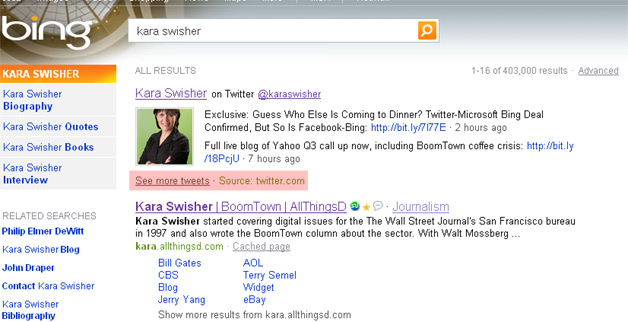
"Much of what is posted on Twitter is public by design, while Facebook’s users prefer the closed nature of the service to disperse a wide variety of personal information only to their friends and they want to control it," says Swisher. "Thus, sources said, not all Facebook updates will be included in the real-time feed to be searched by Bing, but only those its users choose to make available to the wider public. Facebook will apparently provide users with a numbers of new tools to do so."
According to Swisher, neither of Microsoft’s deals will bear fruit for several weeks, and that would leave plenty of time for Google to sneak in with its own deals. We’ll just have to wait and see what happens.
As for the financial details of Microsoft’s deals with Twitter and Facebook, these can only be speculated upon at this point.
-
Energy Future Extends Debt Exchange Deadline
NEW YORK (Reuters) – Energy Future Holdings has extended the deadline for early offers in its debt exchange, a massive debt restructuring that ran into opposition from bondholders, according to a company statement.
The deadline for early tenders is now 5 p.m. (2100 GMT) Oct 23, New York City time, Energy Future Holdings said on Monday. The original deadline was 5 p.m. (2100 GMT) Oct 19. The deadline for consenting to amendments of bond indentures also moved to Oct 23 from Oct 19.
Energy Future, formerly known as TXU, has been trying to reduce its $43 billion debt load by about $2 billion by offering to exchange outstanding debt for new notes at steep discounts.
Franklin Templeton Investments and other major bondholders holding more than 50 percent of bonds targeted in the debt exchange have formed a group to oppose it, a source close to the deal has said.
Bondholders believe the discounts are too steep now that the bond markets have recovered from a sell-off earlier this year, according to analysts. Debtholders are also opposed to amendments Energy Future is seeking that could make it easier for the company to sell its prized transmission business, Oncor.
Bondholders are being offered between 46.5 cents and 74.5 cents on the dollar if they exchange their debt by the early tender deadline. They will receive slightly less if the bonds are exchanged after that. The offer expires Nov. 3.
Energy Future took on a great deal of debt when Kohlberg Kravis Roberts & Co, TPG Capital and Goldman Sachs Capital Partners took it private in the largest leveraged buyout ever in 2007. The company has been burning cash since the market for power worsened and a weak economy hurt demand. (Reporting by Dena Aubin; Editing by Theodore d’Afflisio)


