Author: Serkadis

  • AGA Medical Edges Up in Nasdaq Debut

    NEW YORK (Reuters) – AGA Medical Holdings Inc., a maker of devices for heart defects and blood vessel diseases, became the latest IPO to disappoint in its debut, rising only 0.7 percent in its first day of trade.

    AGA shares started trading at $14.50 on the Nasdaq, rose as much as 2.4 percent to $14.85 and ended 10 cents higher for the day.

    Historically, U.S. IPO stocks have on average risen 10 to 12 percent in their first day, but AGA Medical became the 11th IPO out of 15 since mid-September to have an sub-par first-day, which came on the heels of the IPO pricing below expectations on Tuesday evening.

    AGA priced shares at $14.50, below the expected price range of $15 to $16 a share, which it had lowered earlier Tuesday from $19 to $21.

    The company, whose largest shareholder is private equity firm Welsh, Carson, Anderson & Stowe LP, sold 13.75 million shares and raised $199.4 million. As recently as Monday it had estimated it would raise $275 million.

    Despite the disappointing pricing, the shares stood their ground in their debut because of company’s profit margins and pipeline of products, an analyst said.

    “The market opportunity for their pipeline products is about $6 billion and they are highly profitable,” said Matt Therian, an analyst with Connecticut-based investment firm Renaissance Capital.

    The downward pressure during the pricing came partly from uncertainty over how long regulatory approval for new products and for new applications for existing products could take, he said.

    Investors may have also balked after AGA’s co-founder Franck Gougeon upped the number of shares he was selling by about 2 million on Tuesday, while AGA itself sold fewer shares, leaving it with less money with which to pay down debt.

    “It does not send a vote of confidence when you see pricing pressure and selling shareholders sell more shares,” Therian said.

    At the share price of $15.50 that AGA had expected, the company would have realized $96 million from the offering, less than the net proceeds of $154.2 million it had originally estimated.

    Welsh Carson, which did not sell any shares in the IPO, still owns 51.7 percent of the company after the IPO.

    The move by Gougeon echoes that of the owners of RailAmerica (RA.N), a rail operator that went public last week.

    RailAmerica’s owners, private equity funds managed by Fortress Investment Group LLC (FIG.N), also lowered the price range ahead of its IPO, while Fortress sold 1 million more shares than expected. Shares fell 8 percent in their debut.

    The last IPO of a company owned by Welsh, Carson — an offering last month by hospital operator Select Medical Holdings Corp (SEM.N) — also priced below range. On Wednesday Select Medical shares were down 3 percent from the IPO price.

    AGA’s lead products, Amplatzer devices, treat structural heart defects and made up 55.4 percent of AGA sales in the 2009 first half. AGA warned in its prospectus that it was likely to remain dependent on Amplatzer for the next few years.

    The company has other products in development, including vascular grafts.

    AGA’s first-half sales totaled $94.4 million, with a net loss of $4.2 million. (Editing by John Wallace and Steve Orlofsky)

    ShareThis


  • Gala Coral Debt Restructuring Moves Closer

    LONDON (Reuters) – The private equity owners of Britain’s biggest bingo company, Gala Coral, are moving closer to agreeing on a debt restructuring deal with the company’s mezzanine lenders, two sources said on Wednesday.

    Junior-ranked lenders, led by Intermediate Capital Group Plc (ICP.L) and Park Square, and Gala’s private equity owners, Candover Investments Plc (CDI.L), Cinven Ltd [CINV.UL] and Permira [PERM.UL], are working on a deal that would see the two sides share control of the company, the sources said.

    The owners of Gala Coral, which runs more than 150 bingo clubs across Britain as well as 1,600 betting shops, need a deal with lenders because the company is close to breaching the terms of its 2.7 billion pounds ($4.47 billion) of debt.

    The deal may see mezzanine lenders and private equity owners take equal representation on the board of directors, one of the sources said.

    The proposal will be put to Gala Coral’s current board of directors on Friday before being presented to senior lenders, the source said.

    “We want a fully baked deal before looking to get this approved,” the source added.

    Candover, Cinven, Gala Coral and Permira could not be reached for comment.

    Earlier this month the mezzanine lenders proposed taking an equity stake in the company in exchange for “turning off” interest payments on the debt, which carries high interest rates and totals more than 500 million pounds. 

    Delaying the interest payments would save the company several hundred million pounds.

    If accepted, the deal between owners and lenders would give the mezzanine debt holders much greater say over the running of the company.

    The talks come as junior debt holders in Europe look to be more active in defending their investments.

    “Mezzanine lenders are being more pushy and coming up with their own solutions rather than accepting senior lenders’ solutions after they were wiped out earlier this year,” a senior leveraged finance banker said. ($1=.6045 Pound) (Reporting by Tom Freke and Tessa Walsh)

    ShareThis


  • Coca-Cola Calls On Bloggers For Global Social Media Campaign

    Coca-Cola has launched a social media campaign that will send three bloggers to more than 200 countries over the period of a year.

    The campaign called "Expedition 206" is part of the beverage makers Open Happiness marketing effort launched at the beginning of the year.

    Coca-Cola has selected nine finalists and is allowing fans to make the final decision by voting for their favorite candidates on the Expedition 206 website through November 6. Fans can vote once each day during the three-week voting period.

    Beginning in Madrid on January1, 2010 and ending at the World of Coca-Cola museum in Atlanta on December 31, the story of the bloggers travels will be available on the Expedition 206 site, as well as on Facebook, YouTube, Twitter, Flickr, and other social networking sites.

    Adam Brown, Digital Communications, Coca-Cola
    Adam Brown,
    Digital Communications,
    Coca-Cola

    "This mash-up of social media — online photo galleries, video clips, blogs, microblogs, social networking — combined with an amazing journey, enthusiastic travelers and a theme of happiness is a great way for us to connect with people around the world," said Adam Brown, director, Office of Digital Communications and Social Media, The Coca-Cola Company.

    "The global adoption of social media has given us a way to deliver a year-long reality TV series without the TV."

    Fans will be able to interact with the three bloggers via the Expedition 206 website and offer suggestions on where they go, what they do and who they visit in each country. Stops along the way include the Vancouver 2010 Olympic Winter Games, the FIFA World Cup in South Africa, and the World Expo 2010 in Shanghai.
     

  • BoA Selling First Republic to PE Firms

    CHARLOTTE (Reuters) – Bank of America Corp (BAC.N) agreed to sell First Republic private bank to a group of private equity investors.

    A consortium of private equity firms, including General Atlantic Partners and Colony Capital, are part of the deal, with First Republic Chairman and Chief Executive James Herbert part of the winning bid, the bank said in a statement on Wednesday.

    First Republic’s current management would continue to run the bank, according to the statement. The sale is expected to close in the second quarter of 2010.

    At the end of third-quarter, First Republic reported $19 billion in total assets, $16 billion in deposits and $15 billion in client assets under management in its wealth division.

    A Bank of America spokesman was not immediately available for comment. (Reporting by Joe Rauch, editing by Leslie Gevirtz)

    ShareThis


  • Pro-Stronger Copyright Propaganda Shows Up In Canadian Press

    Rob Hyndman points us to a column in Toronto’s Globe & Mail by Barrie McKenna that is basically all of the recording industry’s talking points on copyright, without even a nod to the views of the other side. It appears that most of the info is (surprise, surprise) based on a recording industry lawyer. It starts with a nice little moral panic about how file sharing sites are rushing to base themselves in Canada due to the country’s supposedly lax copyright laws. Of course, that’s ridiculous. Canada has very strong copyright laws already. What they don’t have is a DMCA. That’s what the industry wants. McKenna tries to bolster his claim that Canada has weak copyright laws with the following:


    Earlier this year, the Obama administration put Canada on its blacklist of shame – a “priority watch list” of intellectual property laggards, joining the likes of China, Russia and Venezuela.

    Sounds nice, but incredibly misleading. The “blacklist of shame” that McKenna mentions, but does not explain, is actually the US Trade Rep’s special “301 Report.” Mention it to just about any policy maker (excluding those pushing for protectionist policies for a specific industry, of course), and you get an eye roll. It’s not so much “the Obama administration” but industries with wishlists attempting to restrain trade in foreign countries by putting forth scary stories about what’s happening in those countries. The USTR basically takes those industry-submitted reports and wraps them up into the 301 report. It’s a joke. Most of the complaints in the report concern countries that actually are in perfect compliance with international treaties — but which the industry still wants to go further.

    Of course, given that McKenna’s source is an industry lawyer, perhaps it’s not surprising that such info wasn’t shared. But, the next claims go from the just uninformed to the unbelievable:


    Canada, which has repeatedly promised but so far failed to deliver on copyright reform, isn’t just out of step with the United States, but with much of the Western world.

    This is simply untrue. Canada’s copyright law is actually quite in line with most of the Western world, no matter what the entertainment industry suggests (and, you might think that McKenna would ask someone other than the person representing the industry that benefits from this). Furthermore, the line that Canada has “so far failed to deliver on copyright reform” is either blatantly misleading or simply ignorant of rather recent history. Canadian politicians have tried to push forth copyright reform, but due to a massive public outcry from people who actually understand how things like the DMCA cause all sorts of problems — especially concerning free speech and consumer rights — those politicians were forced to back down.

    That’s called informed democracy in action.

    Oh, McKenna also claims that the last time the Canadian government tried copyright reform was in 2007. According to his bio, McKenna is based in DC, not Canada, but even down here in the States plenty of us were aware that Jim Prentice introduced copyright reform in 2008.

    So, McKenna makes it out like Canada has no strong copyright laws (false), that it’s laws are different from most of the western world (false) and that it hasn’t tried to add more draconian copyright laws (false again). From there, he comes up with this bizarre justification for more draconian copyright law:


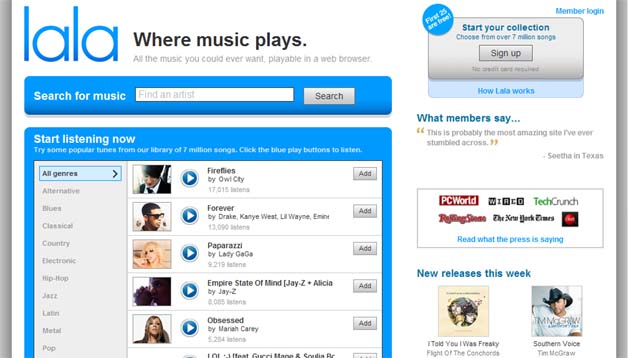
    The world has gone digital. And there’s now an explosion of legitimate download sites in the U.S. and Europe, including ground-breaking music sites Pandora.com and Lala.com. But you can’t use them in Canada.

    These and other businesses are choosing to bypass the market entirely, in part because of licensing problems.

    And the creative industries that produce music, software and the like – industries that contribute significantly more to the economy than BitTorrent sites – may also shun Canada if nothing is done.

    Actually, you have Canadian record labels like Nettwerk, that are doing quite well, even as its CEO has declared that copyright is obsolete and should be done away with entirely within a decade. And the reason that those services can’t be used in Canada isn’t because the law is too lax, but because the laws are too strict, in terms of figuring out special licensing setups in each country. It’s such a pain to get them licensed in a single country that the services have been forced — against their will in many cases — to block access in other countries like Canada.

    Meanwhile, it’s telling to note some of the things that McKenna conveniently left out. Like how about the private copying levy system up in Canada, which has made blank media ridiculously expensive, and which is supposed to be paying for all that “piracy.” We don’t have that in the US at all. Or what about the weak fair use/fair dealing laws in Canada? What about an understanding of the value of the public domain or the value of fan promotions? What about new business models that have shown that copyright isn’t necessary to make money in the industry? What about the studies that have shown that file sharers tend to buy more music? All of that seems relevant… but when your only source is a representative of the industry looking to get laws passed in its own interest, is it any wonder they get left out?

    Barrie McKenna got taken for a ride here by the recording industry. His writeup included multiple factual errors, significant errors of omission, and a gross misunderstanding of what’s actually happening in the music industry these days.

    Permalink | Comments | Email This Story


  • Yesterday’s Macs are today’s bargains

    bargainYou have to love the game that Apple plays. The company never puts anything on sale and all its products generally stay at their MSRP until new models are available to replace them. Well, because of yesterday’s new products, today is lucky day. (if you’re in the market for a new Mac, that is)

    Head over to the refurbished section in the Apple Store for some nice bargains. Yeah, these are all refurbs, but they do save you a bit of coin. You can snag a 2.13GHz MacBook for $749, a MacBook Air for $1,099, an aluminum MacBook for $899, or a 24-inch iMac for $1,099. Plus there are a whole lot more deals. I say go for it.


  • Childhood Obesity Prevention in Texas: Workshop Summary

    Cover imageChildhood Obesity Prevention in Texas summarizes the information gathered at a workshop held February 5-6, 2009, in Austin, Texas. At this workshop, committee members met with Texas lawmakers, public officials, and community leaders to exchange ideas and to view first-hand strategies that are being implemented effectively at the state and local levels to prevent and reverse childhood obesity.

    Texas leaders at the workshop expressed the strong belief that the state’s economic vitality and security depend on the health of its population. Accordingly, the state is no longer simply describing the personal, community, and financial costs of its obesity crisis; it is taking proactive steps to address the problem through strategic initiatives. An overarching strategy is to address obesity by targeting the state’s youth, in whom it may be possible to instill healthy behaviors and lifestyles to last a lifetime. A guiding principle of these efforts is that they should be evidence based, community specific, sustainable, cost-effective, and supported by effective partnerships. Moreover, the goal is for the responsibility to be broadly shared by individuals, families, communities, and the public and private sectors.

  • Community Perspectives on Obesity Prevention in Children: Workshop Summary

    Cover imageAs the public health threat of childhood obesity has become clear, the issue has become the focus of local, state, and national initiatives. Many of these efforts are centered on the community environment in recognition of the role of environmental factors in individual behaviors related to food and physical activity. In many communities, for example, fresh produce is not available or affordable, streets and parks are not amenable to exercise, and policies and economic choices make fast food cheaper and more convenient than healthier alternatives.

    Community efforts to combat obesity vary in scope and scale; overall, however, they remain fragmented, and little is known about their effectiveness. At the local level, communities are struggling to determine which obesity prevention programs to initiate and how to evaluate their impact.

    In this context, the Institute of Medicine held two workshops to inform current work on obesity prevention in children through input from individuals who are actively engaged in community- and policy-based obesity prevention programs. Community perspectives were elicited on the challenges involved in undertaking policy and programmatic interventions aimed at preventing childhood obesity, and on approaches to program implementation and evaluation that have shown promise. Highlights of the workshop presentations and discussions are presented in this volume.

  • Revisiting the Department of Defense SBIR Fast Track Initiative

    Cover imageIn October 1995, the Department of Defense launched a Fast Track initiative to attract new firms and encourage commercialization of Small Business Innovation Research (SBIR) funded technologies throughout the department. The goal of the Fast Track initiative is to help close the funding gap that can occur between Phase I and II of the SBIR program. The Fast Track initiative seeks to address the gap by providing expedited review and essentially continuous funding from Phase I to Phase II, as long as applying firms can demonstrate that they have obtained third-party financing for their technology. Another program initiative, Phase II Enhancement, was launched in 1999 to concentrate SBIR funds on those R&D projects most likely to result in viable new products that the Department of Defense and others will buy.

    The current volume evaluates the two SBIR Program initiatives–Fast Track and Phase II Enhancement–and finds that both programs are effective. Ninety percent of Fast Track and 95 percent of Phase II Enhancement reported satisfaction with their decision. This book identifies the successes and remaining shortcomings of the programs, providing recommendations to address these issues.

  • Facebook Users Spend 8 Billion Minutes/Day on the Site

    facebook_head_6_smallFacebook’s 300 million users collectively spend more than 8 billion minutes on the site each day, according to the social network’s VP of engineering, Mike Schroepfer. He offered up the number onstage at the Web 2.0 Summit Wednesday as proof of the infrastructure challenges the social network faces relative to other web sites. On a busy day, an eye-popping 1.2 million photos are served on Facebook each second, he added.

    And the more than 15,000 sites that have integrated Facebook Connect mean the site has API demands it has to address, too. Facebook was accessed via its API 5 billion times yesterday alone, according to Schroepfer.

    To accommodate all that data without damaging the user experience and stifling innovation, Schroepfer said Facebook has rewritten its memcache multiple times so that now deploys five times faster than before. But even though Facebook continues to augment its engineering team to keep up with its growing audience, he said there’s 1.2 million users per Facebook engineer. No wonder the company is looking to expand its staff by 40-50 percent this year.


  • Weird Accessory #8791: Kawaii Bear iPod Charger

    ipod charger 

    What is that bear doing to that poor outlet and WHAT is that iPod cable doing to that poor bear?! This is the Kawaii Bear iPod Charger, straight from our friends in Japan.

    They apparently cost 1980 Yen each ($21.75) although it’s not exactly clear where or how they’re sold, which is probably a good thing.

    [via Craziest Gadgets]


  • Flashback 1990: The debut of Windows 3.0

    By Scott M. Fulton, III, Betanews

    This is most likely neither the first nor the last article you will read on the subject of Microsoft Windows 3.0. The attention being given the new product is not only deserved, but in many cases carefully orchestrated. The weeklies and fortnightlies have already extolled the merits of Win3’s “three-dimensional” buttons, proportional text, and now-boundlessly managed memory. Their gold-star awards have no doubt been bestowed upon the product for being the best in its class, albeit the only product in its class. The “pundits” have already laid blame upon someone for Win3’s alleged tardiness to market. The entire story is so well-patterned, it may be read without ever having laid eyes to the printed page.

    Yet if we follow the pattern, we miss the real story…

    It is May 1990. For several months, reporters had been prepared by Microsoft to cover what was being billed as the most important event in the history of software. It was the beginning, we were told, of the end of DOS, and the birth of a new software “ecosystem” that enabled independent developers to build graphical applications for the first time, without having to jump through the many hoops and stroke the countless egos of Apple. Microsoft would have a hands-off policy in the development of software that supports what was being called, for the first time, the Windows Operating Environment.

    Sure, it still used the MS-DOS bootstrap, but don’t tell anyone that. And sure, that bootstrap still required 640K of conventional RAM, but don’t tell anyone that either. The real benefits were to be seen in something Macintosh itself couldn’t do: run more than one application at once, with true multitasking and pipelining for the very first time…and all in color.

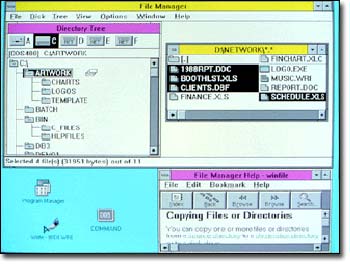
    A screenshot from File Manager in Microsoft Windows 3.0, circa 1990.The prospects for applications were boundless, and Microsoft wanted to be seen as opening all the doors and not stepping through them first. The first question in journalists’ minds was, would there be a counterpart to Hypercard? Without a Hypercard, Windows may as well be broken. Rest assured, we were told, a company called Asymmetrix would provide the toolkit that would revolutionize programming, with a bit of Microsoft’s funding. The next generation metaphors for Windows were being created not by Microsoft but by Hewlett-Packard, for a product called NewWave — again, Microsoft made certain journalists knew, with its help but not its supervision. And the world would know Windows was for real when it used an everyday spreadsheet with a name familiar to everyone: Lotus 1-2-3 G.

    In the spring of the turn of the decade, I had a regular series in a magazine that was widely considered to be “Computer Shopper in exile,” called Vulcan’s Computer Buyer’s Guide, staffed by many former Shopper regulars who would, like myself, become regulars there again once a dispute with the new owners, Ziff-Davis, was resolved. I had the lead role in covering the biggest software release in history, for a magazine whose editors told me flat out, “Use as much space as you need.”

    Months earlier, Microsoft had granted me some of the first demonstrations of Dynamic Data Exchange ever shown outside its laboratories. It was astounding to me, and I was proposing to write a book on it all, except that none of the book editors at the time knew, or appeared to care, about running two applications at once. “We want a book about Excel or a book about Word,” one editor told me toward the close of a conversation. “No one wants to read a book about Excel and Word.”

    It was uncharted territory, as every editor I worked with kept reminding me. One of these days, my former Shopper editor told me, you’ll be writing this story in May and someone on the other side of the screen will read it in May. But for now, it was the August issue we were working with, and complete with interviews with everyone we thought would matter — Asymmetrix, HP, and Lotus included — I headed forward for 33 pages of draft copy, with a full head of steam…

    Yet if we follow the pattern, we miss the real story. There is a real development taking place between the authors of and for Windows 3.0, which concerns the remodeling of the computer application. We are familiar with the application as a program and its associated data, which is entered and exited like a jewelry store or a bank. We sometimes see ourselves “in” an application, just as we often see ourselves “in” the subdirectory pointed to by the DOS prompt. The data we need while we’re “in” the program is much like the diamond necklace behind the display case; we’re allowed to look at it and touch it, but unless we’re very crafty, we’re not allowed to take it outside. It doesn’t belong to us, even if the data’s very existence is due to our having typed it in.

    The entire contraption of the DOS environment — along with the guilt feelings it so subtly leaves us with — are being shattered by Windows 3.0. There is a movement under way by Microsoft and its independent software vendors (ISVs) to abolish the structure which grants exclusive ownership rights of a set of data to an application. Having done that, the movement will also seek to dissolve the programmatic barricade which surrounds the once-exclusive application, allowing for the equal distribution of correlated tasks within an arbitrarily-defined computing job, to other programs non-specifically.

    It’s a difficult concept to discuss in the orchestrated fashion with which we have become accustomed, so instead I offer a hypothetical situation: Assume you have an inventory list card file. You want to compare gross profit percentages, so you demand such a list from the computer. Your spreadsheet — whatever that may be — shows you the list. You didn’t need to save the card file, translate it, export it, and re-import it — the list simply appeared. You want to see how these figures look graphically, so instantly you see a detailed pie chart. You’d like to make this chart part of your report to your superiors. This is quite simple to accomplish. Since what you’re reading is the report to your superiors, the word processor saw your chart and automatically composed a standard form. This was sent to your typesetting program, which is providing the image you’re seeing now.

    Your superiors are in six different countries and two of them are out on the road somewhere. you tell your machine to send them all a copy of the report you’re looking at now. The machine already knows two of them have fax machines, two are available via WANs, and the other two have cellular phones connected to laptops. You neither know this nor care; you just have your computer “send” the report to them, regardless of the media of transmission. The report is received in six different places, even if the recipient computers’ operators weren’t using their machines at the time. A mere three minutes of your life have been expended in the processing of the weekly profit report.

    You have just been witness to an example of the model for the meta-application — one smoothly-flowing, correlated process combining the resources of several programs from different vendors. This is the model Windows 3.0 seeks to gradually implement. Actually, this is what OS/2 was supposed to implement at first; its muddled and haphazard development agenda has prevented it from leading the way.

    The meta-application is not an inevitable fact of computing; the marketing debacles of cross-vendor cooperation it imposes may render it as ineffective as OS/2 in changing our computing habits. Still, it is something to be wished for. And it is a far more important facet of the Windows 3.0 story than faceted buttons and little pictures. The way in which world industry and commerce works is not affected in the least by faceted buttons and little pictures.

    Copyright Betanews, Inc. 2009


    Add to digg
    Add to Google
    Add to Slashdot
    Add to Twitter
    Add to del.icio.us
    Add to Facebook
    Add to Technorati


  • Uncharted 2, Tekken 6, SF4 Home bound, client update to fix issues from previous version

    Friday, October 23rd will be a big day for PlayStation Home as it marks the arrival of three spaces dedicated to three major titles of the year: Uncha…

  • A Sidekick crisis post mortem on cloud confidence

    By Tim Conneally, Betanews

    I was sitting in the dentist’s chair getting my teeth drilled, while the technician complained about her now-worthless Sidekick. With no way to access her contact lists, she couldn’t get in touch with her family due to arrive in DC for a reunion, and had to rely on the frequently failing device as a simple inbound line for family members to contact her. When that failed, she had to use a payphone.

    It was a pretty sad story, and thousands of users were faced with a similar communication breakdown…for more than a week.

    People threaten to sue Google when Gmail goes down for mere hours. But the poor Sidekick customers lost use of their phones, lost their personal data (in some cases permanently), and even lost the ability to turn off or restart their devices for upwards of nine days.

    Microsoft and T-Mobile claim to have finally restored much of the lost data, and now offer a recovery tool on the T-Mobile site, but the incident was just too tremendous to simply walk away from. The whole concept of Web-based, shared, and distributed cloud services now has a huge black mark smeared across it, even though the Sidekick’s contact, calendar, photo, and info sync only vaguely constitute a “cloud” service.

    The resulting cloud doubt was never as clearly portrayed as it was by ABC News columnist Michael Malone, who said, “What counts is that we never really ever trust the cloud again.”

    But “the cloud” — the marketing buzzword — represents much of what the computer industry has been working toward for years: small, fast, and lightweight consumer end devices relying heavily on their persistent connection to a network (whichever one that may be) to provide information, storage, and processing on demand.

    It’s not something one can particularly trust or distrust.

    I liken it to home PC security. You can’t simply say the whole Internet is untrustworthy because it contains viruses, scams, and information of dubious authenticity. You take the good with the bad, protect yourself, and tread lightly.

    There’s only so much your antivirus software can do to protect you if you’re recklessly clicking through everything, installing whatever fake plug-ins you’re told to, and voluntarily submitting personal information when asked. Similarly, if you’re uploading information to a single hosting service without backing it up somewhere, you’re putting yourself at risk.

    Unfortunately, Sidekicks are a risk.

    Regarding the fiasco, Microsoft CEO Steve Ballmer recently said, “Non-Sidekick users, we are not earning their trust back, but I think people are going to say, ‘Hey, look, show me what you are doing to ensure this does not happen to me.’”

    The devices have been compared to thin clients, where there is no mechanism in place for a client-side backup of all the data stored on the Danger/Microsoft servers, so users are given only minimal control over their data.

    This degree of control is one of the critical elements in establishing confidence in cloud-based services.

    “All risk cannot be removed,” said Erik Laykin, leader of the Global Electronic Discovery and Investigations group at independent financial advisory and investment bank Duff & Phelps. “After all, we are still relying on hardware and software systems, both of which can fail.”

    “Both organizations and individuals need to consider some factors [when] turning their data over to a third party…What are the risks we opening ourselves up to? Where is this data going to be (US, India, China)? What kind of backups and redundancies are in place? Who are the third party’s subcontractors?” Laykin said.

    Risk-benefit analysis, therefore, is another critical element.

    “My clients are corporations and law firms, but consumers have to be aware of the risks too. For example, as an individual, I outsource my backups to online storage services like Carbonite. Do I accept that as the final solution? No. I make a physical backup because I can’t always rely on my third party. Sidekicks unfortunately lack flexibility in this area.”

    But because we cannot rely solely on a cloud service, does that mean that ABC News was right to suggest we can’t trust the cloud?

    Laykin said no: “I’m getting on a plane tomorrow, and we all know the plane can drop out of the sky for a thousand different reasons. But does that mean I can never trust airlines to get me there safely? Of course not. We trust that the airline has mitigated those risks, but protect ourselves and our families with insurance in the unlikely event that something happens.”

    It’s situations like the Sidekick data loss that could ultimately restructure the way we deal with data protection.

    “For the last ten years, the insurance industry has provided coverage to mitigate data loss, which usually addresses hosting data,” Laykin said. “Data insurance for individuals may not be something widely available today, but I envision policies like that being part of the average user’s portfolio twenty years down the road.”

    Today, groups like Laykin’s can assess the risks for companies looking to move their data into the cloud, but incidents like the Sidekick outage could trigger the demand for stricter regulations. “We may see a day in the future where organizations and companies like Microsoft or Google are rated on how safe and accessible their data is. Right now, it’s still a brave new world in terms of third-party data management.”

    Copyright Betanews, Inc. 2009


    Add to digg
    Add to Google
    Add to Slashdot
    Add to Twitter
    Add to del.icio.us
    Add to Facebook
    Add to Technorati


  • Facebook Gift Shop May Soon Get Songs

    The Facebook Gift Shop may soon get a lot better.  A new report indicates that full songs are coming to the store, and a clever option that should even allow them to be transferred off the site is also part of the plan.

    Brad Stone wrote this afternoon that Facebook will integrate Lala into its store.  He then continued, "And Lala is the perfect partner for this.  It charges 10 cents (or one Facebook credit) for a ‘Web song,’ which can be played online in perpetuity; for full price, usually around 10 credits, the recipient of the music gift will be able to download the song and transfer it to their iPod."

    Facebook will have to be careful that the introduction of Lala doesn’t turn it into autoplay-era MySpace; no one needs Nickelback blaring from their speakers every time a new page loads.  Otherwise, though, the idea sounds solid.

    Look at it this way: would you rather send a friend a few pixels that look like a mug of beer, or a four-minute song by some great band?  Most people would go for the second option, ensuring that Lala’s music will become a hit among existing Facebook Gift Shop users.  Then, as gifts are given and word spreads, a lot more people are likely to spend a little money.

    Unfortunately, it’s unknown exactly when the Facebook-Lala integration will take place, so stay tuned.

  • PRS’s Latest Trick: Demanding Money From Shop Assistant Who Was Singing At Work

    Sometimes, these collection societies write the jokes themselves, it seems. PRS, the music collection society in the UK, famous for going way over the line in demanding money from people (remember the time it demanded a woman pay up for playing music for her horses? Or how it calls small businesses and if they hear any music in the background, demand payment?), has done it again. It threatened a shop assistant for singing out loud (public performance!) while stacking the grocery shelves, demanding she pay £1,000 for the privilege. Of course, why was she singing? Because PRS had already threatened the owner for having a radio — so he got rid of the radio.

    Of course, as with the horse debacle, once PRS realized the PR nightmare it had created for itself, it apologized (and sent some flowers). But, that hardly makes the situation better. Why is PRS demanding such things in the first place? Given the long trail of similar examples, this isn’t just some random one-off accident. It’s basically how PRS operates. And that’s because it’s structured its business so that its “investigators” aren’t really “investigators” at all, but sales people. They have every incentive to get as many companies to pay up as possible, no matter if there’s any real performance at issue.

    On top of that, the very fact that PRS forced this shopowner to take away his radio should show how backwards and braindead PRS’s strategy is. The radio in the shop isn’t a “public performance.” It’s not the reason people go to the shop. But it did help promote the musicians PRS supposedly represents. Not any more. Musicians in the UK should be furious at PRS for making it more difficult to get their music heard, let alone for threatening someone for singing while stocking the shelves.

    Permalink | Comments | Email This Story


  • What’s inside this mystery box?

    Mobile Photo Oct 21, 2009 12 34 19 PM

    This just mysteriously appeared on our doorstep. The return address on the label leads to Verizon’s PR company, Weber Shandwick. We’re going to do a video unboxing in just a second – in the mean time, any guesses as to whats inside?


  • Senate Votes To Shelve ‘Doc Fix’ Legislation

    “The Senate has sidetracked legislation raising Medicare payments for doctors by $247 billion over the next decade,” The Associated Press reports. “The 47-53 vote was 13 short of the 60 needed to advance the measure, and reflected bipartisan concern that it would have raised deficits if it became law” (10/21).

    The Wall Street Journal: “Without the needed 60 votes to proceed to the bill, it is effectively shelved. Senate Majority Leader Harry Reid (D., Nev.), alluded to that outcome Wednesday, saying he expected the Senate would ‘pick this up again’ after it considered a broader health-care measure.” Action by Congress is still necessary in order “to avoid a 21% drop in physician payments under Medicare” slated for January. It it appears that a temporary solution is in the works, the Journal reports. “‘Right now, we’re going to a one-year fix,’ Mr. Reid said” (Yoest and Kendall, 10/21).

    Even before the vote, Reid talked about the expected outcome.

    Time’s Swampland: “I don’t bring anything to the floor unless I think I have the votes,” Reid said to reporters while answering a question about the apparent shortfall of support. “I was told by various people that we’d have 27 Republican votes, which seemed reasonable since Senator Jon Kyl was the co-sponsor of this legislation. So I was stunned when I was told by his co-sponsor, Senator Stabenow, that, no, he wouldn’t support it” (Newton-Small, 10/21).

    The Hill: Earlier today, “Reid told colleagues that the AMA said it could deliver 27 Republican votes for the legislation, according to two Senate Democratic lawmakers, who spoke on condition of anonymity. … Reid said at a news conference Wednesday that he would bring up the 10-year freeze after the healthcare reform legislation is passed and will settle for a one-year fix in the meantime” (Bolton, 10/21).

    Reid “pointed to what he called the ‘Republican Senate’ for trying to stop the measure from advancing,” according to Roll Call. “Reid and other top Democrats called the Medicare payments vote — otherwise known as the ‘doc fix’ — the ‘first vote’ of the health care debate and appear to be looking to cast Republicans as obstructionists before the actual debate on the broader overhaul begins.” But many Republicans have opposed the measure because it does not include off-sets to cover its price tag. As many as eight Senate Democrats said they would oppose it, too. (Stanton, 10/21).

  • Lenovo gears up for Windows 7 with 2 new laptops

    Picture 9A pair of new additions have been announced for Lenovo’s ThinkPad line. So all of those business people who shunned Windows Vista and held onto XP can finally take the plunge to a new OS. These new notebooks are optimized to run Windows 7 along with a host of other little goodies.

    Powered by Intel Core2 Duo processors, a 16:9 HD screen, HDMI and VGA outs are just some of the features. Lenovo also really hit the VoiP market hard with these. You’ve got WiFi, Ethernet, Bluetooth, and some models have 3G built in. The camera resolution is supposed to be better, but we didn’t get any specs for it, so who knows. The integrated microphone now has a dedicated mute button for when you need to cut the audio. These laptops are even EPEAT and Energy Star certified to be green. So you’ll know that you aren’t horribly destroying the planet when you buy one.

    The SL series is the lowest of the ThinkPad’s but the new SL410 and SL510 are the only members to be certified under Lenovo’s Enhanced Experience program. I’m not really completely sure what that means. According to the press release, “certified PCs deliver a faster, richer and easier computing experience over identical configuration, non-optimized PCs.” So they have the same hardware, they just run better for some reason? Why not just optimize all of them?

    These should hit stores tomorrow, with a starting price of $529.


  • Party Leaders, Key Lawmakers Speculate On The Health Reform Schedule

    “Sens. Ben Nelson (D-Neb.) and Olympia Snowe (R-Maine), two key moderates, met with Senate Majority Leader Harry Reid (D-Nev.) Wednesday morning — their second meeting with the leader this week as a part of their ongoing effort to shape the final Senate health care reform bill,” Roll Call reports.

    Although Democratic leaders were aiming to vote on reform legislation by Thanksgiving, Snowe said, “That would be optimistic.” In response to a question about whether a final vote could occur before December, she said, “That would be my sense” (Drucker, 10/21). 

    According to Politico’s Live Pulse, Snowe also said, “I think the issue is that making sure everyone has the opportunity to express themselves through the form of amendments, I think that’s key. … because everybody, certainly on the minority side should have the ability to offer amendments. I got a sense that [the majority leader] is very much disposed towards that.” Snowe also echoed the Republican theme that Democrats are rushing the health overhaul. “But the criticism will likely hold more weight coming from swing-vote Snowe, who Democrats have gone out of their way to accommodate throughout the process” (Frates, 10/21).

    Meanwhile, on the House side, Speaker Nancy Pelosi told reporters today that the House would approve health care reform by Thanksgiving, according to MSNBC. “We’re on schedule, and we’re pleased from our standpoint that we will have a bill passed well before Thanksgiving — and hopefully in time for it to be signed with the work done with the Senate to be signed before Thanksgiving but certainly this year.” But MSNBC also notes less optimistic comments from last week from other members of the House leadership and  that “even the most dedicated Democrats will say privately that it is a long-shot for health-care reform to be passed through the House and Senate by Thanksgiving” (Russert, 10/21).