Indeed, The Sims are bustin’ out again. They’ve given us a heads-up back in February (qjnet/news/the-sims-3-coming-to-consoles-and-handhelds.html), but today, EA has announced that The Sims 3 is now in development for console and handheld.
Author: Serkadis
-
Porsche recalls Panamera sedan, fears losing reputation for quality

2010 Porsche Panamera
Porsche has recalled every Panamera sedan it built only months after the model went on sale, in what is being called a “severe dent” on the company’s sterling reputation for quality. The recall consists of 11,300 Panameras being recalled to fix possible faulty seatbelt tensioners.
Porsche, which has repeatedly received top marks from J.D. Power for its industry-leading quality, may have some German executives a little angry on the news of the recall.
Porsche SE controls 51 percent of Porsche AG, with the remainder held by Volkswagen AG. The news could get Volkswagen to take action.
Martin Winterkorn, who is CEO of both Volkswagen and Porsche SE has repeatedly said that the better a brand performs, the more autonomy it gains within the overall group.
Click here for more news on the Porsche Panamera.
Refresher: The $89,800 Porsche Panamera S is powered by a 400-hp V8 allowing for a 0-60 mph time of 5.2 seconds with a top speed of 175 mph. The $93,800 Panamera 4S is powered by the same 400-hp V8. The $132,600 Porsche Panamera Turbo is powered by a turbocharged V8 making 500-hp allowing for a 0-60 mph time of 4.0 seconds with a top speed of 188 mph. The Porsche Panamera V6 and Porsche Panamera 4 are powered by a 3.6L V6 engine making 300-hp and a peak torque of 295 lb-ft. Prices start at $74,400 for the base V6 Panamera and $78,900 for the V6 Panamera 4.
2010 Porsche Panamera:


– By: Omar Rana
Source: Reuters
-
100 cavallini lined up for Concorso Ferrari 2010 In Old Pasadena
Filed under: Classics, Performance, Misc. Auto Shows, Ferrari, Event Alert
 Colorado Boulevard is one of those streets that is known to millions of people around the world, many of whom have never set foot in California. In this case, it’s because Colorado serves as the thoroughfare that hosts the annual Rose Parade, the float-tastic flower-power procession that precedes the Rose Bowl college football game in Pasadena, California. During the rest of the year, it’s known as a great spot for shopping, dining and people watching for locals and tourists alike. But on a certain Sunday in May, it is also known as a place to see Prancing Horses. You see, Colorado Blvd. in Old Town Pasadena is the site of the Concorso Ferrari event.
One of the largest annual gatherings of Maranello’s finest, Concorso Ferrari 2010 is expected to draw more than 100 classic and late-model GTs, sportscars and supercars for a free-to-the-public event like no other. The combined value of the vehicles is expected to top $100 million, with nearly one-fifth of that amount accounted for by one particular model – a Pebble Beach-winning 250 Series I Cab. Other highlights on the entry list include a Cavallino Best of Show 250 GT SWB, the Agnelli 400SA (fresh from the Ferrari Museum in Maranello), a Concorso Italiano Platinum winning 400SA, and one of six Vignale 225S racers produced.
Organized by the Ferrari Club of America, Southwest Region, the Concorso will stretch across several blocks of Colorado, from Pasadena Ave. to Raymond, and will run from 10 am to 3 pm on Sunday, May 16. The event will be a judged concours for pre-’99 cavallini, with unjudged displays of newer cars including not just those from Ferrari, but Maserati, Aston Martin, Lotus, Spyker, and Mercedes-Benz models as well.
The full press release and contact info is pasted in after the jump.
Continue reading 100 cavallini lined up for Concorso Ferrari 2010 In Old Pasadena
100 cavallini lined up for Concorso Ferrari 2010 In Old Pasadena originally appeared on Autoblog on Tue, 27 Apr 2010 08:28:00 EST. Please see our terms for use of feeds.
-
The first pre-production 2012 Opel Ampera produced in Michigan

The Opel Ampera team with the first pre-production Opel Ampera
The first pre-production 2012 Opel Ampera, the Chevy Volt’s European sibling, rolled off the assembly line at GM’s Pre-Production Operations assembly line in Warren, Michigan on April 23.
“We’re right on target for producing the Ampera for European markets later next year,” said Andrew Farah, Vehicle Chief Engineer for the Ampera “There’s still work to be done, but being able to drive an Opel Ampera off our pre-production line is a great accomplishment for the teams here and in Europe.”
GM said that assembly workers will continue to build more pre-production Amperas in the coming months and that the pre-production vehicles will not be sold at dealerships, but used instead for testing and validating the production intent design as well as developing the final vehicle software and controls. Engineers in Europe and the United States also use them to tune the vehicle’s overall driving experience.
Most of them will end up being used in safety and structural integrity testing.
2012 Opel Ampera:


– By: Kap Shah
-
Após três dias, o Nissan Leaf recebe 6.635 reservas de compra

Depois de anunciado e aguardado, o novo Nissan Leaf que é novo modelo totalmente elétrico da companhia, já chegou a impressionantes 6.635 reservas em apenas três desde que se tornou disponível para reservas, após um depósito online antecipado de $99 por quem estava interessado, sendo que esse valor pode ser reembolsado depois.
O liberação das reservas do modelo elétrico para o público em geral irá começar somente no dia 15 de maio, mas as pessoas que demonstraram grande interesse no carro já puderam reservar o modelo ecologicamente correto antes dos outros.
Mas os números grandiosos prometem não parar por ai. A montadora japonesa estima chegar aos 25 mil pedidos até que o carro seja lançado no mercado no final desse ano. Uma prova do sucesso do Leaf foram as 6.635 reservas já feitas, o que motiva a Nissan a lançar uma plataforma inteira de veículos elétricos.
Via | Top Speed
-
Porsche Design packs it in with new Travel Collection
Filed under: Etc., Porsche, Design/Style
 Porsche Design Driver’s Selection Travel Collection – Click above for high-res image gallery
If you’re planning a road trip, there are worse ways than going in a Porsche. But notwithstanding the extra space afforded by the Cayenne sport-ute or the new Panamera four-door, most Porsche don’t have a wealth of luggage space. Fortunately, Porsche Design has released a full line of luggage and travel accessories made especially for its sister-company’s line-up.
Part of the Porsche Design Driver’s Selection, the new Travel Collection offers choices of Ultralight polycarbonate hard-shell luggage, AluFrame wheeled pieces and leather Carfit baggage. They’re all made to fit in the trunks of the 911, Boxster, Cayman, Cayenne or Panamera, and many of the hard-shell pieces can even be ordered to match standard Porsche exterior paint colors. To cap it off, there’s extra accessories like coordinating wallets, jackets designed for the traveler and the requisite sunglasses for the road. Check ’em out in the gallery below, along with the details in the press release after the jump.
[Source: Porsche Design]
Continue reading Porsche Design packs it in with new Travel Collection
Porsche Design packs it in with new Travel Collection originally appeared on Autoblog on Tue, 27 Apr 2010 07:58:00 EST. Please see our terms for use of feeds.
-
ASLA Announces 2010 Professional Awards

The American Society of Landscape Architects (ASLA) announced the winners of the 2010 Professional Awards, representing the best in landscape architecture around the world in the categories of general design, residential design, analysis and planning, research and communication.The jury considered 618 entries – the largest number in ASLA history – from 20 countries around the world, selecting 49 projects for distinction.
The awards ceremony will take place on Monday, September 13, at 12 noon during the ASLA Annual Meeting and EXPO in Washington, D.C.
View the full list of award winning projects.
Image credit: 2010 Professional Award of Excellence. Shanghai Houtan Park: Landscape as a Living System, Shanghai, China. Turenscape, China and Peking University Graduate School of Landscape Architecture

-
Ford Motor Co. posts $2.1 billion profit in first quarter of 2010

Ford CEO – Alan Mulally
FoMoCo today announced that its first quarter 2010 net income came in at $2.1 billion, or 50 cents per share, a $3.5 billion improvement from the same period a year ago. Ford says the number moved up due to strong selling new products, improvements in its global Automotive operations, and higher profits at Ford Credit boosted results.
Excluding special items, Ford reported pre-tax operating profit of $2 billion, or 46 cents per share, an improvement of $4 billion from a year ago. It marked the Dearborn automaker’s highest quarterly pre-tax operating profit in six years.
“The Ford team around the world achieved another very solid quarter, and we are delivering profitable growth,” said Ford President and CEO Alan Mulally. “Our plan is working, and the basic engine that drives our business results – products, market share, revenue and cost structure – is performing stronger each quarter, even as the economy and vehicle demand remain relatively soft.”
Ford pointed out that since it has decided to sell Volvo to Zhejiang Geely Holding Group for $1.8 billion, it will report all of Volvo’s 2010 results are being reported as special items and excluded from Ford’s operating results.
Ford said that its first quarter revenue was $28.1 billion, up $3.7 billion from the same period a year ago. If Volvo had been excluded from 2009, Automotive revenue would have increased by $7 billion, or more than 30 percent.
– By: Omar Rana
-
UK Labour Party Claims ‘Innocent Error’ Absolves It Of Infringement — But Where Is The ‘Innocent Error’ Defense In The Digital Economy Act?
We were just noting that the UK’s Labour Party appeared to have egregiously infringed on the copyrights of a television program with its campaign poster for the second time, and Shane Richmond, over at the Telegraph, points us to an even more blatant infringement by the same party. In this case, the party put out a pamphlet that used a blogger’s photo entirely without permission and against his wishes (he’s voting for a different party).
Richmond contacted the Labour Party to get their comments on both situations. On copying the television poster, the comment was:
“We only bought the digital posters for a set period and that period has now passed.”
On the situation with the blogger’s photograph, the party responded:
“It appears in this instance that one of our design team has made an innocent error which we regret.”
Now, both of these responses are quite interesting, because having dug through the Digital Economy Act (no longer the Digital Economy Bill, now that it’s been rammed through Parliament), I’m having trouble finding the defenses it includes for “I only infringed for a little while, and that period has passed” or the “innocent error” defense.
As Richmond notes, does this mean that when someone is accused of infringement under the Digital Economy Act, they’ll be able to respond:
“Yes, I downloaded your new film but that was an innocent error which I regret.”
After all, if that response is good enough for the party that wrote the new law, stood behind it forcefully, and rushed it through the House of Commons with basically no debate, then shouldn’t it be good enough for UK citizens as well?
Permalink | Comments | Email This Story
-
Hibrido Porsche 918 Spyder: 900 clientes interessados em sua compra

O surpreendente protótipo hibrido Porsche 918 Spyder revelado no Salão de Genebra ainda não foi oficializado para ser produzido, pois a companhia vem acompanhando o interesse do publico no modelo, que determinará se seu projeto enfim chegará as ruas. As ultimas informações são de que a Porsche recebeu cerca de 900 potenciais clientes interessados no 918 Spyder.
Apesar dos bons números em sua recepção, o chefe de desenvolvimento de projetos da Porsche, Wolfgang Duerheimer, disse durante uma entrevista no Salão do Automóvel de Pequim realizada dia 24 de abril que esperava pelo menos 1000 ordens: “Estou confiante que em breve alcançar o limite de 1000” , complementando que: “Nós precisamos de 1.000 pessoas seriamente interessado em fazer um caso de negócios”.
Nossa torcida é que o hibrido esportivo Porsche Spyder 918 seja realmente produzido pois ele promete revolucionar o sua categoria, apresentando um desempenho superior até mesmo que o Porsche Carrera GT, porém com um consumo de combustível e de emissão super-reduzidos sendo em média, mais que o dobro econômico que nossos atuais populares, apresentando um consumo de apenas 33,3 km/l !!!
Tudo isso gracas a seu sistema hibrido combinando um motor V8 de mais de 500 cavalos de potencia e três motores elétricos, gerando mais 218 cavalos adicionais. Com isso sua aceleração de 0 a 100 km/h é feita em apenas 3,2 segundos e sua velocidade final chega aos 320 km/h.
Fonte: TopSpeed
-
Tecnologia: Dirija um carro com seus olhos, sem as mãos

A tecnologia evolui a passos largos nos tempos atuais. No mundo automobilístico, por exemplo, podemos citar algumas melhorias marcantes e interessantes, como o GPS para os perdidos, carro que estaciona sozinho para os despreparados, os atuais motores elétricos e por ai vai. Mas, com todas essas facilidades, o que mais podemos criar em um carro? Se pensaram na sua direção, acertaram!
Depois do GPS e do piloto automático em alguns veículos, algo a mais poderia ser criado, e isso está acontecendo. Estamos falando da mais nova invenção feita por pesquisadores alemães, um sistema de direção chamado “eyeDriver” que faz com que o veículo responda aos movimentos dos olhos do motorista, para qualquer direção que o mesmo olhe.
O novo sistema funciona com duas pequenas câmeras, sendo uma instalada na parte frontal do veículo, apontada para a rua, e outra câmera focaliza os olhos do motorista, e essa captura todos os movimentos dos olhos. A invenção foi apresentada na Universidade de Berlin, utilizando uma Dodge Caravan (foto), que atingiu cerca de 60 km/h usando a nova tecnologia. Muito ainda precisa ser aprimorado, isso ainda está muito longe de ser comercializado, comentam os estudantes.
Via | Top Speed
-
Starry Starry Night
 This item is mostly a good excuse to hang out a great picture. They certainly have been getting progressively better although I am always uneasy reading interpretations.The reason I say that is that nothing is truly testable or open to any form of confirmation. It really is science by democratic opinion building on layers of the same. It is way too easy to see what you expect.Otherwise they are wonderful pictures and obviously space exploration has been building serious momentum, this past decade has many others are getting into the act. No one is prepared to meekly wait for NASA to get around to things anymore.Starry-Eyed Hubble Celebrates 20 Years Of Awe And DiscoveryPillars and Jets. Credit: NASA, ESA, and M. Livio and the Hubble 20th Anniversary Team (STScI)by Staff Writers
As the Hubble Space Telescope achieves the major milestone of two decades on orbit, NASA and the Space Telescope Science Institute, or STScI, inNASA is releasing a new Hubble photo of a small portion of one of the largest known star-birth regions in the galaxy, the Carina Nebula. Three light-year-tall towers of cool hydrogen laced with dust rise from the wall of the nebula. The scene is reminiscent of Hubble’s classic “Pillars of Creation” photo from 1995, but even more striking.NASA’s best-recognized, longest-lived and most prolific space observatory was launched April 24, 1990, aboard the space shuttle Discovery during the STS-31 mission. Hubble discoveries revolutionized nearly all areas of current astronomical research from planetary science to cosmology.Over the years, Hubble has suffered broken equipment, a bleary-eyed primary mirror, and the cancellation of a planned shuttle servicing mission. But the ingenuity and dedication of Hubble scientists, engineers and NASA astronauts allowed the observatory to rebound and thrive. The telescope’s crisp vision continues to challenge scientists and the public with new discoveries and evocative images.“Hubble is undoubtedly one of the most recognized and successful scientific projects in history,” said Ed Weiler, associate administrator for the Science Mission Directorate at NASA Headquarters inHubble fans worldwide are being invited to take an interactive journey with Hubble. They can also visit Hubble Site to share the ways the telescope has affected them. Follow the “Messages to Hubble” link to send an e-mail, post a Facebook message, or send a cell phone text message. Fan messages will be stored in the Hubble data archive along with the telescope’s science data. For those who use Twitter, you can follow @HubbleTelescope or post tweets using the Twitter hashtag #hst20.The public also will have an opportunity to become at-home scientists by helping astronomers sort out the thousands of galaxies seen in a Hubble deep field observation. STScI is partnering with the Galaxy Zoo consortium of scientists to launch an Internet-based astronomy project where amateur astronomers can peruse and sort galaxies from Hubble’s deepest view of the universe into their classic shapes: spiral, elliptical, and irregular.Dividing the galaxies into categories will allow astronomers to study how they relate to each other and provide clues that might help scientists understand how they formed.For educators and students, STScI is creating an educational website called “Celebrating Hubble’s 20th Anniversary.” It offers links to facts and trivia about Hubble, a news story that chronicles the observatory’s life and discoveries, and the IMAX “Hubble 3D” educator’s guide. An anniversary poster containing Hubble’s “hall-of-fame” images, including the Eagle Nebula and Saturn, also is being offered with downloadable classroom activity information.To date, Hubble has observed more than 30,000 celestial targets and amassed more than a half-million pictures in its archive. The last astronaut servicing mission to Hubble in May 2009 made the telescope 100 times more powerful than when it was launched. -
Tissue Growth Biology Revealed
 This work has inevitable with the first discovery of stem cells and perhaps will now build momentum. We are still a long way from home but the possibility of simple tissue replacement is really the magic wand.I doubt if we overcome the degeneration of aging yet, but that will also likely bend to research.Most important is this particular step. Whatever else can be done with it, it will open the door for nerve cell regeneration within the spine. That will end the circumscribed lives of paraplegics. That alone will be financially rewarding to society as this particular burden gets eliminated.Obviously we are looking at major restoration for those who suffer combat injuries. One aspect of present war casualties not commented on is the very low ratio of dead to wounded as compared to other wars of the recent past. Body armor and rapid intervention is keeping troops alive like never before. That means regrowth protocols will and can be swiftly adopted.In short we have room for optimism and this should now attract a surge of support.Revealed: The secret of how worms re-grow amputated body parts… and how humans could one day do the same
Last updated at 11:49 AM on 22nd April 2010Scientists have discovered the gene that allows a worm to regenerate its own body parts after they are amputated, it was announced today.The research into how Planarian worms can re-grow body parts – including a whole head and brain – could one day make it possible to regenerate old or damaged human organs and tissues, the University of Nottingham said.The research, led by Dr Aziz Aboobaker, a Research CouncilsResearch into how Planarian worms can re-grow body parts could one day make it possible to regenerate old or damaged human organs and tissuesThe worms have the unusual ability to regenerate body parts, including a head and brain, following amputation.They contain adult stem cells that are constantly dividing and can become all of the missing cell types.They also have the right set of genes working to make this happen as it should so that when they re-grow body parts they end up in the right place and have the correct size, shape and orientation, the research showed.The study is published today in the open access journal PLoS Genetics.Dr Aboobaker said: ‘These amazing worms offer us the opportunity to observe tissue regeneration in a very simple animal that can regenerate itself to a remarkable extent and does so as a matter of course.‘We want to be able to understand how adult stem cells can work collectively in any animal to form and replace damaged or missing organs and tissues.‘Any fundamental advances in understanding from other animals can become relevant to humans surprisingly quickly.‘If we know what is happening when tissues are regenerated under normal circumstances, we can begin to formulate how to replace damaged and diseased organs, tissues and cells in an organised and safe way following an injury caused by trauma or disease.‘This would be desirable for treating Alzheimer’s disease, for example.‘With this knowledge we can also assess the consequences of what happens when stem cells go wrong during the normal processes of renewal – for example in the blood cell system where rogue stem cells can result in Leukaemia.’The researchers said Smed-prep is necessary for the correct differentiation and location of cells that make up a Planarian worm’s head, as well as for defining where the head should be located.They found although the presence of Smed-prep is vital so the head and brain are in the right place, the worm stem cells can still be persuaded to form brain cells as a result of the action of other unrelated genes.But even so, without Smed-prep these cells do not organise themselves to form a normal brain, the researchers said.Daniel Felix, a graduate student who carried out the experimental work, today added: ‘The understanding of the molecular basis for tissue remodelling and regeneration is of vital importance for regenerative medicine.‘Planarians are famous for their immense power of regeneration, being able to regenerate a new head after decapitation.‘With the homeobox gene Smed-prep, we have characterised the first gene necessary for correct anterior fate and patterning during regeneration.‘It has been a really exciting project and I feel very lucky to have had this study as the centre piece of my thesis work.’Read more: -
Graphene Projections
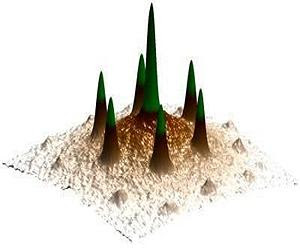 The neat tricks we are learning to do just go on and on. Many of these tricks will also have applications to other materials were special needs arise. Except the pure versatility of graphene suggests such a wide range of capability that other materials are almost moot.Here we are learning to move plasmoids about over the working surface. At some point this will be shaped with precision and applied.Strangely, our whole idea of electronics is gathering itself up and sinking into a three dimensional graphene matrix. It is just beginning, but this revolution is similar to the discovery of the idea of a transistor and just as important.Imagine the concentrated computer power of something that looks like a diamond but is internally constructed using the methods we have been seeing in these posts. Imagine triggering the diamond ring and seeing a holographic projection of a person who stands in front of you and communicates with you and takes your instructions.This work on graphene makes all this no longer a nice fantasy. It is becoming technically plausible.Graphene: What Projections And Humps Can Be Good Forby Staff Writers
A residual interaction with the SiC substrate causes the formation of the six-fold satellite reflex structure. (Credit: Christoph Tegenkamp,
At present, graphene probably is the most investigated new material system worldwide. Due to its astonishing mechanical, chemical and electronic properties, it promises manifold future applications – for example in microelectronics. The electrons in graphene are particularly movable and could, therefore, replace silicon which is used today as the basic material of fast computer chips.In a research cooperation, scientists ofTheir results suggest that it will soon be possible to control plasmons, i.e. collective oscillations of electrons, purposefully in the graphene, by virtually establishing a lane composed of projections and humps for them. The results were published in the current edition of the New Journal of Physics.The structure of graphene itself is fascinating: It consists of exactly one single, regular layer of carbon atoms. To manufacture this incredibly thin layer absolutely neatly is a great challenge. A possible method to recipitate graphene extensively on an insulating substrate is epitaxy, i.e. the controlled growth of graphene on insulating silicon carbide.For this purpose, a silicon carbide crystal is heated in vacuum. Starting from a specific temperature, carbon atoms migrate to the surface and form a monoatomic layer on the – still solid – silicon carbide. An important question for later applications is, how defects and steps of the silicon carbide surface affect the electronic properties of the graphene grown on it.Within the scope of a research cooperation between PTB andBy different sample preparation, first of all silicon carbide crystals with different surface roughness and, thus, with a different concentration of surface defects were investigated, on which, subsequently, graphene formed. The influence of the defects on the plasmon excitations was then investigated by means of low-energy electron diffraction (SPA-LEED) and electron loss spectroscopy (EELS).The process revealed a strong dependence of the lifetime of plasmon on the surface quality. Defects, as they are caused on step edges and grain boundaries, strongly impede the propagation of the plasmons and drastically shorten their lifetime. Here it is remarkable that the other electronic properties of the plasmons, in particular their dispersion, remain largely unaffected.This opens up interesting possibilities for the future technical application and use of plasmons (the so-called “plasmonics”) in graphene.By selective adjustment of the surface roughness, different graphene ranges could be generated in which the plasmons are either strongly dampened or can propagate almost unobstructedly. In this way, the plasmons could be conducted along “plasmon conductors” with low surface roughness specifically from one point of a graphene chip to another. -
Slavery Blame Game
 The subject of slavery suffers from a severe lack of perspective. It was never a crime except in the eyes of its victims and notably to later generations. It was accepted and endured for the whole of human history and only frowned upon in the Christian world but fully tolerated until the political rise of enlightenment reformists inI have already posted this, but the principal cause of the American Revolution was not simply an argument over taxes but thatIt has been a long hard battle and residual global slavery has been forced to go underground. The rise of the modern economy has eliminated most wage slavery simply because it is now pressingly uneconomic. Just as modern cotton harvesting wiped out serfdom inNo slave anywhere can compete with a mechanized harvester. Crops needing such labor are few and provide only short term work. It is certainly a long way from the need to have labor available year round.Elements of classical slavery still function inSlavery today though is mostly the preserve of the highly profitable but underground sex trade and is obviously operating everywhere. This can be only ended once again by legalizing the sex trade and regulating out forced employment.Ending the Slavery Blame-GameTimes Topics: SlaveryTHANKS to an unlikely confluence of history and genetics — the fact that he is African-American and president — Barack Obama has a unique opportunity to reshape the debate over one of the most contentious issues of America’s racial legacy: reparations, the idea that the descendants of American slaves should receive compensation for their ancestors’ unpaid labor and bondage.There are many thorny issues to resolve before we can arrive at a judicious (if symbolic) gesture to match such a sustained, heinous crime. Perhaps the most vexing is how to parcel out blame to those directly involved in the capture and sale of human beings for immense economic gain.While we are all familiar with the role played by theFor centuries, Europeans inHow did slaves make it to these coastal forts? The historians John Thornton and Linda Heywood ofAdvocates of reparations for the descendants of those slaves generally ignore this untidy problem of the significant role that Africans played in the trade, choosing to believe the romanticized version that our ancestors were all kidnapped unawares by evil white men, like Kunta Kinte was in “Roots.” The truth, however, is much more complex: slavery was a business, highly organized and lucrative for European buyers and African sellers alike.The African role in the slave trade was fully understood and openly acknowledged by many African-Americans even before the Civil War. For Frederick Douglass, it was an argument against repatriation schemes for the freed slaves. “The savage chiefs of the western coasts of Africa, who for ages have been accustomed to selling their captives into bondage and pocketing the ready cash for them, will not more readily accept our moral and economical ideas than the slave traders ofTo be sure, the African role in the slave trade was greatly reduced after 1807, when abolitionists, first inIn 1999, for instance, President Mathieu Kerekou ofOur new understanding of the scope of African involvement in the slave trade is not historical guesswork. Thanks to the Trans-Atlantic Slave Trade Database, directed by the historian David Eltis of Emory University, we now know the ports from which more than 450,000 of our African ancestors were shipped out to what is now the United States (the database has records of 12.5 million people shipped to all parts of the New World from 1514 to 1866). About 16 percent ofThrough the work of Professors Thornton and Heywood, we also know that the victims of the slave trade were predominantly members of as few as 50 ethnic groups. This data, along with the tracing of blacks’ ancestry through DNA tests, is giving us a fuller understanding of the identities of both the victims and the facilitators of the African slave trade.For many African-Americans, these facts can be difficult to accept. Excuses run the gamut, from “Africans didn’t know how harsh slavery inBut the sad truth is that the conquest and capture of Africans and their sale to Europeans was one of the main sources of foreign exchange for several African kingdoms for a very long time. Slaves were the main export of theDid these Africans know how harsh slavery was in theAfrican monarchs also sent their children along these same slave routes to be educated inGiven this remarkably messy history, the problem with reparations may not be so much whether they are a good idea or deciding who would get them; the larger question just might be from whom they would be extracted.So how could President Obama untangle the knot? In David Remnick’s new book “The Bridge: The Life and Rise of Barack Obama,” one of the president’s former students at theAbout the practicalities, Professor Obama may have been more right than he knew. Fortunately, in President Obama, the child of an African and an American, we finally have a leader who is uniquely positioned to bridge the great reparations divide. He is uniquely placed to publicly attribute responsibility and culpability where they truly belong, to white people and black people, on both sides of theHenry Louis Gates Jr., a professor at Harvard, is the author of the forthcoming “Faces of
 -
AutoblogGreen for 04.27.10


Chelsea Sexton: why the Volt’s engaged roll-out is vital, especially in the first few years
GM is walking the fine walk this time around.

Compared to Jay Leno’s Big Dog Garage, you park in a Superfund site
This one got out of hand, in a good way.

Video: Monoxitube puts exhaust and carbon monoxide emissions in your face
Just a thought.Other news: AutoblogGreen for 04.27.10 originally appeared on Autoblog on Tue, 27 Apr 2010 05:59:00 EST. Please see our terms for use of feeds.
Read | Permalink | Email this | Comments
-
Computerized Front Running and Financial Fraud
 The second story was sitting in my done box were I keep stories that I have not published yet when Ellen landed this story outlining just how gamed the actual trading system has become. For what it is worth, everyone knows how to skim an order and traditionally floor governors were on the lookout for just such behavior as it worked directly against the client’s interest.In short it was a totally unaccepted behavior because it would have worked also against the interests of the firms themselves. No one wants someone running a business in your business. How we have the firms themselves doing exactly this because they no longer have to share too much with their employees.The bad news is that this article lays out a class action suit against Goldman Sachs that will strip the firm and its many co conspirators of every nickel they have. The victims include every other firm on Wall street and every institution to say nothing of the odd investor.It also makes the SEC look like the donkeys they have proven to be. Front running was well understood in 1933. Have they lost their minds or are they hiring absolute neophytes or simply compromised insiders? Every trading system must be automatically audited to recognize front running. It is literally the very first thing that you would programm into your system after the completion components are put in place.Computerized Front Running and Financial FraudHow a Computer Program Designed to Save the Free Market Turned Into a MonsterBy Ellen BrownURL of this article: www.globalresearch.ca/index.php?context=va&aid=18809While the SEC is busy investigating Goldman Sachs, it might want to look into another Goldman-dominated fraud: computerized front running using high-frequency trading programs.Market commentators are fond of talking about “free market capitalism,” but according to Wall Street commentator Max Keiser, it is no more. It has morphed into what his TV co-host Stacy Herbert calls “rigged market capitalism”: all markets today are subject to manipulation for private gain.Keiser isn’t just speculating about this. He claims to have invented one of the most widely used programs for doing the rigging. Not that that’s what he meant to invent. His patented program was designed to take the manipulation out of markets. It would do this by matching buyers with sellers automatically, eliminating “front running” – brokers buying or selling ahead of large orders coming in from their clients. The computer program was intended to remove the conflict of interest that exists when brokers who match buyers with sellers are also selling from their own accounts. But the program fell into the wrong hands and became the prototype for automated trading programs that actually facilitate front running.Also called High Frequency Trading (HFT) or “black box trading,” automated program trading uses high-speed computers governed by complex algorithms (instructions to the computer) to analyze data and transact orders in massive quantities at very high speeds. Like the poker player peeking in a mirror to see his opponent’s cards, HFT allows the program trader to peek at major incoming orders and jump in front of them to skim profits off the top. Note that these large institutional orders are our money — our pension funds, mutual funds, and 401Ks.When “market making” (matching buyers with sellers) was done strictly by human brokers on the floor of the stock exchange, manipulations and front running were considered an acceptable (if morally dubious) price to pay for continuously “liquid” markets. But front running by computer, using complex trading programs, is an entirely different species of fraud. A minor flaw in the system has morphed into a monster.Keiser maintains that computerized front running with HFT has become the principal business of Wall Street and the primary force driving most of the volume on exchanges, contributing not only to a large portion of trading profits but to the manipulation of markets for economic and political ends.The “Virtual Specialist”: the Prototype for High Frequency TradingUntil recently, most market making was done by brokers called “specialists,” those people you see on the floor of the New York Stock Exchange haggling over the price of stocks. The job of the specialist originated over a century ago, when the need was recognized for a system for continuous trading. That meant trading even when there was no “real” buyer or seller waiting to take the other side of the trade.The specialist is a broker who deals in a specific stock and remains at one location on the floor holding an inventory of it. He posts the “bid” and “ask” prices, manages “limit” orders, executes trades, and is responsible for managing the uninterrupted flow of orders. If there is a large shift in demand on the “buy” side or the “sell” side, the specialist steps in and sells or buys out of his own inventory to meet the demand, until the gap has narrowed.This gives him an opportunity to trade for himself, using his inside knowledge to book a profit. That practice is frowned on by the Securities Exchange Commission (SEC), but it has never been seriously regulated, because it has been considered necessary to keep markets “liquid.”Keiser’s “Virtual Specialist Technology” (VST) was developed for the Hollywood Stock Exchange (HSX), a web-based, multiplayer simulation in which players use virtual money to buy and sell “shares” of actors, directors, upcoming films, and film-related options. The program determines the true market price automatically, by comparing “bids” with “asks” and weighting the proportion of each. Keiser and HSX co-founder Michael Burns applied for a patent for a “computer-implemented securities trading system with a virtual specialist function” in 1996, and U.S. patent no. 5960176 was awarded in 1999.But things went awry after the dot.com crash, when Keiser’s company HSX Holdings sold the VST patent to investment firm Cantor Fitzgerald, over his objection. Cantor Fitzgerald then put the part of the program that would have eliminated front-running on ice, just as drug companies buy up competing patents in order to take them off the market. Instead of preventing front-running, the program was altered so that it actually enhanced that fraudulent practice. Keiser (who is now based in Europe) notes that this sort of patent abuse is illegal under European Intellectual Property law.Meanwhile, the design of the VST program remained on display at the patent office, giving other inventors ideas. To get a patent, applicants must list “prior art” and then prove that their patent is an improvement in some way. The listing for Keiser’s patent shows that it has been referenced by 132 others involving automated program trading or HFT.HFT has quickly come to dominate the exchanges. High frequency trading firms now account for 73% of all U.S. equity trades, although they represent only 2% of the approximately 20,000 firms in operation.In 1998, the SEC allowed online electronic communication networks, or alternative trading systems, to become full-fledged stock exchanges. Alternative trading systems (ATS) are computer-automated order-matching systems that offer exchange-like trading opportunities at lower costs but are often subject to lower disclosure requirements and different trading rules. Computer systems automatically match buy and sell orders that were themselves submitted through computers. Market making that was once done with a “specialist’s book” — something that could be examined and audited — is now done by an unseen, unaudited “black box.”For over a century, the stock market was a real market, with live traders hotly bidding against each other on the floor of the exchange. In only a decade, floor trading has been eliminated in all but the largest exchanges, such as the New York Stock Exchange (NYSE); and even in those markets, it now co-exists with electronic trading.Alternative trading systems allow just about any sizable trader to place orders directly in the market, rather than routing them through investment dealers on the NYSE. They also allow any sizable trader with a sophisticated HFT program to front run trades.Flash Trades: How the Game Is RiggedAn integral component of computerized front running is a dubious practice called “flash trades.” Flash orders are permitted by a regulatory loophole that allows exchanges to show orders to some traders ahead of others for a fee. At one time, the NYSE allowed specialists to benefit from an advance look at incoming orders; but it has now replaced that practice with a “level playing field” policy that gives all investors equal access to all price quotes. Some ATSs, however, which are hotly competing with the established exchanges for business, have adopted the use of flash trades to pull trading business away from the exchanges. An incoming order is revealed (or flashed) to a trader for a fraction of a second before being sent to the national market system. If the trader can match the best bid or offer in the system, he can then pick up that order before the rest of the market sees it.The flash peek reveals the trade coming in but not the limit price – the maximum price at which the buyer or seller is willing to trade. This is what the HFT program figures out, and it is what gives the high-frequency trader the same sort of inside information available to the traditional market maker: he now gets to peek at the other player’s cards. That means high-frequency traders can do more than just skim hefty profits from other investors. They can actually manipulate markets.How this is done was explained by Karl Denninger in an insightful post on Seeking Alpha in July 2009:“Let’s say that there is a buyer willing to buy 100,000 shares of BRCM with a limit price of $26.40. That is, the buyer will accept any price up to $26.40. But the market at this particular moment in time is at $26.10, or thirty cents lower.“So the computers, having detected via their ‘flash orders’ (which ought to be illegal) that there is a desire for Broadcom shares, start to issue tiny (typically 100 share lots) ‘immediate or cancel’ orders – IOCs – to sell at $26.20. If that order is ‘eaten’ the computer then issues an order at $26.25, then $26.30, then $26.35, then $26.40. When it tries $26.45 it gets no bite and the order is immediately canceled.“Now the flush of supply comes at, big coincidence, $26.39, and the claim is made that the market has become ‘more efficient.’“Nonsense; there was no ‘real seller’ at any of these prices! This pattern of offering was intended to do one and only one thing — manipulate the market by discovering what is supposed to be a hidden piece of information — the other side’s limit price!“With normal order queues and flows the person with the limit order would see the offer at $26.20 and might drop his limit. But the computers are so fast that unless you own one of the same speed you have no chance to do this — your order is immediately ‘raped’ at the full limit price! . . . [Y]ou got screwed for 29 cents per share which was quite literally stolen by the HFT firms that probed your book before you could detect the activity, determined your maximum price, and then sold to you as close to your maximum price as was possible.”The ostensible justification for high-frequency programs is that they “improve liquidity,” but Denninger says, “Hogwash. They have turned the market into a rigged game where institutional orders (that’s you, Mr. and Mrs. Joe Public, when you buy or sell mutual funds!) are routinely screwed for the benefit of a few major international banks.”In fact, high-frequency traders may be removing liquidity from the market. So argues John Daly in the U.K. Globe and Mail, citing Thomas Caldwell, CEO of Caldwell Securities Ltd.:“Large institutional investors know that if they start trying to push through a large block of shares at a certain price – even if the block is broken into many small trades on several ATSs and markets — they can trigger a flood of high-frequency orders that immediately move market prices to the institution’s disadvantage. . . . That’s why institutions have flocked to so-called dark pools operated by ATSs such as Instinet, and individual dealers like Goldman Sachs. The pools allow traders to offer prices without publicly revealing their identities and tipping their hand.”Because these large, dark pools are opaque to other investors and to regulators, they inhibit the free and fair trade that depends on open and transparent auction markets to work.The Notorious Market-Rigging Ringleader, Goldman SachsTyler Durden, writing on Zero Hedge, notes that the HFT game is dominated by Goldman Sachs, which he calls “a hedge fund in all but FDIC backing.” Goldman was an investment bank until the fall of 2008, when it became a commercial bank overnight in order to capitalize on federal bailout benefits, including virtually interest-free money from the Fed that it can use to speculate on the opaque ATS exchanges where markets are manipulated and controlled.Unlike the NYSE, which is open only from 10 am to 4 pm EST daily, ATSs trade around the clock; and they are particularly busy when the NYSE is closed, when stocks are thinly traded and easily manipulated. Tyler Durden writes:“[A]s the market keeps going up day in and day out, regardless of the deteriorating economic conditions, it is just these HFT’s that determine the overall market direction, usually without fundamental or technical reason. And based on a few lines of code, retail investors get suckered into a rising market that has nothing to do with green shoots or some Chinese firms buying a few hundred extra Intel servers: HFTs are merely perpetuating the same ponzi market mythology last seen in the Madoff case, but on a massively larger scale.”HFT rigging helps explain how Goldman Sachs earned at least $100 million per day from its trading division, day after day, on 116 out of 194 trading days through the end of September 2009. It’s like taking candy from a baby, when you can see the other players’ cards.Reviving the Free MarketSo what can be done to restore free and fair markets? A step in the right direction would be to prohibit flash trades. The SEC is proposing such rules, but they haven’t been effected yet.Another proposed check on HFT is a Tobin tax – a very small tax on every financial trade. Proposals for the tax range from .005% to 1%, so small that it would hardly be felt by legitimate “buy and hold” investors, but high enough to kill HFT, which skims a very tiny profit from a huge number of trades.That is what proponents contend, but a tiny tax might not actually be enough to kill HFT. Consider Denninger’s example, in which the high-frequency trader was making not just a few pennies but a full 29 cents per trade and had an opportunity to make this sum on 99,500 shares (100,000 shares less 5 100-lot trades at lesser sums). That’s a $28,855 profit on a $2.63 million trade, not bad for a few milliseconds of work. Imposing a .1% Tobin tax on the $2.63 million would reduce the profit to $26,225, but that’s still a nice return for a trade that takes less time than blinking.The ideal solution would fix the problem at its source — the price-setting mechanism itself. Keiser says this could be done by banning HFT and installing his VST computer program in its original design in all the exchanges. The true market price would then be established automatically, foreclosing both human and electronic manipulation. He notes that the shareholders of his former firm have a good claim for voiding out the sale to Cantor Fitzgerald and retrieving the program, since the deal was never consummated and the investors in HSX Holdings have never received a penny for the sale.There is just one problem with their legal claim: the paperwork proving it was shipped to Cantor Fitzgerald’s offices in the World Trade Center several months before September 2001. Like free market capitalism itself, it seems, the evidence has gone up in smoke.Ellen Brown developed her research skills as an attorney practicing civil litigation in Los Angeles. In Web of Debt, her latest of eleven books, she turns those skills to an analysis of the Federal Reserve and “the money trust.” She shows how this private cartel has usurped the power to create money from the people themselves, and how we the people can get it back. Her websites arewww.webofdebt.com, www.ellenbrown.com, and www.public-banking.com.__________________________________________
 What is wrong with this tale is that they have eliminated client or broker control over one side of the transaction, allowing them to optimize the outcome for the other side. If two human beings were engaged in the tradition of outcry on the floor then this nonsense would end.In fact this prevents other parties from reacting to the presence of a trade and to offer better prices or to even change their minds.The point is that preference is provided to allow one pool to front run and manipulate prices when it is profitable. You will never see them accommodate a slight loss on sentiment or beneficial for the traffic.The only good thing here is that this is becoming way more visible.Open outcry blocked this sort of behavior to some degree by putting a sufficient lapse time to allow others to contribute. These guys are trying to simply grab stuff off the table by simple speed.“High Frequency” Financial Trading,By Mike Whitney2010-04-18URL of this article: www.globalresearch.ca/index.php?context=va&aid=18724The Securities and Exchange Commission (SEC) knows that High-Frequency Trading (HFT) manipulates the market and bilks investors out of tens of billions of dollars every year. But SEC chairman Mary Schapiro refuses to step in and take action. Instead, she’s concocted an elaborate “information gathering” scheme, that does nothing to address the main problem. Schapiro’s plan–to track large blocks of trades by large institutional investors– is an attempt to placate congress while the big Wall Street HFT traders continue to rake in obscene profits. It achieves nothing, except provide the cover Schapiro needs to avoid doing her job.
High-frequency trading (HFT) is algorithmic-computer trading that finds “statistical patterns and pricing anomalies” by scanning the variousstock exchanges. It’s high-speed robo-trading that oftentimes executes orders without human intervention. But don’t be confused by all the glitzy “state-of-the-art” hype. HFT is not a way of “allocating capital more efficiently”, but of ripping people off in broad daylight.
It all boils down to this: HFT allows one group of investors to see the data on other people’s orders ahead of time and use their supercomputers to buy in front of them. It’s called front-loading, and it goes on every day right under Schapiros nose.
In an interview on CNBC, HFT-expert Joe Saluzzi was asked if the big HFT players were able to see other investors orders (and execute trades) before them. Saluzzi said, “Yes. The answer is absolutely yes. The exchanges supply you with the data, giving you the flash order, and if your fixed connection goes into their lines first, you are disadvantaging the retail and institutional investor.”The brash way that this scam is carried off is beyond belief. The deep-pocket bank/brokerages actually pay the NYSE and the NASDAQto “colocate” their behemoth computers ON THE FLOOR OF THE EXCHANGES so they can shave off critical milliseconds after they’ve gotten a first-peak at incoming trades. It’s like parking the company forklift in front of the local bank vault to ease the transfer of purloined cash. Due to the impressive research of bloggers like Zero Hedge’s, Tyler Durden and Market Ticker’s, Karl Denniger, many people have a fairly good grasp of HFT and understand that the SEC needs to act. But Schapiro has continued to drag her feet while issuing endless proclamations about pursuing the wrongdoers. Baloney. She needs to stop yammering and shut these operations down.
In a recent posting, Market Ticker explained some of the finer-points of high-frequency trading, such as, how the banks/brokerages probe the exchanges with small orders in order to find out how much other investors are willing to pay for a particular stock. Here’s a clip:
“Let’s say that there is a buyer willing to buy 100,000 shares of Broadcom with a limit price of $26.40. That is, the buyer will accept any price up to $26.40. But the market at this particular moment in time is at $26.10, or thirty cents lower.So the computers, having detected via their “flash orders” that there is a desire for Broadcom shares, start to issue tiny “immediate or cancel” orders – IOCs – to sell at $26.20. If that order is “eaten” the computer then issues an order at $26.25, then $26.30, then $26.35, then $26.40. When it tries $26.45 it gets no bite and the order is immediately canceled.Now the flush of supply comes at $26.39, and the claim is made that the market has become “more efficient.”
Nonsense; there was no “real seller” at any of these prices! This pattern of offering was intended to do one and only one thing – manipulate the market by discovering what is supposed to be a hidden piece of information – the other side’s limit price!
With normal order queues and flows the person with the limit order would see the offer at $26.20 and might drop his limit. But the computers are so fast that unless you own one of the same speed you have no chance to do this – your order is immediately “raped” at the full limit price!
The presence of these programs will guarantee huge profits to the banks running them and they also guarantee both that the retail buyers will get screwed as the market will move MUCH faster to the upside than it otherwise would.
If you’re wondering how Goldman Sachs and other “big banks and hedge funds” made all their money this last quarter, now you know.” (“High-Frequency Trading is a Scam”, Market Ticker)The HFT uber-computers are able to find out the highest price that traders will pay in a millisecond and then extort that full amount millions of times to maximize profits. Clearly, this has nothing to do with efficiency or innovation. It’s high-tech highway robbery; institutional bid-rigging on a grand scale, tacitly sanctioned by industry lackeys operating from within the administration. Schapiro was picked by Team Obama for this very reason; because she was known as a regulator with a “light touch” when she headed Finra the financial industry’s self policing agency. As Finra’s chief, Schapiro managed to keep her head in the sand during the Madoff scandal and the auction-rate securities flap.She also issued far fewer fines and penalties than her predecessor. Here’s an excerpt from the Wall Street Journal which sums up Schapiro’s regulatory doctrine:
“The Financial Services Institute, a trade group, was meeting, and Ms. Schapiro addressed the crowd about Finra’s efforts to fight frauds aimed at senior citizens. Frank Congemi, a financial adviser, asked what Finra was doing to regulate “packaged products” such as complex mortgage securities. Mr. Congemi says that Ms. Schapiro replied: “We have rating agencies that rate them.” The credit-rating agencies, by this time, were being heavily criticized for having given triple-A ratings to mortgage bonds that became unsalable as foreclosures rose.” (Wall Street Journal)
If the financial crisis has taught us anything, it’s that the system is NOT self-correcting. And it takes more than just rules. It takes regulators who are willing to regulate. -
F5 Doesn’t Like A10’s Name — But Sues Over Patents, Not Trademarks
johnjac points out that it’s a bit odd that, in the middle of a patent lawsuit, data center provider F5 Networks complains that competitor A10 Networks name itself is an attempt to copy F5. Who knows whether the patent questions are legitimate, but names have nothing to do with patents, and it seems like a pretty big stretch for F5 to claim that a company that combines a letter and a number is automatically doing so “as a play, or allusion to, F5’s corporate name.” And, even if it were true, how would that matter if the discussion is over patents, not trademarks?
Permalink | Comments | Email This Story
-
Uh-Oh: Americans Beginning To Love Stocks Again (And Are Still Bizarrely Infatuated With Real Estate)
A new Gallup poll confirms a few not very surprising things.
One is that America is starting to believe in stocks again, which, given the S&P at 1200 is not altogether surprising. 22% think they’re the best long-term investment.
Also, despite everything, Americans still hold a bizarre fixation with real estate, as a plurality, 29%, still consider it the best investment. (Though this is down from 50% at one point).
And bonds — which most Americans have never seen in a bear market — continue to pull up the rear.
Here’s the chart.

Join the conversation about this story »
-
Let’s Start The Clock Now For Greece Leaving The Euro

And now top German leaders are practically begging to quit the damn euro.
Greece might have to quit the euro zone for a time if the country failed to tighten its belt sufficiently to qualify for emergency aid, a budget expert with Germany’s junior coalition party said on Tuesday.
A temporary exit from the single currency might benefit Athens if accompanied by a devaluation, the Free Democrats’ (FDP) Juergen Koppelin told Deutschlandfunk radio.
This makes total sense except for the “temporary” part. You have to figure that once Greece is gone and goes back to Drachmas, we’re talking years and years before they’re back.
But Koppelin’s motives go beyond merely not wanting to bail out Greece.
Per the Eric Sprott piece we cited last night, there are fears of a run on Greek banks, and it may come to the point that savers in other marginal countries like Portugal and Spain also decide to pull their cash, and put it into other countries banks, or at least gold.
And if that alone isn’t worrisome enough, read Felix Salmon’s piece with some anonymous plugged-in sources. He brings up several points, but the nut is this:
Where would Greek debt trade in the event of a default? This is the scariest thing: my highly plugged-in companions both agreed that it wouldn’t just fall to 70 or even 60 cents on the dollar: they saw fair value closer to 40, and said that it would probably fall to 30 before people started buying.
Needless to say, if Greek debt was trading at 30 cents on the dollar, it wouldn’t take long for the Portuguese domino to topple. After that, Spain — and then, it’s easy to imagine, Italy, Ireland, UK. And so the stakes are very high: it’s certainly cheaper to bail out Greece with virtually unlimited funds than it is to risk a fully-blown PIIGS default. But there does seem to be the hope or expectation that a line could get drawn in the Iberian sand, and that Italy and Ireland would not be allowed to default even if Portugal and/or Spain imploded.
Good luck drawing that line in the sand. If there’s one thing we’ve learned, it’s that the best intentions of leaders are powerless to stop economic reality.
Of course, if Greece won’t leave the euro, Germany just might.
And don’t miss: The ugly math that shows why saving Greece is an impossible mission >
Join the conversation about this story »
See Also:
- Here’s The Ugly Math That Shows Why Saving Greece Is Mission Impossible
- Greece Angst Hits America As States Lash Out Against Shorting Speculators
- Mohamed El-Erian: If Greece Isn’t Solved In The Coming Days, The Problem Will Grow More General