Author: Serkadis

  • Nokia teaser video of next Lumia focuses on camera bump. A true PureView?

    Nokia is holding a London press event on Tuesday where it is expected to launch a new Lumia smartphone. The company isn’t waiting until then to build buzz, however. A video was shown on British television over the past weekend, teasing the “new Nokia Lumia”.

    There isn’t much to see in the video, spotted by The Verge on Sunday, as Nokia is keeping most details under wraps until the big reveal. It’s clear that in typical Nokia fashion, the company is planning to play upon its strength of camera quality. The teaser ad clearly shows two flashes on the rear of the camera along with a raised bump where the camera sensor lies. Either the phone is extremely thin or the sensor is larger than current Nokia Lumia phones use.

    I suspect the latter as Nokia has been working on its PureView technology, with one example phone being the Nokia PureView 808. That device — more of a concept than anything else, although you can purchase one — offers a 41 megapixel sensor that allows for tremendously detailed photos even when zoomed in. The video also alludes to this concept suggesting the phone will capture “more than your eyes can see”.

    It’s also likely that Nokia will move away from their standard polycarbonate material for the phone’s body and instead use a metal casing. That could eliminate the wireless charging feature found on current Lumia’s but would help reduce the weight of the handset.

    Related research and analysis from GigaOM Pro:
    Subscriber content. Sign up for a free trial.


  • Groupon POS For iPad Launched In App Store

    Groupon has released a new POS solution for the iPad. The app, which can be found in the App Store, is described as “a beautiful and simple way to manage your business and accept payments at the lowest rates available today.”

    Groupon has not put out any official announcements about the product so far, but one is likely on the way. Appsfire tweeted about the app, which was then picked up by TechCrunch and other outlets:

    On the Groupon POS app page, Groupon describes it:

    Setup your offerings in seconds, quickly check out customers, and view real time analytics. Start running your business more effectively.

    Groupon POS works also works with an optional cash drawer and printer to automate and simplify your point of sale.

    Groupon POS works for a wide variety of merchants from cafes and delis, to salons, spas, and florists.

    Here are screen shots from the App Store:

    Groupon POS

    Groupon POS

    The app appears to build off Breadcrumb, the POS app Groupon acquired last year, and has since been improving.

    Groupon reported its Q1 earnings last weekend, beating Wall Street expectations for revenue.

  • Vin Diesel: Facebook Owes Me Billions Of Dollars, But Whatever

    Vin Diesel did an interview with Entertainment Weekly, which came out on Friday. Some comments he made about Facebook have been attracting some attention in the days since.

    When interviewer Darren Franich asked Diesel what he attributes his large Facebook following to, he responded, “Did you ever see the movie Social Network? Do you remember what they said the reason was to make Facebook?”

    To which Franich replied, “To meet girls?”

    “YOU GOT IT!” said Diesel. “And when they made the movie, nobody had a million fans. They were promoting it, like, ‘We came up with a new way for people to check marital status.’ That’s not what Facebook was. That’s not why Facebook would be successful. No one gives a s— about people’s marital status. That’s as dated as MySpace! What Facebook didn’t realize is something very big was about to happen, and that was — for the first time in history, and it’s kind of a fluke they didn’t see this coming — when I jumped on that page in April 2009, I started talking to people. In the realest ways. Imagine if you could’ve been a Facebook friend to Marlon Brando, or whoever your role models are. Imagine, if you were able to Facebook Elvis, and talk to him, and hear from him without the Hollywood of it all. That was the Fast & Furious experience.”

    Diesel said when he started his page, the only person who had a million fans was Barack Obama. It was the first quarter of 2009, just after the President’s inauguration.

    “Facebook used to ask me to come up to their office to explain what the f— I was doing, and why I had so many fans. What was unique was: I never let anyone do a post, I never let anyone post for me in the last four years. My audience knows me so well on the page that if my producing partner’s in the room when I post, they’ll know somebody was around me. That’s kind of cool, that’s how sophisticated they are. Facebook really owes me billions of dollars. But whatever.”

    It’s certainly worth noting, as indicated in the interview, that Diesel was laughing when he said that.

    In 2013, Vin Diesel is still having fun with Facebook fans. For Valentine’s Day, he covered Rihanna’s “Stay” as a gift to them.

    41 million people currently like Vin Diesel on Facebook. 35 million like Obama.

    In the EW interview, Diesel talks about much more than Facebook (including Fast & Furious, Riddick and and Hannibal the Conqueror).

  • Bill Gates recounts final visit with Steve Jobs in emotional interview [video]

    Bill Gates Interview Steve Jobs
    Bill Gates and late Apple co-founder Steve Jobs are among a small group of people who helped shape the technology industry over the past 40 years and in a new interview conducted by 60 Minutes’ Charlie Rose, the former reflects on his final visit with the latter. Gates recently sat down with 60 Minutes to discuss his work at the Bill and Melinda Gates Foundation and although it didn’t air in CBS’ broadcast, the conversation veered off topic for a few moments as the Microsoft co-founder got emotional while recounting his last visit with friend and rival Steve Jobs in May 2011. No spoilers here — the unaired footage from the Gates interview follows below.

    Continue reading…

  • Google Penguin Update Gets Ready To Bite Webmasters’ Noses [Penguin 2.0]

    Matt Cutts revealed late on Friday that Google Penguin Update 2.0 is on the way, and that it will be a big one. Yes, there have been multiple iterations of the update to come out, but those have simply been data refreshes of the original update. Google is readying a big new version of it, and when we say big, we mean bigger than the original.

    Matt Cutts says the internal team at Google is referring to it as Penguin 2.0, despite what other numbers are making the rounds out there.

    Get ready, because it’s coming:

    In case you don’t get the nose-biting reference, enjoy this scene from Tim Burton’s Batman Returns featuring Danny DeVito as The Penguin.

    Hat tip to Danny Sullivan

  • Why I love Chromebook Pixel

    Seventh in a series. When I reported the original iPhone launch in June 2007, there was sense of history among the people waiting to buy. Several shared similar sentiment: That we would all look back in five or 10 years and see the mobile as a defining moment in computing. They were absolutely right. I feel similarly about Chromebook Pixel, not that as many people appreciate what it represents compared to the larger number of folks rushing to purchase Apple’s smartphone.

    Google’s computer is an acquired taste, and so delish you don’t easily go back. But there’s a Vegemite quality. Most people wouldn’t eat the spread, but ask those who do — they can’t live without it. Likewise, Chromebook Pixel isn’t for everyone, but is for me and possibly could be for you, if given a chance.

    Before continuing, this post is part of BetaNews’ “Why I love” series, which commenced on Valentine’s Day. Among the others (in order, so far): Surface Pro; Kindle; Chromebook; Windows 8; Lumia 920; Raspberry Pi. I’m to blame for Surface Pro and Chromebook.

    Pixel Paradigm

    You might wonder why I write a love story to Pixel, if I already professed my heart for Chromebook. Simple answer: I love Google’s touchscreen computer more and could never go back to plain-Jane Chromebook. I could imagine going sideways to MacBook Pro, using Chrome browser as my primary user experience. But anything less would be letdown. The high-resolution display is magnificent, and touch makes for better user experience.

    To love Chromebook Pixel, you must change your mindset, particularly if a long-time computer user. The browser is the user interface. You mainly use web apps, and there is surprisingly good selection available from the Chrome Web Store.

    However, while Google makes the operating system UI more like Linux, OS X or Windows with each iteration, local apps are generally laughable by comparison. File manager, photo editor and music player are examples of basics gone bad; they offer too little compared to rival platforms. But browser satisfies and the experience will improve as Google and third-party developers release more “packaged apps“, which work offline.

    Critics balk at the whole browser-as-UI concept. They just don’t get it. True innovation isn’t improving what you have but providing what you don’t know you need. That’s the vision driving Chromebook Pixel, like iPad, which also received cool, early reception (me among the fools). Comparisons to the existing way are meaningless in this context. As cloud services proliferate and people spend more time in browsers, rather than apps, something like Pixel makes more sense.

    Related: The computer embodies a design philosophy that captures Google’s culture DNA and vision for the digital lifestyle of the contextual cloud computing era. If you are dependent on some business process that requires software like Microsoft Office or Adobe Photoshop, Pixel isn’t for you. I don’t require either, nor do many other people who think they do. The paradigm is the browser.

    Tasty Treat

    In September, I explained how “Chromebook changed my life“. Please refer to that story for the broader explanation of the basic benefits of the computer category and Chrome OS.

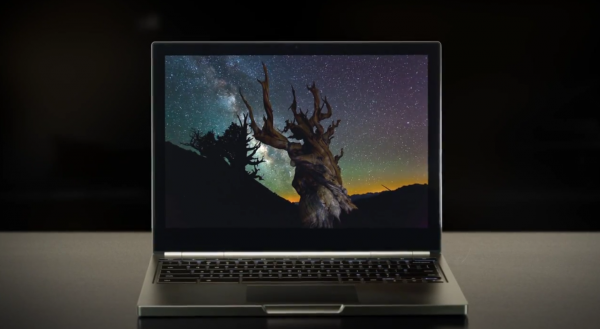
    Google’s first laptop transcends OEM partner products. Pixel is the MacBook Pro of Chromebooks. There is strong design aesthetic, metal enclosure and stunning screen, which 2560-by-1700 resolution outdoes the Apple Retina Display’s 2560 by 1600. As I explained in February, Google means Chromebook Pixel for people considering MBP.

    The best products make you feel good, regardless of benefits or shortcomings. I really enjoy using Chromebook Pixel. While not as behavior-changing as I anticipated, the touchscreen improves the overall user experience, and display resolution is beyond spectacular. The keyboard is about the best I’ve ever used, making writing fast and furious. Overall performance satisfies, too.

    The key advantages are resolution and touchscreen. No Mac comes with the latter, although some Windows machines do. But no Windows laptop in this size or price class offers nearly as much resolution.

    Chromebook Pixel specs: 12.85-inch touchscreen, 2560 x 1700 resolution, 239 pixels per inch; 1.8GHz Core i5 processor; Intel HD graphics 4000; 4GB DDR3 RAM; 32GB or 64GB of storage; HD WebCam; backlit keyboard; dual-band WiFi 802.11 a/b/g/n 2×2; 4G LTE (on one model); Bluetooth 3.0; mini-display port; two USB ports; Chrome OS. Measures: 297.7 x 224.6 x 16.2 mm. Weighs: 1.52 kg (3.35 pounds). Cost: $1,299 (32GB WiFi); $1,449 (64GB WiFi/4G LTE). 1TB Google Drive storage is included free, for three years.

    Lover’s Lament

    Nearly 12 months have passed since I started using Chromebook as my primary PC. Except for a few weeks in February, when I reviewed Surface Pro, Chromebook is my only computer — Pixel for two months now (please see my review for much more).

    That said, I could get many of the benefits, short of touch, running Chrome browser on MacBook Pro with Retina Display. Plus, I could easily run traditional software while taking advantage of web apps. But there is something about how tight is the whole package, thanks to Google software and services. If the search and information giant doesn’t provide most of what I need, some other developer does.

    But as expressed earlier, Chromebook Pixel is an acquired taste. Even for me. Much as I love the computer, my mindset needs more adjustment — to pull away from app-centric thinking to looking from a task-perspective. That’s the direction Pixel is headed, but the apps aren’t there yet, nor is Google’s UI. The potential is obvious, but software is still a work in progress.

    The point: I may love Chromebook Pixel, but it doesn’t always love me.

    Google’s developer conference commences in two days, and there Chrome OS is sure to get some attention, and even Pixel. I ask myself: Will the love last? That’s a question to answer after Google I/O and Apple’s Worldwide Developer Conference and Microsoft’s BUILD in June.

    By the way, I won’t attend I/O as expected, due to a family situation. Sigh, there’s always next year, eh?

  • Top carriers raked in $202 billion in profit last year, but growth is slowing

    Global Wireless Carrier Revenue 2012
    It’s good to be king, but ensuring your kingdom continues to expand is always a top priority. According to a recent report from ABI Research, the world’s top-10 wireless carriers — which include Verizon Wireless (No.2) and AT&T (No.4) — took in a combined $202 billion in gross profit last year. That 2012 total is up 4.2% compared to the prior year, but high plan prices and growing subscriber bases aren’t drumming up the growth rates they used to. “As the underlying lift from accumulating subscribers has matured, carriers are starting to cast around for additional revenue streams that don’t just boost revenues but also profitability,” said ABI analyst Jake Saunders. “There is still tremendous income to be generated from mobile services; the Top 10 Mobile Carriers alone generated US$202 billion in gross profit, up 4.2 % year-on-year in 2012.” According to the research firm, IP-based value-added services are now a big focus for top carriers as they look elsewhere for growth opportunities.

  • HP Updates Cloud Management Software

    HP (HPQ) has released the next generation of its software for automating the management of data centers and cloud infrastructure, the company said today. HP Operations Orchestration 10 is an integrated portfolio of software and services to help automate  complex distributed systems and heterogeneous environments.

    HP Operations Orchestration (OO) 10 has out-of-the-box support for over 5,000 IT operations, including new support for Amazon S3 storage, HP ArcSight, HP Fortify, OpenStack and SAP applications. The HP Server Automation (SA) 10 server lifecycle management platform allows IT to manage more than 100,000 physical and virtual servers, and improves operational economics by reducing the administrator-to-server ratio by up to 60 percent. HP SA 10 is also offered as a virtual appliance for smaller organizations or department-level IT teams to begin managing server environments in less than one hour.

    HP Database and Middleware Automation (DMA) improves administrator efficiency by automating administrative tasks associated with database management. It has over 1,000 out-of-the-box best practices to provision, patch, upgrade and release application code into databases and middleware servers such as DB2, Oracle, SQL Server, Sybase and WebSphere. HP Cloud Service Automation 3.2 is a comprehensive, unified cloud management platform for building, brokering and managing enterprise-grade application and heterogeneous infrastructure cloud services. It simplifies management of heterogeneous environments by leveraging HP OO and HP SA while providing support for Amazon EC2 public cloud services, HP Cloud Services, KVM OpenStack and Microsoft Hyper-V.

    “Our IT employees were bogged down being enterprise ‘fire fighters’ instead of proactive business partners,” said Andy Smith, vice president, Application Hosting Services, McKesson. “HP cloud and automation software enabled us to improve our IT operations by automating routine, repetitive tasks prone to human error, encouraging our employees to focus on innovative IT services. As a result, we can now deliver both IaaS and PaaS in under an hour, and we reduced IT service outages by 78 percent, the occurrence of critical IT incidents by 65 percent and have been able to deploy 40 percent more IT systems.”

    HP OO 10, HP SA 10, HP DMA 10 and HP Cloud Service Automation 3.2 will be available individually worldwide directly from HP or through its ecosystem of worldwide channel partners.

  • Gemini Rue Review (iOS)

    One of the best point and click adventure games of the past decade, Gemini Rue has been recently ported on iOS platform. Created by Joshua Nuernberger and published by Wadjet Eye Games, Gemini Rue was released back in 2011 on PC platform.


    Featuring a compelling sci-fi story set in a dystopian world, the PC version of Gemini Rue’s only drawbacks are the p… (read more)

  • Parents have no ‘right’ to homeschool their kids, says Justice Department

    Individual liberty is being burned at the stake, as governments set fire to people natural rights. This time it has everything to do with homeschooling. It all started in Germany. Uwe and Hannelore Romeike were raising their five children in the German state of Baden…
  • South Carolina to criminalize implementation of Obamacare; showdown with feds inevitable

    More and more states are beginning to challenge the Obama Administration over what they view as unconstitutional abuses of power, especially regarding firearms and health care. The latest example comes from South Carolina, whose legislature has passed a measure declaring…
  • Who will buy HTC One?

    More than two weeks ago I asked: “Will you buy HTC One?” Preliminary results are in, and many of you express intentions to get the smartphone. Last week, I expressed how much more I like the One than iPhone 5.

    The unlocked One is backordered at HTC.com, while T-Mobile can’t meet demand. Someone wants this smartphone, and it might just be you. Forty-five percent of respondents say they will get the handset “as soon as available”, while another 11.5 percent “within 3 months”. Buying polls like this one, and that includes those conducted by outfits like ChangeWave, only measure sentiment — what people would like to do. What they actually do often varies for lots of reasons. Clearly there is lots of interest in HTC One.

    Steve Jones “got the HTC One”. He “traded up from a Galaxy S3. HTC one is a fantastic phone best I have ever had. The weight and the feel of it in your hand feels perfect. The GS4 just seemed to be a GS3s”.

    Kyle McIsaac:

    I got the device in Canada the day of release (April 19th) and been in love with it since. Other than the News Feed being sort of in your face at first (which can easily be changed to a different home panel later), the interface is easy to handle and responds quickly.

    The sound on the device is amazing with the two front-facing speakers, the main camera is amazing, and the device, with its larger size, is very lightweight and sturdy. Battery life is not as much as I expected, but mostly due to the fact of LTE, quad-core CP, and data being processed every so often. With HTC’s great deal right now of trading in your old smartphone for up to $100 back, it’s well worth the switch to it.

    The deal is different now. HTC offers up to $300 on trade-ins.

    HTC One specs: 4.7-inch Super LCD3 display with 1920 x 1080 resolution and 468 ppi; 1.7GHz Qualcomm Snapdragon 600 quad-core processor; 2GB RAM; 32GB or 64GB storage; 4MP front-facing and 2.1MP rear-facing cameras; 1080p video recording; 4G: LTE (Asia 1800/2600 Mhz), EU (800/1800/2600 MHz), AT&T (700/850/AWS/1900 MHz), Sprint (1900 Mhz), T-mobile USA (1900 Mhz); HSPA/WCDMA (850/900/1900/2100 MHz); GSM/GPRS/EDGE (850/900/1800/1900 MHz); WiFi N; GPS + GLONASS; Bluetooth 4; NFC (carrier chooses); DLNA; ambient-light and proximity sensors; accelerometer; digital compass; gyroscope; 2300 mAh battery; Android 4.1.2 with HTC Sense. Measures 137.4 x 68.2 x 9.3 mm and weighs 143 grams. In the United States, AT&T and Sprint: $199.99 for the 32GB model, with 2-year contract. AT&T sells the 64GB One for $299.99. T-Mobile: $99.99 upfront and 24 $20 monthly payments for 32 gigger.


    I’m among those people buying HTC One, something not expected when posting the poll. I really like this phone; it makes me happy to use. Confession: Social- and news-oriented BlinkFeed is a major reason for my purchase, with the camera being another big one. HTC must believe in BF, which is centerpiece of the most recent One advertising: “No Digging Necessary“; “Anthem“. My gripe: Not enough customization.

    Stephen Green “purchased a Blackberry Z10 — BB10 rocks!” Jack Brown: “No”.

    Vic Gundotra, Google’s senior vice president of engineering, should be slyly showing off the next Nexus phone, with the company’s developer conference starting in just two days. Instead, he brags up HTC One, which runs Android 4.1.2 rather than 4.2.2. Last month, regarding the front-facing speakers: “Listening to Sade on my new HTC One. I can’t tell you how good this song sounds on this phone. Speakers in front. Wow. Love this phone”. Yesterday, he bragged up the camera.

    I can’t guess what will be HTC One’s sales success — or not. But I’m glad for my purchase. One buyers, are you?

    Photo Credit: Joe Wilcox

  • Adding an electric car cut the payback point of our solar panel investment in half

    When we discussed our home solar panel project in mid-2011 with friends, one of the first questions everyone asked was, “What’s the payback period before you break-even?” The second question was unsurprisingly, “How much is it costing you?” but the focus always ended up on the payback. After all, if you’re going to invest in green technology, you’re hoping that at some point in the near future, you get ahead of the game. It turns out that something we didn’t plan for — our Chevrolet Volt — is actually helping us boost the ROI and cut our payback time in half.

    Details of the solar panel investment

    Solar panel framingI shared details on both the solar panel project and the car before, but let me step back and recap a bit. In October 2011, we added 41 solar panels to our southern-facing roof in southeastern Pennsylvania. Each panel is rated for 230W of Direct Current (DC) so that works out to an array of 9.43kW DC. In our family of four, with two work-at-home adults, we average around 7,500 kWh of electricity usage. So the system may be a bit oversized for our needs — about 125 percent — but we planned ahead. It’s a four-bedroom house so we thought that the next occupants could have at least one more family member and therefore use more electricity.

    At the time, we were quoted a price of $5.50 per watt for the project. When you multiply that price times the 9,430 watts of the system, you get the total cost: $51,865. That’s just the gross cost, however. We received a 15 percent Federal tax credit for $15,560 and a state rebate check of $7,100, bringing the net cost to around $29,205. Our typical electric bill for a year had been roughly $2,500, which makes the break-even point around 11.7 years.

    Adding an electric vehicle one year later

    A year after the solar panels were installed — they generated 13.8 MWh in the first 12 months and you can see the real-time stats here — we opted to add an electric car to our garage. So we traded in an Acura RDX and, after shopping around, replaced it with a 2013 Volt. This was to be our primary car, just as the Acura was. We have another vehicle in the garage, but it’s a rarely driven sports car: A 2007 model that just passed 18,000 miles on the odometer.

    Volt charging at mallSince the Acura was our primary vehicle, we racked up miles quickly. Even though we both work from home, my wife and I are often driving the two kids to activities or head a few miles into town most days for food or other goods. With the Acura we were averaging about $250 per month on gas as a result. Now, with the same general driving habits, we pay a maximum of $50 on gas in a given month.

    With the Volt — you can see driving stats for that too — we’ve already turned 7,228 miles in the six months of ownership. That’s normal driving behavior for us: We typically drive about 15,000 miles on the main car. Of those miles, 5,255 have been solely on battery power and the car reports our gas mileage at 125.33 MPG so far. Even though we’re averaging 1,250 miles per month, we’re only filling up the gas tank once — or maybe twice — in a given month. The tank is small too: Just over 9 gallons.

    So what does this do to our solar panel payback? It cuts it nearly in half to around six years. How so?

    The reduced payback on our investment

    Three-quarters of our driving is powered by electricity. Even with the addition of the Volt, which we charge every night, we still don’t have an electric bill. We’re at the point where we’re much closer to using all of the electricity our panels produce, but we’re not there yet. And we’ve cut down on our gasoline expenditures as a direct result of both the car and the solar panel system, saving around $200 per month that we used to spend.

    TofelhomeThat works out to $2,400 a year in gasoline savings and when added to the $2,500 in electricity bills we’re no longer paying each year, you get $4,900 in net cash flow savings. Divide that figure in to the net cost of the solar panel project and it works out to 5.96 years before break-even. Best of all, the payment for the Volt is slightly less than the Acura payment was, but I don’t consider that as part of the solar panel payback.

    There was a recent intangible benefit gained by the solar investment, as well. Just before we bought the Volt, we decided to refinance our home. The appraiser added $30,000 in value to the house just for the solar panel array. That gave us the best possible rate because of our LTV, or loan to value, ratio.

    Without that extra boost in the appraisal, we would have had to pay more in fees to get our low rate or simply have a marginally higher rate. I don’t consider this part of the payback either, but it sure helped!

    Related research and analysis from GigaOM Pro:
    Subscriber content. Sign up for a free trial.


  • ICYMI Podcasts: Chromebooks on sale, connected cornfields and Google’s iOS strategy

    This week’s GigaOM podcasts were full of useful information, starting with the GigaOM Chrome Show. Besides a recommended extension of the week and several Chrome tips — including where to buy a Chromebook for $185! — I share experiences and features on the newest Chrome OS Dev channel.

    On the Internet of Things podcast, Stacey Higginbotham spoke with Russ Fadel, CEO of ThingWorx. Fadel explains how predictive intelligence, big data plus connected sensors are changing farming and improving medical care.

    And on the GigaOM Weekly Wrapup podcast, we have a round-table discussion on how Google is cleverly slipping through the cracks of Apple’s walled garden while also. Did you hear that YouTube has paid subscriptions now? If you subscribed to the podcast, you’d already know all the details!

    (Download the GigaOM Chrome Show)

    (Download the GigaOM Internet of Things podcast)

    (Download the GigaOM Weekly Wrapup podcast)

    Related research and analysis from GigaOM Pro:
    Subscriber content. Sign up for a free trial.


  • View and Manage the Clipboard History

    The copy/paste function is one of the most used computer operations. It comes in handy when having to move or copy information from one place to another, but what if you could take it to the next level? For this, you can use Jumpcut.

    Jumpcut enables you to view all your Mac’s clipboard history in the menu bar and also access all the text snippets you’ve copied while … (read more)

  • Change Logon Screen Image Automatically

    Logon Screen Rotator is a simple application built specifically to help users change the original screen loaded by Windows when booting up.

    This image is also displayed when locking the computer, so you don’t get to see it only when rebooting the system.

    The application is free of charge and it does not require too much effort from the… (read more)

  • Zayo Upgrades Network in Minneapolis: Good for Business and Wholesale

    I know the following won’t change the outlook for most readers today – but I always feel like building leads to building. Zayo reports

    Zayo Group today announced the expansion of its Tier 1 internet protocol (IP) backbone in the Minneapolis market. With this expansion, Zayo can provide extended IP services in Minneapolis, now offering up to 10Gbps at both the company’s IP PoPs and at end customer locations. The upgraded network will deliver high quality, high capacity internet service to enterprise and wholesale customers. Zayo’s IP expansion leverages Minneapolis’ extensive metro fiber assets, consisting of more than 1,300 route miles and more than 615 on net buildings.

    Unfortunately the flip side to the news is that this widens the gap between the served (often in metro areas) and the un- and underserved markets in rural areas.

  • Android this week: New Nexus 7 specs; Android @Home thoughts; Google X Phone tests

    It’s the week before the annual Google I/O developer event so predictions and expectations are in full force. April saw reports of an updated Nexus 7 tablet and now analysts are chiming in with similar predictions. KGI Securities analyst Ming-Chi Kuo suggests that 1920 x 1080 isn’t a high enough resolution for a new Nexus 7: Look for 1920 x 1200 on the small slate.

    nexus-7-unboxedI think it’s a very safe bet that we will see a refreshed Nexus and it will indeed have a high-resolution display. And I agree with Kuo that Google will likely move from an Nvidia Tegra 3 chip to a newer Qualcomm Snapdragon as well, although there’s an off-chance that Nvidia’s Tegra 4 is used. But I have two concerns.

    One is the price. Today the Nexus 7 starts at an attractive $199 for the base Wi-Fi model. I can’t see Google pricing a base Nexus 7 with 1080p (or better) display at under $249. Between the screen, processor and (likely) additional RAM, a new Nexus 7 could even cost upwards of $299 to start. And that brings up my second concern: Apps.

    If a newer Nexus 7 starts at $299, that price is very close to the iPad mini’s $329 cost. Yes, the Nexus would have the much better screen — at least for now — but iOS apps often offer a better experience because they’re specifically made for tablet screens. While there has been some progress with Android tablet apps, I still find many titles aren’t optimized for larger screens or higher-resolution displays. Regardless, I’m looking forward to seeing what Google announces next week in regards to Android tablets.

    It’s possible that Google could also bring its Android @Home initiative back to the forefront. My colleague, Janko Roettgers shared some thoughts on the connected home platform Google announced two years ago: We really haven’t heard much since then, but Janko found information that points to official news:

    “Android @Home is far from dead. Android enthusiasts recently found traces of Android @Home in the Android 4.2.2 update. And some casual searches on LinkedIn reveal that the company isn’t just maintaining the team, but actively hiring and adding people to the fold. There are industrial designers and software engineers “working on Android@Home cloud services,” managers who’ve been working on “Nexus Q and other fun things to come” and numerous other people listing Android@ Home as their current area of work. A bunch of them have actually been hired in 2013.”

    We’ll find later next week if Janko is right. I also expect Google to finally introduce its “X Phone” initiative with Motorola.  A new handset sailed through FCC testing, notes PhoneScoop, that’s Motorola-branded and appears similar to leaked X Phone images from a few weeks ago on 9to5Google.

    Little is known about the device or even if Motorola had the product in the pipeline prior to Google buying the company. If the phone does debut at Google I/O, I wouldn’t expect it to take the place of Google’s Nexus phone line. Instead, it would likely complement the Nexus, mainly because the Nexus devices are targeted at developers and heavy-duty enthusiasts.

    Related research and analysis from GigaOM Pro:
    Subscriber content. Sign up for a free trial.


  • Top 5 Data Center Stories, Week of May 11

    equinix-dc11-cabling

    The dense cabling inside DC11, the new Equinix data center in Ashburn, Virginia, which opened this week. (Photo: Equinix)

    For your weekend reading, here’s a recap of five noteworthy stories that appeared on Data Center Knowledge this past week.

    Open Compute Will Begin Building Network Switches – In a move that will likely accelerate the shakeup in the networking sector, the Open Compute Project said this week that it will expand its “open source hardware” initiative to include network switches. The announcement is the largest step yet in extending the open source hardware movement to networking, a sector which has been dominated by a handful of large vendors offering routers and switches managed by proprietary software.

    Twitter Plans Major Data Center Expansion – Twitter has begun a major expansion of its data center infrastructure, adding space on both coasts in anticipation of huge growth for the microblogging service. Industry sources say Twitter is leasing a huge chunk of additional space in Sacramento, where it will expand its presence at the RagingWire data center campus.

    Equinix Unveils New ‘Crown Jewel’ for Ashburn Campus – Equinix keeps growing in northern Virginia, expanding the largest Internet exchange in North America with the largest facility yet on an already immense campus. The new DC11 facility will support growing network traffic in Ashburn, which shows no signs of slowing as the integral East Coast network hub.

    Iron Mountain is Taking the Data Center Underground – After several years of quietly developing space in its massive underground facility in Pennsylvania, Iron Mountain is entering the data center business in a bigger way. The company has announced plans to build and lease data centers, offering both colocation services and wholesale suites to enterprise and government customers.

    Telx CEO Eric Shepcaro Passes Away – Eric Shepcaro, the Chief Executive Officer of Telx, passed away Saturday after an illness. Shepcaro led the company through a period of tremendous growth, during which it became a national provider of interconnection and colocation services, with operations in major Internet gateways in markets around the U.S.

    Stay current on Data Center Knowledge’s data center news by subscribing to our RSS feed and daily e-mail updates, or by following us on Twitter or Facebook or join our LinkedIn Group – Data Center Knowledge.

  • Mystery Motorola Phone Passes Through The FCC, Looks Just Like Early X Phone Leaks

    fcc-xfon

    Here’s a little noodle-scratcher for you fellow mobile hardware nerds to ponder this evening. This little Motorola Mobility beauty, brandishing the model number XT1058, recently passed through the FCC and left the customary paper trail in its wake.

    Alright, maybe calling it a beauty is a bit of a stretch, but here’s the kicker: the rudimentary sketch included with the listing looks bears a striking resemblance to a slew of earlier leaked images that purportedly showed off Motorola’s secretive X Phone.

    Consider the alignment of those three circular elements on the back — those bits match up rather nicely with the camera, LED flash, and Motorola logo/button as seen in images of an unreleased smarpthone originally circulated by the team at Tinhte.vn. Even the seemingly curved section along the top edge where the device’s headphone jack lives and the placement of what appears to be the sleep/wake button are spot on when compared to those leaked photos.

    Having a hard time visualizing all that? Here’s a side by side view to give you a sense of the similarities:

    Of course, this doesn’t bring us any closer to figuring out what the device is actually capable of — all the FCC’s listing reveals is that this thing sports radios for Bluetooth 4.0, 802.11ac and NFC. It could be that this is the first regulatory appearance of the so-called XFON, a device that noted gadget leaker @EvLeaks posted photos of earlier this month. After all, the XT1058 has been found to support AT&T’s particular LTE bands, and the XFON’s IMEI label clearly calls it out as an AT&T device.

    At this point no one (save for the lucky chump who snapped those photos in the first place) can definitively say whether or not the XFON and this curious AT&T device are the same, but it’s distinctly possible. There are a few cosmetic similarities between the two — namely the Motorola logo stamped on the top left corner, the shape of the speaker grille, and the placement of the indicator LED and the front-facing camera. Don’t pay too much attention to the chunky chassis though, as it’s not uncommon for non-final hardware to undergo testing clad in patently ugly shells. You may recall that BlackBerry’s Dev Alpha and Beta devices lived in similarly unflattering boxes before the innards were officially unveiled at a series of simultaneous launch events back in January.

    For all of the things that Google is expected to show off next week at its annual I/O developer conference (the refreshed Nexus 7, a unified chat system, redesigned Google Maps, etc.), a brand new smartphone wasn’t expected to be one of them. Of course, that doesn’t mean that the X Phone (or XFON, whatever) won’t make an appearance in San Francisco, but there has been a distinct lack of chatter that leads me to think that such a smartphone isn’t on the agenda. After all, Google’s been downright lousy at keeping things under wraps lately.