Author: Serkadis

  • Elon Musk, David Sacks ditch Zuckerberg’s Fwd.us

    Facebook founder and chief executive Mark Zuckerberg only launched his immigration reform political action group, Fwd.us, last month, but it’s already becoming controversial. On Friday Reuters and AllThingsD reported that the group, which boasted membership by some of Silicon Valley’s most recognizable entrepreneurs and investors, is losing two big names: entrepreneurs Elon Musk and David Sacks.

    Reuters said that Musk departed because the group funded ads for senators vocalizing support for the oil pipeline, the Keystone pipeline, and oil drilling in Alaska. Think Progress reported last month that Fwd.us has spent a considerable amount of money on these anti-environmental ads. Various environmental groups have been protesting the ad funding.

    Musk is the CEO of electric car company Tesla Motors, and the chairman of solar installer SolarCity. Sacks is the founder of Yammer, which was sold to Microsoft last year. Other members of Fwd.us include Yahoo’s Marissa Mayer, Kleiner Perkins’ John Doerr, LinkedIn’s Reid Hoffman, eBay’s (e ebay) John Donahoe, Dropbox’s Drew Houston and many others including Facebook alumni.

    Our own Om Malik weighed in on Fwd.us last month, and took issue to its angle, not necessarily to its fossil fuel ad funding:

    If Mark and others really cared deeply about immigration reform on a holistic level then the conversation would involve a whole lot of other people — members of non-engineering and non-technology corps. So, no, I don’t buy that just because an immigrant works on an algorithm make her more important. I know, because I am one. Perhaps FWD.us and Zuckerberg should start actually learning about the whole and real problem: a society disrupted in connected age.

    Related research and analysis from GigaOM Pro:
    Subscriber content. Sign up for a free trial.


  • ScraperWiki lets anyone scrape Twitter data without coding

    The Obama administration’s open data mandate announced on Thursday was made all the better by the unveiling of the new ScraperWiki service on Friday. If you’re not familiar with ScraperWiki, it’s a web-scraping service that has been around for a while but has primarily focused on users with some coding chops or data journalists willing to pay to have someone scrape data sets for them. Its new service, though, currently in beta, also makes it possible for anyone to scrape Twitter to create a custom data set without having to write a single line of code.

    Taken alone, ScraperWiki isn’t that big of a deal, but it’s part of a huge revolution that has been called the democratization of data. More data is becoming available all the time — whether from the government, corportations or even our own lives — only it’s not of much use unless you’re able to do something with it. ScraperWiki is now one of a growing list of tools dedicated to helping everyone, not just expert data analysts or coders, analyze — and, in its case, generate — the data that matters to them.

    After noticing a particularly large numbers of tweets in my stream about flight delays yesterday, I thought I’d test out ScraperWiki’s new Twitter search function by gathering a bunch of tweets directed to @United. The results — from 1,697 tweets dating back to May 3 — are pretty fun to play with, if not that surprising. (Also, I have no idea how far back the tweet search will go or how long it will take using the free account, which is limited to 30 minutes of compute time a day. I just stopped at some point so I could start digging in.)

    First things first, I ran my query. Here’s what the data looks like viewed in a table in the ScraperWiki app.

    sw1

    Next, it’s a matter of analyzing it. ScraperWiki lets you view it in a table (like above), export it to Excel or query it using SQL, and will also summarize it for you. This being Twitter data, the natural thing to do seemed to be analyzing it for sentiment. One simple way to do this right inside the ScraperWiki table is to search for a particular term that might suggest joy or anger. I chose a certain four-letter word that begins with f.

    Surprisingly, I only found eight instances. Here’s my favorite: “Your Customer Service is better than a hooker. I paid a bunch of money and you’re still…” (You probably get the idea.)

    But if you read my “data for dummies” post from January, you know that we mere mortals have tools at our disposal for dealing with text data in a more refined way. IBM’s Many Eyes service won’t let me score tweets for sentiment, but I can get a pretty good idea overall by looking at how words are used. For this job, though, a simple word cloud won’t work, even after filtering out common words, @united and other obvious terms. Think of how “thanks” can be used sarcastically and you can see why.

    Using the customized word tree, you can see that “thanks” sometimes means “thanks.” Other times, not so much. I know it’s easy to dwell on the negative, but consider this: “worst” had 28 hits while “best” had 15. One of those was referring to Tito’s vodka and at least three were referring to skyline views. (Click here to access it and search by whatever word you want.)

    sw2

    Here’s a phrase net filtering the results by phrases where the word “for” connects two words.

    sw3

    Anyhow, this was just a fast, simple and fairly crude example of what ScraperWiki now allows users to do, and how that resulting data can be combined with other tools to analyze and visualize it. Obviously, it’s more powerful if you can code, but new tools are supposedly on the way (remember, this is just a beta version) that should make it easier to scrape data from even more sources.

    In the long term, though, services like ScraperWiki should become a lot more valuable as tools for helping us generate and analyze data rather than just believe what we’re told. Want to improve your small business, put your life in context or perhaps just write the best book report your teacher has ever seen? It’s getting easier every day.

    Related research and analysis from GigaOM Pro:
    Subscriber content. Sign up for a free trial.


  • Earl: An Android tablet built to keep you alive

    Earl Android Tablet
    Amid the sea of iPhone cases, camera mounts and iPad styluses that have flooded various crowd-funding sites in recent years, an interesting new project emerges. It’s name is Earl. Seattle, Wash.-based startup Sqigle is on a mission to build an Android tablet designed to keep users alive while the roam off the beaten path. It will feature a ruggedized exterior, an E Ink display, an integrated solar charger, 20-hour battery life, GPS and highly detailed topographic maps that will help users navigate various terrains while hiking, climbing and wandering. Squigle is seeking an ambitious $250,000 to fund the project, and it hopes to launch by August 2013. If the project meets its funding goal, the Earl will be available starting at $249 including 100k resolution topographic maps or $299 with both 100k and 24k resolution topographic maps. Earl can be preordered on the project’s site, which is linked below.

  • So, Have You Seen These Moths That Drive Cars Yet?

    Researchers at the University of Tokyo have figured out that they can hook up moths to robotic vehicles, and get the flying insects to drive them. Not only did they get the moths to drive the vehicles, but they got them to drive the vehicles to the intended targets.

    NPR ran a story on the paper about the experiment. Its abstract goes like this:

    The reconstruction of mechanisms behind odour-tracking behaviours of animals is expected to enable the development of biomimetic robots capable of adaptive behaviour and effectively locating odour sources. However, because the behavioural mechanisms of animals have not been extensively studied, their behavioural capabilities cannot be verified.

    In this study, we have employed a mobile robot driven by a genuine insect (insect-controlled robot) to evaluate the behavioural capabilities of a biological system implemented in an artificial system. We used a male silkmoth as the ‘driver’ and investigated its behavioural capabilities to imposed perturbations during odour tracking. When we manipulated the robot to induce the turning bias, it located the odour source by compensatory turning of the on-board moth. Shifting of the orientation paths to the odour plume boundaries and decreased orientation ability caused by covering the visual field suggested that the moth steered with bilateral olfaction and vision to overcome the bias. An evaluation of the time delays of the moth and robot movements suggested an acceptable range for sensory-motor processing when the insect system was directly applied to artificial systems. Further evaluations of the insect-controlled robot will provide a ‘blueprint’ for biomimetic robots and strongly promote the field of biomimetics.

    The story received a bit of attention back in February, when the video was released, but is receiving some more this week, thanks to the NPR report.

    [via NPR]

  • How the New York Times can fight BuzzFeed & reinvent its future

    Getty Images

    Getty Images

    If I ever run into New York Times executive editor Jill Abramson (unlikely as it might be) I will sure as hell let her know that she is absolutely right to be excited about what her paper did with Snow Fall, which in my opinion was one of the first truly post-tablet storytelling experiences. At the Wired Business conference in New York earlier this week, Abramson said:

    “Snow Fall” is now a verb.  “Everyone wants to snowfall now, every day, all desks,” she said. Reporters are waiting for time to “Snow Fall” their bigger story.  She said that the story originated from the sports desk — and took “months and months and months” of time —  but Snow Fall-type projects can come from anywhere.

    Snow Fall, in case you missed it, was a multimedia project that included a gripping six-part story by John Branch, one of the Times’ Pulitzer Prize-winning writers who was intrigued by the growing number of skiing fatalities. The stories were presented with interactive graphics, videos and bios of various snowboarders and skiers. It is brilliance personified and was rewarded with 2.9 million visits and 3.5 million page views within the first six days after publication. (The Times doesn’t reveal the total traffic it received since its release in December 2012.)

    Snowfall cover image

    Snow Fall (and other such attempts) represent a great opportunity and the future for news organizations like The New York Times, especially as they are right now in a losing battle for attention with upstart competitors that include everyone from BuzzFeed to The Huffington Post. If you are the New York Times management, it is time to take a gamble: spend $25 million on creating 100 Snow Fall-like projects.

    Money for something and clicks for free

    In fact, it is important that our media brethren at the Times think even bigger than that, eventhough it would also mean taking a more prosaic, mercantile and business-like perspective to what they do.

    They need to NOT think about Snow Fall as an add-on — as something that makes traditional content more web- or mobile/tablet-friendly — and instead treat it as a brand-new kind of media product that is created especially for the multiple device/many-screen world.

    I have been involved with online publishing for a very long time — 18 years to be exact. And in that time I have seen the incumbent media make the same mistake again and again. They’ve often tried to adapt the content they’ve created for newspapers and magazines to the online world. And when they did embrace online, even then the online reporters were asked to do the same thing they did for the newspapers or the magazines.  (The Times, to its credit, published Snow Fall first online, and then in print three days later, which suggests it had a pretty clear understanding of the digital potential of a project like this.)

    Yes Dorothy, the Internet is different

    The internet is and will always be an immersive, interactive and communal platform. Many publishers continue to treat it like the old two-dimensional medium. Every time we have some major news events, such as the recent Boston tragedy, the social web brings the consumers of content into our newsrooms and makes them part of the process. It is one of the reasons why most of the big media still don’t get blogs. Sure, some writers like David Carr or Paul Krugman are an exception, but look at some of the Times blogs and you see they are just news stories (or features) retrofitted for the blog medium.

    Federal agents descend on the home of a suspect-at-large in the Boston Marathon bombing. Getty Images

    Federal agents descend on the home of a suspect-at-large in the Boston Marathon bombing. Getty Images

    Blogging is a way of editing the world and presenting it to my community, and that means everything from photos, links, tweets and videos, in addition to sharing my raw thoughts and fully packaged features, scoops and even basic news. Every act of sharing tells you what I am interested in and what I am willing to learn and talk about.

    There is a failture in the media business to understand that the medium and the content are intertwined much like those lovers on the walls of Ajanta and Ellora caves. It was one of the many reasons why Rupert Murdoch’s The Daily failed to impress me. It didn’t really invent a new form of storytelling for the tablet.

    Now take all of that as context and then understand why I keep harping on the point that Snow Fall-type products are a brand new media, a whole new style of storytelling and a model for 21st-century journalism — one that doesn’t sacrifice the best of our profession, but takes it by the scruff of its neck, and drags its bloated, aging body into the new world and revives it with a shot of adrenaline.

    Mr. Excel meets Ms. Editor

    Getty Images

    Getty Images

    However, that is only part of the story. The trick is not to get married to just the oohs-and-aahs of the Snow Fall, but to think of it as a business opportunity, much like the way Hollywood studios creatively monetize their blockbusters. My question is why can’t newspapers and magazine companies take the same approach and build a business model that actually factors in various opportunities that something like Snow Fall can offer?

    So instead of starting with a newspaper story and adapting it to different formats, the Times should start with the Snow Fall. If you look at Snow Fall closely, you can see a cohesive approach to content, one that adapts and morphs to not only the medium of access, but to diverse business models — much like the movies.

    Snowfall 2

    From my own experience at magazines, I can tell you producing features isn’t cheap and can easily cost tens of thousand dollars, depending on the publication. The longer the lead time and higher the profile of the story, the bigger the costs. So from that perspective, spending some more on the post-tablet version of the feature shouldn’t break the bank.

    The current editorial effort is to create something for a day or two of attention in the newspaper and hopefully for tens of thousands of pageviews. Why not start with the apps and e-readers (both paid), then follow up with the web version and then get to the newspaper. While apps and selling e-reader-oriented content might involve the Times learning new tricks, the company doesn’t need to change much for the latter two channels.

    Blame my enteprenurial tendencies, but when I was experiencing Snow Fall, all I could see was stunning brand-advertising opportunities, that went beyond the dumb, commoditized advertising the Times is forced to put on its website. Why not embed a tasteful Land Rover ad or throw in one for Moncler? That is native advertising that actually allows organziations like the Times to live by their ethos and maintain the fidelity of their brand.

    Hollywood, Baby

    Now, let me explain why the Times can do it. And for that I will point to Hollywood again. One of the reasons why Hollywood studios succeed with the multi-tier approach to their “product” is because they do their best to ensure that they create an optimum experience. And they can do that with the right story, the right stars, the right production values and, most importantly, they have distribution. And gobs of money.

    Hollywood-vs-print-media

    The Times and other big media companies have a lot of those same capabilities. They have great stars (real people, for god sake, are better stars than anything Hollywood can produce — see the Cleveland samaritan), they have great storytellers (editors and reporters, whose Pulitzers are testimony enough) and they have the ability to create the right production values (photographers, visual artists and designers). The Times also has a big audience – 35 million monthly visitors to their website in the U.S. alone, according to comScore – which means it has a lot of attention, which can be channeled effectively to promote new concepts.

    Distribution Matters

    Just as blockbuster movies get a lot of attention from media, Snow Fall got a lot of attention from the rest of the media community. Those millions of monthly visitors and lots of advertising space on print means distribution isn’t really a problem. And despite the financial headwinds, many of them — including the Times — still have a lot of money to try and finance a few dozen Snow Falls.

    It isn’t clear how much money the Times spent on Snow Fall, but let’s just assume it was a small fortune. (Yes, I asked them and got this response: “We can’t disclose details about costs. Really, this is a newsroom effort. The business side works with the newsroom, of course, to provide the infrastructure and technology they need to tell stories in innovative ways.”)

    And in exchange, it got a few million page views, but I am guessing they also built a nice backend infrastructure to create more such projects. As a result, the next Snow Fall is going to cost less, with most future spending going to the creative: words, photos, other multimedia elements and design.

    So what will the Times (or someone like them) need to get it done? Simply put, a departure from the incumbent thinking, embracing today’s reality and re-imagining the work flow of a big city newspaper. In other words:

    • Re-imagining its business model to factor in the reality of today’s world and forget the legacy of newsprint.
    • Create a new breed of “producer” who can switch between Excel and content.
    • Create a whole new breed of a journalist — one who has old-school values but also the ability to tell a story that works in many mediums of today.
    • Build an editorial creative machine that works differently from a print-centric editorial group.

    Now, if they can actually overcome their angst — and it hurts me to say this — they can change the conversation in the media business away from the increasingly shallow content and instead bring the focus back to quality and in-depth journalism, which is their stock and trade. If the New York Times management were feeling bold, it would put $25 million to work on creating 100 other Snow Falls and basically change the reader’s expectations of what long-form digital content and journalism are in the new century.

    So if you want to fight BuzzFeed and HuffPo, there you go, Jill!

    Related research and analysis from GigaOM Pro:
    Subscriber content. Sign up for a free trial.


  • PNNL’s Krishnamoorthy earns one of Energy Department’s 61 Early Career Research Program awards

    PNNL’s Sriram Krishnamoorthy is one of many scientists reaching for the next step in supercomputer evolution, the exascale computer. DOE has awarded him $2.5 million over five years to explore ways to advance exascale computing through their Early Career Research Program.

    The top supercomputers nowadays work at the petascale level, performing in one hour what would take a typical laptop more than roughly 20 years to do. But as computer programs that help solve energy and environmental problems get more useful, they also get much bigger. Exascale computing seeks to solve problems that are about one thousand times bigger than what the top computers can do today.

    That magnitude requires supercomputers to perform different parts of calculations simultaneously, sometimes on different kinds of computer hardware, and then put all the pieces back together on the fly. This computational style is called parallel computing and its complexity creates challenges such as making sure all the parts of the system are working as well as they can be. In addition, complex, multi-component calculations have more chances to err and crash. Krishnamoorthy has been studying ways to make computers better deal with these issues.

    Currently, computational scientists must translate equations that work on conventional machines into computer language and a style that can be used by a parallel computer. Krishnamoorthy has begun to automate parts of this process. He has also created a set of tools that allows programmers to write code in modules that can be automatically matched to different computing platforms, making it easier to customize programs to different systems.

    He has also improved how supercomputers handle errors that could make them crash. When a fault crops up, supercomputers return to the last good checkpoint. By creating programs that identify just the work lost due to a fault and only redo that portion, Krishnamoorthy has narrowed the amount of work that a supercomputer has to repeat. This can greatly improve the speed of science on supercomputers.

    He will be using the new support from DOE to delve deeper into how parallel computing solves problems and making sure that the different pieces of the full calculation are working as efficiently as possible. After understanding when and where certain approaches work best in different programs and platforms, he will be testing how they will perform on the computer systems of the future.

  • Rob Schneider IS The Latest Microsoft Anti-Google Spokesperson

    Microsoft has come out with a new attack-on-Google ad. You’re shocked right?

    This time it’s an Office ad called “Google Docs isn’t worth the gamble,” where Google Docs (which you might know better these days as Google Drive) is somehow equated with a shady casino game in which Rob Schneider is the swindler. Yes, that Rob Schneider:

    Now here’s Microsoft’s ad as hosted on Google’s YouTube:

    Good timing, as Google Drive experienced a brief service disruption today.

    As an added bonus, Pete Rose makes an appearance at the end to say that Google Docs is too big of a gamble for him. Get it?

    It’s always nice to see Pete Rose in ads, but it’s hard to top this one:

    Update: This one exists too:

    Yes, I’m pretty sure that’s Kid.

    So far the YouTube comments on that one consist of:

    “Not realliy funny,” “Maybe why I identify with Google Docs so much,” and “racist”.

  • Google Drive Experiences Service Disruption

    Update: Google has now updated the Apps Status dashboard indicating that the issue is resolved:

    The problem with Google Drive should be resolved. We apologize for the inconvenience and thank you for your patience and continued support. Please rest assured that system reliability is a top priority at Google, and we are making continuous improvements to make our systems better.

    Google Drive is experiencing a service disruption. Numerous people are complaining about issues like not being able to access certain documents they have saved.

    The issue has been reported by a few outlets, and Google has updated its Apps Status Dashboard acknowledging the problem.

    It was last updated at 3:00, and it says:

    We’re investigating reports of an issue with Google Drive. We will provide more information shortly.

    Here’s what people are saying on Twitter:

  • Financial Times comes to Flipboard [Q&A]

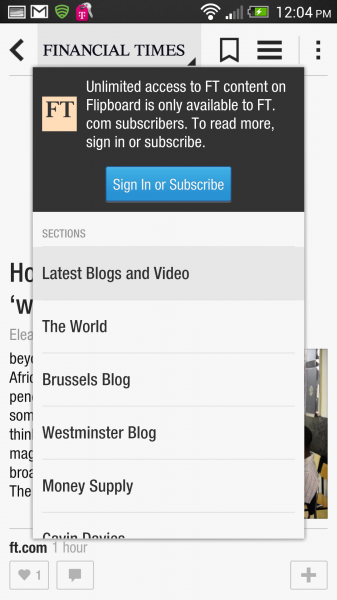
    May 9 was a big day for Flipboard. The personal news app launched a new version on Android, bringing feature parity with iOS, and the Financial Times debuted as a content provider. FT is unique among magazine news publications, by making people pay. Free rides are short lived; the newspaper lets registered users view a limited number of stories per month. More than that, requires a subscription.

    Many people look at Flipboard as a pretty news aggregator — a smorgasbord of valuable content served up for free; eat as much as you like. Financial Times brings the pay model with it. You still need a FT account. Registered users are limited to blogs and video, while subscribers get access to everything. I wonder if personal paper apps like Flipboard aren’t the future news, with some — even more — content behind the paywall.

    Charl Porter, group product manager, graciously took time to answer questions about the Financial Times’ business model and how Flipboard fits into the overall strategy. Remember, FT is among the rare publications for which people pay.

    BN: As a journalist, I am rather mortified by what the Google economy does to news. Free content supported by advertising, particularly when there is too much ad space to fill, isn’t tenable. How is it Financial Times succeeds by making people pay?

    CP: The FT’s business is based on dual revenue streams (content and advertising), and more people than ever in our 125-year history are readers and subscribers of FT content.

    We provide premium and essential news, commentary and analysis to an audience of over 600,000 paid subscribers (print and digital), who believe that FT content is worth paying for. Our successful channel-neutral strategy offers readers flexibility in how they choose to receive our content, and at its core is the metered access model we pioneered in 2007. Thanks to our digital access model, we now have deep knowledge of our audience and can apply data analytics for smarter marketing.

    BN: Why Flipboard?

    CP: We recognized early on that the continued success of our business depends on our ability to adapt to changing reader habits, and launching on a leading mobile app like Flipboard is a natural development for the Financial Times.

    Mobile continues to drive growth and now accounts for a third of all FT.com page views, driving 15 percent of digital subscriptions.

    Social media has changed the way people interact with brands, consume content and connect with each other. This is particularly true of the media industry and the way consumers discover and share news. At the FT, this deeper engagement with our audiences helps drive growth, and in 2012 the volume of visits to FT.com driven by social media grew by 35 percent.

    BN: Why Flipboard now — and not sooner?

    CP: We have been in discussions with Fliboard for a couple of years now to make sure that our proposition would work for both parties and across platforms, given we want to offer readers a multi-channel subscription with a single login. This launch has combined the FT’s award-winning journalism with a personalized reading experience on Flipboard. It also strengthens our presence on Android.

    BN: How do you see apps like Flipboard, or even Google Currents, changing how people consume news?

    CP: I see it as an opportunity for publishers like the FT to engage readers across multiple channels and devices. Our partnership with Flipboard allows reader to consume FT content in a new format using the same login as they would on FT.com or the FT web app. It’s a great way to get our brand out there without compromising our business model. We are still able to retain a direct relationship with our readers, which is key to our strategy.

    BN: To be honest, I used to be a Financial Times subscriber but the Android tablet app just couldn’t satisfy. How would you compare the Flipboard experience?

    CP: Flipboard provides an engaging leanback experience, and the app has successfully replicated the ‘browsability’ of a magazine. Our partnership with Flipboard does extend our presence on Android but we are working on enhancing the overall FT experience on Android. Our award-winning HTML5 FT web app now has more than 3.8 million users and was recently redesigned. The app is currently available on iOS now cleaner and easier to use, with more personalization and a choice of a static morning edition or a dynamically updating version.

    BN: Flipboard lets users create custom magazines, of sorts. How does Financial Times sees this, and other mechanisms like it, fitting into broader editorial content and revenue-generating strategies?

    CP: The social aspect of Flipboard’s custom magazines is exciting and we hope to play a part in that by allowing readers to use FT content within custom magazines while also experimenting with FT branded magazines.

    We also have a dedicated iPad app for our award-winning How To Spend It magazine, which aesthetically matches its printed counterpart whilst offering the dynamism and immediacy of the web. The revenue on our HTSI platforms (tablet and desktop) more than doubled year on year.

  • Activision CEO: Next-gen Xbox, PlayStation 4 sales might sputter just like Wii U

    Xbox Infinity PlayStation 4 Sales
    Nintendo is off to a rough start with its new Wii U video game console and Activision CEO Bobby Kotick thinks Microsoft’s “Xbox Infinity” and Sony’s PlayStation 4 could see similar tepid debuts when they launch ahead of the holidays this year. “We continue to face the uncertainties of the console transition” Kotick said during Activision’s earnings call this week. The executive noted that Nintendo’s Wii U has had a “very slow” start, and he warned that “uncertainties” in the coming year might impact Activision’s performance.

    Continue reading…

  • Latisys Partners With Ascenty to Enter Brazilian Market

    Here’s our review of some of this week’s noteworthy links for the data center industry:

    Latisys and Ascenty Partner.  Latisys announced a strategic partnership with Ascenty, a rapidly emerging metro fiber and data center services provider in Brazil. Under terms of the agreement, Latisys gains access to the Brazilian market and will leverage Ascenty’s Sao Paolo IT Infrastructure-as-a-Service (IaaS) platform and local operations to support its enterprise customers. This strategic relationship expands the addressable market for Latisys in international markets and does the same for Ascenty’s entrance into the US market. Both Latisys and Ascenty build high density data centers that serve as a platform for colocation, managed hosting and cloud services. “There are real challenges that go with international expansion,” said Pete Stevenson, Latisys CEO, based on his significant international experience. “For large IT service providers, it’s a big decision in deciding whether or not to spend capital in a foreign market where the operator has no experience. We think it’s more efficient to manage the execution risk by partnering with a strong local partner so we get speed to market and local operating knowledge for current and future customers that have deployment needs in Brazil.”

    Equinix adds AWS Direct Connect to Seattle.  Equinix (EQIX) announced the availability of the AWS Direct Connect service in the Equinix International Business Exchange data centers in Seattle (SE2 and SE3). AWS Direct Connect enables customers to connect their infrastructure directly to Amazon Web Services (AWS). Equinix opened the SE3 Seattle data center earlier this year. Equinix customers can also use AWS Direct Connect to access the AWS GovCloud (US) region from all existing AWS Direct Connect locations in North America. ”By leveraging AWS Direct Connect inside Equinix data centers, customers can take advantage of the cost savings and performance benefits of hybrid environments,” said Chris Sharp, general manager, cloud and content for Equinix. ”As we continue to support expansion of the AWS Direct Connect service to new markets, we are removing barriers to adoption and enabling customers to deliver on the promise of cloud computing.”

    ViaWest partners with Wayin.  ViaWest announced its partnership with Wayin, the online social engagement company. The partnership allows both companies to utilize each other’s IT services and join forces to promote and support the thriving Colorado business community and technology expertise. As part of this partnership, Wayin will implement ViaWest’s KINECTed Cloud service to host its employee and social engagement platforms, Wayin Enterprise and Wayin Hub, thereby connecting users globally in real time. In addition, ViaWest is launching Wayin’s enterprise engagement solution, which enables the human resource department to gather employee feedback and sentiments on various questions, surveys and company initiatives. “With ViaWest’s long history in this region, we know we have a dependable partner to pool resources,” states Tom Jessiman, CEO of Wayin.  “ViaWest’s best-in-breed infrastructure powers our applications and we have immediate access to live technical experts when needed. As both companies are Colorado-based, ViaWest shares our commitment to serving the Colorado business community, making the partnership a truly collaborative effort.”

  • Bing Gets More Tightly Integrated With Facebook

    Bing has added a bit more Facebook integration to its social search features. Now, you can comment on and like Facebook content right from Bing.

    “Bing already lets you view Facebook updates and comments from your friends in sidebar, but now you’ll also be able to add your own Likes and comments to your friends’ Facebook posts directly from Bing,” a Bing spokesperson tells WebProNews. “This is yet another step in Bing’s efforts to make it easier for people to leverage all of the incredible information across the web and content within their social networks to help them spend less time searching and more time doing.”

    “Say you’re a huge Beyoncé fan and are searching Bing to see what she’s up to, such as the latest on her trip to Cuba,” the spokesperson says. “While searching, you see a post in Bing’s sidebar from a Facebook friend who has an extra ticket to the sold out Beyoncé concert this week. With Bing, you can now comment on your friend’s Facebook post in one step, directly in sidebar, and claim the extra ticket. You’ve gone from simply browsing for news to attending the concert in one simple step. With Bing’s social search you can connect with your friends and engage with your social world to get things done – all in one spot.”

    Facebook Comments

    Of course none of this applies to the “Bing it On” challenge, which Microsoft just kicked off a new campaign for. The site, which lets you do side-by-side blind comparisons between Google and Bing results, strips out special features from each search engine, including Bing’s Facebook integration and Google’s Knowledge Graph.

    Bing continues to be a major partner of Facebook’s, also providing the web search results to Facebook’s Graph Search.

  • Tiny antennas that can harvest light and heat could deliver new solar tech

    A quiet startup called RedWave Energy, based just outside of Chicago, has been heads-down working on building prototypes of tiny antennas that can harvest clean power from infrared light, waste heat and eventually visible light. According to a filing, the company, which was founded in January 2011, has just closed on a $1 million round, and the company’s investors include Northwater Capital.

    RedWave Energy says on its website that early markets for the technology could be industries like explosives detection and high speed communications. But later down the line, the end goal could be harvesting solar energy in a method that has twice the capacity of current solar cells and panels but at a lower cost.

    Nanotechnology is being used to eek out as much efficiency as possible from solar cells and panels. For example, Swedish startup Sol Voltaics says it has developed a low cost way to make tiny nanowires out of the semiconductor gallium arsenide. Sol Voltaics turns these nanowires into an ink, which can be layered onto basic solar panels and boost the efficiency of a standard panel by 25 percent.

    But RedWave Energy’s nano scale antennas — or nantennas — work differently than solar cells. Nantennas act as an antenna or collector to absorb light of specific wavelengths and convert it into electricity. The technology has been around for decades, but RedWave Energy is now trying to commercialize nantenna technology licensed from Idaho National Labs, tech from University of Colorado, and is working with manufacturing company MicroContinuum.

    RedWave Energy says it will start to talk more about its energy capture technology after it builds its prototype in the second quarter of 2013. We’ve reached out to the company and will update this if we hear back.

    Related research and analysis from GigaOM Pro:
    Subscriber content. Sign up for a free trial.


  • Lion Tacos Pulled After Restaurant Generates Controversy

    There was a time when you could go into a restaurant in Tampa and get yourself some lion meat tacos. Those days are now behind us. Taco Fusion has reportedly pulled lion from the menu after causing a media stir.

    “There’s nothing like eating a predator to make you feel like a predator,” said one patron in the above Fox News report.

    “They’re surprisingly tasty,” another said about lions.

    Surprisingly, nobody said, “It’s like eating a cat, because that’s what it is.”

    As you can see from the video, otter and beaver were also on the menu. It’s unclear whether they’re still serving these meats, but here’s a page from their online menu, which indicates you should still have no problem getting a kangaroo taco:

    Safari Tacos

    Also, they deliver.

  • Next-gen Nexus 7 with Android 4.3 to reportedly be highlight of Google I/O

    Nexus 7 Second-gen
    Google will reportedly take advantage of Apple’s “delayed” second-generation iPad mini launch, and will reportedly make a new version of its Nexus 7 tablet a highlight of Google I/O next week. According to KGI Securities analyst Ming-Chi Kuo, Apple’s Retina iPad mini launch might be pushed back a bit and Google’s next-generation Nexus 7 will step in to the limelight following an unveiling at Google I/O. In a note picked up by AppleInsider, the analyst says Google’s next Nexus 7 will feature Android 4.3 — which will seemingly be another updated version of Android Jelly Bean — along with a 7-inch 1,920 x 1,200-pixel display, a 5-megapixel rear camera, Qi wireless charging support and a 4,000 mAh battery. The tablet will reportedly still start at $199, and Kuo makes no mention of when it might launch.

  • HTC One Draws Interest From Men In San Francisco, LA And Houston

    The HTC One has become the smartphone of the hour, with pretty much overwhelmingly positive reviews. Naturally, its drawing a lot of interest from consumers, but according to search data from Yahoo, it’s drawing interest specifically from men in select cities in the U.S.

    Yahoo tweeted today:

    77% of searches? That’s a pretty big percentage.

    ZDNet says, “HTC has pulled out all the stops with the One, which looks great, performs well and includes some clever features. The lack of storage expansion and the persistence of BlinkFeed are irritations, but overall the HTC One stands up well against rival flagship handsets.”

    The Salt Lake Tribune says it’s “slightly better” than the Samsung Galaxy S4.

    IBN says it’s “beautiful to look at,” and “powerful to play”.

    Here are a few official videos from HTC showing off the device:

  • Networking Company Cyan Prices Initial Public Offering

    Here’s some of today’s noteworthy links for the networking sector of the data center industry:

    Cyan Prices IPO.  Cyan (CYNI) a provider of software defined networking (SDN) and packet-optical platforms for network operators, announced the pricing of its initial public offering of 8,000,000 shares of common stock at $11.00 per share. Shares began trading May 9 on the New York Stock Exchange under the symbol CYNI, and ended the day at $11.14. Petaluma, California-based Cyan was founded in 2006 and has raised over $30 million in funding. Late last year, Cyan launched its software defined networking Blue Planet software, aimed at enabling service providers of all types to virtualize their networks.

    Fujitsu Develops SDN-based Platform. Fujitsu announced the development of FUJITSU Intelligent Networking and Computing Architecture, a new architecture for network-wide ICT platform optimization based on the principles of software defined networking (SDN). The new architecture employs a software-based approach to intelligently and flexibly enable optimized control over three unique domains: data centers, wide area networks, and smart devices. In the initial phase, Fujitsu is offering the following products based on this architecture: an updated version of unified administration and control software for server, storage and network resources, a new switch that supports network virtualization, and a new virtual appliance platform.

    Exinda Network Optimization Suite EnhancedExinda announced significant enhancements to the its Network Optimization suite that uniquely combines WAN Optimization, Network Control and Application Monitoring into an integrated solution specifically designed to meet the growing requirements of mid-market enterprises and educational institutions. With the release of its 6.4 firmware, the Exinda suite integrates many of these tools into a single converged solution that allows network managers better control of their network and create a more predictable user experience for applications that rely on it. “With the growth of tools for network management and the lack of integration between these tools, the complexity of performance management has increased,” said Jim Rapoza, senior network analyst for Aberdeen Group. “However, there has been a push among companies to deploy products that offer a single integrated platform for network control, along with deep visibility into user experience and application performance. Aberdeen Group data shows that 88 percent of organizations have or plan to centralize network and application performance and user experience visibility. By deploying an all-in-one integrated platform, these organizations are working to meet user demand, manage cost, and maintain or improve the overall quality of their network and application experience.”

    Silver Peak joins NEC. Silver Peak Systems  announced it has joined NEC Corporation of America (NEC) to include its data acceleration software as part of NEC’s new Software-Defined Networking (SDN) Application Center.  The NEC SDN Application Center focuses on solutions that address customers’ top-of-mind network concerns. “Silver Peak’s leadership in delivering software-based WAN optimization is the perfect complement to NEC’s market-leading ProgrammableFlow Network Suite,” said Don Clark, director of business development, IT Platform Technologies, NEC Corporation of America. “Silver Peak virtual products plug into our new SDN Application Center to give customers maximum flexibility and performance for extending business-critical applications across any distance.”

  • Big Data News: Cloudera, Splunk, Clustrix, Teradata

    News from the worlds of big data, databases and data analytics includes announcements by Cloudera and Splunk, investment madeinto Clustrix and Terradata Analytics finished a deployment for a large retailer.

    Cloudera and Splunk form big data alliance.  Cloudera announced that it has formed a strategic alliance with Splunk (SPLK) to deliver big data analytics across the enterprise. The relationship ensures best-in-class integration of the Splunk Enterprise platform for real-time operational intelligence to Cloudera Enterprise, using Splunk Hadoop Connect, which provides bi-directional integration to easily and reliably move data between Splunk Enterprise and Hadoop. “Splunk’s mission is to make data accessible, usable and valuable to everyone. By working together, Splunk and Cloudera deliver big data analytics that span the needs of any organization,” said Bill Gaylord, senior vice president of business development, Splunk. “The integration of Splunk Enterprise and CDH through Splunk Hadoop Connect provides customers a way to easily and reliably transfer data between the systems. This allows customers to easily use Splunk’s best-in-class machine data ingestion and management to deliver data to Hadoop, or ingest data into Splunk from Hadoop, such as the output of Hadoop MapReduce jobs and easily analyze and visualize that data.”

    Clustrix raises $16.5 million.  Scale-out SQL database company Clustrix announced the completion of a $16.5 million round of funding by current investors Sequoia Capital, U.S. Venture Partners, ATA Ventures, and Don Listwin. This the total capital raised to date to $46.5 million. Last month, the company released Clustrix 5.0 on Amazon Web Services and published a breakthrough real-time analytics performance benchmark for its scale-out SQL database, demonstrating a 50x advantage compared to legacy scale-up databases on AWS. “The combination of big data and cloud computing has broken the legacy database, creating an industry transition to new scale-out database platforms.” said Robin Purohit, CEO at Clustrix. “The Clustrix scale-out SQL database is battle-tested in mission-critical customer applications all over the world, providing unprecedented levels of performance, scalability, and real-time analytics. In our next phase of growth, we are making it easy for developers to build their next great application on our platform.”

    Woolworths completes Teradata Analytics implementation. Teradata (TDC) announced that Woolworths Limited, based in Australia and one of the world’s top twenty retailers, has completed implementation of its Teradata Data Warehouse Appliance platform in collaboration with Teradata Professional Services. The new data warehouse environment, fusing the most powerful new database software and hardware, serves as the point of integration for continuously rising volumes of detailed customer data. Woolworths’ decision to go with Teradata is part of an on-going program of business and technology investment, renewal and expansion,” said Priscilla Patroni, Business Technology Services, Woolworths. “We see growth ahead of us and this system will enable this by providing the analytic insight we want – to see our customers more clearly and serve them more personally.”

  • Samsung Galaxy S4 32GB arrives at AT&T

    Today, another Galaxy S4 variant goes on sale at AT&T — 32GB and yours for $249.99 with two-year contract. Buyers looking for commitment-freedom pay $669.99. The S4 joins HTC One as hottest smartphone of the season. Both pack gorgeous 1080p displays. The One is my choice for design; other benefits include booming front-facing speakers and low-light photography. Samsung packs in larger screen and loads more software capabilities.

    For the US carrier selling more iPhones than any other, AT&T makes Galaxy S4 quite the priority, jumping ahead of competitors selling the 16GB model and carrying its larger-capacity cousin. Preorders started April 16, with the 16GB phone in stores two weeks later.

    Samsung launched the S4 during a New York gala on March 14. The phone is actually a tad smaller than its predecessor but packs in larger display (5 inches). The South Korean manufacturer focuses more on software innovations than hardware for the newer handset.

    Among them:

    • Air Gesture lets users wave over the phone to manipulate some controls, such as choosing music or scrolling web pages. Related: Air Wave allows people to hover their fingers to manipulate the screen.
    • Dual Video Call permits use of both cameras simultaneously so that the caller on the other end can see other people, say, at a party.
    • Eraser removes unwanted objects (or people) from photos. Who hasn’t wanted to do that?
    • Group Play lets S4 users share documents, music, games and more, even combining up to eight handsets to create a speaker system (using Share Music).
    • S Health tracks some personal biological functions, such as calorie burn, heart rate and pulse and pulls them together into a mini report.
    • S Translate is quite futuristic. Think Star Trek’s universal translator. The feature can translate 9 languages, including speech-to-text and text-to-speech capabilities. While the service needs a network connection for optimal use, there is basic vocabulary on device for basic translation.
    • S Voice Car is a voice-activated system for using Galaxy S IV hands-free.

    Galaxy S4 specs: 5-inch Super AMOLED with 1920 x 1080 resolution and 441 pixels per inch; 1.9GHz quad-core processor; 2GB of RAM; 16GB, 32GB storage (expandable up to 64GB with microSD card); 13-megapixel auto-focus rear-facing and 2MP front-facing cameras; 1080p video recording; 4G: LTE; WiFi N/AC; GPS + GLONASS; NFC; Bluetooth 4; IR LED; MHL 2; accelerometer; barometer; gyroscope; geomagnetic, gesture, proximity, RGB light and temperature & humidity sensors; 2600 mAh removable battery; and Android 4.2.2 with TouchWiz UI. Measures 136.6 x 69.8 x 7.9 mm and weighs 130 grams. AT&T’s prices: $199.99 (16GB) and $249.99 (32GB).

    Personally, I debated between the S4 and HTC One, and bought the latter. Storage is 32GB and 64GB, $199.99 for the small capacity or $299.99 for the larger. AT&T currently offers a trade-promotion on both handsets — $100. Unless you have a clunker feature phone, try Craigslist first. You likely can sell an older phone for more than what the carrier offers.

    Many of you are really interested in Galaxy S4. More than 3,000 people responded to our buying poll. Fifty-three percent planned to preorder or buy “as soon as available”. Only 15 percent answered “No”.

    Of course, buying polls merely express intentions. What people say they will do isn’t often what they do. If you’re one of the people answering affirmatively to buying right away, please tell us if you actually did and which model. If so, how do you like the S4?

  • Google Glass Will ‘Definitely’ Get Someone Punched In The Face By This CEO

    Meetup CEO Scott Heiferman wants to punch someone in the face wearing Google Glass. It’s not entirely clear whether that means he wants to punch someone wearing Google Glass in the face or if he wants to punch someone in the face while wearing Google Glass.

    Business Insider put out this video of him talking about the device:

    Heiferman says, “Google Glass? Well, I’m definitely going to punch someone in the face wearing a Google Glasses. I’ve never punched anyone in the face in my life. I’m generally a peaceful guy. If you’ve ever seen a three-year-old using an iPad, you’ll know why I smashed an iPad with a sledgehammer. It’s so damn compelling, and that has implications.”

    He continues, “We’re going from ten to fifteen seconds to get my phone, you know, turn it on, open Facebook, and see something interesting…well now, with Google Glass, and the watch, we’ve gone from like ten to fifteen seconds to interestingness down to like three to five seconds to interestingness, and now once it’s on my wrist, and like you know, plastered on my eyeballs, that’s like down to one second to interestingness.”

    “It basically means that you’re gonna be an asshole,” he says. “it’s easier and easier for you to ignore real people around you, and sometimes that’s totally fine, but on this relentless pursuit – the train is barreling down, and saying, distraction is just a fact of life. We have to consider what it means.”

    He concludes, “And I’m not saying like, ‘Let’s sit back and ponder the nature of culture, and the future of society,’ in that way. I’m just saying, you gotta punch someone in the face wearing Google Glasses.”

    Business Insider itself says he wants “to punch anyone wearing Google Glass in the face.” That would certainly be in line with his “assholes” comment. Still, whenever he says it in the interview, the wording sounds more like he wants to punch someone in the face while wearing Google Glass.

    “Compelling…Interestingness…”

    “I’m definitely going to punch someone in the face wearing a Google Glasses…I’m just saying, you gotta punch someone in the face wearing Google Glasses.”

    Either way, he’s definitely going to punch someone in the face, and Google Glass will be involved.