Author: Serkadis

  • UK Comedy Writer Takes The Digital Economy Bill Seriously… As A Threat To His Livelihood

    Nathaniel Tapley, an award-winning comedy writer, writes “Yesterday, I wrote a blog post disagreeing with [Bernie Corbett,] the General Secretary of my union, the Writers’ Guild of Great Britain, who was defending the Digital Economy Bill. Surprisingly, he emailed me with a full response, which I have now posted at the link above, and I’ve answered a couple of his points in the comments section. Anyway, I thought it might be of interest to some of your readers, as it’s a detailed response from a supporter of the Digital Economy Bill.”

    Tapley joins the many creatives that oppose the Digital Economy Bill. His original post that spurred Bernie Corbett’s response is a worthwhile read, as is his response to Corbett’s email. Tapley’s main point of contention is that it is stupid to disconnect anyone if they are suspected of violating copyright:


    Internet disconnection works directly against writers, musicians and artists being able to get their works in front of audiences, and paying audiences. In the last five years a number of models have emerged for ‘monetising content’ (ugh!) At present, the residuals and tips and ad revenues make up a small but growing part of many creators’ incomes, and more sophisticated models are being developed.

    Reducing the number of people who have access to my work is not the same as working on my behalf, Bernie.

    It’s great to see more people come out of the woodwork who seem to understand how to approach new challenges as opportunities and not threats. That said, while it’s great that there is this discussion between people who disagree about the bill, it’s very unfortunate that the bill was rushed through Parliament with such haste.

    After all, soon, for anyone suspected of copyright infringement, Techdirt will look like this. At that point, continuing such discussions online will be slightly more difficult.

    Permalink | Comments | Email This Story


  • McLaren Chairman calls Bugatti Veyron “a complete piece of junk”

    The Chairman of McLaren Automotive, Ron Dennis, recently said that the Bugatti Veyron is “a complete piece of junk.”

    “The Bugatti Veyron is a complete piece of junk. I think it is. I believe I can look at a range of women and I can see beauty in most of them, but I can look at a Bugatti and I think it is pig ugly,” Dennis said. “The Veyron doesn’t do anything for me. I’ve been looking at it for years, and I don’t see one single thing that makes me feel good.”

    Dennis also criticized BBC’s Top Gear and their recent road race organized in Abu Dhabi between a Bugatti Veyron and the McLaren F1. He said that the race had to be rigged to make the Veyron look quicker than it was.

    “I know that they have to cut the car open to take the engine out. To make an engine in that configuration, you know, it doesn’t go around corners. When we did the race in Abu Dhabi, we beat it off the line so many times that the film crew was getting frustrated because the outcome was supposed to be for the Bugatti to win. So we had to do that whole thing about ten times before it managed to get off the line cleanly and catch us up. Because every time they dropped the clutch it bogged down and we were gone.”

    Ouch – we are waiting Bugatti’s and Jeremy Clarkson’s reply.

    – By: Kap Shah

    Source: ArabianBusiness (via Jalopnik)


  • Bugzilla 3.6 Released

    The Bugzilla Project is announcing that Bugzilla 3.6 has been released and is now available for install or upgrade. With Bugzilla 3.6, the development team focused on improving the existing components and features, but it also comes with a few big, new features. Notable is the new extensions system that enables developers to quickly build new functionality on top of the ex… (read more)

  • Ford open to partnerships in green technology, but will remain cautious

    Speaking on the sidelines at the Fortune Brainstorm Green conference, FoMoCo’s Chairman Bill Ford Jr. said on Monday that the company is open to partnerships in green technology but will be cautious in committing to any alliance.

    “We are always open to it but I think we will be careful before we jump,” Bill Ford said in an interview with Reuters. “You always go into the joint venture with the premise that you will save money and save manpower, and our experience often has been that it does neither.”

    Bill said that partners heading into any alliance needed to have clear agreement on the division of work and the ownership of any intellectual property created by the result of a partnership.

    “I am not saying every joint venture is bad,” he said. “But you have to be very thoughtful and really have very clear expectations.”

    – By: Stephen Calogera

    Source: Reuters


  • IPS writer in Peshawar wins health reporting award

    A child gets a dose of polio vaccine in the city of Mingora in Swat district . Credit: Ashfaq Yusufzai

    A child gets a dose of polio vaccine in the city of Mingora in Swat district . Credit: Ashfaq Yusufzai

    Ashfaq Yusufzai has won a 2009 Media Health Award in Pakistan in the category of “Best Reporter – International” for his story for IPS in November, “Polio Vaccination: One Hurdle Down, One More to Go”. The awards are a joint initiative of the Ministry of Health, UNICEF and WHO in Pakistan. Two thousand three hundred entries were judged by a five member jury.

    The awards ceremony was held on World Health Day, 7 April, with the Minister of Health along with the country heads of UNICEF and WHO in attendance. The Health Secretary, Khushnood Lashari, explained the thinking behind the awards “The idea is to promote reporting on health issues so that alongside political and strategic reports, health news should also constitute breaking news.”

    Ashfaq’s winning story datelined Peshawar is about renewed efforts in late 2009 to vaccinate children against polio in the Swat region. From January 2007 to May 2009 the vaccination campaign stalled because of fierce opposition from the Taliban that controlled the region during that period. The Taliban and some hard-line local clerics are convinced that the immunisation programmme renders recipients impotent and sterile. Other religious leaders have supported the vaccination efforts.

    Read Ashfaq’s award-winning story in full here: “Polio Vaccination: One Hurdle Down, One More to Go

  • Google Docs’ New Drawing Editor

    Google has just launched its greatly revamped Google Docs with completely new underpinnings, new document and spreadsheet editors and the brand-new drawing editor. This last tool is clearly aimed at the work and school environments and is designed to allow several people to collaborate on flow charts, project plans, diagrams and any other kind of graphics you&rsqu… (read more)

  • Pay for Parking with Your Cell Phone

    I’ve had more than my fair share of parking issues since moving to DC, mostly because DC meters (in my humble opinion) are absurdly expensive and I rarely have a fist full of quarters in my change purse. (What do I have at all times? Spare bobby pins and a Hanson guitar pick- the ultimate conversation piece.) 

    A few hefty tickets later, I am thrilled to hear that DC has implemented a pilot program which lets drivers pay for their parking meters via cell phone.

    In fact, you can even get text messages to update you when your time is about to expire.

     To be able to do this, you register online, create an account that is linked to your credit card and when you park, you enter the meter number and indicate the amount of time you need.

    Brilliant!

    This is a great example of government using technology to make life easier, and I’m very excited to try it out.

    What kind of government web 2.0 are you using? What is available in your area, or would you like to see put to use?


  • Greece Spreads Are Widening Again, But Who Cares, Stocks Are Heading Higher Once Again

    There’s never been any evidence that the ructions in Greece are impacting US equity markets.

    So far the only possible domestic repercussions have had to do with Treasuries, and Greece has been a net plus, pushing cash into safe US government assets.

    So here we are, and there’s another morning of Greek spreads widening (despite the umpteenth bailout), according to Markit, and futures are headed up once again.

    Behold, the can’t-lose market.

    chart

    Join the conversation about this story »

  • Climategate Petition: Fire Michael “Hockey Stick” Mann

    Article Tags: ClimateGate

    Pennsylvania State University’s Young Americans for Freedom (YAF) has launched an online petition urging Penn State to preserve academic integrity and order an independent investigation of Mann and his role in climategate.

    Jordan Marks, YAF Executive Director, said, “Students are held to a high level of academic integrity on a daily basis and when the academic code of honesty is broken universities go to great lengths to investigate and administer justice.” Marks continued, “The cover up of Professor Mann’s suppression of climate data because he is one of the faculty’s own is a disgrace to the academic community and an insult to the students who buy into the system of integrity and honesty. The fact that Mann falsified data to promote his personal agenda should be cause for him to stripped of his PhD and removed from his position as a Professor.”

    To sign the PSU YAF online petition urging Penn State preserve academic integrity and order an independent investigation of Professor Mann, please go to PSU YAF Petitions for Independent Inquiry to Turn Up the Heat on Penn State Climategate Professor.

    Source: mensnewsdaily.com

    Read in full with comments »   


  • We’ve Still Got Debt Coming Out Of Our Ears

    From Neil Irwin at the WaPo: Economic data don’t point to boom times just yet

    “There have always been Wall Street economists wanting to cheerlead the recovery, and quick to jump on any piece of news showing a great boom is around the corner,” said Kenneth Rogoff, a Harvard economist. “The data so far are more consistent with a very moderate recovery.”

    There are a number of reasons that would be the case. American households are trying to reduce debt to stabilize finances. But they are doing so slowly, with total household debt at 94 percent of gross domestic product in the fourth quarter down just slightly from 96 percent when the recession began in late 2007…

    “When you have a recession that’s amplified by a deep financial crisis, the recovery is slower and more painful, much akin to recovering from a heart attack,” said Rogoff … “It just takes time. If you look at a typical recovery, we would be growing at 7 or 8 percent by now given the depth of our fall.”

    Household Debt as Percent of GDP Click on graph for larger image.

    This graph, based on the Federal Reserve Flow of Funds data, shows household debt as a percent of GDP through Q4 2009 (note: I removed a few non-profit categories).

    Note that the household debt problem is mostly a mortgage debt problem. Mortgage debt as a percent of GDP started really picking up in 2001 and 2002 and continued to increase sharply through 2006.

    There was also a sharp increase in mortgage debt in the late ’80s. That was partially associated with Tax Reform Act of 1986 that only allowed mortgage debt to be tax deductible, and excluded interest on all personal loans including credit card debt. There was also a smaller housing bubble in the late ’80s that was associated with the increase in mortgage debt.

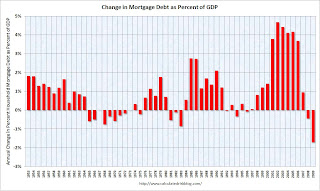
    Change in Household Mortgage DebtThe second graph shows the annual change in the percent of household mortgage debt.

    There was some increase in the late ’90s associated with the booming economy and stock bubble wealth effect. But the real boom in mortgage debt started in the 2nd half of 2001 – and continued through 2006. This rapid increase in mortgage debt should have been a red flag for regulators.

    Finally, on Rogoff’s comment about “Wall Street economists wanting to cheerlead the recovery”, there is an old saying on Wall Street for analysts: Bearish equals unemployed. Of course they are cheerleading!

    Reprinted from Calculated Risk.

    Join the conversation about this story »

  • Sun blamed for Europe’s colder winters

    Article Tags: Headline Story, Solar News, World Temperatures

    When the Sun’s magnetic output is low, winters in Europe tend to be cooler than average – whereas higher output corresponds to warmer winters. That is the conclusion of a new study by physicists in the UK and Germany that looked at the relationship between winter temperatures in England and the strength of the Sun’s magnetic emissions over the last 350 years. The group predicts that, global warming notwithstanding, Europe is likely to continue to experience cold winters for many years to come.

    The possibility of a link between European winter temperatures and solar activity can be seen in historical records from the second half of the seventeenth century. For about 50 years the Sun remained free of sunspots (in contrast to its normal 11-year cycle of sunspot highs and lows) and at this time Europe experienced a number of harsh winters. Motivated by the fact that the relatively cold winters of the past few years have come at a time when solar activity fell to the lowest values for 100 years, Mike Lockwood of the University of Reading and colleagues set out to establish whether or not there is a strong connection.

    Lockwood and colleagues used data from the Central England Temperature record. This provides monthly temperature data from several monitoring stations in central England all the way back to 1659 – the world’s longest instrumental temperature record. The researchers first removed the estimated contribution from the warming recorded in the northern hemisphere as a whole over the past century – which is widely believed to have been caused by increasing levels of manmade carbon dioxide in the atmosphere. Hemispheric temperature records data back to 1850; to extend the analysis back to 1659 they used data from a number of different proxy sources, such as tree rings, isotope concentrations in stalagmites, sediment depths, lake heights and documentary evidence.

    Click source to read FULL report

    Source: physicsworld.com

    Read in full with comments »   


  • ‘Climategate’ panel set to report by Roger Harrabin, BBC news

    Article Tags: BBC, ClimateGate

    The second of three reviews into hacked climate e-mails from the University of East Anglia (UEA) is set to be released later.

    It has examined scientific papers published over 20 years by the Climatic Research Unit (CRU) at the heart of the e-mail controversy.

    The panel was nominated by the Royal Society, and climate sceptics forecast it would defend establishment science.

    But the BBC understands the panel has taken a hard look at CRU methodology.

    It is thought to have focued on statistical methods used by the CRU and the way uncertainties inherent in climate science may have been down-played by government bodies.

    Source: news.bbc.co.uk

    Read in full with comments »   


  • Bit.ly Celebrates Its Biggest Month Yet with 3.4 Billion Links Clicked

    Despite the recent troubles, it’s still a pretty great time to build a service based on or catering to Twitter. A great example of this is bit.ly, Twitter’s ‘official’ URL shortener. The service just keeps on growing and posted record numbers again in March. And the service is about to get even better… (read more)

  • Goldman: All The Good Earnings Are Fully Priced In, And Investors Will Sell The News

    (This guest post previously appeared at the author’s blog)

    Goldman Sachs says the recent surge in equity prices is fully discounting the positive earnings season that began two days ago.  As can be seen in the accompanying chart, Goldman says investors have begun to catch onto the “better than expected” trend in earnings and have been front running the last few earnings seasons.  Each earnings season has subsequently resulted in weaker equity performance as investors look to “sell the news”.  When the market bottomed in March 2009 investor sentiment with regards to earnings was extremely negative (something our Expectation Ratio was way ahead of the curve on – see here). 

    The two quarters following this extreme negativity resulted in significant upside surprises.  By Q3 ‘09 the trend was well in place and it was clear that corporate profit margins were expanding and resulting in stronger than expected earnings.  Each of the past two earnings season were front-run by investors who had noticed this trend and were hoping for performance that was similar to the prior earnings seasons.  Neither Q3 nor Q4 resulted in significant gains and the Q4 earnings season coincided with the largest sell-off of 2010.  The current rally into earnings is the largest since the quarter after the March 2009 bottom:

    chart

    Source: Goldman Sachs


    Read more market commentary at The Pragmatic Capitalist >

    Join the conversation about this story »

  • Official Google Buzz Share Buttons

    Now that the Google Buzz hype and controversy have died down, it’s probably the best time to find out if it has what it takes to become a popular social web product. It would be Google’s first if it did. Any social web service, especially one focused on sharing as much as Buzz, needs to make it easy for sites to add sharing options for it. Two mont… (read more)

  • Facebook May Be Getting Into the Q&A Game

    Facebook has reached a stage where it can pursue any product or feature it wants and enter pretty much any market as a strong competitor. Google is one of the few other companies in this position and Facebook has only recently become so powerful. It’s not wasting any time, though, and it is looking at various opportunities. One of these is the Q&A… (read more)

  • 14 Graeco-Roman tombs discovered in Bahariya oasis

    Egypt State Information Service

    Minister of Culture Farouq Hosni announced on April 12, 2010 the discovery of 14 Greco-Roman tombs dated back to 2,300 years at a construction site near al-Baweeti town in al-Baharia Oasis, October 6th Governorate.

    The archaeologists discovered four plaster human masks, a gold fragment decorated with the four sons of the god Horus, as well as coins, clay and glass, said Zahi Hawwas, the Secretary-General of the Supreme Council of Antiquities.

    A mummy of a woman measuring 97 centimeters, wearing some jewelry and covered with colored plaster depicting a Roman costume, was also found.

    The tombs were unearthed in an area where a youth center was to be built in a village there, Sabri Abdel-Aziz, the head of the ancient Egyptian antiquities department, said in a statement.

    The antiquities department has halted construction at the site, where a large necropolis may exist, he said.

    Discovery News (Rossella Lorenzi)

    A bejeweled mummy dressed in Roman robes has emerged from the sands of Egypt’s Bahariya Oasis, the Supreme Council of Antiquities said Monday.

    Entombed in a decorated gypsum sarcophagus, the 38-inch tall mummy belonged to a woman or girl who died in the Greco-Roman period about 2,300 years ago.

    Unearthed in a rock-hewn tomb at a modern construction site near the town of Bawiti, in Bahariya Oasis, some 185 miles southwest of Cairo, the mummy points to the existence of a large Greco-Roman necropolis nearby, Mahmoud Affifi, director of Cairo and Giza antiquities, said in a statement.

    Google/AFP

    Egyptian archaeologists unearthed a Roman mummy entombed in an elaborate sarcophagus at an ancient grave site alongside gypsum masks, the antiquities council said in a statement Monday.

    The one metre (three feet) long gypsum sarcophagus portrays a woman dressed in Roman robes and contains a mummified woman or girl who died in the Greco-Roman period about 2300 years ago.

    “We are sure (the mummy) is female. Either she was a small woman, and mummies always shrink, or she could have been a young woman,” Zahi Hawass, chief of the Supreme Council of Antiquities, told AFP.

    Presstv

    Findings suggest that the tombs might have been part of a much larger necropolis, Egypt’s Culture Ministry said in a Monday statement.

    The female mummy was found in the stair-lined interior of one of the rock-hewn tombs, Reuters reported.

    The 97-centemeter tall mummy was cast in colored plaster inlaid with jewelry and eyes.

    Archeologists also found four anthropoid plaster masks, a gold fragment adorned with engravings of the four sons of Horus and a collection of coins, and clay and glass vessels.

    Monsters and Critics

    5-photograph slideshow, with captions.

  • UN to assist with development of Dahshur

    Al Masry Al Youm (Ekram Ibrahim)

    The Egyptian government and the United Nations held the first workshop in their “Mobilization of the Dahshour World Heritage Site for Community Development” program on 10 April. The program aims to focus on developing the community while preserving the area’s rich cultural and natural heritage.

    The workshop, held under the auspices of 6th of October Governor Fathy Saad at the famous Sakkara archaeological site, was attended by Spanish Ambassador to Egypt Antonio Lopez Martinez, and UN Resident Coordinator James W. Rawley.

    “I am confident that programs such as the Dahshour World Heritage Site for Community Development will succeed in improving the quality of life of the people of Dahshour while at the same time contributing to the preservation of the area’s unique cultural heritage and biodiversity for future generations,” Rawley declared in an opening address.

  • A step nearer to finding the land of Punt?

    Heritage Key (Owen Jarus)

    Throughout their history the ancient Egyptians recorded making voyages to a place called the ‘Land of Punt’. To the Egyptians it was a far-off source of exotic animals and valuable goods.

    From there they brought back perfumes, panther skins, electrum, and, yes, live baboons to keep as pets. The voyages started as early as the Old Kingdom, ca. 4,500 years ago, and continued until just after the collapse of the New Kingdom 3,000 years ago.

    Egyptologists have long argued about the location of Punt. The presence of perfumes suggests that it was located somewhere in Arabia, such as Yemen. However the depiction of a giraffe, at a temple built by Queen Hatshepsut, tells archaeologists that Punt is likely somewhere in Africa – perhaps around Ethiopia, Eritrea or Somalia.

  • Exhibition: The great African Meroë empire at the Louvre

    afrik.com (Shahinez Benabed)

    With Meroitic timeline.

    Meroë is one of the great kingdoms of ancient Sudan. Perched next to it was Egypt, another, great kingdom. For several centuries, especially the late period and during the reign of Cleopatra, Meroë was strategically positioned in terms of its geographical location, thus contributing to its reputation as a hub, or a melting pot, for several civilizations. However, till date, very little is known about this great civilization. An exhibition to enlighten the general public, on the vestiges of a great kingdom that hint on an atypical culture which could have influenced or been influenced by African, Greek, Roman and Egyptian civilizations is underway at the Louvre Museum in Paris until September.

    Meroë or Ethiopia (“The Land of Burned Faces”— as termed by Greco-Roman historians, or “The Kingdom of Kush” — as termed by ancient Egyptians) covered large areas within the confines of present day Egypt and Sudan, over 1000 kilometers along the banks of the Nile river for over six centuries.