Author: Serkadis

  • Expansion of Supreme Council of Antiquities

    Heritage Key (Ann Wuyts)

    Egypt’s Supreme Council of Antiquities is to expand, with the addition of a new department for archaeological collections. Among its duties will be the registration of privately owned artefacts, as well as supervising the transfers of ownership on these items. The Archaeological Collections Administration is established to facilitate the execution of the newly amended Antiquities Protection Law. The announcement comes only days after Egypt held its first conference on the repatriation of artefacts, showing that Egypt’s focus is not just on retrieving looting antiquities from foreign collections, but mapping and saveguarding those ‘at home’ as well.

    Farouk Hosni, Egypt’s Minister of Culture, announced the establishment of the first department for archaeological collections, the Archaeological Collections Administration (ACA), as a part of the Supreme Council of Antiquities (SCA). The new division will be responsible for determining the archaeological status of transferred individual or institutional collections in accordance with the recently amended Antiquities Protection Law.

    Those amendments lead to tougher punishments for theft and smuggling of ancient treasures, as well as cancelling the percentage of movable antiquities that were previously granted to ‘outstanding’ foreign excavation missions who discovered then.

  • Book Review: Hatshepsut: From Queen to Pharaoh

    Art Museum Journal (Stan Parchin)

    With photos

    Roehrig, Catherine H. with René Dreyfus and Cathleen A. Keller (eds.), et al.
    Hatshepsut: From Queen to Pharaoh (exh. cat.).
    New York and New Haven: The Metropolitan Museum of Art and Yale University Press, 2005.

    Queens seldom played decisive roles in the known course of antiquity. A handful distinguished themselves, sometimes due to their notoriety. Only recently has the skillful scholarship of art historians and archaeologists allowed their personalities to emerge and take their rightful places in the historical record. Nefertiti (ca. 1352-1336 B.C.), the beguilingly beautiful consort of ancient Egypt’s monotheistic “heretic pharaoh” Akhenaten, and the highly romanticized Cleopatra (r. 51-30 B.C.) number amongst these women. Not one distinguished herself for her accomplishments as did Hatshepsut. Indeed, in a time of relative peace and prosperity in Egypt, she fostered a cultural renaissance rarely seen in the ancient world.

    Hatshepsut: From Queen to Pharaoh is the catalogue published in conjunction with the popular special exhibition at the M.H. de Young Museum, The Metropolitan Museum of Art and the Kimbell Art Museum in 2005-06.

  • Barnum Museum mummy suffered from dental disease

    Stamford Advocate

    An expert in forensic dentistry at the University of Connecticut School of Dental Medicine in Farmington said that Pa-Ib, the 4,000-year-old Egyptian mummy at the Barnum Museum, suffered greatly from dental disease in the last years of her life.

    But the expert, Dr. Alan G. Lurie, DDS, said that whether that was the actual cause of her death would be impossible to tell because of damage to the skull that was caused during the mummification process.

    But he said that she suffered from “very dangerous lesions” at the roots of the lower canines that can lead to infections of the sinuses, and ultimately, abscesses of the brain.

  • More re low terahertz radiation scanning of mummies

    The National (David Crossland)

    Scientists in Germany and Switzerland have pioneered a new method of examining ancient mummies by using technology employed in airport body scanners.

    The pilot project, conducted at the University of Freiburg in south-western Germany, could revolutionise the way in which the secrets of mummies such as Egypt’s King Tutankhamun are unlocked in future.

    The low-level terahertz radiation used in new screening equipment currently being installed at airports around the world is particularly suited to scrutinising ancient tissue because it is far more gentle than X-ray scanning, the scientists said. Until now, researchers have resorted to X-raying mummies with CT scans, which can destroy DNA remnants because the rays can break apart molecules.

  • Hemiunu to be loaned for opening of the Grand Egyptian Museum

    Earth Times

    A German museum confirmed Sunday plans to lend its greatest treasure, the seated statue of Hemiunu, to Egypt for the 2013 opening of the Grand Egyptian Museum at Giza near Cairo.

    Doubts over the loan cropped up after Zahi Hawass, the flamboyant chief of the Egyptian Supreme Council of Antiquities who visited Germany last month, called for the statue and other Pharaonic treasures to return to Egyptian permanently.

    Hemiunu is believed to have been the architect of the Great Pyramid of Cheops at Giza. The life-size statue, depicting him in nothing but a loin cloth, is the top draw at the Roman and Pelizaeus Museum in Hildesheim, Germany.


    Bikya Masr

    Egypt’s top archaeologist Zahi Hawass is feeling good today, after the German museum housing a famous seated statue of Hemiunu has agreed to lend Egypt the statue for the 2013 opening of the Grand Egyptian Museum in Giza, near the pyramids. It continues Hawass’ push to have all Egyptian artifacts taken from the country returned to Egypt.

    This is just a loan, but a Supreme Council of Antiquities (SCA) official said that they fully expect Germany to allow the statue to remain in Egypt upon the end of the agreement.

    “We would not have agreed to only a loan if there were not discussions in the works that could see the statue return to its rightful home for good,” said the official, who was not authorized to speak to the media.

    The statue is one of the top pieces at the Roman and Pelizaeus Museum in Hildesheim and doubts over the weekend of the possible loan deal had emerged after Hawass, the outspoken and often controversial figure, had called for the statue and other ancient Egyptian pieces to be returned to Egypt permanently.

    The museum, however, did confirm they would loan the statue for the opening of the museum, but said upon the end of the deal, the statue would return to Germany.

  • Changes to the Downtown area of Cairo

    The National (Ursula Lindsey)

    Downtown – Wust al Balad in Arabic – is Cairo’s 150-year-old central district. With its mix of Belle Époque, neo-Islamic and Art Deco apartment buildings, its roundabouts ornamented with statues, its glittering cafes and elegant shops, the area was once known as “Paris on the Nile”. But in recent decades the neighbourhood has lost its upper-class cachet, and its architecture has been damaged by misuse and neglect.

    It has become common to lament Downtown’s decline – in the press and in Egyptian literature, whose development is deeply linked to the area. Now private investors and government authorities are putting in motion plans to protect and renovate the neighbourhood.

    Karim Shafei fell in love with the area when he attended an art festival there in 2001. “I thought: Downtown is going to happen again, the same way it happened in Paris, New York, Istanbul,” he says. Shafei is the chief executive of Al Ismaelia Company for Real Estate Investments, a new venture that is dedicated to buying and renovating Downtown properties – and possibly returning the area to its glory days.

  • In Defense of the Pope


    As is clear, the Catholic Church is grasping the nettle of sexual abuse today and struggling with discovering effective strategies to overcome the problem.  The easy part is the procedural.  Priests can be and have been shunted into other duties that eliminate the risk and now we are going to see some of them been forced to confront civil authority at least in the developed world.
    The hard part is to understand that institutions dealing with vulnerable children are targeted by individuals driven by aberrant sexual needs.  That has been true with the Boy Scouts and the educational system and the foster care system.  It will also continue to be true unfortunately.
    At least now they will not be able to hide behind the culture of general denial that has operated everywhere in the past.
    I suspect that the most vulnerable children and thus likely the most abused are those children passing through the government run foster care systems.  The children themselves effectively have no protector.
    The Catholic Church is at least capable of actually solving the problem better than just about anybody else.  They are a hierarchical system of administration that can implement globally corrective systems.  So if the underlying problem is solvable they should be up to it.
    The good news I suppose is that the actual hard numbers of aberrant individuals appears to be low.  Except that their individual ability to cause damage is huge.  A hundred victims is almost common.  Yet out of thousands we have a couple here and there causing all the agony.  One teacher in our system created a serious scandal some years back, yet that appears to be the only serious case in a large school system
    Because these folks strike at the core of society’s framework of trust, society reacts heavily.  I do not myself excuse the damage caused or think that individuals can be cured, so must class myself as intolerant.  Yet the reality is that the perpetrators are victims of their biological urges however wrongly directed.  It begs a cure rather than forgiveness.
    In short it is ultimately a scientific problem.
    I do find offensive that some of the press give free rein to any number of creeps who want to take advantage of the situation to attack the Pope.  The Church is a bureaucracy that is naturally behaving like a bureaucracy and Pope Benedict is where the buck stops.  He had already made key corrections to repair what was clearly not working.  That alone may be sufficient to cut of any internal escape routes for problem priests.  What remains is the creation of an open reporting system that is self corrective on the ground.  That done and it will be almost immune to the problem.
    In the meantime, the church will have to isolate all perpetrators who have any history and allow them mostly to die out.  Again this will take careful judgment calls because of the insidious nature of the problem.  Some will call for witch hunts and victims have to be addressed and helped.  This can be organized.  I suspect though that hunting up victims in order for them to recount their traumas is often simply extending the abuse with another form of abuse.
    This article outlines a lot of what the church has done and where it now goes. I have little doubt that this will be solved.
    The bigger problem remains with the foster care system operated by governments throughout the world.  It is likely a whole order of magnitude greater.  Moves to correct the problem there have been generally implemented at least to the point of awareness.  Yet the institutional structure is still quite vulnerable and no one really knows how to fix it.   Things may have changed while my information from many interviews is decades old but I cannot see how.
    In Defense of the Pope
    Posted by Alan M. Dershowitz on Apr 13th, 2010 and filed under FrontPage
    Having criticized particular Catholic cardinals for blaming everything–including the Church’s sex scandal–on “the Jews”, let me now come to the defense of the Pope and of the Church itself on this issue.  To begin with, this is an extraordinarily complex problem, because the Church has at least five important traditions that make it difficult to move quickly and aggressively in response to complaints of abuse.
    The first tradition involves confidentiality, particularly not exclusively the confidentiality of the priest with regard to the penitent.  But there is also a wider spread tradition of confidentiality within the Church hierarchy itself.
    Second, there is the tradition of forgiveness.  Those of us outside the Church often think, perhaps, that the Church goes too far in forgiving.  I was shocked when the previous Pope immediately forgave the man who tried to assassinate him.  But this episode and other demonstrate that the tradition of forgiveness is all too real.
    Third, there is the tradition of the Church regarding itself as a state.  The Vatican is, after all, a nation state.  The Catholic Church is not big on the separation of church and state, as are various Protestant denominations.  The Catholic Church, like Orthodox Judaism, believes that matters affecting the faithful should generally be dealt within the church, without recourse to secular authorities.
    Fourth, the Vatican prides itself on moving slowly and in seeing the time frame of life quite differently than the quick pace at which secular societies respond to the crisis of the day.
    Fifth, the Catholic Church has long had a tradition of internal due process.  Cannon Law provides for scrupulous methods of proof.  The concept of the “devil’s advocate” derives from the Church’s effort to be certain that every “t” is crossed and every “I” is dotted, even when it comes to selecting saints.
    None of these explanations completely justify the long inaction of the Church in coming to grips with a serious problem.  But they do help to explain how good people could have allowed bad things to happen for so long a period of time.  Nor is the Catholic Church the only institution that has faced problems of sexual abuse.  Every hierarchical body, especially but not exclusively religious ones, has faced similar problems, though perhaps on not so large a scale.
    The problem of hierarchical sex abuse has only recently emerged from the shadows.  Singling out the Catholic Church, and for stereotyping all priests is simply wrong.
    Pope Benedict, both before he became Pope and since, has done a great deal to confront the issue.  He changed the policy that kept allegations of abuse within the authority of local bishops, and he acknowledged that the local option had encouraged shifting abusive priests from parish to parish, thereby hiding their sins from potential new victims.  He also met with abuse victims and recognized their victimization.  Nor has he tried, as other members of the Vatican hierarchy have, to publicly blame the problem on “the Jews”, “the media,” and others.
    It is obvious that despite Pope Benedict’s good efforts, more must be done, and not only by the Catholic Church but by all institutions that have experienced hierarchical sexual exploitation.  They must create structures that assure prompt reporting, a zero tolerance policy and quick action, so long as these processes are consistent with due process and fairness, not only to alleged victims but to the accused as well.  It’s easy to forget, in the face of real victims with real complaints, that there have also been false accusations as well.  Processes must be put in place that distinguish true complaints from false ones.
    Most important, this tragedy should not be used as an excuse to attack a large and revered institution that does much good throughout the world.  Blame must be placed with precision and praise should be given with precision as well.  The eleventh Commandment, Thou Shalt Not Stereotype, must never be forgotten.
  • Book Review: Thutmose III

    Strategy Page (A.A. Nofi)

    Thutmose III: The Military Biography of Egypt’s Greatest Warrior King
    By Richard A. Gabriel
    Washington: Potomac Books, 2009.

    Largely due to his extensive propaganda, most historians cite the megalomaniacal Ramses II as Egypt’ s “greatest” warrior king. But a better case can be made for Thutmose III , who ruled more than a century earlier. And Prof. Gabriel (Royal Military College of Canada), author of quite a number of works on ancient warfare, makes that case very convincingly.

    Gabriel opens with a short, but concise introduction to Egyptian history to set Thutmose’s life and campaigns within the framework of the political, economic, diplomatic, and, of course, military practice of his times.

  • Banks Blowing up the Economy


    What this all means is awful.  The last chart shows us that the assets of the top four banks now represent half of the US economy. Now this also reflects that these banks are themselves not anchored in the US economy.  They absorb US dollar deposits worldwide and also lend globally.  It is no longer possible for the USA economy by itself to backstop these particular banks.  They likely need to be cut free and their deposit base transferred to smaller institutions.
    The simple removal of the fed guarantee should change everything in a hurry. 
    My point is that these banks are actually bigger than the government itself.
    We now need a global financial regulatory scheme that is able to manage these entities and drive down the ratios.  Having depositors caring about your ratios also works wonderfully.   Ending the government back stop should cause that.
    Perhaps the banks that are beyond a certain size will need to automatically lose deposit insurance.  It would certainly encourage a huge and healthy second tier.
    Banks Blowing Up the Economy
    By Morgan Housel  April 13, 2010 | 
    I read two interesting thoughts last weekend. The first is from legendary 18th-century economic god Adam Smith — father of free-market thinking — who wrote this on the topic of regulating banks:
    “exertions of the natural liberty of a few individuals, which might endanger the security of the whole society, are, and ought to be, restrained by the laws of all governments, of the most free as well as of the most despotical. The obligation of building party walls, in order to prevent the communication of fire, is a violation of natural liberty exactly of the same kind with the regulations of the banking trade which are here proposed.”
    The second came from JPMorgan Chase (NYSE: JPM) CEO Jamie Dimon’s annual letter to shareholders, which says a skill he strives for is the “Ability to face facts.”
    Amen to both 

    The outcome of banking gone wild is now well-known. Less obvious are the dramatic changes banks underwent since the 1980s that concluded with the collapse of 2008.
    By looking back over the past 25 years, it’s easy to highlight Smith’s point of banks running roughshod over everyone else. And we can show this with cold, hard facts Dimon appreciates.
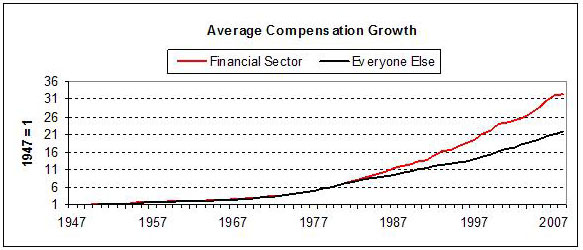
    The three facts that put our current financial system in perspective are charts of profit growth, compensation growth, and relative size of today’s biggest banks. I owe credit for the inspiration of these charts to a presentation in March by former International Monetary Fund chief economist Simon Johnson. Let’s look at each.
    1. Money for nothin’ 

    Every business, every corporation, and every consumer relies on banking in one way or another. That makes it a special industry, and it’s why banks receive special treatment like backing from the Federal Deposit Insurance Corp. It also makes it an industry that should be at least somewhat anchored to the rest of the economy. When the economy does well, banking does well; when the economy does poorly, so do banks.
    That’s roughly how it worked for most of the post-World War II period until the early 1980s — profit growth among banks hugged close to the businesses they lent to. Then something strange happened:

    Source: Bureau of Economic Analysis, author’s calculations.
    Let me explain this chart a little more. The Bureau of Economic Analysis tracks total corporate profits by industry going back to 1947. I took total financial profits, and total profits from all other industries, and calibrated both groups to “1” in 1947. So what this chart shows is the relative profit growth of banks compared with everyone else.
    From 1947 until the mid-’80s, financial profits and all other profits were fairly correlated. Then in the mid ’80s … snap! … financial-sector profits left everyone else in the dust.
    There are two explanations for this. One, we’ve had consistently falling interest rates since the ’80s, which is great for most businesses, but banks especially. Two, the ’80s were deregulation central. As Simon Johnson and James Kwak explain in the book 13 Bankers:
    [A broad] deregulatory trend begun in the administration of Jimmy Carter … transformed into a crusade by Ronald Reagan. The eventual result was an out-of-balance financial system that still enjoyed the backing of the federal government — what president would allow the financial system to collapse on his watch? — without the regulatory oversight necessary to prevent excessive risk-taking.
    Two big innovations that came from this were an explosion of derivatives, and the securitization of debt. As the past two years taught us, both products can be great in moderation yet deadly when used in excess — which they usually are.
    The reason excess within financial products became standard is simple: Bankers were getting fat and happy off these things even when clients lost money. That brings up chart No. 2.
    2. Lifestyles of the rich and fortunate

    There was nothing glamorous about banking for most of the post- World War II period. The leaders made fortunes and gained power — as leaders of all industries do — yet the lower workers were just average Joes making average wages.
    As with profits, that changed abruptly in the ’80s:

    Source: Bureau of Economic Analysis, author’s calculations.
    In 1959, the average finance employee made $4,880 a year, while the average in all other sectors made $4,560. By 2006, the average finance worker made $82,200 compared with $52,800 for everyone else. Nice.
    The practice of paying bankers ungodly sums just for showing up isn’t the historic norm. It’s really something that sprung up in the ’80s with the advent of financial engineering and the outburst of subsidized profits.
    Another thing we’ve become accustomed to that isn’t historically ordinary is the size of the largest banks. That brings up chart No.  3.
    3. What too big to fail looks like


    Source: Capital IQ (a division of Standard & Poor’s), measuringworth.org, author’s calculations.
    This is the combined total assets of the four big commercial banks — Citigroup (NYSE: C),Bank of America (NYSE: BAC), Wells Fargo (NYSE: WFC), and JPMorgan Chase — as a percentage of gross domestic product. In 1992, the combined assets of these four banks amounted to 5.2% of GDP. By 2009, that number had increased tenfold, to 52% of GDP. The big jump came in the late ’90s with the repeal of the Glass-Steagall Act, which allowed commercial banks to merge with investment banks. A second surge came in 2008 after surviving banks purchased their fallen neighbors.
    This chart is particularly revealing because it thoroughly wrecks the claim — made mostly by bank CEOs — that megabanks must not be broken up because large companies like Appleand ExxonMobil absolutely need banks of today’s size to conduct business. Eyeball the chart for three seconds and you realize how ludicrous this idea is. Big companies didn’t struggle to raise capital in 1992. Or 1995. Or 2000. Or 2006. In fact, they thrived like never before. To suggest that reducing the size of big banks relative to GDP to where they were in, say, 1998, would somehow asphyxiate big businesses is comically refutable.
    Don’t shoot the messenger

    These three charts don’t tell the whole story, of course. You can gab away about how the Fed, Fannie and Freddie, China, the Democrats, the Republicans, the media, and whoever else you detest created the financial collapse. And please do.
    What I hope they do is provide perspective. There’s a growing group, without naming names, that acts like even the slightest smidge of financial reform will send us into a Socialist Stone Age. But when you see how dramatically and quickly the financial system skewed, you see how even significant reform would simply revert it back to where it was only a handful of years ago — a time that was demonstrably more stable, produced higher growth, and, to the irony of all, represented the “old America” so many reform opponents want back.
    Some say banks are making lots of money and paying themselves accordingly, but that’s their right. That’s capitalism. We encourage it. We cherish it. But as Adam Smith mentioned more than 200 years ago, it isn’t capitalism if the misbehavior of a few bankers “endanger the security of the whole society.” And that’s exactly what happened in 2008.It wasn’t capitalism. It was banks blowing up the economy. And a few of us are praying it’ll soon end.
  • June Hogs


    I love this story.  Dams certainly have their place but they can be overbuilt also.  This is certainly a situation were the removal is obviously well justified.
    A dam has one proper purpose.  It is called flood control.  When that is not a particular issue, energy can be collected through run of the river hydro facilities and well located dams with a working fish bypass system in place.  In fact I have posted on a horizontal turbine system that while not producing a lot of power will allow returning salmon to climb through the system back up to the top of the reservoir.
    Once again, I would be willing to take on the contract.
    We are not going to give up the Aswan or the Yangtze River dams anytime soon.  The flood control aspect is often as important as the power generation if not more so.  In time though, we may decide that we need to build more flexibility into even flood control.
    For example the Nile could be diverted into a second channel west of the present course and filling the Qattara Depression.  This could be done with diversion channels and a barrage allowing a switching back and forth of the flow of the Nile.  Done properly far to the south the Aswan could be retained for some time and possibly have its natural lifespan extended while much silt is used in the new channel and its related new farmlands.
    In time, the Aswan must be taken down because it will be simply full of mud.
    This project is going to inform us a great deal over how difficult it is to fully restore a rich river.  We need that knowledge.  The Columbia desperately needs smart thinking as does every river system.
    Officials hope dams’ removal will bring the big salmon back
    By Les Blumenthal | McClatchy Newspapers
    WASHINGTON — They were known as June Hogs — 100-pound salmon that, when stood on end, were taller than a man.
    Up until a century ago, they returned annually to the Elwha River on Washington state’s Olympic Peninsula in runs so huge that homesteaders reported that the river turned into a wiggling mass from bank to bank. One count placed their number at 392,000.
    Then, two dams were built across the river, .and the spawning grounds were blocked, giving the fish less than five miles of river to breed. Today fewer than 3,000 fish return to the Elwha.
    That’s about to change.
    In what would be the largest dam removal project ever in the United States, the federal government last week requested bids to demolish the two structures _ the 105-foot Elwha Dam, finished in 1913, and the Glines Canyon Dam, twice as tall as the Elwha Dam, finished in 1927.
    The dams won’t be blown up, but dismantled over roughly three years so the 19 million cubic yards of silt, gravel and rock behind them can be flushed downstream gradually.
    The project will cost more than $300 million. The cost of removing the dams _ $60 million to $70 million _ is only a portion of the price tag.
    Once the dams are down, it may take 10 years to re-establish the runs, but officials are determined that the fish will return. Some will be flown by helicopter to the upper reaches of the Elwha watershed. To supplement the meager number of native fish, others will be raised in a nearby hatchery and added to the runs. Eventually, the runs are expected to become wild.
    Scientists say if the salmon runs can’t be restored on the Elwha, they can’t be restored anywhere.
    More than 85 percent of the river’s salmon habitat is in the Olympic National Park, remote back country even now barely touched by man.
    “I have no doubt this will work,” said Brian Winter, the Elwha Project manager for the National Park Service.
    Winter, a fisheries biologist who’s been working on restoring the Elwha runs since 1985, said the river is a living laboratory that has been studied for decades.
    “This isn’t so much about taking out the dams, it’s about seeing the first salmon headed up stream,” he said.
    Others are calling it the “last dam summer” as demolition work is expected to begin next year.
    “All eyes, including internationally, are on it to see how a river comes back to life,” said Amy Kober of American Rivers. “The lessons we learn on the Elwha will apply to others rivers around the nation.”
    To the Lower Elwha Klallam Tribe, the removal of the dams is about more than salmon. When the dams were built, the reservoirs that grew behind them flooded the tribe’s only inland village and the “tribal creation site,” where according to legend the tribe was created.
    “We just have word of mouth about where they are,” said Robert Elofson, the tribe’s director of Elwha River restoration. “It’s been 100 years.”
    The dam removal project began in 1992 when Congress approved the Elwha River Restoration Act.
    The privately owned dams provided electricity that helped power the economy of the Olympic Peninsula, including the Bremerton Naval Shipyard and nearby paper mills.
    There were several attempts to strip funding over the years, but they failed. Former U.S. Sen. Slade Gorton, R-Wash., unsuccessfully sought to link the Elwha project to a promise that four dams on the lower Snake River would never be breached to aid salmon runs in the Columbia River basin.
    Before seeking bids to remove the dams, the Interior Department, which includes the National Park Service, spent $24.5 million on a water treatment plant for the city of Port Angeles and $69.6 million for other water facilities. Port Angeles takes it water from the Elwha and there were concerns the silt released by the removal of the dams could affect water quality.
    The Interior Department also paid $16.4 million to construct a new tribal fish hatchery. Work is also underway on some levy modifications.
    Congress has been providing roughly $20 million in funding annually and nearly $55 million in economic stimulus money was also appropriated.
    Rep. Norm Dicks, D-Wash., whose congressional district includes the Elwha, has championed the project from the beginning.
    “There’s no question we can do this,” Dicks said of restoring the runs.
    Dicks is an avid fisherman. In his congressional office is a mounted 54-pound salmon he caught in Alaska. He laughs when asked about catching a 100-pound salmon.
    No one is betting those giants will return to the Elwha.
    But to those who have been working on the restoration project for 18 or more years, the end may be in sight.
    “It’s amazing we are so close,” said Kober. MORE FROM MCCLATCHY

    Read more:

  • Tappen Zee and Global Warming


    It is always good to find what we can describe as definitive evidence that shuts down argument.  Here we have a handy oyster bed that swung in and out of existence like it was some handy toggle switch.
    The Roman and Medieval warm spells are locked in and so is the collapse of the little ice age.  They are recent enough to clear in the record.  The mid Holocene warm period is clear although the length is not mentioned.  Other records show a couple of millennia.
    This was followed by cooler climate perhaps similar to present conditions.  The 4000 – 5000 BP seems surprising in time and place but may mean that we have understated the actual warmth of the North Atlantic. 
    In fact it is becoming timely to compare several sources to try and assemble a better picture than has been bandied about.  Even this item is leaving a lot hanging and reporting on the bit they are sure about.
    This item is certainly improving resolution and opening an instructive line of inquiry.
    Hudson River Estuary, USA


    Reference
    Carbotte, S.M., Bell, R.E., Ryan, W.B.F., McHugh, C., Slagle, A., Nitsche, F., Rubenstone, J. 2004. Environmental change and oyster colonization within the Hudson River estuary linked to Holocene climate. Geo-Marine Letters 
    24: 212-224.

    Description

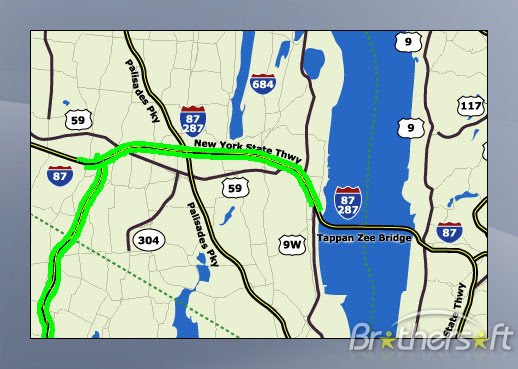
    The authors located fossil oyster beds within the Tappan Zee area of the Hudson River estuary, New York, USA (~ 41.13°N, 73.90°W), via chirp sub-bottom and side-scan sonar surveys, after which they retrieved sediment cores from the sites that provided shells for radiocarbon dating. Results of their analyses indicated that “oysters flourished during the mid-Holocene warm period,” when “summertime temperatures were 2-4°C warmer than today.” Thereafter, the oysters “disappeared with the onset of cooler climate at 4,000-5,000 cal. years BP,” but “returned during warmer conditions of the late Holocene,” which they specifically identified as the Roman and Medieval Warm Periods as delineated by Keigwin (1996) and McDermott et al. (2001), explicitly stating that “these warmer periods coincide with the return of oysters in the Tappan Zee.” They further report that their shell dates suggest a final “major demise at ~500-900 years BP,” which timing they describe as being “consistent with the onset of the Little Ice Age.” Because the oyster beds of Tappan Zee have not been reestablished during the Current Warm Period, we conclude that temperatures in this region today are not as warm as they were during the MWP (~ AD 600-1250).

    References

    Keigwin, L.D. 1996. The Little Ice Age and Medieval Warm Period in the Sargasso SeaScience 
    274: 1504-1508.

    McDermott, F., Mattey, D.P. and Hawkesworth, C. 2001. Centennial-scale Holocene climate variability revealed by a high-resolution speleothem δ18O record from SW IrelandScience 294: 1328-1331.
  • Photo for Today – Gerf Hussein temple

    Gerf Hussein temple, originally Per Ptah (the House of Ptah), was built
    in the name of Ramesses II by Setau (the Viceroy of Kush, who was also
    responsible for the Wadi es-Sebua temple to the south).
    This free-standing section is in fact only part of the temple.
    The other part, which was rock-cut, was left in situ during the UNESCO rescue operations
    and is now flooded by the waters of Lake Nasser.
    New Kalabsha island

  • Polly “Ecocide for the UN” Higgins is a Capitalist and Imperialist Looking for Invest

    04.13.10 06:57 PM posted by Veronica Estrada

    This is why we can’t dismiss people like Polly Higgins the Barrister by simply calling her "nutty as a fruitcake."

    It turns out, our Polly, champion of the Treehuggers who believe trees have Rights, is deep into a Solar Panel the Sahara scam (dubbed "Saviour of the World") that would provide solar-manna from the sky, "sufficient to cover all needs of the earth."

    Wow. The progressives don’t even care to connect the "myth" of God to a person anymore. Now that climate change is religious dogma, we’ve just been supplied with a God-Company Incarnate, with the UN about to turn Enforcer to prosecute Climate Deniers — although they have yet to lift a finger against Holocaust deniers like Ahmadinejad. read more »

    http://www.conservativeoutpost.com/p…ill_obama_bite

  • Mark Levin on Obama the Global Citizen – Institutionalizing Poverty, Institutionalizi

    04.13.10 02:29 PM posted by Veronica Estrada

    In this segment of his 4/13 show, Mark finally calls Obama a Global Citizen. Although this term can take on a multitude of meanings. he uses it to emphasize how Obama implements policies that destroy American values and culture, American prosperity, and are clearly not American-delineated, especially in retrospect of what has transpired since his election into office. We can begin to see how Obama is more interested in serving the interests of the world than he is in serving the citizens of his own nation. For background, the following are excerpts from articles Mark mentions in this clip. Skip ahead to the trascript of this important segment, or right click and download and begin listening at 30:13 for maximum impact. Again, this is from yesterday’s Monday, 4/12/10 show. ** From the Millions of unemployed may never recover, the Seattle Times:

    Despite recent job gains, one grim statistic casts a long shadow over the recovering economy and the futures of more than 6 million workers: Fully 44 percent of the nation’s 15 million unemployed have been out of work for more than six months.And evidence suggests many of them may never rebuild their working lives completely.Never since the Great Depression has the U.S. labor market seen anything like it. The previous high in long-term unemployment was 26 percent in June 1983, just after the deep downturn of the early ’80s. The 44 percent rate this year translates into more than 6.5 million people.In fact, nearly two-thirds of these workers actually have been jobless for a year or longer, new Labor Department reports show.

    From The Detroit News’ AP survey: Recovery to remain sluggish into 2011: read more »

    http://www.conservativeoutpost.com/m…ng_destitution

  • Obama Nominates Bill Ayers for Court; Lindsey Graham Politely Requests More Liberal C

    04.13.10 08:37 AM posted by scottspiegel

    When anticipating Obama’s upcoming nomination to replace retiring Supreme Court Justice John Paul Stevens, there are two approaches conservatives might consider:

    Hope that Obama nominates the most conservative candidate, in case he gets confirmed;

    Hope that Obama nominates the most liberal candidate, to highlight Obama’s radical ideology and make it easier for Republicans to reject her.

    Relatively speaking, the most conservative candidate on Obama’s short list is D.C. Appeals Court Judge Merrick Garland. The most liberal is Seventh Circuit Appeals Court Judge Diane Wood.

    The problem with hoping for a moderate candidate is that anyone Obama is dreaming of nominating would be a disaster as far as adherence to the rule of law and upholding the Constitution.

    The problem with hoping for a leftist candidate is that we cannot rely on Republican Senators to be courageous enough to block even the most egregious Obama nominee—even after the Democrats just declared war by passing a bill taking over the country’s health care system without a single Republican vote.

    Given their dismal failure last summer to stand up to Our Wise Latina Sonya Sotomayor’s incendiary record (typical GOP critique during her confirmation hearings: Lindsey Graham’s creepy, drooling paean, “I like you!”), Republicans cannot be counted on to offer meaningful opposition to whichever train wreck Obama picks this year. read more »

    http://www.conservativeoutpost.com/o…eral_candidate

  • Chelated Boron ( 3 mg, 90 Caps )

    Chelated Boron ( 3 mg, 90 Caps ) Bluebonnet’s Chelated Boron 3 mg Vcaps provide the trace mineral boron from multi chelated complex including boron citrate, aspartate and glycinate in easy-to-swallow vegetable capsules for maximum assimilation and absorption.

  • Potassium Gluconate ( 99 mg, 100 Tabs )

    Potassium Gluconate ( 99 mg, 100 Tabs ) Potassium is an important mineral used in various bodily functions. It is an important factor in the maintenance of the body’s acid-base balance and nerve condition, as well as the transfer of nutrients through cell membranes.
  • Great Plains Bentonite Detox ( 32 Oz )

    Great Plains Bentonite Detox ( 32 Oz ) Great Plains Bentonite provides strong detoxification in the digestive tract, with the ability to bind herbicides, viruses and other potentially harmful substances by adsorbent action. Great Plains Bentonite is specially formulated to provide the maximum benefits of bentonite. Bentonite’s mechanism of action is physical, due to its colloidal structure and charged particles, which allow it to bind with toxins in the stomach, small intestine and colon. It is not digested, nor is it absorbed into the bloodstream. Since toxins are bound to the bentonite, they are excreted from the body when the bentonite is eliminated through bowel movements.
  • Chelated Magnesium ( 220 mg, 100 Tabs )

    Chelated Magnesium ( 220 mg, 100 Tabs ) Chelated Magnesium, vegetarian, dietary supplement. • Magnesium provides nutritive support for normal, healthy heart, nerve, and muscle function. • Vegetarian Formula • Chelated for Maximum Bioavailability