Occasional Autoblog contributor and Associate Editor at Engadget, Tim Stevens, is our go-to guy when it comes to navigating the intersection of technology and automobiles. So it’s fitting that Stevens has published a comprehensive shoot-out pitting six iPhone navigation systems against each other to see which app reigns supreme in the race from point A to B.
The review covers everything from Mapquest’s free GPS app to the far pricier Navigon MobileNavigator, along with progs that span the price spectrum from CoPilot, TomTom and AT&T. There’s a great breakdown of available features and functionality, along with initial and reoccurring costs, but in the end, only one gets the Engadget tip of the hat. Check it out.
Ugur Sahin has brought us some wonderful concepts in the past including the Corvette Z03 and the GT-S Passionata Concept. Sahin has now released his latest creation called the Aston Martin Concept Design Study Gauntlet.
As Sahin puts it:
The main goal of the Aston Martin Gauntlet Concept was to design a car which is technically almost identical to the existing production Aston Martins while defining a design character that outmost respects the impressive history of the brand and combine the timeless lines of the past Aston Martins with the modern interpretation of the existing styling.
Sahin said that his goal focused on being coherent balance between past and the future without overlapping each other to fit the taste of today’s design definitions. Too much of the past would look “Retro” while too much of the “Future” would look unrealistic.
“I believe that Gauntlet matches these two worlds exactly without exaggerating,” says Sahin.
Sony Creative Software announced a version 6 update to the Blu-print Blu-ray Disc authoring application and the brand-new Z Depth 3D subtitle offset editing application. As one of the first professional 3D Blu-ray(TM) Disc authoring products available on the market, the upgraded Blu-print 6 will be capable of authoring 3D titles in accordance with the Blu-ray Disc Association (BDA) 3D Blu-ray disc specification to greatly enhance workflow capability for production facilities and professional video editors. Blu-print 6 allows for easy import of MVC encoded content along with support of 3D menu graphics and subtitle graphics. 3D Blu-ray Java integration also allows for user interactivity like BD-Live. To assist editors creating 3D subtitles, the new Z Depth application generates the required offset metadata file needed in a 3D BD project allowing editors to more accurately and easily position subtitles when creating 3D Blu-ray Discs.
“With the home entertainment industry, consumer electronics manufacturers and consumers eagerly awaiting the introduction of 3D on Blu-ray, Blu-print 6 and Z Depth 3D subtitle offset editing application will enable editors and disc authoring professionals to provide a seamless 3D viewing experience for home audiences,” said Dave Chaimson, vice-president of global marketing for Sony Creative Software. “Given the precise balance of art and technology needed to produce 3D Blu-ray Discs, production professionals require powerful and specialized new tools like Blu-print 6 and Z Depth for Vegas Pro 9 to deliver content that exceeds the high expectations accompanying the excitement for 3D at home.”
As one of the first professional-level 3D Blu-ray disc authoring software systems available, the new features of Blu-print 6 will allow studios to author 3D content for the new 3D Blu-ray format standard Profile 5, import new MVC encoded streams, and work with Z Depth for 3D subtitle authoring. Designed for high volume professional production, the updated Blu-print 6 software will also include support for offset metadata integration required for 3D Presentation Graphics and 3D Interactive Graphics. 3D BD-J integration and 3D Blu-ray Disc cutting master generation is also supported in order to provide maximum intuition and flexibility for complex authoring projects.
The all-new Z Depth subtitle offset editing application uses the video power of Vegas Pro 9 to provide a combination that will allow 3D authoring companies to easily create required disparity metadata files for positioning of subtitles and IG menus in a 3D Blu-ray Disc production. New to 3D BD production, the Z Depth application will allow 3D Blu-ray Disc authoring facilities and subtitle creation companies to produce accurate subtitling in the 3D space that will allow for the most comfortable viewing experience. The BD spec offset metadata files created by the application can be used in any 3D Blu-ray Disc authoring application that follows BDA specifications Profile 5. There are no special hardware requirements for Z Depth, though it is highly recommended that editors use the Presonus Fader Port for data input. Vegas Pro 9 is required for Z Depth integration.
We love crash test videos because there’s nothing quite like a 35 mph collision between a two-ton automobile and a cement barrier done in the name of science and safety. When we watch the slow-motion footage we marvel at the twisting metal and the busted glass, but unless the crash test dummy’s head falls off, we rarely give the anthropomorphic stiff the time of day.
That may change after watching the two-minute video after the jump that explains the work that goes into making a General Motors‘ test dummies. The video tells us that each unit can have 50 to 100 information channels and a data collection box that is about as big as a Blackberry. The video also details why the dummies wear clothes and why those duds are pink. Hint: it has nothing to do with fashion.
Following the initial joint announcement to make the world’s first FIFA World Cup available in 3D, FIFA and Sony unveiled insights into what the football fans around the globe can expect from this innovative undertaking to add a third dimension to the football viewing experience. Coinciding with the rapidly growing consumer interest in 3D fueled by the release of blockbuster movie titles in 3D and impending launch of 3D TV sets for the home, the first ever FIFA World Cup in 3D will further capture the excitement for millions of football fans around the globe.
With a total of seven pairs of Sony’s professional HDC cameras on rigs at every match (model: HDC-1500, above), the action on the pitch will be captured in a stunning 3D quality enabled through its proprietary multi-image processor (model: MPE-200, below) and 3D Outside Broadcast truck.
Sony’s cutting-edge processor, the only one in the market to date, makes an end-to-end workflow possible in the production process and automatically adjusts the depth-of-field to ensure an unprecedented and optimal 3D viewing experience around the world. Starting from the FIFA Confederations Cup last year in South Africa, Sony has been working on enhancing the 3D capturing of fast-moving football action and has since conducted a number of 3D filming trials in Europe.
3D filming will be conducted at five out of the 10 FIFA World Cup stadiums: Soccer City and Ellis Park in Johannesburg, Durban, Cape Town (above) and Port Elizabeth. 25 matches in total will be filmed and broadcast in 3D, which will include a carefully chosen selection of those games expected to attract most public attention, including the opening game on June 11 at Soccer City (South Africa vs Mexico) and the crowning final game on July 11 also in Johannesburg. Other games to be captured in 3D are:
June 11 16:00h RSA v MEX
June 12 16:00h ARG v NGA
June 13 20:30h GER v AUS
June 14 13:30h NED v DEN
June 15 20:30h BRA v PRK
June 16 16:00h ESP v SUI
June 17 13:30h ARG v KOR
June 18 16:00h SVN v USA
June 19 13:30h NED v JPN
June 20 20:30h BRA v CIV
June 21 20:30h ESP v HON
June 22 20:30h NGA v KOR
June 23 20:30h GHA v GER
June 24 16:00h SVK v ITA
June 25 16:00h POR v BRA
June 27 20:30h 1st B v 2nd A
June 28 16:00h 1st E v 2nd F
June 28 20:30h 1st G v 2nd H
July 2 20:30h Quarter finals
July 3 16:00h Quarter finals
July 3 20:30h Quarter finals
July 6 20:30h Semi finals
July 7 20:30h Semi finals
July 10 20:30h 3rd place match
July 11 20:30h Final
“The 3D feed from these 25 matches will be made available for broadcast on 3D channels, which can be enjoyed by consumers on their 3D-compatible TV sets in the comfort of their home, almost as if they were in the football stadium themselves,” said Niclas Ericson, Director of FIFA TV. “Whilst discussions with major broadcasters are ongoing, I am very pleased to announce the first confirmed partners for the 3D live broadcast, who are ESPN in the US and Sogecable in Spain. We expect further announcements to be made shortly,” he added.
In line with FIFA’s and Sony’s endeavor to make this new exciting 3D viewing experience available to as many football fans as possible, a dedicated global 3D public viewing project will debut at this year’s FIFA World Cup. Eight matches will be fed live to digital cinemas and selected venues in 3D HD quality around the globe. To this end, FIFA has appointed Swiss-based Aruna Media AG to manage the exclusive 3D cinema and entertainment venue rights for live games in 3D. Aruna plans to broadcast live 3D coverage of matches to around 26 countries and is in advanced discussions with several major markets.
Reaffirming its leading position at the forefront of the emerging 3D market, Sony is the key technological enabler of this new viewing experience and enhances the excitement of football fans, either watching a football match live in the stadium or enjoying a new 3D experience through 3D TV channels or at the public viewing events around the world. “Sony has long standing credentials in the creation of professional 3D technology and content for theatrical use,” said Hiroko Saito, Deputy General Manager of Global Sponsorships, Sony Corporation. “True to our strategy eFrom the lens to the living-room’, we are actively involved at every stage of the 3D value chain and proudly draw on the strengths of the e3D World created by Sony’, which encapsulates our expertise in professional solutions, consumer electronics, movie making and gaming alike. We are very excited to capitalise on these strengths and to be able to complement our compelling 3D proposition by bringing an entirely new viewing experience to the world of football through our partnership with FIFA,” Saito added.
Complementing the 3D live broadcast and public viewing activities, the general public will also be able to exclusively enjoy the 3D promotional trailers shown on Sony 3D BRAVIA TVs in around 4,000 Sony-affiliated retail stores worldwide, including 200 Sony flagship stores (total number of Sony-affiliated retail stores: 1,500 in North America, 1,300 in Europe, 500 in Japan, 200 in Asia, 200 in Latin America, and 30 in South Africa). Furthermore, Sony Pictures Home Entertainment today unveiled plans to produce and distribute the official FIFA film in 3D on Blu-ray Disc this year.
Published April 9, 2010 Dori O’Neal, Tri-City Herald staff writer
Jeff Hamilton will headline the evening entertainment at this year’s Jazz Unlimited Festival happening April 9-10 and 15-17 at Columbia Basin College in Pasco.
The festival is a competition that involves 4,500 student musicians from all over the Northwest, including high school and middle school students. Competition categories include concert choirs, jazz bands and jazz choirs.
There is no fee to watch the daylong competitions, which begin at 7:30 a.m. each day on the CBC campus.
There is a charge to the Hamilton concert on April 9, but the rest of the festival’s evening entertainment is free. Tickets to the Hamilton concert, which begins at 7:30 p.m., are $15 for adults and $10 for students and senior citizens.
Hamilton, who’ll perform with his trio that includes Oscar Peterson and Ray Brown, is world renowned as a versatile drummer with a unique style.
David Badham, music critic with the Jazz Journal International, referred to Hamilton’s recent album, Heart and Soul, as, “the finest modern big band sound I’ve heard.”
Opening the Hamilton concert will be performances by the CBC Orchestra and the CBC Jazz Ensemble.
On April 10, Hamilton will play with the jazz ensemble starting at 5:15 p.m. in the Gjerde Center. Then on April 15, CBC’s FreeForm jazz group will sing songs from its latest CD release starting at 7:30 p.m. in the theater.
Another WM-Port enabled speaker dock comes from Sony Japan this week with the RDP-NW1, which is very similarly styled to their iPod/iPhone type speaker docks. Available in black or white, the NW1 has a WM-Port, stereo audio input, AM/FM, and alarm/snooze functionality. Enjoy the simple 3W + 3W speakers with MEGA Xpand to color your audio. You can also wake up using music from your Walkman, and control the device from a distance with a remote control.
RDP-NW1
<amanaDigitalLockerPhoto><downloadInfo><downloader><id>1271</id><loginId>CORESUGI</loginId></downloader><time>Fri Mar 05 10:31:25 JST 2010</time></downloadInfo></amanaDigitalLockerPhoto>
<amanaDigitalLockerPhoto><downloadInfo><downloader><id>1271</id><loginId>CORESUGI</loginId></downloader><time>Fri Mar 05 10:31:21 JST 2010</time></downloadInfo></amanaDigitalLockerPhoto>
It’s no secret that FreeCreditReport.com, a site owned by Experian, has always been somewhat misleading in its marketing (okay, very misleading), getting people to get a “free credit report” that is not the government mandated free credit report, and whose entire program was really about upselling people to expensive credit monitoring services. However, we noted back in March that the FTC was finally forcing the site to be more honest in its marketing — including a clear and conspicuous link to the real free credit report offering. But now, reports are coming out that FreeCreditReport.com isn’t offering anything for free any more. The report you used to get for free is now a dollar. And, even though they promise to donate that dollar to charity, it makes you wonder: could the domain name itself be considered false advertising?
Of course, the reason why Experian is charging that dollar seems even more misleading than its old advertising program:
The new F.T.C. rules went into effect on April 2, and they required sites to include a prominent notice across the top of each Web page that mentioned free reports declaring that the only authorized source under federal law for such reports is annualcreditreport.com.
Rather than include such disclosures, Experian added the $1 charge, saying that “due to federally imposed restrictions, it is no longer feasible for us to provide you” with a free credit report. And now that the report costs $1, the new F.T.C. rule would presumably no longer apply.
Yes, you read that right. It’s trying to make the FTC look bad for requiring the company to actually be honest… and, in doing so, is pretending that this means it no longer has to be honest. An Experian spokesperson explained it this way:
The offer for the $1 report is very clear and in compliance with the F.T.C.’s rule,” she said in an e-mail reply to questions. “There is no express or implied offer on our site for a free report.”
General Motors’ Detroit-Hamtramck Assembly Plant, where the Chevrolet Volt is being built, may become a big tour stop for schools and industry leaders. GM officials said there has been a huge interest in wanting to visit the plant once the official production of the Volt kicks off in September.
“I’m expecting that we will have all different kinds of visits,” plant manager Teri Quigley told the Free Press. “I think it will be five times as many people as normal at the onset,” she said.
GM started producing preproduction units of the Volt last week at the plant. The Detroit automaker plans to build fewer than 500 preproduction units from now until November.
A Nissan anunciou o desenvolvimento de um modelo pra rivalizar com o Volkswagen Golf, com o objetivo de “roubar” seus clientes e também de preencher lacunas que existem entre um modelo e outro em alguns segmentos da montadora.
Contudo, a maior noticia fica por conta da intenção da Nissan, que pretende lançar um veiculo melhor que o Golf. É o que diz Andy Palmer: “O segmento C é uma solução para uma área de expansão que nos parece óbvia. O Qashqai e o Juke já estão presentes nesse segmento, mas ir mais longe significa construir um automóvel melhor que o VW Golf, e é esse o desafio a que nos queremos agora dedicar. O projeto é um projeto a longo prazo, mas que já está a caminho”.
Seu futuro lançamento tem como objetivo auxiliar a Nissan a atingir suas futuras metas, de poder comercializar seus veículos em cerca de 90% do mercado global e aumentar em 3% a sua participação nas vendas de automóveis no mundo todo. Atualmente a companhia tem uma participação aproximada de 84% no mercado automotivo global.
Toyota announced today that it has established a new SMART business process using existing product engineers, field technical specialists and specially trained technicians to quickly and investigate customer reports of unintended acceleration in Toyota, Lexus and Scion vehicles in the United States.
SMART, which stands for Swift Market Analysis Response Team, will attempt to contact customers within 24 hours of receiving a complaint of unintended acceleration to arrange for a comprehensive on-site vehicle analysis.
“Members are drawn from a group of 200 technical associates located across Toyota’s North American operations and will work in close partnership with Toyota and Lexus dealer,” Toyota said in a statement. “As part of the SMART program, dealerships will utilize structured business processes and materials to address owners’ concerns or reported experiences with unintended acceleration.”
“There has been a great deal of confusion, speculation and misinformation about unintended acceleration in the past several weeks,” said Steve St. Angelo, Toyota chief quality officer for North America. “We believe judgments should be based on reliable evidence, and our SMART business process is there to help provide information upon which such judgments can be made. As we did in two recent, much-publicized cases in San Diego, California and Harrison, New York, we will continue to work in close partnership with law enforcement agencies and federal regulators with jurisdiction over accidents whenever requested.”
Engineers from Toyota Motor Corporation in Japan are also expected to assist in some evaluations, as are specialists from other fields if warranted by initial findings, Toyota said.
Volkswagen’s merger with Porsche is facing some significant legal and tax risks, according to details from Volkswagen’s prospectus for last month’s capital increase. The risk contains of potential tax liabilities and hedge fund lawsuits alleging former Porsche executives manipulated markets during Porsche’s attempted takeover of Volkswagen last year.
The risks could force both companies to delay the merger or abandon it altogether.
A Volkswagen spokesman said that its plans to merge in 2011 “have not changed.” A Porsche spokesman said that the risks listed in the prospectus come from a legal document, which lists “ever possible risk.”
He may not be one of the big four included in the demo (qjnet/news/four-big-names-and-two-game-modes-to-be-playable-on-ufc-undisputed-demo.html), but that doesn’t mean Cain Velasquez is going to be left out of UFC Undisputed 2010. He’s still looking to snag that
The Economist writes that straw buildings may be making a comeback, even if use of the material breaks local building codes. Straw may be an ideal building material for some types of buildings– it can be embedded with other materials to create adobe or stucco. It’s a great insulator. It’s often a waste material so can be recycled for low-cost. Additionally, straw buildings are highly earthquake-resistent because the material is inherently flexible and absorbs seismic energy better than steel, brick or glass.
In some areas, the benefits of using straw may not be realized because local building officials prevent its use. The Economist points to Californian officials who recently tried to dump heavy fines on Warren Brush, owner of a non-profit farm, for building straw-bale buildings on his property. “The problem is that California’s building codes make no provision for the use of straw. And Mr Brush has many defenders—among them several university scientists and David Eisenberg, the chairman of the United States’ Green Building Council’s code committee.”
Perhaps with all the support from the USGBC, more local officials will see the utility of making low-cost earthquake-resistant material widespread. The Economist writes that straw has beaten other materials in earthquake tests. “A year ago, a test conducted at the University of Nevada’s large-scale structures laboratory showed that straw-bale constructions could withstand twice the amount of ground motion recorded in the Northridge earthquake that hit Los Angeles in 1994.”
It’s the combination of materials that make straw buildings highly resilient. Straw building begin with a foundation of gravel contained in plastic bags covered with soil mortar. ”The walls are made of tightly packed straw bales held together with bamboo pins and lined with fishing nets. These are then coated with a clay-based plaster. Aesthetically, the final product is similar to stucco or adobe.”
Complicated work can also be done with the material. One structural engineer was able to create a two-story, three bedroom house with the straw mix. Additionally, in areas where there aren’t rules against using straw, there’s been a growth in projects, including a new post office in suburban Albuquerque and a Quaker school in Maryland.
Also, check out a new book on Shigeru Ban’s Paper Architecture. Ban has also faced a range of permit challenges, but has created stable, sustainable large-scale buildings out of paper.
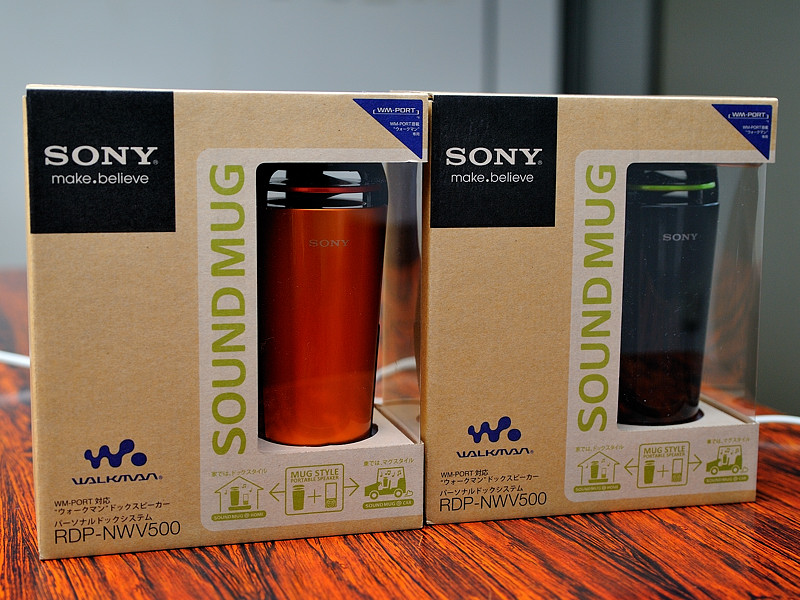
Sony Japan recently showed off a new RDP-NWV500 audio accessory, and is probably the strangest Sony product I have seen in recent memory. The NWV500 is basically a tumbler-shaped audio speaker that has WM-Port capability. Apparently the device has a digital amplifier, heavy bass and a 360-degree speaker integrated at the top. They prescribe it for the car as it should fit perfectly in your drink holder. Sony says that this is also a better alternative than FM transmitters which often are a nuisance more than anything.
However, its clear this device can’t match a dedicated media port or AUX input in a car, which many newer vehicles have these days. The NWV500, available on April 24th for Y20,000, will be available in orange or black and is scratch resistant with UV coating. We were surprised to see a 16W output, which is not bad for a device of this size. Apparently it also has 2-way bass reflex, and a 56mm woofer and 20mm tweeter. A remote control is included, and it can run either from the car’s 12V accessory socket (aka cigarette lighter).
\RDP-NWV500
<amanaDigitalLockerPhoto><downloadInfo><downloader><id>1271</id><loginId>CORESUGI</loginId></downloader><time>Mon Mar 15 11:44:42 JST 2010</time></downloadInfo></amanaDigitalLockerPhoto>
<amanaDigitalLockerPhoto><downloadInfo><downloader><id>1271</id><loginId>CORESUGI</loginId></downloader><time>Mon Mar 15 11:44:39 JST 2010</time></downloadInfo></amanaDigitalLockerPhoto>
Along with the 2011 TT, Audi has released details on a few upgrades for the new Q7 Crossover/SUV. For 2011, the Audi Q7 gets three new V6 engines and an 8-speed tiptronic transmission.
Continuing with its downsizing strategy, Audi will offer the Q7 with two version of the 3.0 TFSI supercharged V6 engine. The first version of the engine makes 272-hp allowing the Q7 to hit 62 mph in 7.9 seconds. The second version of the 3.0 TFSI supercharged V6 is straight out of the Audi S4 making 333-hp allowing the Q7 to go from 0-62 mph in 6.9 seconds. The third V6 engine is the second-generation version of the 3.0 TDI, which now makes 240-hp and helps the Q7 return an impressive fuel-economy of 32 mpg.
All 2011 Audi Q7 models will be mated to a 8-speed tiptronic, which is based on the 6-speed unit but with another friction-clutch shift element added.
All these details provided in the press release are for the Euro-spec Q7 – stay tuned for the U.S.-specs.
Hit the jump for the press release and the high-res image gallery.
2011 Audi Q7:
The Audi Q7: new engines and eight-speed transmission for power and efficiency
The Q7 is the large Audi for the sporty individualist – the high-performance SUV for sport, leisure, family and business. Now Audi has made it even more powerful and efficient, with a choice of three new V6 engines and an 8-speed tiptronic transmission.
Engines: a new range
Even more power, even higher efficiency: Audi has revised the engine lineup for the Q7. The two gasoline engines, both V6 units but with different power outputs, are new, and so is the second-generation V6 TDI. A mighty V8 diesel completes the range. All the engines for the Q7 combine two technologies: forced induction and direct fuel injection. A high-performance recuperation system that recovers energy during braking is also a standard item with all six- and eight-cylinder engines.
The new 3.0 TFSI gasoline engine embodies Audi’s downsizing strategy: replacing engine displacement with supercharging. Within the 90-degree angle formed by its cylinder blocks there is an engine-driven supercharger that compresses the intake air. Two charge-air intercoolers prevent the air temperature from rising, so that the engine draws in more oxygen for the combustion process. Vigorous thrust and spontaneous throttle response make the 3.0 TFSI engine, with its sonorous note, an ideal source of power for the large high-performance SUV from Audi.
Two versions of the supercharged V6 are available. The basic version develops 200 kW (272 hp) and has a maximum torque of 400 Nm (295.02 lb-ft) over a broad engine-speed range from 2,250 to 4,750 rpm. It accelerates the Q7 in 7.9 seconds from a standing start to 100 km/h (62.14 mph) and gives it a top speed of 222 km/h (137.94 mph), or 225 km/h (139.81 mph) with adaptive air suspension.
The more powerful version of the 3.0 TFSI delivers 245 kW (333 hp) and a torque of 440 Nm (324.53 lb-ft) between 2,900 and 5,300 rpm. 100 km/h (62.14 mph) are reached in 6.9 seconds, with powerful forward progress continuing until 243 km/h (150.99 mph) are reached; with adaptive air suspension the top speed is 245 km/h (152.24 mph). Both versions of the 3.0 TFSI are impressively efficient: in the EU fuel consumption test cycle they are content with 10.7 liters per 100 kilometers (21.98 US mpg). Compared with the previous engines, the 3.6 FSI and the 4.2 FSI, fuel consumption has been reduced by 1.4 and 2.0 l/100 km – 12 and 16 percent respectively.
The second-generation 3.0 TDI, a new development, has effectively nothing in common with its predecessor – apart from plenty of power! It has a rated output of 176 kW (240 hp) and a constant 550 Nm (405.66 lb-ft) of torque all the way from 1,750 to 2,500 rpm. This V6 diesel accelerates the Q7 from a standstill to a typical main-road speed of 100 km/h (62.1 mph) in 7.9 seconds and reaches its top speed at 215 km/h (133.59 mph) or, with adaptive air suspension, 218 km/h (135.46 mph). Its fuel consumption is impressively low, averaging 7.4 liters per 100 km (31.79 US mpg), which is equivalent to CO2 emissions of 195 grams per kilometer (313.82 g/mile). This is an improvement of 1.7 l/100 km or 19 percent.
The latest 3.0 TDI engine weighs much less than before: 198 kilograms (436.52 lb), a reduction of 20 kg (44.09 lb). A new chain-driven timing gear and a complex cylinder wall machining process have reduced internal friction. The new turbocharger is exceptionally responsive, making itself felt as rapid torque buildup. The common rail injection system has also undergone further development: it has a maximum operating pressure of 2,000 bar and can therefore inject fuel in an extremely precise spray pattern.
The crankcase and cylinder heads of the new 3.0 TDI have separate cooling water circuits connected together by valves. During the warm-up phase and when loads are not high, the coolant is not circulated in the engine block. This saves energy and raises the oil more quickly to its regular operating temperature. The new start-stop system switches off the engine when the Q7 comes to a standstill.
Audi also offers its customers a second version of the V6 TDI: the 3.0 TDI clean diesel. It already meets the exhaust emission limits laid down in the Euro 6 standard, which does not come into force until 2014, and the tough US regulations as well. Sensors in the combustion chambers, a common-rail fuel injection system with a delivery pressure of up to 2,000 bar and a high-performance exhaust gas recirculation system keep untreated exhaust emissions to a minimum. A DeNox catalytic converter in the exhaust system reduces the remaining oxides of nitrogen by means of an additive. The 3.0 TDI clean diesel also develops 176 kW (240 hp) and has an impressive 550 Nm (405.66 lb-ft) of torque between 2,000 and 2,250 rpm. It takes the Q7 from a standstill up to 100 km/h (62.14 mph) in 8.1 seconds and gives it a top speed of 215 km/h (133.59 mph), or 218 km/h (135.46 mph) with adaptive air suspension. Its average fuel consumption is 8.4 liters per 100 km (28.00 US mpg).
The Q7 4.2 TDI has also had its fuel consumption drastically reduced – from 9.9 (23.76 US mpg) to 9.2 liters per 100 km (25.57 US mpg) – by installing a 2,000-bar fuel injection system and minimizing internal friction. Yet at the same time the V8 diesel, with its unchanged power output of 250 kW (340 hp), delivers more torque than before. It now supplies a vigorous 800 Nm (590.05 lb-ft) between engine speeds of 1,750 and 2,750 rpm. The big TDI engine gives the Q7 performance figures worthy of a sports car. It accelerates from 0 to 100 km/h (62.14 mph) in 6.4 seconds and has a top speed of 242 km/h (150.37 mph).
Power transmission: eight speeds are standard
Audi has given all six- and eight-cylinder Q7 versions a new automatic transmission. The eight-speed tiptronic lowers fuel consumption by about five percent. It is based on the six-speed unit, but with another friction-clutch shift element added. Being able to shift between eight ratios keeps the jumps in engine speed low: the engine always runs close to its ideal operating point. All gear shifts are fast, flexible and take place extremely smoothly without delay.
At 7.25 to 1, the overall spread of ratios in the eight-speed tiptronic is unusually wide. In the lower ratios the Q7 accelerates powerfully; in the higher ratios it rolls along efficiently at low engine speeds.
To cut fuel consumption still further, the torque converter lockup clutch eliminates slip even at low engine speeds. Any engine vibration that could occur as a result is suppressed by the new damper in the torque converter until scarcely any trace can be detected.
Drivers can choose between the D and S programs – or make their own gear shifts at the transmission selector lever or the optional steering-wheel paddles. In combination with the 3.0 TDI the new eight-speed tiptronic achieves an exceptionally high level of efficiency. Its oil cooler is heated after a cold start by hot coolant from the engine’s cooling system. An electric oil pump makes operation of the Q7’s start-stop system possible: it maintains oil pressure in the hydraulic circuit when the engine stops, and closes the clutch for restarting.
The eight-speed tiptronic transmission transfers engine power to the quattro permanent all-wheel drive train. This splits the power in a sporty manner, with 40 percent going to the front and 60 percent to the rear wheels, but in certain on- or off-road situations, the mechanical-action center differential can direct up to 65 percent of the power to the front or up to 85 percent to the rear.
The chassis: agile and safe
The Q7 is one of those personalities who are at home wherever they may be. On the road it excels with its precise, sporty handling, and where the hardtop surface ends it demonstrates impressive offroad characteristics. The suspension uses double wishbones made of aluminum, attached to separate subframes. The wheel bearings have been optimized to reduce friction. The servotronic steering varies the degree of power assistance according to the vehicle’s speed.
The optional adaptive air suspension (standard on the Q7 4.2 TDI and Q7 V12 TDI) with electronic shock absorber control varies the ride height to suit the actual situation. On a high-speed road it lowers the body for enhanced stability and lower fuel consumption. Across rough terrain it raises the body if a button is pressed. At the standard MMI terminal the driver can choose between five operating modes: comfort, automatic, dynamic, offroad and lift. The adaptive air suspension is also available as a dynamic S line version.
The Audi Q7 has 18-inch wheels with 235/60 or 255/55 tires, depending on the chosen engine. But other wheels up to 21 inches in diameter can be selected as optional extras. Braking is looked after by large ventilated disks. With the two most powerful engines even larger disks made from lightweight carbon-fiber reinforced ceramic material are available. They are gripped firmly when the need arises by black callipers with “Audi ceramic” lettering. The ESP stabilization program includes an off-road mode as standard that gives priority to traction on a loose surface. And when the driver encounters a steep downhill slope off-road, the hill descent assist is a useful aid.
Design and body: sculpture in motion
The design of the Q7 stands for power and presence; it is the visual expression of this large SUV’s character. Flowing surfaces create a moving sculpture, with the coupé-like roofline, the low window strip and the tautly curved panel surfaces being distinctive visual features. The outlines are sporty, strong and elegant.
The Audi Q7 is 5.09 meters (16.70 ft) long, 1.98 meters (6.50 ft) wide and 1.74 meters (5.71 ft) high. Its wheelbase of 3 meters (9.84 ft) creates a luxurious amount of space inside. The front-end styling is dominated by the large singleframe grille with chromed surround, and the headlamps. As an optional extra Audi can supply a xenon plus version with LED daytime driving lights and LED flashers, and also an adaptive light version with integrated turning and cornering lights as well as the low, full and highway beams.
Standard LEDs in the rear lights create a distinctive lighting pattern. The tailgate, which wraps around the rear roof posts in an S-shaped outline, and also the hood and the front fenders are made of aluminum. Audi supplies the add-on parts in a contrasting color as standard, or, if desired, in the same color as the body. The Audi Q7 always leaves the assembly line with a high-gloss package. Optional extras are the black styling package or the aluminum-look exterior package, which consists of an all-round chrome trim strip on the bumpers, door capping strips and door handles, and gives the Q7 even greater sophistication. The optionally available S line exterior package also adds further visual emphasis to this SUV’s sporty potential.
The interior: abundant space
The Q7 sets standards for flexibility: no fewer than 27 seat configurations are possible. Depending on the wishes of the customer, Audi can supply its large SUV as a five-, six- or seven-seat version. This last version has comfortable single rear seats and a third row of seats at the back for occupants up to 1.60 meters (5.25 ft ) tall. As a standard feature, the seat backs in the second row can be folded down to provide a level cargo floor. This increases load capacity from 775 liters (27.37 cubic ft) to 2,035 liters (71.87 cubic ft) in volume.
Operation of the controls is simple and logical, and the clearly marked instruments are easy to read. For the driver and front passenger there is a choice of three seat versions: standard seats, electrically adjustable sport seats and climatized luxury seats that can be both heated and ventilated. The elegant lines of the interior, with many restrained details, communicate the typical feeling of wellbeing that the Audi driver or passenger enjoys. The ambient lighting provides subtle highlights, and many of the control elements have fine chrome trim. The workmanship is typical of Audi – quality with no compromises.
The choice of colors and materials emphasizes the distinguished character of the interior of the Q7. A variety of leather grades, headlinings and inlays are available, and for the individualist there are leather and design packages of various styles. The S line sports package uses cool black throughout the interior, with subtle accents in the trim and upholstery. Among the items it includes are sports suspension and 20-inch wheels.
Equipment and trim: the highest standards of luxury
The Audi Q7 comes with an opulent array of standard equipment features, including two-zone deluxe automatic air conditioning, high-beam assistant, an MMI radio operating system complete with audio system and eight speakers, a double load floor in the cargo area with storage compartment and a dirt tray. Roof rails are also fitted.
A standard item when the optional driver information system is chosen is the on-board computer with efficiency program. This monitors the vehicle’s energy flows and displays the requirements of the most important consumers, with hints on how to reduce consumption.
The list of optional extras includes such luxury features as the convenience key, four-zone automatic air conditioning, a dark glass panoramic roof and a cool box. Items of interest for sport and leisure include an electric tailgate mechanism, baggage retaining rails and a sliding storage box. In the program of accessories are such items as a pivot-head tow hitch – the large SUV can tow a trailer weighing up to 3.5 metric tons (7,716 lb).
In the infotainment area Audi also offers a complete modular system. The top-of-the-line version has an integral hard disk drive for navigation, music, and telephone data, a color monitor with 3D graphics, a DVD player, and voice control. It can be expanded into a luxury media center with features such as a Bluetooth telephone, TV tuner, digital radio tuner, plus rear seat entertainment. A special highlight is the Advanced Sound System from Bang & Olufsen with its 14 channels, 1,000 watts of power and 14 speakers. In the cockpit area two acoustic lenses reproduce the treble frequencies; when the system is started, they extend out of the dash panel.
The range of optional equipment is rounded off by advanced driver assistance systems. The adaptive cruise control system regulates speed and following distance by means of targeted accelerating and decelerating. If a risk is detected, the integral Audi braking guard provides a warning. Audi lane assist helps the driver to stay in lane; Audi side assist employs radar to help drivers change lanes more safely. The Audi parking system advanced assists parking by means of a rearview camera.
The Audi Q7 V12 TDI quattro: the most powerful diesel SUV in the world
The Audi Q7 V12 TDI quattro is the most powerful diesel SUV in the world. Its 6-liter twelve-cylinder TDI engine develops 368 kW (500 hp) and delivers 1,000 Nm (737.56 lb-ft) of torque between 1,750 and 3,250 rpm to the six-speed tiptronic transmission. With a time of just 5.5 seconds from zero to 100 km/h (62.14 mph) and a governed top speed of 250 km/h (155.34 mph), the Audi Q7 V12 TDI quattro matches the performance of a powerful sports car, but is content with a fuel consumption of only 11.3 liters per 100 kilometers (20.82 US mpg).
The luxurious standard equipment specification of the Audi Q7 V12 TDI quattro includes 20-inch wheels, Audi ceramic brakes, xenon plus headlights, adaptive air suspension, a Bose sound system, sport seats and many other features. This top version also has a number of striking body details that identify it immediately.
The equipment, data and prices specified in this document refer to the model range offered in Germany. Subject to change without notice; errors and omissions excepted.
There are not many empty seats in the dismal, echoing conference chamber in the ghastly concrete box that is the Hotel Maritim here in Bonn, where the UN’s latest attempt to maneuver the 194 States Parties to the Framework Convention on Climate Change gets underway today.
The “international community”, as it is now called, is here in full force, in the shape of expensively-suited, shiny-shod bureaucrats with an urbane manner and absolutely no knowledge of climate science whatsoever.
However, one empty chair is a pointer of things to come. The Holy See – a tiny nation in its own right, with a billion citizens around the world – has left its chair empty. And that is significant. If “global warming” still mattered, the Vatican would make sure that its representatives were present throughout this gloomy gathering of world-government wannabes.
Far-left advocacy group Greenpeace receives large donations from rich and powerful people, enough to drown the entire notion of political independence and non-partisanship. The mechanism of receiving funding – through foundations – is the same as the opposition “right wing” organizations that it criticizes for funding bias.
Greenpeace is an international conglomerate, composed of corporations in 40 countries across Europe, the Americas, Asia, Africa and the Pacific. Included among Greenpeace’s largest corporate donors are the Rockefeller brothers, Ted Turner and Jane Fonda, and the Macarthurs; as well as a long list of foundations with left-leaning gifting bias.
Since people on the left are generally unfamiliar with religious thought, my guess is that the Greenpeace propagandists are unfamiliar with the rules on casting the first stone. The group’s recent libelous attack against the Koch brothers appears to have had a dual purpose; both obviously connected to the exposure of the global warming scam.
Sony Japan has released information on the eclectic NAS-V7M and NAS-V5 speaker docks with WM-Port, USB, and MP3 CD capability. They are quite stylish in design, and also quite large. Due for release on June 26th, the latest in the NAS home audio series has several unique features. The V7M to transfer music from a CD straight to your Walkman with the touch of one button.
And with a wired LAN and Wi-Fi integration, you can enjoy access to Internet radio services such as vTuner and SHOUTcast. 20 programmable stations for the Internet radio allow you to quickly hit your favorite genres without having to search. CD’s that are inserted also automatically have CD/title information pulled and displayed from the ‘net.
It’s important to state that the NAS-V7M is a bit more advanced than the V5, as it has 16GB of built-in storage, 2x CD to HDD recording capability (128/256kbps mp3), and MP3/WMA/AAC/ATRAC and PCM. Great to see ATRAC still lives on in Japan. Output is fairly good at 7.5W +7.5 W, with a full range speaker size of 65mm.
NAS
IB_S_BASIC_COPYRIGHT =
IB_S_BASIC_COPYRIGHT =
IB_S_BASIC_COPYRIGHT =
IB_S_BASIC_COPYRIGHT =
“Real life” series photos are from AV Watch.
Sony has also noted that both devices has a 32-bit digital amplifier with DSP, rich bass and excellent treble. Both also have a USB port, and headphone jack. The Y50,000 NASV7M will be available in silver and gold, while the Y40,000 NAS-V5 will be available in black and pink.
Science Daily: Keeping with the global “green” trend, educators worldwide are relying more on environmental education lessons to enhance students’ science knowledge. Studies have revealed that bringing environmental education into the curriculum raises not just science scores — environmental-based lessons can also improve student test scores in other subject areas. Naturally, educators are interested in developing new ways to integrate these relevant lessons into the classroom in hopes of piquing student interest and comprehension in multiple subject areas.
To accompany an established program called “Coastal Roots,” educators in Louisiana recently designed and tested eight hands-on horticulture lessons to teach middle school students the basic needs, processes, and benefits of plants. Students who received the horticulture lessons were tested on science content and “environmental awareness.” Significant increases in student post-test scores were found in both years of the study.
In 1999, The Louisiana Sea Grant College Program established ”Coastal Roots” an innovative program designed to teach information on Louisiana’s wetland loss and foster stewardship for the state’s coastal resources in elementary through high school students. The program combines nursery management and coastal environmental awareness into a hands-on program in which students at participating schools grow coastal plants for use in local wetland restoration projects.
To compliment the nursery-based Coastal Roots program, the researchers designed eight hands-on lessons that take basic horticulture knowledge a step forward by introducing the importance of plants to Louisiana’s wetlands. Kathryn Karsh, Edward Bush, Janice Hinson, and Pamela Blanchard from Louisiana State University published the study report in HortTechnology.
Four Louisiana schools participated in the LSU study. The schools were chosen from those participating in the Coastal Roots program, and included one private and three public schools in four southern central parishes (counties). Students were tested on science content in the lessons using a pre-test, eight multiple choice quizzes (each focusing on a particular lesson), and a post-test. An “attitudes toward the environment scale” test was administered to evaluate students’ environmental awareness changes in the treatment and control groups.
Students who received the horticulture lessons improved their post-test scores by 11.4 points in the first year and an impressive 25.07 points in the second year of the study. In the second year, students who received the lessons were more found to be significantly more “aware of their role in the environment” than those who did not receive the additional lessons.