Looks like Square Enix isn’t the only one gearing up for a surprise announcement this week. Rumor has it that a new Pokemon title will be revealed come Sunday.
Author: Serkadis
-
New Pokemon to be announced Sunday?
-
A Small, Petty, Place reserved in Hell
 I know society comes up with a million stereotypical reasons to hate lawyers (and speaking as a lawyer I will received 333,333 reasons before taxes). But really it’s the mix of the law and the chance to make a buck off the misery of others that really takes it.
Talx, which emerged from obscurity over the last eight years, says it handles more than 30 percent of the nation’s requests for jobless benefits. Pledging to save employers money in part by contesting claims, Talx helps them decide which applications to resist and how to mount effective appeals.
Across the country the standard for obtaining unemployment is essentially the same – a terminated employee is entitled to unemployment insurance benefits unless they either quit their job or engaged in serious misconduct.
But, if benefits are rewarded an employer has to pay more unemployment insurance tax.
Enter Talx, making money by encouraging employers to be jackasses and increase misery, because it may, ‘just may’ save more in taxes than it costs to pay Talx.
“Talx often files appeals regardless of merits,” said Jonathan P. Baird, a lawyer at New Hampshire Legal Assistance. “It’s sort of a war of attrition. If you appeal a certain percentage of cases, there are going to be those workers who give up.”
Kicking a person when their down — for fun and profit.
(pic from here)
-
Mega Flood Lake Agassiz
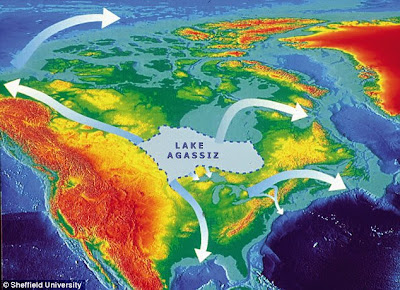 I have posted extensively on the topic of the events that took place around 11,000 to 13,000 years ago. A lot of evidence supports the idea of a crustal shift triggered by a comet impact into the ice cap close by the then North Pole position. Some of it is direct but a huge amount of the evidence is indirect or inferential.Most telling is that a direct crustal shift does end the million year Ice Age while nothing else does. In addition the ice is exactly were it belongs and the geological evidence is then in the right place geographically.All the good direct evidence is long since lost under three hundred feet of water.This article discusses the collapse ofIt also seems reasonable for the crustal shift to create the necessary conditions for the creation of the lake itself. That may not be true at all. The land barrier would become much more secure if the lake formed thirty degrees north over many millennia. The crustal shift would then lift up the lake itself sufficiently to effect the broad swift emptying that in fact took place.It may actually solve a problem. You will observe that there are no large lakes positioned on the ice caps anywhere today. It is not unreasonable at all to presume that they are simply impossible because natural elasticity and failure modes assure us such water will penetrate the ice and escape.ThereforeIt is also possible that the original conditions forWe are still a long ways from working out time lines with any particular confidence of say even a century or so. It really needs a round table with specialists.Mega-flood triggered
Last updated at 2:00 AM on 02nd April 2010Mark Bateman from the University of Sheffield, said a catastrophic flood was caused when an ice sheet in the U.S melted causing a huge amount of freshwater to be dumped into theThis led to the shutting down of the Gulf Stream ocean circulation pattern that brings warmth toA huge lake (pictured), the size of the‘We’re talking about a lake the size of the‘We don’t know the exact period of time but we’re talking about a catastrophic flood.’The finding has confirmed past theories about the likely cause of a sudden cooling period called the Younger Dryas when temperatures in‘Our research shows that if you put a large volume of fresh water into theHis team’s work is published in the latest issue of the journal Nature.The Gulf Stream acts like a conveyer belt by bringing warm water from the tropics toThe last of winter sea ice inClimate scientists fear rapid global warming could trigger a sharp increase in the amount of meltwater fromThis surge in freshwater could trigger a tipping point that overwhelms the Gulf Stream, shutting it down and likely plunging Europe into another deep freeze.Dr Bateman and his team confirmed the path of the floodwaters fromScientists had previously guessed that a giant flood unleashed from the lake probably caused the Younger Dryas cooling but couldn’t confirm the route of the floodwaters.A research team log sediments in a cliff exposure atDr Bateman found that the waters flowed down the Mackenzie River,Studying sediments from cliff sections along the river delta, he said the evidence spanned a large area at many altitudes. This could only be explained by a mega-flood fromDating of the sediments helped the team pin down the date of the flooding, showing that it occurred right at the start of the Younger Dryas.Satellite observations and computer models by scientists have shown that the Greenland ice sheet is melting at an accelerating rate, dumping large amounts of ice and meltwater into theA study published in the journal Science last November said recent summers further acceleratedRead more:
-
18 Medicinals in NA

This is a good check list of presently known medicinal plants now available in
I grew up been curious about the benefits of local plants in mid western
So this is a reminder that in the known ranges of these plants, specimens are everywhere, likely thanks to the distribution powers of birds. The trick is to actually ferret them out. Every square yard is a likely micro biome. A simple six inch depression in the ground can completely alter plant behavior. My best example of that was to find a couple of yards of depressed ground in a sunlight meadow in which the wild strawberries avoided frost damage. Instead of round berries tip burned by frost, we found long perfect berries with maximum sweetness. Greenhouse grown wild strawberries is strongly indicated for the gourmand trade.
The pictures are excellent and many you should recognize. Otherwise it is time to get out in the woods and identify this stuff.
18 of Nature’s Most Powerful Medicinal Plants
http://cdn.webecoist.com/wp-content/uploads/2008/09/medicinalplants.jpg
(Part of an Exclusive WebEcoist Series on Amazing Trees, Plants, Forests and Flowers
From marijuana to catnip, there are hundreds of remarkably common herbs, flowers, berries and plants that serve all kinds of important medicinal and health purposes that might surprise you: anti-inflammatory, anti-fungal, insect repellent, antiseptic, expectorant, antibacterial, detoxification, fever reduction, antihistamine and pain relief. Here are eighteen potent medical plants you’re likely to find in the wild – or even someone’s backyard – that can help with minor injuries, scrapes, bites and pains.*
Images via Current and Street KnowledgeSeriously. Though marijuana is still illegal in theLady Ferns
http://cdn.webecoist.com/wp-content/uploads/2008/09/lady-fern.jpg
Image via US Forest Service
If you grew up in theCalifornia Poppy
http://cdn.webecoist.com/wp-content/uploads/2008/09/california-poppy.jpg
Images via Netstate and Mountain Meadow Seeds
The brilliant blooms of the poppy make this opioid plant an iconic one. The plant is an effective nervine (anxiety reliever) and is safe for use on agitated children. Can be made into a a tea for quick relief of nervousness and tension. A stronger decoction will offer pain relief. (A decoction is made by “stewing” all safe plant parts, including stems and roots if possible, in water for several hours and, ideally, soaking overnight.)Blood Flower
http://cdn.webecoist.com/wp-content/uploads/2008/09/mexican-butterfly-blood-flower.jpg
Image via Mistifarang
The blood flower (also Mexican butterfly weed) is a type of tropical milkweed with toxic milky sap that is emetic (it makes you hurl). It’s also historically favored as a heart stimulant and worm expellent. Pretty useful for a number of potential hiking disasters, if you think about it. (Of course, if you’d quit eating those poisonous berries you probably wouldn’t need to worry about finding a natural expectorant.)Tansy
Image via Earth Heart Farm
If you’ve decided to backpack through Europe instead of the mountains ofKorean Mint (hyssop)
Image via Herb Gully
Who doesn’t want to be minty fresh? Most of the various types of “mint” ormentha – spearmint, Korean mint, applemint, regular old mint – offer reported health benefits and medicinal properties. (Avoid pennyroyal, as it’s poisonous.) Mint is famous for soothing headaches, fighting nausea, calming the stomach and reducing nervousness and fatigue. Korean mint, also called Indian mint and hyssop, is a fairly effective antiviral, making it useful for fighting colds and the flu. Whatever continent you’re on, some type of mint is usually to be found. Eat whole, garnish food or make tea to get the all purpose health benefits.Alfalfa
Image via In Advance
Alfalfa is fodder for livestock for a reason: it’s incredibly rich in minerals and health-promoting nutrients and compounds. With roots that grow 20 to 30 feet deep, alfalfa is considered the “father of all plants”. (It also contains a high amount of protein for a green.) Alfalfa originally grew in the Mediterranean and Middle East but has now spread to most ofCatnip
http://cdn.webecoist.com/wp-content/uploads/2008/09/catnip.jpg
Images via UCC
The cannabis of the cat kingdom. Famous for making cats deliriously crazy, catnip has health properties that are great for humans, too. Catnip can relieve cold symptoms (helpful if you’re on a camping trip and don’t have access to Nyquil). It’s useful in breaking a fever as it promotes sweating. Catnip also helps stop excessive bleeding and swelling when applied rather than ingested. This mint plant (yep, another one) is also reportedly helpful in treating gas, stomach aches, and migraines. Catnip can stimulate uterine contractions, so it should not be consumed by pregnant women. It grows in the Northern Hemisphere.Sage
Image via Palestine Shop
Sage is an incredibly useful herb, widely considered to be perhaps the most valuable herb. It is anti-flammatory, anti-oxidant, and antifungal. In fact, according to the noted resource World’s Healthiest Foods, “Its reputation as a panacea is even represented in its scientific name, Salvia officinalis, derived from the Latin word, salvere, which means ‘to be saved’.” It was used as a preservative for meat before the advent of refrigeration (eminently useful: you never know when you’ll be forced to hunt in the wild). Sage aids digestion, relieves cramps, reduces diarrhea, dries up phlegm, fights colds, reduces inflammation and swelling, acts as a salve for cuts and burns, and kills bacteria. Sage apparently even bringscolor back to gray hair. A definite concern when lost in the woods.Blackberries
Image via Old Ice Works
Did you know blackberries have useful healing properties? Of course they’re loaded in antioxidants and vitamins, but the leaves and roots have value, too. Native Americans have long used the stems and leaves for healing, while enjoying the young shoots peeled as a vegetable of sorts and the berries, either raw or in jams. The leaves and root can be used as an effective treatment against dysentery and diarrhea as well as serving usefulness as an anti-inflammatory and astringent. Ideal for treating cuts and inflammation in the mouth.Wild Quinine
Image via Stone Silo Prairie Gardens
According to Alternative Nature Online, wild quinine is a potent herb that “is used as an antiperiodic, emmenagogue, kidney, lithontripic, poultice. It has traditionally been used in alternative medicine to treat debility, fatigue, respiratory infection, gastrointestinal infection, and venereal disease.” Whatever the ailment, quinine is famously helpful in treating it. Only the root and flowers are edible; avoid the plant.Navajo Tea
Image via Birds ‘n Garden
Also called greenthread, Plains Tea or Coyote Plant, this plant has been used for centuries by Native Americans to quickly relieve that most brutal and irritating of infections: the UTI (urinary tract infection). Best when made into a tea or decoction.Red Clover
Image via Foxy Island
Native to Europe, Northern Africa andSweet Marjoram
Images via Tasteful Garden and Veseys
Marjoram and oregano are often used interchangeably, but the aromatic sweet marjoram is slightly different. The Greeks called it the “Joy of the Mountain” and it was revered throughout theBurdock Herb
Images via Norman Allen and Ontario Wildflowers
Burdock, or cocklebur, is a prickly, thistle-like plant that grows commonly in many parts of the world. It can get fairly big and its leaves resemble the elephant ear plant. Though the burs often get caught in pets’ and livestock’s fur, don’t think of it only as an annoying plant. It is a highly effective treatment against poison ivy and poison oak (claims that it cures cancer are slightly *less* substantiated).Feverfew
Image via Earth Heart Farm
Feverfew is a plant that has well-known and documented health properties and medicinal benefits. This anti-inflammatory can treat rheumatism, arthritis and, most famously, migraine headaches and tension headaches. It’s also good for alleviating tension and general anxiety (it is a natural serotonin inhibitor). It also helps to reduce swelling and bruising. Though feverfew is most effective when taken daily, it can be a helpful pain reliever when no Advil is on hand.Sweet Violet
Image via Firefly Forest
Native to Europe andWinter Savory
Image via CGNA
Winter savory is your savior against insect bites and stings. One of the most effective natural plant treatments for bug bites is originally from Europe and the -
Desalination Surging
 This one has snuck up on me. The delivery cost over the past decade has clearly drifted down even without a radical game changer such as we were proposing in 2000. This has made desalination work in far more conventional locations than I ever anticipated. There was obviously a lot more fat to winkle out of those budgets.Cheap water is wonderful, but if the need exists it is obviously no big trick to fold in a desalination plant into a conventional water supply and simply blend costs to keep the product acceptable. We even have a case of just this with waste water in Windwoek.I presume these are all membrane based systems and consume a fair bit of energy. They also end up producing a briny waste stream that tends to limit expansion as theGlobal water crisis and cheaper technology sparks surge in desalinationFrom the GuardianMar 31, 2010
The world’s unquenchable thirst for clean water drove a record increase in the desalination and reuse of sewage last year, figures show, as water-stressed countries around the world try to build their way out of trouble.Making fresh water from the sea was once the preserve of cruise ships and oil-richThe rise in fresh water production was the biggest ever recorded, reaching 9.5 cubic metres a day, the annual report by analysts Global Water Intelligence will say tomorrow. That is equivalent to twice the annual flow of theBut wet overpopulated cities such asWith water “manufacturing” allowing people to change fundamentally the geography of fresh water on such a large scale, Christopher Gasson, GWI’s publisher, talks of “rivers flowing backwards”.“People do desalination when they run out of opportunities, and the problem is the world overall is running out of opportunities: groundwater is overexploited to the extent it’s becoming saline and unusable; rivers are being drained; new dams are becoming less and less viable [and] long-distance transfer is expensive and controversial,”he said.The fundamental reason for the rise of water manufacturing is a simple gap between demand and supply: in 2006 a report from the International Water Management Institute found one in three of the world’s population were “enduring one form or another of water scarcity” – such as “when women work hard to get water, [or] you want to allocate more but can’t”.Growing numbers of people, richer lifestyles, demand for water-intensive food such as meat, and dwindling supplies are expected to increase that number – to up to half the projected global population or more in the middle of this century. And that is despite an expected doubling of water manufacturing capacity between now and 2016, according to UK-based GWI.The falling cost of desalination, thanks to technology improvements, is key, and the reuse of water can be cheaper still.Contracts have been signed to deliver desalinated water in Algeria and Israel for 55–56 cents (36p) a cubic metre, and reuse plants can now turn sewage into drinking water for 40–45 cents a cubic metre, said Gasson. To compare, the average cost ofComparisons between the energy needs of different desalination methods – heating up water for distillation or pushing it through membranes to filter the salt – have also become much closer. Continuing developments in membranes – which one day are likely to be modelled on the “technology” nature uses in kidneys and mangroves – will continue to bring down costs and energy needs, said Gasson. Systems using carbon-free energy are also being tested: nuclear desalination in the UAE, solar power inDespite the advances, there are still serious objections to manufacturing water. The WWF remains concerned about building facilities in often environmentally sensitive coastal and wetland areas; about the intake of seawater, which is home to millions of tiny species, and discharge of the remaining brine, which can be contaminated with cleaning chemicals and particles from corroding pipes. Concerns about the energy use of plants also still remain, especially where they are still dependent on fossil fuels, or if they could divert renewable resources which could otherwise replace existing carbon-intensive energy supplies. Residents in upmarketWater worldsThe capital, surrounded by desert, has the world’s only system that treats waste water and puts it back into the public water supply, mixed with water from the city’s main reservoir. The success of the scheme is credited to a long-standing public acceptance campaign, including advertising, education in schools and an “excellent” water-quality record.Arizona and Nevada, US: desert desalinationNorth American states andDespite its rainy reputation,This article was shared by our content partner the Guardian.environmentalresearchweb is now a member of the Guardian Environment Network.About the authorJuliette Jowit is the Observer’s environment editor. -
Psychics Tackle Prisons
 I consider this somewhat premature considering the state of research into psychic science itself. Or have I been missing something?I certainly think that any process that establishes a new belief system in an obviously flawed individual has merit. The army does this all the time. If a patient is prepared to accept guidance it is clearly proper to deliver that guidance under appropriate oversight.Society needs rehabilitation of the individuals involved. It actually does not matter a whit how that comes about. These are all methods that appear to release deep repressed feelings and clearly have the potential to advance the case. Possibly this can even come about with far greater ease than through conventional therapy.We are so used to making rational demands yet outright failing to communicate. Making irrational demands may simply get through and that is good enough. Certainly the practitioner will be able to gain the trust of a broader group of patients.Think about this. A patient sitting down with a clairvoyant will completely lose sight of the fact that he is been treated. The odd rules of engagement are perfect to reset the patient’s mental framework. In short, even a faux psychic can introduce changes using this method.Dutch prisons use psychics to help prisoners contect the deadDutch prisons are using psychics to give jailed criminals guidance by putting them in touch with their dead relatives.By Bruno Waterfield
Published: 1:54PM GMT 26 Mar 2010A spokesman for the Dutch justice ministry said: “This is not something which fits in our treatment field.”Paul van Bree, a self-styled “paragnost” or clairvoyant, has been hired by the Dutch prison service to teach prisoners how to “love themselves”.“I tell them that dead relatives are doing well and that they love them. That brings them peace. Big strong men burst into tears,” he said.Mr van Bree, who also publishes annual predictions of the future, claims to be from a long line of clairvoyants, including his mother and grandmother.The Dutch paranormal, who describes himself as the “happy Buddha” told De Tijd magazine that he is not the only psychic healer employed by the Dutch justice ministry.He has claimed that by talking to both the prisoner and the prisoner’s dead parents he can discover key psychological insights to help the prison authorities rehabilitate criminals.“With my antennae I sometimes reveal more than a psychologist or a prison welfare officer,” he said. “My work can be compared to mental health care in widest sense of the words.”A spokesman for the Dutch justice ministry said: “This is not something which fits in our treatment field.”The Dutch employment service has also looked beyond the normal to use “regression therapy” and tarot cards to help the jobless.Uncooperative welfare claimants have been told they will lose benefits unless they accept the guidance of a regression therapist to help them get in touch with their past lives.In 2007, 42,500 Dutch people signed up to state funded spiritually-based “personal development programmes”. -
Moderncat Etsy Find: Handmade Fabric Cat Buttons from Heyday Handmade

Looking for the perfect button for that craft project you’ve been meaning to finish? Check out these wonderful fabric covered buttons from Heyday Handmade. Each button is hand-sewn using Japanese cotton fabrics and a plastic shank, which offers a rounder surface than metal pressed buttons. I may have to come up with a project just so I can use some of these!
-
Another ‘surprise’ to come from Square Enix later this week
Square Enix is apparently not yet done with surprises. After their announcement last week of the PSN Japan release of Final Fantasy XI, the publisher is at it again, dropping some more Easter Egg surprises via Twitter.
-
Brooke Jacobs Kitten Post-it Winners

Congrats to Cathy (comment #41) and Victoria (comment #173) winners of the kitten Post-its from Brooke Jacobs. I hope you both have fun leaving these adorable little notes for the cat lovers in your office or at home!
-
Mastering Brushes in Photoshop
All Photoshop Brushes are based on a flexible, sophisticated system which you can use to customize existing Brushes or to create new ones from scratch. When you select a tool, its corresponding options will become accessible in the upper tool bar. Being quite complex entities of Photoshop though, Brushes have a separate palette dedicated to them, as well. You can toggle this palette by relying on the F5 hotkey, or, alternatively, you could invoke it directly using the option bar of the Brush tool.
There are numerous attributes that control and define how a Brush behaves when you create a stroke with it. The level of this control could range from simple to extremely sophisticated, depending on the result you are looking for. The essential attributes of Brushes are the shape, the size and the hardness of the tool. Apart from these properties though, you may also need- or want to control optional values exclusive to the Brush system. As you will see, a wide range and fluent customizability of options are available to form the type of control you need to achieve the results you have in mind.

Accessing BrushesPhotoshop comes with rich libraries of Brushes, inviting you to organize a virtual jar containing the tools that you use most frequently in your current work. While the Brush system is infinitely flexible, the basis of an effective jar consists of the default Brushes Photoshop comes with. Regardless the unique sets and types of tools you will use and create, the most frequently used tool in the software will be the standard Brush with the shape of a circle.
To access a Brush Library, you need to activate the flyout menu of the Brush palette. Flyout menus are easy to spot on all Photoshop palettes. They are located in the upper right hand corner of every palette that has this function associated to it. The flyout menu of the Brush palette is quite rich in its contents. Notice that the menu is divided into numerous parts. The bottommost section lists the available Brush Libraries, while the upper sections give you straightforward controls of Brush management. Once you click on an available library, Photoshop will ask if you want to add these new Brushes to the jar, or, would you prefer to replace the previous Brushes with the contents of the selected library instead. Libraries can be saved out with the .abr – Adobe Brush – file extension to them and this is the file extension you will find downloadable libraries with, as well.
Brush Customization
The Brushes section of the Brush palette hosts all the optional attributes you could utilize to form virtually infinite types of control to define Brush behavior. To see these in effect, pick a Brush Tip of your choosing that has well defined characteristics. Tips resembling grass are good candidates to see the effects of various options on. Brush customization happens via six main categories and all of these have a separate set of controls. To see and understand how custom attributes do work, select the Shape Dynamics category and put a checkmark next to it. You have just activated this optional set of attributes. Now click on the word „Shape Dynamics” to access the attributes themselves.
The values you currently see on the right side of the palette are context sensitive and they are exclusive to the Shape Dynamics category. Try and adjust the different sliders and see how they affect the Stroke preview. This preview is a precise representation of what the stroke will look like if you amend the current settings.
Once you have established values for a category that you are happy with, you have multiple choices. You could lock these values in by clicking on the tiny padlock icon. Locked values will be remembered by the software and the visual results they yield will not be altered by any subsequent changes. There is one exception though, as you could deactivate the effect of the category by removing the checkmark. This will not remove the effect, but will toggle its visibility. These optional attributes are stackable, meaning that they will react to each other non-destructively to create the stroke you are looking for.
Essential Brush Shortcuts
There are multiple methods to access the most essential Brush attributes like the size of the tip and the hardness. A quite effective technique is to press right click with the Brush tool activated. This will grant access to a dialog panel you could define the Master Diameter – size – and the hardness from. You could select a fresh tip from here, as well. Once you are confident with the shape of the Brush though, you may want to gain even more effective control of the size and hardness attributes.
One of the most comfortable pair of hotkeys in Photoshop is activated using the bracket keys. Once you have a Brush in your hand and you press and hold the bracket keys, the diameter will change “on the fly”, giving you direct feedback on the size of the Brush. Keep in mind that the Brush cursor is not necessarily rendered by the software. In case you do not see the Brush cursor, then there is a good chance that you have it deactivated. To display the cursor and the shape again, press the hotkey “Caps Lock”. This is the shortcut to toggle the visibility of the Brush tip.
Being able to alter the size of the Brush intuitively is a valuable ability, but the hardness of the tool remains almost as essential as the previous property. To alter the hardness of the Brush, you could rely on the bracket keys once again, but press and hold the SHIFT modifier key while you set the new value. These four, comfortable hotkey maneuvers will make your work flow much more swift and fluent.
Creating Custom Brush Tips
Create or open up an image and select an area of it which you would like to use as a brand new Brush tip. Keep in mind that your selection will define the Brush tip itself. Once you are happy with the selection, go to Edit – > Define Brush Preset. A dialog will pop up, inviting you to name the new tip. You could do so or you could skip that step, as well. Regardless of your choice, the new tip you have just created is added to the current jar of Brushes. You will find the new tip as the last component of the jar. In case you would like to keep any of your custom Brushes, you could save them out as a variant of an existing Library, or you could create a Library from scratch. To remove and/or rename individual Brush tips from a Library, simply right click on the Brush tip’s thumbnail image in the jar and select the function you need.
Related posts:
- Complex Manual Selections in Photoshop Photoshop comes with various selections tools you could utilize to…
- Top 25 Photoshop Tips – Part 1 This 2 part article offers 25 tips for Adobe Photoshop,…
- Using Reuseable Borders in PhotoShop About In this tutorial I will continue where the previous…
-
Trees Insist Arctic Cooled 500-2004 AD
Article Tags: World Temperatures
 Two tenets of AGW theory are 1) tree-ring paleoclimate data reconstructs an accurate portrayal of the climate of the past [except when scientists don’t like what it shows, call it a “divergence problem” and hide the decline] and 2) the poles should show the most warming of all. Unfortunately, the Scots pines in the Torneträsk area within the Arctic Circle in northern Sweden around 68.5°N have not received the memo on AGW as of 2004. A 2008 paper shows that the updated Torneträsk data “show a trend of -0.3°C over the last 1,500 years”. The trees also say that the end of the Little Ice Age in the late 1800’s was the lowest temperature over the past 1,500 years, and according to ice core data was the lowest temperature in the past 10,000 years. By pure chance, this exceptionally cold period is also the same time the global temperature record (HADCRU) begins in 1850. Thus, the global thermometer record showing increasing temperatures in the 20th century mostly represents the recovery from the lowest temperatures of the past 10,000 years during the Little Ice Age. The Torneträsk pines insist that the rate of temperature increase and temperature anomaly of the 20th century was not unprecedented and was less than that of the Medieval Warming Period (~850-1200AD).
Click source to read FULL report
Source: hockeyschtick.blogspot.com
-
Poll: Ron Paul’s VP in 2012
If Ron Paul runs for President in 2012, who should be his running mate? Vote in our latest poll and select your top 5 choices.
Note: There is a poll embedded within this post, please visit the site to participate in this post’s poll.
This poll will remain open until April 15.
Post a comment if you’d like to suggest someone who is not included in the poll.

Related posts:
- Ron Paul 2012 Poll Results Click here to participate in our latest Ron Paul 2012…
- Ron Paul 2012: Who should be Ron Paul’s running mate? Ron Paul hasn’t announced a decision yet whether he is…
- Ron Paul 2012: When should Ron Paul announce his decision? Click here to participate in our latest Ron Paul 2012…
-
Ron Paul: Energy Exploration is None of the Government’s Business
by Ron Paul
As we head into the summer driving season, and gasoline prices are again creeping up, the administration has announced plans to explore opening up more offshore areas for exploration and drilling. On the one hand this can be lauded as a positive step. On the other hand, it’s too little, much too late to have any meaningful or long-term effect on what Americans pay at the pump anytime soon, if at all.
Indeed, if increasing domestic energy production was really a priority, the administration would direct the EPA to remove its many roadblocks and barriers to energy production. In fact, abolishing the EPA altogether would do much to improve our country’s economy. Instead of protecting the environment as they are supposed to do, most of what they do simply chills the economy. Polluters should be directly liable in court to any and all parties they harm, rather than bureaucrats at the EPA.
Of course, last week’s announcement was couched in terms of removing barriers and red tape. However, the fact that we had these barriers in the first place is yet another reminder of how the energy market is hampered and controlled by bureaucrats and central planners in Washington, rather than to the demands of the people and the decisions of private investors.
Consider how extremely negative our government’s reaction has been to other governments around the world that have nationalized their oil and energy industries, such as Venezuela and Iran. We deposed the democratically elected leader in Iran in 1953 for this very reason. Yet the level of involvement of our government and bureaucrats in energy is nearly absolute. Of course the only thing worse than our government dictating energy decisions to its own citizens, is our government’s dictating energy decisions to citizens of other countries.
Along with the waste of prohibitions that that leave our own national resources untapped, is the waste our government perpetuates with subsidies to alternative fuel sources. There is certainly profit to be made in providing cheaper, cleaner fuel sources, but government subsidy programs interfere with finding realistic long-term solutions. Subsidies divert resources towards certain politically favored fuel types while ignoring others. If the market were left alone, private investors would put their own capital into the most promising alternative fuels. Instead, due to government incentives, resources are concentrated into politically chosen endeavors that could very well end up being dead ends. Meanwhile, precious time and money is wasted.
The government has the opposite of the Midas touch. This has been observed over and over by the reduced quality and rising prices in every private industry in which it entangles itself. Yet somehow, people still seem willing – even eager – to relinquish to government control the most important and sensitive portions of our economy and society. Education, healthcare and energy are all unfortunate examples of industries that are in my opinion far too important to be left to the government to control, when it is the market that has the golden touch.
Related posts:
- Artificial Jobs vs. Honest Productivity In his latest column Ron Paul points out the folly…
- Cash for Clunkers: Artificial Boom and Environmental Disaster In his latest column Ron Paul exposes the “Cash for…
- Government Motors: Obama’s Engine of Wealth Destruction In his latest column, Ron Paul criticizes the government’s takeover…
-
Gran Turismo 5 McLaren F1 Replay video leaked
Another video for Gran Turismo 5 has been leaked, and this time it showcases the McLaren F1 Replay video. Honestly, I just wish they’d send out the whole thing already. These videos teasing us, they’re definitely not
-
Secretary Chu Announces $37.5 Million Available For Joint U.S.-Chinese Clean Energy Research
 (DOE, March 29, 2010) Washington, DC – U.S. Energy Secretary Steven Chu announced today the availability of $37.5 million in U.S. funding over the next five years to support the U.S.-China Clean Energy Research Center. Funding from the Department of Energy will be matched by the grantees to support $75 million in total U.S. research that will focus on advancing technologies for building energy efficiency, clean coal including carbon capture and storage, and clean vehicles. The Clean Energy Research Center (CERC) will be located in existing facilities in both the U.S. and China and will include an additional $75 million in Chinese funding. “Cooperation between China and the United States on clean energy is crucial to confronting the global climate crisis and presents an important opportunity to create American jobs and build U.S. leadership in a growing global industry,” said Secretary Chu. Click here to read more…
 -
Army Solicitations – April 2010
 Rapid Development of Night Vision Devices for Integration into Explosive Ordnance Disposal Bomb Suit Helmets – The DoD solicits proposals for the development of innovative capabilities to defeat IEDs employed against U.S. and coalition forces anywhere in the world, but especially in Iraq and Afghanistan. The Joint Improvised Explosives Device Defeat Organization (JIEDDO) is seeking night vision devices for integration onto EOD bomb suits that can be rapidly developed, demonstrated, and deployed within 12 to 24 months from award. JIEDDO will use a two-phased proposal selection process for this solicitation to minimize cost and effort of prospective offerors. Phase 1 will solicit and evaluate proposal quad charts and white papers. Proposals found to have technical and operational merit during Phase 1 will be selected for Phase 2. Submitters will be contacted with specific instructions for Phase 2, which will consist of technical meetings as well as more detailed presentations and submissions to the JIEDDO acquisition management process. Subsequent to funding approval, full technical and cost proposals may be requested. Eligibility: All. Opening Date: April 5, 2010. Closing Date: June 4, 2010.
Posted Date: April 2, 2010
Research Opportunity Number: BAA JIEDDO-09-EODNVD-01
————————————————————————————–
Future Affordable Turbine Engine (FATE) Advanced Mechanical Systems Technology – Using the Broad Agency Announcement (BAA) process, the Aviation Applied Technology Directorate (AATD) is soliciting technical and cost proposals to conduct the 6.2 Research and Development in the following topic of interest: Future Affordable Turbine Engine (FATE) Advanced Mechanical Systems Technology. The Army is anticipating the development of a new centerline turboshaft engine for use in current and Future Force rotorcraft. This effort, known as the FATE program, will demonstrate advanced turboshaft engine technology in a 7000 horsepower class engine. In order to meet the aggressive goals of the FATE program, significant advancement in mechanical systems technology will be required. The aggressive performance goals of the FATE program dictate a need for increased rotational speeds, temperatures, and pressures. The objective of this announcement is to develop and validate critical advanced mechanical systems technologies that improve the performance, durability, and/or affordability necessary to enable FATE technology level turboshaft engines. Proposal Due Date: May 17, 2010.
Posted Date: April 2, 2010
Solicitation Number: W911W6-10-R-0003
-
IARPA Solicitations – April 2010
 Integrated Cognitive-Neuroscience Architectures for Understanding Sensemaking (ICArUS) – Intelligence analysts are frequently called upon to explain data that are sparse, noisy, and uncertain. This process, termed sensemaking, is a basic human cognitive ability as well as a foundational component of intelligence analysis. Yet despite its importance, sensemaking remains a poorly understood phenomenon. The goal of the ICArUS Program is to construct integrated computational cognitive neuroscience models of human sensemaking. By shedding light on the fundamental mechanisms of sensemaking, ICArUS models will enable the Intelligence Community to better predict human-related strengths and failure modes in the intelligence analysis process and will point to new strategies for enhancing analytic tools and methods. Furthermore, ICArUS models may serve to help define a platform for a new generation of automated analysis tools. The ICArUS Program is expected to consist of three phases over a five-year period. This BAA solicits proposals for Phases 1 and 2 only. Eligibility: All. Proposal Due Date: May 17, 2010.
Posted Date: April 1, 2010
Solicitation Number: IARPA-BAA-10-04
-
Is this the 3D tech of the upcoming 3DS?
Could it be? Well, according to earlier rumors from Japan, the screens of the upcoming Nintendo 3DS will be built using Sharp’s upcoming parallax barrier system that requires no goofy-looking glasses to output the 3D display. More
-
NIH Solicitations – April 2010
 Consortia for AIDS Vaccine Research in Nonhuman Primates (P01) – This FOA issued by the NIAID, NIH, solicits applications that propose to establish a collaborative, multidisciplinary research program to investigate viral and host events that occur at the earliest stages of mucosal infection of nonhuman primates (NHP) with simian immunodeficiency virus (SIV), and to identify vaccines and vaccine-induced immune responses that can block initial infection, prevent establishment of systemic infection, or significantly reduce pathogenic effects of SIV infection. This FOA will use the NIH Program Project (P01) Research grant mechanism. A FOA of similar overall scientific scope but with a different approach, RFA-AI-10-001, is soliciting applications using the NIH Research Project (R01) mechanism. Applicants are urged to apply to one or the other FOA, but not both. Total Funding: $5M. Eligibility: All. LOI Receipt Date: October 1, 2010. Application Due Date: November 3, 2010.
Posted Date: April 1, 2010
Funding Opportunity Number: RFA-AI-10-004
-
Navy Solicitations – 2010
 Structures and Materials Research and Development (BAA) – The Naval Air Systems Command (NAVAIR) and the Structures and Materials Engineering Divisions under the Air Vehicle Department (AIR-4.3) are soliciting proposals for research and development (R&D) concepts in the area of structures and materials to support current and future Naval Aviation needs. Concepts proposed may represent novel dedicated technologies and/or dual use of new emerging commercial technology. NAVAIR is soliciting proposals for advanced research and development in a variety of enabling technical areas. Proposals may be either basic or applied research. Proposals that are not research, but rather integration of technologies or systems development will also be considered. Response Date: May 31, 2010.
Posted Date: April 1, 2010
Solicitation Number: N00421-10-R-1041