Author: Serkadis

  • Intel debuts Silvermont: mobile chips with powerful battery-sipping abilities

    Once left for dead in the mobile market, Intel is showing signs of a potential comeback. On Monday, the company introduced its new Silvermont chip, promising three times more performance over existing Atom chips or the same current performance using five times less power.

    What’s the secret sauce in the silicon? The chips will use a 22 nanometer process combined with Intel’s Tri-Gate transistors. The Tri-Gate technology is already used in Intel chips for laptops and desktops, but Silvermont will be the first to use it in mobile devices such as tablets.

    AnandTech has a superbly detailed analysis of the new chip, which, according to Intel’s official press release, offers these benefits:

    • A new out-of-order execution engine enables best-in-class, single-threaded performance.
    • A new multi-core and system fabric architecture scalable up to eight cores and enabling greater performance for higher bandwidth, lower latency and more efficient out-of-order support for a more balanced and responsive system.
    • New IA instructions and technologies bringing enhanced performance, virtualization and security management capabilities to support a wide range of products. These instructions build on Intel’s existing support for 64-bit and the breadth of the IA software installed base.
    • Enhanced power management capabilities including a new intelligent burst technology, low-power C states and a wider dynamic range of operation taking advantage of Intel’s 3-D transistors. Intel Burst Technology 2.0 support for single- and multi-core offers great responsiveness scaled for power efficiency.

    I expect we’ll first see Silvermont power a new generation of Windows 8 tablets around the holidays. The current Intel Atom slates running Windows 8 offer the same benefits and experiences of a similarly priced Windows RT slate with an ARM chip. The added benefit is that the tablets with Intel inside run the full Windows 8 software and provide a complete Desktop mode experience.

    The downside is that the chips aren’t powerful enough to provided a superb Windows 8 experience; for that, buyers opt for Intel Core i5 chips and give up battery life in the process. If Intel’s claims of Silvermont are correct, however, a low-priced Windows 8 tablet of the future could offer a big performance boost when needed or provide battery savings if a user prefers it.

    Related research and analysis from GigaOM Pro:
    Subscriber content. Sign up for a free trial.


  • Does Google Glass need an etiquette guide? WSJ seems to think so

    Google Glass Etiquette Guide
    According to some pundits, Google Glass is a doomed geeky gadget destined to follow the Segway into obscurity. If that’s the case, creating an etiquette guide for Google’s connected eyewear seems like a huge waste of time. The Wall Street Journal apparently has some faith in the device though, and it recently published a list of guidelines it wants Google Glass owners to follow once the device launches to the public in 2014.

    Continue reading…

  • Bing Heads To Google, Kansas

    Bing is at it again with another “Bing it On” challenge. Actually, it’s pretty much the same challenge, but they’re challenging people again.

    Bing says in a blog post, “With the newest version of the Challenge site, in addition to search results, you’ll get to learn about a new homepage every day, rollover video preview and instant translation all on the same site – some of our unique features that give you even more reasons to fall in love with Bing.”

    They’re kicking off a new nationwide campaign. This time they went to Topeka to ask people if they know that most people prefer Bing search results to Google’s.

    “I’m not sure I believe that,” one participant says, before being wowed by the awesomeness that is Bing.

    As you may recall, a few years ago, Topeka temporarily adopted the name “Google” for its city in a campaign to get Google Fiber (which ultimately debuted in Kansas City).

    “In Google, Kansas, you made me a Bing man,” says one person.

    You can try the challenge here. Just remember that the experience is completely different (for both search engines) than when you actually search on Google or Bing, as it strips out key features like Google’s Knowledge Graph and Bing’s social features.

  • Tablets devastate laptop market

    The white box battle is on, and laptops are losers. The big trend in tablets isn’t iPad, contrary to public convention, but non-big-brand slates, which account for one-third of shipments, according to NPD DisplaySearch. Their success is good for Android, bad for Apple and worse for notebooks.

    The early DOS/Windows PC market succeeded largely because of clones (like those from Compaq) and white label/box manufacturers and build-your-own enthusiasts. BYO isn’t a tablet trend, but white box is, and its greatest impact is growth markets PC manufacturers count on — or at least did.

    “The rapid rise and establishment of white box tablet PCs — tablets made by small local brands, mainly in China — is putting pressure on traditional notebook PCs”, Richard Shim, DisplaySearch senior analyst, says.

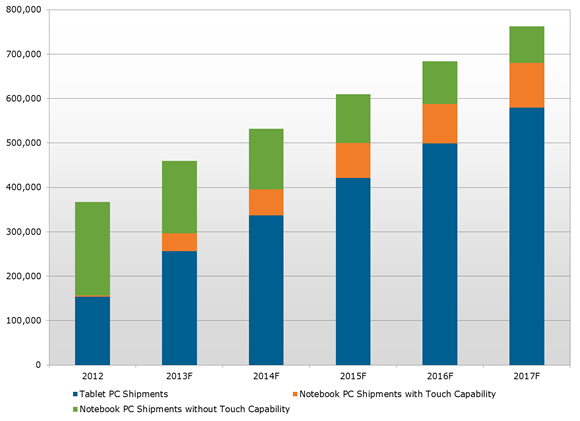
    Largely lifted by white box models, tablet shipments will reach 256.5 million this year, eclipsing, as NPD DisplaySearch previously forecast, laptops (203.3 million). The analyst firm expects shipments of the one category to rise 67 percent, while the other falls by 10 percent, respectively. By 2017, tablet shipments will reach 579.4 million, while laptops fall to 183.3 million. That’s right, more than three times as many.

    Emerging Trends

    More isn’t always significant. Handset shipments are about four times PCs but only marginally affect sales. Tablets are similar enough to personal computers that they either displace sales, or replace them. The latter scenario, occurring in markets where PC manufacturers expected years of growth, is the problem.

    “These low-cost tablets are reaching further into emerging regions where notebook PC penetration rates have remained low, resulting in cannibalization by tablet PCs”, Shin says. Keyword: Cannibalization.

    In March, IDC observed similar trend, but from different perspective. “In emerging markets, consumer spending typically starts with mobile phones and, in many cases, moves to tablets before PCs”, Megha Saini, IDC research analyst, says. That reverses a longer trend of handset-to-personal computer migration. Non-big-brand tablets, many localized and selling for less than those from manufacturers like Apple or Samsung, is catalyst for the change.

    Touch Me

    While lower-cost and localization lift shipments, other factors are significant contributors. DisplaySearch sees an overwhelming shift to touch, which for many people delivers superior user experience to PCs and extends what’s familiar on smartphones. As such, expect touch everywhere. DisplaySearch predicts a shipment surge in touchscreen notebooks — up 48 percent next year. Touch will be big among Ultrabooks, and DisplaySearch predicts even MacBook Air will get the capability.

    The dramatically changing market validates Microsoft’s decision to make touch a priority for Windows 8, with Modern UI. “We built Windows 8 with touch and mobility at the center of the experience, which positions us well in this new era”, CFO Peter Klein says. “Consumers and businesses are increasingly shifting their focus to touch and mobility, and as a result, they want touch-enabled computing devices that are ultrathin, lightweight, and have long battery life”.

    Contrary to Apple’s emphasis on apps as an iOS advantage, touch changes everything. Humans are primarily tool users. We look and then touch. Using fingers to touch is more natural and extension of you. There’s more intimacy involved with touching something on the screen than interacting with it via keyboard and mouse. Intimacy and immersion shift away from apps to the broader user experience.

    Windows 8 Wait

    I expect Microsoft to reap big UX payoff as more Windows 8 touch devices come to market. However, Shim sees hardware, not software, driving touch notebook adoption. “Thus far, Windows 8 has had a limited impact on driving touch adoption in notebook PCs, due to a lack of applications needing touch and the high cost of touch on notebook PCs”.

    He emphasizes: “Form factors aimed at differentiation from standard clamshell notebooks will help to drive consumer adoption of touch-enabled notebook PCs, starting in the second half of 2013”.

    Meanwhile, white-box tablets, bringing touch benefits for much lower cost, will drive up shipments and cannibalize notebooks. Oh, and which platform benefits most from the scenario? You know the answer. Android.

    Photo Credit: eteimaging/Shutterstock

  • Boosting ‘cellular garbage disposal’ can delay the aging process, UCLA biologists report

    UCLA life scientists have identified a gene previously implicated in Parkinson’s disease that can delay the onset of aging and extend the healthy life span of fruit flies. The research, they say, could have important implications for aging and disease in humans.
     
    The gene, called parkin, serves at least two vital functions: It marks damaged proteins so that cells can discard them before they become toxic, and it is believed to play a key role in the removal of damaged mitochondria from cells.
     
    “Aging is a major risk factor for the development and progression of many neurodegenerative diseases,” said David Walker, an associate professor of integrative biology and physiology at UCLA and senior author of the research. “We think that our findings shed light on the molecular mechanisms that connect these processes.”
     
    In the research, published today in the early online edition of the journal Proceedings of the National Academy of Sciences, Walker and his colleagues show that parkin can modulate the aging process in fruit flies, which typically live less than two months. The researchers increased parkin levels in the cells of the flies and found that this extended their life span by more than 25 percent, compared with a control group that did not receive additional parkin.
     
    “In the control group, the flies are all dead by Day 50,” Walker said. “In the group with parkin overexpressed, almost half of the population is still alive after 50 days. We have manipulated only one of their roughly 15,000 genes, and yet the consequences for the organism are profound.”
     
    “Just by increasing the levels of parkin, they live substantially longer while remaining healthy, active and fertile,” said Anil Rana, a postdoctoral scholar in Walker’s laboratory and lead author of the research. “That is what we want to achieve in aging research — not only to increase their life span but to increase their health span as well.”
     
    Treatments to increase parkin expression may delay the onset and progression of Parkinson’s disease and other age-related diseases, the biologists believe. (If parkin sounds related to Parkinson’s, it is. While the vast majority of people with the disease get it in older age, some who are born with a mutation in the parkin gene develop early-onset, Parkinson’s-like symptoms.)
     
    “Our research may be telling us that parkin could be an important therapeutic target for neurodegenerative diseases and perhaps other diseases of aging,” Walker said. “Instead of studying the diseases of aging one by one — Parkinson’s disease, Alzheimer’s disease, cancer, stroke, cardiovascular disease, diabetes — we believe it may be possible to intervene in the aging process and delay the onset of many of these diseases. We are not there yet, and it can, of course, take many years, but that is our goal.”
     
    ‘The garbage men in our cells go on strike’
     
    To function properly, proteins must fold correctly, and they fold in complex ways. As we age, our cells accumulate damaged or misfolded proteins. When proteins fold incorrectly, the cellular machinery can sometimes repair them. When it cannot, parkin enables cells to discard the damaged proteins, said Walker, a member of UCLA’s Molecular Biology Institute.
     
    “If a protein is damaged beyond repair, the cell can recognize that and eliminate the protein before it becomes toxic,” he said. “Think of it like a cellular garbage disposal. Parkin helps to mark damaged proteins for disposal. It’s like parkin places a sticker on the damaged protein that says ‘Degrade Me,’ and then the cell gets rid of this protein. That process seems to decline with age. As we get older, the garbage men in our cells go on strike. Overexpressed parkin seems to tell them to get back to work.”
     
    Rana focused on the effects of increased parkin activity at the cellular and tissue levels. Do flies with increased parkin show fewer damaged proteins at an advanced age? “The remarkable finding is yes, indeed,” Walker said.
     
    Parkin has recently been shown to perform a similarly important function with regard to mitochondria, the tiny power generators in cells that control cell growth and tell cells when to live and die. Mitochandria become less efficient and less active as we age, and the loss of mitochondrial activity has been implicated in Alzheimer’s, Parkinson’s and other neurodegenerative diseases, as well as in the aging process, Walker said.
     
    Parkin appears to degrade the damaged mitochondria, perhaps by marking or changing their outer membrane structure, in effect telling the cell, “This is damaged and potentially toxic. Get rid of it.”
     
    If parkin is good, is more parkin even better?
     
    While the researchers found that increased parkin can extend the life of fruit flies, Rana also discovered that too much parkin can have the opposite effect — it becomes toxic to the flies. When he quadrupled the normal amount of parkin, the fruit flies lived substantially longer, but when he increased the amount by a factor of 30, the flies died sooner.
     
    “If you bombard the cell with too much parkin, it could start eliminating healthy proteins,” Rana said.
     
    In the lower doses, however, the scientists found no adverse effects. Walker believes the fruit fly is a good model for studying aging in humans — who also have the parkin gene — because scientists know all of the fruit fly’s genes and can switch individual genes on and off.
     
    Previous research has shown that fruit flies die sooner when you remove parkin, Walker noted.
     
    Walker and Rana do not know what the optimal amount of parkin would be in humans.
     
    While the biologists increased parkin activity in every cell in the fruit fly, Rana also conducted an experiment in which he increased parkin expression only in the nervous system. That, too, was sufficient to make the flies live longer.
     
    “This tells us that parkin is neuroprotective during aging,” Walker said. “However, the beneficial effects of parkin are greater — twice as large — when we increased its expression everywhere.”
     
    “We were excited about this research from the beginning but did not know then that the life span increase would be this impressive,” Rana said.
      
    The image that accompanies this news release shows clumps or aggregates of damaged proteins in an aged brain from a normal fly (left panel) and an age-matched brain with increased neuronal parkin levels (right panel). As can be seen, increasing parkin levels in the aging brain reduces the accumulation of aggregated proteins.
     
    Scientists have found that this kind of protein aggregation occurs in mammals as well, including humans, Rana said.
     
    “Imagine the damage the accumulation of protein trash is doing to the cell,” Walker said. “With increased Parkin, the trash has been collected. Without it, the garbage that should be discarded is accumulating in the cells.”
     
    Walker’s research was funded by the National Institutes of Health’s National Institute on Aging (grants R01 AG037514 and R01 AG040288) and the Ellison Medical Foundation. Rana was supported by a Rubicon fellowship from the Organization for Scientific Research in the Netherlands, where he earned his doctorate (University of Groningen). Michael Rera, a UCLA postdoctoral scholar in Walker’s laboratory, is a co-author of the PNAS research.
     
    UCLA is California’s largest university, with an enrollment of more than 40,000 undergraduate and graduate students. The UCLA College of Letters and Science and the university’s 11 professional schools feature renowned faculty and offer 337 degree programs and majors. UCLA is a national and international leader in the breadth and quality of its academic, research, health care, cultural, continuing education and athletic programs. Six alumni and six faculty have been awarded the Nobel Prize.
     
    For more news, visit the UCLA Newsroom and follow us on Twitter.

  • Android is eating everyone’s lunch in the U.S. – except for Apple’s

    Smartphone Market Share US Q1 2013
    The latest U.S. smartphone market share data from comScore shows an interesting twist compared to global data. Fast growth in emerging markets has sent Apple’s global market share plummeting, but the big-money U.S. smartphone market is still very much driven by high-end handsets. According to comScore’s latest data, Apple’s share of the U.S. smartphone market climbed to 39% in Q1 2013 from 36.3% in the fourth quarter last year. Over the same period of time, Android’s share of the U.S. market slid from 53.4% to 52%. Perhaps even more interesting than the figures themselves, however, is the trend among mobile operating systems in the U.S. — Android is still the nation’s top smartphone platform by a healthy margin, but its remarkable growth stopped the iPhone from enjoying impressive growth as well.

    Continue reading…

  • First impressions of a new flagship, the LG Optimus G Pro for AT&T

    Last week, AT&T announced it is exclusively selling the LG Optimus G Pro for $199 with contract. The phone can be pre-ordered now and is expected to be available on May 10. I received an early review unit and have spent just a little time so far using the phone. A few things already stand out to me: LG is mimicking Samsung’s large phone approach — both with hardware and software — and those looking for a flagship phone will have to add the Optimus G Pro to their list of potential candidates.

    I’ll have a full review forthcoming — I never review a phone without at least five days use for testing battery life and other reasons — but for now, here are my first impressions, in no particular order, followed a some images of the phone.

    • When I first removed the phone from the box, I thought I was sent the wrong phone. It appears nearly identical to the Samsung Galaxy Note 2, although LG’s new handset is roughly a quarter-inch narrower in width. And that small width shaving makes a big difference — for the better — when holding this phone.
    • Like the Note 2, the Optimus G Pro is all plastic and has a removable back cover. In all seriousness: If I didn’t see the LG branding on the top of the device, I would have sworn it was Samsung made.
    • The 5.5-inch 1080p display is excellent, easily rivaling those on the Galaxy S 4 and HTC One, both of which also have 1920 x 1080 resolution screens. There’s nary a pixel to be seen.
    • LG’s software is much improved over earlier efforts. Although this phone doesn’t run stock Android, LG’s skin is very minimal compared to similar phones. The home screens have a nice 3D effect: When swiping through them, everything on the display rotates around the left axis of the screen as if the icons and widgets were rotating around a flagpole.
    • Short of LG’s Tag+ NFC software and an IR remote control app, there are no other LG-specific apps. The same can’t be said of AT&T: I count at least nine bits of software from the carrier.
    • Similar to the Galaxy S 4, the Optimus G Pro has settings split up by four tabs. It’s not a confusing layout, but clearly the high-end Android phones are gaining more features that could add complexity. There are no hover gestures, but you can pause video by turning the phone over.
    • A quad-core 1.7 GHz Qualcomm Snapdragon 600 with 2 GB of memory powers the phone and for some reason it appears to perform a smidge better than the HTC One and Galaxy S 4 in my limited usage so far. I suspect the lack of a complex skin atop Android may be the reason, however, it’s too early to determine a performance winner.
    • I don’t mind a physical home button on Android phones although some do. The one on the Optimus G Pro isn’t my favorite though. I find it too small; it’s wide enough, but very thin. It does, however, have a nice LED ring around it with different colors for notifications and such. I also personally don’t like the placement of the two capacitive buttons: Back is on the left side of the Home button, while Menu is to the right. This may not bother others.
    • The phone comes with 32 GB of internal memory at this price; cheaper than the 32 GB Galaxy S 4. And you can expand it, unlike the HTC One, although some won’t have to. However, the total space available is 23.3 GB, which surprises me; I would have expected around 26 GB or so. Carrier bloatware, perhaps?
    • Like many new phones, the Optimus G Pro ships with Android 4.1.2. There is a bit of multitasking capability as some apps and widgets have a transparency slider. Use this and the app is see through so you can interact with other apps. Slide it back for the original app to regain focus.
    • Although there isn’t a stylus, the phone has a dedicated note-taking app called QuickMemo, which is available from the drop-down notifications shade. I almost wish there was a stylus because I don’t see many folks taking notes here with their fingers.
    • I haven’t taken many photos with the 13 megapixel rear camera yet. I did notice that there are only a few camera modes: Normal, HDR, Panorama, VR Panorama, Burst Shot and Beauty Shot. Perhaps that’s a good thing so consumers won’t get overwhelmed by a wider range of image modes.
    • It’s too early to determine battery life on a single charge. However, with a 3140 mAh battery, I’d be disappointed (and somewhat surprised) if this phone doesn’t easily last a full day for all but a very select number of power users.

    Related research and analysis from GigaOM Pro:
    Subscriber content. Sign up for a free trial.


  • Scarface Actor Who Died Was Also The Anchor In Robocop [Video]

    Mario Machado, a broadcast news reporter, who also played the part of a reporter in Scarface, Robocop, Rocky III, and Brian’s song, died on Saturday at a convalescent facility in West Hills, Los Angeles.

    Machado was an eight-time Emmy award winner, and in 1970, became the first Chinese-American on-air TV news reporter and anchor in LA, an possibly in the U.S.

    He was so good at his job that the movie industry couldn’t get enough of using him as a reporter. He appeared in all three Robocop films as anchor Casey Wong. Here’s a compilation of Robocop news reports:

    Machado was seventy-eight years old. According to a statement from his daughter, he died from complications of pneumonia, and had been suffering from Parkinson’s disease.

    He was born in Shanghai in 1935, and emigrated to the U.S. in 1956. He became a U.S. citizen in 1965.

    He got is start in the reporting business at local Los Angeles news stations like KCBS and KNXT. He also hosted medical investigation show Medix.

    In addition to his Emmy awards, he won the Howard Blakeslee Award, San Francisco’s Interceptor Award, and was even named honorary mayor of Granada Hills for eight years. He was also named LA Commissioner of Cultural Affairs. In 1983, Mayor Benjamin Norton proclaimed December 4, Mario Machado Day.

  • Look, IBM is doing SQL on Hadoop, too

    Maybe this is just news to me, but IBM has a SQL-on-Hadoop product in the works called Big SQL. The company announced the technology preview version in March (well under my radar and, from what I’ve seen, nearly everyone else’s radar), and is offering up a cloud-based demo environment for a select group of early users.

    As a refresher, the big difference between SQL on Hadoop and the Hadoop connectors that were popular a couple years ago is that SQL-on-Hadoop products query the data where it resides — in HDFS or HBase — rather than pulling it into a relational database environment to analyze it. We have been talking for months about the emergence of a large SQL-on-Hadoop market, but IBM’s name was conspicuously absent from that discussion. The company has Hadoop software called BigInsights and lots of SQL expertise, so it only made sense that IBM would get into the game at some point.

    Details on Big SQL are still pretty sparse save for a few high-level blog posts and an instructional video (embedded below), but it looks to take the standard approach, as Cloudera is doing with Impala, of enabling access through traditional tools via JDBC and ODBC drivers.

    Ultimately, I think the advent of big data will enable some new types of querying techniques quite a bit different than the SQL queries we’ve come to know and love over the past couple decades. But SQL is still the language du jour and might never go away, so there’s a lot of value to be had if people can put their SQL skills to work on data stored inside Hadoop or other environments, and if companies can work toward a nirvana where all the data is stored in a single place rather than across database environments.

    That IBM got this message and got into the game isn’t surprising at all, but it is important. Lots of large companies buy IBM’s software.  If it wants them to follow it into the world of big data and Hadoop, it has to give them the tools they need to use it.


    Related research and analysis from GigaOM Pro:
    Subscriber content. Sign up for a free trial.


  • How Goods Are Advertised In The Star Wars Universe

    TheGamerChick has shared a series of Star Wars commercials/infommercials, giving us a glimpse of what television advertising could be like in a galaxy far, far away.

    Pretty funny.

    And don’t forget to check out Darth Vader’s recent at bat.

    [via Neatorama]

  • Sign Up Now For The Austin TC Meetup + Pitch-Off

    austin-meetup-event-460

    After the amazing success of our New York Pitch-Off in February, we thought it would be fun to bring the energy and excitement of a mini-Disrupt to more cities across the country. We’re pleased to announced the 2013 Meetups + Pitch-Offs will begin in Austin on May 30 at Stage On Sixth in downtown Austin from 6pm to 10pm. You can buy tickets now!

    Then, throughout the year, we’re holding meetups with pitch-offs in Seattle, San Diego, and Boston.

    Each meetup is traditionally a crowded mishmash of networking, hustling and, well, drinking, so 21 and older only, please. This year, after the roaring success of our first pitch-off, each meetup will feature a rapid fire pitch-off and a few brief on-stage discussions for TechCrunch TV.

    You can sign up for the Pitch-Off here and buy a $5 ticket that entitles you to booze and other goodness. Sponsors can buy tables here (and we definitely need your support to make this a rocking event.)

    The pitch-off is a way to get your startup in front of TC judges as well as a few local judges from the area. Our goal is to pick three winners. Third place gets one ticket to Disrupt SF, second place gets two tickets, and the winner gets a spot in Startup Alley. Everyone who pitches will be considered for the Startup Battlefield as well.

    Participants interested in competing in the pitch-off will have 60 seconds to explain why their startup is awesome. PowerPoint presentations are not allowed. These products must currently be in stealth or private beta, and they must be ready to launch at Disrupt in September.

    Our sponsors help make meetups happen. If you are interested in learning more about sponsorship opportunities, please contact our sponsorship team here [email protected].


  • Coming to America: A new trash-to-energy plant planned for Arizona

    The city of Oslo turns so much of its trash into energy, that it actually imports garbage into the city to heat and light many of its buildings. While the process is far less common in the U.S., the city of Glendale, Arizona could be an unexpected trash power leader, if it gets a planned garbage-to-energy plant built by Spanish engineering company Abengoa.

    On Monday Abengoa said it plans to build a $110 million factory in Glendale that will turn city garbage into electricity. Chicago-based power company Vieste Energy will own the planned factory, and Abengoa will build it and run it for 30 years. Construction will take 20 months, and create 50 jobs, says Abengoa. When fully built, the factory is supposed to be able to gasify 180,000 tons of garbage per year, produce 350 tons of gas per day, and create 15 MW of electricity.

    Glendale, AZThis type of factory planned for Glendale gasifies many types of waste, not just organic waste, but also plastics. In contrast, other biogas plants built sporadically around the U.S. — most commonly at landfills and water treatment facilities — put organic waste into bioreactors, which captures the gas that is produced as the organic materials decompose.

    Combusting and gasifying city trash into energy is a process that has been around for decades. But modern plants now meet strict emissions standards and have many filters to catch any potential pollutants. Next-generation garbage-to-energy plants also use sophisticated sensors and computing to sort the trash into usable and unusable parts.

    In Europe these types of new plants are popular. A New York Times article back in 2010 noted that there were 400 of these plants in Europe, with Denmark, Germany and the Netherlands leading the continent. But in the U.S. there are very few of these new and modern plants, and only a handful of older, aging plants. Back in 2010 there were no new waste to energy plants planned for the U.S., and there were only 87 of these plants that were all built more than 15 years ago.

    The Glendale waste to energy plant, which has been under discussion for at least a year in the city, would reportedly be built 30 feet below ground level, and have a 50-foot stack visible by passersby. The plant is planned for the north end of the Glendale Municipal Landfill.

    Related research and analysis from GigaOM Pro:
    Subscriber content. Sign up for a free trial.


  • BlackBerry R10 photos leak, could kick BlackBerry comeback into high gear

    BlackBerry R10 Photos Specs
    BlackBerry kicked off its comeback efforts earlier this year when it launched the new BlackBerry Z10 smartphone, and the charge continued last month as the BlackBerry Q10 began rolling out. But while low-end and mid-range smartphones had played the biggest role in keeping BlackBerry alive as it readied its next-generation BlackBerry 10 smartphones, both of these new handsets were expensive high-end models. A number of industry watchers feared that the high-end smartphone market was already cluttered enough and BlackBerry should instead focus on its bread and butter, and a new leak suggests it might finally be ready to add a cheaper handset to its new device lineup.

    Continue reading…

  • Tough luck Apple, non-big-brand tablets account for one-third of shipments

    Apple’s supremacy as tablet market leader may be even shorter lived than previous analyst forecasts suggest. Already, Android topples iOS share, and there is simple catalyst: White-box slates accounted for one-third of shipments last year — a level NPD DisplaySearch predicts will continue in 2013 and beyond.

    Android is the big beneficiary of the trend. In third quarter 2012, shipments exceeded iOS models, according to IDC. During first quarter this year, green-robot slates took 56.5 percent market share. At this pace, contrary to analyst predictions just a year ago, Android does to iOS in tablets what it did in smartphones — take early leadership away from Apple.

    In October 2009, I explained why “Apple cannot win the smartphone wars” and more than two years later why “iPad cannot win the tablet wars“. The factors are similar in both markets. One company against a world of others — Apple/iOS versus dozens of Android manufacturers — simply isn’t sustainable, repeating the Mac’s early rise and eventual decline before DOS/Windows PCs in the 1980s and 1990s; more recently, smartphones.

    Why Platforms Succeed

    Typically, successful platforms share five common traits:

    • There are good development tools and APIs for easily creating applications
    • There is at least one killer application people really want
    • There is breadth of useful applications
    • Third parties make lots of money
    • There is a robust ecosystem

    However, in my 2011 “iPad cannot win” analysis, which I strongly encourage you read, I replaced the traditional second point with another: “There is a killer user experience that people want to enjoy”. I can’t overstate the importance of UX to modern platforms and how it displaces PC-era concepts about killer applications.

    For tablets, there is no one killer application, or even thousands. But there is killer UX, which Apple got right in 2007, delivering a far superior smartphone experience than every other competitor. But Google and its manufacturing partners easily copied Apple’s UX approach, first on smartphones and then tablets. Today, iOS is a tired-looking user interface compared to stock Android or OEM replacements, such as HTC Sense or Samsung TouchWiz UI. Apple’s challenge, during next month’s developer conference, is to bring with iOS 7 modern UI and UX.

    User Experience is Everything

    The UX concept is crucial to understanding the current tablet market. By the traditional view, platforms succeed only if there are applications that people want. But developers only create them if there is demand, which usually requires applications first. But there’s no financial demand to develop apps, without platform adoption — thus the chicken-egg scenario: Which comes first, apps or sales volume?

    Tablets capitalize on platform success smartphones established, while offering great, immersive user experience. Apps, and the ecosystems for handsets, carry forward. Money matters more in this scenario — where partners make the most — and there extenuates dramatic dynamics that applied to the Mac and DOS/Windows PCs in the late 1980s and through the following decade.

    Apple pays developers about $1 billion a month, but volume shifts in Android’s favor and competing OEMs take control of specialized, even localized, ecosystems — like creating their own app stores. Apple’s controlled, contained iOS platform restricts who makes money where, while Android openness allows third parties to innovate and create distinct profit streams. That $1 billion today means little tomorrow.

    IBM PC clones and white boxes drove DOS/Windows success decades ago. Something similar plays out today, in a category with striking similarities. Tablets are much closer to traditional PCs than are smartphones, and DisplaySearch sees slate shipments exceeding laptops this year — 256.5 million units to 203.3 million.

    Apple’s Rivals are Many

    White box accounting for one-third of shipments already rivals Apple. The distinction is enormous, and bodes badly for the fruit-logo company in the most-important growth markets, like China. During first quarter, IDC puts iPad market share at 39.6 percent, with Samsung a distant second at 17.9 percent. That makes Apple the indisputable OEM leader. However, assuming white boxes account for one third of shares, iPad’s lead is more tenuous, particularly considering the tablet’s share fell from 58.1 percent a year earlier.

    The whom and where matters here — white box manufacturers, largely shipping to and from China. They now lead the Android horde Apple cannot defeat. The one against the many is not a long-term winning strategy, particularly as PC spending shifts to tablets.

    Google and its partners merely need to get the user experience to be good enough for more people to buy and for a broad ecosystem to thrive — one where lots of third parties make loads of money. In many ways Android UX is superior, something Apple could change with iOS 7. But the fruit-logo company can’t easily solve the volume disparity, something non-big-brand manufacturers widen for Android.

    Photo Credit: ollyy/Shutterstock

  • Reddit Makes This Old Man’s Day By Restoring His Old Navy Photo

    Reddit is good for a lot of things, mostly because it’s simply made of up a huge group of people. When a community pulls together it can be capable of some pretty incredible things, and in the reddit age, sometimes that is something that wouldn’t have been possible in years past.

    One reddit user wanted to give his grandpa a gift by having an old Navy photo restored for him. He turned to the reddit community, and a bunch of people took a shot at it, with some working off the others’ work. Eventually, the community came up with a great restoration job, and the user recorded video of the moment when he explained the process and showed his grandpa the finished product.

    “I didn’t realize I was so good looking…That’s fantastic!” says the grandpa before thanking the reddit community.”

    After just a day, the video already has over 70,000 views.

    Here’s the reddit thread for the story.

  • Baseball Is A Much Darker Sport When Darth Vader Is Involved

    The Star Wars YouTube channel has uploaded a series of videos featuring Darth Vader, some stormtroopers and scout troopers getting ready for a baseball game, and even playing (against each other).

    As one of the videos’ descriptions says, Vader was stepping up to the plate for a Pacific League Baseball game in honor of Star Wars Day (May 4).

    Anyway, here’s the series of videos.

  • Cloud News: Amazon Offers AWS Certification

    News from the cloud computing sector includes developments from Pengiun Computing, Software AG and Amazon:

    Amazon launches AWS certification program. Amazon (AMZN) announced the launch of the new AWS Certification Program with the first of several exams that will made available in 2013. The new AWS Certification Program helps to fill this need to recognize IT professionals that possess the skills and technical knowledge necessary for building and maintaining applications and services on the AWS Cloud. To earn an AWS Certification, individuals must demonstrate their proficiency in a particular area by passing an AWS Certification Exam. Individuals looking to prepare for an exam can attend courses through AWS Training to help gain proficiency with AWS services. “AWS Certified Solutions Architect – Associate Level” is the first exam available, which tests skills for technical professionals and solutions architects involved in the design and development of applications on AWS. “With cloud computing being quickly adopted by organizations of all sizes around the world, in-depth training programs as well as certifications for individuals who have demonstrated competence with AWS are increasingly important,” said Adam Selipsky, Vice President, Amazon Web Services. “The AWS Certification Program helps organizations identify that the employees, partners and consultants they depend on for their AWS solutions are well-versed in the best practices of building cloud applications on AWS and have the skills to help them be successful.”

    Penguin Computing Icebreaker Cloud CS storage. Penguin Computing announced the immediate availability of the Icebreaker CS storage platform for large scale-out cloud storage deployments. The Icebreaker CS is a fully integrated and pre-configured appliance that incorporates Scality’s RING Organic Storage software. It will be available directly from Penguin as well as through Scality. Based on its Icebreaker 4860 storage server the Penguin Computing Icebreaker CS offers 240TB of raw data in a 4U form factor. It is powered by an Intel Xeon E5-2600 processor and configured with 128GB of RAM. Organizations with multiple sites can achieve even higher levels of availability with Scality RING’s geo-redundancy features. “Performance, availability and scalability requirements of large scale cloud businesses cannot be met with traditional IT approaches to storage, that typically excel in one of these areas and fall short in another,” said Charles Wuischpard, CEO Penguin Computing. “To meet the demands of our customers that require storage solutions at the petabyte scale we based our large scale storage appliance Icebreaker CS on software from Scality. With its distributed no-shared architecture and its sophisticated Advanced Resilience Configuration, Scality RING offers excellent storage scalability and great availability without compromising performance.”

    Software AG acquires LongJump. Software AG announced the acquisition of the Cloud Platform vendor LongJump. LongJump’s technology is fully complementary to Software AG’s ARIS, Terracotta and webMethods, product suites extending the company’s business value both within existing enterprise customers and to SMEs. Software AG will also continue to develop and extend LongJump’s Platform-as-a-Service products for fast and flexible cloud based development and deployment of situational and case management applications. “The digital enterprise is all about real-time business insights driving fast decisions and faster reactions,” said Wolfram Jost, CTO at Software AG. “With this latest acquisition we have taken a major step in optimizing both the business knowledge and IT skills needed to develop flexible, business process driven, situational applications and deploy them rapidly wherever they are needed.”

  • What You Need To Know About The Liberator 3D-Printed Pistol

    liberator_1

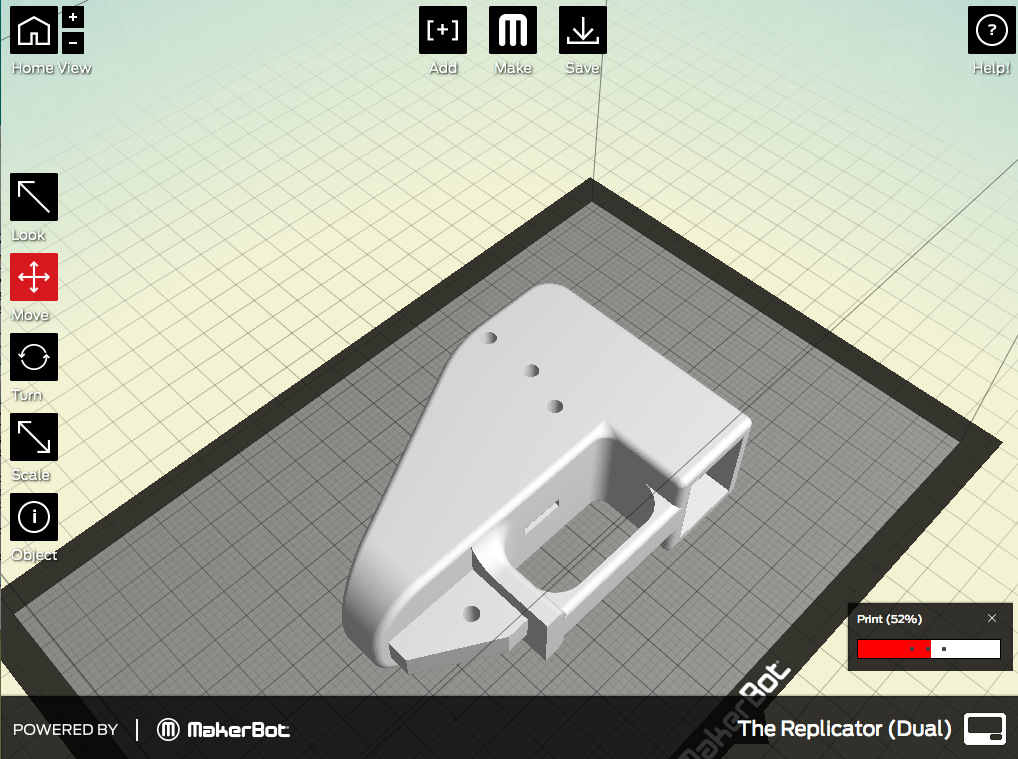
    Now that we have confirmation that the Liberator 3D-printed pistol can be fired without destroying the body, let’s address what this means for 3D printed weapons and, presumably, homemade weapons in general.

    Does the pistol work? Yes, it can be fired at least once without damage to the body of the gun or the person at the trigger. Andy Greenberg at Forbes has seen the gun fire multiple times and the video above shows one shot.

    Is it a real pistol? No. This is more of a zip gun than a pistol. Zip guns were improvised firearms made of tubes, rubber bands, and nails. Kids fool-hardy enough to shoot one (this cohort included my own father who showed me how to make them) were promised a second of hair-raising and potentially deadly excitement when they made zip guns out of pipe and rubber. To fire one, you fitted the cartridge into the pipe and pulled back on the nail attached to the rubber band. If it hit the charger properly the bullet would fire. A similar thing is happening here: a spring-loaded nail is hitting a cartridge.

    The barrel of the gun is threaded but I wouldn’t expect this weapon to be very accurate. Think of this gun as a controlled explosion generator. It uses a very small .380 caliber bullet which is deadly, to be sure, but quite small.

    Could I print one? Yes. You can easily download the 3D-printable files from DEFCAD.org (here is a private mirror) and if you have a 3D printer you can easily print any of these parts.

    The creators built this gun using the Stratasys Dimension SST 3D printer, a high-resolution printer that works similarly to the Makerbot but offers a far finer and more durable print. This printer has a layer thickness of .25mm, however, which the Makerbot can easily match.

    Would I print and fire this using on my Replicator? No. I’m far too risk averse. I asked multiple 3D home printer manufactures and none would comment specifically on firearms, so there is no implicit or explicit promise of safety.

    Will someone try to print it on home equipment? Yes.

    Is this legal? Yes, but I’m no lawyer. It is a legal, homemade firearm and those have been made in basement workshops for most of this century. In most cases, a Federal Firearms License is mandatory to begin making or manufacturing weapons. For example, anyone building this gun would be a “Manufacturer of Destructive Devices, Ammunition for Destructive Devices or Armor Piercing Ammunition.” Anyone can apply for this license, thereby making the manufacture of this thing legal. For decades, however, the need to license was a minor barrier to entry into what would be a non-trivial process. The tools and materials necessary to build a real gun in your basement were expensive and it made economic sense to legally safeguard your home workshop. The manufacture of a 3D-printed weapon, however, is trivial, and can be built by anyone with an investment of $8,000 or so for a Stratasys printer or, for the less risk-averse, a home 3D printer that costs about $2,000.

    It is also designed to comply with the Undetectable Firearms Act of 1988 because it contains a small block of steel. From the print instructions:

    How to legally assemble the DD Liberator:
    -Print (ONLY) the frame sideways (the shortest dimension is the Z axis). USC18 922(p)(2)(A)*: “For the purposes of this subsection (The Undetectable Firearms Act of 1988) – the term ‘firearm’ does not include the frame or receiver of any such weapon;”
    Thus, you can legally print ONLY the frame entirely in plastic, even without 3.7 ounces of steel.-Once the frame is finished, epoxy a 1.19×1.19×0.99″ block of steel in the 1.2×1.2×1.0″ hole in front of the trigger guard. Add the bottom cover over the metal if you don’t want it to show.-Once the epoxy has tried, the steel is no longer removable, and is an integral part of the frame. Now your gun has ~6 ounces of steel and is thus considered a ‘detectable’ firearm. So now you can print all the other parts.

    It is, in short, legal to make a gun and this is a gun.

    Can this be stopped? No.

    What’s next? The cynic would say we will soon see the first murder with a 3D-printed gun. The cynic will also say that this will cast 3D printing in an entirely new, more sinister light and could affect the home printing industry dramatically. The cynic would also expect a great deal of messy legislature to come out of this that will, depending on which side of the gun debate you fall on, “get these off the streets” or “infringe on our rights.”

    A cynic would also say that the entire Defense Distributed agenda is an example of trolling that will eventually do more harm than good. The cynic would also say that a harsh government crackdown would also be equally silly.

    A nuanced approach is absolutely necessary.

    The non-cynical would find this to be more a proof of concept than a real manufactured weapon and say that it was bound to happen eventually. 3D printing has made manufacturing trivial. This is a logical evolution of an entrenched industry and a centuries-old product. Gunsmithing is not a new hobby. However, it just got much easier.

  • Iceland: Where Mixed Modular Design Meets Free Cooling

    ast-thor-modular-room

    The Avania Thor data center in Iceland features the use of both container-style data center modules (at the left, in the rear) and “modular rooms” assembled from pre-built components. Both products are supplied by AST Modular.

    The diversity of modular data center design can be seen in a single large room in Reykjavik, Iceland. That’s where the Advania Thor Datacenter has added new capacity using a “modular room” assembled from pre-built components, which sits alongside a pair of stacked container-style modules.

    Both phases of the design were created by AST Modular, and use the Barcelona company’s “natural free cooling” (NFC) technology, which harnesses Icelandic fresh air to cool servers for customers like Opera Software, the mobile browser pioneer.

    The first phase of the project was completed in 2009 as proof of concept,and comprised of one 40-foot containerized data center with 17 racks at a power density of 14 kilowatts per rack, plus a modular room with 50 racks at 7 kilowatts.  The second phase, which is currently being finalized, features one 105 square meter modular room plus a separate cooling room hosting 8 of AST’s cooling modules providing indirect free cooling.

    Air-to-Air Heat Exchanger

    This approach use an air-to-air heat exchanger that takes advantage of the cool climate without introducing outside air into the servers – an important consideration in a land where volcanic ash is a concern. By avoiding the need for chillers or refrigeration, Advania is able to achieve a Power Usage Efficiency (PUE) of 1.16, according to AST.

    “The latest expansion clearly shows that our prefabricated data center options – either containerized or modular – help customers achieve a Capex differed growth and generate savings,” said Davide Ortisi, Marketing Director at AST Modular. “On the other hand our Indirect Free Cooling NFC will minimize Advania’s Opex and guarantee security since Iceland can be an environment with high concentration of volcanic ashes and external contaminants.”

    The approach taken by Advania reflects one of the benefits that’s been advanced for modular designs -the ability to expand incrementally. AST says the additional data center space has been built with “minimal” electrical and mechanical upgrades and finalized in less than 2 months upon shipment of components from Barcelona to Iceland.

    “We have seen a tremendous increase in datacenter space demand in the last 12 months” said Ægir Rafn Magnússon, Sales Director at Advania Data Centres. “Iceland is a very competitive country for data centers. The huge availability of green and affordable geothermal power combined with low outdoor temperatures and highly skilled IT professionals allow us to go to market with a first in class service at a very low price.”

    Here’s a look at a time-lapse video showing the construction of an AST modular room at the Advania facility.

  • Google Talks Online Reviews For Ten Minutes

    As part of the “Friday 15″ series for small business owners, Google has shared a video discussing the importance of online reviews.

    It features Whitney Lemon from Google’s’ “Get Your Business Online” team and Cody Julian, the associate marketing manager at Google Fiber.

    According to a study Julian cites, seventy percent of Americans say they look at product reviews before making a purchase decision.