Author: Serkadis

  • 3D metrology: user-friendly, portable and accurate

    FARO, the world’s leading provider of portable measurement and imaging systems, presents its broad range of portable measuring machines at CONTROL 2010, Stuttgart/Germany from 4th – 7th May.

    At the FARO booth 3404 (hall 3), visitors will discover more about the latest technologies and industry-specific software solutions in the field of portable 3D measurement technology. They will have the chance to see live demonstrations of all FARO products.

    FARO’s product range includes:

    The FaroArm product line consisting of Quantum, Platinum, and Fusion, which are flexibly deployable, portable measuring systems for 3D measurements. They meet the high accuracy requirements posed by development and production. The FaroArm products measure, digitize, or create a CAD component analysis right in production or during assembly. The measurement arms are available with six or seven axes and with four measuring volumes.

    Laser Tracker ION, the most advanced, state-of-the-art FARO Laser Tracker ever introduced. The ION also features a longer measurement range, lighter weight, and contains the fastest, most sophisticated distance measuring system: Agile Absolute Distance Meter (aADM).

    FARO Gage which is the smallest and most precise FARO measuring arm. With a measurement volume of 1.2m it is ideal for adjusting, aligning, measuring and verifying parts. Different software packages are available to suit various requirements.

    FARO Laser Scanner Photon 120/20. Combined with the new FARO Scene 4.6 software it offers users the fastest and longest range phase shift laser scanning solution in the market place. The new Photon models capture and analyses detailed 3D images of large objects efficiently by reducing scan time and post processing work.

  • Fluorescent Luminaires Explosion Proof

    The range of FDX luminares has been specially developed for the ATEX in gas area1, 2 and dust area 21, 22.

    The design of the FDX with glass tube and Aluminium against sea corrosion, provides a high impact resistance and longer lifetime. Its ingress protection is IP66.

    Equip with electronic Ballast, this technology allows instantaneous lighting and a period of operation without intervention.

    Its dimension is reduced in compact version.

    The sliding plate gives a high facility for the maintenance.

  • Flow Meter Measures Flare Gas For Oil/Gas Offshore Platforms and Refineries

    Offshore production platform operators and oil/gas process engineers now have a reliable, cost-effective solution for measuring the flow of combustible hydrocarbon waste gases in flare gas system operations. The GF90 Flare Gas Flow Meter from Fluid Components International (FCI) solves the problem of measuring dangerous, explosive and toxic gases that often flow at extremely varying and/or low levels. The GF90 Flow Meter will be exhibited in FCI Booth 7705 at the Offshore Technology Conference, May 3-6, Houston, Texas.

    Hydrocarbon combustible waste gases are challenging to measure due to their wide flow fluctuations caused by variable production and refining processes. With its highly sensitive thermal mass flow sensing element, the GF90 Flow Meter also precisely measures gases of varying hydrocarbon composition. This makes it the ideal gas measuring solution for ultimately eliminating these dangerous, polluting gases.

    With a highly sensitive thermal mass flow sensing element and microprocessor-based intelligence featuring multiple calibration groups built into the design, the advanced GF90 Flare Gas Flow Meter delivers precision flow measurement to a low 0.25 SFPS. A flow meter that accurately measures combustible hydrocarbon waste gases for flare system disposal ensures that these dangerous byproducts are safely and efficiently eliminated from the environment with minimal pollution. The disposal of flare gases protects people, equipment and complies with air quality regulations.

    The versatile GF90 features a thermal mass gas flow sensing element designed with 316 stainless steel and nickel-braze construction. It also can be specified with corrosion and abrasion-resistant alloys, including Hastelloy, Monel and tantalum, and with all-welded construction for service in the harshest environments. It is available for service in a broad range of applications—operating at temperatures from -100 to 850ºF (-73 to 454ºC) and pressures to 1000 psig [69 bar (g)].

    Designed for complex multi-gas or variable flow processes, the GF90 Flow Meter includes an advanced microprocessor-based programmable transmitter. The transmitter can store up to three calibration groups. To obtain accurate flow measurement in complicated gas processes, each group can be independently configured for a specific calibration range, fluid, switch point settings, etc. The instrument is also inherently multi-variable, providing both flow and temperature measurements without any additional tap points.

    Developed with constant power technology, the GF90 features turndowns from 1000:1, accuracy of +1 percent of reading plus 0.5 percent of scale, with repeatability of +0.5 percent of reading or better. Flow sensitivity is from 0.25 to 1600 SFPS [ft/sec at a standard temperature of 70ºF and pressure of 14.7 psia] or 0.08 to 487.7 NMPS [m/sec at a normal temperature of 21.1ºC and pressure of 1.013 bar absolute].

    The GF90’s transmitter features two independent, field programmable analog signal outputs of 4-20 mA, 0-10 Vdc, 0-5 Vdc, and/or 1-5 Vdc., which can be assigned to any combination of flow and/or temperature. It also offers dual alarm switch points with relay outputs. The switch points are user, field programmable to alarm at high, low or windowed and can also be assigned to flow and/or temperature readings. Dual 10A relay outputs are provided for contact closures to lamps, alarm and control systems.

    A NEMA Type 4X (IP66) rated transmitter enclosure is standard. Optional Class I and II, Division 1 and 2, Groups B, C, D, E, F and G [EEx d IIC] transmitter enclosures are also available with agency approvals for Factory Mutual Research, ATEX, CSA. GOST/RTN, IEC, CPA and NEPSI.

  • Even MORE Storage for IAC Industries’ Workmaster Storage Cabinet Workbenches

    IAC Industries adds 7 new pedestal configurations to its line of Workmaster Storage Cabinets (WSC). The new pedestals units offer wide, large capacity drawers in combination with split-door cabinet compartments. The cabinet pedestals support a variety of worksurface options that include laminates, maple butcher block and stainless steel.

    Company President, Don Murphy explains, “The drawer-only pedestals that we launched this line with provided great storage because the pedestal and drawers are much larger than those found on standard size workbenches. Still, customers asked for more. They asked us to include a compartment for objects larger and heavier than suitable for the 12″ height of our largest drawer. The addition of these truly cavernous cabinet areas provides capacity for very large items, without weight constraints inevitable on a slide-out drawer. The largest offers 12 cubic feet of storage.”

    Cabinet pedestal sizes offer plenty of choices for customers to configure the right size workbench for their needs. Each pedestal is 29.5″ wide, allowing one or two pedestals to fit under either the 60″ or 72″ long worksurfaces. The 96″ long worksurface allows for up to three pedestals side by side. IAC provides a choice of sixteen (16) different cabinet configurations. Each configuration is made up of a combination of 3″, 6″ and/or 12″ high drawers, and now with cabinets up to 27″ tall. Optional locks are available for drawers.

    Cabinets offer up to 12 cubic feet of storage, and shelving divides the space as needed. A 3-point locking handle securely latches the door when closed. The drawers are heavy duty and incorporate two recessed handles to prevent accidental collision with carts, chairs and knees. Each drawer uses top-quality Accuride® steel ball-bearing glides that feature 95% extension and provide a weight capacity of 100 lbs.

    Drawer dividers are available to compartmentalize the space. The dividers provide either 48 3″x3″ or 12 6″x6″ compartments. An optional ribbed rubber mat for the drawer bottom helps to prevent small parts and tools from rolling around the drawer. Label holders are also a popular option.

    Storage Cabinet Workbenches support an evenly distributed static load of 1,000 lbs. Worksurfaces are available in lengths of 60″, 72″ and 96″, and depths of 30″ or 36″. Worksurface height may be specified at 33″ or 36″.

    Accessories available to expand the functionality of these new workbenches include IAC’s Multi-Task Systems (upper utility structures), instrument shelves and accessories, electrical channels, lower metal shelves, backsplash and end stops, modesty and end panels, ESD ground block and personal ground kits.

    Based in Brea, California, IAC Industries is a prominent manufacturer of technical furniture (production workbenches, workstations, and related products) for companies performing assembly, testing, repairs, inspection and related applications across a wide spectrum of industries. IAC products are 100% made in the USA by Union Labor, and are sold worldwide.

    IAC Industries currently offers the widest range of workstations, workbenches, seating, and workstation-related accessories available from a single manufacturer. Products meet many industry and military requirements for static control in electronics assembly and testing.

  • Protests for Lambros and bombs in Athens

    Greece, March 2010: Lambros is one of us!

    from OL, 20 March 2010: “Despite the fact that the police claims that Lambros Foundas was a key member of a terrorist group, anarchists in Athens and Thessaloniki have launched an extended campaign in honor of him. A demonstration of memory took place 20 March in the area where the anarchist was shot dead last week. The same time, in Thessaloniki a gathering took place. The banner was placed at the spot of the shooting and reads “Lambros is one of us”…” more

  • Bolton: 74 arrests at English Defence League protests

    from corporate media, 20 March 2010: “Violent protesters have been condemned by police following 74 arrests out at a demonstration in Bolton town centre. The English Defence League (EDL), an organisation which opposes “radical Muslims” and Sharia law, organised the rally in Victoria Square. A counter-demonstration by Unite Against Fascism (UAF) was also being held, and hundreds of police officers fought to keep the two factions separate, aided by police dogs…” more

  • 2010 Buick LaCrosse with 2.4L Ecotec starts at $26,995

    General Motors announced today that its new 2010 Buick LaCrosse is now available with a fuel-efficient, direct injected Ecotec 2.4L 4-cylinder. The Ecotec 2.4L makes 182-hp with a maximum torque of 172 lb-ft.

    “As Buick continues its transformation, new products like the 2.4L-powered LaCrosse CX are helping us reach all-new customers,” said Craig Bierley, Buick’s product marketing director. “It gives them a fuel-efficient option that’s simply not available with the competition.”

    Mated to a 6-speed automatic transmission, the LaCrosse CX gets an EPA-rated fuel-economy of 19/30 mpg (city/highway). That makes the LaCrosse one of the most fuel-efficient cars in its segment.

    Prices for the 2010 Buick LaCrosse CX with Ecotec 2.4L start at $26,995.

    2010 Buick LaCrosse:

    2010 Buick LaCrosse CXS

    – By: Omar Rana


  • London: Metropolitan Police admit G20 unlawful arrests

    from email, 22 March 2010: “The Metropolitan Police has paid damages to protesters it unlawfully arrested during the G20 protests. The force paid £6,000 in damages to Hannah McClure and Andrew Rubens who were held during a raid on a squat. The arrests came about when officers in riot gear broke up a meeting of some 60 climate camp activists during the April 2009 global summit in London. Solicitors for the pair said that others demonstrators held during the same operation would now sue…” more

  • Google Fined For Not Blocking Dirty Jokes

    sinsi was the first of a few of you to send in the news that Google has been fined by a Brazilian court for not blocking some dirty jokes on its Orkut social network (which, for reasons no one has explained, is only popular in Brazil). This isn’t the first time that Google has run into legal trouble over Orkut — though it appears in every case that the Brazilian courts seem to blame Google for any action done by its users. Have they no safe harbors in Brazil? Do courts really not understand why it makes no sense to blame the service provider for actions of their users? Amusingly, the court even cited the fact that Google censors content in China as a reason for why it could do so in Brazil — but left out Google’s recent decision to pull out of China entirely, rather than continue to filter results.

    Permalink | Comments | Email This Story


  • And Now We Know This Market Is Completely Absurd

    We’ve been pointing out how this market has become absurd and “can’t lose,” and you might think that today’s decline somehow mitigates that but it’s just the opposite.

    Europe is cracking up over its Germany crisis, Portugal is putting the P in PIIG, and housing is double dipping, and yet despite being overextended by any measure, we’re down a whopping 50 points. That counts as being unstoppable.

    chart

    Join the conversation about this story »

  • Guy Dared To Spray Axe When Talking To Girls (VIDEO)

    Real life isn’t like commercials, who knew?

    (MakeADare


  • Tell your best Yugo story, win a signed copy of the Yugo book

    Filed under: , , ,

    Q: What’s included in every Yugo’s owners manual? A: A bus schedule – click above for high-res image gallery

    Everyone loves free stuff, right? Everyone also loves (and loves to hate) the Yugo. Well then, have we got a contest for you. Yesterday we posted our review of The Yugo: The Rise and Fall of the Worst Car in History and many of you commented that you’d like to read the book. Friends, comrades, fellow travelers-now is your chance! Publishers Hill and Wang are sponsoring a contest where you submit your best Yugo-related story and (maybe) win a signed copy of The Yugo. Here are the details:

    Jason Vuic, author of The Yugo, wants to hear from everyone who has a Yugo story to tell. Whether you owned one, drove one, sat in one, passed one, or crossed paths with one, if a Yugo made a lasting impression on you, tell us about it. Love it? Tell us why. Hate the Yugo? Give us the cause. Jason Vuic will select his ten favorite stories, and Hill and Wang will include them in an updated ebook edition. The winners will also receive a signed hardcover copy of The Yugo. To submit, go to www.yugostory.com. Entries must be under 1,000 words and submitted by March 31.

    In the interest of helping to stir the pot, take our own medicine and practice some preaching, here’s our best Yugo story.

    As some of you may know, I’m heavily involved in the 24 Hours of LeMons. At the 2008 Arse-Freeze-Apalooza race held at the mighty Thunderhill, the word goes out that someone’s bringing a Yugo. Which, at a $500 car race, makes a lot of sense. Not only does it make sense, but it makes us hard-hearted LeMons types oh-so very happy.

    Sadly, the Yugo didn’t fair so well on the track. After about three laps (two to be totally honest) the extra weight from the roll cage was too much for the Zastrava-grade suspension, and after spinning and slamming into another car, the Yugo flipped over onto its roof. However, the Zastrava-grade roof quality (and aforementioned roll cage) held, and within moments emergency workers had pushed the little Yugo back onto its wheels and were towing it to the paddock. After much hammering, ritual spraying of WD40 into the Weber-derived carburetor, there was much rejoicing as the Yugo started back up.

    Sadly for team Tito (or whatever they were called), the 24 Hours of LeMons has a rule called, “Why am I Upside Down?” If you do find yourself upside down in your race car, the car is done for the weekend and the driver is done for the season (don’t worry, it was December, the last race of the season). Shockingly, the Yugo team took the news very well. So well in fact, that they offered the Yugo to LeMons Chief Perp Jay Lamm. The conversation went something like this, “Take our Yugo, please.” Jay Lamm, a former Trabant owner, looked at the Yugoslavian race car, and after thinking things through for less than one second proclaimed, “Hell no!” That’s ours. Now it’s your turn.

    Tell your best Yugo story, win a signed copy of the Yugo book originally appeared on Autoblog on Wed, 24 Mar 2010 14:01:00 EST. Please see our terms for use of feeds.

    Permalink | Email this | Comments

  • OnAir@AAAR: Kicking off Air Science 40

    Dan Costa, national program director of EPA’s Clean Air Research Program, presented Air Science 40 at Tuesday’s AAAR conference lunchtime lecture.

    The presentation marked the beginning of a yearlong celebration of 40 years’ worth of air pollution research at EPA.

    Over the course of 2010, a five-part Air Science 40 seminar series will take place on Capitol Hill and at EPA Headquarters in Washington, DC. The series will include lectures on the hottest topics in air science by some of the most prominent researchers in the field.

    Recognizing the importance of communicating this research to policymakers and the public, the American Heart Association (AHA) and the American Thoracic Society (ATS) have joined the celebration as sponsors of selected seminars. The AHA will use Air Science 40 as a platform to release an important statement from the cardiology community that contains new information on the impacts of air pollution on cardiovascular health.

    In another Air Science 40 milestone, the new Clean Air Research Centers—each funded by a multimillion dollar EPA grant—will be revealed in 2010. The Centers will provide the fundamental scientific research EPA needs to develop multi-pollutant policies and manage air quality sustainably. They will also expand the scope of previously funded EPA PM Research Centers, which gave critical new insights into the sources and health effects of outdoor particles.

    Another goal of Air Science 40 is to promote an informed public. Americans are directly impacted by regulatory decisions based on air research; they need and deserve to understand the science behind these important decisions.

    Air Science 40

    Throughout 2010, the public will have new opportunities to learn about air science and how it has directly impacted their lives. A 10-minute documentary film on the history of air pollution research and its major contributions to environmental and human health will be presented at regional meetings and on the web. Print literature and web features will also be widely distributed to increase awareness about timely air quality issues.

    Since 1970, EPA has provided the research to support the development and implementation of national air quality standards. The scientific information, tools and technology to reduce and control air pollution are products of air science research. It deserves to be celebrated.

    More information about the Clean Air Research Program

    About the Author: Becky Fried is a science writer with EPA’s National Center for Environmental Research. Her OnAir posts are a regular “Science Wednesday” feature.

  • Teaching Civis With Children’s Literature:

    9780516228976_sm.jpg

    “You must choose a president.  I hope that each of you will run.  Everyone can vote just once.  This job can be a lot of fun!”  In this entertaining book, the Beasties must elect a class president and each candidate presents their platform to their classmates. What a great way to introduce young students to civics.  The book also contains activities and a word list.

    Curriculum Connections
    This book is a great introductory level (K-1)  book to the topic of civics. By reading it , students will learn that “being a good citizen involves participating in decision making in the classroom”  (SOL K.8.f).  The class could hold a mock election after reading the book so the students would get to see the process of voting in action.  Math could be tied into the lesson my counting the votes.

    Additional Resources

    Citizenship City  is a PBS kids website containing 8 days of lesson plans and activities for teachers to use when teaching civics!

    This website provides printable coloring book pages of US Presidents.

    Video of School House Rock song “I’m Just a Bill”.   Lyrics are on this site

    Book:  Vote for Me- All About Civics

    Author:  Kirsten Hall

    Illustrator:  Bev Luedecke

    Publisher: Children’s Press

    Publication Date: 2003

    Pages: 31

    Grade Range: K-1

    ISBN: 016228978


  • Want To Profit From The Next Sovereign CDS Blowout? Here’s Where To Look (MS)

    Morgan Stanley (MS) helpfully offers up this chart of emerging market CDS spreads vs. their credit ratings. The line in the center is the mean to which the CDS would likely revert.

    The firm’s belief is that the recent rally in sovereign credit has made CDS protection for the lower rated countries (Turkey, Indonesia, the Phillip nes, etc.) cheap again.

    chart

    Join the conversation about this story »

  • Report: GM developing twin-turbo 3.0L V6 to fight EcoBoost

    Filed under: , , ,

    These are the days when V6 engines are getting all the love, and the reasons are obvious. Chrysler has finally got its Phoenix Pentastar V6 on, and down under General Motors recently rolled out the facelifted Commodore line with its 3.0-liter SIDI V6. The point is to provide solid power and go easy on the gas, and in the U.S. the V6 that’s been making that point very well is Ford‘s 3.5-liter V6 EcoBoost found in the Flex and Lincoln MKS and MKT.

    GM’s got its eye on that lump as it prepares a twin-turbo 3.0-liter V6 engine provisionally called LF3, a derivative of the same High Feature LF1 V6 (pictured) in the new Commodore. According to GM Inside News, we should “expect the engine to rival” the EcoBoost. The Ford motor comes in at 350 horsepower and 355 pound-feet of torque, compared to the 3.0-liter SIDI V6 at 270 hp and 213 lb-ft.

    Where would this engine appear? Up at this end of the Earth we can probably expect it in the newly confirmed Cadillac XTS (Cadillac worked with Holden to develop the HF1) and perhaps even the Cadillac ATS and the Camaro. Look for it in 2011 or 2012… hopefully.

    [Source: GM Inside News]

    Report: GM developing twin-turbo 3.0L V6 to fight EcoBoost originally appeared on Autoblog on Wed, 24 Mar 2010 13:31:00 EST. Please see our terms for use of feeds.

    Read | Permalink | Email this | Comments

  • Olympics Threaten ICANN, Saying Its Trademark Concerns Outweigh Any Benefits From New TLDs

    It’s no secret that the Olympics seem to have a massive sense of entitlement when it comes to trademark issues — getting various governments to pass laws that go way beyond trademark laws in those countries to add special protections for the Olympics, barring pretty much any unauthorized mentions outside of press coverage (and even that’s a bit iffy). This is not at all what trademark law is supposed to do. Its latest move is to complain to ICANN about its new plans for a .sports top level domain, worrying that any benefits “are outweighed by the risks, harms and costs it poses to trademark owners and the public.” The public? Really? Furthermore, the IOC warns ICANN that it retains the “right to proceed against ICANN for damages resulting to the IOC or the Olympic Movement from the implementation of an unlimited number of new gTLDs.” Nice of them.

    That article highlights that the IOC already has special deals with a number of big domain registrars blocking any registration that includes an IOC trademark — which is highly questionable, since registrations including trademarks are very much allowed to non-trademark holders, so long as the sites aren’t confusing to the public (for example, with “sucks sites” which are allowed). Hopefully ICANN stands up to bullying from the IOC which has no real case here, unless gov’ts keep passing special “for the Olympics only” abusive trademark laws.

    Permalink | Comments | Email This Story


  • Turning CO2 into Cement


    The New York Times
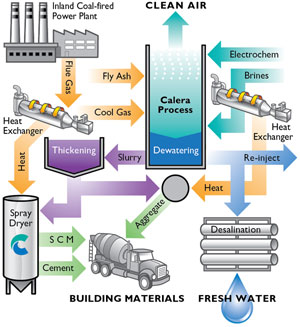
    highlights a new technology that turns carbon dioxide emissions from coal and gas power plants into the basic inputs for cement. Calera, the Silicon Valley start-up creating the approach, has received some $50 million in financial support from venture capitalist Vinod Khosla. Peabody Energy, one of the world’s largest coal company, has put $15 million into the idea. While still relatively small numbers compared to overall investments in fossil fuel-related technologies, these first funds signify growing investment in turning CO2 into a reusable, non-polluting resource.

    Calera will combine CO2 with “seawater or groundwater brine, which contain calcium, magnesium and oxygen. It is left with calcium carbonate and magnesium carbonate, which are used in making cement and aggregate. It plans to sell it to concrete companies for use in pavement.” To convince building manufacturers that their material is safe, Calera’s CO2-embedded cement is being mixed with Portland cement, the “calcium silicate” binder used in concrete for buildings and transportation infrastructure.  Turning CO2 into building materials will make “carbon reduction attractive,” argues Brent Constantz, Calera’s founder and chief executive.

    Coal power plants are major emitters of CO2 emissions. Cement production also contributes large amounts. Creating a cycle wherein the coal plants’ waste becomes feedstock for cement will help kill two birds with one stone. Vinod Khosla said: “With this technology, coal can be cleaner than solar and wind, because they can only be carbon-neutral.”

    R.W. Beck examined Calera’s process and determined that its cement process captured 86 percent of CO2 from a flue gas in one power plant. Seawater and flue gas CO2 are the two key inputs into the process; cement, waste seawater, and a harmful acid are the putputs. The waste sea water that comes out of the tail end of the process can be de-salinated, but the acid, if produced in bulk, could create environmental problems, writes The New York Times. “Much of the skepticism about the project stems from the acid created in Calera’s chemical process. It has to find a way to dispose of it or neutralize it by adding alkaline materials, without creating more environmental problems or raising costs.”

    Some scientists raise doubts the firm can pull it off, arguing that the idea has been explored for more than 15 years. There have been earlier failures, largely due to the costs involved. Beyond the costs of the actual process, infrastructure costs associated with scaling this up (and dealing with potentially massive amounts of that toxic acid) also need to be addressed. Ken Caldeira, a researcher at the Carnegie Institution for Science at Stanford, says: “The idea that they’re going to come up with something that’s both economic and scalable? I’m highly skeptical.”

    But other options are also very expensive. Carbon capture and sequestration demonstration projects all show that these projects are multi-billion dollar undertakings. Injecting CO2 into the ground may not be stable in many parts of the world. (see earlier post)

    On Calera’s web site, the firm outlines their initial target markets, which mostly involve infrastructure: “We will first introduce our […] materials into applications such as pavements and road base course. We will be introducing SCM into applications such as pavers, non-structural block, other miscellaneous precast products, sidewalks, and other similar applications.”

    Read the article

    Also, check out another technology that would reuse waste products while reducing CO2 emissions.  MIT Technology Review discusses a new process that would turn cellulose from agricultural waste into gasoline and jet fuel. “The process is one of a number of new technologies that make conventional fuels such as gasoline and diesel from biomass rather than petroleum.”

    Image credit: Calera

  • The Most Basic Rule In Macroeconomics Says Rates SHOULD Be Higher

    taylor rule

    On March 3, I heard John Taylor over lunch at the San Francisco Federal Reserve. In his talk he reviewed the government’s bailouts and their effects on our economy. If you aren’t familiar with Taylor, he co-authored, along with Bob Hall, the macroeconomics textbook most widely used these days. In addition, he served as undersecretary of the Treasury in the early Bush years where, among other responsibilities, he was tasked with bringing a new currency to Iraq.

    But for us economics nerds, he is most famous for formulating the Taylor Rule, a guideline for where the fed funds rate should be set. While there is more to it, the general idea is to use the inflation rate and the gap in GDP growth from its potential growth rate.

    To make sure that inflation doesn’t get out of control, the fed funds rate should be higher with higher inflation. When the economy is doing poorly, a lower fed funds rate can help the economy.

    The Taylor Rule incorporates these two items into the calculation to suggest an appropriate level for the Fed to use in setting its overnight rate. The basic rule is that the appropriate rate for the Fed can be calculated as follows:

    Rate = 1.5 X inflation % + 0.5 X (real GDP gap %) + 1%

    In the chart just below, I calculated what the Taylor Rule indicated would be a reasonable level for the fed funds rate (in orange), overlaid with the actual fed funds rate (in red). It shows how the Fed kept rates too low in 2004, fueling the housing bubble. That was Taylor’s major point and is documented in his latest book.

    A similar comment could be made about 1975-1977. The wild swing down at the end of 2008, with negative inflation and GDP growth, indicated that the economy was so bad that the rate should go below zero, an impossibility. Even so, that provides some justification for the extreme actions of the Fed in undertaking its quantitative easing.

    Looking to the future, the more important concern for me is that the end of the chart seems to indicate that the appropriate rate has already moved up to 4%. That’s because the measure of inflation used here for personal consumption expenditures has turned from negative to positive.

    If you think inflation will be rising and the economy will not be as bad going forward, you might expect rates to head higher soon. Of course, the Taylor Rule for rates and the actual rates don’t follow an exact track, but using data from the last quarter of 2009, we see a dramatic turnaround in the pressures on rates, based on the Taylor Rule.

    Taylor was surprisingly critical of the long lists of bailout programs, citing data that they had very little positive effect on other measures of the economy. He implied we would have done better with less of these measures, including the granddaddy of the Fed’s actions, to buy $1.25 trillion mortgage-backed securities (MBS), as mortgage rates dropped only slightly. He said we shouldn’t worry about deflation, as he considers it unlikely but felt that in the future we will be worrying about inflation.

    In combination, the conclusions I came away with were supportive of our position that the country’s economic problems are not over, and that inflation will be added to the list of those problems in the future.

    Join the conversation about this story »

    See Also:

  • More details on the long-travel Mopar Ram 1500

    Filed under: , , ,

    Kent Kroeker is cooking up a bit of evil that is 90 inches wide for the Easter Jeep Safari. The latest details reveal that 90 inches is the width of the front track on the Mopar Ram 1500 being built as a “research project,” while that number tapers down to 87 inches in the rear. We’re talking about a truck that will be at least 22 inches wider than a normal Ram when you see its grille coming towards you. And that might be from the air, we’ll have you know – with 15 inches of travel up front and 14 in the rear, this baby looks like she’ll be a true jumper.

    This might be the best of the bunch as far as the Moparized concepts go for this Moab event. What we really want to know is this: We have a good idea of where Fiat and Chrysler head Sergio Marchionne stands with little cars and sedans, but how does he feel about taking muddin’ – and an OEM version of this truck – to the masses? Can the Ford F-150 SVT Raptor now be put on notice?

    [Source: PickupTrucks.com]

    More details on the long-travel Mopar Ram 1500 originally appeared on Autoblog on Wed, 24 Mar 2010 12:59:00 EST. Please see our terms for use of feeds.

    Read | Permalink | Email this | Comments