
del.icio.us · Slashdot · Digg · Facebook · Technorati · Google · StumbleUpon · Yahoo

It’s nothing new that relations between China and the US are more tense these days, but Congress and Tim Geithner are beginning to fear that in the not-too-distant future, the Chinese Yuan could overtake the US Dollar as the world’s reserve currency.
That is exactly what Mr. Dennis Gartman suggests this morning in his Gartman Letter, saying that Congress is full of “idiots” and that their decisions are “truly, truly stupid” because they signed a letter with Tim Geithner that was sent to China. The letter stated their concern over the need to boost the value of the Yuan. Says the letter:
The impact of China’s currency manipulation on the U.S. economy cannot be overstated. Maintaining its currency at a devalued exchange rate provides a subsidy to Chinese companies and unfairly disadvantages foreign competitors.
Chalk another one up for the Krugman brigade.
Join the conversation about this story »
See Also:
 Wikileaks has been in the news recently not for the controversial scoops it regularly publishes but for its financial troubles. The site was taken offline until the necessary funding was raised for it to operate, but it is now coming back with a vengeance. The latest document published on the whistleblower site is a very interesting one, a report about Wikil… (read more)
Filed under: Car Buying, Coupe, Performance, Marketing/Advertising, Dodge

Having trouble deciding which of the three modern muscle cars you want to buy? Dodge is now providing some extra incentive to buy a Challenger over a new Ford Mustang or Chevrolet Camaro. Through April 30 Mopar is offering $2,000 in “Mopar Bucks” to anyone who buys a Challenger R/T, R/T Classic or SRT8, allowing customers to choose between several combinations of performance parts and accessories.
For those who want their Challenger to look even more retro, the best option is probably Mopar’s exterior package. It includes a body-color hood with scoop, rear “Go-Wing” and stripe graphics. Of course, at $1,995, that leaves you with nothing left for performance parts. That’s why we’d probably opt for the cat-back exhaust system ($1,190) and pair it with the interior package ($780) for the manual transmission (of course) that includes a T-handle shifter and full car cover. For super-boring more practically minded Challenger buyers, Mopar is also offering customer care packages that include scheduled maintenance, towing and roadside assistance and rental car allowance. Thanks, but no thanks. Get all the details of the offer after the jump.
[Source: Chrysler]
PSA: Buy a Dodge Challenger, get $2,000 in Mopar bucks for go-faster (or look faster) bits originally appeared on Autoblog on Tue, 16 Mar 2010 10:00:00 EST. Please see our terms for use of feeds.

A group of Japanese automakers, including Nissan and Toyota, are teaming up with Japan’s biggest electric company and the government to make electric-vehicle recharging technology the global standard and bringing it to the United States.
The aim of the coalition, known as CHAdeMo, is to corner the market on one of the technologies that will play a key role in consumers opening up to electric-cars – high-speed charging stations.
“What we need to do is make this protocol a standard outside Japan,” said Tsunehisa Katsumata, chairman of Tokyo Electric Power Co., the main utility backing the venture.
A total of 158 companies involved in the group are pushing for the idea of common charging “language” for fast-charging electric-vehicles from various brands. They say that the move would cut development cost and encourage the use of EVs by consumers.
Tokyo Electric Power developed the protocol with Fuji Heavy Industries, the owners of Subaru, four years ago and have made it the standard in Japan.
Nissan Toyota, Fuji and Mitsubishi are all part of the group and use, or plan on using the fast-charging technology.
– By: Stephen Calogera
Source: Automotive News (Subscription Required)
The world’s largest industry-only event has wrapped up, and the organizers at UBM TechWeb Game Network could not be happier with the outcome. GDC 2010 pulled in a record 18,250 attendees to the event,besting last year’s turnout

This weekend, we noted widespread Arab-world rumors that Egyptian President Hosni Mubarak had died.
There’s no evidence that it’s true, but traders are obviously freaked out.
BusinessWeek: EFG-Hermes Holding SAE, the biggest publicly traded Arab investment bank, dropped the most since December. Telecom Egypt, the largest fixed-line operator in the Middle East, slumped the most since October 2008 after posting full-year earnings that missed estimates. The EGX 30 Index’s 3.8 percent retreat was the most among 93 indexes tracked by Bloomberg.
The retail market is “feeling a little nervous about the president,” said Angus Blair, head of research at Cairo-based investment bank Beltone Financial. “When he returns, I guess you get more calmness.” The benchmark index lost 6.2 percent in the past three days, the most since Nov. 30. The EGX 30 closed at 6,353.14, with all 30 stocks declining.
Join the conversation about this story »
See Also:
By Mohammed A. Salih WASHINGTON, Mar 16 (IPS) Poverty is on the rise in Sub-Saharan Africa (SSA) and various forms of corruption threaten to undermine the impact of investments made to meet the Millennium Development Goals (MDGs) in the continent, said the World Bank in a report released Monday on Africa's development.
The report says the number of people who live on less than two dollars a day has doubled from 292 million in 1981 to nearly 555 million in 2005.
Painting a gloomy picture of Africa's state of development, the report says the SSA region presents the "most formidable development challenge" of the world. It says thousands of people are dying from preventable diseases on a daily basis, and HIV/AIDS and malaria continue to spread through the continent.
The report also highlights "pervasive" corruption in Africa in a 29-page essay elaborating on the subject. It focuses on "quiet corruption", a term referring to the "the failure of public servants to deliver goods or services paid for by governments" that do not involve monetary exchange.
The report warns about quiet corruption's "harmful long-term consequences" for Africa, saying it strongly marginalises the poor.
Although "ubiquitous" in Africa, the Bank says, because it is less "salient" and "noisy", quiet corruption draws less public attention compared to big corruption.
As an example of quiet corruption, the report says that in some SSA countries, primary school teachers are not in school 15 to 25 percent of the time.
The problem has spread to the health sector as well, with deadly consequences. In rural Tanzania, four out of five children who died of malaria had sought medical attention from the country's health facilities, to no avail.
The World Bank says a number of factors such as the absence of diagnostic equipment, drug theft, and absence of providers in health centres contributed to the children's deaths.
In the agriculture sector, one major reason behind the low fertiliser usage among African farmers is the poor quality of fertilisers manufactured in the continent. Although manufacturers have the capability to produce good fertiliser, 43 percent of fertilisers in West Africa in the 1990s lacked the expected nutrients due to poor controls at the producer and wholesaler levels, the report says.
Referring to the pervasiveness of "quiet corruption", the World Bank report calls the familiar "big-time corruption" – bribes and kickbacks to public officials – the "tip of the iceberg".
While the World Bank regularly publishes reports on the state of developing world, it has been frequently lambasted for the role it has played in developing countries.
Doug Hellinger, executive director of Development GAP, accuses the World Bank of contributing over time to some of the current problems in Africa through its policies. Hellinger's organisation works to promote economic justice across the South, a term referring to the developing countries.
"The Bank historically has been the facilitator for Northern corruption by changing the policy environment in these countries," he told IPS. The term "North" refers to the world's developed countries.
"Just the fact that the World Bank insisted on full implementation of the Structural Adjustment Programs (SAPs) and held back loans until they were implemented and the fact that these programmes such as privatisation and import liberalisation benefited Northern companies, it created an environment of corruption, it's a corrupt practice," he said.
SAPs are used to promote and implement free market policies, deregulation and privatisation in countries that borrow loans from institutions like the World Bank and International Monetary Fund.
Hellinger blames institutions like the World Bank for contributing to the inefficiency of health and education systems in the countries of SSA because "they have been the major institution for the cutting of budgetary support for health and education services" in those countries.
Africa has been a key focus of efforts to implement the MDGs set by world leaders in 2000. While the countries in the region are at different stages of development, SSA appears to have a long way to go to achieve the MDGs.
The MDGs include, among others, considerably reducing poverty, child mortality rates and halting epidemics such as AIDS by 2015. But many countries in SSA still fare poorly in some key areas on the World Bank's Development Indicator. The overall GDP of the SSA's 47 countries grew 5.1 percent, with Angola's growth rate of 14.8 percent at the top and Botswana with a negative growth of -1.0 at the bottom. Zimbabwe has the highest adult literacy rate of 91.2 percent in the SSA, while Mali and Burkina Faso have the lowest with 28.7 percent.
In Chad, only nine percent of the population has access to improved sanitation facilities, while the access rate is 94 percent in Mauritius.
Liberia has the lowest primary enrollment rate of 30.9 percent and Sao Tome and Principe has the highest rate, at 97.1 percent.
Child mortality is also a serious problem, with 155 out of 1,000 children in Sierra Leone dying before the age of one, while in Seychelles, the rate is 12 per 1,000.
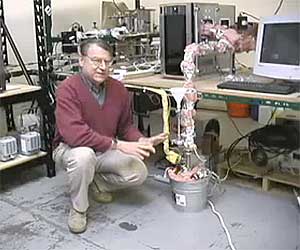 According to CEO Ronny Bar-Gadda of Genesys LLC there is a new technology that he’s invented called RET (radiant energy transfer) that is a breakthrough in producing hydrogen from water. According to Mr. Bar-Gadda, this may just be the disruptive technology the H2 community has been waiting for in regard to producing cost effective hydrogen from any feedstock of water.
The RET system is expected to provide head to head competition with the most efficient electrolysis systems on the market today. According to the video the RET device uses components from both a simple microwave oven and proprietary Genesys components to show that the device can be manufactured in a cost effective manner.
According to Genesys, “The principle of the technology relies on the unique properties of the oxygen-hydrogen bond. By using electromagnetic radiation tuned to the OH bond energy it is possible to break the bond with a minimum amount of energy. The rate of hydrogen production using this technology far exceeds that of electrolytic processes. RET is a continuous process technology that also operates at room temperature. RET is modular and easily scaleable as well as carbon neutral. As a result of this revolutionary approach, RET modules may be added or subtracted very quickly to respond to changes in hydrogen demand.”
Since the Genesys RET technology relies on water (or steam) as a feedstock, there are a several renewable ways to go about using this system. The first method would be to use wind or solar to heat the water into steam and then break the bonds using the RET system.
Another method would be to use geothermal wells, abandoned oil wells, or the steam from online power plants as sources for the high temperature cracking of steam into hydrogen and oxygen. Landfills and waste treatment plants may also be used to provide the H2O feedstock for the Genesys RET system. The Genesys RET technology is a hydrogen on demand system. It is capable of provide hydrogen fuel near the customer of an H2 car, which I take to mean produced in a decentralized manner near the fueling station.
But, the device also looks as if it could be downsized and create hydrogen on demand at the fueling station itself, thereby side-stepping the need for a huge hydrogen distribution system to be built. If this RET hydrogen production method lives up to it’s billing this could be the disruptive technology that hydrogen car advocates have been waiting for that could provide rapid commercialization for H2 cars.
 The New Zealand Government has approved plans to sponsor and build a national rural broadband network to supply 5 Mbps connections to people and institutions in rural areas. The plan is to be carried out by Telecom New Zealand, and will be aimed at providing high-quality Internet access for schools, students and home users.
Th… (read more)

Lexus announced today that it will be heading back to the Nurburgring this spring to compete in the 24 Hours endurance race in May. Lexus says it will enter the race for the first time in the production LFA, which has been race-prepared by Gazoo racing.
We’re not sure if you remember but the LFA had a pretty disappointing run each time its been to the 24 Hours endurance race at the Nurburgring. In 2008, one prototype crashed and finished 120th while in 2009 one prototype caught fire and the other finished 87th.
This year there will be two 552-hp mid-mounted V10 LFAs piloted by Takayuki Kinoshita and German team member Armin Hahne.
Hit the jump for the high-res image gallery and the press release.


Press Release:
LEXUS LFA TO TAKE ON THE ‘RING
– Two production Lexus LFA supercars to compete in Nürburgring 24 Hours endurance race in May
– Race-prepared machines entered by Gazoo racing
– Lexus also to defend championship titles with SC 430 and IS 350 in Japanese Super GT series
Lexus is heading back to the legendary Nürburgring this spring to challenge for glory in the 24 Hours endurance race with its LFA supercar.
It will be the first time the production LFA is seen in full-blooded competition, taking on one of the world’s most challenging circuits in a marathon test of speed, handling and durability. In two previous outings in the event, development versions of the LFA were raced primarily to help hone performance and handling. This time the LFA will line up as a prime challenger in standard production car guise.
It’s a formidable proposition: with its advanced, lightweight composite construction and 552bhp mid-mounted V10 engine, it will reach 62mph in just 3.7 seconds and race on to a top speed beyond 200mph.
Gazoo Racing will prepare and field the two LFA in the event, which takes place from 13 to 16 May. Led by Toyota master test driver Hiromu Naruse, the team will include four Japanese and three German drivers who between them boast outstanding GT and endurance racing experience.
Takayuki Kinoshita is a six-time winner of the Super Taikyu Endurance Series and has competed more often and finished higher (fifth overall) at the Nürburgring 24 Hours than any other Japanese driver. Akira Ida was overall winner of the Tokachi 24 Hours in 1995 and 2007, and both Juichi Wakisaka and Kazuya Oshima have recorded consistent success in Japanese Super GT 500 and GT 300 competition.
The German team members are Armin Hahne, winner of the Spa 24 Hours in 1982 and 1983; Jochen Krumbach, who finished second overall in the 2008 Nürburgring 24 Hours; and Andre Lotterer, Super GT 500 champion in 2006 and 2008.
– By: Kap Shah
There was lots of press coverage about the FCC’s broadband plan on Monday, as the commission released an exec summary of its nearly 400-page plan for broadband in the US. If you want to wade through the details, it’s all there online for you. But, if you want a basic summary, it appears that, like pretty much everything this FCC is doing, it’s a lot of talk and little of consequence. So far, I’ve seen statements from lobbyists on pretty much all sides of the issues “commending” or “applauding” or “supporting” the FCC. And that’s because there’s basically nothing controversial and nothing big at all in the plan. It appears to try to thread the needle and keep everyone happy — and in doing so, it appears to punt on the all-important questions. If it was really about making the necessary changes, key players would be up in arms. But they’re not.
The report pays lip service to greater competition and talks about getting better data and about making better use of wireless spectrum. Well, duh. But it takes no bold steps — does nothing to really take control out of the hands of the incumbent telco providers — just as we originally expected, even if really disruptive, but necessary, ideas were considered, they don’t appear in the final plan.
In the end, it’s the kind of plan you put forward if you’re being political and don’t want to make waves. It’s not the plan you put forward if you’re making a bold leadership statement about how to really expand broadband in this country. Too bad.
Permalink | Comments | Email This Story
Filed under: Sedan, Performance, Bugatti, Luxury

Bugatti seems intent on keeping us on the ropes regarding the production prospects for the 16C Galibier. The concept was unveiled to a very select audience last September during the Frankfurt Motor Show, but didn’t debut on the marque’s show stand. Bugatti pulled a similar shtick in Geneva, but we were luck enough to get a closer look at an exclusive viewing in Beverly Hills.
The company has been fairly tight-lipped on whether their higher-ups at the Volkswagen group have given it the green light – leaving the matter up to speculation and conjecture – but to keep us interested, they’ve released this batch of photos showing what appears to be a second show car, doing its best Johnny Cash impression instead of the two-tone blue and silver paint scheme seen on the the original.
Underneath the dramatic split hood sits a version of the Veyron‘s 8.0-liter W-16 engine, but with a pair of superchargers replacing the quartet of turbos and an eight-speed automatic reportedly in place of the Veyron’s seven-speed DSG. Will we ever hear one rumbling down our streets? That’s in Wolfsburg’s hands now, so for the moment, we’ll just have to enjoy the latest crop of photos in the gallery below.
[Source: Bugatti]
Pics Aplenty: Bugatti 16C Galibier is back… in black originally appeared on Autoblog on Tue, 16 Mar 2010 09:28:00 EST. Please see our terms for use of feeds.
 QR codes are all the rage in Japan, a country pretty much obsessed with mobile devices, having been so way before the iPhone came along and opened the eyes of everyone else to what a powerful mobile device could do. Incidentally, the iPhone hasn’t really taken off in Japan like in the rest of the world. But QR codes are about to get a massive push… (read more)
Harley-Davidson’s (HOG) stock is going hog-wild this morning with heavy volume amid speculation that the legendary motorcycle manufacturer could be purchased by a private equity firm in a leveraged buyout offer deal.
Shares are up 4.1% to $27.69 so far this morning.

Join the conversation about this story »
See Also:
Posting their quarterly financials earlier, Atlus can now pull a Scrooge McDuck and swim in their very own money bin. Sort of. The publisher reported sizable gains over the last few months, mostly thanks to their North

Foi anunciado pela McLaren Automotive que a conferência de imprensa sobre os planos futuros da empresa será feito no próximo dia 18. Entre os detalhes da conferência, apesar de não confirmados, pode estar as novas informações da nova versão da McLaren MP4-12C.
O nome do evento será “Inside McLaren – The Launch of a New Car Company”. Como o nome sugere, a companhia pretende crescer no mercado automotivo, tendo a versão final do MP4-12C como parte de sua linha em seus planos futuros.
Também é esperado que o piloto Lewis Hamilton esteja na conferência para conversar a respeito dos planos da McLaren, e sobre como a equipe da F1 pode contibuir no desenvolvimento dos modelos da companhia. Mais supercarros parecem estar a caminho das estradas!
Imagens do novo supercarro da McLaren


Via | Autocar.uk
Avoiding conflicts of interest should be easy when you vow to stay objective. But even incentives for objectivity can’t content with outside influences, according to new research by HBS professor Max Bazerman and colleagues. Writing in “Conflict of Interest and the Intrusion of Bias,” they emphasize how remarkably typical it is for individuals to fall prey to outside influences yet continue to believe in their own biased assessments—with implications for professional conduct and public policy. “Our results suggest that the psychology of conflict of interest is at odds with the way economists and policy makers routinely think about the problem.”
In Capitalism: Its Origins and Evolution as a System of Governance (forthcoming), Professor Bruce R. Scott provides analysis of capitalism’s roots and transformation, highlighting the role of political authority. As he explains, “Capitalism is not a natural system, and it did not emerge or spread as an unguided process like biological evolution; it has only existed since the liberation of the markets for land, labor, and capital, i.e., the end of feudalism. Its spread is a story of the politics of hostile takeovers and/or liberation.”
Among other cases this week, “Ben Bernanke: Person of the Year?” looks at recent criticism of the Federal Reserve and its chairman.
— Martha Lagace
| Author: | Geoffrey Jones |
|---|---|
| Publication: | Istanbul: Is Bankasi Kultur Yayinlari, 2010, Turkish ed. |
Unilever’s brands can now be found in one out of every two households in the world. This arresting and impressive fact shows the scope and scale of this unique global corporation. Geoffrey Jones, a leading business historian from the Harvard Business School, takes us inside this corporation, which from its origins in Britain and the Netherlands has become a worldwide manufacturer of fast-moving consumer products. Unilever’s operations cover food and home and personal care, and its brands include Lipton Tea, Hellmann’s, Bird’s Eye, Wall’s, Ben and Jerry’s, Surf, Domestos, Comfort, Dove, Sunsilk, Pond’s, Signal, Axe, and Calvin Klein. In particular the book focuses on the evolution of the company over the last half century. Managing such a firm in the era of globalization posed enormous challenges. The book covers the company’s strategies and provides compelling evidence of its decision making, marketing, brand management, innovation, acquisition strategies, corporate culture, and human resource management. The author has had full access to corporate archives and executives and provides us with a unique insight into the workings and strategies of one of the world’s oldest and largest multinationals.
| Author: | Bruce R. Scott |
|---|---|
| Publication: | Springer-Verlag, forthcoming |
Capitalism, as defined in this book, is an indirect, three-level system of governance for economic relationships (i.e., economic, administrative, and political). Whereas economic markets can coordinate supply and demand within an existing system thanks to the invisible hand of the pricing mechanism, capitalism must have the administrative capability to regulate the behavior of economic actors within those markets and the political capability to redesign their institutions; regulation and the design of market frameworks require the visible hand and coercive powers of a political authority. This three-level structure closely parallels that of all organized team sports. The play on the field is like the markets of capitalism, and the actions of the players are regulated by referees who enforce a set of rules created and promulgated by a political authority that enjoys an anti-trust immunity. Capitalism is not a natural system and it did not emerge or spread by an unguided process like biological evolution; it has only existed since the liberation of the markets for land, labor, and capital, i.e., the end of feudalism. Its spread is a story of the politics of hostile takeovers and/or liberation. Capitalist evolution requires the continuing transformation of its three levels of governance.
| Author: | Richard S. Tedlow |
|---|---|
| Publication: | Portfolio, a branch of Penguin Viking, 2010 |
This book deals with two of the biggest problems in business: Why do sane, smart leaders often refuse to accept the facts that threaten their companies? And how do they find the courage to resist denial when facing new trends, changing markets, and tough new competitors?
| Authors: | Bo Becker and Jagadeesh Sivadasan |
|---|---|
| Publication: | B.E. Journal of Economic Analysis & Policy (forthcoming) |
We investigate financing constraints in a large cross-country data set covering most of the European economy. Firm-level investment sensitivity to cash flow is used to identify financing constraints. We find that the sensitivities are significantly positive, on average, controlling for country and industry fixed effects, as well as firm-level controls. Most importantly, the cash flow sensitivity of investment is lower in countries with better-developed financial markets. This suggests that financial development may mitigate financial constraints. This effect is weaker in conglomerate subsidiaries, which are likely to have access to internal capital markets and depend less on the outside financial environment, and possibly for firms in industries with highly liquid assets as well. This result sheds light on the link between financial and economic development.
| Authors: | Bo Becker, Henrik Cronqvist, and Rüdiger Fahlenbrach |
|---|---|
| Publication: | Journal of Financial and Quantitative Analysis (forthcoming) |
Large shareholders may play an important role for firm performance and policies, but identifying this empirically presents a challenge due to the endogeneity of ownership structures. We develop and test an empirical framework, which allows us to separate selection from treatment effects of large shareholders. Individual blockholders tend to hold blocks in public firms located close to where they reside. Using this empirical observation, we develop an instrument—the density of wealthy individuals near a firm’s headquarters—for the presence of large, non-managerial individual shareholders in firms. These shareholders have a large impact on firms, controlling for selection effects.
| Authors: | Clayton M. Christensen and Paul R. Carlile |
|---|---|
| Publication: | Academy of Management Learning & Education 8, no. 2 (2009) |
Some in the Academy have questioned the usefulness of case studies in teaching sound management theory (Shugan 2006). Our research and experience suggests exactly the opposite—that case studies can unite the development of theory with the teaching of it in a single enterprise we’ll call course research. Conclusions such as those that Shugan and others have reached stem from misconceptions about the relationship of research, theory, case studies, and teaching. In fact, the proper use of case studies in teaching can help faculty resolve a basic dilemma of academia: promotion is often based upon our published research, and we find that responsibilities to teach detract from the mandate to publish. When approached properly, case studies can transform teaching into research and enroll students as “course researchers,” whose class participation can be exceptionally valuable in the theory-building process.
| Authors: | Paul A. Gompers, Henry Chen, Anna Kovner, and Josh Lerner |
|---|---|
| Publication: | Journal of Urban Economics (forthcoming) |
We document geographic concentration by both venture capital firms and venture capital-financed companies in three metropolitan areas: San Francisco, Boston, and New York. We find that venture capital firms locate in regions with high success rates of venture capital-backed investments. Geography is also significantly related to outcomes. Venture capital firms based in locales that are venture capital centers outperform, regardless of the stage of the investment. This outperformance arises from outsized performance outside of the venture capital firms’ office locations, including in peripheral locations. If the goal of state and local policy makers is to encourage venture capital investment, outperformance of non-local investments suggests that policy makers might want to mitigate costs associated with established venture capitalists investing in their geographies rather than encouraging the establishment of new venture capital firms.
| Authors: | Paul A. Gompers, Josh Lerner, David Scharfstein, and Anna Kovner |
|---|---|
| Publication: | Journal of Financial Economics (forthcoming) |
This paper presents evidence of performance persistence in entrepreneurship. We show that entrepreneurs with a track record of success are much more likely to succeed than first-time entrepreneurs and those who have previously failed. In particular, they exhibit persistence in selecting the right industry and time to start new ventures. Entrepreneurs with demonstrated market-timing skill are also more likely to outperform industry peers in their subsequent ventures. This is consistent with the view that if suppliers and customers perceive the entrepreneur to have market-timing skill, and is therefore more likely to succeed, they will be more willing to commit resources to the firm. In this way, success breeds success and strengthens performance persistence.
| Authors: | Don A. Moore, Lloyd Tanlu, and Max Bazerman |
|---|---|
| Publication: | Judgment and Decision Making 5, no. 1 (February 2010): 37-53 |
This paper explores the psychology of conflict of interest by investigating how conflicting interests affect both public statements and private judgments. The results suggest that judgments are easily influenced by affiliation with interested partisans, and that this influence extends to judgments made with clear incentives for objectivity. The consistency we observe between public and private judgments indicates that participants believed their biased assessments. Our results suggest that the psychology of conflict of interest is at odds with the way economists and policy makers routinely think about the problem. We conclude by exploring implications of this finding for professional conduct and public policy.
| Authors: | S.P. Kothari, Karthik Ramanna, and Douglas J. Skinner |
|---|
Based on extant literature, we review the positive theory of GAAP. The theory predicts that GAAP’s principal focus is on control (performance measurement and stewardship) and that verifiability and conservatism are critical features of a GAAP shaped by market forces. We recognize the advantage of using fair values in circumstances where these are based on observable prices in liquid secondary markets but caution against expanding fair values to financial reporting more generally. We conclude that rather than converging U.S. GAAP with IFRS, competition between the FASB and the IASB would allow GAAP to better respond to market forces.
Download the paper: http://papers.ssrn.com/sol3/papers.cfm?abstract_id=1413775
| Authors: | André Martínez-Fritscher, Aldo Musacchio, and Martina Viarengo |
|---|
Brazil at the turn of the twentieth century offers an interesting puzzle. Among the large economies in the Americas, it had the lowest level of literacy in 1890, but by 1940 the country had surpassed most of its peers in terms of literacy and had made a significant improvement in its education system. All of this happened in spite of the fact that the Constitution of 1891 included a literacy requirement to vote and gave states the responsibility to spend on education. That is to say, Brazilian states had a significant improvement in education levels and a significant increase in expenditures on education per capita despite having institutions that limited political participation for the masses (Lindert, 2004; Engerman, Mariscal, and Sokoloff, 2009) and having one of the worst colonial institutional legacies of the Americas (Acemoglu, Johnson, and Robison, 2001; Easterly and Levine, 2003; and Engerman and Sokoloff, 1997, 2002). This paper explains how state governments got the funds to pay for education and examines the incentives that politicians had to spend on education between 1889 and 1930. Our findings are threefold. First, we show that the Constitution of 1891, which decentralized education and allowed states to collect export taxes to finance expenditures, rendered states with higher windfall tax revenues from the export of commodities to spend more on education per capita. Second, we prove that colonial institutions constrained the financing of education, but that nonetheless the net effect of the increase in commodity exports always led to a net increase in education expenditures. Finally, we argue that political competition after 1891 led politicians to spend on education. Since only literate adults could vote, we show that increases in expenditures (and increases in revenues from export taxes) led to increases in the number of voters at the state level.
Download the paper: http://www.hbs.edu/research/pdf/10-075.pdf
Dennis Campbell and Brent Kazan
Harvard Business School Case 110-049
The case illustrates the role of performance measurement and analytics in translating TD-Canada Trust’s service model of “comfortable banking” into operational terms. In 2000, in a banking market where consumers and regulators were typically hostile to mergers and acquisitions, Canada’s fifth largest commercial bank, Toronto-Dominion Bank (TD Bank), undertook a merger with a relatively small trust company, Canada Trust, which was known for exceptional customer service. To assuage the concerns of regulators, consumer groups, and newly acquired customers, TD Bank made several public pronouncements promising to maintain Canada Trust’s high customer service standards and to deliver a “comfortable banking” experience. Chris Armstrong, executive vice president and chief marketing officer, was now faced with the task of defining the comfortable banking model and consistently delivering on these promises. Armstrong and his team undertake a systematic analysis of the drivers of customer satisfaction and branch network profitability and, based on the results, must decide how to change TD-Canada Trust’s branch compensation and performance reporting systems to consistently, and profitably, deliver a “comfortable banking” experience.
Purchase this case:
http://cb.hbsp.harvard.edu/cb/product/110049-PDF-ENG
Lakshmi Iyer and Matthew C. Weinzierl
Harvard Business School Case 710-051
In response to the economic and financial crisis of 2008-2009, the Federal Reserve greatly expanded the scale and scope of its activities. Though lauded by many experts for its actions, the Fed and its chairman, Ben Bernanke, faced harsh criticism from some public commentators and members of Congress. This document summarizes that criticism and Chairman Bernanke’s responses to it, highlighting the tension between congressional oversight of the Fed and the Fed’s independence from political influence.
Purchase this case:
http://cb.hbsp.harvard.edu/cb/product/710051-PDF-ENG
Robert S. Kaplan
Harvard Business School Case 110-007
The vice president of sales learns that the most profitable 1% of the division’s customers generate 100% of profits, and that two of the division’s largest customers lose 50% of profits. The division has just finished a project to install a time-driven activity-based cost system that traces costs directly to the processes used to produce, sell, and deliver a wide variety of stainless steel sinks to a diverse customer base. Given the division’s high variety of products and customers (which includes wholesalers, retailers, contractors, and distributors), the VP of sales wanted a much more accurate cost system so that he could conduct difficult but fact-based negotiations with customers. The case describes the design and implementation of the new cost and profit measurement system. It documents acceptance and decisions made by managers after seeing the enormous dispersion of profits among their products and customers.
Purchase this case:
http://cb.hbsp.harvard.edu/cb/product/110007-PDF-ENG
Joseph B. Lassiter, Ramana Nanda, and David Kiron
Harvard Business School Case 810-005
Just months after declaring their intent to become a solar cell equipment supplier, van Mierlo and Sachs were again revisiting the issue of what the company should be. Becoming a successful solar cell manufacturer would potentially be much more lucrative than becoming a successful equipment supplier. But, the latter was much less capital intensive and perhaps a less operationally risky approach. For van Mierlo and Sachs, the question—”What kind of company should 1366 become?”—was back on the table.
Purchase this case:
http://cb.hbsp.harvard.edu/cb/product/810005-PDF-ENG
College Savings Answers
Statistics show the cost of college tuition, room and board
at four-year public institutions rose by 30 percent from 1998 to 2008 – and
it’s still growing. This spring, Harper College will host a free seminar showing
parents, grandparents and others how to financially prepare for the impending
price of higher education. The “Saving for College” session is from 6 to 7:30
p.m. Wednesday, April 21 in the Wojcik Conference Center on Harper’s main
campus, 1200 W. Algonquin Road in Palatine. The event will offer tips and
advice from college experts and professional advisors, who will cover the
basics of saving for higher education and provide tools to help attendees
navigate the college savings process. “Whether the young person in your life is
4 or 14, it’s not too early – or too late – to start investing in their
education,” says Katherine Sawyer, Associate Executive Director of the Harper
College Educational Foundation. “Saving that money, though, can be daunting,
particularly amid rising tuition and a gloomy economy. This seminar will give
attendees the confidence and know-how they need to start saving the right way.”
The event, hosted by the Harper Heritage Society’s Professional Advisor group –
an offshoot of the College’s Educational Foundation – also will include Harper
financial aid experts. To register, call 847.925.6490 or visit www.harpercollege.edu/foundation
and select the Professional Advisor Seminar Series. For more information, call
847.925.6490.
Media Note: Reporters
are welcome to attend the event and talk with participants about the task of
saving for college amid shrinking financial aid resources and rising tuition
costs.
Press Contact: Erin
Brooks, Media Relations Specialist, 847.925.6159, [email protected].
Entrepreneur Help
Making a small business flourish can be a tough task,
particularly in a downturned economy. But it’s not impossible. With an eye on
helping small business owners compete and excel in a continued rough-and-tumble
climate, Harper College is hosting Entrepreneur’s Quest 2010, a daylong seminar
filled with expert tips on marketing, sales, branding, business strategies and
the latest technology. Social media trends – including details on promoting
businesses, boosting sales and improving customer service via networks like
Facebook and Twitter – will be among the topics. This year’s edition also will
include a panel discussion offering strategies and wisdom from successful,
seasoned entrepreneurs. “Staying in business can be difficult struggle for any
small business owner anytime, but especially in a time when America is still
battling the effects of a devastating recession,” Small Business Development
Manager Bonnie Richter says. “This workshop will offer strategies for surviving
and thriving despite economic challenges, and competing in the nation’s new
business landscape.” If small businesses fail, many jobs go, too: more than 70
percent of jobs are created by small businesses like the ones targeted by
Harper’s Quest event. Sam Glenn, an author, comedic speaker and founder of the
motivational resource company EverythingAttitude.com, will serve as the keynote
speaker. Glenn’s new book, “A Kick in the Attitude,” offers tips for using
positivity to achieve success. The event also will feature Mike Muldoon, a
marketing and management professor and president of a consulting and business
coaching practice. Entrepreneur’s Quest 2010 runs from 8 a.m. to 3:30 p.m.
Saturday, April 24 at the Wojcik Conference Center on Harper’s main campus,
1200 W. Algonquin Road, Palatine. The cost is $60 for those who register by
April 1, and $75 afterward. That includes lunch. To register or for more information,
visit www.harpercollege.biz, call
847.925.6520 or email [email protected].
The event is sponsored by the Small Business Development Center at Harper
College, which provides free resources and one-on-one counseling and advice for
small business owners and entrepreneurs. For appointments, call 847.925.6520.
Media Note: The
Illinois Small Business Development Center at Harper College has had many
success stories, even in the midst of a downturned economy. To interview
successful entrepreneurs for this story or others, or for comments on small
business start-up tips, contact Erin Brooks, Media Relations Specialist, 847.925.6159,
[email protected].
Deaf Institute Dedication
In 2005, the Kimball Hill family pledged $200,000 to support
programs and resources for deaf and hard of hearing students at Harper College.
In the five years since, those funds have been invested to create a
technology-rich classroom and learning laboratory, develop in-class captioning
services, purchase assistive listening devices for students, provide additional
tutoring, allow out-of-district students easier access to Harper’s program and
support a summer program helping deaf and hard of hearing students transition
to their first college semester. In recognition of those advancements, Harper
this month will formally dedicate the Kimball Hill Family Deaf Institute – a
comprehensive program offering education, resources and support to deaf and
hard of hearing students across the suburbs, the state and the nation. A
reception will be held on Thursday, March 18, allowing attendees to see
firsthand the innovations Harper provides, learn more about College’s deaf and
hard of hearing programming and hear from successful program graduate Katie
Romano. Romano, 24, of Bartlett attended Harper for two years before
transferring to Gallaudet University, playing on the College’s soccer team and taking
mainstream courses with the help of interpreters and notetakers. “This
Institute is yet another example of how donations made to Harper can improve
the education and lives of our students and enhance our contribution to the
community,” says Catherine Brod, Executive Director of Harper’s Educational
Foundation. “We are grateful to the Kimball Hill Family for this generous gift,
and are excited to share with others all the amazing things the funding has
helped us achieve for this student population.” Members of the Kimball Hill
family – including Harper College Trustee Diane Hill and TK Hill, a nephew who
is deaf, will be on-hand for the hour-long event; representatives from local
high school programs and supporting agencies for the deaf and hard of hearing
also have been invited to attend. Harper has provided programming for deaf and
hard of hearing students since 1973, serving about 50 students each year. The
program, which boasts services and instructional support well beyond those that
are mandated, draws enrollments from local communities, other parts of
Illinois, neighboring states and the world. To learn more about the Kimball
Hill Family Deaf Institute, or to make a contribution, call 847.925.6490 or
visit www.harpercollege.edu/foundation.
Media Note: This event
is not open to the public, but reporters and photographers are encouraged to
attend. Students, staff and faculty of the Kimball Hill Family Deaf Institute are
available for interviews in advance of, during and after the event. To arrange
an interview, contact Erin Brooks, Media Relations Specialist, 847.925.6159, [email protected].
A Visit with Salinger
In the mid-1970s, “The Catcher in the Rye” already was a hit,
and its author, J.D. Salinger, already was a literary legend – and an
undeniably private man. It was in that decade that Harper College Professor
Greg Herriges made up his mind to meet and speak with the famously reclusive
author, eventually becoming one of few people to ever accomplish the task.
Herriges details his cross-country journey – and the once-in-a-lifetime
Salinger encounter and conversation that ensued – in his book, “J.D.: A Memoir
of a Time and a Journey.” He’ll read from the book and discuss his adventure at
12:15 p.m. Thursday, March 18 in Harper’s Drama Lab, Room L109, Building L. The
event, a tribute to the late Salinger, is free and open to all. Salinger’s
January death left Herriges temporarily stunned; he noted afterward, “It
walloped me, because there has always been a Salinger, and suddenly, there
wasn’t.” Over the years, many Salinger fans made the trek to New England to
visit the author; most were turned away. Today, amid speculation that Salinger
had locked away a safe filled with unpublished texts, Herriges says he believes
the author did indeed leave work behind. But “how much there is and what the
content is about is all a matter of intense conjecture. We’ll have to wait and
see,” he says. For more information on his reading, call 847.925.6242 or visit www.harpercollege.edu/boxoffice.
Press Contact:
Erin Brooks, Media Relations Specialist, 847.925.6159, [email protected].
Acing Alpaca
Amanda Joseph is only in her first year of Harper College’s
fashion program, and she’s already making a name for herself. The 19-year-old
Palatine resident beat out dozens of other competitors from colleges and universities
across the nation and Canada to take second place at a recent national
competition requiring contestants to design a cutting-edge textile from alpaca
fibers. The honor scored Joseph a $750 scholarship, a trip to Nashville, Tenn.
to collect the prize, and bragging rights among a field of entrants from
schools like the Art Institute of California, the Fashion Institute of
Technology in New York City and Kansas State University. Joseph drew
inspiration from the image of a melting glacier field to create her piece: a brushed,
woven alpaca fabric on which she incorporated an additional technique: marbling
the fabric with paints. The annual Fiber to Fashion Design Competition is
sponsored by the Alpaca Owners and Breeders Association. Alpaca, though not widely
used in fashion, is similar to cashmere in its substantial price and luxurious
texture. “Contests like these draw some of the best talent there is in the area
of fashion and textile design,” says Donna Sculley, Joseph’s textiles
instructor. “The fact that Amanda won as a first-year student speaks to her
notable skill and potential in the industry, and showcases the kind of talent
we attract here at Harper. We’re excited to see what the future holds both for
her and for us.” Harper students have come up winners at the contest before.
Most recently, student Yulia Kersten earned first place in the 2009
competition’s textile category for her felted alpaca fabric, and took home a
Consumers Choice Award. In 2008, a trendy knee-length alpaca coat designed by student
Olga Pasman of Schaumburg won the top prize in the contest’s fashion category
and was manufactured afterward and sold online.
Press Contact:
Erin Brooks, Media Relations Specialist, 847.925.6159, [email protected].
Urinetown
Harper College will offer three more public stagings of
Urinetown, the Tony Award-winning, go-green satire about the fallout from a
drought and a water shortage. Remaining showtimes are 8 p.m. Friday, March 19
and Saturday, March 20 and 2 p.m. Sunday, March 21 in the College’s Performing
Arts Center. Urinetown, written by Greg Kotis, draws on his experience as a
student traveling
encountered pay toilets and had to limit his bathroom trips for lack of cash.
The musical tells the story of a town where a water shortage has made private
toilets unthinkable. Instead, all restroom activities are conducted in public
toilets controlled by a corporation that requires them to pay for restroom use
or be banished to the Urinetown colony. “The reality of Urinetown is that it
slyly explores issues that are so fundamentally part of the American fabric,”
says Harper Professor Laura Pulio Colbert, who is directing the play. “It is
exuberant, ridiculous satire at its finest.” The play, which won three Tonys,
also lampoons the Broadway musical form. Tickets are $15 for general admission,
with discounts for students and seniors. Call 847.925.6100 or visit www.harpercollege.edu/boxoffice.
Press Contact:
Terry Karow, Marketing and Public Relations Specialist, 847.925.6627, [email protected].
Free Ultrasounds
The Harper College Diagnostic Medical Sonography program is
seeking volunteers interested in receiving free ultrasounds. Available tests
include obstetrical ultrasounds (participants must be at least 18 weeks
pregnant; they will receive a copy of the images), carotid artery ultrasounds (participants
must be at least 50 years old), venous ultrasounds of the lower legs
(participants must be at least 18 years old) and echocardiograms (participants
must be at least 18 years old). All exams will be performed by students on
state-of-the-art equipment, under the supervision of a registered Diagnostic
Medical Sonographer. The free tests, lasting about an hour each, are
non-diagnostic. Volunteers will not receive a medical report, but will be
instructed to follow up with a doctor if abnormalities are suspected.
Volunteers are needed through May 1. Ultrasounds have been used since the 1950s
and have no known harmful effects. Harper’s program conforms to all patient
safety regulations. To schedule a free ultrasound appointment, call 847.925.6104.
Press Contact:
847.925.6159, [email protected].
Photo Opportunities
Event: Reading
by and conversation with Professor Greg Herriges, who met the famously
reclusive author J.D. Salinger and detailed the experience in a published book.
Date: 12:15
p.m. Thursday, March 18
Location: Drama
Lab, Room L109, Building L
Event: Kimball
Hill Family Deaf Institute dedication
Date: 4 to 5
p.m. Thursday, March 18
Location: Room
D115, Building D
Media Note: This event is not open to the
public.
Event: “Tide
of Poseidon” massive balloon art aerial sculpture
Date: 8:30
a.m. to 4:30 p.m. weekdays through Thursday, March 18
Location: Art
Exhibition Space, Room C200, Building C
Event: Computer
Kids Program. Elementary District 21 students whose parents are in Harper
literacy courses are able to learn digital concepts and computer technology in
this new class.
Date:
Location:
Wolf Road
Filed under: Motorsports, Coupe, Europe, Lexus, Toyota, Racing

Toyota has announced its racing activities for 2010. And while Formula One has already been removed from the program, the Japanese automaker has plenty going on in other disciplines, including the domestic Super GT series, Formula Nippon, NASCAR and…what’s that? The Nürburgring 24 Hours.
As you may recall, Toyota’s Lexus division took LFA prototypes to the ‘Ring in both 2008 and 2009 for the round-the-clock race to help drum up some excitement and give the prototypes some competition testing. Since then, the LFA has gone from concept car to race car to production car and is now going back to endurance racer for this year’s event.
The pair of cars, now based on the production LFA, will be fielded once again by Gazoo Racing, piloted by a roster of Japanese and German drivers with a wealth of experience between them in sportscar racing. They’ll be supported by Toyota factory personnel, potentially to include once again company president Akio Toyoda.
The announcement comes hot on the heels of the similar news regarding a track-oriented LFA special edition, reportedly bearing the Nürburgring name as well. The race takes place in May, but in the meantime, you can check out the press release after the jump and the fresh images in the gallery below.
Gallery: 2010 Lexus LFA racer


[Source: Toyota]
Continue reading ‘Ring Leader: Lexus announces return to Nürburgring 24 with new LFA racer
‘Ring Leader: Lexus announces return to Nürburgring 24 with new LFA racer originally appeared on Autoblog on Tue, 16 Mar 2010 08:57:00 EST. Please see our terms for use of feeds.


