Author: Serkadis

  • Preserving the tomb of Tutankhamun

    eTurboNews (Hazel Heyer)

    Egypt’s Supreme Council of Antiquities (SCA) and the J. Paul Getty Trust announced a new partnership for the conservation and management of the tomb of Tutankhamen, a five-year collaborative effort between the SCA and the Getty Conservation Institute (GCI). . . .

    Because of its history and its contents, which were excavated over a ten-year period, the tomb of Tutankhamen is of great historic and cultural value. Today the tomb is among the most heavily visited sites in the Theban necropolis and the large number of visitors may be contributing to the tomb’s physical deterioration. The Tutankhamen project will undertake detailed planning for the conservation and management of the tomb and its wall paintings, with the SCA and the GCI working jointly to design and implement the plan.

  • Nefertiti photo ban

    Earth Times

    I was surprised, when I read this, that the museum had had a policy of permitting photographs. Apart from the dangers of flash I would have thought that for logistical reasons alone photography would have been banned simply because people taking picutres usually slows up visitor flow around certain exhibits. The problem with people ignoring the restrictions on flash is infuriating. If they don’t know how to turn the automatic flash off then they quite simply shouldn’t use the camera where flash is banned.

    Berlin has banned tourists taking photographs of Queen Nefertiti, amid fears that camera flashes may spoil pigments painted on the limestone and plaster bust, a museum spokeswoman said Thursday. The sculpture in the Neues Museum featuring a delicate skin-tan and perfect eye makeup that make the 3,500-year-old figure look like a contemporary woman, is one of the city’s top tourist draws.

    The spokeswoman said the previous policy, allowing photographs if the flash was turned off, was changed several weeks ago, “because most visitors were not obeying the ban on flash.”

  • The boat beneath the pyramid

    Talking Pyramids (Vincent Brown)

    Vincent has done a great feature today on Khufu’s boat at Giza. He has displayed some excellent photographs and provided links to PDFs and photographs which describe the boat and its discovery, excavation and reconstruction.
  • Lecture on Djehuty

    Luxor News Blog (Jane Akshar)

    Thanks again to Jane for making her lecture notes available. See her website, above, for the full set of notes. Here’s a short preview:

    Djehuty by Jose Galan
    Totally excellent lecture with 203 slides!

    Their website http://www.excavacionegipto.com/index.jsp.htm in Spanish but you can use Goggle translate to view it.
    I also have previous notes
    http://luxor-news.blogspot.com/2009/02/mummfication-museum-lecture-tt11-tt12.html and
    http://luxor-news.blogspot.com/2008/07/previous-posts.html (search on TT11)

    The Spanish team have been working there 9 seasons at the northern end of the Theban necropolis at Dra Abu Naga. This was a special place in ancient times as it was connected to Karnak, the sun roses between the pylons across the river and set behind Dra Abu Naga. It was also the 1st landing place of the Beautiful feast of the valley, which was Luxor’s most special ancient festival.

    The first excavation was done by the Marquis of Northampton with the Egyptologists Newbury and Spiegelberg but this was a very short season back in 1899. In 1909 both Gardiner and Weigall started work trying to protect tombs and around that time a number of photos were taken which are in the Griffiths Institute. The situation in 2002 was not much different from that of 1909 with TT11 only half visible and TT12 and TT399 not visible at all.

    The original aim of team was to document the courtyards of the tombs and in fact TT11 has the longest recorded courtyard. The tombs of TT11, TT12, TT399 and Baki are all connected; TT11 is a t-shaped tomb.

  • Exhibition: Ippolito Rosellini

    Al Ahram Weekly (Gamal Nkrumah)

    Every depiction of an ancient portrait has the capacity to change interpretive history. It is mid-February and the Temple of Edfu looks a shadow of its usual self. Instead of picture-postcard columns, the colossal figures etched on its walls and the spirit of the late summer inundation, the ghostly outlines of high-priests look like they are under the spell of a sorcerer of the ancients.

    It is not the dead bodies, decomposing mummies, powerful memories of a lost world that entrance the viewer. It is the very image of Ippolito Rosellini, the father of Italian Egyptology and colleague of Jean- François Champollion at work in Upper Egypt that captures the imagination of the visitor to “Ippolito Rosellini and the Dawn of Egyptology” at the Egyptian Museum. It takes some time to come to terms with the imposition imported, or rather on loan, from the Rosellini Archives in the University Library of Pisa, the home town of Italy’s “Father of Egyptology”.

  • Photo for Today – Kiosk of Qertassi

    Kiosk of Qertassi
    New Kalabsha
    (Lake Nasser, just south of the Aswan High Dam at Aswan)

    The kiosk, the remainder of what was a much larger temple,
    was originally erected next to sandstone quarries 40km to the south
    and features twin heads of Hathor, who was the deity responsible
    for miners and quarrymen

    There’s a good photograph of it in its original position,
    taken by Francis Firth in 1857, on the Megalithic Portal website.

  • Microsoft-Yahoo Deal Gets Approval from Regulators in the US and EU

    The preparation stage for the biggest deal in web-search history is over, Microsoft and Yahoo are free to do as they please with their search engines as far as US and EU regulators are concerned, as was expected. Both the US Department of Justice and the European Commission had given their approval of the search deal proposed l… (read more)

  • Bill Gross: Stop Freaking Out, The Fed Hike Means Nothing

    billgrosscnbc3.jpg

    According to the Bond King, Bernanke’s discount rate hike was the pretty much the equivalent of doing absolutely nothing.

    Reuters:

    “I don’t think it’s the beginning, really, of a tightening from the standpoint of monetary policy,” Gross told Reuters Insider television soonafter the Fed’s decision. “I don’t think it is the beginning of an increase in the fed-funds rate or in terms of interest on reserves that has been discussed as well.”

    Read more here >

    Join the conversation about this story »

    See Also:

  • MWC 10: Hands-on with the Toshiba TG02

    Above is our last video from Mobile World Congress 2010, featuring a hands-on with the lovely Toshiba TG02.

    The handset appears much smaller and slimmer than previously, and of course now features a capacitive screen.  Unfortunately it seems Toshiba has merely thrown together a bundle of third party software which fail to show the device to best effect, resulting in for example the extremely finger-unfriendly Core Player being used on a capacitive screen and software which does not respond to the accelerometer for example.

    Could Toshiba have done more to make the device compelling? Let us know below.

  • Does ‘Radiohead Journalism’ Make Sense?

    Wired has a story written by journalist Paige Williams about her experience putting up a long form feature story about the pseudonymously named Dolly Freed, who had written a rather successful book as a teenager called Possum Living: How to Live Well Without A Job and (Almost) No Money — but following the publication, Dolly decided to effectively disappear. Williams tracked her down and wrote a feature article about her, but couldn’t find anyone willing to publish it. The NY Times was going to, but backed out when Williams refused to reveal Freed’s real name. So, instead, she put the article on her own site and put up a Paypal donation button, hoping to recover her expenses. She calls it “Radiohead journalism” after Radiohead’s famed “name your own price” experiment.

    Then, with little direct publicity — beyond mentioning it on Facebook and Twitter — the story got a bit of attention. Not a ton, mind you, but a few thousand views, which resulted in about 160 people donating a bit over $1,500. Combined with the kill fee from the NY Times for backing out on publishing the feature, her expenses were covered.

    There are some interesting things here, but I’m afraid that the catchy name “Radiohead journalism” is not really accurate or a very good way of thinking about this particular experiment. Radiohead had a variety of other income streams, and from the very beginning, the band admitted that the “name your own price” offering for digital files was part of a way to get more attention for the fancy “discbox” tangible version of the album. In other words, Radiohead always had an additional reason to buy, which Williams didn’t really have. Her model was more of a “give it away and pray” for donations, which can work in some cases, but isn’t really sustainable.

    Still, it does show that there are some creative ways (and this is but one of many) to fund longer form journalism — and, contrary to the opinion of some, if there’s real demand for such things, business models will begin to develop. Williams, for her part, seems interested in further experimenting and improving on the model, and I’m hopeful that she’ll look at some more involved business models that go beyond a straight donation model.

    Permalink | Comments | Email This Story


  • Facebook Is Twice as Fast as Just Six Months Ago

    It looks like Google isn’t the only web company with a need for speed. While its efforts border on obsession, another Silicon Valley-based startup turned internet giant is starting to be a contender for the title, one that is quickly becoming Google’s main adversary. Facebook has caught the speed bug and seems to be serious. A couple of weeks ago… (read more)

  • Conservative-Republican-Patriot Meld… No Third Party.

    02.18.10 11:00 AM posted by Skip MacLure

    As much as the Democrats/liberals/progressives/greens/socialists/communists (calling them what they are makes them mad) would love to drive a wedge between the Republican Party and its patriot components, the newly activated grass roots Independents and ‘Tea Baggers’, it looks like they will be disappointed again.

    As usual, the statists took exactly the wrong message from the Tea Party Convention. What they reported on was Sarah Palin’s crib notes, ignoring the fact that she delivered a near flawless address of 40 minutes to universal acclaim, both at the convention and across the nation, with six words scribbled on her hand, while Barack Obama can’t speak to sixth grade students without his teleprompters and has trouble delivering two cogent sentences extemporaneously. Further, they isolated the presentation of featured speakers to make the messages appear as divisive as theirs is. What they missed in their eagerness to trash people like Sarah Palin, Tom Tancredo, Andrew Breitbart and others, was the UNANIMITY of purpose and the consistency of the message.


    Sarah Palin

    Unlike the mental and philosophical lockstep demanded by liberal dogma, Conservatives can and do disagree… sometimes vociferously. But they have one thing in common that the statist lacks and furthermore, cannot comprehend. It’s the PRINCIPLE of Patriotism, a deep and abiding love of the country and the freedoms that have been gained and maintained for us at so great a cost. It’s a love for the wisdom of the founders and those most miraculous of all documents, inspired by God and given to the hand of these wise and Godly men. Our Constitution, our Declaration of Independence and our Bill of Rights. read more »

    http://www.conservativeoutpost.com/c…no_third_party

  • Ministers Get The Bejesus Knocked Out Of Them

    02.18.10 04:15 PM posted by FMeekins

    And no, the headline is not about a form of religious persecution.

    A number of churches are turning to Ultimate-Style fighting as a way to attract young men back to the pews.

    Eventually, as in the case with so-called "Christian tattoos" (ones added after conversion rather than prior too), one will be categorized as not being devoted enough to the Lord if one is not willing to have one’s body mutilated in this manner.

    If pastors really want to draw in testosterone oozing crowds, why not have two chicks whacking on each other? But that goes too far some may respond.

    How so? It is no more immoral to have two women fighting each other without legitimate cause as two men. And in this day of anything goes and sloppy theology, any undue titillation that results could simply be explained and celebrated as the God-bestowed appreciation of the female form inherent to any red-blooded American male.

    If churches want to be serious about luring actual manly men back to their congregations how about more songs and lessons that emphasis objective doctrinal or historical content rather than the lyrical equivalent of Jesus blowing in your ear as is the case with many of these praise and worship choruses as well as providing study opportunities where one is free to share what’s on one’s heart if one feels led to but one is not branded as a heretical individualist if one decides not to.

    by Frederick Meekins

    http://www.conservativeoutpost.com/m…ocked_out_them

  • Palms, Knuckles, and Fingertips: A Rich Assessment of Palin Hate

    02.18.10 05:41 PM posted by ibbetsonusa

    Oh, it is indeed a hard time to be a liberal. The storm clouds of destiny are so close one can feel the humidity of thehumiliation that is about to rain down on the liberal left. The thunder, of course, is the American people who have had enough of uncontrolled spending and the quickstep to socialistic left with which Barack Obama and his political supporting cast has taken this country with an arrogant indifference to opposition by the American people. So, as is the case in a free country, our system will be used to wash away these destructive forces and the nation will begin to heal itself and hopefully, be wiser for the experience. I have written about Palin Hate many times and have been observing its evolution as liberals attempt to come to terms with their upcoming ideological defeats in 2010 and 2012. This documentation has been a dirty business with many twists and turns and as always, with each writing, a little more is learned about both Palin and her attackers. The latest attack comes from liberal New York Times columnist Frank Rich. For the most part Rich blindly stabs his trident at Palin like most of thefrothing left that knows they hate the former governorof Alaska for some reason or another but fail to make a coherent argument. To continue a documentation of the evolution of Palin Hate, I will give you an assessment of Rich’s most overt thrusts at the Palin camp. read more »

    http://www.conservativeoutpost.com/p…ent_palin_hate

  • Governor Delivers Remarks Honoring Black History Month

    Governor Schwarzenegger delivered remarks at the California Legislative Black Caucus’ Reception honoring The Kinsey Collection and Black History Month.

    http://gov.ca.gov/speech/14442

  • Governor Schwarzenegger Signs Historic Klamath River Agreements

    Gov. Schwarzenegger joined U.S. Secretary of the Interior Ken Salazar, Oregon Governor Ted Kulongoski, PacifiCorp Chief Executive Officer Greg Abel and the chairmen of the Klamath, Yurok and Karuk Tribes to sign final agreements.

    http://gov.ca.gov/press-release/14467

  • Noblesse O-bilge

    Thanks for getting me out of

    Well look who showed up at the 38th Annual Hotel/Motel Art Fair and Book Burning yesterday

    Liz Cheney also came out swinging in her conference address.

    “There’s no polite way to put this, but that kind of incompetence gets people killed,” Cheney said, accusing the Obama administration of missing warnings from the intelligence community that Yemeni terrorists were plotting an attack.

    “There is no doubt that the daily intelligence briefings that the president receives contained much more information on the threat from Yemen,” she said, without a hint of irony…

    If this was a reality-based community, as opposed to CPAC, Liz would then have turned around and arrested her father (and commenced the torture immediately, she is a Cheney after all).

  • Archeological Dating Extended to 50,000 Years

    This good to see.  Radio carbon dating has been and continues to be a valuable tool.  In fact it is mostly our only effective tool. Extending it to 50,000 years will allow evidence of some of mankind’s oldest traces to be effectively dated.
    By and large, this form of dating has stood up rather well, although the advent of tree ring calibration for the first twelve thousand years put a lot of previous theory on its head and effectively ended the idea of Mesopotamia as the center of outgoing migration of civilized peoples.
    We can now go comfortably much further back.
    My only touch of disquiet with this type of data is that we lack an independent form of calibration able to act as a check.  I also suspect that carbon is more vulnerable to radionuclide contamination quite able to alter the ratios than we imagine.  Elemental carbon is an ionic sponge that collects such things from groundwater.
    And after investigating dating on the Bronze Age and seeing the level of dispute there, I cannot imagine what we are going to have a few millennia older.
    Building An Archaeological Time Machine
    by Staff Writers

    Belfast, Ireland (SPX) Feb 16, 2010
    This is Professor Gerry McCormac and Dr. Paula Reimer pictured in the 14 Chrono Center at Queen’s University Belfast. Staff at the center have been involved in the creation of a new calibration curve, which extends back 50,000 years. Credit: Queen’s University Belfast

    Researchers at Queen’s University have helped produce a new archaeological tool which could answer key questions in human evolution.

    The new calibration curve, which extends back 50,000 years is a major landmark in radiocarbon dating– the method used by archaeologists and geoscientists to establish the age of carbon-based materials.

    It could help research issues including the effect of climate change on human adaption and migrations.
    The project was led by Queen’s University Belfast through a National Environment Research Centre (NERC) funded research grant to Dr Paula Reimer and Professor Gerry McCormac from the Centre for Climate, the Environment and Chronology (14CHRONO) at Queen’s and statisticians at the University of Sheffield.

    Ron Reimer and Professor Emeritus Mike Baillie from Queen’s School of Geography, Archaeology and Palaeoecology also contributed to the work.

    The curve called INTCAL09, has just been published in the journal Radiocarbon. It not only extends radiocarbon calibration but also considerably improves earlier parts of the curve.

    Dr Reimer said: “The new radiocarbon calibration curve will be used worldwide by archaeologists and earth scientists to convert radiocarbon ages into a meaningful time scale comparable to historical dates or other estimates of calendar age.

    “It is significant because this agreed calibration curve now extends over the entire normal range of radiocarbon dating, up to 50,000 years before today. Comparisons of the new curve to ice-core or other climate archives will provide information about changes in solar activity and ocean circulation.”
    It has taken nearly 30 years for researchers to produce a calibration curve this far back in time.

    Since the early 1980s, an international working group called INTCAL has been working on the project.

    The principle of radiocarbon dating is that plants and animals absorb trace amounts of radioactive carbon-14 from carbon dioxide in the atmosphere while they are alive but stop doing so when they die. The carbon-14 decays from archaeological and geological samples so the amount left in the sample gives an indication of how old the sample is.

    As the amount of carbon -14 in the atmosphere is not constant, but varies with the strength of the earth’s magnetic field, solar activity and ocean radiocarbon ages must be corrected with a calibration curve.

    Most experts consider the technical limit of radiocarbon dating to be about 50,000 years, after which there is too little carbon-14 left to measure accurately with present day technology.
  • Free Trade and Modernization in Africa

    I find blaming free trade a bit off the mark.  Free trade has never been about opening your market to gratuitous dumping.  A shipload of subsidized rice from New Orleans will wreck anyone’s rice market for a time.  The treat of it is however sufficient to keep most traders honest.
    All countries need to use import quotas to protect local market integrity.  Imagine the uproar if someone dumped thirty shiploads of unwanted rice in New Orleans plugging all the storage.  These types of erratic transfers are normally blocked for obvious reasons.
    The historic weakness of subsistence farming has been a lack of capital to both expand established production and to establish new production.  It is inevitable that this form of agriculture will modernize into larger well capitalized farms using far less manpower.
    They may do a better job of that than we did, but few recall that our small rural farmers were essentially starved out of business for lack of ready capital.    That is why the farm was sold and or a job taken at the local factory.
    Free Trade Cripples Food Production In Africa
    by Staff Writers

    Corvallis OR (SPX) Feb 16, 2010

    Despite good intentions, the push to privatize government functions and insistence upon “free trade” that is too often unfair has caused declining food production, increased poverty and a hunger crisis for millions of people in many African nations, researchers conclude in a new study.
    Market reforms that began in the mid-1980s and were supposed to aid economic growth have actually backfired in some of the poorest nations in the world, and just in recent years led to multiple food riots, scientists report in Proceedings of the National Academy of Sciences, a professional journal.
    “Many of these reforms were designed to make countries more efficient, and seen as a solution to failing schools, hospitals and other infrastructure,” said Laurence Becker, an associate professor of geosciences at Oregon State University. “But they sometimes eliminated critical support systems for poor farmers who had no car, no land security, made $1 a day and had their life savings of $600 hidden under a mattress.
    “These people were then asked to compete with some of the most efficient agricultural systems in the world, and they simply couldn’t do it,” Becker said. “With tariff barriers removed, less expensive imported food flooded into countries, some of which at one point were nearly self-sufficient in agriculture. Many people quit farming and abandoned systems that had worked in their cultures for centuries.”
    These forces have undercut food production for 25 years, the researchers concluded. They came to a head in early 2008 when the price of rice – a staple in several African nations – doubled in one year for consumers who spent much of their income solely on food. Food riots, political and economic disruption ensued.
    The study was done by researchers from OSU, the University of California at Los Angeles and Macalester College. It was based on household and market surveys and national production data.
    There are no simple or obvious solutions, Becker said, but developed nations and organizations such as the World Bank or International Monetary Fund need to better recognize that approaches which can be effective in more advanced economies don’t readily translate to less developed nations.
    “We don’t suggest that all local producers, such as small farmers, live in some false economy that’s cut off from the rest of the world,” Becker said.
    “But at the same time, we have to understand these are often people with little formal education, no extension systems or bank accounts, often no cars or roads,” he said. “They can farm land and provide both food and jobs in their countries, but sometimes they need a little help, in forms that will work for them. Some good seeds, good advice, a little fertilizer, a local market for their products.”
    Many people in African nations, Becker said, farm local land communally, as they have been doing for generations, without title to it or expensive equipment – and have developed systems that may not be advanced, but are functional. They are often not prepared to compete with multinational corporations or sophisticated tradesystems.
    The loss of local agricultural production puts them at the mercy of sudden spikes in food costs around the world. And some of the farmers they compete with in the U.S., East Asia and other nations receive crop supports or subsidies of various types, while they are told they must embrace completely free trade with no assistance.
    “A truly free market does not exist in this world,” Becker said. “We don’t have one, but we tell hungry people in Africa that they are supposed to.”
    This research examined problems in Gambia and Cote d’Ivoire in Western Africa, where problems of this nature have been severe in recent years. It also looked at conditions in Mali, which by contrast has been better able to sustain local food production – because of better roads, a location that makes imported rice more expensive, a cultural commitment to local products and other factors.
    Historically corrupt governments continue to be a problem, the researchers said.
    “In many African nations people think of the government as looters, not as helpers or protectors of rights,” Becker said. “But despite that, we have to achieve a better balance in governments providing some minimal supports to help local agriculture survive.”
    An emphasis that began in the 1980s on wider responsibilities for the private sector, the report said, worked to an extent so long as prices for food imports, especially rice, remained cheap. But it steadily caused higher unemployment and an erosion in local food production, which in 2007-08 exploded in a global food crisis, street riots and violence. The sophisticated techniques and cash-crop emphasis of the “Green Revolution” may have caused more harm than help in many locations, the study concluded.
    Another issue, they said, was an “urban bias” in government assistance programs, where the few support systems in place were far more oriented to the needs of city dwellers than their rural counterparts.
    Potential solutions, the researchers concluded, include more diversity of local crops, appropriate tariff barriers to give local producers a reasonable chance, subsidies where appropriate, and the credit systems, road networks, and local mills necessary to process local crops and get them to local markets.
  • Planned Decadal Oil Production


    This item sketches the apparent emerging oil production picture over the next decade.  The surprise is the expected levels of production out of Iraq.  I would like to believe them except that they arrive rather conveniently to reassure us all that there is no problem with oil supply.  The point is that we are been promised around 12 million barrels per day by the end of the decade.


    The decline of current production is not predicted at all by anyone.  My own best guess is no guess at all except to say it could be fairly modest which is rather unlikely to massively catastrophic which is also unlikely.  The projected new production is around fifteen percent of current production over the next decade.  Yet all historic major fields are well into decline.


    As I have stated in the past present production levels are not sustainable even with what is promised.  We need to be under 50 million barrels fairly soon.  The question is if we will be ahead of the curve or if we will be forced.


    I do not know if we risk a present decline of twenty million barrels per day or not over the next decade.  Historical comparables suggest that it is so.


    On a more upbeat note, enhanced production using THAI can make up any short fall by the end of the decade by producing deeper heavy oil everywhere.  Burning oil can remain an option for a couple of decades or more yet.  The pricing structure however will drive the development of every likely alternative and this will be a transition period.


    The good news is that the transition may continue to be fairly smooth.


    Latest Canadian Oilsand Production Growth Forecast and Summarizing Main World Oil Production Growth Sources

    FEBRUARY 10, 2010


    Adding Significant Oil in Iraq, Brazil, Canada and the United States


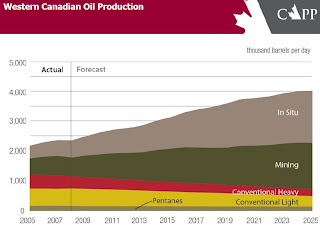
    Canada will be adding a little of 1 million barrels of oil per day from now to 2020. More could be added if oil prices stay strong.

    Canadian Oilsand


    Economics coming into line for some projects
    -Driven by stronger oil prices and lower costs
    -Projects under construction:
    Imperial Kearl Lake
    •Shell Jackpine and Shell upgrader including Quest CCS project
    -Projects Re-activated
    •Suncor Firebag Phases 3 and 4
    Devon Jackfish Phase 3 application in 2010
    Cenovus Christina Lake –application for phases E, F, G
    •ConocoPhillips/Total –Surmount phase 2
    •Husky/BP –Sunrise phase 1

    -Enhanced Oil/Tight Oil
    •Technology enabled plays such as the Bakken, Cardium and Viking (multi-frac horizontal wells)
    •Narrow Light/Heavy Differentials
    -Good news for heavy oil projects
    -Tough for stand alone upgraders in the short term
    •Competing against existing capacity left empty by Venezuela and Mexico