 |
A breakthrough report on the nutritional density of genetically-modified (GM) corn crops demolishes all existing claims that GMOs are “substantially equivalent” to non-GMOs. Entitled 2012 Nutritional Analysis: Comparison of GMO Corn versus Non-GMO Corn, the paper reveals… |
Author: Serkadis
-
Biotech lies exposed: Genetically-modified corn contains practically no nutrients but is loaded with chemical poisons
-
Medical announcement reveals: Almost everything you’ve been told about prostate cancer is wrong

Men, especially after the age of 50, have long been told they need to be screened regularly for the dreaded disease of prostate cancer with a prostate-specific antigen (PSA) test. The reason? Because if caught early, this common cancer can be treated before it supposedly… -
HTC First (and my last) with Facebook Home
My distaste for the privacy challenges of Facebook and its apps including the Home is pretty well documented. As we move into the connected age and build a quantified society, Facebook’s dark shadow looms over us like a menacing monster. So perhaps that made me an unlikely reviewer of the HTC First, which is the first official phone that comes with Facebook Home, a hybrid app-skin environment for Google Android.
Since I don’t really review devices like my talented colleague Kevin Tofel, I will restrict myself to things I like and dislike about Facebook Home. And then, I will share my quick impressions of the actual hardware. So here we go – and please don’t treat this as anything more than just my impressions!
What I like about Facebook Home (on First)
- Facebook Home is visually very attractive and makes Android a lot more attractive and qualifies for “good” sobriquet. I wouldn’t expect anything else considering that the company has been stockpiling nuclear arms of design war. It reminds me of some of the elements we loved in Al Gore’s book, Our Choice, which was published to the iPad by Push Pop Press. (Facebook acquired that company and Push Pop co-founder Mike Matas works at Facebook.)
- Facebook has made Android faster by removing a lot of crud that typically ships with Android on carrier-branded phones. It has taken many design and use-case cues from iOS and Facebook’s iOS app and applies them to the Android environment. For instance, notifications are much more improved, not just for Facebook but also for other applications.
- The check-ins and process of taking photos are more tightly integrated and are simpler to use.
- Facebook Home took its inspiration from the “Launcher” category that is extremely popular in Asia and made a far superior product. Home is a very polished product and focuses the phone owner’s attention on all the right things. (I remember buying similar skins for Windows XP and Windows 98, back in the day when it was a thing to do.)
What I dislike about Facebook Home (on First)
- For a service that is supposed to bring us updates in real time, this isn’t close enough and it is clearly working on Facebook Time. Facebook hasn’t been able to fine tune its algorithm and as a result it shows only a very specific kind of update — big bold pictures — from your newsfeed. You can actually feel the slow speed (and infrequency of updates) of the feed when you compare it with the desktop feed which moves at a faster pace.
- It is still hard to do many of the basic Facebook tasks on Facebook Home.
- While I appreciate the unified messaging option of Facebook Home, the new “Chat Heads” feature is not as easy to use. For example, If you hit five (or more conversations) it takes over the entire screen. It is quite intrusive and really hard to get rid of the chat screen.
- I found navigating between Facebook Home and the Android environment a little confusing and jarring — enough to feel the difference.
And now about the hardware:
- HTC First has a 4.3-inch display. It is powered by a 1.4 GHz dual-core Qualcomm 400 chip and it comes with 16 GB of storage and an adequate 1 GB of memory. It uses Android 4.1 Jelly Bean as the base operating system.
- The phone has a soft-touch rubber design which is easy to grip and it is something I appreciate because my phone keeps dropping from my hand. In this age of giant Android phones (and phablets), the 4.3 inch screen device is actually a pleasant change.
- Despite the company’s claims, the HTC First isn’t very responsive and feels underpowered. I have used the Nexus 4 and let’s just say, this feels like a mid-range smartphone at best.
- It started out as very responsive, but over a couple of days of use, I felt that swiping between apps, messages and photos wasn’t as brisk.
- The device’s look is a little dated and reminds me of iPhone 3GS.
- It gets really hot and the battery isn’t anything to write home about.
- AT&T’s LTE network isn’t as good as advertised, slowing down in places during my tests which also showed connection drops.
Bottom line: I am unlikely to use this device. But if you are a Facebook addict, are on a budget and have solid AT&T coverage in your area, this might be a good one for you.

Related research and analysis from GigaOM Pro:
Subscriber content. Sign up for a free trial.- Analyzing the wearable computing market
- The future of mobile: a segment analysis by GigaOM Pro
- Mobile 2012 and beyond


-
Drones on parade, and a few fun facts about 4K
So I stopped by the National Association of Broadcasters show today to talk big data with Gracenote Co-Founder and CTO Ty Roberts, after which he took me on a brief tour of the nearby show floor. If you’ve never been to NAB, it’s like a behind-the-scenes-version of CES, filled with the biggest, baddest, most-expensive television and movie-production equipment you’ve ever seen.
The big thing this year — 4K television. Here are a few factoids that Roberts, clearly having been educated by his peers in the Sony family, shared:
- The storage footprint of 1 hour of 4K video is 512 gigabytes.
- That’s a lot of data to move across IP, so 4k cameras just send everything straight to production storage systems over fiber-optic cable.
- The picture is so detailed that it’s difficult for one person to shoot scenes and focus at the same time. The answer: new two-person camera setups where one guy shoots and the other stands next to him focusing the shot on a larger screen.
Oh, and there were drones, too:

The Schiebel Camcopter S-100.
This is the civilian version of the Schiebel Camcopter S-100. There’s a military version, too. Its sticker price of several hundred thousand dollars probably isn’t surprising.
For the more cost-conscious aerial cinematographer, Freefly Systems had its own booth:

The Freefly Cinestar helicopter
Or for those who prefer the ground:

A video rover, I guess.
This all kind of makes me wish I shot video for a living. If I had a flying, rotating video camera or an off-road setup, I’m sure I could find some way to use them.

Related research and analysis from GigaOM Pro:
Subscriber content. Sign up for a free trial.- Controversy, courtrooms and the cloud in Q1
- When video gets democratized, who wins and who loses?
- Connected Consumer Q2: Digital music meets the cloud; e-book growth explodes

-
That was quick: HomeBase Social is an unofficial Facebook Home launcher
Those who can’t wait until Friday to get Facebook Home on their Android handset can get a similar, but limited, experience now. Widdit, the maker of an Android home screen customization tool called HomeBase, quickly whipped up HomeBase Social, a Facebook Home lookalike that works on any Android 2.2 or better phone. Facebook Home will initially be limited to a half-dozen phones.
I’m not too surprised that we already have a Facebook Home clone of sorts. Even with all the hoopla of last week’s Facebook event, Facebook Home in its current state is still little more than a custom launcher for Android. These types of skins have been around for a few years now. Sure, Facebook Home has Chat Heads, which is a nifty approach to messaging, and you won’t find that in HomeBase Social.
 Instead, you get full-screen Facebook status updates and pictures on your Android’s home screen, although unlike the official Facebook launcher, you can’t like a status. HomeBase Social also provides one touch lock screen access to up to five apps of your choice and your camera. You can also add custom screens and widgets to have the launcher look the way you want.
The launcher is a little buggy on my Galaxy Note 2, so I don’t think I’ll keep it installed. It’s still a limited subset of what Facebook Home will provide. My Note 2 will be officially supported on Friday, anyway. However, Widdit gives you a nice idea of what Facebook Home will look like on your own phone while also showing off their custom launcher product.

Related research and analysis from GigaOM Pro:
Subscriber content. Sign up for a free trial.- Analyzing the wearable computing market
- The fourth quarter of 2012 in mobile
- Forecast: the converged mobile messaging market

-
iPhone sales seen beating Q2 estimates, no thanks to the iPhone 5

-
Clive Barker Shares Rare Set Pics From Nightbreed On Facebook
Author/artist/director Clive Barker, who wrote and directed the cult classic Nightbreed (based on his own book, Cabal), has been sharing some rare behind-the-scenes photos from the set of the film on his Facebook Page. Others have posted them, and he (or whoever updates his page, at least) has shared them with his fan base.


Recently we looked at some rare behind-the-scenes photos from Hellraiser, which Barker also shared on Facebook.
-
AT&T and Google’s plans to give Austin a gigbit is an experiment. Is it a good one?
Austin may be feeling like one of the luckiest towns in the world today. Not one, but two big name companies have said they plan a gigabit network in the Texas Capital. But, as both Google and AT&T plan their fiber-to-the-home deployment strategies, they are testing plans that look inefficient and might bite consumers in the end. Still, innovation is needed in broadband deployment, so all eyes will be watching Austin.
Ma Bell announced its gigabit plans on Tuesday after Google said it planned to offer its own fiber to the home, gigabit network to the Texas capital.
I got on the phone with Larry Solomon, an AT&T spokesman to get details on the network. Solomon said that AT&T will expand its existing fiber-to-the-node product to “homes and buildings.”
In its release AT&T also said that this expansion wouldn’t “materially affect its capital expenditures for 2013,” which struck me as far-fetched. However, Solomon said, “AT&T spends $20 billion a year on capital expenditures. We don’t expect this year to be materially different.”
In further conversation with Solomon the rationale behind that statement became clear. The time frame here is uncertain and AT&T has learned a thing or two from Google on how to lower the cost of deployment.

Google Fiber trucks stringing fiber in Kansas City.
AT&T has taken a lesson from Google Fiber
AT&T executives will meet with city and state officials seeking the same concessions that Google is getting in order to build out its network Solomon said. As someone who has followed telecom in Austin, and in Texas, this mostly means the ability to cherry pick where it will deploy its gigabit network. And that points to both the upside and downside of Google’s influence.
I wrote back in July that Google has changed the economics of deploying fiber in part by its strategy of getting people to sign up in advance and then choosing to deploy where demand was greatest. This eliminates the need to pass homes that might not sign up for fiber and also lets Google roll out service to neighborhoods in bulk.
Well, AT&T wants to do something similar. AT&T would like to follow a strategy where communities help drive demand for the gigabit service, Solomon said. When I asked if that means aggregating demand and then serving those communities he said that was something AT&T was interested in.
But there’s a big downside to this plan for the end user and the cities. Having both Google and AT&T trying to convince customers to sign up for their respective gigabit service effectively splits the vote. Solomon didn’t comment on that possibility, but did say AT&T wants to offer competitive pricing and build offers around wireless and other AT&T products. Google hasn’t announced pricing for its services in Austin yet, but in Kansas City a gigabit costs $70 a month and a gigabit plus TV costs $120 per month. I’ve covered AT&T’s comparable pricing in Austin here.

Conduit, anyone?
Two fiber networks may not be what we want — or even need.
Which brings me to my larger issue with our broadband strategy in the U.S. — the lack of a plan for delivering real wireline competition. If AT&T gets its way with city and state officials and goes head to head with Google in the neighborhoods, we’re looking at what could become — at best — a network buildout in areas where people own their own homes (Google had to develop special programs for attracting landlords to commit, which made Google Fiber in low-income areas a tougher sell) and already know they want a gigabit. At worst, neighbors who are split between Google or AT&T will not meet the threshold to get a buildout, and no one gets a gig.
And frankly, it’s dumb that both AT&T and Google might spent dollars building out fiber to the home in the same neighborhoods. Will streets get torn up twice? Will your broadband provider be determined for the life of your home based on the decisions that occur during a few pre-determined fiber sign-up periods?
A better option for Austin, and what could potentially become a model for communities everywhere, would be if Google and AT&T decide to work together to lay conduit (basically pipe in which anyone could run fiber) in areas where people want the service. When I asked Solomon about this possibility he said, “I wouldn’t rule out anything, but I wouldn’t include it either.”
However, he then pointed out that with its Android operating system, Google is not just a competitor on the fiber front, but also a partner. “Google provides the operating system for a lot of devices we sell, so in that sense Google is an indirect partner and great company. We have a lot respect for Google.”

Is the new gigabit future?
For better or worse AT&T is coming to Austin to seek the same opportunity that Google has. It wants to get city officials to let it roll out a fiber-to-the-home, gigabit network in a way that lowers AT&T’s deployment costs and allows it to put fiber exactly where people say they want it. And it is happy to take this plan on the road to other places in the U.S.
“We will sit down and work with any community that allows us to reach an agreement that allows us to accelerate our telecommunications investment,” Solomon said. “
As for timing on AT&T, Solomon says that once AT&T has its agreements from the city it plans a similar style of announcement to the one Google hosted in Austin today. “We have been looking at this for some time and seeing the Google announcement is obviously a sign that is encouraging,” Solomon said. “That telecom companies and Google or whomever can work with city officials to get policies in place to see regulations and costs lowered to speed up the infrastructure is good.”
I’m not so sure this is the best way for gigabit networks to be constructed. It is clearly less efficient than laying conduit — although in the U.S. the question of who would take on that investment has rested in the hands of private companies. There are very real questions and worries about how and when all parts of a community would be served. Google faced some of that scrutiny in Kansas City when lower-income neighborhoods weren’t signing up quickly enough, but eventually said that it would roll out fiber to 90 percent of eligible neighborhoods.
However, the telecom industry has needed innovation to get it to faster speeds, and this is clearly an innovative way to try to expand network access and upgrade the infrastructure. So instead of simply getting a gig, it looks like Austin may get a whole lot more. A starring role in the battle to bring innovation and faster speeds to the broadband industry. I just hope it’s one that consumers win.

Related research and analysis from GigaOM Pro:
Subscriber content. Sign up for a free trial.- 12 tech leaders’ resolutions for 2012
- U.S. Wireless Data Market: Q4 and Year-End 2008
- Who and what to watch in the new era of the living room

-
Matt Cutts On Web Hosts That Host Spam
In the latest Google Webmaster Help video, Matt Cutts discusses whether or not a site that is hosted by a hosting service that also hosts spam, has to worry about a negative impact on rankings. The answer is pretty much no, but he talks about some “corner cases” where it’s a little more complicated.
“Typically a hosting company has a lot of different stuff on it. Some of it will be good. Some of it will be bad,” says Cutts. “There will be some spam, but just because you happen to be on an IP address or using a hosting company that also hosts some spam, that doesn’t mean that you should be affected.”
“There have been a very few situations…I remember several years ago there was a really bad hosting company,” he says. “I’m not even sure whether you would call them a hosting company. It was something like 27,000 sites of porn spam and like two legit sites. On one IP address…so if you were one of those two legit sites…in order to catch the 27,000 porn sites…you know, that was something where we were like, ‘Well, okay that’s really pretty excessive.’”
He says they haven’t looked at IP address in a “long, long time” in terms of gathering sites. In most situations, you don’t have to worry about it.
-
Google Spends $14.5 Million To Fight Human Trafficking
Google announced today that it is contributing $3 million to Polaris Project, Liberty Asia, and La Strada International as a “Global Impact Award” for fighting human trafficking. This amounts to a total of $14.5 million from the company for this cause, after some grants it gave in 2011.
Google’s Jared Cohen and Jacquelline Fuller write in a joint blog post:
Global Impact Awards support nonprofits that use technology to launch disruptive solutions in their sector. We launched the Global Impact Awards program last December to fund new ideas with a potential for huge scale. And at the Google Ideas INFO summit over the summer, we brought together technologists, leaders, and those with unique personal experiences — including former weapons brokers and survivors of domestic and international human trafficking — to look at illicit networks and their defining obstacles. By connecting technologists and experts with those who understand and have lived through trafficking situations, our discussion centered around a fundamental question: What if local, national, and regional anti-trafficking helplines across the globe were all connected in a data-driven network that helped disrupt the web of human trafficking?
Since the summit, we’ve worked with Polaris Project, Liberty Asia and La Strada International to make this concept a reality. These organizations exist to provide vital help to victims in need across the United States, the Mekong Delta region and Europe. Now, working across borders, this new Global Human Trafficking Hotline Network will collect data from local hotline efforts, share promising practices and create anti-trafficking strategies that build on common patterns and focus on eradication, prevention and victim protection. To enhance the participating organizations’ ability to better share, analyze and act upon their data in real time, Palantir Technologies will expand on its existing relationship with Polaris Project by donating its data integration and analytics platform for this project. In addition, Salesforce.com supports Polaris Project’s hotline center and is helping scale their call tracking infrastructure internationally.
More on last summer’s Google Ideas initiative here.
-
Accidental Racist: Twitter And YouTube React To Brad Paisley, LL Cool J Song
Brad Paisley, as you probably know by now, has a new song called “Accidental Racist,” which features LL Cool J. It’s getting a lot of media attention, and generating a lot of discussion in social media.
Good luck trying to find it on YouTube. You can find it on Spotify, if you’re so inclined. Here’s what some are saying about it on Twitter:
LL Cool J’s 16 bars on that “Accidental Racist” record are the equivalent of Mary J Blige’s Crispy Chicken commercial…..
— Charlamagne Tha God (@cthagod) April 8, 2013
Has LL Cool J become everyone’s embarrassing dad? Thorough examination by @lindseyweber: vult.re/12ECw7q
— Vulture (@vulture) April 9, 2013
BO-RING! You guys hear “Accidental Racist” yet? RT @cnn Worries about North Korea threat at all time high, according to new CNN poll.
— Ben Hoffman (@thebenshow) April 9, 2013
The only thing I don’t understand about “Accidental Racist” is how Kid Rock had nothing to do with it.
— Michael Ian Black (@michaelianblack) April 8, 2013
Just heard Accidental Racist. Next time I hear it will definitely be accidental.
— thesarcastro (@thesarcastro) April 9, 2013
@bradpaisley @llcoolj i just heard Accidental Racist for 1st time & cried. Beauitful honest brave song. I don’t get the “controversy?”-truth
— Penny Lusk (@CaptPirateLady) April 9, 2013
I probably won’t be bumping “Accidental Racist” by Brad Paisley, but the lyrics are actually really good if you just stop & listen.
— Doña Paula (@the1paula) April 9, 2013
Isn’t a non-accidental racist like the bad guys in Captain Planet, who deliberately set out to pollute just for the hell of it?
— Sherwin Siy (@sherwinsiy) April 9, 2013
Is it too late for Mitch Hurwitz to add a scene to Arrested Development where GOB Bluth does an Accidental Racist song with Franklin?
— Josh Spiegel (@mousterpiece) April 9, 2013
We are now living in a post-Accidental Racist society.
— Adam Fasullo (@adamfasullo) April 9, 2013
class discussion in military history class went from the holocaust to Accidental Racist lol wtf
— tloob (@tloob) April 9, 2013
Some of the reactions on YouTube have been interesting:
Here are the lyrics (via AZLyrics):
To the man that waited on me at the Starbucks down on Main, I hope you understand
When I put on that t-shirt, the only thing I meant to say is I’m a Skynyrd fan
The red flag on my chest somehow is like the elephant in the corner of the south
And I just walked him right in the room
Just a proud rebel son with an ‘ol can of worms
Lookin’ like I got a lot to learn but from my point of viewI’m just a white man comin’ to you from the southland
Tryin’ to understand what it’s like not to be
I’m proud of where I’m from but not everything we’ve done
And it ain’t like you and me can re-write history
Our generation didn’t start this nation
We’re still pickin’ up the pieces, walkin’ on eggshells, fightin’ over yesterday
And caught between southern pride and southern blameThey called it Reconstruction, fixed the buildings, dried some tears
We’re still siftin’ through the rubble after a hundred-fifty years
I try to put myself in your shoes and that’s a good place to begin
But it ain’t like I can walk a mile in someone else’s skin‘Cause I’m a white man livin’ in the southland
Just like you I’m more than what you see
I’m proud of where I’m from but not everything we’ve done
And it ain’t like you and me can re-write history
Our generation didn’t start this nation
And we’re still paying for mistakes
That a bunch of folks made long before we came
And caught between southern pride and southern blameDear Mr. White Man, I wish you understood
What the world is really like when you’re livin’ in the hood
Just because my pants are saggin’ doesn’t mean I’m up to no good
You should try to get to know me, I really wish you would
Now my chains are gold but I’m still misunderstood
I wasn’t there when Sherman’s March turned the south into firewood
I want you to get paid but be a slave I never could
Feel like a new fangled Django, dodgin’ invisible white hoods
So when I see that white cowboy hat, I’m thinkin’ it’s not all good
I guess we’re both guilty of judgin’ the cover not the book
I’d love to buy you a beer, conversate and clear the air
But I see that red flag and I think you wish I wasn’t hereI’m just a white man
(If you don’t judge my do-rag)
Comin’ to you from the southland
(I won’t judge your red flag)
Tryin’ to understand what it’s like not to beI’m proud of where I’m from
(If you don’t judge my gold chains)
But not everything we’ve done
(I’ll forget the iron chains)
it ain’t like you and me can re-write history
(Can’t re-write history baby)Oh, Dixieland
(The relationship between the Mason-Dixon needs some fixin’)
I hope you understand what this is all about
(Quite frankly I’m a black Yankee but I’ve been thinkin’ about this lately)
I’m a son of the new south
(The past is the past, you feel me)
And I just want to make things right
(Let bygones be bygones)
Where all that’s left is southern pride
(RIP Robert E. Lee but I’ve gotta thank Abraham Lincoln for freeing me, know what I mean)
It’s real, it’s real
It’s truth -
First Solar shares soar almost 50% on outlook, efficiency records, acquisition
Solar thin film leader First Solar saw its shares zoom almost 50 percent on a rosy 2013 guidance, new records for efficient solar cells and news that the company acquired solar panel tech company TetraSun. Marketwatch blog reported that the stock rallied so much that it “triggered Nasdaq circuit breakers” (which pauses trades if a stock moves more than 10 percent in five minutes) and trading of First Solar’s stock “was halted five times.”
First Solar’s full-year earnings are projected to hit between $4 and $4.50 a share, up from analyst projections of $3.60 a share this year. Sales are expected to come in between $3.8 billion and $4 billion, while operating income is estimated to be $430 million and $460 million.

The news is surprising in that First Solar had a pretty difficult year in 2012, and just reported those earnings in February. For the entire 2012, First Solar took in $3.4 billion in sales, up 22 percent from 2011, but it recorded a net loss of $96.3 million, or $1.11 per share.
First Solar has been supremely focused on raising the efficiency of its solar panels. Higher efficiency means it can sell panels for more, and raise its margins, but also the overall cost of installing the solar system can be lower (less panels, produce more power, with less space). In February it was touting a world record 18.7 percent efficiency for cells made from the material cadmium-telluride. This morning First Solar announced more efficiency records for cells.
Efficiency is also the reason behind First Solar’s aquisition of TetraSun. TetraSun has developed a solar cell design that can hit conversion efficiencies exceeding 21 percent. Investors in TetraSun include JX Nippon Oil & Energy Corporation.

Related research and analysis from GigaOM Pro:
Subscriber content. Sign up for a free trial.- After Solyndra: analyzing the solar industry
- Warren Buffett and the true value of solar
- Green IT Q4: solar, subsidies and the outlook for EVs

-
AOL Announces Marketplace by AdTech
AOL announced the launch of a new sell-side platform called Marketplace by AdTech today.
With the offering, premium publishers can leverage AdTech’s technology and AOL Networks’ cross-platform ad serving platform, mange blocks and transparency settings at an inventory level, and get “high-touch client service from setup all the way through yield evaluation.”
“Our goal at AOL Networks is to simplify digital advertising at scale and now, with the addition of Marketplace, publishers have a one-stop solution to manage every piece of inventory they have,” said David Jacobs, Senior Vice President, AOL Networks. “If you don’t have both supply and demand solutions, you are disadvantaged in this increasingly complex digital advertising ecosystem. With Marketplace, we give publishers a connected programmatic platform that is transparent and efficient as well as pre-loaded with demand.”
“Marketplace was built with an in-depth understanding of publisher needs – after all, we based it off of the needs of one of the largest publishers in the world: AOL,” Jacobs added. “Having partnered with thousands of premium publishers for over a decade on the buy side, we have developed significant experience and insights into how to drive demand and yield for publisher partners who are seeking to increase their revenues. We are excited to offer our Marketplace solution to drive value for our partners on a global basis.”
The announcement was made at ad:tech San Francisco by AOL CEO Tim Armstrong.
-
AdWords Enhanced Campaigns Get Ad Group Mobile Bid Adjustments
Soon, AdWords advertisers will be able to set a mobile bid adjustment at the ad group level in enhanced campaigns. This functionality will become available sometime in the middle of next month.
“We think this may be useful if you’ve been operating large scale campaigns and found that your optimal bids for some keywords would require significantly different mobile bid adjustments within an enhanced campaign,” says Group Product Manager Bhanu Narasimhan.
“Example: A nationwide retail chain currently uses mobile-only campaigns to optimize bids for several hundred thousand keywords,” Narasimhan continues. “They’ve found that 95% of their keywords in mobile-only campaigns have bids that are 10% lower than in the equivalent desktop campaigns. The remaining 5% of their keywords have very different bid ratios (ranging from 40% lower to 100% higher) based on differences in performance and competition on mobile and desktop. By using the new ad group bid adjustments for mobile, this retailer can better maintain their desired bids and ROI on different devices as they upgrade to enhanced campaigns.”
Google says most advertisers will see the most value in using the existing campaign level bid adjustments.
API access for the new feature will be available first, in early May.
Enhanced campaign upgrades will start happening automatically on July 22.
-
Take that, Google: AT&T ups the ante with plans for its own Austin gigabit network
AT&T plans to build a gigabit network in Austin, Texas according to a company release Tuesday. On any day this would be big news, but Google just announced its own plans to build a fiber to the home, gigabit network in the Texas capital. Looks like Google’s plans to tweak the incumbent broadband players is working — at least at the press release level.
Google’s Kevin Lo said earlier today that the Google network won’t be available until mid-2014 and it’s unclear when AT&T’s network will be rolled out. I’ve contacted AT&T for more details and will update the story when I have them. Currently AT&T provides a fiber to the node product called U-verse that offers speeds of up to 24 Mbps down. However, as Google expanded in Kansas City, it received some concessions around permitting that the incumbents later complained about.
As a result, both Time Warner Cable and AT&T were granted similar benefits in Kansas City. However, in Austin, the agreements that Google has signed with the City of Austin are no different than the ones that AT&T and Time Warner have signed according to Laura Morrison, an austin city councilwoman. Yet, AT&T in it’s release of the gigabit network seems to imply otherwise. From the release:
Today, AT&T announced that in conjunction with its previously announced Project VIP expansion of broadband access, it is prepared to build an advanced fiber optic infrastructure in Austin, Texas, capable of delivering speeds up to 1 gigabit per second. AT&T’s expanded fiber plans in Austin anticipate it will be granted the same terms and conditions as Google on issues such as geographic scope of offerings, rights of way, permitting, state licenses and any investment incentives. This expanded investment is not expected to materially alter AT&T’s anticipated 2013 capital expenditures.
As an Austin resident and broadband lover, I’m ecstatic that I might soon have not one, but two gigabit capable networks. Of course, with so little known about the cost, timing or the locations of either Google’s or AT&T’s network, I’ll wait to get out my party hat.

Related research and analysis from GigaOM Pro:
Subscriber content. Sign up for a free trial.- Startup growth and the new recruiting ecosystem
- A near-term outlook for big data
- CES 2012: a recap and analysis

-
Meet Photon: A low-cost 3D scanner that helps replicate physical objects
I haven’t yet bought a 3D printer although I plan to do so in the not-to-distant future. The main reasons I’ve held back are the printer costs and the fact that I have no experience with the design software needed to create objects. There are now several sub-$1,000 3D printer models available, with some even as low as $200 for printing small items. That reduces the cost issue, but I’m still not an expert in 3D design software.
Photon could be answer for me. This 3D scanner, currently a funded Indiegogo project, helps replicate physical objects so you can print a 3D copy of them. Essentially, it takes all of the design work out of play, provided you want to print a copy of something that already exists. I can live with that while I learn how to use the software to create my own designs, particularly when Photon costs CAD $449.00 (US $442.21), which isn’t too bad for this type of technology.
What I like best is that the Photon will scan hundreds of points on an object’s exterior surface and then convert the captured data into a wire-mesh design.

Other aspects that appeal to me: Although Photon can scan things up to 7.5 inches in diameter and 9.75 inches high, it actually folds up and looks quite portable. Average resolution scans can be completed in about 3 minutes. And a USB port makes it easy to get design files from the Photon to a computer, although I’d also like to see an integrated microSD card slot.
So am I backing this one? I’m going to have to think on it a little more, partly because I don’t yet have a 3D printer and partly because of the software support for Photon. According to the project page:
“We’re aiming to make the 3D files compatible with all major CAD packages, 3D modelling software and 3D printers. Currently, models produced from the Photon, can be saved as .STL, .OBJ, and point cloud .PLY formats. Making it easy to integrate scans within existing systems, such as 3DS max, Maya, solidworks, cinema 4d, google sketchup, rhino, True space, etc.”
Until I see that type of compatibility nailed down, I may hold off on the Photon. However, I like what I see and this device could push me over the edge to purchase a 3D printer sooner rather than later. I should also note that the first batch of Photon deliveries is slated for July and August. That’s an aggressive time-frame that puts the Photon on the market before the MakerBot Digitizer; another 3D scanner which has no price tag yet and is expected this fall.

Related research and analysis from GigaOM Pro:
Subscriber content. Sign up for a free trial.- GigaOM Research highs and lows from CES 2013
- How HR can make the case for workforce analytics
- The 2013 task management tools market

-
Defense Experts Warn Of Cheap Enemy Drones On The Battlefield

While many current drone programs are extremely complex – and costly – cheap drones used for spying, mapping, and even attacks could turn the tables on world militaries by giving terrorists and less well-funded groups access to UAV technology.
A report by the Project 2049 Institute notes that China is hard at work on its own, less-expensive drone program that could end up being marketed to other players on the globe. Iran, for example, already sells simple drones to neighbors in the Middle East, including Syria. An advanced program coming out of China would, at the very least, allow for more powerful devices to percolate out to countries with less-developed UAV systems.
“In whatever future conflict scenario we’re in five or 10 years from now, the proliferation of UAVs is going to complicate things for the U.S. military,” said research fellow Ian Easton to TechNewsDaily. The market for unmanned drones could reach $89 billion over the next decade.
While they may not be as powerful as US, European, or Japanese robotic systems, these cheaper, Chinese drones could level the playing field just a bit when it comes to unmanned warfare in the future.
-
Intel Selects LSI Server-side PCIe Flash
LSI announced that it has entered into an expanded original equipment manufacturer (OEM) relationship with Intel (INTC), whereby the LSI Nytro MegaRAID technology will be available as part of the Intel RAID product family. The LSI Nytro tMegaRAID takes server-side PCIe flash and dual-core RAID-on-Chip (ROC) technology and integrates intelligent caching software, to enable transparent application acceleration and RAID data protection for directed attached storage (DAS) environments.
“Customers in virtually every industry are facing competitive pressures to increase data center efficiency and lower IT costs,” said Noury Al-Khaledy, General Manager Intel Enterprise Platforms and Services Division. “Through our expanded relationship with LSI, we’re able to offer customers a single, integrated solution that enables exciting levels of application performance, data protection and a low TCO.”
The Nytro MegaRAID technology will help to provide Intel server board and systems customers with high levels of random IOPS performance for data-intensive and latency-sensitive workloads such as databases and big data applications, Hadoop implementations and virtual desktop infrastructure (VDI). It integrates LSI SandForce Flash storage processors to delivery performance, reliability and energy efficiency. Benchmark testing using Nytro MegaRAID cards have achieved up to a 33 percent improvement in the time it takes to complete Hadoop jobs and delivered support for up to twice as many VDI sessions compared to a non-caching storage implementation.
“Intel’s selection of LSI Nytro MegaRAID technology is another significant validation of our strategic focus and investments in flash-based server acceleration technology,” said Gary Smerdon, senior vice president and general manager, Accelerated Solutions Division, LSI. “We’re excited to be working closely with Intel to bring the powerful performance, data protection and TCO benefits of Nytro MegaRAID technology to Intel customers.”
Intel will offer LSI Nytro MegaRAID technology within their Intel RAID SSD Cache Controllers RCS25ZB040 and RCS25ZB040LX which include embedded flash of 256GB and 1TB, respectively.
-
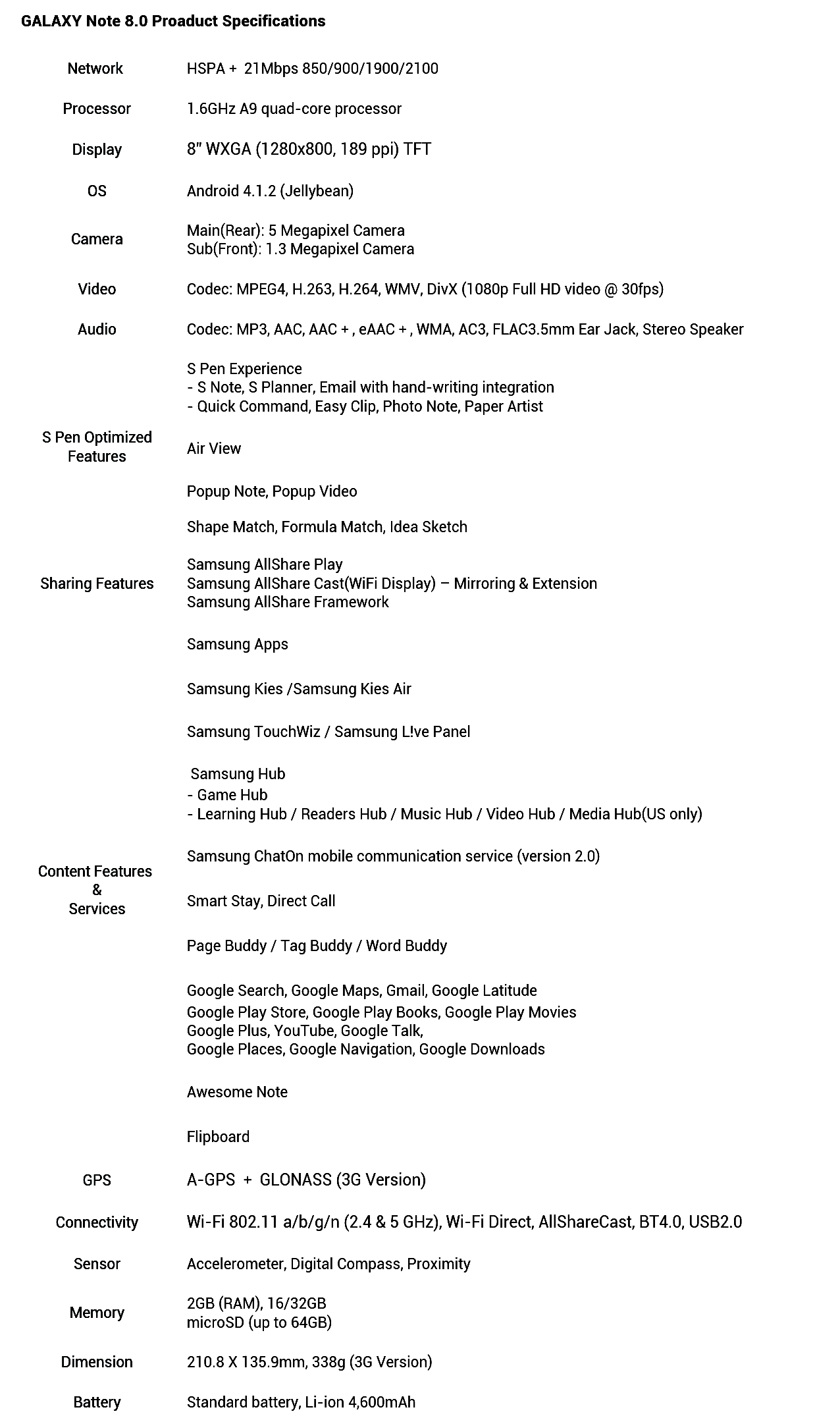
Samsung Galaxy Note 8 arrives April 11, but something’s missing
 What’s wrong with Samsung? That’s the question I asked in newsroom group chat today after seeing specs for Galaxy Note 8.0. Screen resolution diminishes the otherwise noteworthy feature list. Sorry, but 1280 by 800 is inadequate — little more than matchup to Apple’s iPad mini, which is similar size. For a company that makes such great-looking displays, lower-res is an endemic problem across Samsung’s entire tablet line.
I really expected more from Galaxy Note 8.0, which as the same suggests has an 8-inch screen; iPad mini is 7.9. Samsung unveiled the tablet in February, and I wrote the news story. But in the rush of Mobile World Congress news didn’t consider screen resolution, in part on possibility specs would change. The electronics giant has done it before, announcing one thing but shipping something slightly different months later.
“Back in 2010, the launch of the first Samsung Galaxy Tab with 7-inch screen opened a new chapter in the mobile industry”, JK Shin, president of the company’s mobile division, asserts. He’s wrong about that. Three years ago, the market demanded larger tablets, like 9.7-inch iPad and 10.1 inchers from other companies, including Samsung. Among the reasons smaller tablets flopped earlier on: Prices were too high and many models sold though cellular carriers that demanded costly data plans with 2-year contracts.
“Now almost three years later, Samsung continues to evolve the sector that meets the demands of modern life”, Shin says. “Evolve” is right. The new tablet could have been so much more by bringing the stylus to “tweener” size between 5.5-inch Galaxy Note II and larger Note 10.1. The size is just about right.
NPD DisplaySearch forecasts a dramatic shift in tablet size preferences this year. Larger is out, smaller is in. iPad dominated tablet shipments through release of the mini. But during the holidays, iPad mini sales surged. Meanwhile, 7-inch models, such as Google’s Nexus 7, wooed consumers with greater features for lesser cost.
Display shipments foreshadow future devices. In early January, the analyst firm forecast that tablet shipments would exceed laptops this year and that the market would shift from 9.7-inch models to those between 7-7.9 inches. At the end of February, DisplaySearch backed up the forecast with real, recent numbers that revealed dramatic changes ahead.
Between December and January, 9.7-inch panel shipments collapsed, falling to 1.3 million from 7.4 million and indicating that Apple sales largely shifted from iPad to mini. Meanwhile 7-to-7.9-inch panel shipments grew from 12 million to 14 million.
At 8 inches, the new Galaxy Note is right at the sweet spot. “We forecast that tablet PC panels will hit 254 million in 2013, up tremendously from 160 million in 2012”, David Hsieh, DisplaySearch vice president, says. “Of this, 5-8.9-inch panels will account for 136 million and 9-10 inch for 118 million. That means smaller-size tablet PC panels — 7-8.9 inches — will surpass the larger size tablet PC panels (9-10 inches-plus)”.
But Samsung stands still on screen resolution, while competitors go forward. “Many panel makers are developing 7-inch 1920 × 1200 or even 8.9-inch 1920 × 1200 or 2048 × 1536 panels with more than 300 ppi”, Hsieh says. These higher-res screens will come to market this year, overshadowing Galaxy Note 8.0. Think about it. When Apple bumps up iPad mini to Retina Display, how will Samsung’s tab really stand out.
“Galaxy Note 8.0 breaths fresh life into the category as it delivers the perfect fusion of portability and everyday productivity — the result is a pioneering, pocket-sized solution that enhances and enriches our everyday lives, whether at work or play”, Shin claims.
I can’t agree. We will see how the market receives this $399.99 iPad mini competitor. The two tablets are about the same size, with similar screen resolution. But Apple’s tablet costs about $70 less for same storage capacity. The stylus, and supporting software, is the big hardware differentiator. Software-wise, Samsung ships TouchWiz UI and stylus apps on top of Android 4.1.2, plus some business-oriented solutions.
-
Sony Launches Media Storage Cloud Services
Sony Corporation of America today announced the launch of Sony Media Cloud Services, a new subsidiary that will serve as a virtual workspace that includes media applications to store, share and manipulate content from any location in the world. The scalable cloud platform, Ci (pronounced see) will provide studios, broadcasters, filmmakers, independent producers, marketing teams and other creative individuals a “one-cloud” solution to collect, produce and archive high-value, high-definition content, allowing fast and secure collaboration on a global scale.
“Every day, creative professionals around the world spend numerous hours and resources on non-creative tasks like moving and sharing content, figuring out how and where to store it, and getting the right assets to the right places and in the right hands,” said Naomi Climer, President, Sony Media Cloud Services. “Sony understands these complex challenges, which is why we designed Ci as a functionally rich, scalable and secure, media-focused cloud platform that can enhance and streamline traditional production workflows to make it easier to collaborate more effectively and cost-efficiently.”
The Ci cloud platform will feature infinite scalability, pay-as-you-go pricing, and a number of browser-based applications. Ci MediaBox will collect, organize, preview, share and archive every media type and size using studio-designed cloud storage solution suite. Ci VideoLog Enables logging of frame-accurate events to prepare content for downstream opportunities, distribution and playout automation. Ci AudioSync uses analysis algorithms and audio pattern matching to reduce non-creative editing work time in content-preparation workflows. Ci FrameMatch analyzes media files to automatically identify differences and likenesses between two sets of video files. Ci ReviewApprove enables review, annotation and collaboration on media files across multiple locations in real time, simultaneously.
“Built by Sony Pictures movie and television professionals, incubated by Sony’s hardware and technology, and brought to market by a global sales force who understand the needs of our industry, Ci goes beyond simply delivering innovative technology—it brings the total power of Sony into the cloud,” said Climer. “Together, we’ve built a platform with applications that not only addresses today’s media challenges, but serves as the foundation to develop innovative services to transform our industry for years to come. The possibilities are endless.”
“The efficiency and flexibility that cloud solutions provide will radically change the way creative professionals collaborate,” said Chris Cookson, President, Sony Pictures Technologies. “Working with Sony’s Cloud Services team to further enhance Ci’s platform and applications will enable our production and distribution teams around the world to work together more efficiently, without sacrificing creativity or quality.”
Ci is currently in beta production and will be on display at the 2013 NAB Show in the Sony booth.


