Author: Andie

  • Egyptology News – 8th to 10th April

    Copied from Twitter @egyptologynews.  Nice to see a bit of sunshine today!


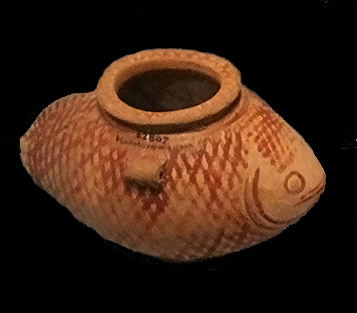
    Naqada II pottery vessel in the form of a fish. Ashmolean Museum.


    Brooklyn exhib: Divine Felines – Cats of Ancient Egypt. Roles of felines in mythology, kingship, everyday life. BWW  
    The remnants of Fort Babylon in Old Cairo: Often overlooked by tourists and neglected by guides. Daily News Egypt  
    Via @Amesemi
    Postcards from Rosetta: A day where the Nile meets the sea  
    Treasures of Cairo – Downtown Edition. The Palace of Prince Said Halim, grandson of Mohamed Ali Pasha. Cairo Kitchen  
    Suez Canal Authority building to become international museum to showcase the history of the Canal. Daily News Egypt  
    Criticism for Egypt’s dollar-a-night proposal for fund-raising to complete Grand Egyptian Museum. Daily News Egypt  
    1000 years of Pottery at Bubastis from Late Period til Late Antique Times. 5 wks of field work. Tell Basta Project  
    Egyptian wedding certificate key to authenticating controversial Biblical text. PhysOrg  
    Un mapa pionero busca descifrar los misterios que rodean a la necrópolis de Tebas. 20minutos.es  
    Egyptian Artifact Authenticates Controversial Biblical Text. Laboratory Equipment  
    Book review: Mireille Hadas-Lebel, Philo of Alexandria: A Thinker in the Jewish Diaspora, Brill 2012 BMCR  
    More re sunken Thonis-Heracleion, gateway to Egypt in 1st millennium BC, topic at recent conference. Science Daily  
    RIC Archaeologist Lobban and Team Discover Lost Temple. Rhode Island College  
    Sahara Went from Green to Desert in a Flash (the studies quoted are from 2012, but of ongoing interest). Live Science  
    More re 4 new 17th Dynasty Dra Abu el-Nagar burials found by Djehuty project, with photos and video. Past Horizons

  • Egyptology News for 7th April 2013

    Copied from today’s Twitter posts @egyptologynews.

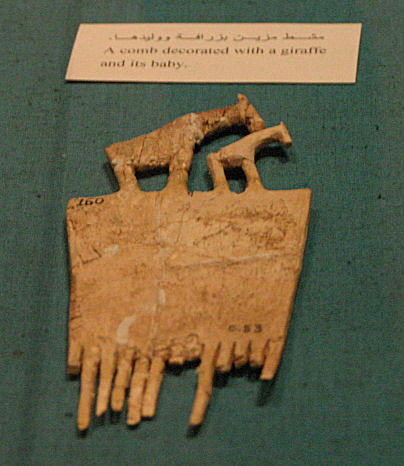
    Predynastic Comb. Nubia Museum, Aswan
    Missed this BBC video whilst away: smugglers have been digging underground tunnels to find archaeological treasures.  
    Khaled Fahmy compares palaces in Italy, Scotland and Egypt and laments the condition of those in Egypt. Ahram Online  
    Seminario Internacional sobre los templos de los Millones de Años de la ribera Oeste de Tebas. AEDE  
    Petition: Urgent call to stop the pillaging of Egypt’s heritage.  
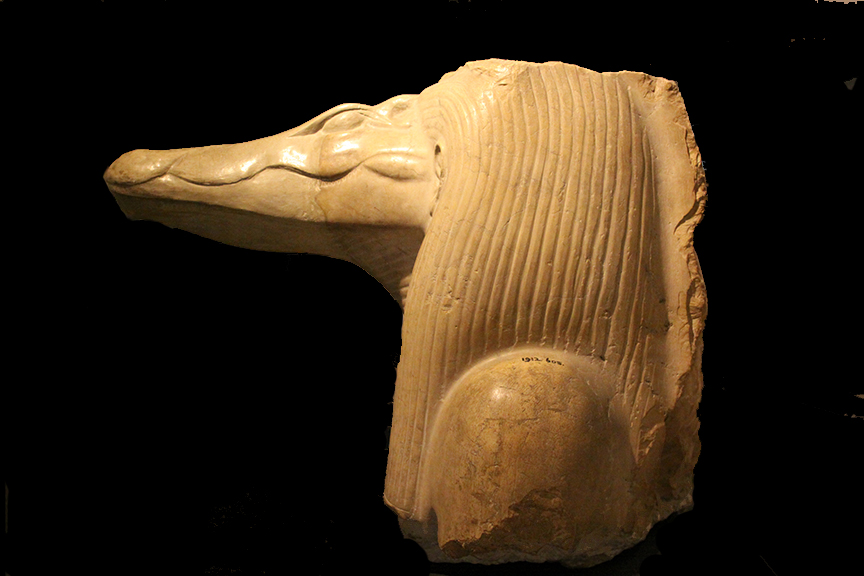
    My most successful Photoshop cut-out to date. The lovely Ashmolean Museum head of Sobek. I took the photo last year.  
    Sad piece re Egypt’s neglected public and historic gardens and parks. L’agonie d’une splendeur fanée. Al Ahram Hebdo  
    Newsletter for the March season of the Amarna Project 2013. I’ve posted the email update on Egyptology News  
    A restored historical neighborhood in Cairo might fall into disarray. Egypt Independent  
    Jean-Luc Martinez is the new boss of the Louvre and a number of the museum’s projects. Daily Star Lebanon  
    Archaeology and Cultural Heritage in Egypt after Mubarak. The Ancient Near East Today  
    Happy Birthday, curse of Tutankhamun. Live Science  
    More re Egypt’s dollar-a-night fundraising scheme to secure build of Grand Egyptian Museum. Al Arabiya  
    Nice post re co-existence of Nile-side and nomadic populations. Challenges tradition of purely north-south corridor.

  • Work at Amarna in March 2013

    With thanks to Barry Kemp and Anna Stevens for the latest Amarna update.  Apologies that the images at then end are not in the right order but you will find that the figure numbers correspond to the captions.

    The first part of the 2013 season ended on Wednesday, March 27th, with the formal return of the site to the SCA inspectorate. The March results mainly reinforced the observations made in the February report, and should be visible from the accompanying photographs.

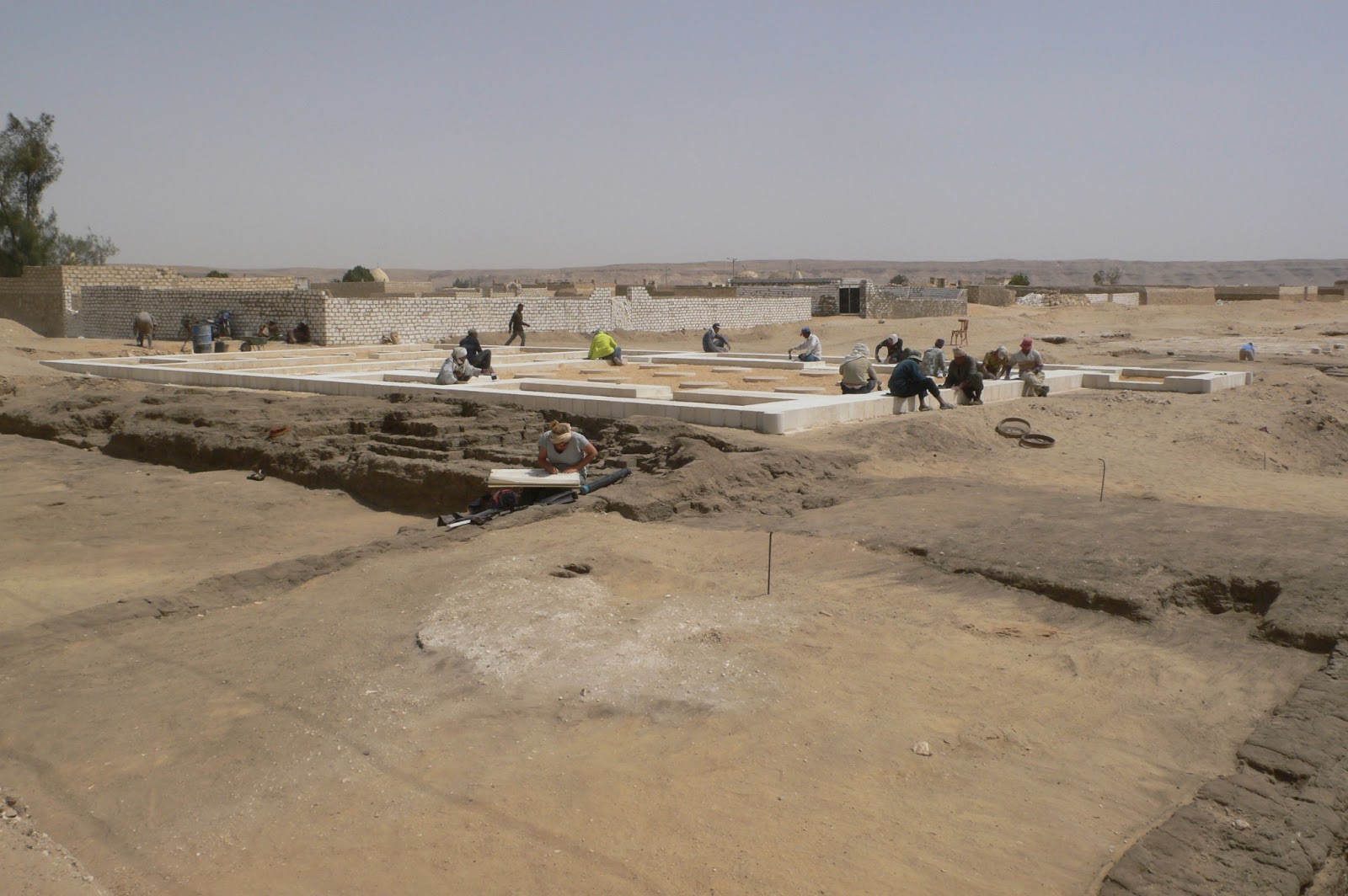
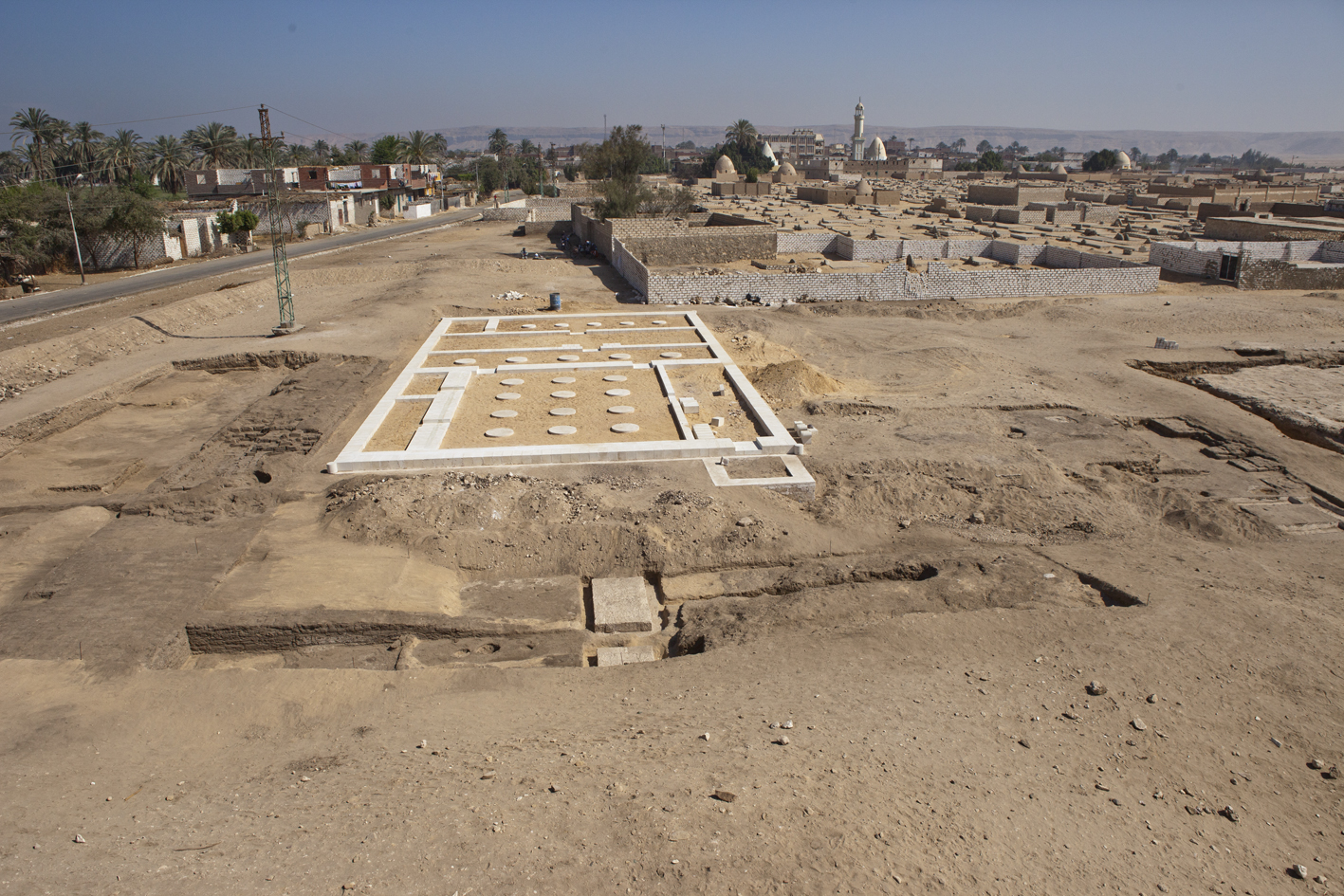
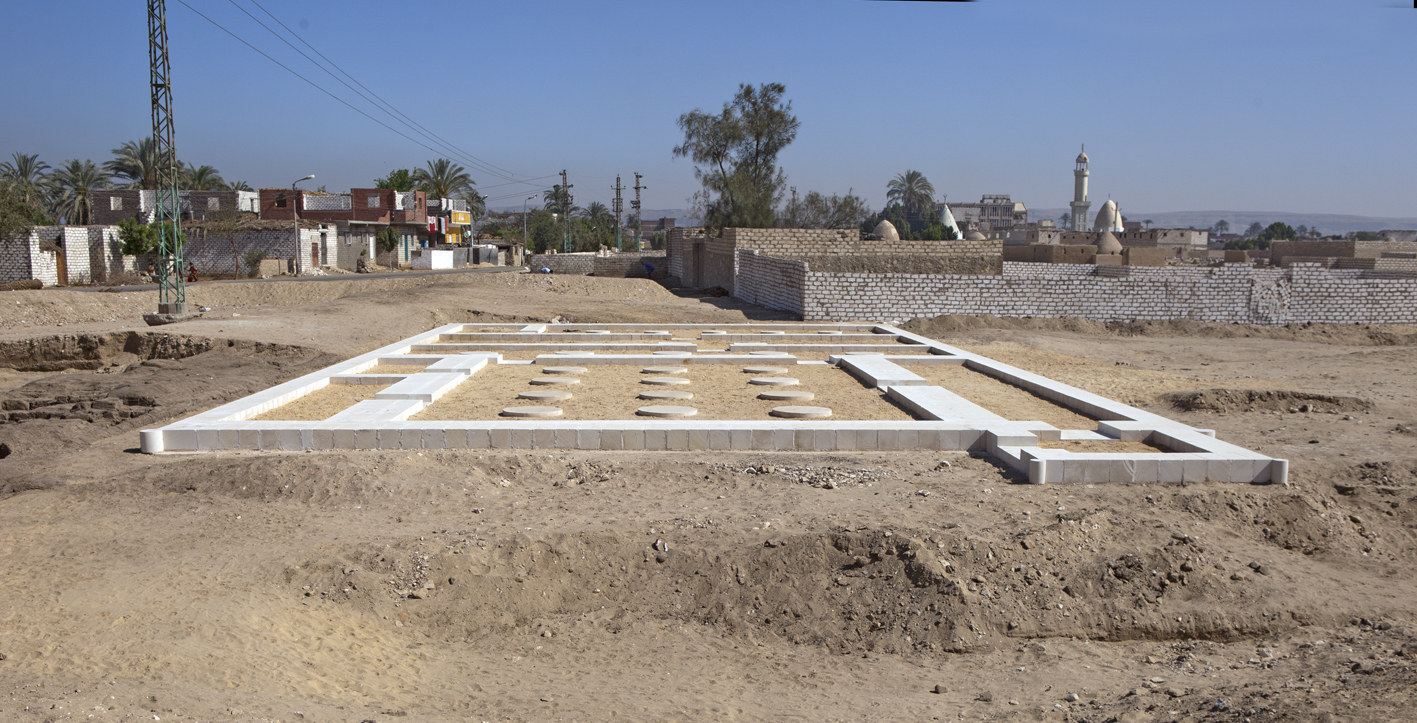
    On the very last day, our team of builders put the finishing touches to the outlines of the small stone palace that had stood there in Akhenaten’s time, on its distinctive gypsum foundation platform. They had responded well to the challenge of laying larger and more carefully cut limestone blocks. The result displays the plan of the building in a simple way.

    By this time also, the large Pendlebury dump over the northern pylon and ground outside had completely gone, fully exposing the brickwork of the pylon. This now needs to be repaired and built up with new bricks to a slightly greater height. Beside it, on the south, comes the outer temple ramp, of brick retaining walls and sand fill, 9.15 m wide.

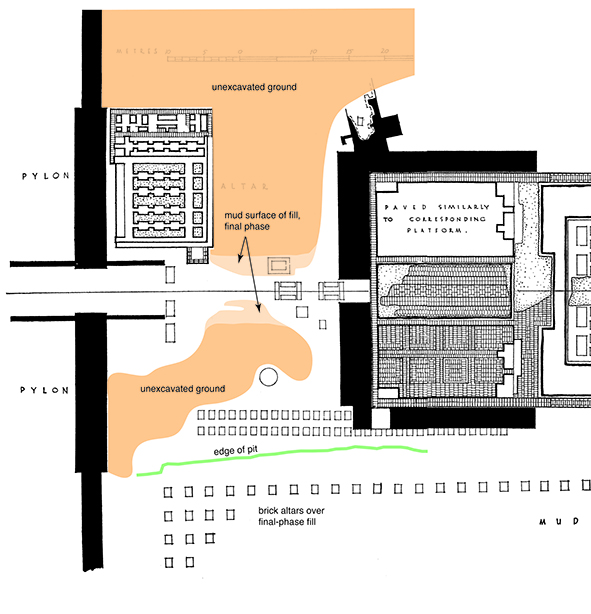
    Already we have the makings of a viewing platform, easily accessible from the asphalt road. What might be the view in a few years’ time? The viewing area will run for twice the present length, to include the southern pylon as well, so that the access ramp stands in the centre. Beyond comes a broad flat surface of compacted mud that runs up to the monumental front to the stone temple, 30 m behind the brick pylons. The recently completed outline of the small limestone palace faces on to this on the left.

    This open space had brought people in – members of the public? – to perform offering-ceremonies on the mud bases surrounded by gypsum-lined troughs, a practice that had begun when the temple site was first laid out.
    Unfortunately, these are too fragile to leave exposed but it should be possible to devise a way of marking their locations. They seem to represent regular participation in a more modest style of worship, separate from the grand setting created by the stone architecture. The small stone palace, if such it really is, belongs within this zone and seems to lack the kind of separation of the king from modest cult surroundings that one might have expected.

    The monumental front to the stone temple comprised a pair of pylons made from limestone blocks, fronted on either side of the wide entrance path by a deep colonnade composed of two rows of four gigantic columns. Their size and design were similar to those at the Small Aten Temple. The current plan is to rebuild the pylon foundations to a height of two courses of stone blocks above the ground level, and to mark the positions of the columns with circular pads of white cement, 3 m across. Behind the stone pylons the visitor will then see the progression of open courts, defined by fresh stonework, but only to the height of one or two courses, and filled with the ranks of stone offering tables that define the unique character of Akhenaten’s cult of the Aten.

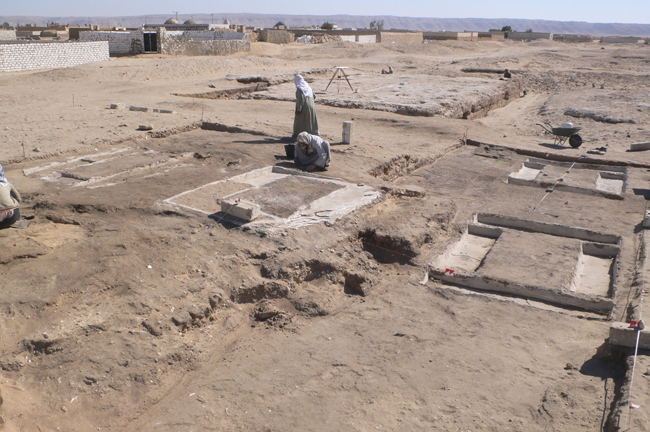
    An interesting question arises here: how tall were the offering tables? The tomb pictures show them standing to around waist height. This year’s re-excavation of the area of the temple axis, as it had stood in the very first phase of use, brought to light two rectangles of limestone blocks that remained undamaged (they are visible in pictures 01 and 02). They might be supports for pieces of sculpture, although they held no trace of mortar to anchor something like that. Or they could be offering-tables (perhaps originally covered with a large mat, which would explain the rough surface). What is to be noted is that they were made to lie at the same level as the surrounding ground. Might this have applied to the main mass of stone offering-tables, that they were more or less at ground level? It might have made them easier of access.

    We all know that, after Amarna had finished, the original building blocks – tens of thousands of them – were methodically removed for re-use at other construction sites. Many fragments broke off during demolition, and these provide clues to the original decorative schemes. We collect them, often from Pendlebury’s dumps, and from them a sketchy outline is starting to appear of the appearance of the temple front. It is summarised by Kristin Thompson in her season’s report:

    “The fragments of hard stone being generated by the current excavations make it vividly clear that the front of the Great Aten Temple was decorated in a colorful and lavish fashion using many varieties of beautiful hard stones. Though the destruction of the temple was thorough, and many of the pieces that have come to light are small and difficult to interpret, some yield important clues that permit us to guess at the decoration of this crucial building.”

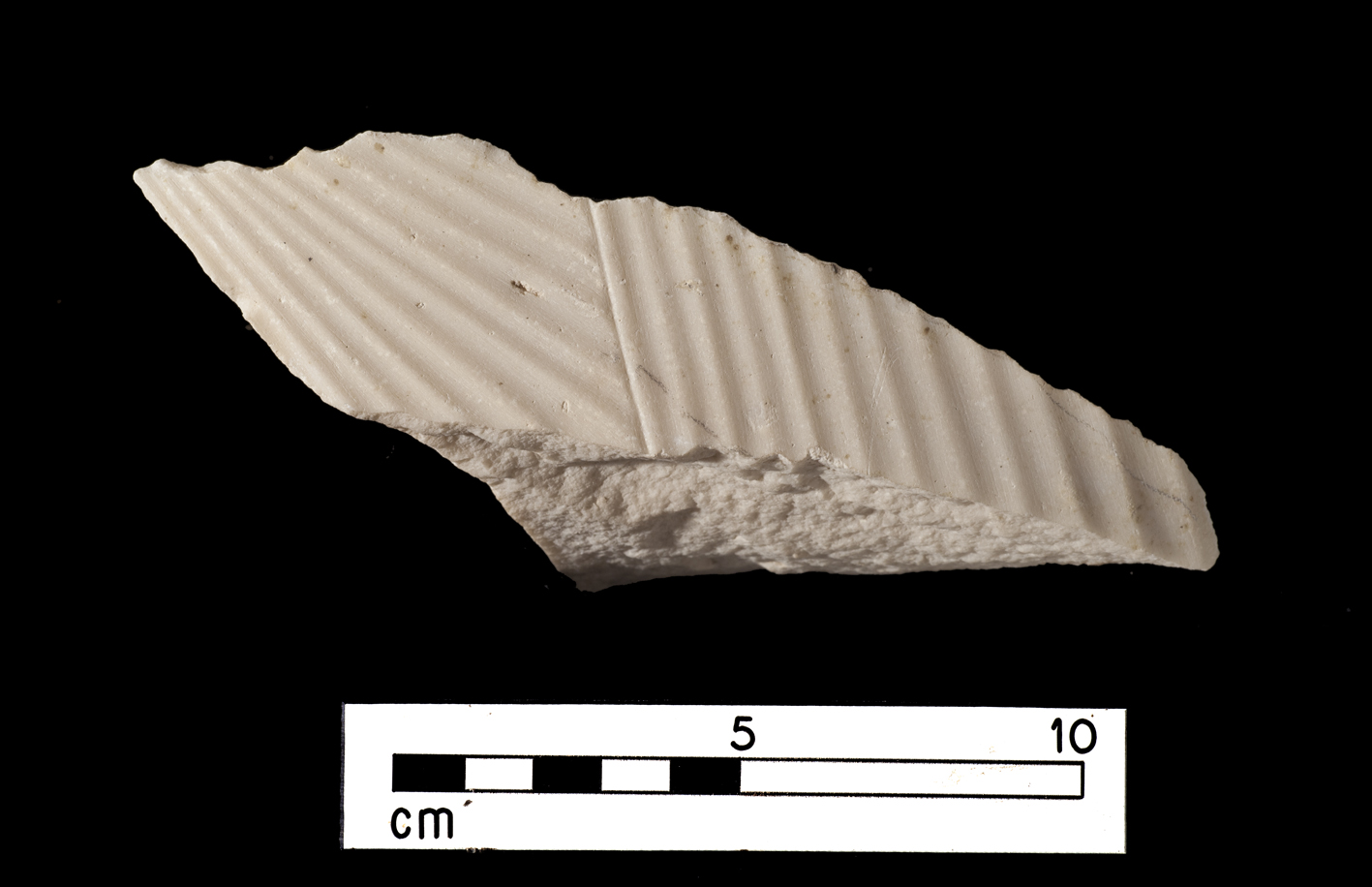
    Some of these hard stone pieces are not from blocks. They are fragments of inserts (rather than inlays), laboriously worked to fit into a gap in backing stonework where damage had occurred or there was a flaw in the stone. The practice is visible still at Amarna at some of the Boundary Stelae, for example. Some of the inserts, and some of the fragments broken from the main surfaces, imply that areas of the temple were made from hard stones – especially the marble-like indurated limestone – and were decorated with scenes in addition to the usual range of Aten formulae. Such hard stone blocks might have been much larger than the modest, standardized size of the common limestone blocks.

    The work at the front of the Great Aten Temple is only the first part of the 2013 schedule of work. On March 29th, the excavating team for the South Tombs Cemetery, of nine archaeologists led by Anna Stevens, arrived at the expedition house for a month’s work, that will be accompanied by continuation of the conservation of the wooden coffins that are such important discoveries.

    It remains, once again, to offer wholehearted thanks our supporters, who make the work at Amarna possible.

    7 April 2013

    Barry Kemp/Anna Stevens

    Figure 3
    Figure 1
    Figure 2

    Figure 4

    Figure 7

    Figure 6

    Figure 5

    Figure 8

    Picture captions:

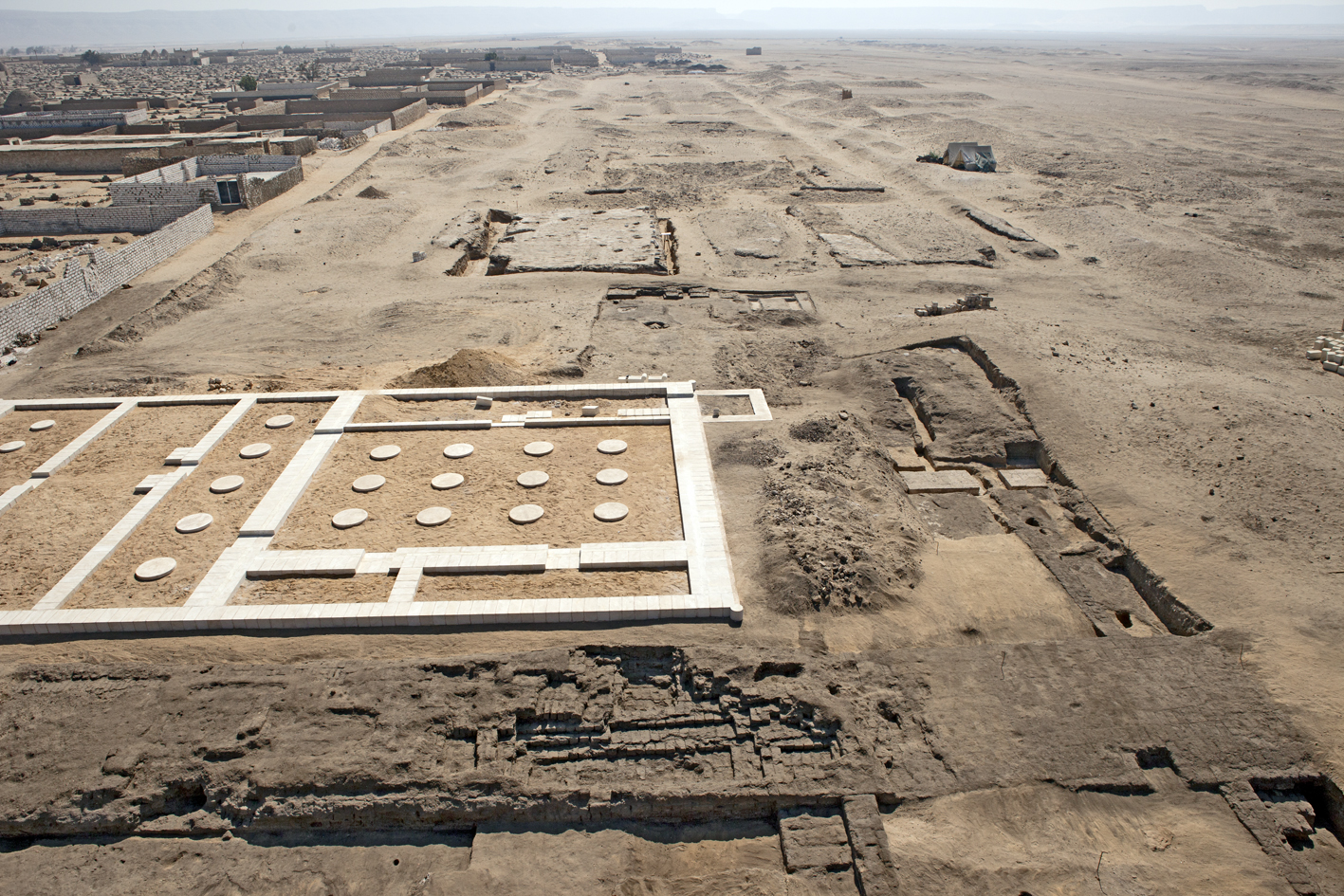
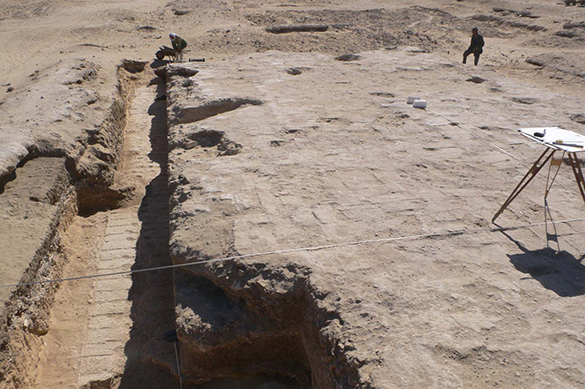
    01. Waiting to be given shape again: the foundations of the Great Aten Temple recede eastwards, as far as the extension to the modern cemetery.
    Photo by G. Owen (shortly before the completion of the stone walls in the foreground).

    02. The stone building that lay behind the northern brick pylon, its walls and column locations recreated in stone and cement. Photo, looking to the north, by G. Owen (shortly before the completion of the stone walls).

    03. Final cleaning of the tops of the newly laid stone blocks, the brick pylon and wide entrance ramp in the foreground. View to the north-east.

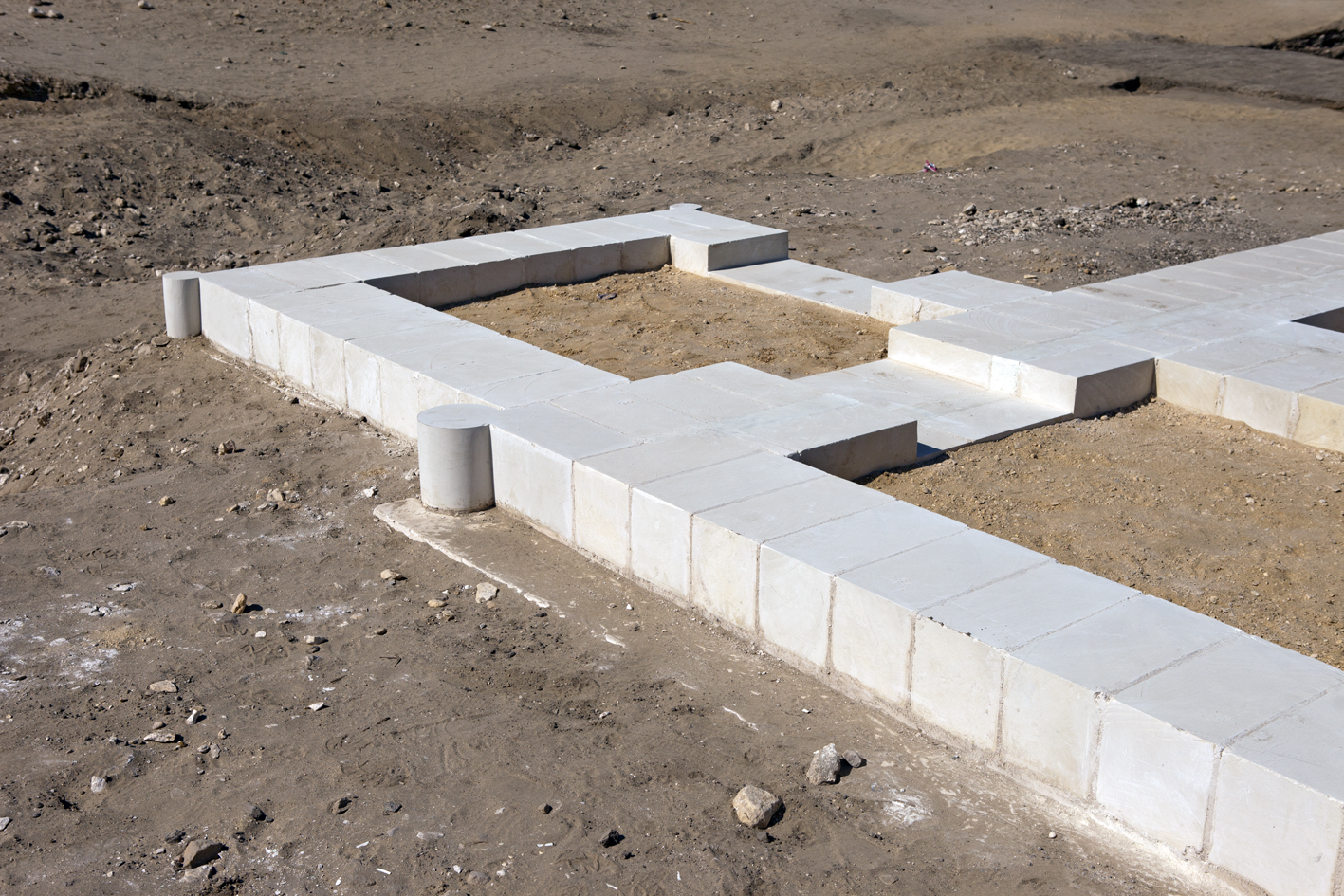
    04. Final view of the stone building, after the last blocks had been laid.
    View to the north, by G. Owen. 05. Detail of the entrance to the stone building, after the last blocks had been laid. View to the south-west, by G. Owen.

    06. The two sets of gypsum-lined troughs surrounding a rectangular pedestal of mud. The pair in the foreground belong to the final phase of the temple; the pair in the background belong to an earlier layout that was subsequently buried. View to the south, by G. Owen.

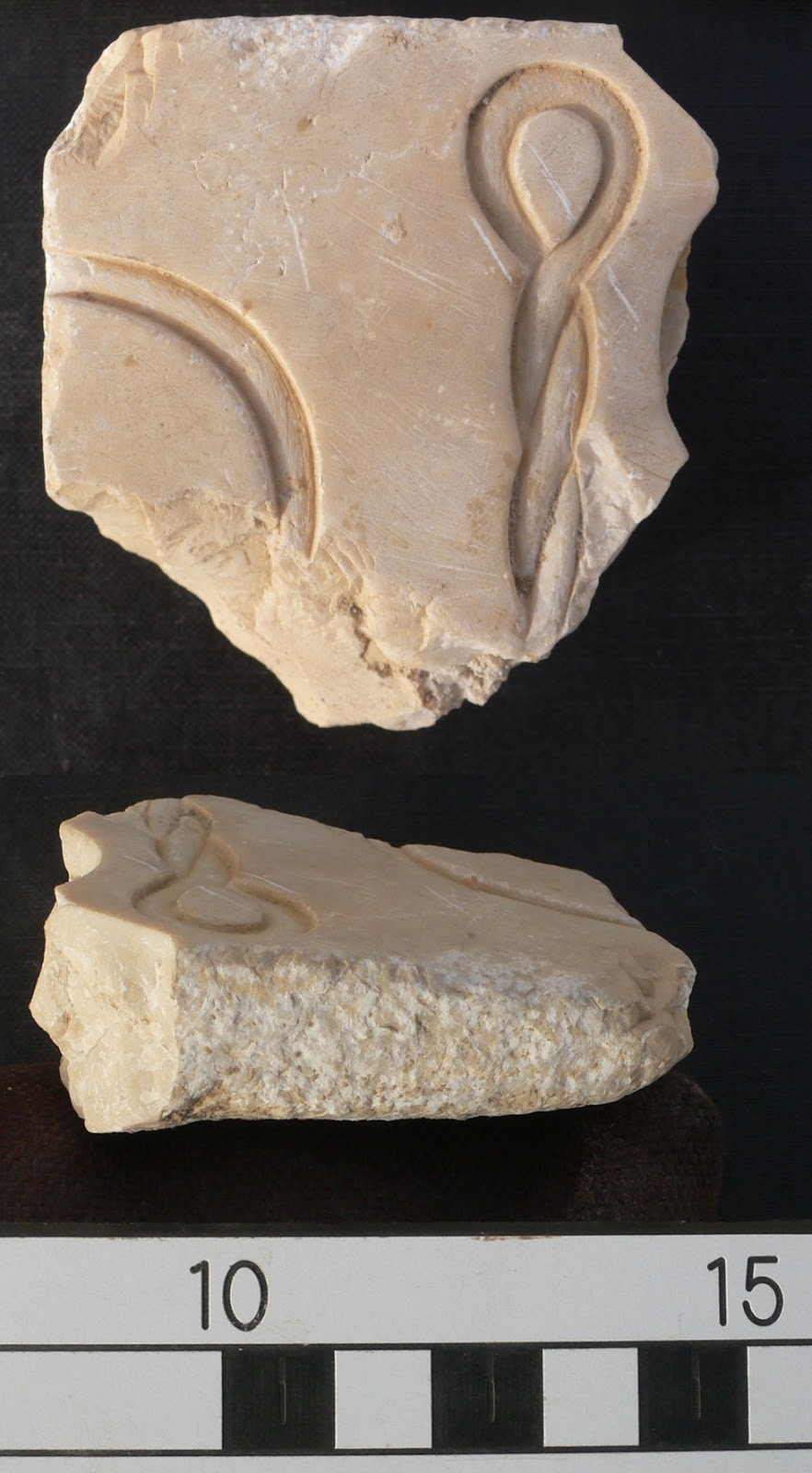
    07. Carved stone fragment S-8207, representing the clothing of a human figure in a scene carved in indurated limestone. Photo by G. Owen.

    08. Carved stone fragment S-7863, part of an insert made from indurated limestone and intended as a patch for an area of damage in the original blocks.

  • Egyptology News from 23rd March to 6th April 2013

    I’ve been in Switzerland for my birthday, so apologies for the rather long post, taken from my Twitter account.
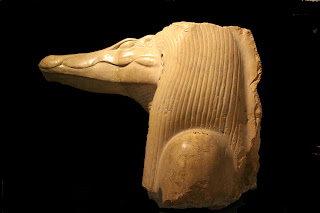
     

    Sobek, Ashmolean Museum

    Via Maria Nilsson ‏@DrMariaNilsson
    Using Inscriptions from the Antiquities Market: Polarized Positions and Pragmatic Proposals | http://asorblog.org/?p=4282

    Museums should engage tourists with content rather than brand for the sake of themselves and the sector. The Guardian http://bit.ly/Z6g9Qr

    In French: British Council seminar shows the role played by the Delta in Egypt at different times. Hebdo Ahram Online http://bit.ly/12twPoW

    New Book: Icons of Power – Revelations though ancient Egyptian art, Anthony Spalinger, Charles Univ. Scoop NZ http://bit.ly/ZDv9Fs

    Aidan Dodson, President of the EES: “L’Egypte risque de perdre une partie de son histoire” Hebdo Ahram Online http://bit.ly/YBSFHj

    A new interactive map of the ancient Mediterranean http://www.ancient.eu.com/map/

    Job: The EES is looking for a new Fieldwork & Engagement Manager to bethe Society’s main representative in Egypt.http://bit.ly/Xiv5yk

    Significant evidence of 17th Dynasty found by Djehuty Project in Luxor. EurekAlert http://bit.ly/XXhvSS  and PhysOrg http://bit.ly/Z6F4EC

    Rus Gant, Giza 3D and George Reisnser’s Legacy: An Em Hotep – Pyramidales Interview. http://bit.ly/Y0LfOH

    Museums Association survey of UK public attitude to museums suggests they are some of the most trusted organisations http://bit.ly/1016tdP

    New Book: “Jean-François Champollion. Notice descriptive des monuments égyptiens du musée Charles X.” Kheops http://bit.ly/Xttvfq

    Freemasons and Ancient Egypt at Kensal Green Cemetery, London. http://bit.ly/12p18xd

    Via Neal Spencer ‏@NealSpencer_BM 4 Apr
    A chronology (with posters) of every temporary exhibition @britishmuseum 1838-2012 http://www.britishmuseum.org/research/publications/research_publications_series/research_publications_online/chronology_of_exhibitions.aspx

    Free online: The failed reforms of Akhenaten and Muwatalli. Itamar Singer. BMSAES, 6 (2006), 37-58 @historyancient http://bit.ly/XRBy59

    Off-topic “The life of man: solitary, poore, nasty, brutish, and short”. Thomas Hobbes, born today 1588. History Today http://bit.ly/ZgIR8o

    Pre-healthcare modern Egypt. With help on hand from health barbers and folk healers, health aid was never far away http://bit.ly/10y4qh6

    Summary of Aidan Dodson’s lecture at the AUC on the royal family after the death of Ramses II. Daily News Egypt http://bit.ly/Zb8kZQ

    Exhibition: “Echoes of Egypt:Conjuring the Land of the Pharaohs” at Yale Peabody Museum. With photos. http://bit.ly/14SjvPg

    Farro or emmer wheat, once a staple in AE being cultivated once again. Offers an insight into its uses. Oxford Press http://bit.ly/XhcsLk

    Forthcoming: Foreigners and Egyptians in the Late Egyptian Stories, Camilla Di Biase-Dyson. Brill http://bit.ly/10BugA6

    New Book: The Life of J.D. Åkerblad, Egyptian Decipherment and Orientalism in Revolutionary Times, F.Thomasson. Brill http://bit.ly/WcRe0U

    In Spanish: Egypt to ask tourists to donate a dollar for each night spent in Egypt to fund Grand Museum. Vanguardia http://bit.ly/Zd5zhy

    Curse of Tutankhamun, 90 years on. Past Horizons http://bit.ly/ZbVdI3

    New project explores influence of Egyptian archaeological finds in sculpture 1907 to 1939 and Petrie’s responses. UCL http://bit.ly/10f0m5J

    Elimination of Mubarak’s police services left aan open invitation to trespass without fear of reprisal. USA Today http://usat.ly/10waUho

    Curator’s Choice: Amber Druce picks a tomb painting from Pharaoh Reborn. Culture24 http://bit.ly/14N3udt

    Archaeologists Uncover Rare Leather from Ancient Egyptian Chariot. AUC Egypt http://bit.ly/XyaQye

    Via Chris Naunton ‏@chrisnaunton 4 Apr
    New book L’Egypte Dessinee by B Cassiers on 18/19/20th cen artists who painted Eg monuments w new works by the author http://www.lycaons.eu/images.html

    Russian photographer apologizes for climbing Great Pyramid of Giza (with photos). NY Daily News http://nydn.us/YK9G4w

    China specialist Prof Anthony Barbieri-Low receives Mellon New Directions Fellowship to research Egypt. Noozhawk http://bit.ly/10ew9Up

    90th anniversary of the curse of Tutankhamen – how a modern myth was born. Univ Manchester http://bit.ly/YUtI9M

    Manchester Mus holds 2 important objects that provide evidence for use of masks in ancient Egypt. Manchester Museum http://bit.ly/10Gr0VR

    Reassembling of the Two Colossi of Amenhotep III at North Gate of his Funerary Temple, West Bank, Luxor.. Luxor Times http://bit.ly/12lPoLJ

    Site Management plan for the Colossi of Memnon and Amenhotep III mortuary temple project. Luxor Times http://bit.ly/10zeBBk

    Article re recent conference. Thonis-Heracleion, sunken gateway to Egypt in 1st mill.BC. With photos. Past Horizons http://bit.ly/X9qCjQ

    Update from the Tell Basta Project http://tellbasta.tumblr.com/post/46430050559/heart-of-glass

    Object biography #12: A wooden shabti of King Seti I (Acc.no.13906) by Campbell Price. Manchester Museum http://bit.ly/10gddTT

    New book on Cleopatra argues that the “Queen of Kings” did not take her own life. Smithsonian Mag http://bit.ly/173Rnbb

    Birds in ancient Egyptian society: some brief notes. Joyce Filer’s blog http://bit.ly/10n95BB

    Part 2 of Dean Kalimniou’s look at the Greek connection in Sudan, focusing on the survival of the Greek language http://bit.ly/14uivk0

    Part one of Dean Kalimniou’s look at the Greek connection in Sudan http://neoskosmos.com/news/en/greeks-in-sudan-part-one

    Progress by the EES Minufiyeh Survey team in the Delta http://minufiyeh.tumblr.com/post/46785854575/progress

    Interview re new book: The Archaeology of Race – The Eugenic Ideas of Francis Galton and Flinders Petrie. UCL http://bit.ly/13Ut7tj

    Ancient Kingdoms in the land of war – the archaeology of Sudan. New York Times http://nyti.ms/YV55Xg

    With security ebbing and prices rising, the sustained drop-off in Egypt tourism has hurt the impoverished. NY Times http://nyti.ms/Yw7paI

    Djehuty Project: Arqueólogos españoles descubren en Dra Abu el-Naga, Luxor, cuatro tumbas de la dinastía XVII. ABC.es http://bit.ly/Z7KmFG

    La campaña 2013 de excavaciones de la UJA, Asuán, constata la complejidad de la estructura de las tumbas. europapress http://bit.ly/ZaePfn

    Book review by Tim Reid: Mummies: Death and Life in Ancient Egypt, James Hamilton-Paterson and Carol Andrews, Penguin http://bit.ly/12iTrw5

    Egypt revolution brings golden age for tomb raiders. http://www.bbc.co.uk/news/world-africa-21960373

    EES Delta Survey dig diary is being started up again for the new season http://deltasurvey.tumblr.com/

    Priceless Egyptian treasures feared destroyed in Cuming Museum (South London) museum fire. http://bit.ly/YxutIj

    New York Prosecutors Seek to Forfeit Ancient Egyptian Artifacts. Cultural Heritage Lawyer http://bit.ly/104kqVA

    Site of Al Bordan site destroyed by illegal construction in spite of intervention by police and archaeologists. http://bit.ly/ZXQcoJ

    Travel. Siwa, the field of trees. With photos. Alrahalah http://www.alrahalah.com/2013/03/siwa-the-field-of-trees/ …

    It’s a boy: Albany museum’s mummy’s true identity revealed. http://bit.ly/14ijeF1

    Seizure of 5 Egyptian artifacts dating back to 2,000 B.C. on their way from Dubai to a Michigan antique dealer. http://www.courthousenews.com/2013/03/22/55962.htm

    2,400-Year-Old Myths of Mummy-Making Busted http://www.livescience.com/28097-herodotus-mummy-evisceration-wrong.html

  • Egyptology News for March 17th-22nd

    Copied from Twitter @EgyptologyNews

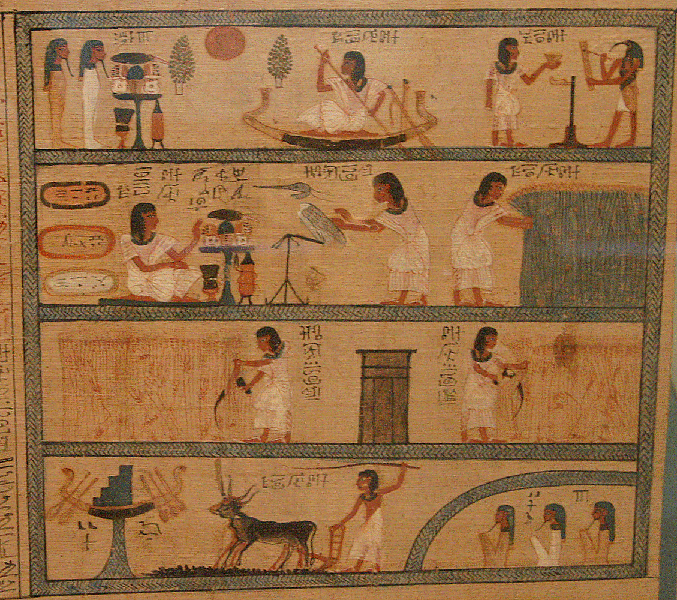
    Papyrus of Ani

    New items under scrutiny in Penn Museum’s lab: http://www.penn.museum/sites/artifactlab/ …

    Tales of the mummy’s curse. The legend of the mummy’s curse still continues to fascinate. Al Ahram Weekly http://bit.ly/ZFFCmZ

    Programme summary for 2-part Ancient Egypt: Life and Death in the Valley of the Kings starting on UK TV this evening http://bit.ly/ZSiEbv

    How Harvard Students Explore Ancient Egypt From Cambridge With New 3D Technology. Forbes http://onforb.es/13fhDjP

    Albany museum corrects gender of mummy after X-ray. Wall Street Journal http://on.wsj.com/11rxjiD

    The EES Minufiyeh (Delta) Survey is back at Quesna and in Shibin el-Kom. http://bit.ly/11kRZZw

    Conference “Tracing Networks.Communicating Knowledge in Antiquity and the Digital Age” Apr 23-24 2013 British Academy http://bit.ly/WJ6YK9

    Using modern fish to understand ancient ones from Old Kingdom Giza. AERA blog http://bit.ly/100Dcy9

    Article re chief research officer + archaeozoologist at Ancient Egypt Research Associates (AERA), Giza. Uni Michigan http://bit.ly/11gzIsC

    Cahiers de notes épigraphiques de Gaston Maspero 1881 – 1884. http://bit.ly/11fqe0W

    Maritime trade thrived in Egypt, even before Alexandria in 1st mill BC. Article about topic of recent conference. http://bit.ly/15QIoZv

    Via Neal Spencer ‏@NealSpencer_BM 19 Mar
    After 10 months away (Paris, Shetland), the Gayer-Anderson Cat is back on display in room 4 @britishmuseum http://via.me/-an0hwdi

    Article: The present state of the site of Behbeit el-Hagar. C.Favard-Meeks. BMSAES 3 Nov2002 (all BMSAES papers free) http://bit.ly/11fb3bN

    Via British Museum ‏@britishmuseum
    Sycamore fig wood, often used for ancient Egyptian coffins, does not come from a sycamore tree, but from a fig tree #SciWeek

    Via Jane Draycott ‏@JLDraycott
    ‘Cleopatra’s Daughter’ in April’s @HistoryToday tells the story of Cleopatra Selene, by way of Egypt, Rome, and Mauretania.

    More re 3,300-Year-Old Egyptian cemetery reveals commoners’ plight at Amarna. Live Science http://bit.ly/WRfeZH

    A Nubian Bishop and His Patron Saint: 10th-century fresco gives insight into the Christian history of Nubia. The Root http://wapo.st/16Gf7Cb

    Tutankhamun: How rival directors of two great American museums joined forces to create an epic event.Vanity Fair http://vnty.fr/14oMwNB

    An exploration of the Louvre’s collection of ancient civilizations of Egypt, Mesopotamia and Persia. Ahram Online http://bit.ly/XVmtkb

    Book Review. Gods, Men & Pharaohs: The Glory of Egyptian Art. I.Woldering. Harry N. Abrams, Inc. The Egyptians blog http://bit.ly/YRMMV0

    Some notes on health problems in ancient Egypt and Nubia. Part One: Problems with teeth. Joyce Filer http://bit.ly/10dfiSp

    Cairo landmark, the Villa Casdagli, badly damaged during the revolution, to be restored to former glory. Ahram Online http://bit.ly/YEbTYm

    New Book: The Valley of the Kings. A Site Management Handbook. Kent R. Weeks + Nigel J. Hetherington. AUC http://bit.ly/WzEEZz

    Via Chris Naunton ‏@chrisnaunton
    If Constable had visited Giza… ‘The Pyramids at Gizeh in Morning 1890 by Ernst Koerner’ http://fb.me/2RDLwNS8R

    Conference: Recent Archaeological Fieldwork In Sudan. 13 May 2013 at the British Museum, London. Details at http://bit.ly/ZVG3Zf

    Via Neal Spencer ‏@NealSpencer_BM
    July 11-12: @britishmuseum colloquium “Nubia in the New Kingdom: Lived experience, pharaonic control and local traditions” more details soon

    Not strictly Egypt but relevant: 3D Modeling Reveals Ancient Artifacts. Popular Mechanics http://bit.ly/XfEPq4

    Via Jan Picton. Preliminary report on activities of Polish Cliff Mission at Deir El-Bahari 10/02-13/03/13. Facebook http://on.fb.me/108HfL7

    From the Forests of Punt to the Deserts of Saqqara: Life and Death as a Sacred Monkey. Researchers in Museums http://bit.ly/YjFZUQ

    A properly protected German reserve provides stark contrast to Egypt’s toothless environmental policies. Egypt Today http://bit.ly/XTkmx6

    Tourism Ireland arranged for the Pyramids of Giza to be illuminated in green for St. Patrick’s Day. Al Arabiya http://bit.ly/1449j5W

    New: Bagnall, Davoli, Hope eds., The Oasis Papers 6: Procs of the 6th Internat. Conf. of the Dakhleh Oasis Project. http://bit.ly/142Zhl5

    El obelisco egipcio que pudo erigirse en Galicia (but is on London’s Embankment and ought to be in Egypt). Ushebtis http://bit.ly/16CIdCe

    Walking the city: an interview with Nabil Shawkat on the pleasures of exploring Cairo on foot. Cairobserver http://bit.ly/XiLwHS

    RT @historyancient Online article. The Sun Queen’s Trademark: A Study of the Tall Blue Crown of Queen Nefertiti. http://bit.ly/YI1yOj

    EES/SCA Delta Survey Workshop 2013, 22nd-23rd March 2013 in Cairo. Papers about fieldwork or research in the Delta. http://bit.ly/YAJJ08

    Not Egypt but important: Palmyra has been subjected to intermittent shelling by forces loyal to President.http://bit.ly/XhwPVq

    2nd International symposium on Coptic culture: Past, Present and Future 22-24 July 2013 Stevenage, UK. Details at: http://bit.ly/15djMru

  • Egyptology News for March 14th – 16th 2013


    From @egyptologynews.  Happy St Patrick’s Day for tomorrow!

    Bobblehead no more: finishing the falcon mummy conservation treatment. With photos. Penn Artifact Lab http://bit.ly/ZZL2Kx

    RT @SakhmetK Report on findings of two visitor surveys about using mobile devices in museums. Digital Media at V&A http://bit.ly/YtSAnt

    #ForeignBodies Exhibition visitor information can be found here: http://blogs.ucl.ac.uk/researchers-in-museums/foreign-bodies/ … Trail maps will be uploaded very soon! @UCLMuseums

    More photos from the discovery of the remains of battle against the Hyksos. Luxor Times http://bit.ly/WNV8zy

    Important discoveries at Tel Habuwa dig in Delta shed light on campaign by Ahmose I against the Hyksos Ahram Online http://bit.ly/XfABia

    Surprising, but NBC says that for the 1st time the Pyramids of Giza + Sphinx will be lit green on St. Patrick’s Day. http://nbcnews.to/WLDc8E

    Call for abstracts. Origins5 conference 13-18 Apr 2014 (Predynastic and Early Dynastic) Cairo 2013. Full details at http://bit.ly/ZHD19L

    RT @TheSSEA Monica Hanna’s photos of destruction at World Heritage Site Dashur http://bit.ly/Zcs9ml  + Antinoupolis http://bit.ly/Yi1OkA

    RT @wzzw Oriental Stone: New entry on UCLA’s free online Encyclopaedia of Egyptology http://escholarship.org/uc/item/4xk4h68c

    Via Kimberley Freeman ‏@Kim0006
    The launch of #foreignbodies in UCL’s North Cloisters was AMAZING! Well done @ResearchEngager ! pic.twitter.com/U69c9K66LR

    Middle East in Early Prints and Photographs (NYPL Digital Gallery). 1000s of prints, photos from 17th-20th Cs. AWOL http://bit.ly/Zcs9ml

    The Coptic blog has just been resumed by Howard Middleton-Jones with updates on Coptic themes. Coptic News + Archive http://bit.ly/YewLcv

    Travelers in the Middle East Archive. Digital archive emphasising travels to Egypt in 19th and early 20th Cs. AWOL http://bit.ly/16y3qNO

    Short article (from Feb, but I missed it). Musical Apes:Can Baboons Play the Harp? By Gemma Angel. UCL http://bit.ly/Z26vOx

    New Book (French): Laurent Bricault “Les cultes isiaques dans le monde gréco-romain” Les Belles Lettres http://bit.ly/15QWr0V

    Kings and Queens and the case of the pink hippo? Review of the LGBT event at the Petrie, by Chris Webber. UCL http://bit.ly/YyMjqQ

    New Book: Ancient Egyptian Administration ed. Juan Carlos Moreno García. Looks comprehensive but very expensive. Brill http://bit.ly/SbttGS

    Summary of University of Basel 2013 season at the undecorated non-royal tombs in the side valley leading to KV34.Past Horizons http://bit.ly/10PJgdP

    In Spanish. Egyptian state subsidies withdrawn, but as at Aswan excavations continue at Oxyrhynchus. La Vanguardia http://bit.ly/XybJrN

    Via Campbell Price ‏@EgyptMcr
    Tea and cake for #ComicRelief @McrMuseum today – and GINGERBREAD SHABTIS! pic.twitter.com/rkqn0WxIDx

    Landscaping the entry to the open-air museum was the theme of the Aswan International Sculpture Symposium. Ahram Wkly http://bit.ly/14xRp78

    Further to my previous post re the 2013 Amheida/Trimethis report, find out more about the project from their homepage http://www.amheida.org/

    Amheida/Trimithis (Dakhleh Oasis) 2013 season report, Jan 20th-Feb 14th. Directed by Roger Bagnall. PDF New York Univ http://bit.ly/WK2nIN

    Travel in the Fayoum, rich in contrasts. Sun-baked desert valleys, frigid lakes and lush farmland. Daily News Egypt http://bit.ly/Z6p1s6

    During excavations in the Kings’ Valley University of Basel researchers found one of world’s oldest AE sun dials. http://bit.ly/X9Jfid

    End of the season post from the Temple of Mut team, from their dig diary, with loads of great photos. Brooklyn Museum http://bit.ly/YnmbPr

  • Egyptology News for 12th and 13th March 2013

    From Twitter @egyptologynews.  
    Where on earth is this year going??  I cannot believe that it is mid-March already.

    End of the season post from the Temple of Mut team, from their dig diary, with loads of great photos. Brooklyn Museum http://bit.ly/YnmbPr

    Further to my previous, keep an eye on the #Save_antinoupolis hashtag if you want to follow this story.

    More much-needed publicity about the damage inflicted by looters upon Antinoupolis and other sites. Worldcrunch http://bit.ly/ZIZjZY

    Conferencia: Religión y prácticas mágicas. El poder de los amuletos y hechizos contra los poderes maléficos. Ushebtis http://bit.ly/XJrA4I

    Book Review: S.Ruzicka, Trouble in the West: Egypt and the Persian Empire, 525-332 BCE. Oxford Univ Press 2012. BMCR http://bit.ly/10H62op

    Video: The biggest exhibition of Egyptian artifacts to be taken around this country will be displayed in Bristol. ITV http://itv.co/WlleHM

    Curator’s Diary 13/3/13: Early Photographs of a Prince’s Journey in Egypt. Egypt at the Manchester Museum. http://bit.ly/12Ptq8l

    Via Rene Nieuwenhuizen ‏@ReneNieuw
    Shape-Shifting Jesus Described in Ancient Egyptian Text – http://po.st/Eg5xGK

    Cemetery Holds Proof of Hard Labor. Akhenaten’s capital was no paradise for many adults, children. National Geographic http://bit.ly/YnqIS5

    QR codes and “Tales of Things” at the Petrie Museum by Andie Byrnes. @PetrieMuseEgypt UCL Museums + Collections Blog. http://bit.ly/Y9l46T

    New Book: Wadi Sura, Cave of Beasts, A rock art site in the Gilf Kebir (SW Egypt). R. Kuper. Heinrich Barth Institut http://bit.ly/YamjQc

    RT @eloquentpeasant All objects in the Ancient Egypt gallery in National Museums Scotland are now available online http://bit.ly/13SJjKt

    RT @NealSpencer_BM A beautiful, little known, granite statue of Ramses II has gone on display Room4 @britishmuseum. http://twitpic.com/cat7w0

    Worrying article about prospects for geo-tourism in NewValley (oases). Fails to consider the damage already inflicted http://bit.ly/Y9q88e

    Em Hotep Digest vol. 02 no. 09: Pharaoh Snefru’s Pyramids. http://bit.ly/W9Fayq

    UNESCO visits Cairo to discuss threats to archaeo sites and the possibility of a regional centre for World Heritage. http://bit.ly/W7m0sY

    Pharaon Magazine (in French) is now available in PDF format for 5 € per issue. http://pharaon-magazine.fr/catalog/ebooks/pdf-pharaon

    New Book: Djekhy and Son. Ordinary businessmen from ancient Egypt. By Caryll Faraldi, AUC.Egyptian Gazette http://bit.ly/ZwG5FE

    Via Dan Snow ‏@thehistoryguy
    If you watched the Syria programme, here’s my article about the threat to the precious heritage of the country: http://www.bbc.co.uk/news/magazine-21702546

    The latest Museum Books catalogue is out now, in PDF: http://www.museumbooks.demon.co.uk/lists/list36.pdf

  • Egyptology News for March 11th 2013

    Reposted from Twitter ‏@egyptologynews.

    Rock art sites and rich archaeological site dating back more than five hundred thousand years found in NE Sudan. PAP http://bit.ly/10F4Pl3

    In N.Sudan archaeologists have found remains of early Homo sapiens settlements c.70 thousand years old. naukawpolsce http://bit.ly/XkyT4F

    Via Chris Naunton ‏@chrisnaunton
    Not good news- the Roemer-Pelizeaus Museum in Hildesheim, Germany is in bad financial straits… http://fb.me/11WWYMbNm

    Via Margaret Maitland ‏@eloquentpeasant
    Poll about threatened closure of Roemer-und Pelizaeus-Museum, 3rd largest Egyptian collection in Germany (scroll down) http://translate.google.co.uk/translate?hl=en&sl=de&tl=en&u=http%3A%2F%2Fwww.hildesheimer-allgemeine.de%2F

    Institute of Archaeology Annual Conference 20-21 May. ‘Forming Material Egypt’ call for papers now announced. UCL http://bit.ly/14LccUL

    Project to revive Al-Muizz Street to be launched to reverse post-revolution deterioration of key sites. Ahram Online http://bit.ly/14O7TrR

    More re clogged arteries in mummies. http://phys.org/news/2013-03-ancient-mummies-clogged-arteries.html

    Even without modern-day temptations people had clogged arteries some 4,000 years ago, according to mummy research. WP http://wapo.st/Zxgtfa

    Journal of Greco-Roman Christianity and Judaism 8 (2011-2012). http://www.sheffieldphoenix.com/showbook.asp?bkid=211

    More Sekhmet statues unearthed at Amenhotep III’s temple in Luxor. Ahram Online http://bit.ly/Y4MB9q

    Via Alice Williams ‏@alicewilliams86
    Great new article by Debbie Challis @poisonchallis on curating the exhibition ‘Typecast: Flinders Petrie and Francis Galton’: http://www.tandfonline.com/doi/full/10.1080/09647775.2012.754627

    Via Campbell Price ‏@EgyptMcr
    Every object tells a story – What do hieroglyphs mean? http://wp.me/sfm2O-2093  http://wp.me/pfm2O-xL

    Write-up of Manchester Museum event “Every object tells a story – What do hieroglyphs mean?”. Seshat Journal http://bit.ly/Y4ZVe1

    Mar 10 Anna K. Hodgkinson Anna K. Hodgkinson ‏@Udjahorresnet1
    This is NOT exactly what happened at Amarna last week… http://english.ahram.org.eg/News/66211.aspx

    Via HistoryoftheAncient ‏@historyancient
    Article: “Lost City” of Tanis Found, but Often Forgotten http://historyoftheancientworld.com/2013/03/lost-city-of-tanis-found-but-often-forgotten/ …

    Call for papers: The Institute of Archaeology Annual Conference 20-21 May on the topic of ‘Forming Material Egypt’ http://bit.ly/14LccUL

    Via EEF. Careless fieldwork activities in Lahun may have resulted in destruction of burials and theft of coffins. http://bit.ly/10ssSjm

  • Egyptology News March 8th – 10th 2013

    Copied from @egyptologynews.  Not a lot of news over the last few days, but some very disturbing and upsetting news about continued looting of sites.

    Via EEF. Careless fieldwork activities in Lahun may have resulted in destruction of burials and theft of coffins. http://bit.ly/10ssSjm

    Hawass says Egypt faces permanent loss of heritage unless President controls illegal development, looting. TheExpress http://bit.ly/Y76D24

    Monica Hanna has warned that Antinoupolis is being destroyed by residents amid government failure to protect it. http://bit.ly/WSRwae
    More re the distressing damage to the site of Antinoupolis, with photos. Kristian Strutt http://bit.ly/XZJOOT

    Research and development in a museum context? It is one of the big themes at #MuseumNext Amsterdam – http://www.museumnext.org/2010/blog/rd-for-museums

    Dimensions of Ancient Egypt. Newly developed virtual reality 3-D reconstructions of Karnak. Harvard Gazette http://hvrd.me/13M0Q7p

    Looking at the past analysis of Philadelphia’s museum mummy PUM1, first autopsied in 1972. With archive photos. http://bit.ly/X7otWb

    New book: Hieroglyphic Egyptian. An Introduction to the Language and Literature of the Middle Kingdom by D.L.Selden. http://bit.ly/ZzmCp4

    A ‘teaser’ page for upcoming film about “Cleopatra’s Needle” on London’s Embankment. If you like close-ups of stone, that is. http://eyeontheneedle.wordpress.com

    The website for the ongoing project Egyptian Coffins in Provincial Collections of the UK Project is up: Bristol Univ. http://bit.ly/YgRs3u

    A closer look at the stela of Nakhtmontu and its gilded Egyptianizing frame commissioned by the Prince of Wales: http://www.royalcollection.org.uk/collection/18052/egyptian-style-frame

    Archaeology, palaeontology, history and oasis culture in Bahariya Oasis. Ahram Online http://bit.ly/WYv6K9

    The mummy named Padihershef that lives in the Ether Dome at Massachusetts General Hospital has undergone analysis. http://bo.st/Zl4Dog

    Stone Age Skeletons Unearthed In Libya’s Sahara Desert Spotlight Gender Divide Huffington Post http://huff.to/13I6XsX

    Via @portableant: Job: Project Curator: Archaeology, The British Museum, UK, England, London http://bit.ly/Zk5LZr

    Via @alicewilliams86. New Book: Museums and Communities. Curators, Collections and Collaboration. Bloomsbury http://bit.ly/12ziECU

    More re analysis of Qubbet el-Hawa remains. Even Egypt’s Ancient Rulers Suffered From Hunger And Disease. redOrbit http://bit.ly/15BDOhq

    900KM Project: grappling with Egypt’s baffling urban condition. Cairobserver http://bit.ly/X1KG85

  • Egyptology News for the 6th and 7th March

    Copied from @egyptologynews. Most recent news is at the top.

    Via Chris Naunton ‏@chrisnaunton. To see what stands to be lost at Antinoupolis see the wonderful images in the Antin Foundation Newsletter #1: http://kdstrutt.files.wordpress.com/2013/03/oracle001.pdf

    Salima Ikram has posted on Facebook to say that Sheikh Abada, ancient Roman Antinouplis, Middle Egypt, is being destroyed systematically at http://www.facebook.com/groups/239832019441502/

    Exhibition: Secret Egypt: Unravelling Truth from Myth, from 30th March – 1st June at Inverness Museum and Art Gallery http://bit.ly/Xssd2h

    Yorkshire historian Joann Fletcher uncovers the lives of ordinary people in Ancient Egypt in a new TV documentary. http://bit.ly/14pRnhG

    Czech Egyptologists uncover 400 prehistoric burials in Sabaloka mountains in C.Sudan. Prague Monitor http://bit.ly/15zAcfR

    Today is World Book Day. What work of history had the greatest impact on your life, why? History Today’s Facebook page http://on.fb.me/13HgEru

    Bodies in Aswan tomb reveal premature deaths. Short piece re findings from Qubbet el-Hawa Tomb 33. Past Horizons http://bit.ly/ZqLoaE

    Conferencia: Los rituales funerarios. Las concepciones en torno a la muerte y la vida en el más allá.Spain. Ushebtis http://bit.ly/VJOXLe

    Egypt and Italy cooperate to document the history of a forgotten site, Kom Al-Ahmer, in the Delta. Daily News Egypt http://bit.ly/10aAUgy

    Very interesting thoughts from Kristian Strutt at the end of the Antinoupolis season. Well worth a read. http://bit.ly/YC9f8b

    A touring exhibition, featuring Bolton Museum’s famous Egyptology collection, is set to open in China next week. http://bit.ly/Zt8FZu

    Via @SakhmetK. Video: Making Many. Investigations into mass production of shabtis using 3D imaging (4.29 mins) http://bit.ly/12wh0BW

    A year old but I don’t recall seeing it: The Spring 2012 issue of Aeragram re Memphis excavations is available in PDF http://bit.ly/XTS7dY

    Via David Lightbody. Article on problems with DNA interpretation that apply to Egyptology too http://bit.ly/13J8n23

    EES events listing for Spring 2013. Some great topics: http://www.ees.ac.uk/events/index.html

    Interview re a technical study of a child sarcophagus. Penn Museum Artifact Lab http://bit.ly/YdOBIx

    Video that aired yesterday a.m. on the BBC about the current state of tourism in Luxor. http://www.bbc.co.uk/news/world-africa-21681367

    Via @SakhmetK Pottery App Now Turns Virtual Creations Into The Real Deal using 3D printing http://cultm.ac/109hZCY

    Via Amesemi ‏@Amesemi
    Online archive for Egyptian stamps is launched | Egypt Independent http://www.egyptindependent.com/news/online-archive-egyptian-stamps-launched

    Via Gwyn Ashworth-Pratt. Video: A Game Engine Based Visualisation of the Queen Meresankh III Mastaba at Giza (2.15) http://www.youtube.com/watch?v=qaULTton-ZY

    La homosexualidad en los tesoros del antiguo Egipto (about LBGT week). Ushebtis http://bit.ly/167JJvO

    Authorities foil encroachment on Egypt’s Tel Al-Amarna archaeological site. Ahram Onlline http://bit.ly/WHkmdq

    In Spanish. Looking for a solution for the long term preservation of Nubian temple of Debod (now in Madrid). AVAAZ http://bit.ly/15vUVBt

  • Egyptology News for the 4th and 5th March

    Copied from @egyptologynews.  Most recent at the top.

    In Spanish. Looking for a solution for the long term preservation of Nubian temple of Debod (now in Madrid). AVAAZ http://bit.ly/15vUVBt

    A report that says Egyptian antiquities officials have confirmed that a pipe has burst inside the Khufu boat museum. http://bit.ly/13BjZIG

    Book available for pre-order: The Survey of Memphis VI. Kom Rabi’a: the late Middle Kingdom settlement (levels VI-VIII) by Lisa Giddy. EES http://bit.ly/WGHgBV

    Read about the iPad app “Tour of the Nile” developed by the Petrie Museum 3D project, available free of charge. http://petriemuseum.com/blog/ton/

    Video: Petrie 3D Cartonnage Conservation. Excellent demonstration of conservation in progress and the info obtained. http://bit.ly/13DTN0h

    Via Jane Akshar: Valley of Kings reopened this afternoon http://nblo.gs/IUCDh

    Further to my previous, all British Museum Studies in Ancient Egypt and Sudan (BMSAES) papers are online, free. http://bit.ly/TlUCUu

    Free online article: The Middle Kingdom Stelae Publication Project. By Detlef Franke. BMSAES 1 (2002), 7-19. http://ow.ly/ilRIN

    Two WC students are working to conserve 3,000-year-old mummy Ti-Ameny-Net and its coffin for display. The Collegian http://bit.ly/VyXrVI

    Em Hotep Digest vol. 02 no. 08: Magic in Ancient Egypt http://bit.ly/Ws8aCD

    Amid declining tourist numbers, cash-strapped bazaar owners in Luxor block roads to West Bank sites. Ahram Online http://bit.ly/Z8EhST

    Mummification Museum lecture notes: Ptolemaic Coins in Thebes by Thomas Faucher. Thanks to Jane Akshar. Luxor News http://bit.ly/WFEmTx

    Conference: Household Studies in Complex Societies: (Micro) Archaeological and Textual Approaches. Oriental Institute http://bit.ly/10FiH9B

    Free online article: Tomb and social status: The textual evidence. Nicole Alexanian (2004) http://bit.ly/13l5PLw

  • News for 3rd March 2013

    Yesterday’s news from the world of Egyptology, copied over from Twitter.

    Via Kristian Strutt ‏@kdstrutt: Antinoupolis Project blog. Visit to the Via Hadriana, Deir El Sombat and rock-cut coptic church http://kdstrutt.wordpress.com

    Via Maria Nilsson ‏@DrMariaNilsson:  Book Review: The Murder of Cleopatra http://rogueclassicism.com/2013/03/02/rcreview-the-murder-of-cleopatra/

    Egyptian minister and German foundation sign MoU to complete database for Akhenaten Amarna museum in Minya. allAfrica http://bit.ly/Za3lKH

    Nothing to do with Egypt, but very cool! Desert finds on Arabian Peninsula challenge horse taming ideas. BBC http://bbc.in/XClkIa

    Not specific to Egypt but relevant: Agriculture and parting from wolves shaped dog evolution, study finds. Physorg http://bit.ly/13htPzg

    Stone Tools in the Paleolithic and Neolithic Near East. A Guide. J.J. Shea, State University of New York, Stony Brook http://bit.ly/160XXPa

    Available to read online: World Archaeology at the Pitt Rivers Museum: a characterization (with 3 chapters on AE). http://bit.ly/eZvAwV

    The last week of the Saqqara.nl dig diaries: http://www.saqqara.nl/news/mission-digging-diary/2013-digging-diaries/2013-03-01

    Linking Things on the Web: Pragmatic Examination of Linked Data for Libraries Museums + Archives. Library of Congress.http://bit.ly/ZcI4jw

    TV (UK): Ancient Egypt: Life and Death in the Valley of the Kings. 9pm BBC2 15th March 2013. C21 Media http://bit.ly/XiLIuc

    The latest email update from Barry Kemp and Anna Stevens with a few of the photos that were attached. Egyptology News http://bit.ly/YWvVBj

    Article about excavation and restoration at Theban Tomb 39 in Luxor. With lovely photographs. Past Horizons http://bit.ly/WiotSB

    The Limestone quarries in the Theban Mountains, with photographs. Sirius Project http://bit.ly/12lqzDJ

    New book available for pre-order: Late Roman Glassware and Pottery From Amarna and Related Studies. Faiers, J. EES http://bit.ly/WAmN7e

    Comprehensive website, in Spanish, about Heracleópolis Magna (Nen-nesu). Plenty of maps and photos. http://bit.ly/M7R6gb

    Book review: 3 volumes on the Popes of Egypt from the beginning of the Church ending at end of 2011. Montreal Review http://bit.ly/XzQ3rq

    Treasures in the wall: The story of the Lewis-Gibson Genizah Collection of Hebrew manuscripts from Cairo. New Yorker http://nyr.kr/Z32KJs

    Mummification Museum Lecture notes – Amenhotep on the hill (and the pyramid of a vizier as well). Luxor News blog http://networkedblogs.com/IQmbV

    Almost a ghost story from Manchester curator Campbell Price: The mystery of the spinning statuette. http://bit.ly/XTfKTR

    Finaliza la quinta campaña de excavaciones arqueológicas de la Univ de Jaén en Qubbet el-Hawa (Asuán). Ushebtis http://bit.ly/Vp2rMv

    Conferencia: El proyecto Djehuty y los secretos de la necrópolis tebana. Ushebtis http://bit.ly/Zcxbhw

    Egyptian Minister Hopes for Improvement of Tourism Ties with Iran. FARS News http://bit.ly/WjE18m

    More Arsinoe: Researchers vow to prove remains found in Turkey ARE those of Cleopatra’s murdered sister. Daily Mail http://bit.ly/Xb8DYv

    How to find postgraduate funding – good advice from @Swanseauni recruitment officer Mark Skippen. http://gu.com/p/3e35k/tw 

    Via Alice Williams ‏@alicewilliams86. Details of the Friends of the Petrie Museum’s new photo competition ‘In and Out of the Nile Valley’ – closes 1st May. http://www.ucl.ac.uk/FriendsofPetrie/pdfs/PMF_Photo_Comp_2013_poster.pdf

  • Egyptology News 25th February – 2nd March

    Copied from @egyptologynews.  Apologies that this is such a long post.  I’ve been up to my ears in work and haven’t had time to do much.  But this covers the period between 25th Feb and 2nd March, in no particular order as usual.

    At the core of it: a Late Palaeolithic workshop, Wadi Kubbaniya, Upper Egypt. K.M. Banks & J.S. Snortland Antiquity http://antiquity.ac.uk/projgall/banks335/

    Experts doubt that the bones unearthed in 1904 in Turkey, belonged to Arsinoe IV, Cleopatra’s half-sister. CS Monitor http://bit.ly/WpxG63

    Restoration Centre to be established at the Grand Egyptian Museum. Daily News Egypt http://bit.ly/13eIivP

    Job: Egypt Exploration Society, London, UK. Publications Manager http://ees.ac.uk/news/news/212.html

    The mastaba of Neferherenptah at Saqqara (“The Bird Tomb”) is now on wonderful Osirisnet at http://bit.ly/VUKpAL

    New Digital Publication: Aksum and Nubia: Warfare, Commerce, and Political Fictions in Ancient Northeast Africa. AWOL http://bit.ly/YJcqtK

    Photographs of the shoes found in Luxor temple. Discovery News http://bit.ly/YIclZq

    Antiquities ministry rejects finance ministry proposal to rent Egypt’s famous sites to tourism companies Ahram Online http://bit.ly/ZRkvRV

    Lost and Found: Ancient Shoes Turn Up in Egypt Temple. Live Science http://bit.ly/13fKN1i

    Spotlighting Fake Antiquities with Record Keeping Laws, quoting case of fake AE statue. Cultural Heritage Lawyer http://bit.ly/VlEoOk

    The little-known archaeology of Gharb Aswan, Upper Egypt. Per Storemyr’s Archaeology and Conservation blog http://bit.ly/YFP2v9

    Statue of Champollion criticized by Egypt 135 years after it was placed in Collège de France in Paris. Ahram Online http://bit.ly/15YgRWY

    Environment: Climate change and water mismanagement parch Egypt http://bit.ly/13QTivj

    Em Hotep Digest vol. 02 no. 07: Daily Life in Ancient Egypt. http://bit.ly/Xx5ZLW

    Article: The Egyptian Fortress in Jaffa. With photogrpahs. Popular Archaeology http://bit.ly/13uWH7n

    First Vatican Coffin Conference. Vatican Museums, with Musée du Louvre, Paris and Rijksmuseum van Oudheden, Leiden http://bit.ly/14cKGPS

    Last week of excavation at the Temple of Mut, Karnak, with lots of photos. Brooklyn Museum http://bit.ly/Xvdxhp

    Job: Egypt Exploration Society in London UK is looking for an enthusiastic and well-organised Office Manager http://bit.ly/15gSdPZ

    New Book: Images of Ancient Nubia. With slideshow. Oxford University Press http://bit.ly/YJ8XeS

    The Man Who Thought Like A Ship – author writing about the background to a book, looking at an Egyptian ship model http://bit.ly/13ko2Jk

    Aerial photography at Malqata as the dig closes for the season: http://imalqata.wordpress.com/2013/02/25/balloons-over-malqata/ …

    Journal of Ancient Egyptian Interconnections 5:1 is a special issue regarding seafaring and maritime interconnections http://bit.ly/jBBHdJ

    To celebrate 50th anniversary of the film Cleopatra, the restored premiere version is released on Blu-ray. comingsoon http://bit.ly/ZIxd1w

    Book review by Tim Reid: Abu Simbel. By William MacQuitty. G.P. Putnam’s Sons 1965. http://bit.ly/Yfj3ok

    Very sad attack on the lovely 1910 Villa Casdagli in Cairo. Cairobserver http://bit.ly/YJ77uw  More photos here: http://bit.ly/13vvRMc

    Karnak Hypostyle Hall Project: Website now includes photo coverage of all Hypostyle Hall interior wall scenes. http://www.memphis.edu/hypostyle/

    Egyptian mummy’s elaborate hairstyle revealed in 3-D, a style that may have been inspired by Roman empress. NBC News http://nbcnews.to/Y5jZZI

    Applications are invited to TVAES 2013 Donation Fund (for AE field work, research, epigraphy and conservation). http://bit.ly/Wn8Nx6

    The 27th International Congress of Papyrology in 2013 will be held in Warsaw. 29th July to 3rd August. Details are at http://bit.ly/ZUd5gO

    I was very glad to attend the Margaret (Peggy) Drower memorial evening at the @PetrieMuseEgypt last week. Great speakers and great stories.

    Call For Papers – new, peer-reviewed Birmingham Egyptology Journal. http://birminghamegyptology.co.uk/

    Job: Herbert Thompson Lecturer in Ancient Egyptian Language. University of Cambridge. http://bit.ly/ZFYdCB

    New book: Seth – A Misrepresented God in the Ancient Egyptian Pantheon? by Philip John Turner. Archaeopress http://bit.ly/ZxvoV2

    Bones found in Turkey are thought by archaeologist to be those of Cleopatra’s half-sister. Newsobserver http://bit.ly/15LLfDJ


  • Work at Amarna in February 2013

    The latest email update from Barry Kemp and Anna Stevens, with a few of the photographs attached to the email:


    We are not far from the halfway point in the first, two-month part of the spring season, and making good progress with the three main tasks set for this period.

    The first is the continued re-examination of the front part of the Great Aten Temple. We are continuing to remove the large Pendelbury dump that lies over the mud-brick pylon and also obscures the view of the temple from the road. A long stretch of the pylon is now revealed, including more of its mud-brick threshold and access ramps. The dump has produced its crop of sculpture fragments, including a fine piece of indurated limestone (resembling marble) carved with hieroglyphs and made to be inlaid into another kind of stone.

    Further into the temple area and along its axis, the work began with the clearance of another stretch of Pendlebury’s trench along the axis. Two sets of gypsum-lined basins surrounding an offering space, first exposed in 1932, have survived remarkably well. They had been remade several times over. One of them had been partly filled in by Pendlebury with unwanted fragments of sculpture which have now been added to our extensive collection. At the higher level of the later temple floor, a simpler basin, also lined with gypsum, has also survived. Although very close to the modern ground level, the mud floor behind it, that Pendlebury did not excavate, has also survived well, and contains at least one more set of gypsum-lined troughs surrounding a rectangular area that has not been revealed before.

    The front part of the temple, therefore, was the site of activities that involved the pouring of water on a sufficiently regular basis to necessitate periodic renewal of the gypsum linings. It was also a practice that was retained when the temple was rebuilt and its ground level was raised.

    Further still along the axis, into the temple front, lie two conspicuous rectangles of gypsum concrete that seem to have been massive foundations for sets of huge columns that stood in front of the stone pylon. The top of one of these rectangles has now been cleaned. The gypsum surface onto which limestone blocks had been laid, leaving their impressions behind, is in better condition than expected and is in the course of being re-planned.
    The curious insets around the edges, especially on the east where they would have fronted the pylon, turn out to have originally been filled with limestone blocks, presumably to create extra-strong foundations to support unusually heavy weights. Large sculptures come to mind.

    The concrete podium was built as a series of compartments, the lower parts filled with a calcareous gravel. A closer study will add further to our knowledge of Amarna building techniques.

    Pendlebury’s plan shows it surrounded by gypsum foundations at the foot of a trench. The foundations bore the impressions of stone blocks, that belong to a surrounding retaining wall for the concrete and might not have risen to ground level. Stretches of this feature also remain although long parts were probably destroyed even when Pendlebury excavated the trenches. Banked against the outside of these walls is a complex stratigraphy that relates to the building of the later-phase temple. This is in the process of being elucidated. A hieratic jar label of regnal year 12 found in debris beneath the level of the temple’s final floor is a useful pointer to when, in Akhenaten’s reign, the major enlargement of the temple took place.

    At the same time that the re-excavation is taking place, the small team of builders from El-Till is busy setting out the outlines of the stone building, the gypsum foundations of which were uncovered last year. There are two main components to this. The first is the marking of the positions of around twenty columns. Our method is to create flat circular pads, 10 cm high, from white cement, standing on square foundations of small, local stone blocks. When the scheme is finished and a layer of sand is spread over the interior of the building, all that will be visible is a few centimetres of their height. The other component is the laying of a single course of stones along the lines of the original walls. To do this we have taken delivery of blocks made in the limestone quarries of Tura, just outside Cairo. They include corner blocks carved with prominent circular mouldings. In length and width the blocks copy the dimensions of the talatat-blocks from which the original walls were built. But we have increased the depth (from 23 to 26 cm) to be the same as the width, partly to increase the choice of surface that we can display and partly to compensate for the sand and dust that will quickly blow in and around the building. When finished, the interior will be filled with sand to within a short distance of the top, hinting at the higher floor level that the building original possessed.

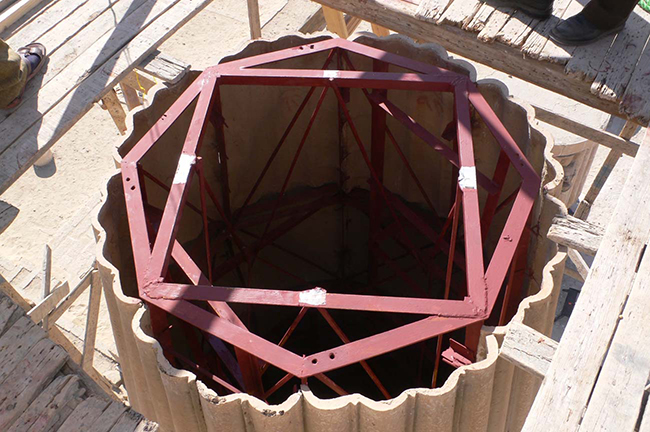
    The inspection of the interior of the column at the Small Aten Temple, that was mentioned in the last bulletin as scheduled to take place, showed that, in the nearly twenty years that have passed since it was put up, the internal ironwork that holds it together has seen very little deterioration. This is a tribute to the skill with which Simon Bradley designed and built it. Nevertheless, to make sure it has a long life, two of our workmen cleaned the surfaces and gave them two coats of red oxide paint. That done, Simon and a local carpenter worked together to create a thick, robust wooden cap that is now securely bolted over the top of the column.

    The outside of the column has generally weathered in quite a pleasing way.

    The one part that shows deterioration is a wide panel with a flat surface let into the side that, on the original, showed Akhenaten and Nefertiti worshipping the Aten. Simon had originally given this a different finish to the rest of the column, providing it with a coat of smooth plaster. This has been cracking and falling off over the last few years. Simon’s current task is to remedy this.

    We have until the end of March to complete the season’s work at the temples. Then the second major part of the programme for 2013 will commence. This is a return to the South Tombs Cemetery for a further excavation.

    It remains, once again, to thank our supporters, who make the work at Amarna possible.

    26 February 2013

    Barry Kemp/Anna Stevens

  • News from 21st to 24th February

    Copied from Twitter @egyptologynews

    Free article: The Calendars of Ancient Egypt. By R.A. Parker. University of Chicago Press, 1950. Hist.of the Anc.Wrld http://bit.ly/Wkz6yM

    A thorough reflection reveals a long-forgotten link between the foundation of Granada (Spain) and Cairo. Ahram Online http://bit.ly/YOopGf

    Mystery fibres on the painted coffin of Tawahibre. Penn Artifact Lab http://bit.ly/WjKtqO

    3D Petrie exhibition in the news: “Where Science meets Heritage at UCL-Qatar.” UCL http://bit.ly/W2gY2i

    Virtual Autopsy at British Museum in last few days: British Museum http://bit.ly/UK2hJN

    Karnak: Where the digital age meets ancient Egypt. By Andrew Lawler. Humanities magazine http://1.usa.gov/WhuKbE

    Disappearing heritage of Sudan,1820-1956: Photographic and filmic exploration in Sudan 17th Jan–30th Apr 2013. Durham http://bit.ly/4t44h4

    Lady Wallis Budge Junior Research Fellowship in Egyptology. University of Oxford http://bit.ly/13fdrPI

    Obituary: André et Etienne Bernand, jumeaux, égyptologues et morts le même jour http://bit.ly/Vz3E2x

    Egypt Salfists forced to cancel preaching event at ancient Pharaoh temple. Al Arabiya http://bit.ly/11ZCmYb

    Book review by Valentino Gasperini: Jaime Alvar, Los cultos egipcios en Hispania. Bryn Mawr Classical Review. http://bit.ly/W2Bgsq

    AE blue pigment used 5,000 years ago is giving modern scientists clues toward the development of new nanomaterials http://bit.ly/Yo4sX1

    BBC interview with Professor Dimitri Laboury re the newly discovered Vizier’s tomb with its small pyramid in Luxor. http://bbc.in/UR3Z1x

    Ancient Worlds: Mummy exhibition in Manchester. Click link at bottom of page to see more pages and pics on the story. http://itv.co/XOx4JE

    Trabajos en las excavaciones en la Tumba Tebana 39, Luxor: un complejo que funcionó como lugar de peregrinaje http://bit.ly/ZBAa7D

    High Definition Surveying (HDS) at Malqata.. HDS scanning is a relatively new tool in surveying. iMalqata dig diary http://bit.ly/YJzgzS

    The annual report on Abu Simbel solar event. Al Masry Al Youm. http://bit.ly/15czCoi

    Wood-turning in Manchester and Ancient Egypt. Report with photos re Geoff Killen’s AE wood-turning demonstration http://bit.ly/ZoCH1b

    Old projects, new projects. Brooklyn Museum team back at the Temple of Mut, updating their dig diary. Lots of photos. http://bit.ly/YQ7hP5

    Amara West dig diary: a kaleidoscope of life and death in Egyptian Kush http://bit.ly/Yig7Z5

    What’s the use of a PhD? Can we remake the humanities PhD to have better job prospects? Megan McArdle The Daily Beast http://thebea.st/YFxhhe

    Book Review by Tim Reid: Sunken Egypt: Alexandria. Franck Goddio, Andre Bernand. Periplus Publishing. Egyptians blog http://bit.ly/YpK1KZ

    Pigmento de la era faraónica puede ayudar a la nanotecnología. Prensa Latina http://bit.ly/UXbHHg

    Via Willeke Wendrich ‏@wzzw. Two new and related articles in the UCLA Encyclopedia of Egyptology: The Akh and the Northern Bald Ibis (Akh-bird). http://escholarship.org/uc/nelc_uee

    Via Kate Wong ‏@katewong. Check out @hpringle’s spectacular cover story on the evolution of human creativity in the March @sciam http://www.scientificamerican.com/article.cfm?id=the-origin-human-creativity-suprisingly-complex

    Via Kasia Szpakowska ‏@SakhmetK. Another Egyptology position! http://www.ku.dk/english/available_positions/vip/

    Via Chris Naunton ‏@chrisnaunton. Two Egyptological jobs going in Copenhagen: http://www.offentlige-stillinger.dk/sites/cfml/kbhuni/kbhuniVis.cfm?plugin=1&englishJobs=Yes&nJobNo=211129&nLangNo=2 … and http://www.offentlige-stillinger.dk/sites/cfml/kbh

  • News for 20th February 2012

    Copied from Twitter @egyptologynews.

    Via HistoryoftheAncient ‏@historyancient: Article: Karnak: Where the digital age meets ancient Egypt http://ow.ly/hRYnP

    Remains of a mud-brick pyramid-shaped tomb cover belonging to vizier Khay (reign of Ramesses II) found. Ahram Online http://bit.ly/XpfNVe

    Creating a pointcloud for a 3D model of houses in E13, Amara West, using a process called ‘Structure from Motion’. http://bit.ly/XpiM00

    Via @chrisnaunton. New book in German – the personal memories of the former Director General of the Egyptian Museum http://bit.ly/Wan9f7

    Durham Univ. 3–4 March 2013 2-day international conference, The Construction of Time in Antiquity. lutz.doering [at] http://durham.ac.uk

    Missed this a couple of wks ago: Campbell Price’s Texts in translation #10: The Stela of Hesysunebef (Acc. No. 4588) http://bit.ly/WfXftd

    Penn Artefact Lab: A step a-“head”: improving storage for our mummified heads http://bit.ly/YArZCt

    Curator’s Choice: Sue Giles on a toy from a child’s grave at Bristol’s King of Egypt show. Culture24 http://bit.ly/Y6J22a

    Discovery of Luxor tomb of Vizier Khay, “the First Royal Herald of the Lord of the two lands” announced. Luxor Times http://bit.ly/15uCVYY

    Avenue of the Sphinxes in Luxor, fully illuminated at night for the first time. Lots of photos. Luxor Times http://bit.ly/11UOj1m

    Amara West 2013: scarabs – for life and death. http://bit.ly/ZdA8Pw

    Via Alice Williams ‏@alicewilliams86:
    Fab new book on World Archaeology at the Pitt-Rivers, with fascinating chapters on the Egypt & Sudan collections: http://www.prm.ox.ac.uk/world.html

    Book Review – Americans in Egypt, 1770-1915 http://collectingegypt.blogspot.com/2013/02/book-review-americans-in-egypt-1770-1915.html

    Upstairs, Dowstairs: contrasting palace life and village life at excavations in Malqata http://bit.ly/Y6rumN

    New Book: Leatherwork from Qasr Ibrim (Egypt). Part I: Footwear from the Ottoman Period. André J. Veldmeijer 2013 http://bit.ly/WPfWmR

  • News for 17th, 18th and 19th February

    Copied from @egyptologynews. It has been a busy few days, so apologies for the late posting, but here’s the news round-up.

    Oriental Inst.News and Notes (PDF). 6 pages on Demotic Dictionary + small piece on Statue of Liberty’s ties to Egypt http://bit.ly/WMOFBl

    Egypt Exploration Society Centenary Awards 2012 providing funding for research at Saqqara and in Khartoum http://ees.ac.uk/news/news/210.html

    Replicas of famous objects from the tomb of Tutankhamun on display at Lord Carnarvon’s Highclere Castle. Daily Mail http://bit.ly/WTJdyh

    In Spanish: Analysis of 200 mummies and skeletons from Aswan paints a picture of deprivation, not opulence. ABC.es http://bit.ly/WKuP9P

    My review of “Digital Egypt: Museums of the Future” (@3DPetrie) has been added to the Petrie Museum’s blog today. http://bit.ly/Y1V10W

    Photo slideshow of dunes, rock formations and rock art in the Western Desert http://bit.ly/11SkvSY

    Cotsten Inst of Arch annual review “Backdirt” with article “Coffin Reuse in the Twenty-First Dynasty” by K. Cooney. http://bit.ly/Y5wdU7

    Grand Egyptian Museum will receive 5 objects of King Tut’s collection after returning to Egypt. Luxor Times http://bit.ly/Xm5fpN

    Amara West 2013 dig diary: getting to grips with this year’s villa. British Museum http://bit.ly/YCFnGk

    Retrospective field diary (posting now from January’s work) of excellent EES Theban Harbours and Waterscapes Project. http://eestheban.tumblr.com

    Jane Akshar’s notes from the Mummification Museum lecture: José Galán – Update from the Spanish Mission. Luxor News http://bit.ly/ZcNBHm

    Another photo story recording the project to rescue statues of Amenemhat III. Luxor News Blog http://bit.ly/YvW0Vb

    Photo story showing emergency project to save 2 colossal statues of Amenhotep III at his funerary temple. Luxor Times http://bit.ly/XKcF5y

    Finding the northern end of the Palace of the King. iMalqata dig diary http://bit.ly/15q4QcG

    Em Hotep Digest vol. 02 no. 06: Jean-François Champollion http://bit.ly/ZbeKdL

    Hierarchy of Women within Elite Families. Iconographic Data from the Old Kingdom. V. Vasiljević. Hist.of the Anc.Wrld http://bit.ly/152OZ2w

    Issue 10 of free online journal i-Medjat, edited by the Unité de Recherche-Action Guadeloupe. TOC and PDF at http://bit.ly/YuWJpD

    Video showing reconstruction of the monuments of Biahmu in the Faiyum by Ben Baker and Chris Kirby. YouTube http://bit.ly/152OF3U

    Was Cleopatra murdered? Author talking about her version of the classic story. No reviews seen yet. Huffington Post http://huff.to/151P729

    Vast robber pits around the 4,000-year-old Black Pyramid of Amenemhat III, metres deep. Triblive http://bit.ly/YDiMJy

    Truth of Tutankhamun curse removed from myth. Times of Malta http://bit.ly/UCcsW8

  • News for 16th February 2013

    Copied from my Twitter account @egyptologynews, in no particular order

    Today is the 90th anniversary of the opening of Tutankhamun’s tomb by Lord Carnarvon and Howard Carter. The Telegraph http://bit.ly/12QKidm

    A New Kingdom jigsaw puzzle from Malqata: reconstructing a pottery vessel and a bone disc. iMalqata dig diary http://bit.ly/XP0PuK

    The new volume of The Journal of Egyptian Archaeology (EES) is now out (vol. 98, 2012). The Table Of Contents is at http://www.ees.ac.uk/userfiles/file/JEA98-Contents.pdf

    The head of the Egyptian antiquities ministry believes that archaeology and tourism will bounce back. NBC Science http://nbcnews.to/Xa5RC0

    Digital Egypt: Museums of the Future:

    I had a brilliant afternoon volunteering at the Petrie Museum’s Digital Egypt event today. I’ll be writing it up on the Museum’s blog v. soon.If you’re interested in the digitizing of archaeology in museums you might check out @3DPetrie on Twitter, charting the museum’s digi work. If you’re on Facebook, here’s my initial enthusiastic blurb re the Digital Egypt event at the Petrie (under the pic). http://on.fb.me/12ufxvd

  • News for 15th February 2013

    Copied from Twitter @egyptologynews – in no particular order

    Via Kasia Szpakowska ‏@SakhmetK: Museum of Fine Arts, Boston, offering a summer position for a research associate in Egyptian art: http://bit.ly/WN52j5

    The first week of the Brooklyn Museum’s dig diary in the Karnak area, with lots of great photographs http://bit.ly/Xc3g9u

    American Soc. Papyrologists invites papers for “Culture and Society in Greek, Roman and Byzantine Egypt” Chicago 2014 http://bit.ly/WMXMDS

    More news from the Amara West dig diary: “What a difference a day makes.” http://bit.ly/11KMbZP

    Man finds stuffed cat in attic is 2,000-year-old Egyptian mummy. IBN Live http://bit.ly/XIanrn

    Live webcams will be placed in Egypt’s major tourist areas to show the true conditions of the country. ANSAMed http://bit.ly/X9kd5u

    This guide to the old Ashmolean Egypt galleries shows the old Victorian cabinets, themselves a bit of museum history. http://bit.ly/Ad7cXm

    iPad app: “Tour of the Nile” introduces Petrie Museum and uses Augmented Reality to explore artefacts in 3D. iTunes http://bit.ly/12Qxx2G

    Petrie Museum Object Analysis e-Learning Resource gives ability to analyse objects in 3D and to generate a catalogue http://bit.ly/TkFYPr

    Al Ahram Weekly article re Hatshepsut’s Netery Menu chapel opening at Karnak and restoration of Amenhotep III colossi
    http://weekly.ahram.org.eg/News/1449/17/New-glories-of-the-New-Kingdom.aspx

  • News for 14th February 203

    Happy Valentine’s Day!

    News copied from Twitter @egyptologynews

    The ARCE has announced the launch of its new Luxor West Bank Archaeological Field School for local MSA/SCA inspectors http://bit.ly/X6jHVT

    Article about the building of the replica of a New Kingdom chariot for a television show. ARCE http://bit.ly/Uk7e1a

    New on the EES Publishing Blog: “Hasiballah Saqqara photos 1909-1988” with photos. http://bit.ly/14V3OnD

    Interesting article looking at the role of spiritual leaders in rural communities a generation ago. Al Ahram Weekly http://bit.ly/14RitjS

    A 48 hour tour of the heritage of some of the New Valley oases during a forum on sustainable tourism. Al Ahram Weekly http://bit.ly/XrnYAW

    Forthcoming titles from the AUC include three Egyptology, two Coptic studies titles and one about Old Cairo heritage. http://bit.ly/X8u2Q8

    Diana Craig-Patch talks about roof collapse at the Malqata excavation, west bank Luxor. iMalqata Dig Diary http://bit.ly/WrzNIB

    New book: Gold and Gold Mining in Ancient Egypt and Nubia. R.Klemm and D.Klemm (Geoarchaeology in the Eastern Desert) http://bit.ly/XbqZES

    Jane Akshar’s notes from the Mummification Museum Lecture, Luxor: Joint Expedition to Malqata. Luxor News Blog http://bit.ly/Viy3SH

    Routine archaeo survey in one of Alexandria’s most densely populated areas revealed Graeco-Roman tombs. Ahram Online http://bit.ly/YgdIMu

    As the project comes to completion: “Demotic Dictionary unveils culture of ancient Egypt.” University of Chicago. http://bit.ly/14sMNlF

    Official denial of problems at the Egyptian Museum in Cairo by Minister of Antiquities Mohamed Ibrahim. allAfrica http://bit.ly/VgdXuQ

    As the value of the Egyptian pound continues to fall, a look at mosques shown on LE and piastre notes. Cairobserver http://bit.ly/VeYPO6

    Amara West 2013 dig diary: faience production in the town? http://bit.ly/YtgSvh

    Greco-Roman tombs have been discovered at Gabbari necropolis in Alexandria. Luxor Times http://bit.ly/VWxP0E