Author: Andie

  • News from 13th February 013

    Copied from @egyptologynews

    The Oriental Institute Electronic Publics. Initiative has made several new Egyptology publications available as PDFs: http://oi.uchicago.edu/news/

    I had missed that the Djehuty dig diary is back online for 2013, with several weeks already published (in Spanish): http://www.excavacionegipto.com/diario/2013/diario13.jsp.html

    Apologies if I’ve posted this before, but excellent if you are interested in Gilf Kebir: Wadi Sura project reports: http://bit.ly/QseTE4

    Super photo from 1920s Port Said. National Geographic. http://bit.ly/12zZKpZ

    Em Hotep Digest vol. 02 no. 05: Ancient Egyptian Gods, Myths, and Legends. http://bit.ly/15cWeWB

    Disputed St Louis Art Museum Ka Nefer Nefer mask settlement terms to be discussed on appeal. Cultural Heritage Lawyer http://bit.ly/WmSTQ6

    Petrie Museum of Egyptian Archaeology database images are now available under Creative Commons license C BY-NC-SA 3.0 http://bit.ly/ooecxi

    Slightly off-topic but interesting. Ancient languages reconstructed by computer program. BBC http://bbc.in/11Dy0pC

    The Ptolemaic temple of Qasr Al Agouz on Luxor’s west bank is to open next week. With 3 photos. Ahram Online http://bit.ly/SJxEYb

    Book: O.E. Kaper. Colours of the Oasis: Artists and the archaeology of Dakhleh Oasis. Only available from publisher http://bit.ly/XzJG4f

  • News from 12th February 2012


    Copied from my Twitter @egyptologynews account

    Preserving one of Egypt’s most efficient ecosystems: The mangrove. Egypt Independent http://bit.ly/12J7hqI

    Amara West excavations 2013: the past as seen in photos from a photographic kite flown over the site. British Museum http://bit.ly/VSDSDl

    Malqata dig diary: One enigmatic feature of the site is a huge area over 72,000sq.m that is a vast deposit of potsherds http://bit.ly/Y7jf68

    Eleventh International Congress of Egyptologists, Bibliotheca Alexandrina 13th-20th September 2013 http://bit.ly/PBKUIi

    A Roman statue head has been repatriated to Egypt from Brazil. With photo. Luxor Times http://bit.ly/YUTTLC

    Not news, just a short article on the AE city of On (Heliopolis), but might be of interest to some. Daily News Egypt http://bit.ly/YQFcJw

    Job opening: Herbert Thompson Lecturer in Ancient Egyptian Language, University of Cambridge, Department of Archaeology http://bit.ly/14QLgow

    Digital Archaeology. Uncovering the “A New Look at Ancient Egypt” website after years of neglect. http://bit.ly/YSgkRw

    Free online: The Goddess Hathor and the women of ancient Egypt. Danielle Basson. MPhil, University of Stellenbosch http://bit.ly/YaIoP7

    French archeologist Michel Wuttmann found dead in his Cairo apartment, investigators suspect foul play. Washington Post http://wapo.st/12J4oGt

    Barry Kemp and his team have resumed work at Amarna. Their email newsletter is copied here: http://bit.ly/V2hWeb

    Amara West Dig Diary 2013: the latest from Cemetery C. British Museum http://hvrd.me/WUYD3o

    Speaking at Harvard, Egyptologist Marc Gabolde offered different interpretation of Tut DNA evidence. Harvard Gazette http://hvrd.me/WUYD3o

    Brown University’s Abydos Dig has uncovered a skeleton in the North Cemetery, among other finds. Brown Daily Herald http://bit.ly/X1sGYy

  • Amarna 2013 begins

    2013 STARTUP

    It has proved possible to resume fieldwork at Amarna. Barry Kemp and a small team traveled to the expedition house on Wednesday, January 30th and began work on site on Saturday, February 2nd, with 20 local workmen, mostly from El-Till and regularly employed by the expedition.

    The main work for the next two months is a resumption of the re-excavation and restoration at the Great Aten Temple, concentrating again on the front part. Areas adjacent to those examined in the spring of 2012 have been marked out, on the south and east, and the cleaning of surface deposits begun, already revealing a strange feature uncovered earlier by Pendlebury, a gypsum-lined trough surrounding a rectangular area and belonging to the temple’s final phase. Removal of the large Pendlebury dump over the brick pylon has also been resumed. Further east a start has been made on cleaning the surface of the two pedestals of thick gypsum concrete that measure about 10 x 15 metres and stood in front of the stone entrance to the temple and probably acted as foundations for very large columns. They are covered with the impressions of stone blocks that will require much patient planning to record in sufficient detail.

    Thanks to the good offices of Nicholas Warner, the first delivery arrived today of limestone blocks from the quarries at Turah, outside Cairo, of much better quality than those we have bought in the past, from local quarries. These will be used for the final layer that will mark the positions of the walls of the Platform Building the foundations of which were uncovered last year.

    We have also chosen this year to carry out an inspection and maintenance of the column in the Small Aten Temple that the expedition (then under the auspices of the Egypt Exploration Society) erected in 1994, on the initiative of architect Michael Mallinson. It has since become a familiar landmark. The column is hollow, and formed of panels fixed to a central iron lattice-work tower. It needs to be inspected from the inside. To this end, scaffolding is being erected around the column. Simon Bradley, who built the column in 1994, has returned to carry out the inspection and any necessary maintenance.

    Much of the funding for this season’s work comes to the Amarna Trust from the Big Give Christmas Challenge, to which so many of you responded. Many thanks again for your generosity on this and on other occasions.

    The further plan for the spring is that another month of excavation will be carried out at the South Tombs Cemetery in April, to be followed by a return of the Arkansas University anthropology field school which will study the human remains.

    4 February 2013

    Barry Kemp/Anna Stevens


    Support the work of the Amarna Project at:
    http://new.thebiggive.org.uk/project/greatatentemple

  • News for 11th February 2012

    Copied from @egyptolognews (Twitter)

    Cleopatra’s World – Lecture Series free to listen to on iTunes, with some very good names – http://itun.es/i6J25cj 

    Kasia Szpakowska Kasia Szpakowska ‏@SakhmetK
    So pleased that “Companion to Women in the Ancient World” won a PROSE Award for Professional & Scholarly Excellence! http://bit.ly/WUcSW9

    Lorna Richardson Lorna Richardson ‏@lornarichardson
    What are your archaeological Internet habits? Where/how do you look for info about #archaeology? https://opinio.ucl.ac.uk/s?s=22070  Please RT/share!

    More re restoration of newly discovered colossi of Amenhotep III. Ahram Online http://bit.ly/WEYcvO

    Ancient Nubia: African Kingdoms on the Nile (AUC) wins professional (PROSE) ceremony in Washington. Daily News Egypt http://bit.ly/YRm0Lu

    RT @historyancient: Free online: The role of the chantress in anc. Egypt. Suzanne Ostine. PhD Thesis, Univ Toronto 2001 http://bit.ly/12G8NtG

    New on Osirisnet: The Old Kingdom tomb of Irukaptah at Saqqara, also called Khenu. http://bit.ly/Y60ZM4

    Mummification Museum Lecture notes by Jane Akshar – The tomb of Panehsy, TT16. Lecture by Suzanne Onstine. Luxor News http://bit.ly/YR71Bu

    The 1928 Italian-built El Shinawy Palace in Mansoura will be converted into an antiquities museum. Luxor Times http://bit.ly/X2fm34

    New Book: The Signs of Which Times? Chronological and Palaeoenvironmental Issues in the Rock Art of Northern Africa. http://bit.ly/Z55Thq

    Sad News: Obituary of geologist Rushdi Said who has died at the age of 93. Egypt Independent http://bit.ly/U5aFJ5

    Saving the twin statues of Amenhotep III in Kom El Hetan, West Bank, Luxor. With photos. Luxor Times http://bit.ly/XpWttM

    Book Review: D. Wengrow, What makes Civilization? The Ancient Near East and the Future of the West, 2010. Rosetta 11 http://bit.ly/Z53W4v

    More re Hatshepsut limestone chapel that will be put on display for the 1st time at Karnak’s open air mus. Ahram Online http://bit.ly/XpVkCx

    Article about Frédéric Cailliaud’s early 19thC accomplishments as explorer and scientist in Egypt. Saudi-Aramco World http://bit.ly/Vls5Q8

    The villa of Kevork Ispenian, Giza, was looted and destroyed despite being on Egypt’s heritage list. Al Ahram Weekly http://bit.ly/YIyXar

    Via @ArcEgyptologist. A roundup of some of the most notable new Egyptology books from 2012. Amun-Ra Egypt http://bit.ly/155FIaS

    Book: M.F. Ayad, Coptic Culture: Past, Present and Future, 2011. Papers from a conference. http://bit.ly/WT4OVH  Bryn Mawr Classical Review

    Neal Spencer Neal Spencer ‏@NealSpencer_BM
    @susiezgreen launching photography kite above 3200-year old town of Amara West.  http://twitpic.com/c2ikv3

  • Stories from W/E 10th February 2012

    Taken from my @egyptologynews Twitter account:

    Free online paper: Architectural Conservation of an Amun Temple in Sudan. T. Sweek, J.R. Anderson, S. Tanimoto. JCMS. http://bit.ly/12DJGrE 
        
    Queen Hatshpsut’s Netery-Menu has been reconstructed at Karnak, open to public by the End of February. Luxor Times http://bit.ly/122kScQ
        
    David Lightbody has added a piece about the new find of 35 Sudanese pyramids with inner circles on his Arkysite blog http://bit.ly/YikC2y

    Osteogenesis imperfecta in skeletal remains of foetus from Romano-Byzantine cemetery, Dakhleh Oasis. Past Horizons http://bit.ly/WXouc8

    Book Review by Tim Reid: “Eternal Egypt: Masterworks of Ancient Art from the British Museum” E.R. Russmann. Egyptians http://bit.ly/V8disI

    The iMalqata dig diary is being updated: “A Celebration Fit for a King: Amenhotep III’s Heb Sed festival.” iMalqata http://bit.ly/VLuJBT

    Slightly older article, but in case you missed it from 30th Jan: Searching for lost royal city in Nubia. Past Horizons http://bit.ly/WyRaaV

    Temple of Mut dig diary is online for the new season: “Back at Mut – How things have changed!” With pics. Brooklyn Mus. http://bit.ly/VKkusd

    Proyecto de la UJA en Egipto “peligra” por la supresión de ayuda del Gobierno. Europa Press http://bit.ly/U1jtiT

    Reviews of the British Film Institute’s “Digging the Past” in 3 parts: http://bit.ly/SAbkBw, http://bit.ly/WAIY7i, http://bit.ly/11huHUF

    Early Third Intermediate Period tombs with grave goods found at Mortuary temple of Amenhotep II on west bank. Al Shorfa http://bit.ly/XltGqk

    Lovely review from @egyptologynews of @poisonchallis and I at @bfi having a great deal of fun in the name of research! http://petriemuseum.com/blog/the-british-film-institute-and-petrie-museum-presentation-digging-the-past-3/

    30 Jan françois tonic françois tonic ‏@francoistonic
    @egyptologynews little news about Karakhamon et South Asasif (in french sorry) http://goo.gl/FVo1Z

    Leiden excavations at Saqqara: Dig diary, week 3: 2nd – 8th February 2013. A Name for the Anonymous Tomb…saqqara.nl http://bit.ly/VMdUS6

    Em Hotep Digest vol. 02 no. 04: Dedicated to Barbara Adams best known from Hierakonpolis Expedition and Petrie Museum http://bit.ly/Y3vmBF

    Amara West: The life of a field ceramicist is certainly never dull, though perhaps sometimes repetitive. With photos. http://bit.ly/XUnjIs

    Archeologists excavating near Luxor have found a wooden sarcophagus believed to belong to a 5-yr old. Huffington Post http://huff.to/VHsWh3

    35 small pyramids, along with graves, have discovered clustered closely together at Sedeinga in Sudan.Yahoo News. http://yhoo.it/Yauz1U

    Mini-pyramids of of Kush: Archaeologists discover 35 burial chambers in Sudan desert with fascinating links to Egypt http://bit.ly/VLW15J

    Ahram Online traces the footsteps of Egyptian and Sudanese history in the capital, Khartoum. http://bit.ly/YN8JUu

    Ancient Rome In Libya: A Suppressed History Resurfaces After Revolution. With photos. IBT http://bit.ly/WRvGXp

    Very short piece about fire breaking out at Karnak Temple. More will doubtless be forthcoming. Al Arabiya http://bit.ly/12BZH18

  • Happy Christmas


    Thank you to everyone who stills follows Egyptology News via Twitter.  

    Particular thanks, also, to everyone who was so supportive when Egyptological was hacked. I’ll keep you posted about where we are with it, during January.


  • Update regarding problems with "Egyptological"

    Kate and Andrea are very sad to announce that Egyptological will be unavailable for the forseeable future.  It has been targeted by a professional hacking group as part of an onslaught on Egypt-related web sites during the current unrest in Egypt.

    Although we have been in negotiations with the hackers, which seemed to be going well, they have now announced their intention of resuming hostilities against us.  They apparently see Egyptology sites such as ours as representing a form of political threat.

    Until we have been able to assess the level of damage inflicted upon our backup solution, and have been able to devise a new strategy for the future security of Egyptological, our site will remain unavailable.  We do not expect it to be recovered until the end of January.

    Please be aware, however, that we are fully committed to restoring Egyptological to its former state, together with the latest unpublished edition of the Magazine, and we are investigating the possibility of publishing a temporary archive at an earlier date.

    We recommend that anyone with similar web sites should upgrade their own security arrangements, as you may now be interpreted as representing a political or religious affiliation.

    Kind regards from both of us

    Andrea Byrnes and Kate Phizackerley
    Egyptological

  • Autumn field school at Amarna

    The latest news update from Professor Barry Kemp, from the Amarna Project.

    On October 14th the current Amarna field school began to assemble, five overseas students and seven SCA inspectors (drawn mostly from the Middle Egypt region) converging on the Amarna expedition house. The theme of the field school is survey, both in the mapping and planning sense and through the appreciation of human impact on the landscape. Amarna is ideal for these purposes, offering a variety of reasonably clear examples and opportunities for instruction. This year’s venue for instruction in planning and profile drawing, using a total station, basic measuring and drawing tools and aerial photography from the expedition’s helium photography balloon is the Great Aten Temple, and more particularly one of the broad spreads of gypsum concrete on which are marked the outlines of large numbers of offering tables. The weekly exercises in archaeological landscape appreciation take in the South Tombs Cemetery, the area of the city around the house of Thutmose, the Stone Village and the tomb of Panehsy and surrounding territory. Evening lectures and visits to other sites complete the programme.

    The field school is run in conjunction with the Institute for Field Research (IFR) of California ([email protected]) and with the agreement of the Supreme Council of Antiquities of Egypt and in particular with the support of Dr Abd el-Rahman El-Aidi. We are grateful to Dr Hans Barnard, Gwil Owen and Miriam Bertram for volunteering their services as instructors.

    The clearing of the gypsum surface of the first court of the temple has revealed a surprising fact. The area is surrounded by an embankment of dusty sand, about 1 metre high, with a thick capping composed of gypsum concrete that is the remains of the floor that originally spread across the entire temple. The sides of the embankment have slumped over the years. In the course of cleaning back the edges it has become clear that it contains fragments of fine sculpture and pieces of carved inlays in darker stone.
    The fragments include pieces in indurated limestone (evidently from a large and ornate architrave), travertine, granite and quartzite. We must conclude that, before the final phase of the temple was completed, fine pieces of sculpture were no longer needed and were thoroughly broken up.

    On October 22nd and 23rd the expedition was honoured by a visit by the British ambassador, James Watt, and his wife, Amal.

    The field school is scheduled to run until November 15th. From October 28th, it will overlap with the start of the next season of excavation at the South Tombs Cemetery, directed by Dr Anna Stevens.

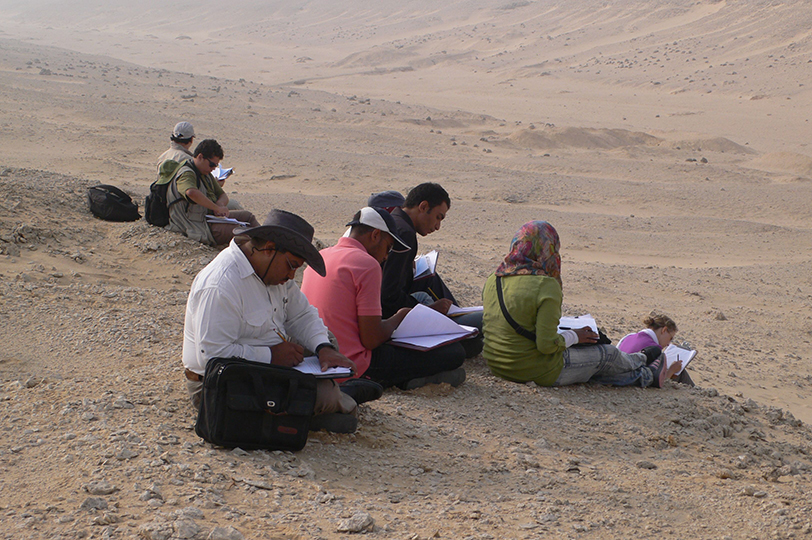
    The attached picture shows the group writing landscape description above the South Tombs Cemetery.

  • The latest Amarna update from Anna Stevens and Barry Kemp


    Amarna, Autumn 2012

    Fundraising news: the Big Give Christmas Challenge

    We are delighted to report that we have reached the ‘Œpledge target’ for the Big Give Christmas Challenge appeal in support of conservation work at the Great Aten Temple.

    What does this mean? It means that donations made online in the week beginning December 6 will now be matched, partly from our pledges and partly from external funding sourced by the Big Give. In effect, online donations can be doubled during the December fundraiser.

    Thank you so much to those supporters who offered pledges: it is a great start to the campaign.

    You can find out more about the Christmas Challenge at:

    http://new.thebiggive.org.uk/projects/view/17049?search=56a6a48d-1564-4a5f-b613-f486df90768c
    And please do consider offering a small donation online in December. Every donation makes a real difference to the work that we can achieve on site.

    Autumn season underway

    The dig house at Amarna was reopened last week for the beginning of the Autumn field season. The house is currently occupied by a team of volunteers who are transferring the paper records of the artefacts excavated at Amarna since 1979 into an electronic database. After a week and a half of work, around 6000 object records have been digitised, of a total of around 24000. Most of the 6000 objects have come from the excavations in the late 70s and early 80s at the Workmen’s Village, and it has been fascinating to revisit these finds. We are aiming to reach the mid-point of the records by the time we leave, at the end of next week, by which time we should be working with the object records of excavations in the Central City and at Kom el-Nana in the late 1980s. A further season of digitising will then be needed in 2013.

    This is the first step in creating an integrated online archive of the artefacts, environmental and biological remains, house plans, and other records for Amarna ­ the Amarna Digital Atlas. We hope that, one day, everyone will be able to better explore and study the archaeology of Amarna online.

    Thanks are due to our volunteers – Ashley Hayes, Megan Paqua, Melanie Pitkin and Reinert Skumnes -­ for all of their hard work. It is so rewarding to see the written records compiled by many object registrars over the years transferred into a form that can be far more easily searched.

    Next up will be a field school in survey techniques, running from mid-October until mid-November, and an extended season of excavations at the South Tombs Cemetery, which will include illustration work and further conservation of the wooden coffins. The season will finish just before Christmas, so it is a busy time ahead.

    We will keep you updated with progress of the season and you can also follow us, and view pictures of the work, at:
    https://www.facebook.com/amarnaproject

    Anna Stevens/Barry Kemp

  • EES webinar

    EES webinar AUTUMN 2012
    The Good, The Bad & The Ugly: Cultural Property and the antiquities trade in Egyptology
    Saturday 29 September 2012, 1 – 4pm (including a break)

    This is an online event; join the EES at http://www.ustream.tv/channel/ees-events

    This ‘webinar’ will be broadcast live on the web, via USTREAM, in order to allow virtual participation and discussion online (via USTREAM, Twitter, Facebook or email) and thereby engage with the widest possible audience.

    The seminar will examine how academics, museums, and the legal antiquities trade interact, and can facilitate the study of objects which pass into private hands; the importance of provenance in preventing the sale of forged and looted antiquities, and the processes of diligence and compliance which reinforce this. The discussion will cover case studies of good and bad practice, successes and failures, and discuss ways in
    which more productive relationships might be fostered in future.

    The discussion will exclude issues of the ethics of trading antiquities and the looting of archaeological sites, and will be chaired by the Society’s Director, Dr Chris Naunton.

    The panellists will include: Professor David Gill, Professor of Archaeological Heritage at University Campus Suffolk and author of influential blog Looting Matters (http://lootingmatters. blogspot.co.uk/); Madeleine Perridge, Head of the Antiquities Department at Bonhams Fine Art Auctioneers and Valuers; Marcel Marée, Assistant Keeper in the Department of Ancient Egypt and Sudan, British Museum; Heba Abd el-Gawad, PhD Student in Egyptology, University of Durham and recipient of an EES Centenary Award in 2012.

    How to Participate:
    We welcome questions for the panel, comments and discussion points, all of which can also be submitted on the day or in advance to [email protected]. In order to participate in the discussion on the day, please go to http://www.ustream.tv/channel/ees-events, and follow the links to ‘Check-In and Chat’. This will allow you to connect via your UStream account (if you have one) or via Twitter or Facebook. You can also participate by tweeting @TheEES (you will need a Twitter account), or by posting on our Facebook page: https://www.facebook.com/pages/The-Egypt-Exploration-Society/124272554326913?ref=hl

    All comments and questions are welcome

  • EIGHTH ANNUAL PETRIE BOOK AUCTION

    The 2012 Petrie book auction has just started.  If you have previously registered to receive the list you should have already received this notification and the first list from Petrie Books and you do not need to register again.  If you are a new member, or would like to register for the first time, or have changed your email address just send an email with ‘subscribe’ to:  [email protected].  Thank you for subscribing to the Petrie book auction – remember that you can ‘unsubscribe’ at any time.

    The email auction will culminate on the evening of 12 October with a live auction. The auction is open to all and will be held at the Petrie Museum, Malet Place WC1. Viewing from 6.00, auction starts at 6.30

    The complete list is sent out with starting prices on all volumes inviting bids (BID?).  As bids come in the bid is listed with the bidder’s initials alongside, e.g. GBP  10 (JP).  TO BID, please either cut and paste title with your bid added, or give me the book number(s) and your bid. Please don’t return the entire list
    – unless you’re bidding on everything!  Regular updates on the state of the bidding will be sent out. All bids should be sent to [email protected]

    Closing date for email bids will be Wednesday 10 October. All bids will be carried forward to the evening of 12 October.  No books will be sold before that date so that Friends and others not on email will have a chance to participate.

    At the end of the bidding process the highest email bidders will be invited to submit a final ceiling-price which will ONLY be used – in increments –  if he/she is outbid on the evening.

    We reserve the right to withdraw, cancel, or change the rules if it all gets too complicated.

    If you wish to cancel your receipt of any further auction information just send an email with ‘auction delete’ in the header and we won’t bother you again.

    After the auction successful bidders will be contacted with the amount owed for their books.

    All prices will be plus postage, payable in advance in GB pounds by cash, UK cheque, or overseas bankers cheque drawn on a UK bank, (or Post Office Giro-cheques from Europe are reasonably priced, or postal orders) so please bear that in mind when making your bid. Sorry, but we don’t have the facilities to accept direct credit card payment although we can accept payment via PAYPAL. Books can be collected from the Museum by prior arrangement.

    The complete list sent to you will include the starting prices on all volumes inviting bids (BID?).  As bids come in the bid is listed with the bidder’s initials alongside, e.g. GBP 10 (JP). TO BID, please either cut and paste the title with your bid added, or give me the book number(s) and author and your bid. Please don’t return the entire list – unless you’re bidding on everything!

    Regular updates on the state of the bidding are being sent out, inviting new rounds of bidding.

    New books may be added to the auction.

    Email bidding will close on the 10th October before the live auction on the 12th October. Instructions for final bids will be sent out closer to the time.

    All bids should be sent to [email protected]

    2012 AUCTION CATALOGUE
    from the donated libraries of Phyllis Grierson, Peggy Drower and others

    The updated auction list is now out – if you have signed up you should now have received it.

    Friends of the Petrie Museum of Egyptian Archaeology Petrie Museum Malet Place London WC1E 6BT

  • Could ancient Egyptians hold the key to 3D printed ceramics?

    ** UWE Bristol**
    Press Release
    Could ancient Egyptians hold the key to 3D printed ceramics? 
    A 7,000 year old technique, known as Egyptian Paste (also known as Faience), could offer a potential process and material for use in the latest 3D printing techniques of ceramics, according to researchers at UWE Bristol.
    Professor Stephen Hoskins Director of UWE’s Centre for Fine Print Research  and David Huson, Research Fellow, have received funding from the Arts and Humanities Research Council (AHRC) to undertake a major investigation into a self-glazing 3D printed ceramic, inspired by ancient Egyptian Faience ceramic techniques.  The process they aim to develop would enable ceramic artists, designers and craftspeople to print 3D objects in a ceramic material which can be glazed and vitrified in one firing.
    The researchers believe that it possible to create a contemporary 3D printable, once-fired, self-glazing, non-plastic ceramic material that exhibits the characteristics and quality of Egyptian Faience.
    Faience was first used in the 5th Millennium BC and was the first glazed ceramic material invented by man. Faience was not made from clay (but instead composed of quartz and alkali fluxes) and is distinct from Italian Faience or Majolica, which is a tin, glazed earthenware. (The earliest Faience is invariably blue or green, exhibiting the full range of shades between them, and the colouring material was usually copper). It is the self-glazing properties of Faience that are of interest for this research project.
    Current research in the field of 3D printing concentrates on creating functional materials to form physical models. The materials currently used in the 3D printing process, in which layers are added to build up a 3D form, are commonly: UV polymer resins, hot melted ‘abs’ plastic and inkjet binder or laser sintered, powder materials. These techniques have previously been known as rapid prototyping (RP). With the advent of better materials and equipment some RP of real materials is now possible. These processes are increasingly being referred to as solid ‘free-form fabrication’ (SFF) or additive layer manufacture. The UWE research team have focused previously on producing a functional, printable clay body.
    This three-year research project will investigate three methods of glazing used by the ancient Egyptians: ‘application glazing’, similar to modern glazing methods; ‘efflorescent glazing’ which uses water-soluble salts; and ‘cementation glazing’, a technique where the object is buried in a glazing powder in a protective casing, then fired. These techniques will be used as a basis for developing contemporary printable alternatives
    Professor Hoskins explains, “It is fascinating to think that some of these ancient processes, in fact the very first glazed ceramics every created by humans, could have relevance to the advanced printing technology of today.  We hope to create a self-glazing 3D printed ceramic which only requires one firing from conception to completion rather than the usual two. This would be a radical step-forward in the development of 3D printing technologies. As part of the project we will undertake case studies of craft, design and fine art practitioners to contribute to the project, so that our work reflects the knowledge and understanding of artists and reflects the way in which artists work.”  
    The project includes funding for a three-year full-time PhD bursary to research a further method used by the Egyptians, investigating coloured ‘frit’, a substance used in glazing and enamels. This student will research this method, investigating the use of coloured frits and oxides to try and create as full a colour range as possible. Once developed, this body will be used to create a ceramic extrusion paste that can be printed with a low-cost 3D printer. A programme of work will be undertaken to determine the best rates of deposition, the inclusion of flocculants and methods of drying through heat whilst printing.
    This project offers the theoretical possibility of a printed, single fired, glazed ceramic object – something that is impossible with current technology.
    Editor’s notes
    Project title
    The project: “Can Egyptian Paste Techniques (Faience) Be Used For 3D Printed, Solid Free-form Fabrication of Ceramics?” has received funding of £ 385,672 from the Arts and Humanities Research Council for the three year research project.
    The Arts and Humanities Research Council (AHRC) funds world-class, independent researchers in a wide range of subjects: ancient history, modern dance, archaeology, digital content, philosophy, English literature, design, the creative and performing arts, and much more. This financial year the AHRC will spend approximately £98m to fund research and postgraduate training in collaboration with a number of partners. The quality and range of research supported by this investment of public funds not only provides social and cultural benefits but also contributes to the economic success of the UK. For further information on the AHRC, please go to: www.ahrc.ac.uk 
    Stephen Hoskins is the Hewlett Packard Professor of Fine Print and Director of the Centre for Fine Print Research at UWE Bristol. Apart from being a practising printmaker, his primary areas of research are; the potential of 3D printing and related digital technologies for the arts, plus the tactile surface of the printed artefact and its consequences for digital technology. His latest book 3D Printing for the Visual Arts (Technology That Crosses Both Art and Industry) is due to be published by Bloomsbury in early 2013. 
    David Huson is a Research Fellow at the Centre for Fine Print Research leading research in the field of 3D rapid prototype printed ceramics. He has given over sixteen peer reviewed conference papers at international conferences, including three focal papers at the IS&T Digital Fabrication Conferences 2007, 2008, 2009. David will moderate the NIP28/Digital Fabrication 2012 roundtable on 3D print in Quebec in September 2012. He has an extensive industrial background, working in research and development in the ceramics industry for 20 years as a ceramic engineer, and as company director for Enoch Wedgwood Ltd, Infrared International Engineering, Phoenix Ceramics and the Moira Pottery Co. 
  • Amarna Fund Raising – the Big Give Christmas Challenge

    Thanks to your support, the JustGiving appeal to raise money for the next stage of the conservation of the Amarna Period coffins from the recent excavations has reached its target. The conservators will resume their work at Amarna in the latter part of the year.

    THE BIG GIVE CHRISTMAS CHALLENGE

    We are delighted to announce that the Amarna Trust has been accepted into the Big Give 2012 Christmas Challenge, with a project to raise funds for the conservation of the Great Aten Temple:

    http://new.thebiggive.org.uk/project/greatatentemple

    The Big Give Christmas Challenge is an annual matched-funding event in which online donations from the public are matched with pledges from major Trust supporters and funding from external philanthropic bodies (‘Charity Champions’). This project will be the focus of our fundraising for the rest of 2012.

    The Challenge has two phases. Phase I requires us to collect pledges from our major supporters (we may contact some of you individually about this).

    Phase II is a period of online donation, beginning December 6th. During this time, online donations are matched with money drawn from pledges and Charity Champion Funds, until the latter are exhausted. An online donation of £5- becomes £10-; a £50 donation becomes £100, and so on. We have set ourselves a target of £8000- in online donations.

    * We write to ask: if you are thinking of offering support to the Amarna Trust in what remains of 2012, please consider making a donation during the December online donation phase. It is a chance to make your donation go further.

    We will send out a reminder closer to the time!

    HORIZON

    The next issue of the Horizon newsletter (no. 11) is about to go to press.

    FIELDWORK

    We plan to open the expedition house in late September for the start of a three-month autumn season.

    Summer greetings to you all and thanks again for your continuing support – Barry Kemp

  • A million thanks

    My feelings about closing the blog were distinctly ambivalent even before all the messages. I am so sorry that it has taken me a while to respond, but you all gave me a lot to think about. Thank you SO much for all those messages!  I feel very lucky to have had so many great people reading the blog for all this time, and I am very sorry that I am no longer able to carve out the time to do the job properly. It seemed (and still seems) better to admit defeat rather than trying to do the job, and doing it badly. 

    As a thank you to all of you who posted and emailed, here’s an offering, not a very good one, but perhaps something that’s better than nothing. A lot of people have said that they have a horror of Twitter, or simply that they cannot access it. The best thing about a blog is that it doesn’t require membership, and quality control is very easy – something less easy to control on Twitter and even less on Facebook. I do understand why people don’t want to sign up to Twitter.  So by way of a very small gesture, I have added my Twitter feed to this page, in the right hand column. It is an exact mirror of everything that I now post on Twitter, with the link to the article at the end of each short post. It will show the most recent 30 posts.  It’s not the same as the blog, but it will contain exactly the same news items that I would have posted, just without the excerpts.  I realize that the excerpts are what made it most attractive, but that was the time-consuming bit.  I spent some months on Twitter, getting a feel for it, before doing anything useful with it.  I’m still having trouble getting the message across in so few words, but I’m getting better.

    Others have asked whether Egyptological will suffer the same fate.  The answer is, in the words of one of our authors, “a big fat no.”  We are working to build a team for Egyptological, with people who will continue to support it in the event of any disaster (like Kate and I being run over by the same bus).  As well as editors and volunteers for various different activities, we will appoint people to look after the site as an enterprise (albeit a non-commercial one).  We have invested an enormous amount of time and energy into Egyptological, and we are committed to its ongoing maintenance.  Doing both of our blogs taught us that one-person or even two-people teams are insufficient, because you never know what life is going to chuck at you.  So we have that in hand.

    I will continue to use the blog, not just for the Twitter feed, but to add email newsletters, like the excellent Amarna report, to which I will then link from Twitter.  There are also going to be occasions, as Paul Rymer observed with so much insight, that I won’t be able to keep quiet about things that interest me, so there will doubtless be comments and some analysis of particular news stories – again mainly for the purposes of being able to link to them from Twitter.

    Obviously, I have regrets.  And I am, of course, suffering withdrawal symptoms!  I have read through all the comments here and on Facebook many times, and can only say THANK YOU so much.  It’s been great to be in touch with so many terrific people.

    Hugs all round
    Andie
    xx


  • Closing down

    After eight and a half years I rather suspect that I am closing down this blog.  I haven’t found the time to update it in nearly a month.  It was always time-consuming, but recently it has become exceedingly difficult to find the time to keep it going as I would like. 

    I won’t delete it – the archive will still be there. I will also continue to moderate comments. 

    Instead, I will start posting news items to my Twitter account, which will take much less time and can be done on a rather more ad hoc basis.  @egyptologynews, for anyone interested. 

    If you still wish for a blog-based news service there are lots of them out there.  When I started Egyptology News it was the only such service, but lots of other people are now doing a similar job.  Just do a Google search and see which one you like the best.  EEF produce a weekly round-up, too.

    My eternal thanks and a huge hug to Kat Newkirk, who has been copying me on news emails for years and years.  Kat, please keep me on your distribution list – I will be using it for Twitter instead.

    My sincere thanks to all of you who have followed the blog over the years too – it has been fun. 

    Best
    Andie

  • Beni Hassan first in National Project to Document Egypt’s Heritage

    Ahram Online  (Nevine El-Aref)

    Eight years after giving the go-ahead for the National Project to Document Egypt’s Heritage, Beni Hassan necropolis in the Upper Egyptian town of Minya has become the first site on the list to be documented.

    The Ministry of State for Antiquities (MSA) is responsible for archaeologically documenting Egypt’s cultural and historical heritage, in an attempt to protect and preserve it, as well as providing comprehensive and detailed studies of every site and monument in Egypt for researchers and students in the field.

    Mohamed Ibrahim, antiquities’s minister, told Ahram Online that Egyptologists used state-of-the-art equipment and modern technology to document the necropolis and published the findings in a booklet of 337 pages, including 268 photos and 62 drawings and charts.

    Director of the ministry’s registration department, Magdi El-Ghandour, described the documentation effort as one of Egypt’s major projects to preserve its heritage. He added that the project aims to establish a scientific database for every monument in Egypt, to help the work of researchers.

    “It is the second documentation project to be established in Egypt; the first was carried out in 1985 during the Nubian temples salvage operation, documenting the Nubian temples whether rescued or inundated in Lake Nasser.”

  • Rising water: a necessary evil?

    Al Ahram Weekly (Nevine El-Aref)

    Can the new pumping system on the Giza Plateau help reduce damage to the Sphinx caused by leaking subterranean water? Nevine El-Aref looks at this, and what caused the high water level

    Within the framework of the Ministry of State for Antiquities’s programme to preserve its ancient Egyptian monuments, Giza Plateau inspectorate has begun operating a state-of-the-art pumping system to reduce the high rate of subterranean water that has accumulated beneath the Sphinx and the underlying bedrock.

    Ali El-Asfar, director of the Giza Plateau archaeological site, says that under the new system 18 water pump machines distributed over the plateau are pumping out 26,000 cubic metres of water daily at a rate of 1,100 cubic metres of water an hour, based on studies previously carried out by reputed Egyptian-American experts in subterranean water and ground mechanic and equilibrium factors.

    The LE22-million project was initiated to reduce the high level of subterranean water under the Sphinx, which had increased because of the new drainage system installed in the neighbouring village of Nazlet Al-Seman and the irrigation technique used to cultivate public gardens and green areas in the neighbouring residential area of Hadaaq Al-Ahram and the golf course at the Mena House Hotel.

    “All these have led to the leakage of water into the plateau, affecting especially the Valley Temple and the Sphinx which are located on a lower level,” El-Asfar said.

  • Egypt’s Sphinx, Pyramids threatened by groundwater, hydrologists warn

    Ahram Online (Nevine El-Aref)

    One month ago, Giza’s antiquities inspectorate installed a new system to pump subterranean water out from under Egypt’s historical Sphinx monument and the underlying bedrock.

    Subterranean water levels at the Giza Plateau, especially the area under the valley temples and Sphinx, have recently increased due to a new drainage system installed in the neighbouring village of Nazlet Al-Seman and the irrigation techniques used to cultivate the nearby residential area of Hadaeq Al-Ahram.

    The system involves 18 state-of-the-art water pumps capable of pumping 26,000 cubic metres of water daily.

    The project, which cost some LE22 million and is financed by USAID, has raised fears among some hydrologists and ecologists that it could erode the bedrock under the Sphinx and lead to the historic monument’s collapse.

  • New antiquities project

    Egyptian Gazette (Amina Abdul Salam)   

    A number of archaeologists have launched a project to develop archaeology in Egypt to be carried out by the new government, according to MENA.    

    The project, which was launched under the title, ‘Egyptian Antiquities’ Renaissance Project ‘ includes a plan to develop archaeology to occupy a prestigious position as one of the state’s main economic sources, said Mohamed Abdel- Maqsoud ,deputy chairman of the Egyptian antiquities sector.

    The project aims at changing the technique of work in this field that should  controlled  by a specialised  state security body to protect Egypt’ monuments and archaeological heritage .

    Abdel-Maqsoud noted that the antiquities sector is facing financial problems due to the reduced number of tourists visiting Egypt  during the last couple of years. The archaeologists have called for cultural tourism  to be mainly based mainly on visiting monumental sites throughout Egypt.

    It is know the antiquities sector is self -financing , says Abdel -Maqsoud, adding that the annual revenues of the monuments normally reaches to LE1.2 billion  nearly($200 million) annually.

  • Learning more about the Middle Kingdom

    Al Ahram Weekly (Nevine El-Aref)

    With photos.

    The discovery of a Middle Kingdom burial of a member of the family of the Deir Al-Barsha governor has given Egyptologists some unique information on the scenario in which the ancient Egyptians conducted their funerary rituals.
    Belgian archaeologists cleaning the newly discovered shaft inside Ahanakht I’s tomb (top); a collection of copper vases and plates used in funerary rituals

    Everything began as normal at this spring’s archaeological season at the Deir Al-Barsha necropolis in Minya, which lasted from March to May. As usual, teams of workmen, archaeologists and restorers were busy on all parts of the site, digging and clearing the tombs of the village nomarchs (provincial governors) and searching for artefacts or monumental remains that could tell them more about the history of this particular period of ancient Egypt.

    The site of the Deir Al-Barsha necropolis in the sandy gravel desert is famous for its rock-hewn tombs dating from the Middle Kingdom. Although part of the necropolis was investigated at the beginning of the 20th century by the American archaeologist George Reisner, no plans or detailed accounts of these excavations were ever published. Time has since taken its toll of the necropolis, and it was almost totally covered by sand.

    In 2002 a Belgian archaeological mission from Leuven University started a magnetic survey there in an attempt to gain some insight into the overall organisation and social stratification of the necropolis.