ALLEGED HEAD OF THE QUINTERO DRUG TRAFFICKING ENTERPRISE EXTRADITED TO U.S. FROM MEXICO
Eight-year battle by defendant to avoid extradition ends with one way trip to San Antonio
(SAN ANTONIO, Texas) – Juan Jose Quintero-Payan, 68, of Guadalajara, Jalisco, Mexico, has been extradited to Texas to face charges of four felony violations of the drug and racketeering statutes, José Angel Moreno and John E. Murphy, United States Attorneys for the Southern and Western Districts of Texas, respectively, announced today along with Zoran Yankovich, special agent in charge of the Drug Enforcement Administration (DEA).
Following the return of a sealed superseding indictment by a San Antonio grand jury and the issuance of a provisional arrest warrant in 2002, Quintero was arrested in Mexico. Quintero fought against his extradition for eight years. On Friday, April 23, 2010, Quintero was extradited by Mexico and transported to San Antonio in the company of U.S. agents. The indictment was unsealed on Monday, April 26, 2010, following Quintero’s initial appearance before U.S. Magistrate Judge Pamela A. Mathy in San Antonio. Quintero has been ordered to remain in federal custody without bond pending further criminal proceedings.
Moreno praised the dedication of the agents and prosecutors as well as the Office of International Affairs in the Department of Justice’s Criminal Division who have worked throughout the years to bring Quintero to justice. “The successful extradition of Mr. Quintero-Payan shows that joint international efforts work and that the rule of lawlessness is ultimately subservient to the rule of law,” he said.
The indictment alleges Quintero was the leader of a criminal enterprise whose operations spanned from South America and Mexico to the United States and the Cayman Islands during the years of approximately 1978 to 2002, when the current superseding indictment was filed. The charged conduct includes the movement of numerous large loads of marijuana to the United States from Mexico, in amounts of up 15,000 pounds at a time, using tanker trucks. As per the charges, cocaine shipments as large as 700 kilograms were acquired from unnamed foreign sources via airplane for re-shipment to the United States.
The indictment details the movement of more than $20 million dollars in United States currency into banks in California and Texas and other deposits into banks in New York and the Cayman Islands. A network of real estate was allegedly acquired in Texas and California related to the drug enterprise’s operations to include ranches, airstrips and residences.
The charges are the result of a continuing cooperative effort between prosecutors in the Western District of Texas and Southern District of Texas in “Operation Cash Crop,” an Organized Crime and Drug Enforcement Task Force (OCDETF) investigation involving the DEA, Internal Revenue Service – Criminal Investigations, the Bureau of Alcohol, Tobacco, Firearms and Explosives, the Narcotics Service of the Texas Department of Public Safety and the then United States Customs Service, now Immigration and Customs Enforcement of the Department of Homeland Security.
“Through close and sustained cooperation with our partners in Mexico, we are bringing alleged cartel leaders to justice – on both sides of the border,” Yankovich said. “Mexico’s continued cooperation in targeting significant drug traffickers is critical to our mutual efforts to protect the public from the negative impact of the drug trade.”
The initial indictment arising from “Operation Cash Crop” was first brought in 1985 in San Antonio, Texas. Those charges were superseded in March 1986 naming Quintero and 49 other defendants. Portions of those charges were tried in 1986 in San Antonio. Additional prosecutions have occurred in San Antonio and in Brownsville, Texas, as a result of this investigative effort. Quintero has been extradited to face prosecution on a 2002 superseding indictment.
While the charges carry a statutory penalty of up to life imprisonment, at the time the extradition request was made, Mexico conditioned extradition on assurances that a sentence of life imprisonment would not be imposed. A copy of the superseding indictment returned in 2002 is attached.
Assistant United States Attorney Charles Lewis of the Southern District of Texas will be prosecuting the Quintero case in the San Antonio Division of the Western District of Texas.
In December of 2009, a previous post noted the death of the Giorgio Carbone, the man who saw himself as the “Prince” of the Italian town of Seborga. Today, The Telegraph reports that Carbone’s successor has been elected:
Marcello Menegatto, 31, was elected monarch of the “kingdom” of Seborga by a majority of the territory’s 360 inhabitants.
He has been dubbed The King of Nylon but he has a choice of either calling himself His Tremendousness Marcello I or Giorgio II, in honour of his predecessor, a flower grower who styled himself His Tremendousness Giorgio I.
A former champion sailor and the heir to a hosiery company, he has big plans for the little principality, including building a new hotel, attracting more tourists and providing new jobs.
“I want to create new infrastructure and work for our people,” said Mr Menegatto, as he was carried in triumph on the shoulders of his supporters after being elected on Sunday. “I will continue the fight for Seborga’s independence.” One of his first tasks will be to decide on his official title. The His Tremendousness Giorgio I was really called Giorgio Carbone. He died in November, aged 73, and the fact that he had no children raised fears that Seborga’s days as a monarchy were at an end.
He was elected in 1963 and spent nearly 50 years championing the rights of Seborga, which consists of a single village on the Italian Riviera, close to the border with France.
Giorgio I claimed that Seborga should be recognised as an independent state because it had never been formally included in the unification of Italy in the 19th century.
“Serborghini”, as inhabitants are called, maintain that their village was a principality of the Holy Roman Empire from the 11th century until 1729, when it was acquired by the Prince of Piedmont.
They insist that when Italy was united under the Savoy dynasty in 1861, Seborga was not formally listed as being part of the newly formed state.
The village has its own currency, stamps and a flag – a white cross on a blue background.
An amazing story! But, as I indicated previously, there is no basis in international law for Seborga’s claim to sovereignty.
So here it is: the long-awaited, much anticipated bail out of Greece. Was there really ever any doubt? I guess there was a little – that’s why Greek bond yields went up. But the break-up of the Eurozone? Com’on – wasn’t gonna happen.
So why has this been such a tragedy? Why the bickering back and forth about whether Greece will get a bail-out and who will do the bailing?
The answer has to do with “moral hazard” and “conditionality.”
Moral hazard rears its ugly head any time actors are insured against a risk.
Imagine how people would drive if they were completely insured against any damage to their cars – answer: a little more recklessly.
The auto-insurance industry deals with potential moral hazard with lots of institutions: deductibles, higher premiums for folks with poor driving records, different rates for different types of cars and drivers.
Imagine the kinds of risks that banks might take if they were completely insured against risk by the government… hmmm… Imagine – it isn’t hard to do.
Why, they’d take risky bets, lending to people who had little chance of repaying – and then when the loan repayments didn’t come, well, they’d just get bailed out by the government.
So, how do we address this kind of moral hazard? This one is tougher. See, if the big banks fail, we all suffer. That’s what “too big to fail” is all about – we don’t have a credible commitment to let them fail… unless we are willing to allow the whole financial system to fail – that is, none of us eat. Since we don’t want to go hungry, and the banks know this, they understand that they are just too big to fail.
Congress is trying to figure out away to deal with this moral hazard. Their solutions have to do with passing preemptive laws. One law could be to require banks to lend less and keep more money in their vaults (this is what “deleveraging” and “capitalizing” are about). Another law being considered is to keep banks small. The financial system can survive if small banks collapse. so we’ve got a credible commitment to let them fail. Knowing this, the small banks will not take undue risks.
Now, imagine how governments would act if they were completely insured against the risk of defaulting on loans. Why, they’d borrow and borrow and borrow… and they’d never worry about paying anything back… Yeah – imagine that. Well, this is what Germany has been imagining lately… it’s been a nightmare thinking about the signal it sends when Greece is bailed out. Portugal, Spain, Italy – they’ll all realize that they can borrow and spend without limit, and in the end someone will bail them out. How, then, can Germany deal with this kind of moral hazard?
The answer: Conditionality. Conditionality is just a quid pro quo. You want loans? You’ve got to change your ways. We’ll give you a li’l slice of the loan upfront. But before giving you the next slice in a few months, we’re going to check your policies. If you’re still misbehaving – eating more than your earning – we’ll hold up the next installment of the loan. And that will be ugly. You won’t be able to pay government workers or deliver public services. Investors will run scared from your country, and no one else will be willing to lend to you. You won’t eat.
Note that conditionality attacks a country’s very sovereignty. The “conditions” of the loan have to do with government taxes and spending – the very essence of politics. It is as though the lender has suddenly entered into a country’s political arena. And when taxes go up while spending goes down, there are lots of people who lose – people who won’t be very happy about conditionality.
So who’s going to impose conditionality?
Germany & the Eurozone have the money to lend to Greece. And they likely have the credibility to crack the conditionality whip. But this is dirty work. Germany would be seen as the bad guy in Greece – indeed throughout Europe – if it were dictating to the Greek government how to run Greece. If only there were some kind of smokescreen that Germany could use… where they call the shots, but make it appear that someone else is cracking the whip.
That’s where the International Monetary Fund (IMF) comes in. See, the IMF has been doing conditionality for years and years. And while the United States is the largest single vote-holder at the IMF, the combined power of the Eurozone easily surpasses American might. So, the Eurozone will be calling the shots. Bickering amongst Eurozone members like France and Germany can take place behind the secret doors of the IMF Executive Boardroom. And whatever emerges will be IMF policy.
So, be on the look out for protest signs in Athens bashing the IMF in coming months. Some will surely see through the IMF facade, realizing that Germany is really calling the shots. Others will see that Greece really sacrificed its sovereignty the day they gave up the drachma in favor of the euro. But the real devil here is moral hazard. And the solution conditionality.
The United States extradited Manuel Noriega, the former Panamanian dictator, to France on Monday, clearing the way for him to face money laundering charges.Mr. Noriega, who had been in a federal prison in Miami, was put on an Air France flight to Paris, according to a Department of Justice official who spoke on the condition of anonymity because he was not authorized to comment on the case.
Yves Leberquier, one of Mr. Noriega’s lawyers, confirmed that he was headed to France.
“When he arrives he will be presented to the prosecutor and notified of the arrest warrant, and he will confirm his opposition” to the warrant, Mr. Leberquier said.
After that, a Paris judge will determine whether Mr. Noriega should stay in custody pending further legal action. Mr. Leberquier said Mr. Noriega’s lawyers would press for the hearing to be open “so that the defense can be totally transparent.”
Earlier Monday, Secretary of State Hillary Rodham Clinton signed a so-called surrender warrant for Mr. Noriega, after a federal judge in Miami lifted a stay last month blocking the extradition, said a State Department spokesman, Mark Toner.
“Now that all judicial challenges to Noriega’s extradition have been resolved, the secretary of state issued a surrender warrant for his extradition to France,” Mr. Toner said.
Mr. Noriega was ousted as Panama’s leader and put on trial after an invasion by American military forces in 1989 drove him from power. He was convicted of drug racketeering and related charges in 1992. His sentence ended in 2007, but France requested his extradition shortly before his drug trafficking sentence in the United States was completed.
The French contend that Mr. Noriega laundered about $3 million in illicit drug proceeds by purchasing luxury apartments in Paris. He was convicted in absentia, but France agreed to grant him a new trial if he was extradited.
Federal judges and the United States Supreme Court declined to block his extradition, turning down his contention that the Geneva Conventions treaties on prisoners of war required that he be returned to Panama.
Mr. Noriega, believed to be in his 70s, was Panama’s longtime intelligence chief before he seized power in 1982. He had been considered a valued C.I.A. asset for many years, but once in power he joined forces with drug traffickers and was implicated in the death of a political opponent.
CIA Director Leon Panetta has a new trophy in his seventh-floor office at Langley: It’s the fuse from a Chinese-made rocket that he helped disable (with a CIA technician hovering close by) during a visit to an agency paramilitary training base.
That’s a good metaphor for Panetta himself as he completes 14 months as CIA director. He has defused a number of bombs that threatened to blow up what was left of the agency’s credibility, and in the process he has focused the CIA on getting the job done.
Panetta was a controversial choice because his experience was in politics, rather than espionage. But that Washington savvy was just what the beleaguered agency needed most. Panetta took on House Speaker Nancy Pelosi after she accused CIA officials of lying, and he quietly prevailed. Congressional Democrats have tempered their CIA-bashing, recognizing that Panetta is carrying out President Obama’s policies.
Panetta also defused the ticking bomb of the intelligence reorganization. When Adm. Dennis Blair, the director of national intelligence, tried to assert authority over CIA operations, Panetta protested to the White House. He complained that he couldn’t operate on that basis — and that Blair should have no more say over CIA operations than over those at the FBI. Panetta won that fight, too. Blair is now focusing on his main challenge of coordinating the sprawling intelligence community.
The surprise with Panetta is how aggressively this Democratic former congressman has been waging the war against al-Qaeda. One official describes the Predator campaign to assassinate al-Qaeda and Taliban leaders as “the most aggressive operation in the history of the agency.” The tempo has increased to two or three strikes a week, up roughly fourfold from the George W. Bush years.
To provide intelligence for the Predator strikes, the agency is running clandestine sources inside Pakistan and paying off tribal leaders on both sides of the border. The agency’s assets are hardly squeaky clean: They are former terrorists who have decided to flip. And Panetta has authority to direct the Predators to hit “signature” targets, meaning vehicles or training locations that are connected to known al-Qaeda operatives.
With the CIA squeezing al-Qaeda in the tribal areas of Pakistan, there’s a danger that the terrorists will slip away to new havens. So Panetta is stepping up operations in Yemen, Somalia, and North and sub-Saharan Africa. And the agency is maintaining a strong presence in Iraq even as the U.S. military withdraws, feeding intelligence to the Iraqi military to target the estimated 1,000 al-Qaeda fighters still there.
Iran may be Panetta’s biggest headache. The agency is trying to recruit more assets inside Iran, and it is running some operations to disrupt Iran’s nuclear capability. But the agency doesn’t have (and doesn’t want) authority to mount lethal sabotage operations of the sort the Israelis seem to be conducting. CIA analysts think that open military attacks against Iran by the United States or Israel would only help the regime.
Panetta put his mark on the agency this month by choosing his own deputy, Michael Morell, 51, to replace Stephen Kappes, a respected career officer who acted as Panetta’s adviser on operations. Morell is a 30-year CIA veteran, but he comes from the analytical side of the house. This should give the clandestine service more running room. An autoworker’s son from Akron, Morell defies the preppy, blue-blood CIA stereotype; that’s another plus.
Morell’s top priority will be to increase collaboration between analysts and operators, which is already paying dividends. To cite two examples: The secret Iranian enrichment facility at Qom was discovered after a tip from a human source, with analysts then focusing intelligence collectors on precisely where to look; and Syria’s secret nuclear reactor was found in 2007 after analysts studied suspicious fragments of intercepted conversations and warned the operations division to look for the smoking gun.
Panetta plans to pitch employees Monday about his five-year plan for the agency: It will feature a more diverse workforce better trained in languages; more officers under nonofficial cover who can penetrate the hard targets; and new technologies to cope with the deluge of data, such as “smart search” capability that can learn with analysts and prompt them where to look.
Another of the trophies in Panetta’s office is a Wild West statue of a rider being bucked off his horse. Surprisingly, given the turmoil surrounding the CIA when he arrived, Panetta these days seems pretty easy in the saddle.
Like many, I was greatly surprised when Panetta was announced as Obama’s nominee for the CIA. But by all accounts– including from my friends and colleagues at the Agency– Panetta has done an amazing job. Kudos to Panetta– at to the many able intelligence professionals at the Agency that work with him!
Dr. Donald Daniel Professor, Security Studies Program
andTromila Wheat
Research Assistant and M.A. Candidate,
Security Studies Program
April 30, 2010
12:00 – 1:30 pm
Mortara Center Conference Room
3600 N Street, NW
Washington, D.C. 20007
Please join Dr. Donald Daniel and Ms. Tromila Wheat as they present the findings of their paper, Civilian Devastation in Peacekeeping Operations. The utilization of peacekeepers to protect civilians confronting devastation remains an issue of considerable debate much of which revolves around whether sufficient capacity exists to take on the task. This paper examines the difficulties of providing resources both for quick response civilian protection against ongoing devastation and follow-on longer-term activities that can help guarantee against a resurgence of violence. The authors find that for the foreseeable future, the most promising prospect for the protection of civilians involves UN missions and “Western” agenda-based initiatives operating either in parallel or sequentially.
Dr. Donald Daniel is a Professor and member of the core faculty in the Security Studies Program. Prior to joining the full-time SSP faculty in August 2002, Prof. Daniel was Special Assistant to the Chairman of the National Intelligence Council. He has edited and contributed to a number of works on peacekeeping operations, including Beyond Traditional Peacekeeping (Macmillan 1995), Coercive Inducement and the Containment of Crises (U.S. Institute of Peace 1999), Leveraging for Success in United Nations Peace Operations (Greenwood and Praeger 2003), and Peace Operations: Trends, Progress, and Prospects (Georgetown University Press 2008).
Tromila Wheat is a Research Assistant and M.A. Candidate in the Security Studies Program, concentrating in terrorism and substate violence. She is a 2008 alumna of Mary Baldwin College, where she received the Algernon Sydney Sullivan Student Award, as well as the Martha Stackhouse Grafton Award as the highest ranking graduate. Ms. Wheat has lived and conducted research in Oman through the Benjamin A. Gilman International Scholarship Program.
We hope you will join us for this informative and revealing presentation. Lunch will be available.
Maria Otero Under Secretary for Democracy and Global Affairs
Washington, DC
April 22, 2010
MR. CROWLEY: Good afternoon, and welcome to the Department of State and happy Earth Day to one and all – and to happy Bring Your Children to Work Day here at the Department of State. I don’t see any cub reporters in the audience.
But anyway, to begin our briefing today we thought we would honor the 40th anniversary of Earth Day. Under Secretary Maria Otero oversees all things connected to preserving the environment and the earth that we all share and rely upon, so we thought we’d start off with a statement and any quick questions. She just got off an airplane coming back from the Middle East so we won’t keep her here very long, but we’ll begin with Maria. Thank you very much for joining us.
UNDER SECRETARY OTERO: Thank you very much, P.J. Good afternoon, everyone.
As you’ve heard, I’ve just returned – literally just returned – from a weeklong trip to the Middle East where I met with government officials to discuss water challenges unique to that region. So it’s very timely that I’m able to join Assistant Secretary Crowley and all of you on Earth Day, especially given my discussions regarding this pressing environmental issue in the Middle East.
As we celebrate the 40th anniversary of Earth Day, the United States is reaffirming our commitment to addressing these challenges with sustainable solutions through local, regional, and global efforts. Under the President’s leadership, the United States has reengaged in international climate negotiations, and we are aggressively working to reduce our greenhouse gas emissions. We are also elevating environmental issues such as water in our diplomatic relationships, and we are forging new partnerships to better engage the private sector and other important stakeholders.
Central to all of this work is our emphasis on building local capacity so that community and national governments are better prepared and motivated to address environment issues, from water scarcity and sanitation to urbanization and green development. Secretary Clinton’s message on Earth Day underscores her personal commitment to this realm of foreign policy.
I’m pleased that in addition to elevating environmental issues in our diplomatic efforts, the State Department is also practicing what it preaches. Last year, we challenged our 60,000 employees worldwide to lessen the environmental footprint of our diplomatic work, and this year we are launching the Greening Embassy Forum to share what we have learned.
In my capacity as co-chair of the Department’s Greening Council, I also considered it a personal victory when we were able to convince the Secretary’s staff to convert to double-sided printing. Now we print on both sides of the paper. It’s a seemingly small change, but it is something that has an impact. So our major diplomatic efforts on climate change and water, to our daily conservation on paper, this Administration is taking our environmental responsibility seriously. We are committed to creating a better earth for future generations.
We have come a long way in 40 years since the first Earth Day, but much work remains to be done and our global imperative is more pronounced today than ever.
Thank you.
So there’s time for a few questions. Yes.
QUESTION: What can you tell us about what did you achieve in your talks in the Middle East countries you visited?
UNDER SECRETARY OTERO: In many ways this trip was partly fact-finding, and it was also an opportunity to speak at all levels of the government on the issue of water. So not only did I meet with prime ministers in Jordan and Prime Minister Fayyad from the Palestinian Authority, but also with many of the ministers of water and irrigation, and in the case of Israel and Palestine
with the water authorities. So much of the discussion was to look at the problems – specific problems that are important to the Middle East, which is, as you know, a part that has enormous scarcity in its work, but also where the sharing of sources of water, both rivers and aquifers, is very much at the core of how they can plan their work in the coming years.
So much of the discussions centered around how we can – how they can create increased efficiencies in the area of water use, especially in agriculture, how in the case of Israel that desalination plants that they have created – and I visited the one in Hadera that is desalinating enough water to constitute close to 25 percent of the fresh water supply of the country, all the way to looking at some other ways in which waste water treatment can be carried out and leakages in water systems can be addressed. So there’s all kinds of things that need to be done and can be done to address this issue. And so these were some of the discussions and some of the conversations that we had with the different officials.
Yes.
QUESTION: Just to follow up on Samir’s question, very often the Palestinians complain that more water is going to the settlements, the Israeli settlements, than going to the West Bank. What did you hear specifically from Prime Minister Fayyad regarding that, and if there’s any specific project that you discussed with the Palestinians?
UNDER SECRETARY OTERO: Yes, I not only discussed this with Prime Minister Fayyad, but I also visited a pump station in the West Bank in which there is a need to – where one could see what water is coming in and what potential problems there are.
One of the areas of difficulties is ensuring that the Palestinians have the equipment and the permits that they need in order to be able to dig wells and to carry out the activities that they need. And so we had very good discussions around those issues with the water authorities of Israel and Palestine, which, incidentally, operate through a joint water committee – or commission that enables them to work together on some of these issues. There are concerns, there are challenges, and there are difficulties. But clearly, there is room to be able to move forward and to progress in this area – in this area of water. But there is still a great deal of work that needs to be done.
QUESTION: I realize this is slightly off topic, but in your other role as a coordinator for Tibet, there is the earthquake quite recently. There has been appeals from exiled Tibetans for the Dalai Lama to be able to go to the affected areas. What’s the U.S. take on that? Could that be a positive step? Is that a realistic possibility?
UNDER SECRETARY OTERO: To be quite honest, I’ve been gone for this past week and I really have not looked at that issue and have looked at those considerations. That’s certainly something that I will take note of and assess as we look forward.
Yes.
QUESTION: Madam, as far as this Earth Day is concerned, where is the – what is the bigger hurdle or big problem, or which country or where? Which area do you think there’s room to – that the U.S. can work together and have a message for those countries?
UNDER SECRETARY OTERO: You mean regarding Earth Day?
QUESTION: Yes, ma’am.
UNDER SECRETARY OTERO: Well, Earth Day, if you recall, was really only celebrated in the United States 40 years ago, and now it’s being celebrated around the world. I understand that over 500 million people participated in Earth Day yesterday, compared to the 20 million that participated the first day. Our embassies throughout the world carry it out, important events collaborating with the different – in the different countries in doing events related to Earth Day, which included schoolchildren, universities, public lectures. In the case of Italy, I think our members of our – high-level members of our Embassy and the mayor went to clean one of the old neighborhoods – Trastevere, I think. And so there have been a series of different events that have taken place that I think demonstrate in the countries that we work in our commitment to environment in all of its manifestations and our desire to really make sure that we ourselves are contributing to greening everything that we are doing in our own work.
The last –
QUESTION: We heard yesterday that the State Department – the State Department program, you will be offering bicycles to officials to move in – to go to meetings in Washington.
UNDER SECRETARY OTERO: Yes, there are a number of initiatives to help high-level officials, or anybody in the State Department, to be able to be greener in the way in which they transport themselves, which, by the way, not only is the suggestion made that bicycles be made available but there’s also a suggestion that people use the stairs instead of the elevators as you go up and down some of the flights.
So there’s a wide array of different suggestions being made. I would just say that the intranet website for the State Department today asks everyone that is interested to take a green pledge, which includes a whole series – maybe 30 different activities that one can take from turning off the lights all the way to biking to work that would contribute to a greener planet. And of course, within all that, are the commitments themselves made by State Department in the way that it constructs future embassies and uses LEED as the way to build in a much greener way.
QUESTION: So we’re talking about climate change – in a way, as far as Earth Day is concerned. And –
UNDER SECRETARY OTERO: What we are talking about is decreasing our footprint to the extent possible. And as the State Department, we are discussing not only the policy of this country as a whole in reducing its carbon emissions, but also looking very concretely at the ways in which we can decrease that at the State Department.
In a previous post, I expressed a worry about a “consensus” that seems to be emerging that the next Supreme Court nominee should not come from an Ivy-League school. I noted:
What troubles me is that this would-be consensus seems to be part of a general tend in American politics to reject anything that has the appearance of being elite. And while I believe it is proper to reject leaders or judges that are snobs or disconnected from reality or condescending or patronizing, I think that in our leadership– both political and judicial– seeking the “elite” is not a bad thing. While the word “elite” has come to be associated with snobs, one of its core dictionary definitions is “the choice or best of anything considered collectively, as of a group or class of persons.” Using this definition, don’t we want an elite surgeon to perform our neurosurgery? Don’t we want an elite group of commandos to rescue a person held hostage? In other words, don’t we want to try to get the best for our most challenging tasks? I don’t really care where the next Supreme Court Justice when to undergrad or law school, but I do want to try to get a person that would be among the best– among the elite.
I wonder whether the consensus to which Tony refers is perhaps motivated by a concern that modern American “elites” are a self-replicating sliver of society entrance to which requires certain credentials. There are those who will tell you that social mobility in the United States is not as easy as we like to think. Indeed, as the Economist’s Lexington observed a couple of years ago:
AMERICAN universities like to think of themselves as engines of social justice, thronging with “diversity”. But how much truth is there in this flattering self-image? Over the past few years Daniel Golden has written a series of coruscating stories in the Wall Street Journal about the admissions practices of America’s elite universities, suggesting that they are not so much engines of social justice as bastions of privilege. Now he has produced a book—The Price of Admission: How America’s Ruling Class Buys Its Way into Elite Colleges–and Who Gets Left Outside the Gates—that deserves to become a classic.
Mr Golden shows that elite universities do everything in their power to admit the children of privilege. If they cannot get them in through the front door by relaxing their standards, then they smuggle them in through the back. No less than 60% of the places in elite universities are given to candidates who have some sort of extra “hook”, from rich or alumni parents to “sporting prowess”. The number of whites who benefit from this affirmative action is far greater than the number of blacks.
The American establishment is extraordinarily good at getting its children into the best colleges. In the last presidential election both candidates—George Bush and John Kerry—were “C” students who would have had little chance of getting into Yale if they had not come from Yale families. Al Gore and Bill Frist both got their sons into their alma maters (Harvard and Princeton respectively), despite their average academic performances. Universities bend over backwards to admit “legacies” (ie, the children of alumni). Harvard admits 40% of legacy applicants compared with 11% of applicants overall. Amherst admits 50%. An average of 21-24% of students in each year at Notre Dame are the offspring of alumni. When it comes to the children of particularly rich donors, the bending-over-backwards reaches astonishing levels. Harvard even has something called a “Z” list—a list of applicants who are given a place after a year’s deferment to catch up—that is dominated by the children of rich alumni.
Why do Mr Golden’s findings matter so much? The most important reason is that America is witnessing a potentially explosive combination of trends. Social inequality is rising at a time when the escalators of social mobility are slowing (America has lower levels of social mobility than most European countries). The returns on higher education are rising: the median earnings in 2000 of Americans with a bachelor’s degree or higher were about double those of high-school leavers. But elite universities are becoming more socially exclusive. Between 1980 and 1992, for example, the proportion of disadvantaged children in four-year colleges fell slightly (from 29% to 28%) while the proportion of well-to-do children rose substantially (from 55% to 66%).
If this is what’s driving the consensus to which Tony refers, I have no problem with that consensus. Indeed, I think it’s over due.
I agree with Steve. If “elite” means persons from the privileged class whose admission to certain schools or advancement in a certain career is not based on merit but rather on family position or status, then I would not want such a person on the Supreme Court. On the other hand, as Steve notes, “if by elite you mean the end result of a meritocracy — a fair tournament in which everybody competes on a more or less even playing field (equality of opportunity) — than I agree that I’d like the next SCOTUS to be an elite judge.”
Chief Justice John Marshall– he only went to William and Mary
There is a very strange consensus developing relating to the next Supreme Court Justice nominee. As Andrew Romano reports over at the Newsweek blog:
Finally, Democrats and Republicans agree on something. Too bad it’s not something worth agreeing on.
In Washington, D.C., a bipartisan consensus seems to be forming around the idea that President Obama should choose a judge without an Ivy League education to replace John Paul Stevens. Last Sunday, Bill Kristol–who went to Harvard (both undergrad and grad), married a fellow Harvard alum, and sent his son to Harvard–urged the president via FOX News to select a non-Ivyite for the post, saying that “it would be good to have a nominee that stood up against powerfulinterests like the elite law schools, which… have done a lot of damage.”
Meanwhile, the Washington Post reported a few days later that “many” Senate Democrats have a “particular preference” for “a nominee who comes from outside the usual background of Ivy League law schools.” As Chuck Schumer–Harvard College, Harvard Law–put it, “I’ve always liked someone with practical experience.”
Read the rest of Romano’s piece to get his specific view on the issue, but let me just add a comment. (And in the interest of full disclosure, let me note that I never attended an Ivy-League school.)
What troubles me is that this would-be consensus seems to be part of a general tend in American politics to reject anything that has the appearance of being elite. And while I believe it is proper to reject leaders or judges that are snobs or disconnected from reality or condescending or patronizing, I think that in our leadership– both political and judicial– seeking the “elite” is not a bad thing. While the word “elite” has come to be associated with snobs, one of its core dictionary definitions is “the choice or best of anything considered collectively, as of a group or class of persons.” Using this definition, don’t we want an elite surgeon to perform our neurosurgery? Don’t we want an elite group of commandos to rescue a person held hostage? In other words, don’t we want to try to get the best for our most challenging tasks? I don’t really care where the next Supreme Court Justice when to undergrad or law school, but I do want to try to get a person that would be among the best– among the elite.
My wife Tracy and I have four wonderful cats. And so, when I came upon this post on Cats and the Sea Services by the U.S Naval Institute, I could not resist. As the post explains:
Sailors and cats have a special relationship that dates back thousands of years. It is likely that the ancient Egyptians were the first seafarers to realize the true value of having cats as shipmates. In addition to offering sailors much needed companionship on long voyages, cats provided protection by ridding ships of vermin. Without the presence of cats, a crew might find their ship overrun with rats and mice that would eat into the provisions, chew through ropes and spread disease. The more superstitious sailors believed that cats protected them by bringing good luck. It was also common for crews to adopt cats from the foreign lands they visited to serve as souvenirs as well as reminders of their pets at home.
Go to the post for more excellent photos of kitties and sailors! The photos here are courtesy the Naval Institute.
A flag is a symbol of a common identity. Almost every type of actor in the international system has a flag: States have flags: international organizations have flags– everything from the UN to NATO to the EU to the WHO to the ICRC; subdivisions of States– like Provinces, Länder, Counties, etc.– have flags; trans-state religious organizations have flags. And we could go on.
My great friend and Georgetown colleague, James Raymond Vreeland, is now proposing that North America have a flag. Over at The Vreelander, he writes:
In a multi-polar world, regionalism may become the key to global governance and prosperity. For all of its current troubles, the European Union and the Euro are here to stay. The Chiang Mai Initiative is the latest in overlapping institutions in East Asia. South America already has a customs union in Mercosur, and there is talk of their own new Banco del Sur. For the United States, our best hope for a regional future is making NAFTA better and building fair cooperation with our neighbors to the north and south.
I like the idea of closer ties to Mexico and Canada. As improbable as unity may seem for us three today, our prospects are certainly brighter than one would have imagined for France and Germany in the first half of the last century. War torn and bitter for decades, look at them now – united under one flag of Europe. A united North America is our future – perhaps distant – and it’s never too early to start dreaming of greater unity and prosperity together under one North American flag.
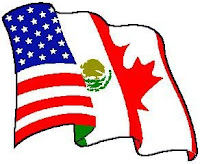
So that’s where I decided to Google-image “NAFTA flag”… YIKES! The image I found – a blending of the US, Mexican, and Canadian flags – looks like somebody’s nightmare. I am, of course, teasing – I appreciate the effort. And it is perhaps reflective of the fact that NAFTA has a long way to go before it brings about any unity to our region. But to forge a new North American regional identity, we need a new flag, not a blending of our current national flags.
If we are going to dream of a future together, we need a new symbol of North American unity – one that reflects our past, present, and future as a new unified region. We can all keep our old national flags, of course, but for the region, we need an original design.
So, I’ve decided to try my hand at a flag for all of North America. Here’s my proposal:
The triangle symbolizes:
The greatness of the pyramids built by the native people of the Americas in Mexico long before the days of colonization
The three sides represent the three core members of our regional cooperation, beginning with NAFTA: Canada, Mexico, and the United States
Most importantly, a resemblance to the North American geographical territory, which is narrow in the southern tip of Mexico, and wide across north of Alaska and Canada
The color recalls the gold of the past and the prosperity of the region’s future
The blue background:
Complements the map interpretation of the triangle: recalls the Atlantic and Pacific oceans which surround and unify us
Blue signifies trust, unity, and loyalty
Some final thoughts – while I justify the blue and gold in terms of our own North American past, present, and future, any similarity to the European flag is not a coincidence. I think that Europe has led the way on regional integration and serves as a model for the world. Personally, I do think 12 stars is overdoing it a bit. I like the simplicity of design on a flag. The one I propose here reminds me of the minimalism of the Japanese flag. This simple design is still distinctively ours: the use of the triangle is original and fitting for our three countries and for our North American land mass. Using a symbol that represents our geography is inspired by the flag of the Gambia. Note that there’s room for Central America and the Caribbean to join some day – but we’re not adding more sides or more stars – let’s keep the design simple: the triangle represents North American unity.
So there it is. Let me know what you think. And if you like it, please forward this to others who might be interested…
Over at The Huffington Post, Georgetown Institute for Law, Science, and Global Security Senior Fellow, Mark Vlasic writes:
The long arm of justice caught up with Radovan Karadzic yesterday, as his former victims began to testify against him at a genocide trial at the United Nations war crimes tribunal in The Hague. Almost fifteen years after the Srebrenica genocide, when Bosnian Serb forces rounded up over 7,500 Muslim men and boys and slaughtered them in cold blood, thousands with their eyes blindfolded and their hands tied behind their backs, the former president of the Serb-controlled Bosnia, the man who presided over the worst massacre in Europe since the Holocaust, now finds himself in the very same dock that held former Serbian president Slobodan Milosevic. And as former president Karadzic sits between two UN prison guards in an international tribunal, one must wonder, is the end of impunity finally coming to a close?
In 2002, I sat across from Slobodan Milosevic in the first war crimes trial of a head of state, ever. It was a historic trial — one supported by the United Nations and the international community — and one that only a few years earlier, I never thought would happen.
You see, up until April 2001, when the Butcher of the Balkans was arrested at his Belgrade villa, it was almost presumed that if you were a terrible dictator, or a head of state bent on mass slaughter and destruction, you would never see the inside of a courtroom. Lesser functionaries, yes — they might go to trial — but the top officials, they were virtually untouchable. As presidents, they would likely die while in office, or escape to a well-appointed villa to live their lives in comfortable exile. But now, the very presumptions that have guided human history, in the short time I’ve been a lawyer, have changed… And we’ve almost taken it for granted.
After the arrest and trial of Milosevic, came the arrest and trial of former president Saddam Hussein — the first war crimes trial of a Middle East leader in history — and the arrest of former president Charles Taylor of Liberia – and who now sits in the dock in The Hague.
It seems that with every year, the dominos of impunity keep falling — first Europe, then the Middle East, then Africa. And they continue to fall:
Chad’s exiled former president, Hissène Habré, is to stand trial at a special court in Senegal, while in Asia, another domino is falling.
Khieu Samphan, the former president of the Khmer Rouge, is facing a UN-sponsored court in Cambodia for his part in “The Killing Fields” — and the slaughter of his own people nearly 30 years ago.
Most recently, the International Criminal Court in The Hague has dropped another domino with its indictment of President Omar al-Bashir of Sudan. The question now is not if another president will ever be charged, but rather — when, and who is next?
This is a fundamental change in the presumption. Unlike those of us that studied law and justice in the 20th Century — the next generation of prosecutors and foreign policy professionals — those graduating from universities and law schools in the 21st Century — will only know a world where such terrible dictators actually do stand trial. Such a presumption will embolden the next generation of leaders to act — and perhaps with time — bring a true end to impunity.
Sixty years after the world’s experiment at Nuremberg — and after millions of lives shattered by war crimes, destruction, and perverted leadership, we should be cautiously optimistic that there is some hope for humanity — but only if we keep pressing the cause of justice. Let us hope we press on — and let us hope that future dictators take notice.
Indeed. Let’s hope that would-be dictators do take notice.
President Barack Obama is scheduled to meet with senators next week to discuss the Supreme Court vacancy created by Justice John Paul Stevens’ planned retirement.The White House said today that Obama has invited four senators to meet with him the morning of Wednesday, April 21: Majority Leader Harry Reid (D-Nev.), Minority Leader Mitch McConnell (R-Ky.), and Sens. Patrick Leahy (D-Vt.) and Jeff Sessions (R-Ala.). Leahy is chairman of the Senate Judiciary Committee, and Sessions is the committee’s ranking Republican.
Leahy has said that he’s already spoken with Obama about possible successors to Stevens. Sessions said late Monday that he had not yet spoken with the president on the subject.
Photo of a campaign billboard for Sudanese President Omar al-Bashir taken by Mark Lotwis for the Save Darfur Coalition. More photos here.
Many thanks to Martha for this useful information. It will be very interesting to follow developments and observe the reactions of the international community.
Remarks on Nuclear Nonproliferation at the University of Louisville as Part of the McConnell Center’s Spring Lecture Series
Hillary Rodham Clinton Secretary of State
University of Louisville
Louisville, KY
April 9, 2010
SECRETARY CLINTON: Thank you. Thank you very, very much. (Applause.) Oh, it is wonderful to be here and to see this kind of a crowd on a beautiful Friday afternoon to talk about foreign policy here at this great university, and I am honored to be the sixth Secretary of State to have been privileged to participate in this important event here at the McConnell Center.
I, of course, want to thank Gary Gregg, who has been a real joy for my staff to work with in planning this. I think we gave Gary a bit of a scare when we had to tell him I had to go to Prague on my way to Louisville – (laughter) – and it all worked out fine, so he’s breathing a little easier. And to the university president and provost, thank you for having me here on this absolutely wonderful day at this exciting venue to talk about issues that are important to our citizens.
I see a lot of familiar faces in the audience, and I am delighted to be back here in Kentucky with all of you. (Applause.) I had a lot of fun two years ago – (laughter) – covered a lot of ground. This is a long state. (Laughter.) I learned that firsthand, and made many friends. And although my travel takes me all over the world today rather than across a great commonwealth like this, I have many, many wonderful memories and just am so pleased to be back here with all of you.
I’m out of politics now. That’s what I say all the time to everybody who asks me an opinion about anything, except foreign policy things. And I am excited to be part of this Administration at this point in history.
And I want to thank my former colleague, Senator McConnell, for inviting me here and for that very kind introduction. During the eight years that I served in the Senate with Mitch, I was fortunate to find common cause and work with him on a number of foreign policy issues: human rights in Burma; legislation to support small businesses and micro-credit lending in Kosovo; promoting women and civil society leaders in Afghanistan; strengthening the rule of law in parts of the Islamic world. And I’ve appreciated working with him in my new capacity upon becoming Secretary of State.
I think this McConnell Center really demonstrates Mitch’s deep appreciation not only for the political process of which he’s been a part for years – I didn’t know until he was introduced that he is the longest serving senator in Kentucky history – but also to the importance of education and the role that education plays in the life of our country. And it is a real tribute to him that this idea which he put forth so many years ago has created the McConnell Center, and certainly these young people who are here studying as part of the center.
Now, I have to say that for some of you McConnell Scholars, graduation is approaching quickly. And I want you to know that we are hiring at the State Department. (Laughter.) We are looking forward to filling our ranks with the best and brightest of young Americans to do the work that needs to be done on behalf of diplomacy and development, two of the three legs of the stool that represents American foreign policy; the other, of course, being defense. And we’ve been fortunate to have bipartisan support of which Senator McConnell was a part, to make sure that we had the personnel that we needed to be able to tackle all of the challenges we face.
I always knew the world was big, but it just seems to have gotten bigger and bigger since I’ve been Secretary of State, and that there isn’t any place – it’s not like being in a big house where you say, “Well, I think we’ll just shut off that third floor so that we don’t have to heat it. Because sure enough, you try to do that, you’re going to have a fire and then you’re in trouble. So you have to paying attention all the time. And we need young people with patriotism, a sense of civic responsibility, a keen awareness of their citizenship and patriotic duty to serve in the State Department and USAID on behalf of the United States.
Back in Washington these days, our policy discussions can get pretty lively. We can both vouch for that, both Senator McConnell and I, because anybody who’s turned TV during the last few months will remember some of the heated exchanges. But in foreign policy, we have a long tradition of coming together across party lines to face America’s toughest national security challenges. That commitment to cooperation helped protect our nation through two World Wars and the Cold War. And Senator McConnell and I were part of that legacy in our cooperation when I was in the Senate. And appreciate the work he’s done and the leadership he has demonstrated encouraging Republicans and Democrats to work together as we deal with the extremely complex situations in Iraq, Afghanistan, and Pakistan.
Well, today, I want to speak about another challenge that is bigger than any one Administration or any political party – it’s protecting our families, our neighbors, our nation, and our allies from nuclear terrorism and nuclear proliferation.
Now, for generations, Republican and Democratic Administrations have recognized the magnitude of this challenge. And they have worked together in partnership with the Congress to reduce the danger posed by nuclear weapons and to maintain a safe, secure, and effective deterrent to protect the United States and our allies across the world.
President Reagan had these goals in mind in 1987 when he negotiated the Intermediate-Range Nuclear Forces treaty, which eliminated an entire class of nuclear armed missiles. And that agreement was ratified in the Senate by a vote of 93-5.
President George H.W. Bush presided over ratification of the START I treaty, which was approved 93-6. And President George W. Bush’s Moscow Treaty passed 95-0. And two years ago this week, President George W. Bush issued a joint statement with the Russians in support of negotiating a successor to the START agreement.
This issue has united national security experts from both political parties. And four of the strongest advocates for action like this are former Secretaries of State Henry Kissinger and George Shultz, former Secretary of Defense William Perry, and former Senate Armed Services Committee Chairman Sam Nunn – two Republicans and two Democrats. Faced with what they said is “a very real possibility that the deadliest weapons ever invented could fall into dangerous hands,” they have come together repeatedly to demand a global effort to reduce reliance on nuclear weapons, prevent their spread, and ultimately end them as a threat to the world.
And so the Obama Administration is committed to building on the work of the last four administrations, and we’ve worked on these issues hand-in-hand with Republicans and Democrats in Congress.
Just this past Tuesday, we released the latest Nuclear Posture Review. That review provides the strategic framework for our nuclear weapons policy and represents the culmination of months of work by the Department of Defense under Secretary Gates’ leadership, and the Departments of State and Energy.
Yesterday, I was in Prague in the Czech Republic with both President Obama and President Medvedev to witness the signing of an historic new START agreement between the United States and Russia that will reduce the number of strategic nuclear warheads deployed by both countries to 1,550 on each side, a level not seen since the 1950s – the first full decade of the nuclear age.
Now next week, leaders from around the world – 47 nations will gather in Washington for a major summit meeting on securing nuclear materials from terrorists. And next month in May, we will come together with partners in the United Nations in New York to review global efforts on nonproliferation.
Now, this is a lot of activity. But it’s fair to ask whether it matters to people in New York or in Los Angeles or Louisville or, frankly, anywhere else beyond Washington, D.C. Discussions of nuclear issues are often conducted in a language of acronyms – NPR, NPT, SALT, SORT, START. At the White House two weeks ago, a reporter asked me why everyone’s eyes glaze over when we talk about arms control. Now, I’m sure that won’t happen in this audience today.
Because it is easy to conclude that this is a subject that doesn’t have much impact on our daily lives or that this issue is a relic of the Cold War. I’m old enough to remember, even though I wasn’t around in 1933 – (laughter) – I am old enough to remember when I was in elementary school having those duck-and-cover drills. You remember those, Mitch. I bet there are a lot of heads – there’s a lot of heads nodding out there. I mean, why in the world our teachers and our parents thought we should take cover under our desks in the case of – (laughter) – of a nuclear attack is beyond me. But every month, we practices. And we’d get up and we’d get under our desks and we’d put our hands over our heads and we’d crouch up. We lived with the Cold War. We lived with the threat of nuclear weapons.
And it seems so long ago now, but it was so real in our daily lives. It wasn’t something left to presidents and senators and secretaries of state, it was something you talked about around the dinner table. And it made the threat of nuclear war something that nobody could escape. So today, it seems like a good time ago. And it would be easy to think, well, that’s a relic of the past. But that is not the case.
The nature of the threat has changed. We no longer live in constant fear of a global nuclear war where we’re in a standoff against the Russians with all of our nuclear arsenal on the ready, on a haired-trigger alert. But, as President Obama has said, the risk of a nuclear attack has actually increased. And the potential consequences of mishandling this challenge are deadly.
So, I want to speak about why nuclear arms control, nonproliferation, and nuclear security matter to each of us, and how the initiatives and the acronyms that make up our bipartisan work on these issues are coming together to make our nation safer.
There is a reason that presidents and foreign policy leaders in both parties are determined to address this danger. A nuclear attack anywhere could destroy the foundations of global order. While the United States and old Soviet Union are no longer locked in a nuclear standoff, nuclear proliferation is a leading source of insecurity in our world today.
And the United States benefits when the world is stable: our troops can spend more time at home, our companies can make better long-term investments, our allies are free to work with us to address long-term challenges like poverty and disease. But nuclear proliferation, including the nuclear programs being pursued by North Korea and Iran, are in exact opposition to those goals. Proliferation endangers our forces, our allies, and our broader global interests. And to the extent it pushes other countries to develop nuclear weapons in response, it can threaten the entire international order.
Nuclear terrorism presents a different challenge, but the consequences would still be devastating. A 10-kiloton nuclear bomb detonated in Times Square in New York City could kill a million people. Many more would suffer from the hemorrhaging and weakness that comes from radiation sickness. And beyond the human cost, a nuclear terrorist attack would also touch off a tsunami of social and economic consequences across our country.
We all remember the aftermath of the September 11th attacks. Air travel in the United States was suspended. Here in Louisville, for example, that meant planes couldn’t get in or out of UPS’s WorldPort where, I understand, three-quarters of the employees are local students. Those attacks ended up costing UPS – a company based far away from ground zero and from the Pentagon – over $130 million. That’s a lot of work-study jobs. And if you multiply those losses across our economy, you can imagine the consequences we would face in the event of a nuclear terrorist attack. In our interconnected world, an attack or disruption anywhere can inflict political and economic damage everywhere. That’s why nuclear security does matter to us all, and why we’re determined to meet this challenge.
There are three main elements of our strategy to safeguard our country and allies against nuclear attack. First, we begin with our support for the basic framework of the nuclear Nonproliferation Treaty. The global nuclear nonproliferation regime is based on a three-sided bargain: countries without nuclear weapons agree not to acquire them; countries with nuclear weapons work toward disarmament; and every nation is afforded the right to access peaceful nuclear energy under appropriate safeguards.
Unfortunately, this bargain has been under assault. North Korea began developing nuclear weapons as an NPT party before announcing its withdrawal from the treaty. And Iran is flouting the rules, seeking to develop a nuclear weapons capability under the guise of a peaceful enrichment program. We have an urgent interest in bolstering the world’s nuclear nonproliferation framework and enforcement and verification mechanism. And the new START treaty signed yesterday by President Obama and President Medvedev in Prague helps us advance that goal.
The United States and Russia still today have over 90 percent of the world’s nuclear weapons, and the new START treaty will mean lower, verifiable limits on the number of strategic nuclear weapons deployed in our countries. Ratification of the treaty will also allow us to continue establishing a more constructive partnership with Russia. And that’s important in its own right, but also because Russia is a permanent member of the UN Security Council and our cooperation is a prerequisite for moving forward with tough, internationally binding sanctions on Iran.
The diplomatic benefits of ratifying the new START treaty could also extend to our cooperation with other countries. In agreeing to abide by the new START treaty, we would demonstrate that the United States is living up to our obligations under the NPT. This boosts our credibility as we ask other countries to help shore up the nonproliferation regime. It’s becoming increasingly fragile, and we need a stronger hand as we push for action against nuclear proliferators.
Now, I’m not suggesting that a move by the United States and Russia to reduce our nuclear stockpiles will convince Iran or North Korea to change their behavior. But ask yourselves, can our efforts help to bring not only the new START treaty into force, but by doing so help persuade other nations to support serious sanctions against Iran? I believe they could. And since I’m on the phone or in meetings constantly with heads of state or government, foreign ministers and others, making the case that they must join us in these strong sanctions against Iran, I know from firsthand experience that this START treaty has left little room for some nations to hide. They are finding it more and more difficult to make the case that they don’t have their own responsibilities.
I believe the new START treaty does put us in a better position to strengthen the nonproliferation regime when parties to the Nonproliferation Treaty meet together in May. Now, we’ll need support to oppose – to impose tougher penalties on violators and create new, 21st century tools to disrupt these proliferation networks.
The foundation provided by our military planners in our Nuclear Posture Review has also strengthened our hand. It contains our newly announced assurance that the United States will not use nuclear weapons against non-nuclear weapons states that are in compliance with their nuclear nonproliferation obligations. We believe states that shun nuclear weapons and abide by their commitments under the NPT should not have to fear a nuclear attack. For states not covered by this assurance, there is a range of options in which our nuclear weapons will play a role in deterring a conventional, chemical, or biological attack against us, our allies or partners.
Now, the second major element of our strategy is a global effort to secure vulnerable nuclear material and enhance nuclear security. This, unfortunately, is not a theoretical issue. When the United States first started working to secure nuclear materials overseas – principally in the former Soviet Union – our teams of experts found highly radioactive materials stored in open fields without any security. They discovered fissile materials – the ingredients for nuclear bombs – warehoused in facilities without electricity, telephones, or armed guards. The International Atomic Energy Agency has released the details of 15 cases of smuggling involving weapons-grade nuclear materials since 1993. But we have no idea how many other smuggling operations have gone undetected. Nuclear terrorism has been called the world’s most preventable catastrophe. But to prevent it, the world needs to act.
And the importance of this issue demands American leadership. So next Tuesday, the President will convene a meeting in Washington as part of an unprecedented summit intent on keeping nuclear materials out of the hands of terrorists. To put it in context, this summit hosted by the United States is the largest conference since the one that came together around the founding of the United Nations in 1945.
Many of the countries who will be there have already taken concrete steps to strengthen nuclear security. And we expect announcements of further progress on this issue during our talks. But we will also hear from other countries that are helping us keep a very close watch on anyone we think could be part of a network that could lead to the sale of or transfer of nuclear material to al-Qaida or other terrorist organizations. We are trying to make this Summit the beginning of sustained international effort to lock down the world’s vulnerable nuclear materials within four years and reduce the possibility that these materials will find their way into the hands of terrorists.
Two Senators – Republican Richard Lugar and former Senator – Democratic Sam Nunn – have worked together to champion this issue since the Cold War ended. Their bipartisan cooperation and the threat reduction legislation that bears their names – now Lugar legislation – has helped to make securing nuclear materials a priority for both Republican and Democratic administrations. And I think their work has made the world safer.
A lot of times that Senator McConnell and I believe in and that I was privileged to do for eight years in the Senate and that he does every day in the Senate today that we think is the most important, doesn’t get the headlines. Getting rid of nuclear material is not something that is going to get people excited on cable TV. And yet that work is among the most important that any senators have done in the last 20 years. And it moves toward a vision of a world, a world in which nuclear materials are not easily available in all states – adopt responsible stewardship of all nuclear materials as part of their basic obligations.
Finally, the third component of our strategy must be to maintain a safe, secure, and effective nuclear deterrent ourselves. For generations, our nuclear forces have helped prevent proliferation by providing our non-nuclear allies in NATO, the Pacific, and elsewhere with reassurance and security. An ally or a partner that has confidence that the United States and our arsenal will be there to defend them in the event of an attack is a country that is less likely to develop its own nuclear deterrent. And we are committed to continuing that stabilizing role for us as long as nuclear weapons exist.
Our latest budget request asks for significant resources to modernize our nuclear complex and maintain our nuclear arsenal. Our budget devotes $7 billion for maintaining our nuclear weapons stockpile and complex. This commitment is $600 million more than Congress approved last year. And over the next five years we intend to boost funding for these important activities by more than $5 billion dollars. We are committed to reducing the role and number of our nuclear weapons. But at the same time, we are investing to ensure that the weapons we retain in our stockpile are safe, secure, and effective.
The fact that we are maintaining this arsenal does not mean that we intend to use it. We are determined to see that nuclear weapons are never used again. But the new START treaty will enable us to retain a strong, flexible deterrent. And our military will continue to deploy every leg of what’s called our nuclear triad – land-based missiles, submarine-based missiles, and bombers.
The treaty will enable us to maintain this arsenal, and also provide strong verification provisions. We think it will enable us to develop greater understanding maybe even allow trust between Russian and American forces, while eliminating potential opportunities for mistakes and miscalculation.
Now, one aspect of our deterrent that we specifically did not limit in this treaty is missile defense. The agreement has no restrictions on our ability to develop and deploy our planned missile defense systems or long-range conventional strike weapons now or in the future. The Pentagon’s recent Quadrennial Defense Review and Ballistic Missile Defense Review both emphasize that improving our missile defense and conventional capabilities will help strengthen our deterrence. And in the future, we feel that regional missile defense will be an important source of protection for allies as well. Used wisely, missile defense could further reduce our dependence on nuclear weapons.
So these three elements of our strategy – strengthening the nuclear nonproliferation regime, combating the threat of nuclear terrorism, and maintaining a safe nuclear deterrent – are not new. And they’re not controversial. Leaders in both parties have been pursuing these goals together for years.
In the course of our work at the State Department and when I was in the Senate, sometimes when you face really tough challenges, it’s hard to sort through all of the different course of actions available to you. And there are times when people of good will and great intellect have diverging views on how to deal with complex issues. But I don’t think this is one of those times.
The new START agreement is the latest chapter in the history of American nuclear responsibility. It’s a chapter that’s been co-authored by Ronald Reagan and George H.W. Bush, Bill Clinton, George W. Bush, and even further back and overwhelming majorities in the U.S. Congress. Now, we believe strongly that is in our nation’s best interest and I’m confident that once senators have a chance to study this new treaty, we will have same high levels of bipartisan support as the agreements that this one builds upon.
But underlining it all is that we are trying to maneuver through a period when our enemies are not just other states who we think of as rational actors, even if we profoundly disagree with them. They are these terrorist networks. And we have to think simultaneously, both about building confidence among other nations, including Russia and other nuclear armed nations, so that they make common cause with us against rogue states and terrorist networks, and sending a message that no state is better off if it pursues nuclear weapons, and any state that gives safe haven to any terrorist network that pursues nuclear weapons is at risk. By ratifying this treaty, the United States won’t give up anything of strategic importance. But in return, we will receive significant, tangible benefits.
Protecting the United States of America from nuclear attack is an issue that should be important to every single American. It’s been an issue where our two political parties have always found common ground – with good reason. And advancing these efforts is critical to 21st century national security. These issues will be with us a long time. But if we are true to the legacy of cooperation we have inherited from our predecessors, then I am convinced we can deliver a safer world to the next generation and, indeed, Mitch, to the next generation of policy leaders and decision makers.
And I expect some of you in this audience to be sitting in these chairs and making these speeches in the future. And I want you to know that we did our very best to pass on to you a world that was safer and one in which the threat of nuclear attack was diminished and where we found common cause internationally to isolate those who would pursue nuclear weapons from any place in the world.
I’m convinced that the United States is once again in the lead, as we always have been, and that leadership position is an opportunity for us to demonstrate that we can make our country safer, our world safer, and chart a new and better future.
Thank you all very much. (Applause.) MR. GREGG: I suppose that applause was for Secretary Clinton. But I thank her for a very substantive address and honoring us with that this morning. She has agreed to take a few questions. So think quickly. We have three people with microphones in the audience. Identify yourselves, hold your microphones up high. Please wait till the microphone gets to you and speak in it in a manner that’s a question and not a statement pretending to be a question.
We’re going to go straight right here to the first hand that I see. QUESTION: Senator, could you comment on the fact that Israel may not attend the summit that you’ve discussed? SECRETARY CLINTON: Well, actually, Israel will attend. The prime minister cannot attend, but the deputy prime minister will be there. And I think it’s especially important that Israel will be at this conference because Israel shares with us a deep concern about Iran’s nuclear ambitions and also about the threat of nuclear terrorism. MR. GREGG: Let’s go right in the middle, then we’ll come over to this side. Right behind you. QUESTION: Thank you. Thank you very much for joining us today, Secretary Clinton. We are immensely proud to have you here at the McConnell Center with us today. Will this treaty be able to strengthen the effectiveness of economic sanctions against rogue states like North Korea and Iran without Chinese involvement? SECRETARY CLINTON: That’s a very good question. You must be one of those McConnell scholars. (Laughter.) Actually, I think the answer is a yes, and here’s why. We have noticed in the last several weeks that the Chinese have become more willing to engage with us on Iran. They have been deeply engaged with us on North Korea. And the fact that the United States and Russia reached agreement on this treaty, and in the Nuclear Posture Review we point out that we’re aware that China is modernizing its military forces and we would seek to have the same kind of strategic dialogue with China that we have historically had with Russia going back to presidents in the 19 – late ‘40s and ‘50s sends a very clear message that this issue of nuclear proliferation is a matter that Russia is concerned with as well as the United States, and that increasingly, China is hearing from a lot of other countries, countries in the Gulf, countries that believe that Iran’s pursuit of nuclear weapons will destabilize the Gulf region, that would potentially lead to instability in the oil markets, and China is very dependent upon the Gulf – Iran, Saudi Arabia, et cetera – for oil and gas.
So I think that the cooperation between the United States and Russia has been very beneficial in getting Chinese participation so that the Chinese have begun engaging with us at the United Nations in the drafting of this resolution that we are putting together for Security Council consideration. And I think that the Chinese have become convinced over the last months of what we are definitely convinced of, and that is that Iran is pursuing a program that is hard to explain in terms of the peaceful use of nuclear weapons, and therefore China does not want to look as though it doesn’t care about something that has such grave consequences for the world.
With respect to North Korea, our mechanism for dealing with North Korea is one that we inherited from the Bush Administration that we actually think makes a lot of sense. It’s called the Six-Party Talks. So China and Russia, the United States, South Korea, Japan, and North Korea are the parties to it. And China has been very strong in pushing North Korea to get back to the talks.
Now, both countries, for different reasons, in the last year have experienced a lot of turmoil, turbulence, instability in their own regimes. In North Korea, the leadership – what do they call him, the Dear Leader – has had some health problems. Kim Jong-il has had some difficulties with some of the economic policies that he’s put forward that has engendered real popular protest on the part of North Koreans. So it’s been difficult to get this regime to move back into the Six-Party Talks, but our alliance with China, Russia, and South Korea and Japan is very strong, and I believe we will eventually get there.
In Iran, because of the elections and the protests and the opposition and the way that the leadership, both the clerical leadership and the elected leadership, have treated the protestors, it’s difficult to get decisions made out of Iran of any real consequence. So this has been a turbulent time to press these two countries, but I feel very encouraged by the unity that we’ve had in both instances. And so as we move forward this month in the Security Council, we’re going to get as strong a resolution as we possibly can. And then we also know that countries like the United States, like the European Union countries, are ready to impose more sanctions. And people say to me, “Well, Iran’s been sanctioned before. What difference is it going to make?”
But if you look at what we were able to accomplish last year in the toughest sanctions against North Korea, Resolution 1874, we have had international support for interdicting North Korean arms shipments. Countries from Thailand to even Burma, South Africa, the UAE, others have all worked together under the aegis of the Security Council resolution. And if we can get something in that ballpark on Iran, that will give us an international mechanism to really put some pressure on Iran, unlike what we’ve had available before. And I personally think it is only after we show international unity that the Iranians will – that there will be any chance that the Iranians will actually negotiate with the international community.
So people – a lot of my counterparts around the world say, “Well, we don’t – want to try to solve this diplomatically.” Well, sanctions, using the United Nations Security Council, is diplomacy and it’s international diplomacy. And we need that kind of international front against Iran, and that’s what we’re attempting to put together in the Security Council. QUESTION: Thank you, Senator, Secretary Clinton. It’s an honor to see you. But you said in the treaty countries will be asked to not pursue a nuclear program. The U.S. is, like you said, spending more money on nuclear program. What other countries will be allowed to spend on nuclear defenses? SECRETARY CLINTON: That’s a good question also, because when the Nonproliferation Treaty came into effect, there was a basic bargain to the treaty. And countries that didn’t have nuclear weapons – and there were some that already had acknowledged nuclear weapons – were supposed to move toward disarmament. And actually, the United States, the former Soviet Union, now the United States and Russia, kept their part of the bargain. We did move toward, as I read to you some of the different treaties that have been signed between our two countries cutting certain classes of weapons and certain kinds of delivery systems.
And so there are three pillars to the Nonproliferation Treaty. One is disarmament, one is nonproliferation, and one is the peaceful use of nuclear weapon – nuclear energy, the peaceful use of nuclear energy for civil nuclear purposes. So the United States will continue to demonstrate its willingness, in concert with Russia, because we have so many more weapons than any of the other countries by a very, very big margin. And other countries that have pursued nuclear weapons, like India and Pakistan, for example, have done so in a way that has upset the balance of nuclear deterrent, and that’s why we’re working with both countries very hard to try to make sure that their nuclear stockpiles are well tended to and that they participate with us in trying to limit the number of nuclear weapons. And both of them will be in Washington this next week.
But I’m a realist. And as long as there are nuclear weapons in the world, the United States will have nuclear weapons. We will not unilaterally disarm. We will maintain our nuclear deterrent. We will invest, not in new weapons, but in ensuring that the weapons we have are as effective as they would need to be in order for our deterrent to be credible. And the countries that we know that have actively pursued nuclear weapons that are still doing so today – North Korea, which we know has somewhere between one and six nuclear weapons, and Iran – and that’s why we’re emphasizing so much international efforts against both of them to try to denuclearize the Korean Peninsula and prevent Iran from getting nuclear weapons in the first place. MR. GREGG: The young lady dying for an answer right back here. QUESTION: Thanks for being here, Secretary Clinton. With respect to Iran’s noncompliance, how is the U.S. practically, socially, and financially prepared for a potential war with Iran? SECRETARY CLINTON: Well, we have been very clear that our preference and what we’re working toward is international action that would isolate Iran and change the calculus of the Iranian leadership. Let me explain what I mean by that.
The only way we think we’re going to convince the Iranians to give up nuclear weapons is if they conclude they will be less safe with them than without them, and that they – their economy and their society will suffer sufficiently that the tradeoff is no longer worth it to them. And there, I think, are a number of different ways that that kind of calculus could change in the Iranian mindset. For example, if the Iranians believe that by having nuclear weapons they will be able to intimidate their neighbors in the Gulf, they’re mistaken, because those neighbors will either pursue nuclear weapons for themselves, further destabilizing the region, or they will be provided support from us to defend themselves against a nuclear-armed Iran.
So if you’re sitting in Iran and you see the absolute commitment of the international community to prevent this from happening and actions are taken to interfere with your financing and banking system, to go after groups and individuals who play a role in the nuclear program, to figure out ways to try to impinge on your energy sector or your arms flow, it begins to – you begin to pay a cost. And I don’t think Iran wants to be North Korea. They consider themselves a great culture and society going back to Persian times. They see themselves in a leadership role in the world.
So what we believe is likely to happen is a real debate within Iran if we can get to the kind of international isolation that such sanctions would bring. Now, we’ve always said – and Secretary Gates and I did a number of interviews and press events around these – the Nuclear Posture Review and the START treaty in the last week, and we’ve always said that, look, all options are on the table. But clearly, our preference is to create conditions that will lead to changes in the policy of the Iranian Government toward the pursuit of nuclear weapons, which, by the way, is their stated policy. Their leadership says all the time we have no intention of obtaining nuclear weapons. It’s just difficult to put all the facts together and square that with their stated intentions, so we’re going to put them to the test. MR. GREGG: Let’s go back to this side for one more. Is there one on this side? Straight back. QUESTION: Thank you, Senator Clinton. Given the fact that probably the Cuban missile crisis may be the greatest example of a deterrent, that’s been almost 50 years ago. Is there any talk within the Department of maybe normalizing relationships with Cuba? SECRETARY CLINTON: That’s a really – that’s a topic of conversation a lot. I don’t think that there is any question that, at some point, the people of Cuba should have democratically elected leaders and should have a chance to chart their own future. But unfortunately, I don’t see that happening while the Castros are still in charge. And so what President Obama has done is to create more space, more family travel, more business opportunities to sell our farm products or for our telecom companies to compete dealing with common issues that we have with Cuba like migration or drug trafficking. In fact, during the height of the terrible catastrophe in Haiti because of the earthquake, we actually helped some of the Cuban doctors get medical supplies who were already operating there.
So there are ways in which we’re trying to enhance our cooperation. But it is my personal belief that the Castros do not want to see an end to the embargo and do not want to see normalization with the United States, because they would then lose all of their excuses for what hasn’t happened in Cuba in the last 50 years. And I find that very sad, because there should be an opportunity for a transition to a full democracy in Cuba. And it’s going to happen at some point, but it may not happen anytime soon.
And just – if you look at any opening to Cuba, you can almost chart how the Castro regime does something to try to stymie it. So back when my husband was president and he was willing to make overtures to Cuba and they were beginning to open some doors, Castro ordered the – his military to shoot down these two little unarmed planes that were dropping pamphlets on Cuba that came from Miami. And just recently, the Cubans arrested an American who was passing out information and helping elderly Cubans communicate through the internet, and they’ve thrown him in jail. And they recently let a Cuban prisoner die from a hunger strike. So it’s a dilemma.
And I think for the first time, because we came in and said, look, we’re willing to talk and we’re willing to open up, and we saw the way the Cubans responded. For the first time, a lot of countries that have done nothing but berate the United States for our failure to be more open to Cuba have now started criticizing Cuba because they’re letting people die. They’re letting these hunger strikers die. They’ve got 200 political prisoners who are there for trivial reasons. And so I think that many in the world are starting to see what we have seen a long time, which is a very intransigent, entrenched regime that has stifled opportunity for the Cuban people, and I hope will begin to change and we’re open to changing with them, but I don’t know that that will happen before some more time goes by (Applause.) MR. GREGG: Madam Secretary, George Schultz, James Baker, Madeleine Albright, Colin Powell, Condoleezza Rice, and today, Secretary Hillary Clinton, thank you for your service to the United States, thank you for being at the University of Louisville. SECRETARY CLINTON: Thank you so much. (Applause.)
Over at Just Joe, Joe Grieboski reports on some possible good news:
It appears an end to the 19 year-old dispute between Greece and Macedonia may be at hand. Sort of.
The Greek government has announced that it is open to a proposal that would add “Northern” to the name of its independent neighbor.
Greek Deputy Foreign Minister Dimitris Droutsas announced to the Kathimerini newspaper that U.N. mediator Matthew Nimetz’s suggestion of Northern Macedonia “fits with the framework for a settlement that we have set out.”
Since the independence of the former Yugoslav Republic of Macedonia, Greece has opposed the use of the name Macedonia for the state, which is also the name of a northern Greek province.
Athens claims that historical and territorial concerns resulting from the lack of disambiguation between the independent country of Macedonia and the adjacent Greek region of Macedonia motivate its actions. Greece also objects to the non-disambiguated use of the term Macedonian for the neighboring country’s main ethnic group and language.
However, there seems to me to be a disingenuousness in the acceptance of “Northern Macedonia” as a term for the country. If Athens was so concerned about disambiguation, therefore permitting territorial claims, does the term Northern Macedonia not then raise similar concerns for the Skopje players? Could Athens’ acceptance of such a phraseology mask territorial claims? To me, Northern Macedonia has the same ring as Upper Egypt or North Carolina…
Droutsas further added that Greece was willing to drop its opposition to European Union accession if Macedonian Prime Minister Nikola Gruevski agreed to add “Northern” to his country’s name.
Droutsas was quoted by Kathimerini as saying, “He [Macedonian Prime Minister Gruevski] will have to explain to his people why he is depriving them of their European prospects… Skopje must demonstrate its political will.”
An intriguing example of political blackmailing committed by Droutsas: accept our acceptance or we will continue to keep you out of the European Union and NATO.
After 19 years and countless proposals and negotiations, it seems to me that Skopje is not the only one that needs to demonstrate political will…
 The Department of Defense has just released the 2010 edition of the Manual for Military Commissions. It can be found here in pdf.

 My friend and colleague Jim Vreeland
  The
The 

 In a previous post, I expressed a worry about a “consensus” that seems to be emerging that the next Supreme Court nominee should not come from an Ivy-League school.
  —that deserves to become a classic.


 The
The