Author: arclein

  • Desert CO2 Cycle

    This is a far more detailed report on an item I posted on in 2008 when first published.  It is worth a revisit.
    The absorption of CO2 by the desert remains poorly understood.  We even need to know the basics as is obvious in the last paragraphs.   Is the process one way?
    Another aspect of these soils is that the soil is in a continuous process of breakdown causing the available surface area to constantly increase.  This is not well understood because the process is slow. Yet a simple cycle of freezing and thawing cracks rock along many crystal faces.  Such rotting of the rock will penetrate many feet into the soils or whatever the till is.
    Knowing that makes the CO2 uptake quite creditable.
    Have Desert Researchers Discovered a Hidden Loop in the
    Carbon Cycle?
    Science 13 June 2008:
    Vol. 320. no. 5882, pp. 1409 – 1410
    DOI: 10.1126/science.320.5882.1409
    Richard Stone
    URUMQI, CHINA–When Li Yan began measuring carbon dioxide (CO2) in western China’s Gubantonggut Desert in 2005, he thought his equipment had malfunctioned. Li, plant ecophysiologist with the Chinese Academy of Sciences’Xinjiang Institute of Ecology and Geography in Urumqi, discovered that his plot was soaking up CO2 at night. His team ruled out the sparse vegetation as the CO2 sink. Li came to a surprising conclusion:
    The alkaline soil of Gubantonggut is socking away large quantities of CO2 in an inorganic form. A CO2-gulping desert in a remote corner of China may not be an isolated phenomenon. Halfway around the world, researchers have found that Nevada‘s Mojave Desert, square meter for square meter, absorbs about the same amount of CO2 as some temperate forests. The two sets of findings suggest that deserts are unsung players in the global carbon cycle. “Deserts are a larger sink for carbon dioxide than had previously been assumed,” says Lynn Fenstermaker, a remote sensing ecologist at the Desert Research Institute (DRI) in Las Vegas, Nevada, and a coauthor of a paper on the Mojave findings published online last April in Global Change Biology.
    The effect could be huge: About 35% of Earth’s land surface, or 5.2 billion hectares, is desert and semiarid ecosystems. If the Mojave readings represent an average CO2 uptake, then deserts and semiarid regions may be absorbing up to 5.2 billion tons of carbon a year–roughly half the amount emitted globally by burning fossil fuels, says John “Jay” Arnone, an ecologist in DRI’s Reno lab and a co-author of the Mojave paper.
    But others point out that CO2 fluxes are notoriously difficult to measure and that it is necessary to take readings in other arid and semiarid regions to determine whether the Mojave and Gubantonggut findings are representative or anomalous.
    For now, some experts doubt that the world’s most barren ecosystems are the long sought missing carbon sink. “I’d be hugely surprised if this were the missing sink. If deserts are taking up a lot of carbon, it ought to be obvious,” says William Schlesinger, a biogeochemist at the Cary Institute of Ecosystem Studies in Millbrook, New York, who in the 1980s was among the first to examine carbon flux in deserts. Nevertheless, he says, both sets of findings are intriguing and “must be followed up.”
    Scientists have long struggled to balance Earth’s carbon books. While atmospheric CO2 levels are rising rapidly, our planet absorbs more CO2 than can be accounted for.
    Researchers have searched high and low for this missing sink. It doesn’t appear to be the oceans or forests–although the capacity of boreal forests to absorb CO2 was long underestimated. Deserts might be the least likely candidate. “You would think that seemingly lifeless places must be carbon neutral, or carbon sources,” says Mojave coauthor Georg Wohlfahrt, an ecologist at the University of Innsbruck in Austria.
    About 20 kilometers north of Urumqi, clusters of shanties are huddled next to fields of hops, cotton, and grapes. Soon after the Communist victory over the Nationalists in 1949,
    soldiers released from active duty were dispatched across rural China, including vast Xinjiang Province, to farm the land. At the edge of the sprawling “222” soldier farm, which is home to hundreds of families, oasis fields end where the Gubantonggut begins.
    The Fukang Station of Desert Ecology, which Li directs, is situated at this transition between ecosystems.
    In recent years, average precipitation has increased in the Gubantonggut, and the dominant Tamarix shrubs are thriving. Li set out to measure the difference in CO2 absorption between oasis and desert soil. An automated flux chamber measured CO2 depletion a few centimeters above the soil in 24-hour intervals on select days in the growing season (from May to October) in 2005 and in 2006. The desert readings ranged from 62 to 622 grams of carbon per square meter per year. Li assumed that Tamarix and a biotic crust of lichen, moss, and cyanobacteria up to 5 centimeters thick are responsible for part of the uptake. To rule out an organic process in the soil, Li’s team put several kilograms in a pressure steam chamber to kill off any life forms and enzymes. CO2 absorption held steady, according to their report, posted online earlier this year in Environmental Geology.
    “The sterilization treatment was impressive,” says biogeochemist Pieter Tans, a climate change expert with the U.S. National Oceanic and Atmospheric Administration in Boulder, Colorado. “They may have found a significant effect, previously neglected, but I would like to see more evidence.” Indeed, the high end of the Urumqi CO2 flux estimates are off the charts. “That’s more carbon uptake than our fastest growing southern forests.
    It’s a huge number. I find it extremely hard to believe,” says Schlesinger, who nonetheless says the Chinese team’s methodology looks sound.
    At first, Li was flummoxed. Then, he says, he realized that deserts are “like a dry ocean.”
    The pH of oceans is falling gradually as they absorb CO2, forming carbonic acid. “I thought, ‘Why wouldn’t this also happen in the soil?’ ” Whereas the ocean has a single surface for gas exchange, Li says, soil is a porous medium with a huge reactive surface area. One question, Tans notes, is why the desert soils would remain alkaline as they absorb CO2. Li suggests that ongoing salinization drives pH in the opposite direction, allowing for continual CO2 absorption. But where the carbon goes–whether it is stowed largely as calcium carbonate or other salts–is unknown, Li says. Schlesinger too is stumped: “It takes a long time for carbonate to build up in the soil,” he says. At the apparent rate of absorption in China, he says, “we’d be up to our ankles in carbon.”
    One possibility, DRI soil chemist Giles Marion speculates, is that at night, CO2 reacts with moisture in the soil and perhaps with dew to form carbonic acid, which dissolves calcium carbonate–a reaction that warmer temperatures would drive in reverse, releasing the CO2 again during the day. (Unlike most minerals, carbonates become more soluble at lower temperatures.) In that case, Marion says, Li’s nighttime absorption would tell only half the story: “I would expect that over a year, there would be no significant increase in soil storage due to this process,” he says, as the dynamic of carbon sequestration in the soil would vary from season to season. Li agrees that this scenario is plausible but notes that his daytime measurements of CO2 flux did not negate the nighttime uptake.
    In any case, other researchers say, absorption alone cannot explain the substantial uptake in the Mojave. Wohlfahrt and his colleagues measured CO2 flux above the loamy sands of the Nevada Test Site, where the United States once tested its nuclear arsenal.
    From March 2005 to February 2007, the desert biome absorbed on average roughly 100 grams of carbon per square meter per year–comparable to temperate forests and grassland ecosystems–the team reported in its Global Change Biology paper.
    Three processes are probably involved in CO2 absorption, Wohlfahrt says: biotic crusts, alkaline soils, and expanded shrub cover due to increased average precipitation. “We currently do not have the data to say where exactly the carbon is going,” he says. Like the Urumqi team, Wohlfahrt and his colleagues observed CO2 absorption at night that cannot be attributed to photosynthesis. “I hope we can corroborate the Chinese findings in the Mojave,” he says. Arnone and others, however, believe that carbon storage in soil is minimal.
    Wohlfahrt suspects biotic crusts play a key role. “People have almost completely neglected what’s going on with the crusts,” he says. Others are not so sure. “I’m mystified by the Mojave work. There is no way that all the CO2 absorption observed in these studies is due to biological crusts, as there are not enough of them active long enough to account for such a large sink,” says Jayne Belnap of the U.S. Geological Survey’s Canyonlands Research Station in Moab, Utah. She and her colleagues have studied carbon uptake in the southern Utah desert, which has similar crust species. “We do not see any such results,” she says.
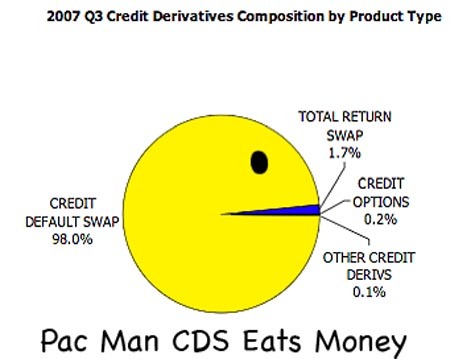
  • Naked Truth on Default Swaps

    In the end we have another round of sophistry hiding the fact that it is all about third parties taking bets on a horse.
    Markets work well as a rule based game.  They fail miserably when rules are constantly changed out by the legal profession to satisfy the financial whims and greed of a client.  This is the creation of non reserve insurance and the losses have been horrific. 
    Obviously a no interest bet opens the door wide to outright insurance fraud because there is no downside.  After all, the perp is hidden offshore.  It would have taken the criminals exactly one sales pitch to figure this one out.
    Naked short selling, now naked insurance all have one thing in common.  The gambler can win if he is able to destroy the victim.  True stock manipulation begins with short selling and its ilk.  Gamblers are proactive in this regard however they cloud their actions.
    The choicest irony was watching Lehman bros scream about the practice as they went down.
    It is completely possible to reform the security trading industry but no one ever would let someone who had a clue near the game.  The victims continue to be citizens and the US economy in general because a huge amount of capital is simply diverted away from its intended destination.
    If a thousand investors decide to support a new energy source with ten million dollars and this money is diverted into a short selling syndicates account and the company is then starved into a profoundly disadvantageous financing that provides only a fraction of the money, while the balance is appropriated by the syndicate, then by most natural measures, a fraud has taken place.
    This is not clearly blocked by the SEC who only squawks once in a while.
    Naked Truth on Default Swaps
    nytimes
    On Thursday May 20, 2010,
    Should people be able to bet on your death? How about your financial failure?
    In the United States Senate, Wall Street won one this week when the Senate voted down a proposal to bar the so-called naked buying of credit-default swaps. If that were the law, you could not use swaps to bet a company would fail. The exception would be if you already had a stake in the company succeeding, such as owning a bond issued by the company.
    On the other side of the Atlantic, Germany announced new rules to bar just such betting — but only if the creditors were euro area governments.
    None of this argument would be taking place if regulators had done their jobs years ago and classified credit-default swaps as insurance.
    As it happened, however, clever people on Wall Street followed the prescription laid down by Humpty Dumpty in Lewis Carroll’s “Through the Looking Glass:”
    “When I use a word,” Humpty Dumpty said, in rather a scornful tone, “it means just what I choose it to mean — neither more nor less.”
    When Alice protested, Humpty Dumpty replied that the issue was “which is to be master — that’s all.”
    The word here is “swap.” It used to mean, well, a swap. In a currency swap, one party will win if one currency rises against another and lose if the opposite happens.
    Credit-default swaps are, in reality, insurance. The buyer of the insurance gets paid if the subject of the swap cannot meet its obligations. The seller of the swap gets a continuing payment from the buyer until the insurance expires. Sort of like an insurance premium, you might say.
    But the people who dreamed up credit-default swaps did not like the word insurance. It smacked of regulation and of reserves that insurance companies must set aside in case there were claims. So they called the new thing a swap.
    In the antiregulatory atmosphere of the times, they got away with it. As Humpty would have understood, Wall Street was master. Because swaps were unregulated, calling insurance a swap meant those who traded in them could make whatever decisions they wished.
    That decision, perhaps more than anything else, enabled the American International Group to go broke — or, more precisely, to fail into the hands of the American government. Had it been forced to set aside reserves, A.I.G. would have stopped selling swaps a lot sooner than it did.
    The decision that swaps were not insurance meant that anyone could buy or sell them — or at least anyone who could find a counterparty.
    Had credit-default swaps been classified as insurance, the concept of “insurable interest” might have been applied. That concept says that you cannot buy insurance on my life, or on my house, unless you have an insurable interest.
    Gary Gensler, the chairman of the Commodities Future Trading Commission, recently laid out the history of that concept. It did not exist until the 18th century, when many people — not just owners of ships or cargos — began buying insurance against ships sinking.
    More ships began sinking, and insurers cried foul.
    The British Parliament outlawed such sales of ship insurance in 1746. Ever since, to buy that insurance you had to have an interest in the ship or its cargo. But it was another 28 years before Parliament extended the idea to life insurance.
    So should it be illegal for me to buy credit-default swaps on companies even if I have no other interest in the company? And if I have an interest, should I be limited to buying only enough insurance to cover my exposure? That is, if I own $100 million in XYZ Corporation bonds, should I be able to buy $1 billion in insurance against an XYZ default?
    To most on Wall Street, the answer is obvious: let markets function. My buying that insurance will probably drive up the price, and serve as a market indication that people are worried about the credit, which is good because it gives a warning to others.
    In any case, it is legal to sell stocks short. That, too, is a way to bet that a company will fail. So what’s the difference?
    One difference is that many people short stocks because they deem them overvalued, not because they think the company will go broke. They can profit even if the company does well, so long as the stock does turn out to have been overvalued.
    Many who despise credit-default swaps argue that they can be used to force companies to fail. The swap market is thin, and even a relatively small purchase can drive up prices. That very movement may make lenders nervous, cause liquidity to dry up and bring on unnecessary bankruptcies.
    There is another, little noticed, possible impact of credit-default swaps. They can undermine bankruptcy laws.
    Normally, a creditor wants to keep a company out of bankruptcy if there is a decent chance it can survive. If it does go broke, the creditor wants to maximize the value of the company anyway, so that more will be available to pay creditors.
    But what happens if a major creditor, who might even control one class of bonds, has a much larger position in credit-default swaps?
    Will he not have interests directly at odds with those of other creditors, since he will do better if the company ends up with less to pay its creditors? Might that creditor seek to, and perhaps be able to, sabotage the company’s best hopes for revival?
    At a minimum, such things should be disclosed, but that gets tricky when one part of a megabank (the one with the bonds) claims it is run independently from the other (the one with the swaps).
    I don’t know whether it is necessary to treat credit-default swaps like insurance and require someone to have an insurable interest before swaps can be purchased.
    The financial reform bill now being debated in the Senate has provisions intended to assure that many of the previous swap abuses are not repeated.
    But I do think Germany’s decision was ill considered. First, it may have little effect if other countries do not join in. Buying a swap in New York or London, rather than Frankfurt, will not be difficult.
    But the more important issue is one of limiting the targets of credit-default swap purchases. If Germany had simply required buyers of credit-default swaps to have an insurable interest, it would have been standing up for a principle.
    By limiting the scope to swaps on debt of euro area governments, the German government sends two signals: it is acting in self-interest, and it is still worried that it may have to finance more bailouts.
    Top of Form
  • Purple Pokeberries Coat Solar


    I am not sure that I believe in the likely efficiency of this protocol.  It sounds like a great story.  The ‘cans’ work best the smaller that they are and that means likely colorants will clog rather than coat.   Of course, this article likely is telling us little or nothing about the practical aspects of this protocol.  Just those pokeberries can provide a convenient dye.
    Red dyes normally deteriorate quickly in the sun so that becomes another issue.
    In short, I can not see how this would work at all.  We will have to wait for more information on this one. 
    Tiny cans acting as quantum wells have been played with and are a promising avenue for solar power.  They would be sealed behind a transparent layer though.  This is not what they seem to be talking about.
    Purple Pokeberries Hold Secret To Affordable Solar Power Worldwide
    by Staff Writers

    Winston-Salem NC (SPX) May 03, 2010

    Pokeberries – the weeds that children smash to stain their cheeks purple-red and that Civil War soldiers used to write letters home – could be the key to spreading solar power across the globe, according to researchers at Wake Forest University’s Center for Nanotechnology and Molecular Materials.

    Nanotech Center scientists have used the red dye made from pokeberries to coat their efficient and inexpensive fiber-based solar cells. The dye acts as an absorber, helping the cell’s tiny fibers trap more sunlight to convert into power.

    Pokeberries proliferate even during drought and in rocky, infertile soil. That means residents of rural Africa, for instance, could raise the plants for pennies. Then they could make the dye absorber for the extremely efficient fiber cells and provide energy where power lines don’t run, said David Carroll, Ph.D., the center’s director.

    “They’re weeds,” Carroll said. “They grow on every continent but Antarctica.”

    Wake Forest University holds the first patent for fiber-based photovoltaic, or solar, cells, granted by the European Patent Office in November. A spinoff company called FiberCell Inc. has received the license to develop manufacturing methods for the new solar cell.

    The fiber cells can produce as much as twice the power that current flat-cell technology can produce. That’s because they are composed of millions of tiny, plastic “cans” that trap light until most of it is absorbed. Since the fibers create much more surface area, the fiber solar cells can collect light at any angle – from the time the sun rises until it sets.

    To make the cells, the plastic fibers are stamped onto plastic sheets, with the same technology used to attach the tops of soft-drink cans. The absorber – either a polymer or a less-expensive dye – is sprayed on. The plastic makes the cells lightweight and flexible, so a manufacturer could roll them up and ship them cheaply to developing countries – to power a medical clinic, for instance.

    Once the primary manufacturer ships the cells, workers at local plants would spray them with the dye and prepare them for installation. Carroll estimates it would cost about $5 million to set up a finishing plant – about $15 million less than it could cost to set up a similar plant for flat cells.

    “We could provide the substrate,” he said. “If Africa grows the pokeberries, they could take it home.
    “It’s a low-cost solar cell that can be made to work with local, low-cost agricultural crops like pokeberries and with a means of production that emerging economies can afford.”
  • Katla, Oh Katla!


    Not a lot to say yet, but this is not a volcano that is dormant and the prospect of a major eruption is quite real.  It is still going to takes us by surprise no day.
    The worst case scenario is in fact a worst case scenario that will be an order of magnitude larger than next door. Everything you can imagine becomes possible.
    Katla Volcano Update 21 May 2010
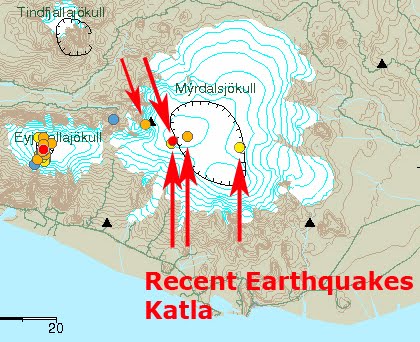
    The earthquakes at the Katla volcano site appear to possibly be increasing in frequency as of this moment (time will tell however). Since May 17 there have been four earthquakes at or very near Katla, while a 5th just on the edge of the Myrdalsjokull glacier.
    Although 4 or 5 earthquakes at the volcano site in 4 days does not indicate a drastic change in pattern, the interesting notation at the moment is the fact that  the two most recent earthquakes occurred within 3 hours of each other on 21 May, 2010, at depths of 5km and 13km. That in itself is an increase in occurrence. It may be an anomaly, but it justifies keeping one eye on Katla, the big sister of Eyjafjallajokull.
    What do these volcanic earthquakes tell us about what is going on at the Katla volcano?
    One type of volcanic earthquake may indicate that changes are occurring due to magma moving in to an area of the rock which changes the pressure around it. At some point, the rock will break or move. If this type of earthquake becomes frequent, and a lot of earthquakes begin occurring or swarming (Earthquake swarms are when we suddenly start seeing clusters of earthquakes in the same general area over a relatively short period of time), it may be a precursor warning that an eruption is about to happen.
    What we are seeing at Katla, in my opinion is NOT cause for immediate alarm, but it is noteworthy to observe this recent activity and to stay up to date with what is happening there.
    There is something going on beneath the ice.
    Katla historically erupts following the eruption of Eyjafjallajokull (April 14), is possibly 10 times more powerful, and has the potential to cause worldwide disruption.
    Earthquake Map Source: Icelandic Meteorological office – their maps show only last 48 hours, so I have kept a separate view to include the Katla quakes since 17-May-2010 as of this post date
    Posted: May 21, 2010 | By: Modern Survival Blog
    Filed under: natural disasters
  • Antimatter Surprise


    Every once in a while theorists get a firm kick in the pants.   This is one of them.  My own work introduces a generalized cyclic metric that is naturally asymmetric but does not obviously make matter – antimatter reactions asymmetric. 
    Of course our characterization of the two types of particles as symmetrically opposite may be wrong altogether.  I can not rule that out.  Close enough is sufficient to keep us off the track.
    We now know that the universe has been grinding up the anti particle inventory  in an odd way not obviously predicted by any present theory.  This is a most unexpected result.
     
    Scientists discover explanation for why the Universe exists
    Thu May 20, 2:41 PM
    Michael Bolen
    Yahoo! Canada News
    Physicists have long wondered why the universe exists when matter and anti-matter particles obliterate each other on contact.

    But new data from a particle accelerator in the United States suggests a reason.
    The tests showed that when anti-protons and protons collide, the resulting new particles show a one per cent skew toward matter over anti-matter. Over a long period of time, this characteristic of the universe could explain why matter has come to dominate over anti-matter.
    “Many of us felt goose bumps when we saw the result,” said Stefan Soldner-Rembold, a physicist at the University of Manchester in the United Kingdom.
    “We knew we were seeing something beyond what we have seen before and beyond what current theories can explain.”
    Every basic particle of matter has a matching anti-particle. The anti-particle has the same mass as the standard particle, but an opposite electric charge. Anti-matter is not to be confused with dark matter.
    While anti-matter has been demonstrated in numerous experiments, dark matter remains a hypothesis used to help explain the effects of mass which scientists cannot currently see.
    The dark matter hypothesis helps to explain why the universe hasn’t expanded into a cold and relatively motionless void. The extra mass, and resulting gravity, is the reason galaxies form into clumps rather than flying apart.
    Particle accelerators, such as the Tevatron collider at the Fermi National Accelerator Laboratory in Illinois, which conducted the tests, and the Large Hadron Collider at CERN on the Swiss-French border, use electric fields to smash particles into each other at incredibly high speeds.
    Scientists then study the particles that are created. Researchers seek larger and larger accelerators in order to create collisions that more closely resemble those which took place soon after the Big Bang 13.7 billion years ago, when the temperature and density of the universe were much higher.
    The new findings deviate from what is known as the Standard Model, the theory created in the 1970s to explain the complex interaction of sub-atomic particles.
    Up until now, the model predicted a small preference toward matter over anti-matter, but not enough to explain the structure of the universe we see today.
    The findings come ahead of an experiment to be held at CERN, called LHCb, also aimed at explaining matter’s dominance.
    Consequently, the results of the test in the U.S. could soon be confirmed and expanded, forming the basis for a new or amended quantum theory.
  • Hubble Watches as Star Slowly Devours Planet


    A neat illustration of what appears to be an exoplanet been ground up.  We actually can not see it of course, so this will have to do.
    We continue to improve our ability to see planet around other stars and have shown that such is completely common.  Also the variation predicted is very much there.
    At least a reborn Star Trek will have plenty of strange starscapes to explore.
    This still makes nice eye candy.
    Hubble Watches as Star Slowly Devours Planet
    May 20, 2010  |  
    Six hundred light-years from Earth, a huge exoplanet circling close to its home star is slowly, inexorably being devoured.
    WASP 12B orbits just 2 million miles from its star, which means the surface of the planet reaches temperatures over 2,800 Fahrenheit. The sun’s gravitational pull is stronger on the front surface of the planet than on the back, so the planet has been pulled into a football shape. If you were floating on the gaseous planet, and looking heavenward, the sun would take up nearly the entire sky.
    And in the next 10 million years, the star that so dominates the planet will destroy it, according to a paper published in May in The Astrophysical Journal Letters.
    It’s not exactly the kind of solar system that human beings anticipated finding in the great beyond.
    “All sorts of things that we never expected to find we’re finding,” said Carole Haswell, an astronomer at The Open University in Great Britain and the lead author on the new paper. “Our preconceptions about what planetary systems might look like were shaped by what our own solar system looked like, particularly Star Trek,” she joked.
    She and her team used the Hubble Space Telescope’s Cosmic Origins Spectrograph to investigate the planet by looking in the ultraviolet part of the spectrum.
    “The near ultraviolet is a very sensitive probe to the presence of stuff and that allows you to deduce an effective radius for the planet,” she said.
    WASP 12B has a puffed up atmosphere that its star is siphoning off. That observation happily matches theoretical predictions made just a few months ago by astronomer Shu-lin Li at Peking University, Beijing. The confirmation shows yet again that exoplanetology, particularly the study of other solar systems not just individual planets, is advancing at a breakneck pace.
    “It is a really nice example of theorists predicting something and we’d already observed something close to what they predicted,” Haswell said.
  • New Aircraft Design 70% More Fuel Efficient.


    This work is presently conceptual but perhaps timely.  Converting concept to practical aircraft is pretty quick these days so we could see these craft a lot quicker than we are used to.
    The massive fuel savings will serve to drive the present fleet into early obsolescence.  In short, this will be as sharp a conversion as the advent of the 747 in the mid sixties.  And in time, it will drive down the cost of air travel.
    No one can fight a fifty percent fuel saving let alone a 70% fuel saving.
    They are projecting 2035 for these craft.  I think we will see birds as quickly as 2020 simply because the fuel argument is just too compelling.  And it would give Boeing a massive jump on its rivals. Who would swiftly be playing catch up.
    MIT-Led Team Designs Two Airplanes That Would Use 70% Less Fuel Than Current Models
    15 May 2010
    An MIT-led team has designed an airplane that is estimated to use 70% less fuel than current planes while also reducing noise and emission of NOx. The design was one of two that the team, led by faculty from the Department of Aeronautics and Astronautics, presented to NASA last month as part of a $2.1 million research contract to develop environmental and performance concepts that will help guide the agency’s aeronautics research over the next 25 years.

    Known as “N+3” to denote three generations beyond today’s commercial transport fleet, the research program is aimed at identifying key technologies, such as advanced airframe configurations and propulsion systems, that will enable greener airplanes to take flight around 2035.


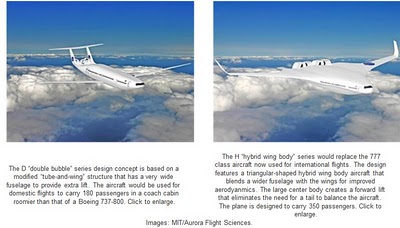
    The D “double bubble” series design concept is based on a modified “tube-and-wing” structure that has a very wide fuselage to provide extra lift. The aircraft would be used for domestic flights to carry 180 passengers in a coach cabin roomier than that of a Boeing 737-800. Click to enlarge.


    The H “hybrid wing body” series would replace the 777 class aircraft now used for international flights. The design features a triangular-shaped hybrid wing body aircraft that blends a wider fuselage with the wings for improved aerodyanmics. The large center body creates a forward lift that eliminates the need for a tail to balance the aircraft. The plane is designed to carry 350 passengers. Click to enlarge.
    MIT was the only university to lead one of the six US teams that won contracts from NASA in October 2008. Four teams—led by MIT, Boeing, GE Aviation and Northrop Grumman, respectively—studied concepts for subsonic commercial planes, while teams led by Boeing and Lockheed-Martin studied concepts for supersonic commercial aircraft. MIT team members include Aurora Flight Sciences Corporation and Pratt & Whitney.

    The objective was to develop concepts for, and evaluate the potential of, quieter subsonic commercial planes that would burn 70% less fuel and emit 75% less NOxthan today’s commercial planes. NASA also wanted an aircraft that could take off from shorter runways.

    The MIT team met NASA’s challenge by developing two designs: the 180-passenger D “double bubble” series to replace the Boeing 737 class aircraft, currently used for domestic flights, and the 350 passenger H “hybrid wing body” series to replace the 777 class aircraft now used for international flights.
    The engineers conceived of the D series by reconfiguring the conventional tube-and-wing structure. Instead of using a single fuselage cylinder, they used two partial cylinders placed side by side to create a wider structure whose cross-section resembles two soap bubbles joined together. They also moved the engines from the usual wing-mounted locations to the rear of the fuselage.

    Unlike the engines on most transport aircraft that take in the high-speed, undisturbed air flow, the D-series engines take in slower moving air that is present in the wake of the fuselage. Known as the Boundary Layer Ingestion (BLI), this technique allows the engines to use less fuel for the same amount of thrust, although the design has several practical drawbacks, such as creating more engine stress.

    According to Mark Drela, the Terry L. Kohler Professor of Fluid Dynamics and lead designer of the D series, the design mitigates some of the drawbacks of the BLI technique by traveling about 10% slower than a 737. To further reduce the drag and amount of fuel that the plane burns, the D series features longer, skinnier wings and a smaller tail.
    Not only does the D series meet NASA’s long-term fuel burn, emissions reduction and runway length objectives, but it could also offer large benefits in the near future because the MIT team designed two versions: a higher technology version with 70% fuel-burn reduction, and a version that could be built with conventional aluminum and current jet technology that would burn 50% less fuel and might be more attractive as a lower risk, near-term alternative.

    Carl Burleson, the director of the Federal Aviation Agency’s Office of Environment and Energy, said that in addition to its “really good environmental performance,” the D series is impressive because its bubble design is similar enough to the tube-and-wing structure of current planes that it should be easier to integrate into airport infrastructure than more radical designs. “You have to think about how an airport structure can support it,” he said. “For some other designs, you could have to fundamentally reshape the gates at airports because the planes are configured so differently.

    Although the H series utilizes much of the same technology as the D series, including BLI, a larger design is needed for this plane to carry more passengers over longer distances. The MIT team designed a triangular-shaped hybrid wing body aircraft that blends a wider fuselage with the wings for improved aerodyanmics. The large center body creates a forward lift that eliminates the need for a tail to balance the aircraft.

    The large structure also allows engineers to explore different propulsion architectures for the plane, such as a distributed system of multiple smaller engines. Although the H series meets NASA’s emissions-reduction and runway-length goals, the researchers said they will continue to improve the design to meet more of NASA’s objectives.

    The MIT team expects to hear from NASA within the next several months about whether it has been selected for the second phase of the program, which will provide additional funds to one or two of the subsonic teams in 2011 to research and develop the technologies identified during the first phase. The researchers acknowledge that some propulsion system technology still needs to be explored. They have proposed evaluating the interactions between the propulsion system and the new aircraft using a large-scale NASA wind tunnel. Even if the MIT designs are not chosen for the second phase, the researchers hope to continue to develop them.
  • Frank Popper on Shrinking Cities

    I have posted on the Poppers work on the Buffalo Commons concept a couple of years back.  Here he is addressing the deteriation of the urban environment in the Midwest in particular.  It is well worth a read.
    The problem as we presently experience it is one of a lack of a well thought out and sustained economic base.  It has been far too easy to just let growth happen and when the drivers of that growth dissipated it became too late to respond.
    Perhaps cities are meant to be more ephemeral than we would like.  Certainly that was true in the small towns of the Great Plains and in the Canadian Prairies in particular.  Cities were meant to last longer.
    The core problem is a lack of a working community template that is inherently stable and also responsive.  I think that I can make this happen in a rural environment and distribute urban populations into that environment.  Such a system may then support the urban environment.
    China seems to have achieved something like this out of centuries of custom, as perhaps has India and Europe.  None of it is properly supported nor even properly encouraged but it is still more stable than the North American experience.    
    The first failure of the US urban environment is the existence of a large proportion of impoverished residents who are poorly utilized as a source of general community wealth generation.  Their housing is typically substandard and access to services can be described as grudging.  Yet they see the city as their only hope and remain.
    This group can naturally be folded into a proper agro village style environment were their presence is economically fruitful and support is inexpensive to provide by design.  They also supply the one resource presently missing in modern agriculture and that is occasional manpower.
    Modern transportation accesses the urban amenities including urban employment.
    The simple idea is to marry a  modern high rise village compound to a working farm integrating the two as much as may be possible and even desirable while providing a fruitful life way for all age groups.
    This is presently not done in the urban environment and is not feasible on the modern farm. I argue that this is the primary source of the lack of sustainability.
    An Interview with Frank Popper about Shrinking Cities, Buffalo Commons, and the Future of Flint
    FRIDAY, MAY 14, 2010
    Deborah and Frank Popper
    http://www.flintexpats.com/2010/05/interview-with-frank-popper-about.html

    What do shrinking cities like Flint have in common with remote grazing land in Colorado?

    Frank J. Popper is just the person to answer that question. The land-use expert from Chicago is a professor at Rutger’s Edward J. Bloustein School of Planning and Public Policy and teaches regularly in the Environmental Studies Program at Princeton. In 1987 he published an article with his wife, Deborah Popper, a geographer at City University of New York and Princeton University, advocating the creation of what they called the Buffalo Commons. They argued that using the drier portions of the Great Plains for farming and ranching was unsustainable, leading to environmental damage and a dwindling population. Instead, they suggested returning 139,000 square miles of the Great Plains to native prairie where the buffalo could, once again, roam. In short, they wanted to turn parts of ten western states into a vast nature preserve.

    Nicholas Kristof of The New York Times called it “the boldest idea in America today…the biggest step to redefine America since the Alaska purchase.” The locals is states like Kansas, Montana and Nebraska were less enthused.

    In an interview with Flint Expatriates, Popper discusses death threats, the links between deindustrialization and agricultural decline, the fate of shrinking cities, and the heartless genius of capitalism.


    What was the response to the Buffalo Commons idea?

    It was extremely negative in the region. Everyone else from outside the region thought it was a great idea. There was a period in the early nineties when we were speaking in the plains five times a year and sooner or later it would emerge that they had hired private detectives to protect us. We had death threats at one meeting that eventually had to be cancelled. If you’re county is suggested as part of the Buffalo Commons, you’re not going to like it very much.


    Have conditions in the Great Plains changed over the years?

    The basic conditions that we described in 1987 are either still there or have intensified. But late last year we picked up our first serious editorial endorsement. Two McClatchy papers in Kansas City and Wichita suggested that two counties in western Kansas should become the core of Buffalo Commons National Park, and that elicited a lot of letters from those two counties. But I think over time it will work and we will live to see it.

    The emerging ideas about how to deal with shrinking cities like Flint echo a lot of your recommendations from the eighties about how to approach the Great Plains. What’s the connection?

    It’s very clear that the industrial decline as it’s still unfolding is almost exactly parallel to the earlier rural decline in the United States. In rural areas, agriculture reached a high point in the late 19th century, and then it started going through a kind of slow motion collapse that the country largely didn’t realize until the dust bowl of the depression. In the 20th century, the industrial sector likewise hits its high point and then started shedding people, only it happened in more urban places like Detroit. The U.S. had these two great cycles play out. And there is the beginning of an argument that the dotcom bust, the mortgage foreclosure crisis and the credit crunch that has now hit a number of sunbelt cities really hard indicates that the information age is beginning to shed people, too. And it’s a largely suburban phenomena so you have a trifecta of decline — rural agricultural, urban industrial, and suburban information age.

    Why are cities and regions so reluctant to accept that they are getting smaller?

    It’s part of American culture to believe were number one, we grow every year etc., etc. So all of this — whether its Buffalo Commons or shrinking cities — feels very un-American. A lot of people ended up describing Buffalo Commons as manifest destiny in reverse, which kind of makes sense. Shrinking cities could be described as unbuilding cities that all those late 19th-centrury, early 20th-century industrialists and laborers sought to build up. And that hurts for their descendants down the line. It also comes with another sort of sting. Good blue-collar jobs that promised upward mobility have just disappeared.

    A population density map of the United States. Click to enlarge

    How does America’s approach shrinking cities compare to the rest of the world?

    I think the American way is to do nothing until it’s too late, then throw everything at it and improvise and hope everything works. And somehow, insofar as the country’s still here, it has worked. But the European or the Japanese way would involve much more thought, much more foresight, much more central planning, and much less improvising. They would implement a more, shall we say, sustained effort. The American way is different. Europeans have wondered for years and years why cities like Detroit or Cleveland are left to rot on the vine. There’s a lot of this French hauteur when they ask “How’d you let this happen?”

    Do shrinking cities have any advantages over agricultural regions as they face declining populations?

    The urban areas have this huge advantage over all these larger American regions that are going through this. They have actual governments with real jurisdiction. Corrupt as Detroit or Philadelphia or Camden may be, they have actual governments that are supposed to be in charge of them. Who’s in charge of western Kansas? Who’s in charge of the Great Plains? Who is in charge of the lower Mississippi Delta or central Appalachia? All they’ve got are these distant federal agencies whose past performance is not exactly encouraging.

    Why wasn’t there a greater outcry as the agricultural economy and the industrial economy collapsed?

    One reason for the rest of the country not to care is that there’s no shortage of the consumer goods that these places once produced. All this decline of agriculture doesn’t mean we’re running out of food. We’ve got food coming out of our ears. Likewise, Flint has suffered through all this, but it’s not like it’s hard to buy a car in this country. It’s not as if Flint can behave like a child and say “I’m going to hold my nose and stop you from getting cars until you do the right thing.” Flint died and you can get zero A.P.R. financing. Western Kansas is on its last legs and, gee, cereal is cheaper than ever.

    In some sense that’s the genius of capitalism — it’s heartless. But if you look at the local results and the cultural results and the environmental results you shake your head. But I don’t see America getting away from what I would call a little sarcastically the “wisdom” of the market. I don’t think it’s going to change.

    So is there any large-scale economic fallout from these monumental changes?

    Probably not, and it hurts to say so. And the only way I can feel good about saying that is to immediately point to the non-economic losses, the cultural losses. The losses of ways of life. The notion of the factory worker working for his or her children. The notion of the farmer working to build up the country and supply the rest of the world with food. We’re losing distinctive ways of life. When we lose that we lose something important, but it’s not like The Wall Street Journal cares. And I feel uncomfortable saying that. From a purely economic point of view, it’s just the price of getting more efficient. It’s a classic example of Schumpeter’s theory of creative destruction, which is no fun if you’re on the destruction end.

    Does the decline of cities like Flint mirror the death of the middle class in the United States?


    I think it’s more the decline of the lower-middle class in the United States. Even when those jobs in the auto factories paid very high wages they were still for socially lower-middle-class people. I think there was always the notion in immigrant families and working-class families who worked in those situations that the current generation would work hard so that the children could go off and not have to do those kind of jobs. And when those jobs paid well that was a perfectly reasonable ambition. It’s the cutting off of that ambition that really hurts now. The same thing has been true on farms and ranches in rural parts of the united states.

    The basic premise of shrinking cities resonates with a lot of people, but there’s not a lot detail in the plan. Is this a concern?

    The shrinking city approach is really the core of what’s needed to improve these places. I guess what I see is an emerging movement that’s improvising every step of the way, often under extreme political pressure. My sense is that it’s sort of like Boris Yeltsin in the ‘90s, making it up as he goes along because he has no other options. That’s not meant as a criticism at all. Cities like Flint and Detroit have gotten so desperate that a lot of policy Hail Mary’s are necessary. And it’s hard in an era of budget shortfalls, but part of the process will be figuring out what does and doesn’t work. The shrinking city [concept] is sufficiently new that things will be discovered on the fly. And this is not uncommon. My impression is that that’s how the Civil War was fought; that’s how the New Deal was created. It’s how NASA operated in the 1960s, which is thought of as a sort of golden age. This is not an unusual situation.

    What about the prospect of a single business or industry moving into a shrinking city and reviving it?

    In none of these cities — including the Southern and European ones — is there any hope whatsoever of a serious new industry coming. I think I can say that categorically.

    Will relocating residents to a more viable central urban core work?

    When you’re talking about many of these neighborhoods, you’re talking about really poor people who are not likely to move. We’ve tried this at different times and different places in this country, and I don’t think any of them were shining points in American history. It evokes all that 1950s urban renewal stuff which didn’t work, but we keep trying to do anyway. More likely is that you’ll get this reversion to a more rural feel to parts of the city, maybe even a suburban feel. That could provide some form of stability for the city. It could even be a retirement option for some people.

    Care to make a prediction of how this approach will play out in cities like Flint?

    I think a few neighborhoods will benefit and things will turn around precisely because the upside of the shrinking city plan — the green economics, the growth of small retail — will work. But the really poor places, the worst neighborhoods, they’ve got real problems, as they always have. I would worry about the really poor ones. I don’t know what will happen to places like that, and I’m not of good conscience about it.

  • Ron Walters on Slavery

    This article is of course a reasoned rebuttal to the recent article by Gates that I commented on.  We obviously can troop around this circle until hell really freezes over.
    I would like to share a few thoughts.
    The end of slavery coincided with the emergence of fiat money toward the end of the eighteenth century.  Innovation in government finance altered the relationship between labor and land decisively and led to the increasing mobility and independence of labor.
    The original deal, however unfortunate, consisted of shifting labor from one subsistence village with no currency base to another such village.  This village also operated a subsistence economy but was also expected to contribute to the general upkeep of the larger plantation.  That was usually demanding only during harvest.  Though we can be sure plenty of extra work was found.
    My point is that during the eighteenth century there was little change in condition and expectation.  In addition, in this world of short money supply, many whites were also sold off or indentured as a method of economic exchange.  This all meant that the active currency of the time and also for the preceding millennia was the use of a human worker.
    Gold supply was always in short supply and insufficient to the needs of the economy as compared to our present expectations.  Thus a barter economy depended on trade in labor.
    Fortunately in the aftermath of the Roman world, the Christian and Islamic worlds both opposed slavery even though it continued to function unabated until the rise of the use of fiat currency.  A culture of short term slavery persisted often contractual.  I suspect that it was rare for an individual to die in the state of slavery in the European environment, and the ability to end slavery by declaring for Islam surely had the same effect there.  That all may have been moot in Islam for women.
    Then we come up to the last phase of the slavery industry in which the victims were a clearly separate race that simply could not blend in and ultimately escape.  I suspect that Indians who were caught up in slavery simply intermarried resulting in offspring able to pass into white society inside of a single generation.  This was clearly not possible for Africans.
    So at the same time that the classical economic model that created slavery began to actually fail, the owners moved to preserve the slave status of Africans through a presumption of inferiority that evolved into classical racism. This was likely unplanned but a natural tendency which Africans could not escape because of visibility.
    Yet the economic model itself was failing because the advent of increasing monetarization began destroying the margins available and drove the system toward sharecropping at least.  Owners discovered that paying upkeep for twelve months in exchange for a few months of need was a bad bargain.  Ready cash made this very visible.  The last vestiges of it all disappeared with capital driven mechanization.
    Thus tortured as the history is, slavery was a form of classical currency that lasted until an efficient modern currency system arose to displace it.  The remnants we still see today will not survive the implementation of a modern government economy globally over the next two generations.
    Ron Walters…Professor Gates and the Blame for Slavery
    by Dr. Ron Walters
    Originally published May 04, 2010
     (NNPA) — Like everyone else who read Professor Henry L. Gates’ piece in the New York Times asserting that Africans were just as responsible for slavery as Europeans, I was aghast because he is one of the most acclaimed scholars in the country and his position lends credibility to those who oppose an historical corrective for the oppression of African peoples. Admittedly, my concern also arises from the publication of my most recent book on reparations, The Price of Racial Reconciliation, in which I take a strong position favoring reparations as a long time member of this movement. ?
    Although Gates’ argument is cast in scholarly terms, it should be said that he is not a recognized scholar of African history, a fact which has caused him to design a simple equation of the culpability of Africans with Europeans in the slave trade. This cannot be so, even if one accedes his point that Africans were surely involved in the slave trade. ?
    The other side of the story is that in the 300 years from the middle of the 16th to the 19th centuries, the slave trade evolved into one of the primary, if not the engine of the first sincere wave of globalization. The development of trading firms from Spain and Portugal to England were the result of the enormous profits from the trade that enriched towns and cities throughout Europe and the Americas and allowed for the extension of European armies and traders into the interior of Africa to concretize the process of colonialism.
    ?I use the word “concretize” because Gates seems to infer that Africans were on an equal part with Europeans in this process. They were not. Consider if you were a chief who sold an enslaved African to a European and received a bottle of rum or some trinkets for the sale. ?What could you do with that resource? How powerful was it? On the other hand, the person who was sold to the European constituted a dynamic resource because he and she could produce others, could work for years to enrich the owner and with the profits, the owner could create new civilizations. There then, is no sense of “equality” between the two in the process of the exchange of slaves.
    ?But even if you credit Professor Gates’ argument that Africans were just as culpable as Europeans for slavery, how does that wash when it was the Europeans who possessed the gold, salt, trinkets, liquor and other items they could exchange for slaves, together with the means of transporting them to new areas of the globe. Even though Europeans did not traverse the interior of Africa until the middle of the 19th century, they did not need to do so, because most of the West African population was near to the Coastal areas except for the Angola/Congolese areas. The great civilizations of the Mali/Songhai area was defeated by the Islamic invasion beginning in the 7th century and was still under the control of much of North Africa at the time of European entry into Africa. ?
    So, Europeans built fortresses on the coast of West Africa to administer the process of slavery made possible by the introduction of European armies that did make forays into the interior and back to the coast with slaves. In short, the truth is that if Europeans did not have the infrastructure for slavery, it would not have been profitable to Africans and thus, would not have become the vast commercial global enterprise that it did.?
    I consider the slave trade one of the aspects of what I call “The Grand Narrative of Oppression.” This narrative has many parts. Professor Gates’ argument does not take into consideration the fact that when the transatlantic slave trade ended, a local slave trade matured inside the United States run by Whites with the same features of production and distribution of enslaved peoples that carried over from the original trade. ?
    Then, he does not consider the fact that slavery itself extended into the 20th century and that the racism against so-called “free” peoples of African descent became a major feature of oppression that also calls for reparations.?
    While writing my book, I was in South Africa and ran into a Zulu chief who understood reparations this way: my friend stole my bicycle from me, then he came to me several months later and wanted to be my friend again. ?
    I told him that he must return the bicycle first. His friend hesitated because not only did he not have the bicycle, he had used it to enrich himself beyond the status of his friend. Thus, the issue of reparations is one of justice. With the monumental profits that were derived from the slave, although one can accede to the fact that Africans did participate in the transatlantic slave trade, one cannot equate that with European culpability for slavery. ? ?
    Dr. Ron Walters is a political analyst and professor emeritus of the University of Maryland College Park. His latest book is “The Price of Racial Reconciliation”(University of Michigan Press).
  • Roman and Medieval Conformed in Himalyas


    This item is a solid confirmation of a global climate effect that is outside of the experience of Europe and further confirms the strength of the millennial cycle recently posted on in this blog.
    This means that all climate modeling must build in this thousand year long bias which is presently upward for the next few centuries.  It is not a great shift but it is certainly positive.  The total amplitude over the entire range is under two degrees and we are likely just entering the warm part for the next several centuries.
    It is safe to grow those grape vines in northern latitudes and it is time to begin dairy farming in Greenland again.
    The cycle length looks pretty close to been just under one thousand years to a high degree of certainty over the past several thousands of years.  Any switch over happens within a fifty year period.
    The Roman and Medieval Warm Periods at Paradise Lake, Northwestern Himalaya


    Reference
    Bhattacharyya, A., Sharma, J., Shah, S.K. and Chaudhary, V. 2007. Climatic changes during the last 1800 yrs BP from Paradise Lake, Sela Pass, Arunachal Pradesh, Northeast HimalayaCurrent Science 93: 983-987.
    What was done

    The authors developed a relative history of atmospheric warmth and moisture covering the last 1800 years for the region surrounding Paradise Lake — which is located in the Northeastern Himalaya at approximately 27°30.324’N, 92°06.269’E — based on pollen and carbon isotopic (δ13C) analyses of a one-meter-long sediment profile they obtained from a pit “dug along the dry bed of the lakeshore.”

    What was learned

    Bhattacharyya et al. report that their climatic reconstruction revealed a “warm and moist climate, similar to the prevailing present-day conditions,” around AD 240 — which would represent the last part of the Roman Warm Period — as well as another such period that turned out to be “more warmer [our italics] 1100 yrs BP (around AD 985) corresponding to the Medieval Warm Period.”

    What it means

    The existence of these two periods — the former of which was at least as warm as the present, and the latter of which was actually warmer than the present — occurring at times when the atmosphere’s CO2 concentration was more than 100 ppm less than it is today, clearly suggests that today’s warmth could well be due to a repeat performance of whatever it was that produced the equally high and higher temperatures, respectively, of these two earlier warm periods. And this study is but one of many distributed throughout the world that suggest the very same thing, as illustrated by the data we have archived in our Medieval Warm Period Project. Therefore, with each passing week,literally (because we post a new such study in each week’s new issue of CO2 Science), it becomes ever more difficult for climate alarmists to claim that our current warmth is unprecedented over the past two millennia or more, and that it must thus be due to anthropogenic CO2 emissions.

  • Katla Warms Up


    If I were living in Europe I would buy some insurance in the form a few large sacks of rice.  Not great, but it will let you get by when food runs out.  Other options exist, but rice serves wonderfully in a real emergency.
    If nothing happens, I have a never ending supply.  Of course plenty of other things can be acquired that you will consume over time anyway.  however, you do not want to be caught out with an empty cupboard and a collapsed distribution system.
    I have already posted on Katla and today we have the first disturbance registered that I am aware of.  These things will build up over time before we reach the eruption stage.  Or at least I hope so.  A massive explosion causing a huge tsunami along the European coast would ruin our day.  Hekla did just that in 1159BCE and ended the European Bronze Age and the Atlantean culture.
    Fortunately Katla just likes to spew lots of ash as far as we know and that will be a handful enough.  If we are lucky, this will brew until we are past harvest.  A blast during the winter will be a lot more recoverable, if only because we can plant cold weather crops if we have to.  I hope you like barley and potatoes and oats.
    Respect what you are seeing folks.  This sucker is running to form and that means it will begin erupting within the next few months.  It will erupt with an ash output ten time worse than the present eruption. 
    This first quake is essentially on schedule.
    Katla Earthquake May Presage Next Volcanic Explosion
    Published: May 18, 2010
    Just to add to the ink needs of European central banks, the Iceland met office reports that it has recorded a small earthquake at the Katla volcano. With Europe already pretty much bankrupt, and the only reason why Europe is still quoted being due to ECB, IMF and Fed backstops, the last thing needed by the troubled continent is the next major volcanic explosion to terminate airline travel indefinitely. As earthquakes tend to not be an indicator of volcanic stability, the most anticipated volcanic explosion in human history may finally be a fact quite soon. We are confident the HFT lobby will somehow determine that volcanic ash clouds add liquidity to the market. Stay tuned.
    On May 17, 2010 08:32 UTC, The Iceland Met office indicates that a small earthquake has occurred at the Katla location. In what could be an early indication of the event that is expected to occur (an eruption of Katla), a small earthquake is reported at the site. Although a single earthquake is not a precursor of an eminent eruption, it could be the first ’sigh’ of the awakening powerful giant.
    Historically, Katla has erupted after the eruption of it’s close neighbor, Eyjafjallajokull, which first erupted on April 14, 2010 and is ongoing at this moment. Magma channels beneath to the two volcanoes are thought to be interconnected. A Katla eruption would likely be about ten times as powerful at the Eyjafjallajokull eruption and could cause worldwide disruption while expelling huge volumes of volcanic ash into the stratosphere which would circle the globe potentially for years, depending upon the magnitude of the eruption.
    Not to be alarmist, but have you started? your food storage plan? Basic survival preparedness is a personal responsibility that was simply a way of life of our ancestors. Let’s not forget how.
  • Black Swan Time


    This item is from Richard Russell who has spent his career tracing the markets and trying to stay ahead.  He is clearly scared.  I certainly am uncomfortable.  I am uncomfortable that he is uncomfortable.  I know all the trends and expectations are grinding down the general liquidity of the market.  It is presently vulnerable to a black swan event when something hits out of the blue that triggers a market washout.
    I experienced this in the weeks prior to the 1987 abrupt market collapse and traded into a defensive position to protect my book.
    I also sensed the vulnerability in the week just prior to 9/11.  Something about the markets triggered my internal red flags.
    There were many other instances over the years and it is curious how often markets seem to sense a pending shift.
    One of my better upside calls was to bid Canada 9.5% at 61 in June 1982 and also predict a market boom beginning September of that year.  I was not noted for ever throwing caution to the wind.
    The markets are locked and cocked for a major general decline.  Without a trigger event, it will simply grind out over the next few months.  A trigger event will make it swift.
    What I will try to do now is construct a list of potential black swan events able to produce massive global disruption and a grossly collapsed market.  This list are possibilities whose probability is non zero.
    A         Gross Geology. 
    Katla blows and Europe does without a crop this year.  A massive collapse of the already weakened euro zone economies takes place.  The rest of the globe struggles to move food supplies to save tens of millions from eminent starvation.  The Volcano continues to spew indefinitely.
    No other prospect is presently showing activity but this is quite enough to put Europe out of action for two years at least.
    B         Terrorist Nuclear Bomb
    Nuclear war at the State level is not going to happen simply because it will not be survived by the initiator and this is well understood.
    It is quite plausible for a Pakistani cabal to spirit a nuclear bomb out of the Pakistani nuclear program, or alternatively another such cabal is able to access a former Russian bomb.  It is too soon for the Iranians to do so.
    It is then no trick at all to put such a device into a shipping container and to load it onto a container ship under control of a suicide bomber.  The most damaging target is New York.  However this can also reach Washington, Los Angeles, San Francisco, Hong Kong, Shanghai, Tokyo, Mumbai, Seoul, London, and Rotterdam.
    This fortunately takes real resources to do.  That gives me little comfort because money will not be a problem and neither will personnel. The terrorists have shown that they can overcome all that.  These are real pending threats that are slowly developing.
    The result of such an event could be the Third World War in which the Islamic world would be fully occupied by armies from every other country and where Islam would be forthwith banned with a full reeducation program implemented.  Many millions would die and many more millions would be displaced.
    C         Human Folly
    We are watching the progress of Europe in unwinding its banking difficulties.  I think they can print their way out of the worst and impose discipline on the members.  It is just messy and the declining Euro is helping to focus attention.
    The real bad news is who is going to bail out California?  That is a black swan that can arrive as a bolt of lightening and it has been ignored by Washington to date.  The damage to the banking sector will be once again severe.
    What happens if this triggers a collapse of the pension industry?
    My point is that a lot of very big chickens are coming home to roost and no one has a plan.  I simply do not believe that the problems can work themselves out.  The housing collapse has not been addressed at all.  That I showed how to turn around but no such thing has been done. In short, financial deterioration is continuing and the dead cat bounce has run out of free cash.  There may be no more room to fix any of it.
    Next year we could have millions on the streets as social systems collapse.  That is what happened during the depression.
    My present point is that these are the black swans that I can imagine.  Have a good night’s sleep and recall that no one imagined 9/11 except the perps.
    Dow Theorist Richard Russell: Sell Everything Liquid, You Won’t Recognize America By The End Of The Year
      |
    Joe Weisenthal | May. 18, 2010, 8:57 AM | 66,483 | comment 101
    Richard Russell, the famous writer of the Dow Theory Letters, has a chilling line in today’s note:
    Do your friends a favor. Tell them to “batten down the hatches” because there’s a HARD RAIN coming. Tell them to get out of debt and sell anything they can sell (and don’t need) in order to get liquid. Tell them that Richard Russell says that by the end of this year they won’t recognize the country. They’ll retort, “How the dickens does Russell know — who told him?” Tell them the stock market told him.
    That’s pretty intense!
    Update: By popular demand, here’s more on what he sees in the market. The gist is that the markets recent gyrations are telling him that the economy is in trouble:
    And I ask myself, “Am I seeing things? The April 26 high for the Dow was 11205.03. The Dow is selling as write at 10557 down 648 points from its April high. If business is even better than expected, then why is the Dow down over 600 points? And why, if there were 674 new highs on the NYSE on April 26, were there only 20 new highs on Friday, May 14? And if my PTI was 6133 on April 26, why is it down 17 points since its April high?

    The fact is that I’ve been seeing deterioration in the stock market ever since early-April, and this in the face of improving business news. The D-J Industrial Average is composed of 30 internationally known top-quality blue-chip stocks. These are 30 of “America‘s biggest companies.” If Barron’s is so bullish on the future of America‘s biggest companies, then why isn’t the Dow advancing to new highs?

    Clearly something is wrong. But what could it be? Much as I love Barron’s, I trust the stock market more. If I read the stock market correctly, it’s telling me that there is a surprise ahead. And that surprise will be a reversal to the downside for the economy, plus a collection of other troubles ahead.


    About Dow Theory — First, we saw the recent April highs in the Averages. Then we saw a plunge in both Averages to their May 7 lows — Industrials to 10380.43, Transports to 4298.12, next a short rally. If ahead, the two Averages turn down and violate their May 7 lows, that would be the clincher. Such action would signal the certain resumption of the primary bear market.

    Just as for years I asked, cajoled, insisted, threatened, demanded, that my subscribers buy gold, I am now insisting, demanding, begging my subscribers to get OUT of stocks (including C and BYD, but not including golds) and get into cash or gold (bullion if possible). If the two Averages violate their May 7 lows, I see a major crash as the outcome. Pul – leeze, get out of stocks now, and I don’t give a damn whether you have paper losses or paper profits!

    Read more: http://www.businessinsider.com/dow-theorist-richard-russell-sell-everything-liquid-you-wont-recognize-america-by-the-end-of-the-year-2010-5#ixzz0oKPKTPEO

  • Florida Pythons Hunted


    Somehow, I think that the population of pythons will be outrunning the interest of hunters and whoever.  I do not think thousands of pythons were released.
    In the meantime the everglades have become a dumping ground for far too many pets.  The only solution is going to be the introduction of effective predators.  Perhaps we need the mongoose in particular.  That may intercept the bulk of the snake population while still young.
    The coyote population will surely prosper hunting other pets.  And human hunters can work on the big stuff.
    The unacknowledged problem is that these populations need to be controlled and actively suppressed.  The action always attracts political noise from fools.  That a two year old was strangled is a rather good hint as to why it is necessary to be aggressive.
    How would you like to have a population of pythons as ubiquitous as that of the Canada goose?  I remind folks that that is the type of population some swamps in the Amazon have of boa constrictors.
    These snakes will be attracted to homes and cellars for dens and will not just be a danger but a serious nuisance.
    Pythons in Florida Stalked by Hunters and Tourists Alike
    Published: May 7, 2010
    FLORIDA CITY, Fla. — Thousands of Burmese pythons, the offspring of former pets, have invaded the Everglades, eating birds, bunnies, even alligators. It has gotten so bad that Congress is considering an outright ban on buying or selling nine kinds of giant snakes.
    But an odd thing has happened here in the swamp: the pythons have become celebrities. The snakes are fast becoming an element of Florida lore, attracting “oohs” and “ahhs” from tourists, along with groans from biologists and even python hunters like Bob Freer.
    “It’s a little frustrating and very strange,” said Mr. Freer, who figures that his 40 captured pythons — most of which he has euthanized — make him the state’s top private hunter. “They’re asking about pythons that don’t even belong here, instead of alligators.”
    Trouble is, the newfound fascination obscures what biologists and Mr. Freer describe as a serious problem. In their view, python proliferation — still significant despite a cold winter that might have killed half the population — is simply the sexiest example of widespread disrespect for pets and the wilderness.
    “People need to view exotic species invasions as pollution — biopollution,” said David E. Hallac, chief of biological resources for Everglades and Dry Tortugas National Parks. “In some cases, this form of biopollution can be even more difficult to remedy than chemical pollution, mainly because in most cases, we have no way of cleaning up exotic species from our natural environments.”
    Nowhere is the problem more visible than in the open expanse of southwestern Dade County, where tract housing gives way to sawgrass and airboat engines. Mr. Freer, a grandfather who cuts the sleeves off his T-shirts, has lived here for a decade, giving animal presentations to tourists and running a wildlife refuge that doubles as his home.
    He grew up in rural New York on a dairy farm with a pet alligator, and he used to live north of Miami with another gator (named Lazy) until his neighbors complained. Now Mr. Freer and his third wife are free to mix with whatever animals they like, and there are plenty.
    Near the back of their five-acre property, for instance, sits Rocky, a tiger once owned by a stripper. Buc, an arthritic grizzly bear, lies in a cage next door near the hyenas, Chewy the camel, birds the color of daiquiris, and a Kenyan lemur whose previous owner pulled out its teeth, so that all its food must now be mashed.
    In nearly every case, pet owners gave the animals up or had them taken away by county officials. Pythons, Mr. Freer said, have been part of the mix since the mid-1980s.
    “It was very exciting then to think about these giant snakes and being able to find them here in Florida,” he said. “I never really thought there would come a time when you would actually go out and hunt pythons.”
    State officials say they had no choice — especially after last July, when an eight-foot python sneaked out of its cage north of Orlando and strangled a 2-year-old. It led to a six-week hunting season to reduce the python population.
    “We really wanted the help, and still need it, to get rid of these things,” said Tony Young, a spokesman for the Florida Fish and Wildlife Conservation Commission.
    With all the attention, the snakes became bigger stars. Reporters have interviewed officials at Everglades National Park around 300 times. Mr. Freer, meanwhile, has turned up on Animal Planet and the History Channel’s “Monster Quest,” after an episode about the Hillbilly Beast of backwoods Kentucky.
    He said that he initially understood the alarm. Pythons are what biologists call “apex predators” that eat nearly everything, including endangered species. And there were financial benefits, too: a group of Canadian snake enthusiasts paid him to help find pythons.
    But on a hunting trip in the Southern Glades, a 30,000-acre tract that abuts Everglades National Park, Mr. Freer struggled to shake a sense of melancholy.
    The area has become a dumping ground littered with both human ruin — a shuttered fish farm, a closed juvenile detention camp and a former rocket test site — and abandoned animals. In addition to the pythons, Mr. Freer said he had come across cobras and black mambas, emus and ostriches. Since the recession started, he said, he has seen more horses that owners can apparently no longer afford to feed.
    The python craze, he said, only illustrated a problem far larger than most people recognize. Mr. Hallac, at Everglades National Park, agreed.
    “We have well over a dozen exotic fish that have invaded the park and may pose a threat to our native aquatic organisms,” Mr. Hallac said. “But being that they’re underwater, and not particularly scary to humans, their stories are rarely told.”
    At Everglades Alligator Farm, an adventure park where Mr. Freer manages the animals and puts on shows for visitors, python presentations are still a hit. Rangers at the national park are regularly asked about how to avoid or see the famous pythons.
    Mr. Freer said he now looked forward to a day when pythons were scrubbed from his routine. “People will be asking me about alligators again,” he said, “And that’ll make me happier.”
  • Stretching Artificial Skin


    Not only is this a good working artificial skin, it also displaces the use of live animals in lab work.  Since the latter aspect is an ongoing public relations disaster decades old, it could not be more welcome.
    Otherwise, this should provide a framework for completely healing damaged skin back to close to original state.
    I do not know how long before this is available but it should be rather quick.  It is very good news and should also facilitate improvements in cosmetic surgery.
    Scientists create artificial skin that stretches like the real thing
    16:27 April 28, 2010
    The University of Grenada’s fibrin-agarose artificial skin
    Scientists at Spain’s University of Granada have created artificial skin with the resistance, firmness and elasticity of real skin. It is the first time artificial skin has been created from fibrin-agarose biomaterial. Fibrin is a protein involved in the clotting of the blood, while agarose is a sugar obtained from seaweed, commonly used to create gels in laboratories. The new material could be used in the treatment of skin problems, and could also replace test animals in dermatological labs.
    The researchers started by obtaining plasma samples from human donors, and separating out the fibrin. They then added calcium chloride, to precipitate coagulation, tranexamic acid, to keep the coagulate from breaking down, and 0.1% agarose. The resultant material was grafted onto the backs of hairless mice, where its bio-compatibility with living organisms could be observed.
    The mice showed no signs of rejection or infection, and healing of the grafted area began within six days – within 20 days, the wounds were fully healed.
    Previously, artificial skin has been made from biomaterials such as collagen, polyglycolic acid, and chitosan. The fibrin-agarose skin, however, looks particularly promising. Prof. Jiménez Rodríguez, one of the researchers, stated “Definitively, we have created a more stable skin with similar functionality to normal human skin.”
  • D-Drive Redux


    It looks like the claims picked up by gizmag did not survive the weekend.  Our D drive is not as workable as claimed but it still is a solid step in the right direction but still could end up in a dead end.
    What it is not yet is an Infinitely Variable Transmission (IVT) which is more the pity.
    This item suggests that a great deal can be salvaged but that remains to be seen and may require as much design skill as the component demonstrated.
    What plausibly comes out of this is that an application clearly requiring a IVT can use this system, but with two equal input sources which is hardly elegant but would solve the problem while perhaps redefining the idea of over engineered.  If both contributed to the final output then it may even work well.
    D-Drive redux: about that holy grail thing…
    00:33 May 17, 2010
    Every now and again, astute Gizmag readers come to the fore to keep us on our toes – and never has this been better demonstrated than with last Friday’s D-Drive Infinitely Variable Transmission article. More than 40 comments and e-mails have flooded in over the weekend questioning the D-Drive’s capabilities as a true IVT, and its potential efficiencies. Furthermore, an engineering report was made available on the D-Drive website that flat-out negates some of the key claims that were made in our interview video. So let’s take another look at this device in the harsh light of engineering scrutiny.
    Steve Durnin’s D-Drive gearbox has spurred a lot of interest since it first came to public attention on the Australian ABC’s New Inventors show earlier this year. But despite its winning the weekly invention challenge, the device was explained in only the vaguest of terms, giving technically minded folk little from which to draw any proper conclusions.
    I contacted Steve Durnin and arranged a meeting, during which we filmed the device from all angles and discussed its potential at length. I then put together a video story, touting the D-Drive’s potential as an Infinitely Variable Transmission, talking about its potential efficiency advantages, and explaining how it works from my own (non-engineer’s) point of view.
    Steve, meanwhile, was working to put together a website for the device – which he made available to me just before the Gizmag article went live – and which contained a link to an engineering report that presented the D-Drive in much more sober terms.
    What we got wrong
    Firstly, the D-Drive as pictured in our video is not a complete infinitely variable transmission system. At best, according to the engineering report, it is a cheap, innovative and potentially very useful primary component of an IVT.
    The key problem here is that the D-Drive’s control shaft needs to be driven at variable speeds in order to effect the final ratio – so effectively, you need a variable drive motor attached to the D-Drive before it actually works. e3k’s engineering report goes so far as to say the control shaft could foreseeably be driven through an external CVT, using a clutch – which of course introduces not one, but two friction components to the system.
    One of the main advantages we spoke of in our original article was that the D-Drive got around the need for friction components and transmitted all power through gear teeth. Effectively, if mated with a CVT, the D-Drive outsources the friction components to the transmission of its control engine.
    The next thing we failed to pick up on, but that several commenters have pointed out, is what happens when you run the D-Drive under load. With the control motor running to decide on the final gear ratio, the input motor’s power would be transmitted to the wheels, where it would meet resistance under load. That load would then be passed back through the gears to the weakest point – which would be the engine driving the control shaft, if it wasn’t up to the job.
    So it’s not possible to run the control shafts using a small electric motor as we said in the video – in fact, the engineering report is quite clear on the fact that the ‘control’ motor needs to be just as powerful as the ‘input’ motor: “Our designation of ‘Input’ and ‘Control’ shafts in this report is arbitrary in that both would conventionally be used to provide power. There is no inherent character of the mechanism that requires the input to be the dominant power-providing element. The torque provided by the control shaft will typically be of the same magnitude as the torque provided by the Input shaft… the Input and Control should be considered as parallel power paths rather than as ‘power ‘ and ‘control’ elements respectively.”
    What you got right
    You can certainly rely on Gizmag readers to think through an issue like this one – some of the technical discussion in the comments section of the original article – as well as the discussion threads on SlashdotReddit and elsewhere – was fascinating.
    The D-Drive does indeed operate as an epicyclic gearset. It does indeed operate in a similar way to the Hybrid Synergy drive on the Toyota Prius – and this is a matter of some pride to Steve Durnin, who designed it with none of Toyota‘s considerable resources behind him.
    It does require an external CVT or some other powerful drive component for the control shaft that will not yield to the torque of the primary input motor.
    So where does this leave the D-Drive?
    More or less where the engineering report concludes. The D-Drive is an innovative component that could be used in the design and manufacture of a true IVT for use in vehicles or anywhere else a variable drive would be required.
    It’s not a ‘holy grail’ and there’s no rabbits coming out of hats – and what’s more, it can’t forseeably operate with no friction components between engine(s) and wheels, or at least something like an electric motor that can be smoothly varied in speed.
    The D-Drive should, and will, be evaluated on its abilities inside this scope – and as such it may well still become a very valuable piece of intellectual property for its designer.
    Thanks for calling us out
    So thank you, astute readers and commenters, for calling bunk on this one. We saw an interesting and remarkable piece of emerging technology that hadn’t been covered yet in enough detail to generate discussion. We certainly generated discussion, but we got some key information wrong – for that, we apologize.
  • Fossil Energy Reduction on Farm

    What this article reveals is that it is possible to maintain yields while lowering fuel and chemical fertilizer inputs through changing crop rotations closer to the traditional cattle based rotations in use before industrial farming became dominant.
    I will add once again that the real revolution will begin when we begin to augment soils with biochar derived from corn stover.  I have beat this horse pretty regularly, and long time readers will be weary, but the power of elemental carbon is to sequester nutrients until needed and collapsing the use of chemical nutrients.  I would expect to maintain two corn crops with biochar in a four year cycle.
    However, this is still very encouraging.  An obvious move may also be to operate a corn-soy-soy crop cycle as a transition aimed at lowering input costs.
    Cattle husbandry still belongs integrated with corn and alfalfa cropping for optimizing the end product.  Make it all natural and we have premium beef to sell.
    Anyway, energy costs are slowly impacting these economics and this trend is unlikely to reverse.
    Reducing Fossil Energy Use On The Farm
    by Staff Writers

    Madison WI (SPX) May 05, 2010

    Conventional agriculture production relies heavily on fossil fuels, particularly in its ability to provide energy at a low cost. However, the uncertain future of fossil fuel availability and prices point to need to explore energy efficiencies in other cropping systems.

    Most of the U.S. Corn Belt relies on a two-year rotation of corn and soybean with heavy inputs of fertilizer, herbicides and pesticides derived from fossil fuels to achieve high yields keep costs low.
    Matt Liebman, Michael Cruse, and their colleagues at Iowa State University conducted a six-year study to compare energy use of a conventionally managed corn and soybean system with two low input cropping systems that use more diverse crops and manure applications, but also use less fertilizer and herbicides. The results were published in the May/June 2010 edition of Agronomy Journal, published by the American Society of Agronomy.

    The two input systems consisted of a three-year rotation of corn-soybean/small grain/red clover and a four-year rotation of corn-soybean-small grain/alfalfa-alfalfa. Between 2003 and 2008, nitrogen fertilizer inputs in the 3-year rotation decreased 66% and decreased 78% in the 4-year rotation.

    Herbicide use decreased 80% in the three-year rotation and 85% in the four-year rotation. Despite the energy input reduction, corn and soybean yields matched or exceeded the conventional system yields.
    Did the application of manure decrease the fossil fuel energy costs? Manure prices are dependent on local economic conditions, but the two low-input systems used 23% to 56% less fossil energy than conventional systems. To analyze the energy and economic costs of manure application, the researchers used two approaches. One where manure was a waste product of live stock and essentially free of cost except for the energy used in its application, and a second approach as if the costs of manure were the same as commercial fertilizers. As a low economic input, manure can return $249 per acre, or $28 to $38 under high economic input for four and three-year systems, respectively.

    Most of the fossil energy input for all systems was from grain drying and handling. Conditions in northern latitudes, where farmers have limited time to allow grain to dry in the field, make it difficult to reduce this cost. The researchers point out, however, that growing corn less frequently in a rotation sequence can reduce the need for grain drying with fossil energy.

    The three and four-year rotation plans rely on agriculture systems where livestock feeding, manure application are integrated into crop production practices. “Iowa has a long history of mixed crop and livestock farming, although these operations do require more management and labor,” said Liebman. “If fossil energy costs rise steeply, we may see more of them again.”

    While fossil energy inputs may decrease with manure application and increased crop rotation, the opposite trend is true for labor inputs. A two-year rotation required 41 minutes per acre per year, with a three-year rotation increasing labor 54%, and a four-year rotation requiring 91% more labor. However, the increases in labor were mainly in parts of the year not associated with corn or soybean production activities.

    The researchers conclude that low energy prices and high wages contributed to the adoption of the conventional two-year corn/soybean rotation. Fossil fuels offset labor costs and allow net economic returns to remain constant. If demand from ethanol or overseas grain markets increase, or if biofuels from corn stover become economically viable, Midwest cropping systems may continue on a trend of less diversity and more corn. However, if fossil energy prices rise without an increase in crop value, diversified cropping systems may become more preferable.

    “It’s hard to predict the exact details of what the future will bring us,” said Liebman. “But results of this study show that we do have options for maintaining high farm productivity and profitability while substantially reducing our dependence on fossil energy.”
  • Zapping Mosquitos

    It appears someone is beginning to take the human war on mosquitoes seriously.  The fact that it was so readily cobbled together is rather good news. It suggests that the next order of magnitude is possible and that works for me. 
    The needs of the modern consumer are simple.  He wants to sit in his back yard in a fairly open place on a summer evening and relax with a beverage in hand.  It takes little to make him happy.
    Lasers can protect a large cube around that consumer as a minimal design plan. 
    Everyone else in the world wants the same protection, but right now a simple fifteen by fifteen by ten cube will satisfy plenty of paying customers who want their patios back for the whole summer.
    Establish that market and the rest will follow naturally as need and funding dictates.
    Using Lasers to Zap Mosquitoes
    February 12, 2010, 9:16 AM
    TED / James Duncan DavidAt the annual TED conference in Long Beach, Calif., Nathan Myhrvold presented a laser, built using common consumer electronic parts, that shoots down mosquitoes.
    Can consumer electronics be used to combat malaria?
    Nathan Myhrvold, Microsoft’s former chief technology officer, thinks so. His company, Intellectual Ventures, has assembled commonly available technology — parts used in printers, digital cameras and projectors — to make rapid lasers to shoot down mosquitoes in mid-flight. If bed nets are the low-tech solution to combat the deadly disease — caused by a parasite transmitted when certain mosquitoes bite people — the laser is a high-tech one.
    He gave the first public demonstration of the laser, which was cobbled together from parts found on eBay, at the annual TED conference in Long Beach, Calif., which features lectures and demonstrations by experts in a wide range of fields, including technology, politics and entertainment.
    After hundreds of mosquitoes (which were kept in the hotel bathroom until showtime) were released into a glass tank, a laser tracked their movements and slowly shot them down, leaving their carcasses scattered on the bottom of the tank. While the demonstration was slowed down for public viewing, Mr. Myhrvold said that normally the lasers could shoot down anywhere between 50 to 100 mosquitoes per second.
    Mr. Myhrvold played a slow-motion recorded video that showed what happened to a representative mosquito. As the insect flew, a sudden light beam struck it, disintegrating parts of its body into a plume of smoke. It fell, even as its wings continued to beat.
    Mr. Myhrvold said the software detects the speed and size of the image before deciding whether to shoot. It would reject a butterfly or a human, for example, and more powerful laser blasts could be used for locusts. In regions afflicted by malaria, the lasers could be used to create protective fences around clinics, homes, or even agricultural fields as a substitute for pesticides.
    The idea was born from a 2008 brainstorming session held on strategies for killing malaria-bearing mosquitoes, a particular interest of Mr. Myhrvold’s friend and former boss, Bill Gates, who has made the illness one of priorities of the Bill and Melinda Gates Foundation (to the point that Mr. Gates released mosquitoes into the audience at last year’s conference).
    The idea of lasers — a miniature “Star Wars” weapons system — was thrown into the mix. “Everyone was like, ‘C’mon, be serious,’” Mr. Myhrvold said in an interview after the demonstration. After doing a little bit of research, he said, his team concluded that “this is feasible. We can actually do it. So we did.”
    The breakthrough relied on understanding how the technology that guides the precision of laser printing could be combined with the image-detecting charge-coupled devices, or C.C.D.’s, used in digital cameras and powerful image processing software. Mr. Myhrvold said he thinks there is particular potential in the Blu-ray laser technology, because blue lasers are more powerful than red ones and there are a lot of them being made cheaply now.
    He estimates that the devices could potentially cost as little $50, depending on the volume of demand. However, his company would not manufacture them. Rather, it built the technology mostly as a proof of concept. (Among other things, his company is also working on cooking technology.) Other companies would have to take the laser technologies to market, so the timeline for seeing the lasers in common use is uncertain.
    The laser detection is so precise that it can specify the species, and even the gender, of the mosquito being targeted. “The women are bigger. They beat at a lower frequencies,” Mr. Myhrvold said. Since it is only the female mosquitoes who bite humans, for the sake of efficiency, his system would leave the males alone.
  • Synchrophasor Boom


    This item gives us a snapshot of the present of power grid upgrades.  It is still not too fast but it is surely moving forward.
    A take home here is that weather related power outages may largely become a thing of the past unless a local line goes down.  We will see system wide outages prevented.
    It is really a small gain but certainly a confidence builder.
    I would like to see more effort spent on EMP protection, or at least have someone explain how it will really be only a short term inconvenience.  Protecting hardware is a serious design problem that needs to be mandated.  I know that the distribution system itself cannot be protected cheaply and by that I mean the cables.  However, those parts can come back up quickly.  It is all the remaining hardware that really needs to be isolated in Faraday cages with failsafes built in.
    The advent of automatic equipment is coming close to the needs of a robust system able to even react properly to an EMP pulse.  Just been able to shut down to prevent damage would be quite effective.  A really strong pulse would directly damage unshielded hardware and that needs to be thought about more.
    Again this is all part of the developing demand for a robust national grid to support an electric Car industry.
    A Synchrophasor Boom
    It’s not just a cool word—synchrophasors are key to optimizing grid automation.
    Five years ago, Roy Moxley could barely get anyone to listen as he preached about synchrophasors. Today, Moxley, a marketing manager for synchrophasors at Schweitzer Engineering Laboratories, can barely keep up with installation inquiries.
    Integrating synchrophasor devices, a.k.a. phasor measurement units, is one focal point of updating high voltage substations into dynamic centers of real-time information. The devices, which sit in electrical substations, take real-time measurements off of transmission lines about 30 times a second and timestamp them using GPS. They can coordinate measurements from across the country simultaneously, giving a full picture of what is happening on the wider grid and alerting an operator if measurements in two places are out of sync. Now, utilities can obtain data on the pulse of their networks every few seconds, if they are lucky. With these units, utilities ideally can start to prepare themselves better to avoid brown-outs or to accept sudden surges of power from wind or solar farms.
    Although the recent attention has been on smart meters, many utilities are also zeroing in on substation automation, which includes synchrophasors, distribution feeder automation and communications networks to relay information faster and with more reliability. (Check out more on smart grid infrastructure at The Networked Grid conference, taking place May 18 and 19 in Palm Springs.)
    “The substations are in the heart of the grid and they are the places where we can take the actions necessary to bring in the green power,” said Moxley. “This is the real smart grid.”
    SEL is a major player in substation automation, along with ABB, Macrodyne, Mehta Tech and Siemens. There are also a host of smaller companies entering the market and keeping the old guard on its toes.
    Moxley estimates that SEL is actively talking to around 75 utilities about how to integrate synchrophasors into substations, although he said there are many more just placing orders without asking for advice. Various other utilities are also buying synchrophasors from other manufacturers. China, Brazil and Mexico also have robust synchrophasor markets.
    Currently, China is the clear leader in the industry, with more than 1,000 units already deployed, according to Arun Phadke, an IEEE Smart Grid Technical Expert and a volunteer for the IEEE Power & Energy Society. He expects to see the U.S., which currently has about 250 units in place, reach that level in the coming years.
    “Synchrophasors offer a higher level of intelligence to all [automated substation] functions,” said Phadke. “Automation already exists, but synchrophasors brings it closer to optimal automation.”
    Substation automation is not just about making an individual point smarter, but empowering communications across the grid. “The paradigm shift is that no longer is it simply, ‘if this happens, switch this,’” said Wes Sylvester, the Director of Smart Grid for Siemens Energy. Instead, synchrophasors can prevent power swings before they happen, as was the case in New Orleans during Hurricane Gustav, when synchrophasors allowed Entergy to keep the lights on for an estimated 250,000 customers, saving the utility more than $2 million in projected repair costs.
    Currently, synchrophasor measurements are used to improve situational awareness, rather than provide true automation, says Alison Silverstein, the project manager for the North American SynchroPhasor Initiative. Currently, only Southern California Edison has automated operations using phasor data. But many other utilities are unfurling strategies around them or already integrating them into their grids. Many of these efforts are being supported by Department of Energy grants.
    That is expected to change in coming years as utilities gain more experience using the data and DOE Smart Grid Investment grants with matching private funding bring more than 800 synchrophasors onto the grid.
    “Two years ago, there were probably 10 large utilities [integrating synchrophasors],” said Moxley. “It’s been a huge growth. It enables utilities to do more with less.”
  • Rise of Ignoramus Jihadist


    I had sensed that the contents of this item was essentially true, but lacked the detailed confirmation included here.  This is the bad news and is similar too what we faced with the Hitler Youth and the young Communists.  Before age and maturity tempered the school lessons, fanaticism was encouraged.  The result then was awful and today we have fanatical Islam.
    Islam accepts profound ignorance in their youth and obviously is not encouraging rational thought ways.  Perhaps a few break out of it but experience shows most will be trapped throughout their lives in some of these modes of thought.
    The West must object and confront and demand change.  We did just that with Nazism and only the final bankruptcy of Communism finally drove home change.
    Islam is soon to experience its greatest crisis.  The financial support of the West is soon to end.  Their internal economies are and will continue to be inefficient because of deliberate structural problems.  Half of their population (the women) is deliberately kept ignorant and economically suppressed.  When some liberalization takes place, it is only for the male half of the population.
    The oil crutch will disappear.  Most of the Islamic world will then be forced to rely on their exports.  Few exist and it will be impossible for them to transform their society fast enough.
    The problem is that the application of an Islamic education system ill prepares the students for proper integration which is its intent, but also leaves them unable to function properly in the Western milieu.   Some buy into fanaticism and become rabid.  They can fake a peaceful appearance yet still commit murder.
    The West will be left with little choice but to militarily confront and overrun the Islamic world in order to deIslamize the culture.  Perhaps the religion itself can be saved but I see few apologists who are even slightly convincing.
    A good start would be to stop accepting Muslims as immigrants unless educated to our standards.
    The Rise of the Ignoramus Jihadist
    Posted by Wm. B. Fankboner on May 14th, 2010 and filed under FrontPage
    It is still widely believed in leftist circles that the generic Islamic terrorist is the product of ignorance and poverty. This idea – that terrorists are a persecuted minority of the ignorant and downtrodden – dovetails neatly with another liberal tenet: that the problem of modern terrorism is amenable to a socioeconomic solution. Typical of this putative class of terrorist is “shoe bomber” Richard Reid. A petty criminal who was arrested in his teens for assaulting an elderly woman, and who was in and out of prison for most his adult life, Reid considered himself a victim of racism. He was thus promising material for conversion to Islam: the Jihadists love to glom onto disaffected and benighted losers to do their dirty work.
    But even liberals are coming around to the view that many acts of terror are being planned and carried out by “educated” members of the Islamic middle class, not a few of whom have come from affluent and privileged backgrounds. Marc Sageman, a forensic psychiatrist and former CIA case officer, states in his book Understanding Terror Networks that a high percentage of al-Qaeda operatives are college educated (34 percent) and come from skilled professions (45 percent). A governmental report prepared for the CIA in 1999 entitled “The Sociology and Psychology of Terrorism: Who Becomes a Terrorist and Why?” reached the same conclusion.
    However, some qualification of the word “educated” is in order. While secondary education in some Islamic countries like Malaysia is modeled on the Western system, in the Middle East it is largely the responsibility of the madrasahs(religious schools), which are dedicated almost exclusively to religious instruction and indoctrination. Though not all these institutions are stridently anti-Western, the fact that the curriculum is entirely religious-based, i.e., focused on the Quran and the hadith, means that the average madrasah graduate is blissfully unaware of the modern world and thus a receptive vessel for the anti-American narrative promoted by militant jihadists.
    For example, if you were to ask a madrasah graduate to explain what role the Christian democracies have played in world affairs in the twentieth century (the Anglo-American alliance that defeated German imperialism in 1918, the Nazi-Fascist Axis in 1945, and international Communism in 1989), they would have no idea what you were talking about. Indeed, so profound is their ignorance of current events and world history, few would even know there had been a Cold War.
    If the number of Nobel laureates is any measure—Islam, 20% of the world’s population, has produced 6, while the Jewish community, a tiny minority of 0.2%, has produced 165—intellectual curiosity is not a highly rated virtue in the Koran; “Islam” is a Syriac word meaning submission, which is the surrender of the mind to faith, i.e., the abdication of free conscience and independent thought to the teachings of the Prophet. Most so-called “educated” jihadists, those who see themselves as symbolic emissaries of Islam and are fully convinced of the rectitude of their cause, suffer from a cognitive disorder Thomas Aquinas called “invincible ignorance.” The best (or worst) you can say of graduates of themadrasahs is that their knowledge of history and world affairs is roughly equivalent to that of an average American fourth-grader. In no other culture, society, or religion is the pursuit of knowledge viewed with such virulent contempt and ignorance of the world considered evidence of virtue.
    So when we speak of “educated” jihadists we are referring to training and expertise in a specialized technical field or in one of the professions, like medicine. Practically all university-educated jihadists are engineers and technologists. In terms of general education, however, middle-class, university-educated jihadists like Mohammed Atta, Khalid Sheikh Mohammed, and Jordanian double agent Mulal al-Balawi aren’t much better off than ordinary graduates of the illiberal and benighted madrasah, i.e. they reason with the intellectual sophistication of superstitious children. Exposure to Western science and technology does not erase years of obscurantist religious indoctrination and conditioning. Like their fellow supplicants, they have been taught from early childhood to believe that the West, and Israel and America in particular, are their mortal enemies; and that Western Enlightenment values, and the temptations of Western popular culture, constitute a diabolical conspiracy to defile and undermine their religion.
    According to a Congressional Research Services report published in 2008, radicalized madrasahs in Afghanistan were incubators for the Taliban movement:
    In the 1980s, madrasas in Afghanistan and Pakistan were allegedly boosted by an increase in financial support from the United States, European governments, Saudi Arabia, and other Persian Gulf states all of whom reportedly viewed these schools as recruiting grounds for anti-Soviet mujahedin fighters. In the early 1990s, the Taliban movement was formed by Afghan Islamic clerics and students (talib means “student” in Arabic), many of whom were former mujahedin who had studied and trained in madrasas and who advocated a strict form of Islam similar to the Wahhabism practiced in Saudi Arabia and other Gulf countries.
    The Madrasahs are, in fact, indispensable to the perpetuation of Islam’s medieval worldview. Deprivation of information about life and the ways of the world is an essential tool for infantilizing generations of Muslim students: isolated from reality, these adolescent novitiates never encounter the world as it is and thus never achieve full adulthood. Their maturation into self-actualized individuals is defeated by a distortion field of fanatical dogma and a rancorous hatred of the infidel; while Islam’s demonstrable inferiority to the West fans a searing humiliation and inchoate resentment that cuts them off from every decent human instinct.
    Since these embryonic jihadists have no inclination or opportunity to discover their own humanity they will never sense any solidarity with the community of mankind. In the Muslim view the non-Islamic world constitutes “the other,” i.e., the enemy of Islam. In place of humanity Islam offers its young men the spiritual blessings of imams, mullahs, and ayatollahs, and the unsurpassed exhilaration and exaltation of martyrdom.
    But while the motivations of information-deprived terrorists are comprehensible, the complacence of Dar al-Islam is unfathomable. One can only gasp with disbelief on learning that in nuclear-armed Pakistan, an ally which the U.S. has bankrolled with over a billion dollars in aid yearly, 64 percent of the population views the U.S. as an enemy. What is to be said of a country where one in five trust Osama bin Laden more than Barack Obama, and of the population that clings to these beliefs after Taliban militias have penetrated to within sixty miles of Islamabad, and after Al Qaeda has, according to estimates of the World Health Organization, killed 150,000 Muslims in Iraq alone? The forces of paranoia, superstition, and ignorance will not be quelled by reason: the roots of anti-Western sentiment are deep, global, and generational in Islamic society. Indeed, how could it be otherwise in Middle Eastern states where outlawing political debate, saturating the media with anti-Western slogans, and propagating hate speech in mosques and in school textbooks, have become institutionalized strategies to maintain political power and prop up incompetent tyrants?
    I happened to be teaching at a government prep school in Malaysia, a country that practices a relatively benign version of Islam, during the siege and occupation of the U.S. embassy in Teheran by revolutionaries of the Ayatollah Khomeini, and I was surprised when a devout but gentle Muslim teacher approached me and half-apologetically explained his admiration for the revered Iranian religious leader who had lately occupied the world stage. I hadn’t expected him to repudiate the Ayatollah for fomenting revolution against the Shaw (self-determination is the right of every decent society) but I was disturbed to hear him countenance the storming, and the imprisonment the staff of, an American embassy that was under the protection of international law.
    So sacrosanct is the concept of diplomatic immunity that the Italian Minister Bettino Craxi allowed Mohammed Abbass, leader of the Achille Lauro hijacking, to leave Italy because he had a diplomatic passport issued by Iraq. In the history of revolution, some perpetrated by ruthless and vicious regimes, the taking of hostages of a foreign embassy was unheard of. Moreover, to countenance Ayatollah Khomeini was to countenance his barbaric fatwa against Salmon Rushdie, a criminal incitement to the assassination of a celebrated novelist and blatant attack on the very roots of Western civilization. What did such reckless and defiant acts portend for the future of Islam and the world? The lawless Ayatollah had passed the infallible litmus test for fascism that had been the mantra of every tyrant in history: What’s Mine is Mine and What’s Yours is Mine.
    The complacent attitude of my Islamic colleague whose faith in the Iranian Ayatollah was absolute and who believed the revered spiritual leader could do no wrong, was almost as disturbing as the event itself; for me and my generation, his viewpoint bore an eerie resemblance to the mindless adoration of the German people for Adolf Hitler and the Nazi Party. How a gang of inept sociopaths succeeded in taking over the country that gave the world Kant, Goethe and Beethoven is still something of a mystery. When asked about it, most Germans simply shrug and say they awoke one morning and found the Nazis in control. Something like the Nazis’ stealthy seizure of power seems to be taking hold in Islam: a cabal of sociopathic clerics masquerading as a holy religious cause appears to be co-opting Islam in an apocalyptic confrontation with the civilized world with the passive compliance of Islam itself.
    The 2005 Pew survey below would seem to indicate that the support of mainstream Islam for violence is diminishing. Such fluctuations in attitude are probably due to increased awareness of the self-liquidating nature of the jihadist philosophy and internal contradictions of Islamic fundamentalism. Such trends can be misleading because the primary cause for jihadist violence still exists, i.e. a culture that has no intellectual tradition, and that uses information deprivation to manipulate the faithful.
    As the examples of Nazi Germany, Imperial Japan, and the Khmer Rouge show, unanimity is not a prerequisite for the takeover of a society. With a misinformed, cowed, and submissive populace, a scant minority of determined fanatics can do the job. What Dar al-Islam does not fully understand or refuses to admit, even to itself, is that the rise of child-martyrs and ignoramus-jihadists in its midst holds more peril for Islam than it does for the West.
    Dealing with Islamic mentality for the first time can be a startling and eye-opening experience for a Westerner. Confronted with Islam’s negative view of the West, one is beset with an overwhelming sense of futility. The problem lies not in only correcting facts, or in supplanting illusion with objective information; this is a mentality so steeped in obscurantist tradition and ignorance that it has never developed any standard for truth; rather “truth” is something used to hoodwink an opponent. And this is an ignorance so absolute and on a scale so extensive that it is impossible to convey it to anyone who hasn’t experienced it. One quickly realizes that in an ignorance this total any fiction, no matter how outrageous, can not only survive but take permanent residence and flourish.
    This is a problem that can only be corrected by a major overhaul of the Islamic educational system. For where there is no concept of truth, there is no idea of free inquiry. Thus, it would appear that the tender-minded liberals had it right after all: this is a socioeconomic problem. The children of Islam are the disadvantaged educationally-deprived victims of deliberate parental abuse and theological violation, and nothing will change until this problem is remedied, either by Islam itself or by the political and cultural disaster that certainly awaits it over the horizon of history.
    Finally, for those who question the power of the Mosques and madrasahs to infantilize and dehumanize Muslim society, and to cocoon a population in near absolute ignorance, there was this AP filing on April 19, 2010:
    A senior Iranian cleric says women who wear immodest clothing and behave promiscuously are to blame for earthquakes. “Many women who do not dress modestly lead young men astray, corrupt their chastity and spread adultery in society, which increases earthquakes,” the cleric, Hojatoleslam Kazem Sedighi, was quoted as saying by Iranian media. Mr. Sedighi is Tehran’s acting Friday Prayer leader. Women in Iran, one of the world’s most earthquake-prone countries, are required by law to cover from head to toe but many, especially the young, ignore some of the stricter codes and wear tight coats and scarves pulled back that show much of the hair. “What can we do to avoid being buried under the rubble?” Mr. Sedighi asked during a prayer sermon on Friday. “There is no other solution but to take refuge in religion and to adapt our lives to Islam’s moral codes.”
    It would probably be disrespectful to suggest that Sedighi is himself getting off on those sexy Iranian bints in tight coats and exposed locks. Nonetheless the lip-smacking relish with which this revered Shiite cleric describes the cause and effect between male arousal and earthquakes is certainly suspicious. Surrealistic decrees from Iran’s delusional leadership have taught us not to be shocked by any communiqués originating in Teheran, but Westerners would probably be surprised to learn how many listeners in Sedighi’s audience actually agree with this childish nonsense. More to the point, the grim-mouthed cleric spouting this vile claptrap is the venerated prayer leader for a regime that is acquiring the capacity to build nuclear weapons and the rocket technology to deliver them.
    William Fankboner is the author of The Triumph of Political Correctness and A Hypertext Field Guide to Marshall McLuhan’s Understanding Media. He runs a web site at: http://home.roadrunner.com/~lifetime. His e-mail address is: