Author: Benjamin Zimmer

  • How Language Log helped jump-start a subculture

    Arika Okrent, author of the wonderful book In the Land of Invented Languages, has a new article on Slate about the burgeoning community of Avatar fans who have become obsessed with the movie’s alien language, Na’vi. Before the movie was released, I had gotten to know the creator of the language, Paul Frommer, for a New York Times Magazine column I wrote about Na’vi and other cinematic sci-fi languages. At my request, Paul was then kind enough to write up a Language Log guest post, “Some highlights of Na’vi,” just in time for Avatar‘s opening weekend. As Arika tells it in the Slate piece, that guest post and its comments section played a key role in the emergent subculture of linguistically engaged Na’vi-philes.

    Twenty-four hours after Avatar appeared in theaters, the Web site Language Log was teeming with comments about Na’vi, the alien tongue spoken in the film. The site is always lively, but it was especially so that day because Paul Frommer—who created the language—had shown up to discuss Na’vi syntax and phonetics. His fans were asking questions. How to say “I don’t speak Na’vi” or “I love you,” for example. An especially ambitious commenter named “Prrton” even posted a lengthy statement in the new language:

    “Ngaru ätxäle … oel set futa Hal’liwutta tsayeyktanru ngal peng futa lì’fyati Na’viyä nume nereeiu a ngeyä wotxa lì’utìtäftxurenu sì aylì’uyä sänumeti perängey ayoel. Ayoel nereu a tsa’u ke tsayängun lu txo ayoel pänutìng futa rawketi sayi nìwotx ulte Eywafa ke txayey. Kawkrr!!;-) Eywa ngahu.”

    Or, in English:

    “I now ask you to tell the Hollywood bosses [Hal’liwutta tsayeyktanru] that those of us who want to learn the Na’vi language are waiting (impatiently) for your full grammar and lexicon. We promise to raise a lotta hell if what we want is not forthcoming, and ‘by Eywa’ we wont stop. Ever!! ;-)”

    Prrton—a California consultant who goes by Britton Watkins in the real world—is clearly a little unusual. But not because he’s an Avatar obsessive (there are lots of those). He’s unusual in that he formulated a paragraph in Na’vi without a grammar or dictionary. And he didn’t just stick a few words from the movie into random order or repeat lines that had occurred in the film. He produced an original and grammatically correct statement.

    As further evidence of the ravenous popular interest in Na’vi and other invented languages like Klingon, check out the exhaustive Q&A that Paul and Arika recently conducted on the New York Times blog Schott’s Vocab.

  • The sliced raw fish shoes it wishes

    The crash-blossom-y headline that Geoff Pullum just posted about, “Google’s Computer Might Betters Translation Tool,” has been changed in the online edition of The New York Times to something more sensible: “Google’s Computing Power Refines Translation Tool.” The headline in the print edition, says LexisNexis, is “Google Can Now Say No to ‘Raw Fish Shoes,’ in 52 Languages.” This is a typical example of the gap between oblique print headlines and their more straightforward online equivalents designed with search engines in mind. (See the April 2006 Times article, “This Boring Headline Is Written for Google.”)

    But enough about the headline: the article itself is worth reading (and has a quote from Language Log’s own Philip Resnik). The headline in the print edition refers to the article’s anecdotal lead:

    In a meeting at Google in 2004, the discussion turned to an e-mail message the company had received from a fan in South Korea. Sergey Brin, a Google founder, ran the message through an automatic translation service that the company had licensed.

    The message said Google was a favorite search engine, but the result read: “The sliced raw fish shoes it wishes. Google green onion thing!”

    Mr. Brin said Google ought to be able to do better. Six years later, its free Google Translate service handles 52 languages, more than any similar system, and people use it hundreds of millions of times a week to translate Web pages and other text.

    I don’t know what sort of source text in Korean might have generated the failed translation Brin mentions, but the “sliced raw fish shoes” problem has apparently been a longstanding issue for Korean-English MT. In 2007 the blogger Karl Heinz Kremer described running a Korean-language message from Microsoft through Babelfish (apologies if the Korean version looks like mojibake in your browser):

    본 메일은 2007년 12월 20일 기준으로 당사의 메일을 수신 동의하신 고객 분들에게만 발송되는 메일입니다.메일 수신을 원치 않으시면 제목란에 “UNSUBSCRIBE”라고 적으신 후 회신하여 주십시오.또한 프로필 센터를 통하여 뉴스레터에 대한 모든 구독 관리를 하실 수 있습니다.주소: 서울특별시 강남구 대치동 892번지 포스코센터 서관 5층 (우편번호 135-777)

    Here is the translation: “The mail which it sees in 2007 December 20th standard the mail of theheadquarters of a party the reception is the mail which is sent out atonly the customer minutes which agree. Unit is not and subject is “asUNSUBSCRIBE” after writing, the sliced raw fish shoes to do the mailreception. Also pro there is a possibility of doing all subscriptioncivil official the news letter the center where it will bloom leadsand against. Address: Seoul Kangnam Ku confrontation eastern 892 housenumber guns su from nose center tube 5 layer (postal code 135-777)”

    Another blogger wrote of getting the Babelfish result, “The hour is busy with relationship of pressure one but shear mail sliced raw fish shoes entrusting under confirming it gives rightly. Thanks it gives in cooperation.” And an automatically translated love letter on Yahoo! Answers includes the ineffable “…like the like that thing the branch doing against the route which is not the after sliced raw fish it does not want.”

    Anyone proficient in Korean want to get to the bottom of the sashimi-shoe conundrum?

  • Sorry, Sgt. Sarver

    Master Sgt. Jeffrey Sarver has filed a lawsuit against the makers of the film The Hurt Locker, claiming that screenwriter Mark Boal based the film’s central character on him after Boal was embedded in Sarver’s bomb squad unit in Iraq. I can’t speak to the overall merits of the case, but one claim rings particularly hollow. The Detroit News reports:

    Sarver said the very title of the movie was a phrase he coined in Iraq, and that Boal asked its meaning after hearing him use it. Boal has since copyrighted the phrase, Fieger said.
    Sarver explained today that the term is akin to Davy Jones Locker, where legend says drowned sailors are kept.
    “It’s just a horrible place you go when you mess up,” Sarver said. “It’s a mental state. A place that’s full of pain and hurt.”

    Unfortunately for Sarver, (in the) hurt locker is military slang dating back to 1966, as a quick trip to Google News Archive readily shows. I give the full history of the expression in my latest Word Routes column on the Visual Thesaurus. Check it out.

    [Update: For more on the supposed “copyright” of the phrase, see Dave Wilton’s post on Wordorigins.org.]

  • Annals of opaque sports metaphors

    On NBC’s “Meet the Press” this morning, Minnesota Gov. Tim Pawlenty grasped for a baseball metaphor in this exchange with David Gregory (see the end of this video clip), and came up with the proposal that the Republicans “need to be not just the party of saying, ‘We hope President Obama continues to kick it in the dugout’.” Here’s the context:

    MR. GREGORY: You’ve actually been critical of the Republican Party, and you gave an interview this week to Esquire magazine. Here’s a portion of it, I’ll put it on the screen. “The Republicans had their shot not long ago to address the real needs and concerns of everyday Americans, and they blew it. … Over the time that they were there and had the leadership opportunity, they blew it. We got fired for a reason.” So what makes you think that the Republican Party has turned itself around?

    GOV. PAWLENTY: As I travel the country, I talk to Republicans, I talk to conservatives. Everybody acknowledges we’ve learned our lesson. And if we are given the privilege and the opportunity to govern again and to lead again, I think everyone’s committed to learning from those lessons and doing it right. You know, the last eight years when Republicans were in charge, the spending was not where it should have been. We had a number of opportunities to change that and they–it didn’t happen. And also, when you look at the real problems of this country, these are serious times with serious challenges. There is a Republican or conservative approach to fixing the healthcare system. It’s needed. There is a conservative and Republican message on growing the economy, and it’s needed. And down the list. So we need to be not just the party of saying, “We hope President Obama continues to kick it in the dugout.” That’s not a strategy, that’s not a plan, that’s not a vision for the future. We also have to offer our own ideas and alternatives to solve and address these needs. (NBC transcript)

    The dugout is, of course, one of two areas along the baselines of a baseball diamond where the team benches are located. When I first heard Pawlenty’s metaphor, I got an image of Obama as the frustrated slugger who strikes out and, on his return to the dugout, kicks the water-cooler or some other equipment. But on further thought, it seems more likely that Pawlenty is saying that Obama is playing the role of an inept infielder trying to scoop up a ground ball but instead booting it into the dugout.

    I was stymied by (what I’m assuming is) Pawlenty’s intended image because of two ambiguities: the anaphoric ambiguity of the pronoun it (does it refer to a baseball or some or other object?), and the lexicosemantic ambiguity of the preposition in (does it mean ‘into’ or ‘inside’?). If Pawlenty had been less opaque and had said “We hope President Obama continues to kick the ball into the dugout,” (or better yet, “boot the ball into the dugout”), at least we’d have a better handle on what he was going for.

    Even when we flesh out the metaphor, it’s more than a little peculiar. In my baseball-watching experience, I can’t recall any noteworthy examples of a player accidentally kicking the ball into one of the dugouts, and a search online doesn’t immediately turn up any occurrences of the phenomenon. Perhaps other fans can help me out here.

    Then again, Pawlenty seems to enjoy unusual sports-related metaphorical turns. Later on “Meet the Press,” Gregory confronted the governor on his odd invocation of Tiger and Elin Woods in his speech at the CPAC conference last week:

    Now, I think we can learn a lot from that situation.  Not from Tiger, but from his wife.  So she said, “I’ve had enough.” She said, “No more.” I think we should take a page out of her playbook and take a nine iron and smash the window out of the–big government in this country.  …  We’ve had enough.

    Pawlenty defended this by saying, “Well, I think people still enjoy a little sense of humor, and if we’ve gotten to the point where you can’t make a joke, you know, I think we’re in trouble.” Inappropriate joking aside, I think he’d be well-advised to start looking for some less problematic sports metaphors.

    [Update #1: This isn’t the first time that Pawlenty has used the dugout metaphor. Here he is on Fox News last October, being interviewed by Neil Cavuto about how he was supporting the conservative candidate Doug Hoffman in an upstate New York congressional race over the Republican party nominee, Dede Scozzafava:

    I think you have here a very just poor decision by the small group of party leaders who made this decision. It wasn’t a grassroots decision. They endorsed a candidate who has voted to raise income taxes in New York, who’s in favor of card check, who’s voted in favor or supported the stimulus bill, has voted in favor of bank bailouts, has voted in favor of all sorts of other issues that just are inconsistent with being a Republican.
    There’s latitude in the party. We’re not going to all agree on all issues. So we got to have some room for that, and I agree with that perspective. But in this case they so kicked it in the dugout it doesn’t even pass a minimum standard.

    A few commenters below suggest “kick it” could mean ‘to relax, hang out,’ but in this case Pawlenty clearly intends “kick it in the dugout” to mean ‘to flub or mishandle something.’]

    [Update #2: One more! On CNN last September, Pawlenty said, “I mean, our strategy can’t be, we hope the other side kicks it in the dugout.”]
  • AgreementFail

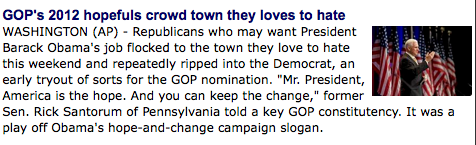
    Here is one of today’s top headlines on the AP wire:

    GOP's 2012 hopefuls crowd town they loves to hate

    The same headline is currently being used online by the Washington Post, the Boston Globe, USA Today, the Guardian, Yahoo News, and many other news sites. The Twitterati were, of course, quick to pick up on the grammar problem (here, here). It’s been to corrected to “…love to hate” by a few outlets already, however (like the Houston Chronicle).

    Hard to say how this one slipped by so many editorial eyes. Perhaps an earlier version of the headline had “loves to hate” agreeing with “(the) GOP,” such as “2012 hopefuls crowd town GOP loves to hate,” and then a last-minute change in word order loused up the agreement.

    [Possible background influences for the verb choice range from Gershwin (“I Loves You Porgy“) to Gollum (“We wants it, we needs it“).]

    [Update, 4 pm EST: The AP has now corrected the headline.]

  • Hopey changey… or changing?

    Via Talking Points Memo comes this correction from the Los Angeles Times:

    FOR THE RECORD:
    Sarah Palin: In some editions of Sunday’s Section A, an article about Sarah Palin’s speech to the National Tea Party Convention quoted her as saying, “How’s that hopey, changing stuff working out for you?” She said, “How’s that hopey, changey stuff working out for you?”

    Maybe the L.A. Times editors could have spared themselves some confusion by paying more attention to the American Dialect Society voting for Word of the Year. For 2008, I included hopey changey in my list of nominations, defining it as follows:

    hopey changey: Derisive epithet incorporating Obama’s two main buzzwords (also dopey hopey changey).

    In the ’08 WOTY voting, hopey changey (hyphenated as hopey-changey) ended up in a special category of election-related terms, finishing a distant third behind maverick and lipstick on a pig (but ahead of hockey mom).

    We’ve discussed the gregarious -y suffix here a number of times, for instance in my posts “Feeling all Olympic-y” and “Slang affixation: it’s all mystery-y-ish-y.” Both posts cite the signal work of Michael Adams on the -y suffix in his books Slayer Slang: A Buffy the Vampire Slayer Lexicon (2004) and Slang: The People’s Poetry (2009). Beyond linguisticky circles, Adams is perhaps best known for his pseudo-feud with Stephen Colbert a few years ago, after truthiness was selected as ADS WOTY for 2005. In an AP report, Adams summed up Colbert’s buzzword as “truthy, not facty” (in true Buffy style). But since the AP somehow neglected to mention “The Colbert Report” in its coverage of the vote, that gave the eternally put-upon Mr. Colbert license to put Adams on his “On Notice” board (where, as far as I know, he remains to this day).

    (And speaking of media errors, recall that the New York Times originally had trouble with Colbert’s truthiness, first rendering it as trustiness in Alessandra Stanley’s review. That, it turned out, was a cupertino.)

    As for A-y B-y formulations in general, there’s a big class of reduplicated compounds like airy-fairy, art(s)y-fart(s)y, fuddy-duddy, hanky-panky, hoity-toity, hurly-burly, itsy-bitsy, loosey-goosey, namby-pamby, okey-dokey, roly-poly, teeny-weeny, willy-nilly and wishy-washy. Others, like hopey changey, only reduplicate the -y element, like hunky-dory, topsy-turvy, and upsy-daisy. Perhaps most germane here are A-y B-y compounds that more transparently reflect a combination of the A and B bases, like artsy-craftsy, creepy-crawly, and touchy-feely. Many of these are disparaging, and I’d imagine touchy-feely in particular serves as a model for Palin and other opponents of Obama’s hopey-changiness (but not his changingness).

    (See Zazzle and Cafepress for a rapidly growing selection of hopey changey products.)

  • Odium against “podium” revisited

    Four years ago I wrote a Language Log post looking into the use of podium as a verb at the Winter Olympics in Torino — and the often extreme reactions that the usage provoked. Now with the Vancouver Olympics coming up, I return to the theme in my latest On Language column in the New York Times Magazine. It is no doubt the first (and last) article in the Times to cite both a senior editor of Ski Racing magazine and Eve & Herbert Clark’s crucial study of denominal verbs.