Author: Big Gav

  • Endgame

    Once upon a time I used to have a slot called “Friday Night Fear Mongering” which I eventually abandoned as I became entirely disenchanted with the doomer community. While I’m still over the doomers, I kind of enjoyed this example from John Michael Greer (aka the Archdruid) looking through a particularly dark glass at the US economy – Endgame (I’m not sure if the title is a nod of the head towards Dennis Jensen, or just a coincidence).

    A different reality pertains within the Washington DC beltway. Where states that fail to balance their budgets get their bond ratings cut and, in some cases, are having trouble finding buyers for their debt at less than usurious interest rates, the federal government seems to be able to defy the normal behavior of bond markets with impunity. Despite soaring deficits, not to mention a growing disinclination on the part of foreign governments to keep on financing the same, every new issuance of US treasury bills somehow finds buyers in such abundance that interest rates stay remarkably low. A few weeks ago, Tom Whipple of ASPO became the latest in a tolerably large number of perceptive observers who have pointed out that this makes sense only if the US government is surreptitiously buying its own debt.

    The process works something like this. The Federal Reserve, which is not actually a government agency but a consortium of large banks working under a Federal charter, has the statutory right to mint money in the US. These days, that can be done by a few keystrokes on a computer, and another few keystrokes can transfer that money to any bank in the nation. Some of those banks use the money to buy up US treasury bills, probably by way of subsidiaries chartered in the Cayman Islands and the like, and these same subsidiaries then stash the T-bills and keep them off the books. The money thus laundered finally arrives at the US treasury, where it gets spent.

    It may be a bit more complex than that. Those huge sums of money voted by Congress to bail out the financial system may well have been diverted into this process – that would certainly explain why the Department of the Treasury and the Federal Reserve Bank of New York have stonewalled every attempt to trace exactly where all that money went. Friendly foreign governments may also have a hand in the process. One way or another, though, those of my readers who remember the financial engineering that got Enron its fifteen minutes of fame may find all this uncomfortably familiar – and it is. The world’s largest economy has become, in effect, the United States of Enron.

    Plenty of countries in the past have tried to cover expenses that overshot income by spinning the presses at the local mint. The result is generally hyperinflation, of the sort made famous in the 1920s by Germany and more recently by Zimbabwe. That I know of, though, nobody has tried the experiment with a national economy in a steep deflationary depression, of the sort that has been taking shape in America and elsewhere since the real estate bubble crashed and burned in 2008. In theory, at least in the short term, it might just work; the inflationary pressures caused by printing money wholesale could conceivably cancel out the deflationary pressures of a collapsing bubble and a contracting economy – at least for a while.

    The difficulty, of course, is that pumping the money supply fixes the symptoms of economic failure without treating the causes, and in every case I know of, governments that resort to it end up caught on a treadmill that requires ever larger infusions of paper money just to maintain the status quo. Sooner or later, as the amount of currency in circulation outstrips the goods and services available to buy, inflation spins out of control, the currency loses most or all of its value, and the economy grinds to a halt until a new currency can be issued on some sounder basis. In 1920s Germany, they managed this last feat by taking out a mortgage on the entire country, and issued “Rentenmarks” backed by that mortgage. In the wake of the late housing bubble, that seems an unlikely option here, though no doubt some gimmick will be found.

    It’s crucial to realize, though, that this move comes at the end of a long historical trajectory. From the early days of the industrial revolution into the early 1970s, the United States possessed the immense economic advantage of sizeable reserves of whatever the cutting-edge energy source happened to be. During what Lewis Mumford called the eotechnic era, when waterwheels were the prime mover for industry and canals were the core transportation technology, the United States prospered because it had an abundance of mill sites and internal waterways. During Mumford’s paleotechnic era, when coal and railways replaced water and canal boats, the United States once again found itself blessed with huge coal reserves, and the arrival of the neotechnic era, when petroleum and highways became the new foundation of power, the United States found that nature had supplied it with so much oil that in 1950, it produced more petroleum than all other countries combined.

    That trajectory came to an abrupt end in the 1970s, when nuclear power – expected by nearly everyone to be the next step in the sequence – turned out to be hopelessly uneconomical, and renewables proved unable to take up the slack. The neotechnic age, in effect, turned out to have no successor. Since then, for most of the last thirty years, the United States has been trying to stave off the inevitable – the sharp downward readjustment of our national standard of living and international importance following the peak and decline of our petroleum production and the depletion of most of the other natural resources that once undergirded American economic and political power. We’ve tried accelerating drawdown of natural resources; we’ve tried abandoning our national infrastructure, our industries, and our agricultural hinterlands; we’ve tried building ever more baroque systems of financial gimmickry to prop up our decaying economy with wealth from overseas; over the last decade and a half, we’ve resorted to systematically inflating speculative bubbles – and now, with our backs to the wall, we’re printing money as though there’s no tomorrow.

    Now it’s possible that the current US administration will be able to pull one more rabbit out of its hat, and find a new gimmick to keep things going for a while longer. I have to confess that this does not look likely to me. Monetizing the national debt, as economists call the attempt to pay a nation’s bills by means of a hyperactive printing press, is a desperation move; it’s hard to imagine any reason that it would have been chosen if there were any other option in sight.

    What this means, if I’m right, is that we may have just moved into the endgame of America’s losing battle with the consequences of its own history. For many years now, people in the peak oil scene – and the wider community of those concerned about the future, to be sure – have had, or thought they had, the luxury of ample time to make plans and take action. Every so often books would be written and speeches made claiming that something had to be done right away, while there was still time, but most people took that as the rhetorical flourish it usually was, and went on with their lives in the confident expectation that the crisis was still a long ways off.

    We may no longer have that option. If I read the signs correctly, America has finally reached the point where its economy is so deep into overshoot that catabolic collapse is beginning in earnest. If so, a great many of the things most of us in this country have treated as permanent fixtures are likely to go away over the years immediately before us, as the United States transforms itself into a Third World country. The changes involved won’t be sudden, and it seems unlikely that most of them will get much play in the domestic mass media; a decade from now, let’s say, when half the American workforce has no steady work, decaying suburbs have mutated into squalid shantytowns, and domestic insurgencies flare across the south and the mountain West, those who still have access to cable television will no doubt be able to watch talking heads explain how we’re all better off than we were in 2000.

    Those of my readers who haven’t already been beggared by the unraveling of what’s left of the economy, and have some hope of keeping a roof over their heads for the foreseeable future, might be well advised to stock their pantries, clear their debts, and get to know their neighbors, if they haven’t taken these sensible steps already. Those of my readers who haven’t taken the time already to learn a practical skill or two, well enough that others might be willing to pay or barter for the results, had better get a move on. Those of my readers who want to see some part of the heritage of the present saved for the future, finally, may want to do something practical about that, and soon. I may be wrong – and to be frank, I hope that I’m wrong – but it looks increasingly to me as though we’re in for a very rough time in the very near future.


  • Feedback sought on SA wave plant

    The ABC has a report on a small wave power plant proposed for South Australia – Feedback sought on wave plant impact.

    A $5 million wave-energy plant off South Australia’s Eyre Peninsula is a step closer, with public comment being invited on its environmental impact. Wave Rider Energy hopes to install the plant 800 metres offshore from Elliston.

    The company’s managing director, Christian Gerlach, says it is hoped federal approval for the project can be secured in March. He says the plant would be built in Adelaide and towed to Elliston early next year.


  • South Korea Unveils Stunning Eco Dome Environmental Center

    Green Building of the week from Inhabitat is this South Korean design for a dome style environmental centre – South Korea Unveils Stunning Eco Dome Environmental Center.

    The National Ecological Institute of South Korea recently released plans for a large-scale nature reserve complete with an incredible series of eco domes, an education center, and an environmental think-tank. Designed by SAMOO, the Ecorium Project will be a striking environmental center comprising thousands of acres of open space in addition to greenhouses and a visitor center. Much like the Eden Project in the UK, the Ecorium Project will serve to educate people about nature, and provide a space for study of the world’s eco-systems and how best to protect them.

    Inhabitat also has a post on a Norwegian tourism design concept – Norwegan Turbine City Could Be The Next Big Eco-Tourist Attraction.

    Turbine City is a way to “spin” turbines in a new light for people who might think of them as unappealing eyesores, and could attract tourists, sailors, offshore oil-workers and others to see the beauty of wind farms with their own eyes. Plus, it makes a lot of sense to have the structures perform double duty as both energy harvesting devices and a place for people to find shelter and enjoyment.

    To be located in Stavanger, Norway, Turbine City would also be self-sustaining in terms of power, needing just 1MW (from 8MW turbines) to run. Since Norway is somewhat (in)famous for its production of oil, Turbine City could also help gain the country some fans in the clean and alternative energy arenas.


  • Handicapped by 19th-century technology

    The SMH has an article on the Australian energy system – now and what it could be – Handicapped by 19th-century technology.

    Renewable energy is the fastest growing power source in the world, and already generates baseload electricity on the scale of utilities. Large solar thermal plants with heat storage can dispatch power around the clock every day of the week regardless of whether the sun is shining, and make handsome profits during demand peaks.

    Wind power is being installed on scales that dwarf Australian grid requirements. These and other clean energy technologies are replacing coal on modern grids. While Australia continues to throw money at 19th-century technologies, Spain, China, the US and others are charging ahead with zero-emissions power generation, and creating export markets.

    Spain consumes about as much electricity as Australia, though its population is about twice as large. Like Australia, Spain is blessed with strong, consistent sunshine, and it uses this attribute to ensure energy security. Already it has built 24-hour baseload solar plants, using molten salt to store heat which is then used to create steam and turn turbines. It started with Andasol 1, a 50MW plant, and has now completed two similar projects. More than 1,800MW of projects are under construction and the government has just approved another 2,440MW for their feed-in tariff scheme for construction over the next three years.

    The Gemasolar project is the shining light of the Spanish boom in baseload solar power. This solar thermal plant has created 1500 jobs and will operate at 60 to 100 per cent of maximum turbine output for up to 90 per cent of hours each year. Very low maintenance shutdown requirements allow this efficiency, far greater than coal-fired power generators in NSW. When the turbine is idle, heat is bled off the ”cold” 290-degree salt storage tank to keep the turbine seals warm, allowing fast starting – as seen in the best hydro and gas plants. This capacity for baseload and fast-start ”dispatchable” power generation places the Gemasolar plant among the highest-value electricity plants, a fact not lost on investors.

    This solar generation capacity is in addition to Spanish wind power. Wind turbines supply 11 per cent of Spain’s electricity demand, and this will more than double to 25 per cent by 2020. Another 6000MW of wind power is approved for installation in the next three years. That is just shy of three plants the size of the Bayswater power station near Muswellbrook, with all the jobs but no emissions.

    Spain is phasing out coal and nuclear, and the companies that built the nuclear plants have re-tooled to build solar thermal plants with heat storage. These companies did not want to own the nuclear plants they built, but they have set up investment vehicles to own solar thermal plants.

    Compared to the 10 years it takes to get a nuclear plant up and running, solar thermal plants with 24-hour baseload capacity have construction times as short as nine months, so such projects are not exposed to the same political, industrial and financial risks as nuclear plants. Envisaging a lucrative market for their solar infrastructure and expertise, the Spanish anticipate a healthy return on any subsidies for these technologies.

    In China, solar hot water and photovoltaic (PV) panels have had huge commercial success. Maintenance-free evacuated tube solar hot water systems were developed in Australia. They are cheap – each tube wholesales for less than $5 and a system for a family costs less than $500. More than 50 million Chinese households now enjoy unlimited, free hot water from such systems.

    China produces solar PV panels on a huge scale, and is the leading manufacturer of this technology for domestic rooftops. This triumph also owes much to Australian innovation, and to Australian governments’ failure to support the industry on home soil.

    The University of NSW solar PV team is the world leader in its field and holds the global efficiency record for ordinary silicon cells. Much of the technology in China, particularly from the leading company, Suntech, leverages off this Australian innovation.

    The Chinese were also ahead of the game when the global financial crisis hit. Their government moved quickly to arrange for government buildings to purchase surplus industrial output. This meant the billions of dollars Chinese companies had invested in PV plants were not wasted when demand suddenly fell.

    This is in stark contrast with the situation in Australia. Melbourne’s Solar Systems has proven commercial success in displacing diesel in diesel/solar hybrid power generation for remote aboriginal communities. Solar Systems, a leader in its field, was unable to generate operational revenue and was forced into administration in August. With a bit of Chinese-style foresight, the Rudd government could have created a pipeline of projects for remote area power systems dependent on diesel. This would have been a responsible use of stimulus funds, and assured the company remained viable and ready for the boom after the global financial crisis.

    Chinese wind power blows us away, too. A total of 30,000MW of wind power was planned to come online by 2020, but this target will be met early this year. China is now planning for 150,000MW of wind power by 2020, and again it is likely that this will be achieved much earlier.

    Within the 150,000MW wind power target is the ”Three Gorges of Wind” project. Named after the world’s biggest engineering project, the Three Gorges dam, it will produce 70,000MW at seven large sites and twice as much electricity as the Three Gorges Dam, but cost half as much. The Three Gorges of Wind will produce about the same amount of electricity as the electricity grid on Australia’s eastern seaboard.

    Denmark obtains 20 per cent of its electricity from wind, and this will increase to 50 per cent by 2025. Wind turbines from the 1980s will be replaced with new models that are 30 times larger and much more efficient in a wide variety of wind conditions.

    NSW alone is 19 times larger than Denmark. It has about the same population and experiences as much wind in any given place. Our national electricity grid extends from Tasmania and South Australia to far northern Queensland. With such a massive resource over a vast area, wind power can make a large contribution to Australian energy security.

    Australia continues to rely on wasteful 19th-century technology. In periods of low demand, such as the dead of night, our antiquated coal-fired power stations throw energy away by blowing steam.

    In Germany, policy decisions have boosted renewable energy sales and provided the environment for a high-tech manufacturing industry. This is despite the fact that, under often-grey northern skies, PV panels installed in Germany may produce 50 to 65 per cent less energy over their lifetime than equivalent panels in Australia. German households and businesses will add up to three gigawatts (GW) of photovoltaic generation by the end of this year, bringing the national total to eight GW. That is 86 per cent of the entire Hunter Valley generating capacity.

    Planning authorities in the US are also swamped with plans for wind and solar thermal power. More than 97,000MW of solar thermal projects are seeking approval from the US Bureau of Land Management. In the south-west of the country, the bureau is doing a study that would speed up development of more than 100,000MW of right-of-way sites (degraded government lands) for solar thermal plants. There go another 38 Bayswater equivalents. An underdeveloped grid is the main obstacle to the expansion of wind power in the US, but President Barack Obama has announced a huge modernisation plan.


  • Monckton’s Melbourne meeting: a gathering of old men in Richie Benaud blazers

    I’m not sure why I find myself watching Chris Monckton‘s travelling circus of climate charlatanry, but I’m not the only one – Crikey reports on the rapt reception he is getting amongst the more conservative segments of the older generation (the only youngish people paying attention are the LaRouchies, trying somehow to deal with the cognitive dissonance of echoing the Viscount’s message while simultaneously claiming global warming is a genocidal plot cooked up by the British aristocracy) – Monckton’s Melbourne meeting: a gathering of men in Richie Benaud blazers.

    One shouldn’t imply that the CEC was representative of the huge crowds attending Monckton’s tour. That would be unfair. The LaRouchites were much younger, for a start.

    Inside Monckton’s Melbourne meeting, most of the attendees looked like Ian Plimer. It was a gathering of men in Richie Benaud blazers, sometimes accompanied by silver-haired wives, dressed up as if for a night at the opera.

    Naturally, the attendees didn’t believe in evil plots led by the Royal Family. In fact, they seemed, if anything, distinctly anglophile, in that Old-Australia-RSL-club kind of way. They’d come, after all, not to listen to Chris Monckton but rather to the “Third Viscount of Brenchley”, a man who was touring not “Australia” but (his slide informed us) the “Commonwealth of Australia”, a distinction that, in context, seemed to matter rather a lot. It was a crowd who saw nothing strange in a priest kicking off proceedings with the Lord’s Prayer, nor in the heraldic crest that adorned every overhead, a grisly emblem with a crown hovering majestically above a portcullis.

    John Howard battlers, for the most part: the old, the white and the angry. That anger — and it was palpable — provides a potential constituency for Tony Abbott, and perhaps even a large one. When a picture of Kevin Rudd flashed on the screen, the hostility was immediate and unfeigned.

    Later, the Viscount asked rhetorically: “Do we want an emissions trading scheme?”

    “No!” came the shout. “No!”

    Could supporters of the ETS — by its nature, an unhappy negotiated compromise — muster the same passion in its defence? One very much doubts that Penny Wong, these days, attracts roaring crowds.

    The deep outrage felt by climate sceptics, their sense of facing a fundamental attack on their way of life, provides Abbott, at the very least, with a pool of active supporters: highly motivated people to hand out how-to-vote-cards, make phone calls, attend meetings.

    But whether he can turn that constituency into a majority is a very different question. For while Lord Monckton eschewed, for the most part, the wraparound jumper craziness of the CEC, he nonetheless strayed regularly into X Files territory. Copenhagen, he explained, represented an attempt to impose world government by bureaucratic coup d’etat.

    He put on a Nazi accent. The real plan at Copenhangen was, he said, all about “the New Vorld Order!”

    Indeed, the fascist jackboot seemed to have already come down on poor old England, which was now ruled by “commissars” (a word he repeated several times) from the European Union.

    “We in Britain are no longer free.” His voice turned mournful. “I know what it feels like to lose my democracy. Make sure you don’t let your democracy go so cheaply.”

    In some respects, this kind of black helicopter nuttiness might have seemed like an add-on to the main message but in other ways it was central. For Monckton was there to explain that there was no climate crisis at all. The temperature was falling, not rising. The sea ice was just fine. So, too, the Eurasian snow cover and the Antarctic ice and the hurricanes and the polar bears. They were all as right as rain, and there were graphs and charts and formulas to prove it.

    And that, of course, raised a second question, one that necessarily haunts climate sceptics. If, as Monckton said, the majority of scientists are scandalously and incompetently wrong about global warming, why does the scientific community go along with the charade? What about the media and the political mainstream? Why aren’t they embracing the truth?

    The answer doesn’t automatically involve a conspiracy but it certainly marches you a long way that direction. You’d think that a researcher who could allay the world’s fears about global catastrophe would be crowned with laurels. But, no, apparently not. Someone must be getting to the scientists, forcing them to toe the party line. Someone is making sure that the journalists don’t dare speak out. Why, it’s probably the same people who turned Britain into a dictatorship without anyone noticing!

    You can see the difficulty for Abbott.

    The attendees at the Monckton performance might seem, at first, the traditional pillars of the Liberal Party, an organisation that’s always done well with old, comfortable, white folks. But there’s a big difference between Menzies’ people and Monckton’s people.

    Once upon a time, the Liberal Party, an organisation temperamentally suited, after all, to hierarchy, accorded an almost royal deference to Big Science. Menzies presided over an Australia that wondered at atom splittings and Sputnik launchings, and not in the sceptical sense of that word but with genuine awe, with the mysteries expounded by clipboard-carrying oracles understood as evidencing the remarkable advances of the modern age.

    Under Howard, however, the party embraced a populist anti-elitism, in which the instincts of ordinary folk always trumped the hoity-toity pronouncements of over-educated know-it-alls. Throughout the culture wars, the high falutin’ elitists in their inner-city apartments, those whining postmodernists confounding the common sense of you and me and the bloke next door, were a perennial punching bag for the Liberals and their mouthpieces.

    The climate debate thus arrived with an oppositional script already well-prepared: on the one hand, the fancy-dancing, silver-tongued scientists and ideologues, with their incomprehensible graphs and statistical charts; on the other, the hard-working traditional Australians forced to feel bad about SUVs and air travel by self-righteous scolds.

    Slapping down some scientific poindexter became, then, a reflexive defence of values associated with the ’50s, even as it manifested an attitude to the research establishment that Menzies would have found incomprehensible.

    Right-wing populism is neither new nor confined to Australia. As a political tactic, a demagogic anti-elitism was imported from the US where it served Republicans for decades, and accordingly it’s in the US where the consequences can be seen to their fullest. George Bush might have been the fortunate son of a political dynasty but his political career centred on a “just folks” persona in which Bush, a brush-cutting Texan cowboy, fronted as the kind of guy with whom you could have a beer — in contrast with, say, John Kerry, who’d undoubtedly clear the entire bar by, like, talking about politics and stuff.

    As a touchstone for electability, the “would I go drinking with this man?” test was, of course, spectacularly insane: a moment’s thought would suggest that proving yourself affable company for alcoholics would not, in and of itself, qualify you to control a nuclear arsenal. Nonetheless, it won Bush two elections and, in the process, shifted the way that the US — and hence the world — thought about power and politics. For, whatever other promises he may have reneged upon, as President, W remained true to an anti-intellectual populism. He was a man with a swagger, an avowed non-reader, a Decider who did his deciding by gut rather than by brain. The political consequences of a presidency ruled by a stomach might be increasingly apparent from New Orleans to Baghdad, but, as Charles Pierce argues in his book Idiot America, the implications for science are even worse.

    “If we have abdicated our birthright to scientific progress,” he writes, “we have done so by moving empirical debate into the realms of political, cultural and religious argument, where we all feel more comfortable because there the Gut truly holds sway. By the rules governing those realms, any scientific theory is a mere opinion and everyone’s entitled to those. Scientific fact is as mutable as a polling sample.”

    If your instinct tells you that climate change is a fraud cooked up by leftists still angry about the fall of communism, well, who or what could convince you otherwise? As Pierce points out, the populist disdain for authority means that everyone is an expert — and thus no one is. Worse, in a debate centred on gut feelings, real knowledge becomes a manifest disadvantage, a palpable signifier of inauthenticity. You trust some wingnut blogger precisely because they’re not a research scientist — that’s why they can speak so freely!

    Monckton’s supporters might protest that, actually, his tour was all about science. There were graphs, there were charts, there were statistical analyses.

    Well, of course there were. But you can’t actually do science that way, can you! How many people in the Sofitel audience knew what a Stefan-Boltzmann Equation called itself when it was at home? Not so many, one presumes — but we all knew how to hiss demonstrably when an outraged Monckton revealed that, throughout the 1600-page UN report of 2007, there was no mention (not one!) of said equation. (It was, one presumes, crowded out by all the plans for a world government!)

    You might think that Monckton should be publishing his equations and graphs to the peer-reviewed literature, the traditional route for challenging a scientific paradigm. Ah, but he can’t, because the journals and the university and the other government-funded institutions prefer to foster apocalyptic projections rather than the arguments of a man who says the environment’s just peachy the way it is. Why? Well, now we’re back to interesting theories about commissars and the collapse of democracy and the rest of it.

    Abbott thus faces a ticklish dilemma. On the one hand, the deniers bring a passion that an Opposition sorely needs. On the other hand, the climate sceptics teeter on the verge of overt hostility to the very establishment that the Liberal Party needs to win over. Populists, after all, despise and mistrust not only greenies and EU commissars but Big Media and Big Business.

    The Liberal Party, well, not so much.

    John Howard managed — most of the time — to present himself simultaneously as a populist and a man of the establishment. Perhaps Abbott can do the same. But it doesn’t seem likely, at least partly because the rhetorical tenor of the sceptics has grown so shrill.

    One of the crusty old fogeys meeting the Lord was Opposition Leader Tony Abbott (though I would have thought that given a number of his fellow travellers also have plenty of conspiracy theories about Catholics he might steer clear) – Abbott to the lunatic fringe: it’s OK, I’m one of you.

    Tony Abbott met with conspiracy theorist Chris Monckton yesterday at lunchtime, but Abbott wouldn’t allow photographers to record the meeting or publicly comment on what was discussed.

    Meeting this shabby character is contemptible and reflects poorly on Abbott’s fitness for high office. There are, after all, plenty of Australian skeptics and denialists out there to meet, plenty of men and women who share Abbott’s view that climate science is crap. We’ve produced quite a few of them.

    Despite Ian Plimer or Bob Carter lacking any credentials in climate science, at least they can mount a pseudo-scientific case against global warming. But Abbott decided to meet this low-rent Lyndon LaRouche from London. Worse, refusing to allow the meeting to be photographed shows thorough cowardice. If he’s happy to meet this “swivel-eyed maniac”, as one conservative called Monckton, he should be happy to be photographed shaking his hand.

    But forget the moral outrage: this was savvy politics. Abbott has sent a clear signal to the right-wing fringe groups and One Nation-types that have drifted away from the party over the last two years: he’s their man, he shares their values. When they talk about shoring up the base, this is what they mean, pulling those voters out of the “Other” camp in polling, where they’re lodged with Family First and socially-conservative parties, and back into the Liberal column.

    It didn’t require being photographed with Monckton – the lunatic fringe will know he met him. It will be all over their blogs and in their email networks. Finally, they’ll think, someone important is listening to us.

    Being photographed with Monckton might have sent the wrong single to mainstream voters, because Monckton’s a risk, prone to coming out with potentially ridiculous statements that Abbott would have to distance himself from. Like interning people with HIV, for example, (although apparently Monckton has invented a cure for that).

    So best to keep it on the quiet, out the media, because the media loves visuals and stories don’t get one-tenth as far without them. A job well done.


  • Michael Schwartz: Will Iraq’s Oil Ever Flow?

    TomDispatch has an article on the future of Iraq’s oilMichael Schwartz, Will Iraq’s Oil Ever Flow? .

    Iraqi oil, too, has been a focus of Washington’s unremitting ambition tempered by failure. Long before the cost of the war began to lurch toward the current Congressional estimate of $700 billion, the idea of using oil revenues to pay for the invasion had vanished, as had the idea of quadrupling production capacity within a few years. The hope of doing so someday, however, remains alive. Speculation that Iraq’s production could — in the not too distant future — exceed that of Saudi Arabia may still represent Washington’s main strategy for postponing future severe global energy shortages.

    Even before the attacks of September 11, 2001, the secretive energy task force Vice President Cheney headed was tentatively allocating various oil fields in a future pacified Iraq to key international oil companies. Before the March 2003 invasion, the State Department actually drafted prospective legislation for a post-Hussein government, which would have transferred the control of key oil fields to foreign oil giants. Those companies were then expected to invest the necessary billions in Iraq’s rickety oil industry to boost production to maximum rates.

    Not so long after U.S. troops entered Baghdad, the administration’s proconsul, L. Paul Bremer III, enacted the State Department legislation by fiat (and in clear violation of international law, which prohibits occupying powers from changing fundamental legislation in the conquered country). Under the banner of de-Baathification — the dismantling of Saddam Hussein’s Sunni ruling party — he also fired oil technicians, engineers, and administrators, leaving behind a skeleton crew of Iraqis to manage existing production (and await the arrival of the oil giants with all their expertise).

    Within a short time, many of these pariah professionals had fled to other countries where their skills were valued, creating a brain drain that, for a time, nearly incapacitated the Iraqi oil industry. Bremer then appointed a group of international oil consultants and business executives to a newly created (and UN-sanctioned) Development Fund of Iraq (DFI), which was to oversee all of the country’s oil revenues.

    The remaining Iraqi administrators, technicians, and workers soon mounted a remarkably determined and effective multi-front resistance to Bremer’s effort. They were aided in this by a growing insurgency.

    In one dramatic episode, Bremer announced the pending transfer of the control of the southern port of Basra (which then handled 80% of the country’s oil exports) from a state-run enterprise to KBR, then a subsidiary of Halliburton, the company Vice President Cheney had once headed. Anticipating that their own jobs would soon disappear in a sea of imported labor, the oil workers immediately struck. KBR quickly withdrew and Bremer abandoned the effort.

    In other Bremer initiatives, foreign energy and construction firms did take charge of development, repair, and operations in Iraq’s main oil fields. The results were rarely adequate and often destructive. Contracts for infrastructure repair or renewal were often botched or left incomplete, as international companies ripped out usable or repairable facilities that involved technology alien to them, only to install ultimately incompatible equipment. In one instance, a $5 million pipeline repair became an $80 million “modernization” project that foundered on intractable engineering issues and, three years later, was left incomplete. In more than a few instances, local communities sabotaged such projects, either because they employed foreign workers and technicians instead of Iraqis, or because they were designed to deprive the locals of what they considered their “fair share” of oil revenues.

    In the first two years of the occupation, there were more than 200 attacks on oil and gas pipelines. By 2007, 600 acts of sabotage against pipelines and facilities had been recorded.

    After an initial flurry of interest, international oil companies sized up the dangers and politely refused Bremer’s invitation to risk billions of dollars on Iraqi energy investments.

    After this initial failure, the Bush administration looked for a new strategy to forward its oil ambitions. In late 2004, with Bremer out of the picture, Washington brokered a deal between U.S.-sponsored Iraqi Prime Minister Iyad Allawi and the International Monetary Fund. European countries promised to forgive a quarter of the debts accumulated by Saddam Hussein, and the Iraqis promised to implement the U.S. oil plan. But this worked no better than Bremer’s effort. Continued sabotage by insurgents, resistance by Iraqi technicians and workers, and the corrupt ineptitude of the contracting companies made progress impossible. The international oil companies continued to stay away.

    In 2007, under direct U.S. pressure, virtually the same law was reluctantly endorsed by Prime Minister Maliki and forwarded to the Iraqi parliament for legislative consideration. Instead of passing it, the parliament established itself as a new center of resistance to the U.S. plan, raising myriad familiar complaints and repeatedly refusing to bring it to a vote. It lies dormant to this day.

    This stalemate continued unabated through the Obama administration’s first year in office, as illustrated by a continuing conflict around the pipeline that carries oil from Iraq to Turkey, a source of about 20% of the country’s oil revenues. During the Bremer administration, the U.S. had ended the Saddam-era tradition of allowing local tribes to siphon off a proportion of the oil passing through their territory. The insurgents, viewing this as an act of American theft, undertook systematic sabotage of the pipeline, and — despite ferocious U.S. military offensives — it remained closed for all but a few days throughout the next five years.

    The pipeline was re-opened in the fall of 2009, when the Iraqi government restored the Saddam-era custom in exchange for an end to sabotage. This has been only partially successful. Shipments have been interrupted by further pipeline attacks, evidently mounted by insurgents who believe oil revenues are illegitimately funding the continuing U.S. occupation. The fragility of the pipeline’s service, even today, is one small sign of ongoing resistance that could be an obstacle to any significant increase in oil production until the U.S. military presence is ended.

    The entire six-year saga of American energy dreams, policies, and pressures in Iraq has so far yielded little — no significant increase in Iraq’s oil production, no increase in its future capacity to produce, and no increase in its energy exports. The grand ambition of transferring actual control of the oil industry into the hands of the international oil companies has proven no less stillborn.

    Over the years since the U.S. began its energy campaign, production has actually languished, sometimes falling as much as 40% below the pre-invasion levels of an industry already held together by duct tape and ingenuity. In the Brookings Institution’s latest figures for December 2009, production stood at 2.4 million barrels per day, a full 100,000 barrels lower than the pre-war daily average.

    To make matters worse, the price of oil, which had hit historic peaks in early 2008, began to decline. By 2009, with the global economy in tatters, oil prices sank radically and the Iraqi government lacked the revenues to sustain its existing expenditures, let alone find money to repair its devastated infrastructure.

    As a result, in early 2009, Maliki’s government began actively, even desperately, seeking ways to hike oil production, even without an oil law in place. That, after all, was the only possible path for an otherwise indigent country with failing agriculture in the midst of a drought of extreme severity to increase the money available for public projects — or, of course, even more private corruption.


  • Meet Trev: A two-seater renewable energy vehicle

    Phil at TOD ANZ has a post on a new South Australian produced electric vehicle – Meet Trev: A two-seater renewable energy vehicle.

    Major auto companies are now close to introducing their first electric vehicles onto the market. But in many cases these new vehicles are as big and heavy as their gasoline powered brethren, and consequently burn just as much energy even though they take it from batteries rather than a fuel tank. I’m not convinced that helps us very much.

    I believe there is instead a bright future for a spectrum of ‘micro’ electric vehicles, from battery powered bicycles up to compact size cars, which I’ve mentioned briefly before in ‘How Big is Your Bicycle’. Here I want to feature a new concept car, named Trev (Two-seater Renewable Energy Vehicle) developed initially by a team of staff and students at the University of South Australia.


  • Victoria pushes for $100m Smart Grid cash

    ComputerWorld has a report on a smart grid initiative in Victoria – Victoria pushes for $100m Smart Grid cash.

    The Victorian State government has thrown its support behind the Frankston Smart Grid, Smart City project in an effort to secure up to $100 million in Federal Government funding.

    The funding, part of the National Energy Efficiency Initiative, aims to support a single Australian state in its testing of new energy saving technologies.

    Victoria’s bid, the Smart Grid, Smart City in Frankston, is being led by power companies United Energy and Jemena, energy retailer AGL and consulting and technology services company Accenture.

    According to the Victorian government, if successful, the Smart Grid, Smart City program will reshape the way power is used and delivered to 10,000 Frankston residents.

    “Neighbourhood solar panels could supply a local street with power in times of high energy demand, such as a hot summer’s day, while software allowing homes to store electricity for air-conditioning in batteries would also be tested,” Victorian energy and resources minister Peter Batchelor said in a statement. “Some households would be able to control home appliances remotely, with trials of mobile phone and internet applications allowing people to turn appliances on and off no matter where they are.”

    The New York Times has an article on China’s efforts to build a smarter grid – China’s Smart Grid Investments Growing.

    China’s overall federal stimulus investments in smart grid projects will surpass the United States’ in 2010, according to a forthcoming market research report — though not on a per capita basis.

    The Chinese government will spend $7.3 billion dollars in the form of stimulus loans, grants and tax credits compared to $7.1 billion by the United States government, according to analysis done by Zpryme, a market research firm in Austin, Tex.

    “They’ve got a strong economy to push forward,” Jason Rodriguez, director of research at Zpryme, said of China’s smart grid push.

    Smaller countries like France and Great Britain, the analysis found, will spend less than $300 million each of stimulus funding on smart grid projects, though Mr. Rodriguez noted that both countries are “already more advanced in smart grid infrastructure than the U.S.”

    “They have double the amount of smart meters,” he said.

    Meanwhile, a number of American companies, including General Electric, IBM and Hewlett Packard have entered the Chinese smart grid market, hoping to cash-in on some of the investments.


  • Biofuels: the Biggest Supply Response to the 2000s Oil Shock

    Stuart Staniford has a look at how the various types of alternative sources of liquid fuels fared during the last oil price spike – Biofuels: the Biggest Supply Response to the 2000s Oil Shock.

    There are four kinds of liquid fuel alternatives to crude oil in actual commercial production at the present:

    * Biofuels – ethanol and biodiesel, primarily from food crops around the world
    * Tar Sands – synfuel and bitumen, primarily from Canada
    * Gas-To-Liquids (GTL) – from South Africa, Malaysia, and increasingly Qatar
    * Coal-To-Liquids (CTL) – primarily from South Africa, but just starting in China

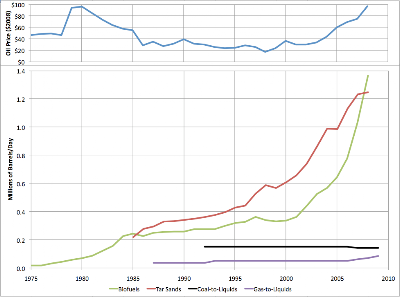
    In this piece, I summarize some research I’ve been doing to look at how each of these sources responded to the oil price increases of 2005-2008. Two sources, GTL and GTL, haven’t shown any particular price sensitivity to date and are at low levels. Tar sands growth has shown modest price sensitivity but mainly appears to be growing on its own internal dynamics. Biofuel production growth appears to be extremely oil price sensitive, and increased the fastest and reached the largest volume in response to the mid-to-late 2000s oil shock. I have argued in the past that there are structural reasons for this: given the comparatively low capital requirements and small plant size of biofuel plants, they can respond much faster to episodes of high oil prices than can the other sources, all of which tend to involve larger, slower-to-build, more capital intensive plants. This has important implications for food and land prices in future oil price shocks. Food prices are likely to rise quickly and markedly in response to oil shocks, public policy permitting.

    In the rest of the piece, I’ll briefly survey the statistics I have for each fuel source, and then draw conclusions about the overall situation.


  • Can Abbott Save The ERF ?

    The Australian opposition has announced a rather skeletal new policy on climate change, opting to promote a scheme based entirely on government investment. Its amazing what climate policy can do – the Greens are the economic rationalists now and the conservatives are advocating a quasi-socialist “solution” (albeit an entirely ineffective one). Crikey has a summary – Abbott’s answer to climate change: ERF.

    It’s hard to pass judgement on the Coalition’s direct action climate package announced by Tony Abbott this afternoon, because quite how it will work is either unclear, or yet to be announced.

    How will the whole package be funded? Well, that’s for later.

    Who will oversee this multi-billion dollar fund? That’s for later.

    How will it ensure money is well spent? Later.

    How will it deliver a 5% reduction in emissions? Well, there’s nothing to indicate it will, but Tony Abbott boasted of consulting with a huge range of industry and environment groups and produced a sheaf of endorsements from them saying the plan could achieve a 5% cut. On closer examination, the endorsements turned out to be industry groups who stand to benefit directly from the fund, like soil carbon companies, coal seam gas energy companies and the National Association of Forest Industries.

    Where will all these trees – 20 million of them – be planted? Well, in urban forests or marginal farming land, depending on who you asked, but there was confusing talk from Abbott of also putting electricity wires underground.

    How is this a “market mechanism” when the Government will pick the projects? Abbott talked about building a bridge.

    What will happen if the rest of the world agrees to higher emissions targets? Well, that’s actually a matter for Kevin Rudd, says Abbott.

    In truth, the Abbott fund proposal is a great idea. We should be investing more in carbon-reduction projects, and Abbott is proposing to invest directly in some emerging technologies like algal synthesis.

    But the idea that this is going to get us within cooee of a 5% reduction on our emissions with a growing economy and growing population is complete nonsense, regardless of what any self-interested industry might say. There is simply no system here for restraining or slowing our growing carbon emissions. The Coalition has proposed one of the few carbon abatement mechanisms that is even worse than the Government’s CPRS.

    John Quiggin has a post on the state of play with climate policy – The circuit breaker.

    The Greens have proposed a carbon tax as an interim measure to begin cutting carbon emissions. Although there are strong reasons to favor an emissions trading scheme over a carbon tax in the long run, I think it’s time to look seriously at this option. Here a few points in no particular order.

    * since the price of carbon is initially capped under the CPRS, it’s just like a carbon tax in the short run

    * the way to dispel public fear of a new tax is to bring it in. Look at capital gains tax and GST, both the subjects of highly successful election scare campaigns (in 1980 and 1993 resp) and both now uncontroversial.

    * the capture of the political right by delusionism is now irreversible, as can be seen from the embrace of the obviously loony Lord Monckton. There’s no chance, now or in the foreseeable future of a deal with these guys. In particular, the version of the CPRS negotiated with Turnbull and briefly supported by the majority of Coalition members is unsalvageable in every respect. There’s no way the deal can be modified enough to get Liberal support now, and on the other hand it’s too much of a dog’s breakfast to take to a double dissolution.

    * The Greens will almost certainly regain the balance of power in the Senate after the next election. Much as the government dislikes it, they are going to have to rely primarily on deals with the Greens to get legislation through in future. They might as well start dealing now.

    In general terms, the government lost control of the debate with the defeat of the Turnbull compromise ETS last year, and has done nothing to regain it. Turning up with the same discredited compromise in February makes no sense at all. This is a time for firm action, not more delay.

    Quiggin also has a post on climate quack “Lord” MoncktonMy response to Monckton’s conspiracy theory.

    Australia is currently enjoying a visit from Lord Christopher Monckton, a former education adviser to Margaret Thatcher, who is here to warn us that the climate change negotiations are a plot to destroy the global economy and impose a communist world government. The plot, according to Monckton is led by President Obama and supported by Kevin Rudd, who are, it seems, communists who ‘piled into the environmental movement after the fall of the Berlin Wall’.

    In an interview with Alex Jones, host of the conspiracy-theoretic radio/TV show Prison Planet, Monckton attributed the plot to a ‘“deliberate desire to control population by killing people in large numbers deliberately if necessary”. His co-speaker, Ian Plimer, assented to similar views on the same program.

    It might be thought that such views should be enough to consign Monckton to the lunatic fringe. But his conspiracy theory has received enthusiastic endorsement from large sections of the media including such prominent commentators as Andrew Bolt and Janet Albrechtsen (though Albrechtsen later backed away a little).

    And Monckton doesn’t lack political support. Opposition Senate Leader Nick Minchin echoed his views a couple of months ago, saying ‘”For the extreme Left [global warming] provides the opportunity to do what they’ve always wanted to do, to sort of deindustrialise the Western world … you know the collapse of communism was a disaster for the Left, and … they embraced environmentalism as their new religion. ’

    The Lavoisier Group, founded by former Labor Finance Minister Peter Walsh asserted that the Kyoto Protocol represented the greatest threat to Australia’s sovereignty since that posed by Japan in 1942.

    It is, then, necessary to make a serious assessment of the claim that Kevin Rudd, Barack Obama and the United Nations are engaged in a communist conspiracy to destroy the global economy and seize world power, as asserted by Monckton, Minchin, Walsh and others.

    One problem with the theory is that the chosen instrument, a carbon tax or emissions trading scheme, seems grossly inadequate to the task of destroying the economy. Even without the massive exemptions loaded in to the Rudd government’s CPRS, an emissions trading scheme with full auctioning might be expected to raise about $10 billion a year, or 1 per cent of GDP over the next decade. By comparison, the GST raises over $40 billion. No credible economist suggest that the economic impact will be more than marginal.

    Even if the world can manage a comprehensive agreement to reduce carbon emissions to near-zero levels by 2050, the best estimates suggest that the economic effect will be to reduce the level of GDP by a few per cent.

    An even more puzzling aspect of conspiracy-theoretic claims is that part-time nature of the conspiracy. Most of the time conservatives like Bolt and Minchin treat Rudd as an ordinary political opponents, attacking him for being indecisive and more concerned with spin than substance.

    But if Rudd is engaged in a conspiracy to destroy the global economy and institute a communist world government, surely this fact should drive any analysis of his economic policy, health care and so on. Full-time conspiracy theorists like Alex Jones are at least consistent. In the same program as his interview with Plimer, Jones explained how the Obama Administration’s apparently modest health care reforms are actually a genocidal plot.

    The Guardian reports that the (lame duck) British Government is calling on people to ignore the “siren call” of the lunatic fringe – Ed Miliband declares war on climate change sceptics.

    The climate secretary, Ed Miliband, last night warned of the danger of a public backlash against the science of global warming in the face of continuing claims that experts have manipulated data.

    In an exclusive interview with the Observer, Miliband spoke out for the first time about last month’s revelations that climate scientists had withheld and covered up information and the apology made by the influential UN climate body, the Intergovernmental Panel on Climate Change (IPCC), which admitted it had exaggerated claims about the melting of Himalayan glaciers.

    The perceived failure of global talks on combating climate change in Copenhagen last month has also been blamed for undermining public support. But in the government’s first high-level recognition of the growing pressure on public opinion, Miliband declared a “battle” against the “siren voices” who denied global warming was real or caused by humans, or that there was a need to cut carbon emissions to tackle it.

    “It’s right that there’s rigour applied to all the reports about climate change, but I think it would be wrong that when a mistake is made it’s somehow used to undermine the overwhelming picture that’s there,” he said.

    “We know there’s a physical effect of carbon dioxide in the atmosphere leading to higher temperatures, that’s a question of physics; we know CO2 concentrations are at their highest for 6,000 years; we know there are observed increases in temperatures; and we know there are observed effects that point to the existence of human-made climate change. That’s what the vast majority of scientists tell us.” …

    The danger of climate scepticism was that it would undermine public support for unpopular decisions needed to curb carbon emissions, including the likelihood of higher energy bills for households, and issues such as the visual impact of wind turbines, said Miliband, who is also energy secretary.

    If the UK did not invest in renewable, clean energy, it would lose jobs and investment to other countries, have less energy security because of the dependence on oil and gas imports and contribute to damaging temperature rises for future generations. “There are a whole variety of people who are sceptical, but who they are is less important than what they are saying, and what they are saying is profoundly dangerous,” he said. “Every­thing we know about life is that we should obey the precautionary principle; to take what the sceptics say seriously would be a profound risk.”


  • Compressed Air Energy Storage (CAES): Part 2

    GreentechGrid has a post on PG&E’s 300 megawatt Compressed Air Energy Storage (CAES) Project – Compressed Air Energy Storage (CAES): Part 2.

    According to EPRI’s energy storage expert, Rich Lordan, “CAES (Compressed Air Energy Storage) is going to be important.” (EPRI is the Electric Power Research Institute). …

    Hal LaFlash, Pacific Gas & Electric’s Director of Emerging Clean Technology Policy, spoke on an energy storage panel last week and added a few more pieces of the storage puzzle as it is seen by a major utility. PG&E is looking forward to exploring the 300 megawatt CAES project in Kern County.

    Hal pointed out that we’re going to need help managing the 4,500 megawatts of new wind coming online in California in 2012 from the Tehachapi Pass Wind Project.

    Mr. LaFlash noted that there is already 1,200 megawatts of pumped hydro storage in the mountains above Fresno and that it is “an essential element of the grid in California.”

    The U.S. DOE and PG&E are still working on the details and site information on the Kern County project.

    According to a recent presentation by PG&E Senior Director Andrew Tang, the 300 megawatt – 10 hour plant is suitable for California’s porous rock formations and has a 5-year development lead time for:

    * Economic and geotechnical analysis
    * Core drilling
    * Siting, permitting and construction

    Note the “porous rock formation” remark made by Tang. The few CAES projects to date have used salt domes, but there is now a movement towards storing the compressed air in a porous rock structure. According to LaFlash, “These structures are used every day for natural gas storage.” Hal also mentioned that natural gas is only cycled a few times a year, while CAES energy storage will be cycled daily. That could present some technical challenges.

    Investigations by EPRI indicate that up to 80 percent of the U.S. has geology suitable for CAES. A single 300 megawatt CAES plant would require 22 million cubic feet of storage space — enough to store eight hours’ worth of electricity.


  • Better Place Raises $350M

    Cleantech.com reports that Better Place has raised $350 million of new capital – Better Place $350M deal bested by Airtricity.

    It’s one of the largest venture capital deals in the history of cleantech, as the company itself described it, but it isn’t the largest.

    Palo Alto, Calif.-based Better Place today announced in a press conference that it secured $350 million in a series B round led by HSBC Group that values the company at $1.25 billion. …

    While a large round, the largest deal on record to date in cleantech was a follow-on round to Europe’s Airtricity, according to Cleantech Group data available to clients.

    In the third quarter of 2006, investors put the equivalent of $394,835,000 USD into the Dublin, Ireland-based company, banking on the company’s wind farm projects.


  • The Geological Prize Called Haiti ?

    Somewhat to my surprise my most highly read article of the past week was an off-the-cuff pointer to some tinfoil about oil in Haiti. F William Engdahl (one time peak oil theorist and now vociferous anti-peak oil and anti-global warming theorist) has taken to the story like a duck to water, floating his now familiar theory about abiotic oil and suppression of oil production – The Fateful Geological Prize Called Haiti. I guess time will tell if Haiti does have any oil or if this is all just some colourful theorising from the fringes.

    A President becomes UN Special Envoy to earthquake-stricken Haiti.

    A born-again neo-conservative US business wheeler-dealer preacher claims Haitians are condemned for making a literal ‘pact with the Devil.’

    Venezuelan, Nicaraguan, Bolivian, French and Swiss rescue organizations accuse the US military of refusing landing rights to planes bearing necessary medicines and urgently needed potable water to the millions of Haitians stricken, injured and homeless.

    Behind the smoke, rubble and unending drama of human tragedy in the hapless Caribbean country, a drama is in full play for control of what geophysicists believe may be one of the world’s richest zones for hydrocarbons-oil and gas outside the Middle East, possibly orders of magnitude greater than that of nearby Venezuela.

    Haiti, and the larger island of Hispaniola of which it is a part, has the geological fate that it straddles one of the world’s most active geological zones, where the deepwater plates of three huge structures relentlessly rub against one another—the intersection of the North American, South American and Caribbean tectonic plates. Below the ocean and the waters of the Caribbean, these plates consist of an oceanic crust some 3 to 6 miles thick, floating atop an adjacent mantle. Haiti also lies at the edge of the region known as the Bermuda Triangle, a vast area in the Caribbean subject to bizarre and unexplained disturbances.

    This vast mass of underwater plates are in constant motion, rubbing against each other along lines analogous to cracks in a broken porcelain vase that has been reglued. The earth’s tectonic plates typically move at a rate 50 to 100 mm annually in relation to one another, and are the origin of earthquakes and of volcanoes. The regions of convergence of such plates are also areas where vast volumes of oil and gas can be pushed upwards from the Earth’s mantle. The geophysics surrounding the convergence of the three plates that run more or less directly beneath Port-au-Prince make the region prone to earthquakes such as the one that struck Haiti with devastating ferocity on January 12.


  • GDF Suez, Santos reach Australian LNG deal

    UPI has a report on yet another Australian LNG project, this one in the Timor sea – GDF Suez, Santos reach Australian LNG deal.

    French energy giant GDF Suez signed an agreement with its Australian partners at Santos to develop three offshore gas fields in Australia, the company said.

    GDF Suez announced a $200 million deal with Santos that concludes plans launched in August to develop its Bonaparte liquefied natural gas project. The integrated project envisions the construction of a floating liquefaction plant with a capacity to produce more than 2 million tons of LNG per year.

    The project relies on gas resources from the Petrel, Tern and Frigate gas fields in the Bonaparte gas basin in the Timor Sea, which GDF Suez described as one of the richest gas regions in Australia.


  • The Low-Hanging Fruit of Energy Efficiency

    Kevin Drum has an article on profitable (for the buyer) forms of energy efficiency investment – Climate Change’s Low-Hanging Fruit.

    If you don’t live in California, you might not have heard of Arthur Rosenfeld. But for the past four decades, he’s been the main inspiration behind a host of energy efficiency and conservation regulations that have made California the greenest state in the nation. He’s retiring from the California Energy Commission this week, and today the LA Times remembers his early battles :

    New homes and buildings were required to be better insulated and fitted with energy-wise lighting, heating and cooling systems. Appliances had to be designed to use less power. Utilities were forced to motivate their customers to use less electricity.

    ….Not surprisingly, those rules were attacked by business groups as bureaucratic job killers. Rosenfeld, who received his doctorate from the University of Chicago, was called unqualified by critics at Pacific Gas & Electric Co., one of California’s largest utilities.

    Yet these mandates have yielded about $30 billion annually in energy savings for California consumers. They’ve eliminated air pollution that’s the equivalent of taking 100 million cars off the roads. They have been copied by states and countries worldwide. California’s gains are so closely linked to Rosenfeld that they’ve been dubbed the Rosenfeld Effect in energy efficiency circles, where the 83-year-old has taken on rock star status.

    Rosenfeld’s ideas, far from being job killers, have been a boon for California. We have plenty of problems here in the Golden State right now, but better energy efficiency isn’t one of them. In the end, Rosenfeld was right and his critics in the corporate world were wrong.

    This reminds me of a current kerfuffle over energy efficiency on a national scale. McKinsey, the consultancy firm, has pressed the cause of energy efficiency for some time, and in 2007 they released a report that contained this now-famous chart (this is the 2009 version):

    The point of the chart is simple: Some energy efficiency measures have a net cost and require fairly careful analysis to decide if they’re worthwhile. Those things are shown on the right side of the chart. But there are lots of efficiency measures that not only reduce greenhouse gas emissions but produce net cost savings at the same time. These are the low-hanging fruit of climate change, otherwise known as “no-brainers.” There are tremendous savings out there for the taking.

    But there’s still opposition to this idea. A couple of weeks ago Ted Gayer of the Brookings Institution wrote that McKinsey’s conclusion “violates the basic principles of economics. If firms (or consumers) could reduce emissions at negative cost, then they would do so. To say otherwise is to say that they are willingly or ignorantly passing up profits.” But firms and consumers do pass up opportunities to save money. Maybe it’s through ignorance, maybe through laziness, maybe because of financing limitations. But there’s plainly friction in the real world that doesn’t always show up in simple Econ 101 models. A few days ago Brad Plumer linked to a Wall Street Journal report about an energy efficiency consultant, EnerNOC, that audited Morgan Stanley’s New York headquarters and immediately saved them a bundle of money…


  • NT Tidal power project could run all homes

    NT News has an article on interest in tidal power in the Northern Territory – Tidal power project could run all homes.

    A COMPANY wants to build a multimillion-dollar tidal power project in the Top End. Territory-based Tenax says it could potentially generate enough electricity to supply 194,000 homes – more than exist in the NT. It has applied for an environmental assessment of the scheme at Clarence Strait at Glyde Point, 50km northeast of Darwin.

    More than 450 generators would be installed across 1690ha of the seabed and connected to the NT’s electricity grid by 2km-long underground cables. Each generator would sit on a 14m x 21m x 3m-high concrete and steel base.

    Clarence Strait was selected for two reasons:

    * IT HAS the greatest tidal velocity near Darwin, with tidal movements of up to 5m; and
    * IT HAS the minimum 20m depth needed for tidal power.


  • How will we recharge all the electric cars ?

    The Economist has an overly-negative look at the issues involved in recharging electric cars in the US – How will we recharge all the electric cars?.

    IN THE ten years since hybrid electric vehicles first hit the highways and byways of America, they have come to represent 2.5% of new car sales. Yet, in places like Los Angeles, the San Francisco Bay Area and Washington, DC, every other car seems to be a Toyota Prius. That is because hybrids like the Prius have sold overwhelmingly where well-heeled early adopters reside.

    Expect the new generation of “Post-Prius” electrics—plug-in hybrids like the Chevrolet Volt from General Motors and those relying only on a battery such as the Nissan Leaf—to end up nosing around the same upscale neighbourhoods. With more than a dozen plug-in and pure-electric models arriving in showrooms over the next year or so, sales are expected to outstrip even those enjoyed by the Prius and other hybrids in their early days. A couple of million of the new electric vehicles could be bought by early adopters during the first few years.

    That would be a problem. Unlike the Prius and its ilk—which use their petrol engines, along with energy recovered from braking, to recharge their batteries while motoring—plug-in hybrids and pure electrics have to be recharged direct from the grid. The popular assumption is that they will be plugged into a wall socket in the garage late at night, taking advantage of cheap off-peak power. Unfortunately, things are not that simple.

    For a start, the new generation of electric vehicles are not glorified golf-carts, but cleaner and more frugal alternatives to today’s petrol-powered family cars. When fully charged, the Volt (to be called the Ampera in Europe) can travel 40 miles (64km) on electric power, enough for three out of four commuters in America to get to work and back without needing to burn a single drop of fuel. Beyond that range, a 1.4-litre engine kicks in to generate electricity and simultaneously propel the car and recharge its batteries.

    The medium-sized hatchback Leaf can carry five adults 100 miles on a single charge. To go farther, Nissan has put its faith in a network of rapid-charging stations it is developing with partners. The Leaf is expected to cost $25,000-30,000, about the same as a comparable diesel-powered car. But the battery pack will have to be leased separately (for around $150 a month).

    One thing the new plug-ins and pure electrics have in common is a beefy lithium-ion battery pack that needs a lot of heavy charging. At the very least, that involves installing 220-volt wiring in the home. Trying to recharge a modern electric car with a standard American 110-volt supply takes too long to be practical (up to 18 hours in the case of the Leaf).

    Of course, if not fully charged at night it may have to be recharged during the day—when electricity rates can be up to five times more expensive. Average peak rates in America are 33 cents a kilowatt-hour compared with seven cents off-peak. Charging at the peak rate is equivalent to buying petrol at $3.63 a gallon (80 cents a litre), instead of 77 cents a gallon off-peak, reckons Southern California Edison, a utility based in the Los Angeles area. In America, peak-rate charging totally destroys any economic advantage an electric car may have. …

    Much, of course, will depend on how quickly the new plug-ins and pure electrics become part of mainstream motoring. Generally speaking, it takes 15-20 years for a new technology to capture 10% of an established market, and a further 10-15 years for it to own 90%. That was the case when steam ships replaced clippers in the mid-19th century, and when petrol-engined taxis took over from horse-drawn cabs in the early 20th century. The same sort of lag occurred with the introduction in the 1970s of emission controls on cars. It takes years for the benefits of volume production to work their way through to the market, and for the supply chain to catch up.

    If plug-in electrics follow a similar demand curve to other disruptive technologies, there could be 25m of them humming quietly around by 2025, and ten times that number by 2040. Hopefully, by then, the utilities will have learned to cope with recharging them.

    The New York Times has an article on the forthcoming release of the plugin Toyota Prius – The Dawn of Plug-In Priuses and Smart Meters.

    Toyota announced on Monday plans to begin selling “several tens of thousands” of plug-in versions of its popular Prius hybrid in 2012 2011, as Hiroko Tabuchi reports.

    In another article in The New York Times today, Matthew L. Wald describes how the rollout of so-called smart meters – which are promoted by electric utilities as a way to save ratepayers money over the long term because they allow for variable electricity rates – is meeting resistance from skeptical consumers, who do not appreciate the meters’ up-front price tag.

    In many ways, these articles are about pieces of the same thing — the “smart grid” envisioned for the future.

    These two new technologies, plug-in cars and smart meters, are both critical components of the smart grid. In the future, large numbers of automobiles are expected to run on electricity and recharge from a home outlet during the night. (That is true not just of the plug-in Prius, but also of other electric vehicles in the pipeline, like the Chevrolet Volt.)

    Smart meters are expected to help encourage consumers to charge their cars at night, because they allow utilities to offer lower rates for electricity at off-peak times. Far less electricity is used at night, when most people are sleeping, than during the day, so power plants have spare capacity to charge automobiles. However, under the current system, there is little incentive to charge automobiles at night because most utilities charge consumers a single rate that stays the same, daytime or nighttime.


  • Gas-to-Liquids and Coal-to-Liquids Production Statistics

    Stuart Staniford at Early Warning has a post on the state of play for gas-to-liquids projects around the world – Gas-to-Liquids Production Statistics.

    Continuing this little series on production stats for various forms of alternative liquid fuels, this morning I look at Gas-to-Liquids (GTL). This is a process in which:

    Gas to liquids is a refinery process to convert natural gas or other gaseous hydrocarbons into longer-chain hydrocarbons such as gasoline or diesel fuel. Methane-rich gases are converted into liquid fuels either via direct conversion or via syngas as an intermediate, for example using the Fischer Tropsch process.

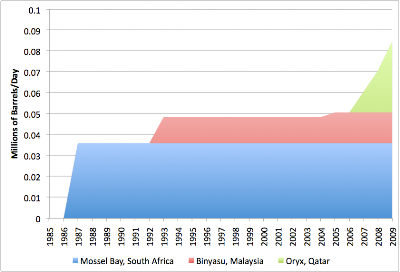
    After researching it, there seems little hope of obtaining actual production statistics for this process globally, but we can get pretty close just from research on plant capacity and opening dates. The graph above summarizes the situation. There are three plants globally operating GTL processes at commercial scale, and together they sum to less than 100,000 barrels/day.

    The longest standing plant is at Mossel Bay in South Africa, operated by PetroSA since 1987 (I assume this is another legacy of apartheid sanctions) which has a 36kbd output capacity.

    In 1993, Shell began operating a small plant in Bintalu, Malaysia, and increased its capacity in 2005 (from 12.5kbd to 14.6kbd).

    Most recently, Sasol and Qatar Petroleum brought on stream the Oryx plant in Qatar. This had a difficult start up, but is now apparently operating at the designed 34kbd capacity.

    There are also other plants under construction: the 120kbd Pearl GTL plant in Qatar, and the Escravos plant in Nigeria. Both hope for production in 2010, but given the history of difficulties with GTL plant startup we should probably reserve judgement.

    There were many more plans for GTL plants around the year 2000, but most went under. A helpful National Petroleum Council study report explains …

    Start also has a post on coal to liquidsCoal-to-Liquids Production Statistics.

    So, in today’s adventure in much-harder-to-find-than-they-should-be energy statistics, I try to assemble some kind of series for global production of synfuel from coal-to-liquids (CTL). This went even worse than the tar sands. However, I think I have figured out the big picture, and I report my findings here for the benefit of future energy sleuths, or in the hope that someone will point me at better data if it exists.

    Firstly, for the sake of readers just getting up to speed, what we are talking about is the possibility to use various kinds of chemical transformations to make a petroleum-like liquid fuel from coal. See the Wiki entry on coal liquefaction for more details of the various possibilities. This was done most famously by the Germans during World War II, and has been done for a long time in South Africa; the South Africans needed to get around economic sanctions during the Apartheid era, and that country has a lot of coal and not much oil. Since there are huge amounts of coal underground around the world, CTL is often cited as a potential substitute for oil in future (generally by folks not worried about climate change).

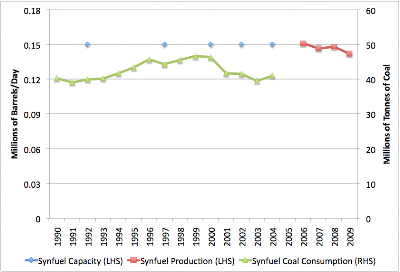
    There are at present two plants in the world operating coal liquefaction processes at commercial scale. The first is operated by Sasol in South Africa and has been operating for a long time. The second has just been opened last year by Shenhua in China. …

    Overall, the picture seems to be that South African production of CTL synfuel has been roughly flat for many years. There are some fluctuations, but there is certainly not an overall upward trend.

    The data situation for the new plant in China is even sketchier. According to this page, the capacity of the plant is 1 million tonnes per year, which is about 1/7 of the output of Sasol in South Africa. It reached full production some time in mid 2009, so there would not have been a full year of production in 2009. Thus, at this time this represents a rather small increase in total global production of coal to liquids – perhaps of the order of 5-10%, with a little more coming in 2010 with, I assume, a full year of operation. Shenhua does have plans to increase the plant capacity to 3Mt in the future, which would give another increase when that occurs.

    Amusingly, the CTL plant is located in a place we have already referenced on this blog: Ordos.


  • iMeter Smart meters save energy, water, and dollars

    Todd Woody has an article at Grist talking about the benefits of expanding the smart meter / smart grid idea from the electricity grid to the water supply network – Smart meters save energy, water, and dollars.

    The other day I came home to find a colorful flyer on my front door proclaiming, “Your meter just got smarter.”

    While I was out and about in Berkeley, a worker from my utility, PG&E, slipped in the side gate and gave my old gas and electric meter a digital upgrade. So-called smart meters allow the two-way transmission of electricity data and will eventually let me monitor and alter my energy consumption in near real-time. I’ll be able to fire up an app on my iPhone and see, for instance, a spike in watts because my son has left the lights on in his room and a laptop plugged in.

    Now I only learn of my electricity use when I get my monthly utility bill, long after all that carbon has escaped into the atmosphere. The situation is even worse when it comes to water consumption; my bill and details of my water use arrive every other month.

    “When you tell people what total bucket of water they used in the past 60 days, the barn door is open and the animals are long gone,” says Richard Harris, water conservation manager for the East Bay Municipal Utility District, my local water agency.

    EBMUD is currently testing smart water meters in 30 households and plans to expand the pilot program to 4,000 homes and businesses later this year.

    “It’ll give us better knowledge of where our water is going,” says Harris. “We also thought if we’re going to ask people to use water more efficiently, especially when we’re coming out of a drought and have imposed water restrictions, customers need to have an idea of what their current use is.”

    EBMUD’s smart meters take readings every hour and participants in the pilot program will be able to go online to check their consumption and set up an email alert if their water use rises above a certain level. The agency also plans to offer a social networking feature to allow people to compare their water consumption with other households in the area. Nothing like a little peer pressure to get you to turn off the tap.

    Given that many states expect to face water shortages in the coming years, one would think we’d be seeing a roll out of smart water meters akin to the national effort being made to smarten up the power grid.

    The payoff could be enormous. Water agencies and consumers would be able to detect leaking pipes and toilets in real-time and fix the problem before the water literally goes down the drain.

    Smart grids continue to be the one area of the cleantech world that is really booming this year, so I’ll do a little roundup of recent articles.

    EETimes points to a recent report predicting their will be over 200 million smart meters deployed by 2014 – Report: Smart meters rise to 212 million in 2014.

    Deployments of smart electricity meters worldwide will rise from 76 million in 2009 to reach about 212 million in 2014, according to a new report from ABI Research. The report provides forecasts of the wired and wireless communications options used to connect meters as well as profiles of some of many smart meter makers.

    The move to smart grids and two-way meters to enable new services to the home got a $3.4 billion boost from economic stimulus grants in the U.S. this year, noted Sam Lucero, a practice director at ABI and author of the report.

    For its part, the European Union enacted a so-called Third Energy Package in September which aims to migrate every European electricity meter to a capability for two-way communications by 2022. China is said to be ramping up its own smart grid programs, Lucero added.

    Smart Grid News has a look at some possible changes to the energy market configurations as a result of smart grid implementation – Why Today’s Utilities May Soon Be Obsolete (and What May Replace Them).

    The potential for implementation of a Smart Grid depends upon the paradigm or paradigms that are eventually implemented, as well as on the quantity and quality of information being exchanged. … Two major questions are paramount across all models:

    * Who makes the decisions?
    * How is control exercised?

    These crucial questions determine who applies the smarts to the grid and how efficiently those smarts realize the promise of Smart Grid technologies.

    Attempting to create a taxonomy of market structures risks over-simplification, but the resulting clarity can be insightful. This said, I argue that there are four market models that capture the critical elements of what will emerge when the Smart Grid is fully implemented. While elements of the four can be mixed and matched, at the core they represent extremes that require dramatically different deployment strategies in information and data flow, as well as end user decision and control.

    These are:

    * Pure Market
    * Intermediated
    * Microgrid
    * Centrally Controlled

    Reuters has a look at the smart grid investment landscape – How to make a play in the smart electrical grid: executives.

    The privately-held Silver Spring Networks is smart grid networking company and is often cited as a candidate for an initial public offering.

    The smart grid will allow two-way communications between utilities and their customers. Analysts have said it will marry clean power, electric vehicles, advanced meters, and power storage into a seamless network, modernizing thousands of miles of outdated power lines and allowing for more efficient energy use.

    Increased momentum for smart grid technology helped push power storage and energy efficiency stocks to perform the best on the WilderHill New Energy Global Innovation Index in 2009, which tracks the performance of 86 global clean energy stocks.

    The sector also has seen a boost from the Obama administration, which announced a $3.4 billion package in 2009 to help build a smart electric grid meant to trim utility bills, reduce blackouts and carry power generated by solar and wind energy.

    “The scale is even bigger than the Internet … but the speed of adoption is still going to be slow,” said Adrian Tuck, chief executive at Tendril, a Boulder, Colorado-based smart grid company that GE recently acquired a stake in. …

    “Demand response is the killer application in this market, at least the first killer app,” said Robert W Baird analyst Michael Horowitz. “These guys already have built fairly good business momentum over the last couple of years, as consumers and utilities alike are looking for better ways to manage delivering electrons,” he added.

    While bigger players are moving into the sector, they may not be the fastest way to profit from the smart grid. Google has invested in smart grid player Silver Spring Networks while Cisco and Microsoft are seeking to leverage their existing networking and software expertise in the emerging sector.

    “Our view is the pure play companies are going to give a lot more bang. This is going to be very small to incremental for a company like Cisco and Microsoft,” said RBC Capital Markets analyst Stuart Bush.

    Back at Smart grid News, a look at some of the issues that are cropping up as utilities try to phase out jobs like meter reading as smart meters are rolled out – Is the Smart Grid Inducing Labor Pains?.

    It seems that there is a bit of wire crossing happening amid the hardworking folks who are actually many of the hands and feet creating and managing the Smart Grid. In spite of very positive initial reactions to the federal investment of billions into the creation of the Smart Grid, the law of unintended consequences is introducing some consternation among the ranks of organized labor as Smart Grid programs move from philosophy to reality.

    While the introduction of the Smart Grid Investment Grant (SGIG) program was applauded by many in the labor community as the beginnings of a new market for skilled technicians, such as in this AFL-CIO blog post, or this IBEW promotional video, some actual deployments are not being greeted as positive changes.

    Most recently, on Jan. 19 the Kennebec Journal reported that IBEW Local 1837 was “speaking out against” a new smart meter installation project by Central Maine Power (CMP) that had been funded to the tune of $96M through the SGIG, and which had a total cost of roughly $190M. Seems that the project would likely eliminate, over time, some 141 positions, and that did not sit well with the union.

    The tension at CMP, however, is not unique. In October, a plan by the board of Memphis Light, Gas and Water Division (MLGW) received similar criticism from the IBEW, which noted that roughly 400 meter reading jobs would be lost in that plan.

    The Smart Grid is comprised of much more than just smart metering. It involves redundancy, and resiliency, and quality of power, and ease of integrating renewables, and storage, and on and on and on. Today’s unfortunate reality, however, is that investment has been increasingly targeted to smart metering. Smart meters, and the improvements in automating, and “remotifying” the reading, turn-on, and cut-off of power, are seen as early wins. They do not appear to jeopardize the delivery of power, and can very quickly demonstrate cost efficiency by decreasing truck rolls. This is both a reaction to the government’s emphasis of “shovel-ready” projects to fund, and to the ease with which a utility can justify the project to regulators as a cost-saver, paying off the capital cost in short order through a reduction in labor costs. As a result, the union teams, originally anxious to generate skilled labor to drive the construction of the next generation of transmission and distribution, is left, instead with a short-term need for installers that will be wiring up the elimination of hundreds of jobs for their meter reading brethren.

    Greentech media has a look at the top 10 smart grid news stories from 2009 – The Past and Future of Smart Grid.

    8. Distribution and Transmission Up Next: Not all smart grid systems are visible to the untrained eye. Upgrading distribution and transmission grids with communications and controls could help utilities squeeze up to 10 percent more efficiency out of their existing generation capacity, according to the Electric Power Research Institute. Those savings can come from preventative maintenance and replacement, shortening outage times, and optimizing grid voltages, among other sources.

    At the same time, managing the massive growth in renewable solar, wind and geothermal energy that will be needed to cut the nation’s carbon emissions will put new pressures on the grid. Hundreds of billions of dollars will need to be spent on new transmission lines to carry Midwest wind power and Southwest solar power to load centers, according to studies – which opens up new business models for startups.

    And at the neighborhood level, distribution grids will need a whole host of new technologies to manage the increase in rooftop solar panels, demand response-enabled homes, and future plug-in hybrid and electric vehicles that will soon place unprecedented new pressures on utilities built on the model of delivering power from central generation stations to millions of customers.

    9. Smart Grid 2.0: All of these emerging smart grid technologies will be a lot more useful if they can be linked together. That’s the idea for the next surge in the industry – a whole ecosystem of smart architectures, stretching from generations sources and transmission lines to the wireless and wired networks in utility customers’ homes and businesses.

    GridPoint, one of the more prominent – and well-funded – of the smart grid startups out there, is centered on delivering this kind of integrated offering to utility customers. Its approach has included buying up a host of startups offering vehicle charging, home energy monitoring and industrial and commercial energy management, indicating the breadth of functions it hopes to provide.

    What will the smart grid of the future look like? Duke Energy CEO Jim Rogers speaks of a utility-managed system that orchestrates smart meters, solar panels, batteries, demand response systems and plug-in vehicle chargers to serve as “virtual power plants” scattered throughout a utility service territory.

    CNet has an article on a in-house energy usage display that is combined with a thermostat (I suspect we’ll see a trend for convergence in home based control devices over time which mirrors that of hand held devices) – CES: To save energy, thermostat becomes mini computer.

    There are dozens of companies making in-home displays designed to help consumers shave energy use at home. But SilverPac is packing many of those features into a high-tech thermostat. SilverPac, which makes digital picture frames and other media electronics, on Monday introduced the SilverStat 7, a sleek device that combines the heating and cooling controls of a programmable thermostat with a real-time energy display. …

    The thermostat is built around a 7-inch touch-screen display that runs Windows CE on Intel’s Atom processor. It has a Wi-Fi interface that will allow it to get electricity usage information from smart meters and talk to network-aware appliances on a home wireless network. It has built-in speakers to play FM radio or music streamed from a home network. People can also use the device as a calendar.

    According to the company, SilverPac’s in-home energy display will rely on getting information from a smart meter, which means that it won’t be accessible to everyone. Even with millions of smart meters expected to be installed over the next three years, many utilities will not be making meter information available over home wireless networks, in part because of security concerns.

    Smart meter programs in Australia are still in their infancy – Western Australia recently announced the first step in a local smart meter rollout – IBM nabs WA smart meter deal .

    RESIDENTS in parts of Western Australia will soon be able to tell exactly how much power each electrical appliance consumes.

    Western Power hopes to roll out 10,500 smart meters as part of its smart grid project, aimed at helping customers identify consumption patterns. As a result, households and businesses could lower their power bills as smart meters make usage monitoring more transparent.

    IBM bagged a key contract with energy supplier Western Power to provide systems integration and project management services for the smart grid trial, due for completion in June 2012. …

    IBM is involved in almost 50 smart grid projects worldwide, including local utilities Energy Australia and Country Energy.

    The federal government has pledged up to $100m towards the nation’s first national smart grid. A government-backed smart infrastructure conference, ThinkFuture, will be held at Parliament House in Canberra on March 12.

    SmartMeters.com has an article on some turbulence being encountered by a smart meter rollout in New Zealand – Second thoughts about smart meters in New Zealand.

    A question has been raised in New Zealand whether the primary motivation for smart meter installations is so power companies can recoup funds from customers where were undercharged previously.

    Three major utilities – Contact, Genesis, & Meridian – are all installing smart meters throughout New Zealand claiming the devices will conserve energy and save money for customers. The devices allow for remote meter reads so human meter readers don’t have to be sent out. The smart meters also use information technology to record and display power usage.

    The New York Times has a look at consumer unhappiness with smart meter rollouts in the US as well – ‘Smart’ Electric Utility Meters, Intended to Create Savings, Instead Prompt Revolt.

    Millions of households across America are taking a first step into the world of the “smart grid,” as their power companies install meters that can tell them how much electricity they are using hour by hour — and sometimes, appliance by appliance. But not everyone is happy about it. Leo Margosian of Fresno, Calif., said his meter put July use at three times as much as last July’s.

    Customers in California are in open revolt, and officials in Connecticut and Texas are questioning whether the rush to install meters benefits the public.

    Some consumers argue that the meters are logging far more kilowatt hours than they believe they are using. And many find it unfair that they will begin to pay immediately for the new meters through higher rates, when the promised savings could be years away.

    Power companies say the meters will allow utilities to vary the price charged to their customers by the hour to correspond to what those utilities are paying for energy in the wholesale market. This can help consumers save money, they say.

    They also say the meters will be crucial to remaking the electric system to handle intermittent power sources like wind turbines and solar cells while continuously meeting customers’ needs. …

    In response to a wave of complaints from the Bakersfield area in the Central Valley, Pacific Gas & Electric has been placing full-page advertisements in newspapers in the area promising benefits from the new meters. It says customers will save money not only by paying rates based on hourly fluctuations in the wholesale market, but also eventually by displaying real-time rates.

    To reduce their bills, customers could cut back at pricey peak times and shift some activities, like running a clothes dryer or a vacuum cleaner, to off-peak periods. Utilities will then have lower costs, the argument goes, because the grid will need fewer power plants as demand levels out.

    Customers will become “structural winners,” said Andy Tang, senior director of the company’s Smart Energy Web program.

    Someday utilities hope to use the meter to control consumption by major appliances like air conditioners. But experts are still debating what technical standards the meters and appliances should use to communicate.

    The Energy Collective has an article on the need to educate consumers about the long term benefit of smart meter rollouts (though I think the fact that some smart meters just aren’t that smart, or they help utilities adopt a utility centric model rather than a customer centric one – like the horrible example above of utilities controlling customer air conditioners rather than customers configuring their own response to high power prices, needs to be addressed – many of these programs are far from perfect) – Connecting the Smart Grid Dots One Meter at a Time.

    There are more signs that the brouhaha over PG&E’s smart meter rollout may do damage to other utilities’ plans for similar deployments. News reports indicate that utilities and regulatory agencies in other states are closely watching the legal tangle devolve in California. Consumer advocacy groups in California are concerned that smart meters are expensive, inaccurate and increase their bills, and only benefit utilities by eliminating meter reading jobs. This clearly demonstrates that they and the consumers they represent see the immediate impacts of the rollout of smart meters – a highly visible and disruptive new technology – as negatives. To them, the smart meter is an unwelcome revolutionary technology with no benefits to average ratepayers. They don’t know about its evolutionary role in the Smart Grid and how it will help ratepayers save money AND the environment.

    And why should they? It’s the responsibility of utilities, and maybe the Department of Energy (DOE) as well to educate consumers better about what Smart Grid technologies can do today and in the future. The DOE has developed a series of booklets that explain the benefits of the Smart Grid to various groups, including consumers, but clearly there need to be much more aggressive and coordinated campaigns to enlighten consumers.

    Does Joe Ratepayer understand that smart meters enrolled in utility programs will reduce or eliminate the need to build more power plants to address peak electricity load requirements? Does Jane Ratepayer understand that new power plant construction translates into higher electricity bills to recover costs? Could Joe or Jane intuitively understand how a smart meter saves them money and saves the environment too?

    Those of us in the business understand that smart meters will save consumers money on their utility bills as the grid evolves to residential Time of Use (TOU) electricity rates and Home Energy Management Systems (HEMS) are deployed. (Note: The Smart Grid Dictionary defines TOU as “A rate structure with different unit prices for electricity use in a 24-hour timeframe, generally to encourage use during periods of lower demand. This price applies to a time-of-use price, rate, or tariff and is a dynamic price scheme typically used with non-dispatchable demand response programs. It is also known as time-of-day pricing.”)

    Analogies can help explain the Smart Grid rollout process and the role that smart meters play. For instance, let’s say that I am building a new house with the kitchen of my dreams. I won’t get the benefits of that kitchen’s output until foundations to fixtures are installed.

    The smart meter is like my house’s foundation. There’s no home without a foundation. There’s no Smart Grid without smart meters. In building my new home, I understand that there is a start and a finish to the project. I have a blueprint to visualize the goal. I have a project plan to understand the process of achieving that goal.

    It is vital for utilities to connect the dots between current smart meter rollout activities and long term Smart Grid objectives. Ratepayers and consumer advocacy groups need equivalent blueprints and project plans to understand the long-term objectives in terms of what it means to their bills and the environment.

    The New York Times also has a look at experiments investigating the psychology of electricity consumption – Will ‘Smart’ Electric Meters Lead to Smarter Consumers ?.

    In conjunction with utilities, tech companies and state and federal agencies, Stanford University is doing a number of experiments to see how psychology affects people’s energy consumption.

    Researchers say that when it comes to demand-side management, the field of psychology has been lying fallow for far too long, particularly in the residential sector.

    “California has huge amounts of money to put toward marketing campaigns, and they spend it all on media marketing campaigns that we know don’t work,” said Carrie Armel, a research associate at Stanford University’s Precourt Institute for Energy Efficiency. “Tens, hundreds of billions of dollars are going to be spent on installing smart meter technology. How much is being spent on behavioral research? Nothing. That’s mind-blowing.”

    Economists and policymakers have long advocated real-time pricing as a way to reduce consumption and smooth demand at peak times. California’s 2001 energy crisis might have been avoided had customers had a direct incentive to conserve power; the state Public Utilities Commission has experimented with at least three different pricing mechanisms since 2003, and is currently aiming to install smart meters in the majority of consumers’ homes by 2011.

    Stanford researchers are working on a dozen different studies on how behavioral patterns can create barriers to adopting new technologies and practices. The projects target four categories — policy, technology, community and media — with the aim of creating tools to tap into people’s natural proclivities.


  • Gasland

    The hunt for unconventional gas sources has created a swathe of health problems and a growing backlash against the industry, with an example being the new documentary “Gasland” – Gasland – The Movie.

    When filmmaker Josh Fox discovers that Natural Gas drilling is coming to his area—the Catskillls/Poconos region of Upstate New York and Pennsylvania, he sets off on a 24 state journey to uncover the deep consequences of the United States’ natural gas drilling boom. What he uncovers is truly shocking—water that can be lit on fire right out of the sink, chronically ill residents of drilling areas from disparate locations in the US all with the same mysterious symptoms, huge pools of toxic waste that kill cattle and vegetation well blowouts and huge gas explosions consistently covered up by state and federal regulatory agencies. These are just a few of the many absurd and astonishing revelations of a new country called GASLAND.

    CAN YOU DO THIS WITH YOUR TAP WATER? from JOSHFOX on Vimeo.