Author: Big Gav

  • Cool roofs: Basking in reflected glory

    MNN has a post on the use of white painted roofs to reduce peak electricity demand and make urban areas cooler – Cool roofs: Basking in reflected glory.

    The U.S. Department of Energy is encouraging the use of reflective paint and “cool roofs” to increase the energy efficiency of homes and commercial buildings. The move could reduce electric bills by 10 to 20 percent, because structures use less air conditioning when they absorb fewer of the sun’s rays.

    White or light-colored roofs can also cut down on what’s known as the “heat island” effect that can make urban areas so dreadfully uncomfortable in the summertime. And lots of cool roofs decrease peak demand for electricity on summer afternoons, easing the strain on power plants and reducing the chances of brownouts and blackouts.

    The EPA says those “islands” in cities with more than a million people can be 2 to 6 degrees warmer than surrounding areas. In the evenings, that can sometimes jump to as much as 22 degrees!

    That steamy scenario adds to energy use, increases pollution and greenhouse gas emissions, and can contribute to heat-related illnesses.

    Paint companies are coming up with a variety of products to help alleviate the heat.

    Hyperseal products both lighten roofs and do a double dose of recycling. The primer is made from recycled rubber; the topcoat contains tiny balls of recycled glass.

    “It’s a great way to get rid of rubber, and it improves the quality of the paint,” says Hyperseal’s R.C. Autry. “It’s like making paint with inner tube toughness.”


  • Cleaner Jet Fuel from Coal ?

    Technology Review has an article on a new coal to liquids process which could “allow Air Force jets to run exclusively on domestically produced biomass and coal” – Cleaner Jet Fuel from Coal.

    The Air Force is testing a jet fuel made from coal and plant biomass that could replace petroleum-based fuel and emit less carbon-dioxide compared to using conventional jet fuels. The fuel is made with a process developed by Accelergy, based in Houston, using technology licensed from ExxonMobil Research and Engineering Company and the Energy and Environmental Research Center at the University of North Dakota.

    Other recently tested experimental biofuels for jets have required that the aircraft still use at least 50 percent petroleum-based product to meet performance requirements, particularly for the most advanced military jets. But the Accelergy process produces fuels that closely resemble petroleum-based fuels, making it possible to do away with petroleum altogether. Because of this, the new process could help the Air Force meet its goal of using domestic, lower-carbon fuels for half of its fuel needs by 2016. Although the first products will be jet fuels, the process can also be adapted to produce gasoline and diesel.

    The fuel has passed through an initial round of testing, including lab-scale engine tests, and is on track to be flight-tested in 18 months, says Rocco Fiato, vice president of business development at Accelergy.

    Turning coal into liquid fuels is nothing new, but such processes have been inefficient and produced large amounts of CO2 emissions. Accelergy’s approach is different because it uses “direct liquefaction,” which is similar to the process used to refine petroleum. It involves treating the coal with hydrogen in the presence of a catalyst. Conventional technology for converting coal to liquid fuels breaks the coal down into synthesis gas, which is mostly carbon monoxide with a little bit of hydrogen; the hydrogen and carbon are then recombined to produce liquid hydrocarbons, a process that releases carbon dioxide. Because the Accelergy process skips the need to gasify all of the coal–which consumes a lot of energy–before recombining the hydrogen and carbon, it’s more efficient and produces less carbon dioxide. “We don’t destroy the molecule in coal. Instead we massage it, inject hydrogen into it, and rearrange it to form the desired hydrocarbons,” says Timothy Vail, Accelergy’s president and CEO.


  • Santos, Oil Search of Better Value Than Woodside, JPMorgan Says

    Bloomberg has an article on Australian natural gas and coal seam gas companies Woodside and Santos – Santos, Oil Search of Better Value Than Woodside, JPMorgan Says .

    Santos Ltd. and Oil Search Ltd., which are developing liquefied natural gas projects in Asia Pacific, are of “superior” value to Woodside Petroleum Ltd., JPMorgan Chase & Co. said.

    “Woodside is overvalued versus peers based on our capital expenditure estimates for its LNG projects, and also given greater uncertainties in LNG growth,” Mark Greenwood, a Sydney- based analyst for JP Morgan, said in a Jan. 22 note to clients.

    Woodside, operator of Australia’s North West Shelf LNG project, is building a A$13 billion ($11.8 billion) LNG project in Western Australia, and planning new ventures at Pluto, Sunrise and Browse gas deposits.

    “We do not think Browse and Sunrise are at a mature enough stage currently to secure heads of agreements, and timely exploration success is required for Pluto-2 to meet its target final investment decision date at the end of 2010,” Greenwood said. …

    East Timor will block Woodside’s plans to develop the Sunrise LNG plant, the Associated Press reported this month, citing a statement from Secretary of State Agio Pereira.


  • Masdar and Boeing’s Qatari catch-up

    Cleantech.com has an article on Masdar‘s aim to get into the biofuel for air transport market using saliconiaMasdar and Boeing’s Qatari catch-up.

    Not to be upstaged by a similar announcement last week, a Masdar-led consortium today reiterated its own jet fuel from saltwater plant project, with an airline partner.

    Masdar, Boeing and Honeywell’s UOP today announced details of a jet fuel from saltwater plant research project first acknowledged four months ago.

    And included today was a new partner: Etihad Airways, the national airline of the United Arab Emirates. …

    The Masdar Institute of Science and Technology is to lead the project, aimed at assessing the technical, commercial and environmental viability of producing large scale jet fuel and co-products from the saltwater herb salicornia.

    Others are investigating salicornia for biofuel use, given the plant’s tolerance for seawater, including experimental fields in Ras al-Zawr in Saudi Arabia, Eritrea in Northeast Africa, and Sonora in Northwest Mexico aimed at the production of biodiesel.

    Cleantech.com also has a set of pictures of the (slowly) emerging Masdar city – Pictures from a walking tour of Masdar City.


  • 100 Lectures on the Future of Energy

    The “Online Degree Programs” site has a great compendium of talks on energy related issues – 100 Amazing Lectures to Follow the Future of Energy.

    Alternative Energy

    Learn about different types of energy solutions, including wind, solar and geothermal energy.

    1. Achieving U.S. Energy Security Through Energy Diversity: As the world changes, how come our reliance on one type of energy hasn’t? Bob Malone proposes a subsidized program for energy conservation and alternative energy.

    2. Glorious Geothermal: A Deeper Look at Geo Systems and Ground-Source Heat Pumps: Learn about geothermal energy alternatives here.

    3. Earth’s physical resources: renewable energy: From biofuel to wind power to hydroelectricity, learn about renewable energy options using Earth’s own resources.

    4. Introduction to Renewable Energy Options: This Berkeley law course introduces you to renewable energy options.

    5. Wonderful Wind: The Evolution of Wind Power Technology: Get an introduction to wind energy in this four-part lecture.

    6. Saul Griffith’s kites tap wind energy: Learn about the new kite turbines created by Makani Power to create clean energy.

    7. Bill Gross on new energy: Get an overview of the development of solar energy solutions.

    8. William Kamkwamba on building a windmill: Even if your resources are limited, William Kamkwamba proves that building a windmill is possible.

    9. Spectacular Sun: An Introduction to Solar Energy and Solar Heating: This three-part lecture will teach you the basics of solar energy solutions.

    10. Two Policies of Winning Sustainable Energy: Learn about the indirect and direct winning of sustainable energy.

    11. Hydropower: Using a River to Create Energy: Discover how this old-fashioned energy solution is getting a makeover.

    12. The World’s Fastest Growing Energy Source: Visit wind energy center in southwest Texas when you watch this video.

    14. Geothermal – An Undervalued Primary U.S. Energy Source: Find out why geothermal is still viewed as the underdog in terms of alternative energy.

    Oil and Alternative Fuels

    These lecture point to new alternatives to fossil fuels.

    81. Building Microbe Refineries: Listen to this lecture to imagine using man-made gas instead of oil.

    82. Juan Enriquez wants to grow energy: Here you’ll learn about bioenergy — coal, gas and oil — and how to grow it and manage it.

    83. Shai Agassi’s bold plan for electric cars: Shai Agassi asks his audience how they’d run an entire country without oil.

    84. Al Gore warns on latest climate trends: Al Gore talks about clean coal in this lecture.

    85. Edward Burtynsky photographs the landscape of oil: View photographs that document the ugly side of the oil industry.

    86. Steven Cowley: Fusion is energy’s future: Consider nuclear fusion as an alternative fuel option.

    87. Amory Lovins on winning the oil endgame: In an effort to strengthen the economy and find alternative energy solutions, Amory Lovins hopes to decrease our reliance on oil.

    88. Solar Energy as a Major Replacement for Fossil Fuel: Roger Angel comes up with different ways to use solar power to help us become more independent of fossil fuels.

    89. Whales to Wood, Wood to Coal/Oil – What’s Next?: Study the evolution of our “fossil fuel habit” here.

    90. Rob Hopkins: Transition to a world without oil: Rob Hopkins explains why we need to start transitioning to a world without oil.


  • There is (offshore wind powered) light at the end of the tunnel!

    Jerome a Paris has a post at TOD on some of the issues involved in constructing offshore wind farms – There is (offshore wind powered) light at the end of the tunnel!.

    I went on a visit of the port site in Zeebrugge where the foundations for the Belwind offshore wind farm (the financing of which I worked on) have been stored before their installation and wanted to give you a glimpse of the kind of logistics that entails and what kind of problems can happen (and how they are solved).

    Follow me below for a tour of a small bit of Europe’s fastest growing heavy industry.

    As a quick reminder, there are 3 main types of foundations for offshore turbines: monopiles, gravity-based, and jackets/tripods. …


  • The Latest Developments in Wave Power Technology

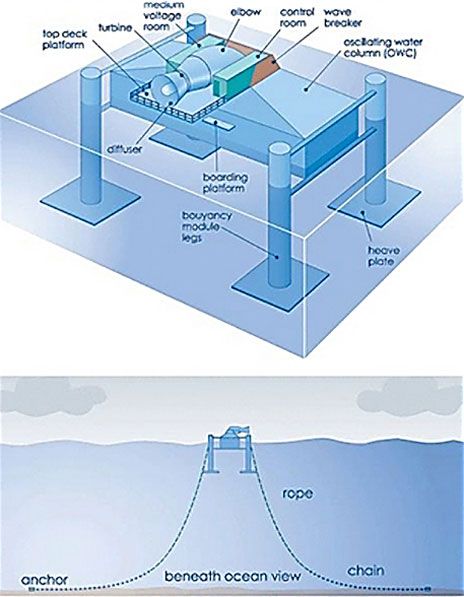
    Beyond Zero Emissions is organising a talk on Oceanlinx’s wave power technology which might be of interest to Melbourne based readers – The Latest Developments in Wave Power Technology.

    Guest speaker: Scott Hunter
    Time: 6.30 ~ 8pm Monday 1st February 2010
    Event location: Sans Frontiers Room, 2nd Floor, Kindness House, 288 Brunswick St, Fitzroy VIC.

    Scott Hunter is the Engineering Manager and Naval Architect for Oceanlinx. Oceanlinx is a leading renewable energy company based in Australia with a unique and efficient system for extracting energy from ocean waves.

    Scott’s current role as Engineering Manager involves assisting the general manager of engineering in bringing the concepts developed through R&D to reality.

    In this discussion group we will discuss how wave power technology works, discuss current projects in NSW and its potential to provide zero carbon electricity.


  • Coal seam gas deal promises water boost ?

    Somehow I don’t think will turn out well. The ABC has a report that a Queensland town is looking to reinject water from coal seam gas fields into the towns aquifers – yet one of the key environmental problems with CSG is what to do with the contaminated water produced as a by-product – are they plannming on filtering this stuff before putting it into the water supply ?. Mine deal promises water boost.

    The Maranoa regional Mayor says a deal with a mining company could solve Roma’s water problems. Rob Loughnan says Santos will start injecting water from its coal seam gas fields into the town’s underground aquifers.

    The project is expected to start within the next six months and councillor Loughnan says the company also plans to sell water to the district’s farmers. “But recharging the aquifer is assisting the whole community. It’s certainly something I’ll be promoting as a great win for south-west Queensland out of all this activity,” he said.


  • China setting the world’s oil price ?

    The FT has a post pointing to a Goldman Sachs report on the oil market, noting the drop in US demand has been entirely offset by a rise in Chinese demand – China, setting the world’s oil prices .

    They also point to a report from the IEA, pointing out that some Saudi Aramco grades are no longer available to European customers, “in favour of Asian markets and domestic power consumption”.


  • ‘Cornucopia,’ the MIT food fab

    Bruce Sterling has a post on a food fabrication device project at MIT – ‘Cornucopia,’ the MIT food fab.

    * If you wanna “print out breakfast” some day, I’d suggest keeping an eye on these guys.

    http://fluid.media.mit.edu/projects.php?action=details&id=79

    “Cornucopia is a concept design for a personal food factory that brings the versatility of the digital world to the realm of cooking. In essence, it is a three dimensional printer for food, which works by storing, precisely mixing, depositing and cooking layers of ingredients.

    “Cornucopia’s cooking process starts with an array of food canisters, which refrigerate and store a user’s favorite ingredients. These are piped into a mixer and extruder head that can accurately deposit elaborate combinations of food. While the deposition takes place, the food is heated or cooled by Cornucopia’s chamber or the heating and cooling tubes located on the printing head. This fabrication process not only allows for the creation of flavors and textures that would be completely unimaginable through other cooking techniques, but it also allows the user to have ultimate control over the origin, quality, nutritional value and taste of every meal.

    “This project is currently starting.”


  • Scientists ‘losing climate fight’

    The ABC has a report on the increasingly successful campaign by climate skeptics to muddy public perception of the global warming problem – Scientists ‘losing climate fight’.

    A leading Australian climate change scientist says experts are losing the fight against sceptics, who are distorting the science of global warming. …

    But one of the lead authors of the report, Australian Professor Andy Pitman, has defended the overall conclusions of the report. Professor Pitman was a lead author on the IPCC’s 2001 and 2007 reports. He is also the co-director of the Climate Change Research Centre at the University of New South Wales.

    Professor Pitman says sceptics have used the IPCC’s error to skew the climate change debate. “Climate scientists are losing the fight with the sceptics,” he said. “The sceptics are so well funded, so well organised. “They have nothing else to do. They don’t have day jobs so they can put all their efforts into misinforming and miscommunicating climate science to the general public, whereas the climate scientists have day jobs and [managing publicity] actually isn’t one of them.

    “All of the efforts you do in an IPCC report is done out of hours, voluntarily, for no funding and no pay, whereas the sceptics are being funded to put out full-scale misinformation campaigns and are doing a damn good job, I think. They are doing a superb job at misinforming and miscommunicating the general public, state and federal governments.”

    And he says if scientists lose the climate change debate, it would be “potentially catastrophic”. “If this was academic debate over some trivial issue [it wouldn’t matter],” he said. “But this isn’t. This is absolutely a fundamental problem for the Earth that we desperately needed full-scale international action on a decade ago.

    “We are now 10 years too late to stop some of the major impacts that we will see and have seen as a consequence of global warming. It is not a future problem, it is a problem here today, around us.”

    Professor Pitman has accused sceptics of failing to base their arguments on the facts. “Most of the climate sceptics, particularly those that are wandering around publicly at the moment, don’t base their arguments on science,” he said. “They have probably never read the Intergovernmental Panel on Climate Change report; they aren’t writing papers in peer-reviewed literature.

    “They don’t update their arguments when their arguments are shown to be false, so they’ll have no problem at all using this ammunition inappropriately and out of context to further their aims in exactly the same way as people did when they were trying to disprove the relationship between smoking and human health.”


  • Venezuela oil reserves twice Saudi Arabia’s ?

    “Business Intelligence Middle east” has an article on a strange USGS assessment of Venezuelan oil reserves, which appears to be based on some sort of fantasy number for oil recovery rates – Venezuela oil reserves may be twice the size of Saudi Arabia’s.

    A new US government assessment of Venezuela’s oil reserves could give the country double the supplies of Saudi Arabia.

    Venezuela’s Orinoco oil region contains about 513 billion barrels of crude that could technically be recovered by energy companies if cost were not an issue, the report said on Friday.

    Scientists working for the US Geological Survey say Venezuela’s Orinoco belt region holds twice as much petroleum as previously thought. This assessment is far more optimistic than even the best case scenario put forward by President Hugo Chavez.

    It is the largest crude oil resource assessment ever done by the US Geological Survey for one area and its first for the Orinoco Oil Belt, a region in central Venezuela that contains heavy, thick crude that does not flow very easily.

    Not all the region’s oil in the USGS’ resource estimate could be drilled at a profit, but the agency does not have a projection on how much of the Orinoco oil could be profitably drilled. “We don’t say anything about the economics of the oil,” said agency spokesman Chris Schenk. Schenk said the estimate was based on oil recovery rates of 40% to 45%.

    The agency said its new estimate on the region’s oil resources was based on advances in technology and new understanding in geology that “allow us to assess how much is now technically recoverable.”

    Petroleos de Venezuela SA (PDVSA), Venezuela’s state oil company, has not commented on the news. However, Venezuelan oil geologist and former PDVSA board member Gustavo Coronel was sceptical.

    “I doubt the recovery factor could go much higher than 25% and much of that oil would not be economic to produce”, he told Associated Press news agency.


  • The Electric Car Revolution Will Soon Take to the Streets

    Yale Environment 360 has a look at the unfolding transition to electric vehicles – The Electric Car Revolution Will Soon Take to the Streets.

    Electric cars are a green movement that is finally moving. Shunted to the side as the public indulged its love affair with gas-guzzling SUVs and four-wheel-drive trucks, history has finally caught up with the plug-in vehicle.

    The North American International Auto Show in Detroit is the domestic auto industry’s biggest annual showcase, and the new models have traditionally been brought out in a son et lumière of dancing girls, deafening music, and dry ice smoke. The few green cars that made it this far were usually for display only — very few actually made it to showrooms.

    But not this year. It’s become a race to market for green cars, and soon you’ll be able to buy many of the electric vehicles that were on display last week in Detroit. The auto show featured one hybrid and battery electric car introduction after another. Although the only truly road-worthy, plug-in electric vehicle you can buy today is the $109,000 Tesla Roadster, by the end of 2010 it will be joined by such contenders as the Nissan Leaf, Coda sedan, and the Think City.

    Indeed, the entire auto industry — from giants such as Ford, GM, and Renault-Nissan to startups such as Fisker Automotive — has joined the movement to build and market affordable electric vehicles.

    There’s a reason the automakers in Detroit are finally plugging in as something more than a greenwashing exercise. Spurring them forward is a historic confluence of events. Chief among them are Obama administration green initiatives, including Department of Energy (DOE) loans and grants, as well as economic stimulus funds that provide $30 billion for green energy programs, tax credits for companies that invest in advanced batteries, and $2.4 billion in strategic grants to speed the adoption of new batteries. (Much of that money is going to Michigan, which despite record unemployment is emerging as something of a green jobs center.)

    Other factors behind the push to manufacture electric vehicles are a federal mandate to improve fuel efficiency to an average of 35.5 miles per gallon by 2016, concerns about global warming and peak oil, and sheer technological progress building better batteries.

    Even without federal largesse, some companies are moving aggressively into the electric vehicle market. A prime example: Coda Automotive, a southern California start-up, has raised an impressive $74 million in three rounds of private funding. CEO and President Kevin Czinger is a former Goldman Sachs executive, as is co-chairman Steven Heller. Among the company’s investors are Henry M. Paulson, who was Goldman Sachs’ chairman and Treasury Secretary under the second President Bush. Clearly, these former investment bankers see electric cars as a good bet.

    A key factor in making today’s electric vehicles possible is the rapid development of the energy-dense lithium-ion battery. William Clay Ford Jr., the executive chairman of the company that bears his name, told me in Detroit, “Five years ago, battery development had hit a wall, and we were pushing hydrogen hard. But now so much money and brainpower has been thrown at electrification that we’re starting to see significant improvements in batteries in a way we hadn’t anticipated. Now we have the confidence that the customer can have a good experience with batteries.”

    Drawing a huge crowd, Tesla Motors Chairman and CEO Elon Musk showed off his company’s 1,000th electric Roadster at the auto show. “For a little company, it’s a huge milestone,” he told me. “A year ago, we had built only 150 cars. We had two stores then, and now it’s a dozen.”

    Cleantech.com has a look at some potential roadblocks to the revolution – ‘Disaster’ scenarios for electric cars.

    The world is hearing more about, even seeing glimpses of an idyllic electric vehicle future.

    But what if things don’t go quite as expected, mused a panel of experts on smart mobility today at the World Future Energy Summit in Abu Dhabi.

    Participants were ostensibly to discuss what will be required to make smart mobility a reality. They initially gave presentations articulating total lifecycle cost benefits of electric vehicles, their reduced carbon impact, mobility-on-demand as an alternative to vehicle ownership, the moderating effects of plug-in hybrids to potentially reduce utility power plant peaking expenses and more.

    The conversation took a different path when Jörg Kruhl, Head of New Technologies for Germany’s E.ON, ended his presentation with, “the next three years will be about the breakthrough—or maybe the disaster—of e-mobility.”

    What could prompt electric vehicle market disasters?

    “I think of safety issues. Early trials resulting in images of damaged cars, burning cars. That would be a disaster,” said Kruhl, adding, “[but] if that means they do not enter the market for the next ten years, they will come back later.”

    Some fear that lithium ion-based vehicle battery packs could experience fiery failures of the type occasionally suffered by lithium ion consumer electronics. Jan-Olaf Willums, former CEO of Think, now Chairman of the Zero Emission Mobility alliance—a battery certification organization—downplayed the problem.

    “The last time there was a disaster it was because the batteries didn’t perform. I think we’re beyond the tipping point there. The batteries which are under testing are actually pretty good,” he said.

    Alan Lloyd, President of the International Council on Clean Transportation, who was very familiar with California’s failed electric car experiments in the 90s, thought bad first impressions could be disastrous for the market, for instance “when early vehicles get out there and people are very disappointed with some aspect, particularly with their high cost, say the range or reliability.”

    The group also had opinions about elements of the electric car value chain to stay away from.

    Battery swapping and public charging stations were not seen as having a short term future, for instance.

    IEEE Spectrum is also focusing on the downside – Speed Bumps Ahead for Electric-Vehicle Charging and Loser: Why the Chevy Volt Will Fizzle.


  • Chilcot becomes the new Watergate ?

    Crikey has sent Guy Rundle off to cover the British election (poor bugger), with the first dispatch looking at the inquiry into Britain’s entry into the Iraq war – Rundle’s UK: Jack Straw takes the stand, Chilcot becomes the new Watergate.

    Britons don’t have a lot to marvel at, at the moment. The grey indifferent skies reflect the mood on earth. The recession has bit hard, with half a dozen familiar store chains going bust, leaving big gaps in the high street.

    The most spectacular and disturbing was the UK arm of the Borders book chain, which had huge flagship stores in Oxford Street and Soho, and just went pffft last November. Not a trading out, not a winnowing down — the whole chain just shut, the stores are still empty, and only a printed A4 notice directing inquiries to the administrator’s office gives any clue they were ever there.

    For many, the collapse of Borders was a sign that a recession was really here. Woolworths had collapsed a year earlier — but it was simply a dying brand, waiting for the final coup. Others, such as the CD/DVD chain Zavvi, had been idiotic enterprises from the start. But Borders was slacker pomo lifemode distilled to its very chai latte essence, part of the furniture of contemporary existence. The fact that it can go in a heartbeat was a chilling reminder that a lot of other things might be less secure than was once imagined.

    So it is a time for national doubt and introspection. A time when Britons are being borne back into the past more than the future, with the Chilcot Inquiry into UK participation in the Iraq War providing revelation after revelation.

    Today, Jack Straw took the stand, the first currently serving cabinet member so to do — and promptly landed his erstwhile leader, Mr Tony, even further in it.

    Looking, as he always does, like a shifty Nazi dentist caught in Bolivia, and frantically manufacturing an alibi for the years 1939-45, Straw claimed that the Iraq War decision had been his toughest and most wrenching decision during the Blair years, and that he had had “a secret plan to keep the UK out of the war” — by offering support, but no troops, pretty much the formula Harold Wilson used to stay out of active engagement in Vietnam.

    There’s no reason to disbelieve him, but his opposition to the Bush-Blair scheme to launch a full-scale occupation and invasion wasn’t enough to prompt him to resign, as Robin Cook had resigned. Nor was there any likelihood of that happening — Straw knew it would split the government down the middle.

    The real revelation in his evidence was that he believed Blair’s correspondence with Bush over the months leading up to the war took regime change and full occupation as a given, and that its tone was tantamount to a confession of breaching international law, and conning the UN. …

    Since Mr Tony is to return to give evidence to the inquiry, Straw has landed him right in it — giving him near-solitary responsibility for the decision to run with total war at all costs. The last person Blair could turn to as a co-conspirator is … Gordon Brown. Which may be why Brown announced late this evening that he had now agreed to appear at the inquiry, before rather than after the election.

    Whether explicitly so or otherwise, the decision was clearly contingent upon what Straw said and the Cabinet underlings are now united in a common plan — sheet it all home to Mr Tony, one way or another. Day by day, Chilcot is starting to have a Watergateish feel to it — a legal-political process put in train due to irresistible pressure, and now drawing all behind it.


  • Does exercise make your brain grow ?

    The SMH has an article on research explorin the link between exercise and the growth of new brain cells – Jog your memory: brain cell secrets explored.

    THE health benefits of a regular run have long been known, but scientists have never understood the curious ability of exercise to boost brain power.

    Now researchers think they have the answer. Neuroscientists at Cambridge University have shown that running stimulates the brain to grow fresh grey matter and it has a big effect on mental ability.

    A few days of running led to the growth of hundreds of thousands of brain cells that improved the ability to recall memories without confusing them, a skill that is crucial for learning and other cognitive tasks, researchers said.

    The new brain cells appeared in a region that is linked to the formation and recollection of memory. The work reveals why jogging and other aerobic exercise can improve memory and learning, and potentially slow down the deterioration of mental ability in old age.

    The research builds on a body of work that suggests exercise plays a vital role in keeping the brain healthy by encouraging the growth of brain cells. Previous studies have shown ”neurogenesis” is limited in people with depression, but that their symptoms can improve if they exercise regularly.

    Scientists are unsure why exercise triggers the growth of grey matter, but it may be linked to increased blood flow or higher levels of hormones that are released while exercising. Exercise might also reduce stress, which inhibits new brain cells through a hormone called cortisol.


  • Interview with Tesla CEO Elon Musk

    MNN has an interview’s with Tesla’s Elon Musk – MNN exclusive: One-on-one with Tesla CEO Elon Musk.

    Elon Musk is a billionaire, not a rock star, but he was nonetheless mobbed when he met the press at the Detroit Auto Show last week. This is, of course, a glamorous story. A mega-rich young businessman — cofounder of PayPal and whose other enterprise involves space flight — sets out to build the sexy, range-friendly, high-performance sports car they said would never hit the road.

    Actually, the very dirty white example on the show floor demonstrated that Teslas are not for display only. Tesla’s loyal employees took turns driving that example from Los Angeles to Detroit (with charging stops at RV parks and people’s houses) and didn’t even get around to washing it.

    Tesla Motors has sold 1,000 Roadsters (capable of 0 to 60 in 3.9 seconds) for $109,000, and is poised to expand the company’s reach with the four-door and four-seat $57,400 (with an available $7,500 federal tax break) Model S in 2011. The company sold a 10 percent share to Daimler for $50 million, and also landed a $465 million low-interest loan from the Department of Energy to build production capacity for the Model S.

    Musk admitted that 1,000 cars looks “small and humbling” when compared to giant automakers such as General Motors and Toyota, but it is “a huge milestone” for a small EV company, and indeed few others in the last 40 years (since the late 1960s battery-car revival) can claim that kind of volume.

    “Sales are doing very well,” Musk told me. “The economy affects us obviously, but we’re comfortable producing the Roadster at levels of 700 to 1,000 annually.”

    The half-priced Model S could quickly escalate Tesla’s sales volume, and Musk said it can break even at volumes of 8,000 to 10,000 annually. But the company will have to build them first. The one in existence, once silver and now Tesla red, gleamed on the show stand. Musk assured the press, however, that the car we were looking at is “not a static model, but a real car that’s capable of 100 mph.”


  • Interest in ancient books could restore Timbuktu

    The Washington Post has an interesting article on the ancient libraries of Timbuktu (which have had a little more luck than the library of Alexandria) – Interest in ancient books could restore Timbuktu.

    A sort of ancient-book fever has gripped Timbuktu in recent years, and residents hope to lure the world to a place known as the end of the Earth by establishing libraries for visitors to see their centuries-old collections of manuscripts.

    In a West African town where nomads and traders eke out livings, a revival of world attention to hundreds of thousands of privately held manuscripts — which survived fire, rain, sand and termites — represents an economic opportunity. But researchers and residents say the restoration of the books, most written in Arabic on fragile paper or lambskin, is also vital to showcasing Timbuktu’s — and, by extension, sub-Saharan Africa’s — more glorious past as a vibrant hub of scholarship. …

    The effort has been slow going. Travel warnings about Islamist insurgents in the area have deterred tourists. And most of the books remain in private hands and will probably stay that way: Many owners refuse to part with their books on the instructions of ancestors, but they struggle to raise funds to restore or display them.

    Tahar’s family, for example, has about 2,700 manuscripts passed down from his grandfather, a calligrapher. For now, they are stuffed inside trunks alongside pots and pans in his sandy house, and in one bookcase at what he calls his library — a couple of nearly empty rooms not far away, where he spends time cataloguing the works. …

    Other private libraries have been more fortunate as donors, including Libya and the Ford and Andrew W. Mellon foundations, have given millions of dollars to save the books. At the Mamma Haidara Library, which received financial help, women vacuum manuscripts in a restoration lab and a trio of men build acid-free storage boxes. “The manuscript is considered like a little baby,” said director Mohamed M. Moure.
    ad_icon

    The library’s 22,000 volumes have been in the family since the 16th century, Moure said. Still, he goes from village to village in search of new additions to a collection of ancient texts on medicine, history, astronomy, culture and religion.

    “What I like most is the correspondence,” Moure said, referring to antique letters. “They speak of walking to Bamako, or to Mecca . . . mysterious things.”

    A half-dozen centuries ago, people were also walking — flocking, even — to Timbuktu. Its spot in the desert between North and sub-Saharan Africa and on the edge of the Niger River made it a crucial trade junction. A university of 25,000 students bustled with scholarship. Bazaars overflowed with books that arrived on the backs of camels. Calligraphers sold copies for grams of gold.

    Timbuktu’s decline began in the late 16th century, when Moroccan raiders chased away scholars they viewed as threats. Trade shifted to West African ports. The books that serve as a testament to those earlier days were put away and neglected.


  • Have we sacrificed too much to the suburban dream ?

    The SMH has an article on the transition town movement and its relevance to Sydney – We’ve already sacrificed too much to the suburban dream .

    The recent trend of Transition Towns, as a response to climate change and the energy crisis, highlights the importance of recognising the rural context when considering the issues of urban development

    The movement, which began in the town of Totnes, in Devon aims to reduce reliance on global sources of energy and food by sourcing needs from within a locality.

    This is particularly relevant to the growth of Australian cities, as the continued spread of suburbia at the expense of proximate farming land is precisely the opposite of a climate responsive urban growth pattern.

    Under our current economic model, food production, packaging and distribution contribute to more than 20 per cent of our energy use. With most of the cost of food taken up by packaging and distribution it is easy to see how rising food prices, an inevitable consequence of peak oil, could be alleviated by localising and intensifying food production. This is the “Transition Town” notion of decoupling food from oil.

    Less generally understood perhaps, is how much damage has already been done by the suburban agglomeration. Not only has it destroyed farmland, coastline and other non-urban habitat, but its form and pattern is such that it can never be economically serviced by any type of circulation infrastructure: water, energy, waste or most obviously transport. An energy efficient city cannot be so dispersed and the continued release of land for housing subdivision on the fringe of major Australian cities, while politically attractive, will always be an environmentally irresponsible strategy.

    Not surprisingly, the need to effectively implement the delivery of much higher density mixed use development into suburbia goes hand in hand with a more climate responsive approach to the non-urban environment. It is unlikely that suburban residents would see it that way, yet maintaining a compost heap down the end of the garden can hardly compensate for the massive environmental footprint that suburban living entails. Of course, residents have little choice because what passes for urban consolidation is really just suburban intensification, offering nothing in the way of a real urban experience and retaining all of the negative features of suburbia.

    Surely the real benefit of urban consolidation should be the opportunity to avoid the homogenised sameness of suburbia while being close to non-urban places.

    Despite good intentions, it is probably not enough to simply introduce higher densities to the suburbs. The suburbs themselves may need to be transformed. If the transition towards much higher densities at transport nodes was accompanied by a corresponding transition to much lower densities in the surrounding undifferentiated suburban fabric, the suburbs could be ultimately dismantled to be reconstituted as non-urban space. Under this scenario, a major metropolitan area such as Sydney would be recast as an efficiently linked network of maybe a hundred small high-density cities occupying one-tenth of the current urban footprint, with the featureless interstitial suburban fabric going under the plough. Like Transition Towns, suitable land would then be available locally for fresh food production, or for other non-urban uses such as forest, parkland, waste recycling, aquaculture and power generation.


  • Bright Green Action as Economic Development Strategy

    Alex at WorldChanging has a post extolling the economic virtues of the new bright green economy versus the old extractive and polluting industries that are slowly dieing – Bright Green Action as Economic Development Strategy.

    Throughout much of the developed world, but especially in North America, the debate about sustainability is routinely framed as a trade-off between the environment and the economy. The problem is, no such trade-off exists.

    Certainly, there are big industries (like coal, oil, manufacture of cheap disposable consumer goods, fast food franchises, auto manufacturing) that will take a big hit as we move into a low-energy, low-carbon, zero-waste future. Many people will lose their jobs, and places that remain deeply committed to those industries are in for decades of suffering.

    But here’s the blunt reality: those industries, jobs and places are toast already. They are the walking dead. Nothing we do, on any scale or at any sacrifice, will save them, even in the medium term — and the more money we spend trying, the worse off our economies as a whole will be. The old economy is dead.

    Of course, those with money invested in that economy have been doing everything they can — spending many billions on lobbying, propaganda campaigns and political bribes — to convince us that they are the economy, and that anything that hurts them will damage the prosperity of the rest of us (and that therefore we should continue spending vast sums of our taxes subsidizing their industries, protecting their supply lines abroad and paying the environmental and health burdens their business models saddle us with… not to mention the catastrophes they’re leaving our children).

    If we could filter their propaganda and influence out of our public debate for a day, we’d have a series of national epiphanies: our economic futures are not dependent on these guys, and the quicker we leave these industries behind, the better of we are; in fact, bright green action’s not only not a hit to competitiveness, it’s the new definition of competitive advantage.

    By slashing emissions, developing clean energy, investing in bright green cities, changing agriculture, spurring design and technological innovation and embracing new models of prosperity, we don’t just meet our ethical obligations not to destroy the ecological foundations of civilization; we also create the kind of economy that is clearly going to lead the way in the 21st century.

    Many people understand already that by doing these things, we save money directly, because energy and materials are expensive, and (all other things being equal) using less of them to generate more economic activity is profitable: money spent making greener profits is not a cost, it’s an investment. If you extend your planning horizon out even a few years, a large percentage of the changes we want to see make us money. This is particularly true in talking about big system shifts, like rebuilding auto-dependent communities and investing in clean energy. Much of what we want to do already makes more economic sense, if all the costs are counted (and harmful subsidies eliminated) and the planning time frame is reasonable.

    Many other things, though are not yet directly profitable. Especially where we’re pushing the boundaries of the possible, there’s a cost to the learning curve. Fewer people yet understand that cost is also an investment, because the knowledge you gain in the process is worth money. Lots of money. In fact, the knowledge gained in being a bold, aggressive first-mover in bright green innovation is itself the industry of the future. The working knowledge of transformational technologies, designs and practices is the economic reward for moving boldly into a bright green future. The speed with which they move is almost certainly going to determine which businesses and regions are globally competitive in coming decades.

    In fact, I’m convinced that a regional government sufficiently free of old industry influence would see what seems like us today as an astonishing pace of transformation as the best economic development strategy there is. Raising building codes and design standards to the best known level (and then continuing to raise them, ensuring that local architects, builders, engineers and designers are on the cutting edge of their fields); doing everything possible to encourage dense and walkable urbanism and the development of new walkshed technologies and product-service models (and working to actively revoke subsidies for auto-dependence, from parking to free roads to externalized costs for health and environmental damage); moving now towards zero-waste policies with hefty penalties for products that can’t be safely disassembled and recycled; investments in watershed and foodshed management and ecosystem service preservation designed to both secure sustainable access to the essentials of life and promote working insight into better farming, forestry and restoration practices — the list goes on and on, but the point is the same: all of these things look radical and unrealistic when seen through the filter of the status quo, but are in fact the kinds of actions that will create vibrant, competitive, prosperous places over the next decade.


  • The New World Energy Order

    The CFR journal Foreign Affairs has a look at the evolving global energy environment – worrying about energy security and global warming but remaining uncomfortably blase about peak oil – The New Energy Order.

    The last decade has seen an extraordinary shift in expectations for the world energy system. After a long era of excess capacity, since 2001, prices for oil and most energy commodities have risen sharply and become more volatile. Easy-to-tap local fuel supplies have run short, forcing major energy consumers to depend on longer and seemingly more fragile supply chains. Prices have yo-yoed over the last 18 months: first reaching all-time highs, then dropping by two-thirds, and after that rising back up to surprisingly high levels given the continuing weakness of the global economy. The troubles extend far beyond oil. Governments in regions such as Europe worry about insecure supplies of natural gas. India, among others, is poised to depend heavily on coal imports in the coming decades. For these reasons, governments in nearly all the large consuming nations are now besieged by doubts about their energy security like at no time since the oil crises of the 1970s. Meanwhile, the biggest energy suppliers are questioning whether demand is certain enough to justify the big investments needed to develop new capacity. Producers and consumers, each group unsure of the other, cannot agree on how best to finance and manage a more secure energy system.

    A crisis is looming, and it will be difficult to resolve because it will strike as two radically new changes are making it harder for governments to manage the world energy system. The first is a shift in the sources of consumption. The era of growing demand for oil and other fossil fuels in the industrialized countries is over; most of the future growth in demand will come from the emerging-market countries, notably China and India. The International Energy Agency (IEA) has projected that by 2030, China will depend on imports for at least two-thirds of its oil, and India, for even more. These countries, especially China, are choosing to secure their energy supplies less by relying on commercial interests — the standard approach for all the biggest industrial energy users over the last two decades — than by locking up supplies in direct bilateral deals with producing countries. For instance, China’s push into Africa, Central Asia, and other energy-rich regions, which usually involves special government-to-government deals, is a rejection of the reigning market-based approach to energy security. And because oil, gas, and coal are global commodities, these exclusive, opaque deals make it harder for the markets to function smoothly, thus endangering the energy security of all nations. They also complicate efforts to hold energy suppliers accountable for protecting human rights, ensuring the rule of law, and promoting democracy.

    The other big shift in the world energy system is growing concern about the environmental impact of energy use, especially emissions of carbon dioxide, an intrinsic byproduct of burning fossil fuels with conventional technology and the leading human cause of global warming. Worries about climate change are one reason why the major stimulus packages passed since the global financial crisis began in 2007 have included hefty green-energy measures: by some accounts, these have made up 15 percent of global fiscal stimulus spending. Some believe that such green-tinted stimulus measures will spur a revolution pushing for cleaner and more secure energy. Perhaps. But there is no doubt that energy systems are in for a major change. Curbing global warming will likely require cutting emissions of carbon dioxide and other greenhouse gases by more than half over the next few decades, and that goal cannot be achieved by just tinkering at the margins. …

    The security of oil and gas supplies is in question not only because the existing supplies are depleting quickly but also because investors are wary of pouring money into finding new resources. The problem is not geology: technological innovation is more than amply offsetting the depletion of conventional fossil fuels. The problem lies in the massive economic and political risks inherent in new projects, particularly those that supply energy across national borders and thus face a multitude of political uncertainties. Suppliers worry that there will not be enough demand to justify the investments, especially now that growing concerns about climate change have cast doubt on the future of fossil fuels without offering a clear alternative.