Author: Big Gav

  • Microgrid Update

    John Robb has a micro-update on the microgrid concept – RC UPDATE: Microgrids.

    Three years ago, I wrote about the importance of smart electricity microgrids in Brave New War as platforms for networked resilient communities. As a reminder, here’s a short synopsis of what a microgrid is (the “smarts” are computer controls and data that allow people to see and manage the generation and use of electricity down to the device level through a simple Web interface):

    Microgrids are modern, small-scale versions of the centralized electricity system. They achieve specific local goals, such as reliability, carbon emission reduction, diversification of energy sources, and cost reduction, established by the community being served. Like the bulk power grid, smart microgrids generate, distribute, and regulate the flow of electricity to consumers, but do so locally. Smart microgrids are an ideal way to integrate renewable resources on the community level and allow for customer participation in the electricity enterprise.

    At the time when I first wrote about it, most of the interest in the topic was academic, and almost all of the implementations were very, very basic in design (hospitals and military bases, etc.). What a difference three years makes. Smart microgrids are now going mainstream with multiple software start-ups and big efforts underway at Siemens and Cisco. Given this pace of expansion, I suspect that this bottoms up approach will vastly outstrip and eventually curtail any efforts to build smarts into the larger utility grids (which is estimated to cost $165 b in the US alone, money that doesn’t exist). Also, with this level of interest, open source efforts are sure to follow.


  • Peak Oil is Soooo …. May of 2008

    Paul Kedrosky has a post on waning interest in peak oil ion spite of climbing oil prices – Peak Oil is Soooo …. May of 2008.

    Despite gas prices having climbed a good chunk of the way back up to 2008 levels, the level of worry about higher prices hasn’t seemed as high this time around. To test that, I pulled data from Google Trends on searches for “peak oil” and compared that to WTI crude prices over the same period. As this graph shows, while the two moved up together in 2007/2008, this time around “peak oil” and higher prices have disconnected in the public awareness — at least for now.

    Why might that be? One explanation is that oil prices haven’t climbed as fast as they did in early 2008, with the slope of the ascent being a primary source of worries. Second, with consumers having seen prices considerably higher than today’s just two years ago, perhaps they have become desensitized to oil at “merely” $87 a barrel. Of course, if either or both are true it wouldn’t take much to turn around perception and have people paranoid about peak oil again: higher prices or a faster ascent would do the deed in short order.


  • If All Chinese Had Wheels

    Bill Totten has exhumed an old New York Times (1972) column by Paul Ehrlich, commenting “Nothing but the numbers has changed” – If All Chinese Had Wheels.

    Now that the People’s Republic of China has been admitted to the United Nations and American leaders are jetting to Peking, it is inevitable that we will be hearing more proposals for trade and aid to help the Chinese bring themselves up to “our standard of living”. The idea of helping less developed nations “industrialize” or “catch up” seems as American as baseball. Few people question the common wisdom behind these programs, the idea that the developing areas of the world can somehow catch up with contemporary consumptive standards of living in industrial societies.

    The emergence of China as a needy superpower must surely generate a re-evaluation of these beliefs. First, it is doubtful that the Chinese will ever reach our current standard of living; indeed it is not certain that this is even possible. But, more important, it is questionable whether such an achievement would be desirable, from any point of view. If the level of industrialization in China could be increased to the point that each Chinese family possessed an automobile and other amenities of industrial society, the effect on China and the entire world would be catastrophic. This observation immediately raises the point, of course, that the US should be considered overdeveloped by virtue of having attained a level of per capita consumption far in excess of that to which the bulk of humanity can realistically aspire.

    Some very basic figures shed light on the development dilemma. There are currently at least 750 million people in mainland China. By contrast, the population of the United States is slightly over 200 million. Since there are more than 3.5 Chinese for every American, it would require some 3.5 times the present United States resource consumption to sustain China at current American levels. Such affluence in China would necessitate a tremendous shift in world consumption of raw materials.

    Energy consumption is the best summary measure of industrial sophistication, and per capita energy consumption is indicative of average individual environmental impact. The world currently consumes 6.5 billion metric tons of coal equivalent in energy each year. The United States uses 2.2 billion metric tons equivalent or one-third of total world consumption. The Chinese, on the other hand, consume less than 400 million metric tons equivalent. In per capita terms, each person in China is supported by the consumption of less than 500 kilograms of coal equivalent, while his American counterpart is supported by some 11,000. Roughly speaking, twenty-two times as much energy is used to sustain an American as to sustain one citizen of China.


  • Green LEDs for Efficient Lighting

    Technology Review has an article on “solar-cell manufacturing techniques [which] could yield LEDs that require 20 percent less energy” – Green LEDs for Efficient Lighting.

    A new approach to fabricating light-emitting diodes (LEDs) could be used to increase their efficiency by 20 percent while yielding higher-quality light than conventional LEDs. Researchers at the National Renewable Energy Laboratory (NREL) in Golden, CO, have demonstrated the approach by making a yellow-green LED that could soon be combined with other colored LEDs to yield white light. The new LED could help replace current, inefficient methods of generating white light.

    LEDs, devices that emit photons when an electrical charge is applied to them, are more efficient and last longer than incandescent lightbulbs. By varying the composition of the semiconductor LEDs, materials scientists can coax the devices into emitting different colors. At the minimum, producing white light requires combining red, blue, and green, but so far, only red- and blue-light-emitting diodes are well developed. To produce green light, LED manufacturers typically apply one or more phosphor materials to blue LEDs. The phospors convert high energy blue spectrum light into lower-energy light through a process that reduces overall luminosity by approximately 20 percent.

    To eliminate this loss of efficiency, researchers have tried to develop efficient green LEDs that don’t require phosphors. But a major stumbling block is that the different known semiconductor materials that can be combined to emit green light, typically indium and gallium nitride, have different-sized crystal lattice structures. For semiconductors to work efficiently, each layer of the device has to have a similarly sized lattice structure as the layer above or below it.

    To get around the lattice-size mismatch, NREL researchers used a fabrication method that they had previously developed for building highly efficient multi-junction solar cells. Their method relies on using additional layers of other semiconducting materials with intermediate-sized lattice structures that bridge the gap between the disparate-sized semiconductors. “If you try to do it in one shot, the whole thing will be defective,” says Angelo Mascarenhas, team leader for solid state spectroscopy in the Center for Basic Sciences at NREL. “You have to grow a sequence of layers in a step-wise fashion.”


  • Crime Prediction Software Is Here and It’s a Very Bad Idea

    While I quite like IBM’s “smarter planet” marketing campaign and the use of advanced analytics in applications like smart grids, this particular use of data analysis seems rather evil. From Gizmodo – Crime Prediction Software Is Here and It’s a Very Bad Idea.

    IBM clearly wants this to go big. They have spent a whooping $12 billion beefing up its analytics division. Again, here’s the full quote from Deepak Advani:

    Predictive analytics gives government organizations worldwide a highly-sophisticated and intelligent source to create safer communities by identifying, predicting, responding to and preventing criminal activities. It gives the criminal justice system the ability to draw upon the wealth of data available to detect patterns, make reliable projections and then take the appropriate action in real time to combat crime and protect citizens.

    If that sounds scary to you, that’s because it is. First it’s the convicted-but-potentially-recidivistic criminals. Then it’s the potential terrorists. Then it’s everyone of us, in a big database, getting flagged because some combination of factors—travel patterns, credit card activity, relationships, messaging, social activity and everything else—indicate that we may be thinking about doing something against the law. Potentially, a crime prediction system can avoid murder, robbery, or a terrorist act.

    It actually sounds like a good idea. For example, there are certain patterns that can identify psychopaths and potential killers or child abusers or wife beaters. It only makes sense to put a future system in place that can prevent identify potential criminals, then put them under surveillance.

    The reality is that it’s not such a good idea: While everything may seem driven by the desire to achieve better security, one single false positive would make the whole system unfair. And that’s not even getting into the potential abuse of such a system. Like the last time IBM got into a vaguely similar business for a good cause, during the 1930s. They shipped a lot of cataloguing machines to certain government in Europe, to put together an advanced census. That was good. Census can improve societies by identifying needs and problems that the government can solve. At the end, however, that didn’t end well for more than 11 million people.

    And yes, this comparison is an extreme exaggeration. But one thing is clear: No matter how you look at it, cataloguing people—any kind of people—based on statistical predictive software, and then taking pre-empetive actions against them based on the results, is the wrong way to improve our society. Agreeing with this course of action will inevitably take us into a potentially fatal path.


  • The Global War on Tribes

    CounterPunch has an article on modern resource wars being conducted against tribal groups – The Global War on Tribes.

    The so-called “Global War on Terror” is quickly growing outside the borders of Iraq and Afghanistan, into new battlegrounds in Pakistan, Yemen, Somalia, and beyond. The Pentagon is vastly increasing missile and gunship attacks, Special Forces raids, and proxy invasions–all in the name of combating “Islamist terrorism.” Yet within all five countries, the main targets of the wars are predominantly “tribal regions,” and the old frontier language of Indian-fighting is becoming the lexicon of 21st-century counterinsurgency. The “Global War on Terror” is fast morphing into a “Global War on Tribes.”

    Tribal regions are local areas where tribes are the dominant form of social organization, and tribal identities often trump state, ethnic, and even religious identities. Tribal peoples have a strongly localized orientation, tied to a particular place. Their traditional societies are based on a common culture, dialect, and kinship ties (through single or multiple clans). Although they are tribal peoples, they are not necessarily Indigenous peoples–who generally follow nature-centered spiritual and cultural systems. Nearly all tribal communities in the Middle East and Central Asia have been Islamicized or Christianized, but they still retain their ancient social bonds.

    Yet modern counterinsurgency doctrine only views tribal regions as festering cauldrons of lawlessness, and “breeding grounds” for terrorism, unless the tribes themselves are turned against the West’s enemies. The London Times (1/5/10), for example, crudely asserts that Yemen’s “mountainous terrain, poverty and lawless tribal society make it… a close match for Afghanistan as a new terrorist haven.” This threatening view of tribal regions is, of course, as old as European colonialism itself. …

    Whether in Mexico, India, Iraq, or the United States and Canada, the Global War on Tribes has some common characteristics. First, the war is most blatantly being waged to steal the natural resources under tribal lands. The rugged, inaccessible terrain that prevented colonial powers from eliminating tribal societies also made accessing minerals, oil, timber and other resources more difficult–so (acre for acre) more of the resources are now left on tribal lands than on more accessible lands.

    Resources are not always the underlying explanation for war, but they’re a pretty good start at an explanation. In the case of Indigenous tribal peoples, their historic attention to biodiversity has also enabled natural areas to be relatively protected until now, as corporations seek out the last remaining pockets of natural resources to extract. Look no further than the Alberta Tar Sands, for instance, to see the exploitation of Native lands by modern oil barons.

    Like in Avatar, Native peoples often resist the militarization brought by corporate invaders seeking to mine “unobtainium,” and they don’t need a white messiah riding a red dragon to guide them to victory. In his book Resource Rebels: Native Challenges to Mining and Oil Corporations, Al Gedicks notes, “Up until recently, the tendency in the mass media has been to stereotype native people as fighting a losing battle against the onslaught of industrial civilization. But after two decades of organizing local, national, regional and international alliances, assisted by…the Internet, native voices can no longer be ignored in powerful places” (p. 1).

    Second, the Global War on Tribes is a campaign against the very existence of tribal regions that are not under centralized state control. The tribal regions still retain forms of social organization that has not been solely determined by capitalism. In her anthology Paradigm Wars, Victoria Tauli-Corpuz, Chair of the United Nations Permanent Forum on Indigenous Issues, comments that “promoters of economic globalization, the neocolonizers, use the overwhelming pressure of homogenization to teach us that indigenous political, economic and cultural systems are obstacles to their ‘progress.’” (p. 14).

    The point is not that all tribal peoples pose an egalitarian alternative to neoliberal capitalism. Some (such as Indigenous peoples) certainly do have strong egalitarian principles, but many other tribal peoples –such as in the new conflict zones–certainly do not (particularly toward women). The salient point is not that all tribal cultures are paradise, but that they are not capitalist, and neoliberal capitalism cannot stand anything other than Total Control.

    Third, the collective form of organization enables tribal peoples to fight back against state control and corporate globalization. When I asked Arundhati Roy at a Seattle forum (3/29/10) why counterinsurgency wars seem to be focused on tribal regions, she answered that tribal peoples do not have a “bar-coded” view of the world. Tribes still have the social networks to defend their lands and ways of life—networks of trust anchored in deeply held values that citizens of urban industrial society generally lack.

    Speaking of Arundhati Roy, she’s in a little trouble over her recent article on the Naxalite rebellion in India – Author investigated over rebel ties.

    A Booker Prize-winning author is facing a police investigation over her links with Maoist insurgents behind the massacre of more than 70 soldiers.

    Police in Chhattisgarh, central India, confirmed they had ordered an investigation into Arundhati Roy’s comments in a magazine article in which she outlines her sympathy for the Maoist insurgency.

    Her comments brought an official complaint from a local activist under the Chhattisgarh Special Public Security Act 2005 who claims the article was intended to drum up support for the Maoists. She can be held for several years without bail and jailed for two years if found to have violated the act.

    Since her novel The God of Small Things won the Booker Prize in 1997, Roy has campaigned for the rights of India’s tribal people who have been ousted from their land to make way for mines, factories, roads and dams. …

    In a statement to an Indian newspaper, Roy denied her article had glorified the Maoists, and said the investigation was an attempt to ”cordon off the theatre of war and choke the flow of critical information coming out of the forests”.

    Roy was jailed in New Delhi in 2007 for contempt of court over a protest against a dam project in the Narmada Valley.


  • Blanketing warehouse roofs with solar panels

    USA Today has an article on the trend towards covering warehouse roofs with solar panels – Edison blankets warehouse roofs with solar panels.

    The view from a warehouse roof here is consistent. In every direction, there are blocks and blocks of warehouse roofs baking in the Southern California sun.

    Rather than letting them sit bare, a California utility hopes to blanket roofs like these with solar panels to produce enough electricity to power 162,000 homes.

    Southern California Edison has installed solar on two warehouse roofs and is working on another in the Los Angeles region. The utility expects to do 100 to 125 more, totaling about 1.5 square miles of roof space in the next five years.

    The program, in which the utility owns the solar, is the largest of its kind in the nation, not surprising since California is the No. 1 solar market. But utilities in other states, including North Carolina, New Mexico, Arizona and New Jersey, have smaller plans to rent roofs for their own mini-solar-power plants, too.

    The phenomenon, while in its infancy, presents another way for solar to spread in a bigger way than it has historically done when home and business owners put solar on roofs. The deep-pocketed utilities are planning bigger installations. Yet the systems don’t consume green land or require new power-transmission links, as do some massive solar farms planned for deserts in California, Arizona and Nevada. As such, rooftop solar is likely to face fewer environmental hurdles than the farms and can get permits and be built much faster.

    “Everybody is looking to see how this works,” says solar analyst Alfonso Velosa at research firm Gartner. “Southern California Edison is the experiment.”


  • “Plastic Soup” Found in Atlantic Ocean

    CBS has a report that the Atlantic ocean may have an equivalent to the pacific ocean gyre – “Plastic Soup” Found in Atlantic Ocean.

    Researchers are warning of a new blight on the ocean: a swirl of confetti-like plastic debris stretching over thousands of square miles in a remote expanse of the Atlantic Ocean.

    The floating garbage – hard to spot from the surface and spun together by a vortex of currents – was documented by two groups of scientists who trawled the sea between scenic Bermuda and Portugal’s mid-Atlantic Azores islands.

    The studies describe a soup of micro-particles similar to the so-called Great Pacific Garbage Patch, a phenomenon discovered a decade ago between Hawaii and California that researchers say is likely to exist in other places around the globe.

    “We found the great Atlantic garbage patch,” said Anna Cummins, who collected plastic samples on a sailing voyage in February.

    The debris is harmful for fish, sea mammals – and at the top of the food chain, potentially humans – even though much of the plastic has broken into such tiny pieces they are nearly invisible.

    Since there is no realistic way of cleaning the oceans, advocates say the key is to keep more plastic out by raising awareness and, wherever possible, challenging a throwaway culture that uses non-biodegradable materials for disposable products.


  • Demand for oil to outstrip supply within two years

    The (Perth) Sunday Times has an article on recent talk of peak oil – Demand for oil to outstrip supply within two years .

    RISING oil prices pose a grave threat to global economic recovery, according to some experts. The fear has been expressed by the US military and by the automobile industry.

    This week in Perth, Volvo’s head of product planning, Lex Kerssemakers, said “we all know that oil is running out”. “We need to find alternative solutions and though we are aware of the alternatives – LPG, CNG, ethanol, electric and so on – we have to introduce these to the market,” he said. “If we don’t do it now, we won’t be ready in five years when oil may be prohibitively expensive.”

    Mr Kerssemakers said Volvo would have an eelctric car on the world market in 2012 that would use less than 1.5 litres/100km of fuel – about one-tenth of that used by a current V8-engined sedan.

    Volvo is not alone in the race to produce more fuel-efficient vehicles – all car companies are either developing alternative engined or fuelled vehicles by themselves or in partnership with other car companies that, in many cases, were once their fierce rivals.

    The US military this week warned the world faces a “severe energy crunch” and looming oil shortages. According to a Joint Operating Environment report from the US Joint Forces Command, “a severe energy crunch is inevitable without a massive expansion of production and refining capacity”.

    The report says the central problem for the coming decade “will not be a lack of petroleum reserves, but rather a shortage of drilling platforms, engineers and refining capacity”. And it warns: “Even were a concerted effort begun today to repair that shortage, it would be 10 years before production could catch up with expected demand.”

    More ominously, the military predicts a “Peak Oil” scenario – where demand outstrips the world’s supply capacity – as soon as 2012.


  • Finds fuel deep-sea oil rush ?

    The Australian has an article on the opening up of some fairly inhospitable oil exploration regions off the south coast of Australia – Finds fuel deep-sea oil rush.

    THREE significant new oil and gas regions have been identified off Australia’s coast, raising the potential for a wave of offshore exploration that could create booming new resources hubs around the nation.

    A combination of new technology and the high price of oil has prompted the commonwealth’s Geoscience Australia survey body to push technical limits and explore frontier areas in deep water, turning up startling new resource potential.

    One of the regions, the South Australian end of the Great Australian Bight, has been opened for exploration and has already attracted strong bids ahead of the April 29 deadline.

    But extracting any oil and gas from this area will mean overcoming significant challenges, including heavy seas and wells deeper than any in operation around the nation.

    In addition to the Bight, Geoscience Australia has uncovered strong indications of petroleum in basins near the Lord Howe Rise, 800km east of Brisbane, and on the Wallaby Plateau, 500km off the West Australian coast and next to the existing North West Shelf gas zone.

    All three areas are at the deepwater edge of Australia’s vast maritime zone – an area almost twice the size of the continent.

    Geoscience Australia is using an advanced aeromagnetic survey also to examine basins to the west and north of Tasmania, recently collecting data over a flying distance of 140,000km. The results are being analysed.

    With extra funding for frontier exploration, Geoscience Australia has employed an array of technology in the search for resources and has turned up enticing new evidence. It has found potential source rocks in the Bight, which has never produced oil or gas.

    The new evidence has emerged at a time of dwindling oil production in Australia, with reserves equal to 10 years of production. …

    Ms Totterdell said the Bight had been regarded as “too hard” by many oil companies, and the rough seas and location of the basin made exploration work in the area “challenging”.

    In 2003, Woodside Petroleum, the nation’s biggest independent oil and gas company, drilled the Gnarlyknots well to a depth of 4000m in the seabed, at a cost of $55m, but it had to abandon the project due to 10m swells. But Ms Totterdell’s team was undeterred. They believed the bitumen rocks that washed up on beaches along the coast gave strong indications there was petroleum offshore.

    Under Australia’s petroleum exploration regime, all information acquired by companies must be given to the federal government. Geoscience Australia re-analysed Woodside’s data, and then began looking for rocks in an area about 200km west of where Woodside had drilled.

    The rocks were dredged from a 5km-wide canyon that enabled geologists to uncover samples that lie thousands of metres below the seabed in the centre of the basin, about 200km to the east. It is in the centre where the exploration blocks have been offered.

    The Bight’s water depth ranges from 500m-4000m; the Wallaby Plateau ranges from 2000m to 4000m and Lord Howe Rise ranges from 1300m-2500m.

    National oil production has declined from a peak of 35 billion barrels a year early last decade to about 20 billion at present. [BG: these numbers are rubbish – we produce about 210 million barrels of oil per year]


  • South Africa to Unveil Plans for High Speed Rail Network

    High Speed Rail seems to be a hot topic lately – Inhabitat reports that the South Africans are looking to jump on the bandwagon – South Africa to Unveil Plans for High Speed Rail Network.

    From the US to the UK to China, countries around the world getting in on the high speed rail bandwagon. The latest country to announce plans for a network is South Africa, which is now looking into a high speed rail line that connects Johannesburg, Durban and Cape Town. Right now a journey from Durban to Johannesburg can take up to 12 hours, but with a high speed rail line the trip would only take 3 hours. This vast improvement is what South African officials feel is necessary to improve economic development and modernize the country.

    South Africa has nearly finished construction on a small high speed rail line, which is set to open in May — just in time for the 2010 World Cup. The Gautrain (a combo of Gauteng province and train) will link Johannesburg to Pretoria and the international airport and have a top speed of 100 miles per hour. Testing for the rail line is ongoing and officials have high hopes for the train’s usefulness during the games this summer.


  • Natural Gas Worse for the Planet than Coal ?

    Technology Review has a post looking at a “preliminary analysis [which] suggests that natural gas could contribute far more to global warming than previously thought” – Natural Gas May Be Worse for the Planet than Coal.

    This week the U.S. Congress heard testimony supporting a bill that would push to replace diesel with natural gas in heavy vehicles. It’s an attempt to cut oil imports, and at the same time reduce greenhouse gas emissions. Part of the argument is that natural gas is substantially cleaner than diesel, and results in the emission of about 25 percent less greenhouse gas.

    But experts are warning that natural gas might not be as clean as it seems.

    In fact, using natural gas rather than diesel in vehicles could actually increase climate change, says Robert Howarth, professor of ecology and environmental biology at Cornell University. “You’re aggravating global warming more if you switch,” he says.

    Howarth is basing his conclusion on a preliminary analysis that includes not only the amount of carbon dioxide that comes out of a tailpipe when you burn diesel and natural gas, but also the impact of natural gas leaks. Methane, the main component of natural gas, is much more effective at trapping heat than carbon dioxide, so even small amounts of it contribute significantly to global warming. When you factor this in, natural gas could be significantly worse than diesel, he says. Using natural gas would emit the equivalent of 33 grams of carbon dioxide per megajoule. Using petroleum fuels would emit the equivalent of just 20 grams of carbon dioxide per megajoule.

    Howarth goes further, suggesting that natural gas could even rival greenhouse gas emissions from mining and burning coal–the dirtiest of fossil fuels. He says it’s “not significantly better than coal in terms of the consequences of global warming” and is calling for a moratorium on extracting natural gas from shale, which requires more energy (and so emits more greenhouse gases) than extracting it from conventional natural gas sources.

    Howarth’s analysis, however, is just a preliminary one. He’s already found one major error in his original calculations. “I blew it,” he says, by not including the impact of methane leaks from coal mining. (Here’s a link to his original, which contains the error; and here’s the updated version). But he still says the gap between coal and natural gas is far smaller than generally thought. And his numbers are significantly different than those researchers at MIT came up with a year ago. (On a CO2 equivalent grams per megajoule basis, they scored diesel at 10.7 and gasoline at 14.4, with natural gas splitting the difference at 12.5). The two studies make different assumptions about the strength of methane as a greenhouse gas, and the amount of methane leakage, for example. A complete analysis should also look at the different efficiencies of natural gas and gasoline or diesel vehicles. The MIT study concludes that there is a benefit from switching to natural gas, all told, but it might not be worth the cost or the hassle. Making more efficient gasoline and diesel vehicles might work better, and be a faster way to reduce greenhouse emissions, it suggests.


  • Volcanic Ash May Impact Iceland’s Data Center Plans ?

    ChannelWeb has some speculation about icelandic volcano eruptions making people think twice about hosting data centres there to take advantage of abundant clean energy sources – Volcanic Ash May Impact Iceland’s Data Center Plans.

    Iceland says its cool climate and abundant supply of geothermal and hydroelectric energy makes it a prime spot for IT data centers. But in the wake of a major volcanic eruption earlier this week, companies may be thinking twice about hosting core IT assets in a place where Mother Nature is known for being a bit unstable.

    Iceland’s Eyjafjallajokull volcano erupted for the first time in nearly 200 years on Monday, sending ash nearly 40,000 feet into the air and shutting down heavily traveled air routes in northern Europe and Scandinavia. The eruption triggered flooding and sporadic ash fall of up to three millimeters thick around the eruption site, according to a Thursday report from the Icelandic Government Information Center.

    It’s unclear if the ash fall is affecting Iceland’s IT infrastructure, as Channelweb.com’s attempts Thursday to contact Icelandic solution providers were unsuccessful. But according to one local news report, the ash fall is the largest Iceland has seen since an eruption in 1918, and scientists aren’t ruling out the possibility that the volcano could keep erupting.

    Data centers are constructed to withstand environmental extremes and natural disasters, but volcanic ash is known for its ability to wreak havoc on desktops, servers, and basically any type of IT infrastructure that has moving parts.

    Volcanic ash also contains silica sand, an abrasive, conductive material that’s capable of destroying circuit boards. With the weight and consistency of talcum powder, ash can easily slip through air conditioning systems, even with filters installed.

    The volcanic eruption comes at a time when Iceland’s data center building push is beginning to gain momentum. In January, Verne Global, a data center developer based in Keflavik, Iceland, and Washington, D.C ., inked a deal with Wellcome Trust, a global biomedical research firm, to build a 44 acre data center facility on the site of a former NATO Command Centre in Keflavik, Iceland.


  • 100% renewables ‘feasible by 2050’, EU told

    EurActiv has an article on a proposal for the EU to shift to 100% renewable energy – 100% renewables ‘feasible by 2050’, EU told.

    The EU could cut its emissions by more than 90% by 2050 by moving to produce all its energy from renewable sources, according to the European Renewable Energy Council (EREC), an industry group.

    In a report published on Thursday (14 April), it said the environmental and social benefits would outweigh the required investments.

    The report provides a roadmap to 2050 for different renewable technologies, arguing that 100% renewables is both economically feasible and environmentally desirable.

    EREC predicts the largest increase to take place in renewable electricity, driven by wind and photovoltaic (PV) solar, with its share of total energy demand rising from 10% in 2020 to 18% in 2030 and 41% by 2050. It also expects the renewable heating and cooling market from biomass, solar thermal and geothermal applications to take off quickly, comprising 21% of the EU’s total energy consumption in 2030 and 45% in 2050.

    Transport will remain the biggest challenge for renewable energies, according to EREC. But as conversion technologies for biofuels and electric vehicles enter the market on a large scale after 2020, it expects the share of renewable transport fuels in Europe’s energy consumption to increase from 3% in 2020 to 10% in 2050.

    EREC stressed that the technologies required to achieve a 100% renewables scenario are already available and it is simply a matter of finding the political will to make it happen.


  • Architects Envision Hawaii-Sized Island Made of Recycled Plastic

    Inhabitat has a post on a rather out-there plan to build an artificial island using the rubbish collecting in the north pacific gyre –
    Architects Envision Hawaii-Sized Island Made of Recycled Plastic
    .

    A group of architects from the Netherlands have a crazy idea to take all the plastic floating out there in the Pacific Ocean, and recycle it into a floating island the size of Hawaii. Climate refugees would be able to move there and live in recycled plastic homes, and work on farms or grow seaweed. The entire island would be totally self-sufficient once built, producing its own food and energy, and managing waste. While totally off the wall, this is an intriguing concept that gets our imaginations in motion about what we can do with that ginormous mass of plastic floating around in the ocean!

    There are millions of pounds of plastic swirling out in the ocean and the best way to take care of it would be to collect it all and recycle it. Whim Architecture, from the Netherlands, is proposing to do just that with their Recycled Island – collect the plastic, sort it and then recycle it into building blocks to create a whole new floating island as big as Hawaii (approximately 10,000 sq km) depending on how much plastic could be collected. As the climate changes, many people, especially island nations like the Maldives, will be forced from their homes, becoming refugees. The new island, located somewhere between San Francisco and Hawaii would be made available to those refugees.

    The island would be totally self-sufficient, capable of producing its own food, managing waste and producing renewable energy. One section of the island would be for urban housing, built from recycled plastic, and would also include all the necessary amenities for recreation, commerce, and living.


  • Building a Green Economy

    Paul Krugman has a (long) article in the New York Times on the transition to a clean energy economy – Building a Green Economy.

    If you listen to climate scientists — and despite the relentless campaign to discredit their work, you should — it is long past time to do something about emissions of carbon dioxide and other greenhouse gases. If we continue with business as usual, they say, we are facing a rise in global temperatures that will be little short of apocalyptic. And to avoid that apocalypse, we have to wean our economy from the use of fossil fuels, coal above all.

    But is it possible to make drastic cuts in greenhouse-gas emissions without destroying our economy?

    Like the debate over climate change itself, the debate over climate economics looks very different from the inside than it often does in popular media. The casual reader might have the impression that there are real doubts about whether emissions can be reduced without inflicting severe damage on the economy. In fact, once you filter out the noise generated by special-interest groups, you discover that there is widespread agreement among environmental economists that a market-based program to deal with the threat of climate change — one that limits carbon emissions by putting a price on them — can achieve large results at modest, though not trivial, cost. There is, however, much less agreement on how fast we should move, whether major conservation efforts should start almost immediately or be gradually increased over the course of many decades.

    In what follows, I will offer a brief survey of the economics of climate change or, more precisely, the economics of lessening climate change. I’ll try to lay out the areas of broad agreement as well as those that remain in major dispute. First, though, a primer in the basic economics of environmental protection.

    Environmental Econ 101

    If there’s a single central insight in economics, it’s this: There are mutual gains from transactions between consenting adults. If the going price of widgets is $10 and I buy a widget, it must be because that widget is worth more than $10 to me. If you sell a widget at that price, it must be because it costs you less than $10 to make it. So buying and selling in the widget market works to the benefit of both buyers and sellers. More than that, some careful analysis shows that if there is effective competition in the widget market, so that the price ends up matching the number of widgets people want to buy to the number of widgets other people want to sell, the outcome is to maximize the total gains to producers and consumers. Free markets are “efficient” — which, in economics-speak as opposed to plain English, means that nobody can be made better off without making someone else worse off.

    Now, efficiency isn’t everything. In particular, there is no reason to assume that free markets will deliver an outcome that we consider fair or just. So the case for market efficiency says nothing about whether we should have, say, some form of guaranteed health insurance, aid to the poor and so forth. But the logic of basic economics says that we should try to achieve social goals through “aftermarket” interventions. That is, we should let markets do their job, making efficient use of the nation’s resources, then utilize taxes and transfers to help those whom the market passes by.

    But what if a deal between consenting adults imposes costs on people who are not part of the exchange? What if you manufacture a widget and I buy it, to our mutual benefit, but the process of producing that widget involves dumping toxic sludge into other people’s drinking water? When there are “negative externalities” — costs that economic actors impose on others without paying a price for their actions — any presumption that the market economy, left to its own devices, will do the right thing goes out the window. So what should we do? Environmental economics is all about answering that question.

    One way to deal with negative externalities is to make rules that prohibit or at least limit behavior that imposes especially high costs on others. That’s what we did in the first major wave of environmental legislation in the early 1970s: cars were required to meet emission standards for the chemicals that cause smog, factories were required to limit the volume of effluent they dumped into waterways and so on. And this approach yielded results; America’s air and water became a lot cleaner in the decades that followed. …

    Dave Roberts has a few comments about the article at Grist, in what he dubs “A plea for hippie economics” – Hey Paul Krugman: How about less econ theory and more econ mechanics?.

    Many people, including me and, um, Al Gore, have recommended Paul Krugman’s primer on climate economics. It’s a top-notch introduction and a welcome antidote to the ignorance and hysteria that characterize most media coverage of climate policy. Read it!

    In describing environmental economics, however, Krugman simply passes along many of its flaws. Economist James Barrett identified a few of them. I want to echo and reinforce one of the points he made.

    “Not that bad” ain’t good

    The great sin of conventional economics is the assumption of rationality. According to rational choice theory, individuals act to maximize their self-interest; ergo, markets based on free exchange of goods and services will yield maximally efficient distribution of resources. A free market is, in German philosopher Gottfried Leibniz’s terms, the best of all possible worlds. Most of what economists miss about energy can be traced to to the lingering effect of this assumption.

    Now, every time I bring this up, people come out of the woodwork to tell me I’m constructing a caricature, and everybody knows about market failures. Which is ironic, since the people who bitch about rational choice theory more than anyone I know are economists. (Again: see James Barrett. Or anything Dean Baker’s ever written. Or the entire field of behavioral economics.) What they tell me is that the most common macroeconomic models still rest on the assumption of rational choice; that the most influential names in the field still work with the assumption; that new approaches are still marginal and viewed with skepticism by modelers; and that laypeople’s understanding of economics is heavily colored by it.

    Anyway, the assumptions of rational choice theory are the only way to explain something like this — and that’s one of a dozen articles I could cite. They are the only way to explain the results of the economic models used by the CBO to score climate legislation. They’re the only way to explain the conventional wisdom in D.C. that climate legislation is all about costs. After all, as Barrett says, “with everyone constantly and correctly optimizing their behavior, there is nothing the government can do to make us any better off.”

    Lamentably, Krugman’s article reenforces that conventional wisdom. He concludes that pricing carbon is the Ultimate Climate Policy (maaaybe we can tack on a few performance standards for coal plants). According to mainstream economic modeling, a carbon price will inhibit GDP growth. Krugman’s cri de couer is as follows: “Restricting emissions would slow economic growth — but not by much.” Freeeeeedooooom!

    “Not as bad as you might have worried” may be a convincing argument to pointy-headed intellectuals, but it hasn’t exactly gotten the public fired up. To boot, it’s almost certainly incorrect. Krugman simply ignores the panoply of policies proven to boost economic productivity and reduce emissions.

    They exist! Long ago, in the Dark Ages (1997), over 2,500 economists, including nine Nobel Laureates, endorsed “The Economists’ Statement on Climate Change.” The second of three propositions in that statement was:

    2. Economic studies have found that there are many potential policies to reduce greenhouse-gas emissions for which the total benefits outweigh the total costs. For the United States in particular, sound economic analysis shows that there are policy options that would slow climate change without harming American living standards, and these measures may in fact improve U.S. productivity in the longer run. …

    But my objection to Krugman’s take on climate economics is even more basic. To see what I mean, consider this passage:

    If there’s a single central insight in economics, it’s this: There are mutual gains from transactions between consenting adults. … Free markets are “efficient” — which, in economics-speak as opposed to plain English, means that nobody can be made better off without making someone else worse off.

    But what if a deal between consenting adults imposes costs on people who are not part of the exchange? What if you manufacture a widget and I buy it, to our mutual benefit, but the process of producing that widget involves dumping toxic sludge into other people’s drinking water? When there are “negative externalities” — costs that economic actors impose on others without paying a price for their actions — any presumption that the market economy, left to its own devices, will do the right thing goes out the window. So what should we do? Environmental economics is all about answering that question.

    Perhaps inadvertently, Krugman reveals how environmental economists seem to think of their work. Assume a free market filled with exchanges among “consenting adults.” Then introduce a negative externality — say, CO2 emissions. What’s the proper response? Viewed in that light, obviously the right response is to put a price on the externality. Done! That’s why the environmental economist’s approach to climate policy always seems to be: price carbon and get out of the way.

    But … and this is a gargantuan but (quit snickering) … why would you assume a free market? Are there free markets in energy anywhere in the world? If so I’m not familiar with them. Everyone involved in energy markets is always and already operating within a skein of existing market distortions. We live in a fallen world.


  • Exceeding the 2008 Peak of Oil Production

    Stuart at Early Warning has a post on reviving global oil production – Exceeding the 2008 Peak of Oil Production.

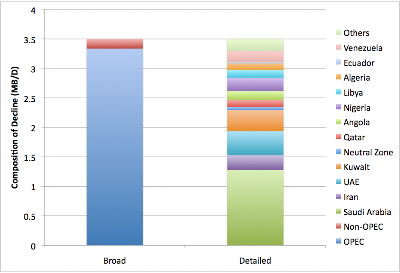
    The peak of monthly production was in July 2008. The trough in the depths of the global recession depends on which series one looks at, but I have been examining the recovery from May 2009 onward. And at this point, the latest figures show us about 1.3mbd to 1.4mbd (mbd = millions of barrels/day) away from reaching the July 2008 peak again.

    A few days back, I analyzed the composition of the recovery from May 2009 to the most recent figures (based on IEA OMR data). That showed the recovery coming from a variety of countries, but with two-thirds of it coming from non-OPEC countries, and only about 0.7mbd coming from OPEC. …

    As you can see, in contrast to the recovery composition, the decline came almost entirely from OPEC’s voluntary cutback in the fall of 2008, with about 3.3mbd of reduction from OPEC, and less than 0.2mbd of reduction in non-OPEC production.

    Given that OPEC has only restored about 0.7 out of 3.3mbd of cutbacks, about 2.6mbd of previously demonstrated capacity remains unused. This is about twice as large as the 1.3mbd or so distance from where production is now to the July 2008 peak level.

    Therefore, if the global economic recovery continues, and in particular if OPEC is willing to restore their production cuts at prices that don’t derail that recovery, then it appears likely that the July 2008 liquid fuel production level will be exceeded.

    This is true even if one assumes nothing about Iraqi production increases.


  • Tomato Power

    Inhabitat has a post on tomato powered illumination – Table Lamp Powered Completely by Tomatoes!.

    We all know tomatoes pack a powerful acidic punch, but we never thought we’d see one lighting up a room! Cygalle Shapiro of Israel-based d-VISION has created an incredible LED lamp that is completely powered by real, edible tomatoes. Currently exhibited at the Milan Furniture Fair, the design collects energy from a chemical reaction between tomato acids, zinc, and copper. This design doesn’t only explore advances in lighting technology – its also an art piece that sends clear and powerful social-conscience messages about where and how we receive energy.

    d-VISION’s tomato lamp calls attention to the amount of natural resources needed to produce even the smallest amount of power for everyday living. Although the tomato lamp utilizes an organic energy source, it still takes a considerately large amount of tomatoes just to power one lamp. The lamp holds power until the tomatoes go stale, signaling a beginning and end to energy sources. The designer highlights value by creating the tomato-powered circuits and lamp completely out of gold.


  • Geothermal plant to be commissioned in 2012

    The ABC has a report on the latest timetable for GeoDynamics' pilot geothermal power plant in South Australia – Geothermal plant to be commissioned 2012.

    Residents of Innamincka will have to wait until early 2012 for the commissioning of a geothermal power plant, set to replace diesel generators as their power source.

    The geothermal company, Geodynamics, plans to develop a one-megawatt power plant to supply the town's 12 residents and prove that it can harness hot-rock energy for general use.

    An explosion at a well that was to power the plant delayed commissioning last year and managing director, Gerry Groves-White, says recent rains and flooding have halted work until June. "But as those floods recede and we're watching it daily we will look for our opportunities to start earlier," he said. "What I can offer them is now certainty that by early 2012 we will be powering up the transmission lines into Innamincka."


  • UK Inquiry Clears Climate Scientists in Email Row

    Scientific American has a report on an enquiry into the "climategate" affair – UK Inquiry Clears Climate Scientists in Email Row.

    An inquiry cleared British climate researchers of wrongdoing on Wednesday after their emails were hacked, leaked and held up by skeptics as evidence they had exaggerated the case for man-made global warming.

    Former government adviser Ronald Oxburgh, who chaired the panel, said he had found no evidence of scientific malpractice or attempts to distort the facts to support the mainstream view that manmade CO2 emissions contribute to rising temperatures.

    The affair stoked the global debate on climate change and put pressure on scientists and politicians to defend the case for spending trillions of dollars to cut emissions and help cope with rising temperatures.

    Thousands of emails sent between scientists were published on the internet just before the United Nations climate talks in Copenhagen last December.

    Campaigners who doubt the scientific basis for saying global warming is manmade said the leaked messages showed that the research unit at East Anglia University had taken part in a conspiracy to distort or exaggerate the evidence.

    The university, in eastern England, appointed Oxburgh to investigate the Climatic Research Unit's methods.

    "We saw no evidence of any deliberate scientific malpractice," Oxburgh's inquiry concluded. "Rather, we found a small group of dedicated, if slightly disorganized, researchers.

    "We found them to be objective and dispassionate and there was no hint of tailoring results to a particular agenda."

    Its strongest criticism was aimed at the unit's handling of statistics. It recommended that the researchers work more closely with professional statisticians in future.

    Oxburgh's was the second of three inquiries into the episode to report its findings. Police are also investigating the leak.

    Last month, a British parliamentary committee cleared the unit of manipulating the evidence, but criticized its handling of requests for information made by outsiders under freedom of information laws.

    The third and most comprehensive inquiry, led by former civil servant Muir Russell, is due to end in May.