Author: Big Gav

  • Explorers target shale gas for Australia’s next energy boom

    The Australian has a look at interest in unconventional (shale) gas in Australia – Explorers target shale gas for Australia’s next energy boom.

    A POTENTIALLY vast gas resource trapped in Australia’s outback by dense rock formations could fuel another boom in the energy sector, at least according to companies like Beach Petroleum and Santos with acreage there.

    But others are skeptical that shale gas locked in Australia’s Cooper Basin can be produced economically like the Barnett and Haynesville shales in the US, or coal seam gas in Australia’s northeast.

    Innovative drilling techniques that can shatter rock with high-pressure bursts of water have made shale gas competitive with more conventional supplies in North America, where people typically pay more for gas. Citigroup says shale gas accounts for 13 per cent of the US’s proven gas reserves and energy companies are staking out positions in European deposits.

    They’re being driven to unconventional fuels by a shortage of oil in countries that are politically stable and open to private investment.

    Rough estimates suggest there are tens of trillions of cubic feet of shale gas in the Cooper Basin, which straddles Queensland and South Australia. Shale gas deposits are present in other regions like Western Australia, where AWE has plans to drill a test well.

    While there’s plenty of shale gas to plunder, the cost equation in Australia may not stack up for decades. “We remain unconvinced that the economics of the play will be able to compete with the significant coal seam gas volumes consistently being proven up in Eastern Australia,” Merrill Lynch analyst Mark Hume says of Beach’s Cooper resource.

    Paul Balfe, managing director of energy consultancy ACIL Tasman, says coal seam gas costs about $2-$4 per gigajoule to produce, comparing favourably with Australian east coast domestic gas prices of $3-$4 a gigajoule and at least $7 a gigajoule in Western Australia.

    The most optimistic cost estimates for shale gas are around $5 a gigajoule, with the more pessimistic at $8. Mr Balfe says a lack of drilling technology and expertise in mining shale gas in Australia may push production costs higher. “I suspect that $5-$8 might look more like $7.50-$10 here,” Mr Balfe says.


  • CPRS into the deep freeze

    Crikey has a look at the shelving of the government’s proposed CPRS – so after a few years of Labour government we haven’t really made any progress on global warming (a messed up insulation installation scheme and slightly improved MRET aside) – CPRS into the deep freeze.

    The government today wheeled its dreadful CPRS into the political deep freeze, continuing its pre-election deck-clearing of anything that doesn’t suit the narrative it wants to sell voters between now and August. …

    The fact that in putting it aside until 2013 means the government will save just under $950 million between now and then shows just how nonsensical the opposition’s “great big new tax” line is. Some tax that would have pumped nearly a billion dollars into the economy — and that was just for starters.

    It bears remembering just where we started from in all this — Kevin Rudd and John Howard going to the 2007 election with a shared commitment to an emissions trading scheme. After the Nelson interregnum, Howard was succeeded by a man more determined than virtually anyone else in Parliament to take action on climate change. And yet somehow, the Prime Minister and Penny Wong managed to botch it.

    And they really botched it, first by letting every rent seeker in the country come in for their chop, and then by thinking climate change was a great weapon with which to split the coalition, rather than a “great moral and economic challenge”.

    It’s a singular achievement for which Rudd and Wong can take credit — with some thanks to Tony Abbott and Nick Minchin and the rest of the coalition climate crazies.

    The Greens, perhaps with one eye on holding the balance of power from July 1, have urged the government to again consider their interim carbon levy proposal, which would cap permit prices and slash handouts to polluters to 20% of revenue (rather than 27% of revenue, where it starts, before rising above one-third of revenue in later years).

    However, that ignores the political reality that the government has gone cold on climate change because it failed to sell its CPRS properly and denialists, engaged in a systematic economic war on future generations, have leapt into the gap.

    Sadly, this is the perfect time to be implementing an emissions trading scheme, with the economy again poised to enter an extended boom led by the resources sector. Any negative impacts on polluters of the scheme — and the Grattan Institute has conclusively shown that impacts will be almost trivial — would be minor compared to the benefits of strong economic growth. Australia’s emerging economic challenge is to manage high levels of growth. The introduction of an effective ETS would provide an additional tool for policy makers dealing with too much demand and unbalanced growth.


  • Solar Coalition Calls to Install Solar Panels on the White House

    Inhabitat has a post on efforts to turn the clock both back and forward and have solar panels re-installed on the roof of the White House – Solar Coalition Calls to Install Solar Panels on the White House.

    Some of you probably know that President Jimmy Carter installed an array of solar panels on the White House roof in 1979. You also may remember that they were unceremoniously removed in 1986 — about the same time that President Ronald Reagan allowed President Carter’s solar power tax credits to expire. Well, now a coalition of solar power companies led by Sungevity are calling on the American people to sign a petition to convince the Obama Administration to have a solar panel system permanently reinstalled on White House roof — one that would lower White House utility bills by 81%.


  • Utilities start massive upgrade of New England grid

    The Boston Globe has an article on smart grid initiatives in the north east of the US – Utilities start massive upgrade of region’s grid.

    Power companies in New England are beginning work on a nearly half-billion-dollar plan to upgrade the region’s electric grid to make way for appliances that can shut down to reduce electric bills, improve energy conservation, and connect to wind and solar energy.

    The first step is replacing decades-old meters with so-called smart meters that detail the use of computers, appliances, TVs, lights, and other household equipment.

    The new meters — the front line of plans for an advanced electricity grid — communicate with utilities and can respond to constantly changing energy prices. Customers will be able to respond to electricity prices in real time and shut down appliances to save money. Utilities can offer better rates as incentives for using appliances in off-peak hours.

    In the future, appliances may even be able to respond to price signals and shut down automatically.

    “Smart meters allow us to see what’s going on in the system and allow customers to see what they’re using, when they’re using it and what the cost is,’’ said Robert V. Jolly Jr., general manager of Marblehead Municipal Light Department, a municipally owned power company in Marblehead, Mass. …

    The federal government’s push for an upgraded power grid in the United States will lead to changes comparable to transformations brought about by the personal computer, said Allen Stamp, a Vermont utility official.

    Stamp, program manager for smart grid deployment at Vermont Transco, said a modernized power grid is “really about the consumer being empowered to save dollars.

    “One person described it as an Internet dot-com mentality coming into use with the electric power system,’’ he said. “It’s a fundamental change.’’

    The US Department of Energy has awarded $230 million in federal stimulus funding — matched by the recipients — to New England utilities, municipal power companies, private companies, and a cooperative that are installing new meters. Companies have three years to complete the projects.

    About $4 billion is being spent nationally on modernizing electricity grids.


  • Indonesia hosts world’s biggest geothermal energy forum

    The BBC has a report on Indonesian interest in further expanding their use of geothermal powerIndonesia hosts world’s biggest geothermal energy forum.

    Indonesia is hosting what is being called the world’s biggest geothermal energy conference. The congress in Bali is an attempt to look at how to better develop geothermal power as an environmentally friendly fuel for the future.

    Geothermal power is energy extracted from the heat stored in the Earth, and environmentalists say it could be the key to using cleaner forms of fuel. Representatives from 80 countries are attending the talks.

    It is often dubbed volcano power but the correct scientific explanation for geothermal energy is power extracted from the heat stored in the Earth’s core. Indonesia has ambitious plans to tap geothermal power and in particular the energy created by its volcanoes. The archipelago of more than 17,000 islands sits on the Pacific “Ring of Fire” – one of the most active regions in the world for volcanic activity.

    Indonesia does not have the resources to be able to provide a consistent supply of electricity to all of its population, so finding an alternative source of energy is critical for south-east Asia’s largest economy as it rapidly expands.


  • Interview with George Monbiot

    George Negus has an interview with George Monbiot on SBS’s Dateline program – Interview with George Monbiot (video).

    GEORGE NEGUS: George, it is good to see you again. We definitely want to talk to you about the link that you draw between the volcano drama, as it were, and other things, but I can’t have you there as a British commentator without asking you about what they are calling here, ‘Clegg mania’. What the heck is going on that suddenly, out of the blue, there’s this guy that has shot from practically nowhere, in our terms, to potentially Number 10?

    GEORGE MONBIOT, COLUMNIST, ‘THE GUARDIAN’: Well, the world’s most boring election seems to have been turned on its head, and there really does seem to be a possibility of a very serious upset indeed here in the United Kingdom. My God, many of us are thinking “It’s about time”. We have had this 2-party system for a very long time. It feels very stale, very old fashioned, there’s very little dividing Labour and the Conservatives. Suddenly, Nick Clegg of the Liberal Democrats seems to be steaming forward. The party which has always been in third place now looks as if it has a genuine chance of coming at least second, and even possibly first – according to some opinion polls. And he’s got Labour and the Conservatives really worried here. …

    GEORGE NEGUS: A little bit of Obama about it, George?

    GEORGE MONBIOT: Well, you know, it has been greatly exaggerated. It’s not an Obama effect really. It’s not as if Nick Clegg is this fantastic, charismatic world-striding leader figure. It is just that the other two are so dull and hopeless. …
    GEORGE NEGUS: It is going to make for a very interesting couple of weeks that is for sure. George, we got you here really to talk about, if you like, another kind of volcanic explosion. We have got one with Nick Clegg, and that’s the worst play on words I am going to make tonight, you’ve drawn this amazing link between the volcanic catastrophe, whatever we would like to call it, and the airlines, and in fact, the banking crisis and the whole GFC. Now, is that the longest bow you have ever drawn? What do you actually mean when you say that a link can be made between the GFC, the banking crisis, and what has happened in Iceland and the airlines this week with the volcanic eruption?

    GEORGE MONBIOT: I think what both the airlines issue, the volcanic issue, and the banking crisis show us is that society becomes so complex that it effectively becomes unmanageable and a small disruption – the butterfly’s wing over the Atlantic – can throw the whole thing into meltdown. Now, this is what we saw with the banking crisis, where the impoverished mortgage defaulters in the United States effectively brought down, or very nearly brought down, the whole world’s financial systems. Because everything was so interlinked and so complex and so hard to understand and there was so a little give in the system, that a small disruption like that could create an enormous effect. Now, we saw the same with the ash cloud that we have become so dependent on aviation, which was previously a very small component of our economy, and aviation is so susceptible, it’s so vulnerable to disruption for a number of reasons – partly because of climatic and physical changes, but also because of its enormous energy demands and its very high cost.

    GEORGE NEGUS: You actually said, “Over the past few days, living under the flight paths, people have seen the future, and they like it.” Are you suggesting that we just have to pull back?

    GEORGE MONBIOT: Well, the party is going to end one way or another – not least because of the prospect of peak oil, where the supplies of liquid transport fuels are just not going to be available to the same extent that they are today. So, we either recognise that and try to forestall the tremendous disruption that will be caused by engineering a soft landing, or we wait like rabbits in the headlight for the truck to run us over. Or rather, for the truck not to be able to move down the road at all because there is no petrol in it! …

    GEORGE NEGUS: In the last few days you have been called a few things I imagine like a volcano worshipper, was one that I saw, but this quote I would like you to react to: “These crazy green, anti-humanist types, have celebrated the volcano as scoring a long overdue victory by nature over us horrible humans :with all our nasty civilisation and progress, such as air travel.” What I guess he is writing you off as, George, as a doomsdayer?

    GEORGE MONBIOT: It is precisely because I care about what happens to humans that I am interested in these questions. Many people try to create this false dichotomy between caring for the environment and caring about humanity, but the most anti-human position you can possibly have is not to give a stuff about the environment because human beings are totally dependent on that environment. It is this sort of ultra-right-wing attempt to defer and to deny the problem by trying to cast this as some opposition between environment and humanitarian concerns. The two concerns are one.


  • Would You Let The Power Company Control Your Appliances ?

    Forbes has a column looking at a survey into people’s attitudes regarding a smart grid model which allows utilities to remotely control home appliances to adjust demand to match supply – Would You Let The Power Company Control Your Appliances?.

    How big a discount would your electricity provider have to get on your rates before you’d be willing to give them the ability to remotely control appliances like your clothes dryer, air conditioning, pool pump or big-screen TV during times of peak power demand?

    Power companies around the world are giddy about the potential energy savings from all these smart meters they’re installing for customers. It makes sense that people will voluntarily wait to run their clothes dryer until cheaper off-peak hours. But what about the potential for power companies to control your loads remotely?

    Accenture set out to answer that question by surveying 9,000 people in 17 countries. The results are surprising.

    An astonishing 16% of respondents said they would be willing to give up control to the power company even if they received no benefit from lower rates and even if they had no override power over the remote control. I guess altruism is alive and well.

    Predictably, the potential adoption rates rise with the offer of price discounts. A 10% overall rate discount lured a quarter of respondents, while one-third said they would give up control for a 20% discount.

    Given that same 20% savings, half of respondents said they would let the electric company control appliances given the assurance that they could override the decision.


  • Burn Up

    I watched the first episode of the series Burn Up on (ABC) TV tonight and quite enjoyed it – Burn Up. Next episode is on next Sunday (for Australian viewers – British viewers got to watch it back in 2008).

    From the oil fields of Saudi Arabia to the boardrooms of London, Burn Up is a two-part topical thriller set in the real-life context of climate change as oil company executives, environmental activists and politicians collide in the battle between economic success and ecological responsibility.

    Starring Rupert Penry-Jones (Spooks, Whitechapel), Bradley Whitford (The West Wing), Neve Campbell (Party Of Five) and Marc Warren (Hustle), Burn Up is a potent mix of fiction and fact that will enlighten as much as entertain.

    Tom McConnell (Rupert Penry-Jones) has just been made head of Arrow Oil, a hugely powerful and wildly profitable oil company. With a happy family and lucrative promotion, life couldn’t get any sweeter. But the assassination of six geologists working in the Saudi desert will turn Tom’s world upside down and Tom will slowly uncover a sinister side of business.

    Always the company man, Tom is as loyal as they come and a staunch defender of the oil business, denying any link from the work of Arrow Oil to climate change. His charismatic best friend and oil lobbyist Mack (Bradley Whitford) helps confirm his convictions. But when a young Inuit, Mika (Sandrine Holt), alleges that Tom and Arrow Oil are ruining the lives of her people, with scant regard for the environmental impact of their work, Tom starts to question Arrow Oil.

    Joined by his environmental advisor Holly (Neve Campbell), Tom takes a trip to Mika’s homeland and learns first-hand the growing climate change problem, a problem he can’t ignore any more. He also can’t ignore his growing attraction to Holly. But when Mack reveals that she is a spy in collaboration with environmentalists, Tom is stunned and starts to question who he can trust.


  • Wind’s latest problem: it … makes power too cheap

    Jerome a Paris has an interesting post at the European Tribune about the economics of wind power – Wind’s latest problem: it … makes power too cheap.

    Bloomberg has a somewhat confusing article about the newest complaint about wind power, but the gist of it is that wind power is an issue for the industry because it brings their revenues down:

    operators in Europe may have become their own worst enemy, reducing the total price paid for electricity in Germany, Europe’s biggest power market, by as much as 5 billion euros some years

    Implicit in the article, and the headline (which focuses on lower revenues for RWE) is the worry that wind power will bring down the stock market value of the big utilities – which is what the readers of Bloomberg et al. care about.

    But despite the generally negative tone of the article, it’s actually a useful one, because it brings out in the open a key bit of information: wind power actually brings electricity prices down!

    windmills (…) operators in Europe may have become their own worst enemy, reducing the total price paid for electricity in Germany, Europe’s biggest power market, by as much as 5 billion euros some years …

    The wind-energy boom in Europe and parts of Texas has begun to reduce bills for consumers. …

    Spanish power prices fell an annual 26 percent in the first quarter because of the surge in supplies from wind and hydroelectric production

    This tidbit of information, which will hopefully begin to contradict the usual lies about the need for hefty subsidies for the wind sector, has been publicised by EWEA, the European Wind Energy Association in a report on the merit order effect (PDF). This is the name for what happens when you inject a lot of capital-intensive, low-marginal-cost supply into a marginalist price-setting market mechanism with low short term demand elasticity – or, in simpler words: when you have more wind, there is less need to pay to burn more gas to provide the requisite additional power at a given moment.

    I’ve long argued that this was one of the strongest arguments for wind (see my article on The cost of wind, the price of wind, the value of wind from last year), and I’ve pushed the EWEA people to use it more – so this study (which I was not involved in) is most welcome.

    The key thing here is that we are beginning to unveil what I’ve labelled the dirty secret of wind: utilities don’t like wind not because it’s not competitive, but because it brings prices down for their existing assets, thus lowering their revenues and their profits. Thus the permanent propaganda campaign against wind. But now that this “secret” is out in the open, it’s hopefully going to make one of the traditional arguments against wind (the one about its supposed need subsidies) much more difficult to use… The argument remains true for solar, and to a lesser extent for offshore wind, but the utilities are going to complain much less about offshore wind given that they are investing so much capital in that sector right now. The reality is that wind power brings prices down for consumers, even taking into account the cost of feed-in tariffs or other regulatory support mechanisms, which means that these regulatory schemes are not subsidies, but rather smart corrections of market inefficiencies for the public good.

    Ironically, wind provides “utility-like” returns to investors, ie low, stable single-digit returns, as befits a regulated strategic infrastructure activity required for the common good. Utilities and investors should love the sector; but they have been spoiled by market deregulation, which has allowed companies to seek higher returns by under-investing, building merchant gas-fired plants, going for M&A games, and playing on market price volatility and trading – in other words, by behaving as perfect clients for investment banks…

    As I’ve noted many times, the energy sector is one of the best examples of how the financialisation of the economy has brought results that are bad for everybody except the investment bankers and top management; it’s also, thankfully, one where reality can most objectively re-assert itself.

    And the reality is that you get cheaper electricity with wind – and oh by the way, wind requires no imports of fast-depleting fuels from unstable countries, spews no carbon and provides lots more domestic jobs. And it’s a perfect investment for our pension needs – safe, low risk, stable, decent long term returns…


  • Nuclear Giant Areva Predicts Solar Thermal Boom

    Joe Romm has an article at Forbes on Areva’s interest in solar thermal powerNuclear Giant Areva Predicts Solar Thermal Boom.

    Earlier this year, French energy giant Areva bought U.S.-based Ausra in order “to become a world leader in concentrated solar thermal” power (CSP). And so the race is on for market share in “The Technology that will Save Humanity.”

    CSP is the most scalable and affordable baseload (or, even better, load-following) low-carbon supply technology — when used with low-cost, high-efficiency thermal storage. CSP can also share its steam turbine with biomass, a strategy the Chinese are pursuing, or with natural gas.

    The Oil Drum wonders if Areva is “losing faith in the oft-predicted but unrealised ‘nuclear renaissance’.” Certainly, Areva’s best-known product has become very expensive and the cost of a new reactor today would be as much as 6 billion euros, or $8 billion, double the price offered to the Finns.

    CSP, on the other hand, has just started down the experience curve and is poised to be one of the major winners in the low-carbon economy. Indeed, Bloomberg/BusinessWeek reports:

    Areva SA of France predicts the global use of solar-thermal power will grow by about 30-fold this decade, a forecast that spurred the world’s largest maker of nuclear reactors to buy a California-based equipment maker.

    The technology, which typically uses curved mirrors to focus sunlight to generate electricity, will be installed on plants with 20,000 megawatts of power potential by 2020, Anil Srivastava, Areva renewable energies executive vice president, said in an interview. That compares with about 625 megawatts today, according to Bloomberg New Energy Finance data.

    “It is a very attractive market,” Srivastava said. Paris- based Areva aims to become a world leader in solar thermal, he said, after agreeing yesterday to buy Ausra Inc., a Mountain View, California-based maker of sun-driven steam generators used by power plants.

    Many big international companies are trying to become leaders in CSP:

    Siemens AG, Europe’s largest engineering company, agreed last year to a $418 million purchase of Beit Shemesh, Israel- based Solel Solar Ltd. Abengoa SA, also an engineering company, is building 13 solar-thermal plants in Spain that will benefit from consumer subsidies for clean energy….

    Bloomberg New Energy Finance has forecast the installed base to grow to as much as 34,000 megawatts worldwide by 2020, exceeding the estimate of the French atomic-reactor maker.

    Whether 20 GW in 2020 or 34 GW, CSP is a very fast-growing market (see “World’s largest solar plant with thermal storage to be built in Arizona — total of 8500 MW of this core climate solution planned for 2014 in U.S. alone“). And ultimately that’s why Areva says it is jumping in:

    The market for concentrated solar power plants is expected to grow substantially in the next decade with an average annual growth rate of 20% and should reach an estimated installed capacity of over 20 GW by 2020. With this acquisition, AREVA is poised to capture the leading position of this attractive and growing market.


  • BioLite Camp Stove

    This gizmo looks pretty good for campers…


  • Coal giants and gas firms set for clash

    The Australian has an article on the looming clash between coal miners and coal seam gas producers in Queensland – Coal giants and gas firms set for clash

    THE massive ramp-up planned in Queensland coal seam gas production to feed Gladstone liquefied natural gas plants could face delays as key players look to develop acreage the state’s coalminers also have their eyes on. …

    Under Queensland’s legislation, ground can be explored by both miners and CSG producers at the same time. When it is time to convert it to production leases overlapping claims are subject to negotiation between CSG and mining companies.

    If this is unsuccessful, the Queensland government will have to make a ruling. The government has not been placed in this position yet, but as applications to reserve ground for gas production gather pace, disputes are more likely.

    “Coal seam gas is in areas which coalminers are now starting to look at opening up, because the global financial crisis has passed and metallurgical coal prices are moving up,” said Paul Newman, head of energy at law firm Blake Dawson. “From our perspective, there is a regime that will come under pressure from this process. There is uncertainty about what the government will do.”

    Early plans by Xstrata for a massive 100 million tonnes a year coal province near Wandoan in the Surat Basin is also expected to spur other miners with overlapping CSG exploration tenements. In a recent tenement overlap dispute between CSG producers and the small underground coal gasification sector, the Queensland government ruled on the side of the CSG producers. It is hard to see state government, which collects royalties from the world’s biggest coking coal export industry, siding so quickly with the CSG industry if the coal industry moves against it.


  • Yes, We Could… Get Out!

    TomDispatch has an article on the chances of the US withdrawing from Iraq and Afghanistan – Yes, We Could… Get Out! .

    Yes, we could. No kidding. We really could withdraw our massive armies, now close to 200,000 troops combined, from Afghanistan and Iraq (and that’s not even counting our similarly large stealth army of private contractors, which helps keep the true size of our double occupations in the shadows). We could undoubtedly withdraw them all reasonably quickly and reasonably painlessly.

    Not that you would know it from listening to the debates in Washington or catching the mainstream news. There, withdrawal, when discussed at all, seems like an undertaking beyond the waking imagination. In Iraq alone, all those bases to dismantle and millions of pieces of equipment to send home in a draw-down operation worthy of years of intensive effort, the sort of thing that makes the desperate British evacuation from Dunkirk in World War II look like a Sunday stroll in the park. And that’s only the technical side of the matter.

    Then there’s the conviction that anything but a withdrawal that would make molasses in January look like the hare of Aesopian fable — at least two years in Iraq, five to ten in Afghanistan — would endanger the planet itself, or at least its most important country: us. Without our eternally steadying hand, the Iraqis and Afghans, it’s taken for granted, would be lost. Without the help of U.S. forces, for example, would the Maliki government ever have been able to announce the death of the head of al-Qaeda in Iraq? Not likely, whereas the U.S. has knocked off its leadership twice, first in 2006, and again, evidently, last week.

    Of course, before our troops entered Baghdad in 2003 and the American occupation of that country began, there was no al-Qaeda in Iraq. But that’s a distant past not worth bringing up. And forget as well the fact that our invasions and wars have proven thunderously destructive, bringing chaos, misery, and death in their wake, and turning, for instance, the health care system of Iraq, once considered an advanced country in the Arab world, into a disaster zone(that — it goes without saying — only we Americans are now equipped to properly fix). Similarly, while regularly knocking off Afghan civilians at checkpoints on their roads and in their homes, at their celebrations and at work, we ignore the fact that our invasion and occupation opened the way for the transformation of Afghanistan into the first all-drug-crop agricultural nation and so the planet’s premier narco-nation. It’s not just that the country now has an almost total monopoly on growing opium poppies (hence heroin), but according to the latest U.N. report, it’s now cornering the hashish market as well. That’s diversification for you.

    It’s a record to stand on and, evidently, to stay on, even to expand on. We’re like the famed guest who came to dinner, broke a leg, wouldn’t leave, and promptly took over the lives of the entire household. Only in our case, we arrived, broke someone else’s leg, and then insisted we had to stay and break many more legs, lest the world become a far more terrible place.

    It’s known and accepted in Washington that, if we were to leave Afghanistan precipitously, the Taliban would take over, al-Qaeda would be back big time in no time, and then more of our giant buildings would obviously bite the dust. And yet, the longer we’ve stayed and the more we’ve surged, the more resurgent the Taliban has become, the more territory this minority insurgency has spread into. If we stay long enough, we may, in fact, create the majority insurgency we claim to fear.


  • Cleaning up the Gas Grid

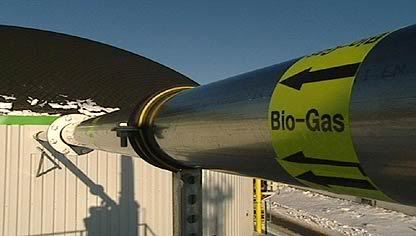
    Renewable Energy World has an article on expanding the use of biogas in the gas network, taking a detailed look at experience in Germnay – Cleaning up the Gas Grid.

    In Germany electricity production from renewable sources is supported at a special rate as set out under the renewable energy law (EEG). This special rate applies to electricity produced from biogas transmitted through the natural gas grid, but is also increased by an additional bonus for use of innovative technology, such as biogas upgrading. In addition, a new law on heating with renewable energies came into effect in 2009, which requires new buildings to be heated with a share of at least 20% of renewable sources or combined heat and power (CHP). Furthermore, there is a negotiated environmental agreement by the gas utilities in Germany to add at least 10% biogas to natural gas for vehicle fuel (LPG) in 2010 and 20% by 2020.

    The main operational advantages of biogas feed-in to the natural gas distribution grid are that the biogas can be used at higher energy efficiency where the waste heat can be used. In addition, by using the gas grid for virtual storage, time-decoupling between biogas production and consumption can also be achieved.

    In spring 2008 the energy utility Energie Baden-Württemberg (EnBW), together with its gas grid subsidiary Erdgas Südwest (ESW), began operations at a new facility, upgrading biogas and feeding it into to the natural gas grid. The bio-methane is produced in co-operation with an agricultural company of 20 farmers who own and operate the fermentation biogas plant and procure the biomass. The gas is produced by the farmers and sold to EnBW-ESW, which ensures the quality necessary in the gas distribution system, the measurement required for invoicing and deals with transport to the customer. Around 5 million Nm3 of raw biogas is upgraded annually to around 2.8 million Nm3 of biogas at natural gas quality and fed into the gas grid.

    In conventional biogas plants in Germany the biogas is burnt in a co-located reciprocating-engine. This is normally in a rural area, where heat demand is very restricted. While some 15%–20% of the exhaust heat is consumed by the fermenter, in most cases the rest is difficult to sell and, as a consequence, the efficiency of biogas plants is limited. However, even under EEG-tariffs for electricity production, without heat sales it is becoming more and more difficult to achieve the economic operation of a biogas plant. Conversely, if biogas can be transported to a heat sink, a CHP plant can utilize the bioenergy much more efficiently and can supply heat at a better value and so at a higher income. If the biogas is to be transported in the wider natural gas grid, it has to be upgraded to meet the quality needed for the grid.


  • Big Energy Storage in Thin Films

    Technology Review has an article on research into combining ultracapacitors with thin film solarBig Energy Storage in Thin Films.

    Energy storage devices called ultracapacitors can be recharged many more times than batteries, but the total amount of energy they can store is limited. This means that the devices are useful for providing intense bursts of power to supplement batteries but less so for applications that require steady power over a long period, such as running a laptop or an engine.

    Now researchers at Drexel University in Philadelphia have demonstrated that it’s possible to use techniques borrowed from the chip-making industry to make thin-film carbon ultracapacitors that store three times as much energy by volume as conventional ultracapacitor materials. While that is not as much as batteries, the thin-film ultracapacitors could operate without ever being replaced.

    These charge-storage films could be fabricated directly onto RFID chips and the chips used in digital watches, where they would take up less space than a conventional battery. They could also be fabricated on the backside of solar cells in both portable devices and rooftop installations, to store power generated during the day for use after sundown. The materials have been licensed by Pennsylvania startup Y-Carbon.

    An ultracapacitor is “an electrical energy source that has virtually unlimited lifetime,” says Yury Gogotsi, professor of materials science and engineering at Drexel University in Philadelphia, who led the development of the thin-film ultracapacitors. “It will live longer than any electronic device and never needs to be replaced.” While batteries store and release energy in the form of chemical reactions, which cause them to degrade over time, ultracapacitors work by transferring surface charges. This means they can charge and discharge rapidly, and because the electrode materials aren’t involved in any chemical reactions, they can be cycled hundreds of thousands of times. Researchers have begun developing thin-film ultracapacitor materials but have had difficulty getting high enough total energy storage using practical fabrication methods, says Gogotsi.

    Gogotsi’s group uses a high-vacuum method called chemical vapor deposition to create thin films of metal carbides such as titanium carbide on the surface of a silicon wafer. The films are then chlorinated to remove the titanium, leaving behind a porous film of carbon. In each place where a titanium atom was, a small pore is left behind. “The film is like a molecular sponge, where the size of each pore is equal to the size of a single ion,” says Gogotsi. This matching means that when used as the charge-storage material in an ultracapacitor, the carbon films can accumulate a large amount of total surface charge.


  • Report: China To Overtake U.S. As World’s Biggest Asshole By 2020

    The Onion has a look at the rise of China and decline of the US – Report: China To Overtake U.S. As World’s Biggest Asshole By 2020.

    According to a new report released Monday by a panel of top economists and social scientists, the People’s Republic of China will overtake the United States as the world’s dominant asshole by the year 2020.

    The findings, published in the most recent issue of Foreign Affairs, support recent speculation that America’s unquestioned reign as the leading super-prick may soon be drawing to a close, leaving China as the foremost shithead among all developed nations.

    “We are seeing a changing of the asshole guard,” said Andrew Freireich, noted economist and lead author of the article. “Although the U.S. will remain among the world’s two or three biggest cocks through much of this century, we can now confidently project that China, with its soaring economic growth, ever-expanding cultural influence, and total disregard for basic human rights, will overtake America as King Prick Numero Uno within the next 10 years.”


  • Peak oil predictions

    The Guardian has an article on peak oil saying it is clean energy that will bring about the end of the oil age – Peak oil predictions.

    It’s now a truism – among oil companies, and governments alike – that even in an age when we risk catastrophic climate change, and its attendant catastrophes such as we’ve seen in the Gulf of Mexico this week, oil exploration is an inevitable part of our future. It may be a truism, but is it true?

    As former Shell CEO Jeroen van der Veer has said several times, the era of “easy oil” is over. This means that the bulk of the oil that is left to exploit is to be found in the tar sands and in ultra-deep water and other marginal resources, such as the Arctic. All of these resources are very expensive to produce, require long lead-in times to bring on-stream and, in many cases, have controversial environmental and social impacts that will cost more to ameliorate.

    Even without addressing the social and environmental costs, the break-even point for these kinds of oil projects is close to the ceiling at which oil prices could be sustained by the global economy. At between $65 and $90 a barrel, the room for long-term profitability appears slender. With the global economy remaining in a fragile state and oil prices rallying, it’s important to ask whether the economy can withstand further price increases, not to mention whether the climate can sustain further growth in carbon emissions.

    Will the expense of bringing this oil to market mean that the sustained oil prices needed to produce the oil will also consistently drive the global economy back into recession?

    At the launch of BP’s most recent Statistical Review of World Energy in early June 2009, BP’s chief executive, Tony Hayward, said that as the oil price went over $90, consumers “began to change their behaviour” and that there was significant “elasticity of demand above $100 a barrel”. In other words, if it costs too much, we can’t – and won’t – buy it.

    The difference between the recovery periods following previous oil shocks and the current one is that a significant proportion of today’s oil demand is in permanent decline. This particularly applies to developed countries where demand for oil is past its peak. In other words, this recession has triggered demand destruction, not demand suppression.

    It’s possible the day of “peak oil” has arrived – but not in the way everyone expected. Instead of peak oil, we’re looking at a peak in demand for oil. The oil age won’t end tomorrow, but the idea that it will go on for ever – with its attendant catastrophes and tragedies – is seriously in question.

    Against this backdrop, the economic case for investing in clean technology becomes as clear as the environmental case. The faster we introduce efficiency in the transport sector, making better cars that use less fuel, adopting cutting-edge hybrid technology and pushing vehicle electrification, the faster the oil industry of the last century will be replaced by the cleaner, safer and economically more sound industries of today.


  • The Atlantic Ocean Garbage Patch


  • ‘Sun’ censored poll that showed support for Lib Dems

    The Independent has a report on the reaction against the Liberal Democrats by the Murdoch press in the UK – ‘Sun’ censored poll that showed support for Lib Dems.

    The Sun newspaper failed to publish a YouGov poll showing that voters fear a Liberal Democrat government less than a Conservative or Labour one.

    The Liberal Democrats accused the newspaper, which is owned by Rupert Murdoch, of suppressing the finding. The paper, which endorsed Labour in the past three elections, declared its support for David Cameron during the Labour Party’s annual conference last October. Like other Tory-supporting papers, it has turned its fire on Nick Clegg over his policies, pro-European statements and expenses claims since he won last week’s first televised leaders’ debate.

    YouGov also found that if people thought Mr Clegg’s party had a significant chance of winning the election, it would win 49 per cent of the votes, with the Tories winning 25 per cent and Labour just 19 per cent. One in four people Labour and one in six Tory supporters say they would switch to the Liberal Democrats in these circumstances. The party would be ahead among both men and women, in every age and social group, and in every region. On a uniform swing across Britain, that would give the Liberal Democrats 548 MPs, Labour 41 and the Tories 25.


  • Will Toe-to-Heel Air Injection Extend the Oil Age ?

    Kurt Cobb has an article at Scitizen on a new enhanced oil recovery technique (saying nothing about the greenhouse gas emissions, which are presumably horrendous) – Will Toe-to-Heel Air Injection Extend the Oil Age?.

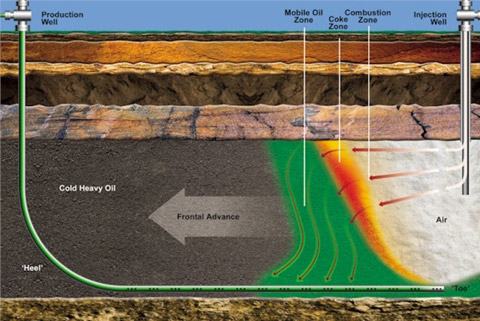
    Currently, the energy for extracting oil from underground must come from the fuel and equipment on the surface. But what if the main source of energy for extracting oil could come from the oil deposit itself? And, what if the method for doing this could provide us with access to oil not amenable to conventional extraction techniques while minimizing disruption of the surface and any associated pollution? This is what the developers of an oil recovery technique called toe-to-heel air injection or THAI suggest they are able to accomplish. And, the technique could increase appreciably the percentage of the world’s vast heavy oil resources that we are able to exploit.

    The oil the engineers and scientists at Petrobank, the patent holder, have in mind is so viscous that it is not easily budged from its hiding places below the surface. There are other techniques already in use for extracting this oil. But they typically require copious amounts of both water (usually in the form of steam) and energy to work. The THAI process, however, burns some of the oil in the underground deposit in a way that makes the remaining oil flow to the surface on its own through production wells.

    This isn’t a bonfire, but rather more like a charcoal fire, very hot (400 to 600 degrees C) without flames. Petrobank claims that THAI burns about 10 percent of the oil in place to accomplish its task. The oil is first heated to about 100 degrees C using steam injection. So far this sounds like conventional steam injection technology. But once this critical temperature is reached, the oil is ignited and only air is injected to keep the oil burning. The burning oil creates additional heat which makes the heavy oil flow more easily, and the combustion gases drive the flowing oil toward and up a set of production wells without any pumping. There are other fire flooding techniques. But the particular methods and well configuration of THAI hold great promise for vastly increasing ultimate recovery while minimizing pollution and well failure.

    Petrobank claims recovery of between 70 and 80 percent of original oil in place, a truly astounding number. Even if this result proves to be reproducible on a large scale, it won’t mean that all heavy oil deposits will be amenable to the THAI process. Some deposits might be too scattered to be economical. Others might not be sufficiently saturated to allow adequate burning and thus high enough temperatures. Yet others might be too close to the surface in which case the fire might break through. Finally, geology, remote location and poor associated infrastructure might make many potential deposits financially too risky to exploit.