Author: Bob Hicks

  • Art Scatter’s new look: We have a winner

    As you may have noticed, here at Art Scatter we’ve been stressing out lately about the way we look. We were feeling … frumpy. We wanted something fresh, something new, and came up with three possible visual themes to replace Artsemerging, the theme we’ve been using since the blog began two years ago.
    Wikimedia CommonsWe asked for your advice, and a lot of you gave it. Thanks to Scatter friends and followers Charles Deemer, LaValle Linn, Charles Noble, Brett Campbell, Cynthia Kirk, Mighty Toy Cannon and others for chipping in with preferences and ideas. Each of the three candidates had its fans, and each had its detractors. I appreciate the energy that all of you put into this. And I appreciate that more than one of you noted that design isn’t why you visit Art Scatter, anyway: You come for the writing and the ideas. Special thanks to LaValle for her warning that Web designs can devour your time and sanity in the middle of the night if you let yourself get too deeply drawn into them: Perish that thought!

    Still, we want the writing and ideas to be displayed well. The decision wasn’t easy. At least one of you listed the eventual choice as his least favorite.

    And the winner is …. Modern, designed by Ulf Pettersson, the design you’re looking at now.

    It’s a clean, well-spaced, elegant design, a very professional-looking presentation, and that’s important. Its headlines are understated but big enough to stand out, and they look good running either one or two lines. Its serif type style moves serenely among bold, italic and roman type, making its point at each stop without leaping for your jugular. The type’s a little small in its pull quotes, but they still look good. The design handles splendidly such small but crucial matters as spacing and creating ample windows for inset illustrations: Nothing’s haphazard about it.

    Is it too understated? We’ll see. If it turns out to be, we’ll switch again. Charles Noble touts the advantages of the premium design he chose for his blog Noble Viola, and it’s true that paying a little more can add a great deal more flexibility. I like the way that Charles’s blog can highlight several posts at once, for instance, and the way it can add “extras” such as promotional highlights and recent comments and still look crisp and inviting.

    I’ve spent a lot of time inside these three designs, checking them out not just for looks but also for flexibility. When we began this journey I was drawn to the jazzy, stop-the-presses look of Copyblogger. (Mighty Toy Cannon points out its nice retro feel and homage to “legacy media,” meaning newspapers, the world from which both Mr. and Mrs. Scatter emerged). But although I liked its side panel perhaps the best of the lot, it had internal difficulties that made it hard to choose, including, but not limited to, poor spacing for its illustration windows, allowing type to bump right into the pictures.

    In general I prefer serif types to sans serif types, although a good sans serif beats a bad serif. Veryplaintext 3.0 has my favorite typeface of any candidate, a distinctive and gorgeously assertive face. But it doesn’t like italic very much (what you see isn’t always what you get), and I consider italic type an integral tool in my presentational box. The real deal-buster, though, was its ragged, center-adjusted side panel, which to my eye (and LaValle’s, too!) looks haphazard and uncontained and, well, unprofessional. Too bad.

    So that brings us back to Modern, which has an elegant look and seems the best compromise. Unfortunately, Mrs. Scatter hates it, and I understand her reasons. The blog title is small and pushed far to the right, and that bothers her. I’d prefer its type a little bigger, but its placement doesn’t bother me. She hates all gray boxes – that’s one of the reasons we defected from Artsemerging, which has a prominent gray screen – and Modern’s side panel is shaded gray. Plus, the panel’s wide, eating up a lot of space that could go instead to the relatively narrow main column. Like Mrs. Scatter, I’d like the side panel to include links to recent posts and possibly recent comments, and in general to be more flexible. Perhaps I can play around with it a bit and get some of those things to happen.

    I deeply, sincerely hope this design grows on Mrs. Scatter – believe me, I deeply and sincerely hope this! – and I hope the design doesn’t prove to be too sedate. I’m convinced that it’s a stylish, visually pleasing design. Time will tell if it’s right for Art Scatter. For now, at least, it’s won the day.
  • Watching paint dry? Taking my Foote out of my mouth

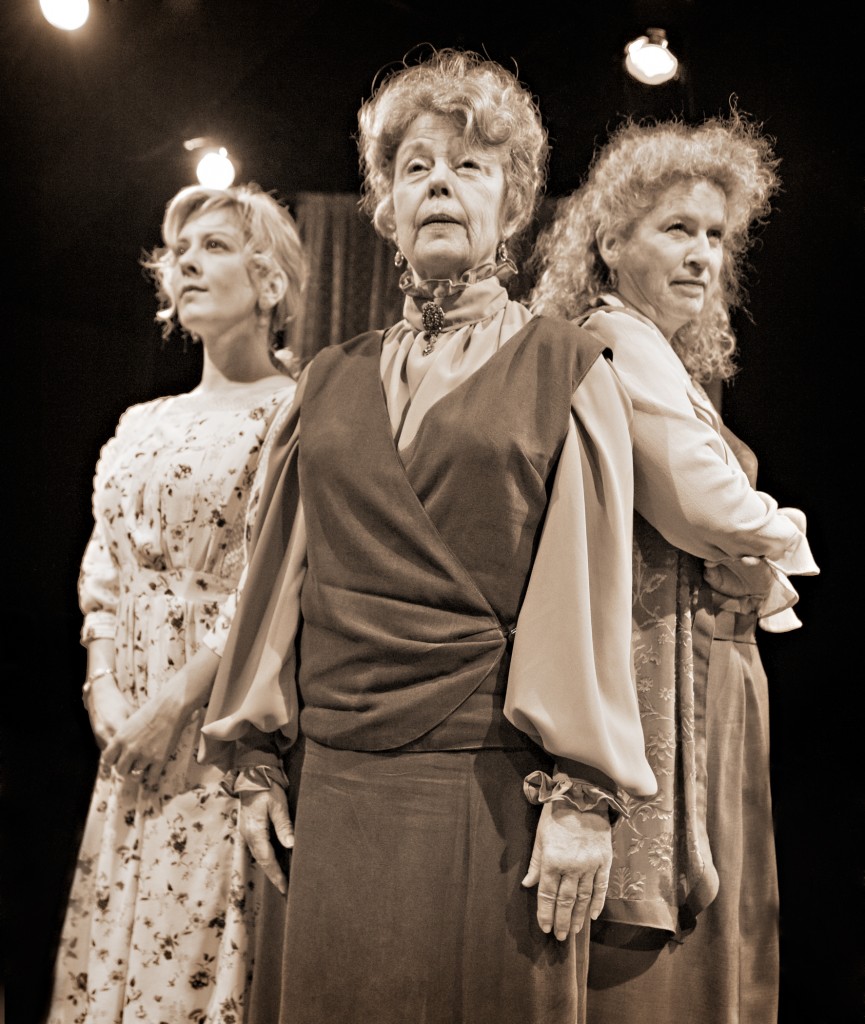
    From left: Val Landrum, Jane Fellows and Jacklyn Maddux in "The Carpetbagger's Children" at Profile Theater. Photo: Jamie Bosworth

    Here’s a story about the playwright Horton Foote, told by his daughter Daisy Foote and reprinted in the program for Profile Theatre’s new production of his play The Carpetbagger’s Children, which opened Saturday night:

    A few years ago a playwright friend and I were having dinner with my father. My friend had just seen “The Carpetbagger’s Children” at Lincoln Center Theater, and he casually asked my dad how long it took him to write the play. My father, even more casually, answered that it took him all of ten days. At that point, my friend looked like he might throw up all over the table and I might start crying, so my father took pity on us and added, “But I had been thinking about it for a very long time.”

    Well, of course.

    Stories take time — a lifetime, sometimes — and the actual setting down of them can be  simply the culmination of a very long process, the plucking of the fruit from a tree that took years to mature and finally produce. It’s a little like the oft-told story of the “overnight success” that took twenty years to achieve.

    But in Foote’s case (he died last March, 10 days shy of his 93rd birthday) it’s not just a matter of long experience bringing forth a story. It’s a matter of long experience in learning how flexible the theater can be, too. The Carpetbagger’s Children, for all its apparent traditionalism, breaks all sorts of rules about the stage — and it breaks them exceptionally because it’s learned the exceptions to the rules.

    This is a memory play, and it’s told by three actresses, and “told” is the correct word: They take turns delivering long, carefully wrought soliloquies, speeches that overlap in theme and content (told by each sister from a slightly different point of view) but never overlapping in delivery. There is no dialogue, no pretension of ordinary conversational speech patterns, no give and take, except in the incidental clashes in the way the stories are told.

    How could something so “undramatic” be so gripping? Because Foote knew story, and he knew the surprising elasticity of the theater, and he trusted that good performers would know how to bring life into the words that he put down. Remember, this is the guy who wrote the screenplays for To Kill a Mockingbird and Tender Mercies. Not ordinary tales. But that’s the beauty of the things.

    I once commented in exasperation that watching a Horton Foote play was like watching paint dry. I don’t think I ever actually wrote those words for print, which is a good thing. I don’t even remember what particular incident inspired them. It must have been, I can only hope, a particularly ham-fisted production of one of his plays. Because although nothing much “happens” in a Foote play, at least in the sense of slam-bang Hollywood action, worlds turn, as they do in Chekhov.

    The director of Profile’s production, Jon Kretzu, has a longtime affinity for Chekhov, and it shows in the way these three able actresses turn softly (and sometimes harshly) on a dime. If the journeys they take are largely internal, they have external effects. This is the story, in a way, of a Southern empire crumbling, more quietly than the crumbling empire of Tennessee Williams’ Cat on a Hot Tin Roof (which opens in revival later this month at the Oregon Shakespeare Festival) but crumbling nonetheless. And that’s a fascinating, troubling, sometimes even exciting thing to see.

    Briefly: A young Union soldier, fighting against the Confederates in Texas during the Civil War, likes what he sees and comes back, after the war, as a reconstructionist. Through shrewd business dealings and the aid of the triumphant Republican apparatus, he amasses a fortune in money and land, which he considers his offsprings’ duty to hold together. It’s up to sisters Cornelia (Jane Fellows), Grace Anne (Jacklyn Maddux) and Sissie (Val Landrum) to achieve that as the decades roll on.

    Well, they can’t. Surprised? But the effort shapes each, and several other characters alluded to, in intense and often warping ways. That’s the way of the world. And without going into more detail, the plain old brutal way of the world is what the play’s about.

    With Tim Stapleton’s simple but familiarly domestic in-the-round setting and DeeDee Remington’s spot-on costumes, it’s a handsome production. The three stars settle with warm fury into their characters. Nothing much “happens” except life and death themselves.  And paint does not dry.

    *

    PICTURED: Val Landrum (left), Jane Fellows (center) and Jacklyn Maddux: the carpetbagger’s daughters. Photo: Jamie Bosworth

  • A gay old time on Super Globe Sunday

    Mr. Scatter understands an American football match of some importance is to take place this very afternoon. Squadrons from the midsized cities of Indianapolis, Indiana, and New Orleans, Louisiana will battle it out on a field called a gridiron to claim rights of municipal supremacy for the coming year.

    picture-16All very manly. But Mr. Scatter would like to offer you as an alternative pastime a chance to read his review of The Lunatic, the Lover, and the Poet that is printed in the O! section of today’s Sunday Oregonian.

    The new novel, by Portland writer Myrlin A. Hermes, is a smart and witty reimagining of some of the great literary mysteries of our time. (The mysterious events take place in Elizabethan times, but it’s our time that gets all hot and bothered about them.)

    To wit:

    • Who was this William Shakespeare?
    • Who was this Dark Lady of the Sonnets?
    • Who was this Melancholy Dane?
    • How did Mr. Shakespeare become Mr. Shakespeare?

    Drolleries abound, along with intellectual, historical and emotional insights. It is not giving away too much to reveal that in this fictional universe Hamlet is as gay as a caballero going to Rio de Janeiro, and maybe Shakespeare is, too. No Super Bowl rings for them. But they find their compensations.

    Enjoy the game. Whichever one you prefer.

  • Art Scatter redesign: a look at the candidates

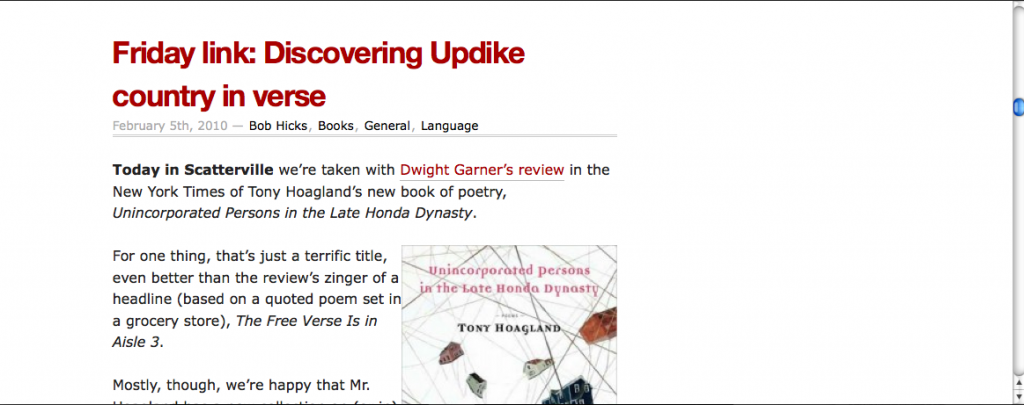
    Thanks to Charles Noble, maestro of the terrific blog Noble Viola, and music writer extraordinaire Brett Campbell, for teaching Mr. Scatter how to take a screenshot on his Mac. (It’s easy!) This allows us to show you samples of how Art Scatter would look using the Web themes Veryplaintext 3.0 (the top series of photos) and Copyblogger (the lower series). The third candidate for a redesign, Modern, is the format you’re looking at now. Thanks, Charles and Brett!

    VERYPLAINTEXT 3.0 SCREENSHOTS:

    picture-91

    ———-

    picture-10

    ———-

    picture-11

    ———-

    picture-13

    … AND COPYBLOGGER SCREENSHOTS:

    picture-4

    ———–

    picture-5

    ———–

    picture-8

  • Art Scatter new looks: a fuzzy stab at comparison

    Try as he might, Mr. Scatter can’t figure out a good way to let you look at the three redesign possibilities we’re considering for Art Scatter.

    Copyblogger Web themeRegulars Brett and Charles have both asked for such a thing, and it’s not just a reasonable request, it’s a no-brainer. Unfortunately Mr. Scatter’s brain just says no when he tries to figure out how to make it happen.

    Veryplaintext 3.0 Web themeThe best he can manage is a fuzzy screen photo of each candidate taken with his inadequate Blackberry phone, in the hopes that the pictures will help jog your memories back to what you saw in the last couple of days.

    Artsemerging Web themeWhat you see, from the top, is:

    Copyblogger, the jazziest of the candidates, with red headlines and a tabloidy staccato feel.

    Veryplaintext 3.0, with a crisp, beautifully design serif type and an old-newspaper feel.

    Artemerging, the theme Art Scatter has had since its birth but is getting ready to shed.

    And, you’re reading this in Modern, the third candidate and today’s theme.

    Mr. Scatter sincerely hopes this helps. And he promises not only to make a decision soon, but to explain how and why.

  • This ‘Cosi’ is a farce. You got a problem with that?

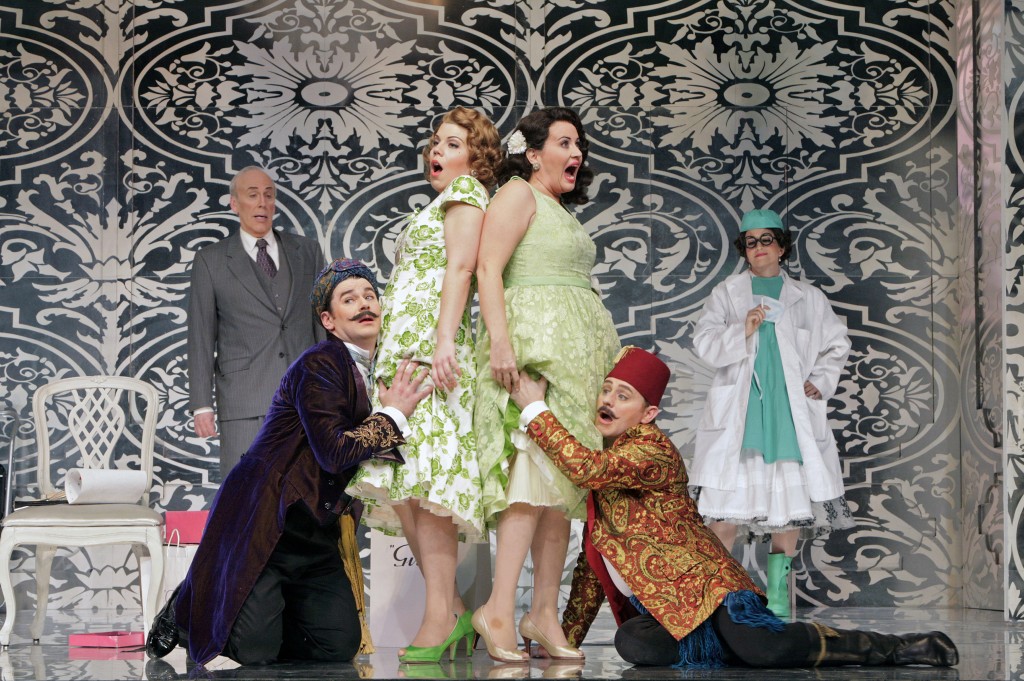
    Cosi fan Tutti. Photo: Portland Opera/Cory Weaver

    Chatting with a friend in the lobby of Keller Auditorium during halftime of Portland Opera’s Cosi fan Tutte on Friday night, Mr. Scatter became aware of a controversy he hadn’t realized existed.

    “Audiences tend to love this production,” my friend, an exceptionally knowledgeable follower of the opera world, sighed. “And critics tend to hate it.”

    Up to this point I’d been having a rather jolly time myself, although I knew the production, which originated in 2003 at Santa Fe Opera and emphasizes brisk farcical shtick, wasn’t strictly traditional. So I stuck his comment in the back of my mind, returned to my seat for the second act, and continued to have a jolly time along with the rest of the audience, right up to the curtain call.

    And this morning I did a little researching. It’s true. A lot of critics (though by no means all) have found this Cosi distressingly populist. “A gag-filled, vulgar romp,” J.A. Van Sant wrote in Opera Today, reviewing Santa Fe’s 2007 revival. That might sound like a good ad quote, but he didn’t mean it as a compliment.

    Since Van Sant seems to speak for a lot of other critics, let’s give him a little more room to explain himself:

    Politely put, (stage director James) Robinson’s Così was a gag-filled, vulgar romp. Such is not Mozart’s Così, an elegant, ironic comedy – not an ambiguous study of human nature requiring Regietheatre treatment, as is the present day style with this piece. To make Così into slapstick comedy combined with faux psychological exploration of the characters is to miss the point.

    Essentially a bittersweet comedy of character types, set to some of Mozart’s most exhilarating and beautiful music, Così indeed has dark edges that serve to heighten amusement over the foibles of human nature.

    You shouldn’t overdo the darkness, Van Sant continued, but you shouldn’t sacrifice the elegance to showy gimmicks, either.

    A couple of other points emerged from other critics.

    • First, the not-too-reluctantly philandering sisters in this play (the story is by Lorenzo da Ponte, who also wrote the librettos for Mozart’s The Marriage of Figaro and Don Giovanni) and their gentleman-and-an-officer lovers have traditionally been played by older singers, suggesting that these erotic foibles are less the result of sheer youthful exuberance and more of something innate in human nature.
    • Second, the play is very much about social convention at a level of society in which adherence to social convention is extremely important. These characters, if they’re going to sin, would do so cautiously, with a sense of decorum, not with casual friskiness. To give Cosi the sheen of 1950s naughtiness that this production does is historically misleading and saps some of the intellectual vigor from an opera that has a far subtler soul.

    Objections noted. And on this one, I’m going to side with the audience.


    Photo:  Matthew Staver/Opera Colorado

    I’ve seen a huge number of concept productions that horse around with the times and settings and sometimes even the underlying intentions of the original shows. It’s common in the theater world, so much so that it’s inspired a hoary but apt joke: “Did you hear about the radical concept for the new Hamlet? They’re doing it Elizabethan style.”

    The true question isn’t, “Is it authentic?” but, “Does it work?” That is, does the concept fit metaphorically with the essentials of the original? Is it carried out consistently, without laboring to make its connections or dropping them halfway through? Does the concept have a purpose other than simply being different?

    And, oh, yes: Does the audience like it? That last is a tricky one. Audiences like all sorts of things that are aesthetically half-baked, but artists who ignore their point of view make a grave mistake: No piece of theater is complete without an audience in the house. Indeed, if it’s not for an audience, it’s not theater.

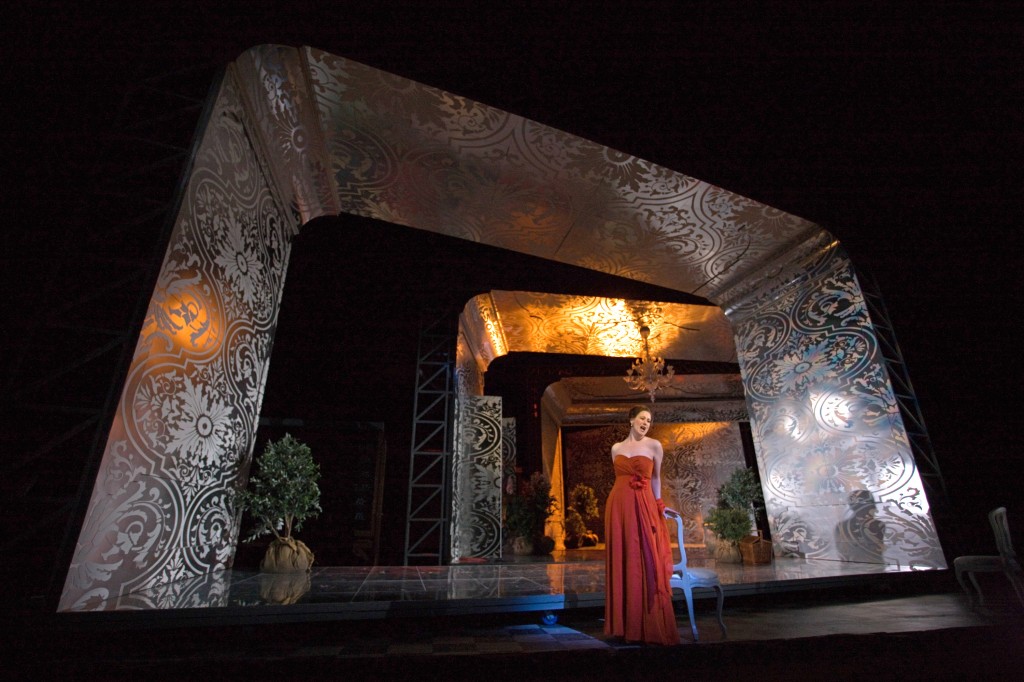
    To me, this Cosi is organic. David C. Woolard’s costumes, which veer from late ’50s girl-group chiffon to Shriner convention madcap, mesh beautifully with Allen Moyer’s curlicued folding box of a set, which cracks open magnificently at the top of the second act. And stage director Elise Sandell, working from Robinson’s original ideas, carries out the same sort of concise overstatement, a swift and busy flow of controlled exaggeration that plays in counterpoint to, but not against the grain of, Mozart’s extraordinary music — which, after all, is the core of the opera.

    This is the language of farce. And a lot of the objections to this production, I think, are essentially objections to farce itself, which seems to many people somehow a lesser form of art, unworthy of playing in conjunction with Mozart’s sounds. I happen to think farce fits this story well, but then, I also happen to think that good farce is a great and serious business, a way to slice to the heart of human nature and analyze it shrewdly without getting all heavy and morose  about it. Farce’s serious-but-frivolous nature seems an excellent complement to this beautiful music, and I had no trouble either integrating the farce and the music or understanding that the two are complementary but not the same.

    About that music, and its performers. The six key figures in this Cosi are true actor-singers, and their easy engagement in the extreme physical actorly demands of what is already a strenuous opera to perform was delightful. The orchestra, under George Manahan’s baton, was both sprightly and nuanced. The balance of voices was good. And the almost mystically seamless flow of Mozart’s music, from harmony to aria to harmony again, was the eye- and ear-opening wonder that it has never ceased to be since the opera’s debut in Vienna in 1790. If I had to choose one standout from this uniformly lovely cast, it would be soprano Lauren Skuce, partly because her Fiordiligi carries the emotional weight of the opera with her brilliant second-act aria of vexation and moral indecision. Farce can have weight, too. Good farce always does.

    I noted a lot of young faces in Friday night’s crowd, and I’m guessing that performance created more than one opera fan for life. My bet: They liked the farce, and loved the music.

    *

    CAPTIONS, from top:

    • From the left in Portland Opera’s “Cosi fan Tutte”: Robert Orth (Don Alfonso), Keith Phares (Guglielmo), Angela Niederloh (Dorabella), Lauren Skuce (Fiordiligi), Ryan MacPherson (Ferrando) and Christine Brandes (Despina). Photo: Portland Opera/Cory Weaver.
    • Allen Moyer’s cracked-open set for “Cosi,” from a recent Denver production with the same sets and cosumes as Portland’s but a different cast. The set, created for Santa Fe opera, will be broken down and recycled after the Portland production — a shame, but Santa Fe is finished with it and doesn’t have a good place to store it. Photo: Matthew Staver/Opera Colorado.
  • Art Scatter’s new look, Variation 3

    Call us vain, but here at Art Scatter World Headquarters we’re still obsessing over the way we look.

    Photo: Max Wehite/Wikimedia CommonsDoes this typeface go with our headline style? Should we go Friday casual, sober-suited, country corduroy or maybe uptown funk? Do we want to look reliable, or available, or maybe flirtatious but with strict limits?

    Today we’re feeling sleek. And no wonder, after trying on the last of three costumes we’ve been contemplating, a Web presentation theme called Modern. Yesterday we showed you the jazzier Copyblogger, and Thursday we kicked off with the simple but typographically elegant Veryplaintext 3.0.

    One of these three designs will replace the format we’ve been using since Art Scatter was a newborn in February 2008, Artsemerging. Why? Because we feel like a change. But we want to make sure it’s the right change.

    So, here you have it. Three new suits. Each with strengths, each with weaknesses. Let us know which one appeals to you and why — and if one of them really grosses you out, let us know that. too. After all, we just make this stuff up. You’re the ones who read it.

    Hit that comment button and let us know what you think.