Author: Bob Hicks

  • Detroit: Garden City, U.S.A.?

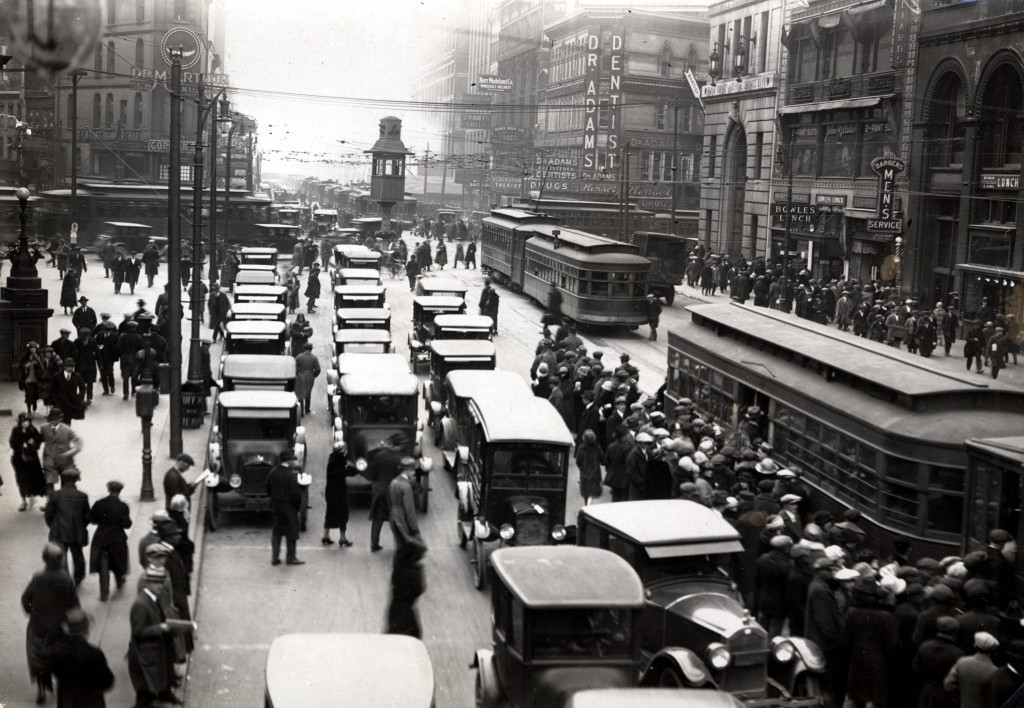
    Corner of Michigan and Griswold. Great deal of car traffic, large group of people boarding trolley car. Large commercial buildings in background. Traffic tower in middle of street, with person standing inside. Date 	  circa 1920 Source 	  Early Detroit Images from the Burton Historical Collection, Detroit Public Library Author 	  unknown

    One of this week’s most interesting reads is by Associated Press writer David Runk, published in the Detroit News under the headline Detroit Wants to Save Itself by Shrinking.

    The crux: Much of the city has become so bleak and uninhabitable that Mayor Dave Bing and other city leaders want to bulldoze huge sections and start over with something else. What that “something else” might be isn’t fully imagined, but a lot of people are saying: Farms. Gardens. Nature. Imagine: A city, having conquered the land, agreeing to a unilateral withdrawal in order to save itself.

    What does this have to do with Portland and Oregon, which pride themselves on their planning and rural-to-urban connections, even if both have flashpoints of read-guard insurgency?

    For one thing, looking at places like Detroit and the Bronx and declining Rust Belt cities is a healthy reminder of how comparatively easy Oregon has it in this area: We simply don’t have to contend with the issues of massive urban deterioration that plague other parts of the country. (Our own, much smaller, issue is the spread of large suburban nowheres without centers, with little to define them but car culture and small-scale speculation.) It’s easy to be smug about our “greenness.” How green would we be if we faced the problems that so many other places face?

    Second, though: Can ideas pioneered here be adapted to the catastrophic conditions that Detroit and other cities face? Can an American urban-sprawl landscape be transformed into something like a 21st century medieval landscape, with tight urban gatherings fed (perhaps literally) by closely surrounding farm and rural areas? And can such projects be undertaken without the kind of massive governmental direction and support that is already under relentless attack nationally in the battles to reform health care and counter the effects of the Great Recession?

    Hurt by white flight and the lingering effects of the 1967 Detroit riots, and hung out to dry by the near-collapse of the American automobile industry, Detroit has shrunk from a city of about 2 million in its heyday to one of a little more than 900,000 today, including the poorest of the poor. The six-county Detroit Metro area is closing in on 4.5 million people, but most of the wealth has fled to the outlying suburbs and cities, with a stubborn pocket of money and influence downtown.

    Just one of the many tangles in the path of accomplishing anything is suggested in today’s Detroit News piece Detroit’s Desolate Middle Makes Downsizing Tough, by Christine MacDonald and Darren A. Nichols. Some of the city’s most vibrant neighborhoods are at its fringes, cut off from the city center by a broad swath of desolate zone. How can the parts of the city that work be connected?

    The city’s challenges in its effort to reinvent itself are practical, philosophical and ethical. Who owns the land, how will the city pay for it, who will own it once it’s been cleared, and what control will the city have over what is done with it by its new owners? Is government the proper instigator of change, or should market forces determine the city’s future? (In Detroit, the answer might be that the marketplace is broken, and if the public in the form of its government doesn’t step in, the rot will simply continue to spread.) Should you tear down without a clear idea of what you’re going to replace with? For this to work, people will inevitably have to be moved, as they were in the massive and disruptive urban renewal projects of the 1960s. What are their rights, and how are their rights weighed in the balance of the public good? Can Detroit afford not to make radical decisions?

    And what if this reinvention works? What if Detroit becomes the model for how America can reemerge from the global economic and environmental disruptions that may at last be shattering our illusion of eternal expansion? What if smaller really is better? What if one aspect of paying attention to infrastructure is simply removing part of it? Can a place be small and dynamic at the same time? If that’s not an Oregon question, I don’t know what is.

    For perspective, a good place to start is Alex Altman’s report Detroit Tries to Get on a Road to Renewal, from the March 26, 2009 issue of Time:

    Detroit has become an icon of the failed American city, but vast swaths of it don’t look like city at all. Turn your Chevy away from downtown and the postcard skyline gives way first to seedy dollar stores and then to desolation. The collapse of the Big Three automakers has accelerated Detroit’s decline, but residents have been steadily fleeing since the 1950s. In that time, the population has dwindled from about 2 million to less than half that. Bustling neighborhoods have vanished, leaving behind lonely houses with crumbling porches and jack-o’-lantern windows. On these sprawling urban prairies, feral dogs and pheasants stalk streets with debris strewn like driftwood: an empty mail crate, a discarded winter jacket, a bunny-eared TV in tall grass. Asked recently about a dip in the city’s murder rate, a mayoral candidate deadpanned, “I don’t mean to be sarcastic, but there just isn’t anyone left to kill.”

    Then, Altman looks at the hopes for something different:

    What would a new Detroit look like? Many say it will have to be smaller, greener and denser. The city can start with the chunks of town that have withered into wasteland. The exodus from Detroit–triggered by suburbanization and the 1967 race riots–dovetailed with the national foreclosure crisis, which has battered few cities as badly as this one. According to a regional listings service, the median home-sale price has plunged to a paltry $5,737–yet tens of thousands of dwellings stand vacant. But the “long-term perspective,” says Heidi Mucherie, director of the organization leading the Detroit Vacant Property Campaign, “is that these are opportunities.” It’s the hopeful note sounded by Detroit’s optimists: The approximately one-third of the city lying empty or unused–an area about the size of San Francisco–is not just an emblem of its corrosion but also the blank slate on which to chart a path to renewal.

    You can get a good look at what’s happened to this city from the Web site The Fabulous Ruins of Detroit, maintained by artist and activist Lowell Boileau. And this page from Detroitblog reveals how the country has already begun to reclaim parts of the city. Meanwhile, here’s a link to The City Rises, a subsection of the “Fabulous Ruins” site that shows some of the rebirth that’s been going on amid the death throes. Things rise, things fall, always at the same time.

    *

    PHOTO: Once, Detroit was one of America’s most bustling cities. This 1920 photo shows the corner of Michigan and Griswold downtown. While the 21st century downtown has shown signs of revival, much of the city is an urban wreckage straight from the pages of dystopian futurist novels. Photographer unknown; Burton Historical Collection, Detroit Public Library/Wikimedia Commons.

  • Reminder: Dance Flight this afternoon

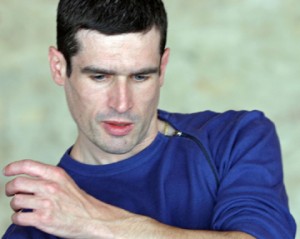
    I’ll be at Northwest Dance Project’s studio in North Portland this afternoon for an onstage chat with Luca Veggetti, the Paris-based Italian choreographer who’s in town to update his dance Ensemble for Somnambulists, which he created on the company dancers in 2006.

    Choreographer Luca VeggettiThis should be interesting. I sat in on a rehearsal a few days ago and afterwards talked with Veggetti for about 20 minutes. He’s smart and eloquent (he speaks five languages, fortunately including English), with a lot to say about his own background and the state of dance in general. He also has strong background in experimental theater and opera (”I was raised at La Scala,” he says) so his outlook is broad.

    The format is the same as last Sunday, when I had a good talk with Maurice Causey, a freelance choreographer associated closely with Nederlands Dans Theater. Show up at 3 p.m., have some wine and cheese, watch a brisk rehearsal, then get ready for the interview. Last week a lot of people in the crowd asked questions, and I expect the same today. Address: 833 N. Shaver Street, just off of Mississippi Avenue. Suggested donation is $20 ($10 students), which helps pay for the event.

    Veggetti and Causey will each have a piece in Northwest Dance Project’s spring performances, which will also include two dances by artistic director Sarah Slipper, March 12-13 at the Newmark Theatre.

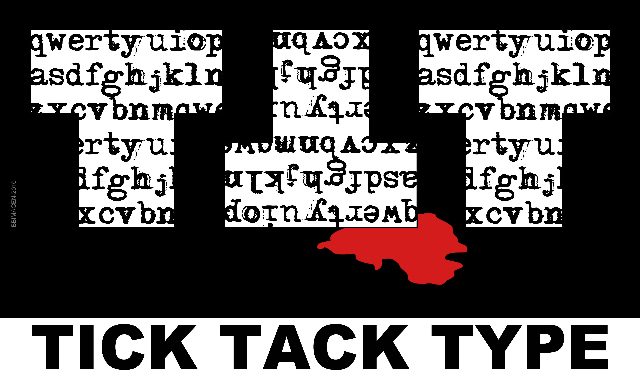
  • The meaning (or not) of Tick Tack Type

    tick-cropped

    What’s it all about, Alfie?

    After a Friday evening of loosely organized chance in the company of Third Angle New Music Ensemble (the program included Terry Riley’s endlessly mutable In C; California composer Mark Applebaum’s similarly open-ended exploration of alternative musical “reading,” The Metaphysics of Notation; and Portland composer David Schiff’s exhilaratingly jazz-charged Mountains/ Rivers, which takes inspiration from In C) we’re feeling a bit unmoored.

    Since we’re in free-float anyway, this seems like a good time to check in on Imago.

    One of the terrific side benefits when Jerry Mouawad develops a new show is that he thinks long and hard about what he’s doing, and then he writes about it online. Anyone who wants to take a peek can get an inside look into one of Portland’s most fertile creative minds. Mouawad, Imago’s co-founder with Carol Triffle, spills his thoughts on the company blog. The spilling isn’t always easy, because, ever aware of the virtues of theatrical suspense, Mouawad really wants to hold onto the beans.

    “I assume this blog is vague since I am not divulging any of the action,” he writes about his new show, Tick Tack Type. “I apologize for this, but I am doing this for your sake (that is if you plan to see the work.) By discussing the action I am robbing you of the experience of it. What I see in an action may not be what you see. I can say this about Tick Tack Type: in many ways it’s about “seeing” or “not seeing.”

    On Friday, in a post titled Finding Logic in the Non-logical, he had some intriguing things to say about the continuing evolution of Tick Tack Type:

    Yesterday I blogged that I tried to dismantle any meaning when meaning began to arise in a scene in “Tick Tack Type.” I wrote that doing this was to free the play and not have it land in a didactic world. Today I will contradict my thinking saying that for every action in the play (or for most) I tried to find meaning in it.

    Is this a contradiction? Yes and no. I think it’s a fine balance between an abstract work that has no means of a handle and an abstract work that resonates for audiences. I am not interested in pure abstraction; if I (were), I would imbed the work in pure movement and dance and not try to create theatre of it.

    … (F)or every action I tried to find meaning yet at the same time dismantle it. … In its simplest terms, when I had a character execute an action I tried to find one level or several of dramaturgical importance.

    And here, from Imago’s Web site, is what Tick Tack Type is “about”:

    Five men and four women are dropped from a chute into a stark empty room to discover themselves as participants in a strange typing academy. … Mouawad’s characters search for ways to compete and survive under the rule of a tyrannical typing instructor played by artistic co-director Carol Triffle. … Mouawad has fashioned theatre without words to explore comedic and tragic drama.

    Sounds logical, no? Tick Tack Type plays March 11-14 only, and tickets are free. Go to Imago’s Web site for information.

  • To the lighthouse, Mrs. Woolf (and pay as you go)

    This afternoon, while shuffling idly through the File of Unfinished and Rejected Posts — it’s true, not everything we write ends up in virtual print — we found this piece from last August, initially rejected on the grounds that maybe it was a little off-topic and too much of a downer. But in light of our continuing national baring of the teeth and difficulties in coming up with a simple, rational health-care plan, let alone any apparent impulse to talk civilly and sanely with one another across the artificial divide of our go-for-the-jugular political discourse, we’re publishing it now. After all, arts and culture can’t exist without an honest sense of shared responsibility and experience, and that is what this seaside idyll is about. Read on, and argue with it if you wish.

    Yaquina Head Lighthouse, Newport, Oregon. Photo: Rebecca Kennison, 2005, Wikimedia Commons

    Newport, Oregon, has two lighthouses. The original, on the south side of town and  decommissioned for most of its 138 years, has been turned into an agreeably nostalgic tourist lure complete with resident ghost story. The larger and younger lighthouse (by two years) has been working continuously since the day it was completed. This light, its beacon visible for miles out to sea, stands 93 feet tall on a narrow peninsula at the city’s northern edge.

    While it’s not precisely true that once you’ve seen one lovelorn ghost you’ve see ‘em all — the tales of tragic circumstance and details of costume have their specificities — it IS true that once you’ve toured a particular location of purported ectoplasmic activity you can go a good long time before repeating the experience. (I make an exception for re-readings of James Thurber’s story The Night the Ghost Got In, which should be frequent and preferably aloud, to an intimate audience.)

    So while I enjoy outside glimpses of the southside Yaquina Bay Lighthouse (active from 1871 to 1874, brought to light again in 1996, haunted since the city’s promoters realized the commercial possibilities) I haven’t taken the tour in several years.

    It’s been a while since I’ve visited the north side lighthouse, too (although I can see it as I’m writing this from the sands of Nye Beach), but for different reasons.

    I’ve always liked this lighthouse — it’s called simply the Yaquina Head Lighthouse, for the rock on which it stands — and for many years I made a point of calling on it whenever I was in the vicinity. A twisty, usually lonely drive west from U.S. 101, past the concave of an old rock quarry, to the spare grounds around the tower. Not too many tourists. Not much of anybody; the few besides me mostly people who had actual work to do. On almost any day the wind was stiff, and on stormy days it was enough to almost knock you down. I like standing against that kind of force, feeling the swift air push against my chest and ripple in unseen waves around me. It’s challenging yet also somehow calming. It re-sets my rhythm to the rhythm around me.

    Somewhere along the line I stopped visiting.

    Partly it was because Mrs. Scatter, who can stay happily on a lonely beach for hours, investigating the tidepools and gathering flotsam and jetsam, is not so much a fan of shivering in the wind. Partly it was because the experience, once casual, became regulated. The lighthouse is now the core attraction of the Yaquina Head Natural Area, operated by the U.S.Bureau of Land Management, with posted hours and a wooden booth near the foot of the road where you pay to enter the domain. One year I bought an annual pass, for twenty or twenty-five dollars; a little steep but I was willing to chip in for the upkeep of a place I enjoyed. The next time I showed up, in a different car, I was told my pass was no good: My license plate was different, and the pass was assigned to a specific vehicle, not to the person who bought the pass. So the lighthouse drifted out of my routine.

    Today, though, I decided I wanted to share the experience with my 11-year-old son. I pulled off the highway and drove toward the wooden booth, figuring the visit might cost $3.50 or four dollars. I looked at the sign: Single vehicle, seven dollars. By this point I was almost to the window, where a tousled,  pleasant-looking young man in BLM uniform was waiting to take my toll.

    “I’m sorry,” I told him. “I didn’t realize it was seven dollars to go in. I can’t pay that. I’m going to turn around.”

    He didn’t act surprised or offended; he was friendly and polite. I had the sense he was used to hearing it.

    In fact, I could have paid the seven dollars. My son and I had just paid that much, including tip, for a fruit smoothie and a cup of coffee. And, no, we probably wouldn’t have stayed more than 20 minutes, which makes for a pretty stiff hourly rate, but that wasn’t the point.

    Because I was thinking about driving through the Willamette Valley town of McMinnville a few days earlier and stumbling across a mass of protesters gathered to bully a town hall meeting scheduled for that evening to hear talk about President Obama’s proposed national health care system. Astroturfers, these people are being called, and it’s a good name — fake grassroots, bused in from God’s Little Acre of Ideological Hysteria and spreading like weeds. This was about the time the astonishing Sarah Palin was whipping up mass frenzy against a rational and innocuous detail added to the health bill by U.S. Rep. Earl Blumenauer to allow older people periodic voluntary consultations with their doctors to talk about end-of-life care and decisions.

    “Death Panel!” Palin roared to Fox News and the New York Times alike, which duly passed her rantings along. The Evil Socialists will force helpless old people into a Democratic version of the gas chamber! She got what she wanted: more mud smeared over the Obama plan, more fears spread among the frightened masses, and the bonus that a typically cynical or invertebrate Senate effectively pulled the plug on the Blumenauer proposal.

    It was lies, of course. Damned lies, if not statistics — but lies in the long and inglorious pattern of the departed-but-not-gone Bush Administration, which lied the nation into a disastrous war, robbed us into a near economic depression, and spirited away a frightening amount of citizen privacy and civil rights, mostly with the acquiescence of a meek and cowed Democratic Party, which pretended that it didn’t know what was going on. (And, I regret to add, with the complicity of a complaisant mainstream press that dared not speak a discouraging or even questioning word for fear of landing in the path of the pseudo-patriotic juggernaut that rolled over the land following the attacks of September 11, 2001.)

    “It’s deliberate at this point,” Blumenauer said of Palin’s politically hyperventilated mendacities. “If she wasn’t deliberately lying at the beginning, she is deliberately allowing a terrible falsehood to be spread with her name.”

    Well, yes. It was, and she did. And why should Blumenauer or anyone else be surprised? This is the way of the reckless right wing. Lie long, lie loud, recruit a distortion of God to your side, rob Peter and Paul to pay the plutocrats, and scare the hell out of people so they’ll vote against common sense and their own best interests.

    Oh: And rip up the social compact, that outmoded and unAmerican idea that there is a public good that might in certain circumstances outweigh the God-given right of private business to own, develop, mark up and sell at a high profit any and everything up to and including, if possible, the thoughts you think. There is no common good. There is no commons. You want to see a lighthouse? Pay up, Mrs. Woolf.

    Which is why I turned my car around. I don’t blame the Bureau of Land Management for putting a fee on visits to public property it administers. What else can it do, given its budget and the country’s unwillingness to pay for upkeep of its public infrastructure? After all, it is charged with maintaining, for the public good, a working lighthouse, a sentinel against disaster, a beacon of warning and comfort to ships at sea.

    I certainly don’t blame the Friends of Yaquina Lighthouses, a praiseworthy private group devoted to restoring and maintaining the two Newport lights.

    Yet I wonder, from somewhere beneath the din of our self-serving political posturing: Do any of our decision-makers know the difference anymore between a light that performs a vital service and a light that simply perpetuates an attractive, ghostly myth? As we struggle through this tunnel of relentless erosion and fear-mongering in our public life: Is there no lighthouse at the end?

    *

    PICTURED: Yaquina Head Lighthouse, Newport, Oregon. Photo: Rebecca Kennison, 2005. Wikimedia Commons

  • Random Dance, and other movements

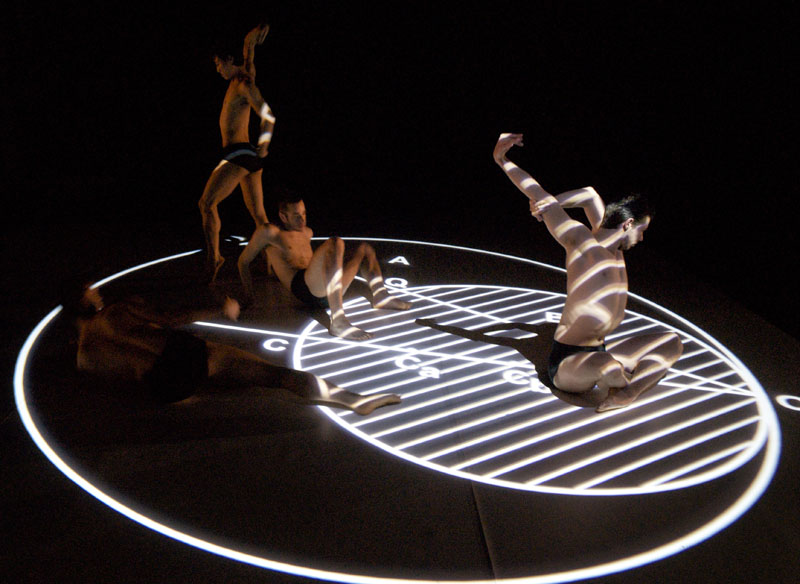
    Random Dance, coming to White Bird and the Newmark.

    Mr. Scatter is not a dancer. This may seem odd, considering the number of dance posts that have been on this site of late (or maybe, once you’ve read them, it seems painfully obvious), but that is partly a matter of coincidence. There’s been a lot of dance in town lately, and more is on the way.

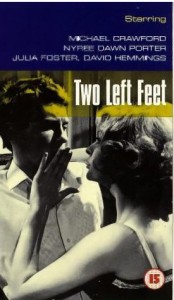
    We’re talking, of course, about presentational dance, art dance, dance as performance — not the social dance that Mr. Scatter did not learn in the 1950s and 1960s, when he suffered from a not uncommon affliction known as Two Left Feet, complicated by a textbook case of shyaroundgirlitis. Yes, he did go to his senior prom. He was in the band. The perfect end-run.

    Mr. Scatter's unfortunate childhood affliction.Watching dance, on the other hand, is a longtime pleasure, one that slides from tap to tango, classic to contemporary, Broadway to ballet. And it strikes Mr. Scatter that, while a lot of people weren’t looking, Portland’s become a heck of a dance town.

    Oregon Ballet Theatre is somewhere near the middle of it all, continuing its lovely performances of Christopher Stowell’s A Midsummer Night’s Dream and George Balanchine’s The Four Temperaments through Saturday at Keller Auditorium.

    And surely much of this renaissance can be laid at the feet of White Bird, which has routinely brought the un-routine to Portland audiences, exposing the city to worldwide dance ideas. Fresh from Hubbard Street, which has barely had a chance to skip back to Chicago, here White Bird comes again, this time presenting England’s Random Dance (that’s them in the photo above) Thursday through Saturday in the Newmark Theatre. The piece, Entity, by company leader Wayne McGregor, runs an hour and is reputed to be fast and furious. It also marks the end of White Bird’s two-year Uncaged series, which has spotted dance in adventurous spaces around town while it’s waited for its regular second-season home, Lincoln Performance Hall, to be refurbished. That’ll be done by the start of next season.

    But as important as they are, the scene is far from just OBT and White Bird. Keep an eye out for these upcoming events, too. (The dance action’s so hot and heavy that we’re sure we’re missing something; we apologize in advance.):

    POV Dance. This intriguing site-specific dance troupe guides its audience through the nooks and crannies of an old east side industrial building at 2505 S.E. 11th Avenue in The Ford Building Project, opening Thursday, March 11, and continuing through March 21. Mr. Scatter recalls seeing the POVers leaning over the railings of the four-story stairwell of downtown’s Pythian Building during last summer’s Conduit benefit performances, and it was a vertiginous experience of gut-wrenching exactitude.

    Northwest Dance Project. Sarah Slipper’s adventurous young company specializes in new contemporary work by international choreographers. Its spring concerts are March 12-13 at the Newmark Theatre and will feature works by Slipper, Maurice Causey (Ballet Frankfurt, Nederlands Dans Theater) and Luca Veggetti (La Scala, Kirov, New York City Ballet). This morning in the New York Times, Gia Kourlas reviewed Veggetti’s latest piece, which opened over the weekend at Manhattan’s Judson Memorial Church.

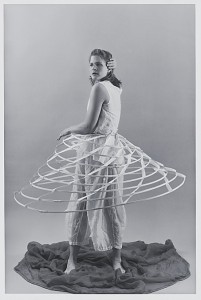
    Dancer/choreographer Katherine LongstrethKatherine Longstreth. A Portland newcomer who’s been making dance in New York since 1994, Longstreth presents Solos and Duets March 12-13 at Conduit, along with Kelly Bartnik, Nancy Ellis and Jeff George. She describes her choreography as “subtly narrative — weaving pedestrian movement with fully articulated physicality to create strange and poignant imagery.” We like the hoop skirt in the photo.

    Alembic #8: Over_here: now. Performance Works Northwest’s series of interdisciplinary collaborations matches movement guy Richard Decker with photographer Chelsea Petrakis and lighting designer Dora Nicole Gaskill to create “a transformative, ritual space with latex tubing and intense physicality, blurring the lines between dance and installation art.” March 12-13, Performance Works NW, 4625 NE 67th Avenue.

    BodyVox. Fresh from the first public performances by its second company, BodyVox-2, Portland’s touring popular dance/aerial/theatrical movement troupe is set to unveil a brand-new show, Smoke Soup, March 25-April 10 at its home space, 1201 N.W. 17th Avenue. We anticipate fresh moments and serious fun.

    Fellow scatterers, get your dancing shoes on. Just don’t ask Mr. Scatter to take a spin around the floor.

    *

    PHOTOS, from top:

    – England’s Wayne McGregor and Random Dance, at the Newmark Theatre tomorrow through Saturday. Photo: RAVI DEEPRES.

    – An entire 1963 movie dedicated to Mr. Scatter’s unfortunate childhood affliction. When the film came out, Mr. Scatter was a sophomore in high school, and wondered: How did they know?

    – Katherine Longstreth, performing March 12-13 at Conduit.

  • 39 steps to a new and better Mr. Scatter

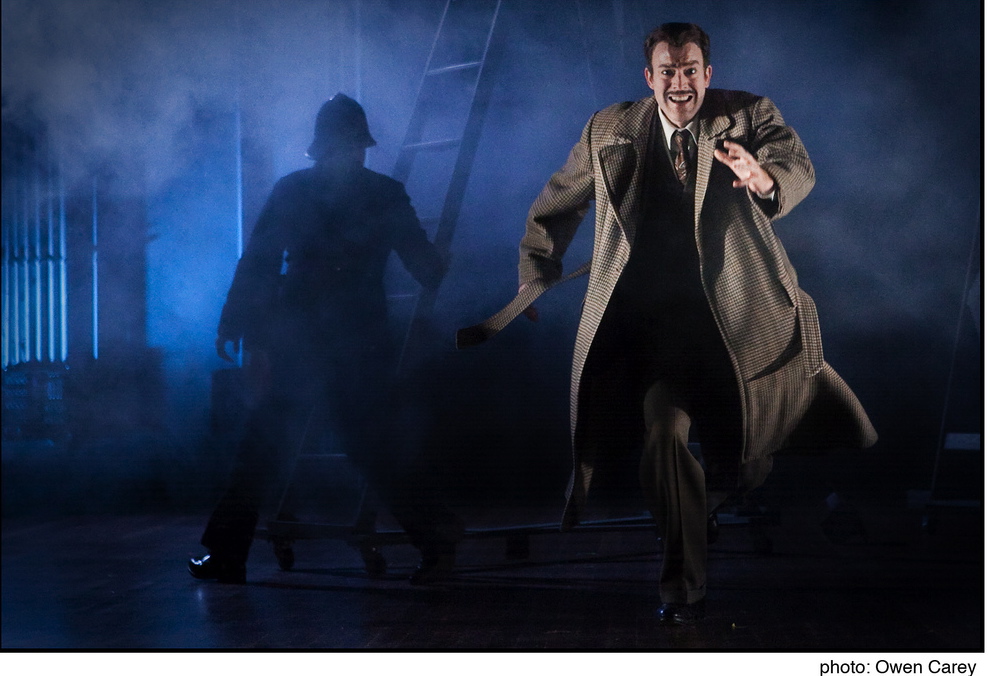
    Leif Norby on the lam in "Alfred Hitchcock's 'The 39 Steps'" at Portland Center Stage. Photo: OWEN CAREY

    It’s been a busy few days around Scattertown.

    First, on Thursday night, Mr. and Mrs. Scatter took a break from the gala festivities of Science Night at Irvington Elementary School to scoot up the hill to Talisman Gallery on Alberta, where their friend Cibyl Shinju Kavan was having an opening of new assemblages. Scrolls, bamboo, feathers and rocks figure into the work, which is quite pleasing.

    Cibyl Shinju Kavan at Talisman GalleryThen, at midday Friday, the Scatter duo showed up at the Gerding Theater in the Armory to see dancer Linda Austin and her cohort J.P. Jenkins tear up the joint with a fascinating visual, musical and movement response to Mark Applebaum’s elegant series of notational panels, The Metaphysics of Notation, which has been ringing the mezzanine railings above the Gerding lobby for the past month. Every Friday at noon someone has been interpreting this extremely open-ended score, and this was the final exploration. California composer Applebaum will be one of the featured artists this Friday at the Hollywood Theatre in the latest concert by Third Angle New Music Ensemble, the band of contemporary-music upstarts for whom Mrs. Scatter toils ceaselessly.

    Austin and Jenkins began by racing around the mezzanine and literally playing the hollow-steel guard rail, which was quite fun. They moved from pre-plotted base to pre-plotted base, always coming up with surprises, as the small crowd followed like Hamelin rats mesmerized by a piper’s tune. Mr. Scatter enjoyed the red fuzzy bargain-store microphone and the Sneezing Chorus and especially the shower of discarded clothing items floating down from the mezzanine into the path of the startled flower-delivery guy in the lobby below. Mr. Scatter took no photos, partly because the little camera doohickey on his cellular telephone is pretty much useless for anything more complicated than an extreme closeup snapshot of an extremely still object, and partly because he was just having too much fun to bother. But Lisa Radon of ultra was more disciplined and took some fine shots which you can ogle on her site.

    On Friday evening
    it was back to the Gerding for opening night of Portland Center Stage’s comedy Alfred Hitchcock’s ‘The 39 Steps,’ which takes the 1935 movie thriller and blows it to preposterous proportions.

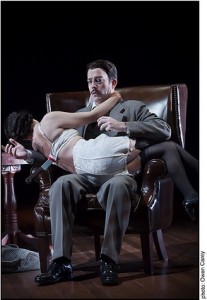
    Christine Calfas is stuck on Leif Norby -- or SOMETHING's stuck. Photo: OWEN CAREYY, ChaiA droll project, fit for our times: It’s chock-full of paranoia, delivered with a knowing wink. And very theatrical: Four actors zip through about 130 roles, often at breakneck speed.

    Ebbe Roe Smith and Darius Pierce do most of the zipping, and Christine Calfas plays all of the women, including one with a knife stuck in her back. That slacker Leif Norby plays only one role — Richard Hannay, the story’s hero, who is square of jaw and lively of step.

    All told, bravo. Scatter friend Michael McGregor, reviewing for The Oregonian, wraps it up superbly here.

    Speaking of mysteries: Somehow, back at the Scatter Ranch, some cheeses and crackers and a bottle of Eyrie pinot gris disappeared after the show.

    Saturday began slowly but picked up speed. In the afternoon Mr. Scatter dropped off the Large Large Smelly Boy at ComedySportz, where he learns how to be improvisational and funny, and then dropped in for a spell at Pearl Bakery, where Mr. Scatter drank coffee and munched on something pastryish and picked up a loaf of challah bread to take home.

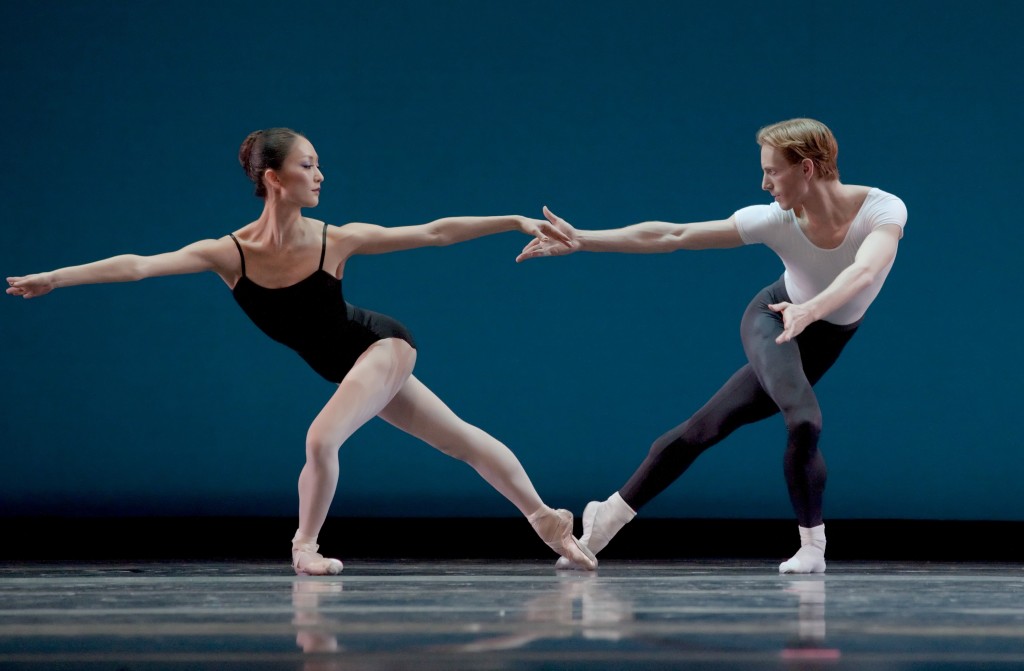
    Yuka Iino and Chauncey Parsons in the Sanguinic variation of "The Four Temperaments" at Oregon Ballet Theatre. Photo: BLAINE TRUITT COVERT Then, in the evening, Mr. Scatter accompanied the Small Large Smelly Boy to Keller Auditorium for opening night of Oregon Ballet Theatre’s current show, a twin bill of George Balanchine’s The Four Temperaments and Christopher Stowell’s A Midsummer Night’s Dream.

    Mr. Scatter was on assignment to cover the event for The Oregonian, and you can read his resulting review here. The big, welcome news was the return of the ballet orchestra for Midsummer from a budget-mandated layoff. After watching Temperaments, SLSB made the wise observation that the dancers had moved everything except their faces: “They did their expressions with their bodies.”

    (On Sunday afternoon, while the Scatters were otherwise engaged, a power outage hit downtown as OBT’s dancers were performing Midsummer, necessitating a cancellation. Audience members left in the dark have been offered free tickets to a later performance.)

    Finally, on Sunday afternoon, Mr. Scatter scurried over to Northwest Dance Project in North Portland to watch choreographer Maurice Causey work on a new piece with the company dancers. Then, while a small and congenial crowd munched on cheese and sipped wine at an event called Dance Flights, Mr. Scatter conducted an onstage interview with Causey, who did most of the talking because that’s the way it was planned.

    Choreographer Maurice CauseyAnd he talked quite well. About his career (he danced with, among others, Pennsylvania Ballet, National Ballet of Canada, and several years for William Forsythe at Ballet Frankfurt, and was ballet master for the Royal Swedish Ballet and Nederlands Dans Theatre). About being an American working mostly in Europe for the past 20 years.

    About being a classically trained dancer who these days is much more interested in creating new work to new music. About public and private support for dance, and his exploratory, let’s-see-what-happens approach to creating new work, and in general about how he loves the openness of young dancers in companies like NDP.

    Causey, too, is open, friendly, generous: despite his impressive resume, no airs in the studio, just a joy in the process.

    His new dance will be part of Northwest Dance Project’s March 12-13 program in the Newmark Theatre. And this coming Sunday, Mr. Scatter will be back at NDP’s studio at 3 p.m. for another Dance Flights interview with another big-name choreographer setting a piece for this program, Italian dancemaker Luca Veggetti.

    But first, he believes he’ll have a day of rest.

    *

    PHOTOS, from top:

    Leif Norby on the lam in “Alfred Hitchcock’s ‘The 39 Steps’” at Portland Center Stage. Photo: OWEN CAREY

    Cibyl Shinju Kavan at Talisman Gallery

    Christine Calfas is stuck on Leif Norby — or SOMETHING’s stuck. Photo: OWEN CAREY

    Yuka Iino and Chauncey Parsons in the Sanguinic variation of “The Four Temperaments” at Oregon Ballet Theatre. Photo: BLAINE TRUITT COVERT

  • Mr. Scatter’s Sunday: Dance, chat, wine

    The magnolia tree in Mr. and Mrs. Scatter’s front yard is budding. The handsome old plum trees a couple of doors down are in deep pink. And like an old tired bear stretching and yawning after a long winter’s nap, Mr. Scatter is cautiously poking his nose out of the cave and making a few public appearances.

    You might recall his recent pre-game patter at White Bird’s presentation of Hubbard Street Dance Chicago, or his stint of instant analysis from the broadcasting booth of Portland Opera’s Orphee.

    Choreographer Maurice CauseyFor the next two Sunday afternoons he’ll be ambling over to the Northwest Dance Project studio just off North Mississippi Street (not all that far, as it happens, from the Scatter cave) to moderate talks with a couple of very interesting guest choreographers who are setting new work on the company for its spring performances.

    The afternoons are called Dance Flights, and they’ll be casual, intimate affairs, a nice place to duck into and out of the rain. This Sunday’s chat will be with Maurice Causey (inset photo above), an independent choreographer identified closely with Nederlands Dans Theater (he’s been ballet master there, and also at the Royal Swedish Ballet) and with Ballet Frankfurt, where he was a principal dancer for William Forsythe for several years. On Tuesday I watched a couple of hours of Causey’s early rehearsal with the NDP dancers, and I’m eager to see what’s happened in the ensuing days.

    Choreographer Luca VeggettiNext Sunday, March 7, the guest will be the Paris-based Italian choreographer Luca Veggetti (photo at right), whose career has roamed from La Scala Milan to London, Pennsylvania, Chicago, New York City Ballet and beyond. In 2000 he was the first Italian choreographer in the 20th century to set a piece on the dancers of the legendary Mariinsky (Kirov) Ballet in St. Petersburg.

    The format is this: Drop in, have a little nibble and a glass of wine, watch the dancers perform the pieces, then settle in for the talks. I’ll mainly ask the choreographers to talk about their backgrounds and their approach to dance, and I’ll encourage people in the audience to toss in their own questions. Very informal.

    Each Dance Flight begins at 3 p.m. at the Northwest Dance Project studio, a pleasant, big-windowed space at 833 N. Shaver Street, just off of Mississippi Avenue. Suggested donation is $20 ($10 students), which helps pay for the events.

    Northwest Dance Project’s spring performances, which will include the new works by Causey and Veggetti plus two pieces by artistic director Sarah Slipper, will be March 12-13 at the Newmark Theatre.

  • Bad day at the Big O: layoff blues

    You’ve probably heard the news already. On Wednesday The Oregonian laid off 37 workers, 27 in the newsroom. The cuts have long been expected. Like the rest of the daily newspaper industry, the (not so) Big (anymore) O is trapped in a nightmare downward spiral triggered by landmark technological shifts, declining readership and, OK, its own reluctance to change with the times.

    The Oregonian: a race to thrive and surviveI’ve waited to write this because even now I don’t know all of the names of the people who’ve been laid off. Lips have been tight, although The Mercury’s Matt Davis has ferreted out most of the hit list here. Predictably, a lot of online smart-alecks have been snickering about this. Don’t know what to tell them except they’re insanely stupid, and callous to the extreme. These are good, talented people, most of them extraordinarily dedicated to the public good, who are now out of work.

    The possibly mortal weakening of the mainstream American press is nothing but bad news for our fragile democracy (or republic). Without the newspapers’ checks and proddings, who will speak authoritatively to power? In October of 2008 I wrote about the problems facing the news industry, and although that post offers no solid solutions (I’m no wizard), I think it lays out the difficulties pretty well.

    Up until now, The Oregonian has managed the illness of its industry with remarkable grace. Maybe it hasn’t come up with answers (and maybe I’ve been frustrated by what’s sometimes seemed like a paralysis of will), but it has treated its people well, offering several generous buyout packages to its workers instead of just dumping them by the wayside, as so many other papers have. I took a buyout two years ago. My wife took one last May.

    Pretty much everyone who was going to leave voluntarily has left. Now, the O has no real choice but to make the tough cuts by layoff. They’ve begun, and there could be more. I don’t pretend to understand how the decisions were made on who went and who stayed. Faced with the extraordinary difficulties of having to make these decisions about people’s lives and livelihoods, my own list would have been different in several particulars. But there’s no good way to do this thing.

    This is only the start of what promises to be a massive upheaval, and my hope is that those who are left, after shaking off the shock, will reinvent the newspaper to make it more appealing, more topical, and more pertinent to people’s lives. Right now it’s a football interior lineman’s uniform hanging on what’s become a jockey’s body. Time to recognize the advantages of being a jockey and get on with the race.

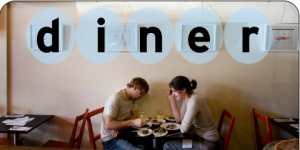
    Diner, the annual guide honchoed for years by Karen Brooks. The pioneering Portland food writer was one of 27 newspeople laid off at The Oregonian on Wednesday.The reinvention could be — should be — exciting. Let’s all hope. And I hope that arts and cultural writing will be a vigorous part of the new Oregonian that emerges from all of this, because culture is a crucial aspect of how a city thinks of itself. In the broader sense, a city is a culture.

    In the meantime, many of those out of work today are people I’ve spent years, even decades, working with. Some of them are friends. Some of them are in shock. All of them wonder what they’re going to do. What I want to do now is to honor a few of them, the ones I’ve worked with a little more closely than the others, the ones I’m especially thinking of:

    Karen Brooks. Karen is the reason you see that Diner photo above. For a quarter-century, beginning at Willamette Week before she joined the O, Karen was the leading voice of food writing and restaurant criticism in Portland. Her style could be bubbly, over the top, unrestrained in its enthusiasm, but nobody could make the tough calls or spot the trends like Karen could. She made people sit up and notice the world of food, and like other pioneers such as her friend Matt Kramer she’s been doing it since long before Portland became a foodie town. Love her or hate her, people responded to Karen’s food writing. She stirred things up. She was also for many years the paper’s arts editor, and I worked with her both as a writer and an editor. Few people understand how much she put on the line and how hard she fought the internal political battles to protect and expand the paper’s cultural turf. That passion is a rare commodity, and attention must be paid. In the relatively straitlaced culture of the newspaper world Karen was an exotic bird, and she didn’t quite fit. Over the years that hurt her and helped the paper. Good luck, Karen. Now’s your chance to write that next cookbook.

    Kevin Murphy. A steady presence, a Vietnam vet, an Irish American who was extraordinarily well-read and intensely curious about culture in many forms, from theater to dance and beyond. He put in stints in the old Northwest magazine and as an assistant arts editor, and was excellent to have on the features copy desk because he took an active interest in cultural matters and knew some of the questions to ask that others sometimes didn’t. A cultured man, the kind that every newspaper needs.

    Shawn Vitt. For the past several years Shawn’s been editor of A&E, the paper’s Friday arts and entertainment guide. It’s a beast of many pieces that must be controlled. When I left the paper and began freelancing, he was always generous and welcoming. Even when I wrote too long, he’d try to find a way to make it fit. Sorry, Shawn, and thanks.

    Cynthia Davis. A designer with a delicate approach, Cynthia worked on the templates for a lot of sections. She thought things through, trying to understand the essence of a story so she could figure out the best way to make it work visually. And she was a quiet, effective administrator, working well with people from other sections and handling the difficult duties of organizing a department of individualists. In many ways, a walking, talking definition of professionalism.

    Fred Joe. Freddy’s a renegade, in a good way. A guy who goes after life hard (think motorcycle crashes) but also has the subtle touch that so many good news photographers have: He can relax his subjects on a photo shoot, “disappear” so they hardly notice he’s there, and make things vastly easier for the writer he’s working with. And he knows a good shot when he sees one. Always a pleasure to work with, always adding something mere writers didn’t think of.

    Becki Lincks. Becki understands computers. And she understands people who don’t understand computers. And with patience, wit and a great sense of humor she helps luddites overcome their fears and get with the program. Many and many a time she intervened between me and my evil machine, and left me laughing over the encounter — an extraordinary skill. How the newsroom will survive without her, I’m sure I don’t know.

    Alan Borrud. Always in the background, always unflappably helpful, always in good humor and interesting to talk with. Alan, a good photographer himself, was a photo lab guy, and good at it. If I needed something in the photo department, which is a semi-autonomous country with its own border patrols, Alan was the cheerful, helpful diplomat who’d help me cut through the red tape. Thanks, man.

    Margie Boule. From being a television personality and a musical-comedy star, Margie made the difficult transition to being a newspaper columnist, specializing in telling small stories that sometimes had very large impacts. Her style divided readers and journalists alike: some followed her closely and trusted her implicitly, some dismissed her as a sob sister. But if she cried, she cried from her heart. And to many readers she was the face of The Oregonian, its ambassador to the community, the person who brought color to the black and white print. You don’t, or shouldn’t, sacrifice that lightly.

    Joe Brugger. A copy editor for many, many years; a smart quiet guy with a wry outlook, one of the steady hands who didn’t get his name in the paper but helped keep the boat afloat. People with bylines desperately need the Joe Bruggers of the business.

    Rebecca Lacy. Also a copy editor, quiet but intense, with a terrier’s focus when she smelled a rat in a piece of copy. If you couldn’t explain it so she could understand, you were in trouble.

    Thanks for the memories, all of you. Go with grace. Hold your heads high. And remember, life can be good after the storm.

  • Dick Bogle, jazz fan deluxe, dies at 79

    UPDATE: Stuart Tomlinson and Kimberly A.C. Wilson have this good obituary on the Metro cover of this morning’s Oregonian. Good pictures at the link, too.

    Dick Bogle's jazz blog home page

    Dick Bogle was a Portland cop, and a television newscaster, and a newspaper reporter, and a city councilman, and he distinguished himself in all four fields, partly by being a pioneer African American locally in each.

    But I like to think of him as one of Portland’s most devoted jazz aficionados, a man who loved the music, had strong opinions about it, and spread the good word about it whenever and however he could. He took wonderful black-and-white photographs of jazz greats and local luminaries in the clubs. He was Oregon correspondent for Downbeat. And he reviewed new releases on his own jazz blog.

    Bogle died this morning at age 79. Willamette Week’s Hank Stern has the story here, complete with excerpts from a short profile WW published in 2007. Bogle’s wife, the singer Nola Bogle, said the cause of death was congestive heart failure.

    Dick Bogle was one of those people of whom you can honestly say, this city is a better place because he lived here. I didn’t really know him, although I talked with him a few times. But I’ll miss knowing he’s around. I wish I knew where to find some of those jazz photos, so I could show you how he saw his city.

  • Talkin’ Hubbard Street: Mr. Scatter speaks

    On Tuesday evening Mr. Scatter stood before a friendly audience (including Scatter friends Jenny Wren and David Brown) in the lower-level lounge of the Arlene Schnitzer Concert Hall and talked for 20 minutes about Hubbard Street Dance Chicago, the admirable company that was about to perform upstairs. Mr. Scatter discovered that (a) microphones are our friends, and (b) speeches are better with simple sentence structures and a lack of ten-dollar words. Mr. Scatter thanks White Bird for the invitation. If there’s a next time, he promises to do better on the simplicity bit. Here is the manuscript of his talk, in black and white:

    Hubbard Street Fance Chicago in Johan Inger's "Walking Mad." Photo: Tom Rosenberg

    Some of you know I do a lot of my writing these days for a Web site called artscatter.com, so bear with me while I scatter a bit.

    At Art Scatter we practice something I like to call the Scatter Method of Indirect Analysis, which basically tries to bring some order to the chaotic collision of free association, intuition and logic that keeps batting around inside most of our brains.

    The process goes something like this.

    You find a topic, and you stick it in the back of your mind, and you sort of forget about it, like it’s a slow-cooking soup.

    Except not really, because from that point on, everything you see and hear becomes part of your back-burner thinking process on that particular topic. And eventually it hits the front burner.

    You’ve opened your receptors. Even when you don’t actively realize it you’re looking for connections, for clues, for ways to relate your everyday world to this thing you’ve decided to concentrate on. It’s all extremely conjectural. But sometimes intriguing clues drop in from very surprising places.

    I happen to think that’s a good way to approach experiencing any sort of art, from reading a book to watching a dance. You, as the audience or consumer, are the finishing point of the art. Without you, it’s incomplete.

    And because each of us brings something different to the party, any work of art has a million possibilities for completion. Or I guess that’s 7 billion and counting. The artist creates, but the implications and the impact are really up to us. We want to make it the best experience we can, so we keep our tentacles attuned. See what we pick up.

    So. The subject is Hubbard Street Dance Chicago.

    Let’s dive in.

    One of the first things that struck me when I started investigating the company’s history was that in the mid 1970s, when it began, it grew out of a studio devoted to teaching tap dance. As in “Bojangles” Robinson and Brenda Bufalino and Gregory Hines.

    Tap has a lot of international relatives, from the hornpipe to flamenco to Irish clogging, but it’s an American art form, with roots in slavery and the West African rhythms that became transformed on our own soil. And here’s something Count Basie had to say: “If you play a tune and the person don’t tap their feet, don’t play the tune.”

    Bing. That stuck on the Velcro at the end of my tentacles. Didn’t know why, quite, but there it was. Something American. Something that pays attention to the audience.


    Next: I was talking with a friend who’s a professional musician, and he has a son who’s in his early teens, and his son’s been playing an instrument for a few years. But he’s tired of it. He’s really into competitive sports, and he’s good at it, and that’s what he wants to do; he just doesn’t think he has time for serious music anymore. Dad’s a little stressed. He admires his son’s athletic aspirations. But he knows what it takes to do music. “He’s too old now, anyway,” he says of his son’s musical future. “You’ve gotta be serious about it a lot earlier than this. But I’d like him to keep it up, anyway.”

    And that’s a bing. Because dancers start young, too. HAVE to start young. Cradle to … not grave, but cradle to burnout or the breakdown of the body.

    And THAT brought me to something else about Hubbard Street, and one of the choreographers whose work we’ll be seeing tonight. Ohad Naharin, who is artistic director of Israel’s Batsheva Dance Company, which many of you have seen perform in the White Bird series, didn’t start dancing until he was 22 years old. In dancer training years, that’s a little like deciding you’re going to learn how to play baseball when you’re 45, and then starting in left field for the Yankees in the World Series.

    So. Hubbard Street. Contemporary dance — maybe as opposed to ballet. Possibilities that defy the odds.


    Back to that tap-dancing
    for a minute. Hubbard Street has an extraordinary number of influences. International stars as diverse as Twyla Tharp and Daniel Ezralow and Nacho Duato work with the dancers. But here’s what’s offered at the Lou Conte Dance Studio, which still exists, and which launched Hubbard Street: ballet, jazz, modern, tap, African, hip hop, yoga, Pilates. This isn’t the performance company. But it’s the performance company’s daddy. And its attitude seems to be: We’re Wide Open. That sets a tone.

    Next stop. Late last week I spent 90 minutes walking through Disquieted, the new show of contemporary art at the Portland Art Museum. The show is about those between places, the inarticulate brooding points of modern life. As curator Bruce Guenther says about one piece, it’s about “how the world shifts in an instant from pleasure to pain, from reason to chaos.”

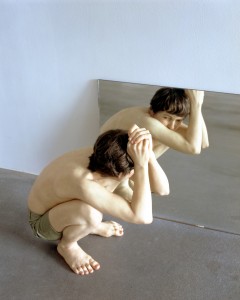
    Walking through, I landed on one piece in particular. It’s a hyper-realistic sculpture by an artist named Ron Mueck, and it’s called Crouching Boy in Mirror. That’s exactly what it is – the figure of a very small boy, crouching, perhaps in fear, in front of a mirror, down in a corner, staring into it so his image bounces back not just at him but also at the viewer/voyeur. It’s the kind of mirror that lines the walls of pretty much every dance studio in the land, but its effect is very different.

    When I was done with Disquieted I walked a few yards to the museum’s European galleries, because something was tickling me, something I wanted to check out.

    Stories. That was it. There were those familiar Luca Giordanos and Jean-Baptiste Greuzes and Michel Corneilles. They all told stories, except you didn’t know the stories’ arcs. Not quite stories, then. Moods. The essence of story, the elements, without the narrative facts. And after all this time of formalism, abstraction, the absence of content except for the form and materials of the artwork itself, here we were again: Art about something outside itself. Dramatic art. Art with stories, even if you weren’t quite sure what the stories meant. Connections. That’s what’s happening in the late 20th century and early 21st century art of Disquieted, too.

    So – very contemporary art, with very real connections to the art of the past. Does dance work like that, too?

    One more scatter.
    Last Thursday night my wife and I went to see BodyVox-2, the young second company of the Portland touring dance troupe BodyVox. It was a program of short pieces, pretty much all of which I’d seen before, and several of which I identify specifically with certain dancers in the main company: I know the pieces through the way these particular dancers move. Seeing them performed by other dancers made me concentrate more on the dances themselves, and to appreciate them as discrete aesthetic accomplishments with lives beyond the original sets of muscles that performed them. It made me appreciate in a new way the invention and sharp editing that created them. In other words: Even contemporary works have histories.

    Have we muddled this soup quite enough yet? Let’s add a little pepper and Tabasco and see if we can serve it up.

    Let me read you the beginning of a review from a year ago by Marcia B. Siegel, the very witty and incisive dance critic, writing in the Boston Phoenix:

    “Hubbard Street Dance Chicago’s Celebrity Series program at the Cutler Majestic last weekend could have been a primer of the ways not to dance ballet. All four dances sampled our taken-for-granted repertoire of everyday actions, gestures, and situations as a basis for movement. Working this way, the choreographer can develop the expertise and physicality of virtuoso ballet without the alienating effects of ‘technique.’ Hubbard Street dancers are terrific turners and jumpers and precision movers, and they also look friendly.”

    Aha. Now we’re getting somewhere.

    If I’m reading Siegel right, a couple of interesting things come out of this opening paragraph.

    First, the way Hubbard Street dances is not the way you approach ballet. This even though most contemporary dance companies around the world include ballet technique in their daily studio routines, and at least deconstructed versions of ballet are knitted into a lot of contemporary dances. A contemporary dancer is expected to be familiar with, if not expert at, ballet moves. It’s part of a flexible dancer’s repertoire.

    Second, Hubbard Street’s dances reflect the way we live: our “everyday actions, gestures and situations.” Unlike classical story ballet, it’s not mythic or fairy-tale. It’s an art of the people. Democratic.

    Third, the company’s dancers are nevertheless virtuosic, but not in an off-putting way. Unlike ballet, Siegel seems to argue, Hubbard Street’s contemporary approach puts no artificial barriers between itself and its small-D democratic audience. Instead they show us a more “natural” virtuosity.

    Which leads to, fourth, they’re friendly. We like ’em. They don’t make us feel like we don’t know the rules. They’re approachable. They speak our language. And when you speak the same language as your audience, you can say some things that are disquieting. Like, in the case of Naharin’s Tabula Rasa, which we’ll see tonight, maybe loneliness is a core element of modern life.

    Now, as audience members, I don’t believe we have to choose between the high artificiality of ballet and the low artificiality of contemporary dance. There are many things to admire in both, and the relationship between the two is closer than a lot of true believers on either side care to admit. Contemporary choreographers create dances all the time for so-called traditional ballet companies. You’ll see that cross-fertilization especially tonight, I think, in Jorma Elo’s dance Bitter Suite.

    Time for a backtrack. Ohad Naharin? Jorma Elo? Didn’t I say Hubbard Street seemed like an American dance company? Yes, I did. And I don’t think that’s a contradiction. The physical borders of countries matter less in the modern world than the borders of the mind. My wife and I were to have a visit from a Chinese professor a few days ago, and at the last minute the Chinese agency governing her visit abroad canceled her trip to Portland, which hadn’t been pre-approved. She was in another state, and her superiors decided she couldn’t leave it to take a side trip to Oregon. End of story. She was outside of China, but China was with her every step of the way.

    So, tonight we have a Finnish dancemaker, Elo, and an Israeli dancemaker, Naharin, and a Swedish dancemaker, Johan Inger, having their work set on a company of mostly American dancers whose new artistic director, Glenn Edgerton, comes to Chicago from running the Nederlands Dans Theatre, essentially switching jobs with Hubbard Street’s previous artistic director, Jim Vincent, who now holds the same post that Edgerton vacated in the Netherlands. Wow!

    This openness, this internationalism, IS American, I think. That is, it represents America at its least xenophobic and at its generous best – the place that welcomes the best ideas and the most innovative thinking, no matter where they come from.

    So. What will that innovative thinking look like tonight?

    Like so many contemporary companies, Hubbard Street keeps a core of balletic movement in its kit but stretches its movements into new patterns that are more calisthenic, kinetic, street-savvy. This is going to show up in Naharin’s piece, Tabula Rasa.

    The images in this dance can be very broad, as in a female dancer’s collapse to the stage as a male dancer walks away instead of catching and cradling her. Is that funny? Is it startling? Is it cruel? Is it, in Marcia Siegel’s words, part of “our taken-for-granted repertoire of everyday actions, gestures, and situations”? Is it just life?

    I almost wrote that Tabula Rasa is more about form and less about story. But that’s not it. It’s what we were talking about earlier, the guts of storytelling without the skeleton to give it narrative sense.

    Visually, this dance is a little like the smudging and softening that Impressionism brought to representational painting, or, in its more radical moments, like Cubism with its angular, barely recognizable evocations of the “real.”

    Of course, dance is always dealing with the human body as its medium, not with paint or clay, and so it can never break entirely free of realism, and it always retains an element of story, even if the story is non-narrative and open-ended. Every human being is a story, at least implicitly. So when we move these human-being stories in patterns, what does it mean? No longer “once upon a time.” But something.

    You’ll see a slow, sad swaying of these bodies, echoing up and down a line. Maybe once and again one body will stop swaying – will just stand still – and another will bump into it, then turn away. Like so much contemporary dance, this one seems partly “about” the difficulty of making connections, and about that point of extremity where trust and lack of trust meet and become quizzically the same. Can I trust you? Must I trust you? Will you catch me? Must you catch me?

    Once, speed was of the essence. Speed, and also spectacle. Think of dashing dances like Le Corsaire, or of Martha Graham’s visual feasts.

    The dances we’ll see tonight are more elemental, more stripped down, less concerned with dazzling you and more with drawing you into the often elongated stillness of the moment. It’s disquieting. It’s modern architecture. No gargoyles jutting out from its sleek sides. Or maybe the gargoyles are sunken into the steel. Surely there are elements in this evening’s dances of Tanztheatre, or dance theater, that theoretical outcropping of German Experessionism in which the visual and movement aspects of performance are fused to create a dramatic whole.

    Now. I said something about even contemporary dances having histories. Elo’s opening piece on tonight’s program, Bitter Suite, has history embedded, both the history of culture and the history of dance. It starts in a darkened group, with individual dancers peeling away from the clump. We’re in an exaggerated place, and the exaggerations elicit laughter, but it’s rarely easy laughter, the laughter of lightness and escape. These are nervous jokes, ironic jokes. It’s the sort of pit-in-the-stomach laughter that comes from realizing suddenly that you’ve been caught in an awkward position and you probably look, well, kind of stupid. Elements of court dance pop up amid fanfare music. Isn’t this a saucy dish to set before the king?

    This piece is in the netherworld between contemporary and ballet, and it seems to me to pulse with a sense of the past that is both celebratory and mournful. In a pas de deux you find something gangly and graceful, memories of myth and the matings of the faun. Here is a piece, stripped down as it is, that nevertheless retains the elegiac quality of classical romanticism. It makes me think of sleeping beauties and briar roses and Charles Perrault. In modern dress, of course, and somehow denuded. What if this dance were in fairy-tale costume instead of gym clothes? How different would it feel? Why is it stripped down? Without its pomp, can it stand on ceremony?

    From what I’ve seen on YouTube of Inger’s Walking Mad – and that’s all I’ve seen of it – this closing piece has the chance to be both intensely disquieting and spectacularly funny. First, it’s set to the narcotic metronome of Ravel’s Bolero, and if that doesn’t make you think automatically of Bo Derek, you’re either younger or older than I am. I’m not sure this music can be treated in any way but with affectionate travesty, and that appears to be what Inger offers it.

    Let’s return to that Marcia Siegel review and listen to some excerpts from her response to Walking Mad. It’s terrific writing, no matter what you think of her opinions:

    The dance, she writes, is “an expert example of Euro-Dada, with menacing moving scenery and lights, joky movement, important but dispensable clothing, spastic love, and the kitschiest music in the world, Ravel’s Bolero. The piece has the manic energy of Ohad Naharin’s Minus series and the misogyny of Tanztheater. All the women seem to be victims; all the men are anti-heroes.”

    She refers to “a jittery, pelvis-grinding chorus line wearing tiny red dunce caps.” She talks about a woman dancer – and this takes us back to the crouching boy staring in the mirror in Disquieted – who is “hunkering down in a corner between two walls.” Soon, Siegel continues, the woman is “beset by men barging in one after another and slinging her around, pinning her to the walls, in a nightmare of amorous entrapment.” And the walls, Siegel points out, literally accordion in to keep the woman in her corner.

    That’s disquieting. There’s a story here, a story without a skeleton. And that leaves it wide open to conjecture. Is it tragedy? Is it Theatre of Cruelty? Is it farce?

    So. Let’s take all these scattered thoughts and try to tie them together.

    One. Hubbard Street has street roots.

    Two. It’s open to a broad sweep of styles, inspired by everyday actions and everyday thoughts. It makes democratic art.

    Three. It offers second chances. It works in an art form in which you can start late, because technique, while essential, is less apparent than in ballet. We talked about performers starting late, but I think the point is even more important for audiences. You don’t have to be a lifelong ballet geek. You don’t have to bring to this dance your study, only your life.

    Four. Well, yes, that seems American.

    Five. Like contemporary art of all sorts, Hubbard Street’s work reflects contemporary life. And that life is nervous and unsettling.

    Six. Maybe it’s new, but this art rides on the shoulders of history. It can’t shake it off, and it doesn’t really want to.

    We live in a time when time itself is malleable, when it comes at us in folds and waves, when we are free to pick and choose from it, to make a collage of our art and our lives, using what we will of our collective and personal pasts to create our currencies and our futures. These dancers, these dancemakers, this company reflect that.

    It isn’t even postmodern anymore. It’s post-postmodern, because it’s no longer self-conscious. It just is. It’s the air we breathe. History, inhale. Future, exhale. And here we are, somewhere between.

    Shall we dance?
  • A disquieting day at the art museum

    Jaume Plensa, "In the Midst of Dreams," 2009. Courtesy of the artist and Galerie Lelong, New York

    Size matters. When a traveler in an antique land stumbles upon, let’s say, a sphinx towering from the sands of a desert, a part of the astonishment is the sheer scale of the thing. What impact would Richard Serra’s Tilted Arc have had if it had been three feet long and sitting serenely on a display table at the Museum of Modern Art?

    We’ve gotten used to monumental works, and some of the — what’s the best word: terror? — of the things has leeched out of our reactions. A giant typewriter eraser by Claes Oldenburg inspires other admirations (and, for a rising generation, a bit of head-scratching: what the heck’s a typewriter?), and as the Burj Khalifa pricks the sky 160 stories above Dubai, we think of our own iconic steel giants, the Empire State Building and the Chrysler Building, with warm, compact, nostalgic pleasure. Not the biggest of the big, we tell ourselves, but still the best of the big.

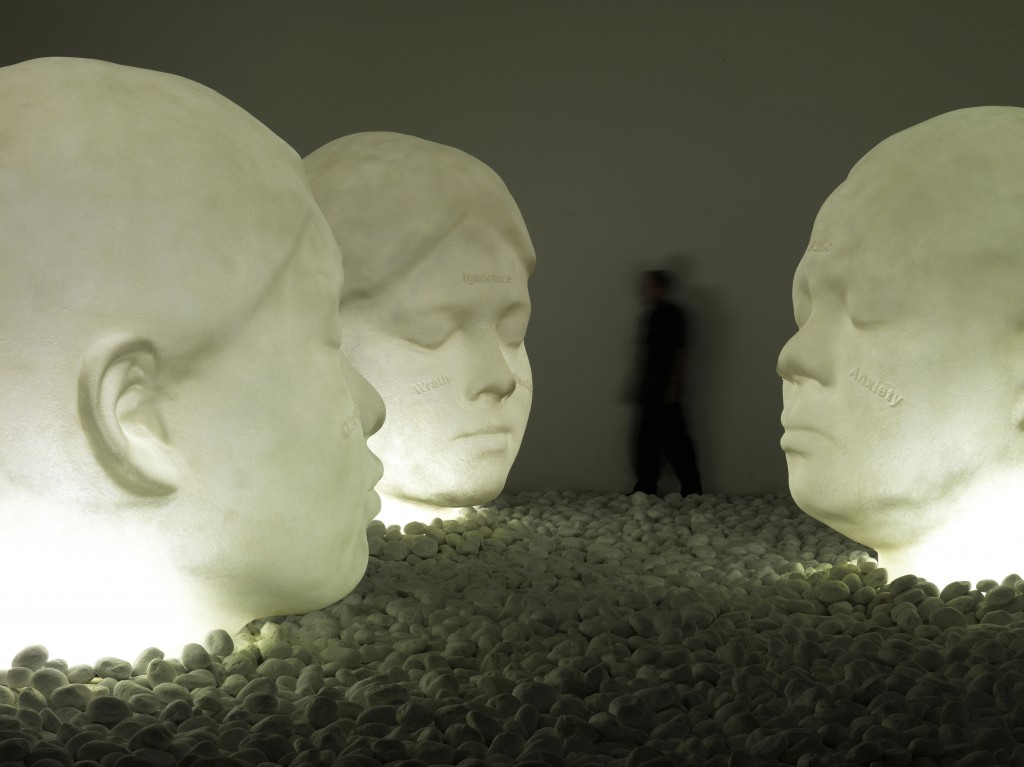
    Daniel Richter, "royit on sunsetstrip," 2008, oil on canvas, 88 x 67 x 1 inches. The Eugene Sadavoy Collection.Bigness and pleasure struck me the other day as I entered the rotunda of the Portland Art Museum and came face to face with Jaume Plensa’s massive 2009 sculpture In the Midst of Dreams. Make that face to face to face: Plensa’s lighted polyester piece, 35 feet long and 24 feet wide and more than 7 feet tall, consists of the large heads of three women “buried” on a bed of stones. It’s the first thing you see when you enter the museum’s new exhibit Disquieted, and I thought immediately, “This is the most fun this space has been in a long time.”
    Fun? At an exhibition that is built around what its curator, Bruce Guenther, calls “the things that wake us up at nights. … the things that make us mutter in the streets”?

    Well, yes. Those heads fit fantastically in the museum’s rotunda. And Friend of Scatter D.K. Row got it right, in his recent review for The Oregonian, when he wrote that despite its title, Disquieted is “an expression of the calming power of beauty and artistic feeling.”

    In other words: the impulse of these 38 works by 28 living artists is the fraught and fractured state of contemporary society. But what the artists produce, in many cases, is like a balm. If Guenther has an eye for the fault lines in society, he also has an eye for the skilled craftsmanship that can elevate dissent into aesthetic form. That creates an interesting rub. We’re unnerved, perhaps. We’re also entertained.

    Ron Mueck, "Crouching Boy in Mirror," 1999/2002. The Broad Art Foundation, Santa Monica.Not all of these works are big. Tanya Batura’s 10 x 17 x 10 inch sculpture Sourire en Bois, a 2007 bust of a reclining woman’s head splayed awkwardly on a flat plane, may be more genuinely disturbing than Plensa’s gargantuas, and Australian sculptor Ron Mueck’s two pieces — a tiny wall plaster of a baby looking downward like Christ on the cross; the hunkered, knotted Crouching Boy in Mirror — pack a genuinely disturbing wallop in small packages.
    A few pieces, such as Charles Ray’s 1992 sculpture Fall ‘91, an 8-foot-tall mannequin of a dominating woman in a power suit, seem already to have passed their time, although his 1990 Male Mannequin, with Brooks Brothers-perfect head and hairy genitals, still seems potent, maybe because we’re used to powerful women but still think of our privates as private: This piece could be a cooler, far less eroticized response to Courbet’s transgressive 1866 portrait of a woman’s genitalia, The Origin of the World.

    Some pieces veer toward the overtly political, without, in most cases, losing their aesthetic edge. German photographer Andreas Gursky, in two very large prints, creates entrapments of different kinds. One shows the massive cattle corrals sprawling across the plain in Greeley, Colorado: miles of animals waiting for slaughter. The other shows vast rows of workers in a textile sweat shop in Nha Trang, Vietnam. Without words, each conveys an unsettling message, and the message is double edged: (1) we treat other living beings like this; (2) the image itself is beautiful. Disquieting? You bet.

    Sanford Biggers, "Cheshire," 2008. Plexiglas, aluminum and LED lights; edition of three. Portland Art Museum.This wary tension between technique and topic — between the beauty and the beast — highlights a lot of the most intriguing pieces in the show. You can feel it in the raw energy of Glenn Ligon’s two paintings of lost battles in the African American community, Remember the Revolution #1 and In My Neighborhood #1, which use bright color and broken typographical lettering to suggest something powerful in ruins: “Remember the revolution? We lost. Motherfuckers kicked our ass in about six months. … What? Huh? What happened? Where Huey and Eldridge? …” In these paintings, engaged anger weds intense aesthetic focus.
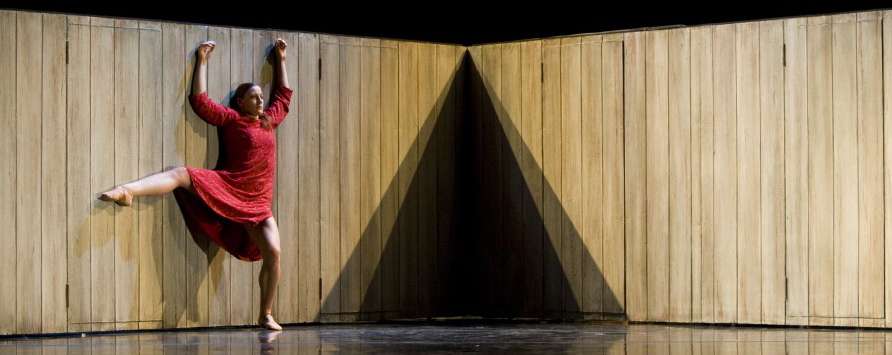
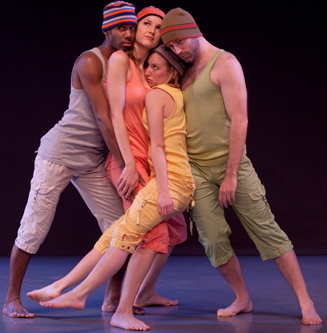
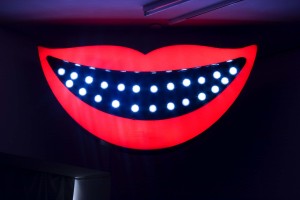
    A couple of other black artists take a more satiric route — Ellen Gallagher with 2004’s Deluxe, her wall-sized lineup of 60 manipulated prints sending up attitudes toward hair and other matters of self-image; and Sanford Biggers’ 2008 Cheshire, a shiny lighted pair of bright red blackface lips with watermelon-seed lips.

    A lot of other pieces speak to the more interior disturbances that Sigmund Freud laid to “civilization and its discontents” — the inevitable raw spots that come from the rub between the desire for independence and the fact that we are social animals. That might be the key to this place called Disquieted.

    Maybe none manages it as elegantly and painstakingly as video artist Bill Viola with his 2000 piece The Quintet of the Astonished, a feverishly slow-moving portrait of five figures moving from still life to gestures of agony or ecstasy. The process takes several minutes, and is both brutal and gorgeous: Think Kathe Kollwitz and George Segal putting on a Samuel Beckett play.

    Now, that’s disquieting.

    Su-en Wong, "Baby Pink Painting with Three Girls," 2000. Acrylic and colored pencil on linen; 108 x 76 inches. Portland Art Museum, gift of the artist.


    PICTURED, from top:

    Jaume Plensa, “In the Midst of Dreams,” 2009. Courtesy of the artist and Galerie Lelong, New York

    Daniel Richter, “royit on sunsetstrip,” 2008, oil on canvas, 88 x 67 x 1 inches. The Eugene Sadovoy Collection.

    Ron Mueck, “Crouching Boy in Mirror,” 1999/2002. The Broad Art Foundation, Santa Monica.

    Su-en Wong, “Baby Pink Painting with Three Girls,” 2000. Acrylic and colored pencil on linen; 108 x 76 inches. Portland Art Museum, gift of the artist.

  • Mr. Scatter speaks. In front of a crowd.

    Hubbard Street Dance Chicago, Johan Inger's "Walking Mad." Photo: Tom Rosenberg

    Today Mr. Scatter is putting the finishing touches on a little talk he’ll be giving Tuesday evening before Hubbard Street Dance Chicago’s performance at the Arlene Schnitzer Concert Hall.

    His charge from White Bird, the dance presenting folks, is simple. Speak for 20 minutes, try to say something interesting about the performance coming up, don’t put the audience to sleep.

    Mr. Scatter will do his best. Yes, scattering will be involved. Mr. Scatter suspects it might even be sort of fun. For the audience, too. On the program Tuesday night: Jorma Elo’s Bitter Suite, Ohad Naharin’s Tabula Rasa, Johan Inger’s Walking Mad.

    The talk, part of the White Bird Words series, will be downstairs at the Schnitz. It starts at 6:45, giving everyone ample time to settle into their seats upstairs before the 7:30 curtain. The talk is free, but you need a ticket to the performance to get in. After all, much as Mr. Scatter might suffer from occasional delusions of grandeur, the performance is the main attraction.

    PICTURED: Johan Inger’s “Walking Mad.” Photo: Tom Rosenberg

  • BodyVox-2 does the bunny hop

    BodyVox-2, in "Usual Suspects." Photo: Blaine Truitt Covert

    Mr. and Mrs. Scatter headed for BodyVox, the Portland touring dance and performance company, the other night for the public debut of BodyVox-2, the next generation.

    BodyVox is a veteran company, filled with performers who have long and deep experience in ballet companies and with such performance troupes as Pilobolus and Momix. They carry their performances with the sureness and muscle memory of artists who have been living with this material for a long time, and, in many cases, who have had pieces created specifically for them and their bodies.

    NodyVox-2, "Hopper's Dinner." Photo: Blaine Truitt CovertSo it’s something of a revelation to see some of these works performed by other bodies. Thursday’s performance included 10 short dances, plus a couple of Mitchell Rose’s terrific short comic films — a smorgasbord of BodyVox hits. Seeing fresh bodies perform them wasn’t just about getting to know a new crop of good dancers in town. It was also about rethinking these works as pieces of choreography that both define the BodyVox style and stand on their own as discrete works of art that have entered the contemporary-dance repertoire.

    These are good dancers, all of whom come to the company with significant training and who now get the opportunity to learn the BodyVox style and absorb some of the knowledge of Jamey Hampton, Ashley Roland, Daniel Kirk, Eric Skinner and other main-company stalwarts. BodyVox vet Zachary Carroll directs the second company, which already has done a little regional touring and several school shows, and he’s done a good job: If things aren’t always quite as crisp as with the main company, this is a highly promising, athletic, nimble young professional ensemble.

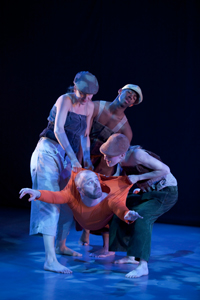
    The troupe of Jeff George, Kara Girod, Melissa Kanavel, Jonathan Krebs and Josh Murry works well together, especially on such ensemble-oriented pieces as Usual Suspects (top photo), the rollicking Hopper’s Dinner, and the nose-wiggling frolic that is The Bunny (inset photo). Despite their loose-as-a-goose moods, these aren’t easy pieces to perform, and BodyVox-2 pulls them off with a nice combination of recklessness and polish.

    The growth of BodyVox-2 means a couple of things. First, BodyVox has become an institution, known for a specific style that can be replicated and performed by multiple casts. That’s a big step in the arts-touring game. Second, it’s a bet on the future, a way to prepare for passing things along. BodyVox isn’t just a group of performers who work together any more. It’s a body of work. And BodyVox-2 makes it much more likely that, come that inevitable day when artistic leaders Hampton and Roland and other veterans retire as performers, BodyVox will continue to grow and thrive. You could call this a legacy moment.

    BodyVox-2 has two final performances, at 2 and 7:30 p.m. today, at BodyVox Dance Center, 1201 N.W. 17th Ave., Portland.

    PHOTOS: Blaine Truitt Covert

  • Art to enjoy with Chianti, whipped cream and watermelon

    One of Art Scatter’s favorite virtual destinations, artdaily.org, is full of all sorts of fun stuff today. For instance, researchers have determined that Tut, the boy king of ancient Egypt, likely died of malaria when he was 19, way back around 1324 B.C. The scientists came to this conclusion after undertaking genetic and radiological testing on the lad’s remains, thus landing a blow to conspiracy theories suggesting murder most foul. (Is there any other kind?)

    In other celebrity culture news, Art Daily fills us in on a couple of new visual art exhibitions from artists better known for baking other slices of the cultural pie.

    Painting by actor Anthony Hopkins, on view in London and EdinburghThe superb actor Anthony Hopkins is showing a few of his paintings at London’s Gallery 27 through Saturday, then at The Dome in Edinburgh, March 2-6.

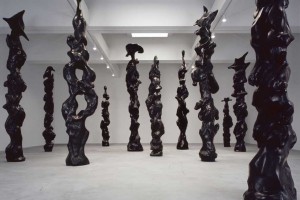
    Herb Alpert, "BVlack Totems," 2005-09, courtesy Ace Gallery, Beverly HillsAnd trumpeter Herb Albert has a show through May 25 at the Ace Gallery in Beverly Hills of big bronze totems, all in black, and up to 18 feet tall. He’s been doing these for 20 years.
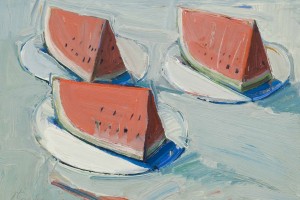
    Wayne Thiebaud, "Watermelon Slices," 1961. Oil on canvas. Private collection. Copyright Wayne Thiebaud/License by VAGA, New York, N.Y.Maybe you link Alpert and art with that famous Whipped Cream album cover from 1965. Dessert is more commonly the subject of Wayne Thiebaud, the California artist, who has a new retrospective, Wayne Thiebaud: 70 Years of Painting, on view through July 4 at the San Jose Museum of Art. Best-known for his effervescent donuts and cakes and the like, he branches out to other edibles (and even non-edibles), too, such as this 1961 painting of watermelon slices.
    Alpert’s big bronzes are inspired by the great totems of the Tlingit and other nations who live along the north Pacific coast ranging from present-day Washington state to Alaska.

    Thiebaud’s retrospective caught my eye partly because of his connection to another California artist, Beth Van Hoesen, whose most complete collection of prints is in the Vivian and Gordon Gilkey Center for Graphic Arts at the Portland Art Museum. Thiebaud was one of a group of important California artists who for many years held weekly drawing sessions at the old San Francisco firehouse that was home and studio to Van Hoesen and her artist husband, Mark Adams. And I’ve lately been working on an essay about Van Hoesen’s art.

    I have a small personal interest in Sir Anthony’s art, too. I remember interviewing him back in 1978 or ‘79, on the release of his none too fascinating movie Magic, and he was at a low point personally: exhausted, doubting himself, wondering whether it wasn’t time to chuck it all in and try something else. Of course, it was a lull, and the best was yet to come, even if “the best” included, as Hannibal Lecter, playing a fellow who dined on Chianti and human flesh.

    “When I paint,” he says of his artwork, “I just paint freely without anxiety regarding outside opinions as criticisms. I do it for sheer pleasure. It’s done wonders for my subconscious…I dream now in colors.”

    Including, I imagine, a rich dark red. Cheers!

    *

    PICTURED, from top:

    A landscape painting by actor Anthony Hopkins.

    Herb Alpert, “Black Totems,” 2005-09. Courtesy Ace Gallery, Beverly Hills.

    Wayne Thiebaud, “Watermelon Slices,” 1961. Oil on canvas. Private Collection. Copyright Wayne Thiebaud/Licensed by VAGA, New York, N.Y.

  • Mr. Scatter shares the wealth

    Mr. Scatter has been a writing fool lately, and not all of it for the virtual pages of this illustrious blog.

    Louis Untermeyer, laureate lionine. Wikimedia Commons.He has also composed essays that resulted in actual financial recompense, including a trio of pieces for that fine and noble stalwart of legacy media, The Oregonian.
    This piece, about Oregon’s search for a new poet laureate, analyzes the situation and reveals the two most important qualifications: a cool name and cool hair. In the old days it also helped if you could rhyme on a dime, but that is less important in our times of free and cut-rate verse. Mr. Scatter is given to understand that sometimes poems don’t rhyme at all!

    Colley Cibber: Bad poetry, great hair. Wikimedia Commons.Mr. Scatter is, in fact, in favor of this position and its title, and he admires Oregon’s retiring laureate, Lawson Fusao Inada, in whose hands the post has been not simply ceremonial but also active and engaged: He has taken poetry and learning to the far corners of the state, in situations ordinary and unusual, and persuasively held that language matters.
    Today, by the way, is the final day to nominate someone to be Oregon’s next laureate. Find out how here.

    This morning’s Oregonian features this story about the artist Joe Feddersen, whose most recent museum exhibition, Vital Signs, is at the Hallie Ford Museum of Art in Salem.

    Joe Feddersen. Photo: Mary RandlettIt’s a fine show, worth the trip. And speaking of trips, Mr. Scatter pauses for what might seem a brief diversion but in fact is not.
    Mrs. Scatter ceaselessly admonishes Mr. Scatter that he should join a social network club called Facebook. Mr. PAW goes a step further, proclaiming loudly that Mr. Scatter must Tweet.

    In fact, Mr. Scatter has trouble with the 200-odd emails that jam his computer daily, and does not fully understand his so-called “smart” telephone. So please drop in on this reconstruction of the interview portion of How Mr. Scatter Got That Story:

    Ring ring!

    “Hi, this is Joe Fe (squawk buzz) in the car (buzz) talk?”

    Disconnect. Pause. Ring ring!

    Joe Feddersen, woven basket, "High Voltage"“Sorr (buzz squawk) bad connect (squawk buzz) driving from Omak to Olym (buzz) call back?”
    Mr. Scatter hits “redial.” A pickup. A squawk.

    “I’m sorry. I can’t hear a thing. Joe, if you can hear this, it isn’t working. Why don’t we try in the morning when you’re closer to Portland?”

    No reply. Long pause. On to other matters. Then: Ring ring!

    “Hi, Bob? This is Joe. Can you hear me OK?”

    “Perfectly, man. What’d you do?”

    “Well, we’re staying overnight in Olympia, and I’m in our motel room. It’s a really bad area for cell connections, so I figured, I’ll just use the phone in the room. Old-fashioned technology, you know? Sometimes it works best.”

    This time, it did.

    Finally, Mr. Scatter reviewed Bag & Baggage Productions‘ experiment in theatrical sexual politics, a squeezing-together of slimmed-down versions of Shakespeare’s comedy The Taming of the Shrew and John Fletcher’s response to it, The Woman’s Prize, or The Tamer Tamed. A brief version is in this morning’s print edition of The Oregonian; you can read the longer online version here.

    Gary Strong as Petronius and Jacob Morehead as Petruchio. Photo: Casey CampbellBag & Baggage performs in downtown Hillsboro, the center of what used to be farm country but has become one of the state’s fastest-growing urban sprawls. This isn’t entirely bad: People need places to live, and they need the jobs the high-tech industry has grown where crops once sprouted. Still, as he was driving Mr. Scatter couldn’t help wondering whether there isn’t some way for the loosely termed “designers” of overblown strip malls and brand-name boxes to be stripped of their architecture degrees, or maybe disrobed by the AIA. Is there not a better way to do this suburban expansion thing?

    Venetian Theatre and balcony from the outside.Bag & Baggage’s shows are performed in the historic Venetian Theatre, a sweet small former vaudeville house that seats about 400 and also includes a bar and bistro that were hopping on Saturday night. Lots of towns have these old small opera houses, vaudeville houses, silent movie houses, and more often than not they’re either run down or they’ve become something entirely different. It’s good to see one that’s still doing well offering a variation on what it was originally designed to do.
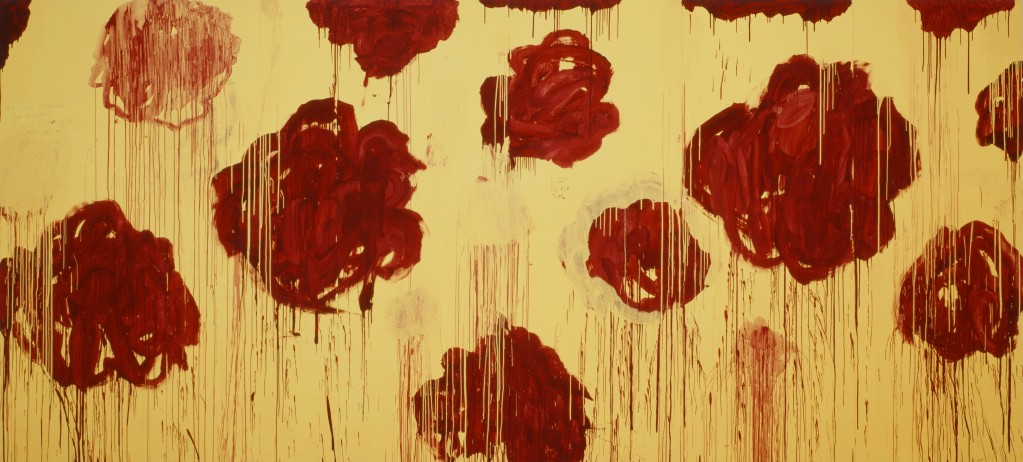
    Like a lot of old downtowns where the business energy has moved to the strip-streets outside of town, old Hillsboro has too many vacant storefronts. Will it ever regain its vitality, or find a vigorous new purpose? The Venetian suggests that at least there’s hope. A lot of sweet small towns are hiding among the American sprawl, just waiting to be reclaimed.

    *
    PICTURED, from top:

    Louis Untermeyer: poet laureate with a pince-nez.

    Colley Cibber: poems that could curl your hair.

    Artist Joe Feddersen at ease. Photo: Mary Randlett

    Woven basket, Joe Feddersen, “High Voltage”

    Gary Strong as Petronius and Jacob Morehead as Petruchio for Bag & Baggage Productions. Photo: Casey Campbell

    Exterior and balcony of Venetian Theatre in Hillsboro.

  • Happy Valentine’s Day. It’s an art.

    Cy Twombly, Untitled, 2007, from Blooming, A Scattering of Blossoms & Other Things, Acrylic on panel, The Broad Art Foundation, Santa Monica. © Cy Twombly. Courtesy Gagosian Gallery

    Ah, the red. Ah, the passion. Ah, the flowers.

    Like love itself, Saint Valentine, as it turns out, is something of a mystery. Way back when, in ancient Rome, several martyred saints were named Valentine, or Valentinus. And whichever individual or composite of them emerged to eventually become the Saint Valentine seems always to have been floating in the realm of myth. One early writer, Jacobus de Voragine, refers to the saint in his book Legenda Aurea as a fellow who was beheaded because he wouldn’t deny Christ in front of Emperor Claudius — in the year 280, almost a thousand years before Voragine’s book became a sensation of the High Middle Ages. This Valentine is revered for having restored the sight and hearing to his jailer’s daughter before getting his head lopped off.

    Michele Rainier, "Anatomically Exaggerated Sock Monkeys," Beet Gallery, PortlandHow did Valentine become linked with chubby cherubs and love arrows, let alone chocolate and Champagne?
    Again, no one’s quite sure, least of all Mr. Scatter, even after long and laborious research of, well, several minutes in an obscure repository of arcane information called Wikipedia. The Nuremberg Chronicle of 1493, referring to possibly the same Valentinus as Voragine, suggests he was beheaded because he’d been caught marrying Christian couples at a time when Claudius II was busy persecuting pretty much any Christian his soldiers ran across. The act of marrying people, of bringing lovers together, might be the seed of the legend. Others suggest that the sentiment of the tradition was pretty much invented by Geoffrey Chaucer and his crowd in the process of mythologizing chivalry and medieval romance, and others yet argue that what Claudius and Chaucer might have begun, those frisky Victorians grabbed by the lacy undergarments and made wholly their own. Exactly when FTD and the nursery industry of America entered the picture is not fully explained.

    Xiaoze Xie, Library of Congress (Music Division M1060)  , 2009 oil on canvas 24" x 42" , Elizabeth Leach Gallery, PortlandHow we got here is a puzzle, and yet, here we are, at the Valentine’s Day of modern times, with all of its traditions, temptations and demands. Not, all in all, a bad place to be, unless like a dope you forget all about it and schedule a poker game with the boys instead.
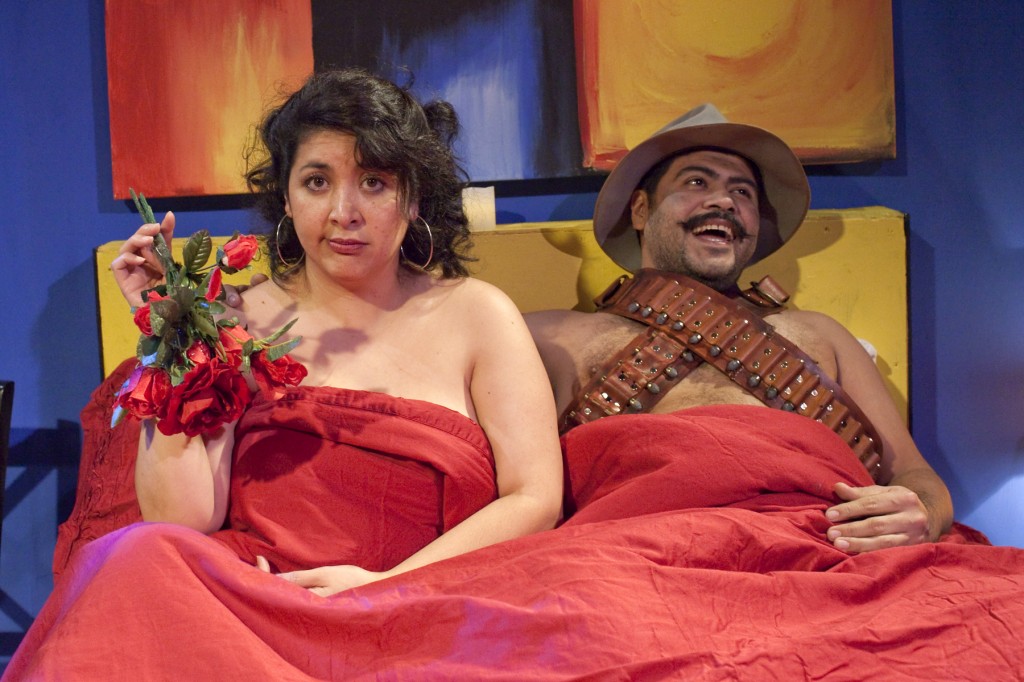
    To help you celebrate, we here at Art Scatter World Headquarters are offering a quick virtual tour of some of Portland’s museums and galleries with an eye for artworks that resonate with the holiday. We’ve also thrown in a guest artwork, not available for viewing in the flesh. Details are below.

    As our waitron says, Enjoy. And have a lovely day.

    Jacopo Bassano, "Saint Valentine Baptizing Saint Lucilla," 1500s. Wikimedia Commons.

    ILLUSTRATIONS, from top:

    • Cy Twombly, Untitled, 2007, from Blooming, A Scattering of Blossoms & Other Things, Acrylic on panel, The Broad Art Foundation, Santa Monica. © Cy Twombly. Courtesy Gagosian Gallery. It’s part of a small but significant showing of recent works by the legendary contemporary painter on view through May 16 at the Portland Art Museum.
    • Michele Rainier, “Anatomically Exaggerated Sock Monkeys.” It’s part of a group show, “Erotica — Be My (Naughty) Valentine,” at Beet Gallery, Portland, through Feb. 27.
    • Xiaoze Xie, “Library of Congress (Music Division M1060),” 2009 oil on canvas 24″ x 42″. This passion of the book is part of the group show “Re-Present,” at Elizabeth Leach Gallery, Portland, through March 27.
    • Jacopo Bassano, “Saint Valentine Baptizing Saint Lucilla,” 1500s. Wikimedia Commons. Note the chubby winged babes bestowing their approval. This one’s not in Portland, folks.
  • Gentlemen, do the right thing

    Nurys Herrera and Vicente Guzmán-Orozco; photo by Russell Young

    Tomorrow is St. Valentine’s Day. This is an important occasion, and not one to be taken lightly — or, horror of horrors, forgotten — unless you enjoy being a thirty-five-year-old bachelor living in your parents’ basement and spending all your free time playing online Dungeons & Dragons.

    Pancho Villa did not waste his time like that. Pancho Villa did not spend his Valentine’s nights alone. Pancho Villa was a man, and he knew how to treat his significant other of the moment.

    This may or may not be at the heart of Sabina Berman’s comedy Entre Villa y una Mujer Desnud (Between Pancho Villa and a Naked Woman), which opened last night at Milagro Theatre. The play’s performed in Spanish, with English subtitles, and although we haven’t seen it yet, as Milagro describes it, it sounds fetching:

    Gina wants more out of her casual relationship with Adrian, a liberal intellectual who’s in it only for some good sex. Adrian shies away from any form of commitment — that is, until Gina takes up with a younger, more sensitive lover. That’s when the spirit of Mexico’s most famous revolutionary rides again, appearing as Adrian’s macho conscience ready to do anything to win this battle of the sexes.

    This evening Mr. and Mrs. Scatter will hie themselves out to Hillsboro for the opening of Bag & Baggage Theatre’s own contribution to the battle of the sexes: a scrunching-together of Shakespeare’s comedy The Taming of the Shrew and John Fletcher’s Jacobean response to it, The Woman’s Prize, or The Tamer Tamed, in which Kate comes out on top. Do tell!

    We might have gone to Third Rail Rep’s new revival of David Mamet’s American Buffalo, which looks like it could be a memorable production, but not this weekend. It’s about three loser guys trying to pull off a scam from a junk shop. What’s the percentage in that? If they couldn’t score a date, they should have just settled in for a round of Dungeons & Dragons.

    Don’t let that happen to you, D&D boys. A last-minute tip: Flowers are always good. Chocolates, too. At Chez Scatter, we’re planning oysters and sparkling wine. We might be leaving our bandolier and hat on the hitching post, though.

    *

    PICTURED: Nurys Herrera and Vicente Guzmán-Orozco in “Entre Villa y una Mujer Desnud.” Photo by Russell Young.

  • A Snopes by any other name

    My paternal grandmother’s name was Lizzie Lou Willingham. Not Elizabeth Louise. Lizzie Lou.

    Lizzie Lou married Virgil Homer Hicks, a man whose naming signaled a certain familial aspiration. One of their offspring, my father, is named Irby Hicks. No middle name, and a first name that was a family surname. (Another of their children, my father’s sister, was named Zollie.)

    William Faulkner in 1954. Photo: Carl Van Vechten. Wikimedia CommonsThe Willinghams and Irbys and Hickses came from South Carolina and Georgia, places where a naming was a serious and sometimes flowery business. On Long Island and in the Hudson River Valley, where my mother’s side of the family had their roots, the names were historical and solid — Baldwin, Seaman — but without that peculiarly Southern sense that a naming is an almost mystical occasion, an assigning of an intensely personal yet communally meaningful identification for life. My mother’s maiden name is Charlotte Louise Baldwin, and it’s lovely. But it seems somehow less thethered, less essential to her personality or her family’s historical lot in life.
    I bring this up because of Patricia Cohen’s report in the Thursday New York Times on the fresh linking of an old farm ledger to many of the names that William Faulkner used in his novels, and in 1942’s Go Down, Moses in particular. The ledger was kept in the mid-1800s by Francis Terry Leak, a Mississippi plantation owner whose great-grandson was a childhood and adult friend of Faulkner.

    In it were the names of many of the plantation’s slaves, and the reading of them both angered Faulkner and excited his imagination. Cohen describes Edgar Wiggin Francisco III, the son of Faulkner’s friend, watching the great writer as he was going through the pages of the diary and “hearing Faulkner rant as he read Leak’s pro-slavery and pro-Confederacy views”:

    Faulkner became very angry. He would curse the man and take notes and curse the man and take more notes.

    That’s a potent vignette, and it speaks to why Faulkner still matters very much. He used many of the slave names from the journal and assigned them to white characters in his books, as he had taken a Native American name and given it to his famous fictional stomping grounds, Yoknapatawpha County. These were not, I think, so much acts of expiation or appropriation as of remembrance, and of the novelist’s determination to describe not only who “won” the battle for the South’s soul, but also the sins and brutalities that went into the waging of a confrontation in which all races and classes were engaged, and from which a great sadness fell not equally yet fully across the land. Don’t forget, Faulkner told his readers. Don’t mythologize, don’t blame others, and never forget.

    That is starkly different from the attitude of another Southern writer, H.L. Mencken of Baltimore, who in his fascinating if sometimes fiercely outdated collection The American Language took many race-baiting cheap shots at the names that African American parents gave their children, citing them as examples of black Americans’ lack of education and common sense. (He seems utterly to have missed the playfulness, the sense of separate cultural identification, and the poetry in many of those names.) And that is evidence of why Mencken, once a household name, matters less and less.

    Other writers have made great use of character naming, from Shakespeare’s Sir Toby Belch to Sheridan’s Mrs. Malaprop to Dickens’ Thomas Gradgrind. But Faulkner created one of my all-time favorite character names: Flem Snopes.

    Flem was the anti-hero of three novels, The Hamlet, The Town, and The Mansion, that traced the rising tide of the Snopes family fortunes from horse thieves and tenant farmers to Flem’s establishment as president of the town bank and occupant of its grandest house.

    Flem accomplished this by having a soul the size and consistency of something stuck in your throat: He was, in his essence, Phlegm. A cheater, a calculator, a man small and hard and avaricious. A man who married a young woman pregnant by another man because she came from a family that would be useful in his rise to the top. A man you’d like to just spit out and forget, except he sticks there, and sticks there, and sticks there, and so you can’t.

    Flem Snopes. Now, there’s a name. Would a Snopes by any other name be so sour?

  • Singing for Haiti: a Portland benefit

    Seems like every time something cataclysmic happens, artists show up to help out. Like a lot of other people they know they can’t do much, but they also know they can do something. And often, because this is what they do best, they put on a show.

    A painting by Leslie Ann Butler will be used as cover art for the benefit CD "Portland Sings for Haiti."Especially when you’re talking about the local artists who are the heart and soul of any city’s arts scene, that often means that people who barely have two dimes to rub together are among the ones who jump in and get something done. They raise awareness (pardon Mr. Scatter for employing that overused phrase) and they raise money. I’m not sure why performing artists and restaurant people so often take the lead on this sort of thing, but maybe it’s because both work in businesses where they become acutely aware that nothing gets done right unless everyone works together.

    The Oregonian’s Marty Hughley has announced one such benefit project, a benefit CD called Portland Sings for Haiti. Marty’s story is interesting, especially in relating how actor Patty Price-Yates got the thing rolling from her own sickbed, so click on the link. The CD, which features cuts by such leading lights as Storm Large, Susannah Mars, Julianne Johnson and Isaac Lamb, will be available Feb. 22, and you can pre-order at cd baby. The money will go to Mercy Corps for its efforts to help Haiti dig out from the rubble of its massive earthquakes.

    Singer-actor Corey Brunish, a participant and one of the project’s organizers, reminds me that you can get a sneak peek (or an early ear) at the music starting at 7 tomorrow night, Thursday the 11th, at Wilf’s. Several of the CD’s musicians will be on hand for a cabaret-style show, and it’s a two-fer benefit. Proceeds from the $20 admission will benefit the musical-theater company Stumptown Stages. Plus, you can be one of the first people to buy the CD, and that money goes to Mercy Corps.

    Sounds like a good night out.

    *

    ILLUSTRATION: This painting by Leslie Ann Butler is cover art for the benefit CD “Portland Sings for Haiti.”

  • My fellow Scatterers: the state of the blog

    English: Lithograph by Edward W. Clay. Praises Andrew Jackson for his destroying the Second Bank of the United States with his "Removal Notice" (removal of federal deposits). Nicolas Biddle portrayed as The Devil, along with several speculators and hirelings, flee as the bank collapses while Jackson's supporters cheer.

    On this very day two years ago — on February 8, 2008 — a fine strapping lad was loosed upon the world, and immediately started yawping. Yes, its name was Art Scatter, and it was born right here in river city: in Puddletown, Oregon, brave bubble of liberality, Do It Yourself center of the universe, fearless exposer of itself to art, curious keeper of the weird.

    Call us sentimental, but we’ve been thinking a lot about our friend Art, this thing we call a blog. For one thing, why is it still here?

    A lot of blogs burn bright for a while and then flame out. Many are simply places to vent steam, or casual public diaries, or vanity projects. Well, almost all, including this one, are the latter at least to a certain degree. After all, nobody’s making any money out of this thing.

    English: Father Time and Baby New Year from Frolic & Fun, 1897Art Scatter has changed a lot over its two years. It was the brainchild of Barry Johnson, my friend and longtime arts section compatriot at The Oregonian, who was looking for a way to explore new approaches to journalism outside of the print world. Barry brought me and his friend Vernon Peterson, a lawyer and talented literary critic, into the project, which was planned to be not too taxing on anyone because there would be three people to fill the virtual space.

    Life moved on, and both Barry and Vernon departed for other projects. That left me wondering what to do with the thing, and wondering, sometimes, whether I was letting it eat up far too much of my time. In a very real sense my wife, Laura Grimes, saved the blog when she began to post her own witty and moving observations, eventually under the nom de plume of Mrs. Scatter. How could I not keep Art Scatter going? I was fascinated by how Mrs. Scatter’s adventures were going to turn out. Besides, she injected a bracing shot of humor into the blog, the humor that I have known and loved for more than twenty years.

    Martha Ullman West, the noted dance critic who had written a couple of pieces for us, began to contribute more, and that added to the conversation. But I realized that if the thing was going to keep going, it was going to be largely up to me.

    So. Why was I doing this?

    • First, writing’s a habit. I do it reflexively, if not always reflectively. Just can’t seem to help myself.
    • Second, it’s fun.
    • Third, it allows me scope to write about a lot of things in a lot of ways that were rarely possible during my years in daily journalism.
    • Fourth, it keeps me connected to my community and allows me to have a voice in a few things that go on in this little corner of the world. Good lord, I’ve made friends through this thing!
    • Fifth, it helps me discover my post-newspaper writing voice. I can feel that voice waking up inside me, gradually realizing that it’s no longer bound by the newspaper straitjacket unless it chooses to be. I can hear it trying out new things, even whooping it up now and again. Good for you, voice. Let ‘er rip.

    Slowly, mostly accidentally, the blog has developed its own personality. The characters of Mr. and Mrs. Scatter just sort of announced themselves. The Large Smelly Boys pushed their way into the mix. OED, the Older Educated Daughter, made brief visits. We talked about word games and secret societies and oysters on the half-shell. The League of Tough-Guy Arts Observers had its brief day in the sunshine and then wandered off to sleep in a cave: perhaps it’ll wake up and elbow back into the action again. We found we were able to be serious, and flip, and amused, and reflective, and serious and amused again, and somehow get away with it. We began to take a very broad view of just what the word “culture” means.

    I’m sure Art Scatter will continue to evolve. It’s already changed in surprising and often delightful ways. It’s opened doors. I know people will drop in and out. Mrs. Scatter’s day job has been busy lately, and I’ve been missing her brilliant reports. (I’m sure you have, too.) Can’t wait for them to return.

    And I’ve become convinced of one thing: The blog has to work with my writing career, not against it. I love the freedom and scope that Art Scatter gives me, and I love that it lets me try things out with a regular and forgiving readership. But I also need to make a living, and I do that by writing. This is not a hobby. It’s what I do. So if Art Scatter is my professional exploratory laboratory (and also the locus of a great deal of my pro bono work) I want it to look professional.

    Which brings us to Modern, the new design theme that we’ve adopted, yes, today. And which wraps up this semi-impromptu State of the Blog address. Thank you, my fellow Scatterers. Good night, and God bless.

    *

    Illustrations, from top:

    • Not Mr. Scatter delivering his State of the Blog address. Edward W. Clay’s lithograph celebrates President Andrew Jackson’s destruction of the Second Bank of the United States with his “Removal Notice” (removal of federal deposits). Well done, Andy! Wikimedia Commons.
    • Not Baby Art Scatter. Father Time and Baby New Year from Frolic & Fun, 1897. Wikimedia Commons.