Author: Brad Evans

  • Bracket Big Board: Cougars dance, break young male hearts

    The Bracket Big Board takes into consideration past returns,
    current performance and expected future gains in determining who should
    be included among the field of 65 (31 automatic and 34 at-large bids).
    Essentially, the Bracket Big Board is a cheat sheet designed for
    amateur bracketologists if they were filling out a Tourney Pick ‘Em ’10
    (SIGN UP NOW!!!)
    entry today.

    *Updated Sunday at 2:48 PM CST


    *For games played through Sunday, March 14
    *RPI data provided
    by Rivals
    *Efficiency
    stats from kenpom.com

    On
    the Bubble:
    Virginia Tech (23-8), Florida (21-12), Mississippi St. (23-11)

    Dropped
    Out:
    Virginia Tech

    Conference

    Breakdown: American
    East
    (1), ACC (6), Atlantic Sun (1), Atlantic 10 (3), Big 12 (7), Big
    East (8), Big Sky (1), Big South (1), Big Ten (6), Big West (1),
    Colonial (1), Conference USA (2), Horizon (1), Ivy (1), Metro (1),
    Mid-American (1), Mid-Eastern (1), Missouri Valley (1), Mountain West
    (4), Northeast (1), Ohio Valley (1), Pac-10 (2), Patriot (1), SEC (3),
    Southern (1), Southland (1), SWAC (1), Summit (1), Sun Belt (1), West
    Coast (2), WAC
    (2)

    Image courtesy of Getty

  • Bracket Big Board: Racin’ to Selection Sunday

    The Bracket Big Board takes into consideration past returns,
    current performance and expected future gains in determining who should
    be included among the field of 65 (31 automatic and 34 at-large bids).
    Essentially, the Bracket Big Board is a cheat sheet designed for
    amateur bracketologists if they were filling out a Tourney Pick ‘Em ’10
    (SIGN UP NOW!!!)
    entry today. The Bracket Big Board is updated every Monday until the
    dance card is officially unveiled March 14.


    With joyful conference tourney victors strutting their way into the Big Dance, the Triple-B enters warp speed mode. No Oscar dismayed Na’vi need apply. However, laser-toting Wookiees are always welcome. (Insert yowl)


    *For games played through Sunday, February 28
    *RPI data provided
    by Rivals
    *Efficiency
    stats from kenpom.com

    On
    the Bubble:
    Memphis (23-8), Arizona St (22-9), South Florida (19-11), Mississippi St (21-10), Rhode Island (21-8)

    Dropped
    Out:
    Connecticut, Rhode Island, UAB, Mississippi St, Coastal Carolina, Stony Brook, Campbell

    Conference

    Breakdown: American
    East
    (1), ACC (7), Atlantic Sun (1), Atlantic 10 (3), Big 12 (7), Big
    East (8), Big Sky (1), Big South (1), Big Ten (5), Big West (1),
    Colonial (1), Conference USA (1), Horizon (1), Ivy (1), Metro (1),
    Mid-American (1), Mid-Eastern (1), Missouri Valley (1), Mountain West
    (4), Northeast (1), Ohio Valley (1), Pac-10 (2), Patriot (1), SEC (4),
    Southern (1), Southland (1), SWAC (1), Summit (1), Sun Belt (1), West
    Coast (2), WAC
    (1)

    Image courtesy of US Presswire

  • Spin Doctors: Nelson Cruz vs. Jason Bay

    Navigating the outfield is a critical part of fantasy success – you’ll need 4-5 of them in most leagues, perhaps more – and with that in mind, we’ve decided to throw down over a couple of big ticket items today. When it comes to that second outfield prong, are you doing a Texas Two Step, or in a New York state of mind? Brad Evans and Scott Pianowski are here to debate to the death, in around 250 words each.

    Noise to Open: To the cursory analyst, a Bay/Cruz comparison is ridiculously lopsided. Many would claim Halle Berry versus Mo’Nique is a tighter race. But scrutinizing the stats reveals an advantage for the Rangers slugger.

    Prior to being derailed by an ankle injury last August, Cruz outpaced Bay in overall worth. According to Baseball Monster, the breakthrough ranked No. 12 at his position and No. 29 overall with a .272-25-58-55-17 line through August 1. Bay checked in at No. 13 and No. 30 respectively. Due to his nagging ankle issue, Cruz’s numbers plummeted down the stretch, but, if he had remained healthy, the perceived divide wouldn’t have been that dramatic.

    Near 30, the power-packed Ranger is in the midst of his statistical prime. Though he’s slated to open the season batting seventh, Texas’ explosive offense and abundant table-setters will keep the RBI gap relatively close.

    However, the same can’t be said in the homer and steals categories. Arlington is a numbers generating bandbox. Last season, Cruz hit .286 with 18 homers and 45 RBI in the friendly atmosphere. Bay’s transition from smallish Fenway to cavernous Citi Field will shave homers. And don’t argue lowering the fences greatly enhance his chances of replicating 36 homers. Also, Cruz will likely outdistance his counterpart by roughly 10-12 steals. Bay’s 13 swipes last year was his highest output since 2005. Jerry Manuel is an aggressive manager, but a regression back into the single digits is probable for the Metropolitan.

    Considering Cruz can be selected some 30-40 picks later, he is the better bargain, and quite possibly the finer player.

    Pianow to Close: There’s plenty of time to be an hero at your draft, but the early rounds aren’t about upside, they’re about floor. Bay has been a fantasy stalwart in five of the past six seasons, and give him a pass for 2007 – he was hobbling around like Fred G. Sanford that summer, dealing with two problematic knees. You know what you’re getting here, 25-30 homers, around 100 runs and 100 RBIs, and 10 steals or more now that he’s back in the NL. Assuming the Mets have exorcized their injury curse (scat, cat), Bay stands as a very safe, if somewhat pedestrian, investment. You don’t want risk with those early picks, you want sure things.

    Cruz offers plenty of pop and some nifty speed, but doesn’t the downside bother you here? Start with batting average, the silent killer: Cruz is a career .255 guy, Bay’s at .280. Ron Washington wants to hit Cruz seventh, and Washington is the type of skipper who will jerk around a player at the slighest hint of a slump (we saw that with Cruz last year). And remember Cruz’s stats took a notable dip in the second half of 2009 – his average, power and running frequency all decreased. Just a blip on the radar, or was the league catching up to this late bloomer?

    Bay’s obviously going to miss Fenway Park but he’ll produce anywhere; his power was actually more pronounced on the road last year (21 homers, .542 slugging). Mr. Evans wants to take you on a Caribbean Mediterranean Cruz, but the smart money is on the steady Canadian.

  • Bracket Big Board: At-large pressure cooker has Huskies panting

    The Bracket Big Board takes into consideration past returns,
    current performance and expected future gains in determining who should
    be included among the field of 65 (31 automatic and 34 at-large bids).
    Essentially, the Bracket Big Board is a cheat sheet designed for
    amateur bracketologists if they were filling out a Tourney Pick ‘Em ’10
    (SIGN UP NOW!!!) entry today. The Bracket Big Board is updated every Monday until the
    dance card is officially unveiled March 14.


    Despite dropping a critical matchup with Louisville
    on Sunday Senior Day, Connecticut’s
    motto on campus still remains: "Yes UCann."

    Plagued by underachievement and extraneous circumstances no
    team could prepare for, the once lifeless Huskies are revived. The return of
    head coach Jim Calhoun, who missed several games with health problems, has
    sparked his team to three wins in its past four – two against highly ranked
    foes Villanova and West Virginia.
    The transformation is nothing short of miraculous. Recall just two weeks ago,
    UConn’s tournament chances was on par with the Nutmeg State avoiding another Nor’easter – slim. At 14-11 overall and 4-8 in
    conference play on February 13, the disoriented Huskies were seemingly destined
    for the Not Invited Tournament.

    How quickly fortunes can reverse.

    Now 17-12 (7-9 in conference) they’re on the brink of bouncing off the bubble and into the tourney field. 

    The primary reason why UConn has emerged from the dead:
    Kemba Walker.

    The catalytic force has rapidly ascended into the Pantheon
    of college point guards. Last season coming off the bench, he played
    unrestrained. His poor decision making led to numerous turnovers. But in his
    second season, some of the matured point guard’s rough edges have smoothed.
    Though missteps occasionally have happened – he’s averaged 3.1 turnovers per game –
    his ability to push the tempo, create, distribute, draw contact and, most
    notably, score (23.5 ppg in his last four), has almost single-handedly
    propelled the Huskies into the at-large picture. Walker’s brutally honest coach recently spoke highly of the sophomore’s development

    "Kemba Walker is one of the best point guards in
    the country, I don’t have any question in my mind about that," Calhoun said.
    "It’s a joy for me to coach him and watch him play."

    However, there’s no time for complacency.

    With three BEASTly teams – Louisville, UConn and Notre Dame –
    potentially fighting for two NCAA spots, Calhoun’s club can ill-afford another
    setback. Wednesday’s road clash in South
    Bend could ultimately decide its tournament fate.
    Still, with nine wins against the RPI 100 – more than at-large locks BYU, Texas, Texas A&M, Maryland, Oklahoma St. and Ohio St. – a
    disastrous final two weeks may not completely crush dancing hopes. Keep in mind
    the Huskies, who’ve played the second-toughest schedule in the country, have
    lost seven games by five points or less. The Selection Committee will also
    weigh Calhoun’s extended absence heavily. 

    If UConn does sneak into the Field of 65, consider it,
    similar to major conference underdogs Arizona
    and Wisconsin
    last year, a diseased Cinderella no one wants a one-night stand with.

    Offensively, the Huskies are doughboy soft interiorly, but
    the same cannot be said on the opposite end. Challenging opponents down low by
    bodying up and swatting shots, they rank in the top 12 nationally in two-point
    field goal percentage defense and block percentage. Overall, they’re No. 28
    in defensive efficiency. Add that with Uconn’s incredible ability to get to the
    line, and this is a team which could wreak considerable bracket havoc. 

    Beware of these dogs.

    Here are the movers and shakers on this week’s Triple-B:


    *For games played through Sunday, February 28
    *RPI data provided
    by Rivals
    *Efficiency
    stats from kenpom.com

    On
    the Bubble:
    St. Mary’s (24-5), Dayton (19-9), Minnesota (17-11), San Diego St. (20-8), Mississippi (19-9), Charlotte (19-9)

    Dropped
    Out:
    Dayton, San Diego St., St. Mary’s, Robert Morris

    Conference
    Breakdown:
    American
    East
    (1), ACC (7), Atlantic Sun (1), Atlantic 10 (4), Big 12 (7), Big
    East (9), Big Sky (1), Big South (1), Big Ten (5), Big West (1),
    Colonial (1), Conference USA (2), Horizon (1), Ivy (1), Metro (1),
    Mid-American (1), Mid-Eastern (1), Missouri Valley (1), Mountain West
    (3), Northeast (1), Ohio Valley (1), Pac-10 (1), Patriot (1), SEC (4),
    Southern (1), Southland (1), SWAC (1), Summit (1), Sun Belt (1), West
    Coast (1), WAC
    (1)

    Image courtesy of US Presswire

  • Spin Doctors: Aaron Hill vs. Robinson Cano

    http://a323.yahoofs.com/ymg/ept_sports_fantasy_experts__24/ept_sports_fantasy_experts-770953450-1266870548.jpg?ymU0HuCDSfubyBkM

    Last season, pivot men Aaron Hill(notes) and Robinson Cano(notes) experienced a major power reconstruction. Both players shattered previous career highs in homers. Separated by a measly three picks according to early draft returns (Hill ADP: 51, Cano: 48), the fantasy community views the intradivisional rivals similarly. However, our Docs completely disagree. Brad Evans and Brandon Funston apply the stethoscope to paper and offer up their diagnoses.

    Evans boasts: 

    A season ago everything finally came together for Hill. After an injury-marred 2008, the numerous doubles he compiled the year before stretched out. As a result, he established new career benchmarks in homers, RBI and runs. Overall, his ‘09 output ranked second only to Chase Utley(notes) at his position and 20th against the entire hitting field. His 36 bleacher deposits tied Ja(y)sons Bay and Werth.

    "Never pay for career year" advocates will argue his 14.9 HR/FB percentage is completely unsustainable. Their perspective isn’t outlandish. Repeating last year’s numbers will be a very difficult task. However, Hill’s terrific contact numbers, excellent GB/FB splits, prime age (28) and comfort level as the Jays No. 2 hitter, a position Cito Gaston declared he will remain this season, are radiant positives. Even if he experienced a fallback, 25-30 bombs with 90-plus runs, 85-plus RBI and a batting average near .290 appear inevitable, especially in a lineup loaded with above average power hitters.

    Cano is a superb producer whose contributions in BA, RBI and runs will be similar despite batting near the bottom of the Yankees order. Due to New York’s bevy of ball crushers, it’s a forgone conclusion. However, his career 1.58 GB/FB ratio (1.39 last season) suggest a lower power ceiling. Unquestionably, Hill will have a sizable advantage in the home run category.

    Count Chocula will side with Cano’s consistency and pristine health. But for the Noise, maximum power at second base is a luxury. Advantage Hill.

    Funston blasts:

    Both Robinson Cano and Aaron Hill are coming off career-best seasons. But Cano’s peak performance came as part of a natural career progression, whereas Hill’s line spiked like he’d just been shot with adrenalin in the heart, Pulp Fiction style.

    Cano had a HR/FB rate of 13% in ’09 en route to his 25 HRs, which was at least in the neighborhood of his ’06 and ’07 rates (12.3% and 11.5%). And it’s easy to look at a favorable home park (.541 SLG%) and maturation to explain the boost. Hill’s HR/FB rate (14.9%) was more than 6% better than his previous high (8.6%), and he did this without a significant change in his other plate metrics. In other words, a 36-HR repeat is unlikely – low-to-mid 20s power is his more logical 2010 destination.

    That puts Cano and Hill on an equal power level, and this debate comes down to RBI/R production and batting average – both players are SB non-factors.

    You can make a case that the RBI/R production will be similar, with Hill occupying a better spot in the order, but Cano sitting in a much deeper lineup – NY outscored Toronto by 117 runs in ’09.

    In the end, it comes down to batting average, where Cano has the decisive advantage. He’s hit .297 or better in all but one of five seasons. Hill’s never hit that high.

    And it certainly helps Cano’s cause that his track record easily explains how he got here – he’s a much smaller leap of faith than Toronto’s ’09 wonder.

    Photo via US Presswire

  • Bracket Big Board: Stevens’ Bulldogs irresistible to KenPom fanatics, ladies

    The Bracket Big Board takes into consideration past returns,
    current performance and expected future gains in determining who should
    be included among the field of 65 (31 automatic and 34 at-large bids).
    Essentially, the Bracket Big Board is a cheat sheet designed for
    amateur bracketologists if they were filling out a Tourney Pick ‘Em ’10
    entry today. The Bracket Big Board is updated every Monday until the
    dance card is officially unveiled March 14.


    When outwardly muscular mid-majors look in the mirror a
    reflection of skinny-armed girly men often conveys. Small conference Cinderella
    hopefuls with hunky records can be very deceiving.

    However, Brad Stevens’ Butler Bulldogs are absolutely
    shredded.

    Playing home games in a building immortalized by
    "Hoosiers," historic Hinkle Fieldhouse, the perennial darling is once again blazing a trail to
    another Horizon conference championship. Unblemished in league play, the
    Bulldogs have ripped off 17 straight wins, a school record. More impressively,
    they’ve upended Big Ten titan Ohio
    St. – sans Evan Turner – Xavier and dismantled a
    quality Siena
    squad in non-conference action. A top five seed is sure
    to follow. Though Temple, New Mexico and Gonzaga have an argument, the
    25-win mighty mite has earned the reputation of being college basketball’s deadliest
    "little guy." Renaming
    them the "Fighting Pescis" seems appropriate.

    Despite playing second fiddle to intrastate powerhouse
    Purdue, Butler
    deserves every accolade. The small liberal arts school has cranked out more
    wins than any other Indiana
    basketball franchise over the past decade. With two Sweet Sixteen appearances
    and an average of 23.4 wins per year since 2000, its amazing how the program
    has maintained a fair level of consistency considering Stevens is its fourth different
    head coach in 10 years.  

    Since the Final Four will be held in their backyard in a
    little over a month, the Bulldogs are thinking big.

    Balanced, experienced and battle-tested, Butler is a team to be feared. Interior
    stalwart Matt Howard, though occasionally plagued by foul trouble, is an
    outstanding post player. Meanwhile, versatile guards Gordon Hayward and Shelvin
    Mack routinely stuff stat sheets with their excellent all-around play. Glue
    guys Willie Veasley and Ronald Nored also play critical roles. In terms of
    chemistry, the Bulldogs are a well-oiled machine. As Siena sideline suit Fran McCaffery remarked
    after Saturday’s defeat at Hinkle
    :

    "They’re different than some of the teams we
    played," said McCaffery, whose team previously lost to
    Temple, Georgia
    Tech and Northern Iowa. "They may very
    well be the best in the sense that they really don’t make mistakes. If you’re
    going to beat them you almost have to play the perfect game."

    From a KenPom perspective, Butler has made dramatic strides throughout
    the season. The tenacious Canines, ranked 27th in defensive efficiency
    nationally, have yielded just 0.83 points per possession in their past six contests.
    Since January 21 only one opponent, Wright St.,
    has recorded an effective field goal percentage above 44 against them. In a
    halfcourt setting, they are no pushover.  

    Offensively, the Bulldogs are equally lethal. They do
    contribute minimally from distance, but, due to their attacking nature, they’ve
    drawn numerous fouls (BU ranks 17th in FTA/FGA), netting nearly 75.1 percent of
    their opportunities, the 11th-best conversion rate in the country. Teams that defend,
    rebound, which Butler
    also does well (11th in defensive rebound percentage), and successfully convert at
    the line typically are difficult outs in tournament play.

    Based on Butler’s
    glowing characteristics, the mid-major macho men could flex plenty of muscle in
    March.

    Here are this week’s movers and shakers on the Bracket Big Board:


    *For games played through Sunday, February 21
    *RPI data provided
    by Rivals
    *Efficiency
    stats from kenpom.com

    On
    the Bubble:
    Connecticut (16-11), Charlotte (18-8), Mississippi St. (19-8), Memphis (20-7), Mississippi (17-9), Minnesota (16-10), South Florida (16-10), Washington (18-9), St. Louis (18-8), Arizona St. (19-8), Notre Dame (17-10)

    Dropped
    Out:
    Mississippi St., Mississippi, Charlotte, Western Carolina, Pacific, Arkansas St., Belmont

    Conference Breakdown: American
    East
    (1), ACC (7), Atlantic Sun (1), Atlantic 10 (5), Big 12 (7), Big
    East (7), Big Sky (1), Big South (1), Big Ten (5), Big West (1),
    Colonial (1), Conference USA (2), Horizon (1), Ivy (1), Metro (1),
    Mid-American (1), Mid-Eastern (1), Missouri Valley (1), Mountain West
    (4), Northeast (1), Ohio Valley (1), Pac-10 (1), Patriot (1), SEC (3),
    Southern (1), Southland (1), SWAC (1), Summit (1), Sun Belt (1), West
    Coast (2), WAC
    (1)

  • Bracket Big Board: New Mexico’s ‘Wolfmen’ ready for tourney feast

    The Bracket Big Board takes into consideration past returns,
    current performance and expected future gains in determining who should
    be included among the field of 65 (31 automatic and 34 at-large bids).
    Essentially, the Bracket Big Board is a cheat sheet designed for
    amateur bracketologists if they were filling out a Tourney Pick ‘Em ’10 entry today. The Bracket Big Board is updated every Monday until the dance card is officially unveiled March 14.


    Currently standing atop the underappreciated Mountain West,
    the Lobos are the lone wolves in a conference with a rather unimpressive NCAA tournament
    history.

    Since the league’s basketball inception in 2000, postseason
    respectability has remained elusive. Though the MWC has churned out multiple
    bids in nine of its past 10 seasons, only two teams have managed to escape
    Round 1. Overall, the conference sports a rather pathetic 8-22 record (26.7%) in
    the Big Dance. "Footloose" the MWC is not.

    But the new decade ushers in optimistic feelings and another
    chance for the MWC to gain the national attention it deserves. Steve Alford’s
    club – and to a similar extent Dave Rose’s BYU team – has the best odds of
    tasting sweetness.

    Although ranked in the top 15 in both polls, few have actually
    watched a single minute of New Mexico basketball, especially viewers east of the Mississippi. Often broadcasts
    have been aired at strange hours or on sparsely distributed networks. Even when
    games have been accessible, eyeball-gouging quadruple overtime women’s hoops
    games
    have kept the Lobos in the dark. Due to an almost complete lack of
    exposure – more eyes have probably watched Isaiah Thomas coaching train-wrecks
    at Florida International
    – the Mountain West titans have unintentionally become
    the masked luchadores of college basketball, sans colorful Spandex.  

    Despite its dwarfish viewership, Danny Granger-U has quietly
    established itself as one of the country’s more formidable foes posting a gaudy
    23-3 record. With non-conference wins over Cal,
    Texas A&M and Dayton
    along with key league victories over BYU and, most notably, at UNLV, the Lobos’
    resume is rich. In total, they boast seven RPI top 50 wins, the second-most in
    the country. Against teams ranked inside the RPI top 100, they’re 11-2.

    Indiana’s
    former Boy Wonder has done a marvelous job with his young team (Roman Martinez
    is the Lobos’ lone senior). Swingman Darington Hobson has developed into one of
    the more well-rounded performers in the West. Meanwhile, Martinez, a gritty glue guy who routinely
    fills up the stat sheet, ranks 13th nationally in individual efficiency
    checking in with a 127.8 offensive rating.

    Collectively, Alford’s bunch has excelled offensively,
    particularly from distance. Four players (Hobson, Martinez, Dairese Gary and Phillip McDonald)
    average at least 11 points per game. Based on their 24th ranked
    offensive efficiency and twelve 80-plus point performances, they can light up
    the scoreboard. More importantly for tournament play, they’ve rarely turned over
    the rock and won several games away from "The Pit," a feat they’ve struggled to
    achieve versus difficult opponents in recent years.

    Defending the basket, New
    Mexico definitely could improve. According to
    KenPom.com, it ranks 64th in D-efficiency. Outside forwards A.J.
    Hardeman and Will Brown, the Lobos are suspect interiorly. As a result, they’ve
    occasionally been pushed around in the paint, indicative in their 48.6 shooting
    percentage allowed inside the arc (210th nationally).

    Still, despite its shortcomings defensively, the masked men
    from Albuquerque
    have enough offensive power and skill players to earn the Mountain West
    its second ever Sweet 16 berth.  

    Here are this week’s risers and fallers on the Triple-B:


    *For games played through Sunday, February 14
    *RPI data provided by Rivals
    *Efficiency stats from kenpom.com

    On the Bubble: UAB (19-5), San Diego St. (18-7), Cincinnati (15-9), Northwestern (17-8), Notre Dame (17-9), Washington (17-8), Memphis (18-7), Tulsa (19-6), Texas Tech (16-8), Arizona St. (18-8)

    Dropped Out: St. Mary’s, UAB

    Conference Breakdown: American
    East (1), ACC (7), Atlantic Sun (1), Atlantic 10 (6), Big 12 (7), Big
    East (7), Big Sky (1), Big South (1), Big Ten (5), Big West (1),
    Colonial (1), Conference USA (1), Horizon (1), Ivy (1), Metro (1),
    Mid-American (1), Mid-Eastern (1), Missouri Valley (1), Mountain West
    (3), Northeast (1), Ohio Valley (1), Pac-10 (1), Patriot (1), SEC (5),
    Southern (1), Southland (1), SWAC (1), Summit (1), Sun Belt (1), West Coast (1), WAC
    (1)

    Image courtesy of Getty

  • Spin Doctors: Gordon Beckham vs. Andrew McCutchen

    http://a323.yahoofs.com/ymg/ept_sports_fantasy_experts__24/ept_sports_fantasy_experts-978406919-1265600610.jpg?ymixRpCDkuZ27Tx9

    Sophomore slumps, like unicorns, El Chupacabra and PED-free late-90s sluggers, are mythical. At least, that’s what fantasy MDs Brad Evans and Andy Behrens think. Evidently, neither hoarded overproduced Upper Deck rookie cards of Bob Hamelin. Separated by a mere six positions in average drafts, second-year stars Gordon Beckham(notes) and Andrew McCutchen(notes) are valued similarly by mixed leaguers. But our experts vehemently disagree.

    Evans shouts: Whenever the name Gordon Beckham is muttered on Chicago’s South Side, Sox fans immediately drop to their knees. Though he’s only logged 378 big league at-bats, the 23-year-old is already considered baseball royalty.

    Owners who acquire the youngster’s services in the middle rounds will also worship him.

    Despite a horrifically slow start last year, the former Georgia Bulldog commanded the fantasy masses’ attention almost immediately. After the break he batted .269 with 11 homers, 43 RBIs, 41 runs and five steals – a line which ranked one spot behind Pablo Sandoval(notes) among third basemen. Extrapolate his full ’09 contribution over 550 at-bats and his numbers were comparable to Ben Zobrist(notes), Lance Berkman(notes) and Torii Hunter(notes).

    Based on his uncharacteristically low 16.6 line-drive percentage, his average was artificially low. If his LD rate climbs back to minor league norms, a .285-plus BA is very possible. Playing a full season in the hitter-friendly Cell should also boost his long-ball totals. However, expected to bat second in the Sox lineup, his 90-run potential will come at an RBI cost, similar to McCutchen.

    This season, value finds at middle infield are more common than scandalous politicians in Illinois, but Beckham is an incredibly rare talent with a Chase Utley(notes)-high ceiling. Though he’s currently only eligible at third base in Yahoo! leagues, his transition from the hot corner to second base greatly enhances his already stellar upside. McCutchen will be a sensational producer, but Becks’ flexibility and 20-25 HR production sways the Noise.  

    Behrens barks: Let’s not pretend this argument is strictly about upside – although if it were, I’d still take McCutchen. We’re dealing with a pair of second-year players who are being drafted as fantasy starters. There’s downside risk to consider. As a general rule, you shouldn’t put yourself in a position where you absolutely need a very young player to repeat or exceed the prior year’s production.

    Yet this is exactly how early drafters are treating Beckham. What many perceive as his greatest strength – eligibility at two talent-scarce positions – is going to be a significant problem if he happens to struggle in his age-23 season. You’ll hate the free agent landscape at 2B and 3B if he fails to produce. If McCutchen disappoints, filling an OF spot won’t be nearly as tricky.

    But obviously I don’t think McCutchen will disappoint. He was immediately fantasy-relevant when called up last June, and his rookie numbers were perfectly in line with his five-year professional track record. Over 2223 career minor league plate appearances, McCutchen had hit .286/.362/.423, swiping at least 20 bases in three straight seasons (and you’ll recall that he was always among the youngest players at his level). Then, in 493 PAs for the Bucs, he hit .286/.365/.471 and stole 22 bags. It was basically a typical McCutchen season that happened to take place in Pittsburgh, not Altoona. His BABIP wasn’t exceptional by his standards and he never had an off-month. He’s for real. McCutchen gets a significant edge over Beckham in both runs and steals for 2010, and a massive edge in risk/reward.

    Images couresty of US Presswire

  • Bracket Big Board: Badgers’ Final Four odds not so long

    The Bracket Big Board takes into consideration past returns, current performance and expected future gains in determining who should be included among the field of 65 (31 automatic and 34 at-large bids). Essentially, the Bracket Big Board is a cheat sheet designed for amateur bracketologists if they were filling out a Tourney Pick ‘Em ’10 entry today. The Bracket Big Board is updated every Monday until the dance card is officially unveiled March 14.


    At the beginning of the season, Wisconsin was viewed by most pundits and publications as a potential, but nowhere near a slam dunk, tournament team. Barely receiving votes in preseason polls, the Badgers, which lost several instrumental pieces – namely Joe Krabbenhoft and Marcus Landry – from last year’s 20-win team were destined to burrow themselves in the Big Ten’s middle ground.

    However, as they do almost every season, the well-coached Cheeseheads have once again greatly exceeded expectation – a true testament to Bo Ryan’s brilliance.

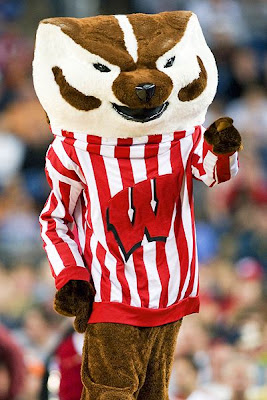
    Although a rodent in candy-stripe doesn’t necessarily conjure frightful thoughts, future tourney opponents should fear Bucky.

    Wisconsin’s chance of reaching the Final Four isn’t some outrageous big fish story. Led by senior point guard Trevon Hughes, the Big Ten contender, which also boasts the mobster law firm of Nankivil, Jarmusz and Bruesewitz, has quietly sprinted out to an 18-5 overall record and 8-3 mark in league play. Their bar-brawling approach certainly is the antithesis of high-flying, fast-paced darlings Villanova and Kentucky. In conference play, they’ve cracked the 70-point mark just twice. But for onlookers who relish beautifully executed basketball, Ryan’s basketball brand is pure bliss.

    Slow, methodical and smart on both sides of the court, the Badgers wouldn’t win a track meet, ranking 339 out of 347 in adjusted tempo – a pace which will inevitably frustrate high-octane teams. But they’ll certainly emerge victorious in most street fights. Wisky ranks fifth nationally in adjusted defensive efficiency, limiting foes to just 0.85 points per possession. It’s not too shabby shooting the rock either checking in at No. 16 in O-efficiency.

    The Badgers’ toughness and tenacity, the hallmark of Ryan teams, was on display last week against the best the Wolverine State had to offer. In consecutive contests, they bullied Michigan State (67-49) and Michigan (62-44) from horn-to-horn.

    According to KenPom.com Wisconsin’s Velveeta train of Ws will likely keep chugging along. Of its seven remaining games, road clashes with Minnesota and Illinois are the most daunting, albeit very winnable:


    What’s more remarkable about the Badgers’ recent string of success: they’ve hammered opponents without premiere interior force Jon Leuer. The bruising 6’10" junior has missed seven games with a broken left wrist. Though team officials have remained mum about his recovery, many insiders believe he will return for the Big Ten Tournament in early March. If Leuer can shake off the cobwebs in time to dance, Wisconsin, which is quite possibly the most dangerous squad in the Midwest, will be an extremely difficult out.

    With a deep tourney run, maybe then Wisconsin, and more importantly the unfairly overlooked Ryan, will finally receive the national recognition it/he unquestionably deserves.

    Here are the movers and shakers in this week’s Triple-B:


    *For games played through Sunday, February 7
    *RPI data provided by Rivals
    *Efficiency stats from kenpom.com

    On the Bubble: Marquette (15-8), South Florida (15-8), Notre Dame (17-7), Virginia Tech (18-4), Tulsa (18-5), Washington (16-7), Minnesota (14-8), Cincinnati (14-9), Wichita St. (20-5), Oklahoma (13-9), San Diego St. (16-7)

    Dropped Out: UConn, North Carolina, Cincinnati, LA Tech, Akron, Maine, Jacksonville

    Conference Breakdown: American East (1), ACC (6), Atlantic Sun (1), Atlantic 10 (6), Big 12 (7), Big East (6), Big Sky (1), Big South (1), Big Ten (5), Big West (1), Colonial (1), Conference USA (2), Horizon (1), Ivy (1), Metro (1), Mid-American (1), Mid-Eastern (1), Missouri Valley (1), Mountain West (3), Northeast (1), Ohio Valley (1), Pac-10 (1), Patriot (1), SEC (5), Southern (1), SWAC (1), Summit (1), Sun Belt (1), West Coast (2), WAC (1)

    Image courtesy of Getty