Welcome back to Molarity Redux, the updated, continuing adventures of Jim Mole and friends.
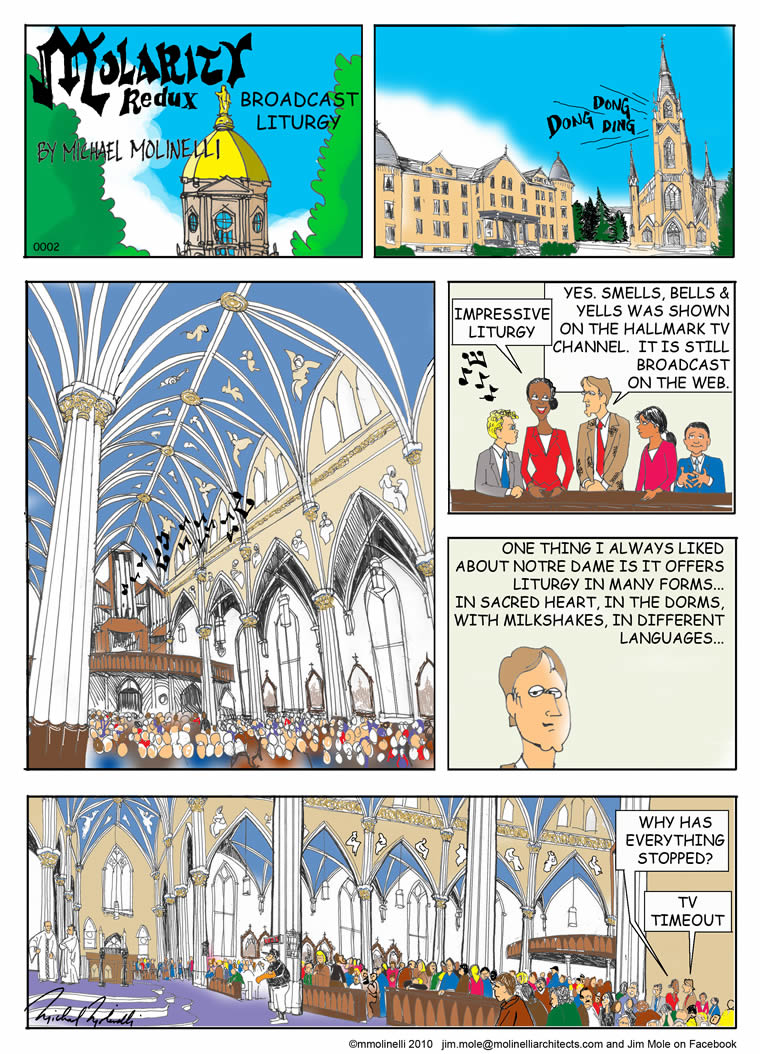
Welcome back to Molarity Redux, the updated, continuing adventures of Jim Mole and friends.
Today is Tuesday. My son isn’t wearing underwear.
“So, why aren’t you wearing underwear?”
“Mom, it’s Tuesday.”
Right. Once again forcing me to recognize that there is no way any woman I can respect is ever going to marry my son.
When I was a project manager in my prior life, our firm had us do this leadership thing where our managers and staff filled out something called an upwards evaluation. One day, sitting at my desk reading the results of this survey, I realized my managers thought I was micromanager. I was shocked.
I immediately got on my high horse and rode over to my managers’ cubicles and asked them, “Do you think I micromanage?” At this point Zach started laughing so hard he spit Starbucks all over his work papers and Mike just about fell out of his chair.
So with the knowledge of my control-freak management style, when I became a mother I made a conscious effort not to micromanage. I didn’t want to be an overbearing parent whose kids go bonkers with new-found freedom as soon as they go to college.
I want to be a parent who exerts just the right amount of control to provide structure and discipline but allows for freedom of expression and respect for the individual. I quickly found it’s not that easy to do.
My 3-year old routinely shows up to dinner without pants on. Now, before we say grace I ask, “Is everyone wearing pants?” If the answer is yes, then we ask for God’s blessings on these thy gifts. If not, then I do demand that she go upstairs and put underwear on, and there I am crushing her expressions of freedom. I’m not respecting the individual who prefers to eat dinner without wearing pants.
But here’s the thing. I think my children should wear underwear at the dinner table and also on Tuesdays. That’s my rule. And all that stuff about exercising just the right amount of control is going right down the laundry chute with the rest of the dirty laundry.
Except with underwear, our family seems to have a problem getting it to go down the laundry chute.
“William, why are your dirty underwear in the middle of the stairs?”
“Because you told me to take them off my head.”
Now, when I tell my son to take his underwear off his head because it’s not safe to walk down the stairs when you can’t see, I find myself back on my high horse micromanaging as I tell him,
“Take the underwear off your head, walk five steps up the stairs, turn left, open the bathroom closet door, open the laundry chute, put the dirty underwear in the laundry chute, close the chute gently, do not let it slam hard enough to set off the burglar alarm, turn around, exit the bathroom without singing any songs about the potty or your recently composed ‘I’ve Got Underwear on My Head’ song, because I don’t want to hear it.”
Unless it’s Tuesday. On Tuesdays you take your underwear and put it on your body.
Maraya Steadman, who lives in a Chicago suburb, is a stay-at-home mother of three children. She can be reached at [email protected].
I have read, many times, that families should eat together. Lots of sociologists, psychologists, behaviorologists, lots of “ologists,” with published books and columns and radio talk shows, say so. I can only conclude that none them ever had children.
When it comes to "ologists,” I like paleontologists. They like to be outside, they like to dig in the dirt and they don’t make me feel as though I missed some well-attended parenting lecture last month.
Despite that lapse, I do know some things. I know that family dinners are overrated, and I know dinosaurs.
We have 37 plastic dinosaurs, 19 dinosaur magnets, three automated dinosaurs, two remote-controlled dinosaurs, an extensive dinosaur library of children’s books (including dinosaur board books for toddlers), one dinosaur sleeping bag, dinosaur T-shirts, DVDs, puzzles, three sets of dinosaur pajamas, a deck of dinosaur flash cards and a T-Rex plushy. We also eat a lot of dinosaur-shaped chicken nuggets.
I put four nuggets each on three plates and a bottle of ketchup on the dining room table. I walk back into the kitchen wondering if they can do it. Can they eat a meal, a single meal, without fighting?
At the point when my youngest is screeching like a Pterodactyl because her brother is on top of the table trying to take the last Stegosaurus nugget from her, and the dog is lapping up the spilled milk, and my oldest is screaming at her brother not to hit the 2-year old, I intervene.
“Okay, everybody freeze," I say. “William, get off the table. Sarah, calm down. Emma, give me the nugget.”
My voice gets even louder: “Sit down. Everybody. Now!”
I pause. I look each one of them directly in the eyes. But for the sound of milk dripping on the floor, all is silent. It’s my move. I have no idea how to handle this. I’m not sure what to do. So I go back to the paleontologists.
“Okay, Allosaurus vs. T-Rex, who wins?”
My son pauses, my older daughter reflects. I can still hear the milk drip, drip, dripping as it hits the floor. The 2-year old quiets and furtively glances between her older siblings as she sucks the breaded coating off a Pterodactyl’s head. I can see my son’s mouth begin to slowly form to speak the “All” sound in Allosaurus.
Still, they pause.
Then, my son starts screaming “Allosaurus! Allosaurus! Allosaurus!” My older daughter points at him and fires back that no way could an Allosaurus take out a T-Rex because an Allosaurus is at least 25 percent smaller. My daughter declares herself the T-Rex and the winner.
My son then jumps on the table and tells her he is faster and more ferocious. He throws back his huge head filled with serrated teeth, bars his sharp claws and roars.
“You sound like a lion not a dinosaur.”
I declare dinner over, and we all start marching up the stairs impersonating a crazed T-Rex to the theme from Rocky.
After the two younger children are in bed, my daughter says to me, “You know Mom, there is no way Allosaurus and T-Rex could fight, because Allosaurus lived in the late Jurassic period and T-Rex lived in the Cretaceous period.”
“I know,” I tell her. “I know dinosaurs.”
Maraya Steadman, who lives in a Chicago suburb, is a stay-at-home mother of three children. She can be reached at [email protected].
The editors of Notre Dame Magazine offer our latest list of blogs, essays, stories, videos and other gems by and about ND graduates and events.
The noted Catholic apologist Dinesh D’Souza and famed atheist Christopher Hitchens engaged each other at Notre Dame in The God Debate: Is Religion the Problem?. The lively event sold out the 875-seat Leighton Concert Hall on April 7, 2010.
U.S. Navy Lieutenant Commander Matthew Frey, ND class of 1998, is serving a 12-month tour in Afghanistan. He blogs about his experiences in the war zone in Afghanistan Tour.
Cinematographer Alan McIntyre Smith, ND Class of 1997 shot the top 5 MTV music video Can’t Stand It, by Never Shout Never.
Gina Vecchione, ND class of 1997, won an Emmy in 2008 for her editing work on the documentary A Distant Shore: African Americans of D-Day. View clips of the documentary and other films she has edited. Also, see the music video of Vecchione as she performs as the blues singer Darla Sugar Candy.
An archive of past Notre Dame Student Film Festival films is available at iTunes U.
If you know of any links by or about Notre Dame graduates that would be networthy, email the information to Notre Dame Magazine at [email protected].
Welcome back to Molarity Redux, the updated, continuing adventures of Jim Mole and friends.
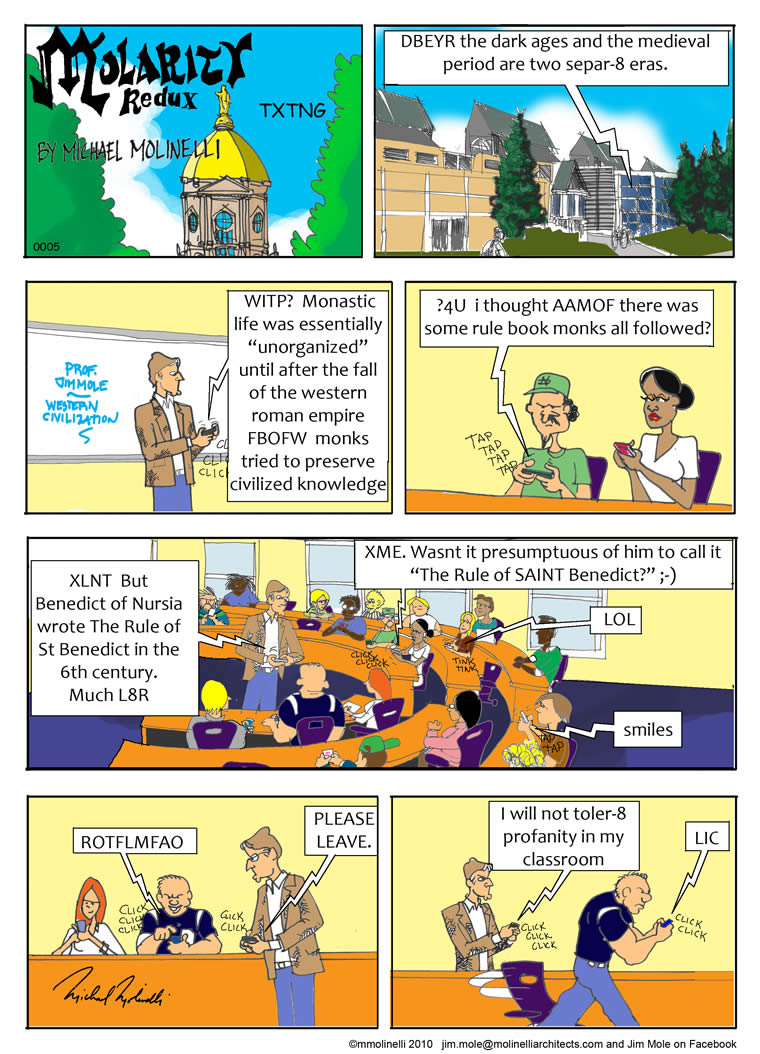

If the walls could speak at 76 Via Monterone, a stately three-story building near the center of Rome, what stories they would tell.
Built as a palazzo for a wealthy Roman family in the 18th century, it later housed nuns, actresses, a celebrated poet and a famous photography studio before being bought by Notre Dame in 1969 for its Rome architecture program, which means that successive generations of students have pulled all-nighters here to the sounds of Jimi Hendrix, the Allman Brothers, Boy George, Snoop Dog and Lady Gaga.
But almost certainly these walls have never seen anything quite like David Mayernik striding out of his office, descending the grand staircase past the massive entrance doors and trotting down the basement stairs, all the while carrying an ironing board under his arm with a radiant smile on his face.
Mayernik, a practicing architect and artist as well as a Notre Dame associate professor of architecture and 1983 ND graduate , is not beaming at the prospect of doing laundry. He’s thrilled for the chance to show his students the almost lost art of fresco. “Fresco simply means painting into fresh plaster,” he tells me as he takes off his tweed jacket and unfolds the ironing board to prepare for a mini-fresco presentation later that week in his class.
Atop the ironing board, he stretches out a full-size sketch of a woman with flowing curls (called a “cartoon” by fresco makers, a term that predates Donald Duck by several centuries), and punches a series of holes that will allow him to trace in chalk the outline of the woman onto plaster before painting.
“Essentially it’s like a big coloring book,” he says, “but you get to draw the lines yourself.
“I love the smell of wet plaster,” he adds. “You feel like you’re doing something people have been doing for thousands of years.”
Painting on a wet surface sets off a chemical process in which paint pigments bond with lime (calcium hydrate) in the plaster, giving frescos a remarkable durability. The art form is thought to go back 40,000 years, and examples survive from ancient Egypt, Greece and Rome, as well as from India, where the Buddha’s life was recorded in the 2nd century B.C. on the walls of caves. Fresco underwent a major revival in 13th century Italy, and today remains connected in most people’s minds with the Renaissance, especially the work of Raphael, Giotti and Michelangelo’s Sistine Chapel.
Mayernik first encountered frescos while studying architecture in Rome as a Notre Dame undergraduate, and he still vividly remembers one by Italian master Giambattista Tiepolo that he saw on a field trip to Vicenza. “It was a mythological scene with a stag arriving on a cloud. It felt like it was happening right here in this world. It was an amazing integration of art and architecture.”
That’s why he insists that budding architects learn about fresco, 500 years after its heyday. “It brings art and buildings together; it’s a practical way that architecture is connected to art. The students seem to appreciate the fact that people are still doing it today.”
Mayernik practices what he teaches, incorporating frescos on a number of buildings he designed at The American School in Switzerland — a boarding school near Lugano where, since 1996, he has served as the campus planner and designed a library, gymnasium and classrooms in the classical style for which Notre Dame’s architecture program is noted. He feels frescos enhance the spirit of the campus, which resembles a traditional Italian village.
“I would never have thought of doing a fresco,” says Lynn Aeschliman, the school’s chairman. “It was David’s idea. But now I can’t imagine our buildings without them. They fit so well, like a woman all dressed up for an evening out putting on the right jewelry.”
In the school’s gymnasium, Mayernik created a biblical scene of Hercules and panels illustrating the history of sport. Above the library entrance, he painted robed figures representing Ars and Scientia, the two branches of knowledge in the classical world. This spring, part of his sabbatical is being spent adding frescos to the school’s theater.
“We believe that buildings should instill people with beauty, ennoble them,” Aeschliman says, “which David’s frescos do.” She commissioned Mayernik to create a fresco of Saint Thomas at the San Tommaso Church up the hill from the school’s campus, and several more at the San Cresci chapel in the Mugello region of Tuscany, near where she runs a summer art academy (which partners with the Notre Dame School of Architecture).
For the Italian church, Mayernik painted a crucifixion scene in fresco, and he is creating five scenes from the life of San Cresci, a local saint martyred in the 3rd century. This summer he plans to finish the final two in the series.
“Fresco is heavy-duty, hard work,” Aeschliman says. “It’s physical. David climbs up the scaffolding, and he’s up there all day.”
Mayernik describes it as “battling a wall. You are tied to that wall for eight or nine straight hours because the plaster is going to dry when it wants to, not when you want it to. You have to plan how much you think you can get done in a day and then do it.”
This physical exertion is why fresco is often thought as a young artist’s medium. Yet Mayernik, who turns 50 this April, notes that Michelangelo painted his masterful Last Judgment in the Sistine Chapel at age 60 and continued painting frescos into his 70s. The artist credited with reviving fresco in the modern era, Pietro Annigoni, started his most ambitious work, the dome at the Monte Cassino monastery, at age 70 and finished it five years later.
Mayernik — whose father worked at the Mack Truck factory in Allentown, Pennsylvania, and whose mother was an amateur landscape painter — relishes the combination of strenuous work and artistic sensibilities in this art form. “Fresco demands solid preparation, long hours and a bold, confident touch. It resists fussiness and rewards bravura,” he declares.
Coming home from his undergraduate year in Rome, Mayernik was fascinated by frescos and went so far as to copy out in longhand passages from books describing the fresco-making process, trying to unlock what makes them so compelling. He returned to Italy in 1988 as a Fellow at the American Academy in Rome and fulfilled his aspirations thanks, in part, to an unexpected Notre Dame connection.
Mayernik says he had been inspired reading in Notre Dame Magazine that Sybil Smoot ’84M.A., an acquaintance from college days, was living in Italy, working as a singer and studying fresco painting on the side.
“One night I was up in Florence dining with a friend, who suggested we go out and hear this great jazz and gospel singer who also painted frescos. ‘Oh,’ I said, surprised, ‘Do you mean Sybil Smoot?’”
At the jazz club, he chatted with Smoot at intermission. She encouraged him to visit the school where she studied, led by Leonetto Tintori, who gained international fame for restoring fresco masterpieces after the disastrous Florence flood of 1966. Mayernik spent six weeks at the school learning the intricate details, then he honed his skills for many months afterward by imitating the frescos of Giambattista Tiepolo.
Joseph Connors, director of the American Academy in Rome at that time, recognized Mayernik as “a very special artist-architect,” and when construction of a new library in the basement provided a perfect spot for a fresco he immediately thought of Mayernik. The duo collaborated across the Atlantic on ideas, agreeing upon an image of the mythological figure Accademia asleep in a library, her head resting on a pile of books.
Connors remembers, “It took seven giornate — the working day in which the artist finishes a section of wet plaster without letting any of it go dry. And these were long giornate, from early in the morning until late in the evening. David was such a perfectionist that, after the second giornata turned out not to be to his satisfaction, he scraped it off and did it all over again the next day.”
In the end both the artist and the patron were pleased with what Connors calls, “the wonderful way in which he depicted a Pompeian-style fresco seeming to peel off a Roman wall in the background.”
This art form, once thought dead, is enjoying a renaissance today, as seen last December when frescoist Richard Wright won the Turner Prize, Britain’s most prestigious art award. Mayernik traces the renewed interest in fresco back to the floods in Florence, when the world was suddenly reminded of the beauty of this old work.
The ND professor also cites the influence of Pietro Annigoni, a painter famous for his portraits of Queen Elizabeth, John F. Kennedy and Pope John XXIII, who traded canvas for plaster later in his career. Ben Long, probably America’s best known fresco painter, journeyed to Italy in the 1970s to apprentice with Annigoni as an oil painter and wound up working on wet plaster instead.
But fresco never actually disappeared from the art world. Both America’s beloved WPA murals of the 1930s and the famous Mexican muralists Diego Rivera, Jose Orozco and David Siqueiros drew upon the techniques of fresco to make powerful statements on national identity and social justice.
Mayernik, too, is drawn to fresco for its ability to express ideas about art, faith and life itself. “Architecture itself is not all that articulate,” he says. "It’s limited in content, much like music. Frescos are the lyrics. That’s why they were traditionally considered the pinnacle of painting. They were large, they were public, and they were expected to convey important messages.”
He believes the current fresco revival must extend beyond the art world to reach architects, which is why he looks so happy as he talks about his work in the windowless basement of Notre Dame’s Rome school. He’s eager to share his passion for frescos with students, so they can learn to communicate their own ideas to the world.
“It’s a bold, powerful artistic form as well as being beautiful. That’s why it’s coming back today,” Mayernik muses, punching the last few holes into the cartoon he will use to demonstrate fresco painting to his class. A bright smile still shines on his face as he folds up the ironing board.
Jay Walljasper, editor of OnTheCommons.org and contributing editor of National Geographic Traveler, writes frequently about architecture and urban planning. His website is JayWalljasper.com.
Out of the depths of the lagoons they come, the alien monsters advancing slowly, relentlessly moving northward, ever northward. Until now they are poised on the verge of wreaking untold havoc.
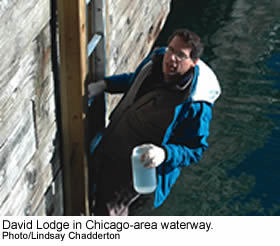
“The menace of the Asian carp” may sound like a low-budget Japanese horror flick, but, as Professor David Lodge, director of Notre Dame’s Center for Aquatic Conservation, will tell you, it is all too real.
The fish, actually two species, bighead and silver carp, offer a classic example of what can happen when non-native species that have no known predators are released into the wild: They run amok. Asian carp routinely grow to 4 feet long and 100 pounds. With their voracious appetite they displace native species wherever they go. And that is a Big Worry when they are bearing down on the Great Lakes’ $7 billion fishing industry.
Originally brought to the United States in the 1970s to clean retention lagoons in southern fish farms and water treatment plants, the fish escaped into the Mississippi River system during severe flooding in the early ’90s. Since then they have been making their way upstream, and now, apparently, they are knocking on the Great Lakes’ door.
In a project with the Nature Conservancy to develop more sensitive fish-monitoring tools, Lodge and his colleagues tested water samples beginning last summer, looking for environmental DNA from microscopic bits of fish tissue suspended in the water.
A sample they drew from Calumet Harbor on the southwestern shore of Lake Michigan last year held very bad news. It showed traces of silver carp DNA, evidence strongly suggesting the fish had breached a two-level electric barrier on the Chicago Sanitary and Ship Canal, which connects the Great Lakes and Mississippi River basins.
In the wake of the findings, federal officials announced a $78.5 million plan of 25 long- and short-term measures, excluding closing locks, to keep the carp out of the Great Lakes. Earlier this year, the state of Michigan had lost an appeal to the U.S. Supreme Court for a preliminary injunction to close canal locks, thus separating the rivers from the Great Lakes. The court sided with attorneys for the state of Illinois, who argued that closing the locks would cause irrevocable harm to the state’s $200 million annual shipping and barge industry. As of March, two other Supreme Court cases on the issue were still pending.
“The fact is our DNA surveillance technique is what motivated all of this. Everyone involved with the canal knew this day would come, that the Asian carp would be up against the electric barrier. Our results just sped time up,” Lodge says.
Until the Notre Dame-Nature Consevancy finding, the Army Corps of Engineers and other agencies had thought the point of the fish invasion was still 20 miles farther downstream, giving everyone more time to respond.
“It was shocking and depressing when we found the DNA in Calumet Harbor, above the barrier,” Lodge says.
However, the ND authority on invasive species believes there is yet time to avert disaster. “Just because we found silver carp DNA in Calumet Harbor does not mean there is a self-perpetuating population in Lake Michigan,” he argues. “Our DNA finding just makes it more urgent that no more individuals of either species get into the lake.”
While testifying in February before a Congressional subcommittee, Lodge was asked how bad the Asian carp invasion of the Great Lakes could be. “There’s only one way to find out,” he said, “and I don’t think any of us want that.”
John Monczunski is an associate editor of Notre Dame Magazine.

One of the best definitions of science I’ve heard was offered by an archaeologist, Lew Binford. Science, he would say, is the most reliable way of diminishing ignorance about the natural world. This is really quite diplomatic: it can satisfy those who believe that there is nothing besides the natural world, but it leaves room for those who believe there is something —a realm, a force, whatever — that is beyond nature, that is supernatural, a place where science cannot go. And wherever science does get to, some new bit of ignorance that lies beyond the old one pops up and calls out for diminishment.
Take the autumnal turning of the leaves, one of the most attractive sights in nature and also one of the most commonplace. Surely scientists know all about it by now — after all, we have had a half-millennium of what can be called modern scientific inquiry since Signore Gallilei. We do know that some combination of temperature, moisture and perhaps day-length may all be involved in when a deciduous tree’s leaves (such as those of an elm) begin to lose their green color. The green is a pigment called chlorophyll and as it disappears it reveals the other pigment in the leaf that chlorophyll has overshadowed — yellow.
But some other trees, sugar maples for example, turn red. The maple leaves start, at this rather late point in their careers, to produce a red pigment called anthocyanin, which was not previously present. Why does the maple tree go to all the trouble and expense of producing a new pigment in its leaves when they are so close in time to floating to the ground and dying altogether?
Several explanations have been offered but there is no agreement as of now. It might have something to do with helping the amino acids in the leaves to slip back into the woody parts of the tree as a protection of the tree against the cold, or it might protect the tree against insects that feed on those very same amino acids. And it might be something else.
So when it comes to red leaves we remain in the dark.
Since there are so many more pressing matters — so many more urgent ignorances for scientists to dispel — we may not learn the answer to red leaves in our lifetimes. Here then are some more unknowns.
Despite a prediction by physicists that it does exist and is a major player in the dance of particles, and that it will explain the very nature of matter, we are yet to find what is called with remarkable specificity the Higgs boson. This is perhaps only the result of the failure of the Large Hadron Collider in Europe to function as planned, but we are left at this time not knowing for sure that the Higgs boson exists.
Indeed, it has been suggested by actual physicists that the Higgs boson itself is sabotaging the Large Hadron Collider. How is it doing that? Among the many alleged properties of the Higgs boson is the capacity to turn back in time. So, it is said, the boson just turns back through time and stops the collider from ever making one. Now that is a really eerie bit of ignorance
Less eerie and more frightful is our ignorance about where to put our radioactive wastes while they expend their lethality over half-life after half-life after half-life. Given the restless nature of the planet we live on, seismicity and all that, something is almost certain to go haywire any place and every place on the earth during the next several thousand years. These effluents now accumulate in barrels here and there around the country which, one hopes, people have been assigned to watch closely, but that seems a bit haphazard. The wastes must be contained, and how exactly to do this for millennia is an ignorance worth diminishing at the earliest possible moment.
Prioritizing ignorances is something that should be done from time to time, even though gaining a list of priorities to which we can all subscribe would seem pretty hard to do. I for one do not care a whit if intelligent life — or even unintelligent life — exists elsewhere in our galaxy and even more remote places. It would be nice to know, I suppose, but our history of traveling around our own planet and introducing lethal diseases to unsuspecting tribal people suggests that wherever we all are galaxy-wise we should simply stay put.
We don’t know how one of our few exclusively human talents came about — language. No other creature known has anything like our language. Apes, dolphins, dogs, parrots — all sorts of animals can perform one or another “linguistic” feat either to our delight or dismay, but none of them can discuss the future or compose poetry or design a bridge.
Plenty of theories exist to explain how language came about. It started with gestures. No, it started with music, with singing. No, with dancing. No, it started when mothers needed to let their babies know they were still nearby, having put them down on the ground to use both hands to gather berries, so they invented “Motherese.” Or could it have been a side effect of the explosion of neurons in the brain caused by an increasingly complex hand-brain continuum involved in making complicated tools? Did it come about all at once with a random genetic mutation?
In the late 19th century, a French academy forbade its members from discussing the origin of language since it caused such bitter argumentation and occasionally physical violence. As H.L. Mencken said, “For every complex problem there is a solution that is simple, neat and wrong.”
Why do all humans pass through the decade (more or less) when they are what we call teenagers? This never happens to a non-human species, so far as we know. Chimpanzees don’t go through a time when they are surly with their parent (the mother), or get the chimp version of acne, or can’t wake up in the morning, or simply flat-out rebel. Some say adolescence is a kind of reproductive apprenticeship. Others say it evolved a few hundred thousand years ago followed quickly by a huge increase in the size of the human brain, so it must be important. The linkage there, however, remains unexplained.
On the other hand, science has determined what most parents intuited long ago — that the adolescent brain undergoes a wholesale reorganization. Teens are not, we can all be relieved to know, taken over temporarily by aliens. This reorganization, it is opined, lets them learn to negotiate the complicated social world into which they will emerge as adults. Well, sure, but this seems vague at best if not wholly vapid. Why, for example, girls experience a growth spurt earlier than boys, which in some cases is now occurring not in the teens but the tweens, remains a bit of a mystery.
However tumultuous the teen years appear to be (at least in Western cultures), there are more serious ignorances about the human condition. Why are so many people so often nasty to one another? Why are some people altruistic? What makes a sociopath? And why do some sociopaths go on to become mass-murderers? There is a single gene that appears to be involved in altruism. Called AVPR1, people with it are more altruistic and generous. Is there a sociopath gene? What on earth will we do if there is such a gene?
We do not know how many species of plants and animals live on the earth, and we do not know how many are disappearing without ever having been taken note of by humans. Most scientists who deal with such matters are of the opinion that we are facing another mass extinction of life forms, this one occurring practically overnight, and caused mostly by humans hogging everyone else’s habitat. To have destroyed so much of the cathedral of life is something the human race will one day be ashamed of and deeply regret.
Apparently we don’t know enough about what is called, in a reified sort of way, the economy to have predicted its latest collapse. According to a friend, the British economist Adrian Wood of Oxford, the Queen of England asked why economists had failed to predict it. The British Academy promptly met, pondered and came up with a wholly unconvincing answer. Indeed, Wood told me, the only thing that all the participants in this global horror story universally agree upon is the statement: “It wasn’t my fault.”
And there are more elusive matters. When it comes to issues such as the survivability of the spirit, I am slightly surprised to find myself of an open mind. Scientists and most fans of science (which I am) tend to believe — indeed, to know — there is no such thing. On the other hand, it is famously difficult to prove a negative. Aside from logic and all that, I have, thanks in large part to my wife, Susanne, experienced things that defy scientific explanation even by our friend Ken Frazier, the ever-resourceful editor of The Skeptical Inquirer, a magazine devoted to debunking all paranormal claims.
One such event occurred on the Hopi Reservation in northern Arizona. We were staying in the motel called the Hopi Cultural Center, which has flat roofs like most of the homes and other buildings there. It had snowed during the day and stopped at dark. Later, we were awakened by a loud crash that sounded like a large rock thrown onto the roof. In the dark we listened, and in a few minutes another crash resounded. We heard smaller rocks skipping across the roof. I turned on the lamp next to the bed, and on the third crash the lampshade shook. The racket continued at about five-minute intervals until the sun peeked over the eastern horizon.
I went outside and climbed up onto the roof. The snow was pristine, totally undisturbed. Back on the ground, I saw two men come out of a room near ours. They asked me if I had heard all the banging and crashing and I said, yes, perhaps it was the roof contracting in the cold. It turned out that the two men were roofers hired from off-reservation to repair roofs in one of the villages. “We know roofs, man,” one of them said, “and that was no roof making that noise.”
Later, the Hopi manager of the motel told us that the racket was the work of spirits of teenagers who over the years had died and for various reasons had been unable to leave the area. Every January, he said, they act up like that. The same racket occurred for the next two nights, and we discovered that it could be heard only inside the motel, but not if you walked outside.
Later I had the chance to recount the events in detail to Ken Frazier. The only explanation he could come up with was the possibility that jet fighters from a base in Utah were flying over, causing sonic booms. I asked him if he had ever heard of Air Force maneuvers taking planes over the Hopi reservation approximately every five minutes throughout the night, silently unless you were indoors. He smiled and shrugged.
On another occasion, Susanne and I were in a Washington, D.C., restaurant finishing dinner with a noted anthropologist and friend, Paul Bohannan. That afternoon he had told us about how he, a nonbeliever in such things of course, had handled stories of African witchcraft and spirit activity when he was in the field there. At dinner he was upset because his son was not interested in pursuing a doctoral degree in something scientific but instead wanted to get a degree in sports writing. He went on a bit about his disappointment and even exasperation.
At this point, Susanne felt a forceful shove on her back and a voice, loud in her mind, said “Margaret!” Susanne had friends who were British sensitives, and she knew that it was crucial never to volunteer information about such communications, but she asked Bohannan’s permission and went ahead and asked if he had someone in his family named Margaret. He said Margaret was his sister, but Susanne said, no, she’s older, she had long braids wrapped around her head, lived on a farm and was churning butter.
Greatly surprised, Bohannan said that it was his grandmother, also named Margaret, who had indeed lived on a farm. He told us about her, pointing out that she used to take young Paul out into the fields to slide down haystacks with her. She was a woman who always seemed to have a great deal of fun in life. He asked if anyone else was there and Susanne reported that she heard the name Louis. Louis, Bohannan reported, was his youngest uncle who had died early. Bohannan’s father had said that he wished that he, himself, had died instead of his younger brother because Louis always found such joy in life.
Then dinner was over, Bohannan went to his hotel in Washington, and Susanne and I, neither of whom had ever heard of either Margaret or Louis, drove home.
The next morning Bohannan called Susanne and told her that what had happened at dinner would change his way of teaching forever. It was unmistakably clear to him, he said, that his grandmother and uncle had come to remind him that one should pursue what makes one happy, that it was fine if his son wanted to be a sportswriter.
As a science editor and writer but also as a chronicler of Hopi and Navajo ways and worldviews, not to mention as husband of Susanne, I have had no alternative but to maintain an open mind about this astonishing world about which we have so much more to discover. After all, if a Higgs boson can reverse the passage of time, wrecking a very expensive and large machine in order to hide from us, who knows what is really going on in this universe of ours.
Meanwhile, on a more prosaic level, I fear that we are severely threatened by another ignorance, the widespread and debilitating ignorance of much of the U.S. public. Polls show that a majority of Americans believe the earth and the human race came into existence 10,000 years ago. At least one member of the U.S. Senate believes that the mountain of evidence showing the climate is undergoing rapid change largely because of the greenhouse effect is all a hoax perpetrated by environmental extremists.
Scientific ignorance is extremely widespread for a country like ours that relies so heavily on technological innovation, but scientific ignorance is merely part of the problem. Polls have also shown that a majority of Americans cannot name the three branches of government, and there are apparently many retired people who don’t know (or aren’t sure) that Medicare is a government-run program.
Such sorry statistics of appalling ignorance regularly appear. One wonders how many Americans could pass the exam administered to immigrants before they can become citizens of the United States. Could all our legislators?
Such ignorance is a shame but it is also profoundly perilous. The writers of the Constitution knew that creating the world’s first full-bore democracy was a dangerous undertaking, and its success would depend in great part on an educated citizenry that could understand and seriously discuss important public issues. They created the Senate in part as a hedge against too direct a democracy. But we hear that the United States is falling behind in all sorts of categories — math, science, history, engineers, teachers, book readers — and may soon be out-competed economically and technically by Asian and European countries.
But suppose some enormous calamity were to take place, something sudden and global in nature, a heretofore unknown climatic tipping point, for example, an irreversible event calling for an informed, intelligent, quick response to a wholly unprecedented cascade of catastrophes. The U.S. military has recently announced that the chaos of rapid global climate change could seriously threaten our national security in any number of ways — resource wars, pandemics, mass migrations, and so forth: catastrophes cascading around the world. This is not the stuff of thriller fiction. It could happen — not tomorrow but easily enough when my grandchildren’s generation is in charge of coping.
Would a large, noisy and ignorant fraction of the American electorate be able to comprehend what was needed in such a circumstance, or would they be captivated by the demagogues who always sprout like nettles in troubled times? Would an unwieldy and super-partisan and financially suborned legislative branch and a bureaucratically clogged and widely beholden executive branch be able to overcome ignorance and demagoguery and act wisely and decisively?
Could we, as presently constituted, keep the trains running on time? Do we know for sure that our democracy would survive?
Jake Page and his wife, Susanne, a photographer, produced the lavishly illustrated book HOPI in 1982, representing the first general photography allowed on the reservation since 1910. A 25th anniversary edition is now available.
Photo of sugar maple:
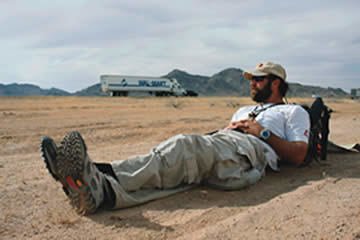
One evening in October 2008, Rory Fanning ’01 was sitting on top of an Appalachian mountain in Georgia eating a container of ramen noodles he’d just cooked over a fire.
A black bear padded up.
“He wasn’t more than 15 feet away,” says Fanning, 32. “We were both sort of stunned. He ran down the mountain when I went to get my camera, sort of unimpressed by my fare.”
Another person might have figured it was time to walk down to civilization.
Fanning, however, had recently left full-time work as a mortgage broker in Chicago partially for moments like this. “I didn’t want to wake up at age 65 with no memories save the weekends,” he says.
In May 2009, Fanning completed a walk from the Atlantic Ocean to the Pacific. His preparation took only three weeks, though the roots of the walk were much deeper.
When the United States decided to invade Afghanistan after the 9/11 attacks, Fanning joined the military. Although he considered himself a pacifist, he says, “If you’re part of a society, you’re culpable for the decisions of leadership regardless of what they are.”
During training at Georgia’s Fort Benning with the U.S. Army Rangers, he met Patrick Tillman. Tillman had made national headlines in May 2002 when he turned down a $3.6 million contract from the Arizona Cardinals football team and instead joined the military. In April 2004, Tillman was accidentally killed by fire from U.S. troops while in Afghanistan.
Fanning completed his tour, returned to Chicago and found work as a mortgage broker. By summer of 2008, he was ready for a change. “I was getting frustrated with the greed and selfishness and direction of the leadership of the country at the time,” he says. “You can’t be a real advocate against greed if you’re not a living example.”
With only one rule — no rides forward — Fanning started walking west from Norfolk, Virginia, on September 17, 2008.
Resembling a modern-day patriarch, he carried a wooden staff and a 49-pound backpack with a sign on the back that read “Rory Fanning, who served with Pat Tillman in the 2nd Army Ranger Battalion, is walking from the Atlantic to the Pacific to raise money and awareness for the Pat Tillman Foundation. Visit walkforpat.org for more info.”
During the first month, Fanning says, “I just tried to avoid attention.” But after he was asked to speak at a high school near Huntsville, Alabama, Fanning decided he enjoyed it. He then spoke to high schools, colleges, prisons, NFL alumni associations and corporations. He also received media attention, taking part in 75 interviews, including Fox News and Good Morning America.
Fanning says he never knew where he would sleep each night. About a quarter of the time he slept in Hampton Inns or people offered him a bed. Mostly he slept outside, sometimes in people’s backyards. That didn’t always work well.
“One guy in Texas caught me sleeping on his property once,” Fanning says. That guy had a shotgun. “He was really uninterested in any reason I might be on his property. Another guy in Alabama pulled out a gun, but he ended up giving me food.”
During the day, he’d do about 45 minutes of brokering by cell phone and would sometimes listen to audio books on his BlackBerry. He’d update his blog in the evenings.
For the most part, he observed. “Every 20 miles there was something new, a different landscape, a different plant,” Fanning says. “When you . . . let your imagination generate steam, you see details you don’t normally see.”
In Arkansas, he accepted a ride from a man who took him to a resort community, where Fanning took a shower while the man went door-to-door, collecting $1,700 for the Tillman Foundation. The man happened to be the Arkansas state tourism director, and he took the bearded, casually dressed Fanning to meet Governor Mike Beebe. Today an Arkansas Traveler’s Certificate given to him by the governor hangs over Fanning’s desk at his Chicago home.
He continued to walk.
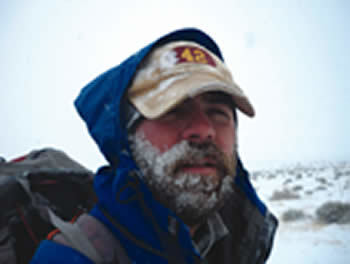
He walked through a blizzard in the Rocky Mountains and 110-degree temperatures in Arizona. In Charlotte, North Carolina, he walked 80 miles though a histamine disorder that caused his hands and feet to swell. “It was pretty miserable; it was walking on rolling pins.”
Walking near the Mexican border in California, he was pulled over 15 times by border patrol agents. “I would see teenage boys in the middle of nowhere staring at me, who had just run across the border,” Fanning says.
On May 15, 2009, Fanning arrived at the Pacific Ocean in San Diego. He had taken about three million steps, wore out five pairs of shoes and lost 30 pounds in the course of walking 3,100 miles across 13 states.
“I just learned to be present,” Fanning says. “I learned that the people in this country have a good side to them. When you can follow a personal passion . . . you enthusiastically bring joy to your own life and the lives of others.”
Mark Lawton is a general assignment report for a chain of community newspapers outside Chicago.
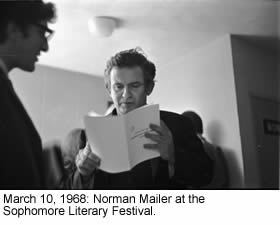
Here is my Sophomore Literary Festival moment.
I am in the old Pay Caf, also known years ago as the Oak Room in the South Dining Hall. High ceilings, beautiful woodwork, those familiar, distinctive aromas.
I am having coffee with Barry Lopez and Edward Abbey. They are two lions of 20th century American nature writing. For prominence and message they would be considered descendants of Whitman and Thoreau; they’d be on the short list with Aldo Leopold, Wendell Berry, Annie Dillard, Edward Hoagland and John Muir as the literary shapers of America’s environmental consciousness. And I am sitting here, sipping morning coffee and listening to these giants talk about wilderness preservation and water rights, native cultures, wildlife and the role of federal government.
Sage-like even in 1983, Lopez, a 1966 Notre Dame graduate, had gained acclaim for Of Wolves and Men. He speaks quietly, thoughtfully. Abbey — always the rebel, the renegade, “the desert anarchist” — is sharper tongued, irreverent and direct. He looks like he stepped right out of the Southwest backcountry: rumply dressed, ample beard, slick hair spearing from beneath his stained and worn-out hat. He’s delightfully out of place at Collegiate Gothic Notre Dame.
Still, Abbey has published his classic beauty Desert Solitaire and his subversive The Monkey Wrench Gang, and two of his novels have been made into movies, Lonely Are the Brave and Fire on the Mountain. By the time he died in 1989, he had become an American icon.
The moment was a refreshing infusion of elan vital in my workaday world. But it would be a typical encounter in the life of the Sophomore Literary Festival, a colorful Notre Dame spring tradition launched in 1967 to bring such literary champions to South Bend, Indiana. Its run lasted more than three decades before fading out of the campus scene.
The cool thing about the Soph Lit Festival is that it was begun by students and was run by students. Students — sophomores — extended the invitations to those authors, poets and playwrights they wanted to hear from and be with. Sophomores made the travel arrangements, met the planes and escorted the writers from hotel to reading to reception. And the writers — at least in the SLF’s heyday — stuck around. They not only did readings, gave talks and made pleasant conversation at post-event receptions. They also spoke to classes, put on workshops, visited with each other and with students, attended wine parties in faculty homes and . . . hung out, usually over the course of a few days. So opportunities for morning coffee or late-night wine were there. It was a week-long festival, it was fun (with some groggy mornings-after).
Gwendolyn Brooks, Chaim Potok and Arthur Miller came my junior year. Joyce Carol Oates and Isaac Bashevis Singer came when I was a senior. Susan Sontag came in 1983, the year Lopez and Abbey were here, as did Richard Brautigan, famous for his period piece Trout Fishing in America. It was Brautigan’s final reading prior to committing suicide.
The impressive list of participants includes Edward Albee, Tom Stoppard and Jorges Luis Borges. Larry McMurtry. Ann Beattie and Margaret Atwood. Jerzy Kosinski. Allen Ginsberg and Ken Kesey came more than once.
Many of the leading poets of the late 20th century read, coached and talked shop with students and faculty alike, a list that includes Galway Kinnell, Kenneth Rexroth, Robert Bly, Lawrence Ferlinghetti, Seamus Heaney, Howard Nemerov, Stephen Spender, Denise Levertov and Sam Hazo, a 1949 ND graduate. The Polish poet Czeslaw Milosz came in 1982, two years after winning the Nobel Prize for literature.
The festival also brought to campus many of the period’s most influential black voices. Claude Brown came in 1970, five years after Manchild in a Promised Land drew intense critical acclaim for its depiction of his growing up in Harlem and his take on American society. The SLF also attracted Ralph Ellison, whose The Invisible Man won him a National Book Award in 1953.
The festival’s leitmotif and cast of characters often translated into edgy, eccentric and unpredictable moments. In 1977 Tennessee Williams opened his presentation on the stage of Washington Hall by pouring himself a glass of wine and toasting Our Lady atop the Dome and then “Notre Dame’s homosexual community.”
In 1985, John Irving reportedly responded to his invitation by saying that the Catholic university may not want him; he was writing a novel that dealt with abortion. He was encouraged to come anyway. That year’s chairman, Greg Miller, told The Scholastic: “We weren’t going to deny the tradition of the literary festival or hold back an author just because he was going to read about abortion, which if you can’t do at a university, you really can’t do it anywhere.”
The SLF was clearly a product of the times, written into a chapter in the life of Notre Dame and American history when the day’s institutional, literary and intellectual currents were embraced in a freewheeling conversation. It was a reflection of the students’ creative, cultural and educational aspirations. In fact, its prime movers openly stated that one of their purposes was to dispel Notre Dame’s reputation as a mere football school.
The year was 1967 and a visionary, entrepreneurial sophomore from Mississippi named J. Richard Rossie put together a conference to honor the Magnolia State’s William Faulkner. The following year John E. Mroz of Osterville, Massachusetts, created a festival celebrated in the Saturday Review and The New York Times. The 1968 lineup included the dean of literary critics Granville Hicks, who penned a post-festival feature for the Review, Norman Mailer, Ralph Ellison, Kurt Vonnegut, Joseph Heller, William Buckley Jr. and Wright Morris, who had won two National Book awards.
Mroz had to patch together funding for the festival. He got a nice boost from Charles Sheedy, CSC, dean of the College of Arts and Letters, who admired Heller’s Catch-22. Heller said he’d come if he could get an autographed football for a family member.
The 1968 festival attracted overflow crowds and was rocked by a series of nationally historic moments. It opened March 31, the day President Lyndon Johnson announced he would not seek re-election. Before the festival ended Martin Luther King would be assassinated. In between Buckley would pepper his talks with barbs slung at presidential candidate Bobby Kennedy. The day after Buckley graced the Stepan Center stage, Kennedy appeared at the same venue, drew enthusiastic applause and replied: “This must be the warmest reception anyone has had in this auditorium since William Buckley spoke here last evening.”
Don Costello, longtime faculty member and informal festival adviser, would say of the festival’s birth years later: “Of course, it couldn’t be done. That’s the beauty of naïve sophomores. They were too naïve to know it couldn’t work.” But over its first two years alone it would bring to campus Tom Wolfe, George Plimpton, John Knowles, John Barth, Peter DeVries, Gary Snyder, Ishmael Reed and LeRoi Jones.
In time the national literary scene changed, and authors expected more for personal appearances. By the mid-1990s the festival had pretty much run its course. It was a product of the times. But what good times they were.
Kerry Temple is editor of Notre Dame Magazine.
The Long Yearning’s End: Stories of Sacrament and Incarnation, Patrick Hannon, CSC, ’88M.Div. (ACTA Publications). The 21 stories here, three for each of the seven sacraments — baptism, reconciliation, eucharist, confirmation, matrimony, holy orders and the anointing of the sick — demonstrate how God is present wherever humanity finds itself. Through such stories as “Hustled by a Holy Man,” “Christ in Pigtails” and “Big Mac Sauce and Other Lessons on Love,” the author shows the presence of God’s grace in everyday life.
Brother Andre: Friend of the Suffering, Apostle of Saint Joseph, Jean-Guy Dubuc (Ave Maria Press). A revised and updated edition of the biography of Andre Bessette, CSC, (1845-1937). This year, the “Miracle Man of Montreal” will become the first saint of the Congregation of Holy Cross, the order that founded Notre Dame. Although Brother Andre left nothing in writing, his friends and co-workers did, and the author draws upon their stories and on newspaper accounts to show the contemporary relevance of a humble man.
Forget-Her-Nots, Amy Brecount White ’85 (Greenwillow Books). In this young adult novel, 14-year-old Laurel discovers she can use flowers to help friends pass pop quizzes — or to make people fall in love. Does an ancient family secret account for her new-found power? Publisher’s Weekly says, “A delicate sense of magical possibility and reverence for the natural world help elevate White’s story from a typical prep-school drama into something more memorable.”
Beyond Blue: Surviving Depression & Anxiety and Making the Most of Bad Genes, Therese J. Borchard ’94M.A. (Center Street). “I’m a manic-depressive, an alcoholic, and the adult child of an alcoholic,” the author says as she takes readers on a tour of her often dysfunctional life. With practical advice, humor and encouragement, she offers hope to readers struggling with depression. Her popular blog “Beyond Blue” is at beliefnet.com.
The Handbook for Catholic Moms: Nurturing Your Heart, Mind, Body, and Soul, Lisa M. Hendy ’85 (Ave Maria Press). The creator of the CatholicMom.com website coaches Catholic mothers on how to care for themselves so “we have the energy, spirit, and peaceful souls to help take care of those who fill our homes and our lives.” She ends each chapter with suggested self-help tips, called “Mom’s Homework.”
The Farthest Home Is in an Empire of Fire: A Tejano Elegy, John Phillip Santos ’79 (Viking). The National Book Award finalist travels from South Texas to New York to Spain to the Middle East as he attempts to recover the missing chronicles of his mother’s family. This memoir is a companion to Places Left Unfinished at the Time of Creation, in which Santos told the story of his father’s family, set within the larger story of Mexico itself.
Sin: A History, Gary A. Anderson (Yale University Press). Attempting to answer the age-old question, “What is sin?” Anderson explores the history of sin and how it has shaped the Christian church. The book received the 2010 Christianity Today book award in the Biblical Studies category. The author is a professor of Old Testament/Hebrew Bible studies at Notre Dame.
The Diet Joke: A Reprogramming Guide for Perpetual Consumers, Lisa Pedace ’85 (Big Shot Press). “Who says losing weight has to be so serious?” the author asks. She proceeds to offer advice on how to lighten up without letting it get you down, with a mix of humor, games and common sense. You can break bad habits, she writes, as she cuts through the confusion of food pyramids, diet programs and mixed messages from advertisers.
Quotidiana, Patrick Madden ’93 (University of Nebraska Press). The engaging essayist takes on everything from the joys and woes of fatherhood to the origins of human language to common actions that illuminate the wonders of everyday existence in a book one reviewer called, “a truly creative creative nonfiction book . . . a remarkable achievement of complex simplicity and elegant confusion.”
A Lifetime of Making Art: Brother Mel, Anne Brown (The Arts Company Press). Over a 50-year period, Brother Mel Meyer, S.M., ’60MFA, has produced work ranging from found-object sculptures to bold abstract watercolors. The book addresses his spiritual commitment as well as his time spent studying with famed sculptor and Notre Dame Professor Ivan Mestrovic, and presents a portfolio of selected images from his thousands of works.
I have taken to saying that my wife and I are at the grandparent stage of life. I don’t before now recall using the metaphor “stage” to describe any other segment or portion of my life. The notion of stages of life has been around for a long while, of course, and doesn’t look to be going away.
The popular journalist Gail Sheehy wrote a book called Passages, but her passages are little different than stages. The psychoanalyst Erik Erikson was in his day best known for his “stages of development,” in which human beings, properly developed, are able to grasp more and more complex realms of experience. In On Death and Dying, Elisabeth Kubler-Ross even spoke of the five stages of grief (denial, anger, bargaining, depression and resignation). Difficult, it seems, to get away from that metaphor of the stage.
“Yes,” I say, “my wife and I are at the grandparent stage,” and then pause and ask the person to whom I’ve just said it if he or she knows that the reason grandparents and grandchildren get on so well is that they share a common enemy. All the world, like the man said, is a stage.
Infancy, childhood, youth, the long stretch of adulthood, ending (if one is lucky) with mild decrepitude and (if one is really lucky) easeful death — such are the traditional stages of life on which most of us would agree. Some people cut it a lot finer. For some, marrying is a major stage of life, with having children no less — perhaps more — major still. Some click off stages of their lives by decades: 30, 40, 50, each turning into a great psychodrama of life slipping past, usually too quickly. For some the death of one’s parents marks a sobering stage of life; it puts one, after all, next in line for entrance into the room where someone awaits with a garrote, which Pascal famously describes as la condition humaine.
Everyone, surely, will have his or her own demarcations for important stages in his or her life. Some may seem quite trivial. Getting a driver’s license at 15, the legal age in the Chicago in which I grew up, was a big item for me and my friends, for having the use of a father’s car gave us freedom to explore the grand city outside our neighborhood. I grew up a frustrated athlete — frustrated, that is to say, by abilities that came nowhere near matching my fantasies of athletic glory, especially in basketball. In this connection I can recall, sometime in my early 30s, walking under a glass backboard and newly netted hoop, and not ever bothering to look up to imagine myself making some acrobatic lay-up. Ah, I thought, all basketball fantasies are officially gone, finished, kaput — I have entered a new stage of life.
A crucial element in this matter of stages of life can be how important the question of being, staying or at least seeming youthful is to a person. I was spared this by being born in 1937, a time when not staying young but growing up into adulthood as quickly as possible seemed the ideal. The English poet Philip Larkin, though older than I, captured this spirit nicely when he said he first had his doubts about Christianity when he read that in heaven one would return to the state of a child. This was not a good idea for him, who longed to be an adult with a lot of keys, long-play records, drinks and beautiful women to chase after.
Staying young as a way of life kicked in in a serious way in the late 1960s, when, you will recall the cliché, no one over 30 was to be trusted. Many who grew up under this rigid requirement have stayed at the game of remaining young, some would say with all too naturally diminishing returns: consider only all those men now in their 60s and beyond with their sad, dirty gray ponytails.
For those for whom youthfulness is all, perhaps there are only two stages to life: young and not young, with the latter being a kind of death unto itself. One thing for certain, in the consideration of stages, taking on biology is a no-win proposition. In a recent short story of mine called “The Love Song of A. Jerome Minkoff,” a man named Maury Gordon, who is 85, is told that he has pancreatic cancer: ‘“When you get to my age,’ Maury said [to his doctor], ‘you’re just waiting to hear that your time is up. All this crap about 60 being the new 40, 70 being the new 50, well, I have some friends who’ve reached 90, and let me tell you, Doc, 90 looks to me like the new 112.’”
“Married, single,” an old joke goes, “neither is a solution.” I don’t happen to believe that, being happily married to a superior woman, but it does point up the paradox offered by the question of when one enters various of life’s stages. My generation, wishing to grow up quickly, tended to marry young and have children early. I had two sons by the time I was 25. Is it better to have children young, when one’s energy is greater but one’s attentions are often fixed on attempting to make good on one’s ambitions? Or is it better to have children when one is older, when one’s ambitions have tended to have had their run, but one’s energy is less, though one can pay proper attention to the chaotic miracle that is the early life of one’s children? Neither, once again, is a solution.
A solution implies a problem, and whether or not one has viewed one’s life as a problem will have much to do with how one views the stages of one’s life. Saddest of all — next, of course, only to early death — is to arrive at the close of one’s life and see all that has gone before as a series of wrong roads taken, opportunities missed, courage wanted. Shouldn’t have gone into this line of work . . . Shouldn’t have married so late . . . Shouldn’t of, shouldn’t of, shouldn’t of . . . In another short story of mine, this one called “The Philosopher and the Check-Out Girl,” the main character, a retired academic, claims to be suffering, fatally, from what he calls “a late-life crisis, the one that occurs when, in the face of approaching death, a person realizes that his regrets greatly outweigh his achievements and there isn’t enough time left to do anything about them.”
Luckiest among us are those who feel they’ve had a good run, and can look back and feel that even their mistakes made sense. I have had serious setbacks and have known profound sadness, yet I hope that I do not sound nauseatingly smug when I say that I think of myself as such a lucky person. My personal regrets, such as they are, reside in the small-change department. I wish I had learned how to play piano, if only so that I could play for myself the enchanting melodies of Maurice Ravel. I wish I had learned ancient Greek, so that I could read many of the writers I love in their own language.
My life has never been about money-making, but I nonetheless wish I had been able to accumulate enough money early in life so as not to have to think about it, a condition I am clearly not likely to arrive at at this point. I even, first time round, married the wrong woman, yet this (one would think) grave mistake resulted in talented and thoughtful children and grandchildren.
Much of my good luck has had to do with when and where I was born. I have lived my life through decades of unexampled prosperity in the richest country in the world. Although I served two years in the Army, the year of my birth put me in the fortunate position of not being called up to fight in any wars: I was too young for Korea and too old for Vietnam. Any man — and now women, too — who fought in a war, who were actually fired upon, would have to count the experience as among the crucial stages in his life, as, surely, did those who fought in World War II or in Vietnam, and soon the same will be true of those who fought in Iraq and Afghanistan.
I was also lucky going through my adolescence in the early years of the 1950s, when there were plenty of ways to get into trouble but at least the deadly alternative of drugs was mostly absent. Of all the stages of my life — and I’ve yet to figure out how many there have been apart from the conventional one I mentioned earlier — my four years in a public high school in Chicago have been the most unrelievedly happy ones. These were years in which I enjoyed neither athletic glory nor the least hint of academic distinction. I came to school each day not for learning but for laughter: riotous, raucous, unremitting laughter among friends. I still see some of these friends, and now, more than 50 years later, we continue to wring pleasure out of the old jokes, incidents, anecdotes of those charming days.
Once again the luck of history was on my side. Owing to the Depression, my generation had one of the lowest populations attending colleges, which took off the enormous — I would even say hideous — pressure that now haunts the young who want to get into the colleges of their choice. In my day, the University of Illinois had to take any student who graduated from a high school within the state, even if he finished last in his class. It was, in effect and in fact, open enrollment. I finished just above the bottom quarter of my graduating class, went to Illinois, and after a year there transferred to the University of Chicago, then, unlike now, not so difficult to get into, though fairly tough to get out of. Luck of the draw.
Not all stages of life are marked by chronology, biology or culture. How one recounts the stages of one’s life has a good deal to do with the time in which one was young, adult, old. Some generations, of course, have been marked by a single historical event: the Depression, World War II, the Sixties. Then there are the stages of one’s career: an old joke invoked the five stages of Joseph Epstein (supply your own name here): 1. Who is Joseph Epstein? 2. This is a job, clearly, for Joseph Epstein. 3. We ought to get someone like Joseph Epstein for this job. 4. This job calls for a younger Joseph Epstein, and 5. Who is Joseph Epstein?
Politics can mark yet another set of stages in the lives of men and women who take them seriously. The standard cliché on this subject is that when young one is liberal-leftish, turning more conservative (“Mugged by reality,” in Irving Kristol’s famous phrase) with the passing years. But many people retain their youthful politics all their lives. For a notable example, William Hazlitt, the great English essayist, never gave up in his belief in the glories of the French Revolution and later in Napoleon, upon whom he wasted his later years writing a wretched book.
For some, politics are much more important than for others; for most of us, politics tend to take a diminishing importance the older we get. I feel this in my own life, quite content to assume that all politicians of both parties are frauds and swine, unless proven otherwise. For the old-line American radicals of the 1920s and ’30s, key stages in their lives would include when they joined the American Communist Party and when they left it.
From this rough sketch, one gets at least a glimpse of the complexity of the notion of stages in a person’s life. One also gets a sense of the subtle tyranny of stage-thinking. Recall that still active cliché of masculine life, the midlife crisis. The way the midlife crisis is supposed to have worked is that a married man, sometime in his early 40s through late 40s, decides that the conventional (by which is generally meant middle-class) married life does not fulfill him; what does is a much younger woman than he (and his wife), preferably one seated in a newly purchased red convertible with him at the wheel. And so in a fine triumph of random desire, not to say idiocy, over good sense, he gives up family and everything else he has worked for to begin this new fantasy life.
The problem with the cliché of the midlife crisis is that it apparently has had immense attraction, for to this day a disproportionately large number of American couples end their marriages when the man is in his early to mid-40s. Which is what I mean by the tyranny that thinking about our lives in stages can have upon us.
The midlife crisis, I’m pleased to report, seemed to float right by me. I hadn’t the time, the money, the leisure or (sad truth to tell) the attractiveness to women to bring the operation off. I have even enjoyed going beyond midlife and understanding that I have passed the stage of being of sexual interest to anyone except my wife. I find myself from time to time, in fact, telling a young check-out clerk or saleswoman that she has beautiful eyes or lovely hands, and they seem to understand that I am not, in the phrase of the day, hitting on them but taking up the prerogative of an older gent to pay simple homage to female beauty.
A midlife crisis would not have done for me. I have never been one to believe he can make dramatic shifts in his own life, upsetting all the standard stages and plans. I have instead believed in living the prosaic life, going at things day by day, and hoping to evade such unexpected thunderbolts as serious illness, economic disaster and early death, my own or that of those dearest to me. Not everyone shares this general view. Although I was a wild young boy, somewhere along the way I chose to live the quiet life, and I have not regretted it.
Some years ago I read a brilliant essay called “Prosaics,” by Gary Saul Morson, a teacher of Russian literature at Northwestern University, in which he showed how Tolstoy believed in the prosaic life and Dostoyevsky in the dramatic.
Things happen to Tolstoy’s characters — they go to war, have vastly disruptive love affairs, suffer unexpected deaths — but they are most interesting in their ordinariness: a strong case in point is Natasha’s family, the Rostovs, in War and Peace. Her brother and father and mother, with their rich but normal passions, appetites and family loves, are people who gain moral stature through an endless series of small acts.
In Dostoyevsky, on the other hand, nothing is ordinary: passions turn into obsessions; gambling addicts and epileptics are at the center of things; men are beating horses to death on the Nevsky Prospect; poverty has wrenched people’s lives into little hells on earth. The question isn’t really who — Tolstoy or Dostoyevsky — is the greater novelist, for both are great, but which shows life as it is more truly is.
As Professor Morson puts it: “Dostoyevsky believed that lives are decided at critical moments, and he therefore described the world as driven by sudden eruptions from the unconscious. By contrast, Tolstoy insisted that although we may imagine our lives are decided at important and intense moments of choice, in fact our choices are shaped by the whole climate of our minds, which themselves result from countless small decisions at ordinary moments.” At some point in life, I think, one has to decide if one is, in one’s belief in the shape of his or her life, a Dostoyevskian or a Tolstoyian.
In the end, of course, it is the final stage of life that is of the greatest interest. Learning to die well, it has been said many times, is the true point of philosophy. Yet what a blessing it is that we do not know the precise or even rough date of our death. It says a great deal about the paradox of life itself that this is no doubt the most important piece of information about our lives and yet we are probably better off without being in possession of it.
On this subject of the final stage of life, the philosopher George Santayana, who lived to the age of 89, thought it made good sense to assume, unless told otherwise by a physician, that one always had another 10 years to live. The wisest man I have known, Edward Shils, who died at 85, used to continue to buy kitchen gadgets and plateware and such things in his early 80s; it gave him, he once told me, “a sense of futurity,” the feeling that the game was not yet over, however actuarial thinking might insist otherwise.
The tough question is whether one is oneself in the final stage of his or her own life. I have just turned 73, and part of me would like to think that I have yet another stage to play through: older I indubitably am but surely not elderly. Yet lots of evidence suggests this might be wishful thinking. Henry James said that when he reached the age of 50, someone he knew died every week. I find the same is true for me at the age of 70: if it is not someone I know closely or even personally (the editor of a friend, for example, or the former wife of one’s publisher), the body count, as I read the morning New York Times’ obituary section, you might brutally say, piles up.
Then at a certain age — for me it kicked in around 60 — one begins to notice the ages of the dead, and how many of the newly dead are of one’s own generation. Not always the best way, perhaps, to begin one’s day, with this gentle reminder of one’s own mortality, but once begun difficult to stop.
Santayana, who was very smart on the subject of the end of life, remarked that one of the reasons older people often grow grumpy about the world is that they, with the presentiment of their own death, can’t see what good it can be without them in it. One hopes of course to fight off this grumpiness; one hopes not to purvey fantasies about the purity of life when one was young as opposed to life now with all its corruptions.
In the last stage of life, even with the cheeriest outlook, it isn’t easy to keep thoughts of death at bay. Consider, though, the advice of the Greek philosopher Epicurus (341-270 B.C.), who lent his name to the school of Epicureanism but who was, in my reading of him, the world’s first shrink. Epicureanism is generally understood to be about indulging fleshly pleasures, especially those of food and drink, but it is, I think, more correctly understood as the search for serenity.
Epicurus, who met with friends (disciples, really) in his garden in Athens, devised a program to rid the world of anxiety. His method, like most methods of personal reform, had set steps, in this case four such steps. Here they are:
Step One: Do not believe in God, or in the gods. They most likely do not exist, and even if they did, it is preposterous to believe that they could possibly care, that they are watching over you and keeping a strict accounting of your behavior.
Step Two: Don’t worry about death. Death, be assured, is oblivion, a condition not different from your life before you were born: an utter blank. Forget about heaven, forget about hell; neither exists — after death there is only the Big O (oblivion) and the Big N (nullity), nothing, nada, zilch. Get your mind off it.
Step Three: Forget, as best you are able, about pain. Pain is either brief, and will therefore soon enough diminish and be gone; or, if it doesn’t disappear, if it lingers and intensifies, death cannot be far away, and so your worries are over here, too, for death, as we know, also presents no problem, being nothing more than eternal dark, dreamless sleep.
Step Four: Do not waste your time attempting to acquire exactious luxuries, whose pleasures are sure to be incommensurate with the effort required to gain them. From this it follows that ambition generally — for things, money, fame, power — should also be foresworn. The effort required to obtain them is too great; the game isn’t worth the candle.
To summarize, then: forget about God, death, pain and acquisition, and your worries are over. There you have it, Epicurus’ Four-Step Program to eliminate anxiety and attain serenity. I’ve not kitchen-tested it myself, but my guess is that, if one could bring it off, this program really would work.
But the real question is, even if it did work, would such utter detachment from life, from its large questions and daily dramas, constitute a life rich and complex enough to be worth living? Many people would say yes. I am myself not among them.
Joseph Epstein is formerly the editor of The American Scholar. He taught for 30 years in the English department of Northwestern University and has written more than 20 books on such subjects as snobbery, friendship, Alexis de Tocqueville and Fred Astaire. A new book of his short stories, The Love Song of A. Jerome Minkoff, will be published in spring 2010 by Houghton Mifflin Harcourt.
Prison is a young man’s world, a world of physical violence and posturing, a world of brute strength and primal, unfocused rage. It is not a place to grow old, although more and more of us are doing just that: growing old in prison.
When I entered the system, I was a young man. I spent my days lifting weights and worrying about my status among peers. I rarely considered the significance or the magnitude of my predicament. In fact, the only lesson prison imparted to me, at least to that younger me, was how to be a prisoner.
I found out how to exist with another angry young man packed into a concrete box too small to be a bathroom anywhere else. I learned to become an accomplished thief, an exceptional liar and a proficient hand-to-hand combatant. The state wouldn’t provide for my desires so I stole to satisfy them. Truth is often viewed as a form of weakness inside, by prisoners and guards alike; I figured out early that the big, well-told lie was superior to the mundane and pedestrian nature of mere facts.
And in the joint — in a world where violence is king, perpetuated by us against us, by us against them, and by them against us in a dizzying choreography of pre-emptive attacks and retaliatory strikes do-si-do-ing around sneaky backstabbers and goonish thugs with battery-filled socks still dripping blood and lead-gray brains in their baggy pants — I came to the no-shit-Sherlock conclusion that I had best become as dangerous as possible. So I did.
All of this living at a high-revved pitch, expending all my strength to meet the challenges in this branch of Hades, wore me down to a cinder mote. This is the common experience of those who spend their youth in such concretized suffering. The accumulated weight of years lived pushing against the immovable yields a premature decrepitude. Long-term prisoners, particularly those of us who threw ourselves into the scrum as young men and never managed to slip back past the buzzing electric fences, age at a rate out of synch with the chronograph of time.
Struggling to maintain the battlements I constructed in the frenzy of youth, the hinges and choke points began to fail — gradually but inexorably. My wrists can never forgive the thousands of tons of rusty pig iron I balanced, or the poorly executed angles I threw as I smashed fists into leather heavy bags. My knees were clicking and popping while I still struggled to hoist weight bars into narrow slots, well before I began the 10,000-mile trek on tight oval tracks as a prisoner of the state. Hair and teeth vacated follicles and sockets, blonde locks disappeared, and vigor succumbed to weariness in the infernal contest to keep upright in this maelstrom.
Before long, an old man stands before all of us, his once bulging muscles and steady hands drooping and shaky. Around this old man the frantic and pointless swirl still heaves its poison in blackened chunks of dissipation and frustrated longing. The rough currents gouge fissures from our weathered hides, all battered into smaller visions of our means-to-an-end existence untethered by wrongs or rights: Before you screw me I will screw you. While almost inevitably we will end up screwing ourselves . . . or at least watching impassively as we are banged into tightly compacted knots of self-immolating futility.
Prisons are madly violent places. Even in the absence of manifest violence, even without the constant stream of broken bodies exiting horizontally, or the rifle fire and clanging, shrieking alarms hounding our beings like dangerous pitchmen hawking insanity, in even the less glaringly violent prisons, violence is always a part of the experience. Every encounter is tinged with the musk of incipient, barely restrained outbreaks of violence.
Prison is that part of the developed world least altered by civilization, by modernity, by the growth of any consciousness of peaceful interaction. In here, the old scourges hold sway in epidemic proportions. Racism, tribalism, all the old “isms” are still vital and dominant, still driving behavior and ruining lives. In a sense, the prisons are society’s dustbins, the dumps into which are swept not only the various miscreants but also the various felonious ideas no longer acceptable in polite company.
Perhaps at this more basic level, the prison is a literal repository of society’s most feared ideas and people. The trouble for those of us growing old in prison, we of the broken body and wounded, drained spirit, is that free society’s fears far outlive our fearsomeness. To that society I will forever be judged by the wail of a police siren long silenced by time’s passage and the ghoulish 8-by-10 photos of the man I killed in another lifetime. In the collective mind on the other side of the chasm between here and there, between some kind of death and some kind of life, I am still a merciless marauder with bloodied hands.
The type of man who endured when life was still “nasty, brutish and short,” who survived the primitive war of all against all, passed down to me his foul temperament and inclinations. But he is as dead in me now as the endless steppe. In his place stands this me of today. Immeasurably wiser, and indeed better, the me of today recalls the wild man of his youth as a sort of fictional character, a mythic being who did not know fear or infirmity, who had no concept remotely connected to mortality. Neither did this barely recalled me grasp the more fundamental concepts of right and wrong, of what it is a young man ought to do in the course of a day’s turning. I now know all of these necessary truths — the truths of wisdom earned by the accumulation of scars.
For many of my age group who remain buried in these places, particularly those serving uniquely American sentences that stretch beyond the horizon of life expectancy, there is a willful juvenilization. It is a function of remorse’s soul-etching acid bath. We desire to regress back to the time before our fall, before we tattooed the black letter of shame onto our foreheads, back to when possibility resided in our lives as a presence and not a barely recalled ideal.
Our resistance to maturity is also closely tied to the milieu of prison itself. The life we live is that of a child. Devoid of responsibility and cursed by the smallest of expectations, it is not the life of an adult. The program is geared to the lowest common denominator, to the erratic twists and emotional dysfunction of an out-of-control teenager. It is designed for who I was, not who I am. And this acts as a potent retardant.
Days for a prisoner grown old devolve to a fruitless struggle to be an adult in a world of juvenile delinquents while navigating the painful straits of physical and emotional decline. In this army of outcasts, one can never exceed the rank of buck private. It is a life of forever proving your Stygian bona fides to the human conveyor belt of newer but always the same damaged souls sleeping in the bunk above or below yours. It is convincing the next doctor, the new young guard, the latest whoever that you are not the irredeemable thug your tattoos claim you to be or that their dehumanizing training has preconditioned them to expect.
It is a series of maddening struggles that leave you drained and embittered — angry at the new prisoners around you who won’t see the wisdom of your experience and demand to spend themselves on the same unwinnable battles; angry at the new guards who refuse to see you as a reformed human being and daily treat you with brutal disdain; angry at the world, at the nature of unreasonable fate, at God himself.
At the root of it all, down in the darkest recesses of your mind, your greatest anger is at the rotten mother——— who put you in this place in the first place. Your most pointed anger is directed at that younger you, that unthinking, unrepentant and irrational you.
The problem is, no matter what the rest of the world believes, that younger me, the me who crashed into and out of my life and left such a chaotic path of destruction, he no longer exists. He is a ghost unaffected by punishment and pain, but his presence continues to define my life. When I look in the mirror at the old man looking back at me I cannot see even a trace of the brute who stole lives, my own included. It would probably be easier if I too could still see the younger me, but I cannot.
Growing old in prison is a horrific existence of dashed hopes and sclerotic veins, of unrealized longings and arthritic knees. It is a withering away from life into the out-of-focus backdrop of a bad movie. It is a fate worse than death’s frozen silence because it is all too cacophonous and all too desperate. I cannot imagine departed prisoners clamoring to rejoin this tormented existence. No one would wish to resume a life of seeing respite just out beyond the fence line, beckoning, shimmering right there in full view but always out of reach.
Kenneth E. Hartman, sentenced to life without the possibility of parole, has served more than 30 continuous years in the California Department of Corrections and Rehabilitation. The award-winning writer and prison reform activist is the author of Mother California: A Story of Redemption Behind Bars (Atlas & Co.). Email him at kennethehartman@hotmail or see kennethehartman.com.
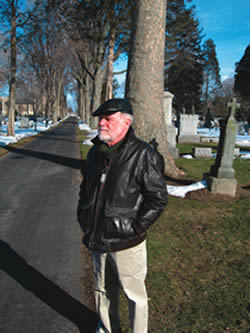
Ralph McInerny, whose body we buried there in February, liked to go for walks in Cedar Grove, too. He used to say of the cemetery a few hundred yards south of Notre Dame’s Main Building that when he walked there he felt as if he were attending a posthumous faculty meeting.
Although I was a mere 4-year-old when Ralph arrived at Notre Dame, I’m catching up with him. It won’t be long before I have as many colleagues and friends, Ralph himself among them, in Cedar Grove.
It’s a pleasant place to visit, and I do so more and more often. Despite its proximity to the busiest part of the campus, Cedar Grove is agreeably quiet, and its big solemn trees — most of which are oaks, maples and sycamores, belying the name — are fine to look at in any weather. The grounds are exhaustively gardened and manicured, and the older monuments feature unique and wonderful combinations of Victorian and immigrant Catholic styles. Because it is a well-trafficked cemetery, vigil lights, freshly placed flowers and other assorted mementi mori abound. In warmer weather, you sometimes see people picnicking among the graves.
From time to time, I picnic there, too, taking a carry-out sandwich and some coffee to an old friend’s graveside. For those of us who adore the incarnate God, keeping company with the dead is another way to revere life. To say so may seem cavalier, but death is no less fearful a thing for us than for others. “It’s always other people who die,” said Marcel Duchamp. We know better.
At the grave of my friend, I remember being with him when he died six years ago, surrounding his deathbed with his family and other friends in the cold blue fluorescence of a Manhattan hospital room, all of us, whether we’d read them or not, learning exactly what W.H. Auden meant when he wrote the lines:
The stars are not wanted now: put out every one;
Pack up the moon and dismantle the sun;
Pour away the ocean and sweep up the wood;
For nothing now can ever come to any good.
I sit where his bones are buried now and toss a few leftover Fritos to a brown squirrel emboldened by my stillness. I’m saying a prayer as I sit by that marble slab, knowing that I’m not praying alone, knowing that my friend and I are both praying to a God who knows exactly what Auden’s despair and our own feels like. A God with flesh like ours, who once longed and feared and died as my friend did; as I will.
Some women who visited another grave one morning were startled by angels who asked “Why do you seek the living among the dead?” If similarly accosted just now, I think I’d push back a little. What do incorporeal angels know about real flesh, the flesh that God and I and my dead friend all share? I seek the living here because my God himself is a man who was once as dead as my friend is and as I will be. I’ll seek the living where I please, and just now it pleases me to seek them right here in Cedar Grove.
In the earliest days of the church, in the catacomb of Callixtus in Rome, an anonymous Christian carved a few words over and over again on and around the tomb of a woman he loved. At times when I walk in Cedar Grove, that grieving Roman’s graffiti seems far less ancient. His wound, his longing, his hope and his faith become as palpable as the lump rising in my throat:
Sofronia, vivas cum tuis. Sofronia, may you live with your dear ones.
Sofronia, vivas in Domino. Sofronia, may you live in the Lord.
Sofronia dulcis, semper vives in Deo. Sweet Sofronia, you will live forever in God.
Sofronia, vives. Yes, Sofronia, you will live.
My friends, and I, too, live and will live. Forever. The day is coming when these graves will be empty.
Michael Garvey is Notre Dame’s assistant director of public information and communication.
I first learned about our body’s electron transport chain (ETC) while working in a biochemistry lab. This complicated process, which uses digested sugars to create an ion gradient that acts like a hydroelectric station for producing cellular fuel, has more belts and levers than a Rube Goldberg machine and can twist the mind like an M.C. Escher print.
Given the genius way ETC utilizes electrons, for days I couldn’t believe I was actually walking around. One of the lab’s doctoral students concurred. A practicing Catholic, Brenda told me that the more she learned about how our bodies work, the more awed she was by God’s creation.
It turns out that the electron transport chain is just the mystifying tip of an improbability iceberg so enormous as to be nearly ineffable. This biochemical process depends on atoms and ions. Physicists tell us these items, once created, cannot be changed or destroyed (except under the extreme conditions of stars and black holes). At a more basic level, this means that the atoms that compose our bodies, which swirl and spin and flow through us to give us energy and make us who we are in tens of thousands of different ways, have been around for billions of years. Compared to the relatively short time our consciousness occupies one of their creations, the elements always have been and always will be.
To be conscious, we need cobalt, which gives glass a radiant blue color. Part of vitamin B12, cobalt helps ensure we produce red blood cells to carry oxygen to muscles, organs and bones. It also helps form the myelin sheaths protecting our nerve cells. Without cobalt, we would suffer from anemia and our bodies would tingle with pins and needles. Perhaps more frightening, our brains would fog over, and we would forget who we are.
This indispensable mineral comes from the heavens. In fact, cobalt is part of the dust left over from stellar explosions known as supernovas. For solitary stars nine or more times more massive than our sun, life ends with what is the most powerful and spectacular explosion in the known universe. If one of our neighboring stars were to go supernova, the starburst would be visible during daylight and outshine the moon at night, no doubt inspiring myths, poems and songs.
Supernovas occur after a star has burned up its fuel, which the star needs to create enough energy to combat its own gravity. In other words, when the fuel is gone, gravity kicks in. The force that pulls apples to the earth also pulls the star into itself. In a matter of seconds, the outer surface — which may be large enough to encompass the entire orbit of Mars — is yanked inward. All those atoms smash into each other and create so much pressure that the small atoms merge into larger ones. Temperatures spike to over 100 billion degrees C (180 billion F). The pressure and heat blasts the new atoms into the cosmos.
Only supernovas pack the energetic punch necessary to create elements more massive than iron, like selenium, gold, mercury, tungsten and cobalt. For most of the lighter elements, a regular star does the trick.
Oxygen is one of these elements. Given our relationship to it and its role as a metaphor for purity and life, it is strange to think that it was born in the violence of stellar furnaces. That cool breeze on a summer day, that deep breath to calm us down, that crisp feeling in an alpine forest — all conjure the binary molecule that enables the electron transport chain and the life-sustaining masks of emergency rooms and surgery theaters.
Together with hydrogen, oxygen forms water, which is fundamental to not just our existence but to life in general. In fact, many scientists believe that life, let alone intelligent life, is impossible without water. But unlike oxygen, hydrogen has an exotic and still poorly understood origin: the Big Bang.
One theory says that before there was anything, there was a void — no matter, no space, no time. It was the state of things before the God of Abraham said: “Let there be light.” Using complicated mathematics, physicists turned this void into the chaos that birthed the Greek gods, an infinitely creative vacancy, swirling with particles and infinitesimal universes.
For every spontaneous appearance, a companion particle or universe pops into being. But the companion is an exact opposite. Since opposites attract, an instant after a companion springs to life, the particle and its companion race toward each other and their energies cancel and they cease to exist. In this timeless and spaceless abyss, chance eventually cranks out a particle the size of our current universe that somehow breaks from its opposite and erupts into life.
After 380,000 years or so, the elementary particles condense into neutral hydrogen and helium — the same hydrogen that imbues all aspects of our life. Every time we take a drink, breathe out or set the electron transport train in motion, we utilize atoms that have been around since creation.
Which happened nearly 14 billion years ago. Physicist Leonard Susskind argues that the human mind is not wired to consider such a large number. Because of the financial crisis, however, today many of us probably have a better understanding of what a billion means than we did a few years ago. A billion dollars is two space shuttle launches or enough to run Minneapolis schools for two years. A billion grains of sand fill a cube with edges just over 4 feet in length.
Still, when it comes to time, perspective is more difficult. A billion seconds ago Jimmy Carter was in the White House. A billion minutes ago, Romans fed Christians to the lions. A billion hours ago, early modern humans had spread over Africa and possibly to Southeast Asia, but not yet to Europe. A billion days ago, mammals were making their move and taking over the planet. A billion years ago it was multicellular organisms that were oozing through the muck to stake their claims.
Hydrogen and helium soared into space nearly 14 billion years ago. They then collected in massive clouds that contracted into stars. Many went supernova, jetting heavier elements into galaxies and nebulae. Roughly 4.5 billion years ago, the nebula that eventually formed our sun captured these star-produced elements in its gravity and coalesced them into balls of solid matter. On one of these balls, oxygen and hydrogen burned to form water. Minerals from stars and supernovae continued to rain down on Earth and blended with the water to establish the primordial soup needed to create life.
Around a billion years after our planet formed, a bolt of lightning kicked the soup into gear, forming molecules that laid the foundations for self-replication. These bumped into each other tens of trillions of times, exchanging elements and building more and more complex structures. This led to RNA, DNA, lipid membranes and, eventually, rudimentary life. Over the next 3.5 billion years, minerals and bases and proteins created prokaryotes, then eukaryotes, then fish, amphibians, reptiles, rodents, prosimians, apes and homo erectus. Finally, homo sapiens stretched its back and grabbed its tools to hunt for prehistoric wildebeest and gather berries and wild tubers.
Given ideal environmental conditions like those found on Earth, astrobiologist Andrew Watson puts the odds at 10,000-to-1 against life appearing.
But what are the chances of those conditions occurring? First the sun has to be in just the right spot. Any closer to the center of the galaxy and the radiation would burn through molecules attempting to form life. Any further out and there would not have been enough of the heavier elements to support life. Astronomer Donald Brownlee and paleontologist Peter Ward call this the Goldilocks zone, because it is “just right” for sustaining life.
It doesn’t end with the sun. Our solar system contains a Goldilocks planet: Jupiter. Because of its size it has the gravity to clean out all the asteroids that would have otherwise crashed into us. We also have a Goldilocks moon to stabilize our orbit, which is thankfully circular: an elliptical orbit would make our climate too variable for life. Our planet is also a Goldilocks size, just big enough to have the gravity to hold in the atmosphere but not so big that it flattens it against the surface.
All told, the chance of these multiple Goldilocks Zones aligning in just the right way is not a million-to-one or a billion-to-one or even tens-of-trillions-to-one, but something much higher. Attempting to compute the probabilities of each zone and apply them to Earth comes with so many assumptions that cosmologists have yet to settle on an answer. They do agree, however, that the odds are remote at best and near impossible at worst.
Still, for all practical purposes, the observable universe is essentially infinite. Current estimates give it at least 125 billion galaxies. Most galaxies have between 300 and 800 billion stars (with some having more than a trillion). Given those numbers, some of those stars will be the right distance from the center of their galaxies and have planets of the right size with the right orbits at the right distance from their suns. These just-right planets will have big sister planets to keep out the asteroids and little brother moons to keep them stable. After the planets cool, water could form and at some point life will crawl onto land and perhaps, just perhaps, evolve like it did on Earth.
Even if this is true, we are not out there. We are not a warlike alternative life form with a scaled head and an appetite for honor or a peaceful, wide-eyed botanist who uses musical notes to communicate. We are here, in the outer spiral arm of the Milky Way on 21st century Earth. So even if life is likely in the universe, this life isn’t. We don’t need to leave the planet to see that the possibilities are still mind-boggling.
Assuming natural events hadn’t nudged evolution in another direction or that historical events hadn’t unfolded differently, we could have ended up doing backbreaking labor among the first farmers in the Fertile Crescent. We could have lived in dire poverty at the edge of the Roman Empire before being sold into slavery and killed by Nero for ladling the soup wrong. We could have been burned in a Wicker Man or slaughtered by Genghis Khan or executed by an English monarch trying to stamp out Catholicism. And today we could have been born in war-torn Sudan, earthquake-stricken Haiti, genocide-suffering Rwanda, Taliban-ruled Afghanistan — when you consider all the possibilities of where we might have been given life, the chance to be alive today, in the developed world, in a land of relative plenty, is nothing short of miraculous.
When looking at the grandeur of the cosmos and marveling at how it led to life, the issue of whether there is a creator may be beside the point. Most of us believe great works of art should be maintained for no other reason than that they are beautiful. We do not need to know who painted the Sistine chapel or designed Notre Dame Cathedral to be awed and comforted by their magnificence. The same applies to life. As we venerate it, admire it, and stand in awe of its engineering and aesthetics, we must also take every opportunity to preserve it and share its blessings.
I do not know if life is a gift from God, a turn of the karma wheel or just pure chance (I prefer the first but suspect the last). But I share my former lab colleague’s reverence, particularly in light of all we’ve learned from cosmologists and biologists.
This means actively polishing our spirits and thus the spirits of others. By the time we reach our 30s, most of us have read enough philosophy and spiritual tracts, heard enough homilies or sermons, seen enough morality plays disguised as sitcoms, and meditated and prayed enough to know how to do this. In some cases, it may be nothing more than a kind word to a troubled cashier. In others it may be volunteering at the food bank. In still others, it may mean putting policies in place that protect the less fortunate or supporting international aid organizations through career choices or donations.
Of course it is hard. And we all know that getting cut off in traffic or waiting in a long line at the grocery store are trivialities compared to the suffering in the world. Yet they bring out the worst in us. (This is why the eponymous devil in C.S. Lewis’ Screwtape Letters advises his nephew to tempt people with these little things.) We also have our own context-specific pain to deal with, like breakups, losses, death, clinical depression, economic hardships, troubled children — you name it. This is why we need to keep studying and listening and meditating on the world around us.
Reflecting on the immensity of the universe can be part of that. The abyss may unnerve us when it stares back, but it still helps smash self-importance by placing our own unlikely being against that of others and that of creation as a whole. It humbles the ego and releases the spirit, allowing it to stand in awe at infinity, which can actually make it easier to wait in lines and handle close relationships while reducing hate, spite, jealousy and whining to energy-wasting indulgences. It helps remind us of our good fortune and that we also have the luxury to realize it.
By embracing the majesty of creation and acknowledging the miracle of our own blessed existence — including all the material struggles and emotional and psychological trials — we help ourselves and others sparkle like the stardust we are.
Mark Yates lives and works in the Czech Republic, where he has generated a drawer full of unpublished novels.
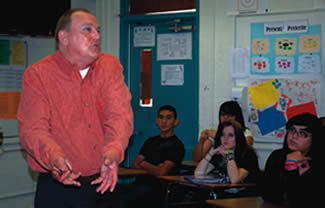
Jose Bautista treasures the moment when the teacher reached out to him, helping him pivot away from gangs and trouble.
Ramon Castillejo remembers the magic the teacher worked upon a boy named Hector, a recent arrival from Mexico whose tense struggle to adapt was eased by the teacher’s story about the noble hero of the Trojan War whose name he shared. And he tells how the teacher’s stories of the partnership of John and Abigail Adams spoke powerfully to students raised in a culture of machismo.
Cristina Galvez recalls the magical transformation of history class, from the dry distribution of fact that she had known in previous classrooms to an encounter with dramatic figures who reshaped the world.
Jose, Ramon and Cristina were students of Chauncey Veatch ’75 J.D., who retired from the Army as a lieutenant colonel in 1995 and launched a second career as a teacher. For his success in the classroom, Veatch, now 62, was named the National Teacher of the Year in 2002. He received the award in a White House ceremony.
The significance of Veatch’s work derives in part because of where he teaches. The Coachella Valley, about 60 miles north of the Mexican border, is an intense, concentrated expression of the demographic and cultural upheaval that a wave of Mexican immigration began in California four decades ago and that is now sweeping the country. Most of his students are immigrants or the children of immigrants who came to work in the valley’s vast fields of grapes, citrus and vegetables.
The valley is best known for Palm Springs, the affluent city that lies on its western edge, set tight against the jagged peaks of the San Jacinto Mountains, just south of the San Andreas fault. Nearby, 4,000 windmills fill the San Gorgonio Pass like massive metallic wildflowers. Their turbines spin electricity from winds brewed when hot air rising from the desert to the east sucks in the cool air from the Pacific Ocean.
Palm Springs got its start as a sanatorium but developed celebrity cache when Frank Sinatra partied here with his Rat Pack and Bob Hope, a local resident, hosted the Desert Classic golf tournament.
A few miles to the east is Indian Wells, one of the wealthiest communities in the world, whose residents live in palatial homes along golf courses sheltered from annoyance by perimeter walls and guarded by a sophisticated private security force. Part-time resident Bill Gates was once reprimanded for teeing up in a T-shirt, rather than the required golf attire.
The Toscana Country Club’s marketing boasts that Indian Wells “began as an exclusive retreat for Hollywood’s elite, captains of industry, and American presidents.” That snob appeal is part of a pitch that offers “a place to indulge in life’s exquisite pleasures" — in exchange for a $150,000 membership.
Two miles down the road from the lavishly landscaped splendor of the Greg Norman-designed PGA West course lies Coachella Valley High. The neat campus, swelling with portable classrooms, looks southward across irrigated farm fields toward a horizon drawn by mountain peaks and a stately line of date palm trees bent eastward by the wind.
Ninety-eight percent of the school’s 2,700 students are Latino. They are part of the big change in California since 1962, when it passed New York as the most populous state in the union.
Back then, about 83 percent of the state’s 17 million residents were non-Hispanic whites. Since then the population has doubled. As journalist Peter Schrag noted, 85 percent of the newcomers are “something other than white Anglos.”
They come from many countries, but Mexico is by far the largest source. “Currently, in public school enrollment, Latinos are already close to a majority. Anglos compose barely a third,” wrote Schrag in a book provocatively titled California, America’s High-Stakes Experiment.
The future of the United States is tied as never before to the future of immigrant children, particularly young Latinos.
That is why Veatch tells his students they are “children of destiny.” That is why he is determined to prepare them for the leadership roles that will beckon.
He brings into his classroom a passionate mind in love with learning. He also brings an extraordinary ability to connect with students and to enlarge their field of vision.
Several years ago, a researcher surveyed Veatch’s students to gauge their opinions of him. In order of frequency, the responses were 1) He cares about us; 2) He is fair; 3) He doesn’t say bad words; 4) He keeps his promises; 5) He knows a lot.
Nita Grantham, who visited Veatch’s world history class while working for the Riverside County Department of Education before Veatch received the teacher of the year honor, recalls the experience vividly.
It was a portable classroom, jammed with kids. Grantham was thrilled at its energy.
“I was in awe at how engaged those kids were and at the quality of the learning that was going on,’’ she says. “Chauncey would take a word that was part of the history curriculum, and he would show that its origins went back to Latin. Then he would take it on to Spanish and back to English. It helped them get a grasp of the word and made the word relevant.”
That sense of excitement, of joint exploration with his students, lies at the core of Veatch’s genius in the classroom.
“I tell my students that our class is like a wagon train heading out across this great expanse of learning to reach our goal — an education,” he wrote in an essay on his teaching philosophy. “No one will be thrown overboard; no one will be left behind. Together, we are all going to get there.”
Veatch is undaunted by discouraging data about Latino dropout rates that for decades have hovered at around 50 percent. A generation ago author Earl Shorris described the stakes, warning that “the multiplier effect of dropouts marrying dropouts and producing children who will drop out promises a 21st century Latino underclass of enormous size.”
Veatch shuns the litany of immigrant-community woe, which also includes the menace of gangs and high rates of out-of-wedlock births, and which some teachers cite as the reason for classroom failure. He refuses to be cowed by the educational deficits many students bring to school, difficulties sometimes compounded by the shadow of their families’ illegal immigrant status.
“I say ‘Get over it,’” Veatch says, blue eyes flashing. “That’s making excuses. That’s giving yourself permission to fail. My job is to move my students as far as I can in the course of the year. I don’t mean remediate. I mean accelerate, I mean do everything I can to help the student achieve the maximum.”
Veatch has developed a lexicon of aspiration. It conveys his conviction that his students can raise their sights from the flatlands, that they can be fired by a sense of possibility.
“A teacher’s job is to be a dream maker, not dream breaker,” he says. “I want to show my students a world without limits. I want them to understand the power of democracy, dreams and destiny.”
As he explained his teaching philosophy in an essay that was part of the National Teacher of the Year competition, Veatch wrote:
“There are two words that are frequently repeated during my instructional day: literacy and dreams. Literacy leads to success in school, success in a career, and success in life. A literate person will have more options in life. A literate person has a greater likelihood of becoming a lifetime learner.”
One concise formulation of the Veatch persona comes from Ramon Castillejo: “He’s an aggressive person. He’s a person who is assertive. But he’s also a humble person.”
Veatch hasn’t been content to make his classroom for those students who already are headed for success, who were oriented toward college and career and, most likely, out of Coachella Valley. He actively sought out those who were quivering at the edge of premature failure.
At the turn of the millennium, Jose Herrera was on a course for that burgeoning underclass that worried Earl Shorris. He was an angry 15-year-old, surly with resentment and tempted by the gang life that can lead to drug dealing and a dead-end — in prison or worse.
“I started hanging out with the wrong crowd, and I made some bad decisions,” Jose says. “Then the teachers and school administrators started labeling me as a troublemaker. I was getting harassed right and left, even when I was walking down the hallway. I started holding a lot of anger, and when a teacher would try to talk with me, I was like, ‘Get away from me!’”
It was a time pulsating with danger for Jose. He was close to a vortex that sucks its victims into a brutal subculture fed by the nihilism of the Latino gangster rap songs known as narcocorridos. These ballads glamorize drug traffickers whose lives spin inevitably toward doom. They often celebrate a certain type — el valiente, the outlaw who is tough and rich and generous and cruel. And certain to die a violent death.
It was in a Coachella Valley bar that the legend of narco balladeer Chalino Sanchez was made in 1992. As he sang on the bar’s stage, an unemployed mechanic shot him. Instead of going down, Sanchez pulled his own gun and chased his assailant through the nightclub. A few months after that, after a performance in the Mexican state of Sinaloa, he was seized and murdered, and the killers dumped his body on a highway.
Dead at 32, Chalino Sanchez became an idol, a Latino James Dean.
Los Angeles Times reporter Sam Quinones, perhaps the best journalistic chronicler of the Mexican immigrant experience, wrote: “Chalino’s corridos are about the only two figures in Mexican popular culture [who, in times of economic crisis] can consistently claim economic success: the drug smuggler and the immigrant; usually, in his songs, the same person.”
Says Jose, “When I was in high school everybody wanted to be like Chalino.” Jose wonders what could have happened to him. “All it takes is one wrong move to fall into that well so deep that you never come back. But Mr. Veatch intervened in my life at the perfect time for me.”
Nearly a decade later, Jose clearly remembers that moment.
“I was at a football game, walking up the bleachers, and Mr. Veatch was walking down. He shook my hand, and we started talking. He approached me in a completely different way. He treated me more like a young adult. He totally flipped me around.”
“If young people feel no connection,” wrote historian and social critic Christopher Lasch, “their dislocation is a measure of our failure, not theirs.” Jose Herrera’s success is a measure of Chauncey Veatch’s genius as a teacher.
Jose enrolled in Veatch’s history class and a financial literacy class that introduced him to the world of checking accounts and savings accounts. His grades shot to a 4.0. His world expanded as he grew interested in American history and government and became convinced that he could find a useful place in U.S. society. His surliness evaporated in the blazing heat of newly found self-respect and ambition.
Jose became a leader in the Cadet Corps, which Veatch established along the lines of an ROTC program. There he worked on community service projects and taught younger students how to march. After graduation in 2002 he became a Marine.
Now, seven years later, Jose is a manager-in-training for Wells Fargo Bank. He traces his interest in banking to the financial literacy class. And he aspires to teach at the Wells Fargo training center because Mr. Veatch showed him the excitement of being a teacher.
“I model my life after him,” says Jose. “He gave me the life I have now.”
Veatch says there’s a simple explanation for the connection he feels to migrant families. He was once a migrant himself, moving continuously in a youth that was defined by the astonishing frequency of moves required by his father’s military career.
“I grew up just about everywhere,” he says, running down a travelogue that included kindergarten in Germany, first grade in France, and second-grade classrooms in five states: Kansas, Texas, Missouri, Alabama and California.
“My dad was going to all these different schools for training. He was a helicopter pilot, and they had lots of eight-week schools. If my father went somewhere, my mother took us. We stayed intact as a family. That was very important to us.”
Veatch’s connection to Mexican migrants began when his family was living at Fort Ord, near Salinas, California, the home of John Steinbeck, whose Grapes of Wrath captured the Okies’ epic migration to California. Once the Okies left the fields, they were replaced by Mexicans. The young Chauncey did volunteer work in migrant camps.
In 1968, when he was enrolled at the University of the Pacific, Veatch was inspired by Cesar Chavez, the charismatic Mexican-American labor organizer who — with a dignity and spirituality that often drew comparisons to Gandhi — challenged the power of California growers as he built a movement that became the United Farm Workers of America.
When Chavez endorsed Robert F. Kennedy’s 1968 campaign for the presidency, Veatch joined the effort. On behalf of the union, he traveled widely to register new voters. At a rally in Salinas, Veatch marveled at the exchange of energy between the polyglot crowd and Kennedy. As Theodore White wrote of RFK in his book about the 1968 campaign, “The grabbing, pulling, screaming ecstasy made him feel alive.”
Veatch remembers an ecstatic surge of humanity around Kennedy — mostly Latino, but also blacks, whites and Filipinos. “His sleeves and coat were shredded from people just grabbing out to touch him. His security detail was struggling to keep him upright. It was an amazing sight.”
Veatch watched in awe.
“I remember thinking: this is a man who doesn’t share their culture, their race or their background, and yet he was able to reach out to them, to make contact with them in such a powerful way. I don’t think I’ve seen anything in my life more powerful than that. It was a huge inspiration for me. There was such power and grace. It confirmed what I had believed for a long time. It celebrated the ability to bridge gaps and differences.”
A confirmation of a different sort shaped his decision to go to Notre Dame. It grew from his experiences in Germany, where as a high school student he made several trips to Paris.
“Every time we went I would break off from the group to spend some quiet time at the Notre Dame Cathedral. Our Lady was especially important to me,” he says. “From the time of those visits, I thought I wanted to attend Notre Dame at some point in my life.”
In 1972, already in the Army, Veatch entered law school at Notre Dame. When he was elected president of the law school student body, he completed a personal, political trifecta that also included the student body presidencies at Frankfurt and at Pacific. Such political energy probably speaks to the hunger for connection that grows in someone who had been uprooted so many times in his youth.
One of the highlights of Veatch’s military career was his service in Panama, where the Army conducted nation-building operations aimed at restoring democracy in the aftermath of the 1989 U.S. invasion that overturned dictator Manuel Noriega.
The Army had prepared Veatch for the his role in that effort — dubbed “Fuertes Caminos” or “Strong Paths” — by sending him for Spanish-language training at the Defense Language Institute in California. Ironically, he spent much of his time in Panama working in isolated areas with indigenous people who spoke little Spanish. Often commuting to work in helicopters, he was part of a unit that built schools and clinics, and repaired roads and bridges.
Veatch was stationed at California’s Fort Ord in 1994 when a powerful earthquake wrecked buildings and crippled highways, killing 55, injuring nearly 5,000, and forcing thousands to camp in parks or seek refuge in shelters. Part of the relief effort involved providing linguistic support for work among the region’s ethnic communities, which included large numbers whose first language was Spanish, Russian, Armenian or one of several Chinese dialects.
Veatch had shown his talent at coordinating logistically complicated events 13 years earlier, where he was a military liaison officer for the committee planning the inauguration of President Ronald Reagan.
He took two indelible memories from that January 1981 week. The first involved an event where Air Force brigadier general and Hollywood legend Jimmy Stewart introduced five-star general and military legend Omar Bradley, who died three months later. The second involved an announcement Reagan made about the Americans who had been held hostage in Iran for more than a year, after the seizure of the U.S. embassy that dogged the presidency of Jimmy Carter.
“I was on the reviewing stand with the president and his guests,’’ Veatch recalls, “and in the midst of the parade President Reagan turned around to face us and said, ‘The hostages are out of Iranian air space.’ I remember thinking it was amazing to be there at that moment in history.”
After he left the Army, Veatch started his teaching career with modest expectations. He thought he’d be fortunate to work as a substitute teacher while earning his teaching credential and sizing up the field. But a California district that had been hemorrhaging teachers asked him to report the next day. Veatch, divorced and without children, jumped right in with a full-time job. He taught math, science, social studies and language arts for four years, picking up the proper credential at night.
Then he was recruited to Coachella Valley High, where he began teaching in 1999. Two years later, he was district teacher of the year, then Riverside County teacher of the year, then California teacher of the year. In April 2002, after a battery of classroom visits and interviews and essays, came the big moment in the White House where President George W. Bush hailed Veatch’s influence on students who moved from the detention to the honor role, abandoned gangs to learn military discipline in a Cadet Corps, and developed a passion for learning because of a teacher whose unrelenting belief in them stirred and nurtured a hunger for accomplishment.
One of the students who accompanied him to Washington was Ramon Castillejo, who had been a migrant worker himself before winning multiple scholarships to college. Ramon still delights in the lessons Veatch taught about John and Abigail Adams.
“He put a lot of emphasis on the fact that John Adams’s wife influenced him a lot, that she was very important to what he became,” Ramon says. “It meant a lot for us to learn that, because in our culture machismo is still very strong and a lot of the girls are a little scared to go to their parents and say, ‘I’m going to go to school; I’m going to do something you’re not expecting me to do.’ I could see that Mr. Veatch was teaching us about a great leader in our country, but he was also teaching a lesson in life.”
Ramon relishes the story of Hector, who came to class feeling awkward in his new surroundings and struggling with a new language. “Mr. Veatch knew that Hector was having a hard time, so he started talking about how people’s names are connected to people in history. He said Hector’s name went back to a great warrior. You could see how that made him feel, that it picked him up. I think it was great that Mr. Veatch did that.”
Veatch has a name for that teaching device. He says he brings his students “ennobling intimacies” with an important figure of history or literature.
Such encounters provide an uplift that generates a hunger to learn more. Now Ramon is himself dedicated to creating classroom magic that can inspire and transform lives. He teaches classes for Los Angeles County, training laid-off workers to reorient themselves in the job market.
Cristina Galvez says Veatch inspired her to want to make a difference in the lives of immigrant families, many of whom bring little education from desperately poor communities in Latin American hinterlands. “When he taught us about the people who changed things,’’ she says, “he taught us that we hold the power to make change, that we can go out there and make a difference.”
Cristina earned a master’s degree in marriage and family therapy and then went to work with Latino immigrant families in Orange County. There she helped start a program called From Cradle to College, which sought to instill a sense of greater possibilities to families that had known generations of peasant labor in Mexico.
Mexican scholar Luis Rubio has written that Mexico “has become a nest of privileges,” where only the privileged few learn to dream. “The rest have virtually no possibility of envisioning opportunities different from those that their social origin imposed upon them.”
From Cradle to College was an effort to widen the immigrants’ sense of possibility, notes Cristina. “The idea was that you start to achieve success in the cradle, you start with the idea that this child will go to college, instead of ‘maybe’ or ‘I don’t know.’”
Cristina is now married to Jesus Cano, who as a student helped Veatch drill the Cadet Corps color guard into a squared-away unit that repeatedly won drill competitions across Southern California. Jesus, who once thought that his future was the same field work of his parents, served with the Marines in Iraq and is now attending college on the G.I. bill and aiming for a career in the California Highway Patrol.
In late 2009, Veatch joined Cristina and Jesus at a Mexican restaurant a few miles from Coachella Valley High. Sitting beneath paintings of Mexican village life, they traded stories of their time together and Veatch talked of his hopes for all his students. “I want to contribute to the impetus for them to be constructively, actively engaged citizens.”
Cristina nodded in enthusiastic affirmation of the mission.
Like a number of former Veatch students, Anabel Vasquez and Maribel Cardenas are now teachers themselves. Both aspire to duplicate the energy and dedication they saw in Veatch. “We look up to Mr. Veatch as a role model,” says Cardenas, “because we saw how much he cared, not just about our education but about us. He was dedicated to us.”
Because of his being National Teacher of the Year, Veatch was able to send two young women to the International Space Camp in Alabama, representing the United States in an international celebration of space exploration. “We were proud to be representing our country, and we were proud to represent Mr. Veatch,’’ says Vasquez. “He’s definitely our angel. We wouldn’t be where we are without Mr. Veatch.”
Echoing a sentiment that is widely held in Coachella Valley, Cardenas adds, “I can’t imagine my life without Mr. Veatch.”
Jerry Kammer is a senior research fellow with the Center for Immigration Studies in Washington, D.C. He is a former Northern Mexico correspondent for the Arizona Republic, and he wrote about immigration and U.S.-Mexico relations as a reporter in the Washington Bureau of Copley News Service. In 1989 he won the Robert F. Kennedy journalism award for his reporting from the border.
Classroom photo of Chauncey Veatch by Cindy Soria.
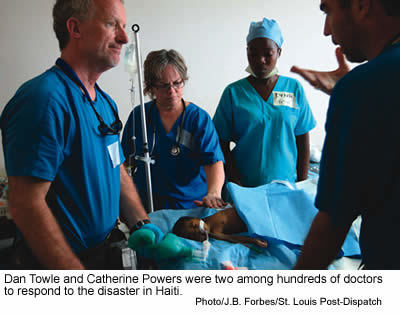
Sister Esta Joseph, C.J., baked a cake and a pizza whenever she knew Emil Hofman was coming.
Over the past six years, Sister turned out a lot of cakes and pizzas. Hofman made a point of visiting her at Saint Rose of Lima parish school every time he visited Léogâne, Haiti.
The legendary Notre Dame chemistry professor guesses he’s traveled to Haiti a dozen times during that span, leading his “Hofman Reconnaissance Trips,” mostly for groups of experienced doctors who share one thing in common. They are Hofman’s former students. Many are men and women he taught 20, 30, 40 years ago. Today they are medical school professors, surgeons, ER physicians, anesthesiologists, pediatricians, urologists, research biologists. To Hofman, they’re all “my freshmen.”
“I never stay more than a week,” Hofman recently said. Saint Rose of Lima is one of several priorities on his itinerary. The idea, he explained, is to give the doctors an overview, “so they can see whether they want to come back at some other time to practice their specialty. And most of them do.”
So a few times a year Hofman and these Notre Dame docs stepped out on the verandah above the schoolyard at Saint Rose of Lima, where the girls, smiling and beautiful in their sky-blue gingham uniforms, typically began the rites of hospitality with school songs and an a cappella rendition of the Haitian national anthem. Their guests responded with the Notre Dame alma mater and the fight song.
Hofman began 2010 with one such trip. Though the group was smaller and included Hofman’s grandson, Colin, a Notre Dame senior, the routine was no different — except that Hofman, 88, took ill. An infection was attacking his kidneys, and with great difficulty the professor boarded a plane on January 8 and returned to the United States.
Before her guest left, Sister Esta Joseph pressed a note into Hofman’s hand, thanking him for the gift he’d left in her care as principal the last time he’d visited. It was his custom. This time the money had financed sanitation and hygiene improvements at the school, and Sister, who had dictated the note to a translator, blessed him. “All the school say thank you and wish you 12 months of blessings, 52 weeks of happiness, 365 days of health and 8,760 hours of love,” it read.
One month later, over lunch in the Corby Hall dining room, Hofman shared the note with Father Thomas Streit, CSC, and a guest. His hand trembled as he held a photograph taken of the schoolgirls, bunched together and laughing as a nun tried to restore order.
Hofman’s voice broke as he remembered saying goodbye to the holy woman who had become his friend. “She was killed in the damn earthquake,” he sobbed.
“She was a saint,” Streit affirmed, placing his hand on his old professor’s shoulder.
A biology professor and director of the Notre Dame Haiti Program, “Pere Tom” has called Saint Rose of Lima home for much of the last 17 years while conducting tropical disease research in Haiti, where healthcare has long lagged badly even behind other poor nations.
“The sister in the picture was killed, too,” Streit said. So were two others. “Hopefully the students were not, because that was the morning group. The afternoon group, about 150 kids were killed.”
According to government estimates, the “damn earthquake” of January 12 claimed the lives of some 230,000 Haitians. While frequent tremors terrified survivors in the month after the disaster, an estimated 300,000 received treatment for injuries. Tens of thousands more face a perilous future that promises battles with infected injuries and disease aggravated by dehydration, malnutrition, heavy spring rains and the merciless sun.
The devastation also directly hit the Notre Dame family. Emmanuel Guillaume, a Haitian seminarian of the Congregation of Holy Cross — which has served Haiti since 1944 — died instantly. John Kloos ’74 lost his son, Ryan, 24, and rushed to the hospital in Miami where his daughter, Emily, 26, was admitted with life-threatening injuries. The siblings were serving in Haiti with Friends of the Orphans, an international children’s aid organization.
The disaster destroyed nearly everything in a relatively small area of the country that happens to be its most populous. Look at a map of Haiti and imagine it as an outstretched hand, thumb in the north and palm in the south. Léogâne, the small, coastal city closest to the epicenter of the 7.0 quake, rests in the palm’s inner curve, about 18 miles west of the capital, Port-au-Prince.
Two of the very few buildings left standing in Léogâne house the Haiti Program, where Father Streit ’80, ’85M.Div., ’94Ph.D. and his staff of 35 labor with realistic hope of ridding the country of lymphatic filariasis (LF), a mosquito-borne, parasitic disease that can cause the grotesque swelling of the legs, female breasts and male genitals known as elephantiasis. Though rarely fatal, the deformation often leaves victims debilitated and ostracized.
The evening the earthquake struck, Streit and several members of his staff were in Port-au-Prince attending a conference of Notre Dame’s partners in the fight against LF at the Hotel Montana. The tone was upbeat. Participants outlined plans to treat preventatively half of Haiti’s nine million people by the end of the year and eradicate the disease later in the decade. Relaxing after an early adjournment, Streit, Sarah Craig ’98MSA, Logan Anderson and Marie-Denise Milord, a Haitian doctor and public health official studying at Notre Dame on a Fulbright scholarship, survived the hotel’s instant collapse. Streit made phone contact with Notre Dame and then lost touch for several days.
In Léogâne , program acting director Jean-Marc Brissau’s sense of isolation deepened. Initially forgotten as international relief organizations rushed to the broken capital, Léogâne had no airport to receive supply planes. With no cell phone service or Internet connection at Residence Filariose, the two-story house where community leaders had gathered for LF information meetings and Hofman and other guests had stayed during visits, Brissau ’08LLM watched as thousands of homeless neighbors gathered in tents and makeshift shelters outside the compound in search of food, water and medical assistance.
Brissau mobilized the staff, offered what he could to the refugees and worked to re-establish communication. When by the weekend it came time to find a place for relief planes to land, he identified a stretch of road he remembered drug runners using as a runway for cocaine drops. He contacted U.N. officials, who dispatched troops to provide security escorts and crowd control.
That is how, when help finally arrived in Léogâne six days after the quake, Notre Dame found itself in a unique position to support the relief effort. To the doctors who flew in with food and medicine on single-engine planes, the ND haven seemed nothing short of providential.
Ralph Pennino ’75 had been there before. So had Kevin Olehnik ’78, Marty Dineen ’74 and several other doctors who responded to Pennino’s summons in the weeks after the earthquake.
Pennino, a plastic and reconstructive surgeon, is founder and president of InterVol, a Rochester, New York-based network of healthcare providers and volunteers that coordinates and delivers medical care, supplies and professional support to places around the globe in need of it. He led three missions to Haiti in the 1990s and returned again in 2008 with Emil Hofman.
After his 2007 Hofman trip, Olehnik had stepped out of his orthopedic specialty to draft teams of urologists who, like Dineen, perform hydrocele surgeries on male victims of elephantiasis. He was among the first to respond to Pennino’s call for a team of surgeons and anesthesiologists, including Daniel Towle ’77, who could relieve the agony building up outside the Notre Dame compound.
While InterVol volunteers packed supplies and medicines donated by Rochester General Hospital and contacts around the country, the doctors petitioned their own networks for medicine and equipment. The response was overwhelming. A Rochester wine distributor, Constellation Brands, offered its corporate jets to shuttle the volunteers and their supplies to the staging airport in Haiti’s neighbor, the Dominican Republic.
Pennino arranged for another donation of air transport from the DR with Tradewind Aviation, a charter flight company, enabling doctors on Léogâne Team I to arrive in Haiti nine days after the earthquake. Landing on the highway outside town, the plane was rushed by locals desperate for food and water. Surrounded by armed U.N. soldiers, the doctors and flight crew hastily loaded 3,000 pounds of supplies and food onto trucks for the 15-minute trip into town.
“We traveled in silence, basically because the moment we hit the city I think everybody was just absolutely horrified and in awe of what they were seeing,” said anesthesiologist Towle, a 25-year veteran of international medical work. “Nothing prepared you for this.”
People were still trapped inside the pancaked buildings. Signs lined the road: “Please America, help us.” “Welcome America.” “Welcome Marines.” Inside the compound, Pennino’s group found that other teams of physicians had set up operations in the nursing school adjacent to Residence Filariose. They could hear the screams of patients enduring amputations performed without anesthesia.
Pennino and Olehnik scrubbed up to help with a complicated hand crush surgery, and Towle’s medical partner Catherine Powers provided the anesthetic. Towle claimed some “reserved” vacant rooms and began tearing open boxes and throwing supplies around to establish turf. The team pulled tables together and set up operating rooms for its first full day of surgery.
The first InterVol team performed 120 surgeries over the next 10 days. Until Towle found a local supplier, he and Powers anesthetized patients without benefit of oxygen. Electricity was limited to a few hours a day. Temperatures soared to the high 100s. The rudimentary sterilization procedures available to the Haitian nurses who stayed to help rather than leaving to find their families were undone by sweat and dust and the fans that drew air in through vents 15 feet away from the tent city growing outside the OR walls.
When the tremors shook — three or four times each day — dogs began to howl. Mothers cried for their children. Those who had roofs were afraid to sleep under them. But at 4 o’clock every morning, the doctors heard hymns of praise rise up outside the gate. “It’s a Catholic country,” Towle said. “Some sort of leader would show up, and people would gather. We laughed about it the day it didn’t start until 4:30, wondering, was he late?”
Between the dogs and the roosters, sleep was hard to find. The doctors rose by 6 in air that hung like wet wool. At daylight, patients arrived. Families carried their wounded on blankets and tree limbs. Some made their own way on homemade crutches. Others came in the arms or Humvees of U.S. Marines, or the trucks that circulated through nearby villages to pick up the sick and wounded. In the field hospital that a medical team from Iowa set up in the ND yard, doctors treated a steady flow of 300 outpatients per day.
The surgeons, through translators, had to console their patients several times before they could operate. “We had patients who said, ‘No. You’re going to cut off my foot. I’d rather go home and die,’” Towle recalled. The team kept them around until they relaxed and learned to trust. Towle took a picture of one fearful woman’s repaired feet to show her when she awoke after surgery. “We both burst into tears,” he said.
At night, the doctors gathered around a fire of burning trash with their colleagues from World Wide Villages, Save the Children and the Children’s Nutrition Program. They drank hot Haitian beer and traded stories and ideas.
The first surgical team at “Léogâne Shock Trauma Hospital,” as its staff came to call it, performed only two limb amputations. They pronounced three deaths; one was a 100-year-old woman whose body couldn’t handle the antibiotic fighting her infection. They delivered babies, many premature, the mothers’ bodies unable to withstand the fatigue, stress and hunger. Most made it. Some didn’t. The ones who did were balm. “I loved it,” Towle said. “Amidst all the death and tragedy, a baby was being born. Hopefully into a decent world. Who knows?”
When Team II flew into “Léogâne International Airport” — the name another instance of field humor — Towle and Olehnik stayed behind a day to orient the new team. The weather cooled. As the disaster neared one month, demand for trauma care began to subside at the ND compound and the other field hospitals operating in town. “Our biggest concern is post-op healing,” Pennino wrote in one of his regular email dispatches. “We have no inpatient capability and patients are sent back home — aka refugee camp — to return for post-op wound checks.”
Ricocheting between Rochester and Léogâne, Pennino continued to recruit doctors and donors via InterVol. At Notre Dame, valedictorian Brennan Bollman ’09 had taken leave from her first year at Harvard Medical School to coordinate offers of medical help through the Haiti Program office. Word of the response effort — and of Notre Dame’s role in it — was spreading through informal networks as well as such established channels as the Tom Dooley Society.
Five weeks after the earthquake, Léogâne Shock Trauma Hospital shifted operations to an improved field hospital provided by a World Wide Village donor. Pennino reported 7,000 patients treated and 250 operations performed. “Incredible,” he wrote,” is an understatement!”
The ND campus responded to the crisis with creativity and determination, beginning with a well-attended Mass for Haiti on January 18. The University raised nearly a quarter of a million dollars in donations, gate receipts and concessions revenue at the men’s and women’s basketball games the following weekend.
Students took up a collection at a faculty panel on Haiti. Others put together a benefit concert, a tent-and-tarp collection in conjunction with South Bend-area Boy Scouts, and a “Polar Bear Plunge” in which 100 undergrads dipped into the 40-degree waters of Saint Joseph Lake. Senior Jeffrey Lakusta secured commitments from wineries to donate a cut of their sales to relief agencies.
Much of this money supported immediate relief efforts. But the University had already begun to think about its long-term role in Haiti, where the disaster crumpled hospitals, schools and churches as indiscriminately as people’s homes.
No longer a missionary effort, Holy Cross’ presence in Haiti is native-born and growing fast. The pain of seminarian Guillaume’s death was compounded for his religious brothers and sisters by the destruction of the provincial house. Many of the eight parishes and 10 schools the order serves were badly damaged.
Hope and vision at Residence Filariose are as strong and tall as walls that withstood the January 12 quake, thanks to Father Streit’s consultations with ND civil engineering Professor Yahya Kurama earlier in the decade. For now, Haiti Program staff have become relief workers. Like their partners in the Haitian government and a cluster of cooperating organizations, they recognize that fractures and flesh wounds come before LF treatments, deworming and iodine deficiency in the triage line.
Still, Streit believes the program can press its effort outside the West Department, the district that encompasses the nation’s worst structural damage. Even the Port-au-Prince warehouse where the program subsidizes the production and sale of salt fortified with iodine and the antiparasitic drug that fights LF is structurally sound and operable. With support, Streit thinks Haiti Program clinicians could add critical services like bednets, malaria drugs, Vitamin A and iron.
He is sensitive to the impact relief efforts can have on Haitian institutions. Hôpital Sainte Croix, his lead research partner in Léogâne, was already struggling before the disaster. Once it rebuilds, it may have to compete with sturdier relief organizations just to stay open for that day when the last foreign medical teams depart. The competition extends to personnel. Streit himself lost two recent hires to Doctors Without Borders, “but I’m happy that they’re working to help get us out of this situation,” he said.
He trusts that experienced agencies share the ethic of “building local capacity” — training and employing Haitians to do most of the work, a key component of the Haiti Program’s success to date. It’s important, he says, to make sure Haitians are prepared to build a future in which healthcare, education, business and government function radically better than they did in the pre-January 12 past.
Once Haiti’s emergency needs lessen, capable volunteers are welcome. Notre Dame Professor Karen Richman has posted Creole language course materials at the University’s open courseware site, ocw.nd.edu, for cooperative self-starters ready to do anything from dropping a well to building homes and churches to comforting orphaned children. Streit likes the idea of something like a Hofman trip for non-medical personnel so people can think about how to plug in.
Hofman himself yearns to return. “I’m 88 years old, and I want to do with the rest of my life what is worthwhile,” he said in February, sitting in his blue ND parka and sipping soup in Corby Hall. “I found what is worthwhile, and it’s what we were doing there. Very, very much so.”
John Nagy is an associate editor of this magazine.
Reports filtered back to campus in January and February of alumni who made financial and professional sacrifices to join the relief effort in Haiti after the January 12 earthquake.
In addition to the InterVol-ND teams, physicians volunteered under the auspices of numerous nongovernmental organizations in Port-au-Prince and other towns. William Devir ’73 led a group of federal disaster responders as part of a U.S. Department of Health and Human Services effort that treated nearly 30,000 patients in the first month.
As vice president of overseas operations for Catholic Relief Services (CRS), Annemarie Reilly ’88 coordinated the $95 million outreach of the U.S. Catholic Church as underwritten by the donations and volunteer hours flooding in from thousands of parishes — and many ND alumni clubs — around the country.
Reilly says CRS, which has served more than 50 years in Haiti, views the recovery as a 5-to-10-year project. CRS encourages all people to help Haiti through prayer, education and action. As the international aid arm of the U.S. bishops, CRS is developing policy positions regarding federal aid, refugees and related concerns.
The University is working to strengthen the Notre Dame Haiti Program’s determined fight against lymphatic filariasis (LF) and to rebuild Holy Cross ministries damaged by the quake. “What can people do?” asks Haiti Program director Father Tom Streit, CSC. “Well, I would say, what are your skills? What is your passion? If you’re patient and flexible, you’ll find a way to help because the list of needs is endless.”
Learn more about the Haiti Program and LF at haiti.nd.edu. Eyewitness accounts and information about the recovery effort are available at haitidisaster.nd.edu and Notre Dame Magazine’s website. To make a contribution to Notre Dame initiatives, call 574-631-9385 or visit supporting.nd.edu/haiti
Photo of Haitian girls with water jug by J.B. Forbes/St. Louis Post-Dispatch.
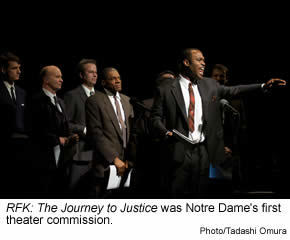
Anna M. Thompson decided to read one last email before calling it a day.
It was nearly 11 p.m. when the executive director of Notre Dame’s Marie P. DeBartolo Center for the Performing Arts (DPAC) clicked on the message from Greg Phillips ’66. Phillips had been in the Decio Mainstage Theatre audience a few hours earlier for the L.A. Theatre Works’ world premiere performance of RFK: The Journey to Justice.
“Keep up the good work of bringing all types of works here and continue to push the envelope of making us think instead of just sitting and being entertained.”
The line that ended that impromptu thank-you note has kept Thompson smiling for weeks. “That’s exactly what we’re trying to do,” she says. “Exactly.”
When Thompson arrived on campus in the summer of 2007, the University made a commitment not only to showcase some of the world’s top performing artists but also to help them cultivate new works to bring to the DPAC’s five stages.
“There’s a trust that we’re building not only with performing artists but with our own patrons,” Thompson says. “We know if they go home and talk about something for a week they’re not only going to come back they’re going to be more willing to try something else.”
Since the 2008-09 Visiting Artist Series, the University has showcased eight new commissioned works by such artists as the Kronos Quartet and Wu Man, the Richard Alston Dance Company and Tim Robbins’ The Actors’ Gang. The University has already commissioned at least six more works for the 2010-11 and 2011-12 seasons — most notably The Actors’ Gang’s anticipated stage adaptation of author Howard Zinn’s A People’s History of the United States — in a growing effort to establish the University as a leader in the creation of new works in music, dance and theater.
“What if we had no more new music?” Thompson says. “What if we had stopped with Bach? What if we said, ‘Okay, nobody’s going to do better than that. Let’s stop now.’ If that happened the world wouldn’t have gotten to hear Mozart or Stravinsky. Can you image a world where nothing new was being created? I feel it’s our responsibility to make sure that doesn’t happen. I think it’s one of the most important things we’re doing right now. There’s a cultural legacy that we have to leave.”
Formerly the executive director of fine arts programming at the College of Saint Benedict and Saint John’s University in Minnesota, Thompson has long been an advocate for investing in the creation of new performance works, especially in the world of dance. She often likens such commitment to the arts as being as important to higher education as funding research in the sciences — both allow new discoveries and exploration of ideas.
The response to January’s RFK: The Journey to Justice, the University’s first theater commission, seems to echo that sentiment.
The performances cross classic theater with old-time radio shows, featuring actors with scripts in hand delivering their lines into microphones placed around the stage. Written by playwrights Murray Horwitz and Jonathan Estrin, the production examines the Civil Rights movement through the lens of Robert F. Kennedy’s political life, showing his evolution from ambivalence to passionate race-relations crusader from 1960 to ’68.
Notre Dame served as lead commissioner on the project, with Stanford University, the University of Maryland and the University of Richmond also contributing.
“Notre Dame did what any good commissioner does,” says Susan Loewenberg, the founder and producing director for L.A. Theatre Works. “They gave us the money and left us alone. They trusted us to come up with something that was good. What they were able to do on their end was to put together discussions, a matinee performance just for students and professors; I even did a class about the politics of the play. It’s a wonderful way of exposing how you can use the arts in all kinds of ways.”
The addition of such educational opportunities across the University community, Thompson says, also can provide rare firsthand examinations into the creative process that can be applied in multiple disciplines.
“We can’t talk to Beethoven or Mozart,” Thompson says. “But to be able to sit down and have a conversation with [British choreographer] Richard Alston about a new dance piece is a very different experience, maybe a once-in-a-lifetime experience, for faculty members and students.”
Although the 2008-09 season was Thompson’s second as executive director, it introduced her first year of artistic programming. With the support of grants, donors and budget reallocations, Thompson was able to commission works by dance troupes Diavolo and Spectrum Dance Theater as well as the world premiere performance of a Terry Riley composition by the Kronos Quartet, a San Franscisco-based ensemble, with soloist and pipa player Wu Man. Since most of the money came out of a fund to pay visiting artists’ fees, Thompson says she had to be more selective in the performers she brought to the University’s stages.
“It may have shifted the way our season looked,” Thompson says “but it certainly didn’t affect the quality of artists we could bring to Notre Dame. The Kronos Quartet has now performed that work all over the country, and in every program it says ‘commissioned by the University of Notre Dame.’ That brings equity to the University, and it brings equity for a performing arts center that’s only six years old.”
Although Thompson doesn’t dictate the subject matter for commissions, she does seek out artists who will develop complex projects that fit the University’s mission. In addition to civil rights, a subject closely tied to the University through the work of former University president Rev. Theodore Hesburgh, CSC, Tim Robbins’ group presented The Trial of the Catonsville Nine. The play follows the trial of nine Catholic activists, most notably brothers and priests Philip and Daniel Berrigan, who entered the Selective Service offices in Catonsville, Maryland, on May 17, 1968, removed 378 draft records and burned them in the parking lot.
Loewenberg of L.A. Theatre Works says being commissioned by a university often provides a much greater chance for such works to be seen.
“It’s become very popular for foundations to commission playwrights, but 97 percent of them are never performed,” Loewenberg says. “They may do readings and workshops, and that’s that. If they aren’t sure they can make money off of it, especially in this environment, they won’t put it on.”
Thompson understands that.
“If I were a community theater looking right at the bottom line, I’m not going to be doing a play like RFK,” she says. “I’m going to do Bye Bye Birdie.”
Creating original works can take anywhere from 18 months to two-and-a-half years to produce, and can cost anywhere from $5,000 to $50,000. Thompson says her goal is to have between two to six commissions and at least one world premiere performance at the University per academic year. She also says that she hasn’t come close to spending $50,000 on a commission since arriving at Notre Dame — but she hopes to.
“We’re not there quite yet,” she says, “but we’re working on it.”
Jeremy D. Bonfiglio is a South Bend-based freelance writer and the staff features writer for The Herald-Palladium of St. Joseph, Michigan.

Rising four stories above Notre Dame Avenue, Stinson-Remick Hall may well be unique among Collegiate Gothic buildings for housing a high-end cleanroom for nanoelectronics research. This union of institutional tradition and scholarly vision, say the new building’s gladdened inhabitants from the College of Engineering, is but one way it captures what is best about Notre Dame, past and future.
Professor Patrick Fay ’91 is one of these happy occupants. His research on next-generation semiconductors and high-performance electronic devices is an example of the pioneering work ND engineers and scientists may now perform with greater confidence and productivity because of the cleanroom’s dust-free environment and the research-minded designs of the building’s other labs and workspaces.
“The former dean of engineering, Frank Incropera, used to say that we were doing first-rate science in third-rate facilities,” Fay says while narrating his lab’s move-in-progress from Fitzpatrick Hall to Stinson-Remick, which opened in January. “This basically gets rid of the third-rate part. We were doing a lot of stuff to work around the limitations of the facility. That will not be the case anymore.”
Several Stinson-Remick labs will operate synergistically with the cleanroom as key components of NDNano, the University’s Center for Nano Science and Technology. Together they’ll support the multidisciplinary labors of electrical and chemical engineers, computer scientists, chemists, physicists and others on materials and processes one million times smaller than the head of a pin.
Empowered by the new facilities, NDNano researchers will accelerate their leadership of a young, industry-funded consortium of university, government and industry partners called the Midwest Institute of Nanoelectronics Discovery. MIND’s quest, in conjunction with three similar regional research hubs elsewhere in the United States, is to map out and move toward the smaller and faster future of the computer chip. Many expect this research to seed substantial, long-term economic growth in South Bend.
Along with NDNano, the new hall will house two additional recipients of multimillion dollar strategic research investments that the University announced in 2008. One is Professor Paul Bohn’s Advanced Diagnostics & Therapeutics initiative. Another is the Integrated Imaging Facility, a unique collection of powerful microscopes that will allow dozens of ND scientists and engineers — and visiting scholars — to better see the objects of their study.
The building’s two other major research programs target the future of energy. Directed by Professor Joan Brennecke, the ND Energy Center is already making major contributions in clean coal technology, carbon sequestration, safe nuclear waste storage, renewable energy resources and related matters. And last fall, Professor Peter Burns secured an $18.5 million U.S. Department of Energy grant to establish a federal Energy Frontier Research Center. Burns and his colleagues will study actinides — key elemental ingredients for tomorrow’s nuclear energy solutions — at the nanoscale.
The building itself will teach students about energy efficiency. General Electric has donated a 200-panel solar array, and natural gas provider NiSource installed a microturbine. These sources will meet a small fraction of the building’s energy demand and will trim costs, but their primary value is the downloadable data they will provide to students learning firsthand about energy efficiency. Stinson-Remick’s low-flow toilets and reuse of exhaust heat to warm incoming air are two among dozens of features that architects hope will earn the building LEED certification — a designation of environmental sustainability — later this year.
For the average visitor, though, the cleanroom is Stinson-Remick’s showpiece.
The nanofabrication facility that Fay directed in Fitzpatrick wasn’t “clean,” which for engineers means devoid of the microscopic aerial debris that can spoil research on all things tiny — like the delicate transistor circuits of which high-speed electronics consist.
“In a circuit, every transistor has to work,” Fay explains. “If a piece of dust lands on one of them, the whole circuit’s finished.”
Here, clean can be quantified. The cubic foot of air from which you’re now drawing breath likely contains millions of tiny particles mostly innocuous to everyday life, and even to much valuable scientific research. Stinson-Remick’s three cleanroom bays shave that down into mere thousands per cubic foot — or even fewer than 100 in the amber-lighted space where researchers will use leading edge photolithography instruments to fabricate and manipulate semiconductor chips finer and faster than they could before.
Fay, of course, won’t be the only one to make use of the cleanroom. He recently tallied 139 professors, postdocs and graduate students whose research needs in fields directly tied to NDNano — high performance electronic devices, optical electronic processes, microelectromechanical systems and nanomagnetics — as well as in microfluidics, will benefit.
That number doesn’t account for undergraduate research apprentices or the grant-funded, visiting summer students seeking research experience. Nor for the hundreds of undergrads in the college’s five departments who may observe the cleanroom at any time through the glass walls that separate it from Stinson-Remick’s sun-flooded student commons.
The close proximity of pathbreaking research to the McCourtney Learning Center, located on the building’s first and second floors, may be what most excites Peter Kilpatrick, the McCloskey dean of the College of Engineering.
“What we anticipate is that undergraduate students will frequently be bumping into the best researchers — both faculty and graduate students — in the college. And that’s exciting. We want undergraduates to be intrigued by, curious about and motivated to do research,” he says.
Kilpatrick cites Notre Dame’s traditional difficulty with spurring students toward graduate study while explaining the rationale behind the building’s dual research-teaching purpose. He wants graduate school to become an attractive path on day one.
“If every day when they come over for their freshman learning lab experience they see researchers behind the glass in the cleanroom working away, I think they’re naturally going to get curious,” he reasons. “What’s going on in there? Why are they dressed up in bunny suits? What’s that all about?”
Students had an active hand in designing the building’s common spaces, the Kitz Kafé coffee shop and the learning center, which facilitates students’ work on hands-on project assignments. The labs, project rooms, study nooks and computer clusters that comprise the center quadruple the space formerly set aside for them in Cushing Hall.
The learning center’s old digs were like a one-room schoolhouse for undergraduate engineers. The management knots that created for Natalie Gedde, the center’s manager, were constant. During the day, she says, the numerically dominant freshmen habitually floated into the senior electrical engineers’ workspace. Aerospace engineers worried about their airplane models. Everyone vied for computer time and storage.
Now undergrads will have bioengineering and chemical engineering labs in separate rooms down the hall and around the corner from the workshop where their peers in civil and mechanical engineering are sawing into wood and PVC. One perk of the extra elbow room, Gedde expects, is that more professors from across the college will think about incorporating the center’s resources into their courses, rather than writing them off as the domain of the undeclared First Year.
Kilpatrick hopes Stinson-Remick’s Holy Cross Chapel will more clearly align the college with Notre Dame’s Catholic mission and forge bonds among students, who traditionally identify with each other by department. To his knowledge, it’s the only chapel inside an engineering building in the country, and the only chapel on campus dedicated to the religious community that built Notre Dame. Its four stained glass windows depict, left to right from the pews, Saint Joseph, Our Lady of Sorrows, Father Basil Moreau, CSC, and Brother Andre Bessette, CSC, on backgrounds illustrating the four seasons.
Stinson-Remick Hall was named for lead benefactors Kenneth Stinson ’64 and John Remick ’59. Together with a third engineering alumnus, Ted McCourtney ’60, their contributions covered well over half of the building’s $70 million design and construction costs. BSA LifeStructures of Indianapolis was the architect and engineer of record. RFD of San Diego and Abbie Gregg Inc. led various aspects of cleanroom and lab design.
Now that the new building is up, Kilpatrick says the next step is to rehabilitate Cushing and Fitzpatrick Halls and reassign vacated spaces to meet his college’s dynamic needs.
John Nagy is an associate editor of Notre Dame Magazine.
Clean room and Stinson-Remick Hall photos by Matt Cashore.