Author: Carol Schaal

  • Seen & heard on campus

    Springsteen concerts aren’t the only performances selling out in 12 minutes these days. The Keenan Revue’s long tradition of entertaining, shocking and ridiculing audiences continued this year before three nights of packed houses at Saint Mary’s O’Laughlin Auditorium. The 2010 theme, “Keenan RevueS.A. vs. RevueS.S.R. . . . A Cold War Revue,” provided a backdrop of patriotism and thick accents amid lots of red. The revue featured student musical performances and jabbed at a recent former Notre Dame quarterback in the skit “Going Professional.” Audiences groaned at several “too soon” moments, such as cracks at Tiger Woods and a reference to “The Jackson Four,” complete with a sobbing Jermaine and an absent Michael. After more than 30 years of hosting Keenan’s shenanigans, however, Saint Mary’s decided not to renew its contract with the revue, citing incompatibility with the college’s mission statement. Revue organizers have begun their search for a new venue. . . .

    bessette

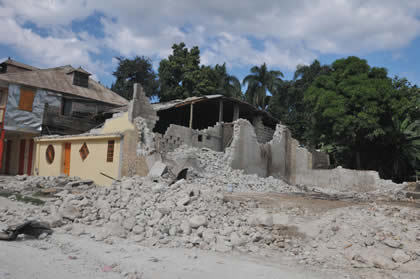
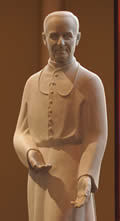
    The Congregation of Holy Cross will soon boast its first saint in the 173-year history of the order that founded the University. Born in 1845, Blessed Brother André Bessette, CSC, was a simple but prayerful laborer with a devotion to Saint Joseph who joined the congregation in his youth and served much of his life washing clothes, cutting students’ hair and greeting visitors at the College of Notre Dame in Montreal, Canada. Thousands of miraculous healings that occurred during his 91 years were popularly attributed to the intercession of the “Miracle Man of Montreal.” He will be canonized in Rome on October 17. . . . “The Big Dog” is turning pro. Bengal Bouts legend Mike Lee ’09 signed a contract to box for fight promoter Top Rank during a Joyce Center press conference attended by former Top Rank fighter Tom Zbikowski ’07, who put his boxing career on hold with a 1-0 record to play safety for the NFL’s Baltimore Ravens. Lee enters his professional career with an undefeated amateur record of his own and a reputation for throwing punches so fast his opponents can’t see them. His modest goal? A championship belt. And he’s pledged to donate a percentage of his fight and sponsorship proceeds to the bouts’ longtime charity, the Congregation of Holy Cross in Bangladesh. . . . “Shall I compare thee to a Summer’s day?” The opening line of Shakespeare’s Sonnet 18 was especially lovely and temperate as uttered by anthropology Professor Agustin Fuentes on a chilly morning in February. Fuentes and dozens of Notre Dame personalities from University Provost Thomas Burish to former Observer columnist Katherine Khorey, a senior, warmed the air inside O’Shaughnessy’s Great Hall with their readings of all 154 of The Bard’s famous 14-liners in early celebration of Valentine’s Day. The new event, dubbed SonnetFest, is part of the year-round festivities and performances of the Shakespeare at Notre Dame program. . . . Scott Malpass ’84, the University’s chief investment officer for more than two decades, has earned widespread accolades as the wizard behind Notre Dame’s admirable endowment performance in good times and bad. Less well known to Domers outside the Mendoza College of Business is the Applied Investment Management course he founded in 1995. In 15 years, the class has trained more than 700 top ND finance students by giving them the opportunity to manage a live, multimillion dollar stock portfolio using fundamental research techniques, and it has become a model for other leading business programs. As more economists tentatively forecast an imminent end to the current recession, about half of those AIM alumni will reconvene on campus in June to network and discuss urgent issues in contemporary global capital markets. . . . Football Saturdays received a major hospitality overhaul in preparation for the 2009 season, with changes affecting every aspect of the weekend from parking to pep rallies to the creation of the personalized weekend-planning website, gameday.nd.edu. Those efforts earned recognition as an industry best practice by the Stadium Managers Association, which represents officials at professional and collegiate outdoor stadiums around the country. Notre Dame’s Game Day guru, associate vice president for events and protocol Michael Seamon ’92, presented the ND model during the group’s annual conference in February. . . . Veterans of Innsbruck gasped a collective “Achtung!” at the January announcement that their beloved study-abroad program would soon exist only in their memories. Citing a dearth of applicants to the once-thriving German language and culture program, launched 45 years ago as the University’s maiden voyage into overseas study, the University shifted from the charming capital of the Austrian Alps that twice hosted the Winter Olympics to its growing presence in Berlin, Germany. . . . The University’s nondiscrimination clause received an extra measure of attention after the January 13 publication of a cartoon in The Observer that made light of violence against homosexuals. The strip prompted weeks of angry letters to the paper’s opinion pages and the resignation of the duty editor. Campus gay and lesbian activists and their allies, who have annually submitted petitions requesting the inclusion of sexual orientation in the official statement, rallied against the cartoon two weeks later and marched to the Golden Dome to deliver a letter to University President Rev. John I. Jenkins, CSC, ’76, ’78M.A., again decrying its absence in the policy. Administrators have said that an explicit inclusion of sexual orientation in the policy would compromise the University’s ability as a private, Catholic institution to maintain a distinction between sexual orientation and practice according to Catholic doctrine on human sexuality. . . . Student Film Festival devotees may now feed their fixation on iTunesU, Apple’s educational media sharing service. The 21st annual fest is free in its entirety via iTunes.nd.edu, and the festival’s founder, Professor Ted Mandell, is also posting “Best Of” collections from past shows. . . . The 600 Club welcomed women’s basketball coach Muffet McGraw after the team’s 78-60 victory over Louisville on January 16. It’s an exclusive group — only 18 other Division I women’s basketball coaches belong. McGraw’s Lehigh teams earned her first 88 victories. She came to Notre Dame in 1987. . . . Explicit support for Catholic teaching on the sanctity of all human life in a policy statement was the first of the preliminary recommendations presented at the beginning of the semester by the ND Task Force on Supporting the Choice for Life. The panel, co-chaired by law Professor Margaret Brinig and theology department chair John Cavadini, also counseled policy statements on charitable gifts and investments, better publicity for the University’s supportive stance toward pregnant students, and various forms of encouragement for pro-life witness among students and alumni. Students cheered the presence of Father Jenkins and nearly three dozen members of the faculty at the January 22 March for Life in Washington, D.C., marking the 37th anniversary of the U.S. Supreme Court’s Roe v. Wade decision. In all, eight buses carrying 400 marchers left from Notre Dame for the event. . . . The alarming discovery of a femur by maintenance workers digging under Lewis Hall in February briefly promised a sensation for campus mystery lovers. But the cold-case file trawl and CSI summons never materialized. A speedy forensic investigation confirmed that the long thigh bone came not from a human but from a cow. . . Grief twice spared the Leary family of Erie, Pennsylvania, when this winter’s deadly earthquakes struck Haiti and Chile. Son Joey ’09, volunteering for both the medical relief organization InterVol and the Notre Dame Haiti Program, wrote of his harrowing brush with a violent Port-au-Prince street protest right before the 7.0-magnitude quake hit on January 12. Carolyn, a ND junior, was among 27 students and staff in Chile at the time of the 8.8 earthquake on February 27. All were reported safe, along with members of the Holy Cross community serving in the South American country. The University does not currently send students to Haiti; at press time, no decision had been made to bring the Chile students back to the United States.


    Photo of statue of Blessed Brother Andre Bessette, CSC, by Matt Cashore.


  • A century of memories

    savage

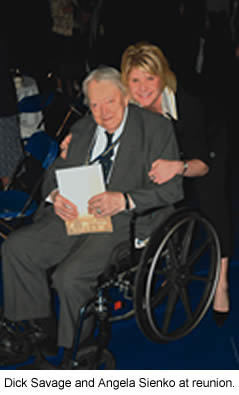
    The fact that Dick Savage celebrated his 102nd birthday this past January is in itself remarkable, but his age isn’t what makes Savage so fascinating. It’s . . . well, it’s Savage himself. Because for him, 102 is the new 50.

    Although Richard J. Savage graduated from Notre Dame in 1930, don’t try to find him listed in the 1930 Dome. Oh, his photo is in there, but the caption calls him “Frank Savage,” which perplexes him to this day. “Frank left school before the spring semester,” Dick says. “I don’t think he even had his photo taken.” Worse yet, one of Dick’s good friends was on the Dome staff and responsible for selecting the images. “How he didn’t catch that mistake is beyond me,” says Dick, revealing the slip of paper he has tucked into the yearbook with a note, lest he ever forget why he’s not listed.

    Upon graduation, Dick Savage earned a Ph.B. — that’s bachelor’s of philosophy in commerce, a degree no longer offered that roughly translates into today’s B.A. in accounting. He has long served as secretary for his class — now the oldest living class notes secretary. He still contributes a column to each issue of this magazine, even though he has no classmates to write about. Savage’s columns these days are full of his own memories and musings, and they’re always entertaining and full of captivating details.

    While most class secretaries email their notes to me, Savage sends his by postal mail. They’re always on time, and they’re always handwritten in an ornately elaborate cursive that resembles artwork more than penmanship. It’s not that he’s computer illiterate — he had an email account, but he grew annoyed with responding to all the messages that filled his in-box.

    Savage, probably the oldest living alumnus (although it’s difficult to verify), regularly attends the annual alumni reunions each June. Something of a celebrity these days, he draws applause, pats on the back and handshakes from dozens of other alums in awe of his longevity. While he accepts the attention with gracious modesty, I know he secretly enjoys all the fuss.

    I first met Savage three years ago when I became the alumni editor at Notre Dame. I manage the class notes section of this magazine and work closely with all the class secretaries, whose loyalty and diligence bring much to this publication and to the bonds of the Notre Dame family.

    I finally had the chance to visit Savage in his Chicago home this past January. His living room is exactly as I had imagined: cozy and layered in memories. A baby grand piano displays dozens of family photos, various honorary citations and a framed copy of his summer 2009 class notes column, “because it’s on the same page as a photograph of Father Jenkins and President Obama,” Savage tells me.

    There are photos of a young Savage, Notre Dame memorabilia and a copy of the congratulatory letter the ND Alumni Association sent him two years ago to honor his 100th birthday. “That meant more to me than anything else, including the birthday wishes I received from the mayor of Chicago,” he says.

    Stacks of books surround him. Despite his severely compromised eyesight, a result of 20 radiation treatments he received for an eye-related cancer that was diagnosed in 2007, he remains an avid reader, thanks to the trusty magnifying glasses he keeps close by.

    Savage is ensconced in what I assume is his favorite spot on the couch. As I glance over the books on the coffee table in front of him, I detect a theme: old Dome yearbooks; Do You Know the Notre Dame Fighting Irish?; Notre Dame trivia. Then there’s a book about bridge. Savage loves playing bridge. A member of the American Contract Bridge League, he used to play five days a week and participate regularly in tournaments. Lately he’s been playing once a week, though with a younger crowd. His partner is 70.

    Games to remember

    The first thing Savage wants to talk about is Charles Goren, a world-champion bridge player and bestselling author who contributed significantly to the development of the game. Savage tells me he used to play with Goren, and the book on his coffee table is a worn copy of Goren’s book Goren Settles the Bridge Arguments.

    “I can quote every word in it,” Savage says. “Charles was a great teacher.”

    Savage talks on about his regular bridge game and about one of his bridge partners, who is a good friend of President Obama. “He admires my bridge skills,” Savage, with a smile, says of his bridge partner. “I’m his idol.”

    Another favorite topic is the Chicago Cubs. Savage was 10 months old the last time the Cubs won a World Series, using his 102 years to stress how long it’s been since the Cubs reached the game’s pinnacle. He can recall, though, when his father, Walter, took him to Game Three of the 1918 World Series.

    “I remember it like it was yesterday,” Savage says of the matchup between the Cubs and the Boston Red Sox. Because of its larger seating capacity, the game took place at Comiskey Park — the home field for the crosstown rival White Sox — instead of the Cubs’ own Weeghman Park (later named Wrigley Field). Although Boston’s Babe Ruth did not pitch in that game, the Red Sox did beat the Cubs — a disappointment Savage still feels.

    Savage rummages through his books and produces a tiny black-and-white photo of Cubs shortstop Charlie Hollocher preserved in Plexiglas. “They gave this out at the ballpark at that game,” he says, “though I have no idea how they got it in the plastic.”

    A few years ago Savage was featured in an ESPN video documenting storied Cubs fans, but says he’s a bigger Notre Dame fan. Since his undergraduate days, ND football is Savage’s passion. He makes it a point to attend at least one game every season, usually the designated “Senior Alumni Game.” Like Reunion, his track record for Senior Game attendance spans decades.

    Party time

    Savage makes the two-hour trip from Chicago to South Bend with one of his daughters, Florence, age 78, and his “baby brother,” Don, age 92. Like most Irish fans, Savage and company take part in the widely recognized game-day tradition of tailgating prior to kickoff, something he says is a natural part of the experience. Despite his compromised eyesight, Savage is still a watchful and wise football connoisseur.

    As with most Notre Dame fans, Savage has a favorite coach. His is Knute Rockne. But while most choose Rockne based on the lore and movie-worthy quotes, Savage’s reason is different — he knew Rockne. During his junior year Savage lived in a University-owned house on Notre Dame Avenue, not too far from the Rockne family. “I’d pass him on the street every day walking to and from campus.” Savage smiles as he remembers. “And without fail, anytime I was with my friends, Coach Rockne would always greet us the same way, ‘Hi, men.’ That amused me because, you know, obviously we were only boys.”

    As for the famed Gipper pep talk Rockne delivered to his weary players during the 1928 Notre Dame-Army game in Yankee Stadium? Savage was at that game. “I had a friend who lived in Brooklyn, so he said I could stay at his place for free,” Savage says. “So I just jumped on the train with the football team and headed east.”

    While the locker-room speech is the most famous event that came out of that matchup, Savage remembers it for an entirely different reason: He got in trouble when he returned to campus. “I had to skip some classes to make the train to get out to New York,” he says. “I missed a test.” His parents weren’t amused by his stunt, even though he was eventually allowed to take the exam.

    Two loves

    Savage hadn’t originally planned to attend Notre Dame. “I was supposed to go to a different college, but my cousin, Bob, was about a half year behind me in high school, and our dads wanted us to go to college together,” he says. “Bob was going to Notre Dame, so that’s where I went, too. We were roommates our freshman year in Howard Hall.”

    In 1926, the year Savage entered Notre Dame, there were no application requirements. “All I did was show them my high school diploma and pony up the cash, and I was in.” He estimates his tuition, room and board totaled about $1,000 for the year — including spending money.

    Between his sophomore and junior year, Savage attended a back-to-school party thrown by a friend in Chicago. At the party he was introduced to a young woman named Eleanore. “It was love at first sight,” he says. “At least it was for me.”

    Eleanore, a talented pianist, attended a Chicago-area music school. She and Savage corresponded by mail to fill in the gaps between holidays when Savage would return home. Immediately after he graduated, they were married.

    The couple built a long and happy life together. Dick earned a living as an accountant specializing in tax work, and Eleanore stayed home to raise their seven children, six daughters and one son. The Savages were married for 60 years before Eleanore died in 1990. Savage has never remarried, though he says he’d consider it if I said “yes.” (I haven’t ruled it out.)

    Savage lives in the same Chicago home he’s owned for 61 years. He lives alone, though his daughter, Florence, spends time with him each day. When she leaves for the evening, Savage speaks with her via cell phone until she’s safe inside her house, which is a few minutes from his own.

    When he isn’t playing bridge or writing his class notes column, Savage works crossword puzzles and watches ESPN. Most nights, he is up until midnight, and he tends to sleep late in the mornings. That’s about as bad as his “bad” habits get. “I suppose I live a life of moderation,” he says.

    Our conversation eventually turns to his longevity. “I never thought I’d make it to this age,” he says simply.

    Maybe that’s because Savage was diagnosed with the flu in 1918 — the year the Spanish flu took 50 million lives, including two of his aunts and two cousins. “I was just a little kid, and I can remember my mom and dad standing at the foot of my bed talking with the doctor,” Savage says. “I thought I was a goner. But apparently the good Lord wanted to keep me around.”

    “Obviously He wanted us to meet,” I tell him.

    “Obviously,” he agrees.

    “Any other secrets to living a long life?” I ask him.

    “There’s a formula,” he declares. “It’s one-third genes, one-third lifestyle and one-third luck.”

    “Anything else?”

    “Yes. Take naps.”


    Angela Sienko is the alumni editor for this magazine and the Notre Dame Alumni Association.


  • Deaths in the family

    They thrived on the four-year cycle of students — the excitement and fears of freshmen, the bittersweet farewells of seniors. This past winter, Notre Dame had to bid farewell to six who helped lead students through that cycle of intellectual and personal growth; six who helped mold the university; six who could call Notre Dame “home.”

    While here we present only highlights of their careers at the University, see the related articles for more personal remembrances: the words of those who shared in the joy of their companionship, the sorrow of their departure.

    Frederick J. Crosson ’56Ph.D., the John J. Cavanaugh professor emeritus of humanities, died December 9 at age 83. A member of the faculty since 1953, Crosson directed the Program of Liberal Studies from 1964 to ’68, when he became the first lay dean of the College of Arts and Letters. In 1975 he returned to full-time teaching. He led Notre Dame’s Center for Philosophy of Religion from its founding in 1976 to ’84, and from 1976 to ’82 he also served as editor of Notre Dame’s Review of Politics.

    Retired Air Force Colonel Frank A. Yeandel ’66Ph.D. died January 9 at age 90. Yeandel taught ROTC at Notre Dame from 1963 to ’66 and was then stationed in Germany for two years. He returned to campus in 1969, where he served as assistant dean in the College of Business Administration, helped establish the MBA program and taught business management classes. From 1977 until his retirement in 1989, he taught business classes at Saint Mary’s College. For 10 years he served as a docent at the Basilica of Sacred Heart.

    Ralph McInerny, the Michael P. Grace professor of medieval studies and professor of philosophy emeritus, died January 29 at age 80. He was a member of the University’s faculty from 1955 to 2009. McInerny directed the University’s Medieval Institute from 1978 to ’85 and its Jacques Maritain Center from 1979 to 2006. The founder of Crisis magazine, he also wrote numerous scholarly books and papers and was an internationally known Thomist scholar. McInerny also wrote poetry and mystery novels, including the popular Father Dowling series.

    Elizabeth Christman, an associate professor emerita of American studies, died February 4 at age 96. She worked at a literary agency for 23 years, until at midlife she switched directions to teaching. In 1968 she began to teach English and creative writing at DePauw University. For six summers between semesters at DePauw, she taught writing to Notre Dame graduate students, finally joining the Notre Dame faculty full time in 1976. Christman wrote numerous short stories and novels, including Ruined for Life and A Nice Italian Girl.

    Robert E. Burns, professor emeritus of history, died February 5 at age 82. A member of the faculty from 1957 to ’95, he also served in a variety of administrative roles: acting editor of Review of Politics from 1967 to ’68; dean of the summer session from 1969 to ’71; associate dean of the College of Arts and Letters from 1971 to ’81, and acting dean from 1981 to ’83. As a dean, he initiated the London program for juniors in arts and letters. He was the author of the two-volume Being Catholic, Being American: The Notre Dame Story.

    Gail Walton, director of music at the Basilica of the Sacred Heart, died February 24 at age 55. She had served as director of music in the basilica since 1988, directing the Notre Dame Liturgical Choir as well as the Basilica Schola, which she founded in 1989. She also taught organ at Goshen College. Walton performed throughout the midwestern United States and frequently played dual recitals with her husband, organist and ND music Professor Craig Cramer.


  • Domers in the news

    But for the fact that Andy McKenna ’79 and Dan Hynes ’90 apparently lost their respective primaries in February by paper-thin margins, it might have been an All-Domer gubernatorial election in Illinois come November. McKenna, the former Illinois Republican Party state chairman, came in third among Republicans, just 1 percent behind the leader. Hynes, meanwhile, lost on the Democratic side by .8 percent. . . . In Minnesota, meanwhile, St. Paul businessman Rob Hahn ’91 is the Independence Party’s candidate for governor. Hahn publishes two niche newspapers, Midwest Wine Connection and Minnesota Prep Sports. Previously he was a producer at WCCO-AM and is the author of a mystery novel. . . . Although none of the contestants knew the answer, author Tom Coyne ’97, ’99MFA had the honor of being featured in the $400 question on a recent episode of the iconic quiz show Jeopardy!. The hint was: The title of Tom Coyne’s golf memoir “Paper” this pays homage to George Plimpton’s “Paper Lion.” The answer: What is Paper Tiger? . . . The Hanging Tree, the second mystery novel by Wall Street Journal Chicago bureau chief Bryan Gruley ’79 will be published in August. His first novel, Starvation Lake, published last year, was nominated for the Mystery Writers of America Edgar Award for best first novel by an American author. . . . Tom Bettag ’66 has joined CNN Worldwide as senior executive producer of the shows State of the Union with Candy Crowley and Reliable Sources. In that capacity, Bettag oversees the cable network’s Sunday public affairs programming. During his long career in TV journalism Bettag has served as executive producer of the CBS Evening News with Dan Rather and ABC’s Nightline with Ted Koppel. . . . Michael Cotter ’71, ’77 J.D. was recently sworn in as Montana’s U.S. Attorney. He is married to Montana Supreme Court Justice Patricia Cotter ’77J.D. . . . The architectural firm of Nolanda Bearden ’90, NHB Group LLC, was chosen as part of the design team for a $530 million domed stadium to be built in Birmingham, Alabama. . . . Chris Rohrs ’71, president of the Television Bureau of Advertising, recently was honored at the Library of American Broadcasting Seventh Annual Giants of Broadcasting Awards ceremony. . . . Brian T. Moynihan ’84J.D. has been named CEO of Bank of America. . . . Andrew Gurtis ’88 is the Daytona International Speedway’s new vice president of operations. As such, Gurtis oversees the operations department of the 480-acre speedway, which includes maintenance, security and emergency services. . . . Matt Knott ’92 is now senior vice president for strategic planning and performance management with Feeding America, the nation’s largest hunger relief organization. Previously Knott was vice president of marketing for Gatorade at PepsiCo . . . . Joseph Cosgrove ’79, a well-known Pennsylvania criminal defense attorney, was appointed a judge by Governor Ed Rendell in the Luzerne County Court of Common Pleas. As a student Cosgrove served as the ND Leprechaun mascot. . . . Avant garde artist Aldo Tambelini ’58MFA, who studied at Notre Dame under the legendary sculptor Ivan Mestrovic, recently received a lifetime achievement award from Syracuse University, which he attended as an undergraduate. Tambelini also has been awarded the key to the city of Cambridge, Massachusetts, where he has lived after leaving MIT as a fellow at the Center for Advanced Visual Studies. . . . At age 71, Ed Ricciuti ’59 passed his test for a second degree black belt and second-level instructor in the martial art of combat hapkido. Ricciuti is at work on a book about the martial arts and self-defense for senior citizens.


  • How to read to kids: The moral of the story

    littleengine

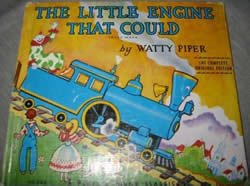
    Remember the train that said “I think I can, I think I can”? Do you remember the moral of The Little Engine That Could? Readers typically latch on to the theme about perseverance — if you keep trying, you will succeed.

    But there is a “more moral” moral to the story. Remember why the little engine was trying to get over the mountain? It was to take toys to the children in the town on the other side in time for Christmas, so the children would be not be sad on Christmas day. So the more pro-social, less self-centered message of the story is: When people need help, work as hard as you can to help them and don’t give up.

    Some contend that children should hear moral stories so they develop moral literacy and, consequently, moral character. In other words, let the stories do their magic without adult assistance. Our research shows that leaving a story and a child on his or her own does not guarantee that an intended message will be understood. In our studies, 8-year-old children rarely (10 percent of the time) picked up the author’s intended message; 10-11 year olds understood the intended message about half the time.

    So what can a parent do to facilitate comprehension of a story and its moral? First, understand that children do not have the life experience to interpret the significance of many story events. So be patient. Imagine yourself in another country trying to learn the social norms. You focus on the little things, not the big picture. This is what children spend much of their time doing—figuring out what is going on in the story, so much so that it is hard to step back and see the big picture and get the moral.

    Even if a child is made aware of the big picture, the mind may be overwhelmed with too much detail to take it in. The moral of the story may just be too hard to remember among the flood of loose detail in the child’s mind.

    Second, understand that telling someone the theme of the story does not mean the lisener will agree with you. Whether adult or child, story readers construct their own messages (based on unique life experiences). Just try letting someone else completely change your reaction to an American Idol contestant. It is very hard to change your gut reaction.

    As you may have noticed, even adults get different messages from a story. How do we heighten our own awareness of the morals in stories, not to speak of our children’s awareness?

    My students and I suggest questions for discussion during or after reading (or watching) a story. These can increase awareness of story elements and how they fit with one’s own moral life.

    For example:

    Moral sensitivity: What is the character feeling? Is the character sensitive to the needs of others?

    Personal application: When recently have you been sensitive or insensitive to another person’s feelings?

    Moral judgment: Does the character make good decisions or choices for self and the community? What makes it a good or bad choice?

    Personal application: Does it remind you of a time in your life when you made a good or bad choice? How did the choice affect others?

    Moral focus: Did the character try to be the best person he or she could be? Did the character show concern for the welfare of others?

    Personal application: Did you do this today when…?

    Moral action: Did the character take positive moral action? Did the character change tactics when things were not working? Did the character persevere even when things were hard? How did the action affect the character and others in the story?

    Personal application: How have your actions affected others today?

    If you are the parent of a young child, I invite you to go back and read The Little Engine that Could. But this time, with those questions above in mind, see what message you take away now. With age, adults become more aware of and concerned about social and moral consequences. We can only hope our children do, too. In the meantime, by talking with our children about the deeper moral we see in the story, we can help them see as well.

    Other resources:

    A guidebook on discussing morals in stories for parents and teachers, Tuning into Ethical Behavior.

    Collaborative for Ethical Education

    An October 10-12, 2010 Notre Dame Symposium on Human Nature and Early Experience.

    Darcia Narvaez’s blog, at Psychology Today, Moral Landscapes.

    You can link to published books and download papers and tools for parents on Darcia Narvaez’s website


    Darcia Narvaez is an associate professor of psychology at Notre Dame specializing in moral development and character education in children. She is the director of Notre Dame’s Collaborative for Ethical Education and the author or co-author of numerous publications on character development.


  • Proud Domer, Proud Daughter

    St

    I was about two months pregnant with our twin girls when my husband and I had our first discussion about where they would go to college. Since we are both graduates of Notre Dame, I answered: “They are going to be Domers, of course.” He said, “What if they want to go to USC?” My response: “We’ll disown them.”

    Of course, we wouldn’t do that. We will foster and support our children’s dreams no matter what paths they take. My husband was surprised, however, at my curt response. I have pondered that moment for quite some time, wondering where its quick response originated. Was it just a pure disgust for the Trojans? Perhaps a bit. Was it the first of many attempts to keep the chicks close to the nest? The first tinge of fear of that empty nest syndrome with which every parent must eventually deal? I think instead that it is just an absolute love and adoration of a place that has given me so much hope, knowledge, love and wonderful memories. Why would anyone want to be anywhere else?

    This love was instilled from my father, a Notre Dame professor going on 35 years. This love resides not because ND football was on in our house every autumn Saturday while I lived at home. Not because I remember sitting on my father’s shoulders waving pompons at the Friday night football pep rallies. Not because we lived close enough to campus that I woke up hearing the band playing on Saturday mornings. While all this added to it, it was more the quiet things that Dad did while I was growing up. Those memories are sewn into the fabric of our family and make me so proud to be not only a Domer, but, even more so, his daughter.

    I remember spending summer evenings walking around the campus lakes at sunset. I remember fishing for bluegills on the island of St. Mary’s Lake long before they put up the gate to ward off mischief. I remember baking bread for Sunday Eucharist at the Basilica. I remember going to parties at Galvin Life Sciences to celebrate another graduate student becoming a Ph.D. My favorite part was always when the new doctor would pop open a bottle of champagne, making a dent in the ceiling with the cork. She would stand on the table and sign the divot, adding her name to an ever-growing family of scientists and doctors, a promise she wrote in ink, vowing to make the world a better place.

    I remember the 30-plus Thanksgivings when we sat down at a table surrounded by not only our own family but by graduate students who couldn’t make it home to their families for the holiday, and other faculty members who became much more aunts and uncles to me than Mommy and Daddy’s co-workers. Two graduate students have returned to my parents’ home for 13 consecutive Thanksgivings now, bringing their own children to meet their Notre Dame family. We were there for their marriage to one another and additions of two beautiful children. Some years, it is the only time that we all see one another. We are family now, though, and families spend holidays together.

    Yes, by the time I stepped foot into the shadow of the Dome as a college freshman, I already had a lifetime of ND memories tucked into my heart. It was those memories that led my collegiate path to Notre Dame. I was actually considering taking up roots at another college in Indiana. My mother and I made it as far as campus visitation day when giddy future students gather in the large auditorium to dream of their futures. Everyone cheered and sang as the band marched in to the other school’s fight song. Everyone but me.

    My mother looked over at me with concern as she saw the tears in my eyes. I said with a calm resolve, “It’s not the Notre Dame Victory March.” And with that, we drove home, and I mailed in my confirmation to attend the University of Notre Dame.

    No moment made me more proud to be a part of the Notre Dame family than last year when my grandmother, living in Pennsylvania, fell and needed to have hip surgery. She called my father from the hospital room, and through her pain, surprisingly, he could hear her smile. She explained that when the surgeon came in to talk to her, he immediately recognized her last name. He then told the story of a Dr. John Duman, who taught him physiology at the University of Notre Dame. He spoke about this class being one of his favorite and how much he learned from and respected my father. And, of course, in true Domer Dynasty fashion, he added that his daughter was now at Notre Dame and planned to take my father’s class.

    The next day, as my grandmother was wheeled into surgery, the surgeon reassured her that she had nothing to worry about; he had gone home the night before and reviewed the notes from my father’s class, having kept them for more than 20 years.

    Perhaps these types of stories happen at other universities. I am sure that many alums return to campuses across the country with swelling hearts and overwhelming recollections of happy memories that shaped their lives and souls. If Notre Dame taught me nothing else, it is that there is an entire beautiful world out there just waiting for me to enter it. So I know that most likely, for my daughters, this world will stretch beyond the borders of South Bend. Looking back on that conversation with my husband, however, I promise two things to both my girls and to my father:

    — I will show them all the wonders of Notre Dame, just as my family showed me. (They had a good start with their first trip to the Grotto at two weeks of age.)

    — I will try to use these memories of love and family to create a grounded Catholic foundation in which my children can grow and flourish, just as my parents shared with me.

    And if in 18 years, after all this, they still want to go to USC, well, I will buy a plane ticket to L.A., put on a smile and a Fighting Irish T-shirt, and try to give them as much guidance and love as my parents gave me. I will pray that they find a professor there who would invite them into her home for Thanksgiving, should they not be able to make it home to ours.

    I just hope that they don’t make me wear a “Proud USC Mother” sweatshirt.


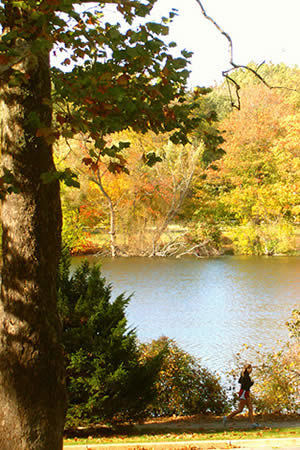
    Photo of St. Mary’s Lake:


  • And Now, the Cycle Will Go On

    islandfox

    On November 7, 2008, National Park Service biologist Tim Coonan crouched down in golden grass and unlatched the wire door of a small dog kennel. “Okay, M67,” he said softly. Out shot a tiny sharp-nosed fox sporting a black collar. Tentatively, he stopped to survey the scene, then glanced back over his shoulder at the kennel.

    “You can’t go back in,” Tim said. “Don’t even think about it.” The fox looked around again at the sage-mottled grassland. “Anywhere is good. Anywhere.” Another lingering glance at the kennel and safety. “Dude, don’t go back. If you go back in, I’m going to kick you out.”

    As the fox took one more look out and then back over his shoulder, this time quicker, Coonan coaxed him on: “Time to go. Time to go.” Then M67 made up his mind, and off he dashed, bounding in glorious long leaps up the scrubby slope. Coonan laughed with delight.

    From the opening of the cage door to the fox’s disappearance over the crest of the hill, just one minute had elapsed. For Coonan, a 1981 Notre Dame graduate, it was a minute filled with cautious jubilation, marking the end of a decade-long experiment and one with high stakes — the survival of a species.

    The story begins as long as 18,000 years ago, when gray foxes (Urocyon cinereoargenteus) from California’s mainland made their way to Santa Rosae, a land mass off Ventura, California, that in the intervening time, with a rise in sea level, has become the eight Channel Islands. Most likely, a pregnant female rafted across the narrow strait on storm debris, though it’s possible that Native Americans living on the islands brought foxes over as pets.

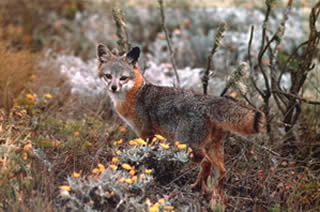
    However they got there, there they stayed, and they quickly evolved into petite versions of their mainland relatives — standing 8 to 10 inches at the shoulder and weighing a mere 4 to 5 pounds, a third as much as a gray fox, smaller than a housecat.

    These foxes also developed a looser, “island” lifestyle: more diurnal in their out-and-aboutness, denning under bushes rather than in holes dug into the ground, and ranging through diverse habitats to enjoy a cosmopolitan diet of fruits, insects, birds, eggs, crabs, lizards and small mammals. In the process they evolved into a genetically distinct species: Urocyon littorali.

    In their island isolation, the foxes had a distinct advantage. Aside from humans, they had no natural enemies. Nothing took them; they were completely safe. For millennia.

    The disappearance

    Tim Coonan arrived at the Ventura, California, mainland headquarters of what is now Channel Islands National Park in 1992 from his previous park service jobs at Canyon de Chelly National Monument and Death Valley National Park. His first assignment was a terrestrial monitoring program for the four northern Channel Islands that make up the national park, to count everything from insects to reptiles to birds to mammals. The ecosystem seemed to be thriving and in balance. Just what a biologist wants to see.

    But within a few short years, an alarming trend set in. Of the three national park islands that are home to island foxes — San Miguel, Santa Rosa and Santa Cruz — a precipitous drop in their population became apparent. Over five years, from 1994 to 1999, Santa Rosa fox numbers went from 1,500 to 15. San Miguel Island dropped from 450 to 15; Santa Cruz Island from 2,000 to 50 or 60. One researcher estimated that unless something was done, and fast, island foxes on Santa Rosa and San Miguel would be extinct within five years, on Santa Cruz within 12.

    What was going on? One possible culprit was disease. Island foxes, being canids, are susceptible to rabies, which can be introduced by campers bringing dogs onto the islands illegally. But on all three islands at once? Not likely. Another possibility was a decline in their food supply, but surveys showed no such thing.

    What about predation? A stealth predator, for example. One that arrives on the wing, dines and then departs over the water, leaving only a carcass as a calling card.

    In November 1998, once the decline was noted, use of trackable radio-collars allowed examination of any foxes that no longer showed any movement. Thanks to that telemetry, the culprit was identified. It was Aquila chrysaetos, the golden eagle. A few months later, nesting pairs were discovered on Santa Rosa and Santa Cruz.

    “No one had any clue that goldens could or would start making a living out here,” says Coonan. Historically, they’d been kept away by fish-eating bald eagles, but DDT and persecution had eliminated our national bird from the islands by the mid–20th century.

    Another significant human interference was the introduction of non-native animals to the islands starting in the 1800s: pigs, sheep, cattle. As late as the early 1900s, San Miguel was overrun with sheep, which erased the native vegetation, leaving grassland and sand — scant cover for a fox caught in a golden eagle’s scope. On Santa Cruz, feral pigs, and on Santa Rosa, elk and deer — or their young, at any rate — offered up a bounty of other dining options. When eagles began not merely to visit but actually to nest on the islands, however, piglets and fawns weren’t always available. Foxes supplemented the menu nicely.

    With the free-floating predators now known to be nesting on the park islands, there was literally no time to lose. In April 1999 — when biologists still thought there were at least several dozen foxes on each of the three islands — an ad hoc island fox recovery team was convened, experts in such areas as island fox biology, carnivore disease, raptor biology and captive breeding and reintroduction. The group consensus was swift and firm: if the foxes had any chance of surviving, they would have to be taken into captivity. Not only that, but the golden eagles would have to be removed from the islands, along with their exotic prey base of pigs and cervids — no small task.

    Within one month, two cyclone-fence pens had been constructed on San Miguel Island and a pair of foxes had been captured and installed in their new quarters. By the fall, all the remaining wild foxes on the island (save one, which eluded capture for another two years) had been taken into captivity. Ten females and four males. A like strategy was put in place on Santa Rosa, and a looser one on Santa Cruz. It was now up to these individuals to bring their subspecies back from the brink.

    “It was a huge decision,” says Coonan. “It meant that on two islands there would be no foxes at all in the wild; all of them would be in captivity. And whatever happened in captivity would determine whether there would be a wild population again.”

    Pairing off

    It is late January 2009. I am standing with Coonan and Ian Williams, the half-time resident ranger, at what Coonan calls “the scene of the crime” — a San Miguel Island ghost town of 11 enclosures, each a 5-foot-tall, 600-square-foot chain-link pen, in a protected spot called Willow Canyon.

    “Sometimes when I come down to these pens, I think, ‘Did I dream this? For 10 years, did we do this?’” Coonan says, shaking his head. “Because before that, we were monitoring island foxes, and they were fine, and now we’re monitoring them, and they’re good, but for this 10-year period we were heavy-duty into captive breeding and worrying about the health of those individual animals. Feeding them. Vet workups every year. Vaccinations. It was an incredible amount of work.”

    Just because you put two foxes in a pen together doesn’t mean they’ll breed. And in that sense, the program really was a big experiment. “When we went into it,” Coonan says, “we didn’t have a clear idea what would be required. In hindsight, many of our decisions turned out to be right, but that may be more a matter of luck, in that we were lucky to be working with a species that was fairly prolific. We didn’t have to do anything strange.”

    What they did do was carry out genetic testing on the foxes, then pair males and females to produce the sturdiest blood lines possible. “We had a rule of thumb: if a pair didn’t reproduce within two years, we split them up and paired them with someone else.” Some animals, he says, “went through four or five mates and never produced.”

    Male aggression was a problem, though it was found, too, that December-May pairings (older females with younger males) didn’t take, and once kits started coming along, wild-born females didn’t want much to do with captive-born males. In the end, only eight of the original 15 San Miguel foxes reproduced, two males (out of only four taken in) and six females. But reproduce they did, starting in 2000 with one litter, a boy and a girl. “The second year, 2001, it was like we hit the lottery because all five pups were boys. Now there were enough pairs to spread things around. We were ecstatic.”

    Looking at these decrepit enclosures, it’s hard to imagine the full-facility bustle of adult and young foxes, playing with their Kong pet toys, squirreling through plastic tubing, taking a snooze on little hammocks and high shelves, or pouncing after mice — part of the revolving feast they were fed daily: dog and cat kibble, insects, quails, nuts, fruits and vegetables, hard-boiled eggs and, yes, live mice.

    “There’s all kinds of Machiavellian techniques for feeding mice to foxes: put them in Chinese takeout boxes, or PVC pipes with a rag in each end like a party popper,” says Williams. “When you’d toss them in they’d grab them right out of the air — they’d even meet you at the door.”

    A happy fox is, potentially, a breeding fox. As the captive population grew, the next generation entered into the breeding arena as well. While not all the foxes bred, enough did — and ultimately 53 pups were born on San Miguel Island between 2000 and 2006.

    Back to the wild

    Coonan, Williams and I leave the “ghost town” and walk up a narrow trail onto the low central plateau of San Miguel, which is slowly being recolonized by the natural scrub of the island — coastal sage, lupine, buckwheat, locoweed. By 2004, Coonan says, with 40 animals in captivity and a new brood of pups imminent, “we’d really reached the maximum number of captive foxes we could handle, with the staffing we had.”

    It was time to reintroduce the foxes into the wild.

    By this time, bald eagles were being reintroduced to the islands and the translocation of golden eagles to lands beyond the Sierra Nevada was well under way. Elk, deer and feral pigs also were in the process of being removed from the islands. Nevertheless, the proposal that the reintroduction begin was met with resistance by some on the recovery team.

    “There were people,” Coonan says, “who wanted us to keep foxes in captivity until all the golden eagles were gone, which would have meant moving the captive breeding program to the mainland.” That, Coonan refused to do. “Reintroduction was a calculated risk, absolutely,” he says, but it was time to take that next step.

    We see small cat-like prints in the soft dirt: foxes have passed this way. Farther along, a pile of scat lies at the intersection of two faint trails — a territorial marker. But we see no actual foxes.

    “Right now,” Williams says, “they’re hunkering down. It’s pretty warm for them during the day, so they’re probably curled up under a bush.”

    Coonan notes several high-activity periods. “Dusk is one, but also after midnight. And dawn. . . . They’ll be sleeping if they’re not hunting. Or in January, mating.”

    Williams adds, “I always say, they eat till they’re tired, and they sleep till they’re hungry.”

    Coonan stops at a rise that dips into a shallow, scrub-filled ravine. “This is the place. We’d release them in the evening here, with feeding stations to ease their transition, which we then closed off after a few weeks. Some bolted right out of the area. But still, this was a pretty good spot habitat-wise, protected, a lot of native plants.”

    In the fall of 2004, 10 foxes were released on San Miguel, “mainly as pairs in the hope that they’d hook up. And they paired up right away. We had four pairs going by January or February of 2005, and we had 10 pups the next year from those pairs. It was just incredible.” The rest of the San Miguel foxes were released through 2007, and reproduction in the wild took off immediately.

    On Santa Rosa, the last releasable fox — M67 — bounded to freedom in 2008. Although reproduction was a little slower to kick in on Santa Rosa, and a golden eagle or two were still wreaking some havoc, there too the numbers started noticeably to climb.

    In late 2009, the population estimates had taken a leaping bound, with an estimated 320 foxes — close to carrying capacity — on San Miguel. “Numerically,” Coonan says, “we’ve reached biological recovery here on San Miguel, and will on the other islands probably within two or three years.”

    Golden eagles remain a relatively minor worry. “I think, especially in the winter, we may have eagles showing up and taking a few island foxes, but leaving the island within a matter of weeks. And I think we can tolerate that.” Another potential threat is canid distemper virus, which a core group of foxes have been vaccinated against to preclude the possibility, however remote, of an epidemic wiping out the entire population.

    We make our way to a knoll overlooking the north side of San Miguel. Williams pulls a collapsible antenna from his pack, extends its six arms, plugs it into a receiver and starts to wave it slowly across the landscape. He listens for pings, which are tied by specific frequency to individual animals.

    This labor-intensive monitoring, together with round-the-clock automatic monitoring, will be ongoing — to identify any radio-collared animals that have gone into “mortality mode,” in order to evaluate the cause of death, and to follow individuals’ movements around the island. Each year in late summer, too, foxes are trapped for five nights running, to calculate their population size and density, and to collar, vaccinate and do a health check on the hapless trappees.

    One interesting wrinkle to this story of recovery is that, for various reasons, the island foxes were not added to the federal endangered species list until 2004 — five years into the captive breeding experiment, and the very year their reintroduction into the wild began. Listing brought in a bit more funding for the program. It also, ironically, makes for what some are calling the quickest recovery of an endangered species.

    Part of the reason for this speedy success, in addition to the foxes’ own reproductive vigor, is the setting. “If you solve something on an island, it pretty much remains solved,” says Coonan. “Remove pigs from Santa Cruz? They ain’t coming back.”

    Saving the island

    Later that night, after a full day soaking up the story of the island, I leave the bunkhouse to stand in the dark, under the pebbly shimmer of the Milky Way, the steady breeze pushing against my face. In the distance I hear crashing waves, rhythmic and insistent, and high-pitched yelps — the mating or birthing or battling cries of thousands of elephant seals, which themselves were gone from this island a mere 70 years ago. Voices in the night.

    I think about how, in this place, for thousands of years, the foxes have danced after deer mice, wrestled each other in their mating ritual, rested under purple lupine, and taught their young the pleasures of seafigs and crabs.

    It is comforting — important — to know and trust that, thanks to Coonan and the dedicated fox recovery team, that cycle will go on; that the foxes will continue to ply their wild existence on this windswept island; that the cages will eventually come down. Although, as Williams says, “This wasn’t just about saving the foxes; it was about saving the island.”

    It’s like a Zen koan: Would San Miguel Island be San Miguel Island without the foxes? I don’t think so. The fox is the keystone. It is necessary. And, let us say however cautiously, it is here to stay.


    Anne Canright is a freelance writer who lives in Monterey, California.
    Photo from the National Park Service.


  • Life in the Abyss

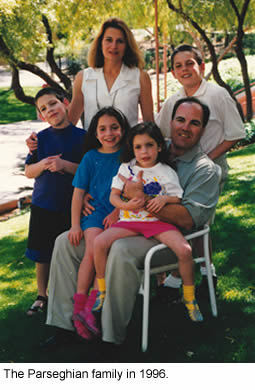
    parseghians1996

    On a June day in New York 15 years ago, Cindy and Michael Parseghian learned that three of their four small children were fated to die from the same genetic disease.

    Within a decade or so, all three would be gone — Michael Jr., then 7, and his two younger sisters, Marcia, 5, and Christa, 3. This was not medical guesswork. It was a fact written into the children’s cells, as close as modern science can come to infallible prophecy.

    Cindy Parseghian remembers sitting that night in the kitchen of her friends’ Chappaqua home and cursing God. Michael Jr. had been diagnosed with a fatal condition called Niemann-Pick Type C (NPC), and it was clear their two girls had the disease as well. A search for meaning and peace would come later, but that night Parseghian felt numb, raw fury.

    “I couldn’t understand why God would do this,” she says. “Michael was such a happy-go-lucky kid. We wanted to keep things normal for the kids, but we felt our whole world was falling apart.”

    In an emotional abyss, the Parseghians sought ways to fight what seemed like an implacable condition. Scientists knew little about the disease, making the prospect for treatment more distant. But the work had to start somewhere — doctors could not treat an ailment they did not understand. Within weeks, Cindy Parseghian began a mission to support research on the disease, though it would mean starting a foundation from nothing.

    “It was kind of like the lions protecting their cubs,” she says. “If we sat back and let the disease progress, we knew what was going to happen. We just had to fight this.”

    They fought as their cheery, dark-haired children slid into the grips of the disease. Marcia, the first child in her dance class to master skipping, became sluggish as the condition sapped her motor abilities. Christa, unusually small from birth, grappled with chronic pneumonia. Michael Jr. started karate classes, though no one knew from one month to the next if he would live long enough to reach the next belt ranking.

    Fifteen years after that bleak diagnosis in New York, many scientists say they are astonished at what Cindy Parseghian has accomplished as president of the Ara Parseghian Medical Research Foundation, named in honor of Michael’s father, the Notre Dame coaching legend. They have raised $35 million for research on NPC, bringing new attention to an understudied area of cellular biology. In the last few years the research has started to identify potential drug therapies for the condition, and it has helped fuel Notre Dame’s Center for Rare and Neglected Diseases, which opened in 2008.

    Numerous researchers describe the Parseghian foundation as a model of how to foster research on rare diseases.

    “It’s a tribute to the Parseghians that they’ve done so much to bring scientists along, to the point that scientists in several continents with varied interests are focusing their energy on this disease,” says Matthew Scott, a member of the foundation’s scientific advisory board and a professor of developmental biology, genetics and bioengineering at Stanford University.

    The work led to an emotional high point in May 2009, when Cindy Parseghian received an honorary degree from Notre Dame for her work advancing research on NPC. Standing beside the president of the United States and University leaders, Parseghian was unprepared for the raucous ovation from graduating students as Provost Thomas Burish read her name and accomplishments. Tears came to her eyes as he described her as “a loyal daughter of Notre Dame.”

    She cried in gratitude and perhaps a little awe over how far she had come. But she also cried for the faces she did not see in the crowd of cheering people. They were the faces she always knew she might not save, despite tireless work and great medical progress. Her family’s struggle with NPC had been one of steady achievement. It was also one of repeated loss.

    On that fine afternoon in May, Cindy Parseghian still could not help feeling that the world was not as it should be.

    ‘The luckiest woman in the world’

    Cindy and Michael Parseghian’s first date in 1975 was a pep rally the night before a Notre Dame football game. They had met while studying in the same section of the library and found they shared high professional ambitions, a deep attachment to Notre Dame and a love of intramural sports (they won a co-ed racquetball tournament).

    The couple also liked how their personalities complemented each other. Michael tended to ponder problems in all their complexity while Cindy was geared toward action. When Michael proposed toward the end of their senior year, he gave Cindy a temporary engagement ring — his mother’s diamond Notre Dame ring, which had been a gift from Coach Parseghian’s staff.

    They married three months after graduating in 1977 and moved to Chicago, where Michael attended the Northwestern School of Medicine and Cindy worked as an accountant while pursuing an MBA degree at Northwestern. When Michael got his medical degree, they settled in Tucson, Arizona, and started a family. Ara was born in 1984, followed by three more children over the next seven years.

    “I thought at the time I was the luckiest woman in the world,” Cindy Parseghian says. “I had four beautiful children, an interesting job and a strong marriage. We probably had a year in there that was just a perfect family year.”

    Ara was always healthy. But when Michael Jr. entered kindergarten, his parents noticed he had trouble keeping up with other kids on the playground. His speech was slow to develop, and his eyes seemed to wander in an odd way.

    “I thought he was just a distracted 5-year-old,” Cindy Parseghian says. “Really it’s one of the first signs of the disease.”

    For the next two years a string of doctors puzzled over Michael Jr.’s condition, building a medical file inches thick. Finally the Parseghians took Michael to see specialists at Columbia University in New York, where doctors realized within minutes that the boy had a probable case of Niemann-Pick. The parents could tell from the doctors’ demeanor that the disorder was fatal.

    The medical signs included Michael’s distinctive eye movement and his enlarged spleen — a symptom that set off immediate alarms. His sister, Marcia, also had been diagnosed with an enlarged spleen when she was 6 months old, and Christa was born with the condition. Now it appeared that their symptoms all pointed to the same disease.

    “Suddenly we went from thinking it was a problem with Michael to thinking it had reached our girls, too,” Cindy Parseghian says.

    Genetic tests soon confirmed their fears. Ara was the only child unaffected. The other three all had the same fatal condition.

    Because both parents were carriers of NPC, pure genetic odds would have predicted that each of their children had a one-in-four chance of being affected by the disease. Half of the time, only one parent passes on a damaged copy of the gene implicated in NPC, and the child becomes a carrier. In one out of four cases, the child gets two good copies and is fine. In the remaining one-fourth of cases, the child gets two damaged copies and develops NPC. But these are only averages — for each individual child, the odds play out anew. Luck had run against the Parseghians.

    Doctors knew those odds because they had observed how the disease was passed on within families. But at the time the Parseghian kids were diagnosed, researchers had not yet isolated the specific genes that caused the condition. That was among the first projects the new foundation helped to fund, along with basic science that started to puzzle out how the disease does its damage.

    Hunting for a gene

    At its root, NPC is a cholesterol-storage disorder that affects the nervous system. Every person needs cholesterol to survive; the body produces it and relies on it for a range of biochemical processes. For reasons that scientists did not understand when the Parseghian foundation started, the cells in NPC patients have lost the ability to clear cholesterol, leading to a toxic build-up that over time makes normal metabolism impossible. The children’s muscles fail, their ability to speak fades and most die in their teenage years — though some NPC patients have a slower course of disease that is not even detected until adulthood.

    The disease requires expertise in many areas of biology to understand, but because it is rare — striking about 1 in 150,000 children — research money can be scarce. The children’s father, Michael Parseghian, an orthopedic surgeon, turned to his friend Michael Parmacek, a cardiologist then at the University of Chicago, to form the foundation’s scientific advisory board. Several researchers said the foundation has become a model of how a small, privately run group can set up productive competition for research grants, with a constant flow of new applications from scientists with fresh ideas.

    “The Parseghian foundation is a wonderful organization,” says Joe Goldstein, a researcher at the University of Texas Southwestern Medical School who won the Nobel Prize in 1985 for his work on cholesterol metabolism. “What makes the foundation unique is that the leaders recognize that solving the puzzle of this devastating disease will not come overnight, and they are committed to the long haul.”

    The children’s Grandpa Ara helped start the steady flow of donations by calling on his extensive national network of connections. An army of volunteers pitched in, many after learning of the Parseghians’ struggle through stories in People magazine and the television news show 20/20. The family launched a penny drive at the children’s school with the goal of raising a million pennies — $10,000 — but they far exceeded that. Next they started an annual walkathon, which now raises about $30,000 every year.

    One of the first breakthroughs the foundation helped to fund was the discovery by National Institutes of Health scientists in 1997 of the gene NPC1. A mutation of the gene can lead to Niemann-Pick Type C disease. Finding the gene was a triumph, but scientists quickly realized that compensating for alterations of the gene would be immensely difficult.

    “This is a very old gene that is used even in single-celled organisms,” says Matt Scott of Stanford. “It has ancient functions that have been preserved for all that time because they’re so important to maintaining life. If you damage that gene, you’re going to have a very serious disease that is very hard to fix.”

    As the foundation got rolling, the Parseghians settled into a household routine that seldom allowed more than two hours of solid sleep during the night. They worried constantly about their children’s breathing and the risk of seizures, and would often get up to roll a child over so he or she could breathe more easily.

    Then with no immediate warning, Michael Jr. died in his sleep from a massive seizure in March 1997. It was the same month that researchers found the NPC1 gene, and a few days short of Michael Jr.’s 10th birthday.

    “We were stunned, because he was still ambulatory and still incredibly engaged in life,” Cindy says.

    All along, Michael Jr. had stayed active in karate class. His instructor held him up as an example to the other students, to teach them that the discipline is about dedication as well as skill. It felt only natural to bury Michael Jr. in his karate uniform, but the Parseghians also wanted to keep his blue belt as a token of his love for the sport. His older brother, Ara, offered to have Michael Jr. buried with Ara’s red belt, a gesture whose full meaning Cindy realized only later.

    “Because Ara gave away his red belt, the rules said he had to lose his rank in the class,” Cindy says. “Until he earned his black belt he always had to line up in back of his classmates.”

    Michael Jr.’s death once more tested the Parseghians’ faith. Since that night in New York when Cindy Parseghian cursed God, she had come to believe that what was happening to her children had little to do with any divine plan. Could a loving God purposely inflict NPC on such loving children? And for what possible reason — so the parents could learn patience? Cindy went back to C.S. Lewis’ writings on pain, which suggest that the nature of life places limits on God’s power.

    “I don’t think you can say that God is all-merciful and all-powerful. You have to choose one,” she says. “I look at our children’s diagnosis, and I say it was really bad luck. I cannot blame a higher being for this, because I don’t think he plays that kind of game. I’d much rather have an all-merciful God than an all-powerful God who is involved with every detail of our lives.”

    ‘I’ll be with you for all of it’

    Marcia, who was 8 when Michael Jr. died, knew she and her sister had the same disease that killed him. One Christmas Eve, Cindy was reading Marcia a Sesame Street book — When I Grow Up — when Marcia suddenly started crying.

    “Mom, I’m not going to grow up,” she sobbed.

    It was the sort of moment the Parseghians had dreaded. They didn’t shield the children from the truth of their disease, but they tried to keep everyone’s lives as normal as possible. Now Marcia understood that she and her older brother shared the same fate, and she was afraid. Cindy resisted the urge to tell Marcia that everything would be fine.

    “I just held her and said, ‘Marcia, I’ll be with you. I’ll be with you for all of it.’”

    Fortunately such wrenching exchanges were rare. The children kept their sweet dispositions even as their cognitive abilities faded. Christa loved the color purple and always reached for the purple lollipop when candy was passed around. Marcia went horseback riding whenever she could. One of her favorite places was a dude ranch in Colorado where she could ride twice a day.

    When the children were first diagnosed, the Parseghians had briefly considered taking them out of school and showing them the world. But that was a grown-up’s idea of what someone with a fatal condition would want. The children hungered for normal lives — the routines of school, the countdowns to birthdays, the company of friends.

    They also met famous figures who lent their help. Before he died, Michael Jr. got to meet his idol, the country singer Garth Brooks. The foundation work brought the family close to the band Chicago, whose manager, Pete Schivarelli, a 19’71 Notre Dame graduate, played football under Ara Parseghian. The band raised $100,000 at a single fundraiser the year after Michael Jr. was diagnosed and has remained a regular contributor. Cindy struck up a friendship with the singer Amy Grant, who heard of the Parseghians’ fight through news stories and has helped with the foundation’s fundraising. Grant dedicated her song “Beautiful” to the family, with its lyrics of loss and hope — “How do you prepare when you love someone this way, to let them go a little more each day?”

    “We prayed for a miracle early on, but God doesn’t answer prayers the way you think he should,” Cindy Parseghian says. “What he did was bring people into our lives to hold us up.”

    They needed more support than ever. Christa, who had been small from birth, struggled from chronic pneumonia for years. She finally succumbed to pneumonia in October 2001, at age 10.

    Only Marcia, then 13, was left of the three children who had the disease. As her disease progressed, Marcia, who had learned to read before kindergarten, lost the ability to speak and had to be fed through a tube. The Parseghians always feared that other kids would talk about the grim prognosis in front of Marcia or tease her, but mercifully that never happened. Marcia’s friends even brought her to their high school’s winter prom, and they pushed her in a stroller as they did a 5K walk for the foundation.

    Glimmers of new hope

    Around 2003, the Parseghians heard that Notre Dame’s chemistry department was stepping up efforts to develop new pharmaceuticals. The foundation also was switching gears. For its first decade it had focused on helping basic research because so little was known about NPC. But it seemed time to push for more applied work.

    “There was a perfect alignment of constellations for us to do more work on NPC,” says Paul Helquist, associate chair of Notre Dame’s department of chemistry and biochemistry.

    With the help of seed funding from Notre Dame’s Office of Research, a group of chemistry researchers began studying the disease and attending the foundation’s annual meeting. Olaf Wiest, ND professor of chemistry and biochemistry, started a project using computer-aided design to search for new molecules to treat the disease. In 2008 the research became one mission of Notre Dame’s new Center for Rare and Neglected Diseases, which strives to fill gaps in medical research by focusing on rare conditions such as NPC, cystic fibrosis, thalassemia, rare forms of cancer and such neglected diseases as malaria and tuberculosis.

    “It really fits the picture we all have of Notre Dame,” Wiest says. “If we’re not doing this work, who will? Industry is never going to do it. They can’t. But we don’t have to think about making a profit, we just have to think about how to help people.”

    The challenge is figuring out how to remedy the NPC1 mutations that cause most cases of NPC. “We actually have to repair it,” Wiest says. “The reality in biochemistry is that we’re very good at breaking things but not as good at building things.”

    The painstaking work of Wiest, Helquist and other researchers has resulted in dozens of molecules that are being tested in cells and animals for therapeutic activity in NPC. Recently some researchers have raised interest in a compound called cyclodextrin, which may have promise as a way of depleting NPC-affected cells of cholesterol. By trying to solve the molecular transport problems at the heart of NPC, researchers believe they can gain insights into other diseases for which transport is important, such as HIV and Alzheimer’s.

    “As always in science, you never know where it could lead you,” Wiest says.

    ‘She taught me how to live’

    In late July of 2005, Marcia Parseghian went once more to the ballet class she loved. As always, her friends spun her around in her wheelchair, and she would smile while extending an arm or a leg with a flourish. The next week she suffered an acute bout of pneumonia and began having massive seizures. In Marcia’s last moments, her mother repeated the words which had comforted them both on that tearful Christmas Eve years earlier: “Marcia, I’ll be with you. I’ll be with you for all of it.”

    Marcia lived to be 16, longest of the siblings with the disease. “Every day of my life since kindergarten was the best day because of her,” one of her friends, Perri Blazer, told the obituary writer for the Arizona Daily Star. “She taught me how to live.”

    Reminders of the children are everywhere in the Parseghians’ Tucson home. Cindy has covered walls and a big corkboard with their pictures. She’s built a collection of hundreds of crosses, starting with one she was handed from Michael’s grave and one that Christa made using two sticks wrapped with a fake flower.

    Their oldest child, Ara, now 25, is married and living in Boston. He had studied the biology of NPC in high school but decided to pursue a medical career only after getting his undergraduate degree from Princeton. He enrolled in a special science program at Tufts University and is now a student in the medical school there. “He has a new appreciation for his dad as a doctor,” Cindy Parseghian says.

    When Notre Dame President Father John Jenkins, CSC, sent Cindy a letter inviting her to receive an honorary degree, she wrote back saying she would accept it in honor of the researchers and volunteers she had worked with, and in memory of her three children who struggled with the disease but lived their lives with grace. Coming back to campus for the degree brought her a mix of emotions. She was immensely proud to get the honor from an institution that remains close to her heart. And she says having President Obama on the same stage was “the sprinkling on top of the cake.” But the sadness was not far from her mind.

    At the same ceremony where she was honored, one of Michael Jr.’s old school friends from Arizona also graduated from the University. Seeing him gave her a twinge of regret. “There was that thought — Michael should be here,” she says.

    Despite all the Parseghians’ hard-won accomplishments, nothing can ease such moments. Though their children’s short lives were rich with joy, they are often reminded of the three adult lives that might have been — the careers they would have found, the help they would have needed.

    “There’s a sadness knowing I’ll never hold my daughter’s baby, never help her learn how to mother her children,” Cindy says.

    And this, of course, is why Cindy Parseghian persists in her fight, so scientists can help others avoid her pain. The loss fuels an urgent mission, but it is still a loss.

    “I think what you learn is that there’s a big black hole in your heart, and you learn to walk around it, but you do fall into it,” she says. “And I’ve learned that’s okay.”


    Jeremy Manier has covered science and medicine for the Chicago Tribune and is news director at the University of Chicago.
    See more information on the Ara Parseghian Medical Research Foundation.

  • Life Is Good

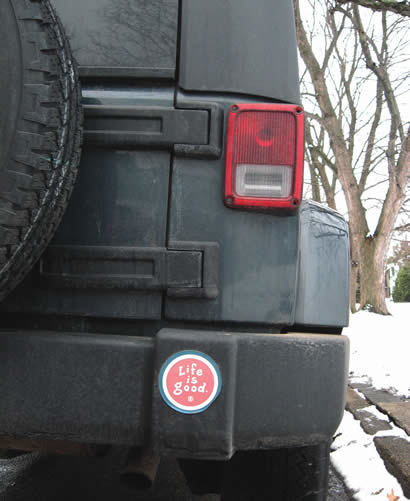
    Lifeisgoodbumpersticker

    I cannot help it — I love “Jake,” the distilled-to-his-essence stick-figure with a wide, winning grin, never-off shades and a disarming, simple message: “Life is good.”

    Yes, he’s probably, to put it mildly, a bit overexposed. In fact, he’s everywhere. In airport gift shops and upscale shopping malls, on bumper stickers and backpacks, on doggie Frisbees, gold balls and baby bibs, there’s Jake — deftly managing a sizzling grill, cruising on a mountain bike, relaxing in a hammock, strolling through the woods, strumming a guitar. “Life is good,” he reports through the medium of carefully distressed “vintage” T-shirts. His sure seems to be.

    It would be easy, but mistaken, to dismiss Jake as a knock-off of Harvey Ball’s “Have a Nice Day” smiley-face. The latter’s expression is vacant and phony — stoned, maybe — but Jake’s is genuinely happy. The smiley-face is a logo, with no story, plans or dreams, but Jake is the buddy who calls to cajole you into skipping work for a powder-day. “Have a nice day” is a limp, tepid, vague suggestion. “Life is good” is a bold blend of laid-back vibe and affirmation of the cosmos.

    Jake is not just a stylized Crocodile Dundee (“No worries!”) or Bobby McFerrin (“Don’t worry, be happy!”), who is relieved to report that things aren’t too bad. He’s no slacker-nihilist, shrugging off what comes with a “Whatever, dude.” No, for Jake, life is Whitmanesque — it is large, it contains multitudes, and he likes it. It is good.

    No doubt, Jake’s success is a tribute to lifestyle marketing, but his is more than a “lifestyle” claim. It is, I think, also a theological one, and I like to imagine that he knows it. When God made the world — the “dome in the middle of the waters,” the “two great lights,” the “great sea monsters” and “all kinds of creeping things” — we are told that “He saw how good it was.” Jake invites us to suppose that God’s verdict on bike rides through the backcountry and sausages cooked over fire would be — indeed, that it is — the same. No Manichean darkness here: Jake’s spirituality is joyfully incarnational. His world, like Gerard Manley Hopkins’, is “charged with the grandeur” — the goodness — “of God.”

    As a general matter, I am leery of bumper stickers, even ones that tout candidates I support or causes to which I am committed. I would hate to undermine them with a sloppy lane-change, an ill-timed nose-scratch or a long-delayed car wash. My “Life is good” decal, though, seems perfect. It says it all — or, at least, it says a lot — and, really, who could object?

    Secret message

    To be honest, however, my sticker has a double meaning. As I see it, I’m not only safely throwing in my lot with Jake, and reminding my fellow drivers of the joys to be found in and through guitars, barbeques and hiking boots. I like to think that I am also proposing sneakily what I suppose I am too nervous to proclaim more straightforwardly (on my car, anyway): Every human person is precious and inviolable, every human person has dignity and worth, and every human person — old and young, strong and frail, vulnerable and independent, loved and lonely, innocent and guilty — ought to be welcomed in life and protected by law.

    But am I really saying all that? Maybe I’m kidding myself. Sure, I want to think that Jake and his motto make it easier to invite my fellow drivers-citizens to consider and embrace what others’ bumpers say more explicitly, but is it just wishful, self-justifying thinking to imagine that hearts and minds are moved, pervasively and comprehensively, in the pro-life direction by even a contagiously good-natured cartoon-guy’s pro-“life” catch-phrase? And does Jake’s message really capture, or even map onto, what I and so many others mean by “pro-life”?

    In his 1995 encyclical, The Gospel of Life, Pope John Paul II challenged all people of good will to take on the “responsibility of choosing to be unconditionally pro-life.” Does my display of Jake’s good-natured profession cut it?

    Maybe not. The pro-life message, after all, is not — that is, it is not only — that there’s a lot of fun to be had in “life,” that we should hope, look and reach for many pleasant experiences. It’s a call to communion, love and relationship, not just to hedonism. The good news that is the Gospel of Life is not just that not all of the stuff in the universe is inanimate but is instead teeming with metabolism, reproduction, growth and adaptation. It’s amazing and wonderful, certainly, that so much in the world is alive, and only a crank would refuse to marvel at, even revel in, its dynamism.

    Still, “to be unconditionally pro-life” would seem to involve more than standing duly impressed before the workings of DNA and photosynthesis. No, the pro-life claim is about us, and not only about the arenas in which we struggle, the contexts through which we move and the stories we construct. It is about the amazing mystery and gift that is the person who lives — and laughs and cries and prays and plays — and not only about the no-doubt impressive facts that cells multiply and neurons fire.

    The pro-life proposal, what it is that I want Jake to be saying when he revels in the goodness of life, is that the individual human person — every one — matters. Each person — every one — carries, in C.S. Lewis’ words, the “Weight of Glory.”

    “There are no ordinary people,” Lewis insisted; “You have never talked to a mere mortal. Nations, cultures, arts, civilisations — these are mortal, and their life is to ours as the life of a gnat. But it is immortals whom we joke with, work with, marry, snub and exploit — immortal horrors or everlasting splendours.”

    The claim that every person matters and has worth might seem unremarkable. Perhaps it is one of those “duh” observations that is not even worthy of a bumper sticker, let alone a pop-culture phenomenon like Jake. It is, certainly, the purported premise of the law and morality of human rights and of our American civil religion (“with liberty and justice for all”). But can this claim, this premise, bear the weight we ask it to carry? Is there anything to it? What’s so special about us, actually?

    My Notre Dame colleague Tom Shaffer has said that every human person is “infinitely valuable, relentlessly unique, endlessly interesting.” This is true, I’m sure. But what is it, exactly, that makes it true, and not just wishful thinking or a delusion of grandeur?

    The great worth

    We profess — Jake and I, and the rest of our pro-life friends — that the dying and elderly deserve more, and better, than a chemically hastened, hospital-bed-vacating death, but what makes this true, as opposed to merely squeamish or sentimental?

    We affirm that even the commission of the most grave, most horrible crime should not be enough to push the criminal beyond all hope for reconciliation, repentance and relationship, but what saves this affirmation from being so much soft-hearted, excessively expensive fluff?

    We insist, flying in the face of a culture that holds out ability and achievement as the criteria for a worthy life, that a severely disabled unborn child is no less welcome, and no less inviolable, than the most gifted protégé, but why isn’t this insistence mere preening or self-indulgence?

    “What is man,” the Psalmist asked God, “that thou are mindful of him?” What indeed. After all, he noted, human beings “are but a breath” and “their days are like a passing shadow.” More than a few contemporary philosophers would agree with John Searle, who insists that the world “consists entirely of physical particles in fields of force,” some of which have become organized into “certain higher-level nervous systems.” We are, in other words, electrified sacks of fluid, meat-puppets in particle-clogged space. What is so “good” about that?

    It is, to say the least, an unsettling question. We are committed, today, to the morality and language of human rights and human dignity. We believe, in Nicholas Wolterstorff’s words, that “human beings, all of them, are irreducibly precious.” This is true, if a bit wordy for a bumper sticker. But how is it true, and what makes it true?

    Many would say that our “reason,” “autonomy” or “capabilities” do the work. We are valuable and inviolable, the arguments go, because of the impressive, inspiring things we do, or at least can do. To be sure, we can do amazing things, we do have characteristics and capacities that set us apart and above so much else that is. But these are not enough. Many of us are broken, disabled, unimpressive; all of us are dependent, vulnerable and incomplete.

    The Psalmist, again, gave thanks that he was “fearfully, wonderfully made,” but even a well-designed meat-puppet is, well, just that. Looking through a microscope, one might mistake us for chimps, if not worms. What gives us — what gives life — the great worth that we have and that saves our talk of rights, dignity and the sacred from being so much pretty nonsense?

    Remember here the children’s book The Velveteen Rabbit. A little boy’s toy becomes, over the years, “old and shabby, but the Boy loved him just as much. He loved him so hard that he loved all his whiskers off, and the pink lining to his ears turned grey, and his brown spots faded. He even began to lose his shape, and he scarcely looked like a rabbit any more, except to the Boy. To him he was always beautiful, and that was all that the little Rabbit cared about.” Eventually the Rabbit is made “Real” by having been loved by the Boy.

    In a similar way, Wolterstorff has argued, God’s love for us is what makes it true that we are precious, sacred and have worth. Our dignity is real; it is not just a convenient, reassuring construct. But, it is not achieved, earned or performed. It is freely bestowed and lovingly given. Our human rights do not attach to our own capacities but instead to the “worth bestowed on human beings by that love.”

    This is what John Paul II called the “moral truth about the human person,” that the “greatness of human beings is founded precisely in their being creatures of a loving God” and not self-styled authors of their own destiny. That in which we so justifiably take pride is also, and always, a call to humility. Not one of us, in the ways that really count and matter, is self-made, and thank God for that.

    Life is good, then, and it is because we love and are loved.

    That almost does sound like it could work on a bumper sticker.


    Richard Garnett is a professor and an associate dean in the Notre Dame Law School. He served as a clerk to Supreme Court Chief Justice William H. Rehnquist before joining the Notre Dame faculty.


  • Drawing Purple Trees

    childflower.jpg

    “What can you do with that major in the job market?”

    That question or some variant of it often sours an otherwise happy reunion of a Notre Dame student with his parents. The parent may not ask it outright, and certainly not at Christmas dinner or Easter breakfast — parents do have a sense of the right occasion. But the question can be read in the eyes and in the pauses when parents and children are together. And after the children have gone back to campus, the parents get it out and worry it between them.

    It’s not that these parents don’t want a broad education for their children; they have sent them to Notre Dame for just that. But by the time the children are juniors, if not earlier, parents begin to yearn for some sign that they are focusing their studies toward a goal. When students float from one major to another, dipping into courses which seem miles away from any coherent life plan, parents get nervous.

    We middle-class Americans have sanctified the notion that single-minded devotion to a goal is the key to success. Autobiographies of famous people often include statements such as “All my family have been lawyers. I never considered any other profession.” Or “I knew from kindergarten days that I would be a priest.”

    But that’s not the only way to live. It isn’t even the way most people do.

    Most of us, I think, are living a different story than the one we worked out when we were 20. I certainly am. When I graduated from college I was offered a fellowship for graduate study leading to a teaching position. I refused it without a second thought, even though I didn’t have a job. Teaching, I thought, was a dull and stodgy career. I wanted something exciting.

    I eventually made a career in a New York literary agency that represented some famous authors. But in late middle age I began to think that teaching might after all be a rewarding profession. I went to graduate school, got my master’s and doctoral degrees, and now I’m a college professor. I love it.

    Was that a mistake, then, that I made in my youth? Were all those New York years a waste, a wrong turn that kept me from my proper profession? I don’t think so. My proper profession, as I define it after living it, is to be a college professor with publishing experience.

    Jean-Paul Sartre, one of the prophets of existentialism, says that man first exists and then defines himself. That’s what I’ve done.

    The crucial movements of our lives are often unplanned. They come about because of some encounter or event that at the time seems trifling. The important people in our lives come unheralded and even unrecognized. Only when we look back do we define them as major influences.

    Things like this happen: Joe Clements answered an ad for a job as a book salesman. The job had been filled. But the employer said to him, “Look, do you know anything about printing, layout, stuff like that? We’re hurting for somebody in production. We’ll even teach you if you’re interested.” So they taught him and he was good at it, and he went on to become a successful designer of books.

    People’s hobbies become their professions. A chance encounter leads to a new job. A talk with a stranger on an airplane, or a sentence in a book, turns the world around and we switch directions.

    Existentialism — building our lives out of the materials that come to hand — that’s the way most of us do it. Then we look back and call our career by the shape it has assumed.

    If parents would reflect on how many chances and coincidences and serendipitous encounters and trivial events have shaped their own lives, they might feel calmer when they see their 20-year-old daughter majoring in philosophy with no idea of what gainful employment that might lead to. Or when their 20-year-old son informs them that he’s going to spend the summer working on a fishing boat out of Galveston instead of clerking in Uncle John’s insurance office.

    A few parents may be able to look back at their lives and affirm that at 20 their ambition was to do exactly what they are doing today. A very few have had one job and one only since they started work. One man out of a thousand recognized his future wife the instant he met her. One woman out of a thousand never considered any other possible husband. But most parents, if they think back, will recognize that time and chance have caused many changes in the lives they once planned.

    To those parents, let me recommend an existential serenity about your children. “Man first exists and then defines himself.” Try to live with the idea that your child is making up his life as he goes along, as you are doing, rather than fitting the life to a preconceived pattern.

    I don’t think that God has a plan for each of us, as we used to be told. I think He has made us free, really free, to devise our own patterns. I think he takes pleasure in our free-hand designs, just as parents take pleasure in their children’s drawings when they draw purple trees and cows with both eyes on one side of the head. They don’t complain: “Trees are supposed to be green.” They simply rejoice in their child’s developing creativity.

    If your children seem to be drawing purple trees even at 20, keep rejoicing. They are drawing their lives, with whatever crayons and inspirations come to hand. Wait for the whole design to emerge. Trees can look purple in certain rosy dawns and copper sunsets. Let the picture widen and develop.

    In the meantime, paste the purple tree fondly on the door on the refrigerator.


    Elizabeth A. Christman, an associate professor emerita of America Studies at Notre Dame, died Feb. 4, 2010. This essay ran in Notre Dame Magazine in May 1980. Professor Christman adapted it from a talk she gave at the closing breakfast of Junior Parents Weekend, February 24, 1980.

    Drawing:


  • Another email: Reports from Haiti

    haitileoganedestruction.jpg

    The first call was a phone message left during the weekend after the Jan. 12 earthquake fractured Haiti. It came from Ann Kloos, who graduated from Saint Mary’s College in 1973. Her brother John, a 1974 Notre Dame grad, had lost his son Ryan in the quake. His daughter, Erin, had been critically injured. The doctors working on her crushed body, transported to Miami, said she would not have survived another 24 hours without their care.

    Ann and I talked Monday, and a string of emails were soon forwarded to me, as well as to their family members and friends. Ryan, 24, and Erin, 26, both of Phoenix, had been working as international volunteers for Friends of the Orphans.

    Those threads of a family’s grief, courage and hope spoke eloquently of the disaster in Haiti, making it personal and real to those of us watching from a distance.

Emails indicate Ryan had only been there five days when the earthquake struck. Erin was severely hurt, with internal injuries and badly damaged arms. One of the first dispatches, from one family member to others, says of the parents: “Most importantly, they are with Erin right now. She arrived in the middle of the night and was treated immediately. She is responsive and knows they are there. At this point, they still wish everyone to be supportive from afar, and as soon as they want visitors or anything else, they will call on you. Secondly, NPH and other groups are confirming that Ryan was killed.”

John’s January 22nd email reports: “I just got back from a one-day trip to the Dominican Republic where I picked up Ryan’s ashes.” After that journey’s narrative, he writes, “Did I mention that I got to give Erin a real hug on Thursday? We were going from the bed to the chair and there had been enough wires removed that I actually got to hold her while she was standing upright. Damn. That felt good.”

Other email reports from and about Notre Dame people have been coming to our offices, too. We’ve heard from Notre Dame alumni who were some of the first doctors on site. We’ve heard from a recent grad who was caught in a life-threatening riot in Haiti the moment the earthquake hit. And we’ve heard from other Notre Dame people with connections in Haiti.

Notre Dame has had a presence in Haiti for years, largely through the work of Tom Streit, CSC, and his medical research and service team that includes doctors, alumni and Notre Dame students. Streit’s clinic was at the epicenter of the quake. Fortunately, his prescience led to Notre Dame engineers constructing facilities to withstand an earthquake.

On January 27, I received an email from Linda Mans Leary whose son, Joey Leary, a 2009 ND alumnus, was working with the Notre Dame Haiti Program and was with Father Streit and others at the Hotel Montana when the earthquake hit. She attached his account of that and his experiences over the next 48 hours, and it’s here for you as well.

And the emails and stories continue to come in, and as they do, we’ll post them here. So read on and come back again.

Meanwhile, scanning through more emails from John Kloos forwarded my way: “Erin is out of intensive care. She has been able to get out of bed twice and has spent some time sitting in a reclining chair, simple tasks that mean a lot right now. The next guilty pleasure she’s looking forward to is getting her hair washed with real shampoo and water. . . .

“The difference between what we saw last Friday morning and the Erin we are looking at today is nothing short of amazing. However, when you finally get to see some pictures of her, please be ready and don’t panic. She has been through hell and there are marks from that journey. But they are just marks. The Erin underneath is going to come out whole.”

That is a prayerful hope we wish for all who have survived and all those affected by this tragedy.


Kerry Temple is editor of Notre Dame Magazine.


  • “Miss Christman,” elegant and gracious

    lizchristman.jpg

    When I got the call last week that my longtime friend Elizabeth Christman had passed away in St. Louis at age 96, I was flooded with memories.

    Liz Christman, a retired Notre Dame professor of American studies, was a kind and dependable friend to all who knew her. Even in her later years, as Liz bravely faced illness and gradually had to surrender her independence, I never knew her to be anything but patient and upbeat.

    Liz started teaching at Notre Dame full time in 1976, during the early years of co-education. The university couldn’t have hired a better teacher, mentor and role model for women students.

    Born before World War I, Liz graduated from college during the Depression and joined the WAVES, an all-women division of the U.S. Navy, working in Washington D.C. as an editorial research officer during World War II. After the war, she moved to New York and spent more than 20 years working at Harold Ober Associates, a literary agency that handled such clients as J.D. Salinger, Agatha Christie and William Faulkner.

    In the 1960s, Liz enrolled in night school at New York University and earned a master’s degree, and began working on a doctoral degree in English and American literature. Then she made a bold and dramatic decision: In 1969, she resigned from her longtime job and moved to Greencastle, Ind., to become an English professor at DePauw University

    “When I was 55 years old I changed my life: I left my work in a New York literary agency and became a teacher in a small Indiana college. I left a city of eight million for a town of eight thousand. I left one of the most dynamic centers of music and literature and theater and art in the world for a place where there wasn’t even a full-time movie house,” Christman wrote in a memoir. "These deprivations didn’t matter to me. I was exultant to have been able to get a teaching appointment at my age, with no experience, and without a Ph.D.” She soon finished the doctoral degree.

    What a fortunate turn of events for DePauw and, a few years later, Notre Dame undergraduates.

    Her literature and writing classes were a treat. And the Juniper Press book-publishing course she developed was so popular that sometimes lotteries were required to enroll in the class.

    We kept in regular touch after I graduated. The formal “Miss Christman” of college days easily transitioned into Liz, as she was known to all her friends. Over lunch we talked about current events, theater and books — always books. She particularly loved Henry James and Anthony Trollope.

    Liz never lost her eagerness for learning and self-improvement. Well into her 80s, she took daily walks. But ordinary exercise was just too dull for Liz’s active mind. She carried index cards on which she had copied poems. As she walked, she glanced at the cards and memorized the lines. If it was good to exercise the body, Liz figured, it was even better to exercise the mind, too.

    She was active in the South Bend community, participating in bridge clubs, teaching classes at the Forever Learning Institute and volunteering for years as an adult reading tutor.

    In her retirement years, Liz and I would meet for dinner and to attend arts events together at the DeBartolo Performing Arts Center on the Notre Dame campus. She loved film, opera and classical music. I recall one stage musical we attended that didn’t live up to the advance hype. The first half dragged, and I wondered if Liz was having similar thoughts. When the lights went up at intermission, she turned to me and said simply: “I prefer Trollope.” By mutual agreement, we left that performance early.

    My favorite photo of Liz is one published some years back in Notre Dame Magazine. It accompanied a column she wrote recounting the joys of teaching about the works of Henry James. In the photo, Liz stands smiling in a plaid dress, white hair perfectly coiffed, pearls at her neck and a thick copy of Henry James: A Life held closely in her left arm.

    That’s the way I’ll always remember Liz Christman: elegant, wise, gracious and cultured. She accepted the world on its own terms and embraced it.


    Margaret Fosmoe ’85 is a staff writer at the South Bend Tribune.


  • A zest for living

    My colleagues on the faculty were amazed when they heard I had signed up to travel with students on the “Short Trip” to the March for Life in Washington, D.C. The itinerary meant, after all, a Thursday evening departure on a 12-hour bus ride through the night, Friday’s participation in the march itself, a return trip by bus Friday night, and a Saturday morning arrival back at Notre Dame.

    Two of my theology department colleagues, Gabriel Reynolds and Larry Sullivan, shared the bus ride with me and approximately 50 students, and Philip Bess of the School of Architecture made the return trip with the students, Gabriel and me. Other Notre Dame faculty and staff rode on other buses with students — there were eight buses in all — while others arrived by plane to participate in the 2010 March for Life, an event of pro-life witness and protest now in its 37th year.

    My experience is thus one little window into a vibrant, kaleidoscopic event directly involving approximately 400 Notre Dame students, faculty and staff; hundreds of alumni in the D.C. area; the pastors and parishioners at St. Agnes and St. Ann parishes in Arlington, Virginia, who hosted the Notre Dame contingent; and an estimated 300,000 marchers from all over the USA, who poured into the nation’s capital in record-breaking numbers.

    “Notre Dame, Queen of the Highways, pray for us.” Inventing a new title for Mary the Mother of God, Mary Forr, our bus’s student co-captain led us in prayer as our vehicle pulled out from Hammes Bookstore. A rosary followed, with travelers on alternate sides of the aisle leading and responding. I was impressed with the atmosphere of prayer, the students’ desire to put first things first. With the completion of the rosary, the student seminarians from Old College who were seated just behind me prayed Night Prayer aloud using their breviaries and reading lamps.

    A spirit of adventure reigned but by midnight the bus was quiet, most of us sleeping or trying to sleep in our seats, covered with a coat or blanket. Punctually at 7:30 a.m., we pulled into the parking lot at St. Agnes, where we joined with a group that had left campus a day earlier. A good breakfast awaited us, and we had time to freshen up, converse with each other and pray.

    Holy Mass at St. Agnes was extraordinary. Father John Jenkins, CSC, the president of the University, concelebrated the Eucharist with his fellow priests and delivered an inspirational homily, which linked witness to the sanctity of human life to the scriptural readings, to the Gospel of Life and its demand that we love our enemies. Hundreds filled the church, as those who had traveled by bus were joined by those who had come by plane and local parishioners — all of us meeting at the altar and table of the Lord to share the one bread and to be sent out on a common mission, to bear witness to the Lord who is Life and to the sanctity of all human life.

    Mutual joy

    Outside it was sleeting. Student leaders from Notre Dame Right to Life distributed plastic ponchos, knit caps with the NDRTL logo and day passes for the Metro, to which we walked in groups. By 11:45 we had reassembled at the National Mall. In the sea of people the Notre Dame banner helped us find our place close to the spot where marchers from the Diocese of Fort Wayne-South Bend, including bishops Kevin Rhoades and John D’Arcy, also gathered. Jenkins’ presence was a special cause of mutual joy. The unprecedented participation of a relatively large group of faculty, staff, and alumni with the students heightened the impression that “We are ND” — one large Notre Dame family.

    At the signal for the start of the march, groups from across the Mall began to make their way onto Constitution Avenue along a route leading past congressional buildings to the Supreme Court — a walk lasting three hours, given the vast crowd. The sun had come out, the rain had stopped, and an unusually warm day added to the marchers’ joy. The majority of them were Catholic youth from parishes, high schools, seminaries and college campuses. Beside them parents and grandparents walked, some carrying babies or, like Notre Dame’s Bill and Elizabeth Kirk, pushing baby carts. Bishops, priests and sisters marched. The disabled, too, joined the march, including one alumna whose scooter bore a sign against euthanasia.

    Carrying banners, singing hymns, praying the rosary, breaking out into football-style cheers and chants, playing instruments, pausing for conversation as one group met another in the streets, the marchers pressed forward.

    Despite my questionable right to do so, given my age, I carried a banner that read “We are the Pro-Life Generation.” The slogan expresses the strong pro-life sentiment of those who consider themselves survivors in an age of legalized abortion. For these young marchers, the movement coincides with their youthful love for life itself, their zest for living, their awareness of the experience of life as an unfolding of human potentials already present in the unborn and, for many, their religious fervor for the Gospel of Life.

    Then there were the “Silent No More” women. Traumatized by abortion, they had come to bear witness to the tragic consequences of abortion for mothers and children alike.

    On the steps of the Supreme Court, we celebrated the conclusion of the march with the singing of “Notre Dame, Our Mother” and the Notre Dame Victory March. By 8 o’clock my fellow travelers and I were back on our buses at St. Agnes, ready to return to Notre Dame. We began again with a rosary. Some students were so tired that they fell asleep in the middle of that prayer.


    Ann W. Astell, a Schoenstatt Sister of Mary, is a professor of theology at Notre Dame.


  • Bigots I Have Loved

    racismstatue.jpg

    Promising that his all-white team alone was worthy of the scoreboard, his looming shrine, he thundered over the grunts and snarls of the boys scrimmaging on each end of the dry field. His players called him Boomer. The varsity was preparing to play a team with a black halfback, and I knew he had designated one of his runners to play the sacrificial role of the talented enemy halfback. From where I practiced with the junior varsity, I felt his booms: “Get the spook. Get that spook.”

    None of us boys walked off the field in protest of the metaphorical lynching. I admit this with difficulty, but we loved the racist coach, who is now honored on the wall of fame in the football stadium at my old high school. He was the only one of my high school teachers to contact me after my father died during my freshman year of college. He drove to my home, sat with my family at the kitchen table and shared gently his sympathy.

    Perhaps it’s insensitive of me to bring up my late coach in this way after so many years. When you’ve loved as many bigots as I have, knowing how to remember them can be as hard as that dusty, cracked ground upon which I felt the words “get that spook.” And perhaps Faulkner was mistaken and the past really is past — bigotry little more than a rusty whip handle unearthed at the site of a Mississippi plantation. I’ve heard that our current president is irrefutable evidence that bigotry in the United States is now a group of feeble old men peering watery-eyed through holes in tattered white sheets; that fear of racism is as irrational as fear of ghosts.

    Perhaps I should let bygones be bygones.

    A slur for a slur

    On my way home from work on election day, I stopped for a beer. The Irish bartender glanced at my Obama shirt and told a joke to the guy on the stool next to me. “Did you hear that Obama is ahead?”

    “No. Is he?”

    “Yes — but that will change when the white people get off work and vote.”

    I asked the same guy, “Do you know if they serve seven-course Irish dinners here?”

    “Whaddya mean?”

    “You know, a six-pack and a potato.”

    My wife is mostly Irish and I’m partly, but my retort by slur was inexcusable, and, anyhow, you could say that my spirit of reconciliation was found wanting. I knew that stupid hate might sputter like old grease on the grill as soon as my plug for Obama was noticed in that establishment where a patron can scribble whatever he desires on a dollar bill before the bartender tacks it to the wall above the bottles of whiskey. Where the father of our nation gushes, “I like Boobies!”

    Since election day, I’ve bought beer at the business where I heard the racist joke, and it wouldn’t be impolite of you to ask why. In my neck of the woods, that bar is one of the few with Guinness on tap, and I am a weak man, but the answer is also that some of my fellow Americans drink elbow to elbow there and — for me — climbing up on one of those stools can be like going home again.

    The first bigoted joke I heard as a child was told by a friend who had heard it from his father. In my backyard, my innocent friend asked, “What did God say when he made the second n——-?” I still hear the birdy, quavering voice of my friend — who walked to church with me on Sunday mornings — as he finishes the joke by assuming the Word of God. In the punch line, God does not remind us that He created all people in His image or demand an end to lynching and holocausts and laughter at hatred. Instead — on the green grass of my childhood — He says, “Oops, burnt another one.”

    Although I’ve made myself forget, surely I laughed. I was already fluent in the tongues of bigotry, though I never used the word dago in the presence of my best friend, who was Italian.

    Fear and loathing

    After he led us in prayer, thanking Our Father for supper, my own father made occasional ethnic slurs while telling us about his day at the power plant or commenting on some news he’d heard on the radio while driving home to our working-class New York town, where eventually Timothy McVeigh would grow up. Usually the slurs were spoken as if he were reporting the weather, but he was not so casual when race riots erupted in nearby Buffalo. He feared that the violence would spread to Pendleton, home to merely a few black families.

    We once ventured into the inner city to cheer the Buffalo Bills, the blue-collar defending champs of the upstart American Football League. My father parked the car on the small, yellowed yard of a house on mostly boarded-up Jefferson Avenue, paid the owner a two-dollar fee, and marched us to the game among an influx watched — predatorily, I imagined — by blacks sitting on front steps and porches, whole families bemused at the sight of so many whites staring straight ahead with silly terror in their eyes as they hurried up the avenue of false promises.

    Ticket scalpers and hot dog vendors hawked at busy intersections, and when we reached crumbling War Memorial Stadium — or the Old Rockpile, as it was called in western New York — my father said, for the second time that afternoon, “We’ll be lucky if our car isn’t stripped when we get back.”

    Somehow my father and the rest of us whites worrying toward the stadium had come to the backward conclusion that blacks had a history of harming whites. Dad and I had given little thought to what it felt like for the two blacks who attended my school or the few who labored at the power plant, but now we feared being in the minority. Inside the decaying but thick walls of the stadium, things would be made right again: the coaches and quarterbacks and security guards would be white like most of the fans.

    Even a boy could sense that football was the way America worked: a hierarchy of owner and directors and coaches and stars right on down to the wounded, grunting and anonymous offensive linemen on whose wide shoulder pads every touchdown rested. Yet our nation had two working-classes: one inside and one outside the walls.

    Anti-Catholic

    When he emigrated from the North of Ireland to the United States, my paternal great-grandfather carried the heirloom of anti-Catholic bigotry. Three generations of Phillipses lived in an Irish neighborhood of South Buffalo, and on their way home from public school my father and uncles and other Protestant boys often fought Catholic boys who were on their way home from parochial school.

    My grandfather referred to Catholics as cat-lickers, though he married one who agreed to give up her faith. Before I met the woman I would marry, who has kept her faith, I suspected that Catholics had tails and horns — a fear she has mostly dispelled.

    Until my grandfather took a new job in the power plant he had helped build, all of the Phillips men were disposable iron workers. In three separate accidents, my great-grandfather and two of his sons died on construction jobs. My grandfather broke two ribs and bruised a lung in another.

    My father inhaled welding fumes all day in a plant so polluted with coal dust and fly ash that if he wore a white shirt, no matter how long he had scrubbed his skin after work, the cloth would gray as he perspired. My maternal grandfather broke a leg on a road construction job; two other kin survived crushing injuries on logging jobs; another lost several fingers in a machine shop. Nearly every iron worker in the family had a damaged back before he reached retirement age, and they were among the lucky ones. When their bodies were broken or lifeless, industry purchased new bodies. Helplessly, my father knew this. On a sidewalk in a nearby town we once passed a stranger in a grandiose suit, glittering watch, gleaming shoes; my father spit on the concrete and muttered, “You son of a bitch.”

    My father, his killed grandfather and two killed uncles did put food on the table while they lived. They could have been limited to starvation wages or sent to the endless unemployment line; and weren’t they forever reminded? Aren’t we all? On some level they must have sensed that the privileged had twisted the word black into a definition for those who are perceived as lower class in America — and that their own skin pigment was no guarantee that they would be perceived as white.

    In his book How the Irish Became White, historian Noel Ignatiev could be referring to my kin when he notes of his depiction of oppressed 18th and 19th century Irish-Americans, “I hope I have shown that they were as radical in spirit as anyone in their circumstances might be, but that their radical impulses were betrayed by their decision to sign aboard the hunt for the white whale,” which, he adds, “in the end did not fetch them much in our Nantucket market.”

    During the hike to the Old Rockpile, Dad bought us lunch at a hamburger stand. On the sidewalk, he counted his change and realized that the black cashier had accidentally handed him a 20-dollar bill rather than a five; he got back in line, corrected the mistake, and explained to me, “They would have taken it out of her pay.” It was a warm autumn day, and as usual he was wearing a dark shirt that hid the coal dust, the blackness flushing from his pores as he perspired.

    Still white

    I never heard my mother use the racial epithets that were second nature to other adults in my family and neighborhood. I like to think she was too bright to be bigoted. She had graduated first in her high school class but didn’t attend college, as she explained it to me when I was a teenager, “because back then college was just for rich girls who wanted to find richer husbands.”

    She grew up with American Indians. Her father’s small, swampy farm edged within a half mile of the Tonawanda Indian Reservation, where, until he died in his 80s, one of her uncles lived with an Indian woman in a cabin with no toilet. My mother’s younger sister married a man from the reservation, and although my grandparents loved their half-Indian grandchildren, their complaints about “lazy Indians” were sometimes slung at their gainfully employed son-in-law, and they were sure that “them Indians must have took it” whenever a possession disappeared from the farm. Until my grandfather landed a job on a state road crew when he was in his 40s, they were poor, but my grandparents could always visit the reservation to witness destitute poverty, to be assured that though they couldn’t afford to buy more than three pairs of underwear for each of their daughters, they were still white.

    I was spending a weekend on the farm when the brother of my grandmother’s closest friend killed himself on the reservation. Charlie Moses lived with his sister, who telephoned my grandmother minutes after the rifle blast. Over the phone, my grandmother asked Arlene, “Was he drunk?” I begged them to take me along, but my grandparents ordered me to stay behind as they hurried out to their old American Motors sedan.

    Early the next morning they returned to the reservation to clean Arlene’s parlor, and I went fishing in the muddy creek that shaped the sinuous east and north boundaries of the farm. I returned to the yard hours later dragging a stringer of gasping and flopping bullheads and rock bass, tormented by a cloud of mosquitoes, and encountered my grandmother kneeling on the grass with her hands plunged in a pail of soapy, pink water. I asked what she was doing, and she replied, “Trying to get brains off these curtains.” She held up a curtain and said, “Who ever would have thought Charlie Moses had so much brains?”

    Civil rights

    We danced to James Brown and Aretha Franklin, and perhaps the sensual celebration awakened us to the images and calls of truth arisen. By then it was 1970 and some of us paid attention when our American history teacher taught about slavery, the KKK and racial segregation, and he asked, “How come you don’t see anyone except whites in this class?”

    Some of us were appalled by the old news footage of police assaulting peaceful civil-rights protesters with truncheons, torrents of water, snarling dogs and Southern law, and were stirred by the brave, truthful poetry of Reverend King, though by then he had been assassinated by a white supremacist.

    When the school board banned Eldridge Cleaver’s Soul on Ice from the library, a small group of us protested, not because we admired the author’s murderous, misogynistic rage but because we possessed some vague understanding that his eloquence was an incantation of Emerson’s self-reliance come home to roost. We argued that the school was supposed to be educating us, and Cleaver was an American reality.

    Of course, none of us walked off the football field: other players might have been granted our positions.

    Family debates

    Lincoln and Douglas we weren’t, but my father and I had a series of debates about racial issues. At first we disagreed about the banning of Soul on Ice, but as in all serious discussions involving race in America, we soon found it necessary to abolish boundaries and time — to visit George Wallace as well as Eldridge Cleaver, South Boston as well as Birmingham, and Africa as well as Harlem.

    He never argued overtly that blacks were genetically inferior, but my father was opposed to court-ordered integration of schools and affirmative action and believed that blacks had accumulated more rights and opportunities than had whites. I was 17. My mother, who knew her socially defined and confined place, listened in silence to our debates, which began during supper and lasted for hours.

    My father thought about our disagreements while at work and I at school, and each of us charged into the new evening armed with arguments we believed to be fresh and potent. My father actually asked a black worker at the power plant what he thought about the Black Panthers and reported triumphantly, “He told me they’re all crazy.”

    We debated for three or four evenings in a row and then, weary from arguments that seemed to be going nowhere except into a recycling bin, gave it a rest. We mostly avoided each other until he came to me after two days of quiet and said, “You know, all that black and white stuff we talked about, some of it you were right. You still got a lot to learn in life, but some of it you were right.”

    I nodded and looked away, embarrassed and proud like a son who has realized that for once his father has not let him win at basketball, that he has actually beaten his flawed hero. Which only goes to show that my father was right about one thing: even though I never again heard him utter a racial epithet, I still had a lot to learn about hate and love.

    Hiding

    He was slowly dying. Men seldom develop cancer of the prostate until at least age 50, but some studies have reported that welders have an earlier and higher incidence. He had been diagnosed with prostate cancer at age 40, and because it had already spread into his bones where it was inoperable, a surgeon had removed my father’s testicles to deprive the tumors of some of their hormonal fuel.

    He continued to limp into the power plant to support his family. On the days when he was in too much pain to work despite the drugs, his fellow welders did his jobs and hid him in a storage room so the big bosses wouldn’t know to fire him. He eventually found it impossible to climb the stairs to the second-floor time clock and took an early retirement, which lasted several months.

    He still was unable to wear a white shirt.


    Mark Phillips lives near Cuba, New York. His memoir, My Father’s Cabin, was published by Lyons Press in 2001.

    Photo copyright Don Nelson.


  • Shovels ready

    nyctrip.jpg

    Here’s a thought that’ll freak me out the next time I cross the Verrazano-Narrows Bridge linking Brooklyn and Staten Island: The span sits as much as 12 feet lower in summer than in winter because of the seasonal expansion and contraction of its steel suspension cables.

    Not 12 inches, a variation I could comfortably assimilate into my simpleton’s comprehension of bridges. Twelve feet.

    Here’s another arresting fact that also comes courtesy of the bridge’s owner, New York City’s Metropolitan Transit Authority (MTA). When placing the towers eight-tenths of a mile apart and dealing with the mind-numbing variables relating to structural weight, cable strength, anticipated vehicular loads and the geology of the Narrows’ floor — to name but a few considerations — the engineers who designed and built the bridge had to account for the curvature of the earth.

    It was the longest suspension bridge in the world for 17 years and is still long by any standard. Yet this massive structure, visible from the distant boroughs of Queens and the Bronx, can shimmy uncomfortably when runners pound across it during the New York City Marathon. It’s a function of the flexibility designed into long-span bridges to accommodate motion and stress.

    Now consider this tale of two bridges. New York’s monumental oceanic gateway opened to traffic in 1964, the same year as the steel truss arch bridge that faithfully carried Interstate 35 West’s traffic across the Mississippi River at Minneapolis until it collapsed under the evening rush on August 1, 2007. Thirteen people died, more than 100 others were injured.

    MTA is preparing to spend $300 million to replace the New York double-decker’s concrete upper level with an orthotropic steel deck, an expensive retrofit that will make it thousands of tons lighter and extend the bridge’s expected life 100 years.

    Inspectors had twice declared the Minnesota bridge — like thousands of others across the country — “structurally deficient,” a federal designation that doesn’t foretell imminent doom so much as it urges serious repairs. The day after the collapse, Governor Tim Pawlenty said the bridge had been tentatively scheduled for replacement in 2020. Instead, Minnesotans spent nearly $300 million to replace it in one year, pay out an early completion bonus and compensate families for their incalculable loss. The result, the award-winning I-35W St. Anthony Falls Bridge, is also expected to last a century.

    The Minnesota disaster happened a few weeks before some 40 young men and women thinking about a future as civil engineers arrived for their freshman year at Notre Dame. Now these students are juniors immersed in what one professor calls the “real, hardcore concepts” of civil engineering. The ominous boom above their heads one sunny Sunday morning this past autumn wasn’t the nation’s infrastructure problems crashing down upon them. It was an experiment-in-progress at Lehigh University, the last stop on their class field trip to New York City, testing the next upper deck of the Verrazano-Narrows Bridge to make sure it really will serve 100 years without cracking.

    ‘One big pothole’

    nyccorrosion.jpg

    We all might want to think seriously about civil engineering and infrastructure because our report card is ugly. At a time when the nation is fighting two wars, has flunked capitalism for the first time in 70 years and is aggressively negotiating its grades in healthcare and education, the American Society of Civil Engineers (ASCE) says we’re pulling a D in infrastructure. Their 2009 report card awarded one of the best marks in any category, a C, to our bridges.

    The secretary of transportation has called the United States “one big pothole.” A study released last May by the American Association of State Highway and Transportation Officials declared a third of our interstates, highways and major roads “mediocre” or worse.

    Oliver Wendell Holmes Jr. famously said that taxes are the price we pay for civilization. Today we can add that sensational auto repair bills are the price we pay when civilization crumbles. Bad roads cost car owners $400 yearly. Double that if you live in a metro area of more than a quarter million people, the transportation officials say.

    What about the rest of our infrastructure? The civil engineers say we daily lose about 7 billion gallons of water to bad pipes and face an $11 billion backlog to replace obsolete water works and meet federal safe drinking water standards. ’Tis but a drop compared to what comes out the other end, an estimated $390 billion to overhaul our wastewater treatment systems and meet new demand over the next 20 years.

    Suburban development has crept up on our dams and levees, which are getting old and dangerous much quicker than we’re fixing them. Mass transit, the fastest growing transportation sector for 15 years, isn’t keeping pace with demand. The bottom line, according to ASCE, is $2.2 trillion to catch up with ourselves over the next five years.

    That doesn’t count the persistent threat of terrorism and everything else we know is coming: rapid population growth; natural disasters like the massive earthquake the Pacific Northwest anticipates within the next 200 years; the high-stakes coastal clash already pitting the oceans against those of us who insist on living next to them.

    Cue every cliché you’ve heard about opportunity in adversity, but today’s civil engineering students are going to spend much of their careers fixing or replacing this stuff. Demand for their services far exceeds supply. “This is a fantastic time to be an engineer,” says Michael Sweeney, the vice president of engineering superfirm AECOM’s Transit Rail East division and the emcee for the Notre Dame field-trip stop at the company’s offices in downtown Manhattan.

    A show of hands reveals this is a first visit to America’s largest and most complex, confounding and fascinating city for more than half the students. Sweeney welcomes them with internship applications, enticing them to come back next summer.

    Building to last

    You don’t go into civil engineering if your goal in life is to make a lot of money, student Kimberly Duffy says.

    That’s not to say it never happens. Notre Dame sends just a few dozen graduates into the field each year, and for a small program it’s well represented in the senior leadership of firms with national and global reach like AECOM, Skanska, Granite and Kiewit. But civil engineers draw the lowest starting salaries among their peers. Money comes easier in petroleum and nuclear.

    Instead, civil engineering is about service to society, says Professor Tracy Kijewski-Correa, a tall-buildings expert who teaches structural engineering. Students learn to provide basic public services. “There’s no consumer for what we do,” she says.

    “That’s one thing that sometimes attracts students into civil engineering,” agrees Professor Yahya Kurama. “The fact that you’re going to make something that will last for a long time.”

    Some years ago it wasn’t clear the attraction was holding. So in 2003, the department tapped a travel fund created by Dennis Murphy ’71 and worked with his firm, Kiewit, to create a field trip that would introduce ND civil engineering students to the challenges of large-scale projects. Kijewski-Correa led a group up the Pacific Coast to examine bridges. They wound up at the Tacoma Narrows Bridge in Washington, where Kiewit had begun construction on a second span the year before.

    “It isn’t always possible to force yourself in the middle of the night to remember why you’re studying differential equations or thermal dynamics,” notes Murphy, who got hooked on construction as an undergrad and valued the trips he’d taken with classmates to Chicago and Lake Michigan’s dunes.

    “Get them dreaming,” is how the current trip leader, Professor Joannes Westerink, distills the purpose. In 2006, Westerink and his colleagues took students to the Mississippi Delta and New Orleans to study the hell wrought by Hurricane Katrina. They couldn’t have bought a better guide. Westerink, affable and courteous, builds weather models for the ocean that predict with incredible precision how fast water flows, how it carries sediments and pollutants, how it forces itself inland when propelled by severe storms.

    The Advanced Circulation Model he has developed with his colleagues, many of them former students, is the vehicle for collective work on storm surge shared by the Army Corps of Engineers, the Federal Emergency Management Agency, the Navy and a host of other agencies, consultants and universities. It’s the kind of knowledge engineers need to build better levees, create all-important digital flood insurance rate maps for threatened states and think critically about the future of coastal cities like New Orleans.

    Now teams of ND faculty will apply their wide expertise to a pair of hurricane preparedness projects. One will model flood risk for Pacific islands. The other will create a comprehensive model for Hawaii, detailing the impact that rushing, piling water and high winds would have on roads, buildings, bridges and people. “It combines everything related to infrastructure,” Westerink says.

    On the New York field trip, the students learn that storm surge and rising seas are no less a concern for Manhattan than New Orleans. Subway entrances in some places are only a few feet above sea level; a devastating 1893 hurricane took out elevated tracks in Brooklyn and obliterated an island near what became JFK Airport. Even under normal conditions, “New York is in need of retrofitting for a significant part of its infrastructure,” Professor Alexandros Taflanidis says. The catalog of challenges in a metropolis of 19 million people is exhaustive.

    This year, after 12 hours on a bus barreling east from South Bend on I-80, Westerink, Taflanidis and their students begin with an after-dinner walk across an old challenge gloriously met: one of the city’s first world-class engineering achievements, the Brooklyn Bridge.

    Faster, safer, greener, smarter

    The following morning, after Michael Sweeney’s introduction at AECOM, the students learn about the company’s work on the Second Avenue Subway (SAS) line and the World Trade Center Transportation Hub.

    The long overdue 8.5 mile SAS and its 16 new stations will relieve the Lexington Avenue Line, the sole north-south subway option up Manhattan’s East Side that carries 1.3 million riders daily. The project has been kicking around since 1929, only to hit the vagaries of finance and local politics. It stalled out in the 1940s and again in the ’70s.

    The project’s final design is expected later this year, but the brutal-yet-delicate job of excavating station sites and tunneling through the undulating bedrock and sediments beneath Second Avenue’s six lanes and 20-foot sidewalks has begun. Public relations are sensitive. Whole blocks have become worksites. “The big challenge in New York is finding space while minimizing impact on the public,” explains senior tunnel engineer Jaidev Sankar. Things don’t get easier underground. “We found utilities even the utility companies didn’t know were there.”

    The WTC’s Transportation Hub will glamorously reconnect the surface city with the PATH commuter rail station that served lower Manhattan before 9/11 — and has again since its 2003 reactivation. Riders will arrive and depart through an underground structure similar in size to Grand Central Station, designed by Spanish engineer and architect Santiago Calatrava. It will emerge above grade in a white monument of steel ribs and glass that Calatrava envisions as a child’s hands releasing a dove.

    Project managers say one goal is a more versatile facility linking riders with Manhattan’s throng of transit options. Another is to restore what was once the highest grossing retail space in North America — engaging a “small city” of commuters and shoppers each day — under the natural light filtering down through Calatrava’s design.

    The design challenges are both practical and spectacular. Sixty escalators, 40 elevators. Steel platforms cantilevered out 75 feet. “One of the joys of Mr. Calatrava’s architecture is holding stuff up with no visible means of support,” project architect Joe Hand notes with an exasperated mixture of professional appreciation and irony. “What he does is challenge your mind to say, that thing shouldn’t be hanging out there, but it is.”

    Some 200 designers worked five years to ensure redundancies in structural, mechanical and electrical systems, Hand says, “so that this building doesn’t suffer the same fate as its predecessor.” Terrorism, a leading concern, will be a fact of professional life for engineers working on prominent projects. Meanwhile, transit through the hub must function continuously.

    Later that afternoon, the focus shifts to sustainability when the students visit the headquarters of Skanska USA on the 32nd floor of the Empire State Building, the first office in its class to receive “platinum” certification under the Leadership in Energy and Environmental Design criteria set by the U.S. Green Building Council. About 80 percent of New York’s carbon footprint today comes from the energy used to construct and maintain buildings, city data shows. It’s a compelling statistic, given projections that the square footage of our built environment will more than double globally over the next 20 years.

    Skanska officials lead students through an on-site review of the company’s work in progress on the United Nations’ Capital Master Plan, a sweeping modernization that will yank the epicenter of global diplomacy out of 1954 in everything from its electrical wiring to its audio translation systems while preserving the five-building complex’s historically spacey look and feel.

    By evening it’s back to bridges at Columbia University’s Carleton Laboratory, a major locus for bridge monitoring and research. One eye-catching experiment lives in a transparent chamber the length of a charter fishing boat. It contains a segment of 20-inch bridge cable undergoing a corrosion simulation while sensors measure humidity, pH levels, temperature shifts and other enemies of structural integrity.

    Designing long-span bridges is part of the curriculum for Patrick Brewick ’09, who is getting acquainted with it all as a Columbia grad student. Nearly three in 10 ND civil engineers pursue graduate study. Brewick traveled to New Orleans as a junior and caughtWesterink’s passion. “I saw that same enthusiasm in all the engineers there. They really had a love for what they were doing,” he says. “It actually led me to start getting interested in graduate school.”

    Fluid development

    Professor Stephen Silliman, who has spent a lot of time working on water quality in such countries as Benin and Haiti, says we have civil engineers as much as doctors to thank for the sharp decline in U.S. infant mortality rates since the mid-19th century.

    Today, “We have no fear — or maybe just a tiny bit of fear — but we have no real fear of turning on a water faucet and drinking out of it,” Silliman says. Should we get complacent or stingy about maintaining our high standards though, we’re fools.

    New Yorkers boast that they have the best drinking water in the world. Ten percent of their supply comes from the Hudson Valley’s Croton watershed. Since the city started drawing there in 1842, the water has flowed unfiltered some 125 miles to customers’ taps. Now development in the watershed threatens quality and the water no longer meets federal standards.

    The $1.3 billion Croton Water Filtration Plant is the largest single construction contract in city history, and the largest project Skanska has ever undertaken. Today it’s a nine-acre square cut 95 feet into the earth and run through with pipes large enough for people to stand in. Think of it as a giant packing box that could store about 1,500 single family homes underground.

    When it’s done, the filtration plant will lurk quietly beneath a golf course in the Bronx’s Van Cortlandt Park. Gravity will pull the water in and pumps will force it through mixers, filters, chemical processes and UV treatments, nine minutes in and out, up to 13 million gallons per hour.

    “On a construction site, you don’t want to multitask,” project safety director Michael Caterina warns. Walking through the plant’s unfinished maze of pipes, rebar and concrete wall, student Megan Smith strains to talk above the staccato drumming of air compressors and jackhammers and the unnerving air horn blasts that remind workers of the murderous, crane-borne loads passing over their heads.

    Smith says her generation’s biggest challenge will be matching its ideals and desire to tackle big problems like global poverty to the long-term commitments required to really help poor communities. One hurdle is the absence in developing nations of the kind of regulatory environment that keeps workers at the Croton plant safe and healthy. So Smith has added classes in political science and economics to her heavy engineering courseload to prepare for the human and cultural dimensions she expects will shape her career. She may work a few years and pursue graduate study in international development.

    “You need to have some expertise and know how to do this,” she says, motioning at the activity around her, “before you can think about how to change it, make it cheaper, make it efficient and then take it somewhere else.”

    Pardon our progress

    “Without water and the subways, New York City wouldn’t exist,” Granite Construction project manager Jim Steers posits later that afternoon. The students are standing on a temporary footbridge at the Avenue J subway station on Brooklyn’s Brighton Line. Miles away, the Empire State Building looms above the trees and a bend in the tracks, a scenic view that draws attention from the gaps in the corroded steel posts big enough to put your arm through, or the concrete missing from the station’s beams and platforms.

    Steers’ team is rehabilitating five stations. Thirty years ago, he tells the students, New Yorkers endured several minor derailments a day. It’s down to two or three per year now, thanks to the city’s persistent reinvestment.

    For the most part, life and business go on around the work, slowing it down. Granite can’t shut down three stations in a row and must keep Avenue J open to allow “backriding” — riders travel past their stop, switch trains and return from the other direction. Complex scheduling, Steers says, accounts for much of the relatively high cost of these projects.

    So it’s ironic when the lead stories on local news broadcasts that night report some of the worst rider headaches in memory. MTA said 18 of the city’s 20 lines were affected and 400 buses were employed in order to expedite maintenance work around the city before winter.

    Not to fear. The sun rises on New York the next day. The students forge once more into the quiet city for Mass at Saint Patrick’s Cathedral before the long trip home.

    Take nothing for granted

    If you have a child obsessed with Lincoln Logs, Legos or K’nex, you may be raising part of tomorrow’s infrastructure solutions. That child playing on your living room floor may one day, as Professor Westerink says, make the world stronger, greener, safer and more efficient.

    Olga Beltsar was one such child about 12 years ago, she explains before a presentation about graduate programs at Pennsylvania’s Lehigh University, the trip’s final stop. Girls liked to build things, she confides with mock superiority. The boys she knew liked to break them. Fortunately, for work that marshals both creative and destructive impulses, ND’s juniors are split about 50-50 down the gender line. But her classmate Brian O’Connor says engineering began for him with the suspension bridge he fashioned out of drinking straws in the 5th grade. That structure didn’t survive the trip home, but the foundations of his future were poured.

    Brian Wysocki rode the train every day from Long Island to high school on Manhattan’s 84th Street. “He tried to take a different route each time,” his mother had said over pizza at Brooklyn’s L&B Spumoni Gardens, explaining her son’s fascination with transit. Beltsar’s path was even more circuitous. In high school, the father of a young girl she tutored helped her find an office job in an engineering firm. She’s since interned in both construction and design, and expects to pursue the latter in her career.

    Engineering often matches youth with responsibility. Ken Burns’ 1981 documentary about the Brooklyn Bridge notes that the average age of the engineers was 34. Most of the engineers leading the Croton plant tour were a few years out of school. At lunch that afternoon, Eric Harvan, one of the ND students, had mentioned an internship documenting progress on the construction of a factory and helping with bids and contracts. One day two superintendents handed him drawings for a shipping office the client wanted inside the warehouse and said, “Get it built.”

    Not to be grim, but all those young engineers will be dead by the time the Verrazano-Narrows needs another deck in the 22nd century, which brings us back to that apocalyptic thrum above our heads in Lehigh’s Advanced Technology for Large Structural Systems lab. The sound, explains senior research scientist Sougata Roy, is actuators simulating the passage of highway truck traffic, one tandem axle lumbering by every two seconds. “The idea,” Roy says, “is to ensure that even the heaviest truck will not cause any cracking to the structure.” Keep things going for eight months without stopping, and you’ve simulated 100 years of constant, reliable service.

    Lehigh professors brief the students on several current experiments. Across the room, actuators apply earthquake forces to a four-story “self-centering” steel frame, testing a system that will essentially allow buildings to rock their way through overpowering winds or a seismic event and restore themselves, undamaged, to their original shape. The computers driving the actuators also simulate the behavior of the rest of the building — a hybrid test that extends the research beyond the physical space of the laboratory. Understanding how large structures fail is a lesson as valuable now to the funding entities as it will be to students throughout their careers.

    Therein lies our hope, says Westerink — given adequate finances, planning, determination and the right people, of course. As our grasp of the physics of the world around us has shot forward over centuries, our computational capacity has grown exponentially in just a few years. It’s possible now to imagine hurricanes in Hawaii and earthquakes in Southern California in all their random ferocity, or forces and stresses of any kind, really, across the thousands of sprawling, fragmented jurisdictions and markets that together support our national infrastructure.

    As all knowledge does, this holds the power to make us stronger. Or at least a little less freaked out.


    John Nagy is an associate editor of Notre Dame Magazine.

    Photos by Brian Bloom.