Author: Colin Starger

  • Is Justice Served by Freeing the Guilty? A Liberal’s Dilemma

    It’s impossible to feel sorry for Paul Robinson, the California man whose rape conviction was upheld by the California Supreme Court late last month. But it’s still possible to fear the precedent the court set in his case, People v. Robinson. Under this precedent, California law enforcement officials can now sidestep statutes of limitations aimed at preventing stale prosecutions of old crimes, simply by issuing warrants against “John Doe” DNA profiles recovered from crime-scene evidence.

    I can see how in individual cases, skirting these statutes through DNA database technology may seem fair. But in the long run, it’s a Big Brother move that erodes justice.

    By invoking Big Brother, I don’t mean to suggest evil design on the part of law enforcement. I actually trust that prosecutors had good intentions when they filed felony charges against “John Doe” — the unknown attacker who raped Deborah L in August 1994. In the August 2000 indictment,  John Doe was identified only as the owner the male DNA found in semen from Deborah L’s rape kit. Had charges not been filed against someone when they were, California’s six-year statute of limitations for rape would have prevented prosecution of anyone for the horrible crime. As it happened, a “cold hit” in the DNA database subsequently linked Robinson to Deborah L’s rape. Accordingly, he was convicted, and sentenced to 65 years in prison.

    (more…)

  • Supreme Court Rejects DNA Challenge

    It’s looking bad for Troy Brown. In 1994, Troy was convicted of raping a 9 year-old girl referred to as Jane Doe (a pseudonym to protect the underage victim’s privacy). At the time, the most damning evidence against Troy was that DNA recovered from the victim’s rape kit was consistent with his DNA profile. The laboratory correctly calculated that the chances that an unrelated individual would share this same DNA profile (known as the random-match probability) was 1 in 3,000,000.

    Pretty damning indeed. Yet the prosecution misrepresented the significance of this evidence to the jury in two critical ways. To begin with, the prosecutor conflated the random-match probability with the probability that Brown was innocent, literally stating that there was only a .000033% chance that Troy was innocent -– a classic statistical maneuver known as the prosecutor’s fallacy. Second, the prosecutor said the probability that one of Troy’s brother’s would share the DNA profile recovered from the rape kit as 1 in 6500, instead of the more accurate 1 in 66. That’s a critical point, because Troy’s brothers, Trent and Travis, both lived in the same trailer park as Troy, and Jane Doe had even identified Trent as her attacker at one point.

    Now, in its first opinion of 2010, the United States Supreme Court has denied Troy a new trial, despite faulty DNA evidence. The Court agreed that the prosecution had done a bad job representing DNA statistics, but said that Troy raised his valid objection under the wrong legal standard. It’s privileging form over substance, but while that may seem unjust, the result isn’t as bad as it sounds. In its ruling, the Court left open the possibility that Troy’s lawyer had failed to call out the prosecution’s DNA errors. It’s still possible (though not likely) that Brown could get relief on this point.

    And in the end, the Court’s decision is actually reasonable. Brown’s innocence claim may not have been all that strong, and he hasn’t actively sought to implicate his brothers in the crime (for example, through further testing to see if Trent’s DNA actually matches the rape-kit DNA). But allowing him to pursue a claim against his lawyers is fair. The case was also a great opportunity for the Supreme Court to shed some light on –- and condemn — the prosecutor’s fallacy, which I hope can help curb the tendency of prosecutors to overstate shaky DNA evidence. Given the Roberts’ Court conservatism, the decision isn’t nearly as bad as it could have been.

    Photo Credit: Txspiked

  • Shocking Pain: Limiting Police Taser Abuse

    If pop culture were your only guide, you’d probably think that tasers are hilarious. Scenes of hapless souls squirming after being “tased” often play with a laugh track in Hollywood comedies. Real-world taser bloopers get thousands of hits on on the net. These images, however, are deeply deceptive. Tasers actually cause excruciating pain and police abuse of the weapon is a deadly serious problem. For this reason, I welcome the recent federal civil rights ruling that may help reform police taser policies.
    The federal case arose out of a particular encounter in California between a police officer and a motorist during a traffic stop for a seat belt violation. The driver, Carl Bryan, was unarmed and indeed wore only boxer shorts and tennis shoes. Bryan was agitated, upset, and muttering gibberish. He exited his car but did not attempt to flee. Neither did he physically or verbally threaten the  cop. However, because Bryan allegedly failed to obey an order to return to his car, the officer — who was standing 20 feet away — discharged his taser. The electric current made Bryan fall flat on his face, fracturing four teeth and causing contusions.

    (more…)

  • Keeping Our Pants On in a Time of Terror

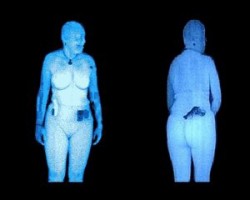
    Ever since Richard Reid attempted to detonate his sneakers with pentaerythritol tetranitrate (PETN) on an American Airlines flight in December 2001, airport travelers in the United States have had to remove their shoes while going through security. Now that Umar Farouk Abdulmutallab has tried to blow-up a Northwest Airlines flight on Christmas Day with PETN sowed into his underwear, I worry that authorities will soon ask us to undress and put our undies on the conveyor belt. Let it not be so.

    (more…)

  • Prisons: Reduce, Reuse, or Recycle?

    It’s official. The Obama administration is going to take over the largely vacant Thomson Correctional Center in the countryside west of Chicago and convert it into a federal maximum security prison that will house Guantanamo detainees. Predictably, Obama critics have decried the move, arguing that transferring Gitmo detainees stateside will court terrorist attacks on our home soil.
    More surprisingly, many local residents of Thomson have applauded the decision on the grounds that it will bring badly needed jobs to their economically depressed town. Though liberals might well support Obama’s efforts to close down Guantanamo, I think they should unequivocally reject this prison-providing-employment justification. It unwisely categorizes incarceration as an economic good.

    Of course, there is no denying that prisons provide jobs and that too many Americans need jobs. But a far better idea for reducing unemployment was Obama’s campaign-trail promise to create millions of Green Jobs. Promoting green employment means creating economic incentives to improve the environment. Promoting prison employment, on the other hand, creates an economic incentive to put more people in cages. Putting even more people in prison pollutes our social environment.

    (more…)

  • IMHO F Yoo

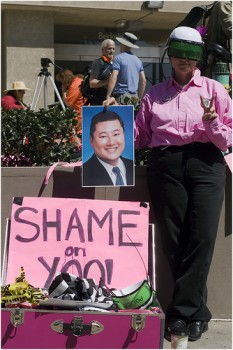
    John Yoo, law professor and notorious former Deputy Attorney General in Office of Legal Counsel (“OLC”), is a sleazebag attorney. As the Bush Administration’s de facto head of war-on-terrorism legal issues, Yoo penned a series of memoranda that legally justified torture at places like Guantanamo Bay. Because of his unconscionable advice, some liberal commentators have proclaimed that Yoo himself should be criminally prosecuted and locked up in prison. I disagree. Though, in my humble opinion, Yoo can go fumigate himself, I still do not advocate prison time as punishment for his sins.

    Don’t get me wrong. In politics, I lean left and believe wholeheartedly in human rights. I therefore detest Yoo’s OLC opinions. I do not defend, for example, his view that inflicting pain during interrogation is perfectly legal up until the point where the physical pain is “equivalent in intensity to the pain accompanying serious physical injury, such as organ failure, impairment of bodily function, or even death.” Though dressed up as legal analysis, this garbage really mocks the rule of law. So why am I against criminal prosecution and incarceration?

    (more…)

  • Why We Shouldn’t Prosecute John Yoo

    John Yoo, law professor and notorious former Deputy Attorney General in Office of Legal Counsel (“OLC”), is a sleazebag attorney. As the Bush Administration’s de facto head of war-on-terrorism legal issues, Yoo penned a series of memoranda that legally justified torture at places like Guantanamo Bay. Because of his unconscionable advice, some liberal commentators have proclaimed that Yoo himself should be criminally prosecuted and locked up in prison. I disagree. Though, in my humble opinion, Yoo can go fumigate himself, I still do not advocate prison time as punishment for his sins.

    Don’t get me wrong. In politics, I lean left and believe wholeheartedly in human rights. I therefore detest Yoo’s OLC opinions. I do not defend, for example, his view that inflicting pain during interrogation is perfectly legal up until the point where the physical pain is “equivalent in intensity to the pain accompanying serious physical injury, such as organ failure, impairment of bodily function, or even death.” Though dressed up as legal analysis, this garbage really mocks the rule of law. So why am I against criminal prosecution and incarceration?

    (more…)

  • Where Free Speech Stops

    Even though I’m an attorney, I don’t oppose prison time for sleazebag lawyers who cross ethical lines and ruin lives. Yet the justice system has it all backwards when it locks up defense attorney Lynne Stewart.

    Stewart is a 70 year-old grandmother and criminal defense attorney who represented many unpopular clients in her long and distinguished career. Perhaps her most unpopular client was Omar Abdel Rahman, the so-called “Blind Sheikh” who was convicted of serious terrorist offenses and sentenced to life imprisonment in 1996.  Based on events arising out of her representation of Abdel Rahman, Stewart was charged with providing “material support” for a terrorist organization. A federal appeals court recently upheld her subsequent conviction and Stewart now languishes in the Manhattan Correction Complex.

    (more…)

  • Could Hate Crime Laws Backfire?

    President Obama recently signed the Matthew Shepard and James Byrd, Jr. Hate Crimes Prevention Act into law — expanding existing federal hate crimes laws to protect against assault based on sexual orientation, gender, gender identity, and disability.

    So why would the Sylvia Rivera Law Project, a pioneering group that works on behalf of transgender, transsexual, intersex and other gender non-conforming people, oppose it?

    Sometimes friends and allies disagree. This is as it should be. In progressive circles, we can and should dispute strategy and tactics while still affirming our commitment to the same core set of shared values. Dissent gives our body politic a healthy workout. In that spirit, it seems healthy to consider the SRLP’s opposition to a new law that was generally praised by progressive LGBT voices.

    The group advances two primary arguments as to why the legislation is a “counterproductive response to the violence faced by LGBT people.” First, it sees hate crime laws as expanding the tentacles of the current criminal justice system that already results in “staggering incarceration rates of people of color, poor people, queer people and transgender people.” Second, the SRLP argues that evidence fails to show that hate crimes legislation actually works to deter or prevent violence against oppressed groups. Taken together, the basic proposition is that the new legislation is essentially another version of a “get tough on crime” measure that threatens to increase violence in oppressed communities rather than decrease it.

    (more…)