Author: Dan Shapley

  • The new Dirty Dozen: 12 foods to eat organic and avoid pesticide residue

    blueberries

    (Photo: Getty Images)

    Fruits and veggies are an essential part of a healthy diet, but many
    conventional varieties contain pesticide residues. 

    And not all the pesticides used to kill bugs, grubs, or fungus on the farm
    washes off under the tap at home. Government tests show which fruits and
    vegetables, prepared typically at home, still have a pesticide residue.

    You can reduce your exposure to pesticides by as much as 80% if you avoiding the most contaminated foods in the grocery store.

    To do so, you need the latest info from the why the Environmental Working Group’s “Dirty Dozen” list of foods most likely to have high pesticide residues. Since 1995, the organization has taken the government data and identified which type of produce has the most chemicals.

    This year, celery takes the number one spot and both blueberries and spinach make an appearance (displacing lettuce and pears).

    The best way to avoid pesticide residue on foods is to buy organic produce — USDA rules prohibit the use of pesticides on any crop with the certified organic label.

    Here’s a closer look at the 2010 Dirty Dozen:

    1. Celery
    Celery has no protective skin, which makes it almost impossible to wash off the chemicals (64 of them!) that are used on crops. Buy organic celery, or choose alternatives like broccoli, radishes, and onions.

    2. Peaches
    Multiple pesticides (as many as 62 of them) are regularly applied to these delicately skinned fruits in conventional orchards. Can’t find organic? Safer alternatives include watermelon, tangerines, oranges, and grapefruit.

    3. Strawberries
    If you buy strawberries, especially out of season, they’re most likely imported from countries that have less-stringent regulations for pesticide use. 59 pesticides have been detected in residue on strawberries. Can’t find organic? Safer alternatives include kiwi and pineapples.

    4. Apples
    Like peaches, apples are typically grown with poisons to kill a variety of pests, from fungi to insects. Tests have found 42 different pesticides as residue on apples. Scrubbing and peeling doesn’t eliminate chemical residue completely, so it’s best to buy organic when it comes to apples. Peeling a fruit or vegetable also strips away many of their beneficial nutrients. Can’t find organic? Safer alternatives include watermelon, bananas, and tangerines.

    5. Blueberries
    New on the Dirty Dozen list in 2010, blueberries are treated with as many as 52 pesticides, making them one of the dirtiest berries on the market.

    6. Nectarines
    With 33 different types of pesticides found on nectarines, they rank up there with apples and peaches among the dirtiest tree fruit. Can’t find organic? Safer alternatives include, watermelon, papaya, and mango.

    7. Bell peppers
    Peppers have thin skins that don’t offer much of a barrier to pesticides. They’re often heavily sprayed with insecticides. (Tests have found 49 different pesticides on sweet bell peppers.) Can’t find organic? Safer alternatives include green peas, broccoli, and cabbage.

    8. Spinach
    New on the list for 2010, spinach can be laced with as many as 48 different pesticides, making it one of the most contaminated green leafy vegetable.

    9. Kale
    Traditionally, kale is known as a hardier vegetable that rarely suffers from pests and disease, but it was found to have high amounts of pesticide residue when tested this year. Can’t find organic? Safer alternatives include cabbage, asparagus, and broccoli.

    10. Cherries
    Even locally grown cherries are not necessarily safe. In fact, in one survey in recent years, cherries grown in the U.S. were found to have three times more pesticide residue then imported cherries. Government testing has found 42 different pesticides on cherries. Can’t find organic? Safer alternatives include raspberries and cranberries.

    11. Potatoes
    America’s popular spud reappears on the 2010 Dirty Dozen list, after a year hiatus. America’s favorite vegetable can be laced with as many as 37 different pesticides. Can’t find organic? Safer alternatives include eggplant, cabbage, and earthy mushrooms.

    12. Grapes
    Imported grapes run a much greater risk of contamination than those grown domestically. Only imported grapes make the 2010 Dirty Dozen list. Vineyards can be sprayed with different pesticides during different growth periods of the grape, and no amount of washing or peeling will eliminate contamination because of the grape’s thin skin. Remember, wine is made from grapes, which testing shows can harbor as many as 34 different pesticides. Can’t find organic? Safer alternatives include kiwi and raspberries.

    More Healthy Eating Tips From The Daily Green

    Reprinted with permission of Hearst Communications, Inc.

    Check out Yahoo! Green on Twitter and Facebook.

  • Four ways to magnify your Earth Day good deed

    earth

    (Photo: NASA)

    The Daily Green received more than 400 pitches for Earth Day, to give readers one window on the marketing blitz that Earth Day has become, at least in some quarters.

    There are Earth Day hotel deals. There are to-go coffees that generate a few pennies for environmental causes. There’s advice for celebrating Earth Day at home, in the kitchen, and even in your cubicle. There are companies announcing new sustainability initiatives, companies telling you to celebrate Earth Day by cleaning up after your dog with a biodegradable “poop bag,” and companies giving out condoms to raise awareness about endangered species (it’s true).

    There are star-studded fundraisers and charitable auctions. There are iPhone apps, websites, festivals, eco-fairs, and stream cleanups. There’s a new super green fish guide to take the mystery out of choosing safe, sustainable fish. There are many tips lists that each include one thinly veiled product pitch. There’s great programming on television with an environmental theme (why was there never an “It’s Earth Day, Charlie Brown” special?). There’s a carbon pawprint calculator for your pets.

    Some of these are worthy, some just marketing. Rather than list all of them, we are encouraging readers to do something that matters this Earth Day.

    The Daily Green’s Heart of Green Awards just celebrated some exceptional individuals who are helping green go mainstream. Our Lifetime Achievement Award winner, Ted Danson, gave an inspiring speech, in which he urged people to do something very simple this Earth Day (or any day): Become educated, and become an international activist.

    Signing a petition, donating a few dollars to a cause, or learning about a major environmental issue is about the most important thing individuals can do this Earth Day. So we are highlighting some of the worthy causes you could join.

    Happy 40th birthday, Earth Day!


    Join the national call to action on comprehensive clean energy and climate legislation
    The NRDC, which is lead by The Daily Green’s 2009 Heart of Green Lifetime Achievement Award winner France Beinecke, is leading an effort to tell Congress that Americans want to take action on climate change.

    So write a letter to your representatives, sign the NRDC’s petition, or join the Climate Rally on April 25.


    Support the Safe Chemical Act
    Frank R. Lautenberg (D-NJ) has just introduced a bill to reform chemical regulations in the United States, so that the health effects of the 80,000 chemicals introduced into commerce in the last 50 years or so will be more thoroughly tested before Americans are exposed. It’s a cause that our 2010 Heart of Green Award winner Dr. Philip Landrigan supports.

    Sign this Environmental Working Group petition in support of the act.


    Buy a ticket for Clearwater’s Great Hudson River Revival
    Clearwater is one of the oldest environmental organizations working on clean water, environmental justice, and healthy fisheries on the Hudson River. Its annual Revival event features a full weekend of music, along with a healthy does of activism. It’s inspiring, and the money benefits a very worthy cause. Plus, Pete Seeger, the group’s founder, is awesome.

    Tickets range from $40-80 at www.clearwaterfestival.org.


    Volunteer locally
    It’s National Volunteer Week, as well as Earth Week, so get out and do some good in your community.

    The Earth Day Network is a good place to start to search for local initiatives.


    If you have another worthy nonprofit cause, put it in the comments below.


    More from The Daily Green

    Reprinted with permission of Hearst Communications, Inc

  • Seven tips for a healthy pregnancy, including some you might not hear from your doctor

    pregnant woman

    (Photo: Getty Images)

    Pediatrician Dr. Philip Landrigan is a pioneer in the study of environmental chemicals and their effect on children’s health. He was among the first to identify toxic lead as a concern and fought to remove it from gasoline, paint, and other products.

    His research and advice was critical to the government’s decision to regulate chemicals not just on their health effects on adults, but on children too. And he is leading the National Children’s Study, a landmark 21-year study that will help identify the causes of chronic childhood illnesses like autism, asthma, obesity, and learning disorders. He is a 2010 Heart of Green Award winner (read more about Dr. Landrigan).

    The Daily Green asked him to share tips for women who are or may become pregnant — here’s what he said:


    1. Keep yourself healthy
    The most fundamental attributes of health matter whether you’re pregnant or not, but especially so when you are pregnant. Keep fit, maintain low blood pressure, and stay at a healthy weight.


    2. Get vaccinated
    Pregnant women should be protected against rubella. Children should get the vaccines recommended by public health officials, including the Measles Mumps Rubella (MMR) shot that some parents increasingly shy away from.

    He discounts concerns about vaccines causing autism:

    There have been a dozen high-quality studies that looked at vaccines and autism. … Every one of these studies has failed to find any connection between vaccines and autism. … I think one of the most compelling studies is one that came out of Japan. In Japan, they have a very top-down health care system. They made a decision to stop MMR because they were worried about autism. When they suspended vaccination, rates of autism continued to go up. They reinstituted the vaccine.

    He added that failing to vaccinate your child is putting him or her at real risk:

    There have been reports of measles outbreaks. There will be rubella. Young parents today don’t remember, but 10% of kids who suffer measles are left with hearing loss. One in 20 develops pneumonia. One in five develops brain damage or encephalitis. Rubella for a pregnant mom, there’s a high risk of heart and lung deformities in her child, even autism. … These are severe consequences. There has been so much chatter on the Internet about the hazards of vaccination, most of it ill informed. These are ancient scourges.


    3. Take your vitamins
    Most importantly, be sure to take the recommended dose of folic acid, which can prevent serious birth defects.


    4. Beware of lead
    Older homes built before lead paint was banned in 1978 are likely contaminated with lead. Don’t renovate, particularly to create a baby nursery, because you may well introduce a serious brain-damaging toxic metal into the air in your home. Once exposed, babies’ brains do not recover from the damage.

    “I always warn young women and young couples of the dangers of lead paint,” Dr. Landrigan said. “Don’t start sanding old paint to prepare a room in the house for the baby; we’ve had a couple horrible cases where they do that.”

    Also be aware that the most common health standard used to test for lead poisoning was set in 1991, and Dr. Landrigan considers it outdated. While health professionals may say a blood lead level under 10 micrograms per deciliter is safe, Dr. Landrigan puts the safe figure at under five. Any blood lead test that shows a level above five should prompt parents to identify sources of lead, and remove them to stop the ongoing exposure.


    5. Eat only safe fish
    Many fish, particularly predators like tuna and swordfish, have high levels of mercury and/or PCBs, which like lead, can cause permanent brain damage. On the other hand, fish is also a great source of omega-3 fatty acids, which may be important for childhood brain development.

    What’s a pregnant mother to do? “There are plenty of safe fish out there,” Dr. Landrigan said. “Pick the safe fish and avoid the dangerous ones.”

    Carry a pocket guide like the Environmental Defense Fund’s Seafood Selector, which usefully identifies fish that are high in omega-3 fatty acids, low in contaminants, and fished sustainably. (There are also mobile phone apps that do the same thing.)

    Ideally, women should start avoiding high-risk fish at least six to eight months before getting pregnant.


    6. Avoid phthalates and Bisphenol A
    These controversial chemicals are difficult to avoid. Phthalates are found in many soft plastics (including baby products), in fragrances and cosmetics, and in personal care products.

    Bisphenol A is found in many hard plastics, including many food containers, the lining of food and beverage cans, and in other products.

    Both chemicals, though, mimic human hormones and may have a particularly risky effect on development. The government still sanctions their use, but many scientists — Dr. Landrigan included — recommending doing all you can to avoid phthalates and BPA: Don’t microwave food in plastic, avoid canned foods, and only use bottles that are BPA-free.

    Dr. Landrigan recommends checking personal care products against the Environmental Working Group’s Skin Deep database to find safe phthalate-free options.

    “In the case of lead, PCBs, and mercury, the data is ironclad,” Dr. Landrigan said. “There is uncertainty with BPA and phthalates, but there’s enough data to encourage prudence.”


    7. Avoid pesticides
    Avoid using lawn, garden, and household pesticides to kill weeds, bugs, or mice. And buy organic food “to the extent you can afford it,” Dr. Landrigan recommends.


    Food for thought
    “The most fundamental message is for people to remember that the environment is not just something that they visit on weekends or during their summer vacation — that the environment is all around us, that it is in us and we are in it, and that it profoundly influences our health,” Dr. Landrigan said. “The second message is that our children, especially children at the very beginning of life, are most sensitive to the environment.”


    More from The Daily Green

    Reprinted with permission of Hearst Communications, Inc

  • Seven questions to ask before buying home furnishings

    Radius Images / Getty Images

    1. Do you really need it?

    Facing economic stress unprecedented in our lifetimes, we might not need this reminder the way we did a couple years ago, but it’s always a question worth asking. Separating your “wants” from your “needs” is a good first step toward reducing the environmental impact of your purchases (not to mention the financial impact on your wallet). The environmental impact from buying comes primarily in the use of natural resources to manufacture the products in the first place. If you don’t buy it, you eliminate its impact.

    In the case of home products, furniture and cabinets can be made out of wood from virgin forests, or processed woods made with toxic glues. Deforestation not only wipes out the habitat for species – many of which, particularly in the case of tropical rain forests, have yet to be studied by scientists hunting for the next medical or nutritional breakthrough – but deforestation also is a leading contributor to greenhouse gas emissions (Indonesia and Brazil rank behind China and the U.S. in carbon emissions because of rapid deforestation, rather than heavy industry). Avoiding the purchase of wood-based home goods is one good decision you can make to help preserve the world’s forests – and its climate.

    2. Can you get it used?

    Many products have a useful life that extends far beyond the needs of one owner. Before buying new, check local garage sales, thrift and antique stores, classifieds, auctions – and their global on-line equivalents, Freecycle, Craigslist and Ebay – to look for items that can be given a second (or third, or fourth) life. Bottom line: buying used is the most environmentally sound way to buy, because it not only requires the use of no new natural resources in manufacturing, but also because it keeps a useful product out of a landfill or trash incinerator. Also, consider renting, rather than buying when it makes sense.

    3. How was it made?

    Particularly if you’re buying new, consider how a product was made: what materials were used, who made it and how were those workers treated? It’s often not the end-user or the end user’s community that suffers from the manufacture of products that aren’t made according to high environmental standards, but workers and local communities and ecosystems near the factories. Some suspect chemicals are also found in many common consumer products, so the question of progeny isn’t important just for the health of workers, but for consumers as well. Among the online retail stores that traffic in ethically made goods, Ebay World of Good stands out, but there are others. Whether shopping online or in stores, look for Fair Trade-certified goods, and ask shop owners questions if you don’t see certification.

    In the case of home goods, consider carefully the materials used to manufacture your decorations and furniture. The gold-standard for sustainable forestry is Forest Stewardship Council (FSC) certification. Look for the label whenever shopping for wood-based products. But you can do one better by choosing products made from recycled materials. Buying artwork and decorations? Consider the work of local artisans, or the independent artists selling through the likes of Etsy.com.

    4. How is it packaged and shipped?

    The making of a product is only part of what contributes to its environmental footprint. The materials used to package it, and the fuel used to transport it, are two other biggies. Studies have generally endorsed the proposition that online purchasing has a smaller environmental footprint than buying from a brick-and-mortar store, in large part because of the reduced energy costs associated with lighting and heating. Look for goods packaged minimally, and packaged with post-consumer recycled materials. If packing something of your own for sale, get creative: Crumple the paper that you’d otherwise have recycled to protect fragile items. Set aside a few boxes as you come across them, so you can re-use them when you need them. A minimum of thought can save significant resources over the long term. If you are buying from a brick-and-mortar store, ask questions of the store manager, or consult the company’s Web site for information about how they manage the efficiency and wastefulness of their supply chain.

    5. How much energy or resources will it require to maintain?

    The environmental impact of newly purchased items doesn’t necessarily end when you get them home. Clothing needs to be washed, and jewelry shined. Buying a new dress that you can run through the washer has less impact than one that must be dry cleaned, for instance, since many dry cleaners clean with toxic solvents. Furniture may need to be washed, oiled waxed or – eventually – reupholstered. On the other hand, buying furniture than can be easily spruced up with some simple maintenance, or repaired when needed, is a smart choice for your wallet and the environment, since it will last longer before needing to be replaced.

    6. Is it reusable, repairable, or at least recyclable?

    What happens to that product once you’re done with it? Is it durable enough to be of use to your grandchildren? Can it have a second (or third or fourth) life once you’re done with it? If it breaks, do you have the means to repair it?

    Not only does it save resources to buy durable, long-lasting goods, but it can also provide a good return on investment. When you’ve tired of a new product, you can sell it to recoup some of your costs – or even turn a profit. But often that’s only possible if you’ve purchased a good quality item with lasting value.

    7. Does it help me go green in other ways?

    The crown jewel of ethical buying comes if the purchase you make helps you maintain a green lifestyle. That may mean supporting local artisans with a purchase of a painting or piece of jewelry. It may mean buying a piece of clothing that lets you wear your passions on your sleeve – and educate friends and passers-by in the process. Or it may be as simple as buying a good raincoat … so you can walk instead of taking the cab on rainy days. It may mean that your next gadget isn’t a new video-mp3 player, but a home energy monitor, so you can track down and eliminate unnecessary electricity use.

    Finally, maybe the purchase itself contributes to a cause, because the seller donates a portion of proceeds. Check with the organizations you support to see which companies they work with, and get in the habit of reading the environmental and sustainability sections of companies’ Web sites. One great way to connect with sellers that share your passions – and who will back up that passion with a donation based on your purchase – is via eBay Giving Works.

    More from The Daily Green

    Reprinted with permission of Hearst Communications, Inc

  • Global warming — fact or myth?

    image name

    (Photo: Getty Images)

    Myth or fact? There are a lot of misconceptions about global warming that have cropped up in recent months.

    Here’s a look at some of them:

    Fact or myth? “Snowmageddon” and all those other weird U.S. snowstorms this winter prove that global warming isn’t real.

    Myth
    The reaction to “Snowmageddon” is an example of a common misunderstanding about climate change.

    Weather events are not climate; climate is the accumulation of weather events over an extended period of time. So a cold summer day doesn’t prove global warming is false any more than a heat wave in winter proves it’s true.

    That said, the effects scientists predict from global warming are sometimes counterintuitive. While snow is associated with winter, warmer winter temperatures can result in more snow, since warmer air can hold more moisture. One of the most well-documented predictions about global warming is that it will result in more intense storms, in any season, but may leave longer droughts between those storms.

    Fact or myth? The U.N. scientific report on global warming was full of errors and should not be trusted.

    Myth
    There have been errors discovered in the U.N.’s landmark report on climate science. The errors concern facets of climate change, like how fast Himalayan glaciers have melted, or how fast sea levels will rise in the Netherlands. The errors are a black eye for an organization that won a Nobel Peace Prize for the authoritative work it has done on the subject.

    However, these errors amount to T’s left uncrossed and I’s left undotted. The sentences still read loud and clear about the overall consensus about fundamental issues: That the Earth is warming, that our pollution is a primary cause, and that continued warming would have consequences worldwide, many of them costly to human life and property, and to wildlife.

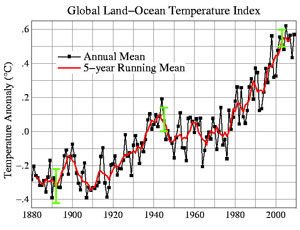
    Fact or myth? There has been no global warming in the past 10 or 15 years.

    global warming temperature graph

    Myth
    The hottest year ever recorded was in 1998, according to measurements by the British University of East Anglia, or 2005 (with 1998 ranking very close) according to measurements by NASA. Both agree that the first decade of the 21st century was the hottest ever recorded, which means the hottest since the 1880s.

    Comparing the temperature to other data hidden in the natural world, like tree rings or layers of Arctic ice, scientists can determine that we’re likely experiencing temperatures higher than any time in thousands of years.

    Image: NASA

    “Climate change” is a more accurate description for what’s happening than “global warming.”

    Fact
    While it is true that the world as a whole is warming, “climate change” is more accurate, particularly when it comes to how individuals in different regions will experience these changes. Global warming is the driving force, but climate change is what we will experience.

    What will climate change look like? It could mean more intense storms or more prolonged droughts. It could mean more risk of wildfires in one area, and more flooded basements in another. It could make one farmer’s field more productive, while killing that of another.

    Some even have called the effects of climate change “global weirding.” In general, scientists expect climate change will affect different regions very differently.

    Fact or myth? Carbon dioxide is natural. Breathing is not pollution.

    Myth
    There’s nothing wrong with breathing, of course, and nothing unnatural about carbon dioxide. Breathing is not causing the world any harm. So if carbon dioxide exhaled in our breath is harmless, how can carbon dioxide “exhaled” by power plants, tailpipes and factories be a problem?

    A clue lies in the name we have for what we burn: fossil fuels. By burning coal, oil, and gas, we take carbon that had been buried deep underground for millions of years, and we transfer it to the atmosphere. There’s about 40% more carbon in the atmosphere today than there was in pre-industrial times.

    In fact, the concentration of carbon dioxide in the atmosphere is higher
    today than at any point in the last 650,000 years, before humans walked the Earth
    — before even Neanderthals walked the Earth. Ultimately it’s an issue of volume.

    Breathing is part of a natural cycle that the Earth manages without any problem. Burning fossil fuels, releases too much carbon dioxide for the Earth to handle without significant changes to the climate.

    Fact or myth? Even if we stopped driving cars completely today, the climate would not be affected.


    Fact
    Carbon dioxide, which is released from burning fossil fuels like coal, oil, and gas, survives for years or decades. When you hear news reports stating that other gasses are “more potent” than carbon dioxide, it’s often because they last even longer in the atmosphere than carbon dioxide, trapping heat all the while.

    The fact is, the pollution we’ve emitted in the past will stay with us for some time. So why act now? We understand today that future generations will have to deal with planetary changes we’re setting in motion. Past generations didn’t have the knowledge we do.

    More from The Daily Green

    Reprinted with permission of Hearst Communications, Inc


    Check out Yahoo! Green on Twitter and Facebook.

  • Endangered vacations

    You’ve heard of a “life list” — the vacation spots you want to see before you die. This is a little different. These are top U.S. destinations you might want to see before they die. “They” being the destinations themselves. Each of these vacation ideas is located in a landscape that is threatened in some way by an environmental hazard.

    While inclusion on this list isn’t an indication that these sites are in imminent danger of disappearing, the fact that this list seems plausible is a distinctly 21st-century phenomenon. After all, destinations are supposed to be permanent, even though our lives are not — that’s what makes the Wonders of the World so mysterious and attractive. It’s not just their beauty and scale, but their endurance.

    This summer is the perfect time to take to the road and see one of these endangered U.S. destinations. You may have another chance, but your kids or their kids may not.


    Paddling the Florida Everglades

    everglade-national-park

    (Photo: National Park Service)

    Everglades National Park is the largest subtropical wilderness in the United States — a vast and slow-moving river channeled through tufts of dry land. It’s teeming with wildlife, from the abundant and ferocious (alligators and crocodiles) to the scarce and ferocious (the panther) and every creature on down the food chain. Paddling a canoe through the Everglades is a rare experience.

    But, the Everglades face a Goldilocks-type question: Will there be too little water, too much … or just the right amount? Too little and the Everglades dry up. Too much and it gets swallowed by the sea. Either way, it won’t offer the same wilderness canoe experience it does today.

    For more than a century, too little water has been the problem, as agriculture and suburban sprawl have eaten into the swamp, draining and diverting the natural water flow. With the water has gone 90% of some populations of wading birds.

    Water levels are rising, thanks to a 35-year preservation plan. Ironically, though, global warming is expected to cause sea-levels to rise and potentially cover the low-lying land. The Everglades could be swallowed by the sea. Bottom line: Better not put off that once-in-a-lifetime trip to this one-of-a-kind destination. 

    Photographing Glaciers in Glacier National Park (and elsewhere)

    glacier-national-park

    (Photo: USGS)

    What would the Grand Canyon be without a canyon? Something like Glacier National Park would be without its glaciers. But by 2030, that’s exactly the landscape that might greet visitors. In fact, two more glaciers disappeared this year. 

    Already, some of the most famous glaciers in the Montana park have shrunk by more than half, and only 17% of the glaciers found there in 1850 remain today (25 of 150).

    Glaciers are things of beauty and awe: The imprint of time and the Earth’s physical processes represented in massive hulk of ice on the landscape. The loss of glaciers worldwide is one of the most visual signs of global warming. Sure, the melting of a glacier is still slow in human years, but the change in Glacier National Park is real, and any children born today should see the park before they hit 20 — because the glaciers might well be gone by then.


    A scenic drive through Appalachia

    appalachian-mountain

    (Photo: Jamil Nasir / iStockPhoto)

    A vast swath of Appalachia is vulnerable to the high altitude scarring and stream-choking waste disposal associated with mountaintop removal mines.

    Scenic byways crisscross the region, from Pennsylvania, through its heart in West Virginia, to Georgia. Not all will remain so scenic, however, as the landscape is scoured to remove rich coal seams, the debris left to fill mountain stream valleys. The rafting, kayaking, trout fishing and hiking will suffer in some places, too.

    Already, 470 mines have obliterated Appalachian peaks, according to iLoveMountains.org, and more are on the way. Get in the car now, and see this majestic, wild region while you still can.


    Salmon fishing on the Snake River

    snake-river-teton
 height=

    (Photo: Tom Stammely / iStockPhoto)

    From its origins in Yellowstone National Park, the 1,040-mile Snake River once produced half the wild Chinook salmon found in the mighty Columbia River. In fact, the upper Snake River has the most extensive freshwater salmon habitat in the lower 48 states.

    The four dams on the lower Snake River, however, have so choked the once-prolific salmon runs that the group American Rivers named it one of the most endangered rivers in America. This spring, a federal judge said federal officials had to at least consider breaching dams to save salmon.

    If the dams aren’t breached, or another solution found, some experts worry that the remaining salmon runs will go extinct, as several have already. The threat of global warming, which makes water warmer and less hospitable to salmon, and many other sensitive freshwater species, only adds urgency to the issue. It could be that a generation from now, 2 million Steelhead and Chinook salmon will spawn in the Snake River, as they once did — but it’s probably a good idea to do your fishing now, just in case.


    Whatever it is that happens in Vegas

    http://a323.yahoofs.com/ymg/daily_green_news/daily_green_news-134338596-1244071649.jpg?ymhrJXBD.lMpBYrd

    (Photo: Rick Rhay / iStockPhoto)

    What could possibly happen to Vegas (that hasn’t already happened in Vegas)? This one might be a little overly apocalyptic for some, but step back for a minute and you’ll remember that Las Vegas is built smack in the middle of the desert.

    It exists because the Colorado River has been dammed, diverted, and directed to flow into Lake Mead and other reservoirs, so that the dry Southwest can bloom beyond its natural limits.

    But for how long? The flow of the Colorado River is already strained, the remnants of its abundant water flow disputed across the western U.S. Add a sprawling population, demanding drinking water and green lawns and farm-fresh produce, and the dwindling snowpack that feeds the river — thanks to global warming — and Las Vegas could face serious strains soon. Lake Mead, which supplies 90% of the city’s drinking water, could be dry by 2021 according to one study.

    Vegas being what it is, the loss of water might not be a death knell. There is, after all, alcohol. Might be better to plan your visit before 2021 all the same.

    More from The Daily Green

    Reprinted with permission of Hearst Communications, Inc

    Check out Yahoo! Green on Twitter and Facebook.

  • Should Goldman Sachs plant the next high-profile organic garden?

    The Daily Green’s senior editor Dan Shapley asked Roger Doiron, a 2009 Heart of Green Award winner, and founder of Kitchen Gardeners International (newly redesigned — check it out!) 13 questions about gardening for beginners and gardening for politicians.

    Doiron and Kitchen Gardeners International were a big part of the movement that convinced Michelle Obama to plant that organic garden at the White House. It was Kitchen Gardeners International that launched the Facebook petition drive you probably remember joining. So he knows a thing or two about not only gardening, but also politics and inspiration.

    Here’s what he had to say:

    Michelle Obama planted the White House garden, as you and KGI had pushed for. What do you think the biggest successes have been to come out of that project?

    I am very impressed with how the first lady and chef Sam Kass have used the garden as platform for creating a national dialogue about food, health and the well-being of our children and the planet we all call call home.

    The White House garden has been the backdrop for prime-time TV shows like the “Biggest Loser” and “Iron Chef America” and is apparently the first thing world leaders ask the first lady about which speaks to its international reach.

    See what happened when Michelle Obama confronted the food industry about nine unsavory truths.

    Is there anything that disappointed you?

    I haven’t been disappointed. On the contrary, I think they’ve managed to do a lot in year one and I’m eager to see what’s next for the garden.

    As a garden educator, I’d love to see them use the garden as a sort-of virtual classroom for the many people, especially parents, who’d like to know more about how they can feed their families, healthy home-grown foods. The Obama administration has been very effective in using new media to get its messages out and I’m sure that a few blog posts or garden videos with an educational flavor could easily reach and teach millions of people.

    And as a garden cook, I’d love to know some of Sam Kass’ go-to recipes when the garden is going full tilt. That would be a great public service to gardeners and eaters worldwide.

    You got the Obamas into organic gardening. Is there any bigger fish to fry here? What’s more powerful than the president of the U.S., or higher profile than the White House? The Vatican? The asphalt in front of the Goldman Sachs building?

    While I don’t think there’s a higher impact landscape than the White House or higher-profile family than the Obamas, I feel strongly that we need to continue pushing for other gardens and gardeners in high places to raise the stature of gardening. It would be great if more stars from the worlds of entertainment, sports, and politics could use their celebrity to encourage people to garden. We really need to reframe gardening as being central to a healthy and sustainable society.

    You joke about Goldman Sachs, but I’d to see companies planting gardens, not for greenwashing purposes, but because it’s the right thing to do for their employees and communities. Companies often own land around their buildings and and they could be making it available to employees to grow healthy food for themselves with overflow going to community food pantries.

    It might sound far-fetched but companies are already investing in the health of their own employees through health insurance (which, as most people know, is really “sickness insurance’), so why not shift some of that investment into simple activities and lifestyle changes that could prevent people from getting sick in the first place?

    Check out some of the most unusual vertical urban gardens.

    13 questions for Roger Doiron

    roger doiron

    What are the most important things for beginning gardeners to keep in mind?
    Which vegetables should the beginner gardener grow?
    What are the most common mistakes made by a beginning gardener?

    What should a beginning gardener do in March?
    What should a beginning gardener do in April
    What should a beginning gardener do in May

    What are the biggest successes of the White House garden Michelle Obama planted?
    Have there any disappointments in the White House garden project?
    What’s next after the White House? The Vatican? Goldman Sachs?

    Is the kitchen garden trend taking hold?
    What about the grow-your-own food movement do you find most exciting?
    What’s Kitchen Gardener International’s next big project?
    What one Earth Day tip would you want everyone to do?

    Photo of Roger Doiron at the 2009 Heart of Green Awards: Doug Goodman

    Roger Doiron’s 2009 Heart of Green Awards acceptance speech


    More from The Daily Green

    Reprinted with permission of Hearst Communications, Inc

  • Four gardening trends to watch

    The Daily Green’s senior editor Dan Shapley asked Roger Doiron, a 2009 Heart of Green Award winner, and founder of Kitchen Gardeners International (newly redesigned — check it out!) 13 questions about gardening for beginners and gardening for politicians.

    Doiron and Kitchen Gardeners International were a big part of the movement that convinced Michelle Obama to plant that organic garden at the White House. It was Kitchen Gardeners International that launched the Facebook petition drive you probably remember joining. So he knows a thing or two about not only gardening, but also politics and inspiration.

    Here’s what he had to say:

    What measures do you look at to gauge whether or not the kitchen garden trend is taking hold? What’s your idea of success, from the perspective of your work to promote kitchen gardening?

    It’s very difficult to measure impacts. We know that we reached millions of people with our White House garden campaign and news of the garden itself has of course reached even more, but it’s hard to know how this is translating into more people gardening.

    We have some anecdotal indicators like seed sales and demand for community garden plots which are up considerably, but there’s no authoritative data. According to a new survey by the National Gardening Association, 1 million new food gardens are planned for 2010.

    If you compare this with the 20 million new gardens that were planted in 1943 at the peak of the Victory Garden movement (when U.S. population was half what it is now), it suggests that we are still very at the beginning stages of the kitchen garden revolution.

    Is there an aspect of the local food and grow-your-own movement that is particularly exciting to you right now?

    Here in Maine there are some innovative efforts under way to bring farmers and fisherman to talk about how community-based food systems can help sustain people while preserving natural resources and Maine’s traditional industries. We’re starting to see the Community Supported Agriculture (CSA) model applied to fishing which is quite exciting.

    I’d be remiss as KGI’s director if I didn’t mention some of the new innovative things we’re doing. We’ve just launched our new gardener-powered website where people are doing all kinds of fun things like starting their own blogs, participating in discussions, setting up local groups, and sharing everything from garden tips to favorite recipes. It’s built with the open-source platform Drupal and represents an important step for us in becoming a sort of “open source” organization.

    See how to eat healthy by joining a CSA.

    What is your and KGI’s next big project?

    My board and I joke that as the only worthwhile follow-up act to helping give a kitchen garden to the Obamas is to give the rest of the world one too. We’re going to continue focusing on gardens and local foods in the U.S. through educational activities and campaigns like Food Independence Day (our campaign to have America’s governors and families source their July 4th meals from local and sustainable sources), but we’re also putting more resources into our work and partnerships abroad.

    In fact, I’m planning on taking KGI on the road next year with my family. We’re going to be doing a “family academic year abroad” with Belgium as our home base. I’ll use the year to make some connections with gardens, gardeners, and garden groups in Europe … a Tour de Plants you might call it.

    See 15 more of Roger Doiron’s tips for eating more local food.

    If there was one Earth Day tip you’d recommend to someone who wants to eat a more environmentally sensitive and healthy diet, what would it be?

    No matter who you are or where you live, commit to growing at least one food item this year from seed to salad bowl or soup bowl. Even it’s just a single basil or parsley plant grown in a window box, you’ll have a chance to touch the soil with your own hands and watch the miracle of life play out on a small-scale right before your eyes.

    Even if you fail at growing one ingredient for one meal, you won’t have really failed in that you’ll have gained some new admiration for farmers and respect for the challenges they face. So, dig in!

    13 questions for Roger Doiron:

    roger doiron

    Photo of Roger Doiron at the 2009 Heart of Green Awards: Doug Goodman

    Roger Doiron’s 2009 Heart of Green Awards acceptance speech:


    More from The Daily Green

    Reprinted with permission of Hearst Communications, Inc

  • Answers to three common beginner gardening questions

    The Daily Green’s senior editor Dan Shapley asked Roger Doiron, a 2009 Heart of Green Award winner, and founder of Kitchen Gardeners International (newly redesigned – check it out!) 13 questions about gardening for beginners and gardening for politicians.

    Doiron and Kitchen Gardeners International were a big part of the movement that convinced Michelle Obama to plant that organic garden at the White House. It was Kitchen Gardeners International that launched the Facebook petition drive you probably remember joining. So he knows a thing or two about not only gardening, but also politics and inspiration.

    Here’s what he had to say:

    What are the most important things for new gardeners to keep in mind? Help me take the audience through these pre-planting months, assuming that the people reading are new to gardening and just want to grow a few simple high-yield vegetables, like tomatoes, zucchinis and a couple others you’d recommend.

    New gardeners come to it with great energy and resolve. It’s important to hang onto that because there’ll be pests, pestilence, and other natural and human-made disasters waiting to rob you of your enthusiasm, not to mention all your fresh veggies.

    My advice is to keep it fun, keep it in perspective, and try to look at it as an opportunity for some fresh air and healthy recreation with family or friends rather than a chore.

    Also see Leslie Land’s seven secrets of successful gardeners.

    Which vegetables should the beginner gardener try to grow? Which are the most likely to provide successful harvests for a typical gardener, who’s maybe got an hour or two to spend in the garden per week at most?

    I always tell people to start with what they and their families like to eat. We started by growing a lot of sweet peas because they were one on my youngest son’s (our most vegetably challenged child) favorites. Peas, for him, turned out to be the garden equivalent of a gateway drug in that they ultimately led him to green beans and raw asparagus.

    Other ways to think about what you might want to grow are in terms of what’s easy to grow, what costs a lot to buy, or what types of varieties are hard to find in stores or farmers’ markets.

    If you only have an hour a week to maintain a garden, I’d recommend planting salad greens. They don’t require much space, mature quickly allowing you to make several harvests over the course the season, and — at $7-$10 a pound at a natural food store — home-grown greens can help you hold onto to some green of your own.

    See the most valuable garden vegetables, according to Roger Doiron’s calculations, or check out these six high-yield vegetables recommended by Leslie Land.

    What are the most common mistakes a beginning gardener makes and how can they be avoided? For instance, are there types of vegetables that people want to grow, but take more care than the typical beginner is capable of?

    One danger beginning kitchen gardeners face is biting off more than they can chew in terms of how big of project they start in their first year. It’s better to have a small and successful garden in year one and to scale it up in subsequent years than a large garden full of weeds, overgrown zucchinis, and regrets.

    It’s also important to know that certain crops are easier and quicker to grow than others. For example, it’s easier to grow a number of bite-sized cherry tomatoes than a one-pound heirloom tomato. One thing every beginning garden should do is befriend an expert gardener in their neighborhood or town.

    See more tips for beginning gardeners.

    13 questions for Roger Doiron:

    Roger Doiron’s 2009 Heart of Green Awards acceptance speech:


    More from The Daily Green

    Reprinted with permission of Hearst Communications, Inc

  • Something odd for the Arctic: “Normal” sea ice extent as winter ends

    National Snow and Ice Data Center

    Only two months ago, it looked as if the Arctic sea ice extent was trending so far below normal that it might set a new record. The extent of Arctic sea ice, a barometer on global warming and one of the most easily visualized effects of climate change, was 1 million square miles short of average throughout February.

    But, lo and behold, so much new ice froze in March that the overall extent for this winter will end up nearly normal, as compared to the long-term average. That’s a headline no one could have written for years, as the extent of Arctic sea ice has dropped, rhythmically with the seasons, but dropped precipitously and consistently for years. The record-setting extent of melting in the past three summers was to a degree not expected for decades, under mainstream scientific predictions of just a few years ago.

    As the ice melts, polar bear, Pacific walrus, ribbon seals and other species struggle for survival, and the potential for human use grows — for oil and gas drilling, and for shipping through once ice-locked channels. The extreme melting in the Arctic has been seen as a harbinger for things to come elsewhere at other latitudes: Does it mean that the worst-case predictions for other aspects of global warming are inevitable? Wildfires, droughts, crop failure, sea-level rise, massive rates of species extinctions … will each appear more quickly, and have more severe impacts than the public expects?arctic sea ice chart march 2010

    The normal freeze this winter could be another blow for global warming activists, who have seen headline-grabbing news about everything from so-called climate-gate and so-called glacier-gate to so-called snowmagedden, none of which is the Achille’s heel for climate science that global warming skeptics would like them to be. The last decade has been the warmest on record, with no end to the warming anticipated if we don’t curb greenhouse gas pollution.

    Still, if the Arctic does indeed have one good year among many bad ones, it could further erode public opinion of climate science at a time when the Senate is on the verge of debating sweeping energy and climate legislation. Given the long-term trend, it should not.arctic sea ice chart 1979-2010

    Charts: National Snow and Ice Data Center


    More from The Daily Green


    Reprinted with permission of Hearst Communications, Inc


  • One household’s experience with a smart meter

    Charles Elk was surprised how much he could learn from a digital clock. That’s what his in-home energy monitor looks like, and Elk found that digital monitor enlightening. He found himself swapping incandescent bulbs for compact fluorescents, and being careful to turn off the outdoor lights before going to bed. Those lights were costing him money he didn’t have to spend.

    “It brought the cause-and-effect much closer than I had ever observed it before,” he said. “My old less-smart meter was out there happily spinning when I hit that switch before. The same information was there but it was outside the house and not six inches from my light switch.”

    As an employee of Oncor, the largest public electricity distributor in Texas, the single-family home Elk shares with his wife and two children was one of the first in the state outfitted with advanced smart home energy monitoring technology. By 2012, all 3 million Oncor customers will have access to detailed information about how much energy they are using — and paying for, via a new Web portal; most of the 800,000 homeowners, who already had Landis+Gyr smart meters installed, could start using the Web portal last week.

    They won’t have quite as much information as Elk, who uses an in-home monitor so he can see real-time data, but they will have access to energy usage data recorded every 15 minutes. (Oncor will be working with seven manufacturers to make similar data available to others who buy off-the-shelf in-home monitors, an achievement unique to the utility, according to Oncor.)

    Some studies have shown that smart meter installations help customers reduce bills by as much as 5-10%, which for the average Oncor customer could mean $200 or $300 in annual savings, according to Carol Peters, the company’s spokeswoman. Oncor spent $686 million on smart meter installation, paid for by a monthly $2.19 surcharge on residential electric bills.

    Texas draws about half its electricity from burning coal, so any reduction in energy demand not only reduces customer bills, but pollution that causes global warming, acid rain, smog and mercury contamination. Texas, moreover, has a Texas-sized demand, accounting for 10% of the nation’s electricity usage, according to the U.S. Energy Information Administration.

    Elk likens his smart meter experience to filling up the tank. A cent or two per gallon isn’t a huge savings, but knowing the actual cost at the pump changes your behavior significantly — and you choose the gas station offering the lowest cost. Similarly, he noticed that flipping on the lights around a mirror in the bathroom, where he had set up his in-home monitor, caused a spike in energy usage, and cost.

    “The first thing we did is change out those bulbs to compact fluorescent bulbs, and that made a significant difference,” Elk said. “It translated to dollars. You change those 10 60-watt lightbulbs into 7- or 8-watt lighbulbs, and the entire set uses not much more than one did before…. This is not life-changing, but we probably knocked $4 or $5 off our monthly bill with that simple act.”

    The effort to give consumers more information about, and control, of their energy consumption and costs, is a big challenge, since the companies providing electricity are paid more if consumers use more electricity, so they traditionally have no incentive to reduce demand. De-coupling energy demand from energy company profits is a big change in business as usual, at least as complicated as the deregulation of the energy industries in many states, which created companies like Oncor that distribute electricity but don’t own power plants.

    The smart meter installation, which is required by Texas law, isn’t the biggest in the country, but it is among the most sophisticated, Peters claims. The meters now spit out data in 15-minute intervals, showing homeowners when their usage and costs increase or decrease; they also communicate outages immediately to the utility, allowing Oncor to potentially react more quickly when electrical service is interrupted. But the smart meters are also sophisticated enough to communicate with home appliances, so that when next-generation smart appliances become available, the meters will be ready to accept the information. That means, for instance, that the dishwasher might kick on automatically at 2 a.m. after having the smart meter communicate an important bit of information: that the price of electricity has dropped as demand hits a nighttime trough.

    “There’s a whole communication backbone behind the meter that’s very sophisticated,” Peters said. “All this technology serves the consumer.”

    That’s not necessarily the perception, though. Some have complained that the smart meter installations were accompanied by a spike in the cost of electricity, as if their demand suddenly increased. Peters said that’s not the case, and meters are checked and double checked for accuracy.

    And despite the anecdotes from Elk and others, Oncor doesn’t yet have any data on the effectiveness of the program overall. It should reduce electrical demand, but no one knows if it will. “We don’t have the data that we can analyze yet,” Peters said. “The data belongs to the customer.”

    For Elk, the smart meter experience has produced one clear outcome, and one big question. He’s seen that having access to the data made him address “low-hanging fruit” like replacing old lightbulbs — but he’s not sure if he would make bigger decisions, like paying more for an Energy Star appliance because he knows it will cost pennies less per use.

    “That’s the big question,” he said. “We’ll see over time what the ultimate answer to that is. I do think that putting the information in front of us on a day-to-day basis will certainly push us that way.”

    To get started saving energy, with or without the benefit of a smart meter, try The Daily Green’s 5 Perfectly Painless Home Eco-Fixes or the DIY Home Energy Audit.

    More from The Daily Green


    Reprinted with permission of Hearst Communications, Inc


  • An inspiring teacher, creating the ultimate green classroom

    greg perry

    In April 2009, Greg Perry accepted the first annual Heart of Green Local Hero Award, for his work to develop, with his high school students, the Green Dream and the Ultimate Green Classro

    om. At the time of the awards, he was unsteady, having just been through intense chemotherapy. His work as a teacher is an inspiration, as is his recovery, and his acceptance speech. We’re happy to say that Greg is back in the classroom — which is a good thing for him, for his students and for the wider community. Here’s his story.

    Greg Perry graduated from Ohio State University with a joint degree in marketing and education confident he would never teach. To him, the education degree was just a bulwark against the recession, so there are probably few people as surprised as Perry that before the age of 40, he would have drawn national attention for his teaching, orchestrated the building of a model classroom and inspired his students to launch the largest green business expo ever staged in Ohio.

    Perry teaches an innovative high school marketing class in Beachwood, Ohio, a city of about 12,000 in the Cleveland suburbs. Students from several area schools commute (it’s the right word) to Beachwood High School for a class unlike any other. Elected executive officers help Perry run the class, and for much of the year, the focus is on lining up exhibitors for The Green Dream, the green business expo that is expected to draw more than 6,000 people this Spring (April 16-17 at the Beachwood Community Center).

    “Sales people are making phone calls to line up exhibitors in the expo. Finance is handling the contracts and payments. Marketing and Communications and Publications and Websites and trying to promote the message. HR is evaluating and incentivizing,” Perry said. “It’s more like a day at work than a day at the classroom. By doing these large projects, they learn about branding, advertising, management styles and marketing techniques without ever picking up the textbooks.”

    The Green Dream

    green dream cardboard art

    The class staged the first Green Dream, with 69 exhibitors and 2,200 in attendance, in 2008. In 2009, it grew to capacity, with 75 exhibitors and 4,000 attendees.

    “The craziest thing looking back is that we were able to convince real businesses to give their money to 18-year-olds with nothing to show. He instilled so much confidence in us to go out and talk to these people,” said Ethan Rush, a sophomore Finance major at Kent State, and the president of the class that organi

    zed the first Green Dream. “That was always what he helped us do – to aim high. And the other thing he taught me was that the worst thing that could happen was they’d say ‘no.’”

    Photo: The Green Dream cardboard art, by Mark Langan.

    Making Green Mainstream: The Ultimate Green Classroom


    The yeses have outweighed the nos. Cumulatively, the events have raised $200,000, and the money not only pays for the following year’s expo, but also the renovation of Perry’s classroom as a model green student and community space. They call it the Ultimate Green Classroom, but it would be unrecognizable to most public school students used to cold cinder block and rows of desks: From the flooring and the cabinets to the full kitchen and board room-style furniture, everything exhibits eco-friendly and energy-efficient attributes. When not in the classroom, Perry runs his own interior design company, Re-Design, and he coached the students in choosing houseplants and bright lime greens and vivid blues (all low-VOC paints, of course) to create a naturally invigorating atmosphere. The chairs alone would be the envy squirming students everywhere, let alone the state-of-the-art air filter.

    Beyond making an environment comfortable for the students and their teacher, the classroom has the larger aim of inspiring environmentally friendly changes at other schools. The first tangible example of success: The Beachwood school board has committed to a $30 million LEED-certified rebuilding of its high school. Other districts are taking note, and the classroom’s dual nature as a classroom and community space has helped inspire hundreds of visitors.

    “This classroom is going to be multiplied by 50,” Perry said. “Not every one will be done to this extent, but every classroom will need floors, chairs, smartboard equipment, tiles, paint. Those are things we can easily take out of here and transfer across the district.”

    Beyond the classroom, Perry’s working with the City of Beachwood and its chamber of commerce to create a Green Leadership Alliance, which is also serving as a model for other communities.

    “It’s so commonplace now, but it wasn’t three years ago, and Greg and the students of the first class shook everybody and dusted off this whole green concept and took it to the forefront,” said Karen Carmen, the city’s community services director. “I think they were instrumental in bringing the green initiative to Beachwood.”

    Fighting the Good Fight


    The success of the project is all the more impressive because of the personal obstacles that Perry has overcome. In January 2008, three months before the first Green Dream expo would take place, he was diagnosed with cancer. Treatment didn’t keep him out of the classroom, and he spent the summer renovating the Ultimate Green Classroom, working with students who had already graduated (their commitment that summer is an impressive measure of his inspirational teaching, as any graduate could confirm). But just two weeks after the ribbon-cutting ceremony in October 2008, he learned the cancer had spread, and he began an intense treatment that sapped his strength and transformed him, physically, into a shadow of his former self.

    He didn’t let his illness keep him from his work in the classroom, though. The school district lined up substitutes, but Perry kept in touch daily, either through text messages, emails, phone calls or Skype conversations.

    “He was an inspiration,” Rush said.

    A Heart of Green Hero

    The Daily Green learned of Perry’s struggles and success from his students, who nominated him for the site’s first Local Hero award. It was only days after leaving the intensive care unit in April 2009 that Perry boarded a plane to attend the site’s Heart of Green Awards. The promise of the award, and the upcoming Green Dream, gave him strength in a difficult period of his recovery.

    “We circled those two dates and said, ‘I need to get out of the nursing home for the Green Dream and we need to get me walking enough to get to New York City,’” Perry said. “Seeing those two dates in front of me and knowing what was pushing me to get better really made a huge impact. If you ask my physical therapists, that day when we found out about the award, I said ‘I need to out of here by April 17 and walking by April 23,’ they both looked at me and said, ‘Only you can make that happen.’ I said, ‘I will make that happen.’”

    In the last year, Perry has recovered much of his strength, returned fulltime to his classroom, restarted his interior design business – and purged his life of many of the artifacts that remind him of his two years of illness. He’ll return to New York City April 20, with several students, to hand out the 2010 Heart of Green Local Hero Award, to be chosen from the 26 heroes nominated by The Daily Green’s audience.

    “I’m starting to feel more like myself,” he said.

    Back to normal, for Greg Perry, is something truly extraordinary.


    More from The Daily Green

    Real People Making a Real Difference: 2010 Local Heroes

    The 2010 Heart of Green Awards: Who Will Win?

    2010 Heart of Green Awards: Full Coverage

    Who Won the 2009 Heart of Green Awards?

    Celebrity Photos from the 2009 Heart of Green Awards


    Reprinted with permission of Hearst Communications, Inc


  • How to start a vegetable garden in March, April, or May

    gardening kid

    (Photo: BLOOMimage / Getty Images)

    The Daily Green’s senior editor Dan Shapley asked Roger Doiron, a 2009 Heart of Green Award winner, and founder of Kitchen Gardeners International (newly redesigned — check it out!) 13 questions about gardening for beginners. The first three questions are featured here.

    Doiron and Kitchen Gardeners International were a big part of the movement that convinced Michelle Obama to plant that organic garden at the White House. It was Kitchen Gardeners International that launched the Facebook petition drive you probably remember joining.

    So Doiron knows a thing or two about not only gardening, but also politics and inspiration.

    Here’s what he had to say:

    Take us through the stages of planning a first-time garden in the pre-season. It’s mid March — if you have never before grown a garden, or haven’t grown a garden successfully, what should you be doing right now?

    There are many different hardiness zones and micro-climates across the country so it’s hard to generalize about what a gardener should be doing each month, but, for gardeners in northern climates like mine in Maine, March is time for starting cold weather crops like radishes, peas, and salad greens outside and warm weather crops like tomatoes indoors.

    For more ambitious and patient gardeners, March is a good time for planting asparagus crowns (roots) which are the ultimate vegetable crop when it comes to delayed gratification, requiring 2-3 years before generating any significant harvest.

    How about in April?

    April is also a month for planting all the cool weather crops mentioned above as well as many others like early (new) potatoes, early carrots, and onions. I also “go wild” in April by making salads using wild dandelion greens from our yard when they’re at their tender best.

    I’m not sure what my neighbors think about a grown man crawling on all fours across his yard with a paring knife in one hand and a colander in the other, but …

    And in May?

    In May, everything seems to become possible for northern gardeners as the air and soil temperatures begin to heat up. Warmer weather crops like beans and summer squash can be sown from seed and the tomatoes, peppers, and eggplants that you might have sown indoors can be moved outside.

    Check back in early April to see the answers to more gardening questions, for beginners and politicians, answered by Roger Doiron.


    Roger Doiron’s 2009 Heart of Green Awards acceptance speech:


    More from The Daily Green

    Reprinted with permission of Hearst Communications, Inc

  • The two-chicken global warming solution

    chicken

    (Photo: Getty Images)

    A new analysis has an encouraging conclusion about individuals who “go green”: If we all took a few simple steps, collectively we could reduce U.S. carbon dioxide emissions 15%. Each of these steps is cheap (or free) and won’t cramp anyone’s lifestyle.

    How simple are the actions? Here are 15 tips from the report:

    That’s right, you don’t have to be a vegetarian. And you don’t have to raise your own chickens. Just eating lower on the food chain has a huge impact on your individual climate impact (even if the commentators on Fox Business News doubted the assertion when The Daily Green suggested it).

    Of course, the challenge, as always, is to inspire mass action on these types of simple actions. That’s the heart of the report by the NRDC and the Garrison Institute’s Climate Mind Behavior Project. It’s probably self-evident, but the purpose of the project is to “integrate emerging research findings about what drives human behavior into new thinking on climate solutions.”

    “The behavioral approach by no means replaces or competes against other policy, regulatory, market, and technology innovations which we need,” Jonathan Rose, co-founder of the Garrison Institute, said in a prepared release. “But it’s one key front among others in the quest for climate and energy solutions, and conservation now is key while we move forward on those other fronts. Economists and people who study behavior and decision-making have broken through to new understandings of human behavior and human choices, based on brain physiology and evolution. They can explain for example why we may be slow individually to do simple things well within our capability that would reduce our climate impacts, even though it would be in our interests to do so, or why we are much more likely to make those changes when we know we’re not alone, that others will do it too, and our contributions will aggregate. The opportunity now is to start applying these sorts of insights concertedly to get people to adopt them faster.”

    The effort recognizes that the old economic view of human behavior (that we all act in our own best self interest) is as flawed as markets are in controlling pollution (such “externalities” aren’t included in the market price of the goods that cause pollution). Instead, behavioral economics suggests that a complex set of influences guides our decision-making (the market itself, our emotions, our communities and our innate sense of fairness, among them).

    More from The Daily Green

    Reprinted with permission of Hearst Communications, Inc

    Check out Yahoo! Green on Twitter and Facebook.

  • Eight questions for Sue Cischke, the highest ranking woman in the automotive industry

    Sue Cischke

    (Photo: Ford)

    The Daily Green recently had the chance to interview Sue Cischke by phone from her office in Dearborn, Mich. The 54-year-old Vice President for Sustainability, Environment, and Safety Engineering is, according to her employer, Ford, the highest ranking woman in the automotive industry.

    You are Ford’s VP for Sustainability, Environment, and Safety Engineering, and you’ve been leading the company’s environmental efforts since 2001.

    In that position, you are the top female boss in the automobile industry — why do you think there aren’t more women in your position?

    It’s a bigger question about women in the auto industry in general. I’ve been in the industry for 34 years. It’s kind of scary to say that but in May it will be 34 years, so I’ve been through a lot of different ups and downs with the industry in general, but I’ve had a chance to see the broad industry.

    In this position you need people with technical skills and there are not usually a lot of women with engineering backgrounds, and that’s probably one reason. Which is not to say you can’t do this without that kind of emphasis, but my problem solving in engineering and other things has helped…

    Are there any lessons you have for young women starting out in business?

    That really makes me feel old. I think it’s as true in automotive as anywhere else, you see more women involved in all aspects of all companies. For us in the automotive industry, 84% of the buying decisions on automobiles are influenced by women, so it makes sense to have women involved in all aspects of designing the car.

    Things are a lot different from when I entered the workforce. It’s still not a huge percent of women selecting engineering as a profession, and specifically automotive. That’s just the way things are and we’re continuing to have an open culture to encourage everybody to participate at all levels.

    You’d encourage men as well as women to take on technical jobs and technical training and background… We have a professional women’s network here at Ford that I’m a champion for and it gives us a chance to network…

    Normally, I’d be most interested in talking to you about sustainability and the environment first, but I’m most curious right now about what everyone is most curious about: Can we trust our hybrid cars? Specifically can we trust the brakes and the accelerators, given that we’ve seen problems with the industry leader in the category, the Prius?

    I saw at least one complaint in the NHTSA database about braking problems with the 2010 Ford Fusion hybrid. And I’ve heard of reports about unintended acceleration in the Ford F150 pickup. Is Ford concerned about any of its models?

    2010 ford fusion hybrid

    No, not at all. We have a very robust process within Ford that we do monitor and investigate issues that come to us. The issue on the Fusion was only one complaint… In our system on the Hybrid (Fusion, pictured; photo by Ford), on some rare situations where there’s a brake fail situation, there would be a brake light and chime… The chime and light will indicate that there’s a change in the brake feel. If the regenerative braking, there’s software in the vehicle that says if there’s any doubt on how effectively the regenerative braking system — default to hydraulic braking system. It should be seamless, but the pedal travel feels a little different.

    The programming we did when you should look to this and when you should not, it was way too sensitive. We went back and tuned that up so that it would be very rare that it would ever have to do that. When you would do that and you have different pedal feel, you would get a chime and a light to alert the driver that it feels differently… We did a customer satisfaction campaign… For all intents and purposes they all get a letter mailed to their home as if there’s a safety recall, but there aren’t recall consequences with it.

    In this case we describe to the customer that this is available to them, no charge. That’s why we use that method. The customer will get the notification in the mail just like any other campaign.

    Do you think the problems at Toyota coupled with the bailouts of GM and Chrysler, where you started your career, have given Ford a new opening in the marketplace?

    Ford has got a good plan that we have in place, and it helps for us to have a successful year last year and we have a lot of optimism this year if the economy continues to improve. We didn’t have to take the government money, and we’re very proud of the fact that we’ve been able to do this on our own. We do have a different balance sheet to contend with. They have more debt to wipe out but we didn’t go through the bankruptcy…

    You’ve got several cars and SUVs that get better than 30 mpg, but many that do not. What are we going to see happening to your fleet as the higher CAFE standards kick-in, requiring a fleetwide average of 35.5 mpg by 2016?

    electric ford focus

    We do have a plan about how we are going to approach that. We’ve been saying all along that it will be some segmentation shifting. We will have the Fiesta. We had the Focus. This year will be the first launch of the new Focus. (Pictured; photo by Jim Motavalli.) That will be a popular vehicle with high fuel efficiency.

    All the vehicles we’re introducing will be at the top of their category for fuel efficiency. Ninety percent of our offerings by 2013 will have EcoBoost engines as an option. That is one area where we direct injection and turbocharge so we boost for power and downsize for fuel efficiency so we’re getting up to 20% improvement on the small engine for the large engine that people would have been buying.

    (Other improvements, she said, would be more electric power-assistance systems, improved aerodynamics, and a “weight loss reduction” of between 250 and 750 pounds on a typical vehicle.)

    You don’t just do one big thing, but you do a lot of little things. We do have a plan that will get us to the numbers in 2016 and beyond.

    We expect a new electric car from Ford, based on the Focus. When we will see this, how many, and what will it cost?

    We already announced that Transit Connect is a battery electric vehicle to be produced this year. Next year, the 2011 battery electric Focus — an all-electric vehicle off the Focus platform. The following year we’ll have a brand new hybrid and a plug-in hybrid and a C-sized Focus-sized platform. We have four new electric vehicles, 2 battery electric and one plug-in on the Focus C-sized platform.

    Do you believe global warming requires federal legislation to address?

    We’ve been very strong saying we need an energy policy for the company. We’re supporting a cap-and-trade system that would be economy wide. We recognize there are a lot of challenges to bring that together… We’re already the most carbon-constrained industry… We have fuel economy tied to carbon emissions. EPA and NHTSA will finalize rule in March. I can say we’re probably further ahead than any other sector. We need the others to step up.

    We are probably the most expensive sector when it comes to controlling carbon. Three hundred to five hundred dollars per ton of CO2 is the cost of putting an electric vehicle on the road. Improvements on electric generation and other sectors is five to ten dollars a ton. At some point in time, someone has to want these vehicles and with the price of fuel so low it’s hard to justify someone paying extra for these vehicles. There’s still a mismatch. The environment doesn’t care where the CO2 reductions come from. The economy does.

    What’s the single most important thing that you think needs to happen to address global warming?

    fuel tank

    I think we need an energy policy. We need to understand where our energy’s coming from long-term… When I look at Brazil, they made a conscious effort to reduce their dependency on oil with sugarcane-based ethanol. It took them years to stick with the course. They established the right subsidies and gradually got to a point where people are consciously making a choice about whether to use gasoline or ethanol…

    We tend to get in and get out, and no one really knows where to put their investments. Where do venture capitalists put their money? Today we’re subsidizing oil companies based on blending gasoline to 10% ethanol. Where is that money really going? We have to have policies that encourage conservation and a long-range plan about where we are going to get our energy from. (Photo: Don Farrall / Getty Images.)

    More from The Daily Green

    Reprinted with permission of Hearst Communications, Inc

  • American Express will pay you $5 an hour to volunteer

    Volunteers like to see their volunteer hours and precious dollars go far in support of the causes they care about. American Express and Take Part are launching a new campaign to make it easier to magnify each individual’s good works.

    The Members Project not only will enlist the public to vote on the best charities to receive $4 million American Express dollars annually, but it will donate up to $100 per person who volunteers his or her time.

    Despite its name, the Members Project isn’t restricted to American Express members. Anyone can suggest charities, vote for their favorites at the Take Part site and take advantage of the volunteer payments.

    Neither American Express nor Take Part is new to this kind of cause marketing. American Express launched the an early cause marketing campaign in 1983 to raise the $1.7 million needed to preserve the Statue of Liberty and Ellis Island, and has continually invested in this type of philanthropy over the years. In 2007 and 2008, it let its members determine how the company should spend its philanthropic dollars, and the company donated at total of $3.5 million to UNICEF and to the Alzheimer’s Association.

    Take Part is the newly launched digital arm of Participant Media, whose mission is to inspire action on a range of pressing issues. Participant Media just scored another win in its efforts with The Cove, winner of the 2010 Academy Award for Best Documentary (Food, Inc., another Participant Media film, was also nominated, and you may have heard of a little film called An Inconvenient Truth, another Participant Media production.)

    “One of the things we’re quite frankly incredibly proud about American Express being a partner of ours is that they are one of the original brands that saw that a brand could do good in the world and should do good in the world,” said Chris Gebhardt, general manager and executive vice president of Take Part. “They get credit for creating cause marketing and it stretches back to the Statue of Liberty restoration.”

    The Members Project works like this:

    Vote
    People vote (as often as weekly) for the charities that should receive American Express money. Every three months, American Express will give $200,000 to each of five organizations, every three months. (That’s $1 million each round, or $4 million ever year.) In the first round, 49 charities selected by an American Express advisory committee are eligible, but additional charities will be added at the suggestion of the audience.

    Donate
    The site makes it easy to find charitable organizations that need support. It also provides a platform for communicating one’s charitable giving to friends, so that they might inspire them to do the same.

    Volunteer
    People who register their volunteer hours can earn $5 per hour, up to $100 per year. American Express cardholders can redeem those dollars for rewards, and others can apply money earned toward the charity of their choice. (Any donations made this way would be in addition to the $4 million in direct giving that American Express has promised.)

    “The innovative hook here is we’ve added volunteering and donating into the mix as well, so it’s really trying to inspire small steps someone can take,” Gebhardt said. “It’s not just about donating. It’s about volunteering too. The small step can make a big difference.”

    For American Express, the $4 million commitment, plus the promise of rewarding volunteer hours, is on top of roughly $30 million in annual giving, according to Nancy Smith, vice president of Global Media, Content and Community at American Express. She hopes to see the campaign become a viral success, catalyzing increased volunteerism and philanthropy.

    “I think that what’s really going to make a difference is for individuals to start telling their own stories,” she said. “Now that the social media tools are available, it’s bringing that to life.”

    Get started at Take Part.

    More from The Daily Green

    Reprinted with permission of Hearst Communications, Inc

  • The five best used cars under $10,000

    Consumer Reports‘s latest car issue lists the most reliable fuel-efficient used cars on the market. That reminds us that for fuel efficiency, for “sticker” price, and often for reliability, used cars are a better value than new cars, even the most fuel-efficient models.

    Of course, as Consumer Reports notes, even used cars can cost upwards of $20,000 — not exactly cheap, especially since you can get at least seven fuel-efficient 2010 cars for under $20,000.

    Here’s a look at Consumer Reports‘ top five fuel-efficient used cars under $10,000, along with the mileage you can expect (complete list).

    honda insight best fuel efficient used car
    1. 2000-01 Honda Insight (manual) — 51 mpg (pictured)
    2. 2001-2004 Toyota Prius — 44 mpg (2004 only; otherwise 41 mpg)
    3. 2000-05 Toyota Echo — 38 mpg
    4. 2003-05 Honda Civic Hybrid — 36 mpg
    5. 2007 Toyota Yaris Liftback (base, manual) — 34 mpg

    If you like to buy American or worry because of recent Toyota recalls, then go for the 2000-02 Chevrolet Prizm, which at 32 mpg, is the only American car to make the list of under-$10,000, reliable, fuel-efficient used cars.

    But buying a used car can be more challenging than buying new, for those who don’t consider themselves car buffs. It takes more research (try edmunds.com to start). How do you know you’re getting a good value? And who can you turn to if something goes wrong?

    That’s what makes the Consumer Reports list invaluable.

    More from The Daily Green

    Reprinted with permission of Hearst Communications, Inc

    Check out Yahoo! Green on Twitter and Facebook.

  • FDA cracks down on food label lies

    food label lies

    (Photo: Masterfile / Photo
    Illustration Gloria Dawson)

    The Food and Drug Administration is getting serious about some egregious food label lies like those that The Daily Green recently blew the whistle on.

    The FDA today notified 17 food manufacturers about 22 food products that violate law because of misleading labeling. Companies that received warning letters have 15 business days to inform the FDA of the steps they will take to correct their labeling.

    “Today, ready access to reliable information about the calorie and nutrient content of food is even more important, given the prevalence of obesity and diet-related diseases in the United States,” Commissioner of Food and Drugs Dr. Margaret Hamburg wrote in an open letter to the food industry.

    Interestingly, several organic brands are also on the list, though the problems didn’t lie with the “organic” part of the nutrition claims. Still, it’s a useful reminder that “organic” means a food was produced without harsh chemical fertilizers or pesticides, but it doesn’t mean it’s nutritious. Processed foods are just that — processed, whether organic or not.

    One good rule of thumb in the grocery store is to choose the least-packaged, least-labeled foods, like fruits, vegetables, and grains: These will be nutritious and will come free of misleading labels.

    Below is a look at the food label lies the FDA is no longer tolerating:


    Company Product Type of Claim or Major Topic Area Action
    Dreyers Grand
    Ice Cream, Inc.
    Nestle Drumstick Classic Vanilla Fudge The front panel shows that the product has no trans fat, but it doesn’t have a disclosure statement to alert consumers that the product has significant levels of saturated fat and total fat. Warning Letter
    Dreyers Dibs Bite Sized Ice Cream Snacks Vanilla Ice Cream With Nestle Crunch Coating The front panel shows that the product has no trans fat, but it doesn’t have a disclosure statement to alert consumers that the product has significant levels of saturated fat and total fat.
    Gorton’s, Inc. Gorton’s Fish Fillets The front panel shows that the product has no trans fat, but it doesn’t have a disclosure statement to alert consumers that the product has significant levels of sodium, saturated fat and total fat. Warning Letter
    Schwan’s
    Consumer Brands
    Mrs. Smith’s Coconut Custard Pie The front panel shows that the product has no trans fat, but it doesn’t have a disclosure statement to alert consumers that the product has significant levels of saturated fat and total fat. Warning Letter
    Spectrum
    Organic
    Products, Inc.
    Organic All Vegetable Shortening The front panel shows that the product has no trans fat, but it doesn’t have a disclosure statement to alert consumers that the product has significant levels of saturated fat and total fat. Warning Letter
    The product makes nutrient content claims such as “cholesterol free,” “less saturated fat than butter,” and “good source of … monounsaturated fat,” but does not meet the legal requirements to make these claims.
    Beech-nut Beechnut DHA Plus line of products The product makes claims on its website such as “no added refined sugar” and “plus vitamins and minerals,” which are not allowed on products intended for children under 2 years of age because appropriate dietary levels have not been established for children in this age range. Warning Letter
    Beechnut Whole Grain Oatmeal With mixed fruit The product makes claims such as “low sodium,” “plus fiber,” and “plus vitamins & minerals,” which are not allowed on products intended for children under 2 years of age because appropriate dietary levels have not been established for children in this age range.
    PBM Products Parent’s Choice Little Puffs Plus Calcium Blueberry Naturally Flavored The product makes claims such as “plus calcium,” which are not allowed on products intended for children under 2 years of age because appropriate dietary levels have not been established for children in this age range. Warning Letter
    Parent’s Choice Little Puffs Made With Whole Grains Peach-Mango Naturally Flavored The product makes claims such as “a good source of calcium,” “a good source of vitamin D,” and “a good source of iron,” which are not allowed on products intended for children under 2 years of age because appropriate dietary levels have not been established for children in this age range.
    Nestle Juicy Juice Brain Development Fruit Juice Beverage (Apple) The product makes claims such as “no sugar added,” which are not allowed on products intended for children under 2 years of age because appropriate dietary levels have not been established for children in this age range. Warning Letter (issued 12/2009)
    Juicy Juice All-Natural 100% Juice Orange Tangerine and Juicy Juice All-Natural 100%
    Juice Grape
    The product labels imply that the products are 100% juice when they are actually juice blends with added flavors.
    Nestle Nutrition Gerber’s 2nd Foods Carrots The product makes claims such as “healthy,” “excellent source of … vitamin A,” and “no added sugar,” which are not allowed on products intended for children under 2 years of age because appropriate dietary levels have not been established for children in this age range. Warning Letter
    Gerber Graduates Puffs The product makes claims such as “good source of iron, zinc, and Vitamin E,” which are not allowed on products intended for children under 2 years of age because appropriate dietary levels have not been established for children in this age range.
    Redco Foods Salada Naturally Decaffeinated Green Tea The product makes claims that it will treat, prevent, or cure diseases such as Alzheimer’s disease, rheumatism, and cancer. These types of claims are not allowed on food products. Warning letter
    The product makes claims on the product website that it is effective in the prevention of cardiovascular disease, but this claim has been not authorized for this product.
    The product makes claims such as “fortified with antioxidants,” but the claim does not meet the requirements of the antioxidant regulation.
    Sunsweet Growers Antioxidant Blend Dried
    Fruit Mix
    The product makes claims such as “full of nutritious antioxidants,” but the claim does not meet the requirements of the antioxidant regulation. Warning letter
    Fleminger Inc. TeaForHealth Green Tea products Dr. Lee’s TeaForHealth 710EGCG inabottle Green TeaTea For Health 710EGCG Ready-To-Drink Natural Brewed Green Tea The product makes claims that it will treat, prevent, or cure diseases such as Alzheimer’s disease, diabetes, and cancer. These types of claims are not allowed on food products. Warning Letter
    FDA has authorized a qualified health claim for green tea, but the claims for these products do not meet the criteria established by FDA.
    The product makes claims such as “drink high antioxidant green tea,” but the claim does not meet the requirements of the antioxidant regulation.
    POM Wonderful POM Wonderful100%
    Pomegranate Juice
    The product makes claims that it will treat, prevent, or cure diseases such as hypertension, diabetes, and cancer. These types of claims are not allowed on food products. Warning Letter
    Ken’s Foods, Inc. Ken’s Healthy Options
    Salad Dressings
    The product makes claims such as, “healthy options,” but has more fat than is allowed in products labeled as “healthy.” Warning Letter
    Pompeian, Inc. Pompeian Imported Extra Light Olive Oil The product makes nutrient content claims such as “light” and “high in good monounsaturated fat,” but doesn’t meet the requirement to make these claims. Warning Letter
    The product makes claims that it will treat, prevent, or cure diseases such as heart disease and cancer. These types of claims are not allowed on food products.
    Diamond Food,
    Inc.
    Diamond of California
    Shelled Walnuts
    The product label makes claims that the product can help prevent heart disease. FDA has authorized a claim relating walnuts and heart disease, but the claim on this product doesn’t meet the requirements to make the claim. Warning Letter
    The product makes claims that it will treat, prevent, or cure diseases such as heart disease, arthritis, and cancer. These types of claims are not allowed on food
    products.
    First Juice, Inc. Organic Fruit and Veggie
    Juice Beverage products
    The product make claims such as “plus calcium” and “50% less sugar,” which are not allowed on products intended for children under 2 years of age because appropriate dietary levels have not been established for children in this age range. Warning Letter
    Purple Carrot products The products make claims that the products will “reduce the risk of cancer and stroke.” This claim has not been authorized by FDA for use on food products.
    Want Want
    Foods
    Baby Mum-Mum Original Selected Superior Rice Rusks The product make claims such as “low in fat” and “no added fats for oils,” which are not allowed on products intended for children under 2 years of age because appropriate dietary levels have not been established for children in this age range. Warning Letter
    Nature’s Path
    Foods, Inc.
    Organic Flax Plus Multibran Cereal The product label includes the nutrient claim “excellent source of omega-3+,” which has not been approved for use on food products. Untitled Letter


    More from The Daily Green

    Reprinted with permission of Hearst Communications, Inc

  • That funny “green police” Super Bowl commercial

    The Denny’s Grand Slam breakfast Super Bowl commercials could have doubled as environmental ads, if only the message was about free range pastures, rather than overworked laying hens.

    And while it may not have lived up to the standards of that Doritos kid slapping his mom’s date, one of the funnier Super Bowl commercials was for the Audi A3 TDI, which gets 34 mpg of diesel fuel, and was chosen as Green Car of the Year by Green Car Journal.

    Even clean diesel, though, is not as clean-burning as gasoline. The Audi A3 produces 15% more carbon in a year than either the Nissan Altima or Toyota Camry hybrid, which also get 34 mpg. It emits 9% more than the Toyota Yaris, which burns gasoline in a conventional engine and gets 32 mpg.

    But the Audi A3 TDI still achieves impressive mileage, and we haven’t seen a better commercial for any of those other comparable models:

    More from The Daily Green

    Reprinted with permission of Hearst Communications, Inc

  • Toyota Prius brake problems result in U.S. injuries, too

    Prius

    (Photo: Toyota)

    While the most fuel-efficient Toyotas at were not among the recall models associated with the growing sudden acceleration problem, the Prius is now suspect because of the feature that makes hybrids hybrid: regenerative braking.

    The regenerative braking problems that has prompted the Japanese government to order Toyota to investigate its popular hybrid, the Prius, may not be unique to that country.

    There have been more than 100 complaints from U.S. car buyers about 2010 Prius brakes made to the National Highway Traffic Safety Administration, at least two of which resulted in injuries:

    WHILE DRIVING 15 MPH AND ATTEMPTING TO ENGAGE THE BRAKE PEDAL IT EXTENDED TO THE FLOOR; HOWEVER, WITHIN A FEW SECONDS THE BRAKE WOULD RESPOND. SHE EXPERIENCED THE BRAKE FAILURE THREE TIMES; DURING THE SECOND FAILURE THE BRAKES DIDN’T RESPOND AND SHE COLLIDED INTO A VEHICLE AND INJURED HER NECK. SHE HAS NOT TAKEN THE VEHICLE TO THE DEALER SINCE THE FAILURE OCCURRED ONLY WHEN SHE HIT A BUMP IN THE ROAD. SHE WILL TAKE THE VEHICLE TO THE DEALER TO BE DIAGNOSED. THE VIN WAS NOT AVAILABLE. THE FAILURE MILEAGE WAS 3,000 AND THE CURRENT MILEAGE WAS 10,000.

    I WAS UNABLE TO SLOW DOWN GOING INTO AN INTERSECTION AT A REASONABLE RATE OF SPEED. WHILE I WAS NOT ACCELERATING, WHEN I APPLIED THE BRAKES THE CAR DID NOT SLOW DOWN AS I WOULD HAVE EXPECTED. THIS SAME BEHAVIOR HAS OCCURRED IN THE PAST SEVERAL MONTHS SINCE I’VE OWNED THE PRIUS 2010 MODEL. IT SEEMS TO SKIP FORWARD OR ACCELERATE WHILE BRAKING ON A DOWNHILL OR UNEVEN SURFACE. BY THE TIME I WAS ABLE TO STOP I THE AIRBAGS HAD GONE OFF AND I HAD HURT MY NECK AND BACK. IT IS A NEW VEHICLE THAT NOW HAS ALMOST $14,000 DAMAGE AND WON’T BE FIXED FOR A MONTH. IF ANYTHING, I’M AN OVERLY CAUTIOUS DRIVER AND WONDERING WHAT I COULD HAVE DONE TO AVOID THE ACCIDENT.

    Is this problem limited to the Prius, or is it a problem associated with regenerative braking more generally? At least one complaint has also been filed about the 2010 Toyota Camry hybrid.

    Here’s the complaint:

    CAMRY HYBRID 2010. BOUGHT NEW AND COMPLAINED TO TOYOTA OF SURGING FORWARD INCONSISTENCY DURING MY DAILY TWO HOUR COMMUTE. I ASKED IF THEY PLANNED TO FIX IT DURING MY LAST SERVICE VISIT AND THE ANSWER WAS “NOPE.” WHEN ASKED THAT THEY DO FIX IT, THE ANSWER WAS, “NOPE!”. YOU WILL BE NOTIFIED IN APRIL WHEN THE PEDALS ARE GOING TO BE FIXED. I HAVE HAD NIGHTMARES OF SPEEDING OUT OF CONTROL AND AM AFRAID TO DRIVE THIS CAR. DO I HAVE ANY RECOURSE. THIS IS NOT THE CAR I THOUGHT I PURCHASED MONTHS AGO.

    And at least one complaint has been filed about brakes on the 2010 Ford Fusion hybrid, but none about the Ford Escape hybrid.

    Here’s the Fusion complaint:

    I BOUGHT A 2010 FORD FUSION HYBRID ON MAY 23, 2009 FROM CROWN FORD OF FAYETTEVILLE, NC. ON MAY 27, WHILE DRIVING DOWN THE ROAD, THE BREAKS SUDDENLY HIT THE FLOOR AND THERE WAS MINIMAL RESISTANCE. I EVENTUALLY BROUGHT THE CAR TO A HALT IN A PARKING LOT. IT WAS TOWED TO CROWN FORD AND THEY SAID IT WAS ONLY AIR IN THE BREAKS AND THE CAR WAS NOW SAFE FOR MY FAMILY. 4 DAYS LATER ON MAY 31ST WHILE I WAS IDLING AT A STOP LIGHT WITH MY DAUGHTER IN THE BACK SEAT, THE BREAKS WENT TO THE FLOOR/FAILED AGAIN AND I HAD TO UTILIZED THE EMERGENCY BREAK TO MANEUVER IT TO A SAFE PLACE. CROWN FORD SAID IT WAS THE WIRING THIS TIME. I DO NOT THINK FORD KNOWS WHAT IS GOING ON WITH THIS VEHICLE SINCE IT HAS THIS NEW REGENERATIVE BREAKING SYSTEM. WHAT I DO KNOW IS THAT AS SOON AS MY FUSION HYBRID WAS “FIXED” AGAIN, I DROVE IT STRAIGHT TO ANOTHER DEALERSHIP AND TRADED IT IN FOR A DIFFERENT VEHICLE. I WOULD NEVER PUT MY KIDS BACK IN THAT CAR AND AM WORRIED ABOUT OTHER FAMILIES WHO CHOOSE TO BUY THIS TYPE OF VEHICLE.

    Of the other hybrids on The Daily Green’s list of most fuel-efficient cars and SUVs, there have been no registered complaints for the Honda hybrids, the Accord, or the Insight; the Mercury hybrids, the Milan, and Mariner; the Lexus HS 250h hybrid, or the Nissan Altima hybrid.

    Will this problem engulf the hybrid market? It’s too early to tell, but stay tuned.

    More from The Daily Green

    Reprinted with permission of Hearst Communications, Inc