Author: Darren Rickard

  • BUSINESSWEEK: Buffett May Buy More Alcohol Distributors After Empire Purchase

    By Andrew Frye

    March 23 (Bloomberg) — Warren Buffett’s Berkshire Hathaway Inc., which agreed yesterday to buy the closely held parent of alcoholic-beverage wholesaler Empire Distributors, said it plans to seek more purchases in the industry.

    “We expect that the Empire acquisition will provide us with a solid platform for potentially acquiring other similar high-quality wholesale distributors,” Buffett, Berkshire’s chairman and chief executive officer, said in a statement. Terms of the deal for Kahn Ventures Inc. of North Carolina weren’t disclosed.

    Buffett is looking for ways to invest Berkshire’s cash after markets recovered last year and profits jumped. The 79- year-old billionaire, who built Berkshire through four decades of takeovers and stock picks, completed the biggest acquisition of his career last month with the $27 billion deal for railroad Burlington Northern Santa Fe Corp. Berkshire’s McLane unit, which had revenue of $31.2 billion last year, will own Empire.

    “It’s just planting seeds,” Michael Yoshikami, chief investment strategist at Berkshire shareholder YCMNet Advisors, said of the Empire purchase. “It looks like they’re getting into a new area that they’re going to try to get some expertise in, and trying to expand.”

    Buffett transformed Berkshire from a failing textile mill to a company with a market value of $200 billion and more than a hundred units selling products and services including candy, electricity and luxury flights. The Empire acquisition adds to responsibilities of McLane CEO Grady Rosier, whom Buffett praised in his annual letter to investors for turning in record profits as other Berkshire manufacturing, service and retailing units suffered in the economic downturn.

    The Exception

    “Almost all of the many and widely diverse operations in this sector suffered to one degree or another from 2009’s severe recession,” Buffett said last month in his letter to Berkshire shareholders. “The major exception was McLane.”

    McLane, which Berkshire bought from Wal-Mart Stores Inc. in 2003, reported 2009 pretax earnings of $344 million, or about 1 cent for every dollar of sales. The unit supplies retailers, drug stores and convenience stores with groceries and other merchandise and gets about a third of its sales from Bentonville, Arkansas-based Wal-Mart.

    “I’m sure that as McLane sees opportunities to grow they will take advantage of them,” said Jeff Matthews, author of “Pilgrimage to Warren Buffett’s Omaha” and founder of the hedge fund Ram Partners LP. “They are working with one of the best balance sheets in the world,” Matthews said, referring to Berkshire’s cash.

    Empire executives will stay in place and the business will remain in the same markets, Berkshire said. Empire distributes spirits, wine and beer in North Carolina and Georgia.

    –With reporting by Jamie McGee in New York. Editors: Dan Reichl, Brett Miller

    Share Investor Links

    Share Investor Blog – Stockmarket & Business commentary
    Discuss this topic @ Share Investor ForumRegister free

    Download the 2009 Warren Buffett Letter & 2009 Annual Report to Berkshire Hathaway Shareholders
    Download the 1977 – 2009 Warren Buffett Letter’s to Berkshire Hathaway Shareholders

    Recommended Amazon Reading

    Warren Buffett's Management Secrets: Proven Tools for Personal and       Business Success Warren Buffett’s Management Secrets: Proven Tools for Personal and Business Success by Mary Buffett
    Buy new: $16.50 / Used from: $13.20
    Usually ships in 24 hours
    The Intelligent Investor: The Definitive Book on Value Investing. A       Book of Practical Counsel (Revised Edition) The Intelligent Investor: The Definitive Book on Value Investing. A Book of Practical Counsel (Revised Edition) by Benjamin Graham
    Buy new: $14.77 / Used from: $10.49
    Usually ships in 24 hours


    Bookmark and Share


  • REUTERS: Buffett’s Berkshire buys beer, liquor distributor

    (Reuters) – Warren Buffett apparently has a taste for alcohol.

    Berkshire Hathaway Inc (BRKa.N) (BRKb.N), the billionaire investor’s insurance and investment company, said on Monday its McLane Co unit has agreed to buy Kahn Ventures Inc, a wholesale distributor of distilled spirits, wine and beer in Georgia and North Carolina.

    The terms were not disclosed. The acquisition was announced fewer than six weeks after Berkshire completed a $26.5 billion takeover of the railroad company Burlington Northern Santa Fe Corp, its largest acquisition ever.

    Berkshire said the acquisition will give Kahn and its Empire Distributors Inc and Empire Distributors of North Carolina Inc units access to greater resources. It said McLane is a food service distributor with 38 distribution centers that serve more than 60,000 stores and restaurants.

    “We expect that the Empire acquisition will provide us with a solid platform for potentially acquiring other similar high quality wholesale distributors,” Buffett, the world’s third-richest person according to Forbes magazine, said in a statement.

    Management at Kahn and the Empire units will remain in place. The transaction is subject to regulatory approval and other closing conditions.

    According to its website, Empire was founded in 1940 by Max Kahn, was bought in 1998 by his grandsons David and Michael Kahn. Empire said it distributes hundreds of beverages such as the Chateau Latour first growth Bordeaux, Maker’s Mark bourbon, the digestif Jagermeister, and Samuel Adams beer.

    Kahn Ventures did not immediately return a request for comment.

    Berkshire is based in Omaha, Nebraska and has roughly 80 operating businesses that sell such things as car insurance, ice cream, industrial equipment, knives and underwear.

    In Monday trading, Berkshire’s Class A shares closed up $875 at $123,500. Its Class B shares rose 31 cents to $82.37.

    (Reporting by Jonathan Stempel; editing by Andre Grenon)

    Share Investor Links

    Share Investor Blog – Stockmarket & Business commentary
    Discuss this topic @ Share Investor ForumRegister free

    Download the 2009 Warren Buffett Letter & 2009 Annual Report to Berkshire Hathaway Shareholders
    Download the 1977 – 2009 Warren Buffett Letter’s to Berkshire Hathaway Shareholders

    Recommended Amazon Reading

    Warren Buffett's Management Secrets: Proven Tools for Personal and      Business Success Warren Buffett’s Management Secrets: Proven Tools for Personal and Business Success by Mary Buffett
    Buy new: $16.50 / Used from: $13.20
    Usually ships in 24 hours
    The Intelligent Investor: The Definitive Book on Value Investing. A      Book of Practical Counsel (Revised Edition) The Intelligent Investor: The Definitive Book on Value Investing. A Book of Practical Counsel (Revised Edition) by Benjamin Graham
    Buy new: $14.77 / Used from: $10.49
    Usually ships in 24 hours


    Bookmark and Share


  • BIRMINGHAM POST: Pick’n’Mix? Kraft shake up the Cadbury Executive Selection Box. It’s all Kraft on the top tray.

    By David Bailey on Mar 22, 10 10:51 AM in Manufacturing

    As readers of this blog will be aware, I’m not a big fan of mega takeovers.

    They usually fail. Costs often go up not down and the resulting disruption can demotivate workers and lead to an executive brain drain as key top staff jump ship rather than facing being ground down by restructuring and upheaval. That brain drain can last for years, as research has shown, and can undermine firm performance.

    Kraft’s integration of Cadbury now involves them deciding which top bosses from both firms stay on and in what roles. It’s being closely watched as Kraft begins the huge job of putting together two big businesses and screwing out enough in the way of ‘synergies’ (read cost savings) and extra growth to justify the $19 billion spent on buying Cadbury, much to the chagrin of big Kraft shareholders like Warren Buffet (who by the way never had a say on the takeover).

    Of course, it hasn’t been a very good few weeks for Kraft in the UK. Last week, Kraft’s boss Irene Rosenfeld bottled it and didn’t show up to face the music at the Select Committee hearing in London.

    Her hapless legal boss Marc Firestone had to take the rap instead. MPs gave him a roasting and didn’t believe his rather lame excuses when it came to the Somerdale fiasco. I thought his defence was not credible either.

    Now we can start to see what Kraft has in store for Cadbury by looking at their executive rejig. There is good news and bad news, depending on your point of view.

    A memo from Rosenfeld has told staff in the enlarged group that 12 of the 17 executives from Cadbury’s chief executive’s committee would stay on at Kraft.

    The good news is that all of the operating executives remain in place for now – although the really big test will be how many stay for the longer run. These include Jim Chambers, Cadbury’s Americas president, who will run confectionary as well as being the manager of Kraft’s “immediate consumption” business in the US.

    (By the way I’ve always struggled with the term “immediate consumption” when it comes to chocolate. My wife can buy the stuff and eat is slowly over weeks whereas I have to scoff the lot, so from my point of view all chocolate is for “immediate consumption”).

    The flip side of the ‘executive selection box shake up’ is that nearly a third of Cadbury execs have gone (5 out of 17) and none of the Cadbury execs have made it into the Kraft inner circle, with the Chief Exec’s Top 10 Team remaining unchanged and an all-Kraft affair.

    As noted in the Financial Times by one source close to Cadbury, “that says this is a bolt-on acquisition rather than a transformational deal… if this was transformational, you would see more of Cadbury’s top team reporting in to Irene.”

    The Rosenfeld memo acknowledges the imbalance in the leadership roles; “in today’s announcements about the leadership teams in our global functions, you won’t read many Cadbury names. I assure you, however, that once the balance of our teams are (sic) named and the full organization is in place, you will see a good mix of talented Kraft Foods and Cadbury people in our functions and business units, across the organization and around the world.”

    The point, though, is that none of the top bosses in the combined outfit are from Cadbury. Forget all the corporate guff about ‘merger’. This is a takeover plain and simple and Kraft is in full control. One wonders whether Kraft is missing a trick though by failing to tap into Cadbury expertise at the top level.

    Remember that Cadbury was leaner and fitter than Kraft and has outperformed its new owner in recent years. If Kraft really want to learn about new markets it should listen to Cadbury bosses.

    So Rosenfeld – who hasn’t been seen in the UK since the takeover – may be making a mistake by allowing so many of Cadbury’s executive team to depart so soon after the takeover, and by not bringing some Cadbury bosses into the inner circle.

    The other key point to note in the Rosenfeld memo is the restructuring timetable now in place: “…we’ll now look toward our 90-day milestone – staffing the country boards of management, which are the local leadership teams. During this time we’ll also determine how and if we’ll consolidate any region, area or country office locations or our various research and development facilities. As we move ahead, we’ll continue to strive to create a combined organization that truly exemplifies the best of both companies.”

    Apparently the Kraft mission statement for the Cadbury integration is “more delicious than ever“. Hmm, tell that to workers at Somerdale and at the Uxbridge Head Office – the latter face job losses when operations are shifted to the US.

    As in all takeovers, securing the support of Cadbury’s senior management team is an important part of Kraft’s efforts to make a go of the takeover. So far it has made a hash of things over Somerdale, and head office cuts haven’t helped.

    Above all, Kraft could itself be more ‘delicious’ by offering better guarantees to Cadbury workers and managers in the UK, especially at the firm’s spiritual home, Bourneville.

    Come on Irene.

    Professor David Bailey works at Coventry University Business School.

    Share Investor Links

    Share Investor Blog – Stockmarket & Business commentary
    Discuss this topic @ Share Investor ForumRegister free

    Download the 2009 Warren Buffett Letter & 2009 Annual Report to Berkshire Hathaway Shareholders
    Download the 1977 – 2009 Warren Buffett Letter’s to Berkshire Hathaway Shareholders

    Recommended Amazon Reading

    Warren Buffett's Management Secrets: Proven Tools for Personal and     Business Success Warren Buffett’s Management Secrets: Proven Tools for Personal and Business Success by Mary Buffett
    Buy new: $16.50 / Used from: $13.20
    Usually ships in 24 hours
    The Intelligent Investor: The Definitive Book on Value Investing. A     Book of Practical Counsel (Revised Edition) The Intelligent Investor: The Definitive Book on Value Investing. A Book of Practical Counsel (Revised Edition) by Benjamin Graham
    Buy new: $14.77 / Used from: $10.49
    Usually ships in 24 hours


    Bookmark and Share


  • MARKETWATCH: In Buffett’s bonds we trust?

    March 22, 2010, 1:02 PM EDT

    Kurt Brouwer’s

    Fundmastery Blog

    There’s something going on around here. Why would AA+ rated corporate bonds sell for a slightly lower yield than AAA-rated U.S. Treasuries? Do investors trust Warren Buffett’s financial management more than our Federal government? Apparently so. This Bloomberg piece points out some reasons for this [emphasis added]:

    Obama Pays More Than Buffett As U.S. Risks AAA Rating (Bloomberg, Mar. 22, 2010, Daniel Kruger & Bryan Keogh)

    The bond market is saying that it’s safer to lend to Warren Buffett than Barack Obama.

    Two-year notes sold by the billionaire’s Berkshire Hathaway Inc. in February yield 3.5 basis points less than Treasuries of similar maturity, according to data compiled by Bloomberg. Procter & Gamble Co., Johnson & Johnson and Lowe’s Cos. debt also traded at lower yields in recent weeks, a situation former Lehman Brothers Holdings Inc. chief fixed-income strategist Jack Malvey calls an “exceedingly rare” event in the history of the bond market.

    The $2.59 trillion of Treasury Department sales since the start of 2009 have created a glut as the budget deficit swelled to a post-World War II-record 10 percent of the economy and raised concerns whether the U.S. deserves its AAA credit rating…

    That’s quite a number — $2,590,000,000,000 — in Treasury sales over the past year or so. Why are we issuing so many Treasuries. Because we can and because we must due to huge government spending initiatives.

    Take a look at this chart. This shows five decades of government spending by category. Only one category has been going up and that is the red line.

    catospending020210.jpg

    Source: Cato Institute

    Bloomberg continues:

    …While Treasuries backed by the full faith and credit of the government typically yield less than corporate debt, the relationship has flipped as Moody’s Investors Service predicts the U.S. will spend more on debt service as a percentage of revenue this year than any other top-rated country except the U.K. America will use about 7 percent of taxes for debt payments in 2010 and almost 11 percent in 2013, moving “substantially” closer to losing its AAA rating, Moody’s said last week.

    …President Obama’s budget proposal would create bigger deficits every year of the next decade, with the gaps totaling $1.2 trillion more than his administration projects, the nonpartisan Congressional Budget Office said this month. Publicly held debt will zoom to $20.3 trillion, or 90 percent of gross domestic product, by 2020, the CBO forecast.

    There’s “a lack of a long-term plan to deal with the federal budget deficit,” said Gary Pollack, who helps oversee $12 billion as head of fixed-income trading at Deutsche Bank AG’s Private Wealth Management unit in New York. “At some point in time the market may lose its patience.”…

    Deficits as far as the eye can see. Lack of a long-term plan and an avalanche of new Treasuries being issued. It is actually remarkable that interest rates on Treasuries have not gone up much more than they have, so I guess we should be grateful for that.

    Share Investor Links

    Share Investor Blog – Stockmarket & Business commentary
    Discuss this topic @ Share Investor ForumRegister free

    Download the 2009 Warren Buffett Letter & 2009 Annual Report to Berkshire Hathaway Shareholders
    Download the 1977 – 2009 Warren Buffett Letter’s to Berkshire Hathaway Shareholders

    Recommended Amazon Reading

    Warren Buffett's Management Secrets: Proven Tools for Personal and     Business Success Warren Buffett’s Management Secrets: Proven Tools for Personal and Business Success by Mary Buffett
    Buy new: $16.50 / Used from: $13.20
    Usually ships in 24 hours
    The Intelligent Investor: The Definitive Book on Value Investing. A     Book of Practical Counsel (Revised Edition) The Intelligent Investor: The Definitive Book on Value Investing. A Book of Practical Counsel (Revised Edition) by Benjamin Graham
    Buy new: $14.77 / Used from: $10.49
    Usually ships in 24 hours


    Bookmark and Share


  • PR – USA.NET: Dairy Queen® offers Sweet Treats to America’s Teachers

    Mar 21, 2010 – MINNEAPOLIS – Dairy Queen®, the treat category leader and one of the leaders in the quick service restaurant (QSR) industry, announced today that it would offer America’s teachers two free items off of its new Sweet Deals value menu to celebrate National Teacher Day, which comes this year on May 5th.

    That’s the day that communities nationwide celebrate the major contributions that local teachers make to both students and adults in their hometowns.

    Teachers in pre-school through high school need only present a valid work or union ID to take advantage to the offer.

    The offer came at the urging of Dairy Queen owner Warren Buffett, an Omaha billionaire and controlling owner of Berkshire Hathaway Corp., who has gained fame late in his life for giving a vast chunk of his fortune away to Microsoft founder and friend Bill Gates.

    Sweet Deals accounted for nearly 10 percent of total DQ sales in March, making it one of the best performing food initiatives in Dairy Queen history.

    “As we continue to build our food credentials, we are very encouraged by these first quarter numbers,” said Michael Keller, chief brand officer for International Dairy Queen. “Sweet Deals is an important initiative for us and its success suggests that customers have responded well to DQ®’s first value menu, which is well-suited and well-timed for the challenging economic environment we all are experiencing.”

    Sweet Deals allows Dairy Queen customers to mix and match nine menu items, choosing two items for $3, three for $4 or four for $5. The menu combines both food and treats and gives customers the opportunity to customize their orders, not only in terms of what they would like to order but also how much they would like to order, how much they would like to spend and how much they would like to save. The menu includes a classic cheeseburger, all-beef hot dog, premium chicken wrap, regular sized French fries and onion rings, medium soft drink side salad, and a small sundae or dipped cone.

    “There’s no group in America that Dairy Queen loves more than American teachers,” noted Mike Fetrow, vice president for creative at the company.

    About IDQ

    International Dairy Queen (IDQ), headquartered in Minneapolis, Minn., develops licenses and services a system of more than 5,600 Dairy Queen® stores in the United States, Canada and other foreign countries, offering world famous dairy desserts, hamburgers, hot dogs and beverages. IDQ is part of the Berkshire Hathaway family, a company run by Warren Buffett, the legendary investor and CEO of Berkshire Hathaway Inc. Following the successful roll out of the DQ Grill & Chill® concept, the Dairy Queen system’s quick-service food concept that features an expanded menu and newly designed restaurant interiors, IDQ began testing the DQ® Orange Julius® concept in August 2005. DQ Orange Julius locations blend a sleek, new look with the feel of a traditional ice cream treat shop and offers a treat menu that includes traditional DQ favorites as well as the Orange Julius line of premium fruit smoothies and fruit drinks.

    Share Investor Links

    Share Investor Blog – Stockmarket & Business commentary
    Discuss this topic @ Share Investor ForumRegister free

    Download the 2009 Warren Buffett Letter & 2009 Annual Report to Berkshire Hathaway Shareholders
    Download the 1977 – 2009 Warren Buffett Letter’s to Berkshire Hathaway Shareholders

    Recommended Amazon Reading

    Warren Buffett's Management Secrets: Proven Tools for Personal and     Business Success Warren Buffett’s Management Secrets: Proven Tools for Personal and Business Success by Mary Buffett
    Buy new: $16.50 / Used from: $13.20
    Usually ships in 24 hours
    The Intelligent Investor: The Definitive Book on Value Investing. A     Book of Practical Counsel (Revised Edition) The Intelligent Investor: The Definitive Book on Value Investing. A Book of Practical Counsel (Revised Edition) by Benjamin Graham
    Buy new: $14.77 / Used from: $10.49
    Usually ships in 24 hours


    Bookmark and Share


  • OMAHA WORLD HERALD: Cover boy Buffett


    By Steve Jordon
    WORLD-HERALD STAFF WRITER

    Sure, you look to Warren Buffett for advice on investing, but what does he know about hammers and 2-by-4s?

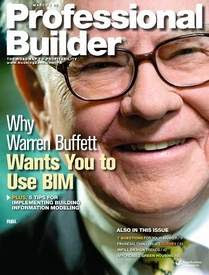
    Enough to end up on the cover of a magazine aimed at home builders.

    Professional Builder editor David Barista says Berkshire Hathaway Inc., the investment company Buffett heads, has close ties to the home-building industry through Shaw carpeting, Acme Brick, Benjamin Moore paints, Johns Manville materials, MiTek building components and modular home builder Clayton Homes.

    But Buffett is on the magazine cover because of MiTek’s acquisition of Simpad, a computer design company from Woburn, Mass., which sells software for 3C-CAD (three-dimensional computer-aided design) and BIM (building information modeling).

    “Buffett views the automating of home building as one of the best bets going forward,” Barista wrote.

    In a book on Simpad that the company distributed to top U.S. home builders late last year, Buffett advised, “The home-building industry, like others, will find ways to reduce costs through technology. I also see the current environment as an important opportunity for leading builders to retool their businesses and to prepare for the up-cycle ahead.”

    With economic pressures high, Buffett says that it’s time for the industry to get serious about using the new technology, which offers cost savings, improved quality and accuracy and faster construction.

    “We are making an investment in assisting a limited number of home-building companies to automate their CAD production and estimating processes,” Buffett wrote in the book. “They will quickly realize the cost savings. The quality and accuracy of their design and construction process will be better than ever before, and they’ll be delivered in a much shorter period of time.”

    In the cover story, Peter Fabris wrote that building information modeling is commonly used in high-rise offices, bridges, power plants and other complex projects but offers the same advantages on homes.

    For example, a builder can fit windows into a 3-D computer image of a house, placing them properly and varying the size, type of glass, frame and other factors. The system then estimates prices and prints out plans that builders and suppliers can follow.

    “Thus everyone can work from the same set of plans and data without having to do any redrawing or transposing,” the story said.

    He’s No. 1

    Speaking of magazines, much was made last week about Mexican telecommunications magnate Carlos Slim Helu topping Forbes’ list of wealthiest people and pushing Bill Gates and Buffett into also-ran status.

    But had the two Americans not collectively donated $37 billion to foundations they still would be on top, with Gates far ahead.

    Forbes estimated Helu’s wealth at $53.5 billion, just ahead of Gates’ $53 billion and Buffett’s $47 billion.

    But since 2006, Buffett has donated Berkshire stock that would be worth about $9 billion today to the Bill & Melinda Gates Foundation and to Buffett family foundations. Gates has donated $28 billion to the foundation that he and his wife and Buffett oversee.

    Helu has pledged to increase the endowments of his companies’ foundations from $4 billion to $10 billion and to spend more of his money on education and health two of the same areas of focus for the Gates Foundation.

    5 X $140,710.60

    Yes, someone out there did buy five shares of Berkshire stock March 12 for $140,710.60 each, the same day that 2,099 other shares sold between $124,065 and $122,546.

    The $140,000-plus was a bonus of as much as 15 percent for the sellers and the highest Berkshire price since September 2008.

    The sales, which occurred around 10:41 a.m. that day, went like this, according to Bloomberg records:

    … $123,037

    $123,060

    $140,710.60

    $140,710.60

    $140,710.60

    $140,710.60

    $140,710.60

    $123,108

    $124,560 …

    The five shares were traded on the BATS Global Market, an electronic exchange based in Lenexa, Kan., next door to Kansas City, Mo., which offers low trading rates via what it touts as the latest technology.

    BATS spokesman Randy Williams said the buyer specified that it/he/she would purchase only shares available on the BATS Exchange. The seller likewise offered the shares on the exchange.

    Williams said he couldn’t give other specific details about the transaction and couldn’t explain why someone paid the above-market price.

    Maybe the buyers didn’t want to deal with the New York Stock Exchange, where nearly all Berkshire shares are traded. Must be some good reason, you would think, but not an obvious one.

    ‘Bring you dollars’

    BYD Inc., the Chinese auto and battery company that is 10 percent owned by Berkshire, saw its stock rise in Hong Kong after reporting a 271 percent increase in profits for 2009.

    The company’s initials stand for the Chinese characters that are its name in that language, but the company also has said they stand for “build your dreams.”

    Now the South China Morning Post said the letters should mean “bring you dollars” because of the rising price of its stock, up 400 percent in the past 12 months.

    Behind the “Buffett-induced BYD frenzy,” the newspaper reported, are “some disquieting warning signals that potential buyers risk ignoring at their peril.”

    Last year’s sales growth was mostly from the sale of conventional cars, not the electric cars that have attracted so much attention, the story said. And those sales were largely due to stimulus incentives from the Chinese government and easier credit standards.

    BYD’s cars have quality problems but sell because they’re the cheapest. But with the stimulus measures ending and the possibility of tighter credit, BYD has little hope of repeating anything like 2009’s earnings growth this year, the story said.

    Profits from the company’s telephone handsets are suffering from intense competition, and revenue from batteries was down 34 percent.

    BYD has postponed mass production of some of its electric car models amid reports of battery problems and doubts about government subsidies. It plans to produce 100 E6 models as taxis.

    The E6’s price is forecast at four times the cost of a conventional car, the Post said, and it weighs twice as much as a Toyota Corolla. (How do you save energy by moving twice as much metal down the road, considering that most electricity comes from coal?)

    BYD has said it plans to sell electric and hybrid cars in Europe next year and in the United States late this year.

    For sale

    The New York Post says Berkshire may be a buyer for Residential Capital, the previously money-losing mortgage division of financing giant GMAC.

    The Post reported a similar rumor in January, but now GMAC has hired Goldman Sachs, an investment banking company in which Berkshire is a big investor, to start the process of selling ResCap, as the mortgage unit is called. The U.S. Treasury owns a s56 percent stake in GMAC.

    With Goldman hired, the newspaper said, it’s more likely that Berkshire may be a buyer. The Omaha company already owns part of ResCap’s debt, the Post noted.

    Buffett, who hasn’t commented on the idea, has said in the past that he isn’t interested in buying troubled companies. But ResCap might be put into good financial shape for the sale and would at least fit Berkshire’s interest in finance-based businesses.

    GMAC received $17 billion from the Troubled Asset Relief Program but might lose $6 billion to $10 billion by the time its restructuring is done, the Post said.

    Share Investor Links

    Share Investor Blog – Stockmarket & Business commentary
    Discuss this topic @ Share Investor ForumRegister free

    Download the 2009 Warren Buffett Letter & 2009 Annual Report to Berkshire Hathaway Shareholders
    Download the 1977 – 2009 Warren Buffett Letter’s to Berkshire Hathaway Shareholders

    Recommended Amazon Reading

    Warren Buffett's Management Secrets: Proven Tools for Personal and    Business Success Warren Buffett’s Management Secrets: Proven Tools for Personal and Business Success by Mary Buffett
    Buy new: $16.50 / Used from: $13.20
    Usually ships in 24 hours
    The Intelligent Investor: The Definitive Book on Value Investing. A    Book of Practical Counsel (Revised Edition) The Intelligent Investor: The Definitive Book on Value Investing. A Book of Practical Counsel (Revised Edition) by Benjamin Graham
    Buy new: $14.77 / Used from: $10.49
    Usually ships in 24 hours


    Bookmark and Share


  • BARRONS: With Warren as Your Wingman

    MONDAY, MARCH 22, 2010

    By MIKE HOGAN

    IT’S OFFICIAL: WARREN BUFFETT HAS TOPPED every mutual-fund money manager of his era. Shares of Buffett’s Berkshire Hathaway have delivered an average annual return of 22% since 1965, easily beating the 16.3% average logged by the top mutual fund, Fidelity Magellan (ticker: FMAGX) fund, according to a recent report in the Wall Street Journal based on calculations from Morningstar. The biggest contributor to Fidelity’s performance was Peter Lynch.

    If you’d like to get in on some of Berkshire’s future gains (ticker: BRK-A) but don’t have the $125,000 price of a ticket, you can, at least, learn to invest like Buffett on Validea (www.validea.com). The seven-year-old Website has simplified Buffett’s strategy and tactics to a formula investors can use to weigh their choices. And not just Buffett’s: the $30-a-month advisory service lets you filter your ideas through investing models suggested by the views of 10 other famous value investors, including Benjamin Graham.

    You can get a quick thumbs-up or -down assessment on your own ticker choices or copy 10- or 20-component portfolios recommended in the writings of gurus like Fidelity’s Lynch, or David Dreman or Martin Zweig. Many of these money managers have built upon the principles outlined in Security Analysis, the valuation bible that Graham co-authored in 1934 with fellow professor David Dodd. For example, Kenneth Fisher of Fisher Investments (www.fi.com) popularized the use of price-to-sales ratios as a way to identify attractive stocks in his best-selling Super Stocks. Validea reports the Fisher-inspired Price/Sales Investor model is up 84.1% over the past 12 months, compared with 59.2% for the Standard & Poor’s 500.

    Meanwhile, the Validea Earnings Yield Investor portfolio focuses on a company’s return on invested capital and its earnings yield as suggested by The Little Book That Beats The Market, by Joel Greenblatt, managing partner of the Gotham Capital hedge fund. The Earnings Yield Investor is up 106.9% over the past 12 months.

    These are mostly value-oriented, long-horizon models whose fundamental approach is to buy into cash-generating businesses — so-called “predictable” companies — whose years of consistent growth can, adherents hope, be extrapolated. Guru screens are designed to uncover strong earnings growth, sound balance sheets and free cash flow. And gurus like to buy companies when their shares are trading at a discount to fair-market value. That’s determined using a variety of traditional value measures and regressions such as the discounted cash-flow model.

    THE BUFFETT PORTFOLIO IS called the Patient Investor, a reference to the long investment horizons for which the Omaha Oracle is famous, as well as to his uncanny ability to discern value in distressed or misunderstood investments. Few investors are in a position to duplicate Buffett’s approach exactly, since he can take a controlling interest in companies. But his investment choices also reflect a philosophy retail investors can adopt. His oft-repeated advice is to invest only in companies you wouldn’t mind owning in whole.

    Validea’s Patient Investor portfolio has a 12-month return of 77.1%, compared with 59.2% for the S&P — about an 18-point outperformance. But approaches like Buffett’s really need to be judged over longer periods. They can underperform in the short-term such as early 2009 when you could hitch a ride on Berkshire for a mere $75,000 a share. Since its 2003 launch, the value of Patient Investor has grown 34.2%, while the S&P’s value has expanded 7.9%.

    “What our portfolios show is that, if you have a good strategy, it doesn’t necessarily have to be the best,” says Validea co-founder Justin Carbonneau. “Success lies in the discipline of selecting a good investing approach and sticking with it.”

    Validea differs from other guru-oriented sites like GuruFocus (www.gurufocus.com) — first, in that it’s focused on a much smaller universe of investors. GuruFocus tracks the actual trades and holdings of about 100 active value-fund managers via SEC filings that get detailed on the site. For $249 a year, GuruFocus subscribers can closely track the moves of their favorite gurus and, hypothetically, duplicate those trades in their own real-world or model portfolios.

    Validea doesn’t report the trades of its gurus, but you can type a ticker into its search engine and have it assessed by all their models. They tend to be risk-averse and to include rather difficult-to-achieve metric thresholds, all of which must be met for a company to qualify as a long bet. Failure to meet even one metric results in a verdict of “no interest.” As a result, Validea tends to favor large-cap stocks with long track records.

    But newer and smaller companies also have a place in a well-diversified portfolio. As a result, Validea has derived a Small-Cap Growth Investor portfolio from the writings of Tom and David Gardner, co-founders of Motley Fool (www.fool.com), another value-oriented Website. Since inception in 2003, Small-Cap Growth Investor has returned 16.2% annually, compared with 2.1% for the S&P, and with only a slightly higher beta than the index.

    These are model portfolios only; Validea does not manage money. But it is affiliated with Validea Capital Management (www.valideacapital.com), where Validea co-founder John Reese will manage individual portfolios of a minimum of $250,000 via the investor’s choice of eight similar portfolio styles for fees that range between 1% and 1.5% annually.

    On March 15, Validea launched a new pro service that issues trade alerts for high-conviction stocks; they are set off when fundamentals suggest upward momentum. In addition to e-mail alerts, the $100-a-month service offers swing traders access to detailed research reports on Validea picks, as well as sector and regional recommendations, much like ETFs. But unlike ETFs, which mirror large indexes, Validea pro portfolios are concentrated on the top 10 stocks derived from guru recommendations for a sector or region.

    Since Validea pays scant attention to asset correlation, its recommendations represent just a piece of a well-diversified portfolio. The site is best used in conjunction with a portfolio designer like MarketRiders (www.marketriders.com), focused on assembling the right balance of non-correlated assets. But building a portion of your portfolio the way Buffett or Graham might build it sure can’t hurt.

    Share Investor Links

    Share Investor Blog – Stockmarket & Business commentary
    Discuss this topic @ Share Investor ForumRegister free

    Download the 2009 Warren Buffett Letter & 2009 Annual Report to Berkshire Hathaway Shareholders
    Download the 1977 – 2009 Warren Buffett Letter’s to Berkshire Hathaway Shareholders

    Recommended Amazon Reading

    Security Analysis: Sixth Edition, Foreword by Warren Buffett  (Limited Leatherbound Edition) (Security Analysis Prior Editions) Security Analysis: Sixth Edition, Foreword by Warren Buffett (Limited Leatherbound Edition) (Security Analysis Prior Editions) by Benjamin Graham
    Buy new: $131.62 / Used from: $137.81
    Usually ships in 24 hours
    Security Analysis: The Classic 1934 Edition Security Analysis: The Classic 1934 Edition by GRAHAM
    Buy new: $37.80 / Used from: $11.94
    Usually ships in 24 hours
    Security Analysis: The Classic 1951 Edition Security Analysis: The Classic 1951 Edition by Benjamin Graham
    Buy new: $40.95 / Used from: $28.00
    Usually ships in 24 hours
    Security Analysis: The Classic 1940 Edition Security Analysis: The Classic 1940 Edition by Benjamin Graham
    Buy new: $32.67 / Used from: $30.99
    Usually ships in 24 hours


    Bookmark and Share


  • THE STREET.COM: BYD May Be Taking Cues From Buffett

    NEW YORK (TheStreet) — Is BYD taking a page out of Warren Buffett’s book? n moving away from its bold goal of mass producing an electric vehicle in China this year, BYD appears to reflect a similar conservative shift Buffett has recently been noted for.

    Buffett, who in the past has been known for picking out undervalued stocks with massive upside potential, has recently made it clear that he is transitioning towards a more conservative investment strategy.

    According to Berkshire Hathaway’s(BRK.A) most recently quarterly 13-F filing, the financier has been placing the vast number of his largest bets on companies more known for stability rather than pop.

    Some notable tweaks made to his legendary portfolio include large increases to his holdings of retail giant Wal-Mart(WMT) and Republic Services Group(RSG), a trash company. In his annual letter to Berkshire shareholders, the financier also referenced his large cash position, saying that although it’s earning 0% interest, he sleeps well at night.

    Taking more conservative approaches to doing business will likely mean that returns for BYD and Berkshire Hathaway will be less dramatic than in the past. However, these transitions will also ensure that investors see consistent returns over the long term.

    BYD, which stands for “Build Your Dreams,” has taken the international and domestic auto industry by storm. Though the company’s roots lay in the battery and power source producing industry, it has risen to become a symbol for the alternative and electric automobile revolution.

    Since first making the bet in 2008, Warren Buffett’s play on BYD has earned the investor billions. This week, Buffett and the rest of the company’s shareholders were treated to a welcomed boost when the firm reported that strong car sales helped lift the company’s fourth- quarter net profit 500%.

    Though BYD has largely been focused on satisfying China’s automobile demand, investors and car enthusiasts have long been buzzing over when the first BYD vehicles will hit American soil. Though there remains a strong chance that we will see the company’s cars on U.S. roads in the near future, the trendsetting firm appears to have extinguished plans to mass produce its electric cars in China this year.

    In a press release issued this week by BYD, the company outlined a far less dramatic plan for its electric vehicle going forward. Rather than producing the E6 on a grand scale, the company will instead produce 100 models to be used as taxis in Shenzhen, the company’s home city. Further development is expected to be dependant on the success of this program.

    In abandoning its plans for a mass produced electric car in China, the company will likely have to lean on other methods of turning profit. Expect BYD to focus more heavily on its F3 model. While not as revolutionary as a fully electric automobile, this sedan has risen to become one of the most popular cars in China.

    Electric cars will be a growing part of the automobile market, and with models like the E6, BYD is likely to be a frontrunner when the trend takes off. Until then, the company can ensure that it will continue to provide investors with strong, stable returns by focusing on more tried and true methods of making money in the present.

    Now that BYD has abandoned its bold plan to mass produce an electric car in 2010, does this company still have the same appeal? Feel free to leave a comment below.

    — Written by Don Dion in Williamstown, Mass.

    Share Investor Links

    Share Investor Blog – Stockmarket & Business commentary
    Discuss this topic @ Share Investor ForumRegister free

    Download the 2009 Warren Buffett Letter & 2009 Annual Report to Berkshire Hathaway Shareholders
    Download the 1977 – 2009 Warren Buffett Letter’s to Berkshire Hathaway Shareholders

    Recommended Amazon Reading

    Warren Buffett's Management Secrets: Proven Tools for Personal and   Business Success Warren Buffett’s Management Secrets: Proven Tools for Personal and Business Success by Mary Buffett
    Buy new: $16.50 / Used from: $13.20
    Usually ships in 24 hours
    The Intelligent Investor: The Definitive Book on Value Investing. A   Book of Practical Counsel (Revised Edition) The Intelligent Investor: The Definitive Book on Value Investing. A Book of Practical Counsel (Revised Edition) by Benjamin Graham
    Buy new: $14.77 / Used from: $10.49
    Usually ships in 24 hours


    Bookmark and Share


  • SYDNEY MORNING HERALD: Buffett investment style has the market cornered

    MARCUS PADLEY, March 20, 2010

    I LOVE the ”Warren Buffett Way”. One of my first clients introduced himself by saying: “I am Fred and I’d like to invest the Warren Buffett Way.”

    So what shall we do? Go out and get the reports of the top 200 companies. Analyse the profit and loss and balance sheets of each one, accurately assess “value”, then go out into the stockmarket and discover: “Wow. I’m right and the whole market is wrong.” And that the share price is trading below true “value”. Then buy the shares and wait for that value to inevitably emerge.

    Correct, but hardly realistic. The Warren Buffett Way, and the way investors and advisers have skimmed the surface and pretended to apply his methods, has cost the average investor more money than it has ever made them. No problem with Warren Buffett himself; the problem is the popular delusion that we can and should do what he does, or at least has done in the past.

    There is hardly a man in the street who does not quote Warren Buffett-isms and hardly an adviser who does not claim an empathy with his investment style.

    The truth is that there is only one Warren Buffett and only one person in the world who has his skill, patience, money, well-earned advantages and dedication to the task.

    But the rest of us? To think we can assess the Foster’s profit-and-loss account between packing four school lunches and holding down a job is delusional, as is the marketing of the idea that someone who is not Warren Buffett can emulate him and his success on our behalf.

    Seriously, if it were possible to imitate the Warren Buffett Way and transplant Buffett’s judgment into another fund manager, wouldn’t we know about it? Wouldn’t his fund be the highest-returning fund in the market? But there is no such fund manager and no such fund, because being Warren Buffett and exercising his judgment is not even very hard, it’s impossible, because so many elements of his analysis are so subjective.

    Getting stocks right is a very personal thing and I’m afraid if you really want Warren Buffett to be your adviser or your fund manager, there is no alternative but to ring him.

    Everyone makes a fortune out of Buffett and I know from experience that it works in our industry to align yourself with his success in the pursuit of more sales, clients and funds.

    But the truth is that apart from the fact that these products have Buckley’s chance of delivering the same success, these services are also conveniently inoculating themselves from responsibility for the products’ performance, because the Warren Buffett Way relies on such a long-term, patient approach.

    This negates the need for them to perform or be judged until much later, after you have paid.

    Most Buffett-based approaches are terrible at timing, which in reality is about the only thing that really matters.

    In an increasingly impatient market, it is not just about “what”, it is becoming all about “when”. Investors who sat through the 54.5 per cent market fall in the crisis need to earn 113 per cent to get their money back. That’s 13 years of compounding average annual returns. Not caring about “when” just cost us 13 years.

    There are only two ways to make money out of Buffett: buy shares in Berkshire Hathaway, or write a book about him. There are close to 50 of those and he hasn’t written one of them.

    On that basis, Buffett himself is hardly to blame for all this hoopla. If there is any blame at all it is ours, for skimming the surface of the biggest investment success story in the world in order to commercialise it.

    There is no Warren Buffett Way for other investors. There is just picking stocks that go up in price and to do that you would be well advised to rely on you, just you, with your understanding, your time horizons, your risk profile and your expectations. Not Warren’s. Forget Buffett. You are not Buffett. You are you. Rely on that.

    Marcus Padley is a stockbroker with Patersons Securities and the author of the daily stockmarket newsletter Marcus Today. For a free trial, go to www.marcustoday.com.au

    Share Investor Links

    Share Investor Blog – Stockmarket & Business commentary
    Discuss this topic @ Share Investor ForumRegister free

    Download the 2009 Warren Buffett Letter & 2009 Annual Report to Berkshire Hathaway Shareholders
    Download the 1977 – 2009 Warren Buffett Letter’s to Berkshire Hathaway Shareholders

    Recommended Amazon Reading

    The Warren Buffett Way, Second Edition
    The Warren Buffett Way, Second Edition by Robert G. Hagstrom
    Buy new: $9.72 / Used from: $5.68
    Usually ships in 24 hours


    Bookmark and Share


  • CNBC: Warren Buffett (With Tats and Bandana) Reveals His Inner Axl Rose

    Published: Thursday, 18 Mar 2010 | 11:01 AM ET

    By: Alex Crippen
    Executive Producer

    Warren Buffett rocks out in a music video featuring GEICO associates singing a guitar ballad about the insurer’s “outstanding” customer service.

    The professionally-produced video, posted by the Berkshire Hathaway subsidiary on YouTube, was shown at the annual employees meeting last month.

    It’s now part of the company’s Social Media marketing efforts.

    It features Buffett, dressed to resemble Axl Rose of Guns N’ Roses, singing, “You bring out the best in me, you can always turn to me.”

    The GEICO “Gecko” also does some semi-flashy guitar work.

    Time quotes Phil Ovuka, director of creative media services for GEICO, saying that he really wanted to push the envelope in this year’s video, after Buffett’s less-flashy cameo appearances in the videos of the past four years. “We thought – what’s the most ridiculous getup we could think up for Warren – and though, nah, we can’t do that.”

    They could and they did. Why? Buffett says, “I’m having trouble finding an agent that will take me on.”

    As they say in the biz, don’t quit your day job just yet.

    Here’s the video:

    Current Berkshire stock prices:

    Class B: [BRK.B 82.1901 -0.3099 (-0.38%) ]

    Class A: [BRK.A 123291.00 -466.1016 (-0.38%) ]

    Share Investor Links

    Share Investor Blog – Stockmarket & Business commentary
    Discuss this topic @ Share Investor ForumRegister free

    Download the 2009 Warren Buffett Letter & 2009 Annual Report to Berkshire Hathaway Shareholders
    Download the 1977 – 2009 Warren Buffett Letter’s to Berkshire Hathaway Shareholders

    Recommended Amazon Reading

    Warren Buffett's Management Secrets: Proven Tools for Personal and  Business Success Warren Buffett’s Management Secrets: Proven Tools for Personal and Business Success by Mary Buffett
    Buy new: $16.50 / Used from: $13.20
    Usually ships in 24 hours
    The Intelligent Investor: The Definitive Book on Value Investing. A  Book of Practical Counsel (Revised Edition) The Intelligent Investor: The Definitive Book on Value Investing. A Book of Practical Counsel (Revised Edition) by Benjamin Graham
    Buy new: $14.77 / Used from: $10.49
    Usually ships in 24 hours


    Bookmark and Share


  • TIME: Warren Buffett Plays a Guns N’ Roses Rock Star

    EWB readers please note. This story appeared on Everything Warren Buffett 4 days ago.

    Who would have thought that under the hard business exterior of mega-investor Warren Buffett lies the soul of a wannabe rocker? A surreal video making its way around the Net shows Buffett doing his best imitation of Guns N’ Roses rocker Axl Rose, complete with waist-length hair, a purple bandanna, a black leather jacket and Axl’s signature red plaid kilt from the ’80s — all as part of an eye-catching video for Geico, the auto-insurance company owned by Berkshire Hathaway. And Buffett sings too. O.K., he attempts to sing. (See the best Super Bowl commercials of 2010.)

    The video, put together by Geico employees, shows workers breaking into song from their cubicles. The power ballad begins with a single employee singing “Jump online or call a rep / We’ll guide you through it step-by-step / Twenty-four-seven we’ll be there for you.” Then a chorus of employees chime in, complete with guitars, drums and a cowbell. Someone dressed as the company’s mascot gecko does his best Slash imitation on guitar. (See pictures of a Berkshire Hathaway shareholder meeting.)

    But it’s Buffett who steals the show, as shots of the billionaire investor singing and swaying à la Axl Rose from a spotlight-illuminated stage are juxtaposed throughout the 2-min. 24-sec. video. His grand finale comes in the final 30 seconds when he stretches out his tattoo-laden arm to an unseen audience and croons into the mike, “You bring out the best in me / You can always turn to me … / We’re always true to you / We’ll do it all for you …” (See 10 big recession surprises.)

    Geico puts together a video each year to play at the company’s annual employees meeting, which was held in February. Geico employees star in the video and film it, and Buffett has taken part in the shoot for the past four years, says Phil Ovuka, director of creative media services at Geico. Buffett played a DJ one year and a hobo another year. This year, Ovuka wanted to push the envelope a little further. “We thought, What’s the most ridiculous getup we could think up for Warren — and thought, Nah, we can’t do that,” says Ovuka. (See pictures of Guns N’ Roses.)

    But Buffett agreed to do it. When asked why, he replied, “I’m having trouble finding an agent that will take me on.” To which we say, Forget talent agents. Geico’s agents have got to love this guy.

    Here’s a link to the Geico video.


    Bookmark and Share


  • THE NEW ZEALAND HERALD: Generous billionaire inspires writer

    By Christopher Adams

    4:00 AM Monday Mar 15, 2010

    Children's book writer Lucas Remmerswaal has four-and-a-half  months to get Warren Buffett and Oprah Winfrey on board. Photo / Natalie  Slade

    Children’s book writer Lucas Remmerswaal has four-and-a-half months to get Warren Buffett and Oprah Winfrey on board. Photo / Natalie Slade

    Lucas Remmerswaal is a man on a mission – a mission to change the way a whole generation approaches its finances.

    But how does a Whangarei investment adviser and father-of-six plan on doing that? By writing children’s books inspired by the ideas and principles of American billionaire investor and philanthropist Warren Buffett – the world’s third wealthiest man.

    Remmerswaal is in the process of producing an illustrated book for five-year-olds, another for 12 year-olds and a teaching aid for parents and teachers.

    The books, both titled The 13 habits that made me $48 billion, inspired by Warren Buffett, have been illustrated by Australian artist Annette Lodge, who has published a number of her own children’s books.

    Remmerswaal says he has invested $64,000 in the project so far.

    “All our money outside the family home is invested in this project.”

    But before approaching publishers, he wants to get Buffett involved, as he says that will be the key to his plan of launching the books on the Oprah Winfrey Show.

    It’s a big dream – Buffett is bombarded by hundreds of unsolicited emails and calls every day, and has a loyal personal assistant whose job mostly involves fending off unwanted inquiries. But Remmerswaal hopes the books will help avoid another global financial crisis.

    “Everyone did it wrong,” he says, referring to the greedy business practices that led to the recession. “Two billion dollars worth of retirees’ savings wiped off the face of the earth, just in New Zealand.

    “I’m just a poor house husband that’s put his life savings on the line because I want to create a change from that Petricevic and Bryers thinking to Buffett thinking.”

    He says financial gain is only a small part of his reason for starting the project, and if it is successful, he plans on donating much of the money to the Success For Students charitable trust that he set up with his neighbour.

    The Buffett project has received high praise from education royalty – national standards specialist Professor John Hattie from the University of Auckland, who met Remmerswaal last week, and viewed the drafts of the books.

    “I think he’s onto a winner and I think it’s a stunning project,” says Hattie. “The artwork alone is incredibly impressive, and that alone will engage young kids.”

    Remmerswaal could be described as a Buffett obsessive. He has researched the Omaha, Nebraska-based businessman intensely since the late 1990s. He recently spent a week in Omaha trying to get a meeting with Buffett, to introduce him to the project, but to no avail.

    Apparently, Buffett doesn’t answer his door to strangers.

    There’s nothing particularly strange about Buffett fanaticism. There are thousands of “disciples” of the so-called “Oracle of Omaha” around the world. The annual shareholder’s meeting for his company, Berkshire Hathaway, fills an arena.

    Despite being one of the richest companies on earth, the offices of Berkshire Hathaway occupy just a single floor of a modest office block in Omaha. Buffett, renowned for his frugality, employs only a handful of staff.

    He reportedly gives 85 per cent of his net wealth to the Bill and Melinda Gates Foundation and family charities, and lives in a humble home – not even the biggest in the street – in a suburb of Omaha.

    Remmerswaal says he has read every chairman’s letter Buffett has released since 1977, as well as countless biographies on the billionaire.

    There is much to be gained from the information contained in those letters and books, he says, but people are put off reading them because they think they are complicated. “All I’ve done is translated [the letters and books] for 5-year-olds, for 12-year-olds and for parents and teachers,” he says. “I’m just a foreign language translator, that’s what I’m doing here.”

    Next month Remmerswaal heads back to Nebraska to join the hordes at the Berkshire-Hathaway annual shareholders meeting. He will again attempt to make contact with Buffett.

    The clock ticks mercilessly for Remmerswaal – he wants the book to be launched on August 30 to coincide with Buffett’s 80th birthday. He has four-and-a-half months to get Buffett, and then Oprah, on board.

    Hattie says there is much Kiwi kids can learn from the ideas in the Buffett books. “The message isn’t so much about Warren Buffett, it’s about key behaviours and key attitudes and Lucas is using [the books] as a medium,” he says.

    By Christopher Adams

    Share Investor Links

    Share Investor Blog – Stockmarket & Business commentary
    Discuss this topic @ Share Investor ForumRegister free

    Download the 2009 Warren Buffett Letter & 2009 Annual Report to Berkshire Hathaway Shareholders
    Download the 1977 – 2009 Warren Buffett Letter’s to Berkshire Hathaway Shareholders

    Recommended Amazon Reading

    The Essays of Warren Buffett: Lessons for Corporate America, Second   Edition The Essays of Warren Buffett: Lessons for Corporate America, Second Edition by Warren E. Buffett
    Buy new: $25.91 / Used from: $29.99
    Usually ships in 24 hours
    The Snowball: Warren Buffett and the Business of Life The Snowball: Warren Buffett and the Business of Life by Alice Schroeder
    Buy new: $13.60 / Used from: $8.95
    Usually ships in 24 hours


    Bookmark and Share


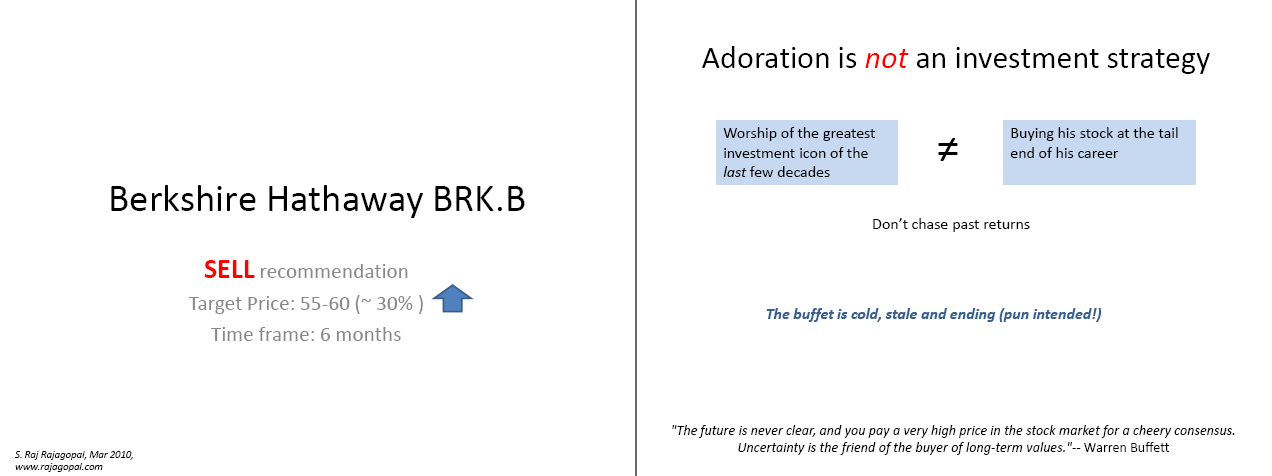
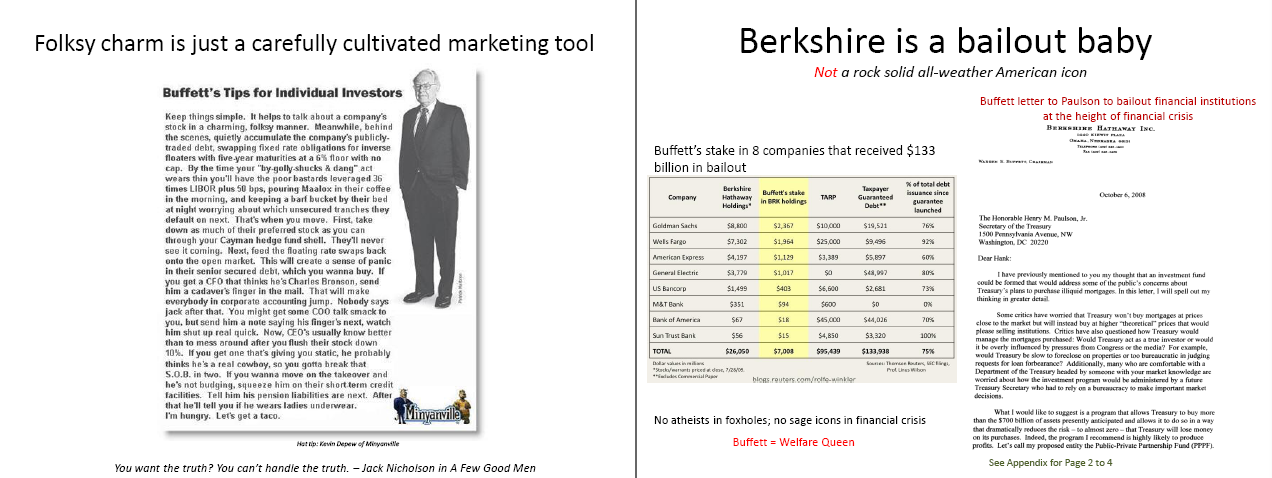
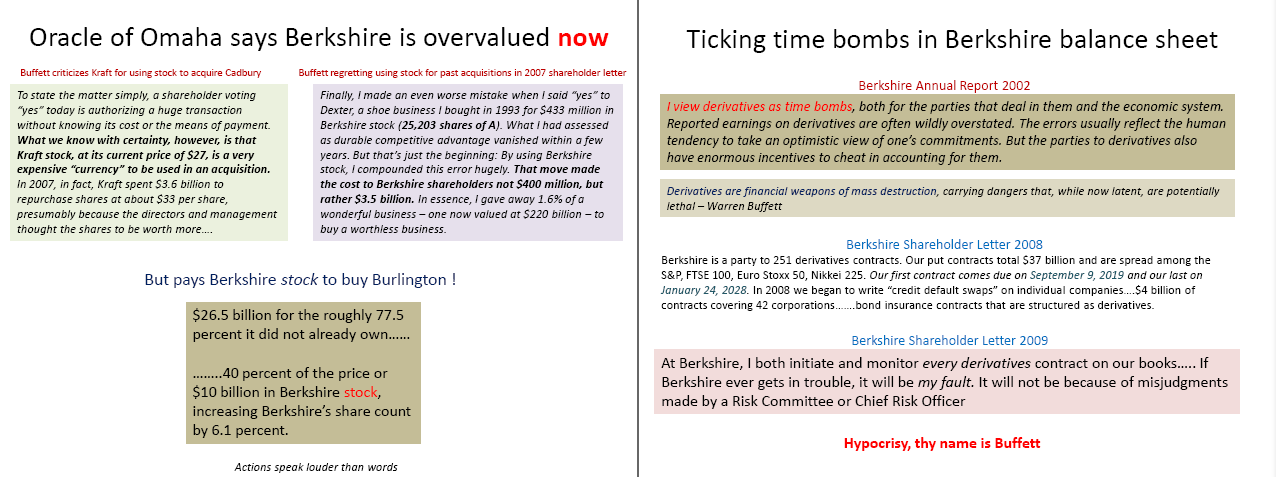
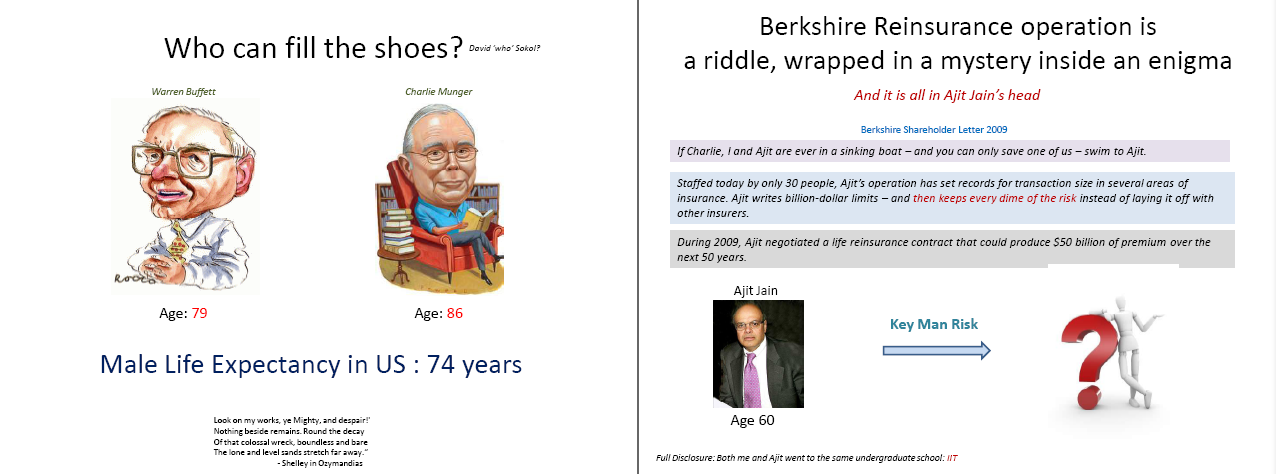
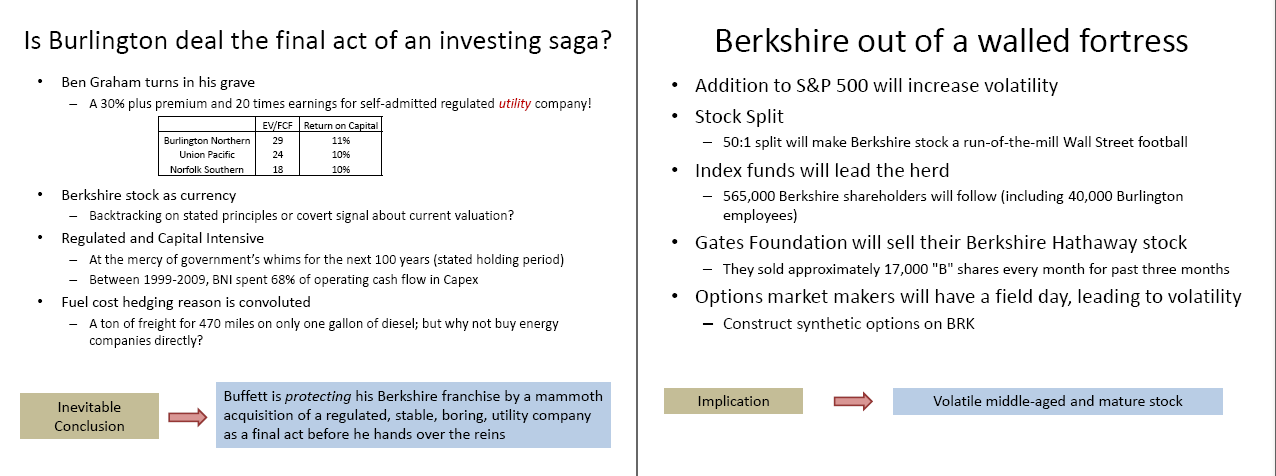
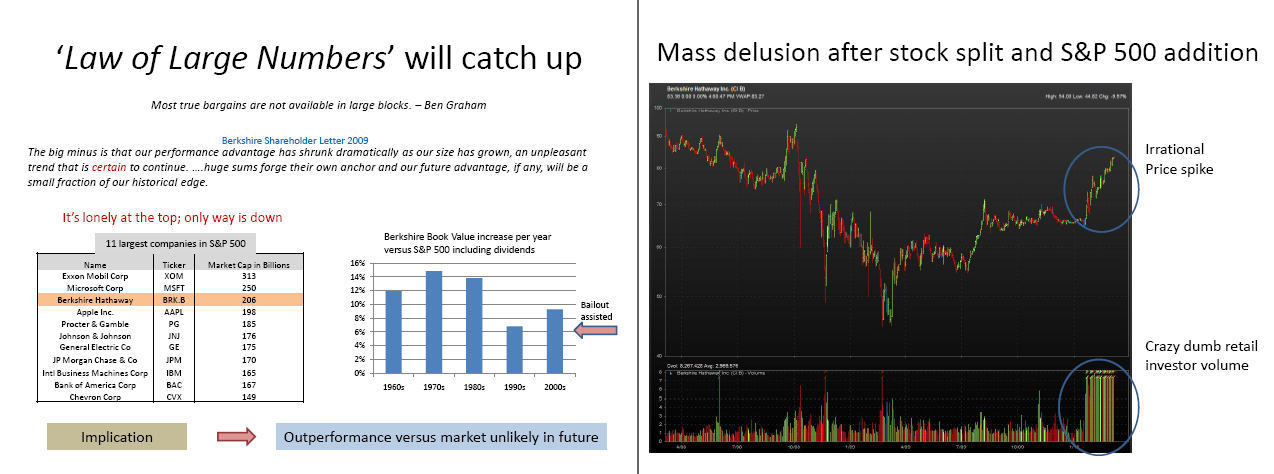
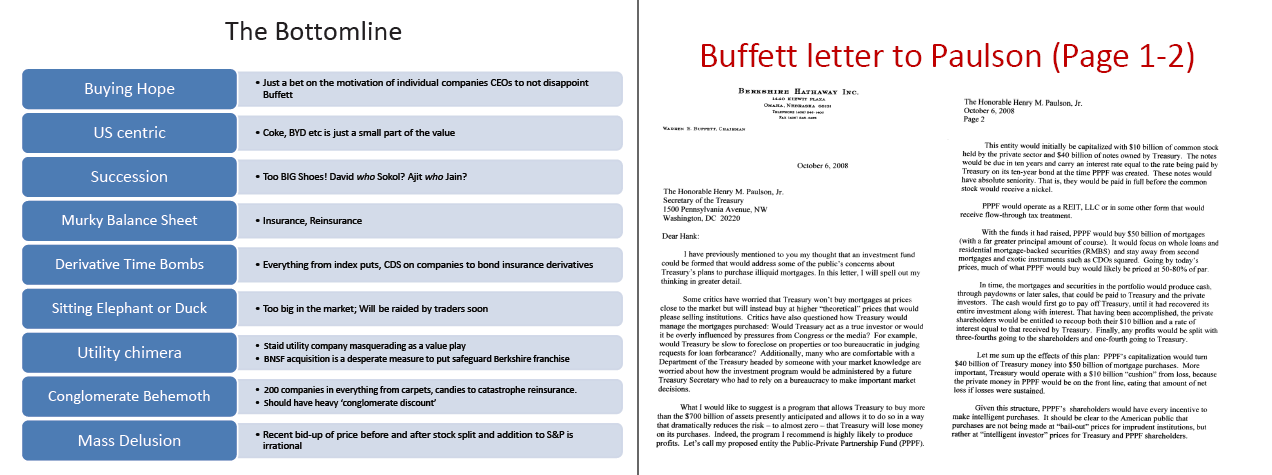
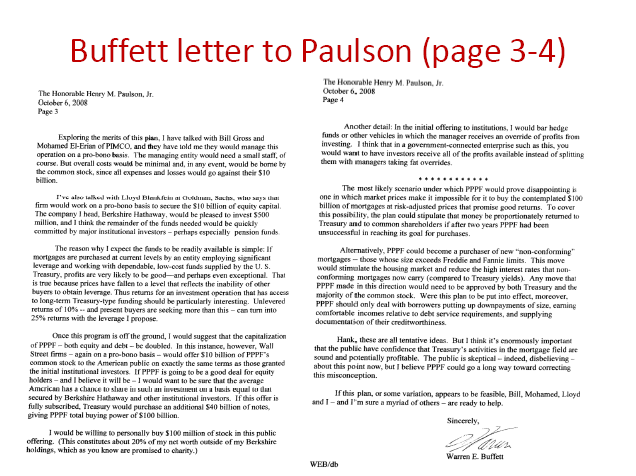
  • GREENBACKD.COM: The short case for Berkshire Hathaway Inc.

    March 17, 2010

    S. Raj Rajagopal has provided a guest post outlining his argument for a short position in Berkshire Hathaway Inc. (BRK.A, BRK.B) Raj is an MBA student at Johnson Graduate School of Management at Cornell University graduating in May this year. He has worked as a portfolio manager at the Cayuga Fund, LLC, the Johnson Graduate School’s $12M hedge fund, and is currently seeking full-time employment in the investment management area.

    Raj’s short case for Berkshire Hathaway Inc. is set out below:

    (Click to enlarge)

    [Full Disclosure: I do not hold BRK.A or BRK.B. This is neither a recommendation to buy or sell any securities. All information provided believed to be reliable and presented for information purposes only. Do your own research before investing in any security.]

    Share Investor Links

    Share Investor Blog – Stockmarket & Business commentary
    Discuss this topic @ Share Investor ForumRegister free

    Download the 2009 Warren Buffett Letter & 2009 Annual Report to Berkshire Hathaway Shareholders
    Download the 1977 – 2009 Warren Buffett Letter’s to Berkshire Hathaway Shareholders

    Recommended Amazon Reading

    The Essays of Warren Buffett: Lessons for Corporate America, Second   Edition The Essays of Warren Buffett: Lessons for Corporate America, Second Edition by Warren E. Buffett
    Buy new: $25.91 / Used from: $29.99
    Usually ships in 24 hours
    The Snowball: Warren Buffett and the Business of Life The Snowball: Warren Buffett and the Business of Life by Alice Schroeder
    Buy new: $13.60 / Used from: $8.95
    Usually ships in 24 hours


  • FORBES: Warren Buffett’s Inner Drive

    Claire Obusan, 03.16.10, 06:00 PM EDT

    How the Oracle of Omaha went from being a stockbroker to one of the world’s richest people.

    image

    Warren Buffett is the third-richest man in the world with a net worth of $47 billion.

    Origins

    Warren Edward Buffett was born in Omaha, Neb., on Aug. 30, 1930, the second of three children of Leila Stahl Buffett and Nebraskan politician and businessman Howard Buffett.

    Even as a child, Buffett was already devising ways to make money. He delivered newspapers as a boy, worked at his grandfather’s store and sold gum, Coca-Cola and weeklies door-to-door. At age 10 his father took him to New York as a birthday gift; the young investor asked to visit the New York Stock Exchange. He filed his first tax return at age 13, claiming a $35 deduction for his bicycle.

    Buffett earned his bachelor’s degree from University of Nebraska-Lincoln, and later went to Columbia Business School to study under value investing guru Benjamin Graham, the father of modern securities analysis. Buffett learned to hunt for undervalued stocks using Graham’s three principles, which he has applied throughout his career: buying a business not a stock; ignoring the fluctuations of the stock market; and maintaining a margin of safety. Buffett originally wanted to work in Wall Street after graduation, but his father and Graham convinced him not to.

    How He Made His Billions

    The Oracle of Omaha became the world’s richest man in 2008, eclipsing fellow billionaire and friend, Bill Gates, who had held the top spot on the Forbes list of the World’s Billionaires for more than a decade. These days Buffett holds the No. 3 spot on the list, commanding a $47 billion net worth.

    The world’s most famous investor started as a stockbroker in Omaha. He went on to work at legendary value investor Benjamin Graham’s partnership for a few years. After Graham retired, Buffett started his first investment partnership at age 25. In 1959 he met Charlie Munger at a dinner party. The duo started investing together, scouting out under-priced businesses to buy.

    Buffett began purchasing shares in textile firm Berkshire Hathaway ( BRK news people ) in 1962 before buying a controlling stake in 1965. Over the next 45 years he used Berkshire Hathaway as a vehicle to invest in insurance (GEICO), food (Dairy Queen), utilities (MidAmerican Energy ( MDPWL.PK news people )), green tech (electric-car maker BYD).

    Today Berkshire Hathaway also owns non-controlling stakes in companies like Coca-Cola ( KO news people ), Kraft and Wells Fargo ( WFC news people ). Buffett shrewdly invested $5 billion in Goldman Sachs ( GS news people ) and $3 billion in General Electric ( GE news people ) amid the 2008 market collapse and recently acquired railroad giant Burlington Northern Santa Fe ( BNI news people ) for $26 billion, Berkshire’s largest acquisition to date.

    Buffett’s Billionaire Network

    Buffett met friend and occasional bridge partner Bill Gates at a Fourth of July party in 1991, where they were introduced by a mutual friend. Both men were initially reluctant about the meeting, concerned that they would not have anything in common. But they immediately hit it off. They have since made numerous public appearances together, including town halls at Buffett’s alma maters. Buffett has also irrevocably pledged the majority of his fortune to Gates’ philanthropic foundation.

    Buffett met his right-hand man and Berkshire Hathaway vice-chairman, Charlie Munger, at a dinner party in 1959. Though Munger’s gruff personality contrasts with Buffett’s folksy manner, he is Buffett’s sounding board: “If we ask Charlie something and he says ‘no,’ then we put all of our money in it. If he says, “that’s the stupidest thing I’ve ever heard,” then we make a more modest investment.” A few years ago Munger convinced Buffett to invest in Chinese electric carmaker BYD. Their original $232 million investment is now worth close to $2 billion.

    Philanthropy

    In 2006 Buffett announced he had irrevocably earmarked the majority of his Berkshire Hathaway shares to charity, with most of the money to the Bill & Melinda Gates Foundation. The gift was valued at $31 billion on the day of the announcement and remains one of the largest charitable donations in history.

    Passions And Hobbies

    Despite his extraordinary wealth, Buffett is well-known for his frugality. He has lived in the same five-bedroom stucco house in Omaha since 1958, when he purchased the property for $31,500. He reportedly carries no cellphone, does not have a computer on his desk, does not have a chauffeur (he drives a 2006 Cadillac DTS) and does not travel with an entourage. The most legendary investor of all time also has a fondness for hamburgers, fries and Cherry Coke. Buffett is also an avid bridge player.

    Share Investor Links

    Share Investor Blog – Stockmarket & Business commentary

    Discuss this topic @ Share Investor ForumRegister free

    Download the 2009 Warren Buffett Letter & 2009 Annual Report to Berkshire Hathaway Shareholders

    Download the 1977 – 2009 Warren Buffett Letter’s to Berkshire Hathaway Shareholders

    Recommended Amazon Reading

    The Essays of Warren Buffett: Lessons for Corporate America, Second  Edition The Essays of Warren Buffett: Lessons for Corporate America, Second Edition by Warren E. Buffett

    Buy new: $25.91 / Used from: $29.99

    Usually ships in 24 hours
    The Snowball: Warren Buffett and the Business of Life The Snowball: Warren Buffett and the Business of Life by Alice Schroeder

    Buy new: $13.60 / Used from: $8.95

    Usually ships in 24 hours


    Bookmark and Share


  • WALL STREET JOURNAL: Lesson From Buffett On Following Dreams

    By SUE SHELLENBARGER

    MARCH 16, 2010

    Warren Buffett gave his son enough to follow his dream, but not enough to do nothing.

    What would you have done if someone, very early in your adult life, had given you a free ticket to explore any career you wanted—but not enough to stop working forever? Would you have used that freedom to pursue another life path? How would your life be different now?

    A story from a forthcoming book by Peter Buffett, son of the legendary Omaha investor, is an invitation to daydream on that topic. At age 19, the younger Mr. Buffett received a relatively modest bequest from his wealthy father—”enough to do anything, but not enough to do nothing,” one of his father’s often-quoted tenets, he explains in an essay adapted from his book, “Life Is What You Make It,” published recently in Bloomberg BusinessWeek. Proceeds from the sale of a farm were converted into shares of his father’s company, Berkshire Hathaway.

    A student at Stanford University at the time, Peter opted to sell the shares, collect roughly $90,000 and leave college. (Those shares are worth roughly $72 million now, but the younger Buffett says he has no regrets.)

    He moved to San Francisco, set up a studio and began working on his music, playing the piano, writing tunes, experimenting with electronic sounds and taking whatever work he could find, paid or unpaid.

    The decision put Peter Buffett in position to get his lucky break—a chance encounter that led to a meeting with an animator who worked with a fledgling cable channel called MTV. That led to paid work in advertising and eventually, the ability to make a living in music. Mr. Buffett went on to create a career as an Emmy Award-winning musician, composer and producer. “If I had faced the necessity of making a living from day one, I would not have been able to follow the path I chose,” he writes.

    I found this story thought-provoking. Some young adults feel forced to grab the highest-paying jobs they can get right out of college—jobs that can entrap them on a path leading away from their career dreams. But for others, the need to earn a living serves as a positive and practical discipline. If someone had given me the gift of time, for example, as Mr. Buffett did for his son, I imagine I would have squandered it writing bad novels, rather than getting useful paying work as a secretary, then as a teacher, and then going on to graduate school in journalism, a far more practical path in my case.

    Readers, what would you have done if someone had given you a free pass to spend time exploring the career of your dreams? Would you have taken a different career path? Or would a free ticket have destroyed your motivation?

    Readers:

    “To my mind nothing is more tragic than having a passion for something that will never be able to support yourself or your family. I have a friend with a passion for music but not enough talent to ever make a go of it professionally, so he works as an administrator. How much better to have been born with a passion for tax law, chemistry or computer programming.”

    “I would have left for France and enrolled in culinary school. That was my dream coming out of high school.”

    Share Investor Links

    Share Investor Blog – Stockmarket & Business commentary
    Discuss this topic @ Share Investor ForumRegister free

    Download the 2009 Warren Buffett Letter & 2009 Annual Report to Berkshire Hathaway Shareholders
    Download the 1977 – 2009 Warren Buffett Letter’s to Berkshire Hathaway Shareholders

    Recommended Amazon Reading

    The Essays of Warren Buffett: Lessons for Corporate America, Second Edition The Essays of Warren Buffett: Lessons for Corporate America, Second Edition by Warren E. Buffett
    Buy new: $25.91 / Used from: $29.99
    Usually ships in 24 hours
    The Snowball: Warren Buffett and the Business of Life The Snowball: Warren Buffett and the Business of Life by Alice Schroeder
    Buy new: $13.60 / Used from: $8.95
    Usually ships in 24 hours


    Bookmark and Share


  • TRADINGMARKETS.COM: BYD to Sell Electric Vehicles to US

    SHENZHEN, Mar 16, 2010 (SinoCast Daily Business Beat via COMTEX) —

    Wang Chuanfu, board chairman, president and CEO of BYD Co., Ltd. (SEHK: 1211), discloses that the company plans to set up regional headquarters in the US to sell renewable energy vehicles by the end of 2010.

    A top executive of Shenzhen BYD Auto Co., Ltd. in charge of public relations says that the company will launch five new car models this year, including L3, I6, G6, S6 and M6, whose price ranges top CNY 100,000.

    An analyst of Ping An Securities

    Co., Ltd. points out that BYD forayed into the automobile industry through battery production. Hence, it would be a better choice for the company to start from low-end products.

    Currently, BYD is selecting locations for its US headquarters. The company is likely to build plants in the local market if its electric car E6 is sold well there. However, insiders remain cautious toward BYD’s ambition.

    For example, an analyst of BoCom International Holdings Co., Ltd. believes that it is difficult for BYD to obtain robust sales growth in the US, because the country is still backward in the construction of supporting facilities like charging stations.

    An analyst of Yuanta Securities points out that the popularization of electric cars depends on infrastructure construction. However, no investor

    is willing to build charging stations without the production of electric cars.

    Wang admits that the manufacturing of environmental-friendly vehicles is still suffering from losses. But, he reveals that E6 is sold at around USD 40,000, which is still competitive. Moreover, E6 will be directly sold to big names, environmentalists and group customers from the utility field.

    Besides foraying into the North American market, BYD takes other steps in the oversea market. Lately, the company inked a memo with Daimler (NYSE: DAI) on the development of electric cars.

    Meanwhile, BYD is seeking cooperation with Volkswagen in the fields of hybrid and lithium battery-driven electric cars. Its traditional vehicles have been sold to Russia and Middle East. Wang believes that E6 will be sold in Europe in the first half of 2011.

    In the future, electric cars will account for more of BYD’s total sales. The company is currently strengthening its R&D of solar cell and storage power station projects, planning to put CNY 500 million in the construction of solar power plants in 2010.

    Within 2010, BYD’s expenditure will top CNY 10 billion, which will be used for the setup of an auto manufacturing base in Changsha City, Hunan Province, central China and production expansion in Xi’an and Shenzhen.

    (USD 1 = CNY 6.83)

    Source: www.mysteel.com (March 16, 2010)

    For full details on (BYDDF) BYDDF. (BYDDF) has Short Term PowerRatings at TradingMarkets. Details on (BYDDF) Short Term PowerRatings is available at This Link.

    Share Investor Links

    Share Investor Blog – Stockmarket & Business commentary
    Discuss this topic @ Share Investor ForumRegister free

    Download the 2009 Warren Buffett Letter & 2009 Annual Report to Berkshire Hathaway Shareholders
    Download the 1977 – 2009 Warren Buffett Letter’s to Berkshire Hathaway Shareholders

    Recommended Amazon Reading

    The Essays of Warren Buffett: Lessons for Corporate America, Second Edition The Essays of Warren Buffett: Lessons for Corporate America, Second Edition by Warren E. Buffett
    Buy new: $25.91 / Used from: $29.99
    Usually ships in 24 hours
    The Snowball: Warren Buffett and the Business of Life The Snowball: Warren Buffett and the Business of Life by Alice Schroeder
    Buy new: $13.60 / Used from: $8.95
    Usually ships in 24 hours


    Bookmark and Share


  • CHINA KNOWLEDGE: BYD’s F3 tops domestic sales in Feb

    Mar. 16, 2010 (China Knowledge) – The F3 compact car, which is made by Chinese auto maker BYD Co Ltd<1211>, led car sales in the Chinese auto market in February, according to figures released by the China Car Times.

    Shenzhen-based BYD sold nearly 21,300 F3s in February, making the F3 the best-selling model in the country during the period.

    Volkswagen AG’s Lavida and Santana models ranked second and third with respective sales of 16,300 units and 15,800 units.

    Last month, BYD sold 34,184 cars, 43.5% more than in the corresponding period a year earlier, thanks to booming sales of its F3 model.

    Sales of passenger cars in China increased 45.9% year on year to 623,100 units in February, according to figures released by the official China Association of Automobile Manufacturers.

    During the past year, China overtook the U.S. as the world’s largest auto market. The country’s auto sales soared 46% to 13.6 million units. The strong sales were partly due to stimulus policies to boost auto demand.

    Share Investor Links

    Share Investor Blog – Stockmarket & Business commentary

    Discuss this topic @ Share Investor ForumRegister free

    Download the 2009 Warren Buffett Letter & 2009 Annual Report to Berkshire Hathaway Shareholders

    Download the 1977 – 2009 Warren Buffett Letter’s to Berkshire Hathaway Shareholders

    Recommended Amazon Reading

    The Essays of Warren Buffett: Lessons for Corporate America, Second Edition The Essays of Warren Buffett: Lessons for Corporate America, Second Edition by Warren E. Buffett

    Buy new: $25.91 / Used from: $29.99

    Usually ships in 24 hours
    The Snowball: Warren Buffett and the Business of Life The Snowball: Warren Buffett and the Business of Life by Alice Schroeder

    Buy new: $13.60 / Used from: $8.95

    Usually ships in 24 hours


    Bookmark and Share


  • INSURANCENEWS.NET: A Team of Rivals: The Long Coattails of Berkshire Hathaway

    March 15, 2010

    With its vast capacity, Berkshire Hathaway is a one-of-a-kind giant that casts a long shadow in the reinsurance and retrocession market, but its goal of reaching for only the highest-priced, most profitable business leaves plenty of room for the competition to feast on the lower branches.

    Berkshire Hathaway “is in a unique place,” said John Lummis, retired chief operating officer with Renaissance Re, “not only because of its size, but because of its capacity for decision making. There are only a few other pools of capital that are even in the same ballpark.” The skill of Warren Buffett and National Indemnity Group’s Executive Vice President Ajit Jain differentiates Berkshire Hathaway as well, he said.

    Led by business icon Buffett, Berkshire Hathaway’s reinsurance operations, which include National Indemnity and General Re, are the third largest in the industry behind Swiss Re and Munich Re, according to 2008 gross reinsurance premiums.

    In recent years, Berkshire Hathaway has not always treated its biggest rivals as competitors, instead snapping up a 3% ownership stake in Swiss Re and a 5% ownership stake in Munich Re.

    Berkshire Hathaway has also offered two large retrocession contracts to Swiss Re, in addition to offering a loan of $2.6 billion that could be converted into a 25% to 30% ownership stake in 2012. Swiss Re has vowed to repay the loan before the conversion can be triggered.

    It might be counter-intuitive for a company to come to the aid of its competitors, but while there are possible disadvantages to Berkshire, the company believes those are outweighed by the short-term gains, said Alice Schroeder, former equity analyst and author of the book “Snowball: Warren Buffett and the Business of Life.”

    “Most of the time, investors price insurance capital far too cheaply. On the rare occasions when he can get an attractive price for it, Buffett is opportunistic,” Schroeder said.

    Indeed, Berkshire Hathaway “is the ultimate wholesale capital provider,” Lummis said. “As I see it, if they can find terms in a transaction that works for them, then they will play — even if it means investing in a competitor.”

    Swiss Re was in a difficult situation when Berkshire Hathaway came through with the $2.6 billion capital infusion in early 2009. The Zurich-based company had been hit hard by default credit swaps and other toxic assets related to the subprime mortgage collapse that had sparked the global financial crisis. Swiss Re reported a 2008 net loss of about 864 million Swiss francs and saw its A.M. Best Financial Strength Rating downgraded to A (Excellent) from A+ (Superior).

    “Swiss Re was in a bad spot a year and a half ago, and few could have done what Buffett did,” said John Andre, group vice president of property/casualty ratings at A.M. Best Co. “He was a white knight in that regard. There’s no one like that, no one even to compare it to. He can play on both sides.”

    Robert DeRose, vice president at A.M. Best Co. said, “You wouldn’t think he would lend capital to competitors of his subsidiaries, but I think he looks at them purely as investment opportunities, and that gives him a stronger foothold in the reinsurance arena.”

    Bob Kennedy, president of ReSource Intermediaries, a San Francisco-based reinsurance broker, said Berkshire Hathaway “has such enormous resources. They will do whatever it is that they can get a good return on. Whether that’s investing in a competitor, or acquiring them, or reinsuring them. It doesn’t make any difference to them.”

    Because of the capacity of Berkshire Hathaway’s subsidiaries, the company could influence the terms and conditions in the retrocession market.

    “Berkshire is of a scale where they can influence pricing if they choose to,” Lummis said. “But while they could really undercut the retrocession market if they wanted to, why would they want to? They are in the business of taking well-compensated risk. It appears to me that they only write if they have confidence that they’re going to get a good return.”

    Pricing retrocession coverage can be tricky, Lummis said. Typically, reinsurers get a lot of detail about the underlying exposures of the primary companies they reinsure. However, retrocessionaires are a step further removed from the primary portfolio, and “that makes it harder to write. Anybody writing retro should be cautious to be sure they understand the risk. If you don’t fully understand it, the solution is to price for the uncertainty: price it higher — or don’t play at all.”

    Which is where Berkshire’s subsidiaries come in, Kennedy said.

    “They play in the retro market on and off again, but only when they see great opportunity,” Kennedy said. “When rates go up, they jump in to take advantage of it. They wean themselves off over time when rates decrease.”

    In that way, Berkshire Hathaway “is a great buffer for the market. There’s always capacity there, at a certain price,” Kennedy said. “But they aren’t afraid to let business go. I’ve never seen them fight on an account as prices goes down. They’ll reach a level, and say, ‘That’s it. We’ve reached our threshold, take it or leave it.’”

    Jim Buysse, president and CEO of Paoli, Pa.-based reinsurance broker Buysee and Associates, said he doubted if Berkshire Hathaway could control the price in the retro market.

    “Anyone can sell it for less. But they have the capacity to do deals that no one else can do,” Buysse said. “The capacity allows them to get their price if they choose to engage.”

    (By Meg Green, senior associate editor, BestWeek)

    Share Investor Links

    Share Investor Blog – Stockmarket & Business commentary
    Discuss this topic @ Share Investor ForumRegister free

    Download the 2009 Warren Buffett Letter & 2009 Annual Report to Berkshire Hathaway Shareholders
    Download the 1977 – 2009 Warren Buffett Letter’s to Berkshire Hathaway Shareholders

    Recommended Amazon Reading

    The Essays of Warren Buffett: Lessons for Corporate America, Second Edition The Essays of Warren Buffett: Lessons for Corporate America, Second Edition by Warren E. Buffett
    Buy new: $25.91 / Used from: $29.99
    Usually ships in 24 hours
    The Snowball: Warren Buffett and the Business of Life The Snowball: Warren Buffett and the Business of Life by Alice Schroeder
    Buy new: $13.60 / Used from: $8.95
    Usually ships in 24 hours


    Bookmark and Share


  • TRADINGMARKETS.COM: BYD to establish U.S. sales headquarters

    BEIJING, Mar 15, 2010 (Xinhua via COMTEX) —

    Chinese automaker BYD Company (01211.HK) will establish a sales headquarters in the United States, and is currently trying to determine where it will be grounded, said Wang Chuanfu, board chairman and president of BYD, on Monday.

    Wang said that BYD will not rule out the possibility of establishing factories in the US if sales prove favorable enough.

    BYD will allocate 10 billion yuan of capital expenditure for this year, well above the 6.3 billion yuan spent in 2009, Wang said.

    The investment will mainly be used to expand production via the establishment of an auto manufacturing base in Changsha and new auto and parts factories in Xian.

    BYD also has plans to introduce its E6 electric car to the US market during this year’s second half.

    Wang expects that BYD’s revenue from auto manufacturing will contributed more than 60 percent to the company’s total revenue in 2010, compared to 53 percent in 2009.

    Its net profit jumped 271.46 percent on year to 3.79 billion yuan in 2009, thanks in part to the government’s auto consumption stimulus policies.

    Li Qian, secretary of the BYD Group, said that BYD is considering an A-share listing, though no detailed timetable such a listing exists at present.

    MidAmerican Energy Holdings Co., a subsidiary of Warren Buffett’s Bershire Hathaway, holds a 9.89 percent stake in BYD. (Edited by Jiang Yujuan, [email protected])

    For full details on (BYDDF) BYDDF. (BYDDF) has Short Term PowerRatings at TradingMarkets. Details on (BYDDF) Short Term PowerRatings is available at This Link.

    Share Investor Links

    Share Investor Blog – Stockmarket & Business commentary
    Discuss this topic @ Share Investor ForumRegister free

    Download the 2009 Warren Buffett Letter & 2009 Annual Report to Berkshire Hathaway Shareholders
    Download the 1977 – 2009 Warren Buffett Letter’s to Berkshire Hathaway Shareholders

    Recommended Amazon Reading

    The Essays of Warren Buffett: Lessons for Corporate America, Second Edition The Essays of Warren Buffett: Lessons for Corporate America, Second Edition by Warren E. Buffett
    Buy new: $25.91 / Used from: $29.99
    Usually ships in 24 hours
    The Snowball: Warren Buffett and the Business of Life The Snowball: Warren Buffett and the Business of Life by Alice Schroeder
    Buy new: $13.60 / Used from: $8.95
    Usually ships in 24 hours


    Bookmark and Share


  • BUSINESSWEEK: Munich Re, Berkshire Reinsurers Post Gains in Surplus

    By Jamie McGee

    March 15, 2010, 1:54 PM EDT

    March 15 (Bloomberg) — Munich Re and Warren Buffett’s Berkshire Hathaway Inc. are among reinsurers reporting a third straight quarterly increase in policyholders’ surplus as capital markets improve and earnings rise.

    The combined surplus of 19 U.S. property-casualty reinsurers rose to $77.32 billion in the fourth quarter, the Reinsurance Association of America said today in a report. The surplus, a measure of assets minus liabilities, climbed 20 percent in 2009 from $64.36 billion a year earlier.

    “It is a combination of a much stronger financial market and solid profits in 2009, particularly because we didn’t have any major catastrophe events,” said Paul Newsome, an analyst at Sandler O’Neill & Partners LP. “Surplus will probably increase in 2010 because we will hopefully be having a reasonably stable financial market and the reinsurers have been pretty disciplined in their underwriting.”

    Berkshire Hathaway and Munich Re, the world’s largest reinsurer, reported profit increases in the fourth quarter from a year earlier as investments improved. Only two tropical storms struck the U.S. in 2009, compared with 2008 when Hurricanes Ike and Gustav contributed to $27 billion in costs to insurers, according to the Insurance Information Institute.

    Munich Re’s surplus rose 7.8 percent from the third quarter to $3.93 billion. The Munich-based reinsurer’s fourth-quarter profit increased sevenfold to 780 million euros ($1.07 billion). National Indemnity Co., owned by Omaha, Nebraska-based Berkshire Hathaway, reported an 11 percent surplus gain to $38.06 billion. The parent company’s profit increased to $3.06 billion in the last three months of 2009.

    Prices

    “Usually if you are in a period where you have excess capital, like the industry has, it does not bode well for pricing,” said Michael Paisan of Stifel Nicolaus & Co. “Demand has stayed stagnant and probably has decreased somewhat because of the economic problems.”

    Global reinsurance prices dropped 6 percent for policies renewed Jan. 1, according to Guy Carpenter & Co., the reinsurer unit of Marsh & McLennan Cos. This compares with an 8 percent increase a year earlier.

    –Editors: Dan Reichl, Steve Dickson

    Share Investor Links

    Share Investor Blog – Stockmarket & Business commentary
    Discuss this topic @ Share Investor ForumRegister free

    Download the 2009 Warren Buffett Letter & 2009 Annual Report to Berkshire Hathaway Shareholders
    Download the 1977 – 2009 Warren Buffett Letter’s to Berkshire Hathaway Shareholders

    Recommended Amazon Reading

    The Essays of Warren Buffett: Lessons for Corporate America, Second Edition The Essays of Warren Buffett: Lessons for Corporate America, Second Edition by Warren E. Buffett
    Buy new: $25.91 / Used from: $29.99
    Usually ships in 24 hours
    The Snowball: Warren Buffett and the Business of Life The Snowball: Warren Buffett and the Business of Life by Alice Schroeder
    Buy new: $13.60 / Used from: $8.95
    Usually ships in 24 hours


    Bookmark and Share