Author: Derek Thompson

  • The Best Stimulus

    The Recovery Act is President Obama’s most significant economic achievement to date, but it is also highly controversial. Some of the controversy is silly and manufactured, like that egregious Rasmussen poll that found half of Americans think the stimulus created no jobs. But some of the controversy is well-placed. After all, stimulating a $14 trillion economy in a downward spiral is a bit like performing full-body surgery on a dying patient when you’re not sure what’s killing him — so you operate on everything. Sometimes the kitchen sink is your best and only tool.

    But there is one thing I think most people (cough, Jim Bunning, cough) agree on: unemployment insurance.

    In a thoughtful post about stimulus spending and its effect on employment, Reihan Salam writes:

    It’s not clear that additional federal
    funds for unemployment insurance and food stamps actually reduce
    unemployment…. The straightforward case is that these measures
    put cash in the hands of cash-poor individuals, and thus the funds were
    likely to be spent rather saved, thus helping to maintain demand.

    That last part is exactly right. More money in the hands of cash-poor individuals is one of the best ways to reduce unemployment because they’re more likely to spend their next marginal dollar, which gives you the biggest bang for your buck in terms of juicing demand. The Economic Policy Institute’s Josh Bivens did a nice podcast a few weeks ago making the cogent point that personal income minus government transfers is down eight percent since the recession began, but that automatic stabilizers have kept overall disposable income even.

    The freshwater rebuttal to this argument is that Americans don’t respond to these kind of stimulus programs because they think the government will tax the money back into their coffers in a few years. I have limited sympathy for this argument. The vicious cycle of falling demand — employers take in less revenue, and fire workers, so jobless workers buy less, so employers take in even less revenue — is too self-perpetuating to preclude government intervention. And the simplest government intervention is to give money to the poorest Americans who (1) have the greatest need for extra change and (2) will spend in throughout the economy almost immediately.

    Unemployment insurance is also preferable across the ideological spectrum to hiring credits. Economic conservatives argue that hiring tax credits — for example, eliminating payroll taxes for all new 2010 hires, as the Senate jobs bill does — are highly wasteful. First, thousand of dollars chase hires that would have happened anyway. Second, even if you truly incent some hires, you’re biasing employers in favor of labor rather than capital investments, which can hurt output and reduce wages in the long-run.

    Even the Congressional Budget Office, which puts stock in the job-creating power of tax cuts and hiring credits, says unemployment aid is the number one most effective policy to reduce unemployment — even though it’s not explicitly an employment policy. Here’s the graph from the CBO’s latest employment policy report:

    Cumulative Effects of Policy Options on Employment in 2010 and 2011,
    Range of Low to High Estimates

    As Megan lucidly explained in a post blasting the horrific tactics of Sen. Jim Bunning, the argument against unemployment insurance is straightforward, but insufficient. It goes like this: “giving people unemployment assistance has a negative effect on work: the
    easier it is to stay out of the workforce, the more people will do it.” That’s a reason to limit unemployment insurance, especially — it’s aid, not a way of life — but it’s not an argument against it.


    Email this Article
    Add to digg
    Add to Reddit
    Add to Twitter
    Add to del.icio.us
    Add to StumbleUpon
    Add to Facebook


  • The Tricky Politics of Financial Regulation

    110 banksareevil flickrcc.jpgIt would seem there is never a politically convenient time to re-regulate the financial sector. That’s one of the policy lessons from from Noam Scheiber’s profile
    of White House Chief of Staff Rahm Emanuel. This bit about the
    administration’s civil war over financial regulation is meaty stuff:

    As early as the transition, according to several administration
    officials, Emanuel was adamant that reform of the financial sector
    proceed immediately. He insisted it simply wasn’t politically viable to
    pump hundreds of billions of dollars into the banks without showing
    voters that they wouldn’t have to ante up all over again a few years
    hence. Geithner objected that fast-tracking reform would only create
    more uncertainty and could paralyze the financial system.
    And there
    were legitimate considerations on both sides. But, suffice it to say,
    no one out to coddle the banks would have taken Emanuel’s position.

    Democrats want to regulate the banks for policy reasons, because
    it’s important to them to discourage over-leveraging, strengthen our
    regulatory regime, promote clearer disclosure of risks for consumers of
    financial products, and generally prevent future calamities. But they
    also recognize — or at least most of them should — that politics is
    about finding enemies, and there’s no more obvious enemy than a banking
    sector that brought about the worst economic crash in 60 years,
    received hundreds of billions of taxpayer dollars, and is now, with
    unemployment at 10 percent, paying individual bonuses that could feed
    middle class families for a decade!

    You would think that taking it to Wall Street bankers (for whom the term “bloodsucking” is rote in the public discourse) would be an easy political sale. But it’s not. Each argument about the political timing of financial regulation seems to answer itself with a reasonable objection:

    Do it early: we’ve just extended hundreds of billions of dollars
    to Wall Street in TARP money and need to show Americans we have sticks
    with our carrots!
    No, rushing regulation will breed uncertainty,
    freeze credit and hurt the stock market when it’s already wallowing in
    the 6000s.

    Do it methodically: let’s have an open, lengthy debate about financial regulation!
    No, an extended debate will slow the momentum for real reform just like
    the health care debate sapped public will to support extending
    insurance. American’s don’t care about resolution authority, or where you lodge the consumer protection agency. They care about swift and clear vengeance.

    Do it last: let’s save it for late summer 2010, when anti-Wall Street rhetoric will stick in the minds of midterm voters! No, with the banks on firmer footing they’ll flood DC with lobbyists
    and pour gazillions into Republican campaigns across the country to
    defeat the legislation and wipe Democrats off the map, and we might end up with nothing at all.

    The conventional wisdom seems to have been that the policy of financial regulation is tough, but the politics is easy. I’m not so sure about that last part anymore.

    (Photo: Flickr Creative Commons)


    Email this Article
    Add to digg
    Add to Reddit
    Add to Twitter
    Add to del.icio.us
    Add to StumbleUpon
    Add to Facebook


  • Are Obama’s New ‘GOP Health Ideas’ Any Good?

    President Obama has offered to incorporate some “Republican ideas” into his health care proposal, by adding high deductible plans to federally regulated exchanges, and expanding tax-advantaged health savings accounts.

    Politically, let’s remember, this move to the center (much like the bipartisan health care summit) isn’t about appeasing Republicans. It’s all about providing cover for nervous conservative House Democrats. The more interesting point for me is: Is this a good change in policy?

    As an Atlantic employee, my first thought is that the health savings account idea looks very familiar. In our epic 2009 cover story How American Health Care Killed My Father, David Goldhill thoroughly critiqued the byzantine, wasteful and poorly-incentivized US health system and concluded that the solution was to cut out the million middle men and encourage Americans to take a more active role in their health care by expanding, yep, health savings accounts.

    So what does that term even mean? A health saving account is, simply stated, a personal piggy bank for medical spending. You save a percentage of post-tax income, with a cap in total dollar contributions, and you withdraw money for pay for most non-catastrophic care. Here’s how Goldhill responded to one reasonable critique: How am
    I supposed to be able to personally afford health care in this system?

    Well, what
    if I gave you $1.77 million? Recall, that’s how much an insured
    22-year-old at my company could expect to pay–and to have paid on his
    and his family’s behalf–over his lifetime, assuming health-care costs
    are tamed … If you had access to those funds over
    your lifetime, wouldn’t you be able to afford your own care? And
    wouldn’t you consume health care differently if you and your family
    didn’t have to spend that money only on care?

    Sounds like a great idea, right? Some health care experts aren’t impressed. Brookings’ senior fellow Henry Aaron told me, “I had been sent that [Atlantic] article to look at it before it was published, and lost it to my eternal regret. When I talked about it with my friend [and former CBO director] Bob Reischauer at the Urban Institute, we had the identical reacion to the piece. It was over-simplified.”

    Why is Aaron down on the idea of health savings accounts? Two big reasons.

    (1) Today, health care should be about expanding coverage. “The fundamental purpose of insurance is to prevent people from being exposed to the financial consequences of expensive medical treatments,” Aaron told me. “When you’re talking about health care reform extending coverage, you’re talking about reducing sensitivity to costs, not increasing them. The first lump of reform will reduce cost sensitivity, and it should.”

    (2) Personal consumerism isn’t the silver bullet.
    Americans spend much more per capita on health care than the average developed country, and yet basically no developed countries rely on significant consumer exposure to curb their spending. Asking Americans to bear a larger share of their non-catastrophic medical care is a fine thing to do, but there’s no reason to think it will dramatically offset the real drivers of health care inflation: advancing medical technology and population aging. (And I think it bears repeating: those drivers of health care inflation are good things! Long lives are good. Medical technology is good.) Numerous studies have demonstrated that when patients more actively participate in paying for their care, the savings are small and the effect on ignoring preventative measures is real.

    But what about high deductible plans — plans that have consumers pay for most non-serious care out of pocket before insurance kicks in? Aaron likes the idea, but cautions that we shouldn’t see anything as a silver bullet. He told me:

    “Including high deductible plans is I think probably a good idea if well
    designed. It won’t take any serious bite out of the problem of rising
    health care spending spending. But the impact on the quality of care
    will on balance be positive if people are provided good information and
    a good ancillary program of preventative benefits. When people are
    exposed to cost sharing they tend to do too little preventative care —
    routine visits, vaccinations. You want preventative exclusions to
    encourage some of the most important medical interventions.”

    So what do I think? Let’s step back for a second and look at what this bill does. Health care reforms wants to do two things on the spending side. First, wants to expand coverage. That’s the easy part: you’ve basically got an individual insurance mandate and a generous subsidy programs to keep Americans from drowning in medical bills. Second, it wants to control overall health expenditures. That’s the hard part, because short of a dramatic tax increase on insurance or the draconian rationing of care, you’re not going to find a silver bullet to kill the medical inflation monster.

    This bill doesn’t have a silver bullet. But it has a quiver of arrows: Medicare cuts that could fight fraud or overspending, a (delayed and watered down) excise tax, a Medicare advisory council, an innovation center, billions in investments for electronic medical records and comparative effectiveness research, and many other potentially useful (or, I’ll admit, potentially pointless) delivery system reforms and straitjackets. At worst, I suppose, the inclusion of HSAs and high deductible plans are sideshows that potentially discourage preventative care, vaccinations, routine doctor visits and the like. At best, they’re two more arrows in the quiver. This is a smart deal for the president to make, politically, and an acceptable coda to a year-long health care policy debate.


    Email this Article
    Add to digg
    Add to Reddit
    Add to Twitter
    Add to del.icio.us
    Add to StumbleUpon
    Add to Facebook


  • The Case for Raising the Retirement Age

    Our looming debt crisis is mostly a looming entitlement crisis. And our looming entitlement crisis is a looming retirement crisis. But the worry is not merely that 80 million baby boomers will phase into retirement over the next ten or fifteen years. The worry is also that Americans today spend twice as many years in retirement than in 1970. Click this picture:

    Source: The Economist. Click on graphic to enlarge.

    So we are living longer. That’s a good thing, right? Of course it is, but longer post-retirement lives means much higher withdrawals from Medicare and Social Security and potentially Medicaid — if, for example, our elderly wind up in nursing homes. Governments around the world are looking for ways to delay retirement, and naturally they’re facing enormous backlash because the about-to-retire voting bloc is (1) very politically active, (2) flush with disposable income that they can spend on political contributions, and (3) about to retire, and counting on government pensions. But we’ve raised the retirement age before in the early 1980s, and today I agree with Greg Mankiw when he says: “I hope the president’s fiscal commission makes raising the age of
    eligibility for these programs one of its main recommendations.”

    This comes, of course, with the caveat that moving back the date when Americans receive full entitlements is not a sufficient response to our fiscal challenge. The federal government is projected to add another $9-11 trillion in debt over the next decade. Adjusting the full retirement age is like giving cane to a man with a shattered leg: necessary, but hardly sufficient. A fuller solution might also involve removing tax benefits, adding new taxes, and cutting both discretionary and non-discretionary spending. But adjusting the retirement age is a smart first step, because it closely reflects the underlying reality of growing longevity. Americans’ life expectancy isn’t carved in stone; it is steadily growing. The same should be said of our retirement age for Social Security and Medicare.


    Email this Article
    Add to digg
    Add to Reddit
    Add to Twitter
    Add to del.icio.us
    Add to StumbleUpon
    Add to Facebook


  • Safety and Soundness vs. Consumer Protection

    Bipartisan support for financial regulation reform could be within reach if Sen. Chris Dodd can convince Democrats to back a Republican plan to house a consumer financial protection agency in the Federal Reserve.

    Before we decide if this deal is acceptable, let’s step back and review the basic case for a unified consumer protection agency. There are at least two problems with our byzantine regulatory regime. First, diversity of regulations at the federal and state level encourages regulatory arbitrage and a race to the bottom among regulators jostling for bank charters. Second, consumer protection is divided among a number of alphabet soup agencies* most of whose first order of business is looking after the “safety and soundness” of banks — ie, their profitability. As a result, consumer protection can either be considered an orphan cause without one real home, or a foster child of parent regulators who don’t care for it particularly effectively, because they’re focused on their financial institutions’ profitability. And companies wouldn’t engage in deceptive practices unless they were profitable.

    The tug-of-war between “safety and soundness” and “consumer protection” is at the heart of this debate. Consumer advocates want a powerful single-body regulator and enforcer that is distinct from safety and soundness regulators. The conservative response is that it’s a very bad idea to have one consumer organization slashing profitable practices — or promoting risk taking — divorced from any safety and soundness responsibility.

    This Senate deal would appear to centralize rule-making (but not enforcing) in an office under the Fed. You can anticipate at least two objections from the consumer protection crowd. First, it’s the Fed — the ultimate guarantor of the soundness of the financial system. “This is like putting the Consumer Product Safety Commission under the supervision of the Department of the Commerce,” says David Balto former policy director of the Federal Trade Commission and a senior fellow at the Center for American Progress. The second objection is that the compromise would keep enforcement of consumer protection rules with other agencies — agencies, you remember, also charged primarily with safety and soundness. My guess is that Democrats will make a stink, but ultimately swallow this deal under the banner of “let’s not make perfect the enemy of barely acceptable.”

    Speaking to financial services experts on the left and right today, it’s fairly clear that the heart of consumer protection is the disclosure of honest information about financial products. This acknowledgment is bipartisan. Pew’s Adam Levitin, an advocate for a single agency, said in a Pew report that “the goal [of an independent consumer protection agency] is to make consumer financial products clear so that consumers can make better choices.” On the other side of the spectrum, American Enterprise Institute’s Alex Pollock, who told the House Committee on Financial Services last year that a single independent agency would be “highly intrusive” and “a major burden,” still said the key to consumer protection was simple, plain-language disclosures of risk, like a one-page mortgage form and a one-page overdraft form for new homeowners. “My fundamental point is that America is built on risk taking,” Pollock told me. “I’m not against risk. But people deserve to know what risk their taking.”

    So we all want better disclosure. The question is whether we can expect tough disclosure laws and regulations — regulations that force some companies to give up profitable schemes; that don’t preempt strong state regulations; that don’t encourage a regulatory race to the bottom to attract more bank charters — if consumer protection is housed within the Federal Reserve. We need better disclosure laws, but ahead of that we need an agency with enough backbone to resist the siren call that financial companies’ soundness must be pursued to all ends. I’ll end with the guy I usually defer to in these stories: Atlantic contributor Mike Konczal. It’s about regulation and disclosure keeping up with the times…

    Now right now, consumers are facing a range of financial products,
    from student loans to credit cards to mutual funds, that are much more
    complicated than they faced in 1933. Some of this complication is
    innovation, some is meant to synthetically create opacity in the
    product innovating product differentiation, and some is just regulatory
    arbitrage. As Dan Geldon has written,
    the regime of disclosure has been turned into a weapon against
    consumers instead of the mechanism to let information and competition
    do its job. So it’s time to update that regime to handle the 21st
    century.

    ___
    * In case you wanted to know:

    –OCC (national banks, federally‐chartered branches, agencies of foreign banks),
    –OTS (federal thrifts and thrift holding companies),
    –NCUA (federal
    credit unions and federally‐insured state credit unions),
    –Federal Reserve (bank holding companies, state‐
    chartered member banks, nonblank subsidiaries of bank holding companies, Edge and agreement
    corporations, branches and agencies of foreign banking organizations operating in the United States and
    their parent banks and some aspects of checks and electronic payment systems),
    –FDIC (state‐charted
    insured banks and insured branches of foreign banks),
    –FHFA (the mortgage industry in general through
    Federal Home Loan Banks, Fannie Mae and Freddie Mac),
    –HUD (real estate settlement procedures and
    FHA‐insured mortgage loans),
    –VA (VA‐guaranteed mortgage loans),
    –IRS (tax preparers),
    –FTC (non‐banks,
    including debt collectors), and
    –Department of Justice (residual anti‐fraud authority). Source: Pew.


    Email this Article
    Add to digg
    Add to Reddit
    Add to Twitter
    Add to del.icio.us
    Add to StumbleUpon
    Add to Facebook


  • The Great Limitations of Journalism’s Web Revolution

    One of the supposed advantages of journalism’s Internet age is that the Web provides a breadth and variety of news that is unparalleled in human history. Twenty years ago, the local newspaper dropped on our front stoop. Today every news source in the solar system streams through our browsers. I can sample from dozens of excellent worldwide newspapers, supplement that with analysis from scores of free magazine sites and top it off with observations from thousands of blogs. In a cozy waterfall of RSS and Google News, world events and myriad sage commentary flows unbridled and fills us with knowledge that’s only fully knowable in the Information Age.

    That’s the vision. This is the reality. Even in our brave new world where online news is more popular than radio or print, a new Pew survey finds that 78% of Americans get the vast majority of their news from only one to five sources. Twenty-one percent of Web users get their online news from a single source. I have no insight into what kind of media readers are consuming, but the relatively minuscule number of sources we’re consulting suggests to me that we don’t really care that the solar system of news is streaming through our browser. We just want the online version of the TV shows already droning throughout dinner and the newspapers already lying at our stoops. “Thanks Universe of Information, but I’ll stick with what I was having.”

    If we riff a bit on the idea of media consumption, then think of it this way: the Web largely isn’t changing herbivores and carnivores into omnivores. It’s just letting us eat more. It’s not dramatically changing what we read — or at least what kind of news we read — but rather it’s letting us read the news we always read more often, and from screens of various sizes. The information revolution was supposed to change the way we think about information, but what if it’s merely changing the way we access it?

    I hope this isn’t coming off as Luddite. (I swear, I value my variously sized information screens immensely!) But the combination of self-ghettoized news consumers and the ability of the Internet to incubate its own split realities does not have happy implications. I’ll close with what I wrote in an entry on the “Disinformation Revolution” for The Atlantic’s 10 Ideas of the Decade:

    In his 2008 book True
    Enough
    , Farhad Manjoo explains that the fragmentation of the Internet
    allows different groups to create, and live in, their own “split” realities.
    Facts can’t find us anymore–instead, we find our own “facts” in the corners of
    the Internet that reflect our beliefs. “Truthiness,” the 2006 Miriam Webster
    word of the year coined by Stephen Colbert, means “truth that comes from the
    gut.” In other words, it is belief cross-dressing as certainty. The World Wide
    Web is a resource many times larger than the largest library in history. Yet
    the very size and structure of the Internet guarantees that we will find what
    we we’re looking for rather than what we need to know.


    Email this Article
    Add to digg
    Add to Reddit
    Add to Twitter
    Add to del.icio.us
    Add to StumbleUpon
    Add to Facebook


  • I Still Support the Weakened “Cadillac Tax”

    President Obama’s latest health care plan waters down the “Cadillac tax” on expensive employer-provided insurance plans. Last week, I said this made me “a little depressed.” This week Matt Yglesias says maybe I shouldn’t be:

    There’s a widespread view in the media that something like the
    “cadillac tax” on high-value insurance plans is meaningless as a
    long-term cost control strategy since it won’t be implemented until 2018.
    At the same time, it tends to be the very same people in the press who are very insistent that it’s necessary to do something now about the long-term fiscal situation…

    Crucially, though, there’s nothing congress can do today about deficits
    10 years from now other than make promises about what future congresses
    will do.

    Well, I don’t think we need to do “something now” about the long-term fiscal situation — and I think even the hawkish folks at Peterson are mostly calling for Congress to quickly adopt a plan rather than immediately begin slashing entitlements and spending. But Matt makes an important point: Deficit reduction is a long-term game. If you’re going to prohibitively worry about “future congresses” blowing up all your cost savings plans, then why even advocate adopting a long-term plan to begin with?

    And yet. I’m still disappointed with the eight-year delay of the “cadillac tax” because this useful cost container has been diluted and twice pushed back. The more the tax is diluted, the less it contains costs and discourages profligate use of the employer insurance deduction. The more the tax is pushed back, the greater chance future electeds will “fix” it — like we patch the Alternative Minimum Tax to keep it from hitting middle class payers, or like we adjust the Medicare Sustainable Growth Rate (although the Center on Budget and Policy Priorities makes an interesting case why the SGR fixes aren’t a good indictment of Medicare cost cuts).

    The good news about the excise tax is that it’s better than a plan, or a promise. If the health care bill passes, taxing insurance plans would be a future law. It would would actually change the default position, as Brookings’ Henry Aaron said, which means future Congresses would need a “sufficient majority in
    Congress to sign a bill and end it.” That’s why for me, the excise tax — beaten, bloodied and bruised as it is — remains a reason to support the bill.


    Email this Article
    Add to digg
    Add to Reddit
    Add to Twitter
    Add to del.icio.us
    Add to StumbleUpon
    Add to Facebook


  • Are Medicare Cuts a Big Fat Lie?

    One of the unbridgable gaps of the health care debate is the issue of Medicare cost controls. Democrats say they can cut hundreds of billions of Medicare bucks, with the faith and blessing of the Congressional Budget Office. Republicans say those spending cuts are totally mythical, and the CBO is a sucker for believing they’ll happen.

    Into the fray leap Robert Samuelson and Fred Hiatt, those twin titans of polemical centrism at the Washington Post. They have twin sentences in their twin columns today about health care cost control. It’s kind of cute, like seeing identical twins wearing matching shirts — except instead of identical shirts, they’re porting identical scare quotes. So actually: not as cute.

    Samuelson: The [health care reform] proposal is “responsible” because it’s “paid for” through new taxes and spending cuts.

    Hiatt: In helping to shape and reshape the bill, Obama has stayed true to the
    goal of improving access. But his new entitlement is “paid for” by
    wishing away costs and wishing into the future taxes and unpopular
    reforms that he can’t bring himself to embrace now.

    Mind-meld, achieved! But substance is more important than style, so onto the meaty question: are Samuelson and Hiatt “right”? Are Medicare cost cuts fictitious?

    This is a tough question. Neither Samuelson nor Hiatt explain exactly why they’ve put “paid for” in quotes, but I’ll try. It’s generally accepted in some corners that Medicare cuts are inherently fantastical. Congress passes them from time to time without implementing them. Exhibit A is the Sustainable Growth Rate, passed in the late 1970s to slow the growth of physician spending. But physicians spent faster than the SGR policy authors anticipated, and Congress has side-stepped the policy ever since.

    But the Center for Budget and Policy Priorities released a study last year that turns that wisdom on its head. Congress has a good record of implementing Medicare savings, the authors found, and the SGR, which wasn’t supposed to save much money anyway, represents an exception that conservative critics have turned into the rule. I called one of the authors, Paul Van de Water, this afternoon to press him on his findings:

    Could you sum up your report and findings for us briefly?

    We looked Medicare savings that were contained in previous budget bills back to 1990. With the exception of the so-called Sustainable Growth Rate formula, the vast majority of other Medicare cuts did stay in effect as they were enacted.

    One can never guarantee what’s going to happen in the future. But these
    people who assert that history shows Medicare cuts don’t stick have
    argued on the basis of the one exception rather than the vast majority
    of cases that have stayed in place.

    One persuasive critique of your report pointed out that medical inflation slowed in the 1990s —  the time period you studied — due to a brief, bizarre heyday of managed care, which Americans have since rejected. Are your numbers potentially skewed by this historical blip in the 90s?

    I mean it’s always possible that there were some unique circumstances. But I think the evidence is such that people who think that future Medicare cuts might not stick have to posit special circumstances. The evidence goes in the opposite in the way people like [Robert] Samuelson are asserting.

    Tell me a bit about the SGR and why you think we should consider it an outlier.

    The first fact that people have to keep in mind is that when it was enacted in 1977, it was wasn’t designed to save very much money. The original estimate at the time was that the proposal would save 5 billion over 5 years and 12 billion over 10 years. In fact, what happened was that physician spending started to grow much more rapidly when the formula was enacted, so Congress started taking steps to make sure the full step didn’t go into effect.

    I’m going to push back a little. We’re instituting Medicare cuts just as millions of baby boomers are about to retire in the next 5, 10, 20 years. That’s going to put a lot of upward pressure on Medicare spending. Is it possible that what happened in the 1970s — when physician-spending increases swamped the original SGR policy — could happen in the next decades, with Medicare spending swamping the planned cuts?

    There is reason think the Senate bill cuts don’t share the same features as the SGR formula. CBO assumes that Medicare spending is going to grow more rapidly
    because there will be more older people. That demographic pattern is
    well known and is built into the projections already. So that’s not
    unexpected or ignored.

    The cuts are mostly reductions that have been suggested by the Medicare Payment Advisory Commission (MedPAC), and they’re supposed to look at what they think is reasonable and fair at holding down costs while making sure providers are paid enough to make a reasonable profit.

    The biggest one is the reduction in payments to Medicare Advantage plans — private plans that participate in Medicare. According to MedPAC those private plans are overpaid by 13 percent compared to what it would cost if those people had just stayed in Medicare. So that’s the bulk of where the savings come from.
    ________________


    Email this Article
    Add to digg
    Add to Reddit
    Add to Twitter
    Add to del.icio.us
    Add to StumbleUpon
    Add to Facebook


  • How Does a ‘Value Added Tax’ Work, Anyway?

    One of the most important pieces in the federal revenue picture is a consumption tax, William Gale told me today. That’s makes him between the thousandth and ten-thousandth tax expert I know who says we need to join the rest of the industrialized world in the category ‘Rich Countries With a Value Added Tax.’ But what is a VAT, exactly, and how does it actually work?

    In Part One of our interview, Gale explained to me why we should learn to love the IRS. In Part Two, he explained why good tax policy today and good tax policy tomorrow are completely different things. Now in the final installment of our Tax Transformation Trilogy — AKA “this morning’s chat” — we discussed the VAT over the phone, with follow-ups via email.

    We need a tax that is broad-based and low rate to raise revenue for the government. One obvious candidate is a value added tax (VAT). So what’s the rationale behind backing a VAT, which is somewhat like a sales tax?

    The VAT is like a retail sales tax, but it’s collected in pieces along the production chain. The reason we need to do it is we need to raise several percentage points in GDP in revenue in the next 10 years. There are not a lot of ways to do that without a new tax. It’s hard to do with an income tax because you can’t raise that much from closing loopholes and deductions, politically.

    Quick diversion: former CBO Director Rudy Penner suggested
    that dramatically reforming tax expenditures could go even further than
    a VAT in terms of closing our deficits. What do you think?

    That’s very difficult, politically. You technically can close all the loopholes and jack up rates. But no country has ever done that. Every country has subsidies in its tax system. But most industrialized countries also have an income, payroll, and consumption tax. I know we like to think we’re special and different in the US, but it’s not like like our tax and fiscal policy has been so darn good that we have nothing to learn from these other policies.

    I’m only slightly embarrassed to admit I don’t understand exactly how a VAT works at each stage “along the production chain”? Can you give me an example?

    Sure. The example I always use is a loaf of bread you buy in a store for a buck — so you have a farmer, a baker, and a supermarket along the production chain. Let’s put the VAT at 10 percent.

    1) The farmer grows the wheat and sells it to the baker for 20 cents. The VAT is 2 cents. The baker pays the farmer 22 cents, and the farmer sends 2 cents in VAT to the government. 

    2) The baker makes a loaf and sells it to the supermarket for 60 cents. The VAT is 6 cents. Now the supermarket pays the baker 66 cents, of which 6 is VAT. The baker sends the government 4 cents — he pays 6 cents in VAT but receives a two cent credit from the government.

    3) The store sells the loaf to me for a dollar. I pay $1.10. The store sends the government 4 cents total – the 10 cents it collected in VAT on its sales, minus the 6 cents it paid to the baker in VAT, which it gets back in a credit. In total, the government gets 2 cents from the farmer, 4 cents from baker, 4 cents from the store. That’s 10 cents on a final sale of a dollar — for a 10 percent VAT.

    {Editors’ note: If you prefer to think in terms of equations:

    Net VAT payment for each merchant =
    [VAT(price you sold product for) – VAT(price you paid for product)].

    So for example, the supermarket in the scenario above pays 4 cents net because: 0.1($1) – 0.1($.6) = $0.4 }

    The VAT sounds complicated, with various tax payments along the
    production line, and tax credits to offset taxes. Why isn’t it easier
    to just implement a one-time retail sales tax?

    It’s easier to collect than the retail sales tax because it’s got these
    various stages in it, built in paper work. A retail sales tax would
    have been very easy to avoid because there’s no counterparty to the
    transaction. Look at the baker in the VAT. The baker wants to avoid
    paying VAT, but he knows the grocery store will report the purchase.
    The government can go to the baker and say “you forgot to report your
    60 cents of sales.” That’s the counter-mechanism. There’s no
    counter-mechanism in the retails sales tax. A lot of history suggests
    that sales taxes are difficult to enforce when you get to rates above 6
    to 10 percent because people find ways around them.

    So how should a VAT be implemented?

    We need to do two things. We need to raise revenues, and we need to stimulate the economy right now. We need Americans to spend more now and less later. We need Americans to save less now and save more later. What we want to do is to announce the future implementation of that VAT that starts relatively low, at 5 percent. But we don’t want too low a rate because there are fixed costs at setting it up — it’s going to take a couple years to set up the machinery. So we’ll say it’s gonna start at 5 and rise to 10 percent in the next five years. It’s probably raising 3-4 percent of GDP in revenues, so we put fiscal responsibility in hailing distance for the next 10 years. We’re not going to solve our fiscal problem in one fell swoop.


    Email this Article
    Add to digg
    Add to Reddit
    Add to Twitter
    Add to del.icio.us
    Add to StumbleUpon
    Add to Facebook


  • ‘Tomorrow’ is Always a Good Day to Totally Transform the Economy

    If you’re looking at America’s grand economic policy, it’s important to wear bifocals — not literally (unless you really want to), but figuratively. You need to keep your eyes on both the recession under our noses and the looming
    debt crisis off in the distance — and to be prepared to respond to
    both. In the short-term, you’ll want to see low taxes, high spending and strong entitlement benefits to keep seniors buying goods. In the long-term, however, you’ll want to see higher taxes, lower spending, and entitlements reformed, or on a inflation-adjusted budget. So that’s the central challenge of designing an effective fiscal policy. We’ll have to dramatically change the way we tax and spend, but not … just … yet.

    In Part One of my interview with Brookings senior fellow William Gale, we discussed why paying taxes should be more like paying credit cards. In this second installment, we break out the bifocals. What should tax reform look like today, and what should we do when we reach that crisis we can spot off in the distance?

    [To learn more about the Wyden-Gregg tax reform plans, see my interview with Roberton Williams of the Tax Policy Center]

    One of the key features of the Wyden-Gregg tax reform plan is that it triples the standard deduction for taxpayers. This is huge, and an obvious blow to itemized deductions like mortgage interest and charitable donations. Is this an opening bid to dramatically change tax benefits? [Read more about tax expenditures here.]

    Let’s step back. There are three features of the Wyden-Gregg bill that are really, really important. First, this is a tax reform, not a tax cut. They’re willing to say, let’s close off some loopholes, which will raise revenue. That’s the kind of decision that’s been lacking in DC. Second, it’s bipartisan. Three, it’s comprehensive. It aims at the system as a whole, broadening the base and reducing the rates. It gets rid of exemptions and loopholes in two ways. It specifically eliminates some of them and by tripling the standard deduction it takes a big chunk out of the mortgage and charitable deduction benefit. because a lot of people are just going to take the standard deduction. The problem with it is it’s an enormous cut into the tax base.

    How would you like to see comprehensive tax reform go deeper?

    I would like them to see the mortgage deduction replaced with a home buyers’ tax credit, one payment of $10K. It would be less expensive for the government. It would be less regressive. And it would be much more effective at stimulating home ownership. It would stop encouraging highly leveraged house purchases.

    Just to push back a little on points one and three. I can see critics saying, “When the government says ‘This would be less expensive,’ home owners will respond, ‘But you’re taking money from me, and reducing the value of my home.’” Also the subprime crash triggered a backlash against home ownership. Some people would argue it’s more financially responsible for some people to rent. How would you respond?

    The problem with the sub-prime crisis was the encouragement to take on debt. Moving away from subsidizing debt toward subsidizing ownership would be a good thing. If we want to avoid the type of things that just happened, we should move away from the mortgage deduction and the subsidy of debt.

    To be clear, I don’t favor this change right now because you’re right it would be less valuable for homeowners even though we’d still be subsidizing home ownership. This change could weaken the housing market and reduce home values. That’s the difference between tax reform we need now and tax reform we need in general. Another example: States and localities are in horrible state. Raising the cost for them to raise taxes by eliminating the state and local tax deduction [what the heck is that? Full explanation here] is good in general, but it would be bad right now. State and local governments, like the housing market, are under water. There are a lot of things that make sense to do in the long run that don’t happen to make sense in a time like this.

    That’s an interesting way to frame it: There’s a difference between the tax reform we can have now, and the tax reform we need later. Once we’re out of the recession, what else has to change?

    Right, so tax reform in general is necessary, but we’re constrained in what we can do now, because these sectors are weak. In the long run, we to fix the employer deduction for health insurance, the non-taxation of carbon, the lack of a federal tax on consumption. Those are the big moving parts in the federal revenue picture. And the biggest is levying a tax on consumption.


    Email this Article
    Add to digg
    Add to Reddit
    Add to Twitter
    Add to del.icio.us
    Add to StumbleUpon
    Add to Facebook


  • Paying Taxes: So Easy, a Caveman Can Do It

    110 cavemen wiki.jpgWhat if paying taxes were as easy as paying your credit card statement? That would be … well, much easier!

    And it would be the future if Congress took up Sens. Ron Wyden and Judd Gregg’s new tax reform plan, which in addition to dramatically changing the tax code by eliminating subsidies and tripling the standard deduction, would also give the IRS the ability the send taxpayers a one-page statement to review and sign — just like you get in the mail from your credit card company.

    Last week I spoke with Roberton Williams about this plan. Today, I checked in with William Gale at the Brookings Institution, who’s been ringing the tax-simplification bell for years. Here’s the first part of our interview, on why you should learn to love the IRS:

    If Wyden-Gregg became law, it would make paying taxes incredibly easy. Most taxpayers would receive a simple one-page tax statement from the IRS to review and sign. That’s it. What do you think of this idea?

    I’m a big proponent of this idea. Imagine if we paid credit card bills like we pay taxes. At the end of the month we collect all our receipts and send an estimate to the credit card companies. And they say, “No you forgot all this,” and we haggle. But no, instead they manage to collect all the relevant information and say, “Heres your bill. You can dispute this, but in the absence of dispute, this is your bill.” That’s the idea here.

    Most people have very simple tax situations, and the IRS has access to all your income information. You have labor income. You have interest income. You have dividend income. You have pension income. The important stuff like the child tax credit can easily be folded into the calculation because the IRS already knows marital status, number of children and so forth. If the credit card companies can do this every month for whatever population has credit cards, why not develop a system where the IRS can do this once a year? The IRS couldn’t do it for everybody now. But we could hire people from the credit card system and can get a million people on this plan in the first year, and five million the second year…

    So who hates this idea? Who will the enemies be?

    The guys who hate all taxes, the Grover Norquists of the world, don’t like it because it makes filing taxes taxes easier, and they want taxes to be painful. They want you to remember your tax burden every time you breath.

    And of course the Intuits of the world [like H&R Block] are gonna dislike the idea. If we had a tax system that made any sense in the world, they wouldn’t have their current business. But they’re smart companies. They’d figure something out.

    (Photo: Wikimedia Commons)


    Email this Article
    Add to digg
    Add to Reddit
    Add to Twitter
    Add to del.icio.us
    Add to StumbleUpon
    Add to Facebook


  • Tax Expenditures: What They Are, and Why They Need Reform

    President Obama’s decision to support a deficit commission has helped pull debt-reduction to the front of Washington’s hivemind. The background story is familiar and oft-repeated: Low tax receipts, rising debt interest payments and looming explosions in entitlement spending threaten America’s fiscal health.

    Fareed Zakaria, who’s always been an admirably efficient thinker, breaks down his diagnosis for the debt into three solutions: institute a value-added tax; make “sensible adjustments” to entitlements like tying benefits to inflation rather than wages and raising the retirement age; and cut distorting “tax expenditures” — for homeownership, health care and agriculture. Those first ideas are commonplace among debt doctors. Let’s take a look at the third.

    t_exp_budgetFirst, tax expenditures: what is that term, anyway? As Ezra explained nicely, if the government spends a thousand dollars on Defense, that’s an expenditure. When it withholds a thousand dollars of potential revenue by not taxing your employer’s health care plan or mortgage interest, that’s a tax expenditure. It’s basically the principle that if you don’t pick up a dollar on the ground, it’s the same as spending a dollar in a store.

    Taxes can be used to discourage behavior, so government uses these tax breaks — which total $900 billion ever year according to the Tax Policy Center — to encourage certain activities. The number one tax break is on employer provided health insurance, because we want employers to provide health insurance. Another top-ten tax expenditure is the tax deductible status of charitable donations, because charitable giving is, we agree, a nice thing to do. You can find a full list of the largest tax expenditures here.

    So what’s the problem with encouraging nice things like getting health care, and saving for retirement, and giving money to charities? The problem, as Zakaria helps point out, is that their not-so-nice consequences. For example, the health care debate helped shine a light on the distorting effect of the employer insurance benefit, which encourages employers to shift more money away from wages toward insurance, which conceals from workers the true cost of their insurance, and promotes overuse of health services, contributing to rapidly increasing health costs.

    There are other problems with tax expenditures. Broadly speaking, the government withholds more taxes — which is like giving you more money — if you earn more, and pay a higher tax rate. That makes many tax expenditures regressive. Spending programs in Washington carry a stigma, so politicians have elected to run de facto spending programs through the tax system (after all, they are tax expenditures). But this is utter self-deception: Electeds convince themselves that they’re not spending money, but they’re giving up revenue.

    Tax expenditures are easy to advocate, and that’s exactly why we need more congressional advocates for capping or partially eliminating them. The Senate plan to tax gold-plated employer insurance is a smart idea (that the policy is designed to expand to more and more employers over time is even better). The Wyden-Gregg tax reform plan goes even further by gutting dozens of tax deductions. But real change will be slow and frustrating. Already, pressure from unions and liberals forced the latest Obama health care plan to delay the insurance tax eight years and raise its threshold. That’s what tax expenditure reform will look like. Politics makes an enemy of good policy.


    Email this Article
    Add to digg
    Add to Reddit
    Add to Twitter
    Add to del.icio.us
    Add to StumbleUpon
    Add to Facebook


  • Why Are Millennials So Darn Optimistic?

    110 friends smiling Todd Baker.jpgConfident. Connected. Open to Change. That’s how Pew Research defines the Millennial generation — Americans born since 1980. We’re socially liberal, technologically savvy and wildly optimistic.

    Wait … wildly optimistic? In these economic times? Actually, as National Journal’s Eliza Krigman points out, our optimism is only growing, recession be damned:

    Based on previous Pew research, Millennials are actually slightly more optimistic about their future earning potential than they were in 2006, before the recession.

    There’s nothing wrong with sunniness, but rising optimism through a recession has the whiff of naivité. As the Atlantic’s Don Peck wrote in our brilliant new cover story, young Americans have lots of reasons to be pessimistic:

    A whole generation of young adults is likely to see its life chances permanently diminished by this recession. Lisa Kahn, an economist at Yale … found that, all else equal, for every one-percentage-point increase in the national unemployment rate, the starting income of new graduates fell by as much as 7 percent; the unluckiest graduates of the decade, who emerged into the teeth of the 1981-82 recession, made roughly 25 percent less in their first year than graduates who stepped into boom times…

    But what’s truly remarkable is the persistence of the earnings gap. Five, 10, 15 years after graduation, after untold promotions and career changes spanning booms and busts, the unlucky graduates never closed the gap.

    Something is going on here (even though I’m not sure I have enough perspective to comment on it thoroughly). For years my generation has been told we are the smartest, savviest, most self-assured generation in, well, generations. In the last two years, that unstoppable promise has hit an immovable job market. The implications of that collision cannot be diagnosed yet, but they will be serious, and enduring.

    (Photo: Flickr/ToddBaker)


    Email this Article
    Add to digg
    Add to Reddit
    Add to Twitter
    Add to del.icio.us
    Add to StumbleUpon
    Add to Facebook


  • 10,000,000,000th Song! Apple iTunes Hits Milestone

    110 itunes.pngThe song: “Guess Things Happen That Way” by Johnny Cash. The buyer: Louie Sulcer, 71, of Woodstock, Georgia. The price: $0.99, of course.
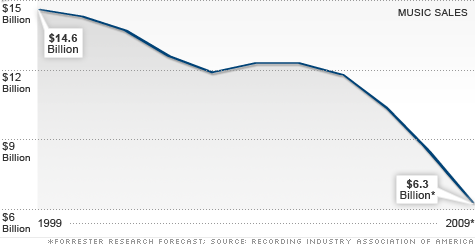
    Apple iTunes is celebrating its 10 billionth song download since it was introduced in 2003. Meanwhile in the music industry, this happened:

    chart_music.top.gif
    It’s interesting that the success of iTunes seems to slightly the buck
    the trend in bundling you see in the rest of our information-hungry,
    and supposedly information-cheap, world. On television, we pay for
    cable, which means we pay for access to a menu of channels, which in
    turn provide access a range of content. In the home movie industry,
    Netflix charges a flat fee for nearly limitless access to shipped or
    streamed movies. On the Web, the world is at our finger tips for the
    price of monthly access fee. In other words, we’re largely living in a
    world where we pay for access — and we pay a lot, as Nick Carr reminds — rather than content.

    But iTunes isn’t selling access. It’s selling content, song by song. It changed the game by letting
    us buy individual recordings instead of albums, which dovetailed beautifully with the
    rise of playlists, the modern cousin of the mix tape. I wish it a
    hearty congratulations, even as I suspect that the content-over-access
    model might not be long for this world.

    (Photo: Wikimedia Commons)


    Email this Article
    Add to digg
    Add to Reddit
    Add to Twitter
    Add to del.icio.us
    Add to StumbleUpon
    Add to Facebook


  • 3 Lessons from the Health Care Summit

    The health care summit is over. Health care reform is not. President Obama pushed and prodded and repartee’d with Republicans over cost control and insurance expansion but at the end of the day, the summit produced nothing except a reminder that health care reform is still onerous and a long shot.

    I expected my reaction to the health care summit to be more complicated. It’s not. I have three things to say, and they’re all pretty straightforward. Nobody won. Bipartisanship died again. And the ball is still with the House.

    1) Bipartisanship Fail. This whole game just reminds me how
    misguided and damaging the bipartisan Baucus strategy was last year.
    Democrats want to raise taxes to pay for health care expansion.
    Republicans don’t want to raise taxes, period. That’s it. Then end.
    There is no more debate to have.

    It’s informative to
    learn that there is small-ball overlap
    between the parties’ health
    reform ideas, but they’re beside the point. It’s like a car salesman
    trying to sell a stretch Hummer to somebody who wants a sedan, and
    saying, “But this stretch Hummer has seats, and radio, and carpeted
    floors, and power windows; it’s just like that sedan you want!” It does have all those things. And it’s still a stretch Hummer. Democrats wasted months selling this plan to a non-buyer.

    2) Nobody won. Yesterday I compared the summit to a musical
    theater revival where everybody knows the songs and the dance numbers,
    but we’re watching for transcendent performances. The summit was a good
    reminder that there are no transcending performances in health care
    reform. It’s too damn complicated and ponderous to make a splash, like
    hitting a home run off a knuckle ball. Next week, this summit will sink
    back into the sea of health care reform events and we’ll be back at square one, with the rotten poll numbers and the Democratic supplications.

    3) Ball’s in Your Court, House. House Democrats know what the
    polls look like, and they’ll bite the bullet if party leadership makes
    the case that this vote isn’t poll numbers today, but rather about
    building a narrative of accomplishment rather than settling with a
    story of party failure in November. That said, I think Megan’s making a lot of sense here.

    (Photo: Pete Souza/White House)


    Email this Article
    Add to digg
    Add to Reddit
    Add to Twitter
    Add to del.icio.us
    Add to StumbleUpon
    Add to Facebook


  • How the Other Half Lives: No Federal Taxes

    110 smiley face Lel4nd.jpgOne of the most commonly cited statistics about our tax system is that about 50 percent of American tax filers actually pay no federal income taxes. Is that fair?

    Roberton Williams (whom I recently interviewed here and here) has a great response:

    The explanation is simple: the income tax serves two masters. On one
    hand, it raises nearly half of all federal revenues. On the other, it
    delivers a broad array of social benefits in the form of exemptions,
    deductions, and credits that reward people for government-favored
    behavior. If we look only at raising revenue, about three-fourths of
    people pay taxes. It’s that social welfare function that knocks so many
    people off the tax rolls.

    Over the past two decades, Congress
    has repeatedly used the income tax to encourage or subsidize specific
    activities.
    We subsidize kids with the child credit, college attendance
    with multiple higher education credits, retirement with all sorts of
    tax-favored savings plans, work with the earned income credit, and
    child care with, you guessed it, the childcare credit. And we’ve
    retained most itemized deductions that subsidize homeownership, state
    and local governments, and charitable giving.

    Those subsidies and incentives came out to $950 billion of tax “expenditures” in 2007. It’s an enormous figure.

    But as Williams explained to me, this particular talking point is a
    political creation. Electeds, especially moderate and conservative
    pols, are reluctant to announce spending programs because it makes them
    look like Big Government Bogeymen. So they execute spending programs
    through the tax system (because hey, “it’s not welfare spending, it’s a
    child tax credit!”). As regular as the tide, tax policy hawks
    intermittently fret that up to 50 percent of taxpayers pay no net
    federal income taxes and that this is lamentable. But surely we can see
    that the reason they’re paying no taxes is that our aversion to new
    spending programs has forced all sorts of actual spending programs to
    go through the tax system.

    This infamous 40-50 percent still pays taxes: local, state, payroll and
    so on. But I’m sympathetic to the argument that we have a civic
    imbalance where up to 50 percent of the electorate is voting on federal
    that they won’t actually pay for, since local and state taxes stay
    local and in-state and payroll taxes go to specific programs like
    Social Security and Medicare. If tax reformers want to correct this
    imbalance, I think a broad-based consumption tax or VAT would be a
    reasonable solution, not to mention a generally smart way to raise
    federal revenue.

    (Photo: Flickr/Lel4nd)


    Email this Article
    Add to digg
    Add to Reddit
    Add to Twitter
    Add to del.icio.us
    Add to StumbleUpon
    Add to Facebook


  • What Real Tax Reform Looks Like

    110 tax Mat Honan.jpgThere is nothing simple about tax reform. Our current system is a smorgasbord of rate brackets and credits and deductions designed to promote growth, but also benefit special interests and preserve favored incentives. The new tax reform plan from two senators — Democrat Ron Wyden and Republican Judd Gregg — aims to strip the clutter. It could make filing taxes as simple as reviewing a one-pager from the IRS. It would reduce the number of tax brackets from six to three (at 15 percent, 25 percent and 35 percent); eliminate the dreaded Alternative Minimum Tax; triple the standard deduction while killing dozens of exemptions; and significantly reform corporate taxes.

    But is it a good idea? I spoke with Roberton Williams, a senior fellow at the Tax Policy Center. Yesterday I published the first part of our chat, about how the dramatically simplified tax system could make filing taxes so easy it could threaten the existence of tax preparers like H&R Block. Today we continue the conversation about the nuts and bolts of a bold new vision for our tax structure:

    What’s the single most significant change you see in this plan?

    The biggest change is on the individual side, the general
    simplification that makes the income tax more understandable. If you go
    back to 1986 the last time we did a major tax reform, we had 15 tax
    rates and we went down to 3. It brought the rates down a lot, and got
    rid of a lot of exemptions for special interests. Lower rates, fewer
    rates, broader base.

    Over the intervening decades, Congress has added in a lot of special
    provisions to complicate the tax code: the child tax credit, credit for
    going to school, for saving for retirement. This is mostly because
    Congress is doing social programs through the tax program rather than
    through the spending side. The Tea Party would be all over you for a
    new spending program, but it would love you if you announce a new tax
    cut. So take the child tax credit. The government sends you a thousand
    dollars for each kid you’ve got. We’ve run it through the tax system so
    it looks like a tax cut instead of welfare. But it’s the exact same
    thing. To be clear, these are good things to do sometimes! But it’s
    made the tax system complicated and people don’t understand what’s
    going on.

    We know this reform would make our taxes simpler. But how would it actually change what we pay?

    One big way it could reduce your tax burden is with a large increase in the standard deduction:
    it will be $15,000 for individuals, whereas now it’s around $5000 for singles. That does two things. It reduces taxable
    income, so it cuts down your tax bill. And it pushes people away from itemized deductions.

    My
    guess is that it would cut taxes at the bottom. They would maintain all
    the tax credits, child, earned income tax credit, child dependent care.
    People at the top: their top rate stays at 35 percent rather than
    rising as it would under Obama’s plan. But the bottom 10 percent
    bracket is eliminated, so they still have the bottom of their income
    taxed at 15 percent. It does look like people
    at the bottom are better off, but people in the top might be slightly worse
    off.

    So this cuts down on itemized deductions. How does that make the system simpler?

    It removes complicated deductions. For example, one really big one they
    have is getting rid of the deduction for state and local taxes.

    How does that deduction work?

    Currently, if I pay $1,000 in state taxes and I’m in the 15 percent
    federal tax bracket, I can deduct the $1,000 and save $150 of income
    tax. Effectively I pay the state $850 and the federal government kicks
    in $150 through my tax savings. We could have the same outcome if my
    state tax were only $850, I wasn’t allowed to deduct that on my federal
    tax return, and the federal government sent the state $150. That’s what
    they’re trying to make happen.

    The underlying assumption is that I’m willing to pay $850 for state
    services but not $1,000. Without the federal tax savings, I’d be an
    unhappy taxpayer. But with the deduction, the state can get more
    revenue–$1,000–and I’m happy paying only $850 (net of tax savings).
    The tax deduction is an indirect form of revenue sharing from the feds
    to the states. The proposal would remove the deduction from the income
    tax and make the revenue sharing direct.

    What kind of deductions and exemptions does the plan keep?

    They’re keeping the mortgage interest deduction and the charitable gift
    deduction. This is understandable, given the complaints the
    administration got last year when it tried to cap charitable
    deductions. The two big groups that complained then were the charitable
    groups and the real estate industry. They said don’t do this, and
    Congress received the idea with cacophonous boos. [Editor: Full list of
    deductions in the Wyden-Gregg plan here.]

    Does the bill move the tax burden to the consumption side?

    There is nothing that I see in the bill to do that. There might be
    something that I’m not seeing. It does make sense to move to a VAT.
    We’re the only industrialized country in the world that doesn’t have a
    VAT. You look at our fiscal situation, and there’s no easy way to cut
    spending. So we need revenue. A VAT can be low-rate so it doesn’t
    effect behavior much, and broad-based so it collects a lot of money.
    The complaint is regressivity. The poor spend every cent they’ve got.
    But you can make up for that with a tax credit at the bottom end.

    Will this plan be revenue neutral? Will it raise or lose money for the government?

    We haven’t done a revenue estimate. The Congressional Research Service
    did something for them — but it’s loaded with caveats. It basically
    says as a package this would make money relative to current tax law. It
    would not make as much as the president’s proposal, which raises taxes
    on the wealthy next year.

    From the looks of things, the plan mostly cuts taxes for individuals. So where’s the money coming from?

    They’re closing loopholes on the corporate tax side: things like not
    allowing firms to hold income overseas without paying taxes on it and
    then bring it back home, which is called repatriation. This proposes to
    tax that money immediately.That that would bring in more revenue. By
    bringing more money home you’d have more investment here and less
    overseas. Now it makes sense for say Exxon to invest in projects in the
    Middle East that have a lower rate of return than here in the US
    because they’re deferring their tax liability. Bring those dollars home
    and invest in higher return enterprises at home.

    Second, it taxes a lot of income not now taxed. There are two big ones
    here. It ends the exclusion for Social Security benefits. It would also
    include taxes on municipal bonds. This is a big source of wealth for
    rich people.

    One thing the tax plan does is it cuts the value of inflation from a
    corporation’s interest deduction. That’s sound complicated! Walk me
    through that.

    There are two ways to finance investment. You can sell stock or borrow
    money. To sell stock you have a return. These are non-deductible
    dividends. But right now firms can deduct the interest they pay on
    money they borrowed. It’s cheaper to borrow money than to sell equity,
    so corporations do too much borrowing. This law is trying to balance
    the incentives here and attract direct investment.

    (Flickr/Mat Honan)


    Email this Article
    Add to digg
    Add to Reddit
    Add to Twitter
    Add to del.icio.us
    Add to StumbleUpon
    Add to Facebook


  • Will the New Tax Reform Bill Kill H&R Block?

    Sens. Ron Wyden and Judd Gregg introduced what could be the most significant piece of tax reform in 25 years: the Bipartisan Tax Fairness and Simplification Act of 2010. It dramatically streamlines the tax system, eliminates key deductions, and — crucially for taxpayers — invites the IRS to prepare easy-to-understand tax returns for payers to read and sign.

    I spoke with Roberton Williams, a senior fellow with the Tax Policy Center about the bill. He likes it, a lot. His first reason for liking it a lot is that it makes tax returns so easy that most taxpayers will be able to request the IRS to send them a one-page form to review and sign rather than go through tax preparer services.

    But what does that mean for the H&R Blocks of the world? Williams explains:

    What do you like most about this bill?

    The whole idea of simplifying the tax system makes a lot of sense. A
    lot of people don’t understand how the tax system works. They’re
    worried about other people finding benefits they’re not finding. If you
    can simplify it, you can get away from those problems.

    The IRS knows everything they need to know for most tax papers. They
    know your income from the W-2 and 1099. They know your mortgage
    interest. Presumably they know the charitable organizations that you
    give money to, because those organizations could report the amounts. If
    you put money into a 401k or IRA, a bank can report that. That’ s most
    of what you need. The information comes to the IRS. Most of us do have
    straightforward tax returns. The IRS can do that. That would take a big
    load off of people. As simple as it is, people should be able to look
    at a simple tax form and say: “Yep, that’s what I earned. That’s what I
    give to charities.” It takes a lot of pressure off people.

    There’s a reason why almost 80 percent of us have other people do our
    taxes. We don’t want to be hassled. It’s easier to let the software do
    they job. I do TurboTax tax And I wonder why the numbers are what they
    are. And I’m a tax expert!

    Does this mean the end for companies like H&R Block? Some
    companies make a living by wading through tax return language. If the
    system is straightforward, we won’t need it interpreted.

    It would not be good for the standpoint of the H&R Block’s of the
    world. It would reduce the demand for their services. I think about 60
    percent of tax returns are done by services like H&R or Liberty.
    It’s a huge faction, because people know there are hidden extra
    benefits and they want to get them.

    But one of the things the IRS has found with preparers is that often
    they don’t follow the letter of the law. There was a study I think in
    Alabama where they went to a number of preparers with a fake tax case
    that legally couldn’t qualify for the earned income tax credit. But
    this particular tax preparer’s thing was to tell people, “We’ll get you
    the EITC.” And guess what? In only one case did the tax preparers say,
    “You don’t qualify for this credit.” You pay people a couple hundred
    bucks for a tax return, you want a real return. You want a credit. If you don’t get it, there goes the business model.

    Obviously H&R Block and companies like it won’t go down without a fight. Will they lobby against this? What can they say?

    That they employ thousands of people doing something that is no longer
    necessary? I don’t know. From a political perspective, you say, “We’ve
    got to do it because you can’t trust big government.” That’s it. That’s
    all you can say. That’s the only argument i can see.

    {A fuller transcript of our interview, which breaks down the basics
    and not-so-basics of the new major tax reform legislation is
    forthcoming…}


    Email this Article
    Add to digg
    Add to Reddit
    Add to Twitter
    Add to del.icio.us
    Add to StumbleUpon
    Add to Facebook


  • Why the Two Parties Just Don’t Agree on Health Care

    The bipartisan summit is going on right now. You can watch it in a little picture box I’ve embedded after the jump. The president said he wants “for everybody to focus on not just where we differ but focus on where we agree, because there actually is significant agreement on a host of issues.

    The points of agreement between Republicans and Democrats do not really matter. Look at it this way: Democrats want to massively extend health care by providing hundreds of billions of dollars of subsidies to low-income Americans over the next ten years, and that will require recouping money with new taxes and Medicare cuts. That’s where they’re coming from. Republicans say they want a whole new bill that somehow reduces health care costs. Also they’d like to cut taxes. That’s where they’re coming from. It’s a completely different approach to health care reform, and taxes, and government.

    So yes, both sides think that insurers should enter into interstate compacts, and other items. That’s wonderful, but it doesn’t matter. It’s like saying Keynesians and Hayekians agree that unemployment insurance is important. That’s nice if they do, but it doesn’t come close to resolving any larger debate.

    Also I wanted to give a shout out to this point by Ezra Klein, because he’s making a bunch of sense about what happens after health care day camp is over:

    There’s no political upside in starting over. The right will still
    cry “death panels!” and let loose the dogs of tea, and the left will
    savage them for failing to pass health-care reform despite controlling
    the second-largest congressional majority since the 70s. There’s a
    policy argument here in that a fallback plan will cover more people
    than no plan will cover, but if covering people is what the Democrats
    want to do, they’ll pass the comprehensive plan, which both covers more
    people and actually gives them a major accomplishment.

    At this point, health-care reform either passes or it dies.
    Democrats are all in on this one. They know it, Republicans know it,
    and maybe more importantly, they know the Republicans know it. Letting
    health-care reform fail is indistinguishable from conceding the 2010
    election. There’s no real fallback plan. If Democrats fall back, they
    fall.

    Here’s the video:


    Email this Article
    Add to digg
    Add to Reddit
    Add to Twitter
    Add to del.icio.us
    Add to StumbleUpon
    Add to Facebook


  • Bipartisan Health Care Summit: All Eyes on the GOP

    It’s showtime! At 10:00AM this morning, President Obama and his administration will kick off a bipartisan health care summit to persuade Americans that Republicans have insufficient ideas on health care reform, and to convince Democrats to vote on a bill.

    Marc Ambinder’s analysis sounds spot on. His major points are: (1) Democrats are trying to set a trap for Republicans; (2) Republicans know they’re walking into a trap; (3) So expect a lot of off-topic platitudes about the role of government generally, because let’s face it, statements like “Well yeah the CBO expects premiums to rise over the baseline of health inflation projections, but the administration proposes to offset these increases with generously scaled subsidies for low-income Americans” is not destined to be the leading sound bite on O’Reilly tonight.

    Here’s one thing I wanted to respond to. Marc writes:

    It is hard to figure out why Republicans, whose plan largely
    addressed those with insurance, failed to address the need to expand
    coverage — as least politically — even though they know that it is the
    conflict between the policies one pursues to expand coverage that clash
    with the policies pursued to make sure people get to keep their
    insurance don’t pay more.

    I can think of a couple reasons why Republicans’ plans don’t expand insurance:

    1) They’re Republicans.
    If Republicans wanted to expand the size of government to subsidize 50
    million additional Americans’ insurance by 2020, we wouldn’t call them
    Republicans. We would call them “liberal Democrats.” Since the beginning of the health care reform debate, analysts have
    regularly assumed that appropriately generous subsidies to help all
    low-income individuals have health insurance would come to about $1
    trillion. That $1 trillion has to come from somewhere. Democrats have
    suggested surtaxes, excise taxes, payroll taxes, and Medicare cuts.
    Republicans have countered with no cuts … except to taxes! It’s impossible to
    pay for extending government subsidies by cutting revenue.

    How would you expand coverage to the poor without significant government subsidies? I don’t know that it’s possible, but I suppose you’d propose significantly reform the system along the lines of the old McCain plan: begin to end the employer tax subsidy, give families tax credits, “restructure” the insurance market somehow and slip in a federal mandate to guarantee more people are insured. The problem with this plan is that…

    2) Reforming the Health Care Industry is a Nightmare
    The Mickey Kaus Theory of Health Care Debacle-ism
    is that the White House blindly followed its OMB director’s advice to make
    health care reform about fiscal reform. The problem is — as Marc
    alludes to above, and Mickey has pointed out relentlessly — fiscal
    reform is tough and mostly unpopular. The administration says, “Let’s bend the
    curve,” and Americans respond,
    “Sounds like a plan!” Then the administration finishes its sentence
    “…with an excise tax and Medicare panels” and Americans finish their
    sentence with “…that we hate!”

    Close to ninety percent of voters in 2008 had health insurance, and they like their health insurance, making them jittery about change. So it’s not politically crazy for Republicans to counter-propose with minor reforms that “largely
    addressed those with insurance.”

    This health care debate has revealed a fascinating schism in the
    electorate. Americans want to extend coverage to the uninsured,
    hypothetically. But they don’t want to pay for it. Not with higher
    taxes, not with Medicare cuts, not with disruptive changes to the
    health care system. That’s what Republicans understand, and fortunately
    for them, it fits snuggly into their party narrative of opposing
    everything Obama does. The tragedy is that many honest analysts — on
    both sides of the spectrum — would agree that removing the employer
    insurance tax benefits, and beginning to fit a belt around Medicare,
    and beginning to disrupt our byzantine and bloated health care system
    with various fiscal and delivery system reforms are utterly necessary.
    So we’re stuck with a plan that does the hypothetically popular thing
    well, and the utterly necessary thing not so well. There’s as word for
    that, I suppose, and it sounds a lot like politics.


    Email this Article
    Add to digg
    Add to Reddit
    Add to Twitter
    Add to del.icio.us
    Add to StumbleUpon
    Add to Facebook