Author: Derek Thompson

  • Jobs Bill Headed to Obama’s Desk. But Will it Work?

    The Senate’s $18 billion jobs bill is headed to the president’s desk after 68 senators voted this morning to cut payroll taxes on new hires and extend highway and transit programs through 2010. The bill is offset under PAYGO rules by giving the IRS new powers to crack down on offshore tax abuses and by delaying an obscure tax credit.

    The heart of the bill is a tax break for new hires first proposed by Sens. Chuck Schumer and Orrin Hatch. Here’s how the credit works. Employers pay no payroll taxes for each worker hired in 2010 after February. The maximum value of this tax credit is equal to the payroll wage cap, or 6.2% of $106,800. If the employee is still around after a year, the employer gets an extra $1,000. “The beauty of this bill: It’s simple, it’s focused on private-sector job growth and it’s paid-for,” Sen. Schumer said. “It’s modest, but … it’s almost
    a legislative dream.”

    Oh, it’s modest alright. As I’ve written, by the CBO’s count, $15 billion could create the equivalent of 120,000
    and 270,000 full-time jobs for one year. That’s not chump change. But
    the country would need 200,000 new jobs created each month for the next seven years
    to hit 5 percent unemployment by 2017.

    The real job stimulus to watch out for is the $150 billion Senate bill that would, among other things, extend unemployment insurance and COBRA coverage. There is a fierce debate about how to create jobs through government spending. There is even a debate about whether that last sentence is tautologically impossible, since deficit spending allegedly distorts capital investment, encourages people to remain unemployed and dampens demand by raising the expectation of future taxes. In any case, I’m on the stimulus-now/deficit-reduction-later side of things, so I’ll be keeping my eye on whether this jobs bill is the snowflake that starts another jobs-bill avalanche, or whether future stimulus efforts don’t stand a snowball’s chance in hell.


    Email this Article
    Add to digg
    Add to Reddit
    Add to Twitter
    Add to del.icio.us
    Add to StumbleUpon
    Add to Facebook


  • Who’s Afraid of the Inflation Temptation?

    There is not much about the US economy today that gives off the whiff of inflation. Unemployment is near 10 percent, and consumer confidence is at a year-low. Banks are holding enormous excess reserves, which holds down the money supply. The Federal Reserve has injected more than a trillion dollars into the economy, but core inflation still declined in January. Producers prices are down today. All evidence suggests that inflation fears are a dream.

    And yet…

    The US government is projected to run a $1.6 trillion deficit in 2010 — the largest nominal deficit in history. Even as the deficit number falls in the next few years, US borrowing to pay the difference between revenues and outlays plus interest will grow to $2 trillion by 2012. As the debt burden grows — the CBO projects that Obama’s budget could add $10 trillion to the debt in 10 years — the feds’ options fall into three buckets. The government can raise taxes, but that will be politically poisonous. The government can cut spending, but that could strangle a weak recovery. Or the Federal Reserve can let inflation seep into the economy, which could erode the value of our debt without the government so much as cutting or raising a single tax dollar.*

    We’ve tried this dirty magic before. As Michael Kinsley recounted in The Atlantic this month:

    In 1979, for example, the government ran a deficit of more than $40
    billion–about $118 billion in today’s money. The national debt stood
    at about $830 billion at year’s end. But because of 13.3 percent
    inflation, that $830 billion was worth what only $732 billion would
    have been worth at the beginning of the year. In effect, the government
    ran up $40 billion in new debts but inflated away almost $100 billion
    and ended up with a national debt smaller in real terms than what it
    started with.

    Perfect? Painless? Plausible? Possibly. But there are dangers. First, inflation doesn’t just chew up the debt. It also swallows the value of non-inflation-indexed savings. For savings tied to inflation, like Social Security, inflation would in nominal terms cost tax payers more money down the line.

    Second, inflation at a level high enough to quickly reduce fiscal deficits could spiral out of control back home. If you’re setting prices in an economy where future prices are expected to rise, your temptation is to set prices higher. In this way, inflationary expectations can outrun the Fed’s target.

    Third, there’s a decent chance that inflation won’t actually reduce our deficit in the first place. If inflation begins to creep up, investors will demand higher interest rates on US debt to beat expected inflation in the future. As Anne Vorce, director for the Fiscal Roadmap Project of the Committee for a Responsible Federal Budget at the New America Foundation, told me this morning, “Our creditors would go nuts. The Chinese premier specifically said he was concerned about inflation in our debt. Inflation is tempting in the short run. In the middle or long it has costs.”

    Vorce says we have every reason to expect that that the Federal Reserve will avoid the inflation temptation. “In the end, there will be recognition that it will be counter-productive.”
    ____
    *Here’s a good explanation of one theory suggesting that inflating away the debt flat-out does not work:

    The fundamental obstacle to
    governments eroding their debt through inflation is the duration of the
    government debt portfolio. If all outstanding debt had ten years before
    it matured, then governments could inflate their way out of the debt
    burden. Inflation would ravage bond holders, and governments (with no
    need to roll over existing debt for a decade) could create inflation
    with impunity, secure in the knowledge that existing bond holders could
    do nothing to punish them.
    In the real world, of course,
    governments roll over their debt on a very frequent basis. As a result,
    governments are vulnerable to higher debt service costs if market
    interest rates change. If markets move to price in the consequence of
    higher inflation by raising nominal interest rates, then the debt
    service cost will rise and increase the debt. Thus a period of high
    inflation will tend to raise both the numerator and the denominator of
    the debt:GDP ratio.


    Email this Article
    Add to digg
    Add to Reddit
    Add to Twitter
    Add to del.icio.us
    Add to StumbleUpon
    Add to Facebook


  • And You Thought Our Mancession Was Bad…

    Remember the mancession? People started to see it more than a year ago, when male unemployment was racing past 10 percent months before the official rate hit double digits. The difference between male and female unemployment hit an all-time high in 2009. The reasons were fairly straightforward. The overall decline in manufacturing gave men a running start. The housing bubble both created and later destroyed jobs in the residential construction industry, where nine out of ten workers are men. Combined, manufacturing and construction have lost more than 2.5 million
    jobs in the recession.

    But take heart, men of America. You are not alone. Economix blogger Catherine Rampell spots a graph showing that America’s mancession is actually pretty average among developed countries:
    .

    DESCRIPTION

    Denmark’s story is pretty extraordinary. For every 100 newly unemployed women, 182 men lost their jobs in the first year and a half of the recession. Outlier alert: South Korea was the only OECD country where female unemployment grew faster.

    For more on the mancession, read Dan Indiviglio’s great piece on the Fed predicting a rough road ahead for men. I have my own thoughts on the possible she-covery here. In short, the Council of Economic Advisers predicts that of the top five fastest growing job industries, three are within the health care and education sectors, where women are disproportionately employed.


    Email this Article
    Add to digg
    Add to Reddit
    Add to Twitter
    Add to del.icio.us
    Add to StumbleUpon
    Add to Facebook


  • Do Americans Know Anything About the Budget?

    Americans: smarter than you thought?

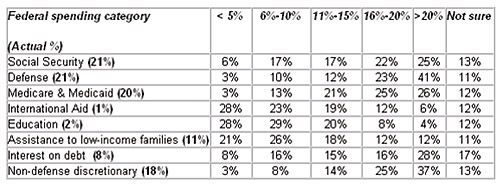
    That’s the conclusion from this Zogby poll that asked respondents to guesstimate the percentage of big components of the budget, like Social Security, Defense and foreign aid. Here’s the graph, from Reason:

    Even one penny on every dollar is too much to spend on international aid.

    What do we learn here? A couple things:

    1) Americans are famous for overestimating our international aid. One study found that the average American estimates that a quarter of the budget — more than Social Security, or Defense — goes to aid abroad. This is why, when asked about cutting the deficit, an outsized number always suggests that we should immediately start slashing foreign aid to save money. Of course, this would be a bit like wiping your brow with a kerchief to fight a fever. Aid is less than one percent of our total budget, but three-fourths of Americans in the Zogby poll think it’s at least six times higher.

    2) Non-defense discretionary spending is a really confusing phrase that sounds like it should be a lot, but it isn’t. This is because Defense and entitlements alone take up almost 2/3rds of the budget. Reason writer Tim Cavanaugh says “it’s not surprising that gimmicks like the
    spending
    freeze
    haven’t moved many hearts,” but I don’t know that he’s right. Almost 40% of Americans think non-defense discretionary spending is more than 20 percent. Do they mean something closer to 21% or 51%? I can’t know for sure, but the small number of respondents that put our discretionary figure at  “11%-15%” suggests most of think that number is much higher than 15%.

    3) We’re pretty good on Medicare & Medicaid and assistance to low-income families.

    4) We still think the budget can hold everything. Zogby concludes that most adults “come close” on components of the budget. I slightly disagree. A plurality of respondents said Americans spend more than 20 percent of the budget of Social Security, and Defense, and Medicare & Medicaid, and Debt Interest, and Non-defense discretionary spending. We also overestimated on international aid and the education. In fact, the only thing Americans arguably did not overestimate was assistance to low-income families.

    This chart is closer to reasonable than I might have expected. But it still shows that Americans think about items in the budget the way children think about clowns in a clown car, or my mom thinks about winter coats in our hallway closet: there’s hardly a limit to how much we can fit in there!

    Update: Bruce Bartlett emails an good observation. The Zogby percentage options stop at >20%, but “had higher options been available I think some of the more sensible results would have turned out to be crazy.” Given that a plurality of respondents were high-balling many of these budget components already, I’d agree.


    Email this Article
    Add to digg
    Add to Reddit
    Add to Twitter
    Add to del.icio.us
    Add to StumbleUpon
    Add to Facebook


  • The Conservative Vision and ‘Middle 60’ America

    As readers of this blog know, I’ve really enjoyed wrestling with the conservative opus that is Rep. Paul Ryan’s roadmap. I’ve also the enjoyed the back and forth over Ryan’s plan between two writers I greatly admire: the New York Times’ conservative columnist Ross Douthat and the The New Republic’s Jon Chait.

    To sum up their positions quickly, Douthat acknowledges that taxes might inch up for the middle class and plummet for the rich. Chait goes further, writing that “the overwhelming thrust in every way is to liberate the lucky and
    successful to enjoy their good fortune without burdening them with any
    responsibility for the welfare of their fellow citizens.” Douthat counters that Ryan’s plan would actually our entitlement program more redistributionalist by eliminating the employer insurance tax subsidy (which benefits richer employees) and means-testing Medicare payments.

    I think this Douthat-Chait debate gets to the heart of why I’m grateful as a blogger that this plan exists, and also fairly confident that it is a completely unworkable policy. Politicians are infamous for their caution. This plan swings away. Whereas all Republicans balk at new taxes, Ryan proposes a value-added tax beginning at a pretty rigorous 8.5%. Whereas bold tax reform plans like Wyden-Gregg tinker with deductions and exemptions, Ryan takes a sledgehammer to tax expenditures. Whereas most politicians (especially Democrats) are nervous to touch Medicare even as they anticipate its growing burden on the budget, Ryan institutes means-testing and strict budgets. Even if I don’t agree with all of this, I admire its boldness.

    But I’m also with Chait when he calls the Ryan proposal a “highly clarifying document” of conservative philosophy. If the conservative ethos is Tax Cuts, Now and Forever, Ryan delivers in spades. He cuts taxes for the richest one percent in half. By eliminating the tax on capital gains and dividends, he shrinks the effective federal tax on the top 0.1% — who take in about 8% of national income — to half the ETR of the bottom quintile. Yes, the tax code is largely flattened. But it also races away from progressivity in the top five percentiles. Meanwhile Ryan’s value added tax raises the ETR on the middle 60 percent; he reduces the child tax credit; and he begins to shrink the entitlement program that is a keystone of middle class security.

    So when Douthat writes that Ryan’s progressive indexing for Medicare and Social Security means “the poor and middle-class get more; the rich get less,” it’s important to note that this is redistribution in a limited and technical and politically unconvincing way. From the perspective of the middle 60
    percent, their federal tax burden will go up and their federal services will go down. That might qualify as definitional redistribution. Something like it might even be necessarily. But don’t expect voters in that middle-60 to believe they’re “getting more.”


    Email this Article
    Add to digg
    Add to Reddit
    Add to Twitter
    Add to del.icio.us
    Add to StumbleUpon
    Add to Facebook


  • Moody’s: US Debt Not in Danger of Losing Triple-A Rating. Yet.

    The United States’ debt is not in imminent danger of losing its high triple-A rating. But in a Moody’s report on Monday, analysts said the our margin for error has “substantially diminished.” In other words … what exactly? Are are standing at the edge of a precipice overlooking calamity, or is Moody’s just putting its hands on its hips and shaking its head like a worldly mom tsking her son on the playground?

    I wanted to know. So I phoned Brookings’ debt expert Douglas Elliott to ask three simple questions:

    1) Does this report matter at all, or does it tell what we already know, which is that the debt is still tomorrow’s emergency?
    Any time that you have a rating agency say that the US government might not be triple-A rated, it’s of some importance. But I really don’t see our rating moving any time soon. I guess you could say it’s still tomorrow’s problem.

    2) From a Fortune write-up, I read:
    “In the case of the United States, interest payments on general government debt — combining the federal government with the states — could rise above 10% of revenue by 2013, according to the report.” Why does Moody’s draw the line at 10%?

    There’s no bright line. But we have seen that with countries who get to that kind of level, they get into trouble … the debt feeds on itself. The big reason is you have to pay significant interest and that gets worse if people get worried about your ability to pay higher rates, and that pushes interest rates up even higher.

    3) Moody said it would only downgrade a triple-A government’s debt if it “concluded that the government was unable and/or unwilling to quickly reverse the deterioration it has incurred.”
    But wait. Has anything the US government has done in the last year convinced you that it is able an willing to quickly reverse its fiscal deterioration?

    So far it’s just talk. I believe the talk, but there’s been little action.There’s a great line from Winston Churchill, that America always does the right thing after trying everything else. We had a debt problem twenty years ago and we significantly decreased the budget deficit under Clinton. Eventually, we are going to be able to do what we have to do.


    Email this Article
    Add to digg
    Add to Reddit
    Add to Twitter
    Add to del.icio.us
    Add to StumbleUpon
    Add to Facebook


  • 7 Ideas That Could Save Online Journalism

    Here’s something you already knew: journalism is facing an advertising crisis. The reasons are simple. Web readers are disparate and distracted, screen sizes are small, and too few companies believe that pixelated display ads are worth print-paper rates.

    But what you might not have guessed is there is a way out of the ad-pocalypse. Like all challenges, it begins with a good old fashioned brainstorm. From the State of the Media report today, here are 7 ideas that could save online journalism. I hope.

    1) Micropayments: Think iTunes. Readers pay for content a la carte, like with songs from Apple’s music store. Except instead of songs, it’s articles. Do I think this could work? Not by itself. Today’s news is perishable. It has a half-life of something like three hours. Music isn’t perishable. We’re still listening to Miles Davis. We’re not still reading old copies of Life, or last month’s news about health care reform’s final gasps.

    2) Microaccounting: Think Hulu, with payments. Microaccounting brings publishers together to create a network. Readers get billed every month for
    reading X number of articles across various networks. Presumably this conceals the cost of reading and
    makes users more likely to pay because they’re only confronting costs
    once a month or so rather than confronting a price for each new revelation about the state of health care reform. This is close to the “Hulu for Magazines” that Journalism Online is trying to build. Essentially it’s a clean way to introduce bundled payments to online journalism.

    3) Freemium Plans: Think WSJ.com. Commodity, front-page news is free. Premium in-depth analysis requires some money. This allows newspapers to acknowledge that their product includes both commodity goods and unique analysis that you will miss if you don’t pony up the dough. This is basically the model I suggested for the NYT in my article “A Five-Point Plan to Save the New York Times.”

    4) Targeted Ads: Think Facebook, for news. Readers
    share demographic information about themselves with a Website in exchange for a free
    reading experience, and content providers charge advertisers higher
    rates for the audience information. Fears include piracy and identity
    theft. General reservations include the fact that Facebook, despite
    obscene page view numbers that swamp Google and Yahoo combined,
    actually pulls in only about 1/15th of Google’s ad revenue. Targeted ads are still the Dippin’ Dots of online revenue: still the model of the future rather than the industry leader of today.

    5) Circulate Bar: Think Hulu, plus Facebook. You enter
    your demographic information into one gateway page for the rights to
    view multiple Websites free of cost. So Conde Nast could create a standard welcoming page to ask readers to share demographic information in exchange for a free reading experience. Then Conde sells that aggregated information to its advertisers, who pay premium for display and video ads. I suppose smaller magazines companies like The Atlantic and The New Republic could also band together to create a Circulate Bar for our readers and advertisers.

    6) Turn Off Google. Think not-gonna-happen. Not any time soon. Rupert Murdoch likes to make noise, and the last time he was making noise, he was talking about turning off Google (blocking News Corp sites from Google bots) and selling his content exclusively to Microsoft Bing for indexing. Murdoch would lose traffic, but Bing’s deal would presumably get him a better deal. If the future of search engines is content wars, so be it. But Murdoch hasn’t followed up to suggest that he should be taken seriously, and no media publishers have made similar Google threats to suggest they were taking Murdoch seriously.

    7) Make Verizon Pay. Think cable. Last, here’s an idea that sounds impossible at the moment, but has ancestors
    in cable: sharing fees with Internet service providers. Basically
    content providers would band together in groups — maybe like
    Journalism Online — and lobby broadband internet providers like
    Comcast and Verizon. I see no indication that something like this is
    possible in the short term, Pew reports that a company called
    Clickshare believes it can implement a service in which “consumers
    have an account at one service (such as a news, cable or Internet
    service provider site) and can be periodically billed for access to
    information from a plethora of other affiliated content sites.”


    Email this Article
    Add to digg
    Add to Reddit
    Add to Twitter
    Add to del.icio.us
    Add to StumbleUpon
    Add to Facebook


  • How Will Online Journalism Ever Make Money?

    What is the state of online advertising? Not good, according to this Pew report:

    The prospect of an economic model for journalism online made only
    limited progress in 2009, even as the industry’s eagerness to find new
    Internet-based revenue sources intensified. Signs
    that advertising, at least in any familiar form, would ever grow to
    levels sufficient to finance journalism online seemed further in doubt.

    It’s no mystery why online advertisements are having trouble filling the revenue cavity left by diminishing print ads. The average American reader spends 2,000% — yes, 2,000% — more time with a physical newspaper than a newspaper Website. A 60-second impression means zip to advertisers, so they pay zip per impression. What’s more, a lot of online readers aren’t regulars to news Websites the same way print advertisers can count on a week-to-week subscriber base, because search engines direct 35-40% of news traffic. For advertisers, the online market is distracted and disparate: not a good combination.

    Journalism publishers keep waiting to for somebody to “figure out the business model” online, but in the meantime the current business model is eating our lunch. Besides search advertising, which is a multibillion dollar industry that practically accounts for all of Google’s revenue, ad success stories are hard to find online. Display ads are ubiquitous, but cheap. Classified ads got swallowed by Craigslist. Rich media ads are still young and undeveloped. Here’s a pretty graph to distract you from/explain all the ugliness:


    Online ad spending by format, 2009 in millions of dollars:

    What’s the alternative to watching your product bleed online? Well, if the ads servicing your page won’t pay, you better hope the readers clicking to your page will. Rupert Murdoch’s Wall Street Journal already charges $79 for yearly Web access, and was the “the only newspaper to turn a profit in 2009,” according to Pew. But charging for premium access turns out to be just the tip of the iceberg. There are other exciting ideas for not letting the Admageddon get journalism down. More on those ideas in my next post.


    Email this Article
    Add to digg
    Add to Reddit
    Add to Twitter
    Add to del.icio.us
    Add to StumbleUpon
    Add to Facebook


  • Closing Arguments For and Against Health Care Reform

    Health care reform is heading into what could be its do-or-die week. Democrats expect a vote by this weekend. Republicans are digging in. And op-ed writers are making their closing arguments.

    Here’s the Washington Post’s Robert Samuelson taking on costs. Samuelson and I agree on the basics of reform: you can’t bring down costs dramatically unless you change the fundamentals of our health providers and move away from a fee-for-service system. On every else, we don’t see eye to eye.

    First Samuelson questions the idea that universal health insurance is a worthy goal because universal care won’t bring down emergency room visits. But that’s far from the central justification for universal coverage. Let’s leave aside questions of morality for a second. Health reform would force insurance companies to make their policies richer: no blocking customers with pre-existing conditions, community rating, no more rescinding insurance for health reasons. Richer policies could force up the price of insurance, because superior products are more expensive. But when the government forces tens of millions of younger, healthier Americans to buy health care, this gives insurance a larger pool of “cheaper” customers and brings down the cost. The universal mandate is a tool to bring down average premium prices.

    Second Samuelson claims universal coverage is a fool’s goal because health insurance doesn’t actually make anybody healthier. He picks some controversial studies that support this argument, ignores studies that rebut his argument, and generally concludes that health care might be totally frivolous. But one paragraph later, we get this:

    Though it seems compelling, covering the uninsured is not the
    health-care system’s major problem. The big problem is uncontrolled
    spending, which prices people out of the market
    and burdens government
    budgets.

    Come. On. If Samuelson can spend four paragraphs arguing that insurance isn’t necessary, why is he even worrying that uncontrolled spending prices people out of the market? That is, after all, just a fancy way of saying “makes people uninsured.” And uninsured people are just as healthy as insured people. Because insurance doesn’t matter, right?

    I don’t really know what to do with this. I want Samuelson to mention the delivery system reforms in the bill, if only to prove to me that he’s aware of them. I want him to acknowledge the political challenge of instituting delivery system reforms as impending laws rather than pilot programs, if only to prove to me that he’s thinking about politics and policy together. I want him to acknowledge that if the uninsured are capable of injury or disease, health insurance would help them; alternatively if they are, in fact, super-humanly healthy, then forcing them to buy insurance brings down the cost of insurance for the rest of us humans. Instead Samuelson has his eye trained on the perfect, and he’s making it the enemy of good enough.


    Email this Article
    Add to digg
    Add to Reddit
    Add to Twitter
    Add to del.icio.us
    Add to StumbleUpon
    Add to Facebook


  • Don’t Buy the Myth That People Won’t Pay for News

    A major “State of the News Media” report is out today from the Pew Research Center’s Project for Excellence in Journalism. I’ll be writing up this report throughout the day, but first I wanted to correct a common misconception that is getting new attention from this survey: “nobody will pay for online news.”

    First, it’s strange that Americans think they don’t pay for online news. We do. We pay through our Internet bill. About two-thirds of Americans have Internet at home, and we pay an average of $41 dollars a month according to a February 2010 FCC survey. The reason we pay $500 a year for Internet access from our couch is partly to check email and chat with friends and partly to read all those “free” Websites that “nobody will pay for.” We buy cable and Internet access, as opposed to particular pieces of content like ABC or NYTimes.com, but we’re still paying for news, and want to.

    Second, some Americans do pay for particular pieces of content. The Wall Street Journal website still tries to hide its premium content behind a pay wall (although you can bypass the wall by entering the article headline in your search box). The Financial Times has a metered system that blocks non-paying readers after a handful of online articles. Those newspapers are comparatively thriving in the beleaguered newspaper industry, and the New York Times hopes to follow the paywall brick road to revenue city when it switches to a soft meter in 2011.

    Third, let’s consider the assumption that today’s “free readers” will never pay for news. In January, a Harris poll reached the similarly despondent conclusion that “most won’t pay to read newspapers online.” That sounds damning. But the actual numbers weren’t so bad. As my colleague Dan Indiviglio pointed out, 43% of those surveyed read the newspaper regularly, and 23% said they were willing to pay a fee to continue reading. That means even before the dawning of the Age of the Paywall, more
    than 50% of regular newspaper readers said they would pay
    for online news. As for the other 60% of respondents: who cares? They’re hardly reading newspapers online anyway. Media publishers wringing their hands over their reluctance to contribute to a paywall is like a politicians despairing that unregistered voters don’t like them.

    I’ll dig deeper into this report later today, but I wanted my opening salvo to get out fresh and early. You can’t say Americans will never pay for news when they’re already paying $500 a year for the freedom to access it. You can’t say paywalls will never work when some of them already are working. And you can’t base major business decisions on hypothetical polling information that you’re possibly misinterpreting, anyway.


    Email this Article
    Add to digg
    Add to Reddit
    Add to Twitter
    Add to del.icio.us
    Add to StumbleUpon
    Add to Facebook


  • Recessions are Good for Pop Music Lyrics

    The recession is making us sick, and fat, and hungry, and ugly. But what is it doing to our pop music?

    It’s making the lyrics more thoughtful (via Ryan Avent):

    The lyrical content of Billboard No. 1 songs for each year from 1955 to
    2003 was investigated across changes in U.S. social and economic
    conditions. Consistent with the environmental security hypothesis,
    popular song lyrics were predicted to have more meaningful themes and
    content when social and economic conditions were threatening. Trends
    for more meaningful, comforting, and romantic lyric ratings were
    observed in more threatening social and economic times. Using
    Linguistic Inquiry and Word Count software, songs with more words per
    sentence, a focus on the future, and greater mention of social
    processes and intergroup themes were popular during threatening social
    and economic conditions.
    Limitations and possible implications are
    discussed.

    That sounds about right to me. “MMMBop” and “Summer Girls” could only have been written in the middle of one of the greatest economic expansions in American history.


    Email this Article
    Add to digg
    Add to Reddit
    Add to Twitter
    Add to del.icio.us
    Add to StumbleUpon
    Add to Facebook


  • GOP Plan Would Be a Gift to Private Equity, Hedge Funds

    This week the New Yorker’s financial columnist James Surowiecki explained how money managers at hedge funds and private equity firms sneak around the tax code by treating most of their income as long-term capital gains, which is taxed at 15 percent, instead of earned income, which is taxed at a much higher rate. What he doesn’t mention is that a new Republican tax reform plan from Paul Ryan would make those capital gains — which account for between 20 and 50% of hedge fund profits — completely tax free.

    The left-leaning Citizens for Tax Justice blasted Ryan’s plan for losing “$2 trillion over a decade even while requiring 90 percent of taxpayers to pay more.” But the most politically unpalatable part of the plan might be how it would dramatically cut taxes for Wall Street investors by making up to half their earnings entirely tax free.

    I spoke to the Tax Policy Center’s Joe Rosenberg about what eliminating the capital gains and dividends tax could mean for American businesses. He said the problem of income reclassification could extend beyond private equity. For example, if you’ve got a law firm structured as a partnership, the partners could conceivably pay themselves a small wage and declare that anything above that wage would be declared a tax free dividend. Similarly, a business owner could pay himself a smaller wage and then distribute other profits to himself as a dividend, and escape those taxes.

    The Tax Policy Center concluded that lower tax rates on income and the capital gains tax elimination might offset. But there is the distinct possibility that cutting capital gains taxes from 15 percent to zero could — without watchful enforcement from the IRS and Treasury — introduce a rash of income reclassification across industries that could cost the federal government even more tax revenue.


    Email this Article
    Add to digg
    Add to Reddit
    Add to Twitter
    Add to del.icio.us
    Add to StumbleUpon
    Add to Facebook


  • How Paul Ryan Would Transform the US Tax System

    Republican budget wonk Paul Ryan clearly believes in big ideas. His “roadmap” for America received harsh criticism in the press this week, but the plan is such an enormous grab bag of ideas it would be a shame to dismiss them off-hand. So here’s my attempt to dig into his tax plan. It is truly nothing short of revolutionary and transformative — and probably impossible.

    Let’s start with the big numbers. The non-partisan Tax Policy Center found that Ryan’s plan came up hundreds of billions of dollars short of his revenue goals. If enacted tomorrow, his plan would lose the US government an additional $550 billion of tax revenue.

    But before we get to the losses, the fascinating thing is that much of Ryan’s plan would actually raise more than a trillion dollars from currently untaxed sources. Where does Ryan find all that money for the government? In two big things. First, he eliminates deductions and tax expenditures — that is, money purposefully left untaxed by the government. Second, he creates a new consumption tax.

    Ryan eliminates most tax expenditures — the employer-sponsored health care subsidy, the mortgage interest deduction, the charitable donation deduction, savings incentives, and so on. That could retrieve as much as $800 billion yearly for the government if we enacted the law today. Ryan also institutes a rigorous value-added tax (he calls it a “business consumption tax”) at 8.5%, which I’ve learned from conversations with tax experts at Brookings and the Urban Institute is on the high end of most VAT considerations (to learn how a VAT works, check out my explanation here). The Tax Policy Center estimates that a 8.5% VAT could raise 4.25 percent of GDP a year: say, $600 billion a year by the middle of the decade.

    That’s $1.6 trillion in possible additional revenue. So how does Ryan’s plan wind up bleeding money? It’s all about the top of the tax bracket.

    The rich, as you know, are different from you and me. They have more money. How much more? According to TPC 2011 projections, the top 20 percent of earners take 55 percent of all US income. The top one percent alone takes 18 percent. (The top 0.1 percent hauls in 8.2 percent.) Slash taxes on these folks, and you leave a lot of dollar bills on the ground. That’s what Ryan does.

    He starts by making the Bush tax cuts permanent. But that’s just the beginning. Ryan takes the top marginal income rate down from the high 30s to 25 percent. He eliminates taxes on capital gains, dividends and stocks. He kills the estate tax and the alternative minimum tax. As a result, this is what happens to taxes for the richest Americans:

    1) The richest 1 percent of Americans see their taxes cut in half.
     
    2) Households with incomes of more than $1 million receive an average annual tax cut of $500,000.
     
    3) The richest 0.1 percent of Americans — those whose incomes exceed $2.9 million a year — would receive an average tax cut of $1.7 million a year.

    Another way to think about the effect of the Ryan tax plan is what happens to effective tax rates. ETR is the average percent of your income you pay through all federal taxes — including individual, corporate, payroll and estate. Ryan’s plan would cut ETR (barely) for the bottom 20 percent of tax payers and raise ETR (barely) for the middle 60 percent. But at the top, Ryan’s cuts taxes for the top 1 percent by 14 percentage points. The top 0.1 percent of taxpayers — because they receive so much of their income from tax-free capital gains — would have an effective federal tax rate of 11 percent: less than half the ETR of the bottom 20 percent.

    I spoke with Joe Rosenberg, the author of the Tax Policy Center report on the Ryan plan, about what he liked and didn’t like about the bill. He likes the VAT. He also calls the capital gains changes a “windfall gain” for the rich:

    I think the VAT is an interesting thing especially coming from Congressman Ryan. That is a good way to look at how you can fill a deficit gap with the least disruptive form of taxation.

    But I think completely exempting capital income is a problem. There is so much wealth up there that you’re giving a windfall gain to the rich by completely exempting capital income. From a revenue standpoint you lose a lot. And you introduce these very, very strong incentives to play games and make your income look like its capital gains.

    More on the potentially explosive incentives of Ryan’s tax plan in my next post.


    Email this Article
    Add to digg
    Add to Reddit
    Add to Twitter
    Add to del.icio.us
    Add to StumbleUpon
    Add to Facebook


  • The Washington Post’s Very Bad Economic Advice for Obama

    When the economy collapses, the federal government runs a deficit. This is basic economic stuff. Americans have less money so tax revenue goes down. The government sends more money out to Americans to keep demand alive, and deficits go up. On the other hand, our 50 states do not have the opportunity to run deficits during recessions, because they are constitutionally required to balance their budgets. So states are slashing spending and raising taxes during a recession. It’s important to understand that zero economists think the federal government should do both of those things in a recession. Literally, zero.

    No, make that one: Economist David Broder! The Dean has a column today — “What the states could teach Washington about budgets” — about our states are desperately slashing jobs and spending and grabbing money from their recession-battered constituents, and how that’s a really great idea Obama should think about turning into a federal policy. Take it away, Dr. Broder.

    While the federal government was handing out tax rebates and is
    preparing to extend many of the Bush-era tax cuts, 13 states were
    raising personal income taxes; 17 were passing sales tax and various
    business tax increases; and 22 were increasing excise taxes on tobacco,
    alcohol or gasoline.

    And onto the conclusion:

    Governors live in the real world, where budgets mean something more
    than a formula for shifting burdens to the next generation and where
    there is much less room for partisan games…

    Broder’s typically a laboriously evenhanded guy. This column could have used another hand. I like long-term deficit reduction plans as much as the next person (unless the next person is Pete Peterson) but holding up the states as fiscal models for the federal government is insane. One reason the US has to run a huge deficit is precisely to keep states from firing all their public employees and jacking up taxes. As former CBO Director Bob Reischauer told me, rescuing the states from their own contraction is “the most important component” of our deficit spending. We’re running a deficit partly to compensate for the “real world discipline” of the states.

    Broder talks about responsible spending cuts as though the state budgets were mostly going to Mars in 2007. What he calls reducing fund outlays, hundreds of thousands of families call “being pushed onto unemployment benefits,” which are paid for, incidentally, out of Washington’s deficit. When the states cut spending, automatic stabilizers raise federal spending. Even the states are clamoring for more stimulus money from the federal government to keep their budgets from falling apart. There are good arguments to be made about how to reduce our debt. This is not one.


    Email this Article
    Add to digg
    Add to Reddit
    Add to Twitter
    Add to del.icio.us
    Add to StumbleUpon
    Add to Facebook


  • The Good News about Rising Unemployment Rates

    “Rise in Washington unemployment rate seen as a good sign.”

    No, that’s not an article in The Onion. It’s not from a memo circulating among Republican strategists, or from bankers trying to securitize unemployment benefits. That’s a real headline today in the Washington Post.

    To explain why they might not be crazy, let’s remember what the unemployment rate is. It’s the number of people out of work divided by the labor force, which is everybody who counts as either employed or unemployed. But folks who aren’t actively looking for work — “discouraged workers” — aren’t counted as employed or unemployed, and they don’t count in the labor force. When discouraged workers start looking for work, they count as officially jobless again. That raises the unemployment ratio, but it can also signal higher economic energy.

    WaPo’s sources are suggesting that DC-area workers are feeling less discouraged, which presumably means they’re seeing more job opportunities. Indeed, percent of DC employers who expect to hire in the next quarter rose from 14 to 23 percent. But the most important implications of this story are national. I’ll explain:

    The number of total discouraged workers has soared in the last six months, from about 700,000 to 1.2 million. Here’s a graph from the BLS.

    unemp discouraged 10-02.PNG

    Why have discouraged workers skyrocketed 70% in the same six months when the unemployment has fallen from 10.2 to 9.7 and weekly unemployment claims have generally dropped? I can’t get 1.2 million people on the phone this morning, but the likely explanation is that job openings are still extremely low. The openings-to-unemployment ratio is falling but still near its all time high at 5.5-to-1. Seventy-three percent of DC-area employers say they aren’t hiring in the next six months.

    But these discouraged workers will come back to the labor force, putting upward pressure on the official unemployment rate. And that’s where the Obama administration has a problem. As the seemingly ironic WaPo article explains, fewer discouraged workers can mean higher unemployment in the short-term. “Unemployment is up; good news!” is weird for a headline, but it’s downright toxic for a political message. As the economy picks up, and Americans are encouraged to get back in the job hunt, unemployment will resist a quick fall. The administration needs to start thinking about how to explain the bright side of sticky high unemployment.


    Email this Article
    Add to digg
    Add to Reddit
    Add to Twitter
    Add to del.icio.us
    Add to StumbleUpon
    Add to Facebook


  • Why is Student Loan Reform Holding Up Health Care?

    Health care reform has hit a new snag. It’s not the excise tax, or the individual mandate. It’s student loan reform.

    Huh? What does student loan reform have to do with extending health care coverage or bending the cost curve? Nothing at all! But Democrats are hoping to pass a measure that would eliminate private student lenders in the same reconciliation “side car” where health care reform could pass through the House and Senate. Seven Senate Democrats — Sens. Carper, Lincoln, Pryor, Nelson(s), Bayh, and
    Kaufman
    — have said they don’t support the student loan barnacle that’s attached itself to health care, and Marc Ambinder says they’re worried about lost jobs and lost donations from the private lender industry. But enough about the politics: why are we trying to reform the student loan industry?

    It’s best to start at the beginning. Lending to students is risky. Think about it: who wants to make a low-rate loan to a 18-year old kid with no earnings, no credit history, and zero collateral when he won’t start paying interest in four years, at the earliest? A reasonable bank might seek out significant guaranteed backing to make a loan like that.

    So the government backs the private student lenders. Since 1965 the feds have offered a guaranteed rate of return for banks who put up capital for student loans. Congress sets the interest rate — based on input from lobbyists, of course  — and covers up to 97 percent of the losses if the student can’t pay back the loan. Heads, students pay the bank. Tails, taxpayers pay the bank.

    If that system appears wasteful or inefficient to you, it’s only because you’re paying attention. In fact, if the government cut out the middleman and originated all of the loans itself — with paperwork assistance from private banks — we would save between $65 and $85 billion in ten years, according to the Congressional Budget Office. That’s billions of dollars a year that we can send back to students and colleges and states in the form of richer grants for low-income students, early childhood programs, money for community colleges and school construction.

    It would be bad enough if taxpayers were subsidizing federally backed, rock solid assets with jacked up interest rates. But the story gets worse.* Student lenders aren’t just in it for the guaranteed returns; they’re also in it for the guaranteed young student market. Banks who deal with students directly through the financial aid office  can cross-sell kids additional loans. As New America Foundation’s Jason Delisle puts it, “under the pretext of competition and choice and the private sector is a smokescreen for banks who want to highjack this federal student loan program and sell kids credit card like loans when they’re least likely to know what they’re getting into. Really, these are the jobs we want to protect?”

    The key thing to know, Delisle emphasizes, is that student loan reform would provide the same loans to students: “there’s nothing changing.” Students would still fill out familiar loan forms. Student loan companies would still administer the loans. The government would still guarantee the money. But the paid interest would go to student programs rather than private companies. Public policy can be difficult. But this is a no-brainer.
    __________
    *And if you’re interested in a deeper wonkier look at how it gets worse, Jason Delisle from New America Foundation has a story for you:

    “Another huge inefficiency that nobody talks about is that lenders have to borrow in the private market to make the loans. Even though they’re guaranteed against default with a guaranteed interest rates, the private sector doesn’t see them as fully government backed because there’s some risk the lender could screw something up. If there’s a paper work error or fraud, the loan no longer qualifies for the government guarantees. The private market actually charges a premium for that.

    So even though the loan has all these government guarantees, the complexity of this system we’ve set up actually creates a separate risk for private market that has a cost for tax payers because that’s built into the subsidy we pay the lenders. So the government has said: Make this complex. Charge us a premium. And well pay it.  As a conservative, I think this is just a terrible way to run this thing.”


    Email this Article
    Add to digg
    Add to Reddit
    Add to Twitter
    Add to del.icio.us
    Add to StumbleUpon
    Add to Facebook


  • Paul Ryan’s Plan is a Trojan Horse for Conservatism

    Today was not a good day for Rep. Paul Ryan. The conservative wonk’s fiscal roadmap would dramatically change US tax policy and revamp our entitlement system in the name of deficit reduction. But as two tax policy centers announced today, Ryan’s deficit reduction plan doesn’t actually reduce the deficit. Whoops.

    What does it do exactly? Well, a lot of things. On the tax side, it turns the income tax into a two-rate system, eliminates most deductions and the Alternative
    Minimum Tax, exempts all interest, dividends, and capital gains, and institutes a broad based consumption tax, or value-added tax. On the spending side, it slashes federal outlays and turns Medicare into a tightly budgeted voucher program. I think Ryan’s plan comprises mostly useful contributions (I like VAT, and raising the standard deduction would create political space to tax mortgage interest and kill other distorting tax expenditures) or distant cousins of interesting ideas (I don’t want to voucherize Medicare, but I think means-testing and cost-controlling entitlements should be on the table).

    But two reports — from the Center for Tax Justice and the Tax Policy Center — uncover serious holes in Ryan’s vision. CTJ concludes that turning the income tax into a two-rate system and slapping a VAT on top would raise effective tax rates for 90 percent of Americans over the Obama baseline, while at the same time reducing overall tax revenue (that’s what happens when you cut taxes on 40 percent of America’s wealth in the top brackets). TPC finds that Ryan’s plan would add $500 billion to the debt by 2020. Using their revenue estimates, Ryan’s plan would send the debt-to-GDP ratio soaring past our historic WWII record in the 2020s.

    Matt Yglesias has a great kicker: “So that’s the Ryan Ripoff in a nutshell–much lower taxes for the rich,
    higher taxes for ninety percent of Americans, and no balanced budget.
    All in the name of balancing the budget!”

    Heh. I still think Ryan’s plan is a valuable contribution to the debate because it has a clear moral. We can completely revamp our entitlement program, dramatically limit defense spending, and even send discretionary outlays back to their 1950s levels, and still — still! — we stand no chance of controlling the debt if conservatives insist on slashing taxes, especially on the rich. In a way, Ryan’s Roadmap is like an accidental Trojan Horse. What looks like a wonky gift to conservative philosophy is actually hiding a stark rebuke of antitax conservatism.


    Email this Article
    Add to digg
    Add to Reddit
    Add to Twitter
    Add to del.icio.us
    Add to StumbleUpon
    Add to Facebook


  • Is Health Care Reform a Vacation from Deficit Reduction?

    Greg Mankiw, the Harvard professor whose textbooks are hallmarks of introductory economics, has a story he’d like to share. He asks us to imagine we have a friend who constantly spends more than he earns (friend = America). This friend tells you he’s going Bermuda. This is another metaphor for health care spending. Here’s the conversation:

    Friend: I am going to take off a few days from work and fly down to Bermuda for a quick vacation.

    You: But isn’t that expensive? Won’t that just add to your growing debts?

    Friend: Yes, it is expensive. But my plan is deficit-neutral.
    I have decided to give up that half-caf, extra-shot caramel macchiato I
    order at Starbucks twice every day. I really don’t need that expensive
    drink. And if I give it up for the next three years, it will pay for my
    Bermuda trip.

    You: Well, then, how are you going to solve the problem of your growing debts?

    Friend: I am going to figure that out as soon as I return from Bermuda.

    You: But in light of your budget problem, maybe you should
    give up Starbucks and skip the Bermuda vacation. Giving up Starbucks
    could be the easiest way to start balancing your budget.

    Friend: You really aren’t any fun, are you?

    I don’t like this very much, because it’s a great example of two sides talking past each other. Mankiw wants to make the point that health care reform could add to the debt, even though the CBO has scored most of the Senate versions as reducing the debt by around $100 billion. That’s fine. He might be right. Many economists have conceded as much.

    But it’s strange to say that a health care bill that lays the groundwork for responsible changes represents a vacation from our deficit reduction policy. Deficit reduction will have to come from inside health care, and the bill has a lot of ideas for making it happen. Mankiw might have incorporated that point into his dialogue this way:

    You: But isn’t Bermuda expensive? Won’t that just add to your growing debts?

    Friend: Yes, it is expensive. But it’s not really a vacation.
    There’s a conference in Bermuda on managing personal finances. Yeah, yeah, I know. Sometimes these conferences are a total waste of time. But I’ve spoken to a lot of friends who say this one is as good as they come. Also, if I simply rip up my Starbucks Advantage card and stop going there, I’ll save enough money over the next ten months to pay for the trip. So that’s what I plan on doing.

    What frustrates me about the health care debate is that there’s this remarkable tendency among brilliant people from both sides to offer high-larious caricatures of the opponent’s argument to score points or make a splash. Mankiw has made some insightful and valuable contributions to the health care debate, so I know he understands the details of the bill. Surely he knows that the bill includes various attempts — many of which are unscorable — to bend the health care curve down. If doesn’t like them, I’d love to hear why. But he can do better than compare this complex piece of legislation to a beach weekend.


    Email this Article
    Add to digg
    Add to Reddit
    Add to Twitter
    Add to del.icio.us
    Add to StumbleUpon
    Add to Facebook


  • The 3-D TV Market is Set to Explode. But Why?

    The 3-D TV market sounds like it’s about to explode. I don’t completely understand why.

    Don’t get me wrong: I love television, I love all three dimensions, and together I’m sure they could make something just splendid. But why would I buy a 3-D television today, when prices are high (as they always are for first-time technologies without widespread competition) and precious few networks are offering 3-D content? We are essentially talking about an expensive normal television (all of Samsung’s 3-D TVs are 2-D compatible) that can play 3-D editions of a handful of movies, if you’re willing to don the goggles. What’s the rush to buy these products right now?

    Don’t get me wrong, just about any innovation is good innovation, and I’m pleased to see hardware designers aiming high. Panasonic announced that it expects to unload 500,000 3-D TVs in the United States in the first year, “half its annual global sales target,” according to Reuters.

    I’m holding out for something better: 3-D without the glasses.

    Philips’ WOWvx technology
    uses image-processing software, plus display hardware that includes sheets of
    tiny lenses atop LCD screens. The lenses project slightly different images to
    viewers’ left and right eyes, which the brain translates into a perception of depth…

    The multiple images allow viewers to walk around the viewing
    area–a cone about 20 degrees wide–without disturbing the 3-D illusion.

    The challenge will be to design a television that bursts with three dimensions for the lucky few in the “viewing cone” and also operates as a perfectly functional 2-D television for viewers outside the cone.

    When I first heard about this technology, I asked this question: if you can design a TV set that projects slightly different images,
    could you somehow have a single television set tuned to two different
    channels? In other words (and maybe this would require the glasses,
    again) could I watch a football game without sound on my 3-D TV while
    my friend to the right watches Jersey Shore on the same set, with
    volume? Open question to techies out there.


    Email this Article
    Add to digg
    Add to Reddit
    Add to Twitter
    Add to del.icio.us
    Add to StumbleUpon
    Add to Facebook


  • The Case Against Paying for Individual TV Shows

    One of my favorite myths is that information is free. We think information is free because we’re used to paying for access — cable bills, smart phone data packages, Internet — but not for content — like ABC, or Google’s mobile search, or a magazine website. But we’re still paying. In that vein, Eduardo Porter wonders whether TV should move away from cable buffets to an a la carte model where we pay for individual shows.

    This is an interesting idea with implications for TV, music, movies, journalism and just about all of media. But let’s fact check of his numbers first.

    His first stats consider what we pay for cable TV. Monthly cable bills are about $50, he says. An American’s average monthly TV time is 150 hours (via Nielsen). So today we pay about 30 cents per hour of TV, right? Not exactly. Monthly cable bills are by household. Monthly TV hours are by
    individual. I live with two roommates. I pay $17 for cable and consume 150 hours of television. My TV experience costs more like 11 cents per hour.

    Porter then looks at advertising. To reach an audience of 10 million homes, advertisers will pay around $230,000 for a
    30-second spot. That amounts to 79
    cents an hour for each home (and a smaller number per individual, but anyway…). Porter asks: might it be cheaper to transition to a pay-to-watch system?

    Imagine a world in which information isn’t free. Your TV set is fitted
    with a coin slot — or a PayPal account. Wouldn’t you rather pay 79
    cents for an hourlong [sic] show to get rid of the ads.

    But it’s wrong to assume that ad rates would stay constant if we moved to a pay-to-watch TV system, for a couple reasons. First, bundling brings down costs for consumers. Second, we pay for general access because we value the ability to choose from a number of networks we might or might not watch.* That freedom has a price.

    Third, a great deal of TV time is spent “surfing” for nothing in particular, or watching shows to which we ascribe no real monetary value but we watch anyway because we’ve already paid the monthly access bill. That means that if you start charging for television shows a la carte, total TV watching time will plummet. That makes advertising less lucrative. The revenue drop-off would also encourage cable companies to charge much higher a la carte rates to viewers to make up for lost revenue. It’s wrong to apply today’s rates to a tomorrow-world where TV viewing plummets and viewers are only paying to watch their favorite shows.

    This lessons has implications for journalism, too. The New York Times, which published the this Porter article, will introduce a “metered” system next year to charge for navigating articles within its website. I don’t know if it will work, but I hope the Times understands the trade-offs. Raising the price of news will raise some money but also reduce the consumption of news. That affects ad revenue. It might also encourage advertisers to pay a premium to access readers who demonstrate greater interest in the product (which I understand is the case at FT and WSJ), but we don’t know. What we do know is that media consumers generally pay for specific content, even if they’re happy to pay quite a bit to access that content. That’s why bundling works, and if we’re going to advocate moving to an a la carte TV world, we have to be prepared to live in a world with very different rates.

    ________
    *There are separate arguments to make on whether paying per TV show would make us more productive, but I don’t really want to wade into that debate right now.


    Email this Article
    Add to digg
    Add to Reddit
    Add to Twitter
    Add to del.icio.us
    Add to StumbleUpon
    Add to Facebook