Author: Derek Thompson

  • Obama’s Budget Stuck Between a Deficit and a Congress

    You want to know what a budget debate looks like in 2010? Here is it, in a nutshell. Step one: The administration wants to reduce the deficit, but it can’t cut spending dramatically without risking a double dip recession and drawing the ire of liberal Democrats. So it’s stuck with a $1.6 trillion dollar deficit, and it goes to Congress to sell its budget. This is where the nightmare begins:

    The Obama administration knows that a $1.6 trillion deficit figure scares
    the bejesus of out Americans. So the White House seeks ways to reduce the deficit by
    either increasing taxes on companies and rich Americans, or eliminating subsidies.

    But wait!
    Congress complains that these tax changes hurt employers and create
    “uncertainty” among businesses that would otherwise hire. So to
    offset the tax changes and encourage hiring, the administration wants to put
    together a jobs bill to offer loans to small businesses and $5000
    checks to employers who add workers.

    But wait!
    The administration can’t put together a decent jobs bill without
    violating their self-imposed PAYGO rules, which require one dollar
    saved for every dollar spent. So they find a loophole: They’ll use the
    $30 billion of bailout money that banks have paid back, and sprinkle
    those funds among small businesses to make jobs grow.

    But wait!
    Deficit hawks in Congress blast the plan, because the money
    recouped from TARP was supposed to go into the Treasury’s general fund
    to (of course!) reduce the deficit. And we’re back at square one, with
    everybody being generally concerned about the red ink. We can’t cut spending dramatically. So cut federal subsidies,
    right? But that will kill jobs! And around and around we go.

    The Obama administration is stuck between a rock and a hard place. The
    rock is an immovable Congress and the hard place is a trillion dollar
    deficit that is as terrifying to contemplate as it is impossible to
    change. Everybody acknowledges that we need
    more jobs, but key senators won’t vote for the money to incentivize
    hiring. The White House can’t spend the deficit up without expecting more blowback, but Congress won’t
    let them bring the deficit down. This is what a budget debate looks like.


    Email this Article
    Add to digg
    Add to Reddit
    Add to Twitter
    Add to del.icio.us
    Add to StumbleUpon
    Add to Facebook


  • Why Democrats Should Pass Health Care Right Away

    If Democrats don’t pass health care reform, the GOP leads in generic ballots by 43%-38%. If Democrats do pass health care reform, GOP leads in generic ballots by 43%-40%.

    The poll has generated a pretty vigorous response online.* One way to interpret these results is: It makes no difference, Democrats are hosed. Another way to interpret these poll results is: It makes no difference, Democrats are hosed — so why not just pass health care reform anyway?

    Megan took issue with the latter interpretation:

    I am similarly underwhelmed by the notion that once we’ve passed
    the bill, it will somehow be easier to sell “what’s in it.” There is
    lots of information about what is in the House and Senate bills, but
    the public has clearly not consumed that information. Why are they
    going to magically become more wonkish after it passes?

    I find
    it easier to make the counterargument–that in districts where the
    thing polls moderately well, it’s easier to make up pleasant
    characteristics for a bill that never passed, and then complain that
    Republican obstructionism prevented us from realizing the dream.
    Whatever emerged from a Senate + reconciliation strategy will almost
    certainly be uglier than either the House or the Senate bills on their
    own.

    I agree with Megan that I don’t see this bill getting much more popular
    if it passes. We might see a little spike among moderates and liberals
    who are relieved to have salvaged something from the slog, but
    the president’s signature is unlikely to transform the bill’s
    marketability. Megan’s conclusion is: Don’t pass the damn bill. My
    conclusion would be: Pass the damn bill right away.

    Americans have short memories, cable news has a hyperactive metabolism
    and news stories have the half-life of a mayfly. If you’re going to pass the damn bill without confidence of its popularity, you need to pass it with time to create months of A1 news that has nothing to do
    with health care reform. If you’re going
    to pass a bill that (a) has the potential to encourage some deep blue
    donors to donate money to Senate and House campaigns, (b) doesn’t move
    national polls dramatically, and (c) isn’t terribly popular to begin
    with, it makes sense to make health care reform a priority rather than
    a back-burner issue. By early summer the Obama team wants the news to be all about
    jobs for Main Street and fixes for Wall Street — a wave of populism
    that carries into autumn when the state-by-state polls start to harden.

    In other words, the Rahm Emanuel strategy of picking up health care reform later this year after the jobs and the bank regulations are passed strikes me as a great way to either alienate the base or remind voters about that trillion-dollar bill they don’t understand (or know they hate) just as they’re about to go to the polls. It just doesn’t make sense to me.

    *Truly I can’t remember the last time so much was said about a poll that said so little, but here I go anyway….


    Email this Article
    Add to digg
    Add to Reddit
    Add to Twitter
    Add to del.icio.us
    Add to StumbleUpon
    Add to Facebook


  • What Will Obama’s Energy Bill Look Like Without Cap-and-Trade?

    President Obama acknowledged in a meeting with lawmakers that an energy bill this year will probably not include cap-and-trade. Instead the president hopes to pass a bill that provides subsidies and tax credits to companies who explore green technology, eliminates subsidies for oil companies, expands loans for nuclear power, and supports training for “green jobs.”

    That’s a fine energy bill. But it’s worse than a carbon price.

    The tragedy is that Obama clearly grasps the necessity of a carbon
    price. Assigning a cost to the negative externality of
    pollution would encourage the private sector to seek new energy
    efficient technologies without government subsidies providing the backseat driving. Obama told lawmakers yesterday (via NYT):

    “And so the question then is: Does it make sense for us to start
    pricing in the fact that this thing is really bad for the environment?”
    Obama added. “And if we do, then can we do it in a way that doesn’t
    involve some big bureaucracy in a control-and-command system, but just
    says, look, we’re just going to — there’s going to be a price to
    pollution. And then everybody can adapt and decide which are the —
    which are the best energies.”

    Unfortunately Obama’s energy policy is at the mercy of a Senate that
    moves through complicated legislation like fly stuck in amber.
    Cap-and-trade legislation has passed the House, but in the Senate its
    caught in the same legislative pipes that have been gummed up by health
    care reform.

    The fact is that a carbon price is far superior to an ad hoc system of
    subsidies and tax credits sprinkled into the chomping mouths of
    energy’s special interests — even if those interests are wind and
    solar energy, rather than oil companies. But what economists call a
    carbon price, opponents call a carbon tax. And it is an immutable law
    of politics that policies including the word “tax” are DOA.

    Cap and trade was always a hard sell. It would almost certainly “cost”
    the United States a small percentage of GDP as the economy transitioned
    to different sources of energy. The way to sell the program, I always
    thought, was to frame climate change reform as a social insurance
    policy. Essentially, it’s like asking Americans: “Would you rather risk
    being 1-2 percent poorer while investing in insurance against the
    likelihood of global climate catastrophic change, or would you prefer
    to be 1-2 percent richer while risking the melting the ice caps,
    devastating some food growing regions, and strengthening climate
    disasters?”

    But instead of something transformative, the Obama administration is looking to settle for something nudging. Supported by tax credits and subsidies, our new energy policy is a lot like our old energy policy, with a different host of recipients.


    Email this Article
    Add to digg
    Add to Reddit
    Add to Twitter
    Add to del.icio.us
    Add to StumbleUpon
    Add to Facebook


  • White House: Don’t Count on Cap-and-Trade

    Is the White House tacitly admitting that they’ve given up on cap-and trade? I have no way to know, but Ezra Klein spots something that should make carbon price advocates nervous:

    Last year’s budget included space for both a health-care reform bill
    and a cap-and-trade bill. The revenues for cap-and-trade, in fact, paid
    for a substantial middle-class tax cut. But this year, the budget
    assumes that health-care reform passes and deletes cap-and-trade — and the tax cut it would fund in the future — entirely.

    Even if the White House is shelving an aggressive cap-and-trade plan, it doesn’t mean the administration is giving up on green energy
    policy entirely. Administration officials have mentioned rretrofitting
    houses for energy efficiency as part of a job stimulus plan for months.
    Moreover the stimulus was packed with green incentives,
    including more than $10 billion to “weatherize” federal, state and
    local government buildings, $11 billion for “smart grid” investments,
    and a green jobs retraining program.

    What would take C&T’s place in the docket? The jobs bill
    will be the administration’s first priority, in front of (or running
    alongside) attempts to salvage health care. Financial reform will
    likely follow. Immigration reform could come after, but although Obama
    mentioned this in his State of the Union address, he’s been light on
    specifics.


    Email this Article
    Add to digg
    Add to Reddit
    Add to Twitter
    Add to del.icio.us
    Add to StumbleUpon
    Add to Facebook


  • Who’s to Blame for the Music Industry’s Free-fall?

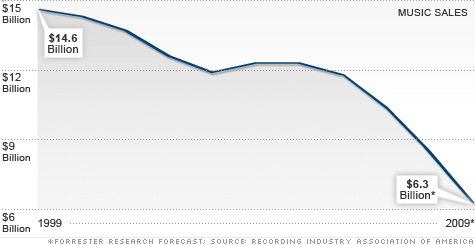
    Total revenue from US music sales and licensing fell almost 60 percent in the last decade, from $14.6 billion to $6.3 billion. Why? The Internet replaced music stores as the most convenient place to find and grab music for your library.

    This graph tells the story:
    chart_music.top.gifBy David

    But the music industry has a strange interpretation of the picture above:

    Apple’s iTunes is credited with finally getting people to pay for digital music, but it wasn’t unveiled until 2003…

    Time out: The music industry’s revenue is half what it was in 2003. It’s not clear to me that iTunes did anything more than ring the death knell of record stores while revenues continues to plunge. OK, time in:

    ..In
    the time between Napster’s shuttering and iTunes’ debut, many of
    Napster’s 60 million users found other online file sharing techniques
    to get music for free. Even after iTunes got people buying music tracks
    for just 99 cents, it wasn’t as attractive as free.

    “That
    four-year lag is where the music industry lost the battle,”
    said Sonal
    Gandhi, music analyst with Forrester Research. “They lost an
    opportunity to take consumers’ new behavior and really monetize it in a
    way that nipped the free music expectation in the bud.”

    Why does Gandhi think those years were so crucial? During the “four-year lag” between
    1999 and 2003, music sales fell no more than 20 percent. Six years
    after iTunes debuted, sales fell another 40 percent. I don’t know that
    any one thing is responsible for this — you could point to bitTorrent
    technology or YouTube or some illegal downloading services or just file it all under: The Internet. But I don’t
    particularly understand why you would blame the erosion of music
    profits in the last three years on some lost opportunity circa 2002.

    Music is free now, and it has been free for millions of Americans for more than a decade. The industry was never going to unring that bell.

    [via Matt Yglesias]


    Email this Article
    Add to digg
    Add to Reddit
    Add to Twitter
    Add to del.icio.us
    Add to StumbleUpon
    Add to Facebook


  • How Obama Should Fight Policy, Politics in the Deficit

    President Obama isn’t doing a very good job making the case that high deficits are not only necessary but desirable now that the economy is producing under capacity. That was the subject of my last post. But I’m already getting some hate mail accusing me of calling trillion-dollar deficits good for the economy, ad infinitum. Not so. Gun to my head, I’d spit out all kinds of ideas for closing the deficit, from repealing the Bush tax cuts to instituting a VAT tax to possibly means-testing Medicare.

    One way to fix our deficit crisis, if you live in Washington, DC, is to gather a
    team of elected officials in a room to brainstorm difficult, unpopular
    ways to bring down the deficit and then ask both Republicans and
    Democrats to jump off that cliff together so that neither side gets
    blamed for the legislation. The problem with a deficit commission today
    is that a bipartisan congressional panel is a minyan of
    syllables of search of usefulness. Congress isn’t about to produce
    either serious tax increases or serious entitlement reform, and without
    both, there is no serious deficit reduction. There certainly won’t
    be any jumping or hand-holding.

    Still the Republicans’ vote last month on the deficit commission was somewhat breathtaking, and it gives Democrats a window to turn deficit
    reduction into a political game. Numerous Senate Republicans including
    majority leader Mitch McConnell had actively and outspokenly supported the
    Gregg-Conrad deficit commission for months. In May,
    McConnell said “the best way to address the (deficit) crisis is the
    Conrad-Gregg proposal.” In January he and 32 of his colleagues voted against it. Washington Post
    editorial page editor Fred Hiatt said the vote nearly represented
    “everything that is wrong with Washington today.”

    President Obama, whose campaign was once brilliant at feigning breathless
    indignation every week, skewered Republicans for flip-flopping on the commission with these poison-tipped barbs in yesterday’s speech:

    Finally, changing spending-as-usual depends on changing
    politics-as-usual .. I should point
    out, by the way, that is an idea that had strong bipartisan support
    ,
    was originally introduced by Senators Gregg on the Republican side and
    Conrad on the Democratic side; had a lot of Republican cosponsors to
    the idea. I hope that, despite the fact that it got voted down in the
    Senate, that both the Republican Leader Mitch McConnell and the
    Republican Leader in the House John Boehner go ahead and fully embrace
    what has been a bipartisan idea to get our arms around this budget.

    Some barbs! Mitch McConnell just voted down the deficit commission, and his reward is … another invitation to vote down a deficit commission. Is it so terribly uncouth to point out that the same Republicans who are railing against the deficit just voted down a commission to fix the deficit?

    Hitting Republicans back on the deficit commission vote is about politics, but it’s also about policy. Obama cannot expect to win the public over to his agenda if he apologizes for his budget and rewards Republican hypocrisy on the deficit with yet another and another offering to a spirit of bipartisanship that so clearly does not exist.


    Email this Article
    Add to digg
    Add to Reddit
    Add to Twitter
    Add to del.icio.us
    Add to StumbleUpon
    Add to Facebook


  • Paul Ryan’s Shocking Budget Proposal

    Rep. Paul Ryan’s new budget proposal — which essentially privatizes Social Security and strangles Medicare inflation with cost-controlled vouchers — is a really important lesson in budgeting. It’s very easy to fix our long-term deficit crisis. All you have to do is blow up our entitlement program.

    There’s a bit of a debate about whether Ryan’s proposal is so honest it’s crazy, or so crazy it’s not serious. I think it’s extremely serious — not as a budget proposal, but as a dystopian parable. It’s like reading 1984 for the next century, but with graphs.

    Consider the terrifying Medicare proposal. Ryan would give seniors a
    voucher that would immediately be worth less than Medicare spending per
    enrollee. Over the next decade, the buying power of the voucher would
    grow more slowly than medical spending, but at the same time, the cost
    of premiums will increase because seniors would wander into the more
    expensive private market for insurance. Anybody wanna know what rationing look like?

    Fiscal hawks like talking about “tightening belts.” This goes way beyond tightening by a few belt holes. This plan is more
    like taking off your belt and tying yourself to a treadmill that has no
    off-switch. It’s an effective weight loss plan, indeed, but good luck convincing the neighbors to sign up for prepaid 12-month plan.

    Truly, I think it’s a shocking budget, and the kind of thing that no
    party in power would ever have the cojones to propose. Indeed,
    Republicans didn’t even have the cojones to co-sign health care reform’s Medicare cuts. Six
    months after the Democrats’ proposed Medicare savings made Republicans
    shout bloody murder (literally: Death Panels), Rep. Paul Ryan is now
    proposing the program’s gradual extermination. Like any good dystopian
    parable, this doesn’t deserve to be taken literally. It’s about the lesson: Our deficit crisis in an
    entitlement crisis, and the solution won’t be pretty.


    Email this Article
    Add to digg
    Add to Reddit
    Add to Twitter
    Add to del.icio.us
    Add to StumbleUpon
    Add to Facebook


  • Obama is Failing to Defend His Budget

    It’s not easy for President Obama to defend a $1.6 trillion deficit, the largest nominal deficit in US history. But that is Obama’s challenge as he sells his 2011 budget. He has to explain to Americans that he is concerned about the debt, even as he increases it tremendously. This “I hate doing this, but I have to” hand-wringing essentially amounts to admitting that you don’t like your budget.

    I think he’s delivering the wrong message.

    In the past two weeks, Obama has said a few things that make me worried about his framing of the deficit. Like this, where he seems to call his own deficits a “terrible mistake”:

    We also continue to lay a new foundation for lasting growth, which is essential as well. Just as it would be a terrible mistake to borrow against our children’s future to pay our way today,
    it would be equally wrong to neglect their future by failing to invest
    in areas that will determine our economic success in this new century.


    Or this, where he reinforces the idea that his administration treats taxes like Monopoly money:

    “We simply cannot continue to spend as if deficits don’t
    have consequences, as if waste doesn’t matter, as if the hard-earned
    tax money of the American people can be treated like Monopoly money.”

    Or this,
    where he makes the weird argument that the administration should be
    more penny-pinching during a recession, while all of his
    policies (and Keynesian economic theory) call for expanding government aid to states, businesses and individuals:

    Families across the country are tightening their belts and making tough decisions. The federal government should do the same.

    Here is what I’m hearing: “This is not my deficit. I don’t like it at all. Deficits are terrible mistakes, and the government always treats your taxes like Monopoly money, and we really should be tightening our belts now by now.” Obama sounds like his own budget’s best critic!

    I can’t imagine this self-critical approach will win public support. One heuristic I use to gauge whether I think a framing device will work
    is: Can I imagine some bloke on the street repeating it with a news
    camera in his face? So: can I imagine a some self-described moderate
    independent say to a CNN camera, “I really respect Obama for
    admitting how much he despises all the numbers in his budget”? No, I
    cannot. Here’s what I can imagine: “Did you hear about how horrible
    this budget and deficit is? Even the president hates it!

    What’s the solution? Well, I’m working on that part. Right now the best idea I have is: Don’t talk about the deficit as a historic deficit. Talk about it as a historic investment. Make the subject record unemployment relief, and record state relief, and record job spending, and record small business investments, and record tax cuts. Tell a positive story you want to defend rather than a negative story you want to apologize for. Obama likes to blame Bush and the recession for the deficit. Substantively, it’s right. Politically, it looks like excuse-making. The average Americans thinks this is Obama’s budget. He needs to defend it like he owns the thing.


    Email this Article
    Add to digg
    Add to Reddit
    Add to Twitter
    Add to del.icio.us
    Add to StumbleUpon
    Add to Facebook


  • Obama Understands What Deficit Spending Is, Right?

    I wanted to go through Obama’s 2011 budget speech and expose the groups who will rail against its most sensible parts.* But then I read this sentence and felt too confused to go on:

    We also continue to lay a new foundation for lasting growth, which is essential as well. Just as it would be a terrible mistake to borrow against our children’s future to pay our way today, it would be equally wrong to neglect their future by failing to invest in areas that will determine our economic success in this new century.


    That sentence doesn’t make any sense, does it?

    Obama’s telling us “it would be a terrible mistake to borrow against our
    children’s future to pay our way today.” But that sentence is wrong — twice.
    First that conditional “would” is a little bizarre, because this is
    our current policy. We’re running up at least three consecutive
    trillion-dollar-deficits in 2009, 2010 and 2011 according to White
    House and CBO projections. We are paying for today with our children’s
    future. That is what a deficit is.

    Second deficit-spending isn’t a terrible mistake, because it’s not
    terrible, and it’s not a mistake. It’s not terrible because it’s
    responsible economics to run up a deficit during a recession. When
    private demand falls below the
    economy’s productive capacity, government replaces
    the shortfall in demand by increasing its own (see: Richard Posner’s post today).
    To finance that extra government spending, we borrow money against a future in which we hope to be
    more prosperous. If we’ll more money, then we’ll have more money to give the government to pay back our debt. This practice is not a mistake because, once again, it is our current policy.

    Maybe I’m making too big of a deal about this sentence. I know Obama’s speech writers are immensely talented, and I know Obama knows what deficit spending is. I think he’s trying to say, “Unfortunately the recession has forced us to borrow against our future. But rather than a tragedy, let’s see this as an opportunity to invest in the future.” But deficit spending is an investment. It doesn’t need a distinction. It’s like taking out a loan because you think you can pay down the interest and still eventually profit from the upfront cash. People do this all the time. It’s got good economics behind it. Why impugn your own policies by calling them “a terrible mistake”?

    _________________
    *For example, replacing the subsidy to banks who lend to college
    students with direct government lending is a commonsense way to both
    save money and streamline the college lending system. And yet the plan has many enemies. We can start with
    Sallie Mae, one of the leading private student lenders, which would lose
    government subsidies as the government took over direct lending to
    students. Many Republicans have accused the government of trying to
    establish an monopoly on student loans, especially Sen. Mike Enzi and Sen. Lamar Alexander, who blasted the move as an attempt to turn the Department of Education into “a $500 billion national bank”
    in this piece by Eliza Krigman.
    On the Democratic side, key Sen. Ben Nelson’s home state of Nebraska is home to Nelnet, another leading private lender that he’s interested in protecting from the subsidy elimination.


    Email this Article
    Add to digg
    Add to Reddit
    Add to Twitter
    Add to del.icio.us
    Add to StumbleUpon
    Add to Facebook


  • What Makes a Great Teacher?

    On the day President Obama’s budget plans an overhaul of US education policy, it’s probably appropriate to finally pass along this excellent Atlantic magazine piece about what makes a great teacher.

    What did predict success, interestingly, was a history of
    perseverance–not just an attitude, but a track record. In the
    interview process, Teach for America now asks applicants to talk about
    overcoming challenges in their lives–and ranks their perseverance
    based on their answers. Angela Lee Duckworth, an assistant professor of
    psychology at the University of Pennsylvania, and her colleagues have
    actually quantified the value of perseverance. In a study published in TheJournal of Positive Psychology
    in November 2009, they evaluated 390 Teach for America instructors
    before and after a year of teaching. Those who initially scored high
    for “grit”–defined as perseverance and a passion for long-term goals,
    and measured using a short multiple-choice test–were 31 percent more
    likely than their less gritty peers to spur academic growth in their
    students. Gritty people, the theory goes, work harder and stay
    committed to their goals longer. (Grit also predicts retention of
    cadets at West Point, Duckworth has found.)

    But another trait seemed to matter even more. Teachers who scored
    high in “life satisfaction”–reporting that they were very content with
    their lives–were 43 percent more likely to perform well in the
    classroom than their less satisfied colleagues. These teachers “may be
    more adept at engaging their pupils, and their zest and enthusiasm may
    spread to their students,” the study suggested.

    In general, though, Teach for America’s staffers have discovered
    that past performance–especially the kind you can measure–is the best
    predictor of future performance. Recruits who have achieved big,
    measurable goals in college tend to do so as teachers. And the two best
    metrics of previous success tend to be grade-point average and
    “leadership achievement”–a record of running something and showing
    tangible results. If you not only led a tutoring program but doubled
    its size, that’s promising.

    This year, D.C. public schools have begun using a new evaluation system
    for all faculty and staff, from teachers to custodians. Each will
    receive a score, just like the students, at the end of the year. For
    teachers whose students take standardized tests, like Mr. Taylor, half
    their score will be based on how much their students improved. The rest
    will be based largely on five observation sessions conducted throughout
    the year by their principal, assistant principal, and a group of master
    educators. Throughout the year, teachers will receive customized
    training. At year’s end, teachers who score below a certain threshold
    could be fired.


    Email this Article
    Add to digg
    Add to Reddit
    Add to Twitter
    Add to del.icio.us
    Add to StumbleUpon
    Add to Facebook


  • Five Ways Obama’s Budget Will Change Education Policy

    One hallmark of the president’s new budget is a major overhaul of No Child Left Behind, the education law passed under President George W. Bush. President Obama and Education Sec. Arne Duncan have both said repeatedly that they appreciate the bright light NCLB shines on student achievement and the program’s stated goal of closing the gap between minority and white students. But here are five ways the new administration might change education policy, based on both today’s budget and the direction of the Education Department:

    1. Drop “adequate yearly progress” for schools. NCLB grades schools by test
    scores to determine whether they are making “adequate yearly progress.” If schools fail to hit their goals, they are forced to offer additional tutoring, allow students to transfer, or face even personnel cuts. As Sam Dillon writes in the NYT, this pass-or-fail approach to evaluation “fails to differentiate among chaotic schools in chronic failure,
    schools that are helping low-scoring students improve and
    high-performing suburban schools that nonetheless appear to be
    neglecting some low-scoring students.” A more nuanced approach would divide the schools into more categories that reflect their challenges.

    2. Broaden the standardized testing system. One common critique of NCLB is that is narrowed the curriculum. By shining its harsh light on math and reading scores, it encouraged teachers to concentrate their energies in those two subjects, to the exclusion of sciences and arts. Duncan’s logic is reasonable: Teachers will teach what the administration says it will test. So if you start measuring science achievement, teachers won’t ignore the sciences. Moreover, the administration is likely to eliminate the 2014 deadline
    for every American child reaching academic proficiency. The quixotic goal probably isn’t worth keeping around. The new goal will be to make every high graduate “college- and career-ready.”

    3. Encourage the states to set higher, stricter standards. Because NCLB
    allowed states to set their own test standards, many states, especially
    in the south, designed easy tests to achieve adequate yearly progress. So even as their students fell below
    the national median in national assessments, more of their schools would pass through the school system. I think we’re going to see a push toward a national standardized test that won’t allow individual states to design their own short-cuts to more government funding.

    4. Develop new formulas for school funding. Typically most federal funds are allocated based to our 14,000 school district based on statistics like school size and income. Education analysts say the administration wants to reform the formulas to take into account school performance. In other words, much like Race to the Top — the Education Dept.’s $5 billion sweepstakes program — the administration would allocate more money to districts that demonstrate progress or pledge certain reforms.

    5. Introduce merit pay, finally. For years the teachers union has rejected a raft of attempts to evaluate teachers based on student performance, but the tide may be shifting away from simple classroom check ups. Efforts to rewrite NCLB failed in 2007 because teachers unions refused to adopt merit pay. But Duncan’s approach would dangle additional funds for school districts in exchange for pledges to evaluate teachers based on stats like chnages in test scores and improvements in graduation rates.


    Email this Article
    Add to digg
    Add to Reddit
    Add to Twitter
    Add to del.icio.us
    Add to StumbleUpon
    Add to Facebook


  • Why Obama is Smart to Cut the NASA Moon Plan

    Fly me to the moon? Eh, never mind.

    President Obama’s $3.8 trillion budget for fiscal 2011 doesn’t cut very much, but it makes one budget slash that is sure to draw blood from certain constituencies: He’s wants to end the NASA moon program and encourage the private sector to pick up the slack.

    I know what some critics are going to say about this plan, because they’ve already said it.

    This was Charles Krauthammer last year, on the 40th anniversary of the first moon landing:

    America’s manned space program is in shambles. Fourteen months from
    today, for the first time since 1962, the United States will be
    incapable not just of sending a man to the moon but of sending anyone
    into Earth orbit. We’ll be totally grounded. We’ll have to beg a ride
    from the Russians or perhaps even the Chinese.

    So what, you say? Don’t we have problems here on Earth? Oh, please.
    Poverty and disease and social ills will always be with us. If we’d
    waited for them to be rectified before venturing out, we’d still be
    living in caves…

    Why do it? It’s not for practicality. We didn’t go to the moon to spin
    off cooling suits and freeze-dried fruit. Any technological return is a
    bonus, not a reason. We go for the wonder and glory of it.

    This is exactly wrong. It’s does not make sense to spend money on
    “wonder and glory” without any practical benefit, and Krauthammer knows
    this perfectly well. It’s extraordinary that somebody who works himself
    into such a fury about pointless pork spending, will abandon his orthodox focus on practicality only when the end is not people, no, but an inanimate satellite.

    Where I feel sympathy for the space program is not the space part, but the program. Florida’s Sen. Bil Nelson told reporters ““I, for one, intend to stand up
    and fight for NASA, and for the thousands of people who stand to lose
    their jobs.” Job loss is a real concern, but one

    fact that will be obscured by the noise over our lunar drawback is that
    total NASA spending will actually go up in Obama’s budget by $1
    billion. Other agencies that fall under discretionary spending will not
    be so lucky because of the announced freeze to demonstrate the
    administration’s seriousness about fiscal restraint.

    Nelson’s plea
    reveals the political impossibility of meaningful spending cuts. If it
    is unacceptable to increase a department’s budget by one billion
    dollars while cutting one of its programs whose advocates admit is “not
    for practicality,” then what part of fiscal
    restraint will be acceptable?


    Email this Article
    Add to digg
    Add to Reddit
    Add to Twitter
    Add to del.icio.us
    Add to StumbleUpon
    Add to Facebook


  • Why Obama’s Job Creation Plan Might Not Work

    President Obama’s $3.8 trillion budget for fiscal 2011 includes a jobs bill that could cost around $100 billion. In addition to small business credits and continued state aid, the White House has proposed a $30 billion job creation plan that would give employers $5000 dollars for each new hire. Last week I wrote that while the job creation tax credit has broad support among policy groups, including the CBO and the left-of-center EPI, it’s also easy to game the system. Richard Posner finds a deeper flaw: It does nothing to juice demand.
    Here’s Posner:

    The Keynesian theory of stimulus (the only theory that makes
    economic sense) is that if private demand for goods and services falls
    substantially below the economy’s productive capacity (as it has done),
    government can replace the shortfall in demand by increasing its own
    demand. It can buy roads and airports and military equipment with
    borrowed money (so as not to take money out of people’s pockets, in the
    form of taxes, and by doing so depressing private demand)
    . And it can
    borrow cheap, because consumers are saving more than usual, and, with
    demand weak, businesses are borrowing less than usual. So the private
    demand for credit is weak, and interest rates therefore low. The surge
    in government demand increases production, and increased production
    results in increased employment.

    The job-stimulus plan is not aimed at increasing demand, and
    therefore is unlikely to increase employment. For think: if a company
    is producing 1,000 widgets a year with a work force of 30, and it adds
    a 31st employee and thereby earns a $5,000 tax credit, the company’s
    total costs will have risen by the wages and benefits that he pays the
    new employee minus the $5,000. But his sales will not have risen.
    Participating in the job-subsidy program will actually reduce his
    profits (revenue minus cost).

    Last year I offered reasons for and against 9 big ideas to beat unemployment, from business tax credits to public works projects. One of those ideas is infrastructure spending — that is, buying roads and bridges with borrowed money. The downside of infrastructure spending is that sometimes it takes a while to get the bridge-building projects off the ground. That’s one reason why the CBO found that the jobs tax credit would actually be not only faster, but more effective at creating work hours.

    At the same time, it’s not clear even to the CBO that a hiring tax credit could work, or if it ever has. After the 1973-5 recession the New Jobs Tax Credit
    gave firms a tax break if they increased total employment by at least
    two percent. The policy was too complex for many firms to apply, and
    later studies struggled to agree that the tax credit boosted jobs by a
    significant number. A Department of Labor report ultimately concluded
    that it was impossible to observe what hiring would have been done
    without the credit.


    Email this Article
    Add to digg
    Add to Reddit
    Add to Twitter
    Add to del.icio.us
    Add to StumbleUpon
    Add to Facebook


  • Is the 2010 Budget Deficit Really a Record High?

    President Obama’s 2011 budget projects the deficit in 2010 to reach $1.55 trillion, which would be the highest number in history. But the number also deserves some context. News organizations like the Wall Street Journal and Reuters are reporting that the 2010 deficit is a “record.” Nominally, that’s absolutely true. As a percent of GDP, it is not.

    Dean Baker makes the case:

    Measured in nominal dollars, the $1.6 trillion deficit is an all-time
    high, but measured as a share of GDP (the only meaningful measure) the
    deficit is about 11 percent of GDP. This leaves it much smaller than
    the deficits run during World War II which exceeded 20 percent of GDP.

    I’m with Dean. It’s not that years of trillion-dollar deficits aren’t
    worrisome (they are) or that our long-term debt isn’t a crisis (it
    really, really is). But it doesn’t make any sense to divorce the
    deficit figure from history. In 1943, when the deficit accounted for a
    modern record of 28 percent of GDP, our GDP was smaller than $200 billion. Today it’s around $14 trillion. It’s silly to compare the GDP numbers nominally, so why compare the deficit figures without context?

    That said, it’s impossible to avoid the conclusion that we face a
    long-term debt crisis. That bit is not only widely reported, it’s also
    exactly right. After we climb down from the trillion-dollar-debt range
    in the next five years, we have about a five-to-ten year window of
    smaller deficits before the baby boomer generation begins to retire,
    pays fewer taxes and collects a lot more government benefits from
    Social Security and Medicare. That’s exactly why any serious deficit commission cannot leave revenues and entitlements off the table. Debt reform is revenue and entitlement reform, ipso facto.

    Update: In fairness, I should note that sources like AmSpecBlog are justified in calling the 2010 debt projection “a post-WWII record.” The highest deficit-as-GDP-percent since the mid-40s is 5.88% in 1983. This year could hit 11%.


    Email this Article
    Add to digg
    Add to Reddit
    Add to Twitter
    Add to del.icio.us
    Add to StumbleUpon
    Add to Facebook


  • The Fundamental Problem with a Spending Freeze

    President Obama’s 2011 budget comes out today, and the big story is the big numbers:

    –$3.8 trillion overall spending.
    –$1.55 trillion deficit in 2010.
    –$1.27 trillion deficit in 2011.

    I’ll be blogging my way through the budget’s particulars througout the day, but first I wanted to make a small but important point about a small (but politically important) part of the new budget: The spending freeze on non-security discretionary spending.

    As a fulcrum, the threat of a spending freeze is potentially useful because it pressures lawmakers to find inefficient programs. As an economic policy, it is not so useful. The OMB has a list of programs where it would like to see cuts. This list includes some public works projects of the Army Corps of Engineers, two historic preservation programs and NASA’s mission to return to the Moon. According to my dreamworld, they also include significant cuts to agricultural subsidies, which are bad for small farmers, bad for free markets and bad for our waistlines.

    But, as Matt Yglesias points out, what if the administration doesn’t get those cuts? Rather than dispel with the idea of a freeze altogether, it’s more likely that they will feel bound by the spending freeze promise and find cuts in departments that they hoped to preserve, like science research and some green technology projects. The reasons for the cuts won’t be that the programs are necessarily over-funded, but that their constituents aren’t as loud. So while it’s defensible to argue that the spending freeze could put the squeeze on earmarks, it’s also possible that some nefarious earmarks like agricultural subsidies will survive and frostbite will touch programs the administration supports.


    Email this Article
    Add to digg
    Add to Reddit
    Add to Twitter
    Add to del.icio.us
    Add to StumbleUpon
    Add to Facebook


  • At Today’s Republican House Q&A, Obama Was Right

    President Obama’s Q&A with House Republicans was supposed to be a Friday news dump, but it turned into a surprisingly electrifying exchange — on C-SPAN no less! The transcript is here. The C-SPAN video is here, but it wasn’t working well last I tried.

    Obama’s interaction with Rep. Mike Pence might grab some weekend headlines, but this seemed the most telling exchange to me, with Texas Rep. Jeb Hensarling.

    REP. JEB HENSARLING, R-TEXAS: Since [the Republican] budget was
    ignored, what were the old annual deficits under Republicans have now
    become the monthly deficits under Democrats. The national debt has
    increased 30 percent.

    PRESIDENT BARACK OBAMA: … The fact of the matter is, is that when we came into office, the
    deficit was $1.3 trillion. $1.3 trillion. So — so when you say that
    suddenly I’ve got a monthly budget that is higher than the annual — or
    a monthly deficit that’s higher than the annual deficit left by
    Republicans, that’s factually just not true, and you know it’s not
    true. And what is true is that we came in already with a $1.3 trillion
    deficit before I had passed any law. What is true is, we came in with
    $8 trillion worth of debt over the next decade.

    First of all, the statement that old Republican deficits have now become monthly Democratic deficits is just plain false. Bush ran up deficits as high as $400 billion. The smallest deficit he ran in his last six years was $160 billion in 2007. Twelve-times-$160 billion makes $1.9 trillion, which is half a trillion more than our deficit in 2009, or our projected deficit in 2010.

    Second I’m not terribly fond of Obama’s insistence on blaming the economy on Bush in every speech. But it’s only natural to be defensive if Republicans insist on blaming Democrats for the entirety of the deficit. Let’s look at 2009. Federal spending was about $3.4 trillion and the deficit was $1.4 trillion. The stimulus distributed a little more than $200 billion in 2009 (and about half of that came in the form of tax relief). That is a lot of money to be sure, but it accounted for six percent of total federal outlays, and some economists credit it for adding up to three percentage points to GDP growth. If we’re going to debate the budget honestly, we have to begin at a place that isn’t “Democrats are responsible for double digit unemployment and increasing the deficit by 1200%.”


    Email this Article
    Add to digg
    Add to Reddit
    Add to Twitter
    Add to del.icio.us
    Add to StumbleUpon
    Add to Facebook


  • How Obama’s Hiring Tax Credit Could Work — And Why It Might Not

    In the State of the Union, President Obama promised to get started on a jobs bill — and fast. Well here we go: The White House has proposed taking the $30 billion of TARP money banks have repaid and give it to companies who hire in 2010. Here’s how the tax credit would work:

    • Tax credits for new hires. A small business that
    hires ten new employees in 2010 will receive a $50,000 tax credit to
    help offset the costs of those new hires. However, if the same small
    business lays off ten employees in 2010 and hires five new employees,
    it would receive no credit. 
     
    • Tax credits for pay raises. A small business with 50
    employees that, through increased hours or higher pay, provides all of
    its employees a $1,000 real wage increase in 2010 will receive a $3,100
    tax credit, enough to cover the Social Security payroll taxes on those
    increases. 

    Tax credits aren’t so different from the other job creating strategies
    out there like job sharing (where the government pays employers to cut
    workers’ hours to free up more work for new hires) and a payroll tax
    cut, which is the most straightforward way to give employers money to
    hire. One problem with job sharing and payroll tax cuts is that they
    pay employers upfront without the guarantee that they’ll actually use
    the cash to hire. That’s one reason some economists prefer tax credits
    to reward hires that have actually happened.

    But there’s a downside: Companies could game this system a couple ways: (1) Fire Peter,
    hire Paul, and say “Look we hired! Tax cut please.” (2) Replace one
    full-time worker with two part-timers (3) Divide one company into
    multiple companies on paper, then shuffle workers around to increase
    the payroll at those companies. The Obama administration anticipates all three cheats:

    • No benefits for gaming. A small business that fires 10 workers and hires 10 workers to
    replace them would see no net increase in employment and thus would not receive a credit. A
    small business that lays off 10 employees making $50,000 each and hires 20 employees
    making $25,000 each will receive no credit. Likewise, a small investment firm that raises
    salaries for its top employees from $300,000 to $350,000 will not
    receive a credit … In addition, rules would prevent businesses from
    renaming themselves or merging in order to claim the credit. 

    The White House does not go into detail about how they will monitor hirings and firings and name changes.

    To compare tax credits to other job creation theories, check out my pro-con rundown of the nine best way to reduce unemployment.


    Email this Article
    Add to digg
    Add to Reddit
    Add to Twitter
    Add to del.icio.us
    Add to StumbleUpon
    Add to Facebook


  • Will the iPad Really Revolutionize Textbooks?

    Apple’s iPad has been hailed as a smartphone-laptop hybrid and a savior of journalism, but its most important contribution might be to the textbook market. Yesterday Atlantic Business contributor Menachem Kaiser predicted that the iPad would take off among college students primarily because iBooks might offer the ability to buy textbook chapters the same way you can buy songs on iTunes. Thanks to companies like Inkling, that’s only the first step:

    Inkling is working directly with textbook publishers. First, they’ll
    port their existing tomes onto Apple’s iPad as interactive, socialized
    objects. Then, they’ll create all-new learning modules — interactive,
    social, and mobile — that leave ink-on-paper textbooks in the dust.

    This is very exciting news, but let’s not forget that electronic textbooks already exist.
    Some of them do much more let you read the text on a laptop — they
    save highlighted passages and electronic notes, the text is searchable.
    So why they aren’t taking off?

    One explanation is that the technology is still buggy. Another is that the technology is waiting for an exciting platform like iPad (although its unclear to me why other touch-technology e-readers like Sony don’t offer similar potential, although without color.) Another explanation is that
    professors haven’t been steered toward offering and mastering e-books. Certainly, if my experience was any indication, professors are generally about
    two decades behind in tech savvy.

    Another explanation is that the incentive for publishers to
    offer superior e-textbooks is dulled by the economic reality that e-textbooks generally sell for 50 percent off. That’s even
    worse if students started to download the chapters a la
    carte, or figure out ways to share versions of the chapters over a network. And it’s even worse when you factor in the 30 percent cut that
    Apple takes on book sales.

    But the potential is thrilling, nonetheless. Here’s Paul Boutin from
    VentureBeat on how Inkling and e-textbooks could change the way
    students interact with reading assignments:

    The
    iPad makes it possible to replace static images with interactive
    puzzles that MacInnis says burn important concepts in to students’
    brains better and longer. He showed me a demo learning module that
    explained the biological concept of cellular mitosis. It starts with a
    real microscope image of a cell. A caption, simultaneously spoken by a
    voiceover (They call this karaoke mode. It turns out to help memory
    better than either text or speech by itself) instructs me to tap the
    cells nucleus three times to simulate its breakdown. Further steps in
    the mitosis process require me to pinch, drag or swipe components in
    the cell after identifying them. When I’m done, I have a memory of
    having walked through the process physically, rather than just scanning
    an illustration with my eyes…

    Besides
    the interactive color format, Inkling’s technology goes beyond the
    Kindle and other readers by making it possible to hop around a book, to
    hand out individual chapters as assignments, and to take notes in
    highlighter yellow right on the text. The notes are sharable among a
    social network of students and instructor.


    Email this Article
    Add to digg
    Add to Reddit
    Add to Twitter
    Add to del.icio.us
    Add to StumbleUpon
    Add to Facebook


  • Would Obama Be Better Off Without Bernanke, Geithner?

    President Obama likes to remind audiences that we inherited a horrible situation from President Bush. But even as he blames his predecessor, Obama sometimes has a hard time distinguishing his policies from Bush II. Bruce Bartlett makes that case in a very interesting Forbes article that says Obama should let go of Fed Chair Ben Bernanke and Treasury Secretary Tim Geithner. Good ideas?
    Barlett:

    Obama could also have explained how the Federal Reserve’s easy money
    policy created the housing bubble, the crash of which is at the heart
    of our current economic problems…

    I agree that the Federal Reserve’s easy money and the the federal
    government’s housing policies played a role in the sub-prime meltdown,
    but I don’t see any political benefit in explaining the crash by
    blaming the Fed just as you’re proposing to make it the ultimate
    regulator of the nation’s largest banks.

    …Yet he reappointed Republican Ben
    Bernanke as chairman of the Federal Reserve rather than using the
    expiration of his term as an opportunity to break from the past and
    chart a new course by at least appointing a Democrat like San Francisco
    Fed President Janet Yellen. Given that Bernanke served as Bush’s chief
    economic adviser in the White House before becoming Fed chairman, this
    should have been a no-brainer.

    I’m with Megan
    here. Reappointing Ben Bernanke was the real no-brainer, and not just
    because a uncertainty at the Fed would have scared bond investors and
    the stock market. Let’s say the White House decided to be against Bernanke’s reappointment. Immediately you’ve guaranteed that (almost?) every Republican will support him — he’s a Bush appointee, after all.
    If only ten Democratic senators decided to buck the White House and
    give Ben a second term, the admnistration faces an embarrassing loss on
    an important economic vote where it had no business sticking its head
    out. Getting behind a liberal economist like Yellen wouldn’t have been worth it.

    Similarly, in appointing Tim Geithner as Treasury secretary, Obama
    lost an opportunity to blame the previous administration for its
    response to the financial crisis in the fall of 2008. As president of
    the Federal Reserve Bank of New York, Geithner was up to his neck in
    the bank bailout that is reviled equally by those on the right and the
    left. And as more and more details about the backroom deals involving
    billions of taxpayers’ dollars and the vast profits made by the very
    bankers who caused the crisis come to light, the worse both Geithner
    and Obama look.

    My money is on Geithner sticking around, but let’s brainstorm a bit. What’s the political upside/downside of letting
    Tim Geithner go right now and shifting toward a populist bank policy by
    filling Treasury with Volcker or Elizabeth Warren? Some Republicans will claim the White House is in chaos, that “the wheels are falling off,” and so on.
    The bankers will revolt and threaten recriminations, but if they
    complain too loudly it would only strengthen antagonism toward Wall St.
    The upside is that the White House can say with conviction, It’s a new day. Last year was about rescuing Wall Street, and we had the right personnel for that. This year is about reforming Wall Street, and we need the right personnel for that.

    Not saying it should happen, just weighing pros and cons… Thoughts?

    Update: Bruce Bartlett responds via email:

    I think you misunderstood my point. I wasn’t saying that I don’t support Ben. I do. I’m just saying that as a purely political matter it was a mistake for Obama to reappoint him when there are well qualified Democrats available. Same with Tim. I’m not saying he should be fired, only that he shouldn’t have been appointed in the first place. As I have blogged, I don’t think it makes sense to fire Tim at this time because there’s no obvious replacement for him and given the problems of getting Treasury appointees confirmed, I think it would be unwise to leave the department rudderless.

    I think we agree on Geithner.


    Email this Article
    Add to digg
    Add to Reddit
    Add to Twitter
    Add to del.icio.us
    Add to StumbleUpon
    Add to Facebook


  • GDP Soars 5.7%, But Here’s the Chart You Should Look At

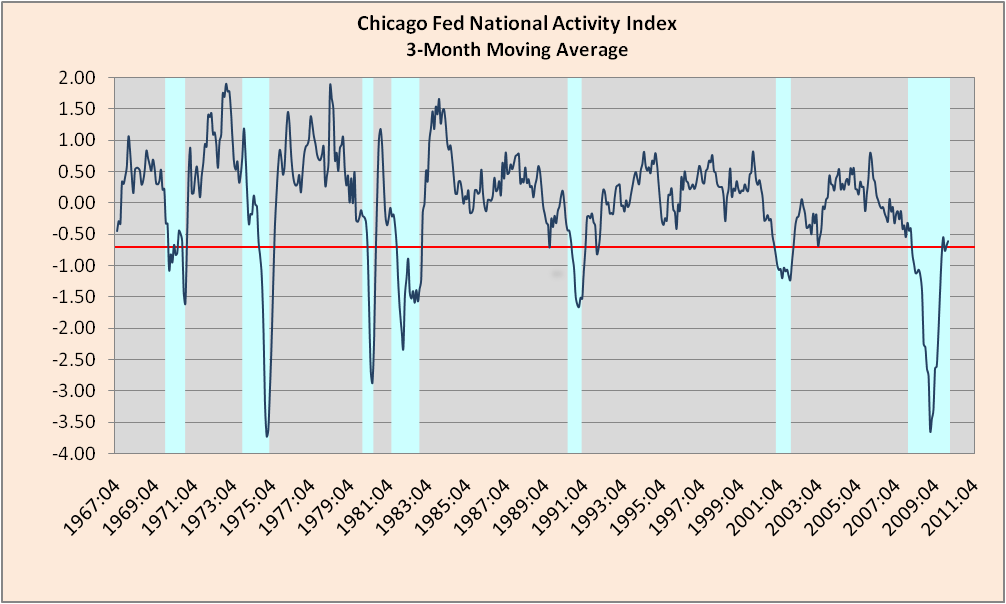
    U.S. GDP in the last three months of 2009 soared by 5.7%. That’s good news, but the number doesn’t tell the whole story. Dan digs into the figure to find out what’s growing and what isn’t, but to get a more complete picture of our economic growth, check out the Chicago Fed National Activity Index (NAI) — what Barry Ritholz calls “the best economic indicator you’ve never heard of.”

    The newest NAI report on 2009’s fourth quarter is out, and it’s not as sanguine as GDP.

    Here’s the chart:

    What’s happening here? The short version is this: The economy started
    to rally dramatically last summer, but the recovery has stalled since
    September.

    Here’s the longer, more informative version. NAI tracks 85 economic
    indicators, which lumped into four big categories: production and
    income (P&I); employment, unemployment, and hours (EU&H);
    personal
    consumption and housing (C&H); and sales, orders, and inventories
    (SO&I). The graph below explains how these categories performed in
    the second half of 2009.

    NAI.pngSome
    lessons from this chart: Production has been positive for six months.
    Employment continues to languish. This shouldn’t surprise us. Not only
    does GDP improve faster than employment, but also Larry Summers
    admitted to the New Yorker that the stimulus plan specifically targeted production over jobs. (Megan will have more on the prospects of a jobless recovery later today….)

    I would be particularly concerned about what the chart says about the
    consumer and housing markets. The C&H figure barely budged from
    near recession levels (the NAI considers figures below -0.70 consistent
    with a recession) in the last six months of 2009. Consumer spending
    continues to be anchored down by broad unemployment. The housing market
    had a particularly rough December — new home sales fells and
    foreclosures, defaults and delinquencies continued to rise

    On the bright side, sales, orders and inventories are up in the NAI —
    and have been near positive growth levels for most of the last six
    months. This also fits with today’s GDP report that found that changes
    in real private inventories made up 3.4% of the 5.7% growth.


    Email this Article
    Add to digg
    Add to Reddit
    Add to Twitter
    Add to del.icio.us
    Add to StumbleUpon
    Add to Facebook