Author: DFID

  • Is Anybody Surprised that Krugman Was Wrong about U.K. Fiscal Policy?

    Daniel J. Mitchell

    Just like in the United States, politicians in the United Kingdom use the deceptive practice of “baseline budgeting” as part of fiscal policy.

    This means the politicians can increase spending, but simultaneously claim they are cutting spending because the budget could have expanded at an even faster pace.

    Sort of like saying your diet is successful because you’re only gaining two pounds a week rather than five pounds.

    Anyhow, some people get deluded by this chicanery. Paul Krugman, for instance, complained in 2011 that “the government of Prime Minister David Cameron chose instead to move to immediate, unforced austerity, in the belief that private spending would more than make up for the government’s pullback.”

    This was nonsense. There have not been any genuine budget cuts in the United Kingdom. Heck, just compare what’s happening today in the United Kingdom and what happened in Canada in the 1990s to see the difference between gimmickry and real fiscal restraint.

    Now we have some new numbers that confirm that the UK economy is suffering because of a heavy burden of government spending.

    Here’s some of what Allister Heath, the Editor of City A.M., wrote for the UK-based Telegraph.

    The public finances are deteriorating again, making a mockery of the Coalition’s core purpose. Osborne’s fatal problem is that he is proving unable to deliver any meaningful reduction in the size of the state. The extent of his failure will come as a shock to many. Remarkably, public spending actually went up last year as a share of our national income… public spending hit 49pc of UK GDP last year, a shocking increase on the 48.6pc of GDP spent by the state in 2011. Even with a stagnant economy, this implies that Osborne has lost control of public spending.

    Gee, doesn’t sound like much budget cutting to me.

    Heck, the burden of government spending is worse than it is in Germany (45 percent of GDP). Or even Spain (44 percent) or Portugal (47.4 percent).

    Perhaps the most shocking number is the one showing that the UK has radically veered in the wrong direction this century.

    Public spending as a share of GDP hit a trough of just 36.6pc in 2000.

    Allister hits the nail on the head.

    …after all the rows about “slashing spending to the bone”, and following almost three years of coalition government, the state is still spending around half of national income. …it beggars belief that a government that remains so large, so bloated cannot provide much better quality services, and that we have a public debate in this country that exaggerates beyond all recognition the extent of the state’s downsizing.

    But there has been some “austerity,” but only for taxpayers.

    …real austerity is only biting on the tax side: total UK government revenues increased from 40.3pc of GDP in 2011 to 42.4pc in 2012, the OECD estimates. It’s getting increasingly hard for the Chancellor to extract revenues, with taxes on income and wealth falling to £194.3bn over 2012 as a whole, 2.7pc lower than in 2011, when they stood at £199.7bn, according to separate figures from the Centre for Economics and Business Research.

    That last sentence, by the way, shows the Laffer Curve in action.  The supposedly Conservative government of Cameron and Osborne has raised the tax burden, yet revenues aren’t materializing.

    Allister also echoes the argument of Veronique de Rugy about choosing the right kind of austerity and reining in the public sector.

    Not all kinds of austerity were created equal: cutting current expenditure, such as benefits, is good for growth; but hiking taxes is bad for it… There is also lots of evidence that elevated levels of public spending and large government debts are bad for GDP; no wonder, therefore, that growth is failing to materialise.

    So what’s the bottom line? Well, as Allister stated, the real problem is that government is too big and spending too much.

    And until Cameron and Osborne are willing to tackle that problem, don’t expect much positive from the United Kingdom.

  • Gun Owner Saves Boy from Pit Bull Attack! Wait … Police Say His Actions Could be ‘Criminal’ ?

    Tim Lynch

    Today’s Washington Post reports that a boy in a DC neighborhood was out riding a new bike that he received on Christmas.  As he was riding through his neighborhood, he turned a corner and suddenly came upon three unattended pit bulls who proceeded to maul him. Fortunately for this 11-year old boy, a neighbor saw what was going on, ran into his house, got his handgun, and then returned and shot one of the pit bulls.  A DC police officer, nearby on bicycle, heard the shot, got to the scene, and then shot the other two pit bulls.

    The boy, unidentified by the newspaper, is traumatized.  His uncle describes his injuries as “horrific” – all three pit bulls had their teeth clenched in the boy’s extremities just before the neighbor and officer shot them. 

    Is the unidentified neighbor hailed as a hero?  No – just the opposite – he apparently needs a lawyer because he is reportedly under “investigation” for violating our capital city’s firearms laws!  You see – he may have discharged his weapon beyond his property line. Talk about no good deed going unpunished.  

    Every single day, Americans use guns to save lives but we do not hear about these incidents on the evening news–and that’s mostly because the gun only has to be brandished and the bad guy takes flight. Just not considered “news.”  Another reason is media bias–as the past few days illustrate.  Yesterday, CNN had full coverage of a gun crime in Houston.  This story–civilian uses gun to save an 11-year old’s life–only a few paragraphs back in the metro section of the newspaper.

    Whether or not the prosecutors file charges here, DC laws need to change–so residents don’t have to hope for good sense to prevail (while paying attorneys fees).   House Republicans do have jurisdiction over DC affairs – so here’s an opportunity to send a bill to the president’s desk to get the needed changes in place.

    To draw more attention to how often Americans use guns in self-defense, Cato published this paper and created this self-defense map.

  • President Obama Falls for a Fallacy

    Steve H. Hanke

    In his second inaugural address, President Obama made a series of direct and indirect references to the Declaration of Independence and other founding documents to make his case for collective (read: state) action. In doing so, he fell into the fallacy of argument ad antiquitatem – an illegitimate appeal to ages past in order to justify present and future actions.

    Most people, including most Americans, would be surprised to learn that the word “democracy” does not appear in the Declaration of Independence (1776) or the Constitution of the United States of America (1789). They would also be shocked to learn the reason for the absence of the word democracy in the founding documents of the U.S.A.  Contrary to what propaganda has led the public to believe, America’s Founding Fathers were skeptical and anxious about democracy.  They were aware of the evils that accompany a tyranny of the majority.  The Framers of the Constitution went to great lengths to ensure that the federal government was not based on the will of the majority and was not, therefore, democratic.

    If the Framers of the Constitution did not embrace democracy, what did they adhere to?  To a man, the Framers agreed that the purpose of government was to secure citizens in John Locke’s trilogy of the rights to life, liberty and property.

    The Constitution was designed to further the cause of liberty, not democracy.  To do that, the Constitution protected individuals’ rights from the government, as well as from their fellow citizens.  To that end, the Constitution laid down clear, unequivocal and enforceable rules to protect individuals’ rights. In consequence, the government’s scope and scale were strictly limited.  Economic liberty, which is a precondition for growth and prosperity, was enshrined in the Constitution.

    The Bill of Rights establishes the rights of the people against infringements by the State.  The only thing that the citizens can demand from the State, under the Bill of Rights, is for a trial by a jury. The rest of the citizens’ rights are protections from the State.

    While invoking America’s founding documents and predecessors to justify collective action might appear as cleverness on the part of the President, it is a brazenly overused rhetorical instrument: an argument ad antiquitatem.

  • Two Wrongs Don’t Make a Right

    Paul C. "Chip" Knappenberger and Patrick J. Michaels

    Global Science Report is a weekly feature from the Center for the Study of Science, where we highlight one or two important new items in the scientific literature or the popular media. For broader and more technical perspectives, consult our monthly “Current Wisdom.”

    As economic heavyweights assembled for their annual summit held by the World Economic Forum (WEF) in Davos, Switzerland, they were greeted by a call for $700 billion/yr of increased spending out to the year 2030 to “to close the green investment gap worldwide, leading to sustainable economic growth that attains global climate change goals.” They were told that this goal can be reached through an additional $36 billion/yr investment from the world’s governments (on top of the $96 billion/yr currently spent) that will “spur up to US$ 570 billion in private capital needed to avoid devastating climate impacts on economy.”

    This call was made by the WEF’s own Green Growth Action Alliance as it released its first Green Investment Report at the outset of the Davos conference.

    The Green Growth Action Alliance justified the call for the extra spending this way:

    Such investments are urgently needed to avoid the potentially devastating impacts of climate change and extreme weather events as witnessed in many parts of the world in 2012. Scientists agree that extreme weather has become the “new norm” and comes at a huge, and rising, cost to the global economic system. Without further action, the world could see a rise in average global temperatures by 4ºC by the end of the century. According to scientists, this could lead to further devastating impacts, including extreme heat waves, more intense tropical storms, declining global food stocks and a sea-level rise affecting hundreds of millions of people.

    Using a poor excuse to call for a bad idea doesn’t seem much like progress.

    The science of global warming re extreme events is hardly compelling.  The data noise, generated from both natural processes and from other human influences, largely overwhelms any anthropogenic greenhouse effect signal in most cases.

    However, compelling evidence is emerging that the magnitude of the climate sensitivity—that is, how much warming we should expect from a doubling of atmospheric carbon dioxide concentration—has been overestimated. Even if there was good scientific evidence that higher temperatures lead to a more “extreme” climate (there’s just about as much evidence for the opposite), an overestimate of the sensitivity would lead to an overestimate of extremes.

    And these overestimates are being used by the Green Growth Action Alliance to oversell the need to do something about climate change.

    In fact, there are much more pressing needs.

    For example, according to the International Energy Agency (IEA), there are currently 1.3 billion people globally without access to electricity. The IEA recognizes that getting these folks hooked up is imperative for economic growth:

    Energy alone is not sufficient for creating the conditions for economic growth, but it is certainly necessary. It is impossible to operate a factory, run a shop, grow crops or deliver goods to consumers without using some form of energy. Access to electricity is particularly crucial to human development as electricity is, in practice, indispensable for certain basic activities, such as lighting, refrigeration and the running of household appliances, and cannot easily be replaced by other forms of energy. Individuals’ access to electricity is one of the most clear and un-distorted indication of a country’s energy poverty status.

    It would seem to us, that getting electricity to those without is a better way to achieve the Green Growth Action Alliance’s goal of “driving development and well-being” than is “reducing greenhouse gas emissions.”

    And the best way to get (cheap, reliable) electricity to large numbers of people is through electricity systems that are powered by greenhouse gas-emitting fossil fuels. This is not to say that there are not instances where boutique energy sources such as solar may provide a better solution, but just that those instances are minor compared to the magnitude of the task—which makes doubly bad Green Growth Action Alliance advice to shift substantial capital from fossil fuel projects to help fund its green solutions.

    The bottom line is this: Fossil-fuel energy leads to more people with electricity which leads to more economic growth which leads to richer, more stable, more resilient and more environmentally-friendly societies with greater wellbeing.

    Don’t get us wrong, we are all for market-driven innovation, but in Davos, the urgency for such innovation is being overhyped, and the situation is made worse by the urging for public sector spending in order to fuel it.

  • On Benghazi, the Buck Stops with Hillary

    Malou Innocent

    Secretary of State Hillary Clinton will face the wrong questions when she testifies today on the September 11, 2012, terrorist attack in Benghazi. The buck stops with Secretary Clinton—and it should. But members of Congress will focus on politically charged and distracting issues. The terrorist attack on the consulate was abhorrent. However, a broader discussion about the NATO-led regime change in Libya—and its unfolding political aftermath in Mali—would be a better use of Congress’s time. The consequences of intervention should not be ignored, and its antecedents must be explored.

    Secretary Clinton was among the handful of U.S. and European officials who urged Western military action in Libya, a mission that entangled the United States in yet another volatile, post-revolutionary Muslim country, and accelerated neighboring Mali’s destabilization. North Africa’s vortex of Islamist crosscurrents has now sucked America and France into Mali. Indeed, the reverberations of NATO-led regime change in Libya impelled U.S. and French involvement in Mali. Like the conflict in Libya, France cannot do the heavy lifting in Mali on its own. Senators should ask: How far will the conflict in Mali go? Will the United States end up holding the broken pieces once again? Is America now “leading from behind”?

    Furthermore, Congress should ask Secretary Clinton about how the White House shamelessly recast the word “war” into “kinetic military operations.” That Orwellian revisionism allowed the administration to side step the War Powers Act and bypass congressional authorization. In the course of supposedly demonstrating America’s selflessness in the promotion of democracy abroad, the administration compromised the integrity of our institutions at home. In that respect, the Libyan adventure has added to the steady aggrandizement of America’s imperial presidency

    Secretary Clinton probably won’t go into any of that, and pitchfork wielding senators likely won’t ask her about those far-reaching consequences.

  • Budget Zombies

    Tad DeHaven

    The Washington Post’s David Fahrenthold reports on a tiny federal program that House Republicans and even the Obama administration would like to terminate but that is seemingly invincible. The Christopher Columbus Fellowship Foundation, a grant program created in 1992, was supposed to pay for itself from the proceeds of coins honoring the 500th anniversary of Columbus’s landing in the new world. 

    After the coin money ran out, however, the foundation’s board of directors ran to Congress. In 2008, Mississippi Republican Sen. Thad Cochran came to the program’s rescue with a $600,000 appropriation. It has received an annual handout ever since: 

    “It’s a sort of a national treasure, if you want to know the truth about it,” said James H. Herring, a lawyer who was the board’s vice chairman until recently. Herring was also a former chairman of the Mississippi Republican Party, which had donated more than $28,000 to Republican causes, including $1,250 to Cochran’s campaigns. 

    A spokesman for Cochran said the senator supported the program long before Herring, his fellow Mississippi Republican, was put on its board. Cochran, he said, believes that the program has merit and has produced “notable accomplishments.” 

    Cochran himself was unavailable for an interview this week.

    Yep, just a coincidence there. 

    It’s almost impossible to find a program that both Democrats and Republicans want to kill. And the Columbus program is miniscule. So what does it say about the prospects for spending cuts when politicians from both parties can’t even get rid of a dinky program that neither supports?  

  • California’s One-Man Laffer Curve

    Daniel J. Mitchell

    I’ve already condemned the foolish people of California for approving a referendum to raise the state’s top tax rate to 13.3 percent.

    This impulsive and misguided exercise in class warfare surely will backfire as more and more productive people flee to other states – particularly those that don’t impose any state income tax.

    We know that people cross state borders all the time, and it’s usually to travel from high-tax states to low-tax states. And we’ve already seen some evidence that the state’s new top tax rate is causing a loss of highly valued jobs.

    This mobility of labor and talent is one of the reasons why California is going to get a very painful lesson about the Laffer Curve.

    Politicians (with help from short-sighted voters) can raise tax rates. But they can’t force people to earn income.

    Now it looks like one of the super-rich is fed up and looking to make himself less vulnerable to California’s kleptocrats.

    Here are some excerpts from an ESPN story.

    Phil Mickelson said he will make “drastic changes” because of federal and California state tax increases. …The 42-year-old golfer said he would talk in more detail about his plans — possibly moving away from California or even retiring from golf… Mickelson said. “I’ll probably talk about it more in depth next week. …There are going to be some drastic changes for me because I happen to be in that zone that has been targeted both federally and by the state and, you know, it doesn’t work for me right now. So I’m going to have to make some changes.” …”If you add up all the federal and you look at the disability and the unemployment and the Social Security and the state, my tax rate’s 62, 63 percent,” said Mickelson, who lives in Rancho Santa Fe. “So I’ve got to make some decisions on what I’m going to do.”

    He’s actually overstating his marginal tax rate. I suspect it’s closer to 50 percent.

    But so what? It’s still outrageous and immoral that government is confiscating one-half of the income he generates.

    Heck, medieval serfs were virtually slaves, yet they only had to give at most one-third of their output to the Lord of the Manor.

    I hope he’s serious and that he escapes from the Golden State’s fiscal hell-hole.

    And if he does, what will it mean for California government finances?

    Well, here’s what Wikipedia says about his income.

    According to one estimate of 2011 earnings (comprising salary, winnings, bonuses, endorsements and appearances) Mickelson was then the second-highest paid athlete in the United States, earning an income of over $62 million, $53 million of which came from endorsements.

    Now let’s bend over backwards to make sure we’re not exaggerating. Notwithstanding the Wikipedia estimate, let’s assume his annual taxable income will be only $40 million for 2013 and beyond.

    With a 10.3 percent top tax rate, California would collect about $4.12 million per year. And Mickelson apparently thought that was tolerable.

    But guess how much the politicians will collect if he leaves the state? I’m tempted to say zero, but they may still get some revenue because of California-based tournaments and other factors.

    I can say with great confidence, however, that California won’t collect $5.32 million, which is probably what the politicians assumed when they seduced voters into approving the 13.3 percent tax rate.

    After all, that assumption only works if Mickelson is willing to be a fiscal slave for Jerry Brown and the rest of the crooks in Sacramento.

    As such, I’ll also state with certainty that California’s politicians won’t collect $4 million if Mickelson leaves for another state. Or $3 million. Or $2 million. Or even $1 million.

    The best they can hope for is that Mickelson decides to stay in the state while also reducing his taxable income. In that scenario, the politicians might still pocket a couple of million dollars.

    Not as much as they collected when the tax rate was 10.3 percent, and far less than what they erroneously assumed they would get with a 13.3 percent rate.

    Regardless of Mickelson’s ultimate decision, California is going to be in trouble because most rich people – whether they’re golfers, celebrities, investors, or entrepreneurs – have considerable control over the timing, level, and composition of their income. And they can afford to move.

    This is why you don’t want to be on the downward-sloping portion of the Laffer Curve. Everyone’s a loser, both politicians and taxpayers.

    So we’re going to see the Laffer Curve get revenge on California and I’ll be first in line to say “serves you right, you blood-sucking parasites.”

    If you want more information, here’s my video on the Laffer Curve.

    And if you want to watch the full three-part series, they’re all included in this Laffer Curve lesson that I put together for the President. He seems oblivious to real-world evidence, but others may find the information useful.

  • Obama Overplays “We” in Inaugural Speech

    Chris Edwards

    When liberals make reference to U.S. economic history, they typically: 1) downplay the role of entrepreneurs, 2) suggest that bold government action has driven growth, and 3) fail to mention the scandals and screw-ups caused by federal interventions.

    President’s Obama’s inaugural address reflected some of those mistakes:

    Together we determined that a modern economy requires railroads and highways to speed travel and commerce….

    No single person can … build the roads and networks and research labs that will bring new jobs and businesses to our shores… Now, more than ever, we must do these things together, as one nation, and one people.

    It is not true that America first invested in railroads and highways because “we determined” to do it through the federal government. In the 19th century, those investments were made by thousands of entrepreneurs and businesses. My new study on infrastructure notes:

    Before the 20th century, for example, more than 2,000 turnpike companies in America built more than 10,000 miles of toll roads. And up until the mid-20th  century, most urban rail and bus services were private. With respect to railroads, the federal government subsidized some of the railroads to the West, but most U.S. rail mileage in the 19th century was in the East, and it was generally unsubsidized.

    Railroads, streetcars, bus systems, and, to an extent, roads were financed and developed over many decades by innovative businesses taking risks and making gutsy decisions in the marketplace.

    The typical pattern has been for the private sector to experiment with new technologies, and then, once certain products or types of infrastructure take off,  politicians want to get in on the action by subsidizing and regulating them. In turn, those interventions have usually led to distortions, scandals, and cost inflation.

    Entrepreneurs, for example, had already put in place about 30,000 miles of railroads before the federal government started subsidizing them through the Pacific Railroad Act of 1862. And in an early illustration of the problems with such crony capitalism, the railroad subsidies led to the huge Credit Mobilier scandal of 1872.

    It also turned out that America didn’t need subsidies for railroads. With his Great Northern Railway, entrepreneur James Hill showed that you could build a cross-country rail system without federal help. Federal involvement in U.S. transportation history is discussed further here and here.

    So, no Mr. Obama, we don’t need Washington to build our “roads and networks and research labs.” Indeed, more than ever we should be encouraging entrepreneurs to take on those tasks. You and your economic advisors, for example, should check out the beautiful new Jordan Bridge in Virginia, which was constructed with $142 million of private funds.


  • Attenborough’s Nonsense

    Marian L. Tupy

    According to Sir David Attenborough, the famous British broadcaster and naturalist, “humans are threatening their own existence and that of other species by using up the world’s resources.” In a recent interview, Attenborough said that “the only way to save the planet from famine and species extinction is to limit human population growth.”

    We are a plague on the Earth,” he continued. “It’s coming home to roost over the next 50 years or so. It’s not just climate change; it’s sheer space, places to grow food for this enormous horde. Either we limit our population growth or the natural world will do it for us, and the natural world is doing it for us right now… We keep putting on programmes about famine in Ethiopia; that’s what’s happening. Too many people there.

    In 2006, Sir David Attenborough was voted Britain’s greatest living icon. Popularity, however, is no substitute for wisdom. As I have explained in a previous blog post, “[The] rate of global population growth has slowed. And it’s expected to keep slowing. Indeed, according to experts’ best estimates, the total population of Earth will stop growing within the lifespan of people alive today. And then it will fall… the long-dreaded resource shortage may turn out not to be a problem at all.”

    Some of the reasons why Attenborough is as mistaken about the “over-population problem” today as Paul Ehrlich was when he published his infamous The Population Bomb in 1968, include:

    1. Increase in urbanization. In 1950, 29 percent of the world’s population lived in cities. By 2050, 67 percent of people will live in cities. City dwellers have less of an impact on the environment than do rural dwellers, because “When you have a critical mass of people like in London or New York, public transport becomes a feasible option for many, while people in more rural areas rely more on cars. And a flat that is surrounded by others is more efficient to heat than a free-standing house.”
    2. Technological change will make it possible is making it possible to feed, clothe and house more people while using fewer resources. In their book Abundance: The Future is Better than You Think, Peter Diamandis and Steven Kotler point to some fascinating technological innovations that will revolutionize supply of water, food, energy, and so on. Put differently, Attenborough’s Malthusian thinking about the relationship between population growth and resources is as outdated as a horse-drawn cart.

    What is to be said about Attenborough’s take on the famine in Ethiopia? In a word: embarrassing.

    To start with, population density in Monaco is 17,676 people per square kilometer. It is 79 people per square kilometer in Ethiopia. Monaco is one of the richest countries in the world and Ethiopia one of the poorest. If anything, there is an inverse relationship between population density and poverty. Some of the world’s most populated places (Hong Kong, Singapore, The Netherlands, etc.) are very rich, while some of the least heavily populated countries (Central African Republic, Chad, the two Congos, etc.) are very poor.

    The real reasons for Ethiopian famines are altogether different. First, Ethiopia was a Marxist dictatorship and like many Marxist dictatorships (USSR, PRC and Cambodia), it experienced both economic collapse and civil war. Second, Ethiopia has almost no economic freedom. All land, to give one example, is owned by the state – and the state can take it away. As a consequence, farmers have little incentive to make long term plans and undertake necessary investment, and agricultural production suffers.

    Attenborough is, in many ways, a great man and I love watching his programs. But, he thinks he knows more than he does. A little intellectual humility would not be amiss.


  • Will Vehicle-Mile Fees Be a User Fee or a Tax?

    Randal O'Toole

    Earl Blumenauer, Oregon’s bow-tie wearing, bicycle-riding member of Congress, has endorsed the idea of replacing gas taxes with vehicle-mile fees. Last week, he introduced a bill directing the Department of Transportation to start vehicle-mile fee pilot programs in every state and authorizing $150 million to fund the pilots. Since privacy is a major concern for many people, Blumenauer wisely makes protection of personal privacy a top priority of the legislation.

    Blumenauer’s support for vehicle-mile fees is refreshing considering that, during the last Congress, the House passed a bill forbidding the Department of Transportation from even studying the possibility of such fees. (The otherwise-fiscally conservative member of Congress who introduced that bill ended up being a one-term congressman.) But Blumenauer’s stance also has some questioning his motives as he is one of Congress’ leading advocates of funding rail transit and other non-highway programs out of gas taxes.

    It’s true that Blumenauer supports building streetcar lines more than new roads. In introducing the bill, the congressman focused on the fact that, over the past four years, Congress has had to transfer $48 billion in general funds to the Highway Trust Fund, and is currently spending $15 billion a year more on surface transportation than is coming in from gas taxes and other highway user fees. The Oregon representative obviously hopes vehicle-mile fees will help close the gap, allowing him and his colleagues to continue funneling billions of dollars into rail transit and other forms of travel that are actually pretty obsolete.

    Of course, Congress could also close the gap by just spending no more money than it takes in. As it happens, the annual deficits are roughly equal to the amount Congress diverts to non-highway projects, so it is not that highways aren’t paying for themselves; they just aren’t paying for the pork Congress wants on top of roads. It is ironic if not hypocritical for highway opponents to insist on diverting billions of dollars from gas taxes to transit and other non-highway programs, and then proclaim that such deficit spending proves that highways are subsidized.

    Still, I welcome Blumenauer’s support for vehicle-mile fees, which have several major advantages over gas taxes. First, they will allow people to pay for the roads they actually use and not just for the gallons of gasoline they burn. Second, once the technology is implemented, cities and counties–which currently spend about $30 billion in general funds subsidizing roads–can collect vehicle-mile fees and end all subsidies to roads. Third, as I explain in a recent Cato Policy Analysis, varying vehicle-mile fees with traffic levels can end congestion by effectively doubling highway capacities during rush hour. Fourth, by forcing state, county, city, and other road owners to compete for people’s travel dollars, they would offer road users better services at lower cost.

    Moreover, rather than a way to fund more pork barrel, vehicle-mile fees would offer a natural path towards devolving transportation funding to state and local areas. The only real justification for a federal gas tax is that the federal government has an inexpensive way to collect this form of user fees: it collects the tax straight from refineries and importers long before the fuel reaches your local gas station. With vehicle-mile fees, the revenues can go straight to the road owners–meaning states, counties, cities, and private owners–thus cutting out the need to have the federal government as a middle-man.

    How much would it cost to use roads under a vehicle-mile fee system? Americans drive nearly 3.0 trillion vehicle miles per year, and current revenues from gas taxes, tolls, vehicle-registration fees, and other user fees are about $120 billion per year, or about 4 cents per vehicle mile. Of course, trucks and other heavy vehicles would pay more; motorcycles and other light-weight vehicles might pay a lot less; people driving on more heavily used roads might pay less because they share the cost with more users, while people on lightly used roads might pay more.

    Nearly all of the opponents to vehicle-mile fees express fears that government will invade people’s privacy. But this is a red herring. None of the dozen or so pilot projects that have been planned to date would allow anyone to keep track of where people go or when they go there. All they do is record how much people spend as they use the roads. People concerned about privacy should worry more about telephones and credit cards, where the government actually does invade people’s privacy.

    Vehicle-mile fees would be a true user fee if the money went to the roads that users drove on. They would be a tax if the money went to transit or some other program, especially if the fees were set at a punitive level designed to reduce the amount of driving people do. As a user fee, vehicle-mile fees would increase mobility and, in the long run, reduce the cost of travel. As a tax, they would increase the cost of travel and limit mobility to the wealthy.

    While it is nearly certain that Blumenauer and I disagree about where the funds collected from a vehicle-mile fee should go, I welcome his support for replacing gas taxes with such fees. Once we get people over the hump of accepting a shift from gas taxes to vehicle-miles fees, then we can argue about what level of government collects them and how to make sure they are spent where they are most needed.

  • Something to Like in President Obama’s Second Inaugural Address

    Michael F. Cannon

    Most of President Obama’s second inaugural address was painful. For libertarians. For those who understand the difference between science and opinion. For those who have tracked his administration’s relationship with openness and the rule of law. All of which cringe-inducing elements undermined the splendor of this gem:

    We, the people, declare today that the most evident of truths – that all of us are created equal – is the star that guides us still; just as it guided our forebears through Seneca Falls, and Selma, and Stonewall; just as it guided all those men and women, sung and unsung, who left footprints along this great Mall, to hear a preacher say that we cannot walk alone; to hear a King proclaim that our individual freedom is inextricably bound to the freedom of every soul on Earth.

    It’s not the first time the president has tied “Seneca Falls, and Selma, and Stonewall” together. Here’s hoping more politicians do.

  • Getting Highway Numbers Right: The Tax Foundation’s Response

    Randal O'Toole

    On Thursday, January 17, the Tax Foundation (TF) issued a paper arguing that only 32 percent of state and local highway costs were paid out of user fees, while the remaining costs came from “general funds.” In a post here, I pointed out that, actually, user fees for highways cover 76 percent of the costs of roads and most of the remaining 24 percent come from interest on user fees before they are spend and bond sales that will be repaid out of user fees.

    TF replied, saying “O’Toole conflates taxes and fees.” In fact, TF specifically said that state gas taxes are user fees, but somehow defined federal gas taxes as “general funds.” I simply argued that, to be consistent, TF should count federal gas taxes as user fees as well.

    TF went on to say, “O’Toole suggests we include federal gasoline tax collections in state-local revenue.” Again, TF said that federal gas tax collections are “general funds” and I disagreed with that statement. If state gas tax collections are user fees, then federal gas tax collections are too. They are certainly not general funds, any more than state gas taxes are general funds, since federal law dedicates them to transportation projects and mostly to highways.

    TF said, “O’Toole suggests that we include motor vehicle registration taxes and fees, but not the associated expenses” such as highway patrols. In fact, I said nothing about the associated expenses because, for the most part, those expenses are already included in the reported $155 billion cost of highways.

    TF said, “O’Toole suggests that we include state and local bond sales for road construction, which would double-count revenue.” But nothing I said would double-counting revenues. What I said was that bond sales for highways are not, in any sense, “general funds” if they will be repaid out of user fees.

    TF said, “O’Toole suggests that we include $13 billion in “investment income” on state-local gasoline tax and user fee revenue, but that is not a net interest figure.” What TF means is that some of that interest might come from investments of non-user fees, which is true. But since user fees cover the vast majority of state and local road costs, interest on those user fees makes up the vast majority of interest. Yet TF counted all interest as “general funds.”

    TF said, “O’Toole suggests that we use Federal Highway Administration data rather than U.S. Census Bureau data. We have no evidence that the U.S. Census Bureau is unreliable in this area.” I suggest that the fact that the Census Bureau, which uses secondary data, differs from the Federal Highway Administration, which uses primary data, is itself evidence that the Census Bureau data are unreliable.

    In sum, by TF’s own definition of user fees as being gas taxes and tolls, something like 55 percent of the cost of roads is collected in user fees. Adding vehicle registration fees brings this to 76 percent, and most of the rest is covered by bonds that will be repaid by user fees and interest on those user fees. TF’s reply failed to address my main point, which is that none of these revenues can be considered “general funds.”

  • China: Money Matters

    Steve H. Hanke

    Contrary to what the doomsters have been telling us, China’s economy is not on the verge of collapse. As the Wall Street Journal’s man in Beijing (and my former student), Aaron Back, reported: “China’s economic growth accelerated in the fourth quarter of 2012.” Indeed, China’s fourth quarter GDP growth rate came in at a strong 7.9%.

    What the doomsters and many other Pekingolgists fail to grasp is that money matters. Indeed, it dominates fiscal policy, and nominal GDP growth is closely linked to growth in the money supply – broadly measured.

    China’s most recent acceleration in GDP growth did not catch me flatfooted, because China’s money supply has been surging (see the accompanying chart).

    In fact, China’s M2 money supply measure is 9.7% above the trend level. Money matters.

  • Battling over Keystone XL

    Paul C. "Chip" Knappenberger

    The Washington Post has an article today on the battle over the Keystone XL pipeline.  There is a sense of urgency on both sides as the decision on the project is expected to be fast approaching.

    The Post features arguments from pipeline proponents that the project will provide an economic boost to the state of Nebraska, and from pipeline opponents that the oil carried though it will lead to more carbon dioxide emissions than previously thought, thus upping the impact on global warming and climate change.

    But the numbers being tossed about don’t tell the whole story.

    First, a look at the new economic claims. An analysis from the Consumer Energy Alliance concludes that during the two year construction phase of the pipeline, the economic activity in Nebraska will increase by a bit more than $400 million per year—generating directly or indirectly, about 5,500 new jobs. Sounds impressive, but this boost is short-lived. After that, for the next 15 years, the economic input drops down to about $67 million/yr, supporting about 300 jobs.  A net positive, but not as much as many proponents claim.

    The climate claims are even less significant. In its new report, Oil Change International asserts that the current estimates of the well-to-wheel (WTW) carbon dioxide emissions from oil extracted from the Alberta tar sands have been underestimated. They claim that the State Department failed to fully include carbon dioxide emissions from the burning of the petroleum coke that is produced as a side product of producing oil from the tar sands. This “petcoke” can be burned like coal, and in fact, is cheaper and more energy dense than coal, so it is often preferable.  According to Oil Change International, including the petcoke in the calculation would increase the WTW carbon dioxide emissions by about 13 percent.

    There are several things wrong with the Oil Change International analysis. First is that the State Department actually did include a considerable discussion of the influence of the treatment of petcoke in its assessment.  It concluded, just like Oil Change International, that if the petcoke is burned, it increases the total wells-to-wheels carbon dioxide emissions of Canadian tar sands oil by the same 13 percent.  But what the State Department points out, and which Oil Change International plays down, is that the burning of petcoke to produce energy by and large displaces the use of coal for the same purpose.  So instead of the total emissions, what is important is the incremental carbon dioxide emissions produced from using petcoke instead of coal. And when that number is used, the WTW emissions increase by less than 1 percent—which is why the State Department concluded that the fate of the petcoke really wasn’t all that significant in the overall WTW emissions calculation.

    But whether consideration of petcoke increases the WTW carbon dioxide emissions of the tar sands oil by 1%, 13%, or any number in between, really doesn’t matter anyway in terms of its impact of global warming.  For as I have shown previously, the global warming potential of the Keystone XL pipeline oil is only about 0.00001°C/yr.  Increase that by 13% and you basically get the same environmentally insignificant number.  In fact, you’d have to increase it by several orders of magnitude before it is even worth paying attention to.

    The war over the pipeline will probably rage on until (and even after) a decision is reached in a couple of months. Hopefully, emotion will play a role secondary to facts.

  • Getting Highway Numbers Right

    Randal O'Toole

    “Gasoline taxes and tolls pay for only a third of state and local road spending,” claims a report released yesterday by the Tax Foundation, an independent, nonpartisan group. “The rest was financed out of general revenues.” According to the group’s calculations, users paid just $49 billion of the $155 billion cost of roads in 2010, the last year for which data are available.

    I am the first to admit that highways are subsidized. But do subsidies cover more than two-thirds of the costs of roads? No way. The Tax Foundation, which strives to be “guided by the principles of sound tax policy: simplicity, neutrality, transparency, and stability,” is simply wrong.

    First, the group counts federal aid to states as “general funds.” In fact, 100 percent of that federal aid comes from gas taxes and other user fees such as taxes on large trucks and tires.

    According to the Federal Highway Adminitration’s Highway Statistics table HF-10, the feds collected $35 billion in gas taxes in 2010, of which $29 billion was given to the states for roads. For some reason, the Tax Foundation counts state gas taxes as user fees, it doesn’t count federal gas taxes as user fees.

    (more…)

  • Raisin Farmers Have Constitutional Rights Too

    Ilya Shapiro

    Long-time California raisin farmers Marvin and Laura Horne have been forced to experience firsthand the costs that America’s regulatory state imposes on entrepreneurs, especially innovative members of the agriculture industry. 

    No longer do farmers enjoy the ancient right to sell their produce and enjoy the fruits of their labor.  Indeed, Horne v. U.S. Dept. of Agriculture exemplifies the extent to which all property and business owners are made to suffer a needless, Rube Goldberg-style litigation process to vindicate their constitutional rights.  

    In this case, the USDA imposed on the Hornes a “marketing order” demanding that they turn over 47% of their crop without compensation.  The order—a much-criticized New Deal relic—forces raisin “handlers” to reserve a certain percentage of their crop “for the account” of the government-backed Raisin Administrative Committee, enabling the government to control the supply and price of raisins on the market.  The RAC then either sells the raisins or simply gives them away to noncompetitive markets—such as federal agencies, charities, and foreign governments—with the proceeds going toward the RAC’s administration costs.  

    Believing that they, as raisin “producers,” were exempt, the Hornes failed to set aside the requisite tribute during the 2002-2003 and 2003-2004 growing seasons.  The USDA disagreed with the Hornes’ interpretation of the Agricultural Marketing Agreement Act of 1937 and brought an enforcement action, seeking $438,843.53 (the approximate market value of the raisins that the Hornes allegedly owe), $202,600 in civil penalties, and $8,783.39 in unpaid assessments.  After losing in that administrative review, the Hornes brought their case to federal court, arguing that the marketing order and associated fines violated the Fifth Amendment’s Takings Clause.  

    After litigating the matter in both district and appellate court, the government—for the first time—alleged that the Hornes’ takings claim would not be ripe for judicial review until after the Hornes terminated the present dispute, paid the money owed, and then filed a separate suit in the Court of Federal Claims.  The U.S. Court of Appeals for the Ninth Circuit proved receptive to the government’s reversal.  Relying on Williamson County v. Hamilton Bank (1985)—the Supreme Court case that first imposed ripeness conditions on takings claims—the court ruled in a revised opinion that the Tucker Act (which relates to federal waivers of sovereign immunity) divested federal courts of jurisdiction over all takings claims until the property owner unsuccessfully sought compensation in the Court of Federal Claims.  In conflict with five other circuit courts and a Supreme Court plurality, the Ninth Circuit also concluded that the Tucker Act offered no exception for those claims challenging a taking of money, nor for those claims raised as a defense to a government-initiated action.  

    The ruling defies both law and common sense.  It stretches the Supreme Court’s ripeness rule beyond its moorings and it forces property owners to engage in utterly pointless, inefficient, and burdensome activities just to recover what should never have been taken in the first place.  Having filed an amicus brief that supported the Hornes’ successful petition for Supreme Court review, Cato has again joined the National Federation of Independent Business, Center for Constitutional Jurisprudence, and Reason Foundation on a new brief that urges the Court to affirm its plurality decision in Eastern Enterprises v. Apfel (1998), which held that an unjustified monetary order is inherently a taking without just compensation.  Any ruling to the contrary imposes a pointless burden on property owners, particularly when the government initiated the original proceeding.  

    We argue that the Ninth Circuit’s overbroad reading of Williamson County stretches the ripeness doctrine beyond any sensible reading; it allows the government to initiate a claim and then block an important constitutional defense on the fallacious notion that it has been brought prematurely.  We advocate a rule that is more compatible with the history and text of the Fifth Amendment—that the most natural reading of the Takings Clause demands that compensation be offered as a prerequisite to government action.  Indeed, from the time of Magna Carta, just compensation has been required before property was seized. 

    Moreover, just as the Court wouldn’t permit the government to seize property without some prior “due process of law,” it shouldn’t permit the government to seize property without prior “just compensation.”  The Court has no reason to treat takings claims with less deference than rights anchored in other constitutional provisions.

    Horne will be argued at the Supreme Court on March 20.

  • New Government Climate Change Report Yet More “Show Science”

    Patrick J. Michaels and Paul C. "Chip" Knappenberger

    Global Science Report is a weekly feature from the Center for the Study of Science, where we highlight one or two important new items in the scientific literature or the popular media. For broader and more technical perspectives, consult our monthly “Current Wisdom.”

    You can get anything you want

    At Alice’s Restaurant

    -Arlo Guthrie, 1967

    Late last week, the U.S. Global Climate Change Research Program (USGCRP) released a draft version of its latest assessment report on the impacts of climate change in the United States. Updated reports are required by Congressional decree every 4 years or so.  The 2013 report, as it now stands, tips the scales at over 1,000 pages, consequently, we haven’t made our way through it yet, but if the Executive Summary is any indication, this report seems even worse than the one the USGCRP released in 2009.

    This is yet another example of our imperial government’s predilection towards “show science” in order to justify taking people’s stuff.  By analogy, think of the “show trials” in some of history’s more freedom-loving regimes. 

    As of this writing, it’s not clear if they intend to produce another “summary” document, such as the 200-pager they put out in 2009. That one was so bad as to require us to produce an Addendum that represents what the USGCRP report coudda, shoudda, woudda looked like had the author team made a more complete and fair assessment of the scientific literature.

    Admittedly, our Addendum report, which was finalized and released last fall, did include citations from the scientific literature that were published subsequent to the publication of the 2009 USGCRP report, which obviously the USGCRP report authors couldn’t have known about.  But, as our Addendum demonstrates, when these new research results are included, the potential impacts of climate change in the U.S. are substantially tempered.  This leads us to think that the 2013 version from the USGCRP—which seems to hype the impacts of anthropogenic greenhouse gas emissions even more so than the 2009 report did—didn’t do a grand job  in synthesizing the literature.

    Nor does it appear they did a good job with the statistics of climate and climate change in the U.S.

    Here is but one example of your tax dollars at work. From the USGCRP draft report:

    U.S. average temperature has increased by about 1.5°F since 1895, with more than 80% of this increase occurring since 1980.

    This sentence is consistent with the lurid story being told by the authors, but is by no means a robust statistical assessment of the U.S. temperature record.

    The latest version of the official U.S. temperature record (at least for today—the historical data are subject to change daily in the new “data homogenization” (!) routines) is shown in Figure 1.  And indeed, a linear fit through the data indicates that the overall trend is 0.13°F per decade, which, over the 118 years’ worth of data (1895 through 2012) produces about 1.5°F of total temperature rise.


    Figure 1. U.S. annual average temperatures (°F), 1895-2012, as continuously compiled and updated by the National Climatic Data Center, and fit with a linear trend over the entire period of record (Source: National Climatic Data Center).


    But does attributing “more than 80% of this increase” since 1980 make any kind of sense at all?  And how would you even go about doing that?

    Probably the best way to do this would be to simply take the overall rate of temperature rise (0.13°F/decade) and multiply it by the number of decades between 1980 and now (3.3) and then divide by the overall temperature change (1.5°F). When you do this, you get 29% of the overall rise has occurred since 1980.  Since 29% is nowhere close to being “more than 80%,” clearly this is not how the USGCRP authors made their determination.

    Another way to do it would be to find the maximum amount of temperature rise that occurred at any time before 1980 and then determine how much more the temperature since 1980 has risen above that amount. For example, from 1895 through 1940, the U.S. annual average temperature increased at a rate of 0.27°F per decade for 4.5 decades for a total rise of 1.2°F. That only leaves 0.3°F of the total overall rise of 1.5°F left over.  So the maximum proportion of temperature rise that could have occurred since 1980 is 20%. Again, 20% is nowhere close to being more than 80%, so clearly this is not how they did it.

    Another way would be to calculate the linear temperature rise between 1895 and 1979, subtract that from the 1.5°F total rise and assign whatever is left over to the period 1980 to 2012.  When you do this, you get that 77% of the rise occurred since 1980.  At least this is starting to get close to the USGCRP number.

    Or, you could calculate the linear rise from 1980 to 2012 and compare this to the total rise.  When you do this, you find that the rise from 1980 to 2012 was 1.58°F. Or, 105% of the total rise!   105% is definitely more than 80%, so maybe that is what they did.

    Or perhaps the USGCRP authors did something completely different. Who knows?

    Now, before we go any further, let’s get something straight—none of these methods for determining the proportionate amount of warming is statistically sound because the nature of temperature rise in the U.S. during the last 118 years is not strictly linear. Instead, there are multi-decadal periods of rising and falling temperatures (see Figure 1). So attempting to describe the proportional change over some period of time is cherry-picking by design.  As we show in the examples above, you have a wide variety of answers at your disposal depending on your analysis method.  The USGCRP authors clearly wanted to choose a method that produced the appearance of a lot of rise since 1980 (and thereby completely disregarding a more rapid warming from 1910-1940).

    Why? Heck, ask the guy responsible for the report (jmelillo [at] mbl [dot] edu).  We surely don’t know but our guess is that they wanted to make the impact of anthropogenic greenhouse gas emissions seem as large as they possibly could, which is certainly consistent with keeping the 60 authors flying first class.

    And this, in a nutshell, is the feeling we are getting about the entire report.

    That’s just not from our own spot checks, but from other as well (for starters, see comments from Roger Pielke Jr. and Judith Curry).

    Looks like our our Center for the Study of (Show) Science is going to have a good time at Alice’s Restaurant.

  • Taxpayers, Parents, and Compelling Belief

    Andrew J. Coulson

    Zack Kopplin has spent the past five years trying to prevent taxpayers from being compelled to support the teaching of creationism as science. His initial focus was the public school system itself, but he has now added government-funded private “voucher” schools to his campaign.

    Reading about Zack’s efforts, I was reminded of another campaigner for freedom of conscience in education, the now-retired law professor Stephen Arons. Thirty years ago, Arons wrote a remarkable book called Compelling Belief, in which he chronicled education-related conflicts that trampled parents’ freedom of conscience. 

    Like Arons, Kopplin seems to come from the political and philosophical left. And, also like Arons, Kopplin is fighting against compulsion that violates people’s most deeply held convictions. But there is one area in which the two men differ: whom they wish to protect from unjust compulsion. For Kopplin the answer is, exclusively, taxpayers. For Arons the answer was, exclusively, parents. As a result of this difference, their proposed solutions are precisely opposite to one another. Kopplin wants to abolish voucher programs. Arons proposed a nationwide voucher program.

    Which proposal is correct? Whose freedom should prevail? The answers, respectively, are neither, and both.

    Neither proposal is correct because neither safeguards the freedom of conscience of both parents and taxpayers. For anyone truly committed to freedom of conscience, it is unacceptable to throw one group under the bus in order to protect the other.

    Fortunately, there is a policy solution that guarantees freedom of conscience for both parents and taxpayers—under which no one is forced to support beliefs that violate their convictions. That policy solution, as the U.S. Supreme Court has understood, is K-12 education tax credits.

  • Based on a Review of Studies Looking at the Impact of Taxes on Growth, Academic Research Gives Obama a Record of 0-23-3

    Daniel J. Mitchell

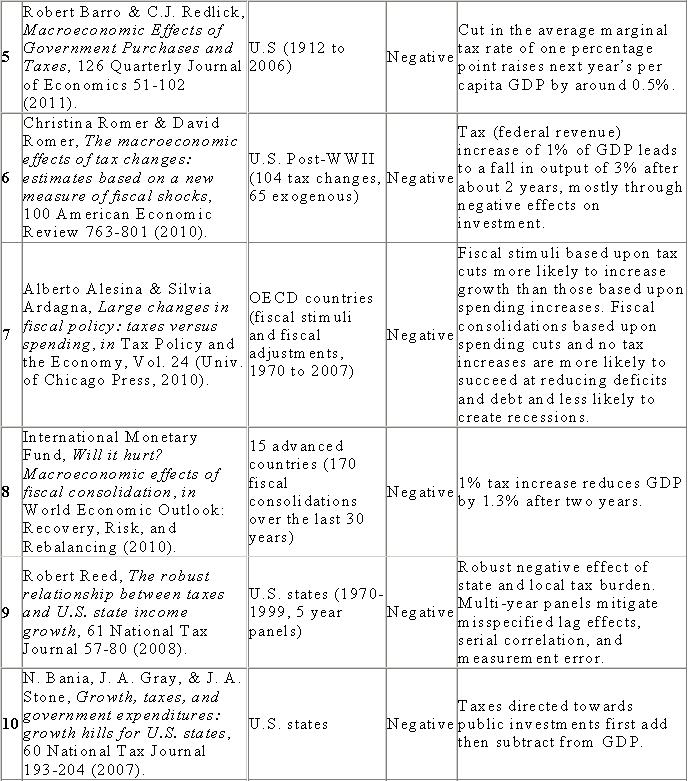
    How do you define a terrible team? No, this isn’t going to be a joke about Notre Dame foolishly thinking it could match up against a team from the Southeastern Conference in college football’s national title game (though the Irish win the contest for prettiest make-believe girlfriends). I’m asking the question because a winless record is usually a good indication of a team that doesn’t know what it’s doing and is in over its head. With that in mind, and given the White House’s position that class warfare taxation is good fiscal policy, how should we interpret a recent publication from the Tax Foundation, which reviews the academic research on taxes and growth and doesn’t find a single study supporting the notion that higher tax rates are good for prosperity. None. Zero. Nada. Zilch. Twenty-three studies found a negative relationship between taxes and growth, by contrast, while three studies didn’t find any relationship. For those keeping score at home, that’s a score of 0-23-3 for the view espoused by the Obama Administration. This new Tax Foundation report is also useful if you want more information to debunk the absurd study from the Congressional Research Service that claimed no relationship between tax policy and growth. Indeed, the TF report even explains that serious methodological flaws made “the CRS study unpublishable in any peer-reviewed academic journal.”

    So what do we find in the Tax Foundation report?

    …what does the academic literature say about the empirical relationship between taxes and economic growth? While there are a variety of methods and data sources, the results consistently point to significant negative effects of taxes on economic growth even after controlling for various other factors such as government spending, business cycle conditions, and monetary policy. In this review of the literature, I find twenty-six such studies going back to 1983, and all but three of those studies, and every study in the last fifteen years, find a negative effect of taxes on growth.

    And what does this mean?

    …results support the Neo-classical view that income and wealth must first be produced and then consumed, meaning that taxes on the factors of production, i.e., capital and labor, are particularly disruptive of wealth creation. Corporate and shareholder taxes reduce the incentive to invest and to build capital. Less investment means fewer productive workers and correspondingly lower wages. Taxes on income and wages reduce the incentive to work. Progressive income taxes, where higher income is taxed at higher rates, reduce the returns to education, since high incomes are associated with high levels of education, and so reduce the incentive to build human capital. Progressive taxation also reduces investment, risk taking, and entrepreneurial activity since a disproportionately large share of these activities is done by high income earners.

    To be blunt, the report’s findings suggest the Obama White House is clueless about tax policy.

    …there are not a lot of dissenting opinions coming from peer-reviewed academic journals. More and more, the consensus among experts is that taxes on corporate and personal income are particularly harmful to economic growth… This is because economic growth ultimately comes from production, innovation, and risk-taking.

    Here’s my cut-and-paste copy of the table summarizing all the academic research. Taxes and growthTaxes and growth 2Taxes and Growth 3Taxes and Growth 4Taxes and Growth 5 So what’s the bottom line? The Tax Foundation report concludes with the following.

    In sum, the U.S. tax system is a drag on the economy.  Pro-growth tax reform that reduces the burden of corporate and personal income taxes would generate a more robust economic recovery and put the U.S. on a higher growth trajectory, with more investment, more employment, higher wages, and a higher standard of living.

    In other words, America would be more prosperous with a simple and fair system such as the flat tax. Too bad the political elite is more focused on maintaining (or even exacerbating) a corrupt status quo, even if it means less prosperity for the nation.

  • Guns in the Capital City

    Tim Lynch

    During his news conference yesterday, President Obama said he was interested in more firearms research and warned that those who opposed his legislative agenda might try to “gin up fear.”  Those are interesting claims.  Let’s take a brief look at some recent history here in the District of Columbia.

    In 2007, when a federal appellate court ruled that DC’s strict gun control laws were unconstitutional, then-Mayor Adrian Fenty told reporters he was “outraged.”  The idea that DC residents could keep a gun in their home for self-defense, he feared, would bring more crime and violence.  Mayor Fenty and the city’s lawyers appealed the Heller case to the Supreme Court, but lost.

    It’s been several years since that landmark legal battle – so what happened?  

    In yesterday’s Wall Street Journal, a former DC prosecutor wrote:

    Since the gun ban was struck down, murders in the District have steadily gone down, from 186 in 2008 to 88 in 2012, the lowest number since the law was enacted in 1976. The decline resulted from a variety of factors, but losing the gun ban certainly did not produce the rise in murders that many might have expected. The urge to drastically restrict firearms after mass murders like those at Sandy Hook Elementary School last month and in Aurora, Colo., in July, is understandable. In effect, many people would like to apply the District’s legal philosophy on firearms to the entire nation. Based on what happened in Washington, I think that would be a mistake. Any sense of safety and security would be a false one.